Author: Admin

  • Governor Meyer Declares Statewide Drought Watch Across Delaware

    Governor Meyer Declares Statewide Drought Watch Across Delaware

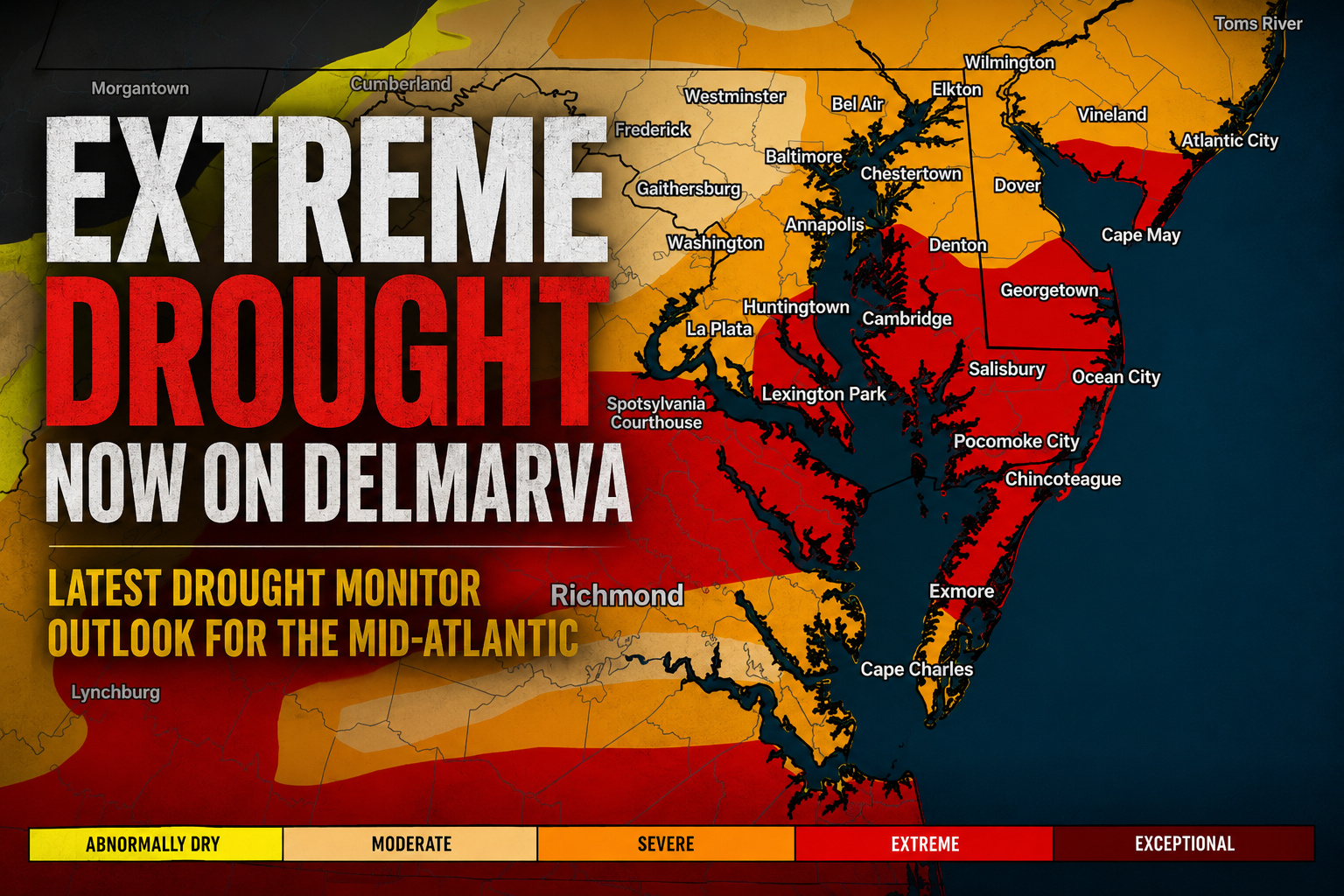
    DOVER, Del. — Governor Matt Meyer has issued a statewide drought watch for Delaware as dry conditions continue to worsen across the state following months of below-normal rainfall.

    The declaration comes after recommendations from the Delaware Water Supply Coordinating Council, which monitors drought indicators including precipitation, streamflow, groundwater levels, reservoir storage, and soil moisture. Officials say a prolonged lack of rainfall, combined with increasing water demand from vegetation during the growing season, has led to deteriorating conditions across much of Delaware.

    According to the Delaware Climate Office, the state has experienced an extended stretch of below-normal precipitation, with streamflows running well below average and groundwater levels continuing to decline. Many waterways are reporting some of their lowest levels on record for this time of year.

    The drought watch is intended to raise awareness and encourage voluntary conservation measures before conditions worsen further. Residents and businesses are being asked to reduce nonessential water use whenever possible, particularly outdoor watering activities.

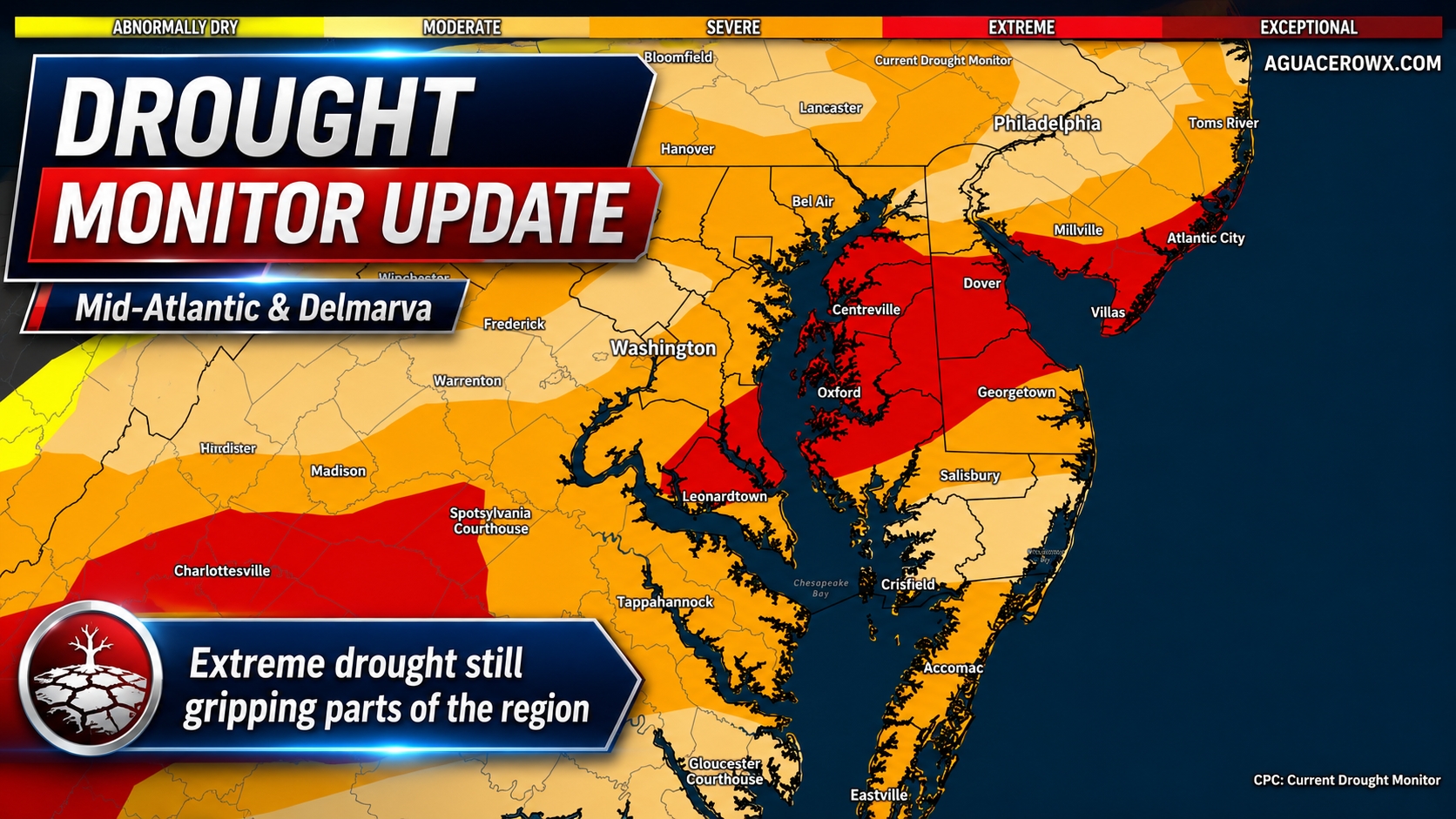
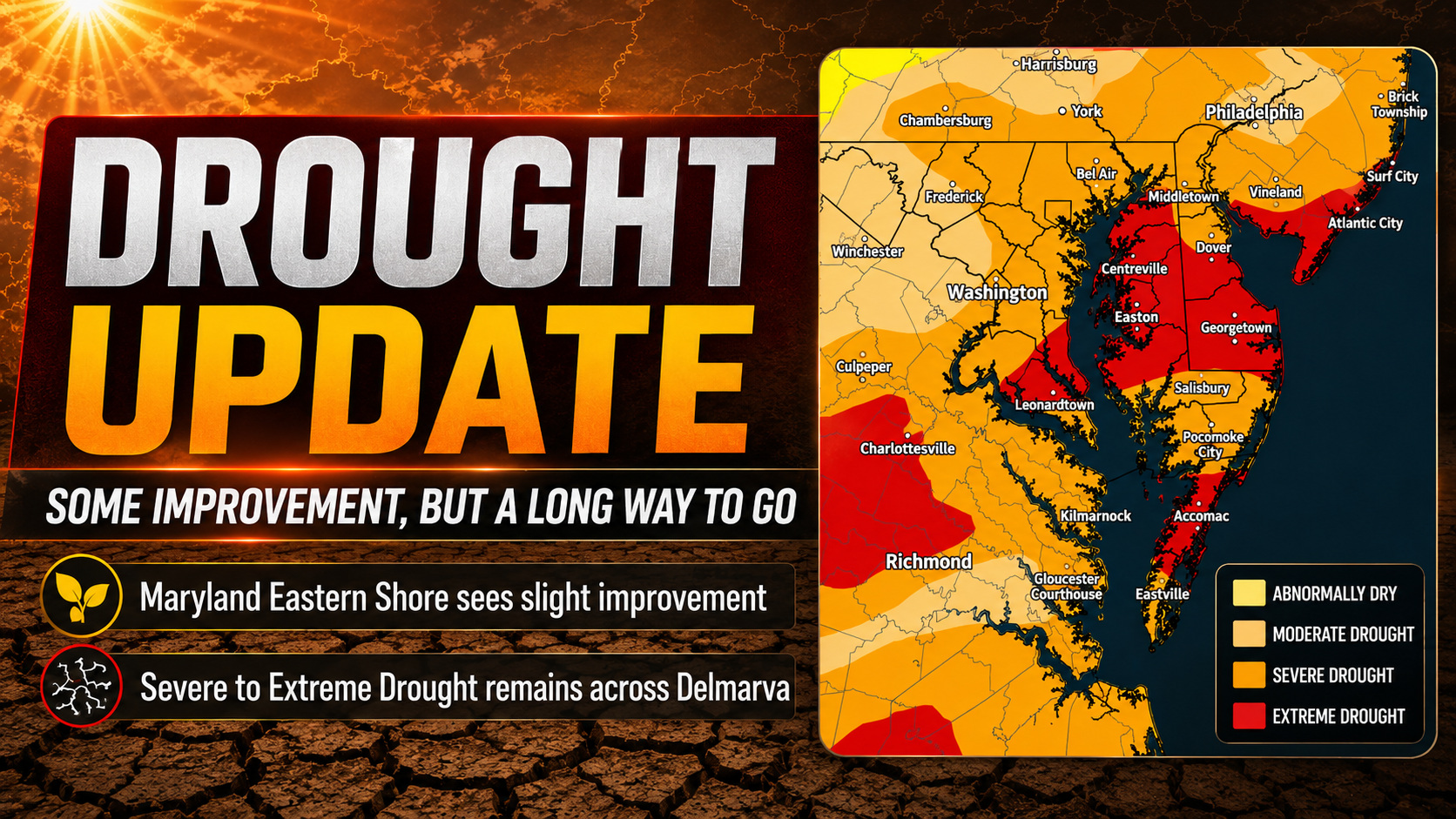
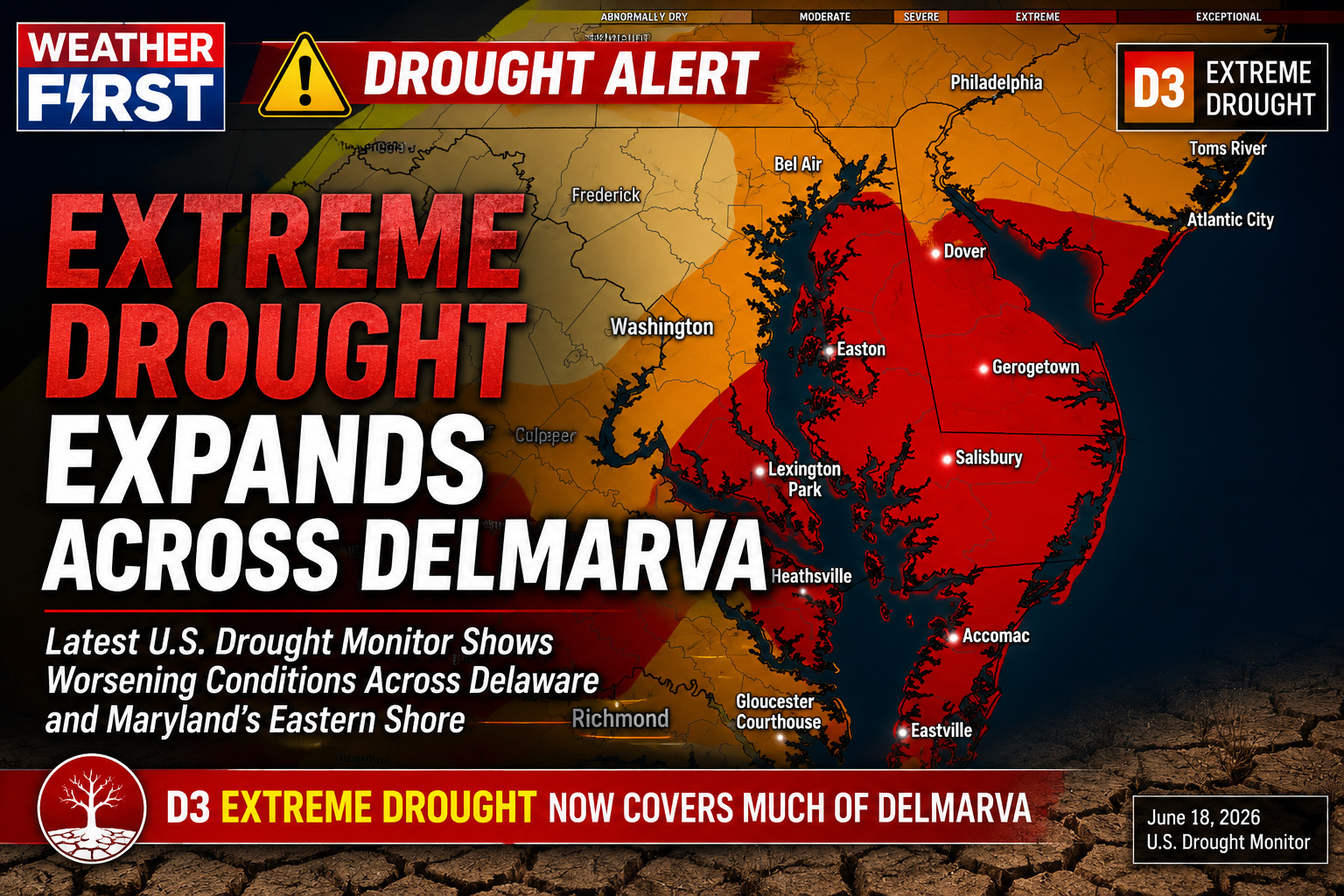
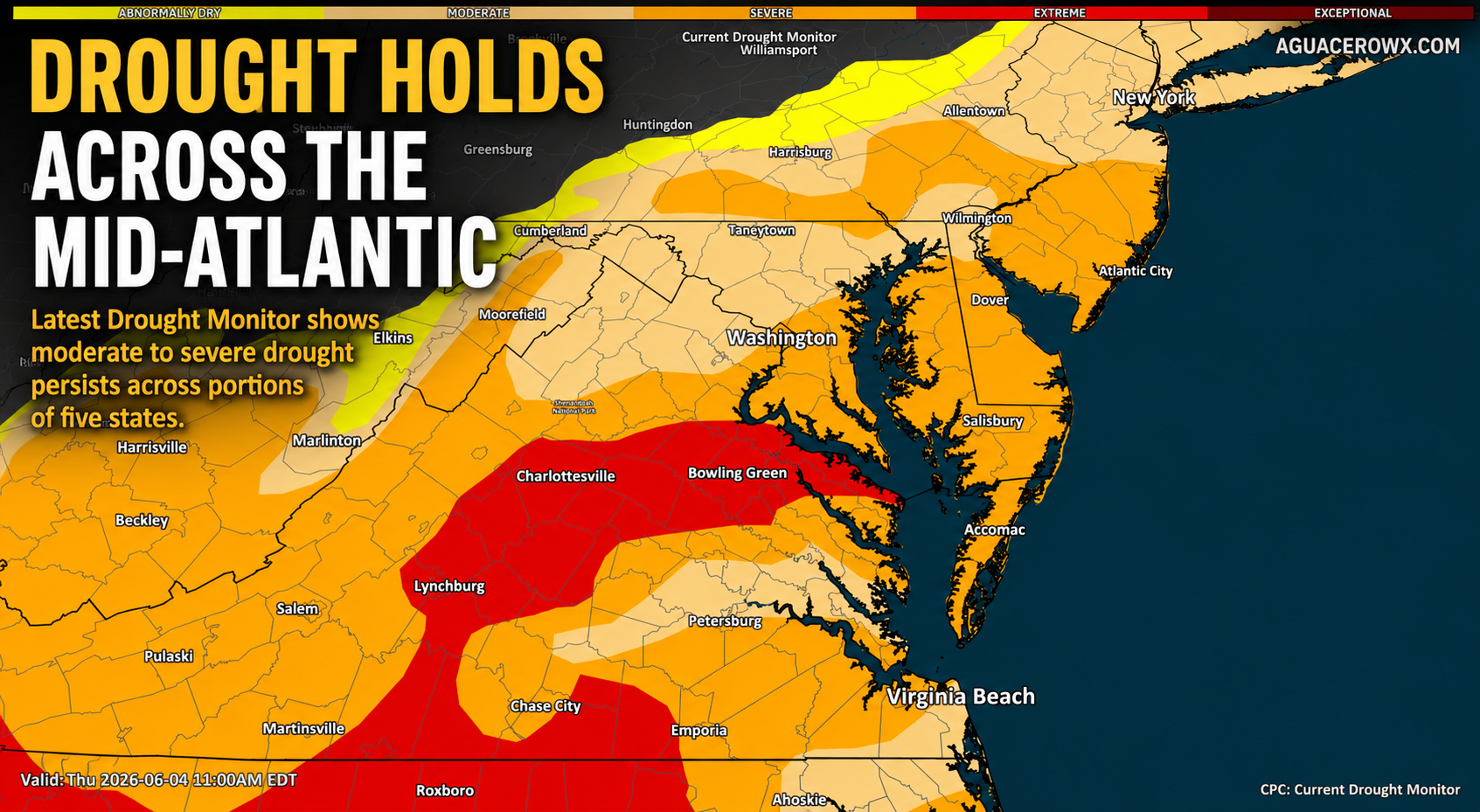
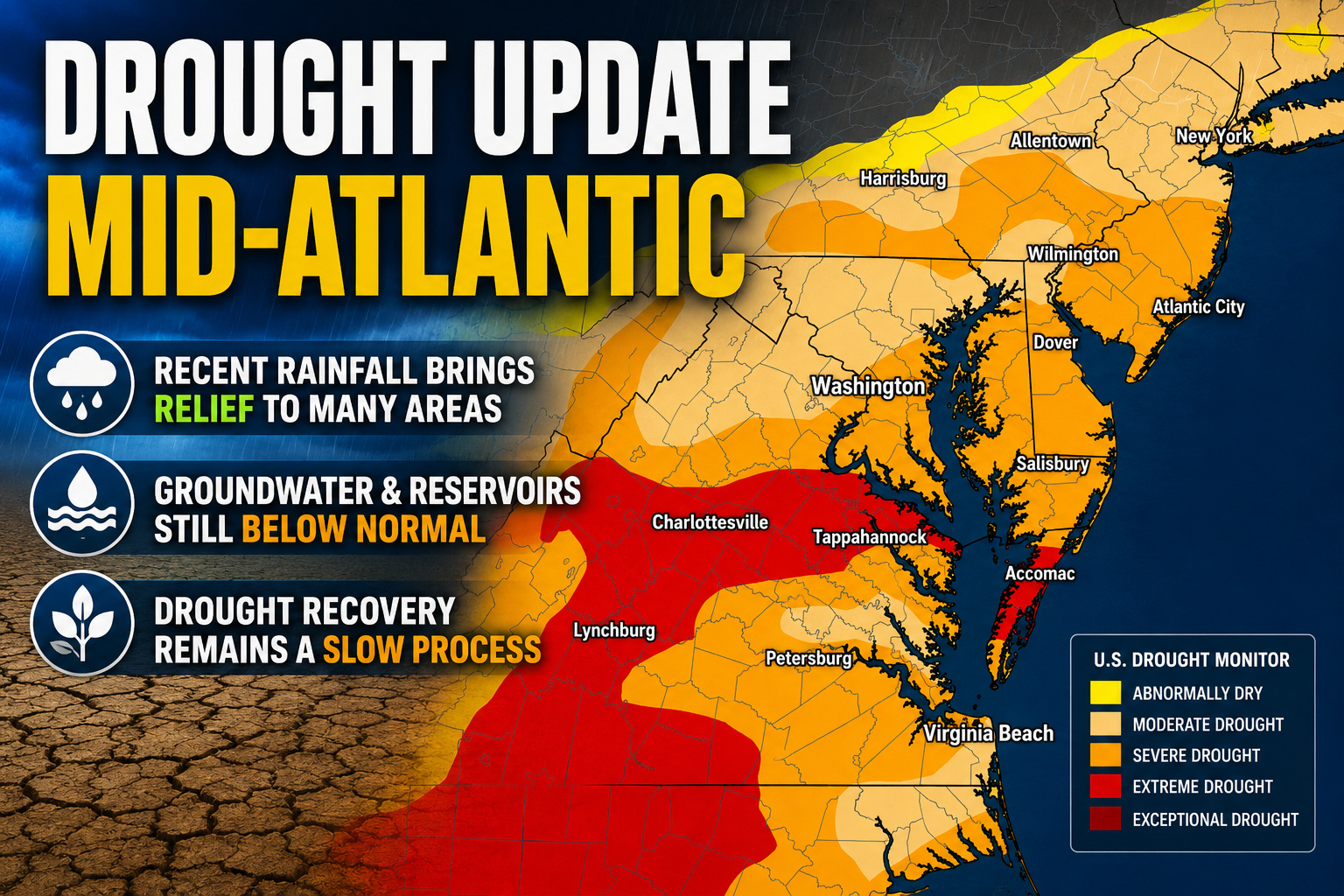
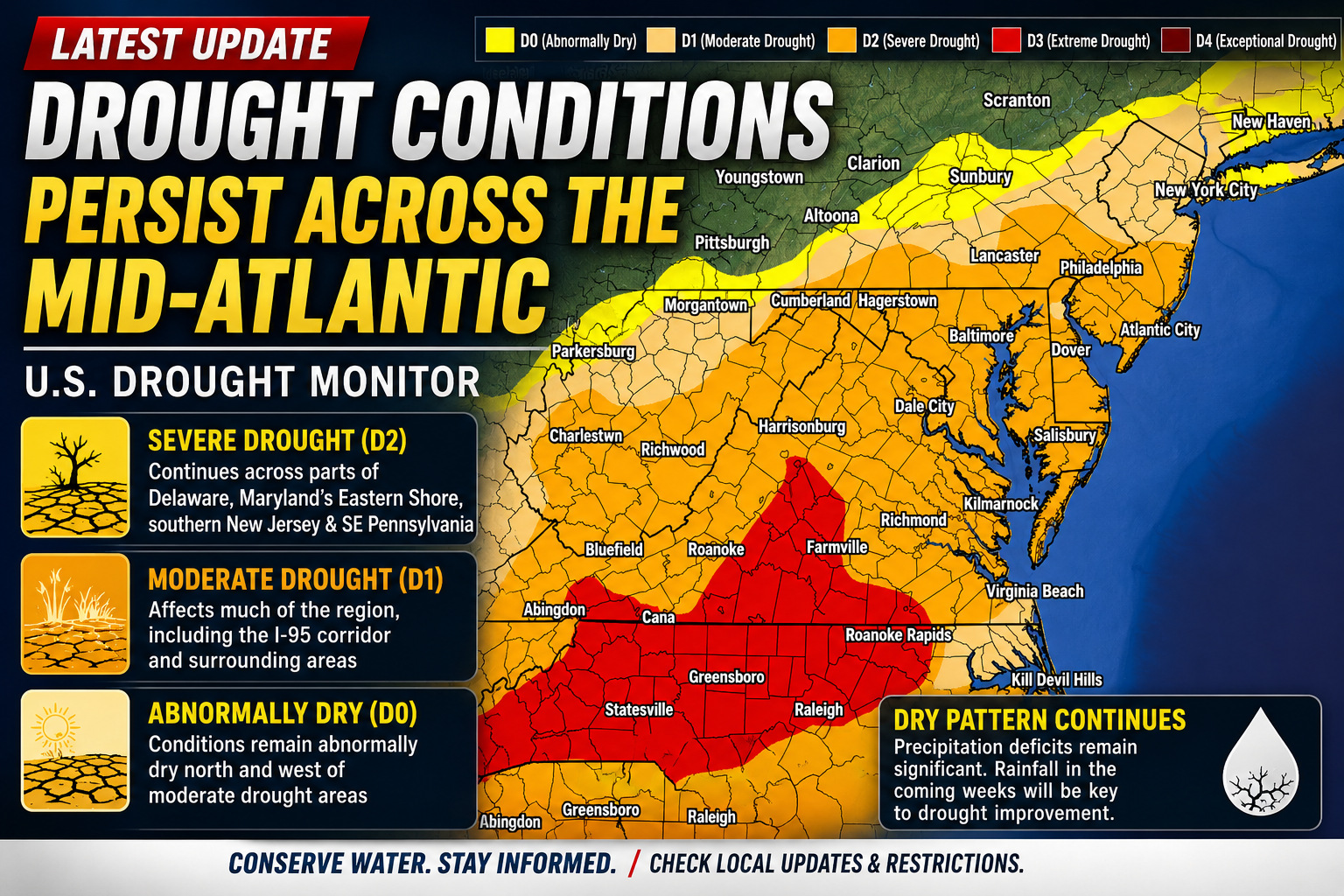
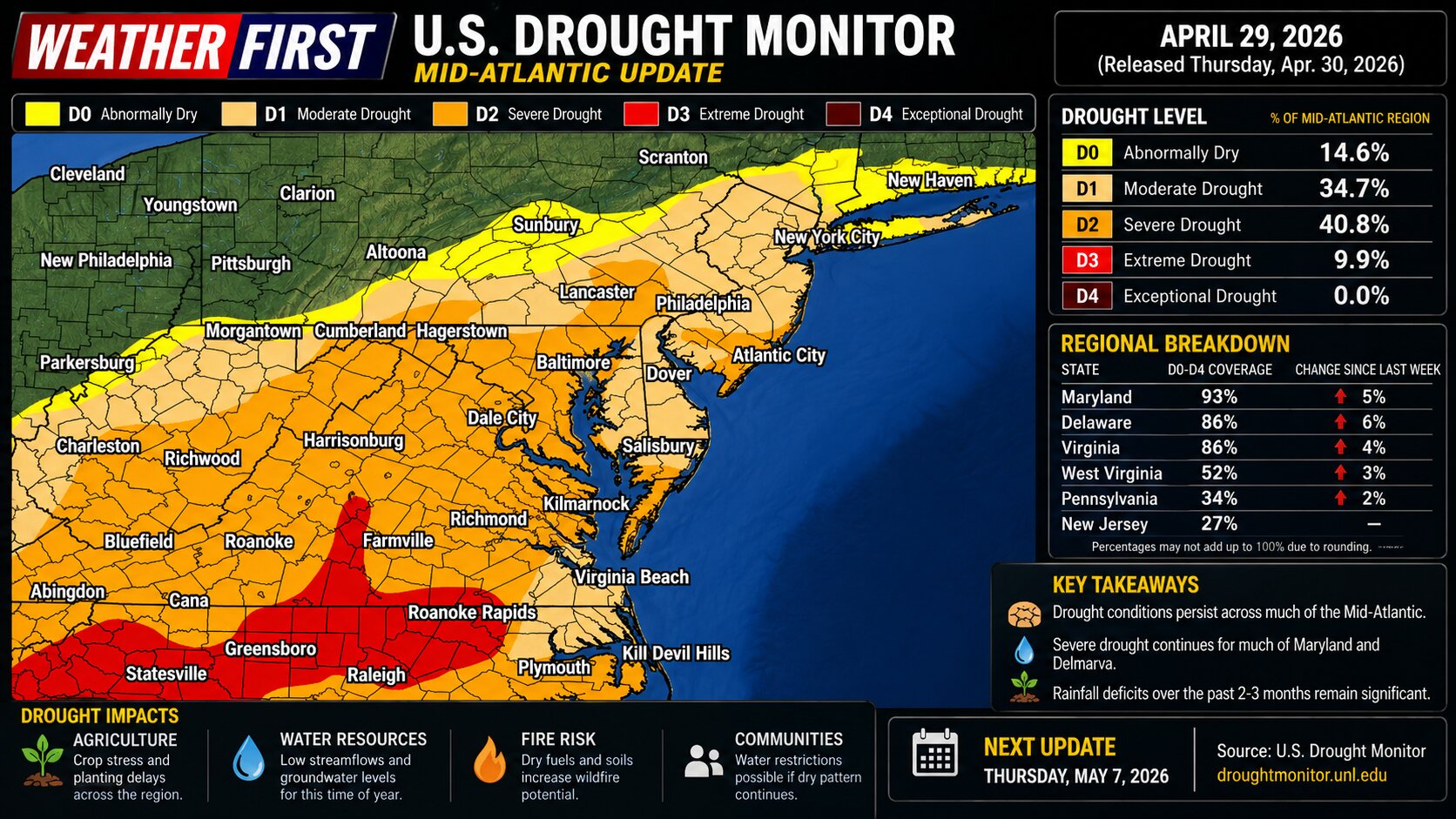
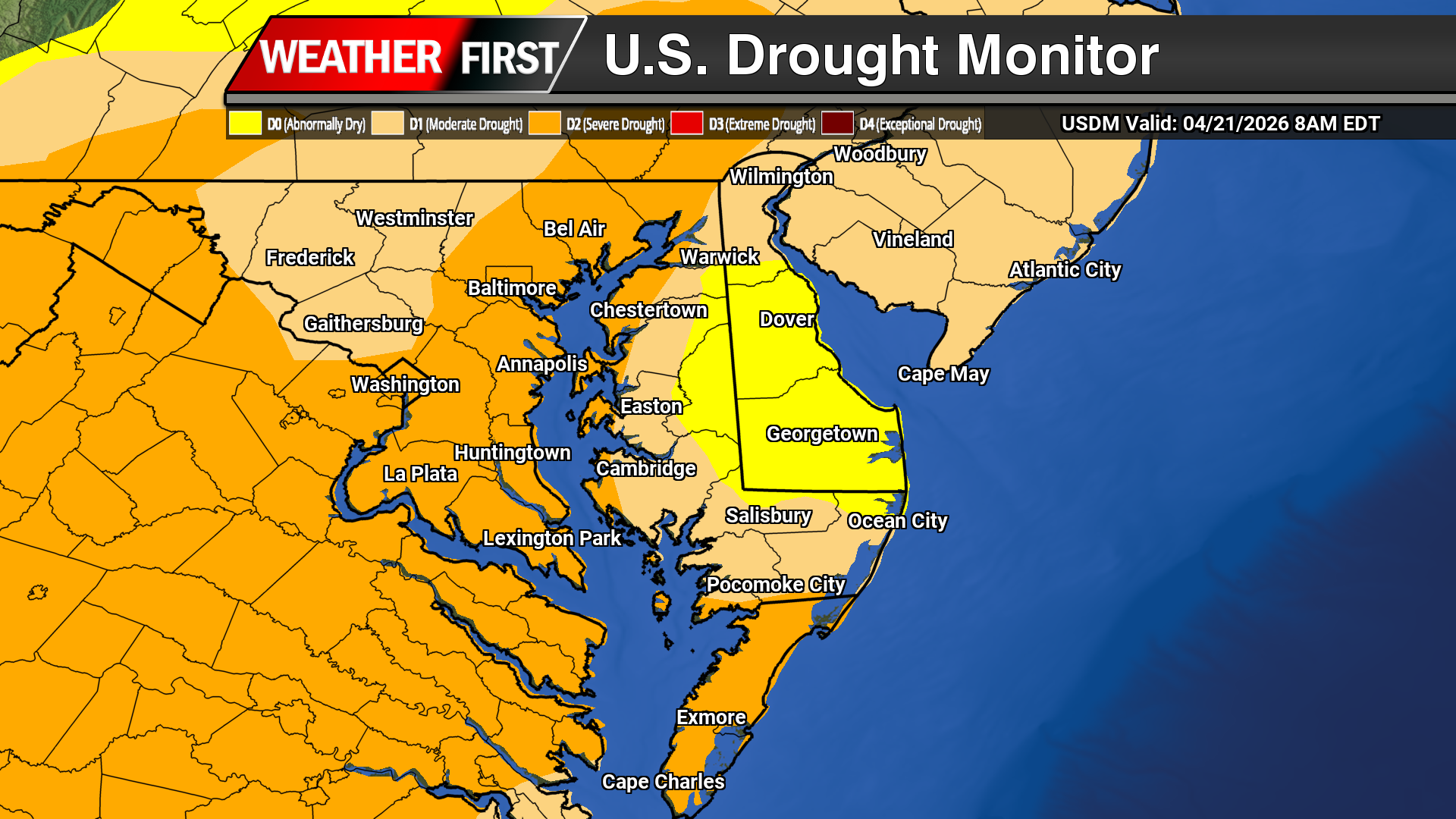
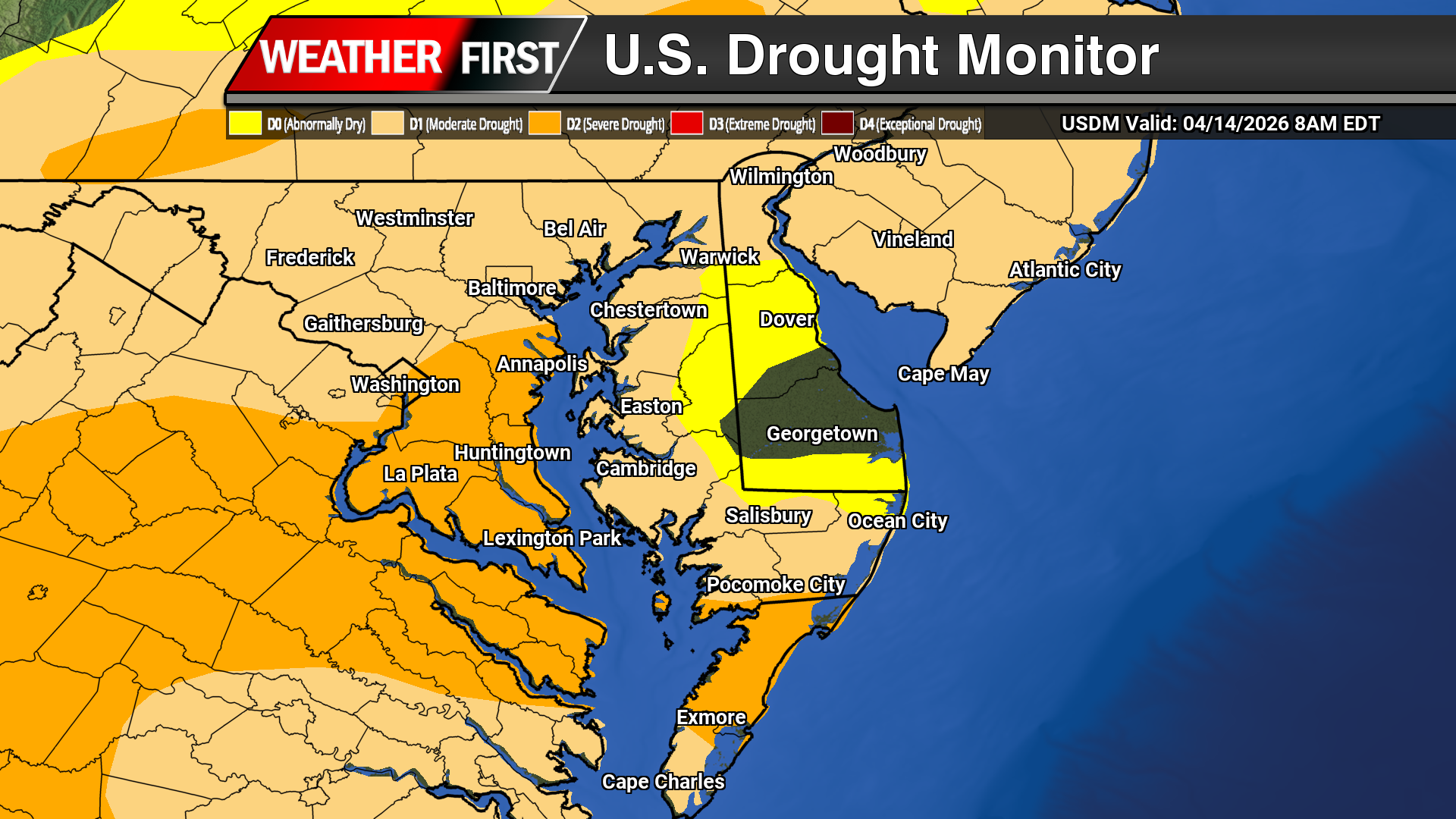
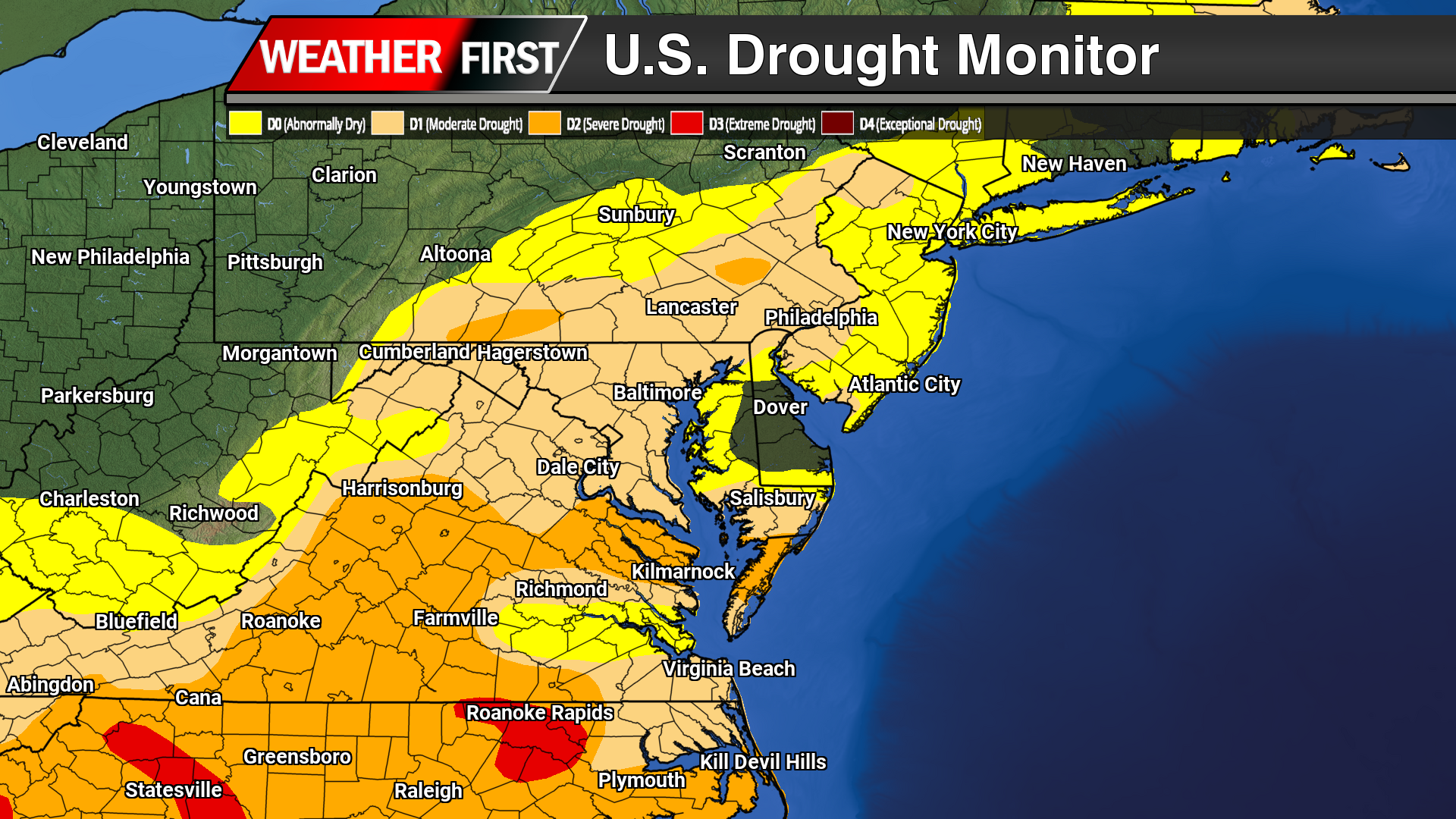
    Current drought conditions remain widespread across Delaware. The latest data indicates that all of the state is experiencing drought conditions, with much of Delaware classified in severe drought.

    State officials emphasize that a drought watch is the first stage of Delaware’s drought response plan. More serious drought warnings or emergency declarations could be considered if dry conditions persist and water supplies continue to decline.

    The declaration also comes as elevated fire danger concerns continue across the state. Dry vegetation, low humidity, and periodic gusty winds have increased the risk of brush and wildfire activity during recent weeks.

    Forecasters are not expecting significant widespread rainfall through the remainder of the week, which may allow drought conditions to continue or worsen heading further into June. Climate outlooks currently suggest limited opportunities for substantial drought improvement in the near term.

    Officials encourage residents to monitor water usage, stay informed on changing drought conditions, and practice fire safety as Delaware enters the summer season under increasingly dry conditions.

  • Could the Northern Lights Be Visible from Delmarva?

    Could the Northern Lights Be Visible from Delmarva?

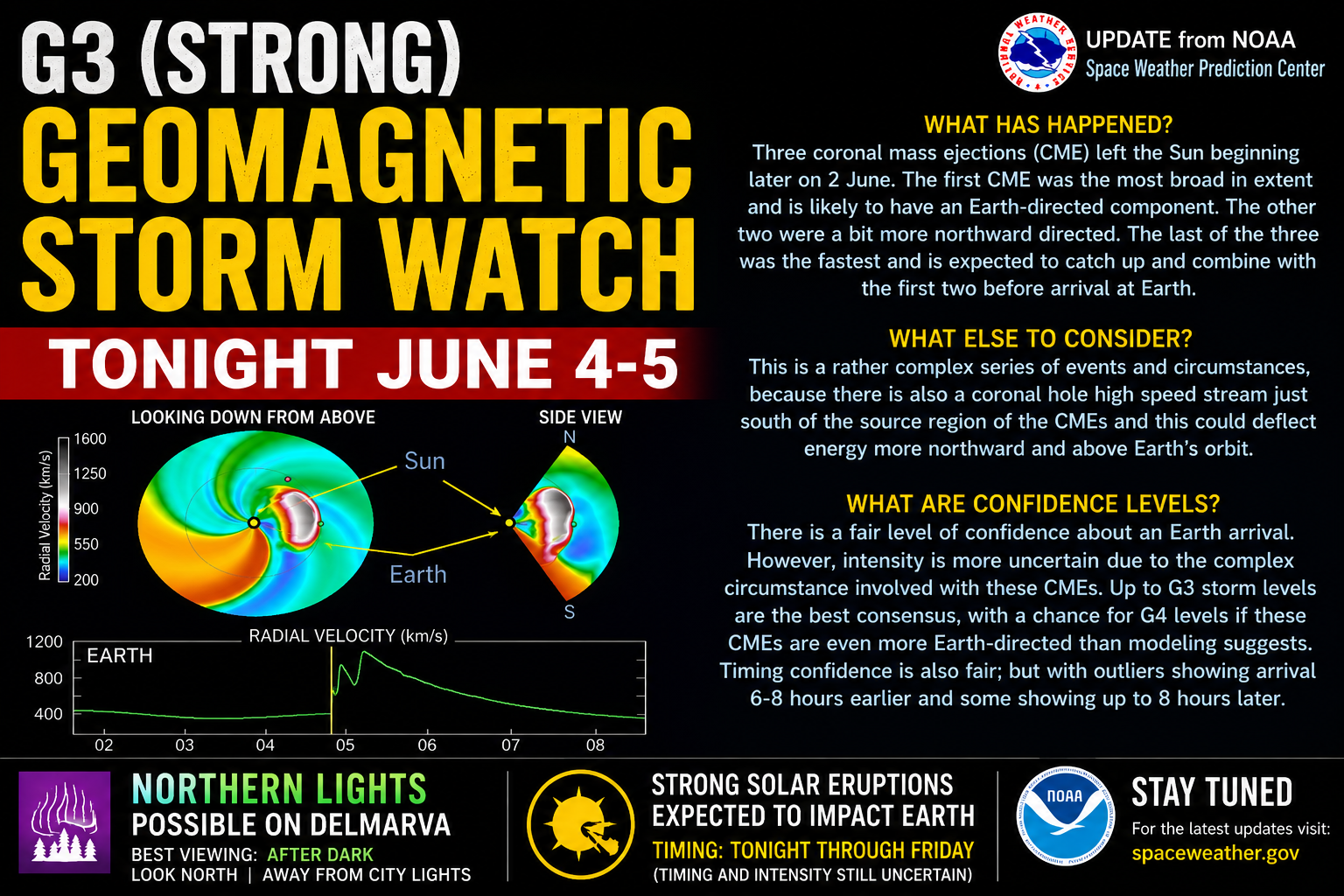
    A rare space weather event later this week could provide at least a chance for Northern Lights visibility across portions of the Mid-Atlantic, including Delmarva, as a series of powerful solar eruptions head toward Earth.

    The possibility stems from multiple coronal mass ejections (CMEs) that erupted from the Sun on June 1 and June 2. CMEs are massive clouds of charged particles and magnetic fields blasted into space during periods of heightened solar activity. When these solar storms are directed toward Earth, they can interact with our planet’s magnetic field and trigger geomagnetic storms.

    NOAA’s Space Weather Prediction Center has issued a G3 (Strong) Geomagnetic Storm Watch for June 4-5 as these CMEs are expected to arrive and potentially combine their effects. The collision between the solar particles and Earth’s magnetic field causes energy to be deposited into the upper atmosphere near the polar regions. This energy excites oxygen and nitrogen molecules, producing the colorful displays known as the aurora borealis, or Northern Lights.

    During stronger geomagnetic storms, the auroral oval expands southward away from the Arctic, allowing residents in the northern United States and occasionally the Mid-Atlantic to witness the phenomenon.

    For Delaware, Maryland’s Eastern Shore, and southern New Jersey, the odds remain lower than areas closer to the Canadian border, but they are not zero. If the incoming CMEs produce stronger geomagnetic activity than currently forecast, or if the storm briefly reaches G4 levels, a faint auroral glow could become visible low on the northern horizon.

    Unlike the vibrant curtains often seen in Alaska or Canada, Delmarva observers would most likely see a subtle red, pink, or purple glow near the horizon. In some cases, smartphone cameras can reveal auroral colors and structure that are difficult to see with the naked eye.

    Sky conditions will also play a major role. Fortunately, high pressure is expected to dominate the weather pattern across the Mid-Atlantic through the end of the week, bringing mostly clear skies and providing favorable viewing conditions should the aurora become visible.

  • Dry Weather Continues Across Delmarva as Temperatures Climb Toward 90 Degrees

    Dry Weather Continues Across Delmarva as Temperatures Climb Toward 90 Degrees

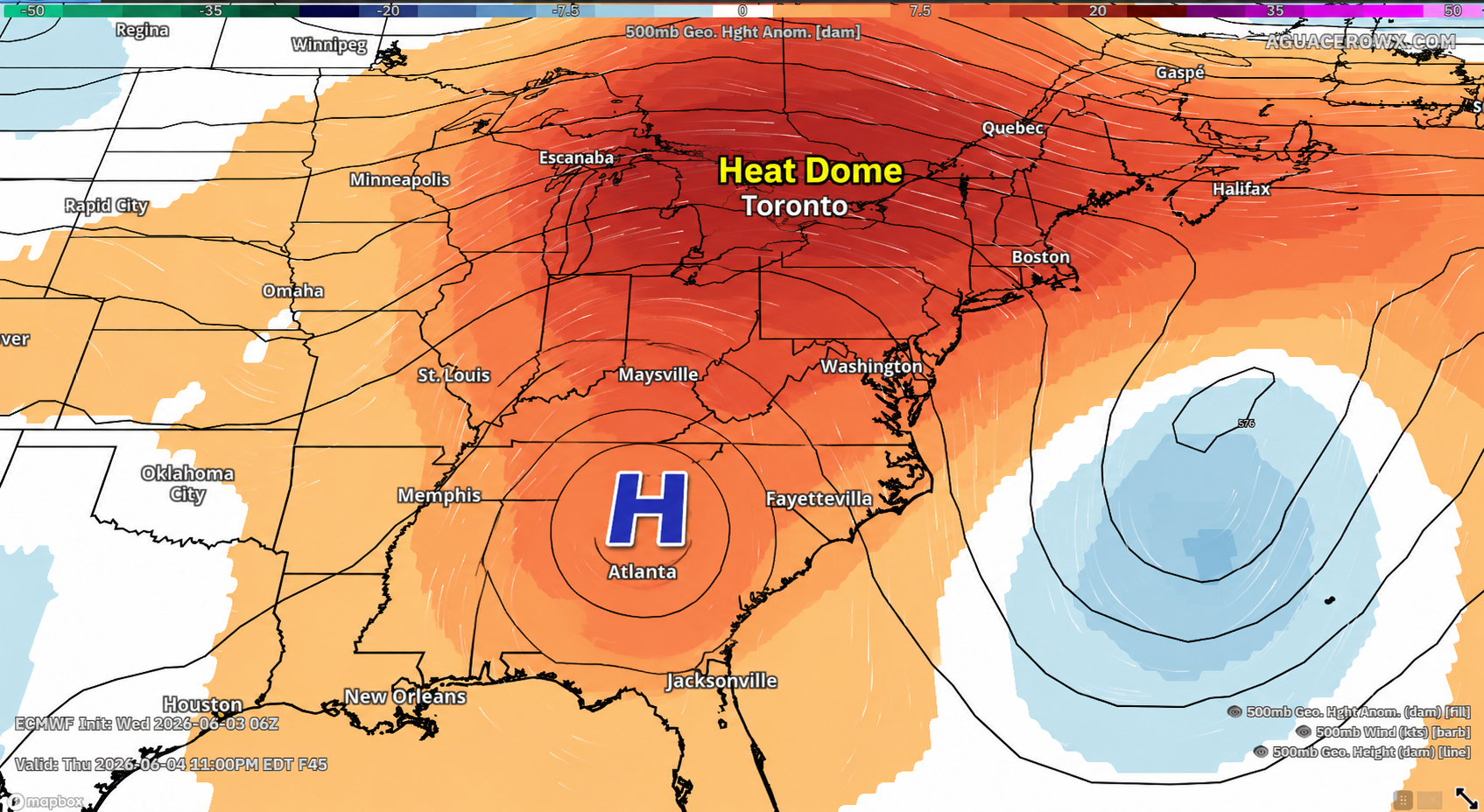
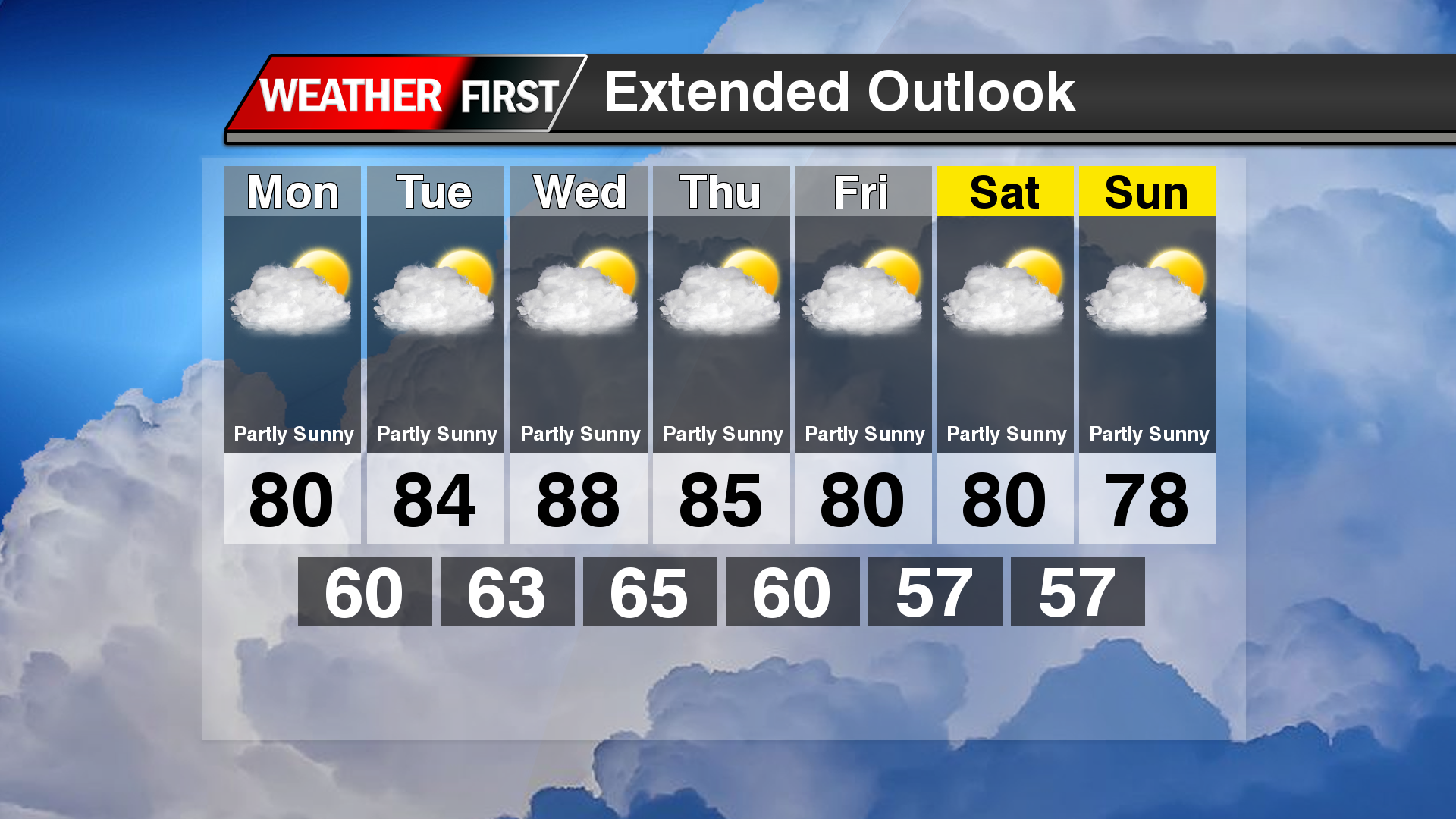
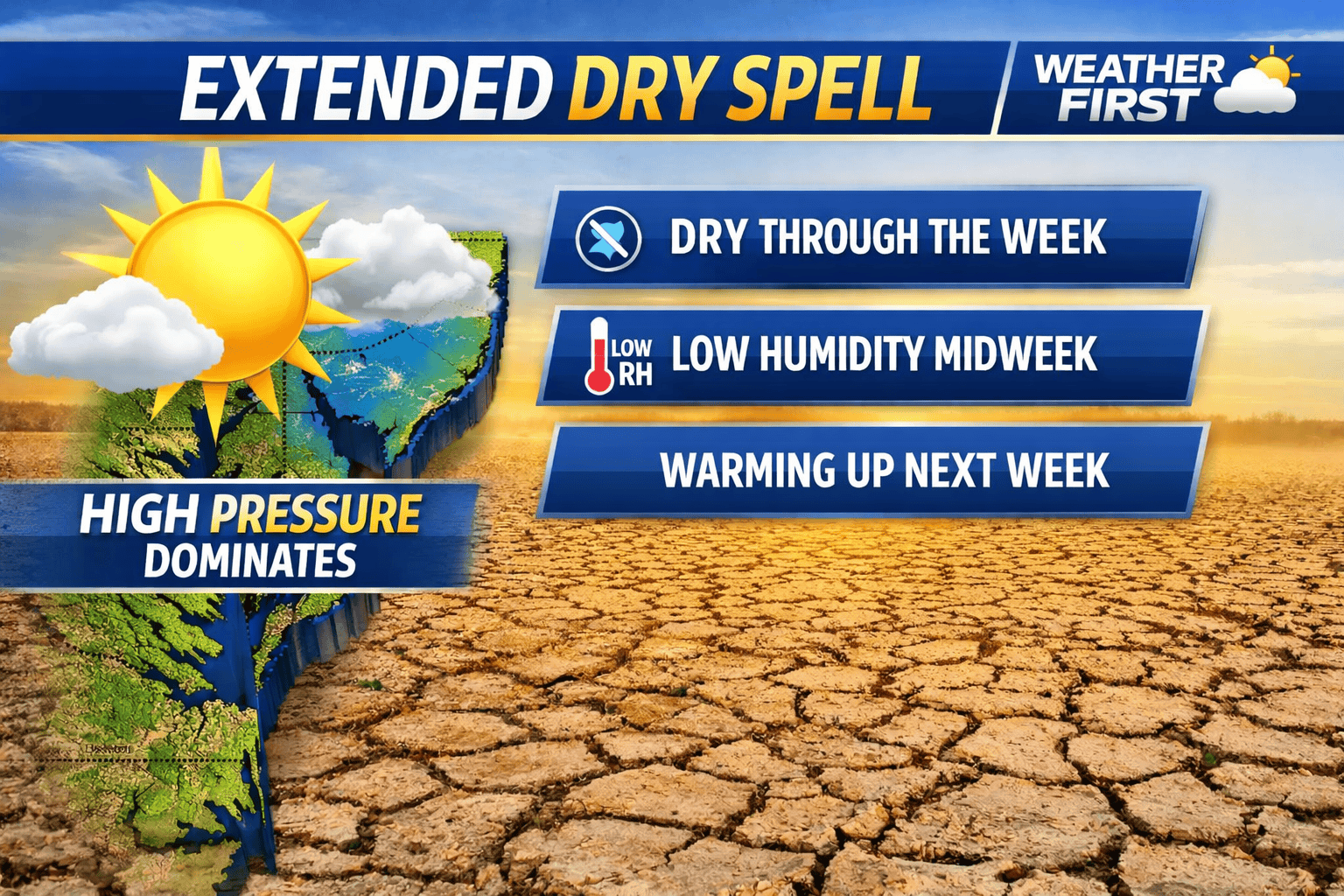
    High pressure will remain firmly in control across the Mid-Atlantic through the end of the week, bringing several days of dry weather, abundant sunshine, and a gradual warming trend to the Delmarva Peninsula.

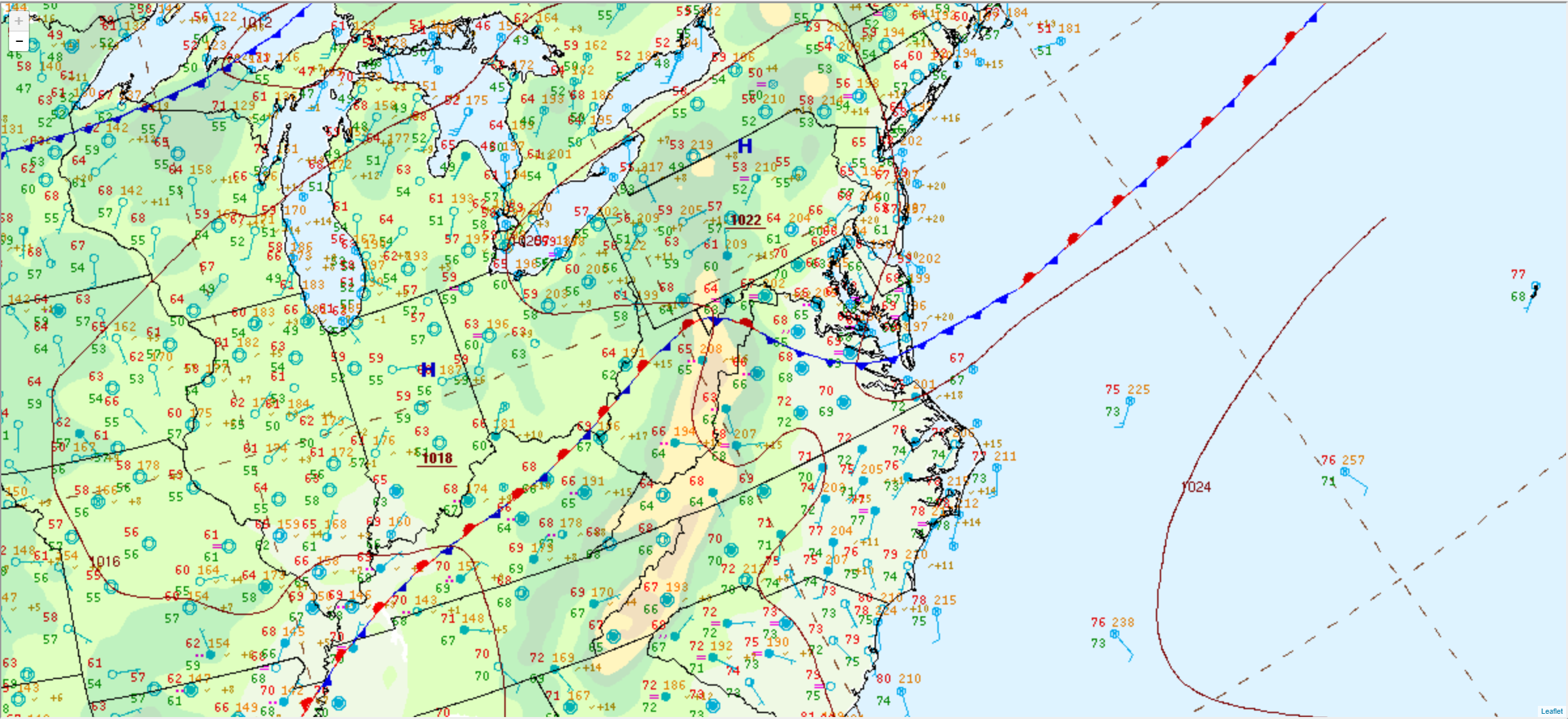
    After a stretch of comfortable early June weather, temperatures are expected to steadily rise over the coming days as a large area of high pressure builds eastward from the Great Lakes and settles across the Appalachian region. While a developing area of low pressure off the Mid-Atlantic coastline will move northeastward offshore tonight, forecasters expect it to remain far enough away to have little impact on the region.

    For Thursday, mostly sunny skies will dominate across Delaware, Maryland’s Eastern Shore, and southern New Jersey. Afternoon temperatures will climb into the lower and middle 80s across inland areas, including Georgetown, Salisbury, and Dover. Communities along the Atlantic coast and Delaware Bay will remain noticeably cooler, generally in the lower 70s, thanks to the influence of chilly ocean waters and developing sea breezes.

    As winds shift onshore during the afternoon, some coastal locations may see temperatures drop several degrees compared to inland communities.

    Tonight will feature mostly clear skies and mild conditions, with overnight lows falling into the 50s across much of the region.

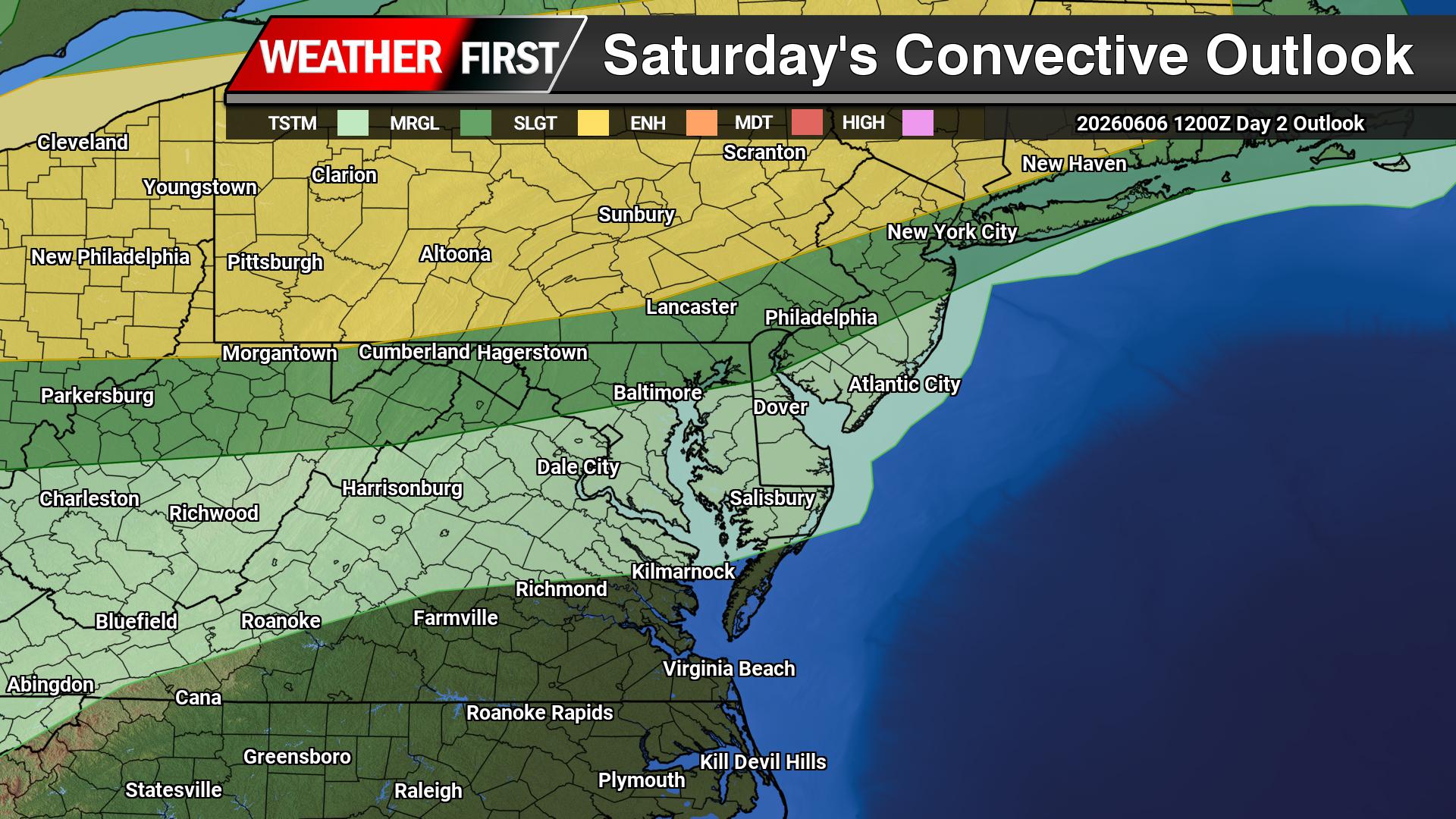
    Looking ahead, the dry pattern shows little sign of changing through Friday and much of Saturday. High pressure is expected to keep storm systems at bay while maintaining plenty of sunshine and low humidity levels. The only exception may be across portions of the Pocono Mountains Saturday afternoon and evening, where a slight chance of an isolated shower or thunderstorm exists.

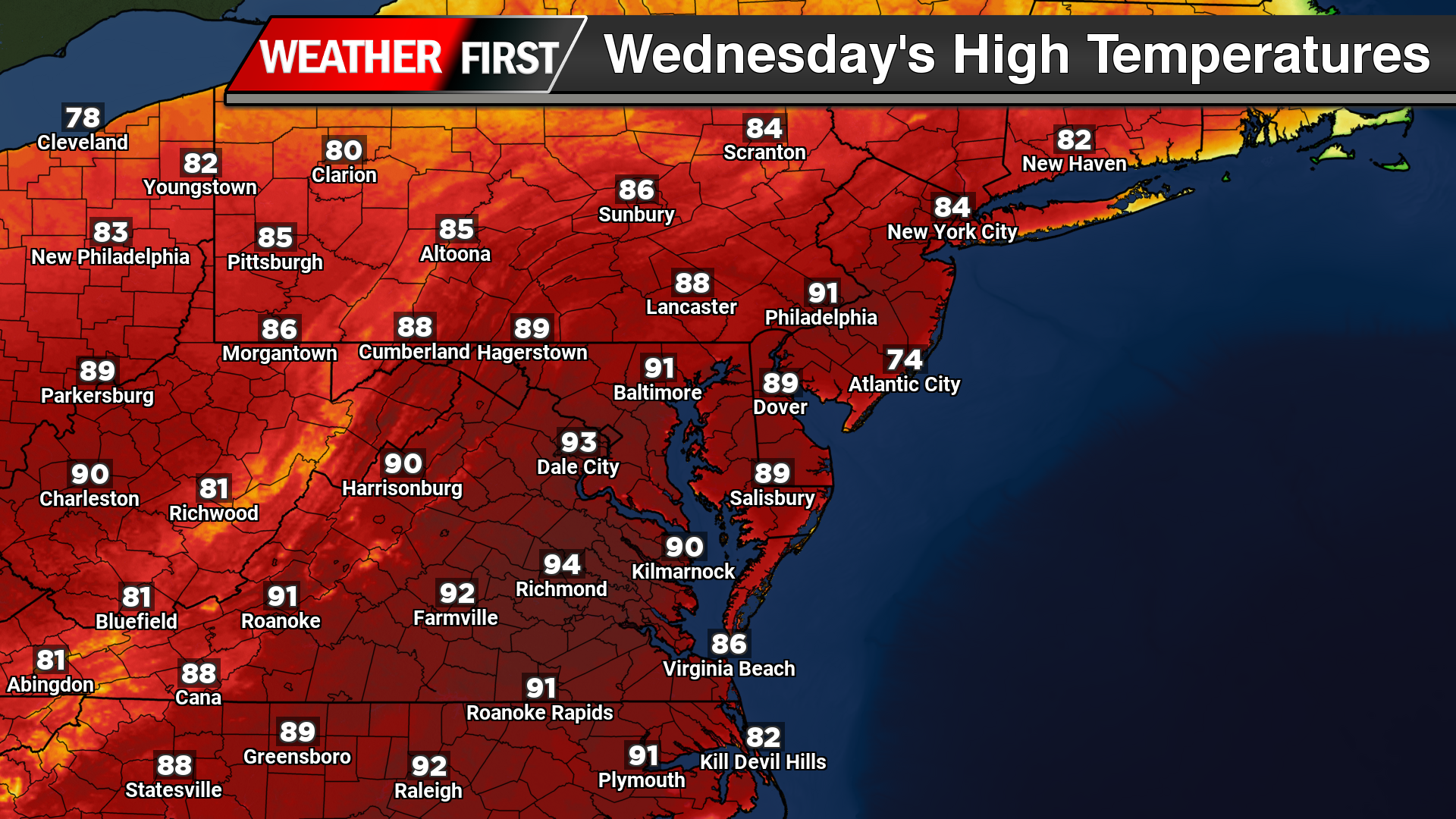
    The biggest weather story heading into the weekend will be the increasing heat. Temperatures are forecast to climb close to 90 degrees on Friday before reaching the upper 80s to lower 90s across much of inland Delmarva on Saturday. Coastal communities will once again remain cooler, with highs generally staying in the 80s due to persistent onshore flow.

    The extended stretch of dry weather will provide excellent conditions for outdoor activities, beach trips, and early summer events, though residents should be prepared for increasingly warm afternoons as the weekend approaches.

  • Offshore Storm to Stay Away from Delmarva as Heat Builds Late Week

    Offshore Storm to Stay Away from Delmarva as Heat Builds Late Week

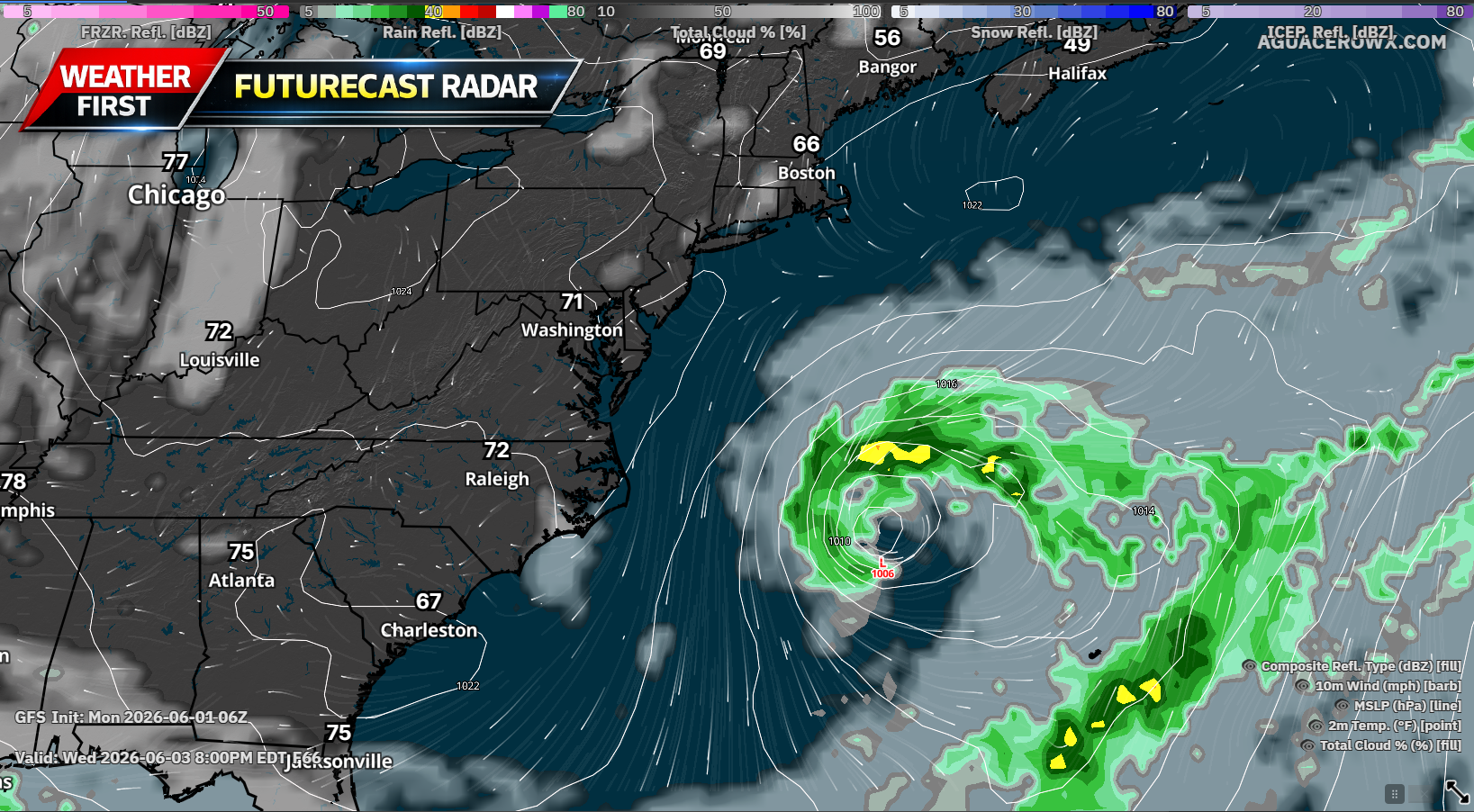
    We are keeping a close eye on a developing area of low pressure expected to form off the East Coast during the middle of the week. While the system bears watching, current indications suggest it will remain far enough offshore to spare the Delmarva Peninsula from any significant impacts.

    An upper-level trough currently moving through the Northeast is expected to become more amplified over the next several days. As this occurs, we expect the base of the trough to close off into an upper-level low pressure system somewhere near the North Carolina coast or farther northeast over the Atlantic Ocean.

    As the upper-level low develops, a corresponding surface low pressure system is expected to form offshore. However, forecast guidance continues to indicate that the storm will remain well east of the Mid-Atlantic coastline.

    A large area of high pressure centered over the Great Lakes and Northeast is expected to act as a blocking mechanism, preventing the storm from moving closer to land. Because of this, confidence is increasing that dry weather will continue across Delaware, Maryland’s Eastern Shore, and much of the surrounding region through the end of the workweek.

    While rainfall is not expected, the offshore storm could still have a minor influence on local weather. If the low pressure system tracks slightly closer to the coast than currently forecast, northeasterly winds could develop, leading to somewhat cooler temperatures, particularly near the Atlantic beaches and Delaware Bay shoreline.

    Despite that possibility, the overall forecast remains favorable with seasonable conditions expected through midweek.

    Temperatures are forecast to gradually warm during the second half of the week as high pressure shifts southeastward. Afternoon highs should climb into the 80s by Thursday before potentially reaching the lower 90s across parts of Delmarva on Friday and Saturday.

    The warming trend will be driven by a much warmer air mass moving into the Northeast, bringing summerlike conditions back to the region after several days of more comfortable temperatures.

    Looking ahead to the weekend, there are some early indications that precipitation chances may begin to increase. However, forecast confidence remains low regarding the timing and coverage of any showers or thunderstorms.

    For now, residents can expect several more days of dry weather, plenty of sunshine, and a gradual return to hotter temperatures heading into the first weekend of June.

  • Back Door Cold Front Brings Cooler Air and Spotty Showers to Delmarva

    Back Door Cold Front Brings Cooler Air and Spotty Showers to Delmarva

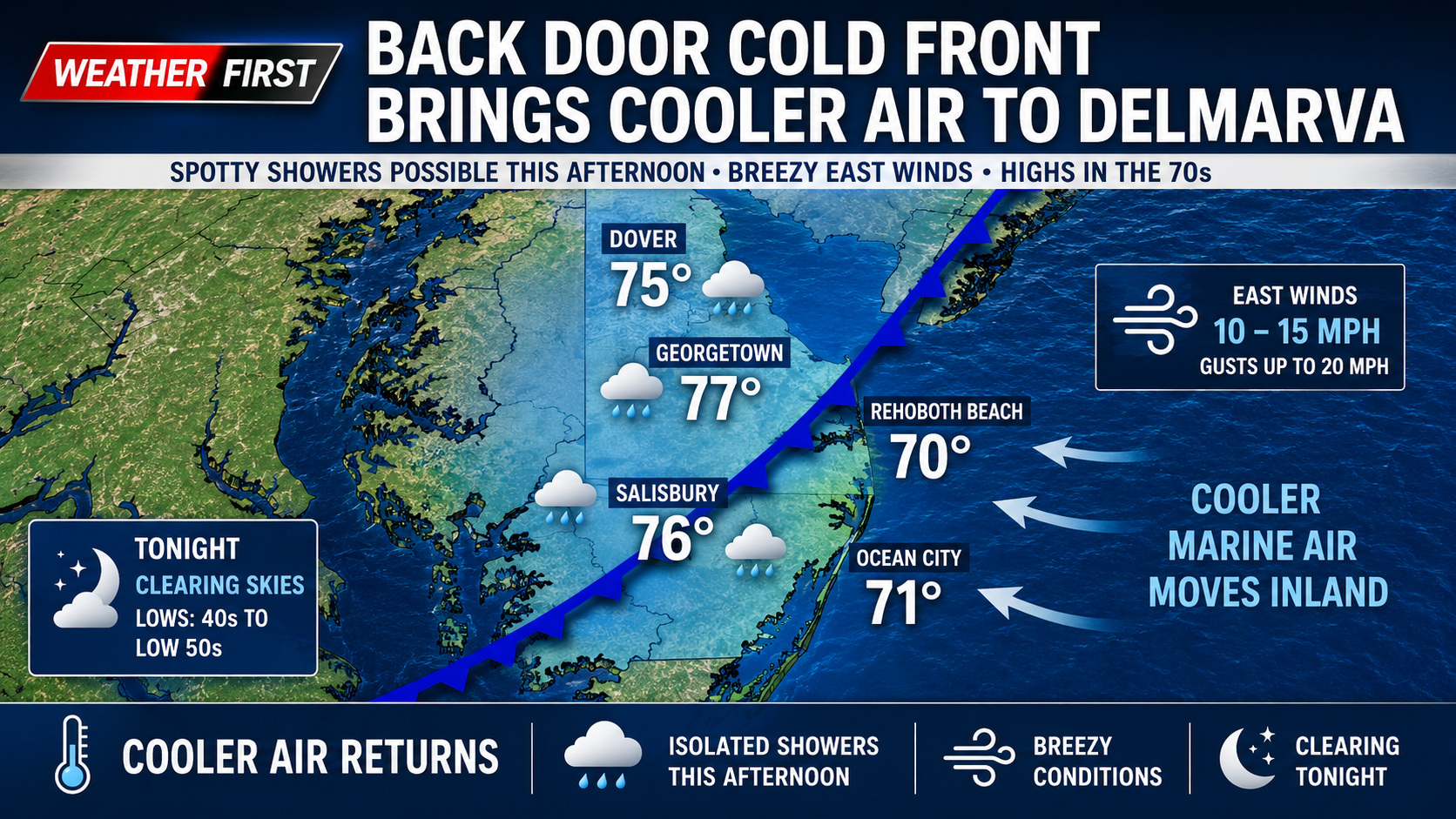
    A pair of weak cold fronts will move through the Delmarva Peninsula today, bringing a shift in winds, slightly cooler temperatures, and the possibility of a few isolated showers.

    The first cold front moved through the region during the early morning hours as a weak area of low pressure tracked across the Mid-Atlantic. While no rainfall accompanied the front, residents may notice changing wind directions throughout the day. Winds that began from the south overnight will gradually shift to the southwest, northwest, and eventually north as the front exits the area.

    Attention then turns to a second feature known as a back door cold front, which will slide southward through Delmarva this afternoon. Unlike a traditional cold front that approaches from the west, a back door front moves in from the northeast, allowing cooler marine air from the Atlantic Ocean to spread inland.

    The combination of increasing onshore flow and a weak disturbance in the middle levels of the atmosphere could be enough to trigger a few isolated light showers across portions of Delaware, Maryland’s Eastern Shore, and southern New Jersey. However, rainfall amounts are expected to remain minimal, with many locations receiving only a trace of precipitation. Any areas that do see measurable rain will likely receive no more than a few hundredths of an inch.

    East winds will increase to around 10 to 15 mph during the afternoon, with occasional gusts reaching 20 mph. Temperatures will remain seasonable for early June, with afternoon highs reaching the middle to upper 70s across much of Delmarva. Communities along the Delaware and Maryland beaches will remain cooler due to the onshore flow.

    Conditions improve tonight as skies gradually clear behind the departing front. The cooler air mass will allow temperatures to fall into the 40s and lower 50s by daybreak Tuesday, providing a crisp and comfortable night across the region.

    While today’s weather will not be a washout, residents may encounter a brief passing shower this afternoon before drier and pleasant conditions return tonight.

  • Widespread Rainfall Brings Drought Relief Across Parts of the Mid-Atlantic

    Widespread Rainfall Brings Drought Relief Across Parts of the Mid-Atlantic

    After months of growing drought concerns across portions of the Mid-Atlantic and Northeast, this week’s U.S. Drought Monitor update shows meaningful improvement in several areas following widespread soaking rainfall and cooler temperatures.

    A highly active weather pattern during the past week delivered multiple rounds of heavy rain from the southern Plains through the Mid-Atlantic states. Across parts of Maryland, West Virginia, and southern Pennsylvania, many communities received between 2 to 4 inches of rainfall, with isolated areas picking up even higher totals.

    The beneficial rainfall came as a strong cold front pushed through the eastern United States, ending an early season heat wave and replacing it with a much cooler and unsettled weather pattern. The combination of steady stratiform rain and convective downpours helped improve soil moisture conditions and increase streamflows across much of the region.

    As a result, the latest drought monitor introduced widespread drought reductions across portions of the Mid-Atlantic. Areas of Maryland, West Virginia, and southern Pennsylvania saw notable improvements, especially in locations where rainfall totals exceeded 3 inches during the week.

    Despite the recent improvement, experts caution that long term drought impacts have not fully disappeared. Groundwater supplies and reservoir levels remain below normal in some locations after months of persistent dryness. While short term drought indicators such as soil moisture and recent precipitation trends have improved significantly, longer term indicators continue to show lingering deficits.

    Because of this, drought classifications across parts of Pennsylvania and Maryland were adjusted from both short and long term drought to primarily long term drought concerns. This reflects improving near surface conditions while acknowledging that deeper hydrological impacts remain in place.

    Further north across New England, modest improvements were observed in portions of Maine and Vermont due to improving groundwater conditions. However, drier weather in southeastern New England led to some worsening conditions across parts of Rhode Island and eastern Massachusetts.

    Across the broader eastern United States, the same storm system also brought widespread drought relief to portions of the Southeast. Heavy rainfall totals ranging from 2 to 6 inches fell across parts of Mississippi, Alabama, Georgia, and the Florida Panhandle, leading to additional drought reductions in those regions as well.

    Looking ahead, forecasters expect a quieter weather pattern to settle over the Mid-Atlantic heading into early June. While additional scattered rainfall opportunities may develop next week, no major widespread flooding or drought busting rainfall events are currently anticipated.

    Even with recent improvements, drought recovery is often a slow process. Hydrologists and agricultural experts will continue monitoring groundwater recharge, reservoir recovery, and longer term precipitation trends throughout the summer season.

  • Quiet Weather Pattern Settles Over Delmarva Into Early June

    Quiet Weather Pattern Settles Over Delmarva Into Early June

    After several rounds of unsettled weather across the Mid-Atlantic in recent weeks, a much calmer and more comfortable stretch of weather is now expected across Delmarva heading into the start of meteorological summer.

    A cold front moving through the region early Thursday morning is bringing a few lingering showers to portions of southern Delaware and South Jersey. Those showers are expected to quickly move offshore around daybreak as drier air pushes into the region from the northwest.

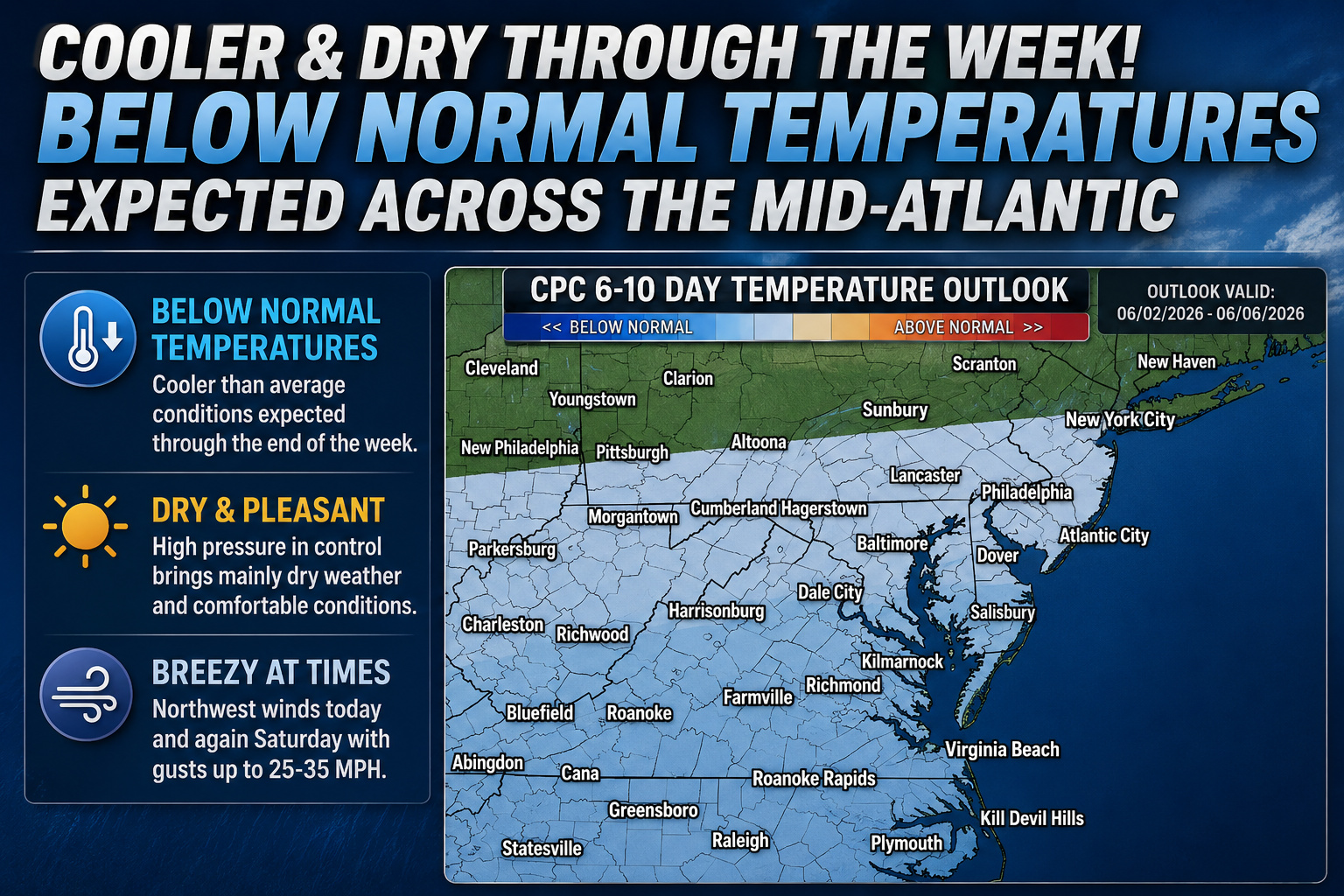
    Behind the front, high pressure will build into the Mid-Atlantic and dominate the weather pattern through much of the upcoming week. The result will be several days of tranquil conditions featuring comfortable humidity levels, cooler overnight temperatures, and seasonable daytime highs mainly in the middle to upper 70s.

    While the overall pattern remains quiet, breezy northwest winds are expected at times. Wind gusts Thursday afternoon could reach 20 to 30 mph, especially closer to the coastline and open areas. Another dry cold front is forecast to move through Friday night, which may bring another round of gusty winds for Saturday with gusts potentially reaching 25 to 35 mph. Despite the breezy conditions, no widespread rainfall or severe weather is expected with the frontal passage.

    We are also monitoring the development of a large scale “Omega Block” weather pattern across the central United States. This pattern tends to slow down weather systems and promote more stable conditions. Delmarva will remain on the eastern side of this blocking pattern, helping keep temperatures slightly below normal through the weekend while also limiting any major storm development.

    Looking ahead into next week, forecast confidence becomes lower as a disturbance may attempt to cut off near the East Coast. This could eventually introduce a more unsettled pattern with increased cloud cover or scattered showers at times. However, current indications suggest the risk for any hazardous or impactful weather remains very low.

  • Strong Thunderstorms Possible Across the Mid Atlantic This Afternoon

    Strong Thunderstorms Possible Across the Mid Atlantic This Afternoon

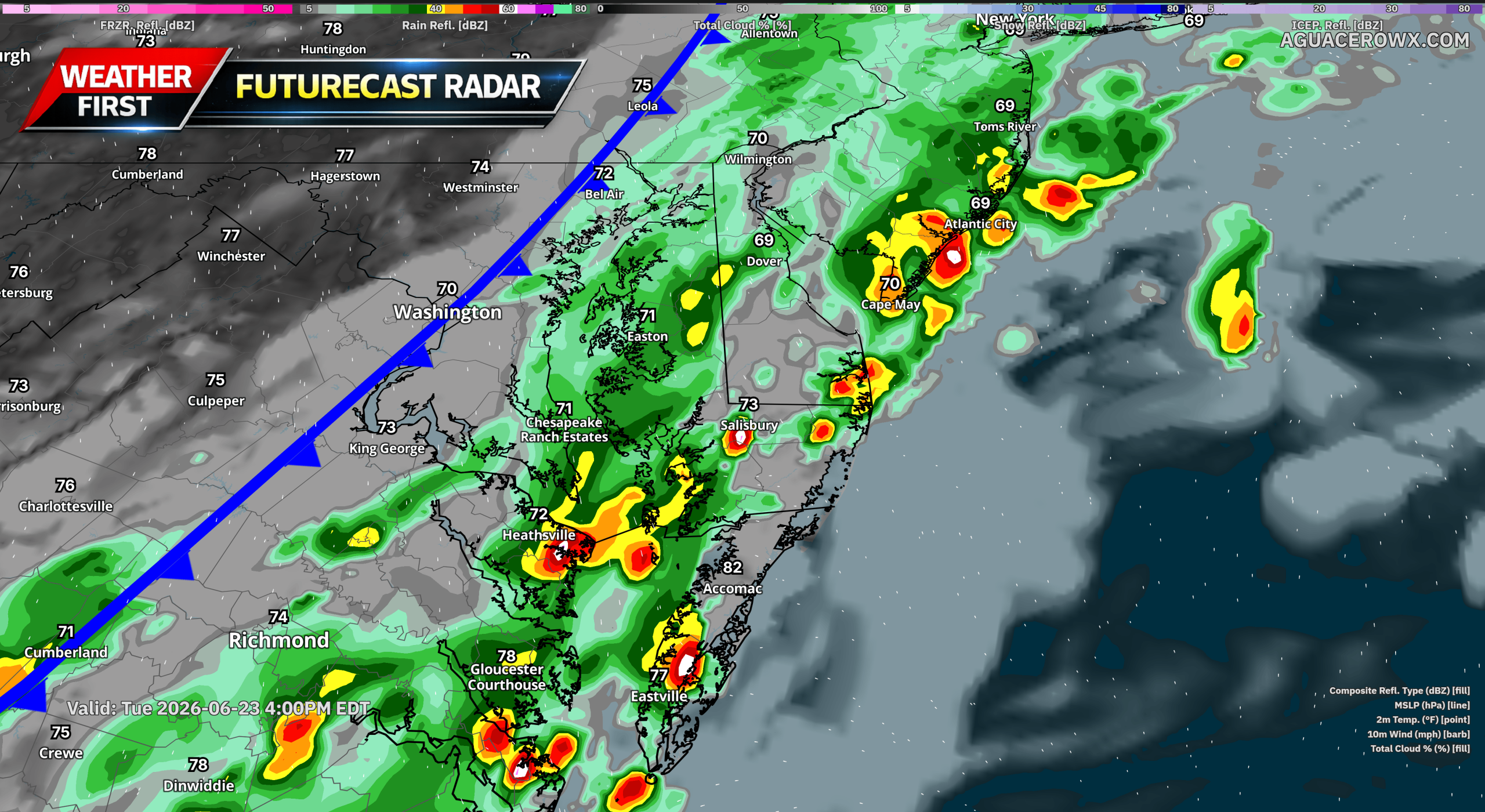
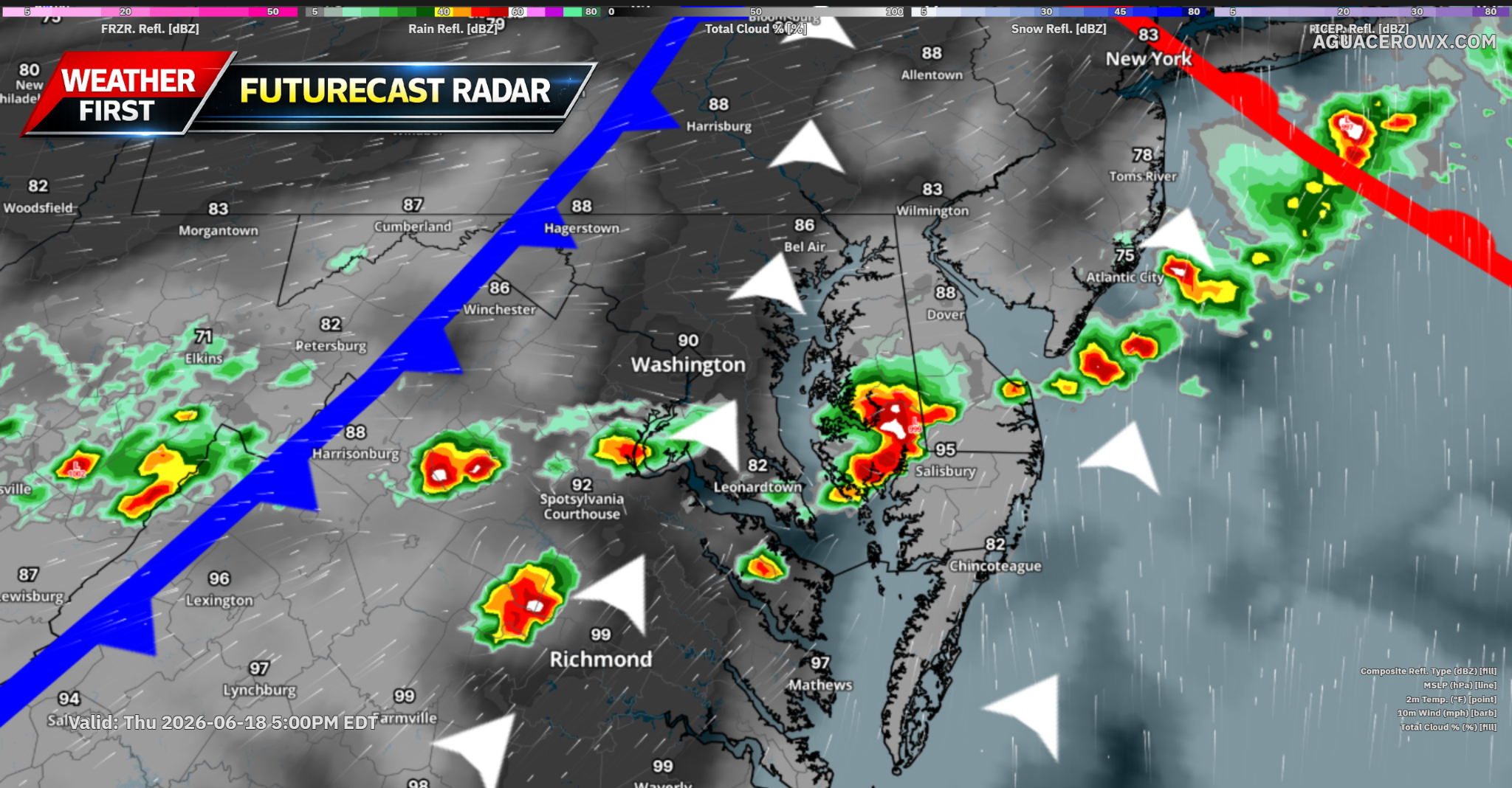
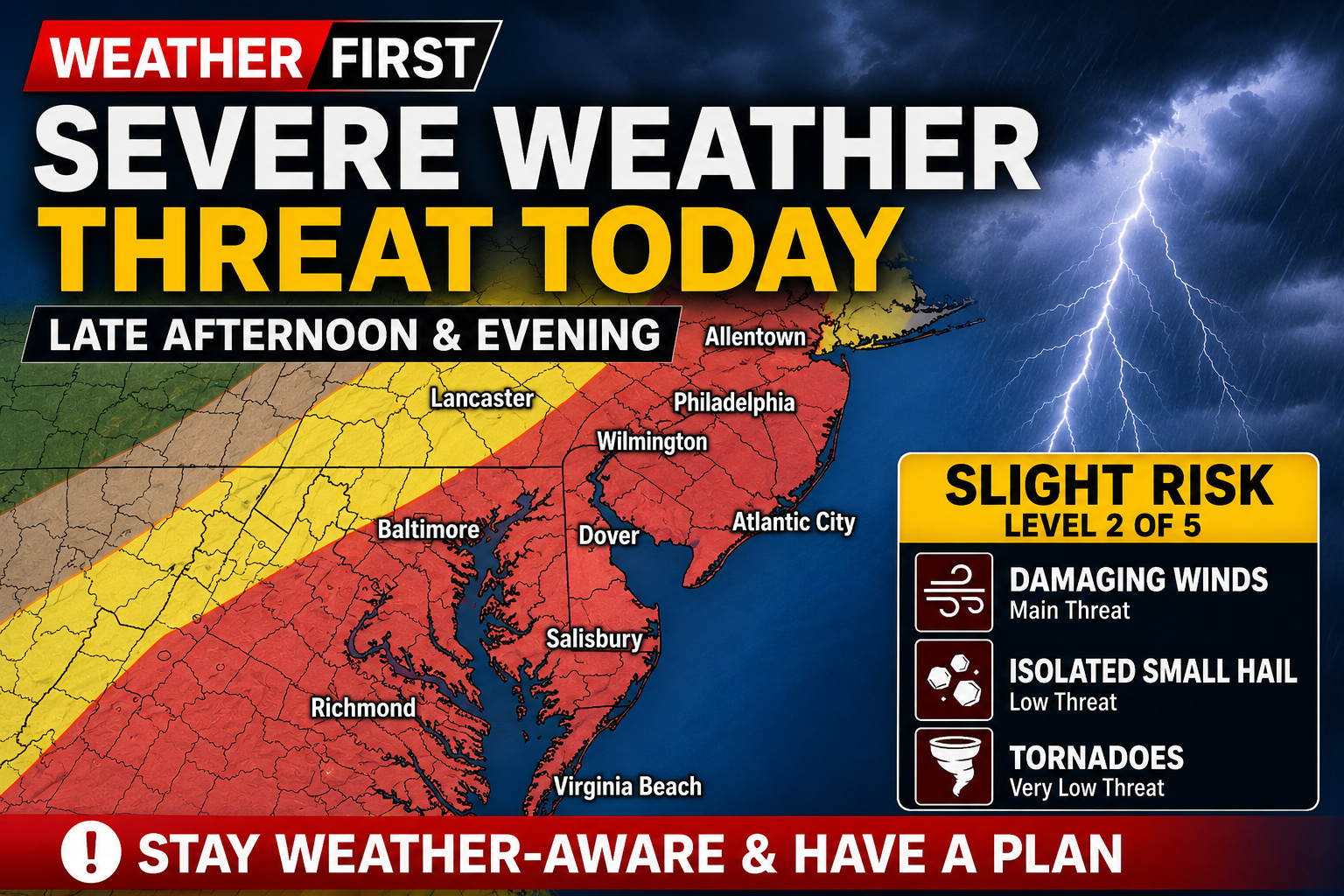
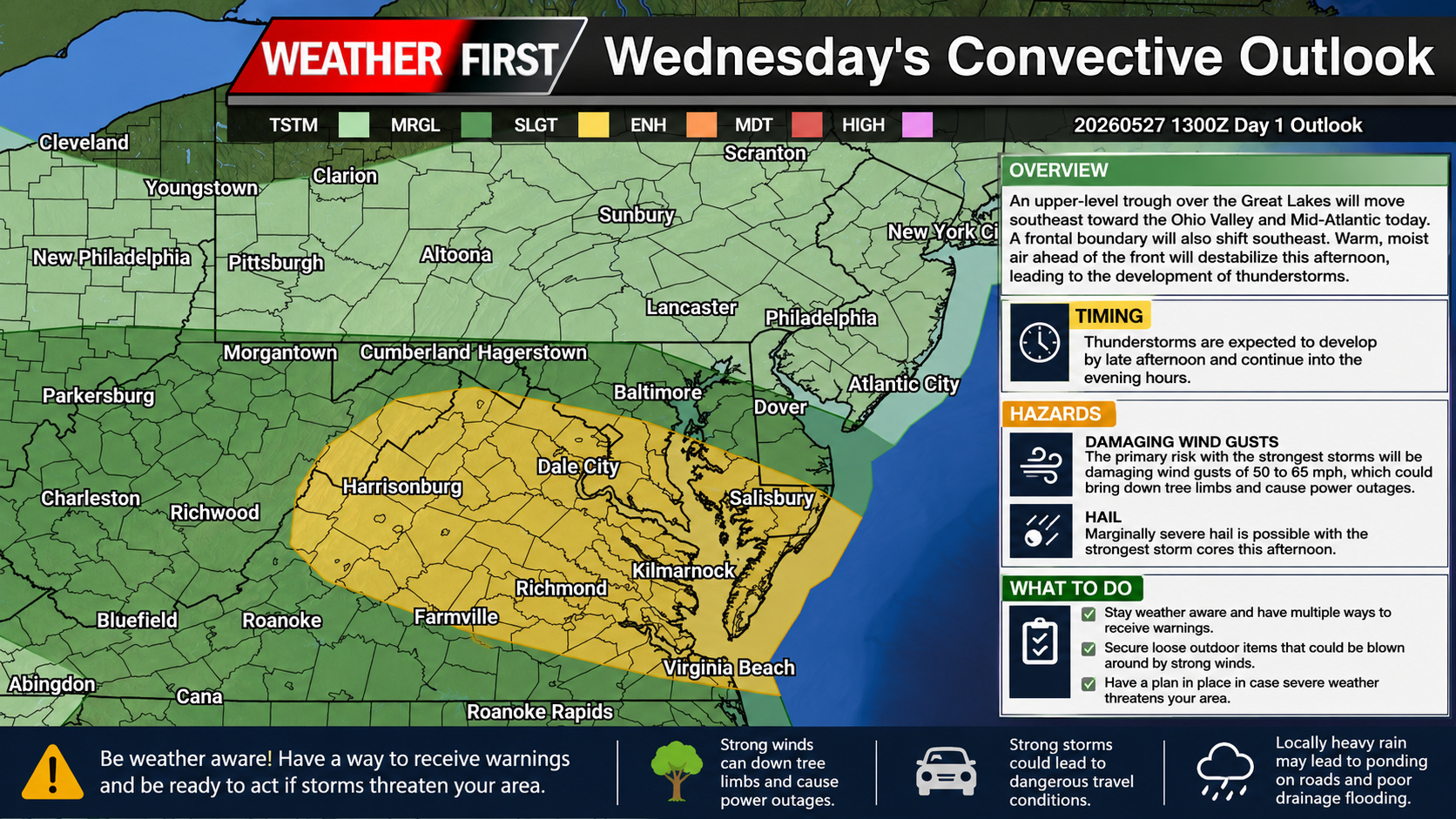
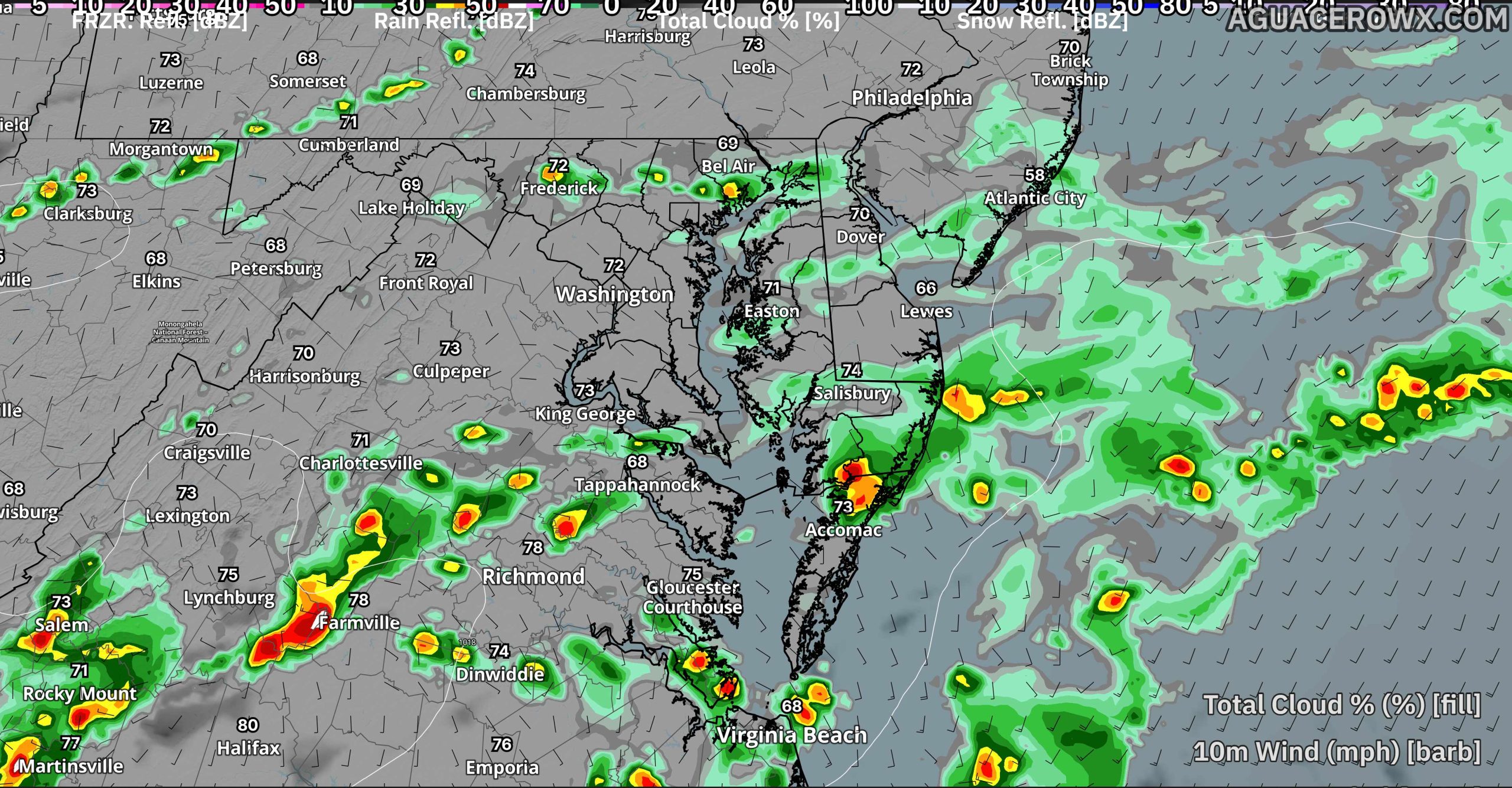
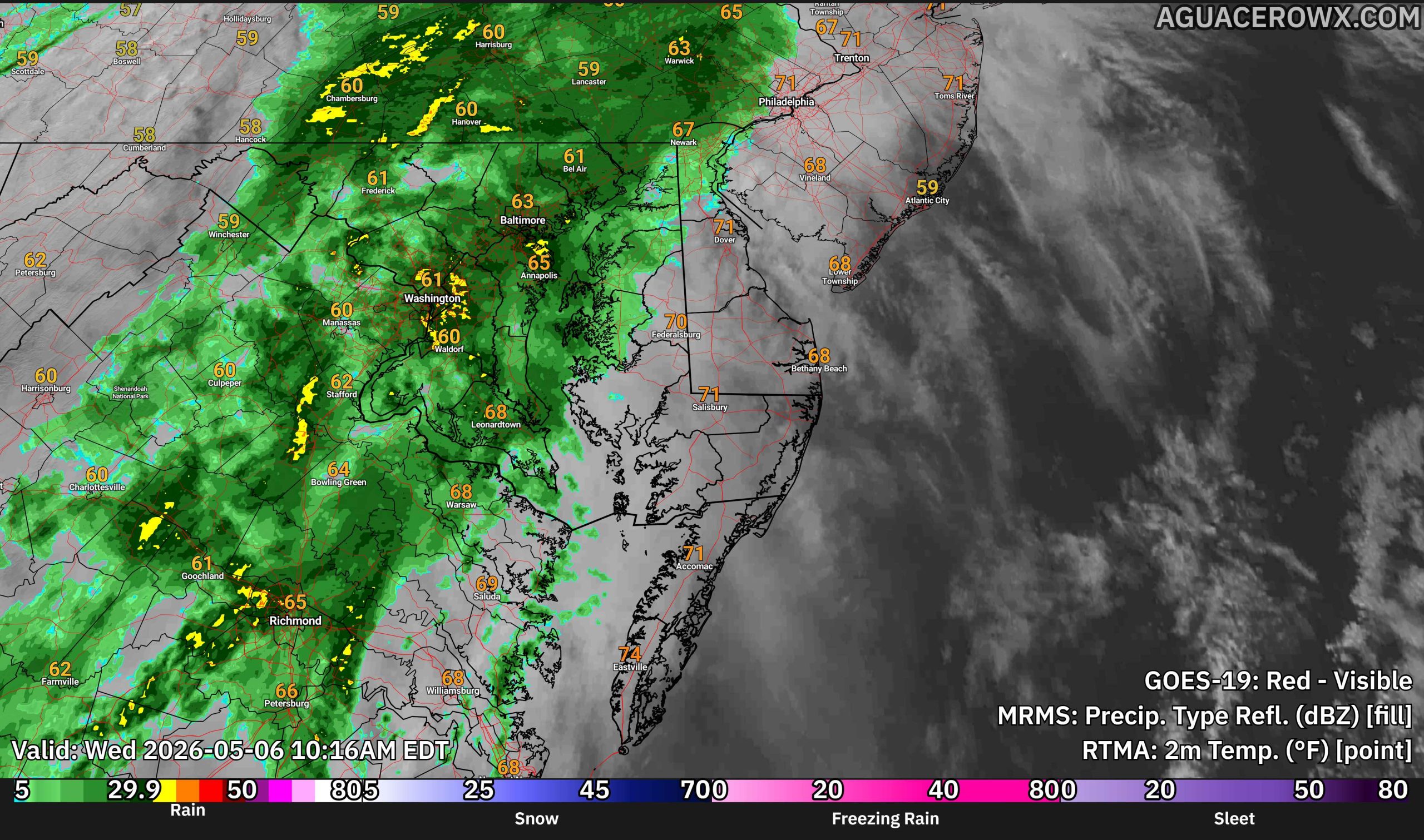
    A more active weather pattern is expected to unfold across the Mid Atlantic today as a disturbance moving out of the Great Lakes pushes toward the Ohio Valley and East Coast. Forecasters are monitoring the potential for scattered strong to severe thunderstorms this afternoon and evening, especially across portions of Maryland, Delaware, Virginia, and southern Pennsylvania.

    An upper level trough currently swinging southeast through the Great Lakes will help provide the energy needed for thunderstorm development later today. Early morning satellite and water vapor imagery already showed a lead disturbance tracking across southern Ohio into the central Appalachians, helping to spark areas of showers and thunderstorms ahead of the main system.

    At the surface, a frontal boundary draped across the region has been reshaped by ongoing morning rainfall and thunderstorms. As this boundary gradually slides southeast through the day, warm and humid air ahead of it will continue building instability across the Mid Atlantic. Dewpoints climbing into the upper 60s and lower 70s will create a very moisture rich atmosphere capable of supporting stronger storms by this afternoon.

    Clusters of thunderstorms to develop and move east southeastward later today. The primary threat with the strongest storms will be damaging wind gusts ranging from 50 to 65 mph, capable of bringing down tree limbs and causing isolated power outages. Some of the more intense storm cores may also produce small to marginally severe hail.

    While widespread severe weather is not expected, scattered strong storms could become locally intense during the peak heating hours this afternoon into early evening. Residents across the region should stay alert for rapidly changing weather conditions and be prepared for possible severe thunderstorm warnings later today.

    In addition to the wind threat, locally heavy rainfall may also accompany stronger storms given the humid environment already in place across the region.

  • Strong Thunderstorms Could Bring Damaging Winds to Parts of the Mid Atlantic Wednesday

    Strong Thunderstorms Could Bring Damaging Winds to Parts of the Mid Atlantic Wednesday

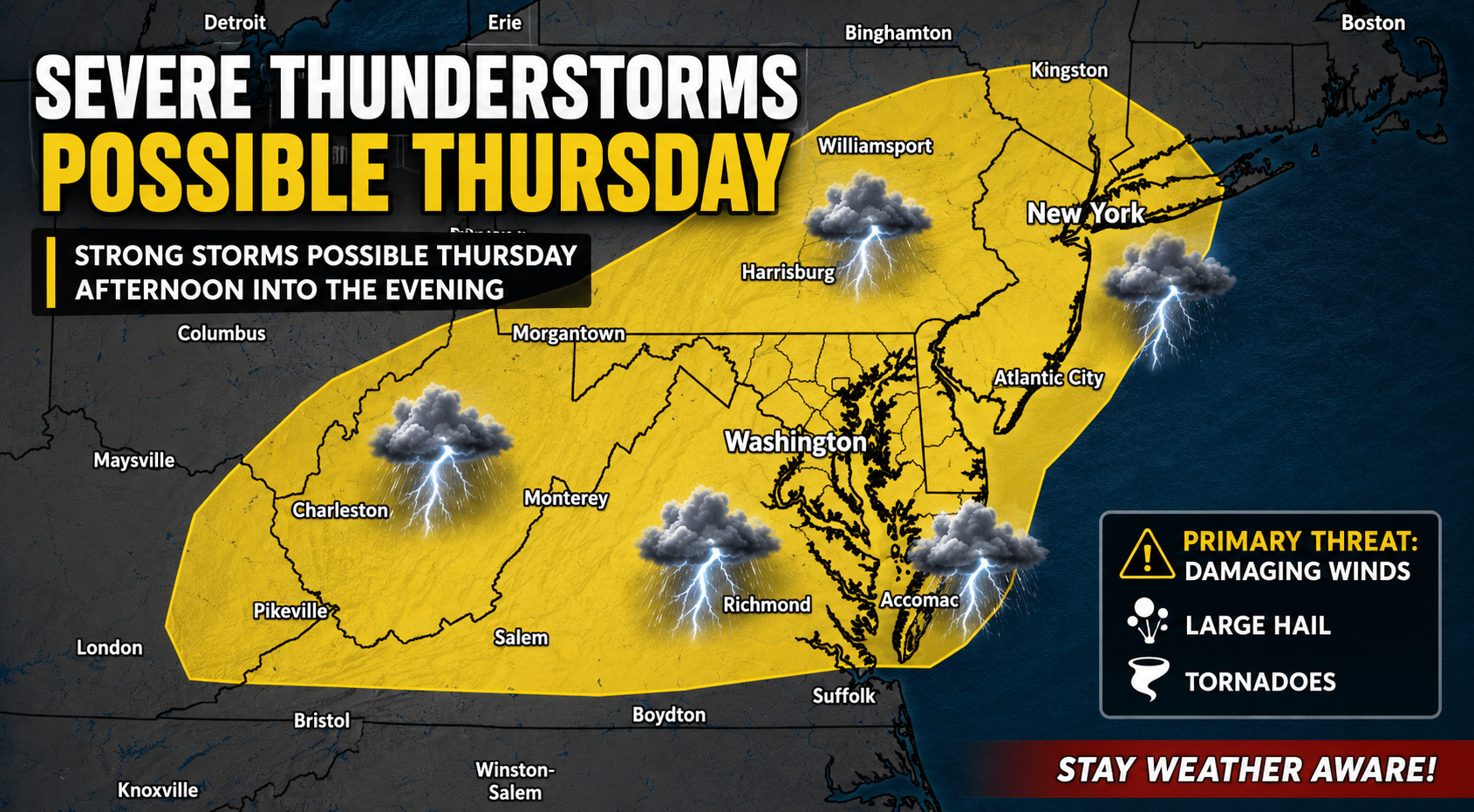
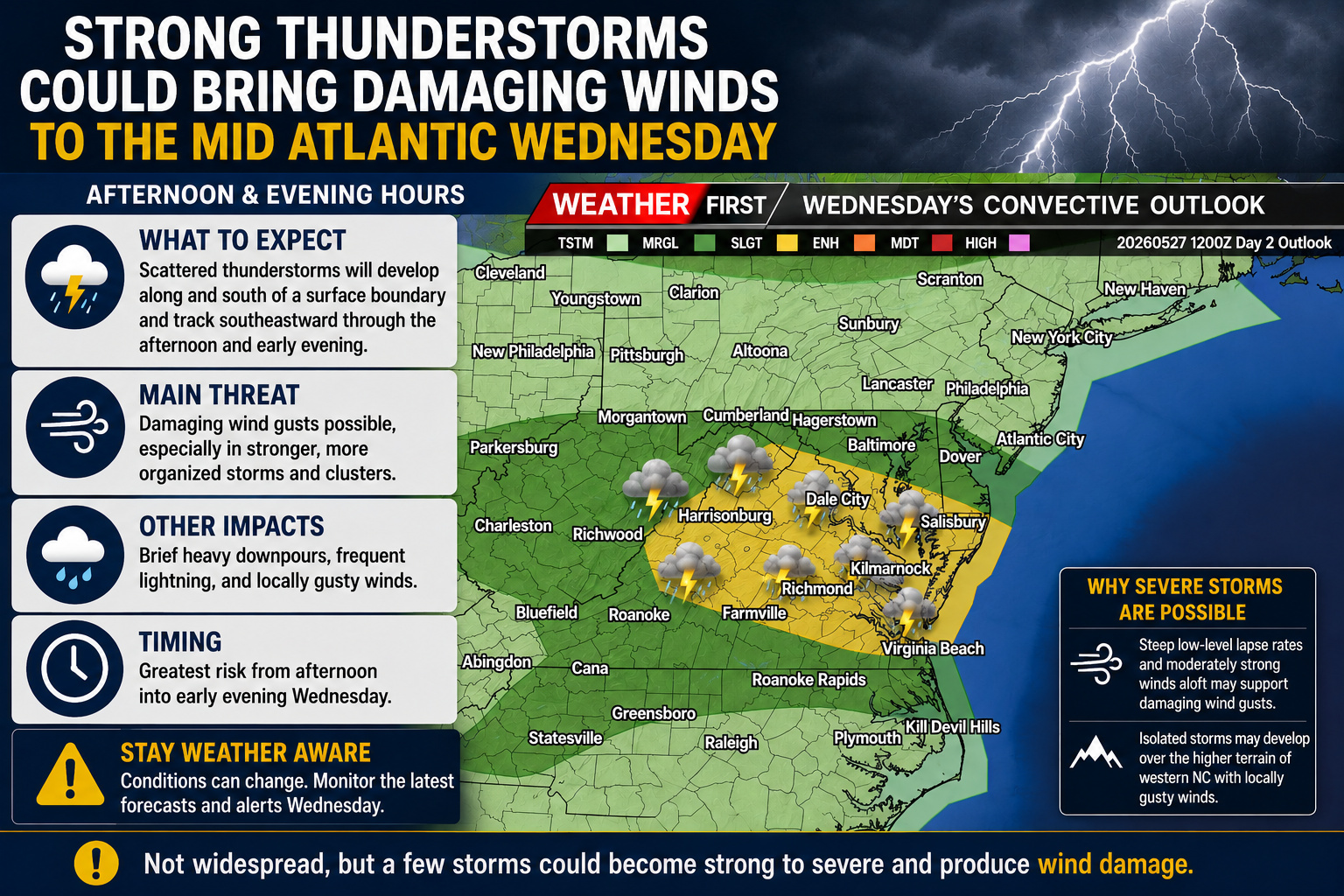
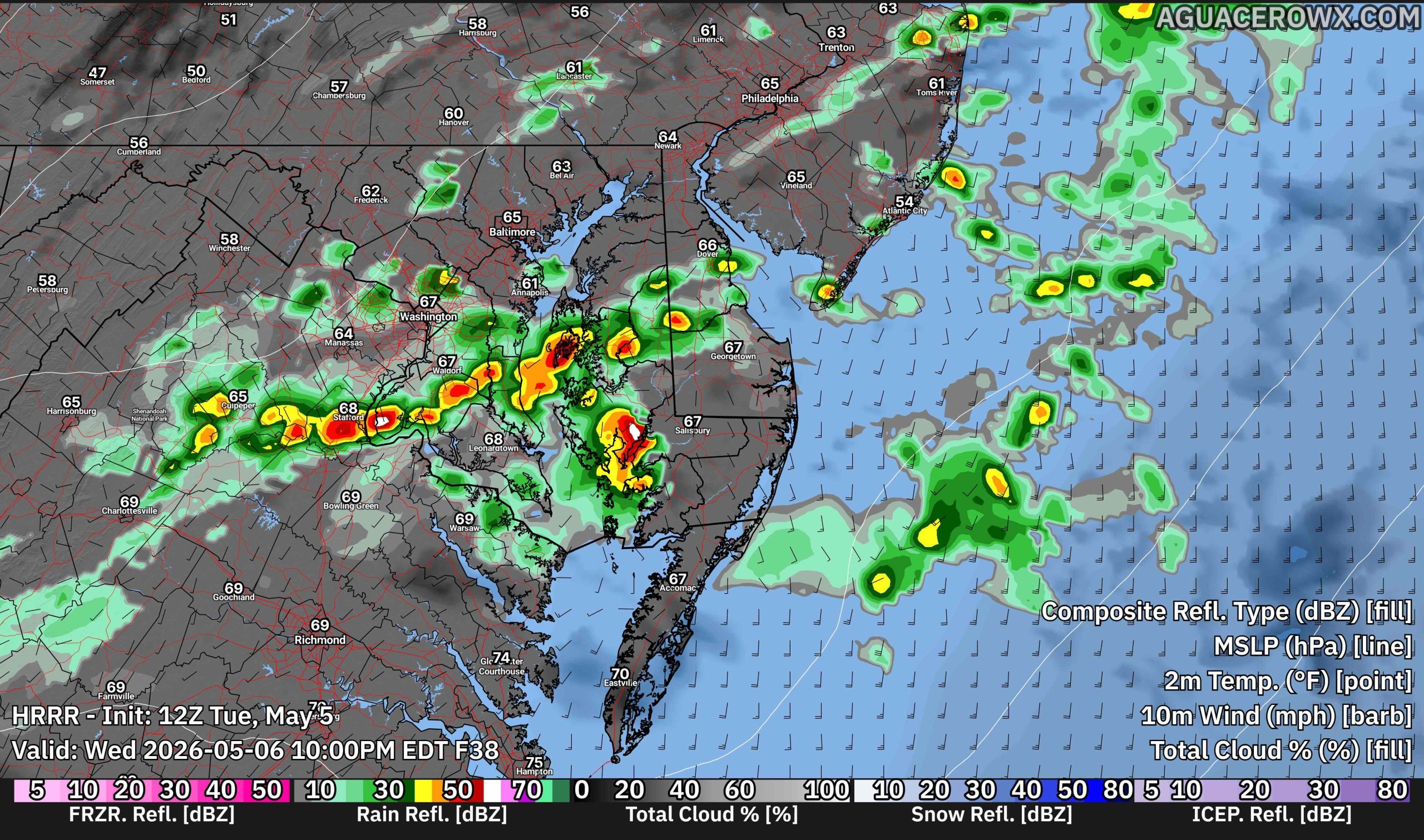
    A threat for strong to locally severe thunderstorms is expected to develop across portions of the Mid Atlantic on Wednesday as a potent upper level disturbance tracks across the northeastern United States.

    According to the latest forecast discussion from the Storm Prediction Center, a strong shortwave trough moving southeast across Ontario and into the Northeast will help trigger scattered thunderstorms from the Ohio Valley eastward into Maryland, Delaware, and Virginia during the afternoon and evening hours Wednesday.

    A warm, humid, and moderately unstable air mass is expected to be in place across much of the region ahead of an approaching surface boundary stretching from the Ohio Valley into the Delmarva Peninsula. As daytime heating develops, scattered thunderstorms are expected to form and organize along and south of the boundary.

    The main severe weather threat will be damaging wind gusts, especially within more organized clusters of thunderstorms capable of producing strong downdrafts. Steep low level lapse rates combined with moderately strong winds just above the surface may allow some storms to transfer stronger winds down to ground level.

    Across the Delmarva region, the greatest severe weather potential currently appears to be during the afternoon into the early evening hours Wednesday. While widespread severe weather is not expected at this time, isolated storms could become strong enough to produce locally damaging wind gusts and brief heavy downpours.
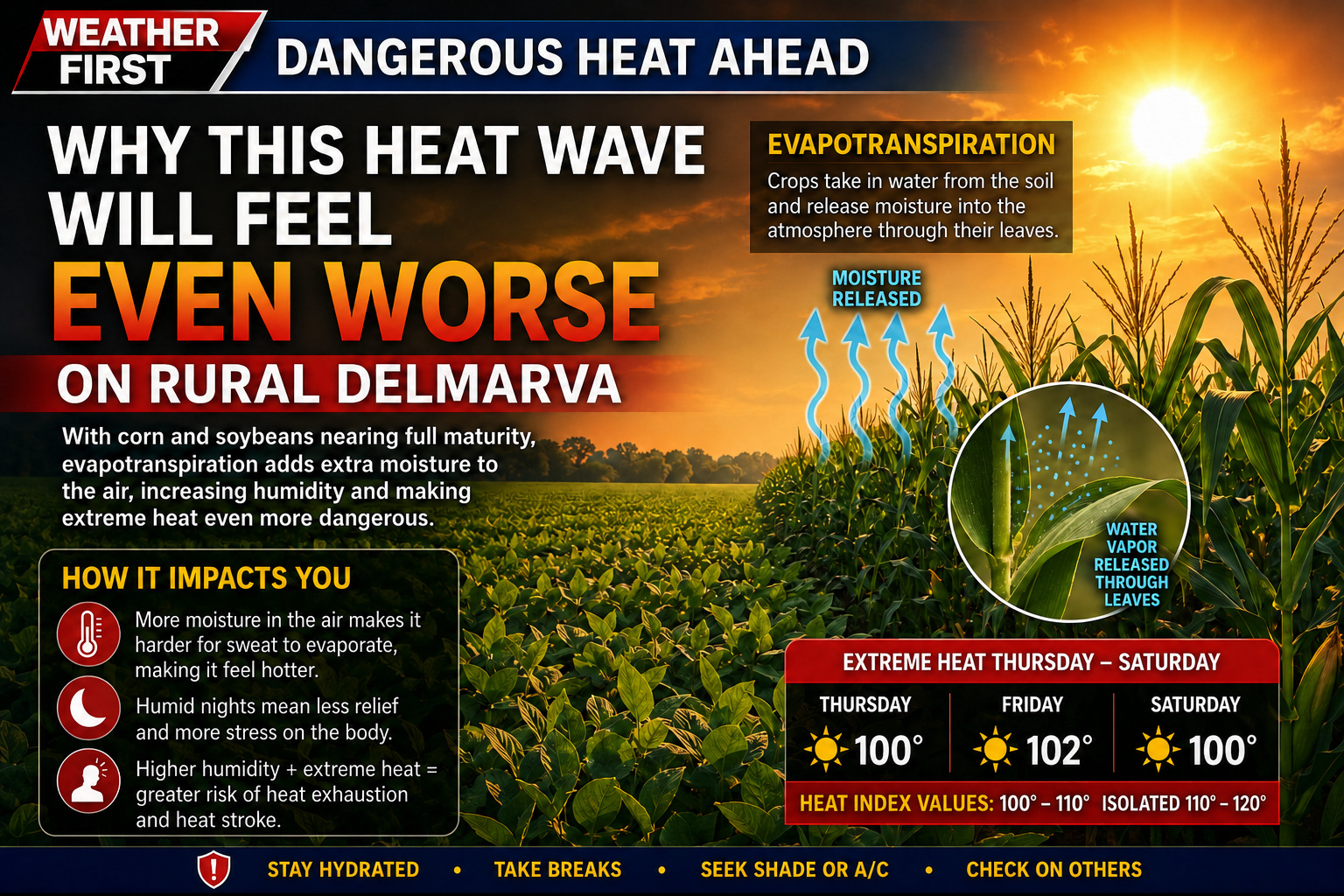
    The threat level and storm coverage will depend heavily on how much instability can develop during the day, which will be influenced by cloud cover and any lingering showers from earlier in the day.

    Residents across the Mid Atlantic and Delmarva Peninsula are encouraged to stay weather aware Wednesday afternoon and evening as conditions may become favorable for a few severe thunderstorms capable of producing isolated wind damage.

  • Drier and Seasonable Weather Returns to Delmarva for the End of the Week

    Drier and Seasonable Weather Returns to Delmarva for the End of the Week

    After several days of unsettled weather and scattered showers across the Delmarva Peninsula, a much quieter weather pattern is expected to settle into the region heading into the end of the week and the upcoming weekend.

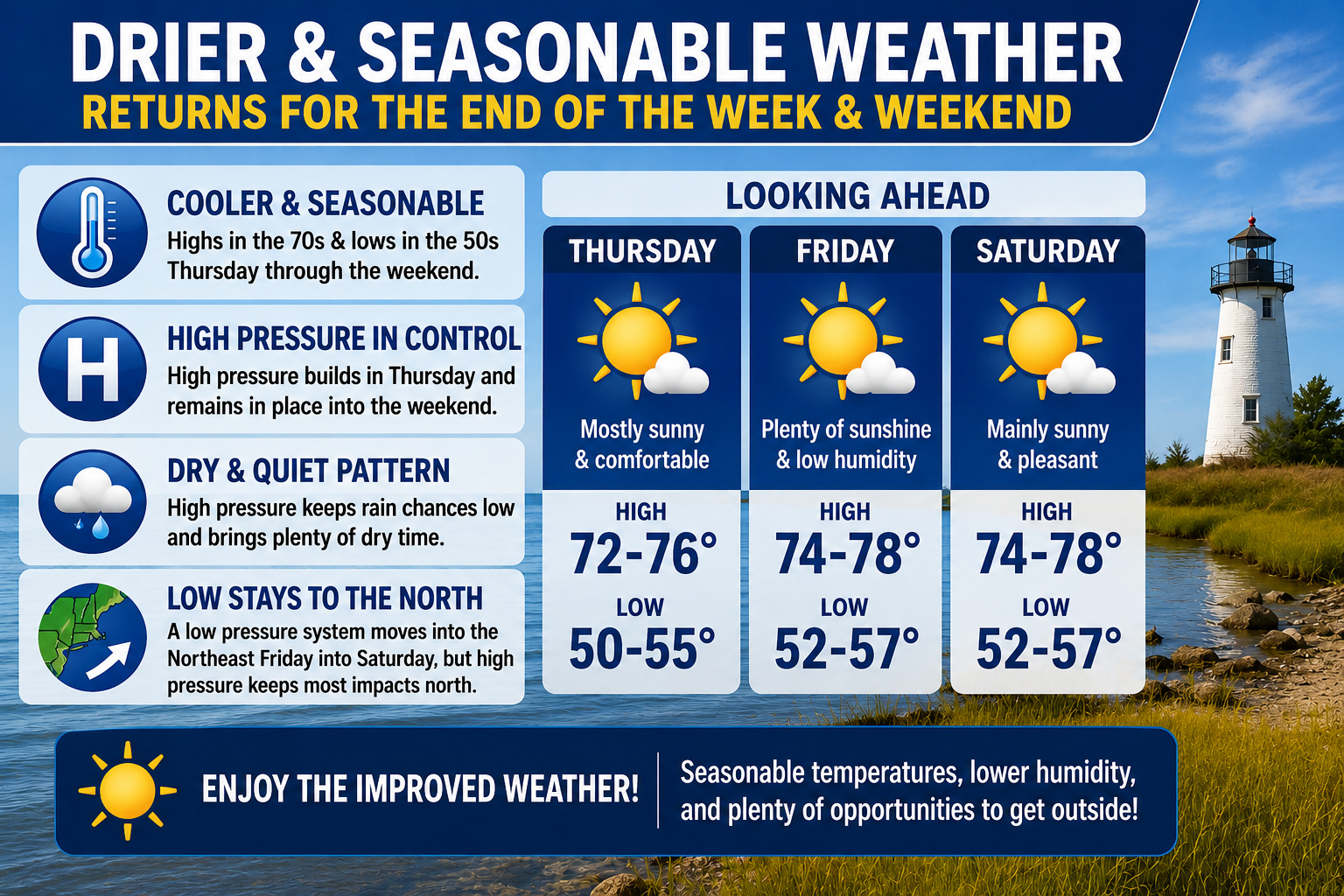
    A cold front moving through Wednesday night will usher in slightly cooler and less humid air for Thursday, with comfortable conditions expected to persist through the weekend. High temperatures across Delmarva are forecast to remain mainly in the 70s during this period, while overnight lows fall back into the 50s, offering a refreshing change compared to the recent stretch of warmer and wetter weather.

    High pressure is forecast to gradually build into the Mid Atlantic on Thursday and remain the dominant weather feature through the weekend. This area of high pressure should provide mainly dry conditions, lower humidity levels, and intervals of sunshine across Delaware, Maryland’s Eastern Shore, and coastal Virginia.

    While another low pressure system is expected to track into the Northeast Friday into Saturday, the strengthening high pressure system over the Delmarva region is expected to keep most of the storm activity well to the north. Forecast guidance continues to support a mainly dry forecast locally with minimal impacts expected from the passing system.

    Overall, the weather pattern heading into the weekend looks much more favorable for outdoor activities across Delmarva, with seasonable temperatures, lower humidity, and reduced rain chances expected through at least Sunday.

  • Unsettled Weather Pattern Continues Across Delmarva Through Wednesday

    Unsettled Weather Pattern Continues Across Delmarva Through Wednesday

    An unsettled stretch of weather will continue across the Delmarva region through midweek, although conditions are expected to improve somewhat compared to the soggy Memorial Day weekend.

    A stationary front remains draped across the region Tuesday morning and will slowly drift southward through the day. While a few showers remain possible, especially across southern portions of Delmarva, much of the region is expected to stay dry for much of today. Especially across the northern tier. Some breaks of sunshine may also develop during the afternoon, helping temperatures climb into the upper 70s to near 80 degrees.

    The front is forecast to stall directly across Delmarva tonight into Wednesday as an area of low pressure rides along it. This setup will bring additional rounds of scattered showers to the region Tuesday night through Wednesday. The greatest coverage of rain is expected across southern Delmarva, where rainfall totals could reach around one half inch or locally higher by the time the system exits.

    Northern portions of Delmarva may see lighter rainfall amounts, generally ranging from a few hundredths to around a quarter inch. Despite the continued wet pattern, no significant flooding or severe weather impacts are currently anticipated.

    Temperatures on Wednesday will remain seasonable, with highs once again hovering around 80 degrees under mostly cloudy skies and periods of showers.

    A cold front arriving Wednesday night will finally sweep the lingering moisture offshore, allowing a transition toward drier, quieter, and more comfortable weather for the latter half of the week across the Delmarva Peninsula.

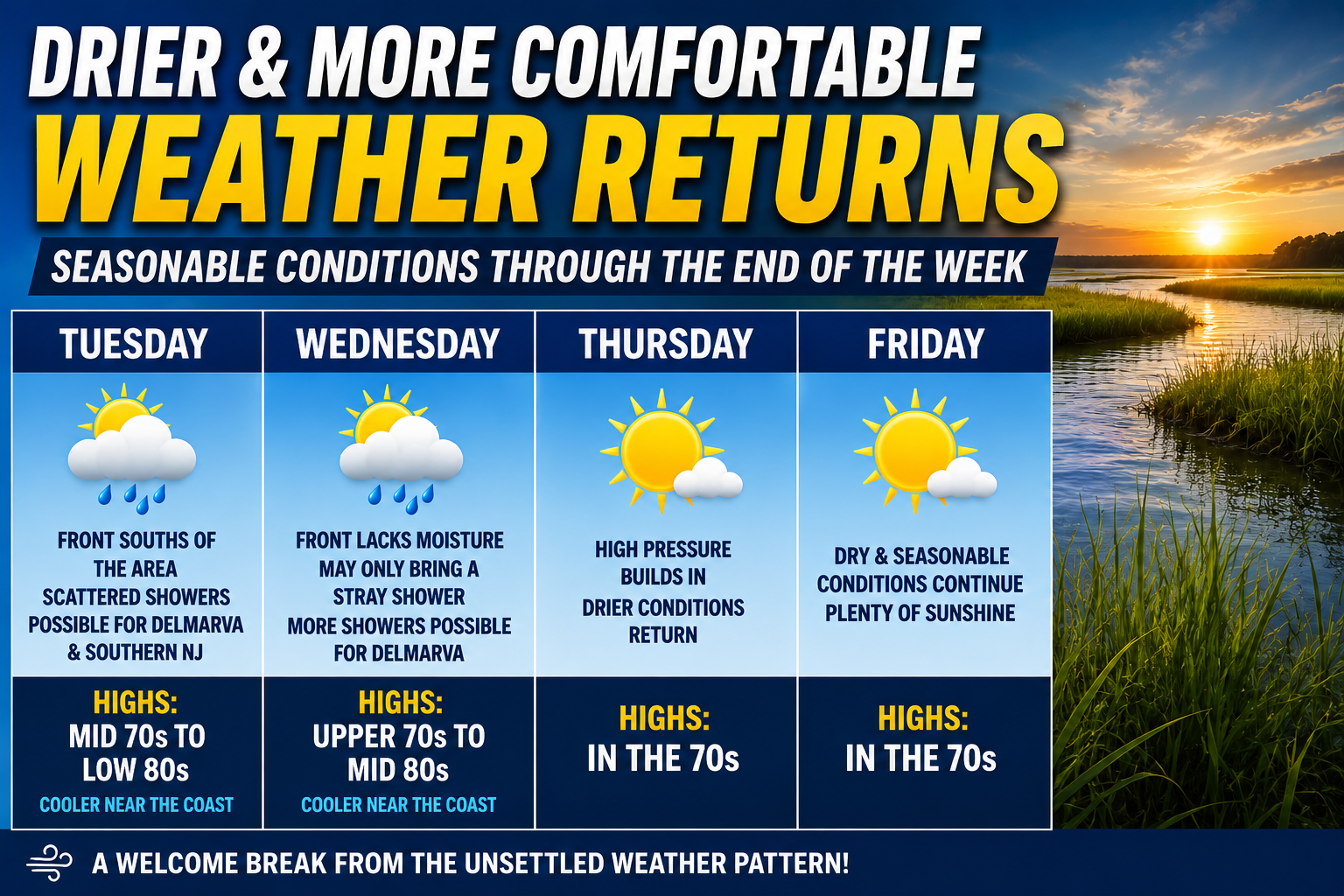
  • Drier and More Comfortable Weather Returns to Delmarva Later This Week

    Drier and More Comfortable Weather Returns to Delmarva Later This Week

    After a stretch of unsettled weather featuring showers, thunderstorms, and periods of heavy rain, a gradual return to drier and more seasonable conditions is expected across Delmarva and the Mid-Atlantic through the second half of the week.

    A cold front moving south of the region Tuesday will help push the more humid and stormy pattern away from the area, although the boundary is expected to linger nearby. Because of its close proximity, scattered showers may still develop at times Tuesday, especially across southern New Jersey and portions of the Delmarva Peninsula.

    Temperatures Tuesday will remain fairly mild with afternoon highs generally reaching the mid 70s to low 80s inland, while communities closer to the Atlantic coast experience cooler conditions due to onshore flow and marine influences.

    Another cold front is forecast to slide southward through the region on Wednesday. However, this secondary front appears moisture-starved and is not expected to produce widespread rainfall. A stray shower cannot be ruled out, particularly across Delmarva where lingering moisture near the stalled frontal boundary to the south could spark a few additional afternoon showers.

    Despite the slight shower chances, temperatures Wednesday will trend a bit warmer with highs climbing into the upper 70s to middle 80s away from the coast. Shore communities will once again stay cooler due to persistent easterly winds off the Atlantic Ocean.

    The overall weather pattern becomes much more favorable heading into Thursday and Friday as high pressure builds into the region from the north and west. This will allow for increasing sunshine, lower humidity levels, and more comfortable late May conditions across the Mid-Atlantic.

    High temperatures both Thursday and Friday are expected to settle into the 70s region-wide, providing a refreshing change following the recent active and humid weather pattern.

    By the end-of-week stretch should offer some of the most pleasant weather the region has experienced in recent days, with lower rain chances and more stable atmospheric conditions expected heading into next weekend.

  • Unsettled Weather Brings Showers, Thunderstorms, and Heavy Rain Threat Across Delmarva and the Mid-Atlantic

    Unsettled Weather Brings Showers, Thunderstorms, and Heavy Rain Threat Across Delmarva and the Mid-Atlantic

    A messy and unsettled weather pattern will continue across the Mid-Atlantic and Delmarva region today as multiple fronts and areas of low pressure move through the area, bringing periods of showers, thunderstorms, patchy fog, and the potential for locally heavy rainfall.

    Early this morning, a warm front began lifting northward across the region ahead of a strengthening area of low pressure tracking through the eastern Great Lakes and Ohio Valley. This setup has already produced areas of patchy fog, drizzle, low clouds, and light rain across portions of eastern Pennsylvania, New Jersey, Delaware, and Maryland.

    As the warm front continues northward through the morning hours, a band of showers moving east out of western Pennsylvania and New York will begin interacting with the increasingly humid and unstable air mass across the region. This interaction could lead to the development of thunderstorms capable of producing torrential downpours and localized flooding concerns.

    The first round of heavier showers and thunderstorms is expected to develop from the southern Poconos and Lehigh Valley eastward toward the Interstate 95 corridor during the late morning into early afternoon. Additional storms are then expected to redevelop later this afternoon and evening as a cold front sweeps through the region.

    The greatest concern for Delmarva appears to arrive later today into tonight, when thunderstorms are forecast to intensify across southern New Jersey and the Delmarva Peninsula. Some of the stronger storms may produce gusty winds, frequent lightning, and pockets of heavy rainfall that could lead to poor drainage flooding in low-lying and urban areas.

    Despite the clouds and rainfall, temperatures will still climb into the low to mid 70s this afternoon as warmer air spreads northward ahead of the cold front.

    Patchy fog and low clouds may redevelop tonight behind the front as lingering moisture remains trapped near the surface.

    Residents across the region are encouraged to remain weather aware through the day, especially during periods of heavy rain and thunderstorms that could quickly reduce visibility on area roadways.

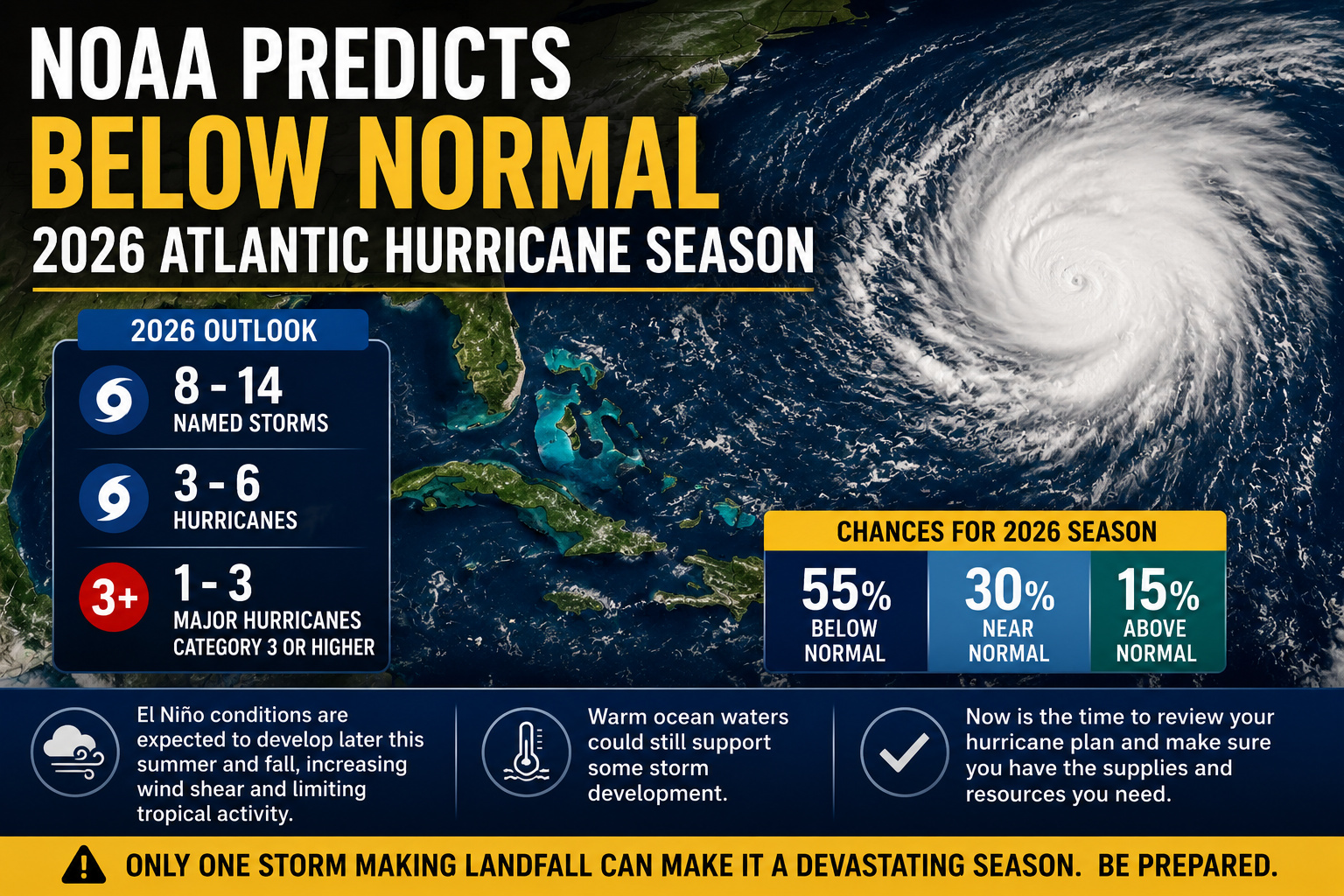
  • NOAA Predicts Below Normal 2026 Atlantic Hurricane Season

    NOAA Predicts Below Normal 2026 Atlantic Hurricane Season

    NOAA is forecasting a below normal 2026 Atlantic hurricane season, citing the expected development of El Niño conditions during the peak of the season as a major factor that could suppress tropical activity across the Atlantic Basin. Despite the quieter outlook, forecasters continue to stress that it only takes one storm impacting land to make a season devastating.

    According to NOAA’s Climate Prediction Center, the 2026 Atlantic hurricane season is expected to produce between 8 and 14 named storms, with 3 to 6 hurricanes and 1 to 3 major hurricanes reaching Category 3 strength or higher. NOAA says there is a 55% chance of a below normal season, a 30% chance of a near normal season, and only a 15% chance of an above normal season.

    The primary reason behind the reduced forecast is the anticipated transition into a moderate to potentially strong El Niño pattern later this summer and fall. El Niño typically increases upper level wind shear across the tropical Atlantic, which disrupts thunderstorm organization and makes it more difficult for tropical systems to strengthen into hurricanes.

    While El Niño may help limit overall storm development, forecasters caution that sea surface temperatures across portions of the Atlantic remain warmer than average, which could still support tropical activity. Additionally, NOAA emphasized that seasonal outlooks do not predict where storms will track or whether any hurricanes will make landfall in the United States. Even below average hurricane seasons have historically produced catastrophic impacts along the Gulf Coast and East Coast.

    The Atlantic hurricane season officially begins June 1 and runs through November 30, with climatological peak activity typically occurring from late August through September. On average, the Atlantic Basin sees around 14 named storms, 7 hurricanes, and 3 major hurricanes each season based on the 1991-2020 climate averages.

    NOAA’s outlook closely aligns with several other preseason forecasts released by Colorado State University and other meteorological organizations earlier this spring, many of which also predicted near to below average activity due to the growing likelihood of El Niño development.

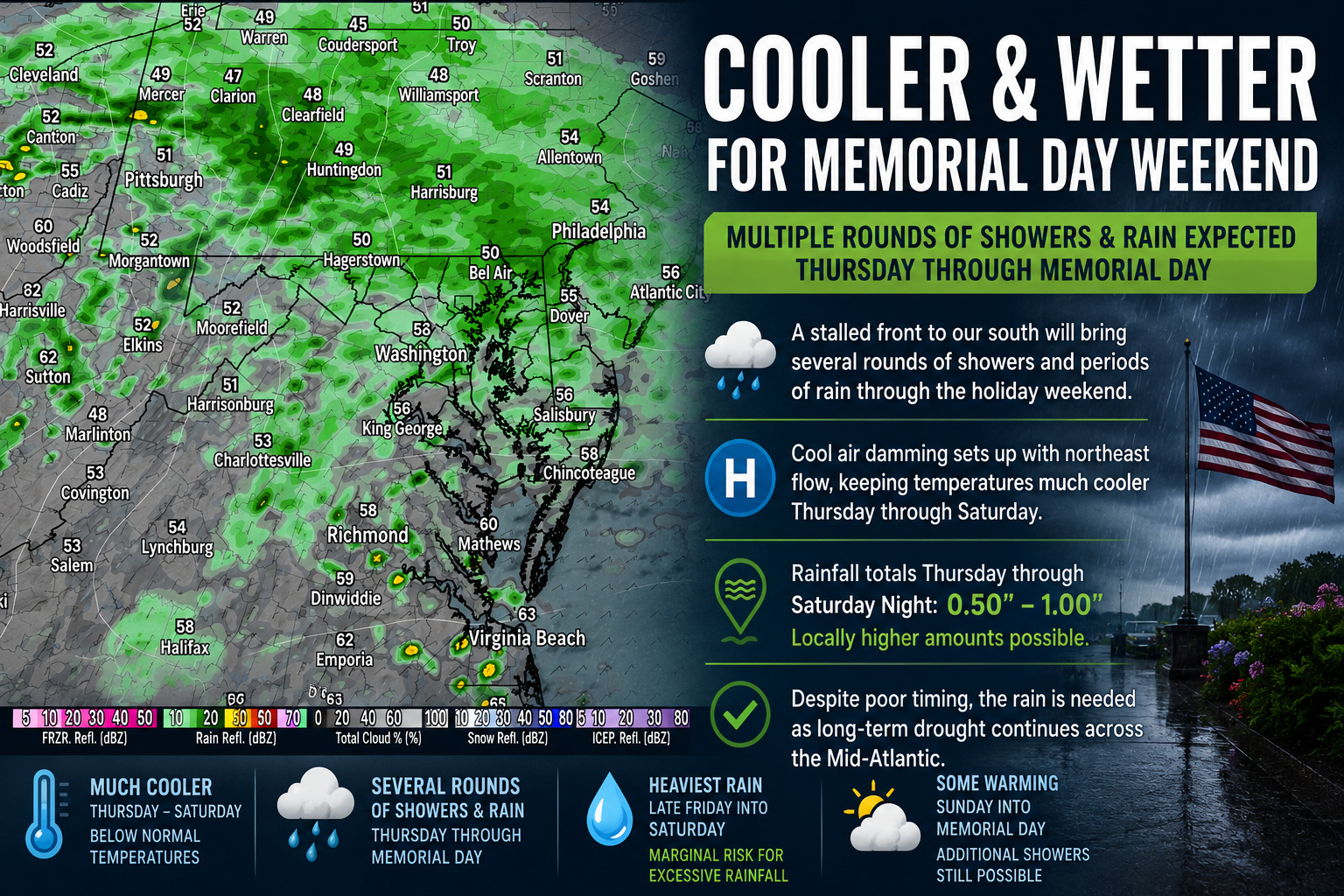
  • Cooler, Wetter Pattern Arrives for Memorial Day Weekend Across Mid Atlantic

    Cooler, Wetter Pattern Arrives for Memorial Day Weekend Across Mid Atlantic

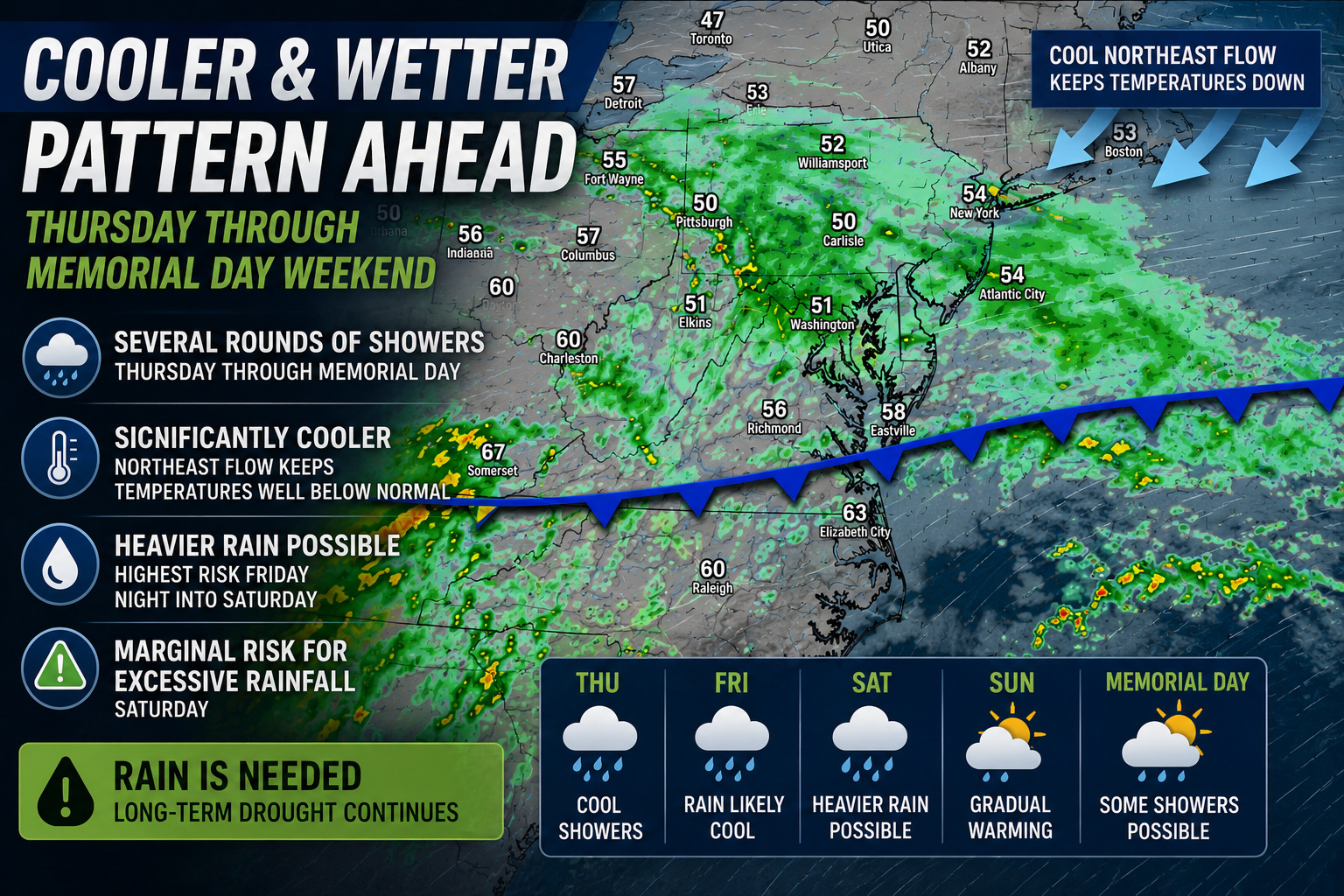
    As many across the Mid-Atlantic prepare for the Memorial Day holiday weekend, the weather pattern is turning much cooler, wetter, and increasingly unsettled as several rounds of showers and periods of rain are expected from late this week through at least Memorial Day itself.

    A cold front moving through the region will settle and eventually stall just south of the area heading into the weekend. This stalled boundary will act as a focus for multiple waves of low pressure and disturbances to ride along it, bringing repeated chances for showers and rain across the Mid-Atlantic from Thursday through the holiday weekend.

    The wettest period currently appears to be later Friday into Saturday as a more organized area of low pressure develops well to the west of the region. At the same time, high pressure building across the Northeast will wedge cooler marine air southwestward into the Mid-Atlantic, creating a classic cool air damming setup east of the Appalachians. This pattern will help keep skies cloudy, temperatures below normal, and rainfall persistent at times.

    We are also monitoring the potential for locally heavy rainfall, especially Saturday, as atmospheric moisture levels rise significantly. Forecast precipitable water values, or PWATs, are expected to climb between 1.50 and 1.90 inches, which is near climatological maximum levels for late May. While widespread flooding is not currently expected, there is at least a marginal risk for excessive rainfall where heavier showers repeatedly move over the same areas.

    Rainfall totals from Thursday through Saturday night are forecast to average between one half inch and one inch across much of the region, though localized higher amounts are possible depending on where the heaviest bands of rain develop.

    In addition to the wetter weather, temperatures will take a dramatic turn compared to the recent stretch of summerlike warmth. Persistent northeast winds, clouds, and rain will keep daytime highs noticeably cooler Thursday through Saturday, with many areas struggling well below seasonal averages. Some gradual warming is expected Sunday into Memorial Day as the stalled boundary begins to weaken, however the overall weather pattern is expected to remain active with additional showers still possible.

    Despite the poor timing for outdoor holiday plans and the unofficial start to summer, the rainfall will provide beneficial moisture to portions of the Mid-Atlantic currently dealing with expanding drought conditions. Several areas across the region, including portions of Delmarva and the central Mid-Atlantic, continue to experience moderate to severe drought according to the latest U.S. Drought Monitor.

  • Widespread Severe To Extreme Drought Spreads Through The Mid-Atlantic

    Widespread Severe To Extreme Drought Spreads Through The Mid-Atlantic

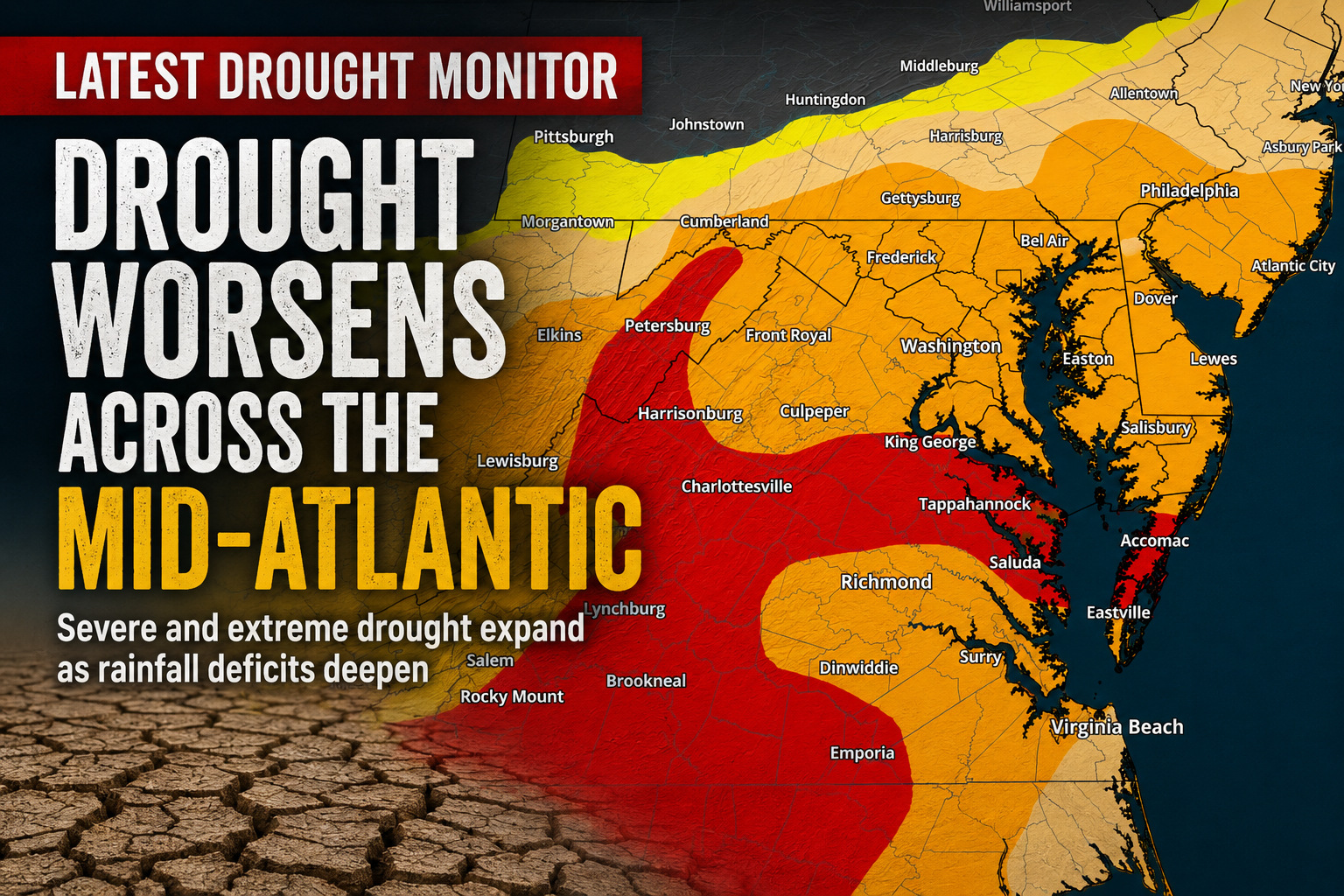
    The latest U.S. Drought Monitor shows drought conditions continuing to worsen across portions of the Mid-Atlantic, with expanding areas of moderate to severe drought impacting Delaware, Maryland, Pennsylvania, New Jersey, Virginia, and West Virginia. Much of the region received very little rainfall over the past week, with many locations seeing less than a quarter inch of precipitation, allowing rainfall deficits to deepen further heading into late spring.

    According to the newest report, severe drought (D2) expanded across portions of Delaware, southern Pennsylvania, New Jersey, and parts of West Virginia, while moderate drought (D1) conditions continued to spread elsewhere throughout the region. The report also noted the introduction of extreme drought (D3) conditions in parts of southern and eastern West Virginia, Accomack & Northampton counties in Virginia as long-term dryness continues to intensify.

    Across the Delmarva Peninsula, precipitation deficits dating back to the fall and winter months continue to create growing concerns for agriculture, groundwater recharge, and streamflow levels. The University of Delaware Climate Office reports that streamflows remain well below normal statewide, with some locations recording their lowest levels on record for this time of year. Groundwater recovery has also struggled due to multiple seasons of below-average precipitation.

    The worsening drought has also increased concerns surrounding wildfire danger and agricultural stress as warmer temperatures and increasing evapotranspiration rapidly dry out soils and vegetation. The Mid-Atlantic Regional Integrated Sciences and Assessments program notes that the U.S. Drought Monitor plays a major role in triggering agricultural disaster assistance and water resource management decisions throughout the region.

    Looking ahead, the Climate Prediction Center’s Seasonal Drought Outlook favors continued drought persistence across much of the Mid-Atlantic through the summer months. While periodic rainfall events are expected, forecasters warn that sustained widespread soaking rains will likely be needed to significantly improve groundwater and long-term hydrological conditions.

    The expanding drought footprint has also prompted NOAA and regional partners to launch a new Mid-Atlantic Drought Early Warning System initiative aimed at improving drought monitoring, preparedness, and long-term resilience across the region.

  • Cooler, Wetter Pattern Expected Across Delmarva Through Memorial Day Weekend

    Cooler, Wetter Pattern Expected Across Delmarva Through Memorial Day Weekend

    After several days of summer-like heat and isolated strong thunderstorms, a much cooler and wetter weather pattern is expected to settle across Delmarva heading into the holiday weekend.

    We are tracking a stalled cold front expected to remain just south of the region Thursday through much of Memorial Day weekend. This boundary will act as a focus for multiple rounds of showers as waves of low pressure and upper level disturbances move along it.

    The unsettled pattern will begin as early as Thursday with scattered showers developing across the area, but the potential for steadier and more widespread rainfall appears to increase Friday into Saturday. Forecast guidance continues to show a developing area of low pressure tracking west of the region while strong high pressure to the northeast wedges cooler air southward into the Mid Atlantic. This setup may create a classic cool air damming pattern, leading to chilly northeast winds, cloudy skies, and periods of rain.

    Rainfall could become heavy at times, especially on Saturday. Atmospheric moisture levels are forecast to rise significantly, with precipitable water values climbing between 1.50 and 1.90 inches, which is near the climatological maximum for late May. Because of this, there is at least a marginal concern for excessive rainfall and localized flooding if heavier bands of rain develop along the stalled frontal boundary.

    Temperatures will also take a dramatic turn compared to the recent heat. Highs Thursday through Saturday may struggle well below normal in many areas due to persistent northeast flow, thick cloud cover, and repeated rounds of rain. Some gradual warming is expected by Sunday and Memorial Day as the stalled boundary weakens and shifts, although additional showers remain possible through the holiday itself.

    While the timing is not ideal for outdoor plans and holiday travel, the upcoming rainfall will provide some beneficial moisture for the region as long term drought conditions continue across parts of the Mid Atlantic and Delmarva Peninsula.

    Residents planning outdoor activities for the holiday weekend should stay updated on the latest forecasts as confidence continues to increase in a prolonged stretch of cooler and unsettled weather.

  • Strong Cold Front May Trigger Isolated Severe Storms Across Delmarva This Afternoon and Evening

    Strong Cold Front May Trigger Isolated Severe Storms Across Delmarva This Afternoon and Evening

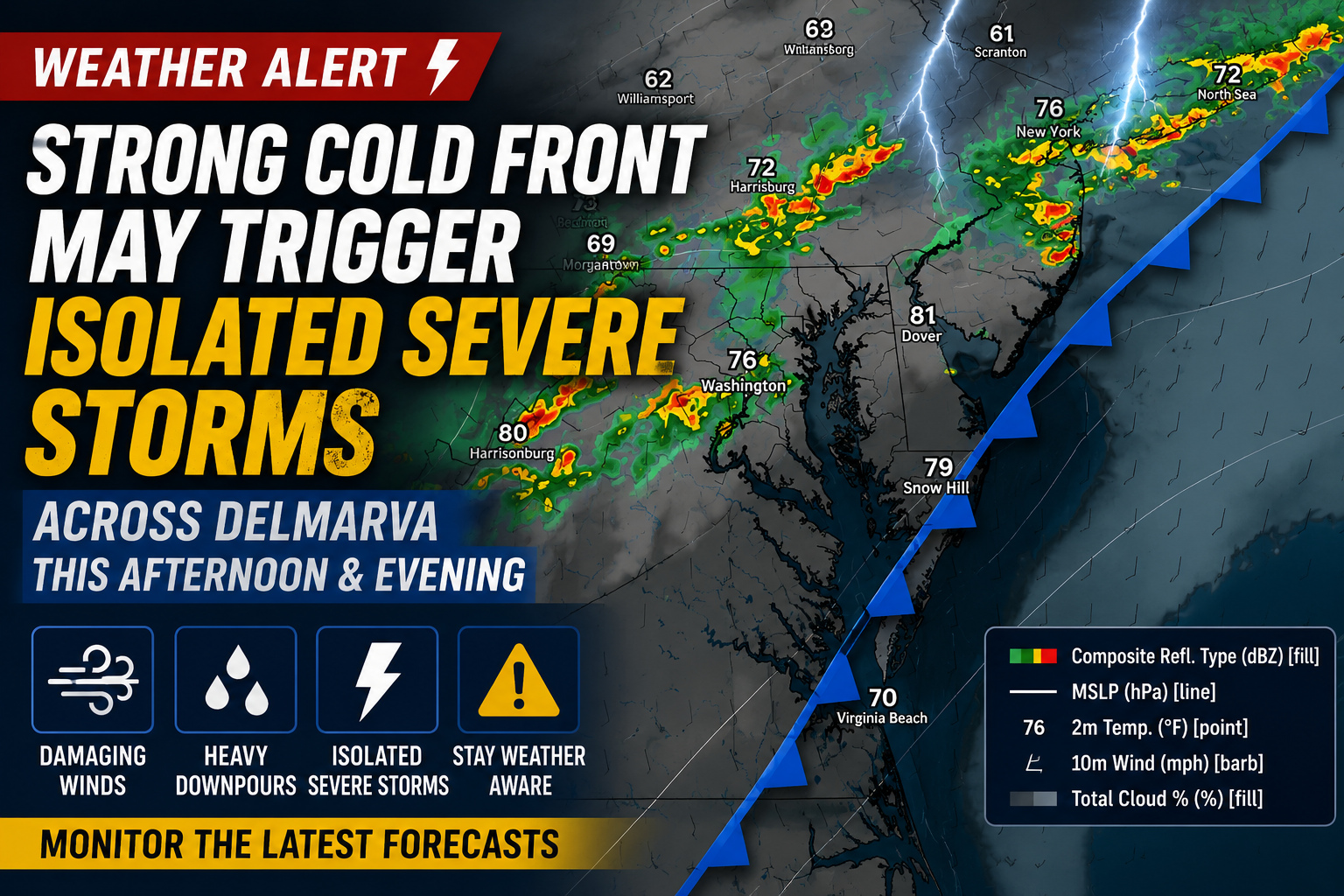
    A strong cold front is expected to sweep across the Mid Atlantic and Delmarva region this afternoon and tonight, bringing the threat for showers, thunderstorms, and the potential for isolated severe weather before cooler air gradually settles in later tonight into Thursday.

    We are closely monitoring the potential for stronger thunderstorms to develop from the Philadelphia metro southward through southern New Jersey, Delaware, and portions of Maryland’s Eastern Shore during the late afternoon and evening hours. A hot and unstable air mass remains in place ahead of the approaching front, helping fuel thunderstorm development as daytime heating peaks.

    While atmospheric wind shear remains somewhat limited across the region, there will still be enough instability and steep low level lapse rates to support isolated stronger storms capable of producing damaging wind gusts. The primary severe weather threat appears to be localized downburst winds, especially with any stronger storm cores that can briefly organize into small clusters or short linear segments.

    At this time, confidence in widespread severe weather remains relatively low due to weaker upper level support and marginal storm organization parameters. However, even isolated severe storms can quickly produce strong wind gusts capable of downing small tree limbs, causing isolated power outages, and creating hazardous travel conditions.

    Heavy rainfall will also accompany some of the thunderstorms. Most locations are expected to receive between one tenth and one half inch of rain, though localized higher amounts are possible where heavier downpours develop. Atmospheric moisture levels remain elevated, with precipitable water values ranging between 1.5 and 2 inches, allowing storms to efficiently produce torrential rainfall in a short period of time.

    Thunderstorm activity should gradually diminish later this evening as the cold front pushes through the region. However, some lingering showers may continue overnight into early Thursday, especially closer to Delmarva where the front is expected to slow down and stall nearby.

    We encourage residents across Delmarva to monitor the latest forecasts and remain weather aware through tonight as storms develop and move through the region.

  • Cold Front To Bring Storms Wednesday, Cooler Air By Late Week

    Cold Front To Bring Storms Wednesday, Cooler Air By Late Week

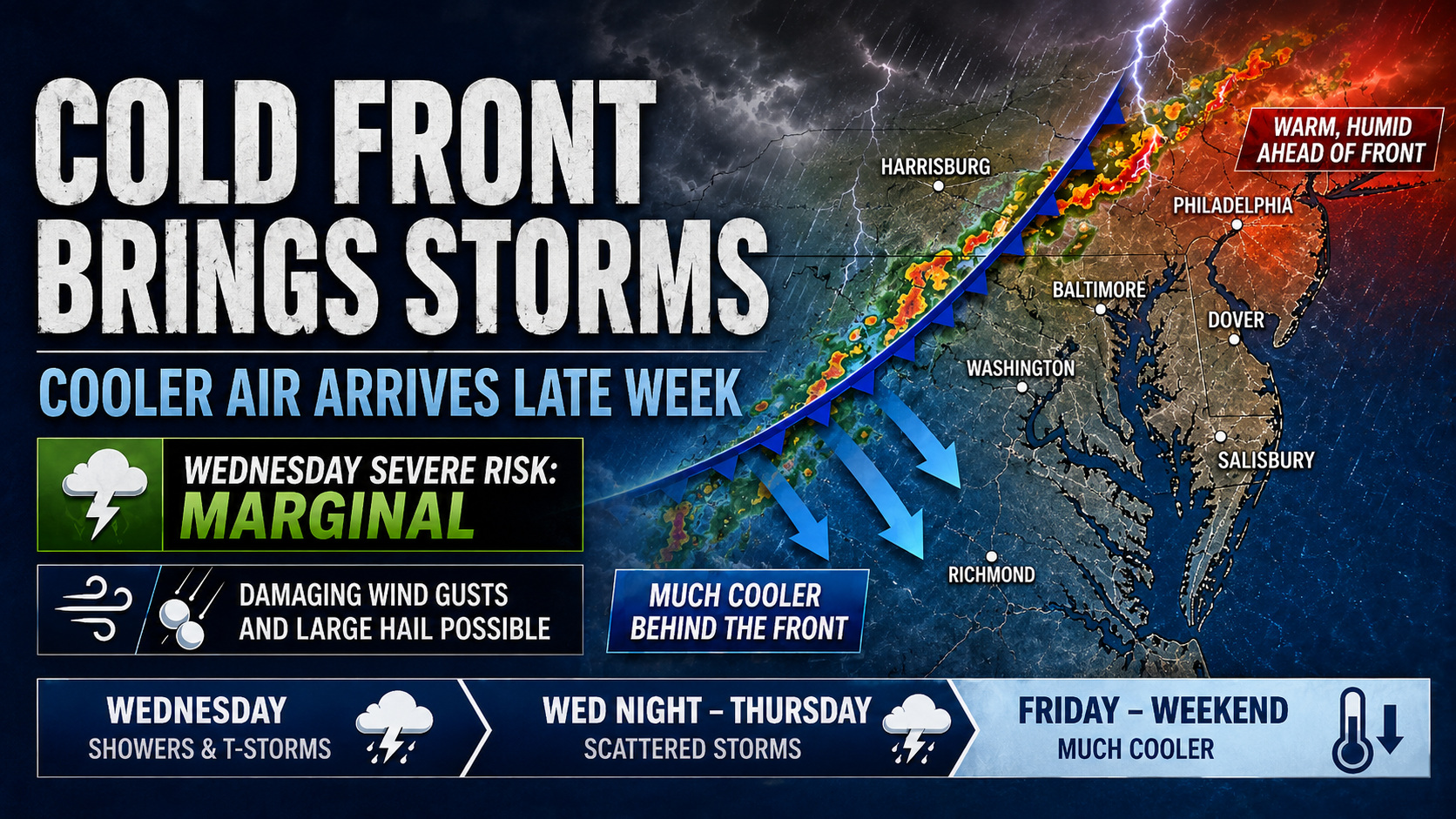
    A cold front will move through the region Wednesday into Thursday, bringing showers and thunderstorms followed by a noticeable drop in temperatures by the end of the week.

    The front is expected to arrive during the second half of Wednesday and continue through Wednesday night. Ahead of the front, a warm and unstable air mass will remain in place, helping to fuel the development of thunderstorms. While the strongest forcing and wind shear may remain farther north, the environment should still be supportive of some organized storms.

    Because of this setup, there is a risk for isolated strong to severe thunderstorms on Wednesday. The Storm Prediction Center has maintained a Marginal Risk for severe weather, which means a few storms could become strong enough to produce damaging wind gusts and large hail.

    Rainfall totals from this system are generally expected to stay around a quarter inch or less for many areas. However, any stronger thunderstorms could produce locally higher rainfall amounts, especially with atmospheric moisture levels running fairly high. Some storms may be capable of producing brief heavy downpours.

    By Thursday morning, the cold front is expected to settle south of the region, but it may linger nearby through the rest of the day. This could keep scattered showers in the forecast, especially across southeastern areas.

    Behind the front, temperatures will turn much cooler by late week, ending the stretch of above normal warmth. The overall pattern looks unsettled heading into Friday and the weekend, with additional chances for showers possible.

  • Delaware Under Code Orange Air Quality Alert Tuesday Amid Early Season Heat

    Delaware Under Code Orange Air Quality Alert Tuesday Amid Early Season Heat

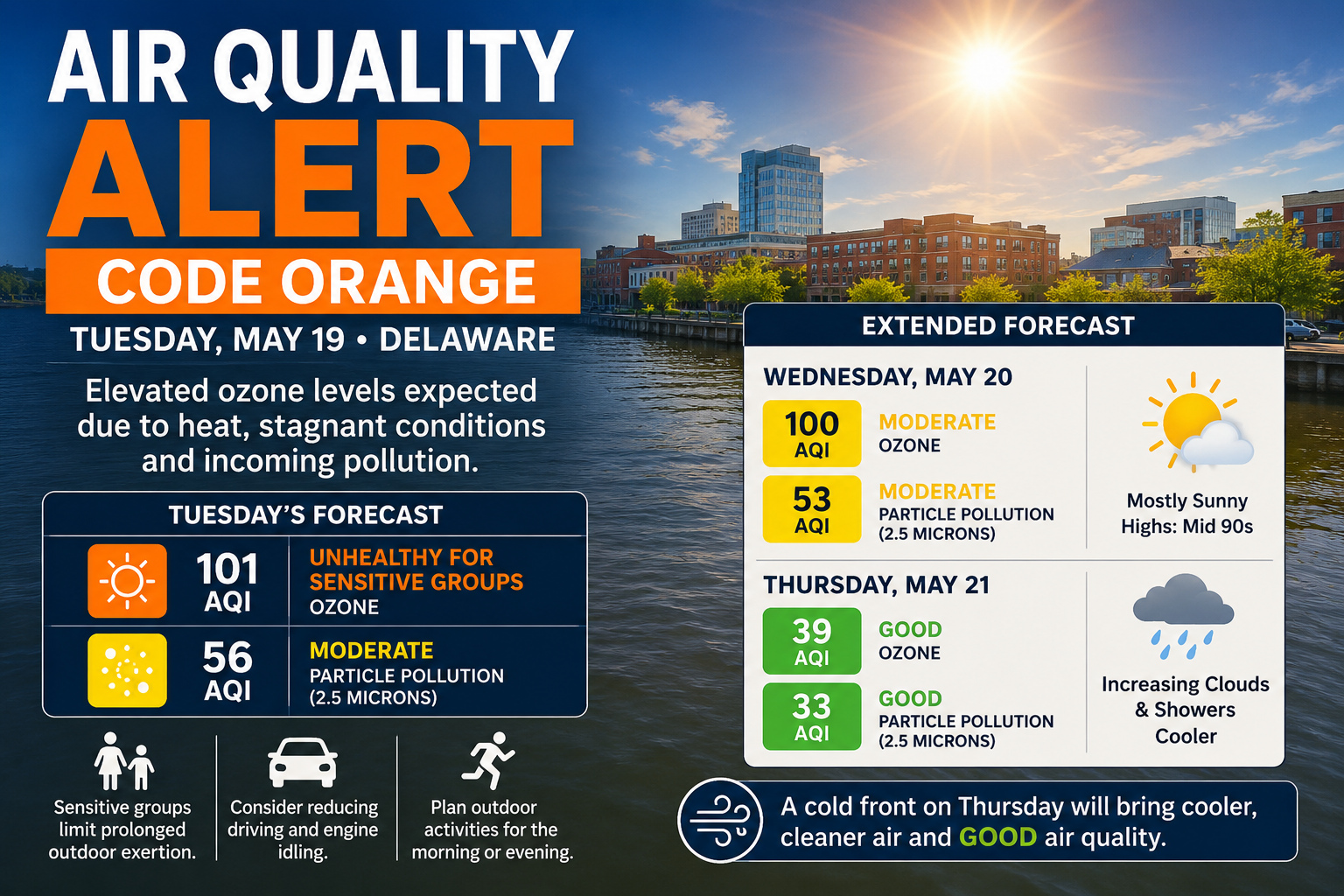
    A Code Orange Air Quality Action Day has been issued for all of Delaware on Tuesday, May 19, as dangerous heat and stagnant atmospheric conditions are expected to lead to elevated ozone levels across the state.

    According to the Delaware Department of Natural Resources and Environmental Control (DNREC), air quality levels are forecast to reach “Unhealthy for Sensitive Groups” for ozone pollution, especially during the afternoon and early evening hours. Fine particulate matter, or PM2.5, is expected to remain in the low-Moderate category.

    The combination of several meteorological factors is expected to contribute to deteriorating air quality. A temperature inversion early Tuesday morning will trap pollutants near the ground, limiting vertical mixing in the atmosphere. At the same time, light to moderate southwesterly to westerly winds will transport additional regional pollution into Delaware from upwind areas.

    Adding to the concern, mostly sunny skies and temperatures soaring into the middle 90s will enhance ozone production throughout the day. Ozone pollution tends to peak during hot, sunny weather when emissions from vehicles, industry, and other sources chemically react in the atmosphere.

    Sensitive groups, including children, older adults, and individuals with asthma or other respiratory conditions, are encouraged to limit prolonged outdoor activity during the afternoon and evening hours when ozone concentrations are typically highest.

    Conditions may remain somewhat elevated into Wednesday as another hot day with temperatures in the mid-90s is expected across southern Delaware. Continued west-southwesterly flow will keep transporting pollutants into the region, while sunny skies will support additional ozone development. Air quality levels are forecast to remain in the Moderate range statewide.

    Relief is expected to arrive Thursday as a cold front moves offshore. Northeasterly winds behind the front will usher in a cooler and cleaner air mass into the Mid-Atlantic. Increasing cloud cover and scattered rain showers are also expected to suppress ozone formation, allowing air quality levels to improve back into the Good category for both ozone and PM2.5 across Delaware.

  • Early Season Heat Wave Targets Records Across Delmarva and Mid Atlantic

    Early Season Heat Wave Targets Records Across Delmarva and Mid Atlantic

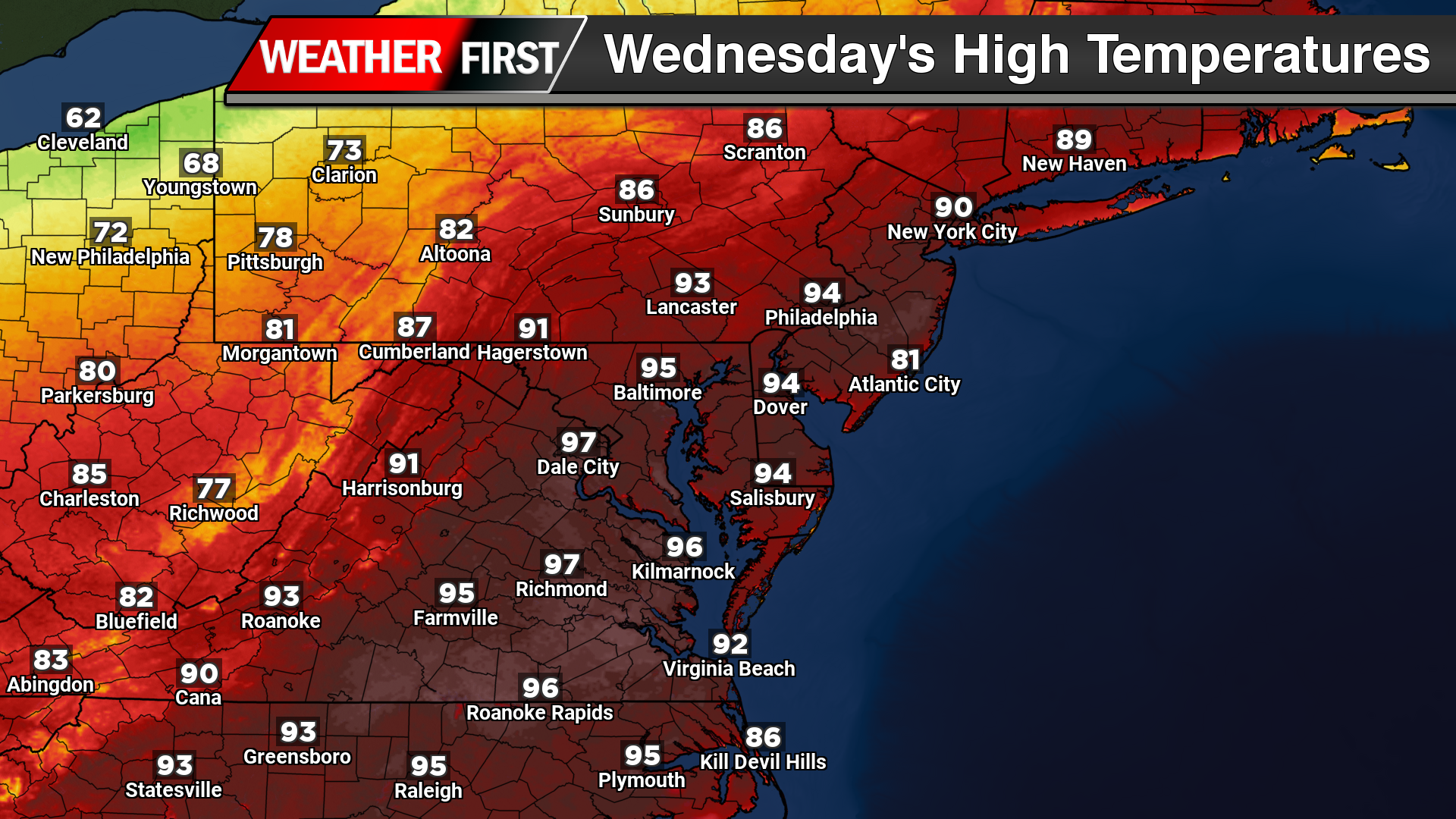
    A stretch of unusually intense early season heat is expected to grip the Delmarva Peninsula and much of the Mid Atlantic through Wednesday, with temperatures running 10 to 20 degrees above average for mid May. Several locations could challenge daily and even monthly record highs as a strong upper level ridge and offshore Bermuda high pressure combine to deliver a prolonged period of summer-like warmth.

    High temperatures across inland portions of Delaware, Maryland’s Eastern Shore, and surrounding inland areas are expected to climb into the upper 80s to middle 90s each afternoon through Wednesday. Tuesday currently appears to be the hottest day of the stretch, with widespread mid 90s anticipated across much of the region. Overnight temperatures will also remain exceptionally warm for this time of year, only falling into the mid 60s to lower 70s, which could challenge warm minimum temperature records for May 19th.

    The pattern responsible for the heat features a large dome of high pressure in the upper atmosphere anchored over the East Coast through Tuesday before gradually weakening and shifting offshore Wednesday. At the surface, Bermuda high pressure positioned offshore is maintaining a persistent southerly to southwesterly flow, transporting much warmer air northward into the region.

    While inland communities are expected to experience the most intense heat, coastal locations will see somewhat cooler conditions due to the influence of the Atlantic Ocean and developing sea breezes. Areas closer to the Delaware beaches and immediate coastline may remain in the 70s to middle 80s during the afternoon before temperatures gradually cool later in the day as marine air pushes inland.

    Humidity levels are not expected to become excessively tropical, but dewpoints in the low to middle 60s will still create uncomfortable conditions given the lack of recent heat acclimation. Heat index values are forecast to remain close to actual air temperatures, meaning many inland areas will feel well into the 90s during the afternoon hours.

    Heat Advisories have been issued for portions of the urban corridor as temperatures and heat indices approach early season warning criteria. Wilmington and parts of New Castle County may avoid the most intense heat at times due to cooling bay breeze influences.

    The weather pattern will remain mostly dry through Tuesday with abundant sunshine and only a very isolated chance for a late day shower or thunderstorm well inland. By Wednesday, an approaching cold front may begin to introduce additional cloud cover and scattered showers or thunderstorms, which could slightly limit how hot temperatures become. Even so, temperatures are still expected to remain well above normal and near record territory, especially southeast of the Interstate 95 corridor where sunshine may persist longest.

    Relief from the heat is expected to arrive late Wednesday into Thursday as the cold front moves through the region. Temperatures should gradually return closer to seasonal averages heading into the latter half of the week and next weekend.

  • Summer-Like Heat Building Across Delmarva Into Next Week

    Summer-Like Heat Building Across Delmarva Into Next Week

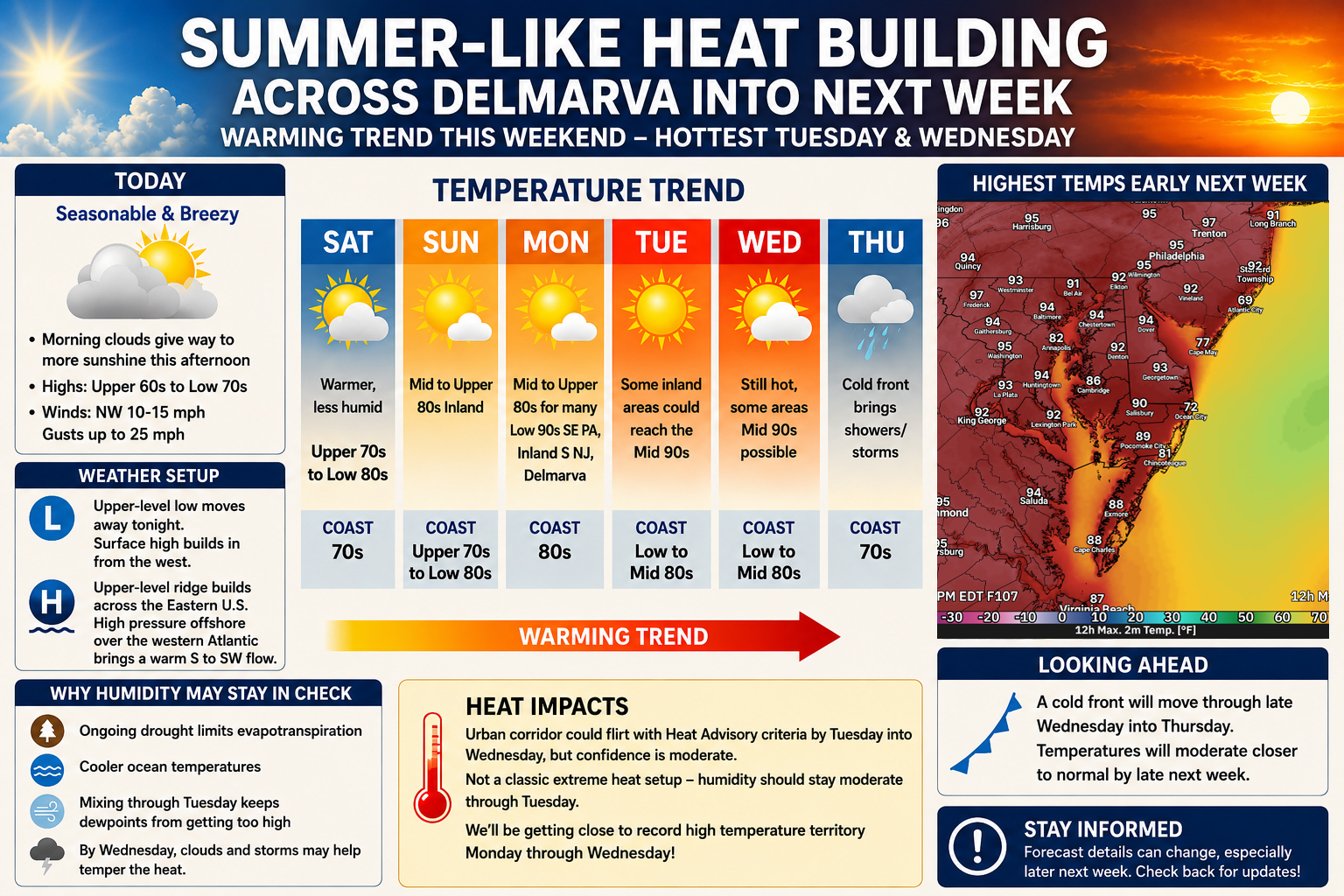
    After a stretch of seasonable and breezy conditions to close out the workweek, a significant warm up is on the way for the Delmarva region as an expanding ridge of high pressure ushers in the first widespread taste of summer-like heat heading into next week.

    Clouds will linger through much of today as an upper-level low pressure system slowly pulls away from the Mid-Atlantic. However, increasing sunshine is expected later this afternoon as surface high pressure begins to build into the region. Temperatures today will remain relatively comfortable for mid-May standards, with highs generally ranging from the upper 60s to lower 70s accompanied by northwest winds of 10 to 15 mph and gusts up to 25 mph.

    The overall weather pattern will undergo a major transition this weekend as a strong upper-level ridge strengthens across the eastern United States. At the same time, high pressure anchored offshore over the western Atlantic will establish a persistent south to southwesterly flow across the Mid-Atlantic and Delmarva Peninsula. This setup will allow progressively warmer air to surge northward through at least the middle of next week.

    Temperatures Saturday will begin climbing back above normal with highs reaching the upper 70s to lower 80s inland, though coastal communities will remain several degrees cooler thanks to the influence of chilly ocean waters.

    By Sunday, much of inland Delmarva could rise into the mid to upper 80s while beach areas remain closer to the upper 70s or lower 80s. The warming trend intensifies further Monday as many communities across Delmarva push into the upper 80s to lower 90s.

    Forecast guidance suggests Tuesday and potentially Wednesday may bring the hottest temperatures of the stretch. Some inland areas across Delmarva, southern New Jersey, and eastern Pennsylvania could climb into the middle 90s if sunshine remains dominant. Confidence in exact temperatures later next week remains somewhat lower, especially as clouds and possible thunderstorms approach with an eventual cold front.

    Despite the increasing heat, forecasters note this setup currently does not appear especially favorable for oppressive humidity levels. Dry ground conditions associated with ongoing drought concerns across parts of the Mid-Atlantic may limit evapotranspiration, while cooler ocean temperatures should also help prevent excessive moisture from building into the atmosphere early in the week. As a result, while temperatures may approach heat advisory territory in some urban areas by Tuesday or Wednesday, the overall heat index values may remain somewhat lower than typical midsummer heat waves.

    Even so, several locations could flirt with daily record high temperatures between Monday and Wednesday as this early-season heat intensifies across the region.

    Relief is expected by late next week as a cold front moves through the Mid-Atlantic sometime Wednesday into Thursday, bringing temperatures back closer to seasonal averages along with the potential for scattered showers and thunderstorms.

  • NOAA Set To Replace Several Legacy Weather Models With RRFS

    NOAA Set To Replace Several Legacy Weather Models With RRFS

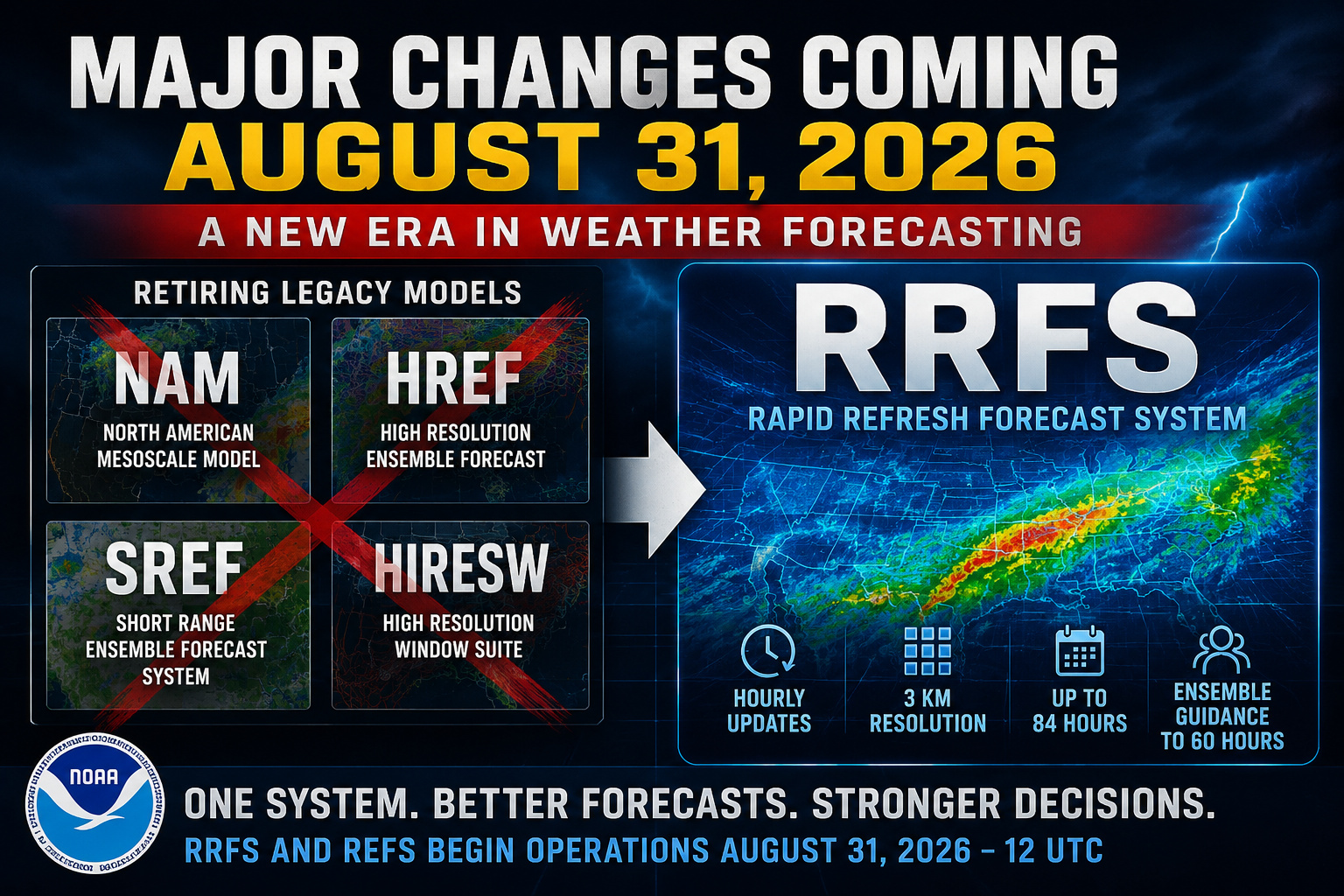
    Major changes are coming to the world of weather forecasting later this year, as the National Weather Service and NOAA prepare to retire several long standing forecast models on August 31, 2026, replacing them with a new generation forecasting system known as the Rapid Refresh Forecast System, or RRFS.

    According to newly released NOAA Service Change Notices, the RRFS and its ensemble counterpart, the RRFS Ensemble Forecast System (REFS), will officially become operational beginning with the 12 UTC model cycle on August 31st. The transition marks one of the largest overhauls to the National Weather Service’s regional forecasting guidance suite in decades.

    The changes will retire several legacy forecasting systems that meteorologists, broadcasters, emergency managers, and weather enthusiasts have relied on for years. Models scheduled for retirement include the North American Mesoscale Model (NAM), the High Resolution Ensemble Forecast (HREF), the Short Range Ensemble Forecast system (SREF), and much of the High Resolution Window guidance suite (HiresW).

    The RRFS is designed to unify many of these forecasting systems into one high resolution platform capable of producing hourly updated forecasts across North America at 3 kilometer resolution. NOAA says the new system will simplify the nation’s convective scale guidance while improving consistency between forecast products.

    The deterministic version of the RRFS will run hourly, with extended forecasts reaching out to 84 hours during the primary 00z, 06z, 12z, and 18z model cycles. Additional hourly updates will extend to 18 hours. Meanwhile, the REFS ensemble system will provide probabilistic guidance out to 60 hours, replacing the HREF system currently used heavily during severe weather and winter storm forecasting.

    https://www.weather.gov/media/notification/pdf_2026/scn26-47_Retirement_of_NAM_SREF_HREF_HiresW_NAM_MOS.pdf

    One notable aspect of the transition is that NOAA plans to eventually phase out additional models, including the widely used RAP and HRRR systems, as future versions of the RRFS mature. While the HRRR is not being retired on August 31st, NOAA researchers have stated the long term goal is for the RRFS framework to ultimately replace legacy regional convection allowing models entirely.

    The move has generated mixed reactions within the meteorological community. Some meteorologists welcome the modernization and unified approach, while others remain cautious about the RRFS performance during severe weather events. Discussions across weather forums and meteorology communities have highlighted concerns regarding convective feedback and supercell handling in earlier experimental RRFS versions.

    Great Discussion by SPC Forecaster Evan Bentley https://x.com/evan_bentley/status/2054544214952665366

    NOAA says the RRFS has undergone extensive testing through multiple national forecast testbeds and collaborative evaluations involving federal agencies, universities, and meteorological partners across the country. Experimental real time data feeds for the RRFS and REFS are expected to become publicly available around June 9th ahead of full operational implementation later this summer.

    For operational meteorologists and weather enthusiasts alike, August 31st will mark the beginning of a major shift in how short range weather forecasting is performed across the United States.

  • Drought Conditions Worsen Across Portions of the Mid-Atlantic Despite Some Recent Rainfall

    Drought Conditions Worsen Across Portions of the Mid-Atlantic Despite Some Recent Rainfall

    The latest update from the U.S. Drought Monitor shows drought conditions continuing across portions of the Mid-Atlantic region, including parts of Maryland’s Eastern Shore, Delaware, New Jersey, and southeastern Pennsylvania, as long-term precipitation deficits continue to impact groundwater, streamflows, and agriculture.

    According to the latest drought information statement issued by the National Weather Service Philadelphia/Mount Holly, severe drought conditions, classified as D2 on the U.S. Drought Monitor scale, remain in place across portions of the region. Moderate drought, or D1 conditions, continue across much of the forecast area, while abnormally dry conditions persist elsewhere.

    The Delmarva Peninsula continues to be one of the more concerning areas in the region. The drought statement noted that drought conditions worsened across portions of Delmarva over the past several weeks with little improvement observed. Maryland has continued its Drought Warning for counties along the Maryland Eastern Shore, while drought watches and warnings also remain in effect for parts of southeastern Pennsylvania and all of New Jersey.

    In Delaware, ongoing dry conditions continue to take a toll on hydrologic conditions statewide. The University of Delaware Climate Office reported that the state has experienced eight consecutive months of below-normal precipitation, leading to rainfall deficits exceeding 11 inches since late summer of last year. Streamflows across portions of the state have dropped to some of the lowest levels ever recorded for this time of year, while groundwater recovery remains sluggish after consecutive dry seasons.

    The broader Mid-Atlantic region has experienced one of its more significant drought episodes in recent decades. The National Integrated Drought Information System noted that the 2024-2025 drought became one of the worst drought periods seen in parts of the Mid-Atlantic in more than two decades, impacting agriculture, water resources, ecosystems, and increasing wildfire concerns.

    Recent rounds of rainfall have provided some temporary relief in isolated areas, but precipitation deficits remain substantial overall. Seven-day average streamflows across much of the Mid-Atlantic continue running below normal, and reservoir levels remain below seasonal averages in several locations.

    Looking ahead, we expect periods of rainfall over the coming week, though it remains uncertain whether enough widespread precipitation will occur to significantly improve long-term drought conditions. Warmer temperatures expected heading deeper into late spring and early summer could also increase evaporation rates and further stress soil moisture across the region.

  • Summerlike Warmth Expected Across Delmarva This Weekend Into Early Next Week

    Summerlike Warmth Expected Across Delmarva This Weekend Into Early Next Week

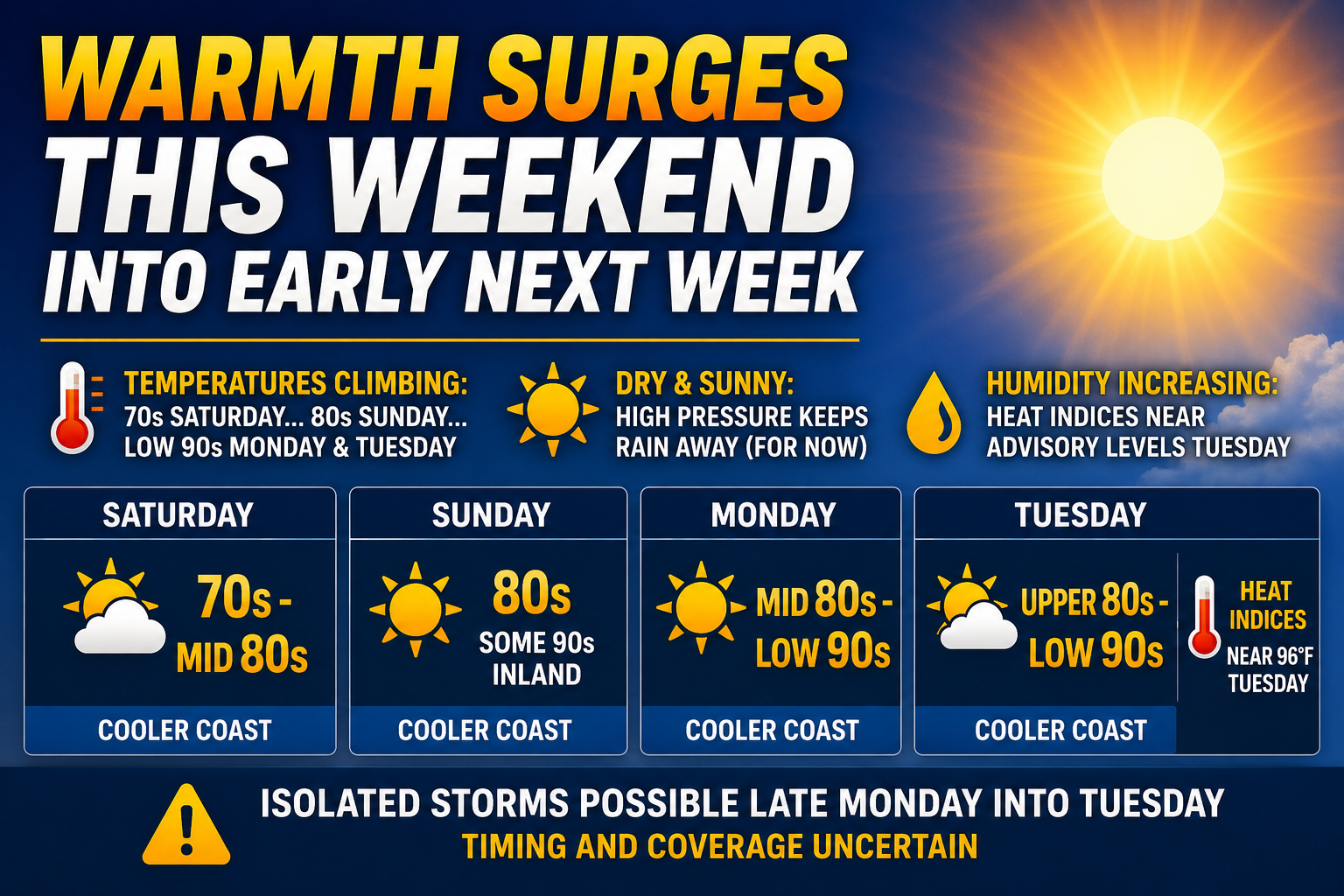
    A significant warmup is on the way for the Delmarva region as a developing ridge of high pressure is forecast to bring summerlike temperatures and increasing humidity through early next week.

    Following the departure of a closed low pressure system to the East Coast on Friday, upper-level ridging is expected to strengthen across the eastern United States through the weekend and into early next week. At the surface, high pressure building over the western Atlantic will help establish a persistent southerly flow, transporting a much warmer air mass into the Mid-Atlantic region.

    Temperatures will begin climbing noticeably on Saturday with highs ranging from the 70s near the coast to the middle 80s inland. By Sunday, widespread 80s are expected across much of Delmarva, with some inland communities potentially approaching the 90-degree mark. Areas along the beaches and immediate coastline will remain somewhat cooler thanks to onshore winds coming off the Atlantic Ocean.

    The heat is forecast to intensify even further Monday and Tuesday. Forecast highs Monday are expected to reach well into the 80s region-wide, while several inland areas could top out in the lower 90s. The warming trend continues Tuesday with highs projected in the upper 80s to lower 90s across much of the region.
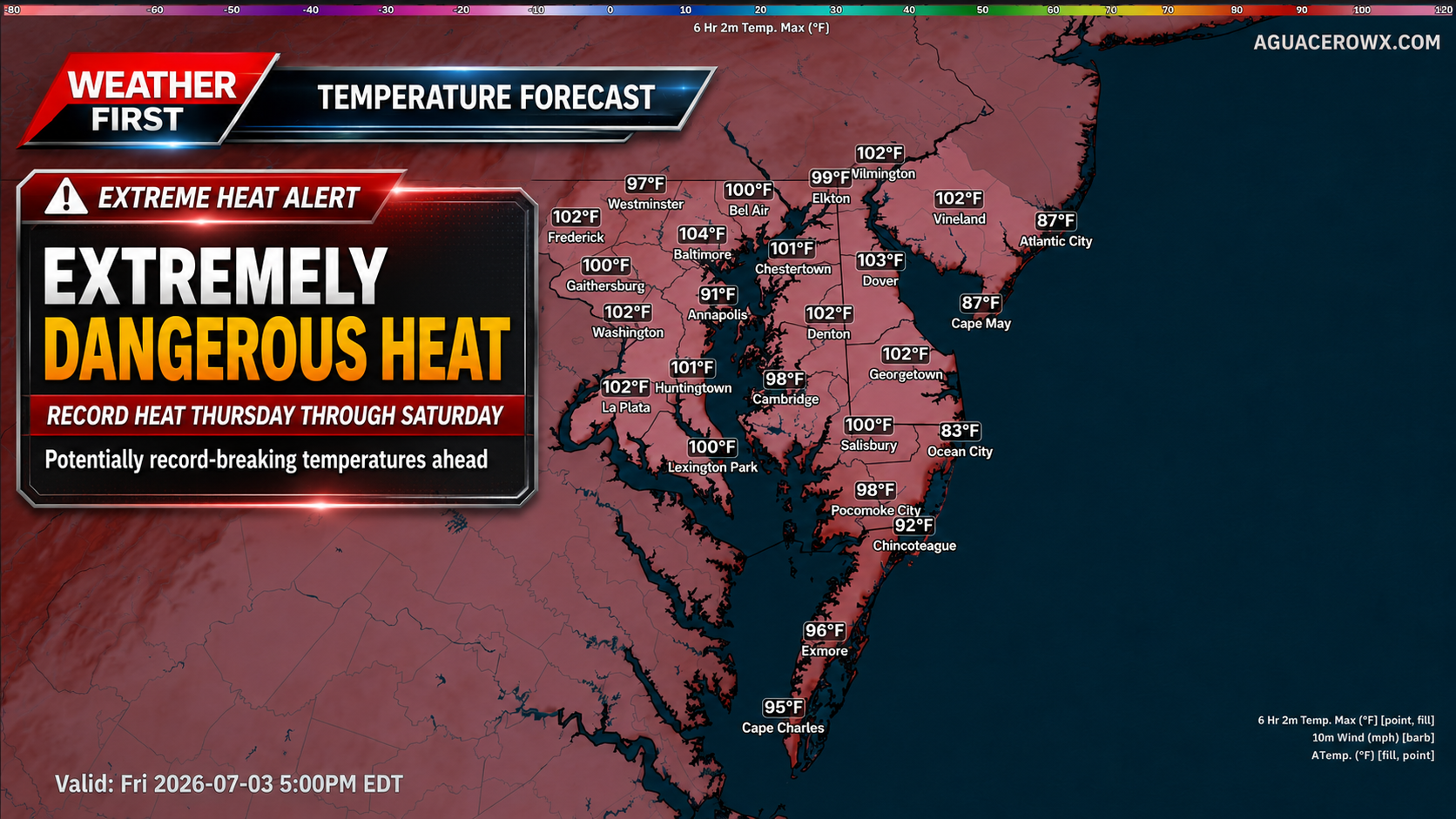
    Humidity levels are also expected to increase as southerly flow strengthens. Surface dew points are forecast to rise into the low to middle 60s Monday and Tuesday, making conditions feel even warmer. Heat index values may climb several degrees above the actual air temperatures, especially in more urbanized areas along the Interstate 95 corridor. Some locations could come close to reaching Heat Advisory criteria by Tuesday afternoon, where heat index values of 96 degrees or higher can trigger advisories during the month of May.

    In addition to the warming temperatures, dry weather is expected to dominate through much of the weekend and into early next week due to the presence of strong high pressure aloft. Forecast guidance currently shows little to no precipitation through Monday for most of the region.

    However, we are monitoring the potential for isolated thunderstorms later Monday into Tuesday as the northwestern edge of the ridge begins to weaken. An approaching upper-level trough and eventual cold front from the west may allow showers and thunderstorms to develop by the middle of next week. The timing and overall coverage of any storms remain uncertain and will depend on how quickly the ridge weakens and how fast the next weather system approaches.

    After a relatively cool and unsettled stretch of weather recently, the upcoming pattern change will deliver the first widespread taste of summer conditions across Delmarva heading into next week.

  • Showers and Isolated Thunderstorms Are Possible Across Delmarva Through Thursday

    Showers and Isolated Thunderstorms Are Possible Across Delmarva Through Thursday

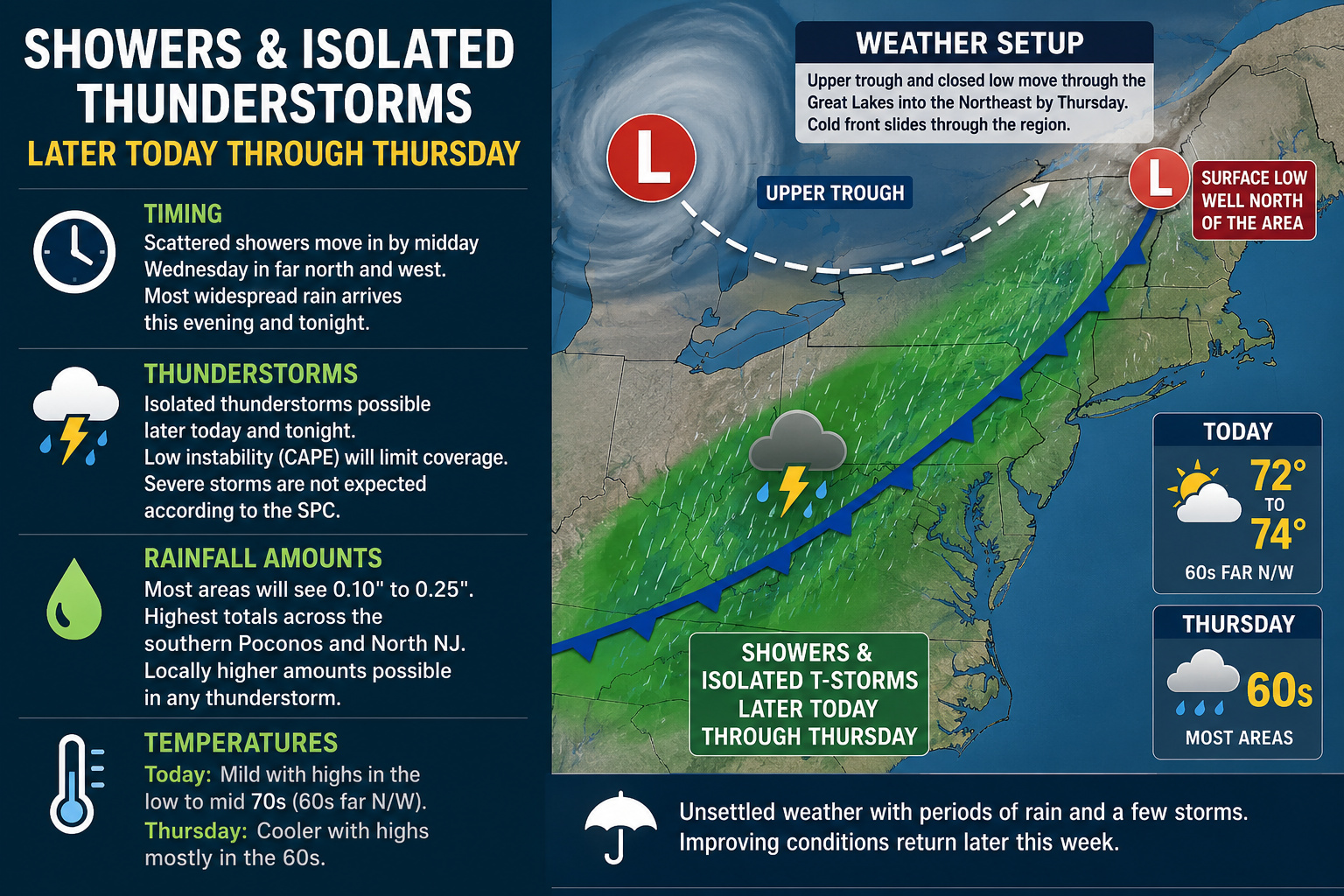
    A stretch of unsettled weather is expected across the Delmarva region beginning later today and continuing through Thursday as an area of low pressure and an approaching cold front move through the eastern United States.

    According to the latest details, an upper-level trough connected to a closed low over central Canada will swing through the Great Lakes and Ohio Valley tonight before settling into the Northeast by Thursday. While the main surface low will remain well north of Delmarva, its associated cold front will cross the region and bring periods of showers along with the chance for a few isolated thunderstorms.

    The timing of rainfall has slowed somewhat compared to earlier expectations. Only scattered showers are expected to begin developing across northern and western portions of the region around midday Wednesday, while the steadier and more widespread rainfall is now expected to hold off until later this evening and overnight.

    Although thunderstorms remain possible later today and tonight, the overall severe weather threat remains very low. Limited atmospheric instability, also known as CAPE, is expected to keep thunderstorm coverage isolated at best. The Storm Prediction Center is not expecting severe thunderstorms across the region during this event.

    Rainfall totals also continue trending lower with most locations expected to receive between one tenth and one quarter of an inch of rain. Locally higher amounts could occur underneath any thunderstorm, but widespread heavy rainfall is not anticipated. The highest rainfall totals are expected farther north across portions of the southern Poconos and northern New Jersey.

    Temperatures ahead of the system will remain seasonably mild today with highs reaching the lower to middle 70s across much of Delmarva, though some far northwestern areas may stay in the 60s. Cooler air arrives behind the cold front on Thursday with daytime highs generally falling back into the 60s region-wide.

    While this system is not expected to produce severe weather, residents should still prepare for periods of wet weather, occasional downpours, and a few rumbles of thunder through Thursday before improving conditions gradually return later in the week.

  • Summer-Like Warmth Expected Across Delmarva This Weekend Into Next Week

    Summer-Like Warmth Expected Across Delmarva This Weekend Into Next Week

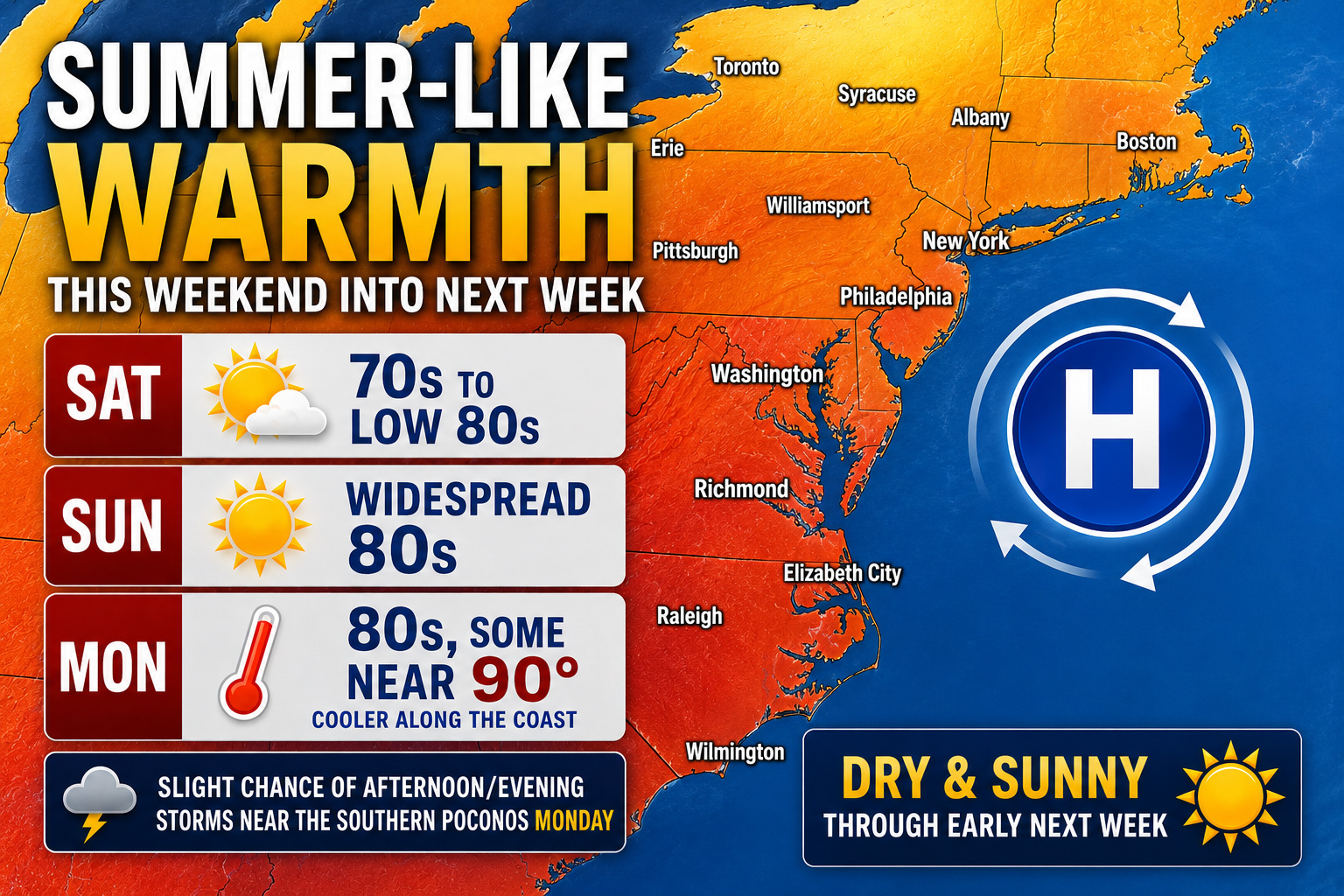
    A major warm-up is expected across the Delmarva region this weekend into early next week as high pressure builds across the eastern United States.

    After cooler and unsettled weather this week, a developing ridge of high pressure and persistent southerly winds will transport much warmer air into the Mid-Atlantic. Temperatures are forecast to climb into the 70s and lower 80s Saturday before widespread 80s arrive Sunday.

    Even warmer conditions are possible Monday, with some inland areas potentially nearing 90 degrees. Coastal communities will likely stay cooler thanks to the influence of the Atlantic Ocean and southerly winds.

    The strengthening ridge is also expected to keep conditions mainly dry through early next week, providing several days of sunshine and summer-like warmth across the region. While a slight chance for isolated thunderstorms may develop near the southern Poconos Monday afternoon, no widespread rainfall is expected across Delmarva.

  • Showers and A Few Thunderstorms Possible Across Delmarva Wednesday Into Thursday

    Showers and A Few Thunderstorms Possible Across Delmarva Wednesday Into Thursday

    A more unsettled weather pattern is expected to return to the Delmarva region during the middle of the week as an upper-level storm system approaches from the west. Showers are expected to increase Wednesday afternoon and continue through Wednesday night, with a few thunderstorms also possible before conditions gradually improve Thursday.

    We are tracking an upper-level trough that is expected to evolve into a closed low over the Mid-Atlantic and Northeast by Thursday. As this system approaches, a warm front lifting northward across the region Wednesday will help increase moisture and atmospheric lift. This setup is expected to lead to showers developing from west to east during the afternoon hours, with the steadiest and most widespread rainfall occurring Wednesday night as a cold front pushes through the area.

    While severe weather is not expected to be a major concern across Delmarva, enough instability may develop to support a few thunderstorms Wednesday afternoon into Wednesday night. The better chance for stronger thunderstorms is expected to remain farther west where instability and wind shear will be greater. However, locally heavy downpours and occasional lightning will still be possible with any thunderstorms that develop locally.

    Rainfall totals are currently forecast to range between around 0.20 and 0.50 inches across much of the region, though isolated higher amounts could occur where more organized showers or thunderstorms develop. The rainfall will provide some beneficial moisture to the region following recent dry conditions, though this does not appear to be a widespread heavy rain event.

    By Thursday, the main cold front and deeper moisture will begin shifting offshore. However, with the closed low potentially moving overhead and colder air aloft lingering across the region, additional scattered showers may redevelop during the day Thursday before the system finally departs later in the day or Thursday night.

    Temperatures will also trend cooler Thursday behind the cold front, with more seasonable conditions expected heading into the end of the week.

  • Taste of Summer Arriving Across Delmarva and the Mid-Atlantic Next Week

    Taste of Summer Arriving Across Delmarva and the Mid-Atlantic Next Week

    After several stretches of cooler and unsettled weather recently, a much warmer pattern is expected to develop across the Mid-Atlantic and Delmarva region heading into this weekend and continuing through much of next week. Forecast guidance is increasingly pointing toward a significant warm up that could bring the first widespread taste of summer-like conditions to the region this season.

    Temperatures are expected to steadily climb beginning this weekend as an upper-level ridge builds across the eastern United States. This pattern shift will allow warmer air from the southern United States to expand northward across much of the East Coast. At the same time, the jet stream is forecast to retreat well north into southern Canada, limiting the delivery of cooler Canadian air masses into the region.

    By Saturday, temperatures across Delmarva are expected to rise into the lower 80s under increasing sunshine. The warmer air mass will continue building Sunday with highs likely reaching the middle 80s in many inland locations. Some traditionally warmer spots could approach the upper 80s by early next week.

    Forecast data from the National Blend of Models continues to show temperatures climbing through much of next week across Sussex County and surrounding areas. High temperatures could approach 90 degrees by Monday and Tuesday if enough sunshine develops. Overnight temperatures are also expected to become increasingly mild with lows rising into the lower to middle 60s, adding to the more summer-like feel.

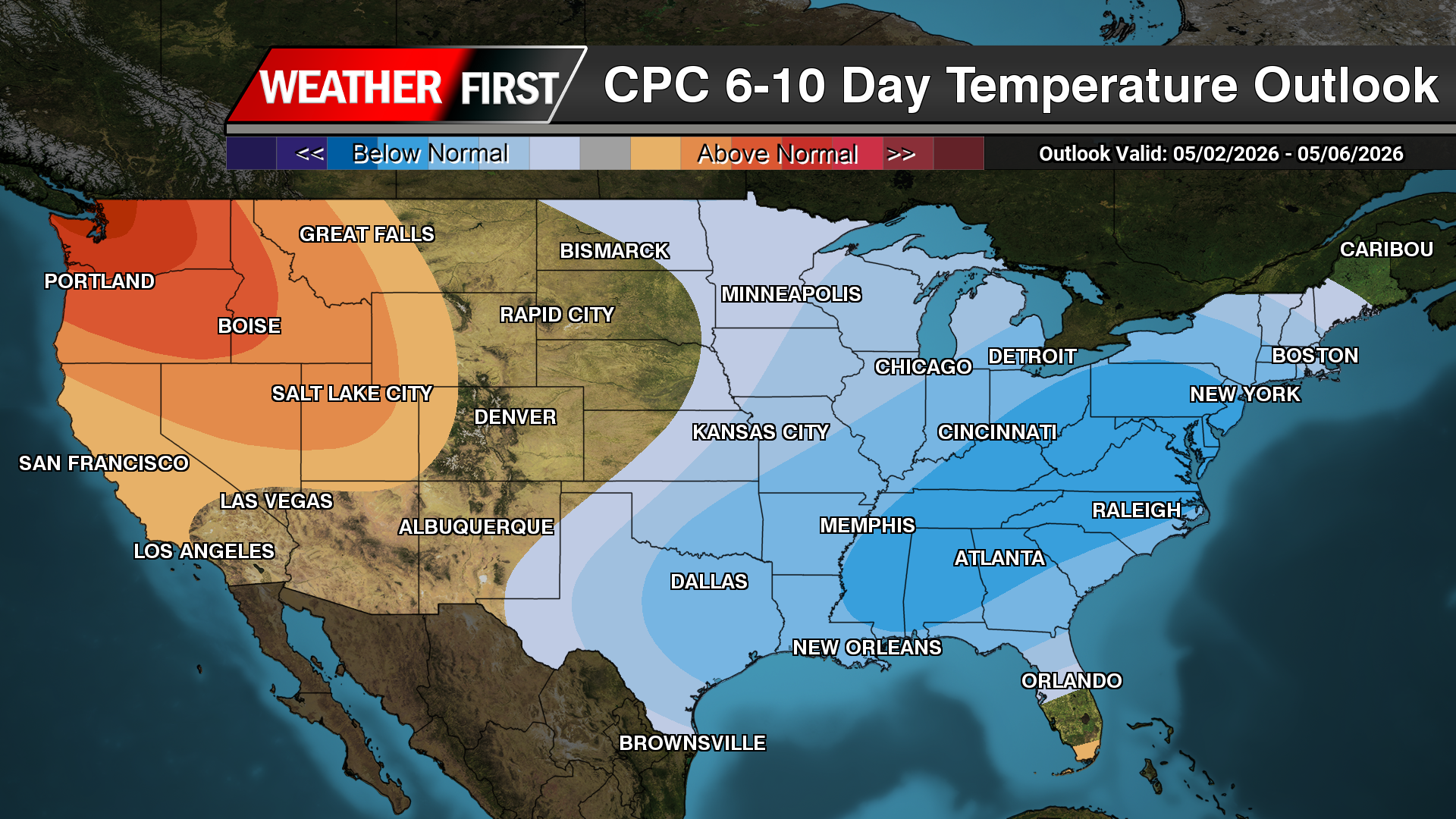
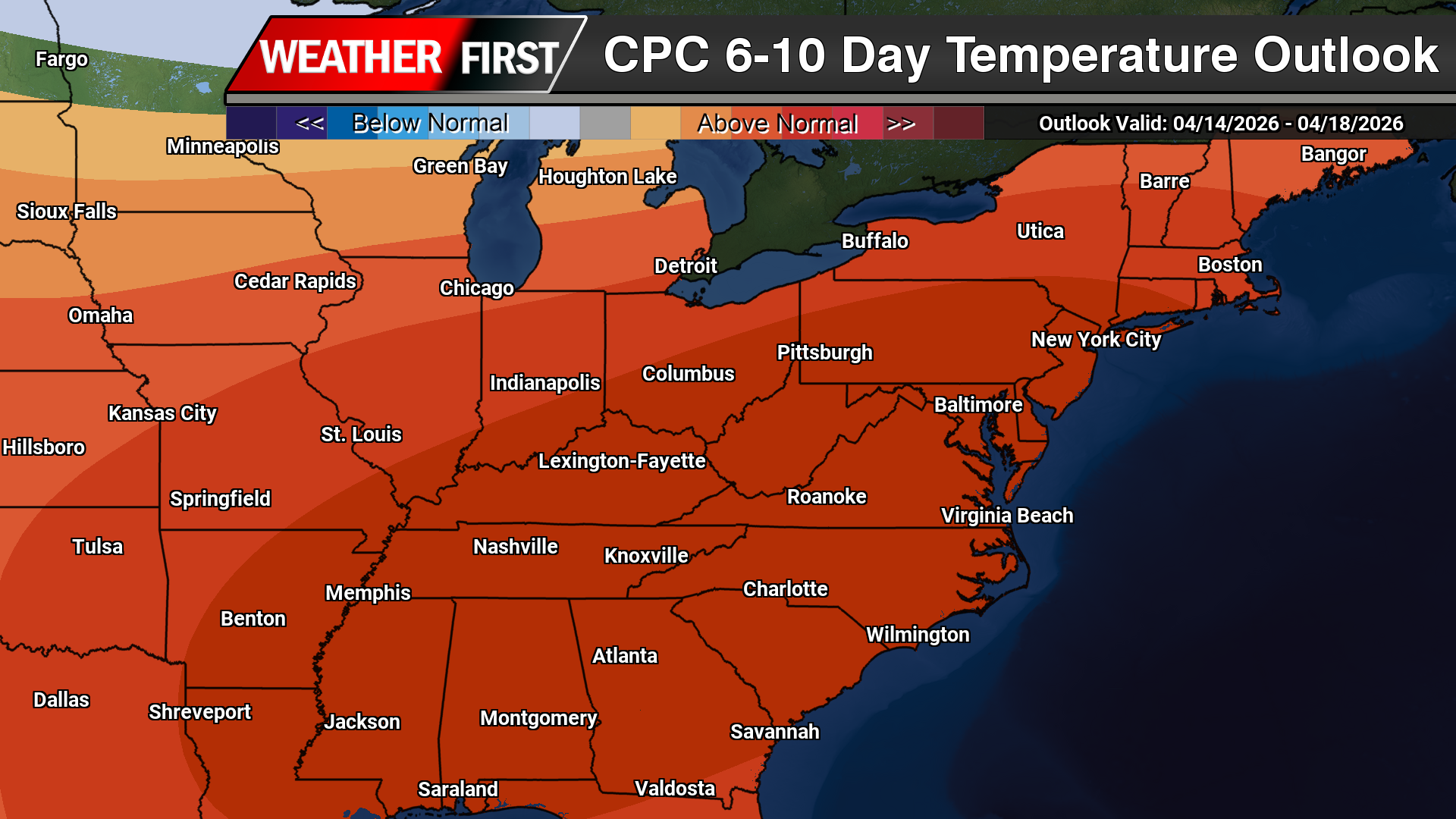
    The large-scale pattern strongly supports above-average temperatures not only locally, but across much of the eastern half of the United States. The latest Climate Prediction Center 6-to-10 day temperature outlook continues to highlight a high probability of above-normal temperatures stretching from the Gulf Coast through the Mid-Atlantic and Northeast.

    Upper-air pattern forecasts also show expanding ridging and higher 500mb heights across the eastern United States during the middle of next week. This is typically associated with warmer and more stable weather conditions, especially during the late spring and summer months.

    While the warmer temperatures will be welcomed by many after recent cool spells, the increasing heat and sunshine may also begin drying out soils once again across portions of the Mid-Atlantic. The region has dealt with periodic dry conditions this spring, and several consecutive warm days could enhance evaporation rates heading deeper into May.

    At this time, the overall pattern suggests the warm conditions may persist through a large portion of next week, although occasional isolated showers or thunderstorms cannot be ruled out during the afternoons as humidity gradually increases.

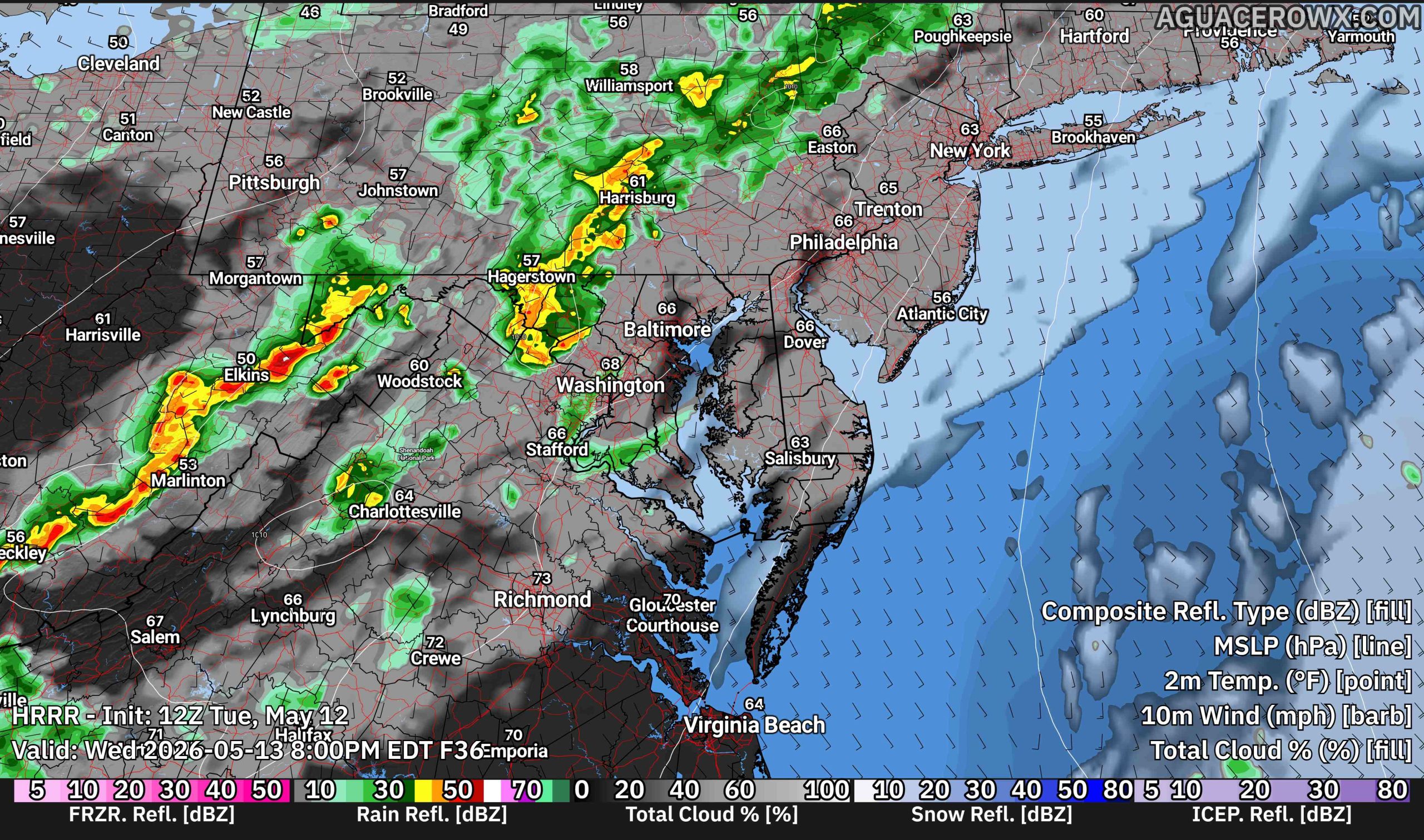
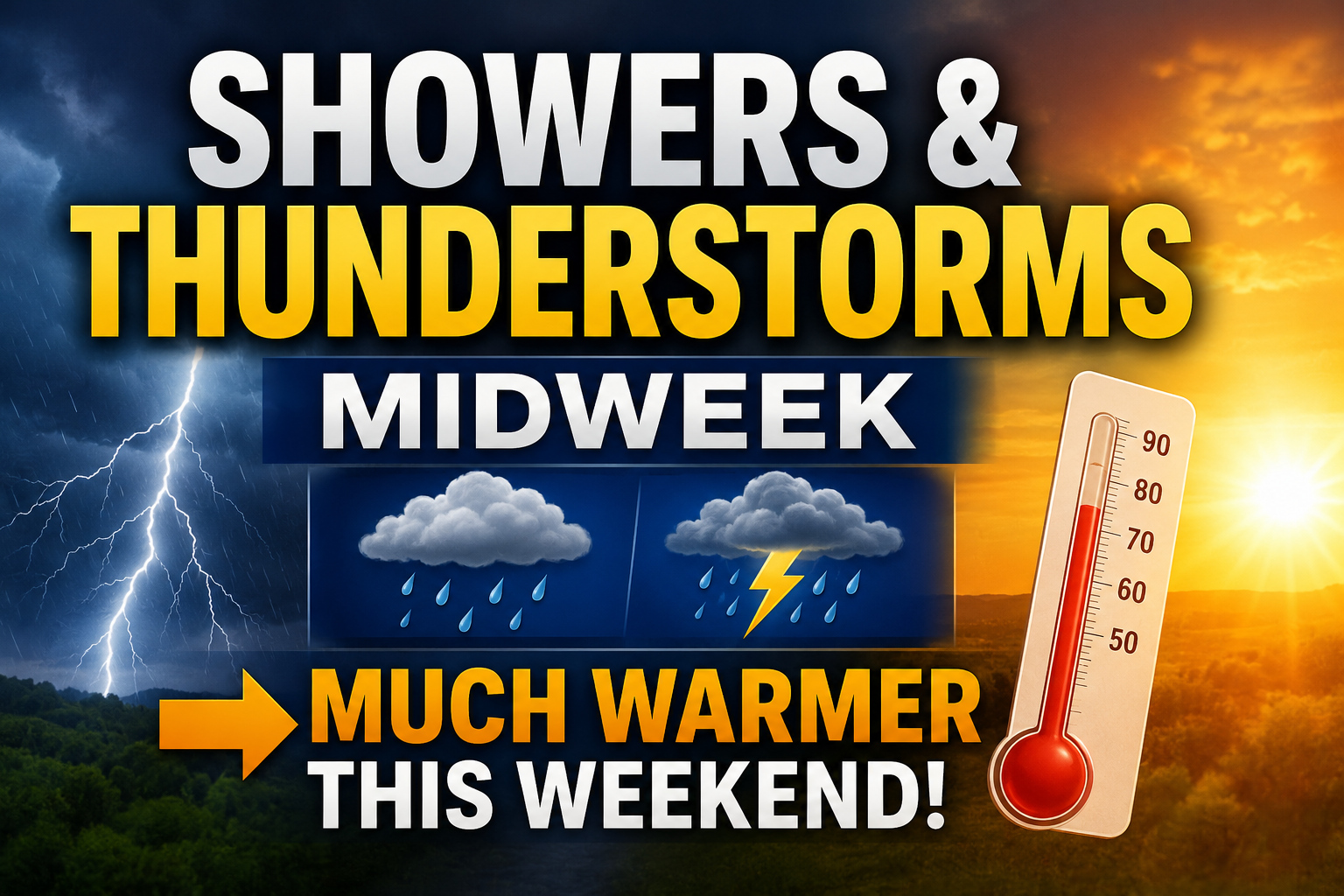
  • Showers and Thunderstorms Expected Midweek Before Much Warmer Weather Arrives This Weekend

    Showers and Thunderstorms Expected Midweek Before Much Warmer Weather Arrives This Weekend

    A more active weather pattern is expected to develop across the Mid-Atlantic and Delmarva region during the middle of the week as a strengthening upper-level storm system moves into the eastern United States. The unsettled conditions are expected to bring a round of showers and potentially a few thunderstorms Wednesday afternoon through Wednesday night before a much warmer and drier pattern takes hold heading into the weekend.

    We are closely monitoring an amplified upper-level weather pattern that will evolve over the next several days. High pressure currently influencing the region will shift offshore by Tuesday, allowing warmer and more humid air to begin moving northward into the Mid-Atlantic. At the same time, another upper-level trough will dig into the eastern United States Wednesday into Thursday.

    There remains some uncertainty regarding exactly how the system evolves. Some forecast guidance, particularly the European ECMWF model, continues to suggest the upper-level trough could close off into a stronger upper-level low over the Mid-Atlantic and Northeast. Other guidance keeps the system more progressive and open as it moves through the region. Regardless of the exact setup, confidence is increasing that widespread showers will develop Wednesday afternoon and continue into Wednesday night as a trough and cold front move across the area.

    Ahead of the approaching system, increasing low-level warm air advection and strengthening winds aloft will help enhance atmospheric lift across the region. A warm front is also expected to lift northward through the area Wednesday, further supporting the development of showers and scattered thunderstorms.

    Rain is expected to overspread the region from west to east during the day Wednesday, with the steadiest and most widespread activity likely occurring Wednesday evening and overnight as the cold front approaches. While widespread severe weather is not anticipated at this time, enough atmospheric instability may develop to support a few thunderstorms capable of producing locally gusty winds. The overall intensity of any thunderstorms will depend on how much instability can build ahead of the front during the afternoon and evening hours.

    By Thursday, the main area of rain and thunderstorms should shift offshore. However, if the upper-level low closes off as some guidance suggests, colder air aloft moving overhead could spark additional scattered showers Thursday afternoon and potentially linger into Friday before the system fully departs.

    Conditions are expected to improve significantly heading into the weekend as the upper-level trough lifts away and a ridge of high pressure begins building into the eastern United States. This will allow a much warmer and drier air mass to overspread the Mid-Atlantic and Delmarva region. Temperatures are expected to climb well above average by the weekend with increasing sunshine and more favorable outdoor conditions returning.

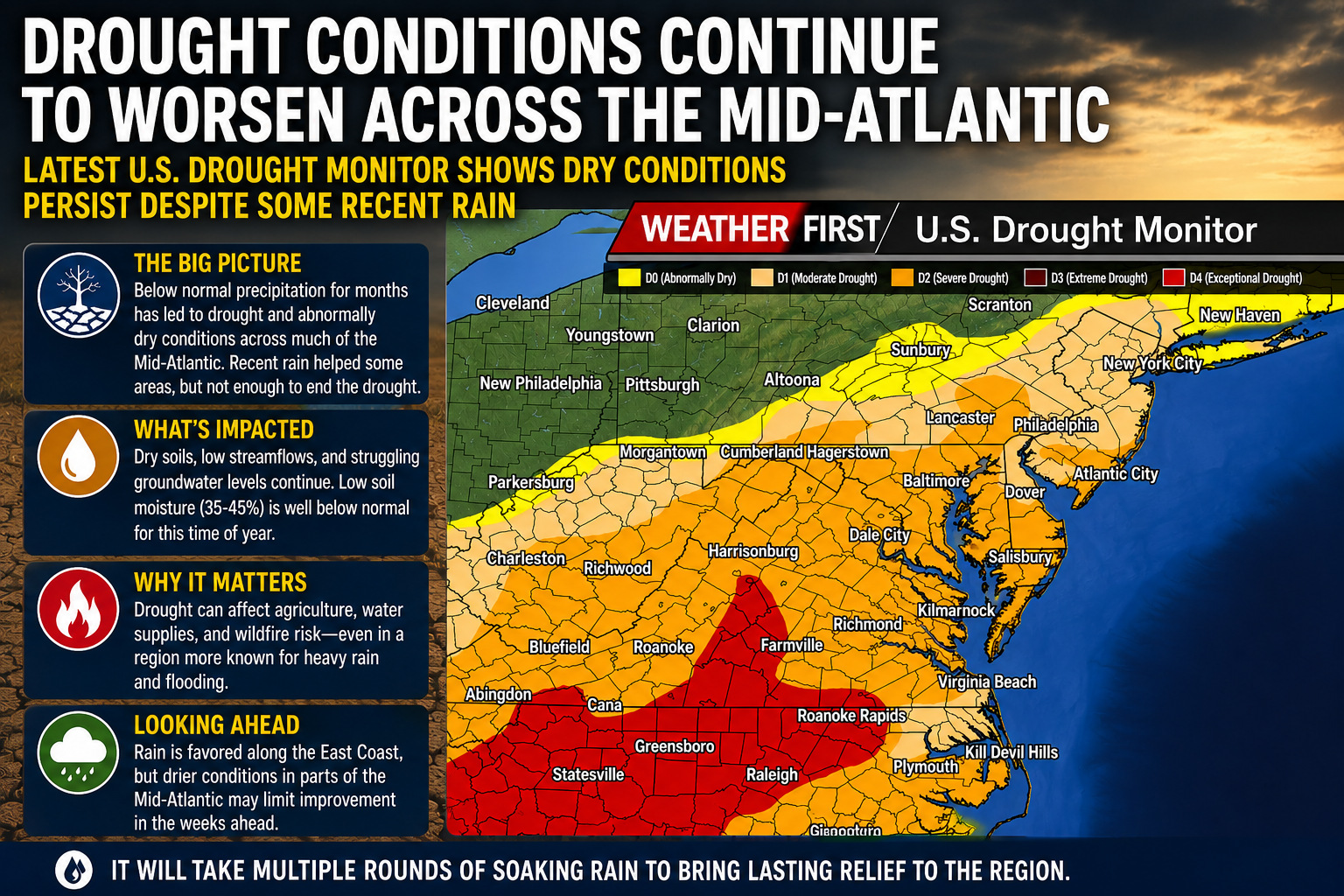
  • Drought Conditions Worsen Across Parts of the Mid Atlantic Despite Some Recent Rain

    Drought Conditions Worsen Across Parts of the Mid Atlantic Despite Some Recent Rain

    The latest U.S. Drought Monitor shows drought and abnormally dry conditions continuing across parts of the Mid Atlantic this week, with recent rainfall helping in some areas but not enough to erase longer term precipitation deficits.

    The national drought summary released May 5 noted that light to moderate precipitation moved across the Northeast during the past week. However, rainfall was uneven across the region. The highest totals fell farther north into Maine, while many drought affected areas of the Mid Atlantic and southern New England received less than a half inch of rain. Cooler than average temperatures helped reduce evaporation rates, which limited more widespread drought expansion.

    For the Mid Atlantic, the main issue remains the lack of consistent, soaking rainfall. While occasional showers have moved through the region, many areas continue to deal with dry soils, reduced streamflows and lingering hydrologic stress from months of below normal precipitation.

    Delaware remains one of the areas closely being monitored. The Delaware Climate Office reported that precipitation has continued to lag statewide, with eight consecutive months of below normal precipitation going back to last fall. The office also noted that streamflows are down statewide, groundwater continues to struggle to recover, and warmer early season temperatures have increased evapotranspiration, leading to greater water loss from the environment.

    Soil moisture has also become a growing concern. According to the Delaware Climate Office, Delaware and much of the Mid Atlantic are experiencing low soil moisture values for this time of year. Soil moisture statewide was estimated in the 35 to 45 percent range, well below the typical 55 to 70 percent range expected during this part of the spring.

    The dry pattern has important implications as the growing season continues. Early season crops, lawns, gardens and natural vegetation can become increasingly vulnerable when rainfall remains inconsistent. Dry fine fuels, including grasses, leaves and brush, can also increase the risk for rapid fire spread during periods of low humidity and gusty winds.

    Drought.gov notes that drought in the Mid Atlantic can affect agriculture, water resources and wildfire risk, even though the region is often more commonly associated with flooding and heavy precipitation events. The Mid Atlantic Drought Early Warning System covers Delaware, Maryland, New Jersey, Pennsylvania, Virginia, West Virginia and Washington, D.C., helping coordinate drought monitoring and response across the region.

    Looking ahead, the U.S. Drought Monitor outlook section indicates that precipitation is favored along the Ohio Valley and much of the eastern seaboard, with the best potential for drought relief farther north into the Northeast. However, somewhat drier conditions across portions of the Mid Atlantic may limit meaningful improvement in drought conditions.

    For Delmarva and nearby portions of the Mid Atlantic, the message remains the same: periodic rain chances may offer short term help, but it will likely take multiple rounds of widespread, soaking rainfall to bring lasting improvement to soil moisture, streamflows and groundwater levels.

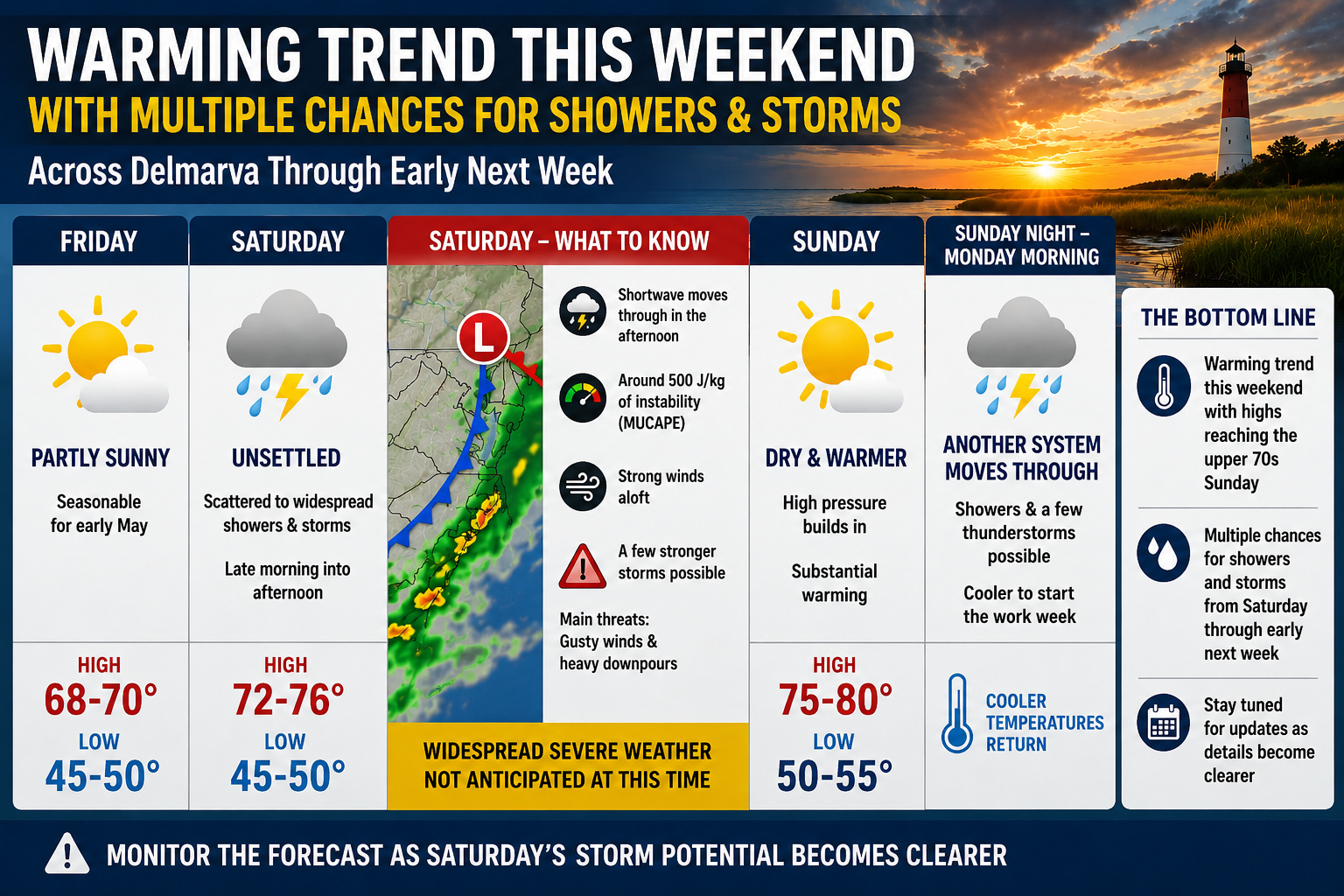
  • Warming Trend Expected Across Delmarva This Weekend With Multiple Shower and Storm Chances

    Warming Trend Expected Across Delmarva This Weekend With Multiple Shower and Storm Chances

    A gradual warming trend is expected to develop across the Delmarva region this weekend, though the warmer temperatures will come alongside several opportunities for showers and thunderstorms through early next week.

    Temperatures through Saturday are expected to remain seasonable for early May, with afternoon highs generally in the upper 60s to near 70 degrees and overnight lows ranging from the mid 40s to low 50s.

    The weather pattern is forecast to become increasingly unsettled beginning Saturday as an upper level disturbance moves across the Mid Atlantic during the afternoon hours. An associated area of low pressure tracking north of the region will drag a cold front through Delmarva, likely triggering scattered to potentially widespread showers and thunderstorms from late Saturday morning into Saturday afternoon.

    Forecast models indicate modest atmospheric instability developing ahead of the front, with around 500 J/kg of elevated instability forecast across portions of the region. In addition, stronger winds aloft may help organize some of the storms. While widespread severe weather is not currently expected, forecasters say a few stronger thunderstorms cannot be ruled out as the system approaches.

    At this time, the primary threats with any stronger storms would likely be gusty winds and brief heavy downpours, though confidence in the overall storm intensity remains somewhat limited.

    Conditions are expected to improve Saturday night into Sunday as the disturbance exits the region and high pressure briefly builds overhead. This setup should provide mainly dry weather for much of Sunday while also allowing significantly warmer air to surge northward into the region.

    High temperatures Sunday are forecast to climb into the upper 70s across much of Delmarva, and a few inland locations could approach the 80 degree mark if enough sunshine develops during the afternoon.

    The warmer weather may be short lived, however, as another area of low pressure and its accompanying cold front are expected to move through the region Sunday night into Monday morning. This next system could bring another round of showers and thunderstorms before cooler temperatures return to begin the new work week.

    Despite the active weather pattern, no widespread hazardous weather is anticipated at this time. However, residents are encouraged to continue monitoring the forecast through the weekend as details regarding Saturday’s thunderstorm potential become clearer.

  • Unsettled Pattern Continues Across Delmarva Through Weekend as Temperatures Gradually Warm

    Unsettled Pattern Continues Across Delmarva Through Weekend as Temperatures Gradually Warm

    An unsettled weather pattern will continue across the Delmarva region through the upcoming weekend, bringing occasional chances for rain along with a gradual warming trend by the end of the weekend.

    Following a cold front moving through Wednesday night into early Thursday, another weak area of low pressure is expected to develop along the stalled boundary just south of the region. This system may bring additional light rain to parts of Delmarva and southern New Jersey Thursday morning, although recent forecast trends have shifted the system slightly farther south, reducing overall rainfall coverage.

    Outside of any lingering showers, Thursday will feel noticeably cooler for early May standards. Afternoon temperatures are expected to remain mainly in the 60s under mostly cloudy skies and a cooler northerly flow.

    Conditions improve briefly on Friday as high pressure builds into the Mid Atlantic. This should allow for drier weather and at least partial sunshine across much of the region before the next systems arrive over the weekend.

    We are monitoring additional weak disturbances that could bring scattered showers back into the forecast for Saturday and again later Sunday. At this time, these systems appear relatively weak and are not expected to produce significant impacts. Instead, they may simply act as occasional interruptions to outdoor plans during the weekend.

    Temperatures will begin moderating Saturday with highs reaching the 60s to lower 70s across much of Delmarva. A more noticeable warmup is expected by Sunday as highs climb into the 70s, with some inland locations potentially nearing 80 degrees if enough sunshine develops.

    Despite the periodic shower chances, no severe weather or flooding concerns are anticipated at this time. Overall, the pattern favors generally light precipitation and seasonable to slightly below average temperatures before warmer air returns by the end of the weekend.

  • Potential Strong El Niño Developing in Pacific Could Reshape Global Weather Patterns

    Potential Strong El Niño Developing in Pacific Could Reshape Global Weather Patterns

    A developing El Niño signal across the Pacific Ocean is gaining attention from forecasters, with new data from the Climate Prediction Center and the European Centre for Medium-Range Weather Forecasts suggesting the potential for a strong event later this year.

    Current observations show warming sea surface temperatures across the central and eastern equatorial Pacific, a key indicator that El Niño conditions are beginning to take shape. Forecast guidance from the Climate Prediction Center indicates a high likelihood of El Niño developing by summer, with increasing confidence that it could persist and strengthen into the fall and winter months.

    The European Centre for Medium-Range Weather Forecasts supports this trend, with seasonal model output pointing toward continued ocean warming through the second half of the year. Some ensemble members suggest sea surface temperature anomalies in the Niño 3.4 region could exceed 2 degrees Celsius, which would place this event in the strong category if realized.

    El Niño occurs when warmer than average ocean water develops across the tropical Pacific, disrupting normal atmospheric circulation patterns. This shift alters the jet stream and can influence weather across much of the globe, including North America.

    For the United States, a strong El Niño typically shifts the jet stream farther south. This pattern often results in wetter conditions across the southern tier of the country and can bring more active storm tracks across parts of the East. In contrast, northern areas may trend milder overall.

    Another important impact is on the Atlantic hurricane season. El Niño tends to increase wind shear across the Atlantic Basin, which can suppress tropical development and reduce the number of storms.

    Globally, strong El Niño events are often associated with above average temperatures and an increased risk of extreme weather events, including flooding in some regions and drought in others.

    For the Delmarva region, the most noticeable impacts typically arrive during the late fall and winter months when El Niño reaches peak intensity. This can influence storm tracks and precipitation patterns, though exact local impacts vary depending on how the pattern evolves.

    Forecasters caution that uncertainty remains, especially during the spring when long range predictions are more challenging due to what is known as the spring predictability barrier. However, the agreement among multiple climate models and ongoing ocean warming signals suggest that a significant El Niño event is increasingly possible.

    We will continue to monitor conditions across the Pacific in the coming months as the strength and impacts of this developing pattern become clearer.

  • Midweek Rain Brings Beneficial Showers to Delmarva, Minimal Impacts Expected

    Midweek Rain Brings Beneficial Showers to Delmarva, Minimal Impacts Expected

    A series of weak weather systems will bring periods of showers to the Delmarva region from Wednesday into Thursday, delivering much-needed rainfall without significant impacts.

    The first system arrives as a cold front approaches from the Great Lakes late Tuesday night, with showers beginning to develop early Wednesday. The steadiest rainfall is expected during the midday hours Wednesday as the front moves into the region. However, the boundary is forecast to stall near or just east of the area, setting the stage for additional development along the coast.
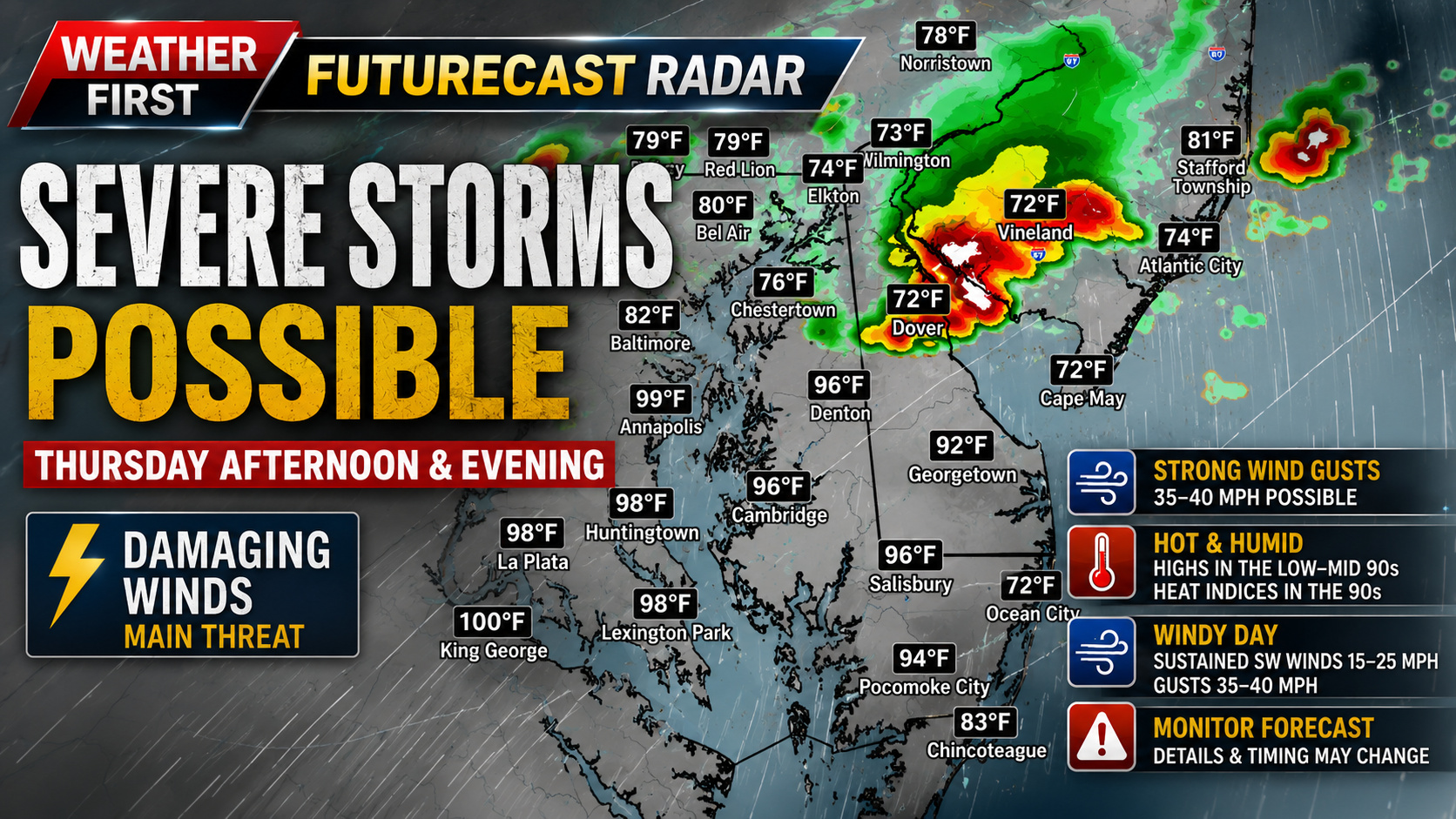
    A secondary area of low pressure is expected to form over the Southeast and track northeast along the stalled front toward the Mid-Atlantic coastline. Recent forecast trends have shifted this system slightly farther south and east, which will likely limit rainfall coverage across inland areas. As a result, the highest rain chances, around 50 to 70 percent, are expected across southern and eastern portions of Delmarva and into southern New Jersey. Areas north and west of the Interstate 95 corridor may see more limited coverage, with chances closer to 20 to 40 percent.

    Rainfall totals have also trended lower with this shift in track. Most locations are expected to receive around a half inch of rain, with isolated areas potentially approaching one inch. The probability of exceeding one inch has decreased significantly, now generally below 10 percent across most of the region, with only localized higher chances in far southeastern Delmarva and coastal New Jersey.

    Despite the presence of multiple systems, atmospheric conditions are not favorable for severe weather. Limited instability is expected, keeping the risk for strong thunderstorms and flooding very low. However, an isolated thunderstorm cannot be ruled out.

    Overall, the rainfall is expected to be beneficial, helping to ease dry conditions across parts of the region without bringing hazardous weather.

    Looking ahead to the weekend, another weak system may approach on Saturday. This system could bring additional scattered showers, but at this time, it appears to be a minor disturbance with no significant impacts expected beyond a potential interruption to outdoor plans.

  • Elevated Fire Danger Across Delaware and Southern New Jersey Today

    Elevated Fire Danger Across Delaware and Southern New Jersey Today

    An elevated risk for fire spread is in place across Delaware and portions of central and southern New Jersey today as a combination of dry air, warm temperatures, and gusty winds creates conditions favorable for rapid fire growth.

    According to the latest forecast, relative humidity values are expected to fall to around 25 to 30 percent this afternoon. At the same time, temperatures will climb into the 80s, while southwest winds increase to 15 to 20 mph with gusts reaching up to 30 mph. This combination of low humidity and strong winds significantly enhances the potential for any fires that develop to spread quickly and become difficult to contain.

    The setup is driven by a dry air mass and efficient boundary layer mixing, allowing stronger winds aloft to transfer down to the surface. The resulting environment promotes rapid drying of fine fuels such as grasses and leaf litter, which are especially susceptible to ignition and fast-moving fire behavior.

    Fire officials emphasize that even a small spark could lead to a rapidly spreading wildfire under these conditions. Outdoor burning is strongly discouraged across the region. Residents are urged to properly dispose of smoking materials and to use caution when operating equipment such as lawn mowers or other machinery that could generate sparks.

    Conditions are expected to improve later this evening as winds begin to diminish and relative humidity values recover, reducing the overall fire danger heading into the overnight hours.

    This elevated fire risk assessment accounts for current meteorological conditions as well as fuel dryness and land characteristics, and has been issued in coordination with state fire management officials.

  • Beneficial Rain Arrives Midweek Across Delmarva, Southern New Jersey, and Maryland Western Shore

    Beneficial Rain Arrives Midweek Across Delmarva, Southern New Jersey, and Maryland Western Shore

    A multi-day stretch of unsettled weather is expected to bring periods of rain across the Delmarva Peninsula, southern New Jersey, and the Maryland Western Shore from late Tuesday night through Thursday, followed by the chance for a few additional showers heading into the weekend.

    High pressure will remain in control through much of Tuesday, keeping conditions mainly dry across the region. However, a cold front dropping southeast from the Great Lakes will begin to approach by late Tuesday. While most locations stay dry during the day, a few isolated showers cannot be ruled out Tuesday evening into the overnight hours, especially toward the northern portions of the coverage area including southern New Jersey and the Maryland Western Shore.

    The more widespread rainfall arrives late Tuesday night into Wednesday morning as the cold front pushes into the region. Rain is expected to continue through much of Wednesday across Delmarva, southern New Jersey, and the Maryland Western Shore. By Thursday, the front is forecast to stall nearby, allowing a wave of low pressure to track along it and prolong the period of unsettled weather with additional rounds of rain.

    Despite the extended duration of precipitation, this setup is not expected to bring significant severe weather or flooding concerns. Atmospheric instability remains limited, which should keep any thunderstorm activity isolated and non-severe. Rainfall totals will vary, but there is roughly a 15 to 30 percent chance of seeing at least one inch of rain across Delmarva, with slightly higher probabilities closer to southern New Jersey and the Maryland Western Shore. Given the ongoing dry conditions across the region, this rainfall is expected to be largely beneficial, helping to ease developing drought concerns.

    Looking ahead to the weekend, a weaker system may bring scattered light showers on Saturday. At this point, impacts appear minimal, though it could interrupt outdoor plans briefly. Overall, the pattern favors a welcome stretch of much-needed rainfall before quieter conditions return.

  • Elevated Fire Danger Threat Develops Sunday Across Delmarva

    Elevated Fire Danger Threat Develops Sunday Across Delmarva

    An increased risk for fire spread is expected to develop across the Delmarva region on Sunday as a dry and breezy weather pattern takes hold behind a departing offshore storm system.

    As the coastal low pulls farther out to sea, high pressure will begin building in from the southeastern United States. This setup will tighten the pressure gradient locally, leading to a strengthening northwest wind across the region. At the same time, the atmosphere is expected to mix deeply during the day, allowing very dry air from aloft to be transported down to the surface.

    Forecast soundings indicate an unusually deep mixed layer for this time of year, potentially extending up to around 700 mb. This efficient vertical mixing will help drive down dew points more than typical model guidance suggests, especially given the tendency for models to overestimate moisture in springtime patterns like this. As a result, relative humidity values are expected to fall to around or below 30 percent during the afternoon hours.

    Even though temperatures will run slightly below average, generally about 5 to 10 degrees cooler than normal, the combination of dry air and increasing winds will create an environment supportive of fire growth. Wind gusts are expected to reach 20 mph or higher at times, which, when combined with low humidity, can allow any fires that ignite to spread quickly.

    The overall fire risk will ultimately depend on the condition of local fuels, but given the recent dry stretch across parts of the region, the potential for rapid fire spread cannot be ruled out. Residents are urged to avoid outdoor burning and to exercise caution with any activities that could produce sparks.

    Conditions are expected to improve later Sunday evening as winds begin to diminish and humidity levels recover.

  • Coastal Low Trend Shifts East, Limiting Rain Potential for Inland Delmarva

    Coastal Low Trend Shifts East, Limiting Rain Potential for Inland Delmarva

    A developing offshore storm system expected to impact the Mid-Atlantic this Saturday is showing signs of shifting farther east, a trend that could significantly reduce rainfall chances for inland areas of the Delmarva Peninsula.

    Latest model guidance from the 00Z cycle indicates a subtle but important eastward adjustment in the track of the coastal low. If this trend holds, the bulk of the precipitation shield would remain offshore, with only coastal counties seeing measurable rainfall. Areas farther inland, including much of central and western Delmarva, may end up largely dry.

    Despite this shift, forecast confidence remains somewhat limited given that this is a relatively recent trend in the guidance. Current forecasts still maintain at least a chance of showers extending as far west as the I-95 corridor, reflecting a blend of solutions that have not fully locked in on the more offshore track.

    In addition to reduced rain chances inland, this eastward shift has implications for wind impacts as well. With the strongest pressure gradient now expected to remain offshore, wind speeds across Delmarva on Saturday may be lighter than previously anticipated. Earlier projections suggested a breezier day, but current trends point toward more modest wind conditions, especially away from the immediate coastline.

  • Drought Conditions Persist Across Mid-Atlantic, Severe Impacts Continue in Maryland and Delmarva

    Drought Conditions Persist Across Mid-Atlantic, Severe Impacts Continue in Maryland and Delmarva

    Drought conditions continue to grip much of the Mid-Atlantic region as we move deeper into spring, with little relief in sight despite occasional rainfall events.

    According to the latest U.S. Drought Monitor, much of the region remains under some level of drought or abnormal dryness, driven by persistent precipitation deficits over the past several months. Many areas across the Mid-Atlantic have seen rainfall totals running well below normal, with deficits ranging several inches over the past 30 to 60 days.

    Maryland and Delmarva Remain a Focus

    The most concerning conditions continue across Maryland and the Delmarva Peninsula. Recent data shows a large portion of Maryland is experiencing moderate to severe drought, with millions of residents impacted.

    On the Eastern Shore and across Delmarva, drought conditions have intensified enough to trigger official drought warnings in some areas, reflecting worsening soil moisture, groundwater concerns, and ongoing precipitation shortfalls.

    In Delaware specifically, the situation has been driven by a prolonged stretch of dry weather. March marked the eighth consecutive month of below-normal precipitation, and April has continued that trend, with rainfall totals running well below average statewide.

    Wider Mid-Atlantic Overview

    Across the broader Mid-Atlantic region, drought conditions have fluctuated week to week, but the overall trend remains concerning. While there have been minor improvements in some areas, moderate drought (D1) still persists and has even expanded in pockets due to continued dryness and limited meaningful rainfall.

    This ongoing dryness follows what has been described as one of the more significant drought stretches in recent decades for parts of the region, with impacts extending across agriculture, water resources, and ecosystems.

    Impacts Being Felt Now

    The effects of the drought are already being felt across the region:

    • Agriculture: Crop stress and delayed planting concerns are increasing, with some counties already receiving federal drought disaster designations.
    • Water Resources: Rivers and streams, including portions of the Potomac River basin, are running at unusually low levels for this time of year, raising concerns heading into summer.
    • Soil Moisture: Continued deficits are leading to dry soils, increasing fire risk and reducing the effectiveness of light rainfall events

    Looking Ahead

    While periodic systems may bring some rainfall in the coming weeks, widespread drought relief will likely require multiple soaking rain events over an extended period. With temperatures expected to trend warmer at times, evaporation rates could further limit the effectiveness of incoming precipitation.

    For now, the Mid-Atlantic remains locked in a pattern that favors continued drought concerns, especially across Maryland and the Delmarva Peninsula, where conditions are among the most significant in the region.

  • Coastal Low Brings Chilly, Showery Weekend to Delmarva

    Coastal Low Brings Chilly, Showery Weekend to Delmarva

    A pair of low pressure systems will impact the Delmarva region from Friday night through the weekend, bringing periods of light rain, gusty onshore flow, and a return to below-average temperatures.

    The first system, a weak area of low pressure, is expected to pass through the region Friday night. This will deliver a quick shot of light precipitation, with most areas seeing minimal rainfall totals. Impacts from this initial system appear limited, but it sets the stage for a more complex setup heading into Saturday.

    Attention then turns to a stronger system developing to the south. A deep upper-level trough digging across the Midwest and Gulf Coast states will help spawn a more organized area of low pressure over the southeastern United States. This system is forecast to lift north toward the Mid-Atlantic during the day Saturday before tracking offshore by Saturday night into Sunday.

    For Delmarva, this track is critical. Current trends suggest the heaviest rainfall will remain offshore, particularly east of the coastline. However, wraparound moisture on the backside of the system will likely spread clouds and occasional rain back into the region, especially across Delaware and far southeastern New Jersey where rain chances are highest.

    While this will not be a washout for most, periods of light rain and persistent cloud cover are expected through at least part of the weekend. The combination of onshore flow and thick cloud cover will also keep temperatures suppressed, with highs generally stuck in the 50s to low 60s, well below late-April normals.

    Overall, the weekend will feature more clouds than sun, with occasional showers and a cool, damp feel. While beneficial rainfall is possible in spots, the bulk of the system’s moisture is expected to remain just offshore, limiting more widespread or heavier totals across the region.

  • Uncertainty Remains as Weekend Coastal Storm To Bring Rain To Delmarva

    Uncertainty Remains as Weekend Coastal Storm To Bring Rain To Delmarva

    A developing coastal storm system could bring a period of rain to the Delmarva region on Saturday, though uncertainty remains regarding how widespread the impacts will be.

    The setup involves a large, closed upper-level low lingering across southeastern Canada, with a stronger disturbance rotating around its base from the Ohio Valley into the Mid-Atlantic. This feature is expected to help generate an area of low pressure near or just south of the region. However, forecast models continue to differ on exactly where this surface low will track and how strong it becomes.

    Some guidance like the ECMWF suggests a stronger system tracking farther north, which would spread a steady shield of rain across much of Delaware, Maryland’s Eastern Shore, and adjacent coastal areas. Other solutions, including the GFS model, depict a weaker and more southern track, which would keep the bulk of the rainfall offshore and result in more limited precipitation locally.

    Despite the uncertainty, one consistent signal is that this system will be relatively fast-moving. Any rainfall that does develop would likely move through quickly rather than linger for an extended period.

    In addition to the rain chances, temperatures across Delmarva are expected to run well below average for late April. The influence of the upper-level low will keep conditions noticeably chilly, with Saturday shaping up to be the coolest day of the weekend.

    We will continue to refine the track and strength of this system over the coming days. A slight shift north or south will ultimately determine whether Delmarva sees a widespread soaking rain or only spotty, light precipitation.

  • Much-Needed Rain Arrives Late Wednesday, Low Thunderstorm Risk for Delmarva

    Much-Needed Rain Arrives Late Wednesday, Low Thunderstorm Risk for Delmarva

    A widespread round of much-needed rainfall is expected to move into the Delmarva region late Wednesday, continuing overnight into early Thursday as a strong cold front pushes through the Mid-Atlantic.

    The system is being driven by a robust upper-level trough and developing area of low pressure tracking across the eastern United States. As this setup evolves, a surface low is forecast to develop along the cold front and track near or across the southern half of the region early Thursday morning, enhancing rainfall coverage across Delaware and the Eastern Shore of Maryland.

    Rain is expected to begin as early as Wednesday afternoon from west to east, with the steadiest and heaviest rainfall occurring Wednesday night into the pre-dawn hours Thursday.

    Atmospheric moisture will be notably elevated ahead of the front, with precipitable water values climbing to around 1.00 to 1.50 inches. In addition, a strengthening low-level jet of 40 to 45 knots at approximately 850 mb will promote strong warm air advection and lift, allowing for periods of moderate to occasionally heavy rain.

    While widespread severe weather is not expected, a few embedded thunderstorms cannot be ruled out, particularly across Delmarva late Wednesday afternoon into the evening. Instability remains limited due to expected cloud cover, but if any breaks develop allowing for greater surface heating, a low-end risk for a stronger thunderstorm could emerge given the favorable wind shear in place.

    Overall rainfall totals are expected to range between one-half inch and one inch across the region, with locally higher amounts possible where heavier downpours occur.

    The rain will be beneficial, especially as much of the region continues to experience longer-term dry conditions and emerging drought concerns. The steady rainfall should help improve soil moisture and reduce ongoing fire weather concerns that have developed in recent weeks.

    Conditions will improve quickly early Thursday morning as the cold front and associated low pressure system exit the region, bringing an end to the rain and a return to drier weather.

  • Cooler-Than-Average Pattern Expected Across Eastern U.S. Into Mid-May

    Cooler-Than-Average Pattern Expected Across Eastern U.S. Into Mid-May

    A prolonged stretch of cooler-than-average temperatures is expected to impact much of the eastern United States through at least the first half of May, according to the latest outlooks from the National Oceanic and Atmospheric Administration’s Climate Prediction Center.

    The agency’s 6- to 10-day outlook, valid May 2 through May 6, shows a broad area of below-normal temperatures expanding from the Mississippi Valley into the Mid-Atlantic and Southeast. That trend continues and strengthens in the 8- to 14-day outlook for May 4 through May 10, with much of the eastern half of the country favored to remain cooler than average.

    Forecasters say the pattern is being driven by persistent upper-level troughing and a tendency for northwest flow across the eastern U.S., allowing cooler air masses to repeatedly move into the region. While these outlooks reflect probabilities rather than exact temperatures, the consistency between forecast periods increases confidence in a sustained cooler pattern.

    Longer-range guidance continues that signal. The Week 3-4 outlook, covering May 9 through May 22, maintains below-normal temperature probabilities across parts of the Midwest, Great Lakes, Ohio Valley and Mid-Atlantic, suggesting the cooler regime may persist well into mid-May.

    For the Delmarva Peninsula, this pattern could result in temperatures running several degrees below seasonal averages on multiple days. High temperatures may struggle to reach typical early May levels, especially during periods of cloud cover and rainfall associated with passing disturbances.

    Coastal areas may see an even more pronounced cooling effect, as onshore flow and relatively cold ocean temperatures limit daytime warming. Instead of sustained warmth, conditions are expected to remain more typical of early spring, with occasional fluctuations depending on individual weather systems.

    While brief warm-ups are still possible, forecasters say the overall trend points toward a delayed arrival of consistent early-season warmth across the region.

  • Delmarva Weekend Weather Outlook

    Delmarva Weekend Weather Outlook

    A coastal low pressure system will bring a stretch of cool, damp, and breezy conditions to the Delmarva Peninsula this weekend, with the most impactful weather arriving Saturday night into early Sunday.

    Saturday starts off mostly dry, but clouds will thicken through the day ahead of an approaching system. A few showers may begin to develop after 2 PM, though rainfall during the daytime hours looks light and spotty. High temperatures will struggle to reach the upper 50s, with an easterly wind increasing to 10 to 15 mph and gusts pushing up to 30 mph, especially near the coast.

    Saturday Night is when conditions deteriorate more noticeably. Steadier rain moves in after 8 PM and continues overnight, with a high likelihood of widespread rainfall. Periods of moderate rain are possible, with totals generally between a quarter and half an inch. Overnight lows will fall into the mid 40s, while a persistent northeast wind around 15 mph keeps conditions raw and chilly.

    Sunday remains unsettled, although trends suggest the steadiest rain shifts out of the region. Scattered showers will linger through the day under mostly cloudy skies. It will stay cool, with highs only in the low to mid 50s. Gusty northeast winds continue, with occasional gusts near 30 mph maintaining a brisk feel.

    Sunday Night, conditions gradually improve as the system pulls away. A few leftover showers are possible early in the evening, but skies will begin to clear overnight. Lows drop into the lower 40s with lighter winds developing late.

  • Severe Drought Expands Across Maryland Western Shore; Delmarva Still Facing Ongoing Dryness

    Severe Drought Expands Across Maryland Western Shore; Delmarva Still Facing Ongoing Dryness

    Drought conditions remain a growing concern across the Mid-Atlantic this week, with the most significant impacts centered on the Maryland Western Shore, where severe drought (D2) continues to expand.

    According to the latest update from the U.S. Drought Monitor, a large portion of the Maryland Western Shore is now classified under D2, or severe drought. This level of drought indicates widespread impacts, including stressed crops, reduced soil moisture, and increasingly strained water resources. The expansion of D2 conditions highlights the persistence of long-term rainfall deficits that have been building since last year.

    Across Delmarva, conditions are somewhat less intense but still notable. Much of Delaware and the Eastern Shore of Maryland remain in abnormally dry (D0) to moderate drought (D1). While there have been minor week-to-week fluctuations, the overall trend continues to reflect lingering dryness, particularly in deeper soil layers. These deficits are becoming more important as the region enters the heart of the growing season.

    The primary driver behind these conditions continues to be a prolonged stretch of below-normal precipitation dating back to the fall. Even with occasional rain events, the region has struggled to make meaningful progress in reducing long-term deficits. In many areas, groundwater levels and streamflows remain below normal, a clear signal that drought conditions extend beyond just surface dryness.

    Agriculture is beginning to feel the impacts more directly, especially across the Maryland Western Shore where D2 drought is in place. Soil moisture shortages are making it increasingly difficult for crops to establish early in the season, and without consistent rainfall, stress on vegetation is expected to increase. On Delmarva, impacts are more gradual but still concerning, particularly for farmers relying on consistent spring moisture.

    Looking ahead, there is some potential for relief. A developing pattern may bring periodic rainfall to the region over the coming weeks, including a system expected this weekend that could deliver a beneficial soaking rain. However, one or two rainfall events will not be enough to eliminate the drought. It will take a sustained period of above-normal precipitation to fully reverse the long-term deficits in place.

    Until then, drought conditions will remain a key issue across both Delmarva and the Maryland Western Shore, with continued impacts expected for agriculture, water resources, and even elevated fire risk during dry and breezy periods.

  • Weekend Rain Brings Cool, Damp Conditions to Delmarva

    Weekend Rain Brings Cool, Damp Conditions to Delmarva

    A developing weather pattern will bring widespread rainfall and a noticeable cooldown across the Delmarva region this weekend, marking a shift away from the recent stretch of milder spring conditions.

    A back door cold front is expected to slide south through the area on Friday as high pressure builds in from eastern Canada. This type of front, which moves in from the northeast rather than the typical west-to-east progression, can be particularly tricky to forecast and often leads to cooler-than-expected temperatures, especially closer to the coast. While most of Friday should remain dry, a few spotty showers cannot be ruled out during the afternoon as weak energy moves through the region. High temperatures are currently forecast to range from the 60s inland to near 70 degrees, with slightly warmer readings possible across parts of the Maryland Eastern Shore. However, if the front pushes through faster than expected, temperatures could end up several degrees cooler.

    The primary weather impact arrives this weekend as a wave of low pressure develops near the Great Lakes and tracks into the Mid-Atlantic. This system is expected to bring a period of widespread rain, with the steadiest and most consistent rainfall likely falling on Saturday. Conditions will turn dreary and damp, with overcast skies and temperatures struggling to climb out of the upper 40s to upper 50s throughout the day.

    Rainfall totals across Delmarva are expected to vary, with generally lighter amounts compared to areas farther north. Current projections suggest totals ranging from around a quarter inch to a half inch across southern portions of the region, with locally higher amounts possible.

    By Sunday, conditions should begin to improve, although some uncertainty remains. While the overall trend points toward drier weather returning, a few lingering showers cannot be ruled out depending on how quickly the system exits the coast. Temperatures will begin to rebound slightly, reaching into the mid 50s to mid 60s.

    Looking ahead to early next week, a return to milder and drier conditions is expected on Monday before another system approaches, bringing the next chance for rain by Monday night into midweek.

  • Lyrids Meteor Shower Peaks Tonight Over Delmarva

    Lyrids Meteor Shower Peaks Tonight Over Delmarva

    Skywatchers across the Delmarva region have a great opportunity tonight as the annual Lyrids meteor shower reaches its peak. This reliable springtime meteor shower, active each year in mid to late April, is expected to produce a steady display of shooting stars under the right viewing conditions.

    The Lyrids originate from debris left behind by Comet C/1861 G1 (Thatcher), a long-period comet that orbits the Sun roughly every 415 years. As Earth passes through this stream of dust and debris, tiny particles burn up in the atmosphere, creating the bright streaks we see as meteors. Under ideal dark-sky conditions, viewers can typically expect around 10 to 20 meteors per hour, though occasional surges have been known to produce higher rates.

    For Delmarva observers, the best viewing window begins after midnight and continues through the pre-dawn hours Tuesday morning. The meteors will appear to radiate from the constellation Lyra, which rises in the northeastern sky during the late evening. However, you do not need to look directly at Lyra. In fact, some of the longest and brightest meteors will appear farther away from the radiant.

    Viewing conditions will play a key role. To maximize visibility, head away from city lights and allow your eyes about 20 to 30 minutes to fully adjust to the darkness. No special equipment is needed. Just look up and scan the sky. While the Lyrids are not the most intense meteor shower of the year, they are known for producing occasional bright fireballs, which can make the show worthwhile.

    With relatively mild overnight temperatures and a quieter weather pattern in place, conditions across much of Delmarva should be favorable for at least some viewing. If clouds cooperate, tonight offers a solid chance to catch one of the oldest recorded meteor showers, with observations dating back more than 2,700 years.

    If you miss the peak tonight, the Lyrids will remain active for a few more nights, though activity will gradually decrease.

  • Warm Surge Ahead Before Weekend Cooldown and Potential Widespread Rain on Delmarva

    Warm Surge Ahead Before Weekend Cooldown and Potential Widespread Rain on Delmarva

    A brief return to above-average temperatures is expected across Delmarva late this week, but the warmup will be short-lived as a cooler pattern and the potential for widespread rainfall arrive heading into the weekend.

    In the wake of Wednesday’s departing system, the atmosphere will transition into a more favorable setup for warming. Building heights aloft and renewed warm air advection will allow temperatures to climb well above seasonal norms Thursday and Friday. Highs on Thursday are forecast to reach into the 70s across much of the region, offering a springlike feel after the recent chill.

    By Friday, forecast confidence begins to decrease slightly as a backdoor cold front attempts to slide into the region from the northeast. These types of fronts, influenced by cooler marine air, can be tricky to time and strength. If the boundary is weaker, temperatures may only dip slightly. However, if it pushes through more aggressively, a sharper drop in temperatures could occur by late Friday or into Saturday.

    That cooler air mass looks to become more firmly established heading into the weekend. As a result, Saturday temperatures are currently projected to fall roughly 10 to 15 degrees below Friday’s highs, with even cooler conditions possible depending on how strong the backdoor front becomes.

    Attention then shifts to a developing low pressure system that may impact the region from Friday night into Saturday. This system has the potential to bring a period of widespread showers, and possibly a steadier rainfall event across Delmarva.

    While there is still some uncertainty in both the timing and intensity of this system, the overall pattern among model guidance suggests a beneficial rainfall could occur. Current projections indicate that up to a half inch of rain is possible, which would be welcome given recent dry conditions across parts of the Mid-Atlantic.

    Forecast confidence decreases into the weekend due to variability in model solutions, particularly regarding how the low pressure system interacts with the cooler air mass in place. Even so, the trend points toward a cooler, unsettled stretch to close out the week.

  • Cold Start Gives Way to Midweek Warm-Up and Rain Across Delmarva

    Cold Start Gives Way to Midweek Warm-Up and Rain Across Delmarva

    After a chilly and, in some spots, freezing start to the day across Delmarva, a noticeable warm-up is underway as the region transitions into a more active midweek weather pattern.

    Freeze warnings remained in effect through the morning hours following overnight temperatures that dropped low enough to threaten early-season vegetation. However, conditions are improving quickly as a departing area of high pressure shifts offshore. This shift is allowing for a developing southerly to southwesterly return flow, ushering in warmer air across the region through the day.

    High temperatures today are expected to rebound into the 50s for most locations, marking a significant improvement compared to the early morning cold. This warming trend is being driven by warm air advection, a process where milder air is transported into the region on strengthening southwest winds.

    Attention then turns to the next weather system approaching from the Great Lakes. A weak area of low pressure will move toward the Mid-Atlantic tonight, bringing an increase in cloud cover followed by scattered rain showers developing overnight and continuing into Wednesday.

    Overnight lows will be milder, ranging from the mid 40s inland to the upper40s closer to the coast. By Wednesday, temperatures continue to trend warmer with highs reaching the upper 50s to upper 60s, depending on location and timing of the rain.

    The system is expected to gradually clear the area later Wednesday, allowing for improving conditions heading into the latter part of the week.

  • Cold Front Brings Sharp Cooldown and Widespread Freeze Risk to Delmarva

    Cold Front Brings Sharp Cooldown and Widespread Freeze Risk to Delmarva

    A strong cold front has pushed through the Delmarva region early this morning, ushering in a much colder and drier air mass that will dominate the weather pattern through the next 24 to 36 hours. In the wake of this frontal passage, temperatures have dropped well below seasonal averages, with afternoon highs today only reaching the mid 40s to mid 50s across much of the region.

    Despite the return of sunshine at times, the overall air mass remains cold aloft. This could allow for a few isolated showers to develop, particularly southeast of the I-95 corridor. Any precipitation that does occur will primarily fall as light rain, but given the colder temperatures in the upper levels of the atmosphere, some graupel may mix in briefly.

    Attention quickly turns to tonight, where conditions become increasingly favorable for a widespread freeze. High pressure building in from the Great Lakes will settle overhead, promoting clear skies and light winds. This setup is ideal for efficient radiational cooling, allowing temperatures to fall rapidly after sunset. Overnight lows are expected to drop into the mid 20s to low 30s inland, with slightly milder readings in the mid to upper 30s closer to the immediate coast.

    A Freeze Warning is now in effect for nearly the entire Delmarva region, excluding only coastal locations. This freeze poses a significant concern due to the early start of the growing season, driven by recent record warmth. Many plants, fruit trees, and other sensitive vegetation have already begun to bloom, leaving them particularly vulnerable to damage from sub-freezing temperatures.

    While the air mass will be quite dry, which may limit widespread frost formation, the cold temperatures alone are sufficient to cause harm to unprotected vegetation. Residents are strongly encouraged to take precautions, including covering sensitive plants or bringing potted vegetation indoors if possible.

    Conditions will gradually moderate heading into the following days, but this brief return to winter-like temperatures serves as a stark reminder of the volatility of early spring weather across the Mid-Atlantic.

  • Coastal Flood Advisory Issued for Delaware Beaches Ahead of Saturday Night High Tide

    Coastal Flood Advisory Issued for Delaware Beaches Ahead of Saturday Night High Tide

    A period of minor coastal flooding is expected to impact parts of the Delmarva region this weekend, particularly along the Delaware coastline and Delaware Bay, as elevated water levels coincide with the upcoming high tide cycle.

    A Coastal Flood Advisory has been issued for coastal Delaware, including areas along Delaware Bay, for Saturday evening into Saturday night. The primary concern centers around widespread minor tidal flooding, driven by a combination of astronomical and meteorological factors.

    The timing of the new moon is playing a key role, producing higher-than-normal astronomical tides. At the same time, a developing onshore southeast flow will push additional water toward the coast. By Saturday evening, water levels are expected to rise to around one foot above normal, which is sufficient to bring many typically vulnerable locations into minor flood stage during high tide.

    While some isolated minor flooding cannot be ruled out during the high tide cycle Friday night, impacts are expected to remain limited. The more notable and widespread concerns arrive with Saturday evening’s high tide, when the combination of elevated tides and persistent onshore winds peaks.

    Residents in low-lying and flood-prone areas along the Delaware beaches and Delaware Bay should be prepared for minor roadway flooding, especially near the immediate coastline and tidal waterways. Poor drainage areas may also see water encroachment during the high tide window.

    Conditions will begin to improve by Sunday, as a cold front moves through the region and winds shift offshore. This change in wind direction is expected to reduce water levels and limit any additional coastal flooding concerns by Sunday night.

    It is worth noting that no tidal flooding is expected along the Chesapeake Bay side of the Eastern Shore, where water levels will remain below flood thresholds.

    Those in vulnerable coastal areas are encouraged to monitor water levels and plan accordingly around the Saturday evening high tide cycle.

  • Cold Snap Brings Frost and Freeze Threat to Delmarva Early Next Week

    Cold Snap Brings Frost and Freeze Threat to Delmarva Early Next Week

    A sharp pattern change is set to impact the Delmarva region early this week, bringing a return to much cooler, below-normal temperatures along with the potential for widespread frost and freezing conditions.

    Following the recent stretch of record warmth, a cold airmass will settle into the region Sunday night into Monday. While temperatures will drop into the 30s overnight, lingering northwest winds are expected to stay elevated enough to limit widespread frost formation initially. However, the bigger concern arrives Monday night into early Tuesday morning, when high pressure builds overhead, winds diminish, and optimal radiational cooling conditions develop.

    By daybreak Tuesday, temperatures across Delmarva are expected to fall into the mid 30s, creating a strong likelihood for widespread frost and potentially damaging freeze conditions. This could pose a risk to sensitive vegetation and early-season crops, especially given that the growing season is now active across much of the region.

    Monday itself will feel dramatically different compared to the recent warmth, with afternoon highs only reaching the mid 40s to mid 50s, roughly 10 to 15 degrees below average for mid-April. Gusty northwest winds up to 30 mph will add to the chill, making it feel even colder throughout the day.

    Conditions begin to improve by Tuesday afternoon as temperatures rebound into the mid 50s to low 60s under gradually moderating conditions. By Tuesday night, lows are expected to remain in the 40s, effectively ending the frost and freeze threat.

    Looking ahead, a warming trend will continue through the middle and latter part of the week, with temperatures returning to near or slightly above normal levels and limited chances for precipitation across the Delmarva region.

  • Severe Drought Expands Across Maryland’s Western Shore While Dry Conditions Persist on Delmarva

    Severe Drought Expands Across Maryland’s Western Shore While Dry Conditions Persist on Delmarva

    The latest update from the U.S. Drought Monitor shows a worsening drought situation across the Mid-Atlantic, with a significant portion of Maryland’s Western Shore now classified under severe drought (D2), while Delmarva continues to experience abnormally dry to moderate drought conditions. Areas along the Chesapeake Bay, including Anne Arundel, Calvert, and St. Mary’s Counties, are seeing increasing impacts from prolonged dryness, with soil moisture deficits becoming more pronounced and early signs of stress emerging in local waterways and vegetation.

    This deterioration is being driven by a persistent pattern of above-normal temperatures and limited rainfall. High pressure anchored over the western Atlantic has allowed temperatures to surge well into the 80s and even low 90s at times, running 15 to 30 degrees above average. At the same time, rainfall has been inconsistent and largely insufficient to offset ongoing moisture loss. The combination of warm temperatures, lower afternoon humidity, and breezy conditions has accelerated the drying of both soils and fine fuels across the region.

    The designation of D2 severe drought signals more significant impacts are beginning to take hold, particularly across the Western Shore. Agricultural interests are facing increasing concerns as soil moisture continues to decline during the early stages of the growing season, while some streams and smaller waterways may begin to show reduced flow levels if the pattern persists. Fire weather is also becoming a growing concern, as dry grasses and leaf litter become more susceptible to ignition, increasing the risk for rapidly spreading wildfires on warm, breezy days.

    Across Delmarva, conditions are not yet as severe, but the trend is heading in that direction. Much of the region remains in D0 (abnormally dry) status, with pockets of D1 (moderate drought) beginning to develop. Without a shift toward more consistent rainfall, further degradation is possible in the coming weeks, especially given the continued stretch of warm weather in the forecast.

    Looking ahead, there is little indication of widespread, soaking rainfall in the near term that would significantly improve conditions. While a few systems may bring scattered showers, they are unlikely to provide meaningful drought relief. Longer-range outlooks suggest precipitation chances may increase later in the spring, but continued above-normal temperatures could offset those gains. For now, drought conditions remain a growing concern across both Delmarva and Maryland’s Western Shore, with impacts expected to expand if the current pattern holds.

  • Elevated Fire Risk Today Across Delmarva as Warm, Dry, and Breezy Conditions Persist

    Elevated Fire Risk Today Across Delmarva as Warm, Dry, and Breezy Conditions Persist

    An elevated risk for fire spread is in place today across the Delmarva Peninsula as a combination of unseasonably warm temperatures, low humidity, and breezy conditions creates a favorable environment for rapidly spreading fires.

    Forecasts indicate that afternoon relative humidity values will drop into the 25 to 35 percent range, which is notably dry for this time of year. At the same time, temperatures are expected to surge into the mid 80s to low 90s across much of Delaware, Maryland’s Eastern Shore, and parts of southern New Jersey. Southwesterly winds will also increase, sustained around 10 to 15 mph with gusts up to 20 mph.

    This setup is particularly concerning given the continued drying of fine fuels such as grass, leaves, and small vegetation. These fuels can ignite easily and allow fires to spread quickly, especially when aided by gusty winds. Once a fire starts under these conditions, it can become difficult to control in a short amount of time.

    The elevated risk is expected to peak during the afternoon hours, when temperatures are highest and humidity is at its lowest. Conditions will gradually improve this evening as winds diminish and moisture levels begin to recover.

    Officials strongly discourage any outdoor burning today across the region. Residents are urged to properly dispose of potential ignition sources, including cigarette butts, and to use extreme caution when operating outdoor equipment such as lawn mowers or machinery that could generate sparks.

    This fire weather risk assessment takes into account not only the atmospheric conditions, but also the current state of vegetation and ground fuels. The forecast has been coordinated with state fire officials to ensure accuracy and preparedness across the region.

    Residents across Delmarva are encouraged to remain vigilant and take preventative measures to reduce the risk of fire ignition and spread through the remainder of the day.

  • Record-Breaking Warmth Continues Across Delmarva, First 90° Days of the Year Likely

    Record-Breaking Warmth Continues Across Delmarva, First 90° Days of the Year Likely

    A surge of early-season heat is firmly in place across the Delmarva region, with record-breaking warmth expected to continue through the remainder of the week and into the upcoming weekend.

    High pressure anchored over the Atlantic Ocean, combined with a warm front positioned well to the north, is allowing an unseasonably warm air mass to dominate the region. This setup is driving temperatures 20 to 40 degrees above average for mid-April, creating conditions more typical of early summer than spring.

    For today and tomorrow, much of Delmarva is expected to see afternoon highs climb into the upper 80s to near 90 degrees. These will likely be the warmest days of the stretch, with several locations poised to challenge or break daily high temperature records, along with records for warm overnight lows. If temperatures reach 90 degrees, it would mark the first occurrence of the year for many areas and the first since early September.

    Despite the widespread heat, coastal communities along the Atlantic will experience noticeably cooler conditions. This is due to colder sea surface temperatures and the development of a daytime sea breeze, which will keep areas near the beaches significantly lower than inland locations.

    A weak surface front is expected to pass through early Friday morning, but it will do little to disrupt the overall warm pattern. Temperatures will remain well above normal through the weekend, generally ranging from the mid 70s to mid 80s. A more noticeable return to seasonable conditions is expected early next week.

    In addition to the warmth, dry conditions will persist across much of Delmarva. While a few isolated showers are possible at times, particularly late this week and again on Friday, rainfall amounts are expected to remain minimal, generally only a few hundredths of an inch. A better opportunity for more meaningful rainfall, potentially exceeding a tenth of an inch, may arrive on Sunday.

    This extended stretch of warm and mostly dry weather is raising concerns for ongoing drought and abnormally dry conditions across the region. Without significant rainfall, conditions are likely to worsen in the short term.

    Despite the dry pattern, fire weather concerns remain relatively low for now. Winds are expected to stay light, and a persistent southwest flow should keep relative humidity values above critical thresholds, limiting the potential for rapid fire spread.

  • Record Warmth Targets Delmarva This Week, First 90° Day Possible

    Record Warmth Targets Delmarva This Week, First 90° Day Possible

    A significant early-season warm-up is underway across the Delmarva region, with temperatures to surge well above normal through the middle of the week and into the upcoming weekend. Forecast confidence continues to increase that some locations to challenge or even break daily temperature records.

    High pressure anchored over the Atlantic Ocean, combined with a warm front positioned well north of the region, is allowing a strong southwest flow to transport unusually warm air into the Delmarva Peninsula. Both surface and upper-level conditions are aligning to support temperatures running 20 to 40 degrees above average for this time of year.

    By Tuesday, inland areas across Delaware and Maryland’s Eastern Shore are expected to climb into the low to mid 80s. The peak of the heat arrives Wednesday and Thursday, when many inland communities, including areas around Salisbury, Cambridge, and Dover, could reach the upper 80s to near 90 degrees. If temperatures hit 90°, it would mark the first 90-degree day of the year and the first since early September.

    Coastal communities, such as Ocean City and Rehoboth Beach, will once again see a noticeable difference. Cooler ocean temperatures will promote a daily sea breeze, keeping highs closer to the 70s, especially during the afternoon hours.

    A weak front is expected to pass through late Thursday night into early Friday, but it will do little to disrupt the overall warm pattern. Temperatures will remain well above normal heading into the weekend, generally ranging from the mid 70s to mid 80s across the region.

    Despite the heat, conditions will remain largely dry. Only a very limited chance exists for an isolated shower or thunderstorm, mainly well north of the Delmarva region. This lack of rainfall is a growing concern, as ongoing abnormally dry to drought conditions across portions of the peninsula may worsen through the week.

    While warm and dry weather can sometimes elevate fire risk, that threat remains relatively low for now. Light winds and a modest increase in low-level moisture from the southwest flow should help limit more critical fire weather concerns.

  • Record-Breaking Warmth Possible Across Delmarva This Week

    Record-Breaking Warmth Possible Across Delmarva This Week

    A significant warm-up is underway across the Delmarva region, with the potential for record-breaking temperatures through the middle and end of the week. After a seasonable start, a strong pattern shift will bring much warmer-than-normal conditions, with temperatures running 20 to 30 degrees above average across Delaware and Maryland’s Eastern Shore, as well as nearby coastal areas.

    By Tuesday, inland areas such as Salisbury, Cambridge, and Dover are expected to climb into the low to mid 80s, with even hotter conditions arriving Wednesday and possibly Thursday. High temperatures could surge into the upper 80s to near 90 degrees, especially across interior sections of Delmarva. If 90 degrees is reached, it would mark the first 90-degree day of the year, and the first occurrence since early September.

    However, as is typical this time of year, coastal communities including Ocean City, Rehoboth Beach, and Lewes will likely remain cooler. The colder Atlantic Ocean waters will help generate a daily sea breeze, keeping temperatures closer to the 60s and 70s along the immediate coastline while inland areas heat up significantly.

    This unusually warm pattern is being driven by high pressure anchored over the Atlantic, combined with a warm front lifting well north of the Mid-Atlantic. This setup is allowing a deep layer of warm air to overspread the region, both at the surface and aloft.

    Despite a weak cold front expected to pass through late Thursday night into Friday morning, the overall pattern will remain warm. Temperatures heading into the weekend are still forecast to stay well above normal, generally ranging from the upper 70s to mid 80s across much of Delmarva.

    In addition to the heat, the region will remain mostly dry, raising concerns about ongoing abnormally dry to drought conditions. While a few weak disturbances may pass to the north between Tuesday and Thursday, only a stray shower or thunderstorm is possible, mainly well north of the region. No widespread or meaningful rainfall is expected, which could allow drought conditions to worsen.

    The good news is that fire weather concerns remain limited for now. Although conditions will be warm and dry, light winds and a more humid southwest flow should help prevent rapid fire spread.

    Overall, Delmarva is heading into an extended stretch of early summer-like warmth, with the potential for record highs, continued dry conditions, and noticeable differences between inland and coastal temperatures.

  • Drought Conditions Persist Across Parts of the Mid-Atlantic Despite Some Improvement

    Drought Conditions Persist Across Parts of the Mid-Atlantic Despite Some Improvement

    Drought conditions continue to impact portions of the Mid-Atlantic, though there are signs of gradual improvement in some areas, according to the latest update from the U.S. Drought Monitor.

    Across the region, which includes Delaware, Maryland, New Jersey, Virginia, and Washington, D.C., varying levels of dryness remain in place. The Drought Monitor classifies conditions on a five-level scale, ranging from “abnormally dry” (D0) to “exceptional drought” (D4), highlighting both ongoing concerns and localized improvements.

    Recent data shows that parts of the Mid-Atlantic have seen modest improvement compared to previous weeks, particularly in areas that have received more consistent rainfall. However, drought conditions are still firmly established in several locations, especially where long-term precipitation deficits and low soil moisture persist.

    In Maryland and Delaware, drought conditions have been a lingering issue over recent months, with significant portions of land previously categorized under moderate drought. While conditions can vary locally, impacts such as reduced soil moisture and stressed vegetation remain concerns as the region heads deeper into the spring growing season.

    New Jersey continues to deal with broader water supply concerns, with the state remaining under a drought warning. Officials note that despite some recent rainfall, long-term dryness continues to strain reservoirs and groundwater supplies, prompting ongoing calls for water conservation.

    Further south, parts of Virginia and the Delmarva Peninsula have also experienced ongoing drought impacts, including reduced streamflow and dry soils. Earlier assessments have shown moderate drought conditions affecting much of eastern Virginia and portions of Maryland’s Eastern Shore.

    Even where conditions have improved slightly, experts caution that recovery from drought is a slow process. Soil moisture, groundwater levels, and reservoir storage all take time to fully rebound, especially following extended dry periods.

    Looking ahead, the broader seasonal outlook suggests the potential for some improvement across the Mid-Atlantic, particularly if wetter patterns develop later this spring. However, continued monitoring will be essential, as periods of warm and dry weather could quickly reverse any recent gains.

    For now, much of the Mid-Atlantic remains in a state of watchful recovery, with drought conditions still a key concern as the region transitions into the peak of the growing season.

  • Early Summer-Like Weather On The Way Next Week

    Early Summer-Like Weather On The Way Next Week

    A big warm-up is on the way across Delmarva over the next several days.

    We’ll start off on a quieter note this weekend, with mostly sunny skies Saturday and highs in the upper 60s. Sunday stays pleasant as well, with a mix of sun and clouds and temperatures in the mid 60s.

    By early next week, a noticeable shift begins. Temperatures jump into the 80s Monday, and continue climbing through midweek. Highs reach the mid 80s Tuesday, with upper 80s possible by Wednesday, making it feel more like early summer across the region.

    Conditions remain fairly quiet overall, with a mix of sun and clouds each day. Overnight lows also trend much warmer, rising from the 40s this weekend into the 60s by midweek.

    If you’ve been waiting for consistent warm weather, it’s arriving in a big way across Delmarva. Just keep in mind, with the warmer temperatures and dry stretch, pollen levels will likely remain elevated as well.

  • Early Taste of Summer: Significant Warm-Up Ahead for Delmarva Next Week

    Early Taste of Summer: Significant Warm-Up Ahead for Delmarva Next Week

    A noticeable shift toward much warmer weather is expected across the Delmarva Peninsula as we head into early and mid next week, bringing the first widespread taste of summer-like conditions this season.

    Following a seasonable and relatively comfortable weekend, high pressure will build back into the region in the wake of a departing cold front. This setup will quickly transition into a return flow pattern, allowing warmer air from the south to surge northward across Delaware, Maryland’s Eastern Shore, and coastal Virginia.

    By Tuesday and especially into Wednesday, temperatures are forecast to climb well above average. Many inland locations across Delmarva, including areas like Salisbury, Easton, Dover, and Georgetown, could see afternoon highs push well into the 80s. Even coastal communities, which are often moderated by cooler ocean waters, should see a notable warm-up, though slightly lower than inland areas.

    In addition to the daytime warmth, overnight temperatures will also trend much milder than recent nights. Lows are expected to remain in the 60s, marking a significant departure from the cooler conditions experienced recently. This combination of warm days and mild nights will create a sustained stretch of above-normal temperatures across the region.

    For the most part, dry weather is expected to dominate through at least the middle of the week. However, a weak disturbance may bring a slight chance for a few showers Monday night, primarily across northern portions of the region such as Kent and northern Queen Anne’s counties. Most areas, especially across southern Delaware and the lower Eastern Shore, are expected to remain dry during this time.

    Looking ahead, the next more organized chance for precipitation may arrive by Wednesday as a cold front begins to approach from the northwest. The timing and strength of this system will determine whether showers or thunderstorms develop, but for now, the primary story remains the unseasonably warm temperatures building across Delmarva.

  • Dry Pattern Holds Across Delmarva; Warmer Temperatures Return Next Week

    Dry Pattern Holds Across Delmarva; Warmer Temperatures Return Next Week

    A prolonged stretch of dry weather is expected to continue across the Delmarva Peninsula through the remainder of the week and likely into much of the upcoming weekend, as high pressure remains firmly in control of the region.

    This expansive area of high pressure is currently centered over the Mid-Atlantic, providing clear skies and stable conditions. As a result, no meaningful precipitation is expected through the end of the workweek.

    Despite the quiet weather, a very dry air mass will settle in, particularly midweek. Minimum relative humidity values are expected to drop into the 20 to 30 percent range, especially on Wednesday. While this is similar to earlier fire weather concerns, lighter winds will help limit the overall risk for rapid fire spread compared to previous days.

    As the high pressure system gradually shifts offshore later this week, winds will turn out of the southeast on Thursday and southwest by Friday. This will allow humidity levels to slowly increase, though conditions will remain dry overall with no significant rainfall expected.

    A weak cold front is forecast to slide southeast across Delmarva Friday night into early Saturday. However, moisture with this system appears limited, and only a slight chance of precipitation is expected at this time.

    Behind the front, another area of high pressure is expected to build in, reinforcing dry conditions through the weekend. Temperatures will remain mild to warm, setting the stage for a notable warm-up early next week.

    High temperatures are forecast to climb well into the 70s by Monday, with many areas likely reaching the 80s by Tuesday, marking a return to above-normal temperatures across the region.

    While the stretch of dry and warm weather may be welcome for outdoor plans, the continued lack of rainfall could begin to raise concerns for drying soils and vegetation across Delmarva if the pattern persists.

  • Freeze Warning Issued Across Delmarva; Temperatures Could Drop to 28 Degrees Overnight

    Freeze Warning Issued Across Delmarva; Temperatures Could Drop to 28 Degrees Overnight

    A widespread freeze is expected to impact the Delmarva region tonight into Thursday morning, prompting a Freeze Warning for much of the area.

    The warning goes into effect at 10 PM this evening and continues through 9 AM Thursday, covering central, northern, and southern Delaware, along with portions of northeast Maryland and southern New Jersey.

    Temperatures could fall as low as 28 degrees overnight as a cold, dry air mass settles across the region. Clear skies and light winds will create ideal conditions for rapid cooling, allowing temperatures to drop below freezing in many locations.

    These conditions pose a significant threat to early-season vegetation. Frost and freezing temperatures can kill sensitive plants, damage crops, and impact blooming trees and flowers that have already begun growing due to recent warm weather.

    Residents across Delmarva are urged to take precautions ahead of the cold. Bringing potted plants indoors, covering gardens, and protecting exposed pipes can help reduce damage from the freeze.

    Temperatures are expected to rebound after sunrise Thursday, bringing an end to the immediate freeze threat, but the cold start could have lasting impacts on agriculture and landscaping across the region.

  • Freeze Warning Issued for Delmarva as Coldest Air of the Week Arrives

    Freeze Warning Issued for Delmarva as Coldest Air of the Week Arrives

    A sharp drop in temperatures will bring widespread freeze conditions to Delmarva early Wednesday morning, with additional frost concerns lingering into Thursday morning.

    A strong Canadian high pressure system, centered around 1040 mb, will build into the Northeast behind a cold front that moved through Tuesday. This setup is allowing a reinforcing surge of cold, dry air to settle over the Delmarva Peninsula through midweek.

    Temperatures by Wednesday morning are expected to fall into the mid 20s to low 30s across much of Delaware and Maryland’s Eastern Shore. As a result, Freeze Warnings are now in effect, especially as the growing season has recently begun across the region. These temperatures are cold enough to damage or kill sensitive vegetation if proper precautions are not taken.

    Despite the cold start Wednesday, the air mass will initially remain very dry, limiting frost development early in the morning. However, conditions will change heading into Wednesday night.

    As high pressure shifts offshore, winds will become lighter and turn easterly, allowing moisture to recover slightly. This will set the stage for efficient radiational cooling Wednesday night into early Thursday morning. Temperatures will once again drop into the mid 20s to low 30s inland, with slightly milder readings closer to the immediate coastline.

    Unlike the previous night, these conditions will be more favorable for widespread frost formation, particularly across inland areas of Delmarva where winds go calm and skies remain clear. Even near the coast, patchy frost cannot be ruled out if winds diminish enough overnight.

    Conditions will begin to moderate by Thursday afternoon and into Friday, with temperatures gradually trending closer to seasonal norms. However, another chilly start is expected Thursday morning, and some patchy frost may still develop in typically cooler inland locations early Friday, though a hard freeze is not anticipated beyond Thursday morning.

  • …ELEVATED RISK FOR FIRE SPREAD TODAY…

    …ELEVATED RISK FOR FIRE SPREAD TODAY…

    There is an elevated risk for fire spread today for the Eastern
    Shore of Maryland and Delaware. Minimum relative humidity values
    will drop to around 25 percent this afternoon. This will be
    accompanied by northwesterly winds 15 to 20 mph with gusts 25 to
    35 mph. These conditions, along with the continued drying of fine
    fuels, could support the rapid spread of any fires that ignite,
    which could quickly become difficult to control. Conditions
    improve this evening as the wind diminishes and the relative
    humidity increases.

    Outdoor burning is strongly discouraged. Be sure to properly
    extinguish or dispose of any potential ignition sources, including
    smoking materials such as cigarette butts.

    This forecast considers meteorological, fuel, and land conditions
    and has been developed in coordination with state fire officials.

  • …FREEZE WATCH IN EFFECT FROM LATE TUESDAY NIGHT THROUGH WEDNESDAYMORNING…

    …FREEZE WATCH IN EFFECT FROM LATE TUESDAY NIGHT THROUGH WEDNESDAYMORNING…

    …FREEZE WATCH IN EFFECT FROM LATE TUESDAY NIGHT THROUGH WEDNESDAY
    MORNING…

    * WHAT…Sub-freezing temperatures as low as 24 possible.

    * WHERE…Portions of central, northern, and southern Delaware,
    northeast Maryland, central and southern New Jersey, and east
    central and southeast Pennsylvania.

    * WHEN…From late Tuesday night through Wednesday morning.

    * IMPACTS…Frost and freeze conditions could kill crops, other
    sensitive vegetation and possibly damage unprotected outdoor
    plumbing.

    PRECAUTIONARY/PREPAREDNESS ACTIONS…

    Take steps now to protect tender plants from the cold.

  • Midweek Freeze Threat for Delmarva Could Impact Early Growing Season

    Midweek Freeze Threat for Delmarva Could Impact Early Growing Season

    A brief but notable return to cold weather is expected across the Delmarva region midweek, with freezing temperatures likely Wednesday morning and additional frost concerns into Thursday.

    A strong Canadian high pressure system will build into the Northeast following a cold front on Tuesday, allowing a surge of cold, dry air to settle over the region Tuesday night through Wednesday night. This setup will promote ideal radiational cooling conditions, with clear skies and light winds allowing temperatures to drop significantly by early Wednesday morning.

    Most areas across Delmarva are expected to fall into the low to mid 30s closer to the coast, with upper 20s to low 30s further inland. There is a 50 to 60 percent chance that temperatures reach or drop below freezing, marking the coldest point of this stretch.

    This timing is particularly important as the growing season is now active across much of Delmarva, with the exception of New Castle County, Delaware. That means sensitive vegetation and early agricultural interests could be vulnerable to damage from freezing temperatures. Despite the cold, the air mass will be quite dry, which should limit widespread frost formation Wednesday morning. However, a hard freeze alone can still have impacts regardless of frost presence.

    We are monitoring the situation closely, and Freeze Warnings may be issued as confidence continues to increase in sub-freezing temperatures.

    By Thursday morning, temperatures will remain chilly but trend slightly warmer as the center of high pressure shifts offshore. Lows are expected to hover closer to the freezing mark for many locations. With a modest increase in low-level moisture compared to Wednesday, patchy frost may develop, especially in more sheltered inland areas. This could lead to the need for Frost Advisories.

    The cold snap will be short-lived. A warming trend begins Friday, with temperatures climbing well above freezing and continuing into the weekend, bringing more seasonable spring conditions back to the region.

    Residents across Delmarva are encouraged to take precautions to protect sensitive plants ahead of Wednesday morning, as this will likely be the most impactful period for freezing temperatures.

  • Elevated Fire Risk Builds Across Delmarva, Peaking Tuesday

    Elevated Fire Risk Builds Across Delmarva, Peaking Tuesday

    An elevated risk for fire spread is expected across the Delmarva Peninsula today, with conditions becoming more concerning on Tuesday as a much drier air mass moves into the region.

    This afternoon, relative humidity values are forecast to fall into the 30 to 40 percent range. At the same time, westerly winds will increase to around 10 to 15 mph, with gusts reaching 20 to 25 mph. While these conditions support an elevated fire risk, they are not expected to reach critical thresholds today.

    However, the situation changes heading into Tuesday.

    A secondary cold front will move through the region early Tuesday, ushering in a significantly drier air mass. Dew points are expected to drop into the teens, which will allow relative humidity levels to fall even further, into the 20 to 30 percent range by the afternoon.

    In addition, northwest winds will strengthen to around 15 to 20 mph, with gusts as high as 30 to 35 mph. This combination of low humidity and gusty winds will create conditions that are close to meeting Red Flag Warning criteria, which signals a high potential for rapid fire spread.

    While the meteorological setup strongly supports critical fire weather conditions on Tuesday, recent rainfall may help limit the overall threat. Many areas across Delmarva picked up between a quarter and a half inch of rain on Sunday, with locally higher amounts near one inch across southern Delaware and parts of New Jersey.

    That recent moisture could keep fine fuels, such as grasses and small vegetation, from drying out as quickly. Still, ongoing drought conditions across much of the region mean that fire risk remains elevated overall.

    Officials are continuing to coordinate with fire weather partners to determine whether additional alerts, such as a Special Weather Statement or a Red Flag Warning, will be issued for Tuesday.

    Residents are urged to avoid outdoor burning and use caution with any potential ignition sources, as fires could spread quickly under these conditions.

  • Weekend Warmth Ahead of Showers, Storms Across Delmarva; Cooler Pattern Returns Next Week

    Weekend Warmth Ahead of Showers, Storms Across Delmarva; Cooler Pattern Returns Next Week

    A changing weather pattern is expected across the Delmarva Peninsula this weekend, featuring a brief surge of warmth followed by rounds of showers and thunderstorms as a cold front sweeps through the region.

    A developing low pressure system tracking through the Great Lakes will push a warm front northward across Delmarva on Saturday. This will place the region firmly in the warm sector, allowing temperatures to climb well above normal. Afternoon highs are expected to reach the upper 70s to low 80s under a mix of clouds and sunshine, providing a springlike feel across Delaware and the Eastern Shore of Maryland and Virginia.

    Conditions will begin to shift late Saturday into Sunday as the trailing cold front approaches. This front is expected to bring multiple rounds of showers, and potentially a few thunderstorms, through the day on Sunday. While current global model guidance does not indicate a strong signal for widespread severe weather, this remains something to monitor. It is common for finer-scale details, including any severe potential, to become clearer as higher-resolution models come into range over the next couple of days.

    One notable aspect of this system is the increase in atmospheric moisture. Precipitable water values are forecast to climb into the 1.3 to 1.5 inch range by Sunday, which is near the climatological maximum for early spring. This suggests the potential for locally heavier downpours, although widespread flooding is not anticipated at this time. Current projections indicate around a half inch of rainfall across much of the region, though localized higher amounts are possible depending on how showers and storms evolve.

    Temperatures on Sunday will trend cooler compared to Saturday, with highs generally in the mid 60s to low 70s as clouds and precipitation become more widespread.

    Behind the cold front, a noticeable pattern change will take place heading into early next week. Cooler, more seasonable air will settle into the region, bringing afternoon highs back into the 50s for much of Delmarva. This marks a return to near or slightly below average temperatures after the brief warmup over the weekend.

  • Cool, Cloudy Conditions Today Before a Warmer Friday Returns to Delmarva

    Cool, Cloudy Conditions Today Before a Warmer Friday Returns to Delmarva

    A noticeable shift in the weather pattern is underway across the Delmarva region today as a stalled frontal boundary lingers just to the south. This setup is bringing cooler temperatures and a more overcast sky compared to the recent stretch of warmth.

    High temperatures today are expected to remain subdued, generally ranging from the mid 40s to mid 50s across Delaware and the Maryland Eastern Shore. Persistent cloud cover will dominate much of the day, and while widespread rainfall is not expected, a few isolated showers or areas of drizzle may develop at times.

    As we head into tonight, the stalled boundary will begin lifting northward as a warm front. This transition will mark the beginning of a gradual warming trend. Temperatures may dip slightly this evening before stabilizing or even slowly rising overnight, especially across southern Delmarva. Overnight lows are now expected to range mainly in the low to mid 40s.

    With increasing low-level moisture and lighter winds overnight, patchy fog may develop in some locations, potentially reducing visibility into early Friday morning. A few spotty showers could also accompany the northward-moving warm front.

    By Friday morning, the warm front is expected to lift fully through the region, allowing for a significant rebound in temperatures. Afternoon highs will climb into the 70s, bringing a return to milder, more spring-like conditions across Delmarva.

    Overall, today’s cooler and gray conditions will be short-lived, with a quick turnaround to warmer weather heading into the end of the week.

  • Severe Storm Threat Builds Across the Mid-Atlantic Today

    Severe Storm Threat Builds Across the Mid-Atlantic Today

    A developing severe weather setup will bring the potential for damaging storms across portions of the Mid-Atlantic later today, as an organized cluster of thunderstorms pushes east from the Midwest.

    This morning, a complex of storms moving out of Missouri is expected to gradually track eastward, entering a more favorable environment for strengthening as it approaches the Ohio Valley and eventually the Mid-Atlantic. Ahead of this system, warmer and more unstable air will continue to build across the region through the afternoon, helping to fuel additional storm development.

    This setup is being driven by increasing instability south of a frontal boundary combined with moderate westerly flow aloft. While wind shear is not particularly strong, it is sufficient to support organized storm structures, especially in the form of bowing line segments. These types of storm features are efficient at producing strong to damaging wind gusts, which will be the primary severe weather hazard.

    The highest concentration of storms, along with the greatest risk for severe weather, is expected to extend from the middle Ohio Valley eastward into the Mid-Atlantic by the late afternoon and evening hours. For areas across Delmarva and surrounding regions, storms may arrive during the late day or early evening timeframe.

    While widespread severe weather is not expected, any stronger storms that develop could produce localized damaging winds, brief heavy downpours, and possibly small hail. The progressive nature of the system should limit the duration of impacts at any one location, but conditions could change quickly as storms move through.

    Residents are encouraged to stay weather-aware throughout the day, especially during the afternoon and evening when storm intensity is expected to peak. Having multiple ways to receive warnings will be important as this system evolves.

  • Isolated Strong Storms Possible Wednesday Across the Mid-Atlantic

    Isolated Strong Storms Possible Wednesday Across the Mid-Atlantic

    A stalled boundary draped across parts of the Mid-Atlantic will act as a focus for developing showers and thunderstorms Wednesday, especially during the afternoon and early evening hours.

    As temperatures warm through the day, rising heat and moisture in the atmosphere will help fuel storm development. This process, known as daytime heating, will allow scattered storms to form along the boundary, though coverage is expected to remain somewhat limited, meaning not everyone will see rain.

    While the overall setup is not highly favorable for widespread severe weather, a few storms could become stronger and more organized. These storms may be capable of producing large hail and gusty to damaging winds, particularly during the peak heating of the afternoon.

    There is also the potential for some storms to group together into small clusters, which can increase the risk of stronger wind gusts as they move through. However, the threat remains isolated, and many areas will avoid severe conditions altogether.

    Residents across the Mid-Atlantic should stay weather-aware Wednesday, especially if you have outdoor plans. Keep an eye on the sky and be prepared to move indoors quickly if a storm approaches.

  • Near-Record Warmth Grips Delmarva Before Midweek Cold Front

    Near-Record Warmth Grips Delmarva Before Midweek Cold Front

    Unseasonably warm air has surged into the Delmarva region, bringing temperatures close to record levels today and continuing into Wednesday. A strengthening southwest flow, fueled by high pressure positioned offshore, is allowing much warmer air to overspread the region, pushing afternoon highs to near or even above 80 degrees in many inland areas. Coastal locations remain slightly cooler, but still well above seasonal averages for late March.

    This level of warmth puts several locations within striking distance of daily record highs. After a few early clouds and spotty showers this morning, partial sunshine will help temperatures climb quickly through the afternoon. While a few isolated showers or thunderstorms may attempt to move in from the west later today, most activity is expected to weaken before reaching much of Delmarva, keeping the overall severe weather threat low.

    The mild pattern continues overnight, with temperatures holding in the 60s across much of the region, more typical of late spring than early April. This sets the stage for another very warm day on Wednesday, where some parts of southern Delmarva could end up even warmer than today. However, a cold front approaching from the northwest will begin to complicate the forecast, especially farther north where slightly cooler air may start to edge in.

    By Wednesday afternoon and evening, that cold front will move into the region, bringing an increasing chance for showers and a few thunderstorms. While instability will be somewhat limited, a marginal risk for isolated strong storms exists, mainly across western areas. Any storms that do develop could produce gusty winds, but widespread severe weather is not expected.

    This brief surge of near-record warmth will come to an end behind the front, with cooler and more seasonable conditions expected to return heading into the latter part of the week.

  • Cold Front to Bring Showers and Isolated Storms to Delmarva Wednesday Night

    Cold Front to Bring Showers and Isolated Storms to Delmarva Wednesday Night

    A summer-like surge of warmth across the Delmarva Peninsula will come to an end Wednesday night as a cold front pushes through the region, bringing a round of showers and a few thunderstorms during the afternoon and evening hours.

    Ahead of the front, Wednesday is shaping up to be another unseasonably warm and humid day. Temperatures are expected to climb into the upper 70s to near 80 degrees across much of Delmarva, with some locations potentially challenging daily record highs. The combination of warmth and increasing humidity will create a more unstable atmosphere by late in the day.

    That setup will allow for the development of scattered showers and thunderstorms, mainly during the mid to late afternoon and into the evening hours. While a few storms could become locally strong, the overall severe weather threat remains low at this time. Forecast soundings indicate some instability will be present, but wind shear appears limited, which should prevent widespread organized severe storms. Current guidance from the Storm Prediction Center does not highlight the region for severe weather in the Day 3 outlook, reinforcing the limited threat.

    Rainfall amounts are expected to be relatively light, generally ranging from a tenth to a half inch, with the higher totals likely staying north and west of the I-95 corridor. No flooding concerns are anticipated given the modest rainfall rates and progressive nature of the system.

    Showers may linger into the overnight hours Wednesday before the cold front clears the region, setting the stage for a cooler and less humid air mass heading into the end of the week.

  • Unseasonable Warmth Builds Across Delmarva as Warm Front Lifts North

    Unseasonable Warmth Builds Across Delmarva as Warm Front Lifts North

    A noticeable warming trend is underway across the Delmarva Peninsula as a warm front begins lifting north through the region, bringing a mix of increasing clouds, spotty showers, and a significant jump in temperatures through mid-week.

    High pressure has shifted offshore to the southeast, allowing a milder and more humid air mass to move in. As the warm front pushes northward today into early Tuesday, skies will turn mostly cloudy with the chance for scattered light showers developing later today and lingering into Tuesday. While a brief rumble of thunder cannot be ruled out overnight, the overall setup remains weak, with minimal impacts expected. Rainfall totals will be light, generally a few tenths of an inch or less, and no severe weather is anticipated.

    The more notable story will be the warming temperatures. Highs today will climb into the 60s for most inland locations, with a few spots nearing 70 degrees, though cooler conditions will persist along the immediate coast due to onshore flow. Overnight lows will remain mild, settling into the 50s.

    By Tuesday, much warmer air takes hold, with highs surging into the mid to upper 70s across much of Delmarva. The warming trend peaks on Wednesday, when temperatures are expected to reach well into the 80s for many areas. Overnight lows will also turn unseasonably warm, staying in the 60s, creating a noticeably more humid feel.

    These temperatures could approach or even challenge record highs for late March, marking a sharp shift from recent cooler conditions. While clouds and a few showers may pass through at times, the dominant theme through mid-week will be spring warmth building across the region.

  • Another Tornado Confirmed From March 11th, 2026; Prospect Hills, MD

    Another Tornado Confirmed From March 11th, 2026; Prospect Hills, MD

    ...NWS Damage Survey for 03/11/26 Prospect Hills MD Tornado...
    
    .Prospect Hills, MD Tornado...
    
    Rating:                 EF-0
    Estimated Peak Wind:    80 mph
    Path Length /statute/:  0.3 miles
    Path Width /maximum/:   75 yards
    Fatalities:             0
    Injuries:               0
    
    Start Date:             Mar 11 2026
    Start Time:             7:14 PM EDT
    Start Location:         Prospect Hills / Carroll County / MD
    Start Lat/Lon:          39.357 / -76.893
    
    End Date:               Mar 11 2026
    End Time:               7:15 PM EDT
    End Location:           Prospect Hills / Carroll County / MD
    End Lat/Lon:            39.360 / -76.890
    
    Survey Summary:
    
    A supercell thunderstorm moved through northern Montgomery, 
    northwestern Howard, and southeast Carroll Counties in Maryland 
    during the evening hours of Wednesday March 11, 2026. The bow echo
    and associated downbursts/thunderstorm wind gusts caused sporadic
    tree damage from 60 to 80 mph gusts, and created both a brief EF1
    tornado near Cooksville in northwestern Howard County for which 
    there is a previous report, and this EF0 tornado in Prospect Hills
    MD, in southeastern Carroll County in the Patapsco Valley State 
    Park.
    
    As the storm crossed into southeastern Carroll County, it 
    produced a brief tornado in Patapsco Valley State Park, with an 
    EF0 touching down at 7:14 pm. In the park, just east of 
    Marriottsville Rd, there were numerous trees uprooted and snapped.
    The most intense area of tree damage was right along the entrance
    drive in the McKeldin Area. Peak winds in this area were 
    estimated to be 80 mph. Several trees were snapped down in 
    multiple directions in a path up to 75 yards wide. Shortly after, 
    the tornado lifted at 7:15 pm and no further tornadic damage was 
    noted. However, sporadic wind damage in the direction of storm 
    motion continued to occur with the winds from the severe 
    thunderstorm.
    
    Special thanks to Montgomery and Carroll County Offices of 
    Emergency Management for their assistance and damage assessments.
    
    &&
    
    EF Scale: The Enhanced Fujita Scale classifies tornadoes into the
    following categories:
    
    EF0.........65 to 85 mph
    EF1.........86 to 110 mph
    EF2.........111 to 135 mph
    EF3.........136 to 165 mph
    EF4.........166 to 200 mph
    EF5.........>200 mph

  • Fire Weather Concerns Possible Across Delmarva This Saturday

    Fire Weather Concerns Possible Across Delmarva This Saturday

    A shift in the weather pattern behind today’s cold front could bring an increased risk for fire spread across the Delmarva Peninsula heading into Saturday.

    Canadian high pressure building into the region will usher in a much drier and cooler airmass. While skies will turn partly to mostly sunny, the combination of low humidity and gusty winds is raising some concern. Relative humidity values are expected to drop into the 25 to 30 percent range, while northwest winds increase to around 10 to 15 mph with gusts between 25 and 30 mph.

    The Frostburg Index, developed by the National Weather Service office in Frostburg, Maryland, is a fire weather tool used in the Mid-Atlantic to estimate how easily fires can start and spread. It combines key factors like relative humidity, wind speed, and temperature to gauge fire risk, with higher values indicating a greater potential for rapid fire growth. The index is especially useful during dry, breezy periods in spring and fall when vegetation is more prone to ignition.

    This setup can enhance the potential for fires to spread more quickly, especially in areas with dry vegetation. Early spring is a particularly vulnerable time across Delmarva, as dormant grasses and brush can ignite easily under these conditions.

    One key factor that may help limit the overall threat is rainfall from today’s system. Recent moisture will help keep fuels from becoming critically dry, reducing the likelihood of widespread fire issues. However, localized concerns could still develop, particularly in areas that see lighter rainfall totals.

    Residents are encouraged to use caution with any outdoor burning on Saturday, as conditions may allow fires to spread more rapidly than expected.

  • Cold Front Brings Showers and Sharp Temperature Drop Across Delmarva

    Cold Front Brings Showers and Sharp Temperature Drop Across Delmarva

    A cold front sweeping through the Delmarva Peninsula early this morning is bringing scattered showers, gusty winds, and a noticeable shift toward colder conditions as the day progresses.

    Rain associated with the front will continue through much of the morning, particularly across Delaware and the Maryland Eastern Shore. While the system is not especially strong, most locations can expect rainfall totals ranging from around a quarter inch up to a half inch. The rain will gradually taper off from west to east, with many areas turning dry by early afternoon. However, a few lingering showers may persist into the mid to late afternoon, especially across southern Delmarva.

    Behind the front, breezy conditions will develop through the morning hours, with wind gusts between 20 and 30 mph. Winds will begin to ease later in the afternoon as drier air moves in.

    The most noticeable change will be temperatures. Mild conditions early this morning, with readings in the 60s and even low 70s, will not last. Temperatures will steadily fall throughout the day, dropping into the upper 40s and low 50s by the afternoon. That cooling trend will continue into tonight, with lows falling into the mid to upper 20s across inland areas and near the low 30s closer to the coast.

    This marks a return to below-normal temperatures across Delmarva heading into the weekend, following the brief stretch of early spring warmth.

  • Drought Persists Across the Mid-Atlantic Despite Limited Improvement

    Drought Persists Across the Mid-Atlantic Despite Limited Improvement

    Drought conditions continue to hold firm across much of the Mid-Atlantic, with the latest U.S. Drought Monitor outlook showing little overall improvement and ongoing long-term dryness across the region.

    A prolonged stretch of below-normal precipitation dating back through the winter months has led to widespread moisture deficits, particularly across portions of Maryland, Delaware, Pennsylvania, and New Jersey. In many areas, 12 to 24 month rainfall deficits exceed several inches, highlighting the long-term nature of this drought.

    Across the Mid-Atlantic, streamflows remain well below normal, in some cases falling into the lowest 10th percentile, signaling continued stress on water resources and ecosystems. The drought is being driven by a combination of persistent dry conditions, limited storm systems, and periods of above-normal temperatures, which have accelerated soil moisture loss.

    The drought classification system used by the Drought Monitor ranges from Abnormally Dry (D0) to Exceptional Drought (D4), with parts of the broader region experiencing moderate to severe drought conditions (D1–D2), and locally higher in some areas nearby.

    Recent rainfall events across parts of the eastern U.S. have brought minor improvements in some nearby regions, but for the Mid-Atlantic, the overall trend remains largely stagnant, with drought coverage and intensity holding steady week-to-week.

    Looking ahead, meaningful drought relief will depend on more consistent and widespread precipitation over the coming weeks, especially as the region heads deeper into the spring growing season where water demand increases.

  • Warm Surge Today Before Showers and Cooler Air Return to Delmarva Friday

    Warm Surge Today Before Showers and Cooler Air Return to Delmarva Friday

    A brief surge of spring warmth is expected across the Delmarva Peninsula and Maryland’s Eastern Shore today, but a cold front will bring a return to cooler and unsettled conditions heading into Friday.

    High pressure positioned offshore near the Canadian Maritimes is continuing to drift out to sea, allowing a strengthening southwest flow to develop across the region. This setup is driving warm air advection, pushing temperatures well above normal for late March. Afternoon highs are expected to climb into the low to mid 70s, running roughly 15 to 20 degrees above average. Skies will remain partly to mostly sunny through much of the day, though increasing cloud cover is expected late as the next system approaches.

    That system, an area of low pressure tracking north of the region, will drag a cold front toward Delmarva later this evening. Showers are expected to develop during the evening hours and continue overnight, becoming more widespread across Delaware and the Maryland Eastern Shore. While instability remains limited, a brief rumble of thunder cannot be ruled out, though no severe weather is anticipated.

    By Friday morning, the cold front will settle into the region and slow down, becoming nearly stationary across the Delmarva Peninsula for much of the day. This will keep periods of showers lingering, especially across southern New Jersey, Delaware, and the Eastern Shore of Maryland, before gradually tapering later in the day.

    Behind the front, a noticeable shift in air mass will occur. Cold air advection will take over, leading to falling temperatures throughout Friday. Morning highs in the upper 50s to low 60s will steadily drop into the upper 40s to low 50s by the afternoon, giving the region a much cooler feel compared to the warmth experienced today.

    Residents across Delmarva should take advantage of today’s unseasonably warm conditions, as a return to more typical late-March weather arrives quickly heading into the weekend.

  • Warm-Up Before Rain, Then a Sharp Cooldown This Weekend Across Delmarva

    Warm-Up Before Rain, Then a Sharp Cooldown This Weekend Across Delmarva

    High pressure currently positioned off the Northeast coast will continue to influence the Delmarva region through today, delivering dry conditions and a gradual warming trend. As this system shifts offshore tonight, a return flow will develop, allowing temperatures to climb closer to seasonal averages today and well above normal by Thursday.

    Expect increasing cloud cover through the day, but temperatures will still respond nicely. Highs this afternoon will reach the mid to upper 50s across Delmarva, followed by a much warmer day on Thursday with highs surging into the upper 60s to near 70 degrees.

    This brief stretch of mild weather will be interrupted by an approaching cold front tied to a low pressure system tracking through the Great Lakes into eastern Canada. Rain showers will begin to move into the region Thursday evening, initially across western areas, before spreading southeastward overnight into Friday morning. Rainfall totals are expected to range between a quarter to a half inch.

    There is also a slight chance for a rumble of thunder as modest elevated instability develops along the front, though severe weather is not expected at this time.

    Winds will become a factor as well. A breezy southwest wind develops Thursday ahead of the front, with gusts increasing to 25 to 35 mph. Behind the front, winds shift to the northwest on Friday, maintaining gusty conditions and ushering in a much cooler air mass.

    Temperatures will actually fall through the day on Friday due to strong cold air advection, setting the stage for a chilly start to the weekend. Highs on Saturday will struggle to reach the 50s across Delmarva.

    Looking ahead, conditions improve by Sunday as high pressure builds back into the region. Skies will remain dry, and temperatures will moderate closer to seasonal norms.

  • National Hurricane Center Unveils New Forecast Cone for 2026 Hurricane Season

    National Hurricane Center Unveils New Forecast Cone for 2026 Hurricane Season

    The National Hurricane Center is introducing a major update to its widely recognized hurricane forecast “cone” ahead of the 2026 Atlantic hurricane season, aiming to improve how storm risks are communicated to the public.

    The updated cone graphic will build on recent experimental versions by better highlighting hazards not just along the coast, but also farther inland. This comes after years of research showing many people mistakenly believe areas outside the cone are safe from impacts, when in reality, dangerous conditions can extend hundreds of miles from a storm’s center.

    What’s Changing

    The new 2026 cone graphic is expected to more clearly integrate watches and warnings into the display, including inland tropical storm and hurricane alerts. This enhancement is designed to give a more complete picture of where impacts like damaging winds could occur, not just where the storm center is forecast to track.

    In recent years, the cone has already evolved from a simple track forecast into a more comprehensive communication tool. The updated version continues that trend, emphasizing that the cone represents the probable path of the storm’s center, not the full extent of impacts.

    Why It Matters

    The change comes as hurricanes are becoming more complex and, at times, more rapidly intensifying. NOAA says improving how forecast information is displayed is critical to ensuring the public properly understands risk and takes appropriate action.

    Past storms have shown that impacts such as storm surge, inland flooding, and tornadoes can occur well outside the cone, leading to dangerous misconceptions if people focus only on the center track.

    A Continued Push for Better Forecast Communication

    The cone update is part of a broader effort by NOAA to modernize hurricane forecasting. This includes new tools like improved modeling, expanded use of artificial intelligence, and efforts to extend forecast lead times.

    Officials stress that while forecast accuracy continues to improve, communication remains just as important as the science itself.

    Looking Ahead to 2026

    The Atlantic hurricane season officially runs from June 1 through November 30, with regular outlooks beginning in mid-May.

    With the updated cone graphic rolling out this season, forecasters hope the changes will lead to better public understanding and ultimately, better decision-making when storms threaten.

  • NOAA Exploring Cloud Technology to Power Next-Generation Weather Applications

    NOAA Exploring Cloud Technology to Power Next-Generation Weather Applications

    The National Oceanic and Atmospheric Administration (NOAA) is taking a major step toward modernizing how weather data is processed, stored, and delivered, with a new focus on expanding the use of cloud computing across its National Weather Service.

    This initiative is aimed at improving the speed, flexibility, and accessibility of critical weather data and forecast tools used by meteorologists, emergency managers, and the public.

    Moving Toward a Cloud-Based Future

    NOAA officials say transitioning more operations to cloud infrastructure will allow the agency to better handle the growing development of environmental data, particularly as next-generation satellites, radar systems, and numerical weather prediction models continue to produce increasingly large datasets.

    By leveraging cloud technology, NOAA can reduce reliance on traditional on-premise systems while enabling faster data processing and more efficient dissemination of forecasts and warnings.

    Benefits for Forecasting and Public Safety

    The shift is expected to enhance forecast accuracy and timeliness by allowing meteorologists to access and analyze data more quickly. Cloud-based systems also provide greater scalability, meaning NOAA can expand computing resources during high-impact weather events when demand is highest.

    For the public, this could translate into improved access to real-time weather information, more reliable services, and faster updates during critical situations such as severe storms, hurricanes, and winter weather events.

    Supporting Innovation and Collaboration

    Another key advantage of cloud integration is the ability to foster collaboration between NOAA and private-sector partners, researchers, and developers. By making data more accessible through cloud platforms, the agency can support innovation in weather modeling, artificial intelligence, and decision-support tools.

    This aligns with NOAA’s broader strategy to modernize the nation’s weather enterprise and strengthen partnerships across government, academia, and industry.

    What’s Next

    While NOAA is still in the early stages of expanding its cloud capabilities, the agency is actively evaluating how best to integrate these technologies into its operations without disrupting critical services.

    The long-term goal is to build a more resilient, flexible, and advanced forecasting system that can meet the increasing demands of a changing climate and more extreme weather patterns.

  • Quiet Weather Midweek Before Late-Week Rain and Weekend Cool Down on Delmarva

    Quiet Weather Midweek Before Late-Week Rain and Weekend Cool Down on Delmarva

    High pressure will dominate the weather pattern across the Delmarva Peninsula through the middle of the week, bringing a stretch of dry, calm, and seasonable conditions.

    Expect plenty of sunshine today with a seasonably chilly feel, as high pressure settles directly over the region. Temperatures will gradually moderate into Wednesday as this system shifts offshore, allowing for increasing clouds and a slight warm-up.

    By Thursday, a noticeable warming trend takes hold across Delmarva as southerly flow strengthens ahead of an approaching low pressure system. Afternoon temperatures are expected to climb above normal, marking the mildest day of the week.

    That system will bring the next chance of precipitation to the region. Rain is expected to develop Thursday night and continue into Friday morning as a cold front sweeps through the Mid-Atlantic. While this is not a significant rainfall event, most areas across Delmarva can expect around a quarter to a half inch of rain.

    Behind the front, conditions turn sharply cooler heading into the weekend. Cold air advection will drop temperatures back below normal, with highs struggling to reach the 40s on Saturday. Despite the cooler air, dry conditions return as strong Canadian high pressure builds into the region.

    A gradual moderation in temperatures is expected by Sunday, bringing conditions closer to seasonal norms while keeping dry weather in place.

  • Cool Start, Then Warming Trend Ahead for the Mid-Atlantic

    Cool Start, Then Warming Trend Ahead for the Mid-Atlantic

    A changing weather pattern is expected across the Mid-Atlantic over the next couple of weeks, starting with a cooler stretch before transitioning to a milder setup heading into early April.

    According to the Climate Prediction Center, an upper-level trough developing over the eastern United States will bring below-normal temperatures to the region during the 6 to 10 day period. This pattern supports a push of cooler air into the Mid-Atlantic, with temperatures running several degrees below average as we close out March.

    This cooler period will be driven by persistent troughing along the East Coast and a reinforcing northwest flow aloft, allowing cooler air masses to settle into the region.

    However, that pattern does not last.

    As we move into the 8 to 14 day timeframe, the overall upper-level pattern begins to shift. The eastern trough weakens and lifts out, allowing heights to rise across the eastern United States. This transition opens the door for temperatures to rebound across the Mid-Atlantic, with a growing signal for above-normal temperatures developing.

    In other words, after a cool end to March, a warming trend is expected to take hold as we head into early April.

    Precipitation, meanwhile, remains somewhat limited through the period. The primary storm track is expected to stay displaced to the north, which favors below-normal precipitation overall across the Mid-Atlantic. While a few systems may pass through, widespread or prolonged rainfall does not appear likely at this time.

    The overall takeaway: a cooler-than-normal stretch in the short term will give way to a milder and potentially warmer pattern heading into early April, with generally limited precipitation along the way.

  • Cold Front Brings Chilly, Breezy Conditions to Delmarva After Morning Showers

    Cold Front Brings Chilly, Breezy Conditions to Delmarva After Morning Showers

    A strong cold front is sweeping across the Delmarva Peninsula this morning, bringing a period of showers followed by a sharp drop in temperatures and increasing winds that will make for a raw and blustery day.

    Early this morning, a disorganized but impactful system stretched from eastern Virginia to just off the coast near Cape May, helping to drive a band of steady showers across the region. This rainfall is expected to persist through the early morning hours before gradually tapering off by mid to late morning. However, the unsettled pattern doesn’t end there, as a secondary round of light showers or drizzle may develop around midday into the early afternoon.

    Behind the departing system, a strong surge of cold air is quickly moving into the region. Temperatures will likely peak early in the day before steadily falling, dropping into the 40s and low 50s by late morning and afternoon. This cold air advection, combined with thick cloud cover, will create a noticeably colder feel compared to recent days.

    In addition to the cooler air, winds will become a major factor. As the pressure gradient tightens between departing low pressure and building high pressure to the west, north to northwest winds will increase to 15 to 20 mph, with gusts reaching 25 to 35 mph throughout the afternoon. These gusty winds will enhance the chilly conditions, making it feel even colder across the peninsula.

    Showers should come to an end by mid-afternoon, but skies are expected to remain mostly cloudy for much of the day, reinforcing the cool and damp feel.

    Conditions improve tonight as winds gradually diminish and skies begin to clear. Sunshine returns for Tuesday, though temperatures will remain on the cooler side, signaling a quieter but still brisk stretch of weather across Delmarva.

  • Mild Weekend Ahead for Delmarva Before Sharp Cooldown Early Next Week

    Mild Weekend Ahead for Delmarva Before Sharp Cooldown Early Next Week

    The Delmarva Peninsula is set to enjoy a stretch of mild and quiet weather this weekend before a strong cold front brings a return to colder, breezier conditions to start the new week.

    High pressure will keep conditions tranquil through Saturday and much of Sunday, with a steady warming trend underway. Afternoon highs on Saturday will reach the mid 50s to low 60s, followed by a milder night with lows only dropping into the low 40s. By Sunday, temperatures will climb even higher, with much of Delmarva seeing mid to upper 60s, and some locations potentially approaching or even reaching 70 degrees.

    Clouds will begin to increase later Sunday as the next weather system approaches from the west. Showers are expected to develop Sunday afternoon and continue into Sunday night as a cold front moves toward the region. While widespread severe weather is not expected, there is enough atmospheric instability for a few isolated rumbles of thunder.

    Rain chances across Delmarva will be somewhat lower compared to areas farther north, but periods of showers are still likely before tapering off by Monday afternoon as the cold front clears the coast.

    Behind the front, a sharp change in conditions is expected. Colder air will quickly move in on Monday, with temperatures likely holding steady or even falling during the day. At the same time, gusty northwest winds will develop, with gusts potentially reaching 30 to 40 mph, creating a noticeably chillier feel.

    The colder pattern will continue into Monday night, with temperatures dropping into the 20s and 30s, followed by highs only in the mid to upper 40s on Tuesday.

    Looking ahead, temperatures will gradually moderate through the middle of next week, with additional chances for light rain returning by Wednesday into Thursday.

  • Gusty Winds and Evening Showers Move Across Delmarva Today

    Gusty Winds and Evening Showers Move Across Delmarva Today

    A mild but breezy day is unfolding across the Delmarva Peninsula as a fast-moving weather system tracks north of the region, bringing increasing winds, warmer temperatures, and a chance for evening showers.

    Southerly winds are strengthening through the afternoon as the pressure gradient tightens ahead of an approaching cold front. Wind gusts are expected to reach 25 to 35 mph, especially during the mid to late afternoon hours. These gusty conditions are being driven by a strengthening low-level jet and improved daytime mixing, allowing stronger winds aloft to reach the surface.

    Temperatures are responding accordingly, climbing into the lower to mid 60s inland, marking a noticeable warm-up compared to recent days. However, areas along the immediate coast will remain cooler due to persistent onshore flow off the still-chilly Atlantic waters.

    Clouds will continue to increase through the day, with showers developing late this afternoon and becoming more widespread this evening as a weak cold front approaches. While the overall severe weather risk remains low across Delmarva, there is a slight chance of a thunderstorm, primarily west of the region. Most local impacts will be limited to periods of rain and brief heavier downpours.

    Rainfall totals across Delmarva are expected to be relatively light, generally ranging from around 0.10 to 0.20 inches, though isolated higher amounts are possible in any heavier showers.

    Conditions will improve overnight as the cold front pushes offshore, bringing an end to the rain and a gradual decrease in winds heading into early Saturday.

  • Mixed Drought Trends Across the Mid-Atlantic in Latest Outlook

    Mixed Drought Trends Across the Mid-Atlantic in Latest Outlook

    The latest U.S. Drought Monitor outlook shows a split pattern across the Mid-Atlantic, with some areas seeing improvement after recent rainfall, while others continue to dry out amid persistent warmth and long-term precipitation deficits.

    Rain Brings Limited Relief to Northern Areas

    Across the northern Mid-Atlantic, including Pennsylvania, New Jersey, and parts of Maryland, a widespread 0.5 to 2 inches of rainfall over the past week has helped improve drought conditions in some locations.

    Locally higher amounts, topping 2 to 3 inches, were recorded in central and northeastern Pennsylvania and surrounding areas. This rainfall helped boost groundwater levels and ease longer-term precipitation deficits, allowing for modest improvement in drought classifications.

    However, the relief has been somewhat tempered by unseasonably warm temperatures, which ran 9 to 12 degrees above normal across much of the region. These warmer conditions increase evaporation rates, limiting how effective the rainfall is in fully recharging soil moisture.

    Drying Concerns Growing to the South

    Farther south into Virginia and the broader Southeast, drought conditions are becoming more concerning.

    In west-central Virginia, severe drought has expanded as soil moisture remains depleted and longer-term rainfall deficits continue to worsen. The same above-normal temperatures have only accelerated drying, increasing stress on soon to be planeted vegetation and water resources.

    While isolated rainfall in parts of North Carolina brought minor improvement, it was not enough to significantly change the broader dry pattern.

    Wider Regional Context

    The Mid-Atlantic sits between two contrasting regimes:

    • To the north: Periodic storm systems are providing temporary relief
    • To the south: Persistent dryness and heat are driving worsening drought conditions

    This transition zone places areas like Maryland and Delaware in a more uncertain position, where short-term rainfall may help, but longer-term deficits remain a concern heading into the spring growing season.

    What This Means Going Forward

    Despite recent rainfall in some areas, the overall trend suggests that consistent, widespread precipitation will be needed to fully reverse developing drought conditions.

    If the current pattern of above-normal temperatures and inconsistent rainfall continues, parts of the Mid-Atlantic could see further drought expansion as we move deeper into spring.

    For now, the region remains in a fragile balance, with improving conditions in some locations, but increasing drought pressure just to the south that could easily expand northward in the coming weeks.

  • Milder Weather Returns to Delmarva Before Weekend Showers and Early Week Cooldown

    Milder Weather Returns to Delmarva Before Weekend Showers and Early Week Cooldown

    After a stretch of cooler conditions, temperatures across the Delmarva Peninsula are set to moderate heading into the end of the week, with a brief taste of spring expected this weekend before cooler air returns early next week.

    A warm front lifting through the region on Thursday will begin the transition, allowing temperatures to rebound into the upper 40s to low 50s. This marks a return to more seasonable conditions across Delaware and the Eastern Shore of Maryland.

    The warming trend continues Friday as a stronger system passes north of the region. Southerly winds will increase, helping push highs into the upper 50s to near 60 degrees across much of Delmarva. A weakening cold front associated with this system will move through Friday night, bringing a period of light rain. Rainfall amounts are expected to remain on the lighter side, generally around a tenth to a quarter inch.

    Heading into the weekend, conditions turn even milder. Saturday looks partly to mostly sunny with highs climbing into the low to mid 60s. By Sunday, even warmer air surges into the region ahead of the next approaching system, with temperatures reaching the mid to upper 60s inland. Coastal areas may stay slightly cooler due to onshore flow and the influence of colder ocean waters.

    Another cold front is expected to cross Delmarva late Sunday into Sunday night, bringing a second round of scattered rain showers to end the weekend.

    Behind this system, cooler Canadian air filters back into the region early next week. While temperatures will drop back closer to seasonal averages, conditions look dry and stable through at least midweek.

    Overall, Delmarva will experience a classic early spring pattern: a brief warm-up with passing systems bringing light rain, followed by a return to cooler, quieter weather.

  • EF-0 Confirmed In New Windsor, MD Monday

    EF-0 Confirmed In New Windsor, MD Monday

    ...NWS Damage Survey for 03/16/26 New Windsor, MD Tornado...
    
    .New Windsor, MD Tornado...
    
    Rating:                 EF-0
    Estimated Peak Wind:    80 mph
    Path Length /statute/:  1.68 miles
    Path Width /maximum/:   150 yards 
    Fatalities:             0
    Injuries:               0
    
    Start Date:             03/16/2026
    Start Time:             12:02 PM EDT
    Start Location:         2 SSE Linwood / Carroll County / MD
    Start Lat/Lon:          39.53609 / -77.12975
    
    End Date:               03/11/2026
    End Time:               12:05 PM EDT
    End Location:           2 ESE Linwood / Carroll County / MD
    End Lat/Lon:            39.55740 / -77.11459
    
    Survey Summary:
    
    A line embedded supercell developed and tracked over north-central 
    Maryland during the late morning into early afternoon hours on 
    Monday, March 16, 2026. This storm was part of a much larger system 
    that brought multiple rounds of severe weather to much of the 
    eastern United States.
    
    Rotation was evident within the storm around 2000 to 3000 feet above 
    ground on the KLWX WSR-88D radar, prompting a Tornado Warning as the 
    storm moved from Frederick into Carroll County. The FAA TDWR TBWI 
    showed this rotation quickly strengthen and lower to below 2000 feet 
    just to the southeast of the mid-level mesocyclone being sampled by 
    the KLWX WSR-88D. The tightened lower-level rotation persisted on 
    TBWI for 1 to 2 minutes after the mid-level rotation on KLWX had 
    notably weakened.
    
    It was beneath the tightening low-level rotation at around 12:02 PM 
    EDT that the first evidence of tornadic damage was found. Several 
    trees in a weakened state just southeast of the intersection of 
    Hawks Hill Road and Beth Way snapped near the trunk, and fell toward 
    the east, west, and north. The parent storm motion was northeast. 
    The trees that fell were only around 100 feet apart at most, with an 
    undisturbed landscape around it indicating an initially very narrow 
    vortex perhaps no larger than about 25 to 50 yards in width.
    
    The tornado then crossed through open fields, lifting the south end 
    of a long irrigation system and rolling it about 100 feet toward the 
    north just east of Winters Church Road.
    
    After this, the circulation continued northeastward crossing several 
    more fields and groves of trees, as well as Little Pipe Creek. The 
    next visible and accessible damage was noted as the tornado 
    approached and crossed MD-75 Green Valley Road near the intersection 
    with MD-84 Union Bridge Road. Here, a couple dozen trees fell in 
    opposing directions (southeast, northeast, east, northwest, and 
    north). One large tree toppled onto power lines taking down a power 
    pole and briefly trapping a motorist between the downed wires, pole, 
    and downed trees. Several large pine trees at the intersection had 
    their tops sheared off, falling toward the north, northeast, and 
    east. Two trees on a hill just east of Mill Dale Lane fell toward 
    the north-northwest, likely just outside the circulation but in its 
    inflow as it passed across MD-84 Union Bridge Road. Meanwhile, an 
    outbuilding just to the southwest of MD-75 Green Valley Road 
    suffered a near total roof collapse, with the west-northwest facing 
    walls partially collapsed inward. Similar to the trees off Mill Dale 
    Lane, this outbuilding may have been just outside the tornadic 
    circulation, with the damage a result of inflow winds into the 
    vortex as it passed. It is at this point where the tornado reached 
    its largest and strongest, with an estimated path width of 150 yards 
    and peak winds of 80 mph. Despite the extent of the damage, only 
    about one-third of the trees in its path at this point sustained 
    visible damage, with no other visible damage to other outbuildings 
    or the farmhouse at the nearby farm.
    
    A video taken from the Carroll County Emergency Operations Center 
    showed a swiftly rotating lowering, likely the tornado in progress 
    as it approached and crossed the intersection of MD-75 Green Valley 
    Road and MD-84 Union Bridge Road, just northwest of their facility. 
    Although trees in the foreground obstructed the view and could not 
    confirm ground contact, the video was directly coincident with radar 
    and the observed (convergent) damage.
    
    A few trees had their tops snapped off just northeast of MD-84 Union 
    Bridge Road, but no visible damage was noted beyond this point. It 
    is possible, based on the rotation signature on TBWI, that the 
    tornado could have persisted for up to another mile over open 
    fields, but the path length in this survey can only confidently 
    conclude a path up to this point, approximately 1.68 miles in length.
    
    The National Weather Service Baltimore/Washington Weather Forecast 
    Office thanks Carroll County Office of Emergency Management for 
    their assistance. Additionally, thanks to the trained spotters, 
    media, and public that sent in reports of damage.
    
    EF Scale: The Enhanced Fujita Scale classifies tornadoes into the 
    following categories:
    
    EF0.........65 to 85 mph
    EF1.........86 to 110 mph
    EF2.........111 to 135 mph
    EF3.........136 to 165 mph
    EF4.........166 to 200 mph
    EF5.........>200 mph
  • EF-1 Tornadoes & Straight Line Wind Damage Confirmed Across Delmarva Following March 16th Severe Storms

    EF-1 Tornadoes & Straight Line Wind Damage Confirmed Across Delmarva Following March 16th Severe Storms

    A powerful line of storms swept across the Delmarva region Monday evening, leaving behind a trail of damage now confirmed by the National Weather Service as a mix of tornadoes and destructive straight-line winds.

    According to storm survey teams from the National Weather Service in Mount Holly, New Jersey, at least two EF-1 tornadoes touched down in the region, along with several corridors of intense wind damage reaching up to 100 mph.

    One tornado was confirmed near Ridgely, Maryland, where winds between 90 and 100 mph carved a nearly one-mile path. Significant damage was reported, including a barn that was completely destroyed, debris thrown hundreds of yards, and numerous large trees uprooted or snapped.

    A second EF-1 tornado was confirmed near Frederica, Delaware, with a shorter path of about 0.7 miles. Damage in this area was primarily to trees, along with a shed that was destroyed after being struck by a falling tree.

    In addition to the tornadoes, multiple areas experienced intense straight-line wind damage, some of which rivaled tornado strength.

    Photo from Magickal Mal

    Near Camden, Delaware, winds were estimated between 90 and 100 mph, where several trees were snapped and fell onto mobile homes. One injury was reported in this area.

    Further west in Queen Anne’s County, Maryland, a large swath of wind damage stretched nearly two miles from near Sudlersville toward Millington Road. Here, winds between 80 and 90 mph snapped power poles, tore metal roofing from farm buildings, and caused widespread tree damage.

    Another concentrated pocket of wind damage was observed just south of Ridgely, Maryland, where winds up to 90 mph destroyed part of a farm outbuilding and scattered debris across nearby fields.

    Outside of these hardest-hit areas, much of the region experienced widespread wind damage in the 60 to 70 mph range, consistent with the passage of a strong cold front.

    Fortunately, no fatalities were reported, though the storms serve as a reminder of how quickly severe weather can intensify across the Mid-Atlantic.

    The National Weather Service notes that this information remains preliminary and could be refined further as additional analysis is completed.

    Full Summary On The Survey Can Be Found Here: https://partnerservices.nws.noaa.gov/products/cache/77-2026/PNSPHI/a6006d7e191cb0e7bc57c3bd63df514b

  • Milder Weather Returns to Delmarva Before Early Week Cooldown

    Milder Weather Returns to Delmarva Before Early Week Cooldown

    After a stretch of below-normal temperatures, conditions across the Delmarva Peninsula are set to gradually improve heading into the end of the week and the upcoming weekend. However, this warming trend will come with a few weak weather systems bringing occasional chances for light rain before cooler air returns early next week.

    Through Thursday, quiet weather will dominate the region. Expect a mix of clouds and dry conditions, with temperatures remaining below average for mid-March.

    A transition begins Thursday as a warm front lifts northward across Delmarva. This will allow temperatures to rebound closer to seasonal norms, rising roughly 7 to 10 degrees compared to midweek levels. Despite the warming trend, this system is not expected to produce any precipitation locally.

    By Thursday night, a weak cold front passes to the north of the region. While this system may bring light rain and even some snow well north and west of the I-95 corridor, Delmarva will likely only see minimal impacts, with perhaps a spotty shower at most.

    The warming trend continues into Friday as that boundary lifts back north. Temperatures will climb a few degrees higher, with another weak system approaching Friday night. This could bring a slight chance of light rain, but once again, the better chances for measurable precipitation appear to stay north and west of the peninsula.

    Heading into the weekend, warmer air becomes more firmly established. By Saturday and especially Sunday, much of Delmarva is expected to see temperatures rise into the middle to upper 60s, providing a noticeable break from the recent chill.

    The next more organized system arrives late Sunday into Sunday night, as a cold front pushes through the region. This will bring a better chance for scattered showers across Delmarva before moving offshore.

    Behind this front, cooler and drier air returns to start the new week. Temperatures will fall back to more seasonable levels on Monday, with a reinforcing push of colder Canadian high pressure arriving by Tuesday. This will bring another period of below-normal temperatures to the region.

    Overall, the pattern remains relatively quiet, with no significant storms expected, but periodic light rain chances and temperature swings will define the forecast over the next several days.

  • EF-1 Tornado Confirmed In Frederica Delaware Monday Night

    EF-1 Tornado Confirmed In Frederica Delaware Monday Night

    ...CONFIRMED EF-1 TORNADO IN KENT COUNTY DELAWARE...
    
    The survey team from the National Weather Service office has
    confirmed a tornado occurred Monday evening near Frederica,
    Delaware (Kent County). The preliminary rating is an EF-1 with
    estimated maximum wind speed of 100 mph. 
    
    Additional extensive wind damage near Camden Delaware remains
    under review. Preliminary estimate of maximum wind speed in this
    area is 100 mph. A determination if this was straight line wind or
    tornado damage will be coming later.
    
    Previously the survey team had confirmed a tornado occurred Monday
    evening in Ridgely, Maryland (Caroline County). The preliminary 
    rating of this tornado is an EF-1 with maximum winds to 100 mph.
    
    The survey team also examined significant wind damage that
    occurred between Sudlersville and Millington in Maryland (Queen 
    Anne's County). The preliminary result is that extensive straight-
    line winds occurred with speeds between 70-90 mph.
    
    A final assessment including all of the details are expected to 
    be completed and transmitted via a Public Information Statement 
    on Wednesday.
    
    The storm survey information will also be available on our
    website at http://www.weather.gov/phi
  • EF-1 Tornado Confirmed Near Ridgley Maryland Monday Night

    EF-1 Tornado Confirmed Near Ridgley Maryland Monday Night

    ..CONFIRMED EF-1 TORNADO IN CAROLINE COUNTY MARYLAND… …EXTENSIVE STRAIGHT-LINE WIND DAMAGE CONFIRMED IN QUEEN ANNE’S COUNTY MARYLAND…

    A survey team from the National Weather Service office in Mount Holly, New Jersey has confirmed a tornado occurred last night in Ridgely, Maryland (Caroline County). The preliminary result is an an EF-1 with maximum winds to 100 mph. The survey team also examined significant wind damage that occurred last night between Sudlersville and Millington in Maryland (Queen Anne’s County). The preliminary result is that extensive straight-line winds occurred with speeds between 70-90 mph. The survey team is currently in Kent County, Delaware.

    A final assessment including all of the details are expected to be completed and transmitted via a Public Information Statement sometime this evening. The storm survey information will also be available on our website at http://www.weather.gov/phi

  • Powerful Winds Sweep Across Delaware and Maryland, Tornado Damage Still Being Investigated

    Powerful Winds Sweep Across Delaware and Maryland, Tornado Damage Still Being Investigated

    A powerful line of storms swept across the Delmarva Peninsula late Monday night, producing widespread damaging wind gusts across both Delaware and Maryland. Reports from the National Weather Service show several locations experienced winds over 60 mph, with a few spots nearing hurricane-force strength.

    The strongest wind gusts were reported in Kent County, Delaware, where both 1 NE Magnolia and SR1 at Trap Shooters Road measured peak gusts of 73 mph. Winds of that magnitude are capable of bringing down trees, damaging power lines, and causing structural damage.

    Other strong reports across Delaware included 68 mph in Bethel, 66 mph at Delaware Airpark, 66 mph at Dover Air Force Base, and 61 mph at Delaware Coastal Airport. Along the coast, Lewes and Dewey Beach both reached 58 mph.

    In Maryland, the highest measured gust was 67 mph near Galena in Kent County. Other notable reports included 62 mph near Rock Hall, 61 mph near Queen Anne, and several additional gusts in the 50 to 60 mph range across Caroline, Queen Anne’s, and Talbot counties.

    Much of the damage from this event appears to be consistent with straight-line winds, but National Weather Service Meteorologists are also closely examining whether a few embedded tornadoes may have occurred within the line of storms, especially across Kent County, Delaware, and Caroline County, Maryland. These types of quick spin-up tornadoes can develop within a fast-moving squall line and may be difficult to distinguish from damaging thunderstorm winds based on initial reports alone.

    Photos from Alyster Jay & Kyle Guesfeird

    At this time, the main damage reports have involved trees down and structural damage, which can occur from either intense straight-line winds or brief tornadoes. Additional storm surveys and damage assessments may be needed to determine whether any tornadoes touched down.

    Meteorologically, this event was driven by a strong cold front and a powerful line of thunderstorms that tapped into stronger winds just above the ground and brought them down to the surface. That created a widespread corridor of damaging winds across the region, with many areas experiencing severe thunderstorm-force gusts well above 58 mph.

    Even outside the hardest-hit areas, many locations still reported gusts between 40 and 50 mph, adding to hazardous travel conditions and scattered damage concerns overnight.

    Residents in Kent and Caroline Counties who experienced storm damage are encouraged to share reports, especially where there may be evidence of concentrated or convergent damage. That information can help determine whether the damage was caused solely by straight-line winds or if embedded tornadoes were involved.

  • Widespread Significant Severe Weather Threat Expected Monday Across the Mid-Atlantic

    Widespread Significant Severe Weather Threat Expected Monday Across the Mid-Atlantic

    A potentially dangerous severe weather outbreak is expected to unfold Monday across parts of the Southeast and Mid-Atlantic, including Virginia, Maryland, and the Delmarva Peninsula. Forecasters warn that conditions may support widespread severe thunderstorms capable of producing destructive winds and tornadoes, some of which could be strong.

    The Storm Prediction Center has placed portions of the region in a Moderate Risk (Level 4 of 5) for severe thunderstorms. This level of risk is relatively uncommon and indicates a higher likelihood of significant severe weather, including the potential for strong tornadoes and widespread damaging wind events.

    Powerful Storm System Moving Into the East

    The severe threat will be driven by a powerful storm system developing over the central United States. An expansive upper-level trough stretching from the Midwest into the southern Plains will rapidly intensify as it moves northeast toward the Appalachian Mountains. At the surface, a deep area of low pressure over the Great Lakes will track into eastern Canada while dragging a sharp cold front across the eastern United States.

    Ahead of this cold front, warm and humid air will surge northward along the East Coast. Dew points climbing into the mid to upper 60s will provide ample moisture for thunderstorm development, while strong winds throughout the atmosphere will create an environment favorable for organized severe storms.

    Tornadoes and Damaging Winds Possible

    Across the Southeast and Mid-Atlantic, thunderstorms are expected to develop along and ahead of the advancing cold front during the day Monday. Some storms may initially form as discrete supercells, which are capable of producing large hail and tornadoes, including the potential for strong tornadoes.

    As the afternoon progresses, storms are expected to organize into a line of thunderstorms, often referred to as a quasi-linear convective system (QLCS). This type of storm structure can produce widespread damaging wind gusts, while still maintaining the potential for embedded tornadoes within the line.

    Strong winds just above the surface will enhance the rotation potential within storms. Even with only modest instability, these strong wind fields could allow storms to intensify quickly and produce severe weather across a large portion of the region.

    Mid-Atlantic Threat Developing During the Afternoon

    Farther north into Virginia, Maryland, and nearby areas, the amount of instability remains somewhat uncertain due to possible cloud cover and earlier precipitation. However, even relatively weak instability combined with very strong wind shear may still be sufficient to support severe thunderstorms.

    Storms are expected to organize into a broad line extending from parts of New York and Pennsylvania southward through Virginia and North Carolina during the midday and afternoon hours. Within this line, embedded rotating storms could produce tornadoes and pockets of intense wind damage.

    Severe Threat May Diminish Near the Coast by Evening

    As the line of storms pushes east toward the Atlantic coastline Monday evening, the severe threat may gradually weaken as storms interact with cooler marine air near the coast. However, damaging winds and isolated tornadoes could still occur before the storms move offshore around sunset.

    Preparedness Encouraged

    With the potential for widespread severe weather, residents across the region should remain alert to changing conditions Monday. Multiple rounds of storms may occur, and warnings could be issued with little lead time if tornadoes develop.

    Make sure you have multiple ways to receive weather alerts and be prepared to take shelter quickly if severe thunderstorms or tornado warnings are issued.

  • Volatile Severe Weather Setup Possible Across the Mid-Atlantic Monday

    Volatile Severe Weather Setup Possible Across the Mid-Atlantic Monday

    A rapidly strengthening storm system is expected to bring the potential for strong to severe thunderstorms across portions of the Mid-Atlantic on Monday, including parts of Maryland, Delaware, and Virginia.

    We are closely watching the evolving setup, which could lead to a volatile day of severe weather across the eastern United States, particularly from the Carolinas northward into the Mid-Atlantic.

    The storm system will begin organizing this weekend as low pressure develops on the eastern side of the Rocky Mountains. As the system strengthens and lifts northeast toward the Great Lakes, the upper-level trough associated with it is expected to turn negatively tilted, a configuration that often signals a strengthening storm system.

    By Monday morning, a warm front is forecast to lift north through the Mid-Atlantic, placing much of the region into the warm sector of the storm. This will allow warmer temperatures and increasing humidity to spread northward, with dew points rising into the 60s as southerly winds transport a deep plume of moisture into the region.

    At the same time, the atmosphere will become increasingly dynamic. Forecast guidance shows strong height falls aloft and a powerful upper-level jet stream positioned over the Mid-Atlantic. These ingredients will help promote rising motion in the atmosphere and the development of thunderstorms.

    While atmospheric instability may be somewhat limited due to cloud cover and early-day showers, the strength of the wind fields and large-scale dynamics could compensate for that limitation. Strong low-level wind shear ahead of the approaching cold front may allow thunderstorms to organize quickly Monday afternoon and evening.

    The primary threat with these storms will be strong to damaging wind gusts, though a few tornadoes cannot be ruled out, especially if individual storms are able to form ahead of the main line of convection.

    Scattered to widespread severe storms are possible across the Southeast and Mid-Atlantic on Monday. The corridor with the greatest potential for more significant severe weather currently appears to extend from South Carolina northward into Maryland, placing parts of the Mid-Atlantic near the northern edge of the higher-risk zone.

    SPC Forecasters also note that this could become a very volatile severe weather day, and portions of the region from South Carolina to Maryland may even warrant an upgrade to a Level 4 Moderate Risk in later outlooks if confidence increases in the severe storm setup.

    Storm modes could include a mix of discrete supercells ahead of the front as well as a fast-moving squall line. Embedded circulations within the line could enhance the tornado threat as storms move east toward the coastal plain.

    In addition to the severe weather threat, the system will also bring the potential for periods of heavy rainfall. Precipitable water values are forecast to climb between 1.1 and 1.4 inches, which is above the 90th percentile for early March. While widespread flooding is not currently expected, locally heavy rain could lead to quick rises on small streams and rivers.

    We will continue to refine the forecast in the coming days as the timing of the cold front and the amount of daytime heating become clearer. These factors will play a key role in determining how intense the storms become.

    Residents across the Mid-Atlantic should stay weather aware on Monday and be prepared for the possibility of rapidly changing weather conditions during the afternoon and evening hours.

  • Significant Severe Weather Threat Increasing Monday Across the Mid Atlantic

    Significant Severe Weather Threat Increasing Monday Across the Mid Atlantic

    A potent storm system is expected to bring the potential for severe thunderstorms across the Mid Atlantic on Monday, including portions of the Delmarva Peninsula. Forecasters are becoming increasingly concerned about the risk for significant damaging winds as a powerful cold front sweeps east through the region.

    The setup begins with a deep upper level trough moving out of the Mississippi Valley and toward the Great Lakes on Monday. As this system strengthens, surface low pressure will deepen while tracking north through the Great Lakes into Canada. Trailing behind the system, a strong cold front will move toward the East Coast and is expected to cross the Mid Atlantic Monday afternoon and evening.

    Ahead of the front, strong southerly winds will transport warm and increasingly humid air into the region. A warm front lifting north will allow temperatures to climb into the 60s across much of the area, with some locations potentially reaching the lower 70s. At the same time, dew points will surge toward 60 degrees, creating a more unstable and moisture rich environment ahead of the approaching cold front.

    Showers are expected to develop Sunday night into Monday as warm air advection increases across the region. These showers will likely become more widespread through the day Monday as the large scale storm system approaches. Even with cloud cover and showers potentially limiting instability, the atmosphere will feature very strong wind fields capable of supporting organized severe storms.

    The Storm Prediction Center has highlighted the potential for an enhancement of significant damaging winds across portions of the Mid Atlantic on Monday. Forecast models show extremely strong winds just above the surface, with winds at around 5,000 feet reaching 50 to 70 knots. When thunderstorms develop along the cold front, these winds could be transported down to the surface, producing corridors of damaging wind gusts.

    In addition to the wind threat, the overall wind shear profile will be very favorable for storm organization. Forecast soundings show strong turning of winds with height, which may allow storms to rotate. If storms develop ahead of the cold front in the warm sector during the afternoon, a few supercells could form. These storms would have the potential to produce isolated tornadoes, especially from the Carolinas into eastern Virginia before moving northward.

    The most likely severe weather scenario, however, involves a fast moving squall line developing along or just ahead of the cold front during the afternoon and evening. This line of storms could produce widespread damaging wind gusts, with embedded tornadoes also possible due to the intense low level wind shear.

    Heavy rainfall will also accompany the storms as deep moisture moves northward into the region, with atmospheric moisture values climbing above one inch of precipitable water.

    Once the cold front passes Monday night, conditions will change quickly. Much colder air will surge into the region on gusty northwest winds, bringing temperatures back closer to seasonal levels for Tuesday and Wednesday.

  • Severe Thunderstorm Threat Possible Across the Mid Atlantic Monday

    Severe Thunderstorm Threat Possible Across the Mid Atlantic Monday

    A strong storm system moving from the Mississippi Valley toward the East Coast could bring the potential for severe thunderstorms across parts of the Mid Atlantic on Monday.

    Ahead of an approaching cold front, warm and humid air will surge northward with dew points climbing into the 60s. At the same time, strong southwesterly winds throughout the atmosphere will overspread the region, creating favorable conditions for organized thunderstorms.

    The primary threat appears to be a line of thunderstorms developing along the advancing cold front, which could produce damaging wind gusts as it moves east through the region. Even though atmospheric instability may remain somewhat limited, the strength of the storm system and strong forcing along the front could still support severe weather.

    There is also a more uncertain risk for isolated supercell thunderstorms ahead of the main line, particularly across parts of eastern Virginia and North Carolina where low level wind shear may be enhanced.

    The Storm Prediction Center have highlighted portions of the Mid Atlantic with a 15 percent severe weather risk Monday, mainly due to the potential for damaging winds with the line of storms. Cloud cover and early day showers may limit instability, which could affect the overall severity of the storms.