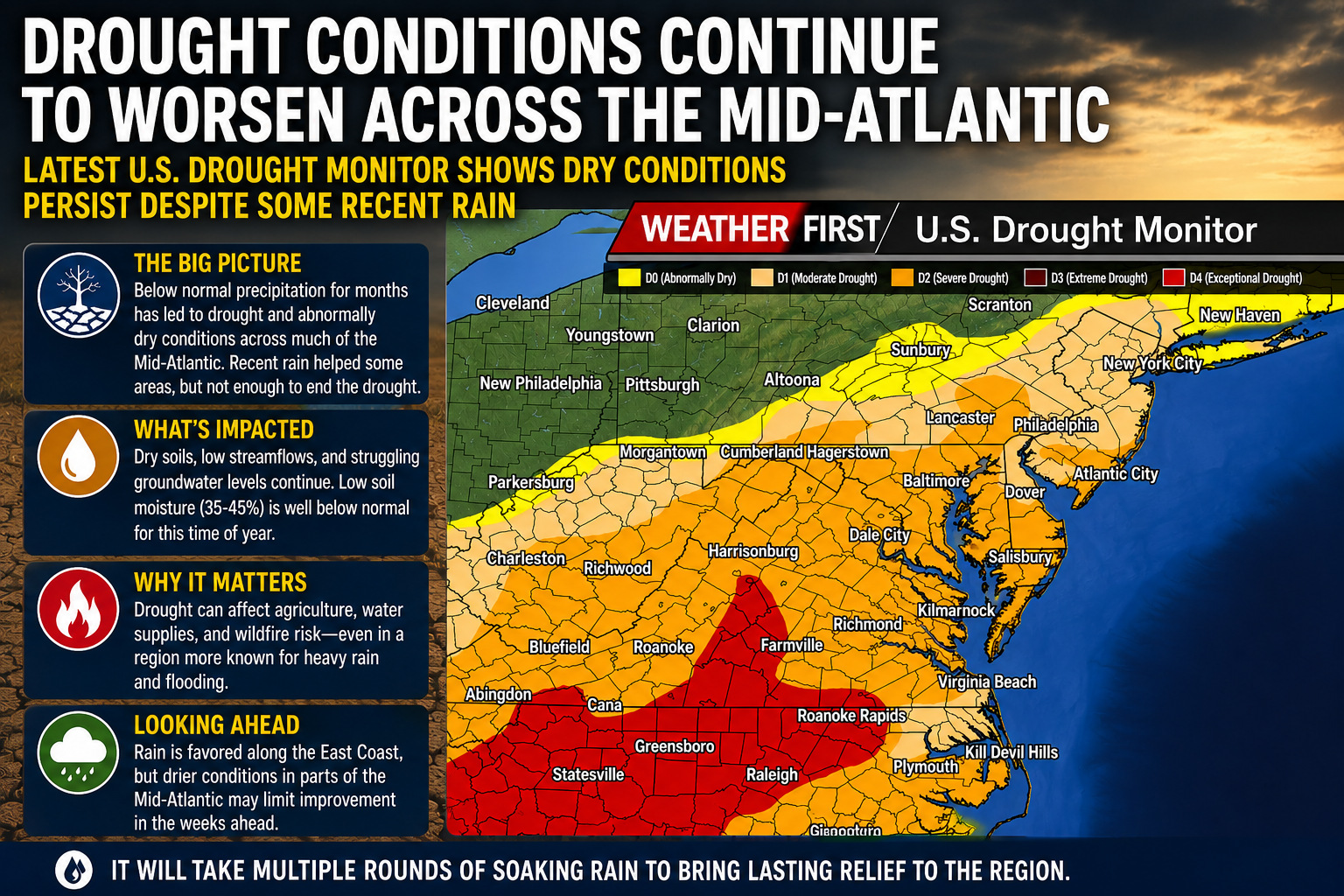

The latest U.S. Drought Monitor shows drought and abnormally dry conditions continuing across parts of the Mid Atlantic this week, with recent rainfall helping in some areas but not enough to erase longer term precipitation deficits.
The national drought summary released May 5 noted that light to moderate precipitation moved across the Northeast during the past week. However, rainfall was uneven across the region. The highest totals fell farther north into Maine, while many drought affected areas of the Mid Atlantic and southern New England received less than a half inch of rain. Cooler than average temperatures helped reduce evaporation rates, which limited more widespread drought expansion.
For the Mid Atlantic, the main issue remains the lack of consistent, soaking rainfall. While occasional showers have moved through the region, many areas continue to deal with dry soils, reduced streamflows and lingering hydrologic stress from months of below normal precipitation.
Delaware remains one of the areas closely being monitored. The Delaware Climate Office reported that precipitation has continued to lag statewide, with eight consecutive months of below normal precipitation going back to last fall. The office also noted that streamflows are down statewide, groundwater continues to struggle to recover, and warmer early season temperatures have increased evapotranspiration, leading to greater water loss from the environment.
Soil moisture has also become a growing concern. According to the Delaware Climate Office, Delaware and much of the Mid Atlantic are experiencing low soil moisture values for this time of year. Soil moisture statewide was estimated in the 35 to 45 percent range, well below the typical 55 to 70 percent range expected during this part of the spring.
The dry pattern has important implications as the growing season continues. Early season crops, lawns, gardens and natural vegetation can become increasingly vulnerable when rainfall remains inconsistent. Dry fine fuels, including grasses, leaves and brush, can also increase the risk for rapid fire spread during periods of low humidity and gusty winds.
Drought.gov notes that drought in the Mid Atlantic can affect agriculture, water resources and wildfire risk, even though the region is often more commonly associated with flooding and heavy precipitation events. The Mid Atlantic Drought Early Warning System covers Delaware, Maryland, New Jersey, Pennsylvania, Virginia, West Virginia and Washington, D.C., helping coordinate drought monitoring and response across the region.
Looking ahead, the U.S. Drought Monitor outlook section indicates that precipitation is favored along the Ohio Valley and much of the eastern seaboard, with the best potential for drought relief farther north into the Northeast. However, somewhat drier conditions across portions of the Mid Atlantic may limit meaningful improvement in drought conditions.
For Delmarva and nearby portions of the Mid Atlantic, the message remains the same: periodic rain chances may offer short term help, but it will likely take multiple rounds of widespread, soaking rainfall to bring lasting improvement to soil moisture, streamflows and groundwater levels.