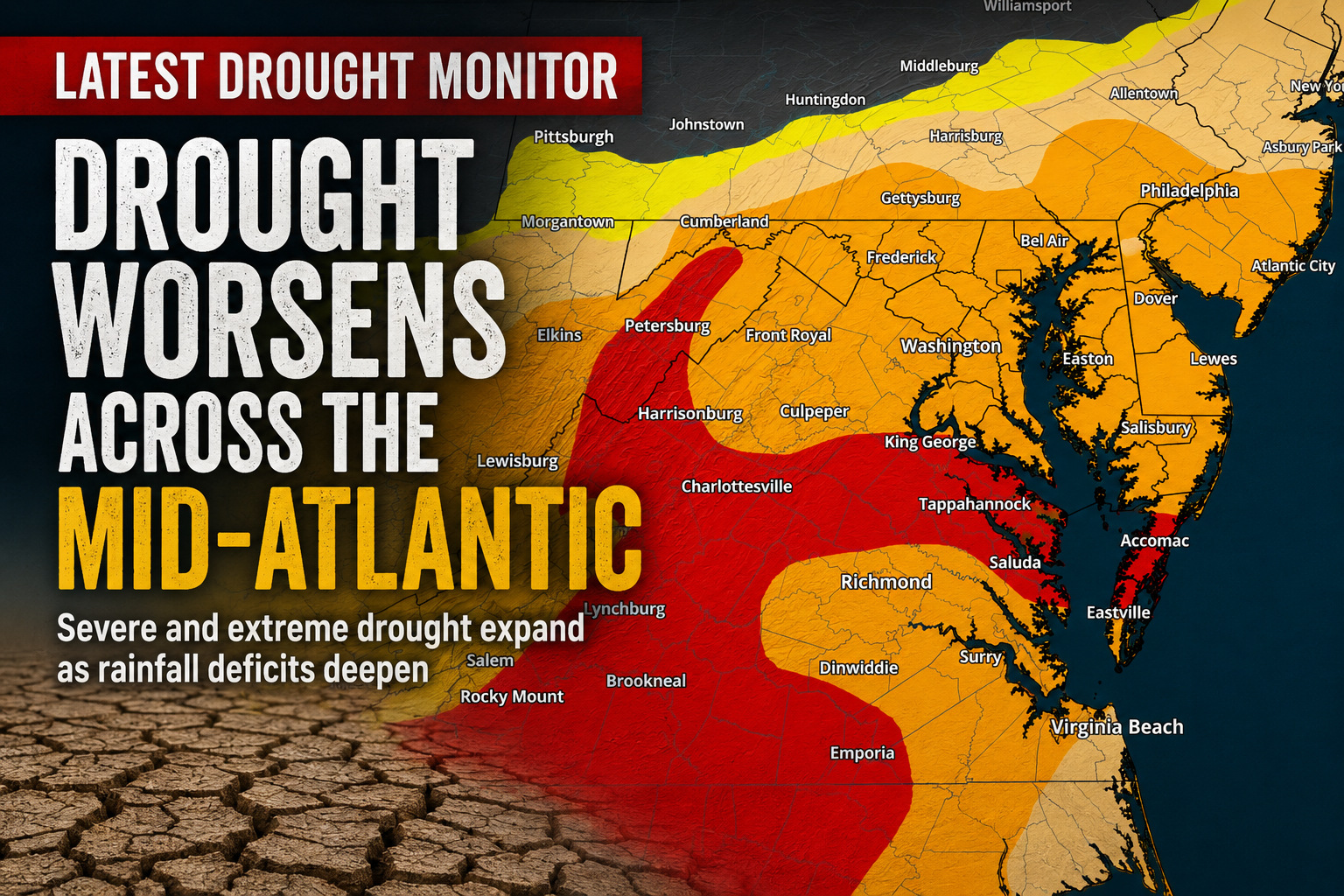

The latest U.S. Drought Monitor shows drought conditions continuing to worsen across portions of the Mid-Atlantic, with expanding areas of moderate to severe drought impacting Delaware, Maryland, Pennsylvania, New Jersey, Virginia, and West Virginia. Much of the region received very little rainfall over the past week, with many locations seeing less than a quarter inch of precipitation, allowing rainfall deficits to deepen further heading into late spring.
According to the newest report, severe drought (D2) expanded across portions of Delaware, southern Pennsylvania, New Jersey, and parts of West Virginia, while moderate drought (D1) conditions continued to spread elsewhere throughout the region. The report also noted the introduction of extreme drought (D3) conditions in parts of southern and eastern West Virginia, Accomack & Northampton counties in Virginia as long-term dryness continues to intensify.

Across the Delmarva Peninsula, precipitation deficits dating back to the fall and winter months continue to create growing concerns for agriculture, groundwater recharge, and streamflow levels. The University of Delaware Climate Office reports that streamflows remain well below normal statewide, with some locations recording their lowest levels on record for this time of year. Groundwater recovery has also struggled due to multiple seasons of below-average precipitation.
The worsening drought has also increased concerns surrounding wildfire danger and agricultural stress as warmer temperatures and increasing evapotranspiration rapidly dry out soils and vegetation. The Mid-Atlantic Regional Integrated Sciences and Assessments program notes that the U.S. Drought Monitor plays a major role in triggering agricultural disaster assistance and water resource management decisions throughout the region.

Looking ahead, the Climate Prediction Center’s Seasonal Drought Outlook favors continued drought persistence across much of the Mid-Atlantic through the summer months. While periodic rainfall events are expected, forecasters warn that sustained widespread soaking rains will likely be needed to significantly improve groundwater and long-term hydrological conditions.
The expanding drought footprint has also prompted NOAA and regional partners to launch a new Mid-Atlantic Drought Early Warning System initiative aimed at improving drought monitoring, preparedness, and long-term resilience across the region.