
An already dangerous and potentially record-breaking heat wave is expected to become even more impactful later this week across Delmarva, especially in rural agricultural areas where crops are nearing peak maturity.
Temperatures are forecast to climb into the upper 90s and lower 100s Thursday through Saturday, with heat index values potentially reaching dangerous levels. While the air temperature alone will be hazardous, the humidity could make conditions feel even worse, and part of that local moisture may come directly from the fields.
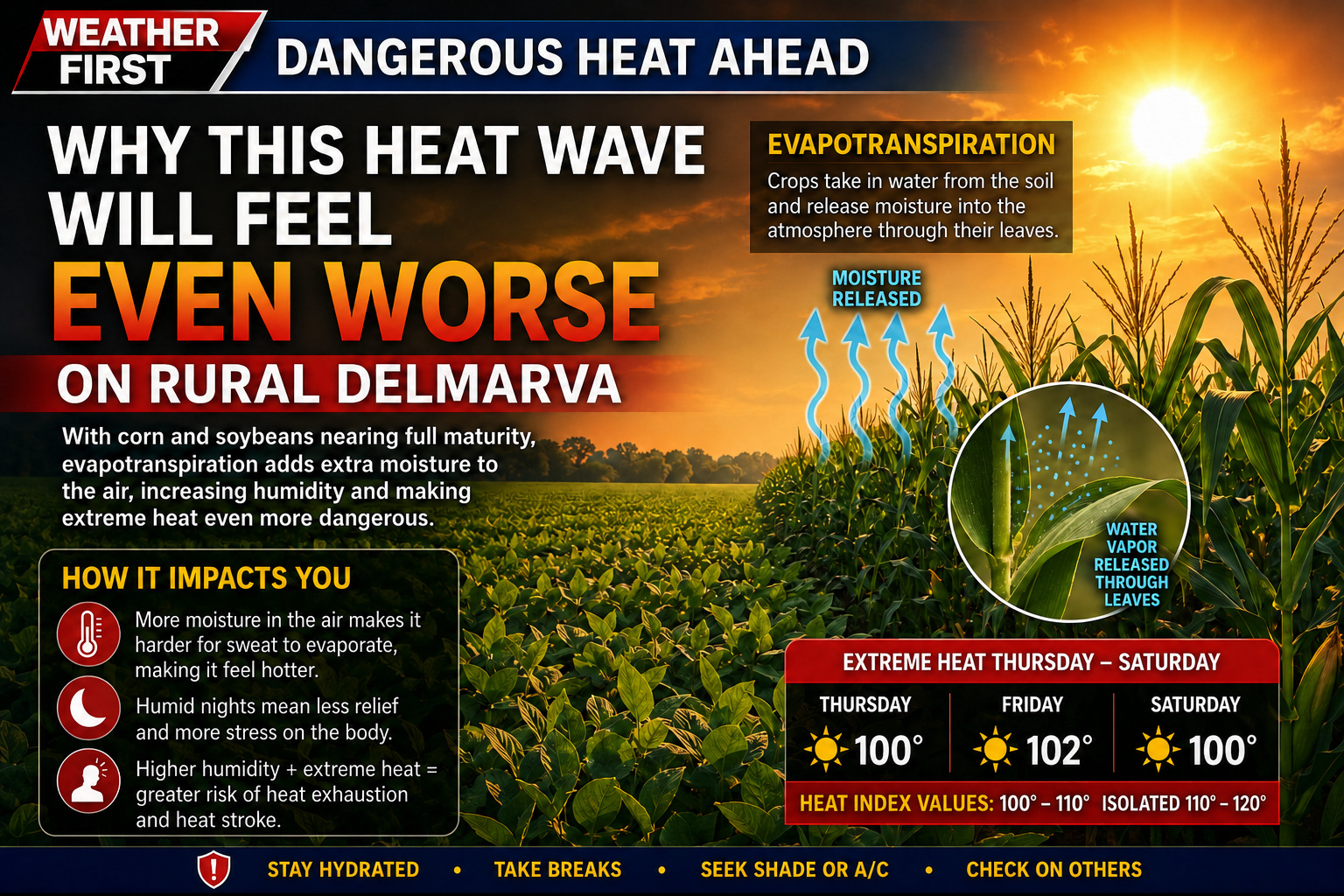
Across Delmarva, corn and soybean fields are now approaching the point in the growing season where evapotranspiration becomes a major factor. Evapotranspiration is the process where moisture moves from the soil and plants into the atmosphere. In simple terms, crops take in water through their roots and release moisture through their leaves. When large areas of corn and soybeans are actively growing, they can add a noticeable amount of water vapor to the lower atmosphere.
This is sometimes called “corn sweat,” and while the term is often used in the Midwest, the same process can happen across Delmarva’s agricultural landscape.
During a major heat wave, that extra moisture can make a big difference. Higher humidity makes it harder for sweat to evaporate off the skin, which is the body’s natural way of cooling itself. As a result, the same air temperature can feel much hotter and become more dangerous for people working or spending time outside.
The impact may be especially noticeable in rural parts of Delaware and Maryland’s Eastern Shore, where large fields of corn and soybeans surround many communities. These areas can hold onto low-level moisture, especially during the morning, evening and overnight hours. That can keep dew points elevated and prevent temperatures from cooling efficiently at night.
This is one reason heat waves can become especially dangerous when they last several days. Even if afternoon dew points mix down somewhat due to west or northwest winds, the combination of intense sunshine, hot ground, maturing crops and lingering low-level moisture can keep heat stress elevated. Nights may also remain uncomfortably warm and muggy, giving the body less time to recover before the next day’s heat builds again.
The hottest stretch is expected Thursday through Saturday, when temperatures may reach 100 degrees or higher in parts of the region. Heat index values could climb into the 100 to 110 degree range at times, creating a serious risk for heat exhaustion and heat stroke.
Outdoor workers, farmers, construction crews, athletes, older adults, young children and those without reliable air conditioning will be most at risk. The agricultural influence on humidity means rural areas may not get much relief, even away from the larger towns and cities.
This heat wave should be taken seriously. Limit outdoor work during the hottest part of the day, take frequent breaks in shade or air conditioning, drink plenty of water and check on neighbors, family members and pets. Those working in fields or around farms should be especially cautious, as the combination of direct sun, high humidity and limited shade can become dangerous very quickly.
While crop evapotranspiration is a natural part of the growing season, it can amplify the human impact of extreme heat. Later this week, Delmarva will not only be dealing with record-challenging temperatures, but also a rural humidity boost from maturing crops that may make the heat feel even more oppressive.