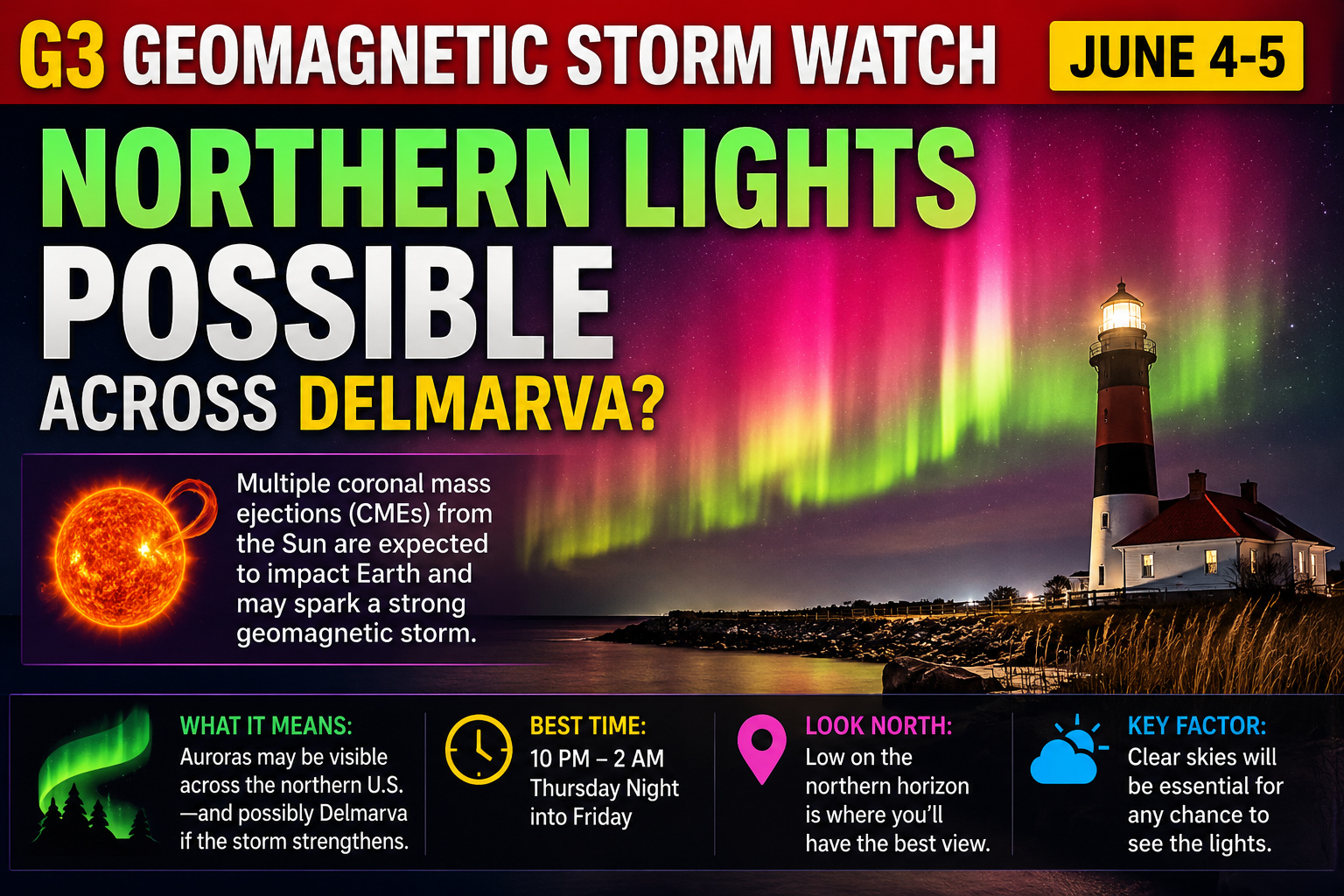
A rare space weather event later this week could provide at least a chance for Northern Lights visibility across portions of the Mid-Atlantic, including Delmarva, as a series of powerful solar eruptions head toward Earth.

The possibility stems from multiple coronal mass ejections (CMEs) that erupted from the Sun on June 1 and June 2. CMEs are massive clouds of charged particles and magnetic fields blasted into space during periods of heightened solar activity. When these solar storms are directed toward Earth, they can interact with our planet’s magnetic field and trigger geomagnetic storms.
NOAA’s Space Weather Prediction Center has issued a G3 (Strong) Geomagnetic Storm Watch for June 4-5 as these CMEs are expected to arrive and potentially combine their effects. The collision between the solar particles and Earth’s magnetic field causes energy to be deposited into the upper atmosphere near the polar regions. This energy excites oxygen and nitrogen molecules, producing the colorful displays known as the aurora borealis, or Northern Lights.
During stronger geomagnetic storms, the auroral oval expands southward away from the Arctic, allowing residents in the northern United States and occasionally the Mid-Atlantic to witness the phenomenon.
For Delaware, Maryland’s Eastern Shore, and southern New Jersey, the odds remain lower than areas closer to the Canadian border, but they are not zero. If the incoming CMEs produce stronger geomagnetic activity than currently forecast, or if the storm briefly reaches G4 levels, a faint auroral glow could become visible low on the northern horizon.
Unlike the vibrant curtains often seen in Alaska or Canada, Delmarva observers would most likely see a subtle red, pink, or purple glow near the horizon. In some cases, smartphone cameras can reveal auroral colors and structure that are difficult to see with the naked eye.
Sky conditions will also play a major role. Fortunately, high pressure is expected to dominate the weather pattern across the Mid-Atlantic through the end of the week, bringing mostly clear skies and providing favorable viewing conditions should the aurora become visible.