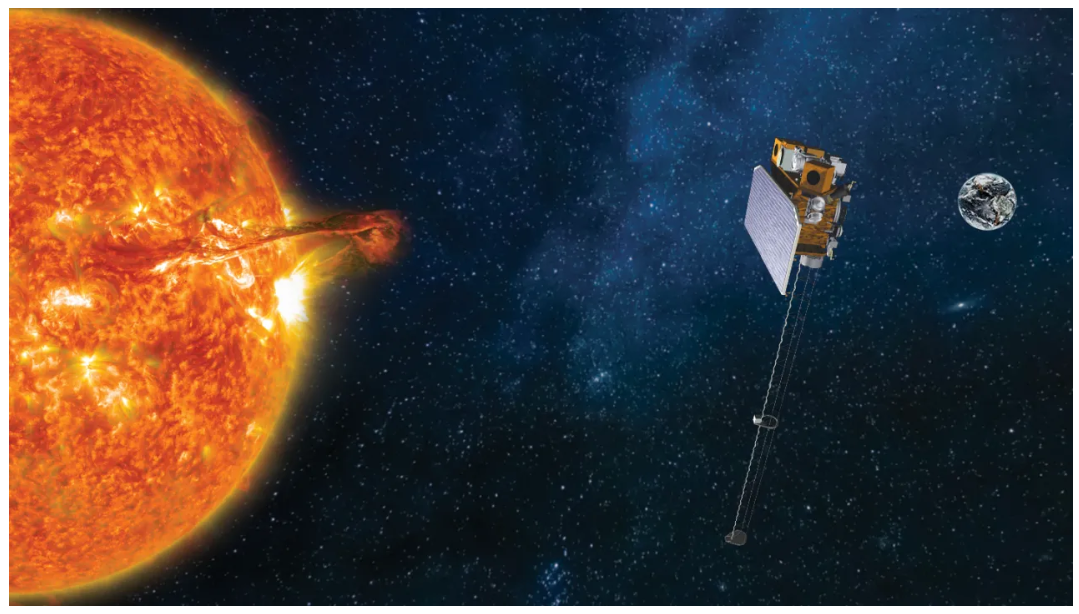

NOAA has officially ushered in a new chapter in space weather forecasting with the start of operational service for its SOLAR-1 observatory, a next-generation mission designed to provide earlier and more accurate warnings of potentially disruptive solar storms. The milestone represents a significant advancement in the nation’s ability to monitor activity on the Sun and protect critical infrastructure both on Earth and in space.
Formerly known as Space Weather Follow On-Lagrange 1 (SWFO-L1), the spacecraft was renamed SOLAR-1 after reaching its permanent position near the Sun-Earth L1 Lagrange point, roughly one million miles from Earth. From this unique vantage point, the observatory continuously monitors the solar wind and tracks coronal mass ejections (CMEs) before they arrive at our planet.
The mission’s primary goal is to improve NOAA’s ability to issue timely space weather watches, warnings, and forecasts. Powerful solar storms can interfere with satellite operations, GPS navigation, radio communications, aviation, electric power grids, and even astronaut safety during missions beyond Earth’s protective atmosphere. Earlier detection means operators have more time to prepare and reduce potential impacts.
SOLAR-1 carries a suite of advanced instruments, including a compact coronagraph that images the Sun’s outer atmosphere and sensors that continuously measure the solar wind flowing toward Earth. The real-time data are transmitted directly to NOAA’s Space Weather Prediction Center, where they are incorporated into operational forecasts used by governments, utilities, airlines, emergency managers, satellite operators, and researchers around the world.
For skywatchers, improved space weather forecasting could also mean better predictions of auroral activity. During periods of heightened solar activity, strong geomagnetic storms can push the Northern Lights much farther south than usual, occasionally making them visible across portions of the Mid-Atlantic and Delmarva under favorable conditions. More accurate monitoring from SOLAR-1 should help forecasters better pinpoint the timing and intensity of these events.
As Solar Cycle 25 continues to produce frequent flares and coronal mass ejections, NOAA’s newest observatory is expected to play a critical role in safeguarding modern technology while advancing our understanding of the dynamic relationship between the Sun and Earth. With continuous observations from one of the most strategically important locations in space, SOLAR-1 marks a major leap forward in operational space weather monitoring.