Author: Admin

  • Delaware State Police Investigating Bank Robbery In Millville

    Delaware State Police Investigating Bank Robbery In Millville

    Delaware State Police are investigating a bank robbery that occurred Wednesday morning.
    On December 29, 2021, at approximately 10:40 a.m.,

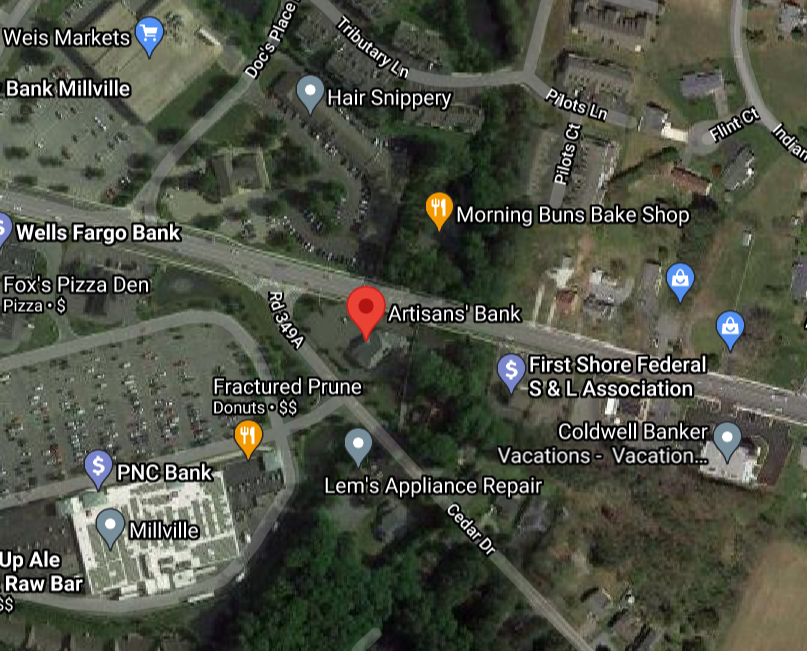
    Delaware State Police responded to the Artisans Bank located at 35696 Atlantic Ave, Millville, for a report of a robbery. The investigation determined a male suspect entered the bank, approached a bank teller behind the counter and displayed a note demanding money. The bank teller complied, and the suspect fled the bank on foot with an undisclosed amount of cash, northbound across Atlantic Ave.

    The suspect was described as a white male wearing a dark-colored jacket, dark pants, with a mask and a beanie hat.
    No one was injured during this incident and there are no surveillance photographs available at this time.

    Anyone with information regarding this investigation should contact Detective Yencer with Delaware State Police Troop 4 Criminal Investigative Unit by calling 302-752-3791. Information may also be provided by calling Delaware Crime Stoppers at 1-800-TIP-3333 or via the internet at http://www.delaware.crimestoppersweb.com .

    If you or someone you know is a victim or witness of crime or have lost a loved one to a sudden death and are in need of assistance, the Delaware State Police Victim Services Unit/Delaware Victim Center is available to offer you support and resources 24 hours a day through a toll-free hotline 1800 VICTIM-1. (1-800-842-8461). You may also email the unit Director at [email protected]
  • First Launch Of The Year From The Wallops Island Flight Facility of 2022

    First Launch Of The Year From The Wallops Island Flight Facility of 2022

    X-rays from space bombard Earth on a daily basis. The sources and characteristics of these X-rays are not clearly understood.

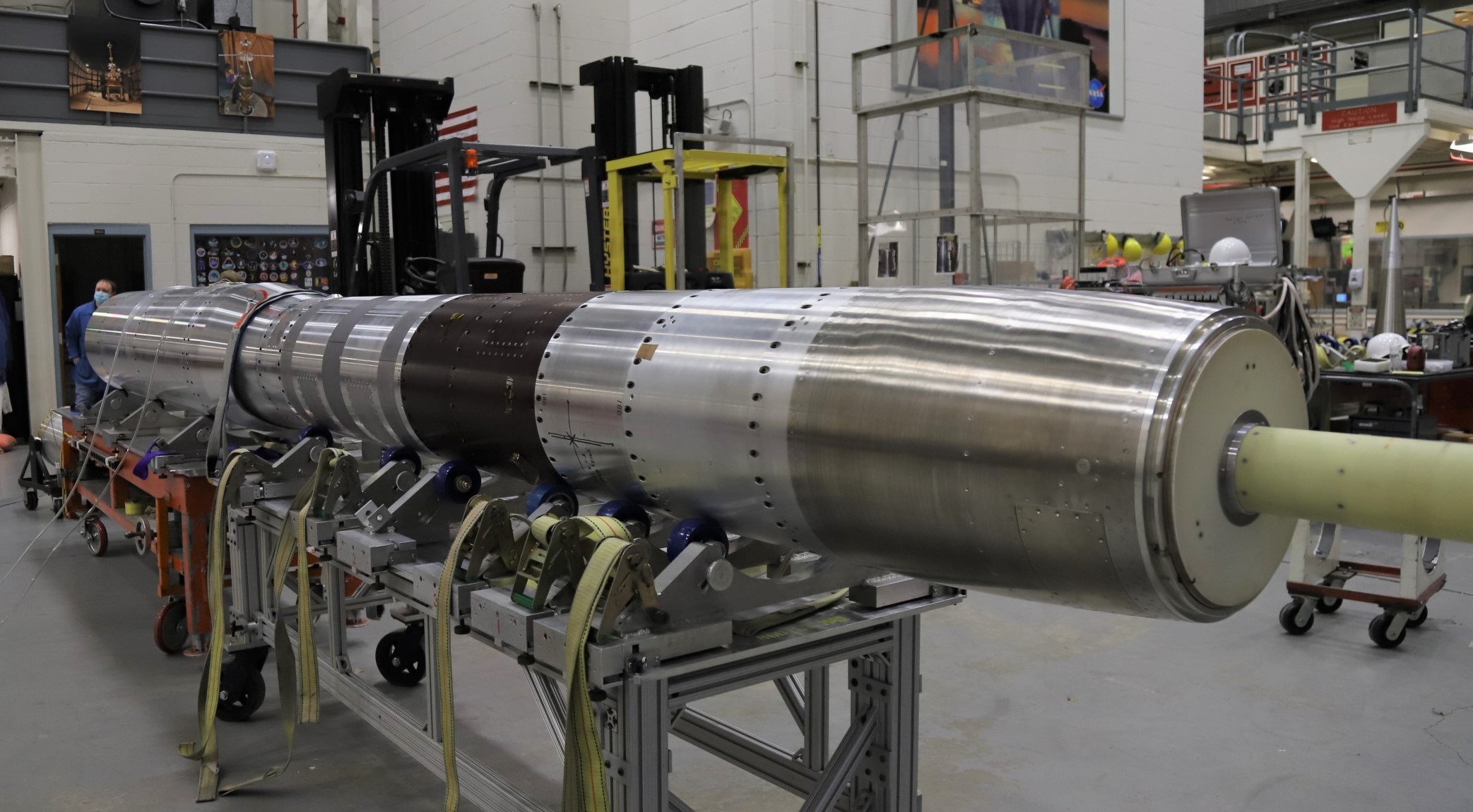
    A January 2022 NASA sounding rocket mission called the Diffuse X-rays from the Local galaxy, or DXL, hopes to shed light on the sources of soft X-rays that hurtle towards Earth from elsewhere in our galaxy.

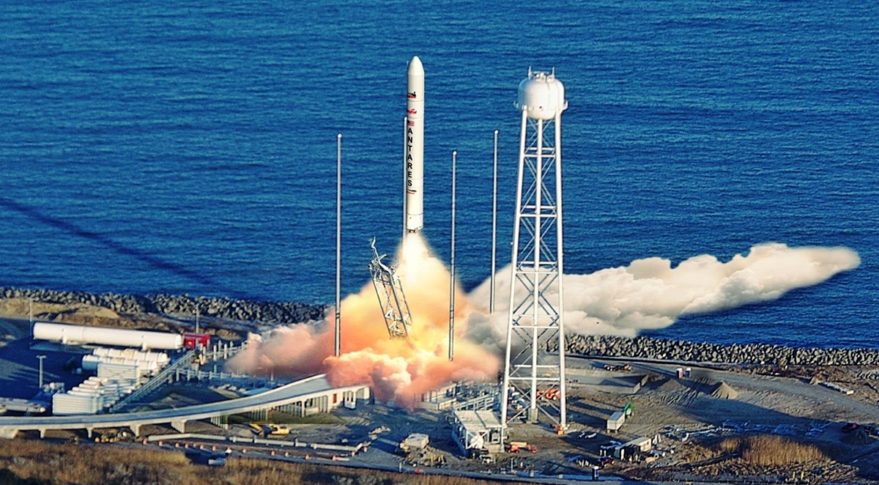
    DXL will launch on Black Brant IX sounding rocket between 10 p.m. EST January 4 and 2 a.m. January 5, from NASA’s Wallops Flight Facility in Virginia. Backup launch days are January 5-17. The launch of the two-stage rocket may be seen by residents in the mid-Atlantic region.

    Live coverage will begin at 9:40 p.m. EST on launch day on the Wallops YouTube site. The NASA Wallops Visitor Center will not be open for this mission.

    While not harmful to humans on Earth, soft X-rays can make changes in the Earth’s ionosphere which can disturb radio communications and the accuracy of GPS navigation systems. They have lower energy as compared to hard X-rays, which are used in imaging for medical applications.

    “Very low energy diffuse X-rays from space are believed to come from two sources,” said Massimiliano Galeazzi, the principal investigator for the DXL mission from the University of Miami, Florida. “The first source is located outside our solar system and is generated by remnants of multiple supernovae explosions forming what is now called the Local Hot Bubble region of our galaxy. The second source is within the solar system and is generated by the solar wind charge exchange. DXL seeks to gain a better understanding of the nature and characteristics of these sources.”

    This will be the fourth flight of DXL. The first flight in 2012 confirmed the Local Hot Bubble as a source of these X-rays. Data from the flight indicated that only about 40 percent of the soft X-ray background originates within the solar system, which means the LHB is the dominant source.

  • Geminid Meteor Shower Peaking Monday Night (Dec 13-14th)

    Geminid Meteor Shower Peaking Monday Night (Dec 13-14th)

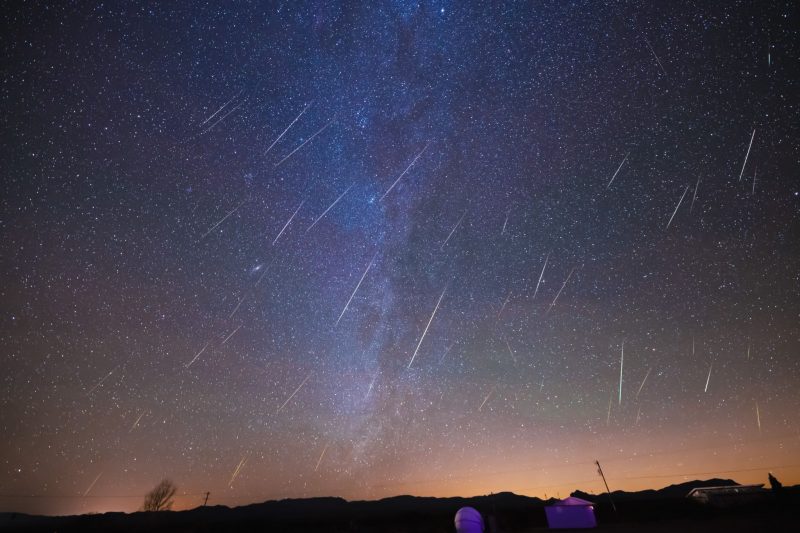
    The 2021 Geminid meteor shower peaks on the night between Dec. 13 and 14. The Geminids are usually one of the best meteors shower of the year, capable of producing 150 or more meteors per hour at a dark site. The meteors are often bright and colorful. The Moon will be 78% full and up for a large portion of the night, which could hamper viewing. We recommend timeanddate.com to help you find ideal times and viewing directions for your location.

    The Geminids are caused by debris from an asteroid called 3200 Phaethon. Phaethon’s 524-day orbit carries it closer to the Sun than any other asteroid: roughly 21 million kilometers, less than half the distance of Mercury’s closest approach to the Sun.

    All you need to watch a meteor shower is your eyes, patience, and a mostly cloud-free night. Go out, get comfortable, and stare at the sky. Typically the best time to see a meteor shower is between midnight and pre-dawn, because that’s when you are on the leading side of the Earth, watching the comet debris come at you like rain hitting a car windshield.

    You don’t have to stare in the direction of the radiant; in fact, meteors farther away from it will appear longer. It is often said that an ideal place to look is 45 degrees away from the radiant, but the most important factor is getting to a dark location away from city lights, letting your eyes adjust for several minutes, and looking at the darkest patch of sky you can. 

    Go out, look up at the night sky and have fun!

  • Warmth, Strong Winds, And Thunderstorms This Weekend

    Warmth, Strong Winds, And Thunderstorms This Weekend

    Storm Prediction Center Convective Outlook For Saturday

    If the wonder hasn’t been wacky enough for you lately, now we have some early fall like weather on the way across the Eastern US. A strong storm system will be bringing a cold front through the region during the evening hours Saturday. Before hand during the evening hours Friday, a warm front will lift through the area and we will start to see a significant increase in temperatures going into the 70s. According to the SPC, they have issued a “Marginal Risk” of severe weather regarding some strong thunderstorms may develop along the cold front. Some of these embedded showers and storms could produce some locally strong wind gusts.

    850mb Height & Wind Speeds ( Low Level Jet)

    Besides the chance for some thunderstorms, the big ticket item will be the winds ahead of this cold front. A notoriously strong low level Jetstream around 5000 feet with winds in excess of 60-70kts. Although we will not being those kind of winds down near the surface, we are still expecting some fair strong winds across the Delmarva Region. Lots of wind energy to tap into regardless.

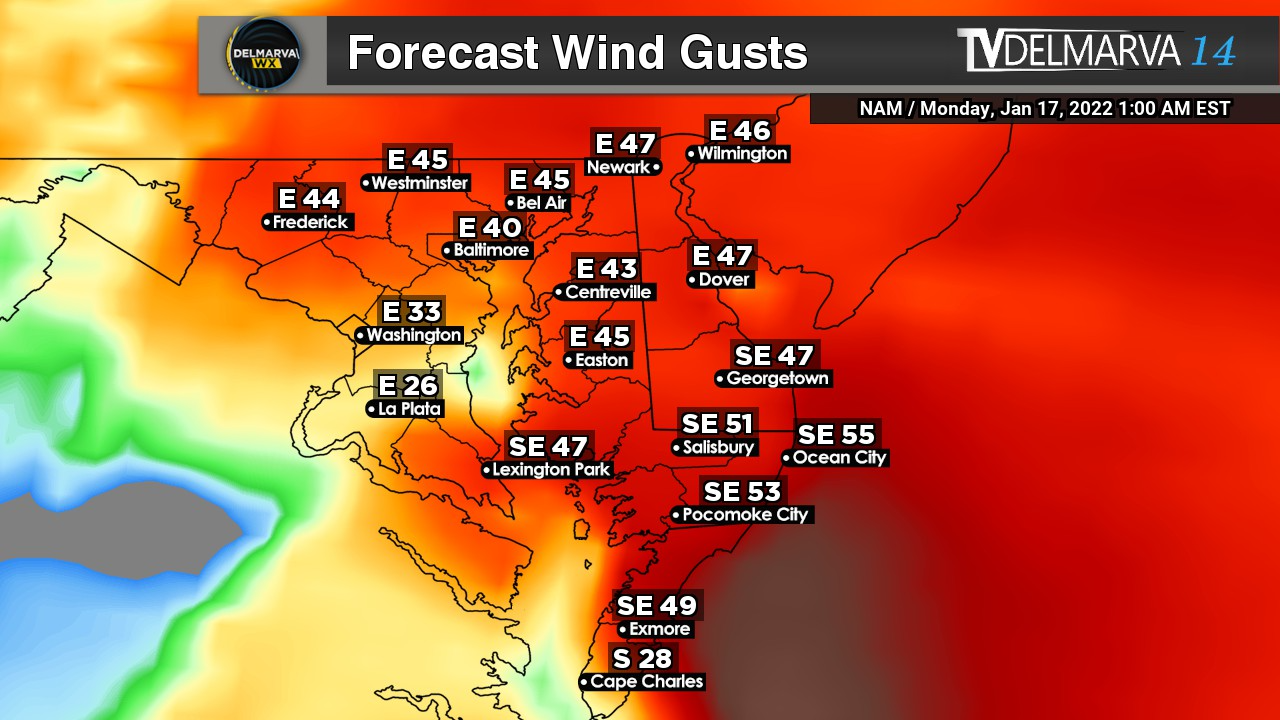
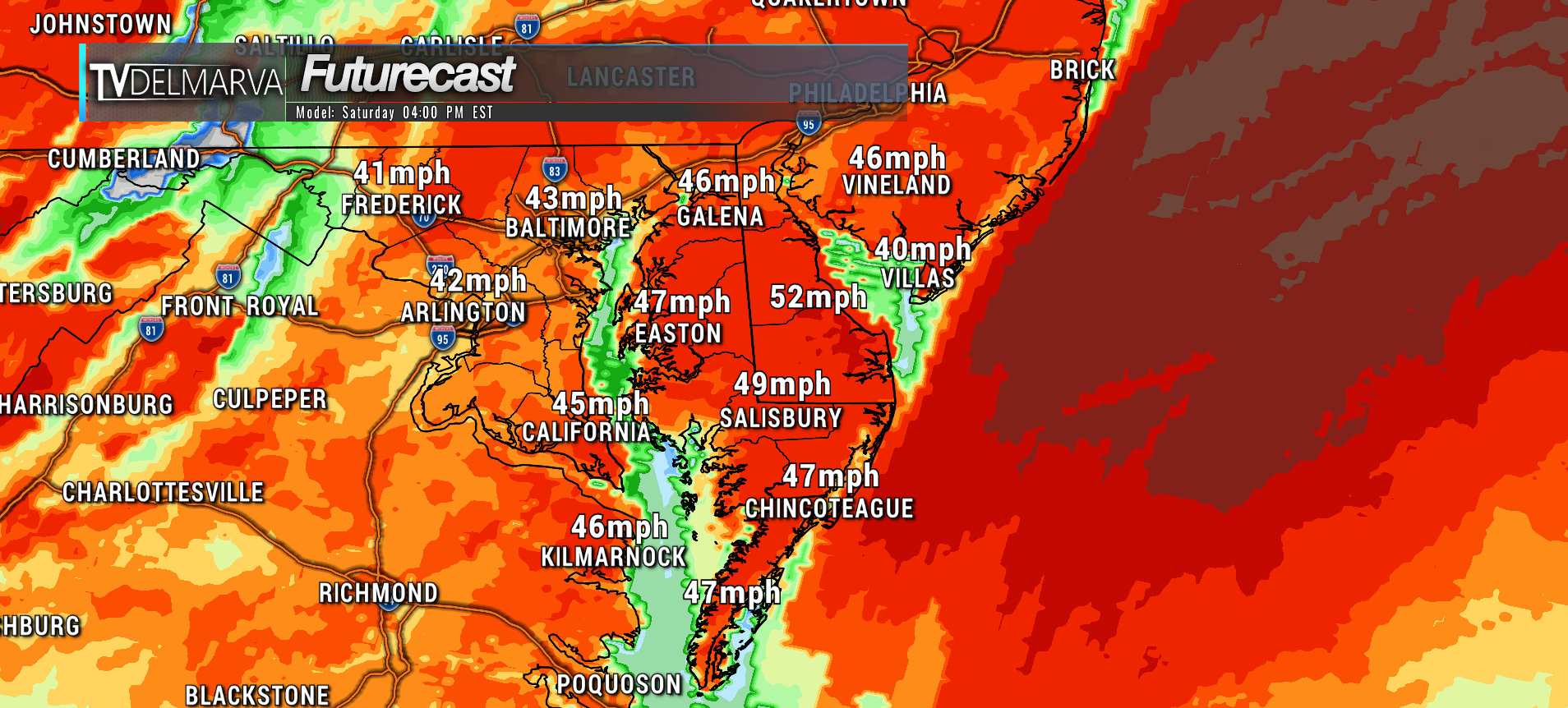
    Forecast Wind Gusts For Saturday

    A fairly good agreement with the model guidance showing a widespread event of 40-50 mph wind gusts for much of the day on Saturday. This will be enough to issue some Wind Advisories across the region. Winds of this magnitude could bring down some trees and powerlines leaving to a few sporadic power outages at times. The strongest winds will occur between 12pm and 8pm Saturday.

  • It’s Beginning To Look A lot Like… September?

    It’s Beginning To Look A lot Like… September?

    Climate Prediction Center 6-10 Day Temperature Outlook

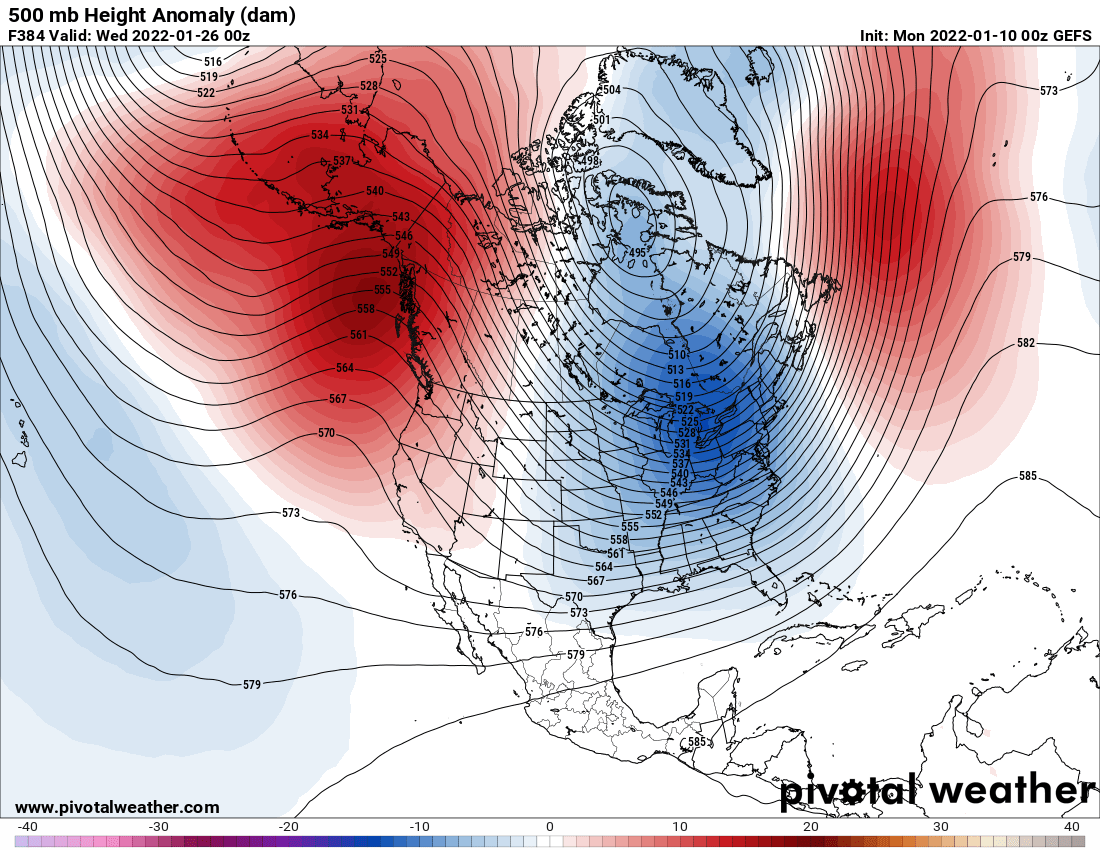
    We are getting ready for the lower 48 to experience not so December like weather for the middle of December.. According to the Climate Prediction Center, a very large expanse of a strong high pressure ridge will allow Well Above Normal Temperatures in the 6-14 day time frame. (12th-20th).

    8-14 Day Temperature Outlook From The Climate Prediction Center

    Trust me it does not get any better for those looking for snow in the 8-14 day map as well through the 20th. The high pressure ridge expands more and Delmarva is in the 80-90th percentile of Well Above Average Temperatures by that time. For those looking for a white Christmas this year, the odds are definitely not in our favor.

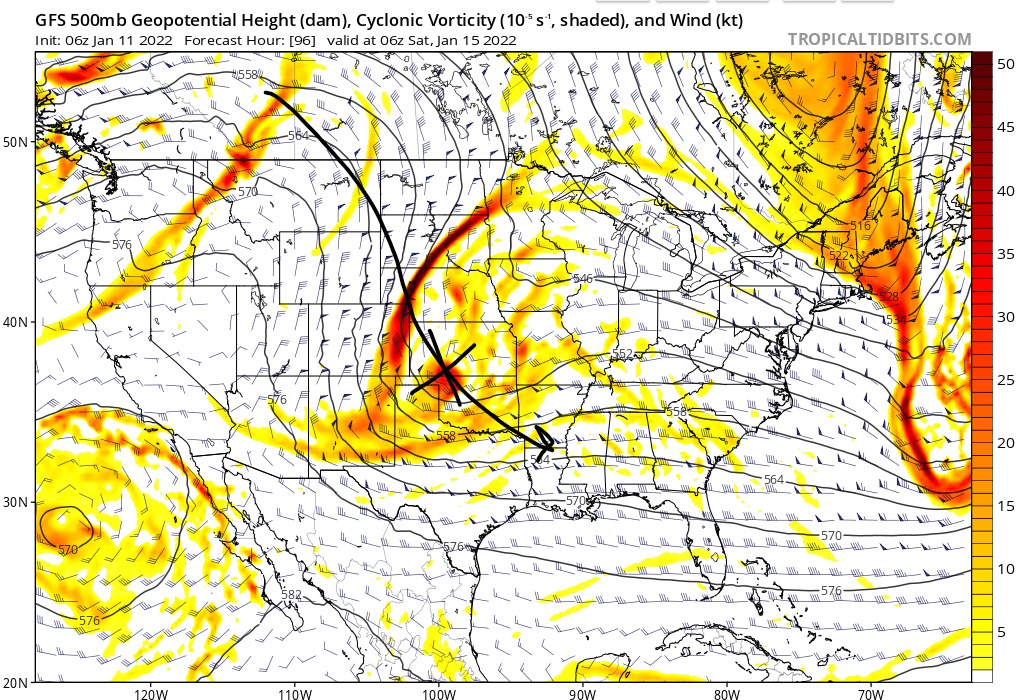
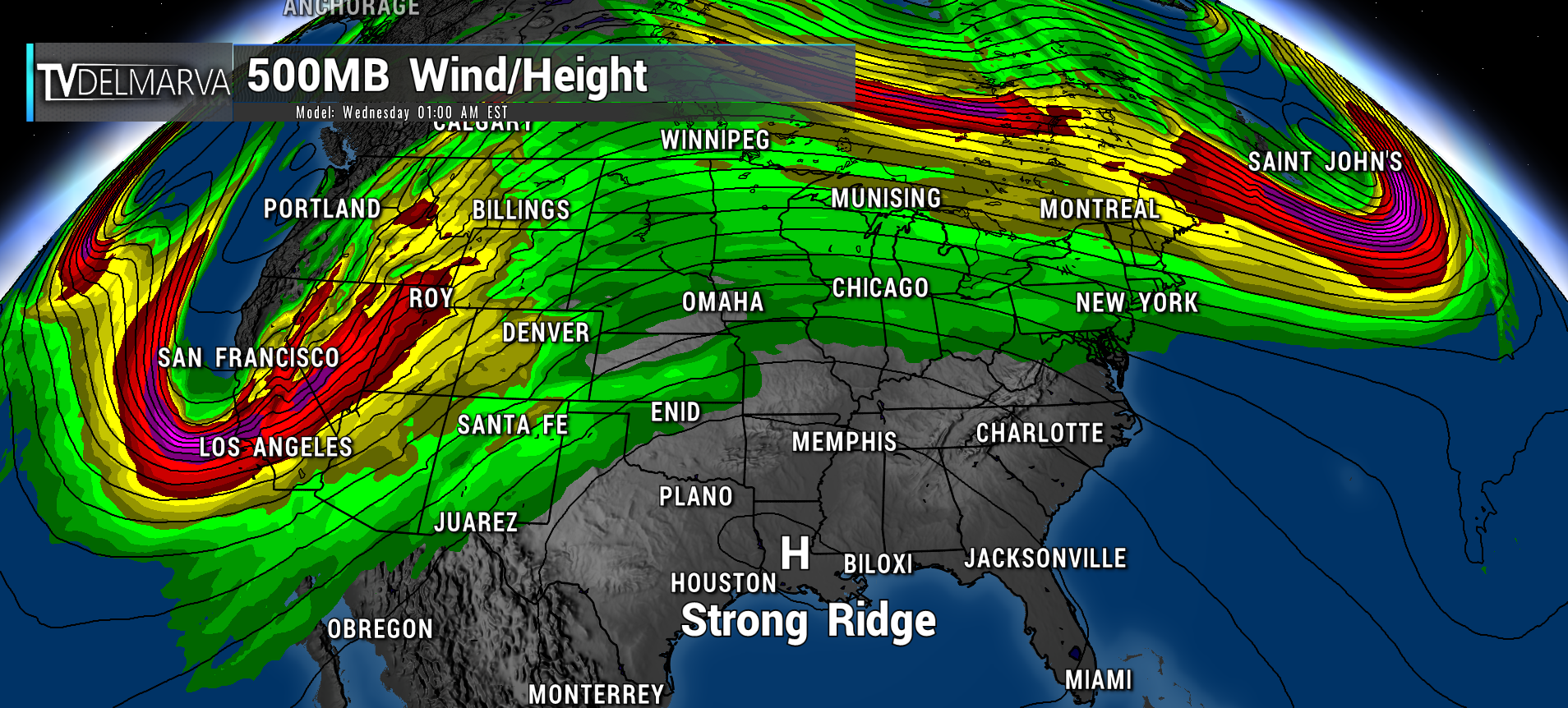
    GFS 500MB Wind & Height

    With a powerful high pressure ridge across the country, this pushes the Jetstream well into Canada keeping the cold air locked up north. This is a direct result of the current La Nina in place. The only place in the country that will see near or below average temperatures is on the West Coast. They can always use the rain.

    MJO Forecast For The Rest Of The Month

    For those snow lovers here on Delmarva, you will have to be a little patient after the Christmas holiday for some snow chances. A common tool I use for long range forecasting the MJO (Madden-Julian Oscillation) The Madden-Julian Oscillation is characterized by an eastward spread of large regions of enhanced and suppressed tropical rainfall, mainly observed over the Indian and Pacific Ocean. Why does this matter?

    The MJO is one of the major contributors to the global weather pattern across North America. With forecasted phases going into 7,8, and possibility 1 by the New Year is a indication that colder and stormier weather is on the way for the eastern half of the nation.

  • Snow, Or Not To Snow? That’s The Difficult Question.

    Snow, Or Not To Snow? That’s The Difficult Question.

    In the Pinpoint 14 Storm Center, we have been keeping an eye on a potential sneaky storm system to ride along an Arctic front Late Tuesday into Wednesday. Models the last few days have been trending a bit further north and west but a tricky battleground on agreement within the model suite. Here’s a run down of the model outputs below.

    GFS Model Output For Wednesday

    GFS Model has been a consentient robust solution to include snow showers from the MD/DE line northward with a light accumulation event during the morning hours Wednesday. This solution has been constant the last 48 hours.

    NAM Model Output For Wednesday

    The NAM model was one of the first models to show this solution and is not standing down from it either the last 48 hours. Although the most aggressive out of the solutions, It’s also one of the outliers due to the very high end extent to this. Producing several inches snow across the Maryland Western Shore to 1-3 inches on Delmarva.

    ECMWF (European Model) The Biggest Fork In The Suite

    It’s been a trade mark for many years to know that the ECMWF model is the so called “King” of all model guidance. It’s very hard to discount the ECMWF model during any situation but this is the one that has me on edge with showing absolutely nothing across Delmarva with a very weak wave well off to the south. Now in the past, the ECMWF does have a tendency to place low pressure centers further south and east in response to something called “Convective Feedback” in falsely placing the low pressure center in not the right place. Mind you this is the only model solution that shows this scenario. So this boxing match shows a 1 v 5 fight with the Euro model being the heavy weight champion. Although the euro in percentages as a outlier as a “median” to the other models, I would not throw this out at all. There’s been plenty of times the Euro wins in the end in weaker systems like this.

    RGEM Model Output For Wednesday
    CMC Model Output For Wednesday.

    Now we will talk about the Canadian Models. The CMC and the higher resolution RGEM models both show robust scenarios just like the GFS and NAM with a light snow event across Maryland and Delaware.

    High Res WRF-FV3 Model Output For Wednesday

    I’ve decided to include one of the experimental models for the WRF (CAMS) to the mix showing I would say if you blended all the guidance together and you would get this as a so called “Average”. This is showing a very light snow event with little to no accumulations across Delmarva.

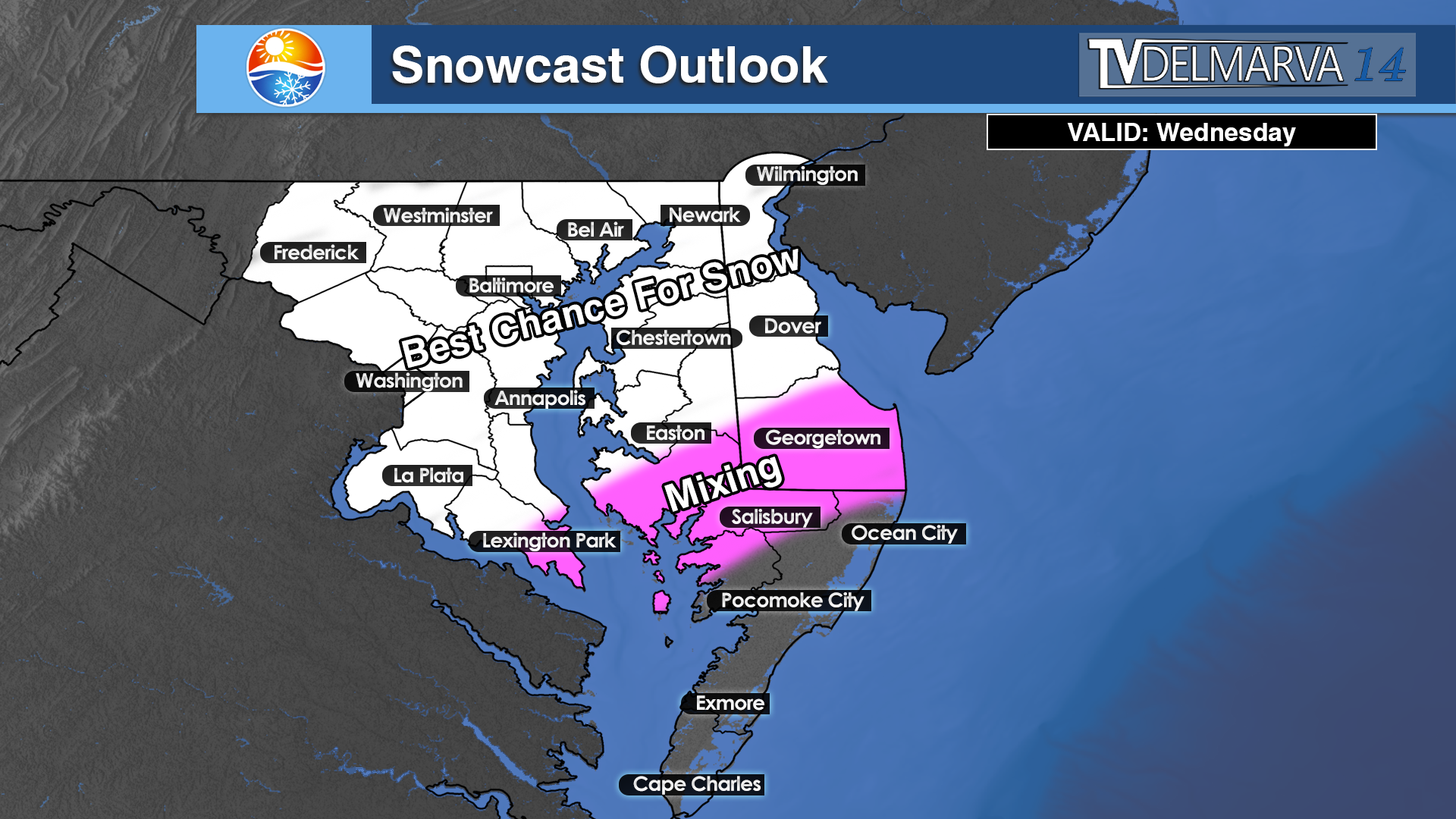
    Probabilities Of Seeing Snow/Mixing With The Blend Of Data

    In this case scenario, If the European model does end up being the outlier in this group, this is where the greatest potential for seeing snowfall would be based on that. But if the ECMWF keeps remaining firm going into tomorrow, that’s a whole different story. If we can get the ECMWF to trend with the others, It’s game on for the snow birds here on Delmarva. We will continue to monitor throughout the next day to get these fine details worked out.

  • Strange Lights In The Sky On Delmarva: “SOLVED”

    Strange Lights In The Sky On Delmarva: “SOLVED”

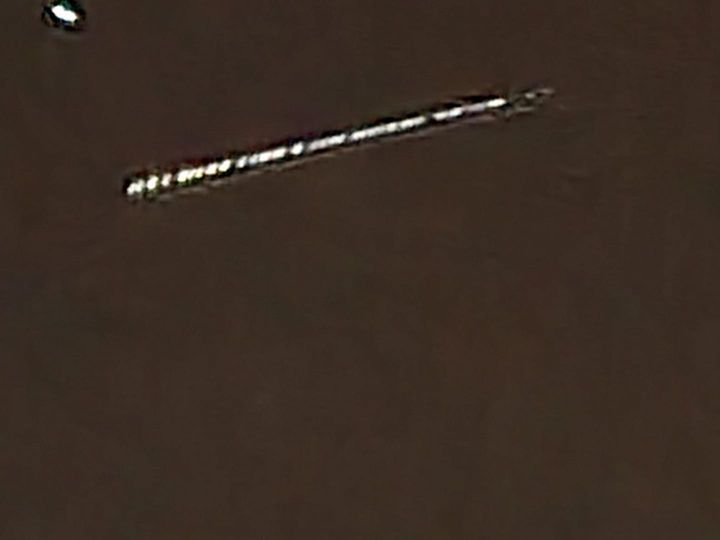
    Photos provided by Betty Fuzy, Vickie Malcom, and Tina Kessler

    A big stir up in the community this evening as thousands witnessed a strange string of lights moving across the sky just after 7pm. Is it aliens? Is it a meteor?

    Both options are wrong. This is the work of Starlink!

     SpaceX just launched the first of four planned Falcon 9 rocket launches this month, with its workhorse rocket carrying a stack of 48 Starlink satellites and two BlackSky Earth observation satellites into orbit, before sticking a booster landing at sea.

    The previously-flown Falcon 9 rocket blasted off from Space Launch Complex 40 here at Cape Canaveral Space Force Station at 6:12 p.m. EST (2312 GMT), marking this particular booster’s ninth flight.

    Since this launch happened a few days ago, the satellites are still very low in orbit and have not got up to the altitude that it needs to be just yet. So they appear extremely bright in the night skies and you likely see them several times over the course of the next few days.

  • Comet Leonard: Best Comet Of 2021 To Close Out The Year

    Comet Leonard: Best Comet Of 2021 To Close Out The Year

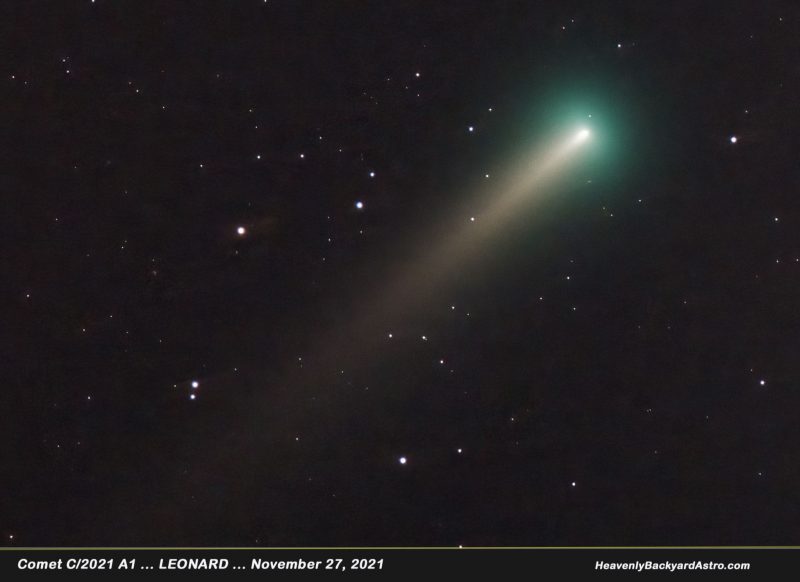
    A much-anticipated comet – C/2021 A1 (Leonard) – is likely to be 2021’s best comet, and its brightest comet by year’s end. Astronomer Greg Leonard discovered the comet as 2021 began. Discovery images showed a tail for the comet, suggesting we might see a nice tail as Comet Leonard draws closer to the Earth and sun. And telescopic observers and astrophotographers do now see a tail, as photos on this page show. The comet is currently heading sunward, toward its perihelion (closest point to the sun) on January 3, 2022. Comets are typically brightest around perihelion. Comet Leonard has been in the morning sky, but, in December, it will become visible in the evening sky. All in all, it’s time to look for a comet!

    Location of Comet C/2021 A1 (Leonard) on December 1, 2021. This chart is as seen from U.S., facing east about 90 minutes before sunrise. The Big Dipper asterism in the constellation Ursa Major the Great Bear will provide a good reference for observers to locate the comet. Binoculars should provide a nice view. Illustration by Eddie Irizarry using Stellarium.
    Over the coming month, as Comet Leonard heads sunward, it’ll sweep closest to Earth on December 12. It won’t be particularly close at its closest, passing more than 21 million miles (34 million km) away. But six days later – on December 18 – the comet will have an exceptionally close pass of Venus of just 2.6 million miles (4.2 million km). Then it’ll round the sun on January 3, 2022, at a distance of about 56 million miles (0.6 AU, or 90 million km).

    December 19, 2021, about 30 minutes after sunset.  facing southwest, as seen from U.S. Illustration by Eddie Irizarry using Stellarium.

    Will the comet get bright enough to see with the eye alone in December? It’s possible that Comet Leonard might reach 4th magnitude before its early January perihelion. Comets are diffuse bodies, not pinpoints, so a 4th-magnitude comet won’t appear as bright to your eye as a 4th-magnitude star. The star would be easily visible in a dark sky. The comet? At 4th magnitude, it would be a good binocular comet. It would be fun to see!

    Nature provides us with sky events seen once in a lifetime. Comet Leonard might be one of these, if it gets bright enough.

    Despite its incredible speed through the vast space of our solar system, don’t expect to see this comet swoosh across the sky. Like planets, comets do move in front of the star background, but only very slowly due to the large distances involved. Observers using telescopes will have to take a close look at the comet’s position relative to background stars. Then compare the view five or 10 minutes later to detect its motion, because its great distance will cause it to appear as a very slow moving object.

  • Powerful Storm System Arriving Next Week To Cause Thanksgiving Travel Delays

    Powerful Storm System Arriving Next Week To Cause Thanksgiving Travel Delays

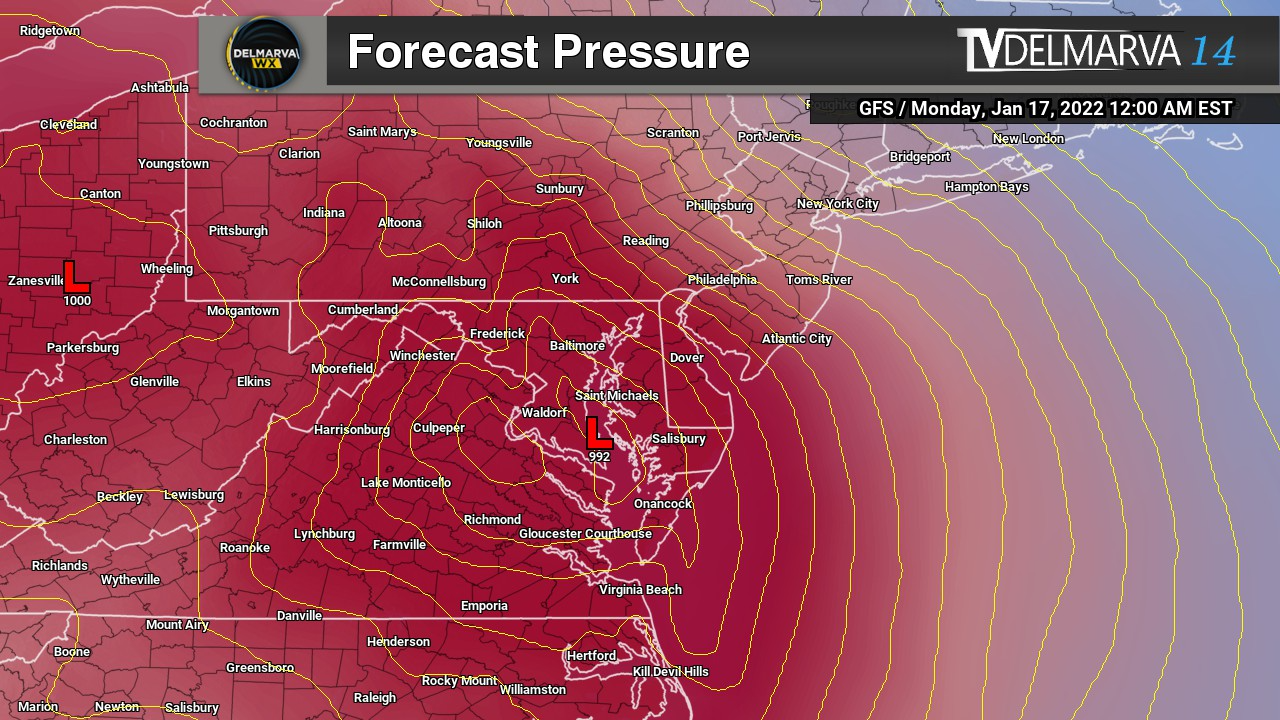
    Monday Morning GFS Model

    Those looking to travel for the Thanksgiving holidays will likely be stuck with flight delays and stormy conditions with a powerful storm system moving across the Great Lakes to the Northeast Monday through Wednesday. A clipper system will begin moving across the northern tier of the US followed by one of the first Arctic Outbreaks of the season. With a trough digging in across the Eastern half of the nation will rapidly intensify the primary low across the Great lakes dragging a cold front through the Mid-Atlantic states.

    Tuesday GFS Model With A Coastal Storm

    Once we get to Tuesday and the trough begins to dig and slow down a secondary low develops and stalls over Cape Cod bringing heavy rainfall, snow, and gusty winds across the interior Northeast and Mid-Atlantic States. Model guidance has been very consistent with a bombing out low below 980mb across New England followed by some of the coldest air of the season to the region.

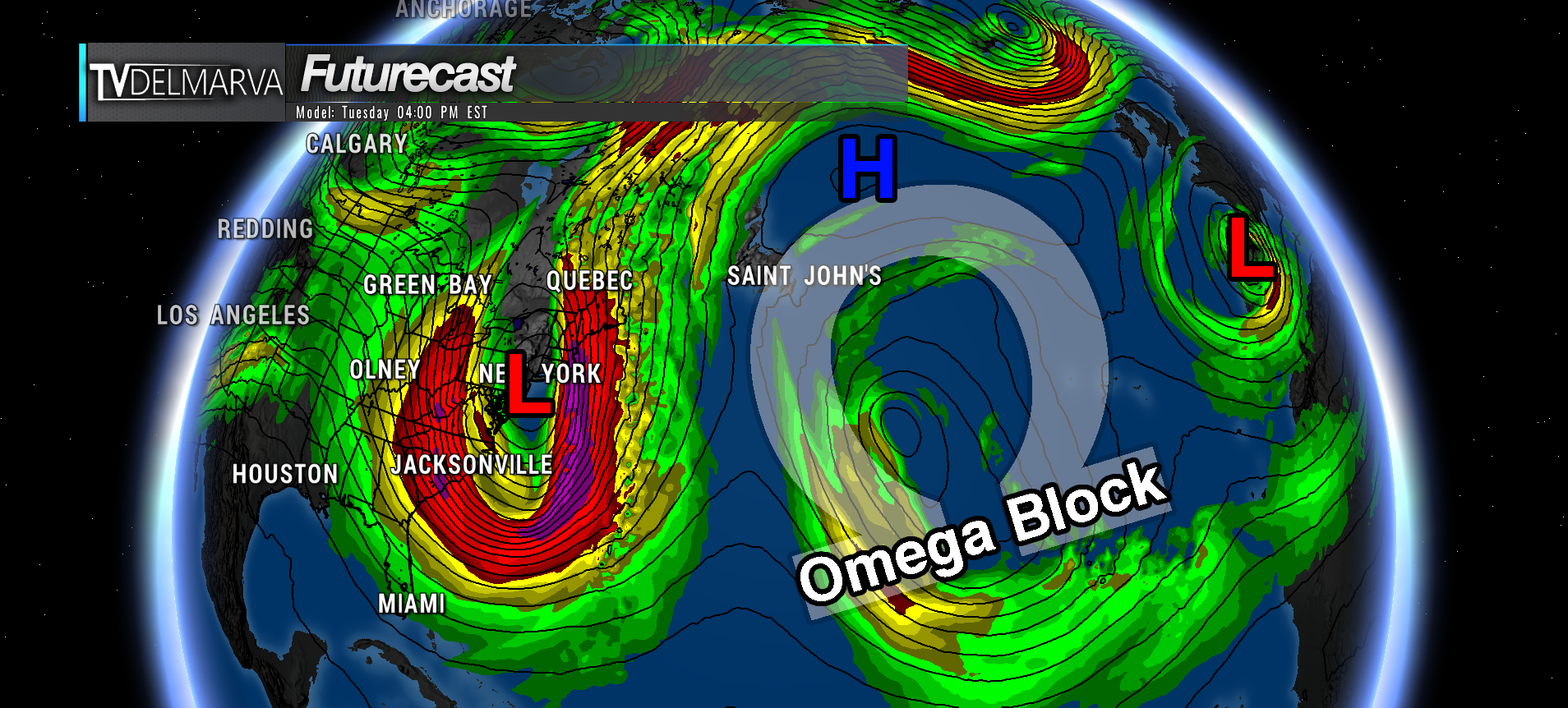
    Omega Block Setting Up For The Rest Of November

    With a powerful Greenland Block (Omega Block) setup going forward, it’s no surprise that we will be seeing a slow moving powerful storm system developing across New England. There is no where for this storm to move up to the north thanks to a strong blocking ridge of high pressure. These blocking patterns put on the brakes on storm systems along the Eastern Seaboard.

    Prepare for travel delays next week if you plan of flying thanks to the very unsettled weather conditions across the Mid-Atlantic to New England. Allow extra time if you are driving with strong winds, heavy rainfall, and snow conditions will be present within in this storm.

  • Longest Lunar Eclipse Of The Century: Beaver Moon Eclipse Nov 19th

    Longest Lunar Eclipse Of The Century: Beaver Moon Eclipse Nov 19th

    Lunar Eclipse Jan 21st 2019

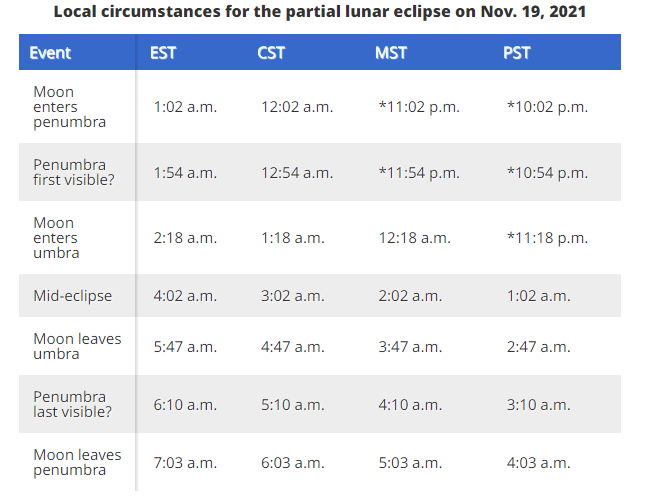
    The next eclipse of the moon will greet early risers before dawn on Friday morning (Nov. 19) across North America. 

    It will be the second lunar eclipse of 2021 and, in some ways, will be similar to the one back in May. Most North Americans will again need to get up early and look low in the west toward daybreak. And again, the farther west you are the better, as the moon will appear much higher from the western part of the continent as opposed to locations farther to the east. It will also be the longest duration eclipse in 580 years, lasting about 3 hours, 28 minutes and 23 seconds, and also the longest this century.

    But in another way, it will be different. This lunar eclipse will fall just shy of being total; 97.4% of the moon’s diameter will become immersed in the Earth’s dark umbral shadow at maximum eclipse, leaving just the southernmost limb ever-so-slightly beyond the outer edge of the umbra. 

    To those watching with the naked eye, binoculars, and small telescopes, the lower edge of the moon will likely remain much brighter than the deep red or ochre hue we can expect across the rest of the moon’s face.

    Because the moon will arrive at apogee — the farthest point in its orbit from Earth — on Nov. 20, it will also be moving at its slowest speed in its orbit. That’s why it will seem to move at an almost “leisurely pace” through the Earth’s shadow, taking over 100 minutes from the time of first umbral contact to the time of greatest eclipse, and vice versa (greatest eclipse to last umbral contact). 

  • Stormy End To The Month Going Into The Thanksgiving Holiday

    Stormy End To The Month Going Into The Thanksgiving Holiday

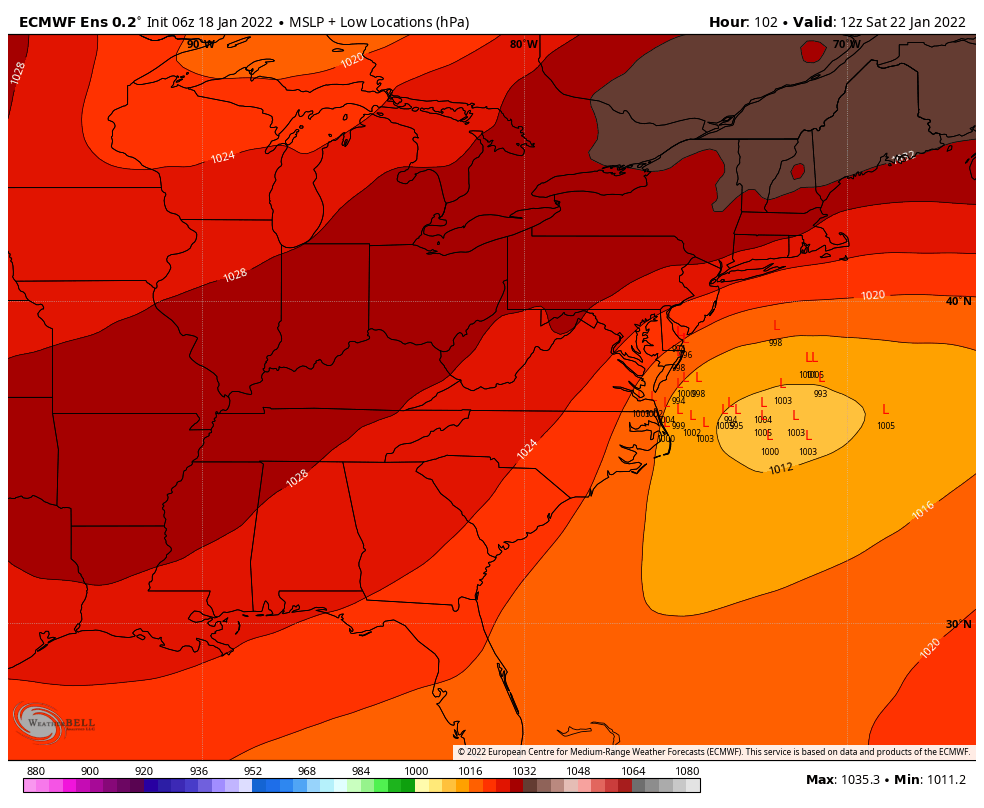
    500MB Pattern For Nov 24th From The ECMWF ENS

    We are looking at quite a stormy end to the month of November with the famous ” Greenland Block ” on the horizon. Higher than normal 500mb heights are showing up around the Greenland region which helps slow down the overall pattern across the lower 48.

    First off we will have a clipper system that dives in across the Great Lakes to set the stage for a potential larger system behind this one. This will bring some snowy showers across the Lakes and rain for much of the Mid-Atlantic and Interior Northeast.

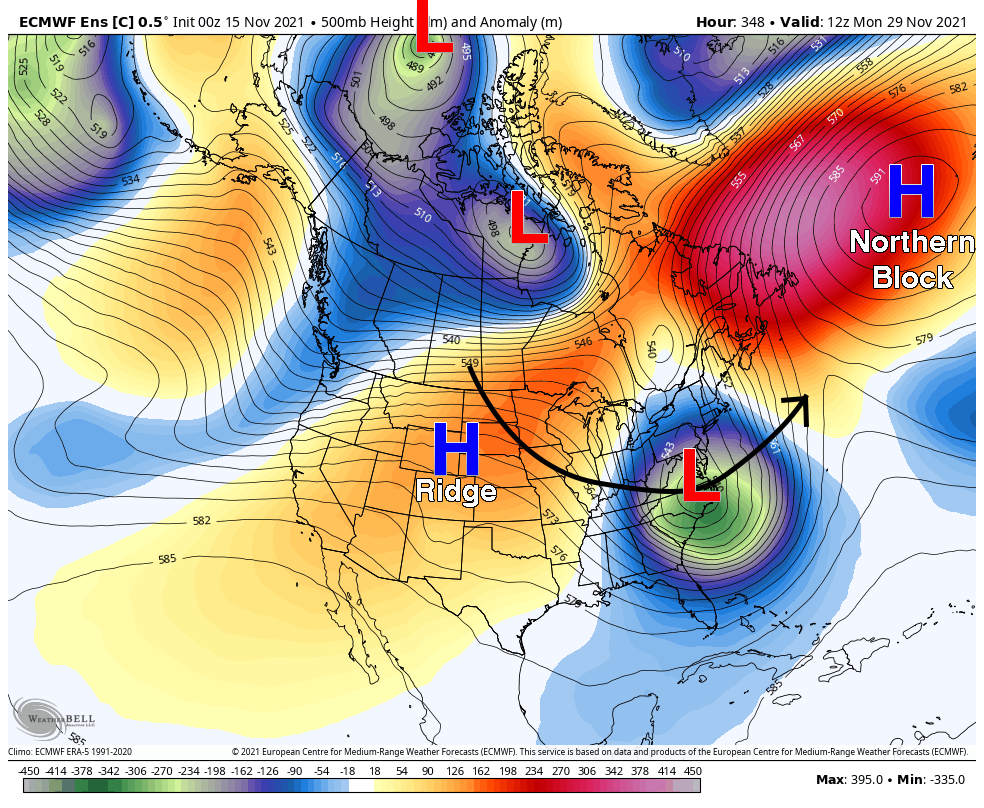
    500MB Pattern For Monday November 29th ECMWF ENS

    Between the 24th-29th, Models have been hinting at a more robust storm system to enter in across the Ohio Valley with a stronger block established south of Greenland. In correlation with the latest NAO teleconnection forecasts, It makes good sense with a fairly negative signal showing that blocking pattern quite well near Greenland. Make sure to keep in touch with the latest forecast for potential travel delays during the Thanksgiving Holiday.

    Negative NAO In Correlation With The Greenland Block From The 21st Through The 27th
  • Rocket Launches Scheduled October 20 from NASA’s Wallops Flight Facility

    Rocket Launches Scheduled October 20 from NASA’s Wallops Flight Facility

    Three suborbital rockets are scheduled for launch Oct. 20, 2021, for the Department of Defense from NASA’s launch range at the Wallops Flight Facility in Virginia.

    The rockets will be launched between 5 and 11 p.m. EDT. The backup launch dates are October 21 and 22.

    No real-time launch status updates will be available. The launches will not be shown live on the Internet nor will launch status updates be provided during the countdown on social media. 

    The rocket launches are expected to be visible from the Chesapeake Bay region. The NASA Visitor Center at Wallops will not be open for viewing the launch.

    Story Written By,

    Keith Koehler
    NASA’s Wallops Flight Facility

  • Waterspouts On The Chesapeake Bay On Saturday 10/16/2021

    Waterspouts On The Chesapeake Bay On Saturday 10/16/2021

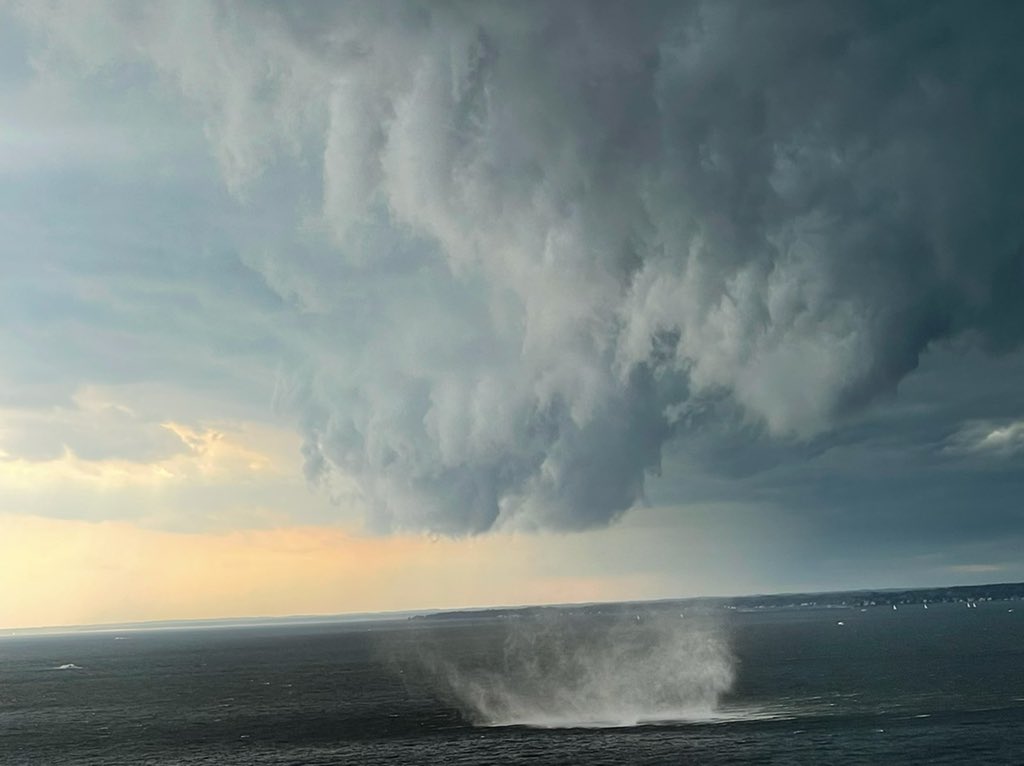
    Waterspout near the Chesapeake Bay Bridge Tunnel. Photo: By Tessa Gunnell / Karen Gunnell

    A surprise for many drivers over the Chesapeake Bay Bridge this afternoon when several spin ups occurred over the open waters right next to the bridge. As stated from Tessa Gunnell these spins ups occurred just before 3pm this afternoon.

    The National Weather Service in Baltimore/Washington issued a Special Marine Warning for this area but no mentions of a waterspout potentials.

    Now waterspouts are very erratic and can form without the presence of a thunderstorm. We happen to bring the perfect recipe for waterspout formations with this passage of a strong cold front.

    Fair weather waterspouts usually form along the dark flat base of a line of developing cumulus clouds. This type of waterspout is generally not associated with thunderstorms. While tornadic waterspouts develop downward in a thunderstorm, a fair weather waterspout develops on the surface of the water and works its way upward. By the time the funnel is visible, a fair weather waterspout is near maturity. Fair weather waterspouts form in light wind conditions so they normally move very little.

    With the very warm weather out ahead of this front in the upper 70’s to low 80’s, very warm water temperatures still around 70 degrees, and much cooler air along the cold front is giving the perfect dynamics for the airmass to clash and begin to rotate.