Author: Admin

  • Flash Freeze Risk Thursday Morning as Arctic Front Sweeps Through

    Flash Freeze Risk Thursday Morning as Arctic Front Sweeps Through

    A rapidly moving arctic cold front will create dangerous flash freezing conditions early Thursday morning, posing a significant hazard for travel across the region.

    Temperatures are expected to fall sharply from the 50s into the 20s in just a few hours as the front passes. Rain will transition to snow during this time, but the most serious concern will be the sudden freeze of wet roadways, sidewalks, and bridges.

    As colder air rushes in behind the front, any standing water from earlier rainfall will freeze almost instantly. This can lead to a thin but extremely slippery layer of ice forming with little to no warning. Bridges, overpasses, untreated roads, and shaded areas will be especially vulnerable to rapid icing.

    The timing of the temperature drop may coincide with the Thursday morning commute, increasing the risk for accidents and hazardous travel conditions. Even areas that see minimal snowfall could experience dangerous conditions due to ice forming faster than road crews can treat surfaces.

    Gusty winds behind the front will reinforce the cold air and cause wind chills to drop quickly, making conditions feel even colder by daybreak. Any snow that does fall will be brief, but it may further reduce visibility during the transition.

    Residents are urged to use caution if traveling early Thursday morning. Slowing down, allowing extra stopping distance, and remaining alert for icy patches will be critical. If possible, delaying travel until conditions improve later in the morning is strongly advised.

    Conditions are expected to stabilize later Thursday as precipitation ends, but cold temperatures will persist through the day.

  • Wintry Mix Followed By Arctic Cold To Finish Work Week

    Wintry Mix Followed By Arctic Cold To Finish Work Week

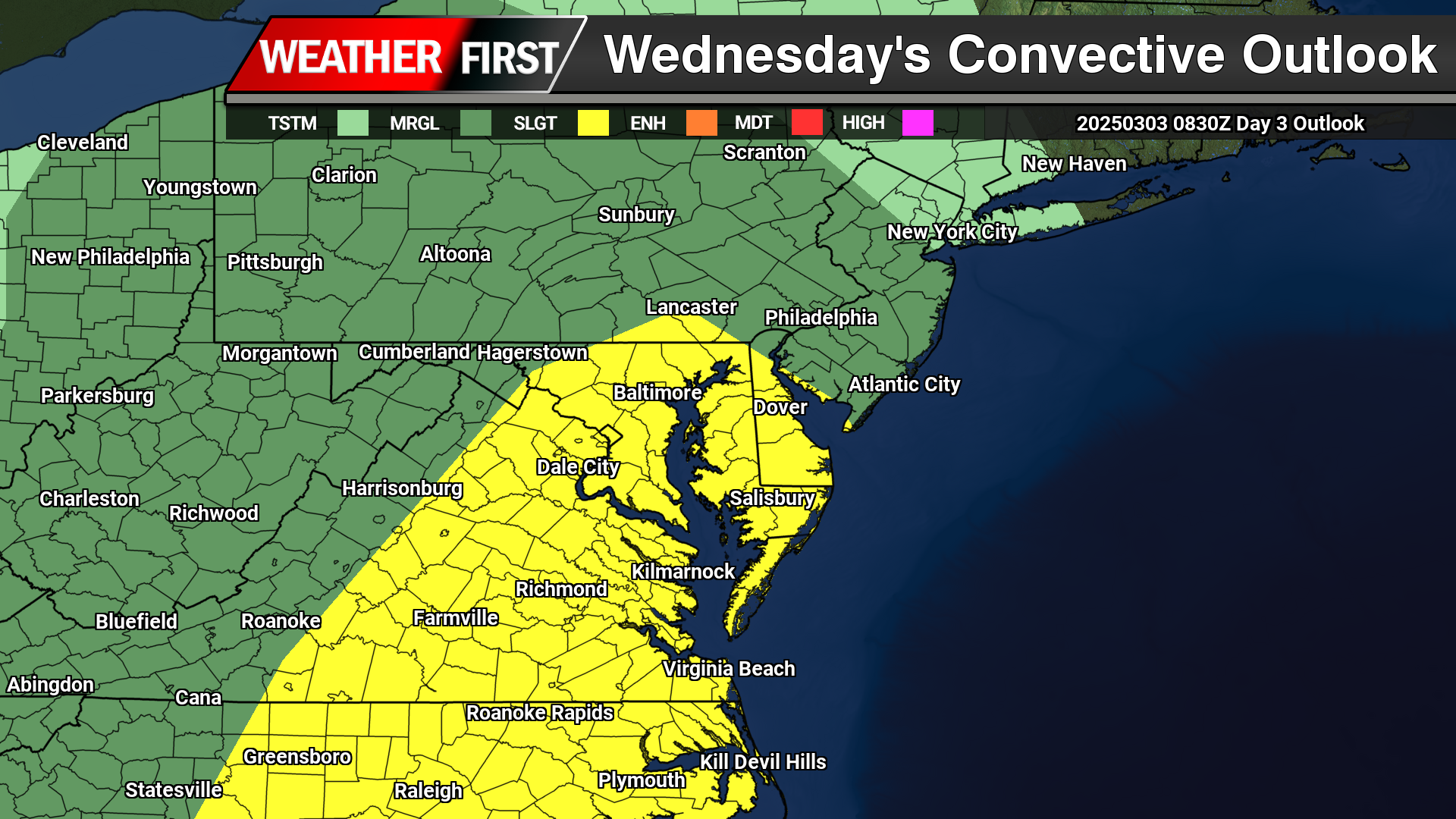
    A developing storm system will bring a brief period of light rain to Delmarva late Wednesday, with the potential for a few snowflakes before the precipitation ends early Thursday. While impacts from precipitation look minimal, the bigger story will be the sharp drop in temperatures and strong winds that follow and last into Friday.

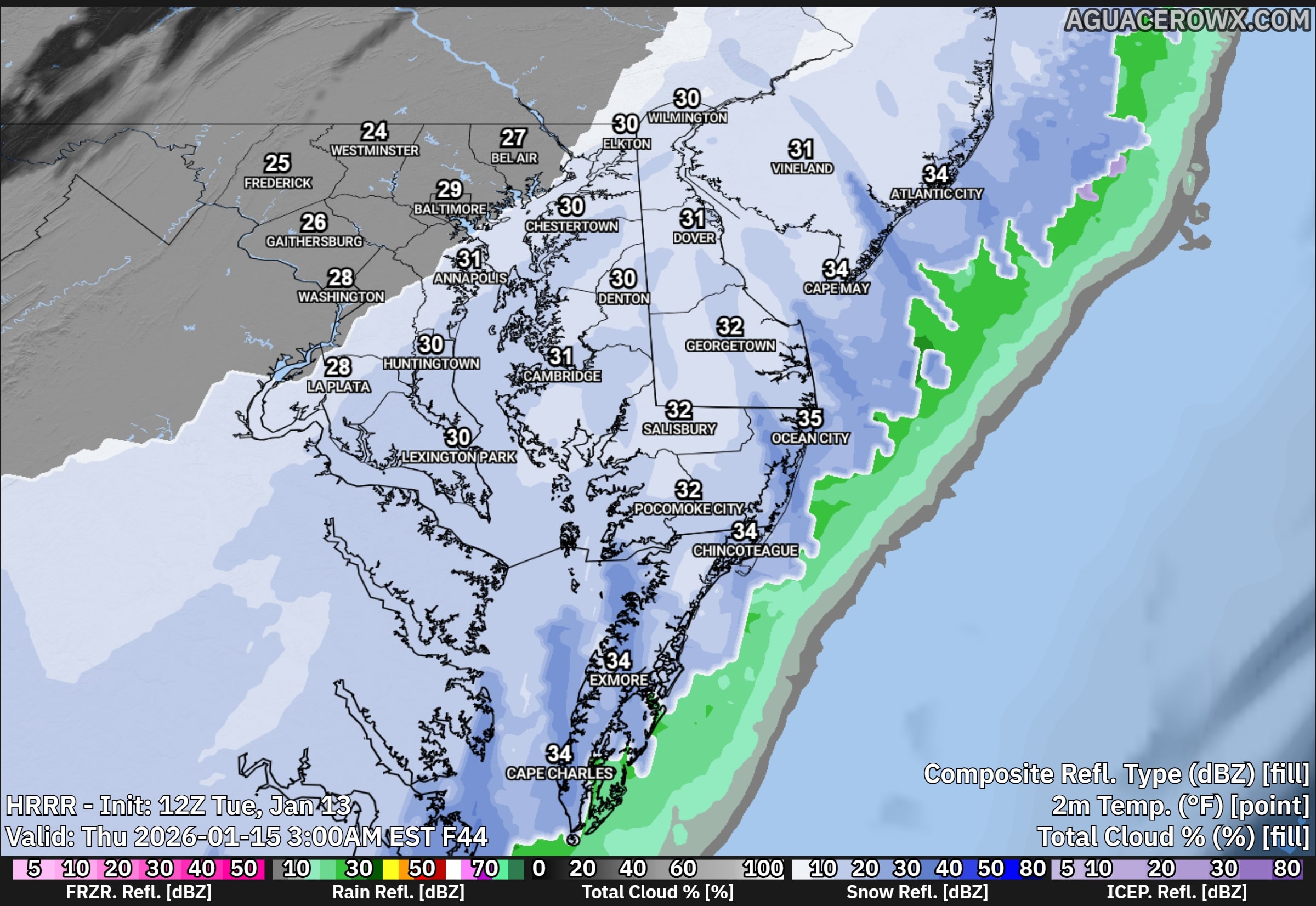
    On Wednesday, a cold front associated with a passing system to our north will move through the region. This front will help produce a shield of light precipitation across the area Wednesday afternoon and evening. With temperatures starting off mild, most locations on Delmarva will see rain initially. As colder air moves in overnight, rain could briefly mix with or change to snow before ending early Thursday morning. Any snow accumulation is expected to be very light, with little to no impact expected across Delmarva.

    A secondary storm system is expected to develop offshore along the Carolina coast late Wednesday night into Thursday. Current forecast guidance keeps this system well offshore, meaning it should have little to no effect on our region. Because of this, confidence remains high that Thursday will be largely dry, aside from a small chance of lingering light precipitation early in the morning.

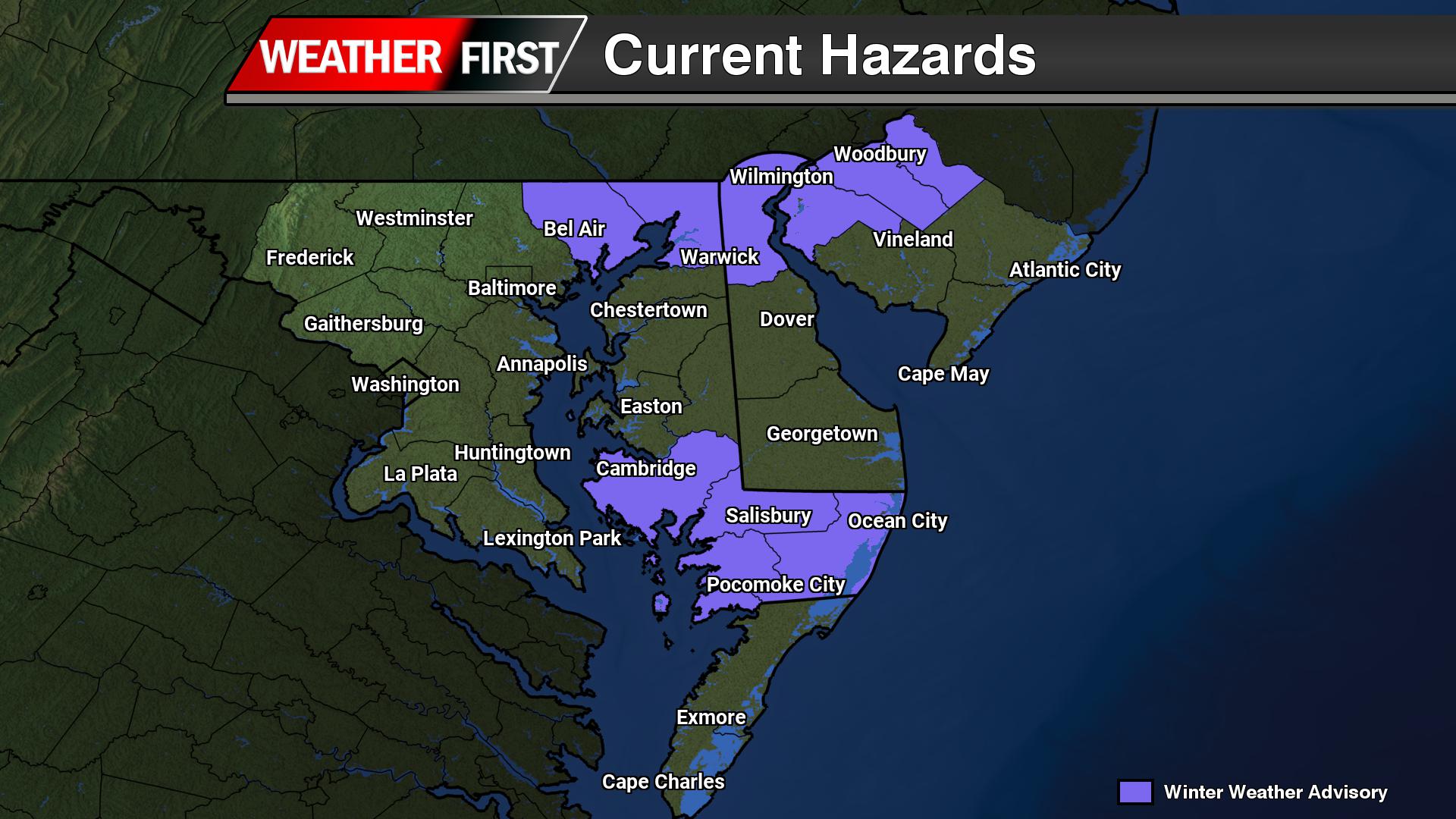
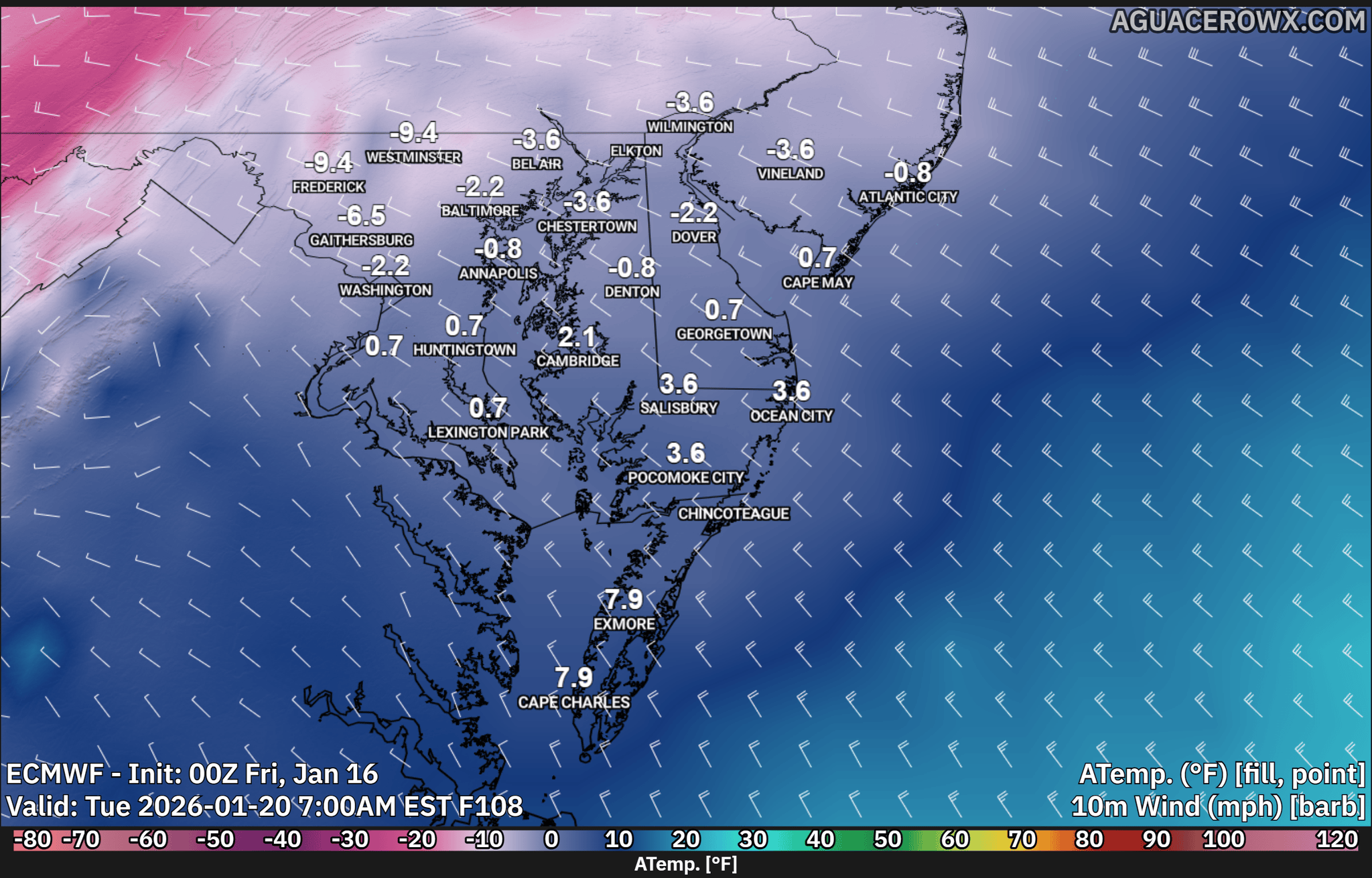
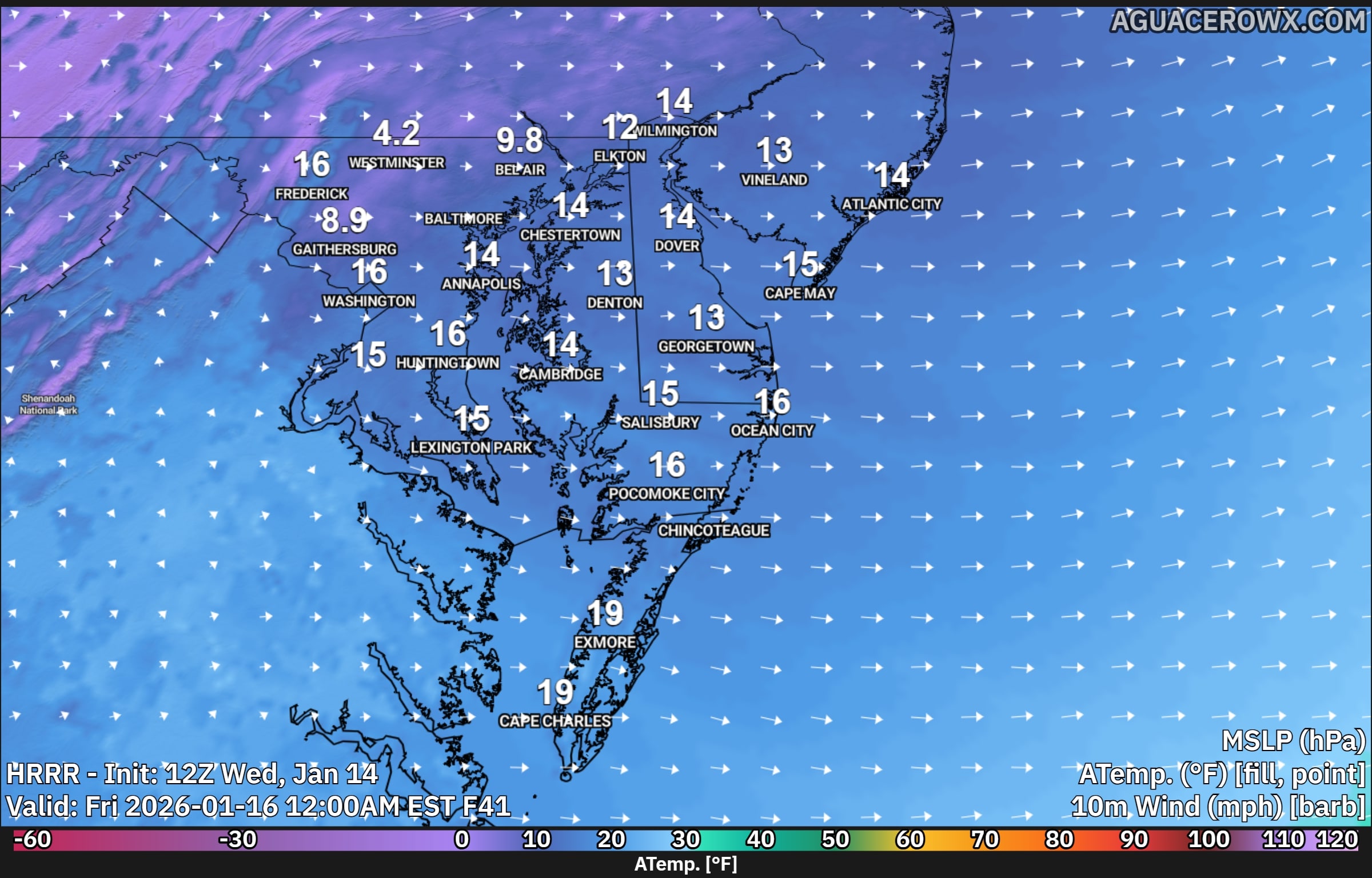
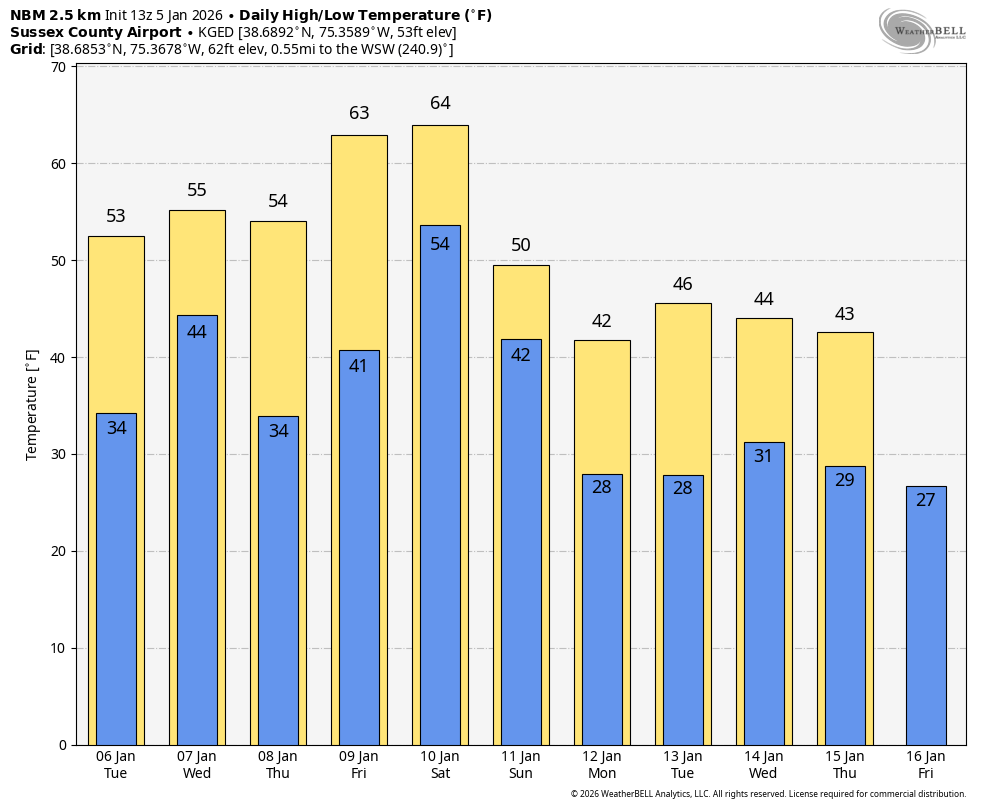
    Temperatures will be relatively mild ahead of the front on Wednesday, with highs ranging from the mid 40s to near 50 degrees across Delmarva. Conditions will change quickly Wednesday night as colder air pours into the region. By Thursday morning, temperatures will drop into the mid 20s to near 30 degrees. Strong west to northwest winds will develop, creating wind chills in the teens and lower 20s through much of the day.

    Thursday will feel bitterly cold and blustery, with sustained winds of 15 to 25 mph and gusts occasionally reaching 30 to 35 mph. Afternoon temperatures will struggle to recover, only reaching the upper 20s to mid 30s despite some sunshine.

    The coldest air arrives Thursday night into early Friday. Overnight lows will fall into the teens and lower 20s across Delmarva, and persistent winds will push wind chills into the single digits by Friday morning. Friday remains cold, with highs once again in the upper 20s to mid 30s and wind chills staying in the lower to mid 20s.

    While this system will not bring significant precipitation, the combination of strong winds and sharply colder temperatures will make it feel more like mid winter across Delmarva heading into the end of the week.

  • Winter Uncertainty Towards The Late Week; Social Media Hype Is Crazy Right Now

    Winter Uncertainty Towards The Late Week; Social Media Hype Is Crazy Right Now

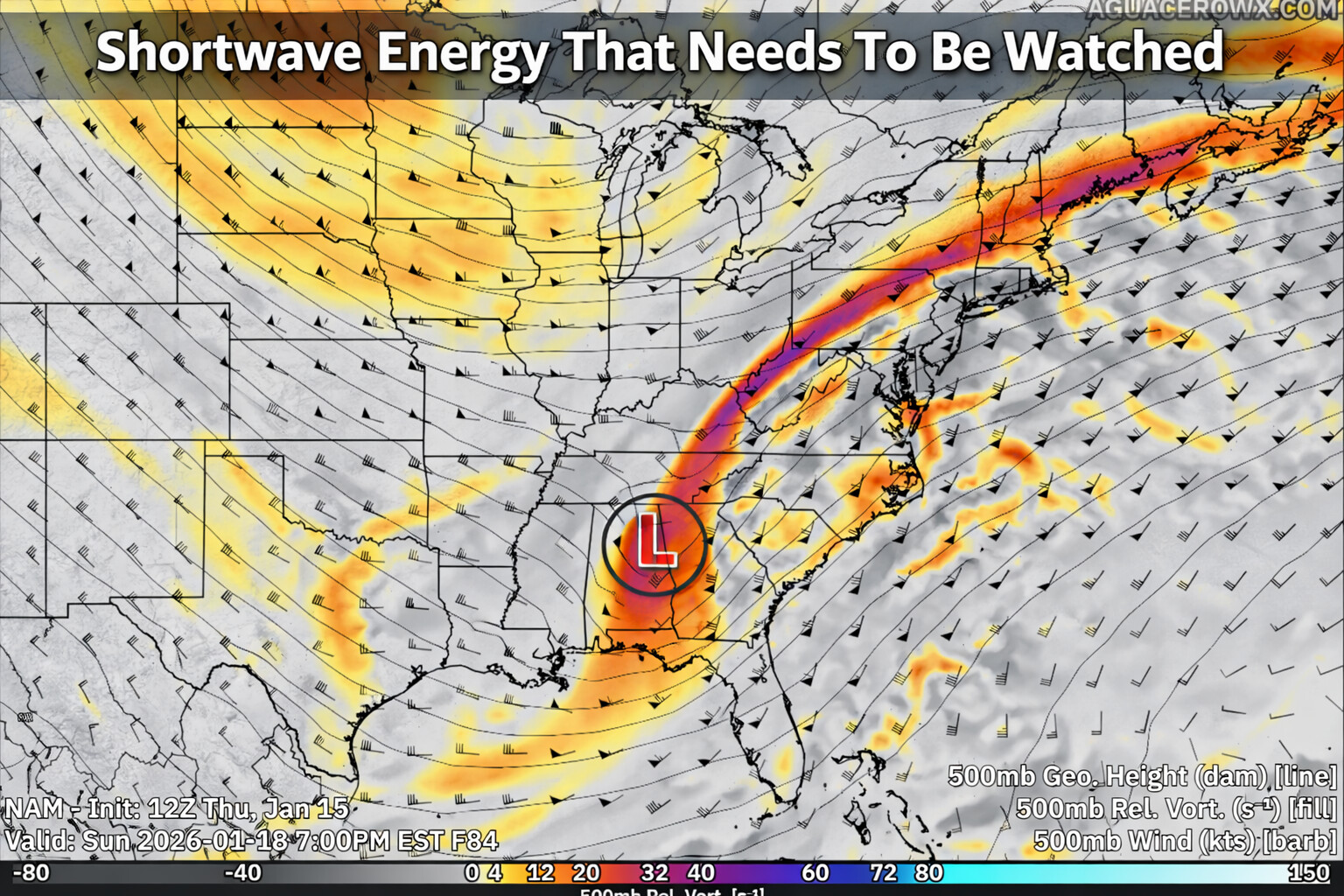
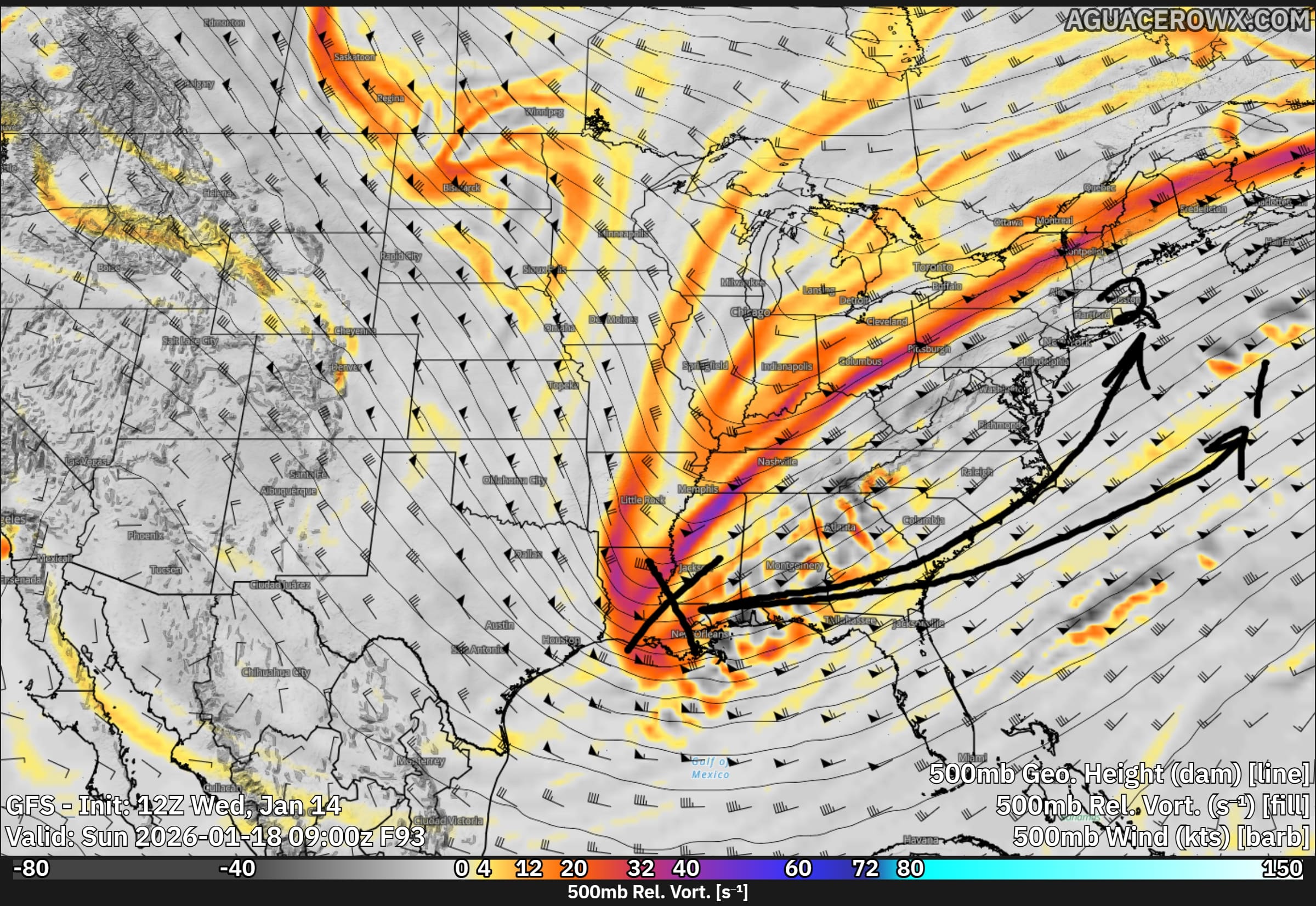
    Forecast guidance continues to signal the potential for a disruptive winter weather pattern later this week, mainly from Wednesday through Friday, as an upper level low strengthens over the Lower Great Lakes and moves toward the Northeast. This system is expected to bring an increase in wintry precipitation across parts of the Lower Great Lakes, the central Appalachians, and portions of the interior Northeast, with colder air also setting the stage for lake effect snow in typical snowbelt regions.

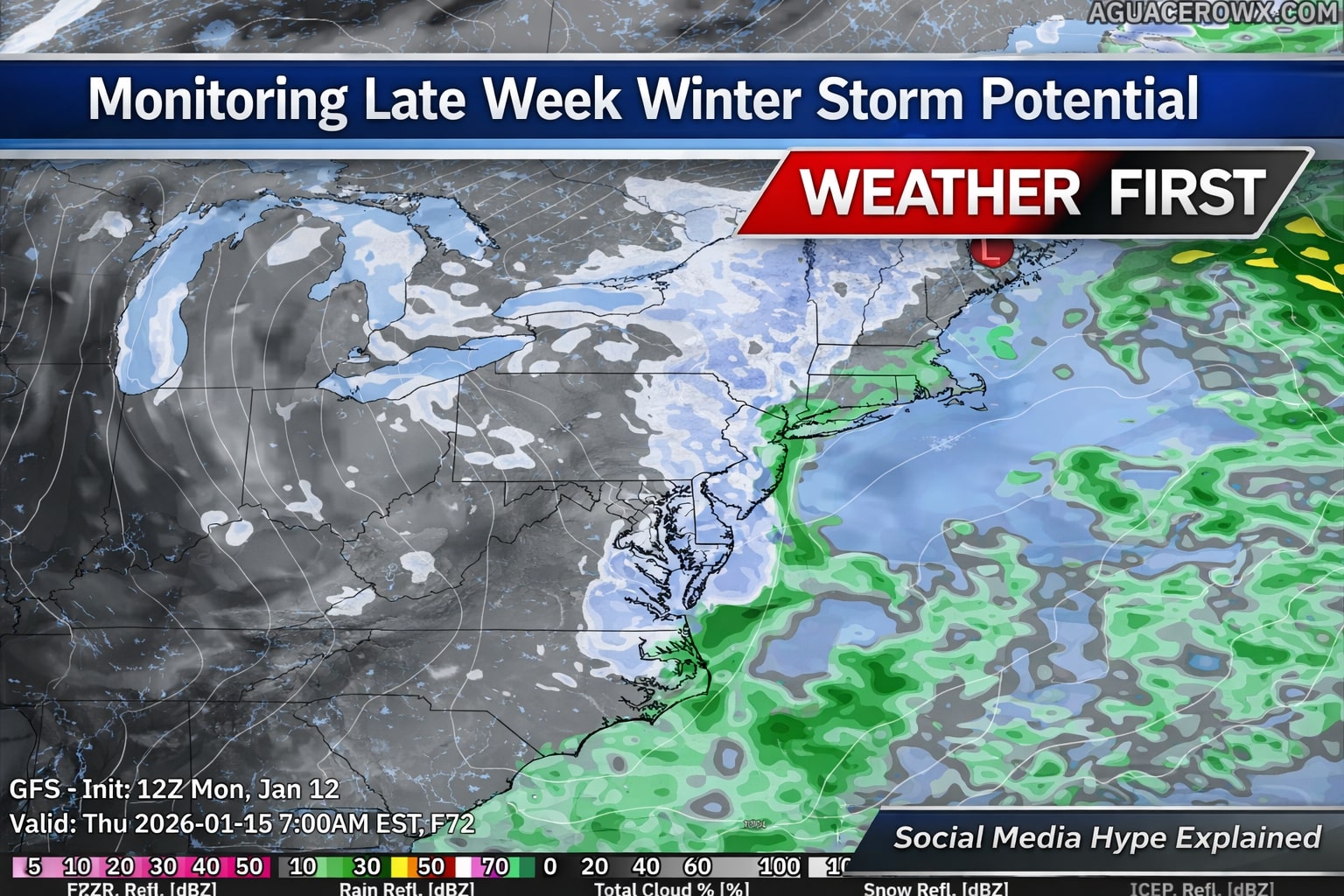
    However, confidence in the overall setup remains low. Key details such as the exact placement and strength of the upper level low are still uncertain, which will ultimately determine where the heaviest precipitation develops. There is also considerable question surrounding coastal low development, including whether it forms too late, remains weak, or tracks well offshore. Recent trends as of today favor a later developing system that stays farther out to sea, which would significantly limit impacts for much of the I-95 corridor.

    The primary question for Delmarva centers on whether a coastal low is able to develop in time and close enough to influence the region. Current guidance shows large spread in both timing and track, with recent trends favoring a system that forms too late and remains well offshore. If this trend holds, meaningful winter weather impacts across Delaware, eastern Maryland, and Virginia’s Eastern Shore would be limited or possibly avoided altogether.

    Because of these uncertainties, forecast impacts to travel and infrastructure remain unclear at this time. While some wintry weather is possible inland, especially across higher elevations and areas closer to the Great Lakes, any coastal impacts would depend on how quickly and how close a coastal low can organize. Forecast confidence should improve over the next few days as the system comes into better range of higher resolution models.

  • Colder Pattern Looks to Take Hold Across the Eastern U.S. Through Late January

    Colder Pattern Looks to Take Hold Across the Eastern U.S. Through Late January

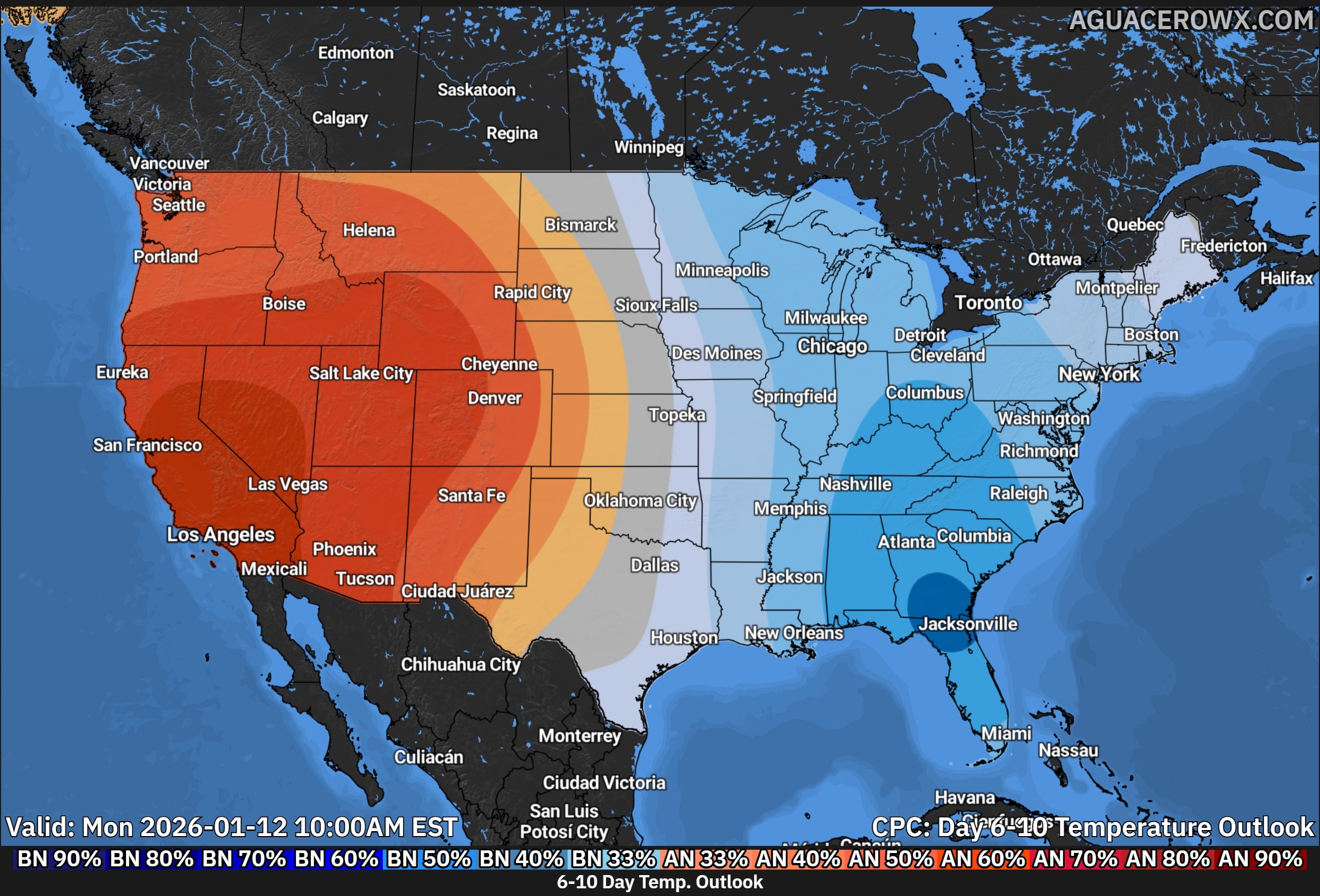
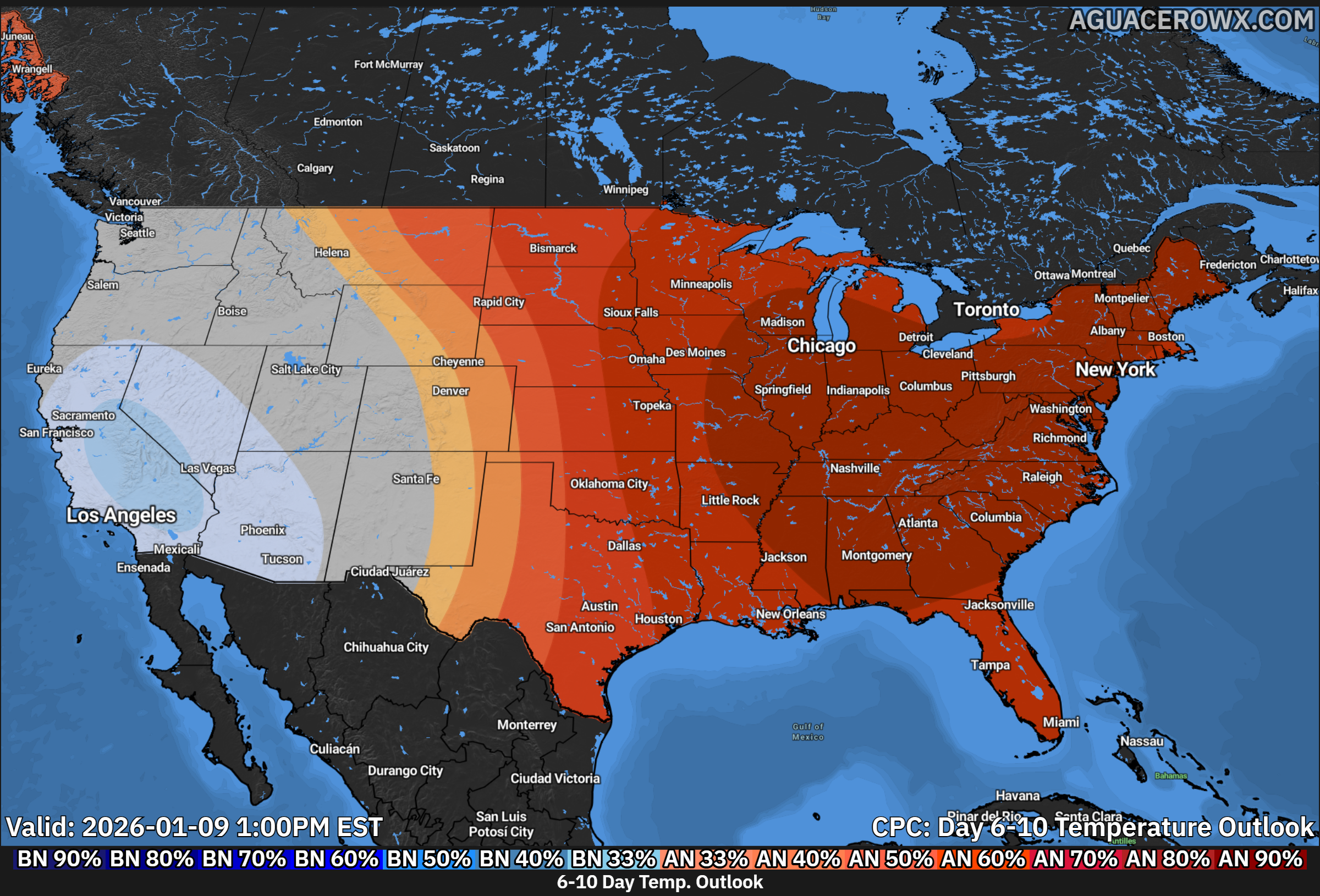
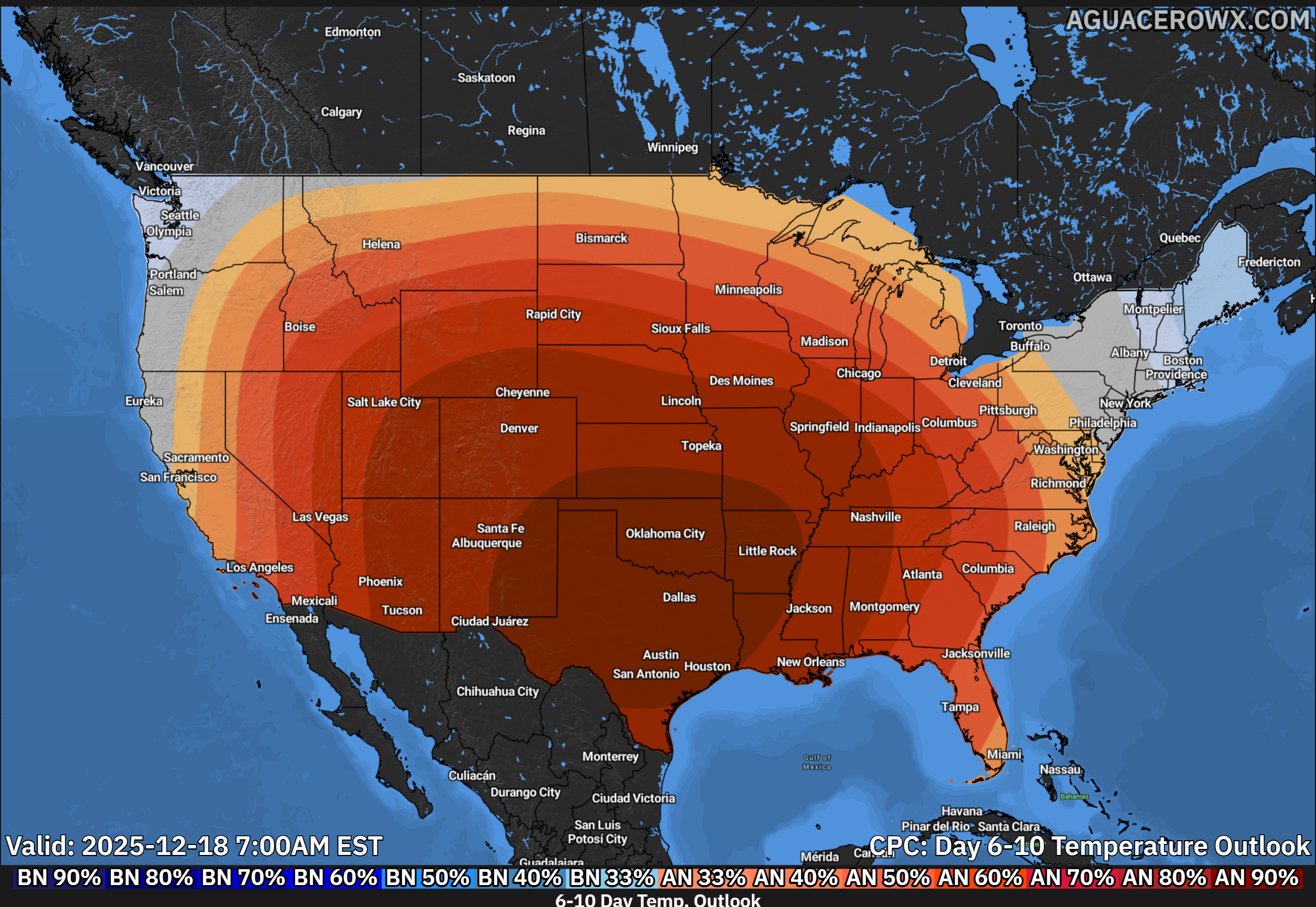
    A noticeable shift toward colder than average temperatures is expected to develop across much of the eastern United States over the next few weeks, according to the latest temperature outlooks from the Climate Prediction Center. Multiple forecast periods show increasing confidence that below average temperatures will dominate the East, including the Mid Atlantic and Delmarva region.

    6 to 10 Day Outlook: Cold Begins to Push East

    During the 6 to 10 day period, colder air is forecast to expand across much of the eastern half of the country. Below average temperatures are favored from the Midwest through the Ohio Valley and into the Mid Atlantic and Southeast. The Delmarva Peninsula falls within this colder zone, signaling a transition away from recent mild conditions.

    While the strongest cold anomalies are centered farther west early on, the overall pattern supports repeated intrusions of cooler air into the region. Daytime highs are expected to trend several degrees below normal, with overnight lows becoming more seasonable to colder than average.

    8 to 14 Day Outlook: Below Average Temperatures Become More Established

    Confidence increases during the 8 to 14 day period as below average temperatures become more firmly established across the eastern United States. The cooler air mass expands and deepens, covering much of the Mid Atlantic, Northeast, and Southeast.

    For Delmarva, this period favors a sustained stretch of cooler conditions, especially during nighttime hours. Persistent northwest flow behind passing systems may keep temperatures suppressed for several days at a time.

    Weeks 3 to 4: Colder Pattern Persists

    Looking ahead into weeks 3 and 4, the temperature outlook continues to favor below average conditions across much of the eastern United States. While forecast confidence naturally decreases at longer ranges, the signal remains consistent for a cooler than normal pattern.

    Across Delmarva, this suggests limited warm ups and continued winterlike temperatures heading into late January. Brief periods of moderation may occur, but cooler air is expected to return frequently as the broader pattern remains favorable for below average temperatures.

    What This Means for Delmarva

    For residents across Delaware, Maryland’s Eastern Shore, and Virginia’s Eastern Shore, the next few weeks are expected to feature a noticeable chill compared to normal January conditions. While temperatures will fluctuate, the overall trend points toward a colder pattern settling in across the region.

    Overall, the outlook supports a sustained period of below average temperatures across the eastern United States, with Delmarva remaining solidly within the cooler regime through much of the remainder of January.

  • Rain Threat Increases Across the Mid Atlantic Through the Weekend

    Rain Threat Increases Across the Mid Atlantic Through the Weekend

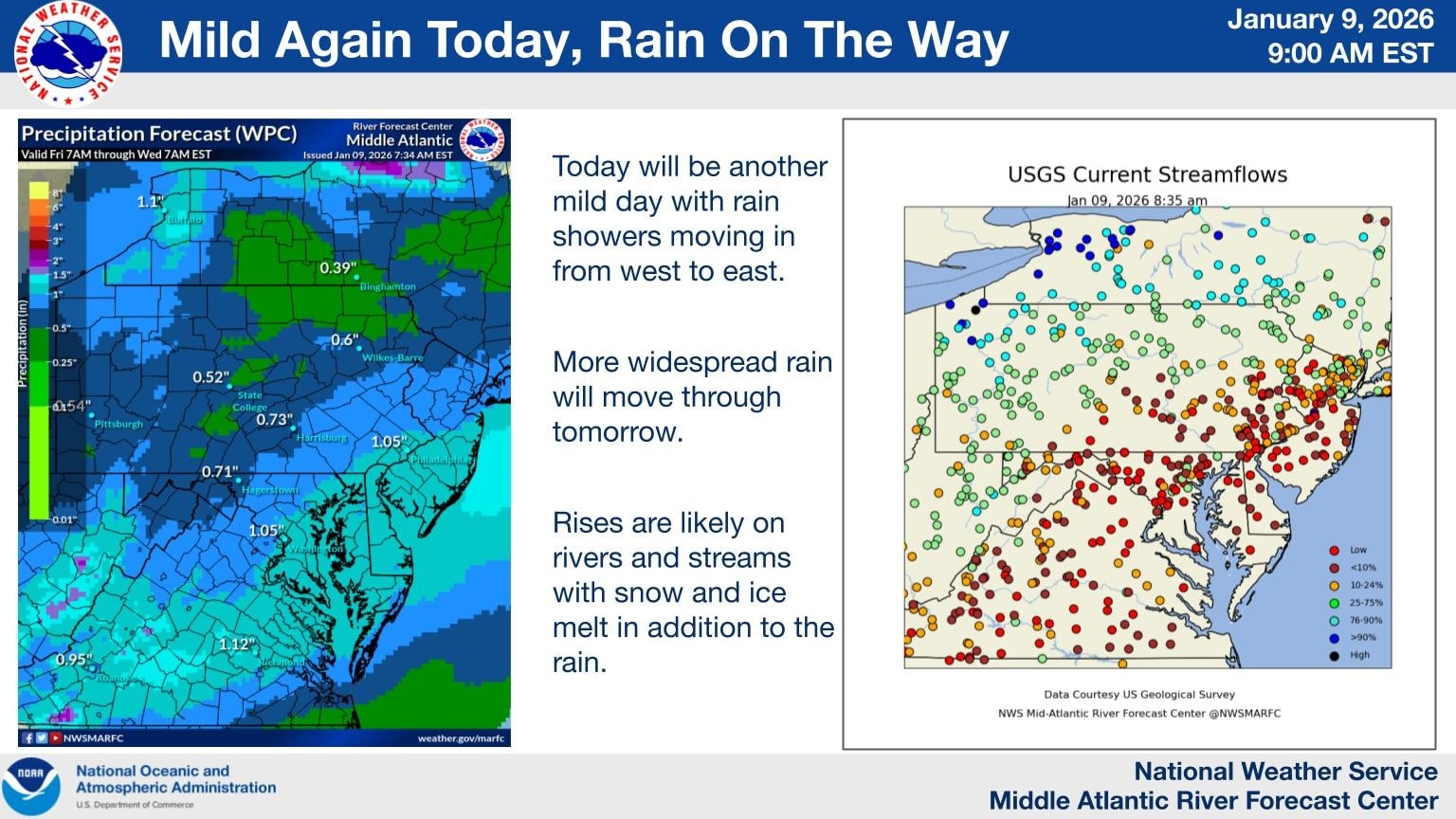
    A prolonged period of unsettled weather is expected to impact much of the Mid Atlantic beginning later this evening and continuing through Sunday, bringing multiple rounds of rain and the potential for localized flooding concerns.

    Rain showers will begin moving into the region from west to east this evening as a mild and moisture rich weather pattern remains in place. While rainfall tonight is expected to be generally light to moderate, coverage will increase overnight and into Saturday as a stronger system approaches.

    More widespread rain is forecast for Saturday and Saturday night as deeper moisture moves into the Mid Atlantic. Periods of steady rain are likely, with occasional heavier downpours. Embedded isolated thunderstorms are also possible during this time, which could briefly enhance rainfall rates in some areas.

    By Sunday, additional rounds of showers are expected to continue, keeping soils saturated and rivers on the rise. While rainfall amounts will vary by location, several areas could see one to two inches of rain by the end of the weekend, with locally higher totals where heavier showers or thunderstorms occur.

    Delmarva Region Faces Elevated Rain And Water Concerns

    Across the Delmarva Peninsula, including Delaware, eastern Maryland, and the Eastern Shore of Virginia, the rain threat will become more pronounced overnight and persist through the weekend. Rainfall totals of one to two inches are likely across much of the region, with isolated higher amounts possible.

    The combination of steady rain, mild temperatures, and ongoing snow and ice melt farther north could lead to noticeable rises on rivers, streams, and creeks. Low lying and poor drainage areas may be especially susceptible to ponding of water, particularly during periods of heavier rain.

    While widespread flooding is not currently expected, localized minor flooding cannot be ruled out, especially if thunderstorms produce brief heavy downpours. Urban areas and locations near small waterways should remain alert for changing conditions.

  • NOAA Forecast: Pacific Ocean Weather Pattern Likely Shifting From La Niña to El Niño

    NOAA Forecast: Pacific Ocean Weather Pattern Likely Shifting From La Niña to El Niño

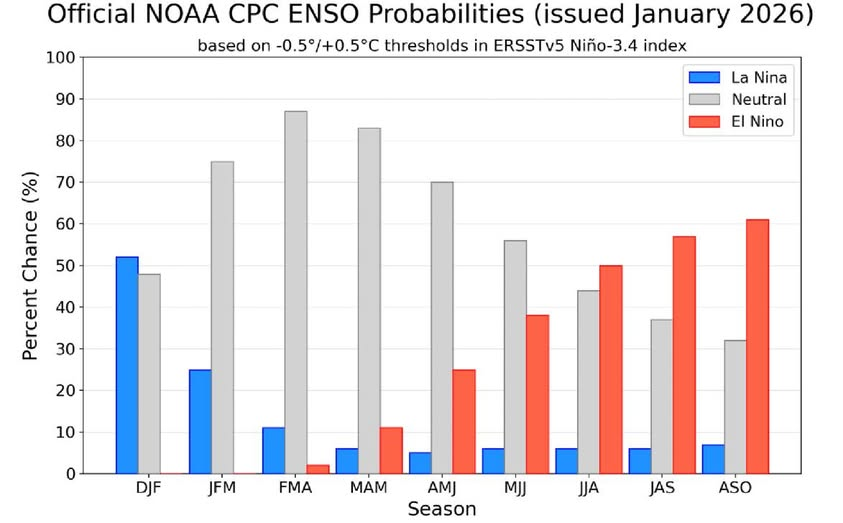
    The latest climate update from the Climate Prediction Center, part of the National Oceanic and Atmospheric Administration, shows that the ongoing La Nina pattern in the Pacific Ocean is weakening. Forecasters say a transition toward more neutral conditions is expected over the next few months.

    La Nina is a climate pattern marked by cooler than normal sea surface temperatures across the central and eastern tropical Pacific Ocean. These cooler waters have persisted into early 2026, based on recent ocean temperature observations. While La Nina remains in place, its influence is beginning to fade.

    According to NOAA, there is about a 75 percent chance that the Pacific will move into ENSO neutral conditions between January and March 2026. ENSO neutral means the Pacific is not in either a La Nina or El Nino phase. Forecast models suggest these neutral conditions could last through at least late spring.

    One of the main signals supporting this shift is warming water beneath the ocean surface. Warmer water that had been confined to the western Pacific is now spreading eastward, helping to weaken the remaining La Nina pattern. While some atmospheric features still resemble La Nina, key wind and temperature signals are gradually trending toward neutral.

    Forecasters caution that even after sea surface temperatures return to neutral, lingering impacts from La Nina could still influence weather patterns during early spring. Looking further ahead, there is increasing potential for El Nino to develop later in 2026, although confidence in that part of the forecast remains lower at this time.

    NOAA continues to monitor ocean and atmospheric conditions closely and will provide regular updates as the Pacific climate pattern evolves. These outlooks help forecasters, emergency planners, and the public prepare for seasonal weather changes influenced by shifts in the tropical Pacific.

  • January Thaw Ongoing For Now, Winter Making A Return Towards Next Week

    January Thaw Ongoing For Now, Winter Making A Return Towards Next Week

    With days as of this past week constantly being int he 50’s and even 60’s, many wonder where did winter go? Normally in the winter months across the lower 48 go through a longer duration warming trend as a recharge of the overall pattern and sign are pointing at a return to more winter weather moving back across the eastern half of the US.

    Weather models are all onboard for a bigger shift in the overall weather pattern across the Northern Hemisphere Mainly what’s going on across the Pacific Ocean which is the biggest driver to the Lower 48 weather pattern for supplying the cold air and the active storm track. One thing that is peaking my interests is a significant drop in the Eastern Pacific Oscillation during the time period of the 14th-20th.

    A very large negative Eastern Pacific Oscillation, or EPO, is a significant large scale weather pattern that can strongly influence temperature and storm tracks across the United States, especially during the fall and winter months.

    When the EPO is strongly negative, a powerful ridge of high pressure builds over the eastern Pacific, often near Alaska and the Gulf of Alaska. This ridge acts as a blocking feature, forcing the jet stream to buckle sharply northward into Alaska and then dive southward downstream into western and central North America. As a result, Arctic air is displaced south out of Canada and into the United States.

    For the western United States, a negative EPO often brings colder than normal temperatures, particularly to the Pacific Northwest and northern Rockies. The ridge offshore can suppress precipitation along parts of the West Coast, leading to drier conditions in California, while the colder air aloft supports snow in the higher elevations of the Northwest and Intermountain West when storms are able to undercut the ridge.

    Across the central and eastern United States, the downstream response to a negative EPO is often a broad trough, which allows cold air to spill southward. This can lead to below normal temperatures across the Plains, Midwest, and East Coast. When moisture is available, this pattern can be favorable for winter storms, as cold air at the surface can interact with southern stream systems or coastal lows.

    The strength of the negative EPO matters. A weak negative phase may only produce brief or modest cold shots, while a strongly negative EPO can support prolonged cold outbreaks, sometimes reaching deep into the southern United States. This setup can also increase the likelihood of sharp temperature swings if the blocking ridge eventually breaks down.

    Weather across the Eastern US might get very interesting going forward into the mid-month.

  • Periods of Rain Expected Across Delmarva Through the Weekend

    Periods of Rain Expected Across Delmarva Through the Weekend

    Residents across the Delmarva Peninsula should prepare for several rounds of rain as a series of weather systems move through the region from late Friday into early Sunday. While no significant flooding or severe weather is expected, the stretch will bring generally wet and mild conditions.

    The first system arrives late Friday as a weakening cold front moves into the Mid-Atlantic. This front is tied to an area of low pressure lifting north from the Great Lakes toward Quebec. Rain is expected to develop Friday afternoon and continue into Friday night. As the front weakens and gradually dissipates over the region, temperatures are not expected to drop noticeably, with little to no cold air pushing in behind it.

    A second, more impactful system follows on Saturday. A deepening upper-level trough moving south from Canada into the Great Lakes will help spawn a new surface low over the lower Mississippi River Valley. This low will track northeast, pushing a warm front northward across Delmarva on Saturday. As the warm front lifts through the region, rain coverage will increase and milder air will overspread the peninsula.

    Temperatures on Saturday may behave unusually, with some locations seeing their highest readings later in the day or even during the evening hours as warmer air moves in. Overnight temperatures may hold steady or even rise slightly in some areas. Overall, Saturday is expected to be a warm and wet day, with temperatures ranging from the upper 40s to the low 60s.

    Heavier rain is expected to move in later Saturday as an initial cold front crosses the region. While a brief rumble of thunder cannot be ruled out due to some elevated instability in the atmosphere, no severe weather is anticipated. Showers may linger Saturday night until a secondary cold front moves through on Sunday morning. Behind that front, winds will increase, but the chance of wind gusts reaching advisory levels remains low.

    There is higher confidence that Delmarva will see periods of rain from Friday afternoon through Sunday morning, though exact rainfall totals remain uncertain. Most guidance suggests at least a half inch of rain, with some models indicating localized totals between 1.5 and 2 inches. The probability of receiving one inch or more of rain is around 40 to 60 percent, while the chance of exceeding two inches is low.

    Rainfall is expected to fall over a 36 to 48 hour period with breaks between systems, reducing the risk of flooding. With mild temperatures in place leading into the weekend, any remaining ice in streams or rivers should have already melted, allowing water to drain efficiently. Confidence in rainfall totals and timing is expected to improve as the weekend approaches.

  • Multiple Rounds of Rain Expected Across Delmarva This Weekend

    Multiple Rounds of Rain Expected Across Delmarva This Weekend

    The Delmarva region is expected to see several rounds of rain as a series of weather systems move through the area from late Friday into Sunday morning. While the rain will be spread out over time, confidence is high that most locations will see wet conditions at some point during the weekend.

    The first round of rain arrives late Friday into Friday night as a weakening cold front crosses the region. This front is associated with an area of low pressure moving from the Great Lakes toward eastern Canada. Because the front is weakening as it approaches Delmarva, it is not expected to bring much of a temperature drop or colder air. Rain during this period should generally be light to moderate.

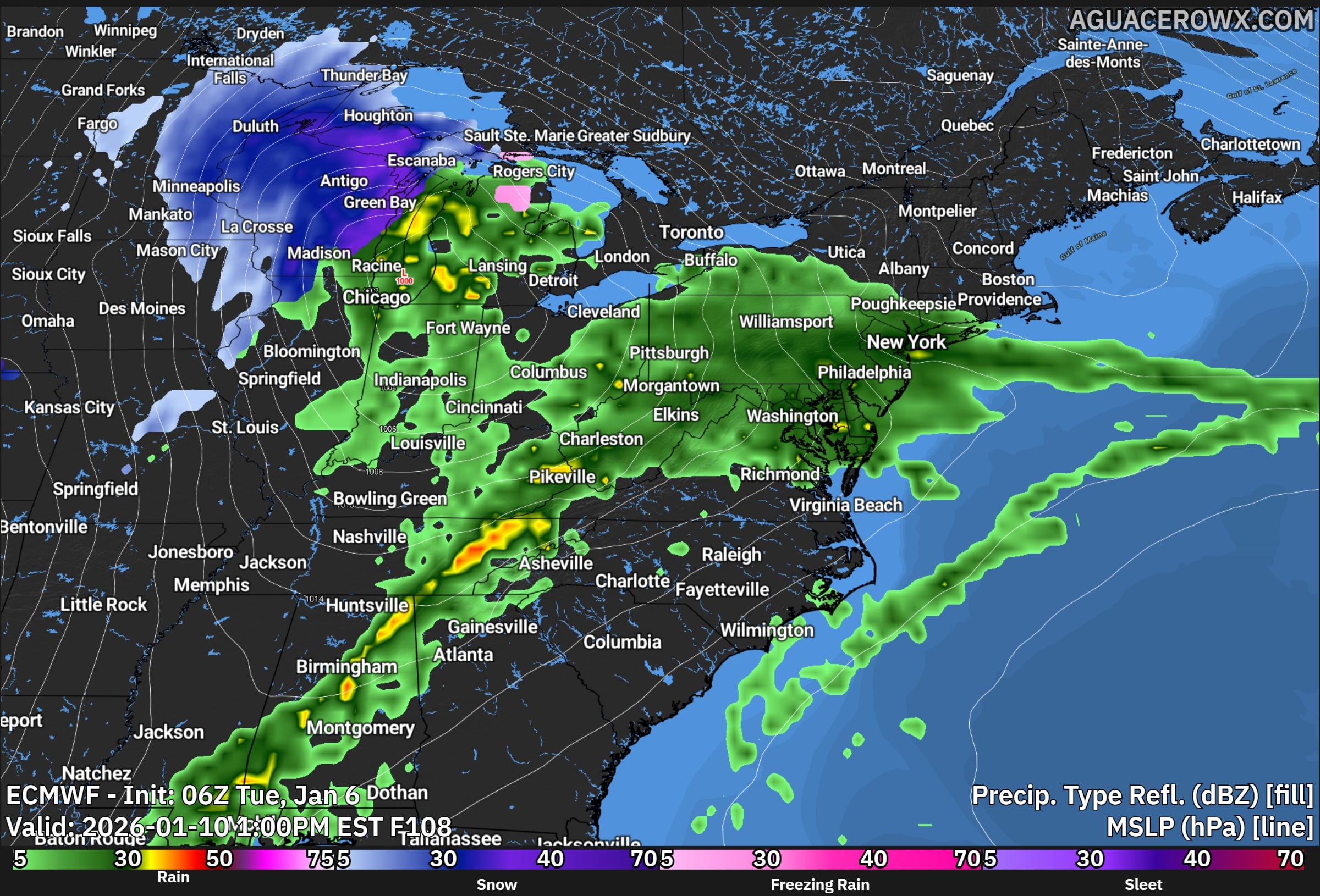
    A stronger system moves in on Saturday as a slow moving trough dives south from Canada into the Great Lakes. This will help develop a new area of low pressure over the Lower Mississippi Valley that tracks northeast toward the Mid Atlantic. A warm front is expected to lift through Delmarva Saturday morning, placing the region in a warmer and more humid air mass. Temperatures are forecast to rise into the 60s, which is mild for this time of year, though still a few degrees shy of daily records.

    Heavier rain is expected later Saturday into Saturday night as a cold front moves through the region. There may be enough instability in the atmosphere for a rumble of thunder, but severe weather is not expected. After the initial front moves offshore Saturday night, scattered showers may linger until a secondary cold front passes through on Sunday morning.

    Once the secondary front clears the area, winds will increase, but the chance of wind gusts reaching advisory levels remains low. Overall, rainfall will be spread out over a 36 to 48 hour period with breaks between rounds.

    Forecast confidence is high that rain will occur, but exact rainfall totals remain uncertain. Most guidance suggests at least a half inch of rain, with some models indicating localized totals between 1.5 and 2 inches. The probability of receiving one inch or more of rain sits around 30 to 50 percent, while the chance of exceeding two inches is low.

    Despite the potential for moderate rainfall, flooding concerns remain minimal. The rain will fall gradually rather than all at once, and recent mild temperatures should have eliminated any lingering ice in creeks or rivers, allowing water to drain efficiently.

    More confidence in rainfall totals is expected as the weekend approaches, but residents across Delmarva should be prepared for several periods of rain from Friday afternoon through Sunday morning.

  • 30 Years Later: Reflecting on the Blizzard of ’96 and the Impact on Delmarva

    30 Years Later: Reflecting on the Blizzard of ’96 and the Impact on Delmarva

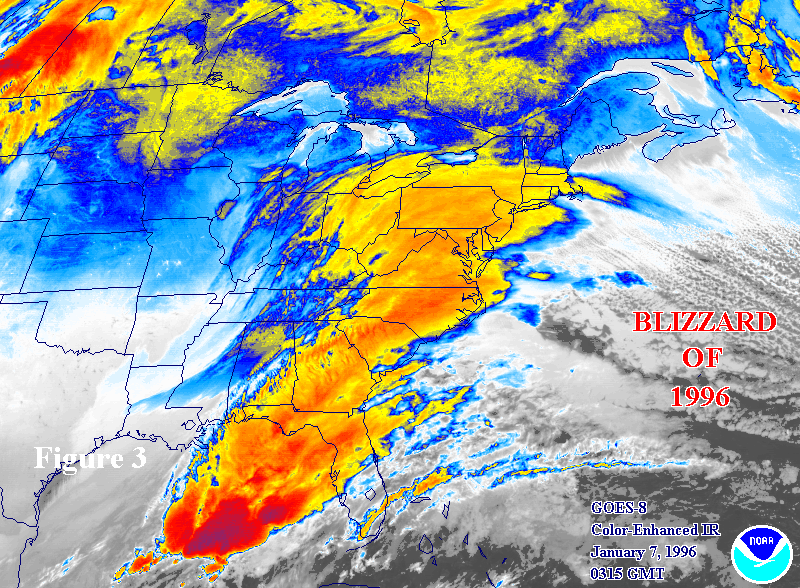
    This winter marks 30 years since one of the most powerful and memorable winter storms in Mid-Atlantic history — the Blizzard of 1996. From January 6 through January 8, a classic nor’easter buried much of the Eastern United States under a historic blanket of snow, bringing life to a standstill from Virginia all the way to southern New England. Thirty years later, the effects of that storm remain part of the weather lore of communities across the Delmarva Peninsula.

    A Storm that Shut Down the Region

    The Blizzard of ’96 was not simply a big snowstorm, it was a paralyzing meteorological event. Fueled by abundant Gulf moisture lifting into frigid Arctic air, the storm produced heavy snowfall, fierce winds, and drifts as high as 5 to 8 feet in places, and it cut off normal travel and commerce for days. More than 20 inches of snow was common from the Smoky Mountains to the Northeast, with Baltimore alone recording more than 22 inches.

    Across the broader Mid-Atlantic, most major airports closed, highways like Interstate 95 became impassable, government and business operations shut down, and utility outages were widespread as heavy snow and strong winds downed trees and power lines.

    Delmarva’s Experience: Snow, School Closures, and Water Issues

    Although Delmarva lies on the more southern and coastal edge of the storm’s heaviest snow, many parts of the Eastern Shore still saw significant impacts. In Delaware and Maryland’s eastern counties, reports from regional accounts show that snowfall totals often reached into the teens across Delmarva, with southern and interior areas picking up even more as the storm slowly moved northward.

    Across the peninsula, schools and local governments closed for days, giving many children extended breaks and making the blizzard one of the most memorable weather events of a generation for families on the Eastern Shore. Many locals from surrounding Mid-Atlantic communities still reminisce about “the week the snow didn’t stop” and the long task of digging out afterward.

    After the Snow: Rapid Melt and Flooding

    What made the Blizzard of 1996 especially notable wasn’t just the snowfall — it was what happened after the snow stopped. Warm and humid air rapidly moved in shortly after the storm, bringing heavy rain and quick snowmelt across the Mid-Atlantic. This combination caused major flooding in rivers and streams throughout the region, including Chesapeake Bay tributaries that affect Delmarva’s watersheds.

    Tributaries that feed into the Bay saw record flows as hundreds of millions of gallons of water — along with nutrients and sediment from the melting snowpack — rushed downstream, raising water levels and flooding low-lying farmland around Delmarva rivers and streams.

    Long-Term Memories and Local Culture

    In the decades since, the Blizzard of ’96 has remained a touchpoint in local weather memory. Many families on Delmarva still tell stories of being snowed in for days, navigating icy roads, building massive drifts and snow forts, and enduring extended school closures that are still talked about at community gatherings.

    For long-time residents of the Mid-Atlantic and Delmarva, the storm also stands as a reminder of how quickly winter weather can transition from snow to serious flooding, the importance of emergency preparation for both snow and water events, and how a single storm system can reshape community life for weeks.

  • NOAA’s SWFO-L1 Space Weather Observatory Nears Final Orbital Position, Systems Reported Healthy

    NOAA’s SWFO-L1 Space Weather Observatory Nears Final Orbital Position, Systems Reported Healthy

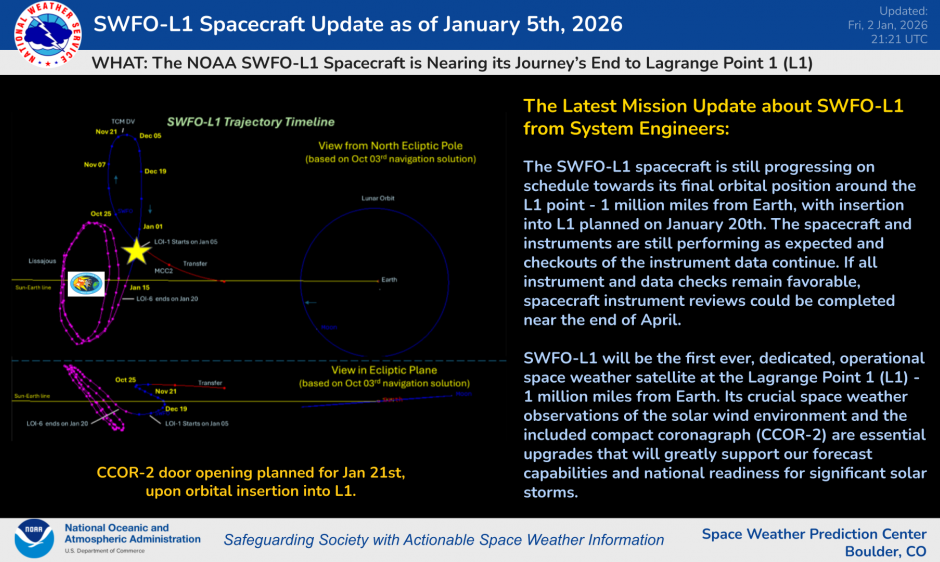
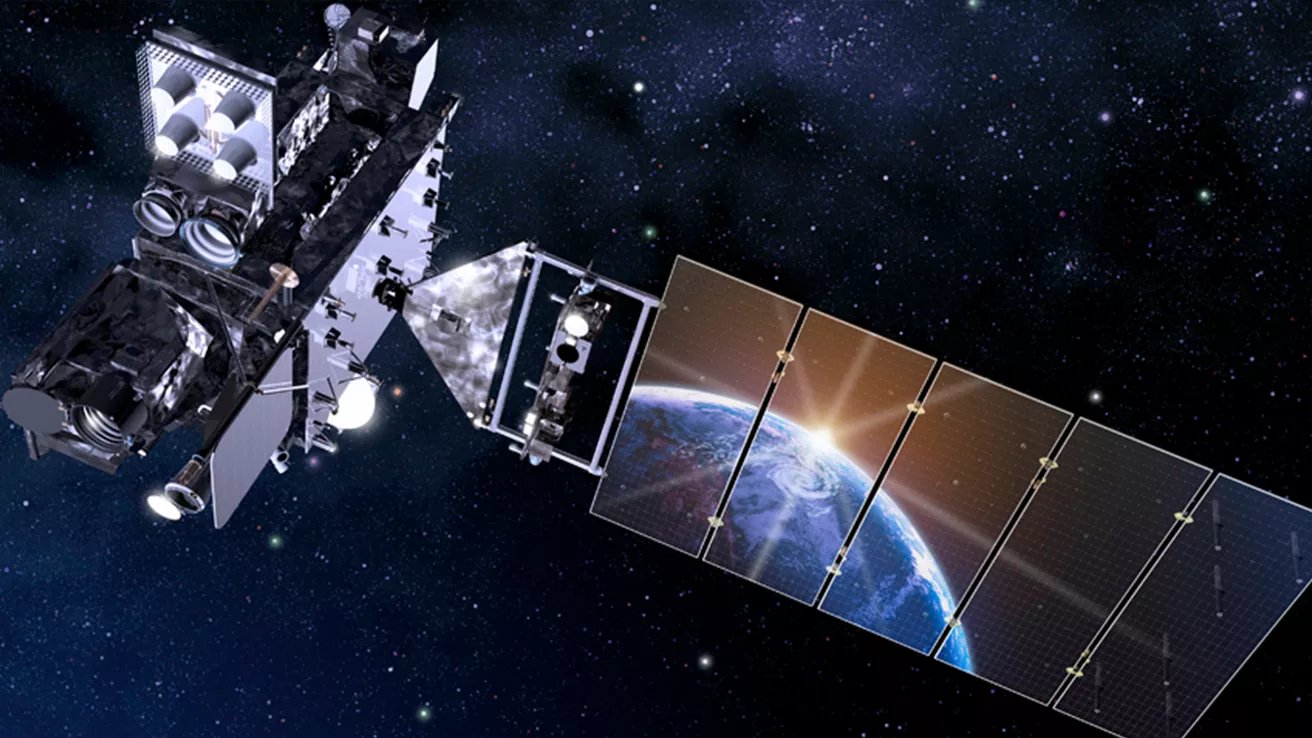
    January 6, 2026 — NOAA’s Space Weather Follow On-L1 (SWFO-L1) spacecraft is nearing the final stages of its journey to Lagrange Point 1 (L1), with orbital insertion scheduled for January 20, 2026. According to a NOAA Space Weather Prediction Center update, the mission’s instrumentation is performing as expected, and engineers report that the spacecraft continues to meet operational milestones as it approaches its final orbit.

    SWFO-L1 was launched on September 24, 2025 aboard a SpaceX Falcon 9 rocket and is designed to provide continuous, real-time monitoring of the solar environment upstream of Earth. Upon reaching the gravitationally stable L1 point—approximately 1 million miles from Earth—it will be renamed SOLAR-1 (Space weather Observations at L1 to Advance Readiness-1).

    Mission engineers are preparing to open the compact coronagraph (CCOR-2) door on January 21, the day after insertion, which will allow NOAA to begin evaluating imagery performance from this key instrument. Early tests of other sensor suites have already shown promising results.

    SWFO-L1 carries several advanced instruments, including a magnetometer, solar wind plasma sensor (SWiPS), and a supra-thermal ion sensor (STIS). These instruments will provide vital measurements of solar wind speed, density, and magnetic field characteristics that drive space weather disturbances. Previous early data from these sensors have already contributed to improved monitoring of solar wind and geomagnetic conditions during space weather events.

    Once commissioned in spring 2026, SOLAR-1’s data is expected to significantly enhance NOAA’s ability to forecast and issue warnings for geomagnetic storms, solar flares, and interplanetary shocks that can impact critical infrastructure such as power grids, communications, navigation systems, and satellites.

    With more accurate and timely space weather data, NOAA officials say the mission will help protect both space-based and ground-based technological systems that are increasingly vulnerable to solar activity—ensuring better preparedness for potentially disruptive solar events.

  • High Winds And Cooler Temps Follow Behind Cold Front This Weekend

    High Winds And Cooler Temps Follow Behind Cold Front This Weekend

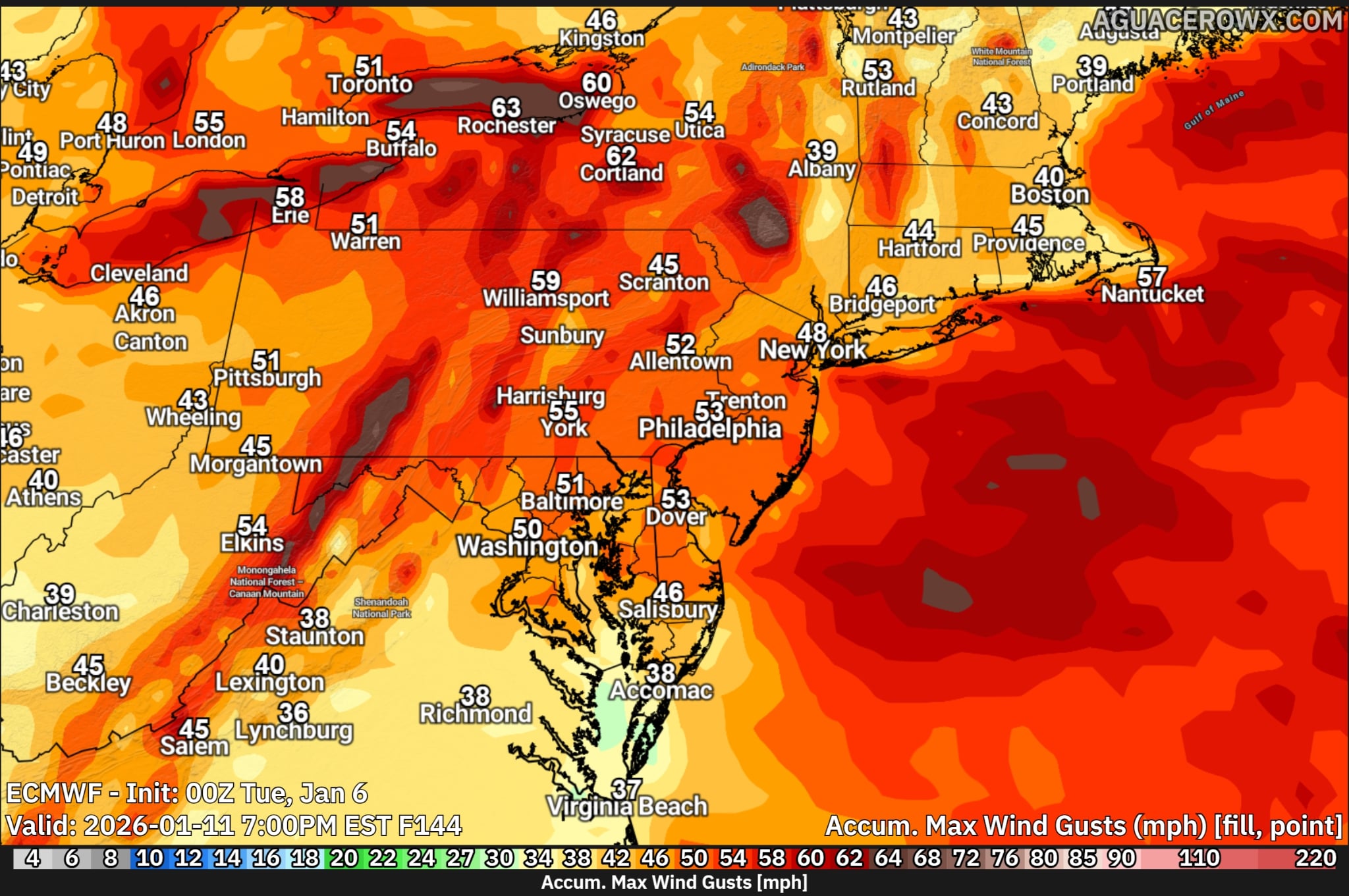
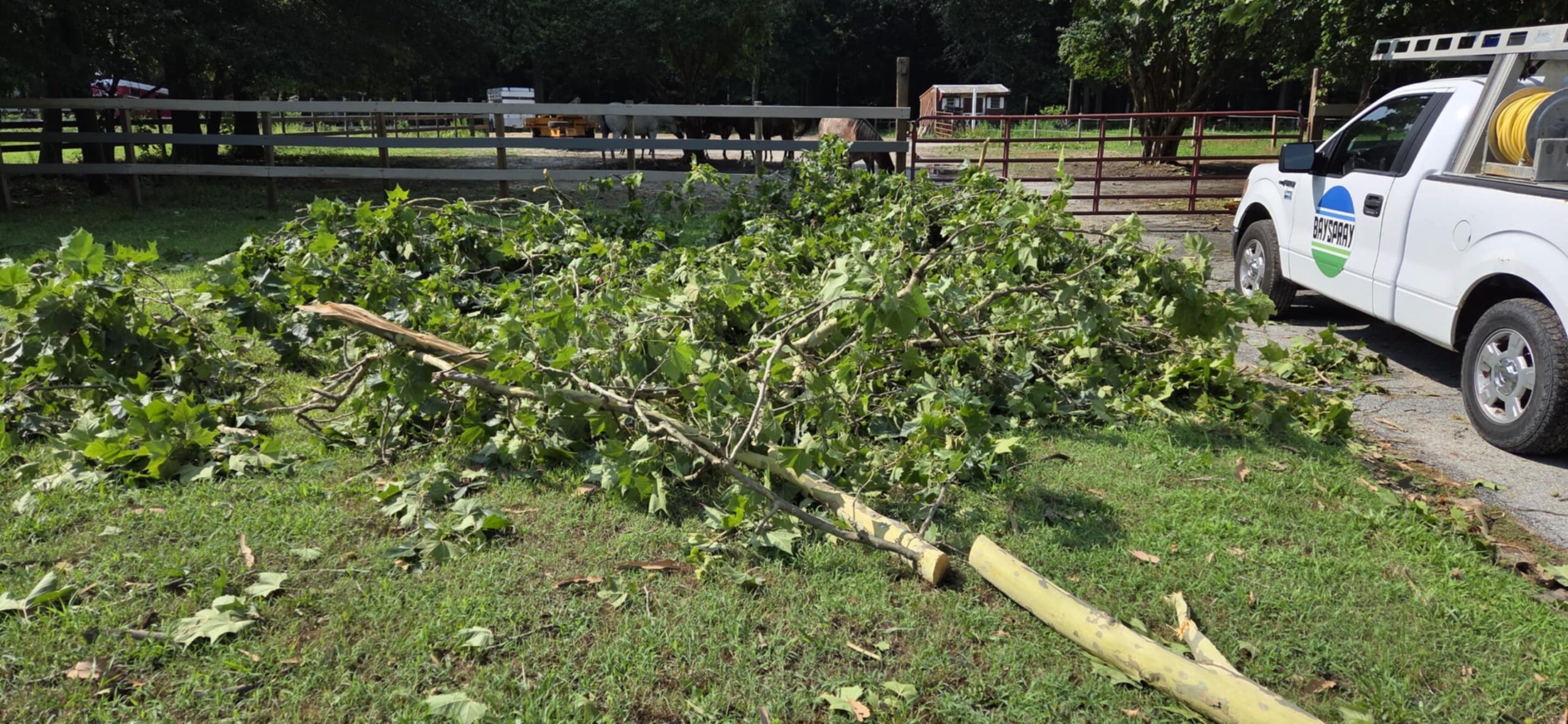
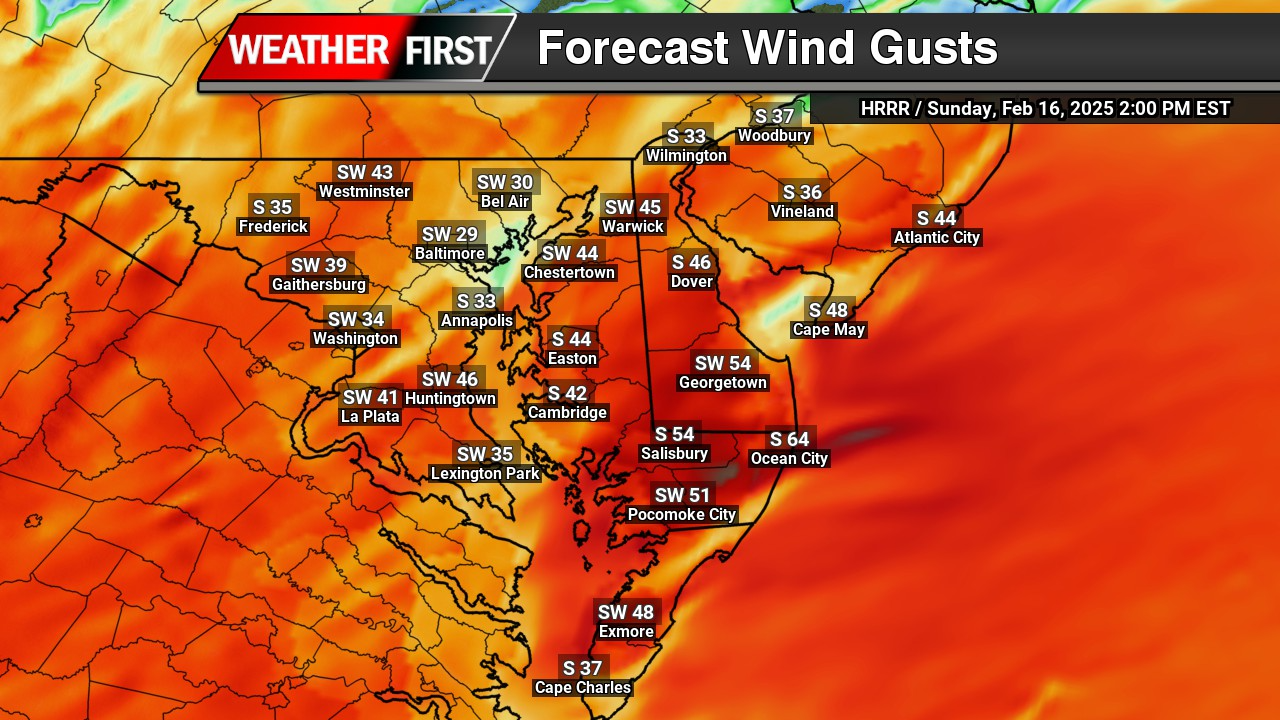
    A strong cold front moving through the Northeast is expected to bring a period of gusty winds through Sunday night, with the highest wind gusts occurring in the wake of the front. Widespread gusts of 40 to 55 mph are likely across much of the Mid-Atlantic and interior Northeast, including Pennsylvania, New Jersey, New York, and New England. Stronger gusts in the 55 to 65 mph range are possible across parts of upstate New York and areas downwind of the Great Lakes, where the pressure gradient will be strongest. Along the coast, especially across New Jersey, Long Island, and southern New England, gusts may exceed 50 mph, increasing the risk for downed trees, power outages, and travel disruptions.

    Here is a break down per state in the region…

    Delaware:
    Strong winds are expected behind the cold front, with peak gusts generally ranging from 45 to 55 mph statewide. The highest gusts are most likely along the coast and across the Delmarva Peninsula, where marine influence and a tighter pressure gradient could push isolated gusts slightly higher. These winds may lead to scattered power outages and difficult travel, especially on bridges and causeways.

    Maryland:
    Widespread gusts of 45 to 55 mph are forecast across much of Maryland, including the I-95 corridor from Baltimore to Washington. Western Maryland could see locally stronger gusts approaching 55 to 60 mph, particularly in higher elevations and along exposed ridgelines. The combination of saturated soils and strong winds may increase the risk for downed trees and power lines.

    Virginia:
    Much of northern and central Virginia can expect wind gusts between 40 and 50 mph, with higher gusts of 50 to 55 mph possible across eastern Virginia and along the Chesapeake Bay. Coastal and tidal areas may experience the strongest winds as colder air surges in behind the front. Impacts may include isolated power outages, difficult travel for high-profile vehicles, and minor coastal concerns.

  • Much Needed Rainfall Later In The Week

    Much Needed Rainfall Later In The Week

    As the temperatures begin to warm up, so does the rain chances as we approach the weekend ahead. Rain will begin to move into the Delmarva region during the morning hours on Friday as a warm front lifts towards New England. Rain chances continue all the way through early Sunday morning when the cold front swings through. But will this bring any relief to the drought situation here in the Mid-Atlantic?

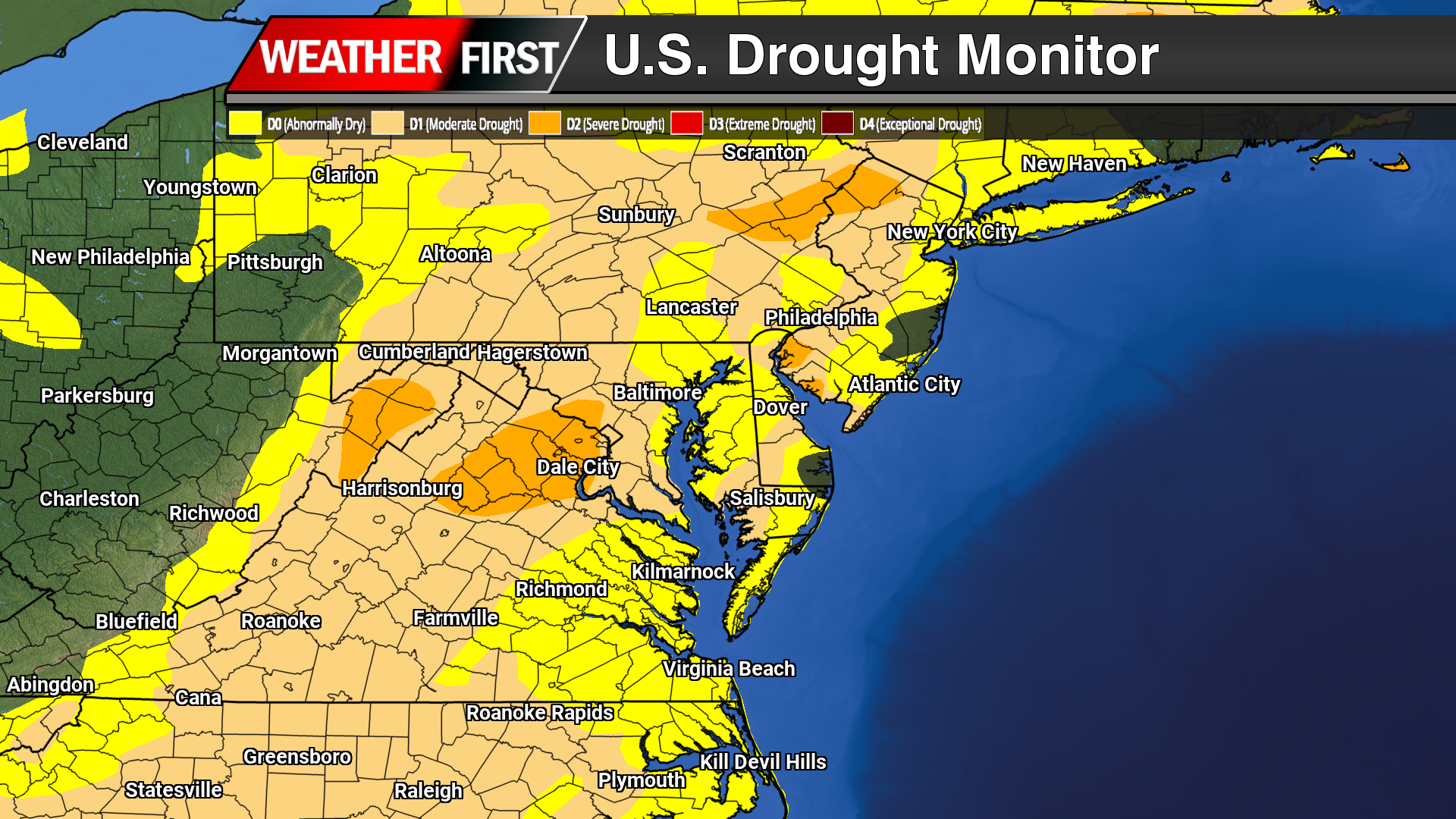
    Much of the Mid-Atlantic remains under ongoing drought conditions as of early January. Abnormally dry conditions continue across large portions of Maryland, Delaware, southern Pennsylvania, and northern Virginia, with moderate drought expanding across central and western Maryland into parts of northern Virginia. The most pronounced dryness is focused west of the Chesapeake Bay, including areas near Washington, Frederick, and Hagerstown, where prolonged precipitation deficits persist. While coastal sections of the Delmarva Peninsula remain primarily abnormally dry, limited improvement has occurred, and soil moisture remains below normal. These conditions continue to stress agriculture, water resources, and increase the risk of winter wildfire activity if dry weather persists.

    Heavier rainfall potential this weekend is focused farther north and west, with higher totals indicated across parts of western and central Pennsylvania and into the higher terrain of western Maryland. Lighter precipitation amounts are expected south and east, including much of central and southern Virginia and portions of the Delmarva Peninsula, where totals look more modest. This setup suggests the best chance for more meaningful rainfall will be away from the coastal plain, while areas closer to the Chesapeake Bay and southward may see limited rainfall and little improvement to ongoing dry conditions.

  • Winter Takes a Break Across The Country But For How Long?

    Winter Takes a Break Across The Country But For How Long?

    The month of December brought well below average temperatures across much of the Mid-Atlantic region. Averaging as much as 4 to 6 degrees below normal. Putting impacts on energy costs already this early into the season but we are looking to see some relief on those heating bills over the next week. starting Tuesday, we flip the switch from being the freezer to being able to thaw out in a big way.

    Throughout the rest of this week, we are about to go from January weather to what i would say be ;ate October weather as we start cranking up to the 50s. Eventually towards the weekend we are even crossing the 60s threshold. Which is going to feel quite nice after being stuck every day in the 30s. But the real question lies, how long will this warm up will last?

    It appears this will be a week long warm up with the warmest time frame appearing closer to the weekend with highs approaching the mid 60s. But also bring the onset of rain chances as a storm system will be lifting up towards the Great Lakes area. But towards the mid-month, signs are pointing to a return of the west coast ridge allowing for troughs to extend east towards the Mid-Atlantic to bring back more seasonable temperatures. Cold air intrusion would be possible after the 15th when this occurs so that’s when any snow chances would return as of now.

    Enjoy the warmth and thaw while it last as we still have a whole lot of winter to get through!

  • Widespread Warmth Expected Across Eastern U.S. in Mid-January Outlook

    Widespread Warmth Expected Across Eastern U.S. in Mid-January Outlook

    A strong signal for above-normal temperatures is shaping up across much of the eastern United States as we head into the January 8–12, 2026 timeframe, according to the latest 6–10 day temperature outlook issued by NOAA on January 2.

    The outlook shows a broad and confident area of above-average temperatures extending from the Mississippi Valley eastward to the Atlantic Coast. This includes the Midwest, Ohio Valley, Southeast, and much of the Mid-Atlantic and Northeast. In these areas, probabilities favoring above-normal temperatures range from 60% to as high as 90%, indicating a strong likelihood that temperatures will trend warmer than what is typical for early January.

    For the Mid-Atlantic region, including Delmarva, Maryland, and Pennsylvania, the signal is particularly robust. Persistent ridging in the upper atmosphere is expected to keep Arctic air bottled up well to the north, allowing milder air to dominate. This pattern would favor daytime highs running several degrees above normal, with fewer opportunities for sustained cold or wintry weather during this period.

    In contrast, below-normal temperatures are favored across portions of the western United States, especially parts of California, the Great Basin, and the Southwest. These regions show a 33–60% probability of cooler-than-average conditions, suggesting a more active Pacific pattern delivering cooler air and potentially unsettled weather.

    Areas of the northern Rockies and portions of the interior West are expected to remain near seasonal averages, lying along the transition zone between the cooler West and warmer East.

    Alaska shows a split pattern, with below-normal temperatures favored across much of the mainland, while parts of the southern coast lean above normal. Hawaii is expected to see above-average temperatures statewide.

    Overall, the pattern supports a continuation of a relatively mild January for large portions of the eastern U.S., potentially limiting snow and ice opportunities while increasing the risk of rapid snowmelt in areas that currently have snowpack.

  • Snow Squalls Could Create Hazardous New Year’s Eve Travel Across Delmarva, Maryland, and Pennsylvania

    Snow Squalls Could Create Hazardous New Year’s Eve Travel Across Delmarva, Maryland, and Pennsylvania

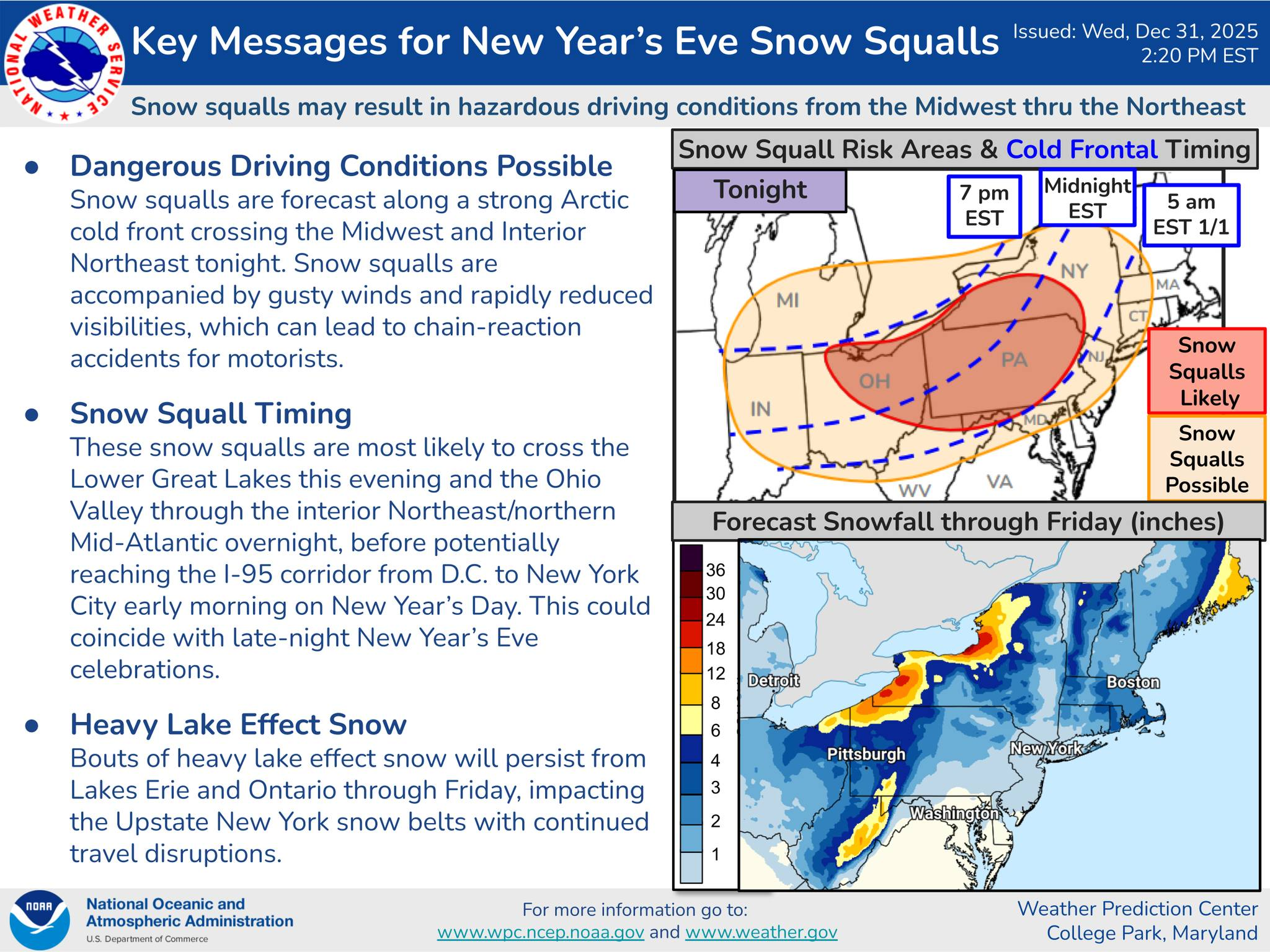
    Drivers across Delmarva, Maryland, and much of Pennsylvania are being urged to use caution this New Year’s Eve as a strong Arctic cold front moves through the region, bringing the potential for sudden snow squalls and dangerous travel conditions. While snowfall amounts are expected to be brief and localized, the intensity of these squalls could quickly reduce visibility to near zero and lead to slick, snow-covered roadways in a matter of minutes.

    Forecasters say the greatest risk for snow squalls will develop this evening across western and central Pennsylvania before shifting east overnight into eastern Pennsylvania, northern Maryland, and parts of Delmarva. The squalls may be accompanied by gusty winds, creating whiteout conditions along major travel routes including Interstates 76, 81, 83, 95, and portions of U.S. Route 13 across the Delmarva Peninsula.

    Timing is a major concern, as the snow squalls could impact travel during peak New Year’s Eve festivities and late-night returns home. In Maryland, areas north of the Baltimore Washington corridor stand the best chance of seeing brief but intense snow bursts overnight, while Delmarva may see fast-moving squalls or snow showers capable of briefly coating roadways, particularly in northern and interior sections in the early morning hours.

    Even though total snowfall amounts will be limited, the rapid drop in temperatures behind the front could allow any moisture on roadways to freeze quickly, increasing the risk of icy conditions. Motorists may encounter rapidly changing visibility and road conditions with little advance warning.

    Looking ahead, much colder air settling in behind the front will fuel lake-effect snow across western and north-central Pennsylvania through Friday. While this will not directly impact Delmarva or most of Maryland, it could lead to continued travel disruptions for those heading north or west after the holiday.

    Officials urge drivers to slow down, increase following distance, and avoid unnecessary travel during squalls. Snow squalls are often short-lived but can be just as dangerous as longer-duration winter storms, especially during busy holiday travel periods.

  • A Lot Of Talk About Wintry Weather Jan 6-8th…

    A Lot Of Talk About Wintry Weather Jan 6-8th…

    There has been a ton of speculation over social media about “Major Winter Storm Signal Jan 6-8th” and different variations for click bait and cash grabs for views. For many who know me over the last 15 years, I tell it like it is. And many of these social media pages need to keep their anticipation in check. I will go through the good and the bad for snow lovers with all this hype being shared around the internet about this timeframe.

    So the big take aways is what’s going on with the North America weather pattern changing a bit from this past week to a more colder one. But the biggest issues that people see on these maps is anytime they see a trough in the east immediately go “MAJOR WINTER SIGNAL, MAJOR STORM AHEAD” but there is so much more that goes into play. Yes we are looking at a trough across the eastern US, that’s only the first step. There is some blocking showing up in the arctic with the ECMWF but much weaker with the GFS. Blocking near Greenland helps slow down the overall weather pattern or for all the technical readers out there a -NAO block. So we have two pieces of the puzzle but there is something way more important in my opinion and its what’s going on the west coast.

    And that’s where my excitement starts going down the tubes as a snow lover. We need ridging in the west coast to get the trifecta ingredients. And this is where things start falling short for my liking. Not only that we have polar opposites in guidance between the two major long range models for this range and the placement is not ideal. Ridging along the west coast not only brings the cold air supply with cross polar flow and helps amplify the trough to its east. With this sitting over the Rockies, not the most ideal to get something off our coastlines. I prefer to have it back right at the coast instead but we also have a trough not too far away to the west side. ECMWF is your friend and the GFS is you enemy with the PNA across the west coast. Hard to say which will be correct until one switches as we get closer in time. This is why I have been thinking it’s so dumb to be stating about a storm is happening in this time frame because of the PNA in itself.

    One thing is for sure, we are looking to see some colder weather over in our neck of the woods going into the New Year. As temp anomalies over the next 1-2 week showing increasing confidence of “Below Average Temperatures” in the Mid-Atlantic & New England. Moral of the story, hold your excitement for now and be wary of pages that post this kind of hype and 384 hour snowfall maps claiming this is what’s ahead. It’s just not good and its a spreading terrible false information. It’s a cash grab for getting views and traffic for all the wrong reason. Trust your reliable sources friends.

  • Icy Post Christmas Storm Across The Northern Mid-Atlantic States

    Icy Post Christmas Storm Across The Northern Mid-Atlantic States

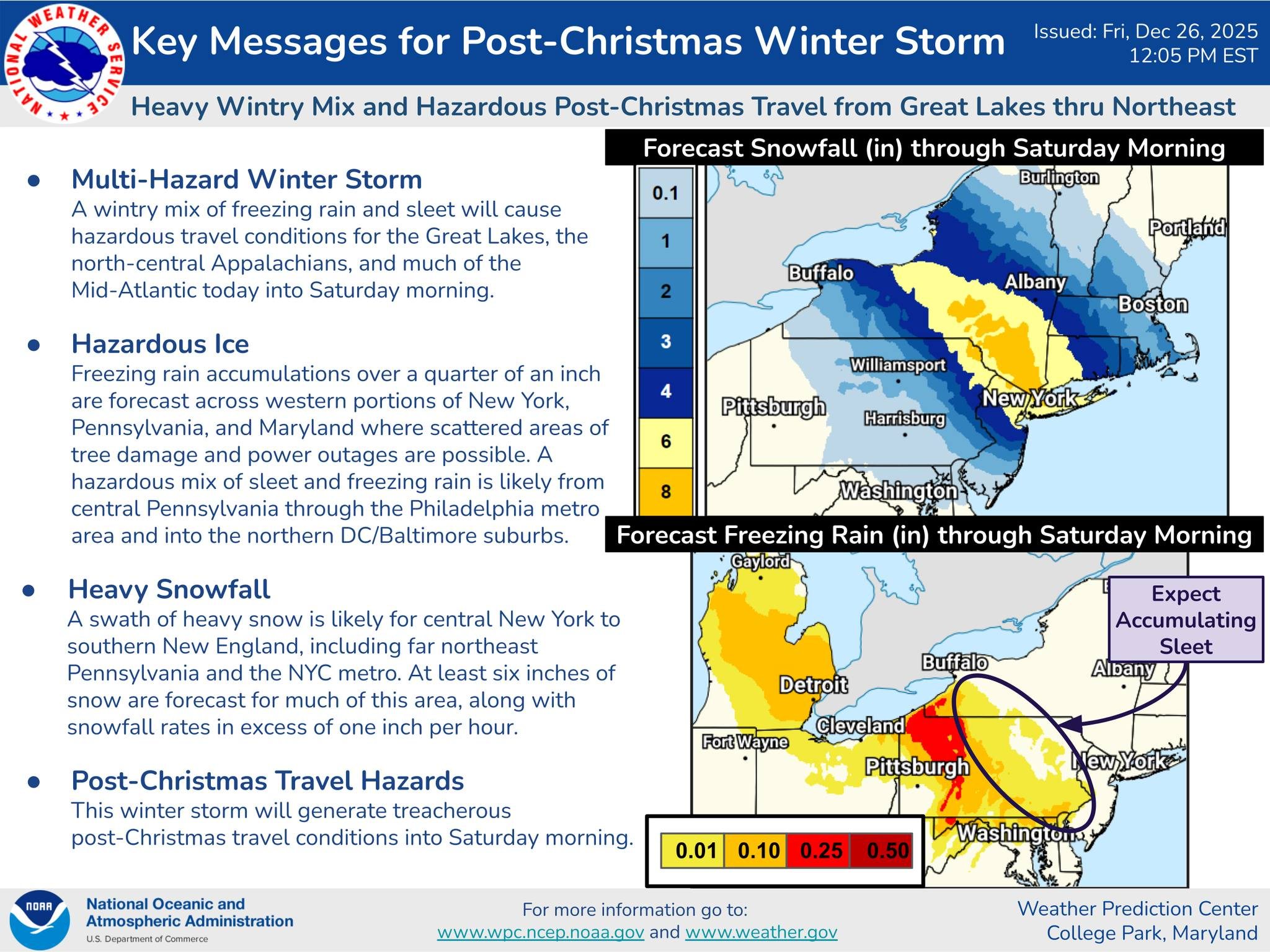
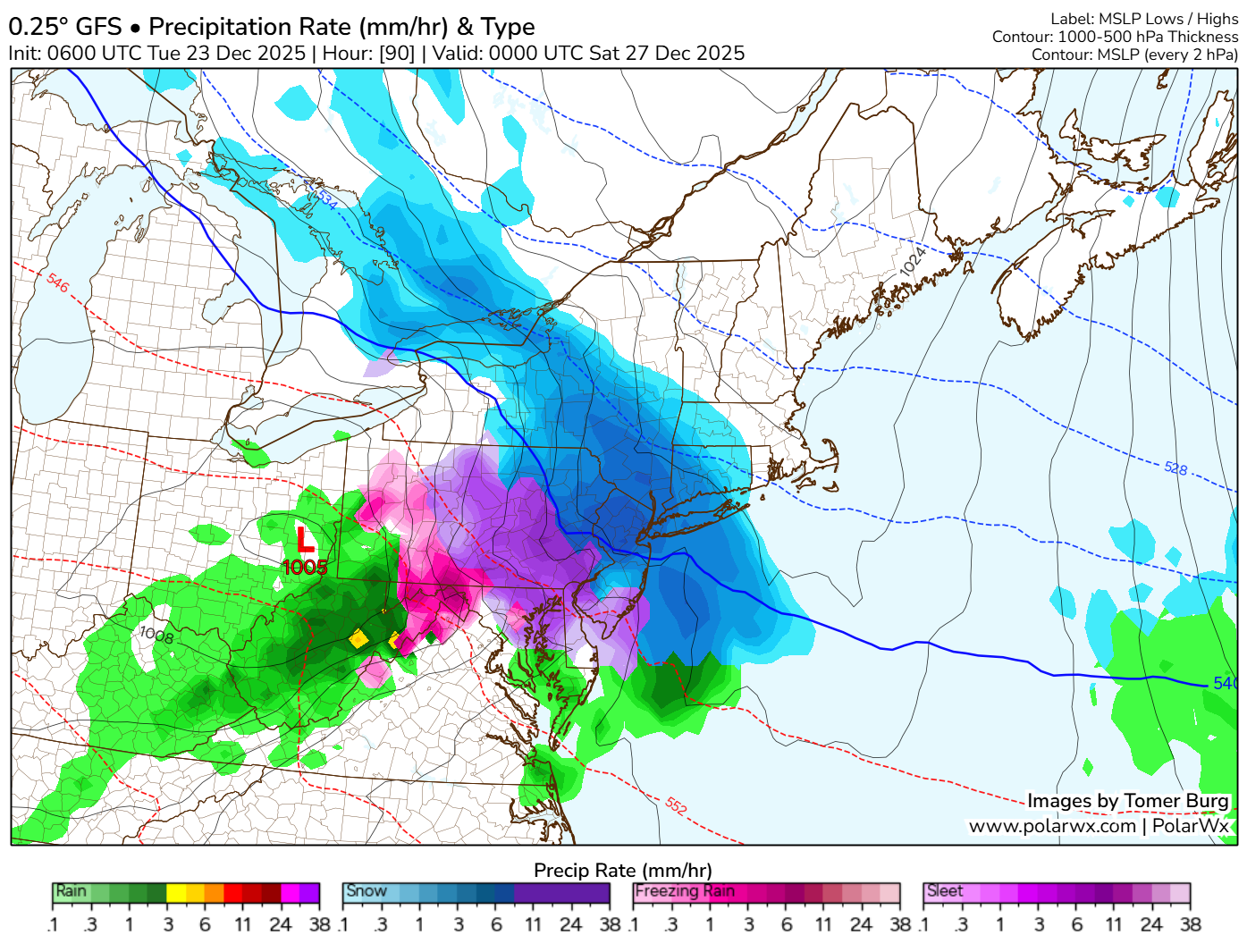
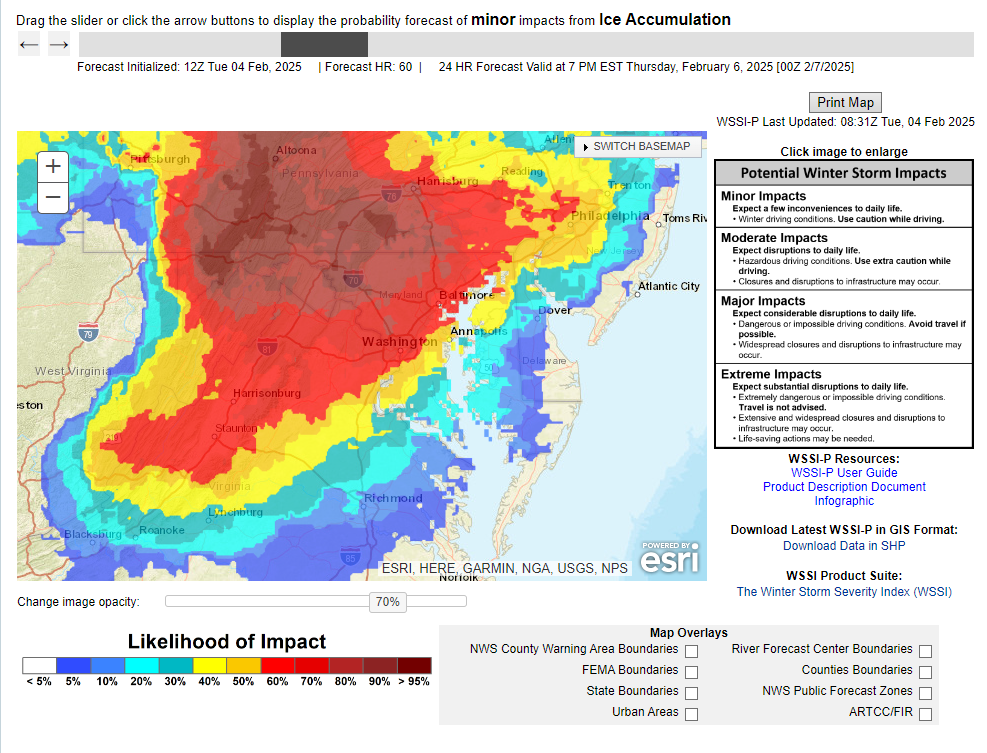
    A significant post-Christmas winter storm is expected to create hazardous conditions from the Great Lakes through the Mid-Atlantic and into the Northeast through Saturday morning, bringing a complex mix of snow, sleet, and freezing rain that will heavily impact travel and infrastructure across the region.

    According to the Weather Prediction Center, this is a multi-hazard winter storm, with the most dangerous impacts tied to ice accumulation and heavy snowfall. A swath of heavy snow is forecast from central New York into southern New England, including portions of northeastern Pennsylvania and the New York City metro area. Many of these locations could see six inches or more of snow, with snowfall rates exceeding one inch per hour at times, leading to rapidly deteriorating road conditions.

    Farther south, the primary concern shifts from snow to ice. Freezing rain and sleet are expected to dominate across portions of Pennsylvania, western and central Maryland, and parts of the Mid-Atlantic, creating a dangerous glaze on untreated surfaces. Ice accumulations over a quarter inch are possible in some areas, increasing the risk for tree damage and scattered power outages.

    Northern Maryland Impacts

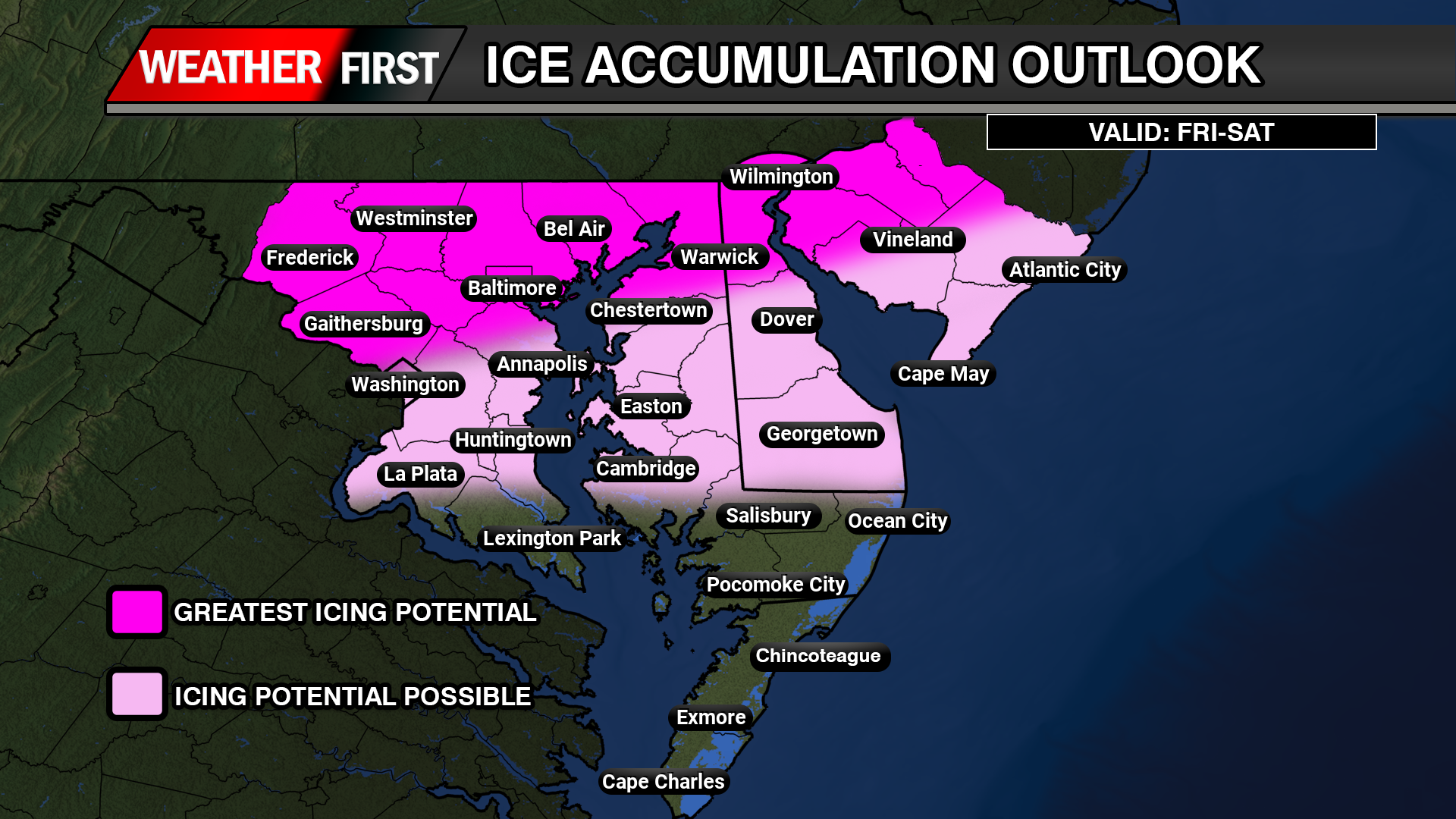
    Northern Maryland, including areas near and north of the Baltimore metro, is expected to be near the transition zone between snow and freezing rain. This setup raises the risk for significant sleet accumulation followed by freezing rain, which can be particularly hazardous for travel. Roads may quickly become icy, even where surface temperatures hover near freezing. Elevated surfaces such as bridges and overpasses will be especially prone to icing. Any ice buildup on trees and power lines could result in localized outages and downed limbs.

    Northern Delmarva Concerns

    Across northern Delmarva, including Cecil County, Kent County, and areas near the upper Chesapeake Bay, a wintry mix of sleet and freezing rain is expected to develop, particularly late Friday into Friday night. While snowfall totals are likely limited, even light ice accretion could significantly impact travel along major corridors such as I-95, U.S. Route 13, and local secondary roads. Gusty winds combined with ice may further stress trees and utility lines, increasing the risk of isolated power disruptions.

    Travel and Safety Impacts

    The timing of this storm is particularly concerning, as it coincides with post-Christmas travel. Treacherous road conditions are expected to persist into Saturday morning, especially in areas affected by freezing rain and sleet. Visibility reductions, slick surfaces, and rapidly changing precipitation types will make driving dangerous, even for experienced winter drivers.

    Residents across northern Maryland and northern Delmarva are urged to closely monitor forecast updates, avoid unnecessary travel during periods of freezing rain, and prepare for the possibility of power outages. This storm serves as a reminder that ice, even more than snow, can quickly escalate impacts and disrupt daily life across the Mid-Atlantic.

  • An Icy Boxing Day On The Way For The Mid-Atlantic States

    An Icy Boxing Day On The Way For The Mid-Atlantic States

    Its shaping up to be a fairly icy day after Christmas for many across the Mid-Atlantic states Friday into Saturday. A classic “Overrunning Event” to unfold as a warm front moves into arctic air that’s trapped across New England forced by northeast winds ahead of the precip.

    An overrunning event in winter meteorology occurs when warm, moist air is lifted up and over a shallow layer of cold air at the surface. This setup is common ahead of winter storms and often develops north of a warm front. Because cold air is denser, it remains trapped near the ground while warmer air flows over it along sloping isentropic surfaces.

    As the rising warm air cools, clouds and precipitation develop well in advance of the main storm system. In winter, this frequently leads to widespread, long-duration precipitation, often falling as snow, sleet, or freezing rain, depending on the temperature profile of the atmosphere. Overrunning events are typically associated with stratiform precipitation, lower visibility, and steady rather than convective rainfall or snowfall.

    These events can produce significant winter weather impacts, including heavy snow accumulations, ice accretion, and hazardous travel conditions, especially when cold air is reinforced at the surface by high pressure to the north. Overrunning precipitation often marks the initial phase of a winter storm before stronger dynamics and surface low pressure move in.

    With the latest guidance at this time, areas closer towards the Mason-Dixon have the greatest threat for looking at snow and ice accumulations as the cold air will be locked up better in those regions. totals wise at this time is not for certain the amount of snow/ice is expected with this system as we get a bit closer in time. Areas across Central Delmarva will start off with that wintry mix but eventually change over to plain rain as the winds turn a bit more easterly which will bring in that warmer Atlantic air across the region.

  • SNEAKY ICING EVENT ON BOXING DAY DEC 26-27TH?

    SNEAKY ICING EVENT ON BOXING DAY DEC 26-27TH?

    December 26-27th event has been a model guidance nightmare these past few days so that’s why i haven’t really talked much about it. Because at one moment its a 63 degree day with rain and then next minute its a day with accumulating snow and ice. This is very typical back and forth nonsense that happens in the 84-120hr timeframe so i don’t put a whole lot of weight to it. But we are starting to get into the sub 84 timeframe where they begin to get their act together. So here is the setup.

    We will already have a push of arctic air in place out ahead of a weak disturbance with a warm front nosing into the cold air. This is a classic representation of what we call a “Overrunning Event”

    An overrunning event in winter meteorology occurs when warm, moist air is lifted up and over a shallow layer of cold air at the surface. This setup is common ahead of winter storms and often develops north of a warm front. Because cold air is denser, it remains trapped near the ground while warmer air flows over it along sloping isentropic surfaces.

    As the rising warm air cools, clouds and precipitation develop well in advance of the main storm system. In winter, this frequently leads to widespread, long-duration precipitation, often falling as snow, sleet, or freezing rain, depending on the temperature profile of the atmosphere. Overrunning events are typically associated with stratiform precipitation, lower visibility, and steady rather than convective rainfall or snowfall.

    These events can produce significant winter weather impacts, including heavy snow accumulations, ice accretion, and hazardous travel conditions, especially when cold air is reinforced at the surface by high pressure to the north. Overrunning precipitation often marks the initial phase of a winter storm before stronger dynamics and surface low pressure move in.

    With the latest mid day mid range guidance rolling in they are starting to come into light of a icing scenario beginning to unfold across areas of central and northern Delmarva, northern Maryland, and portions of South Jersey. A lot of factors remain in place like will the cold air remain more locked in and keep the warm nose at bay, will the warm nose make it a widespread icing event, or will the warm nose overwhelm the environment and keep it more of a rain threat in the region. Those are the details we need to iron out going later into the week.

  • Drought Conditions Continue to Worsen Across Delmarva

    Drought Conditions Continue to Worsen Across Delmarva

    Dry weather has continued to dominate the Delmarva Peninsula, with the latest drought data showing little improvement and increasing stress across the region. While occasional light rainfall has been observed, precipitation totals remain well below normal, providing minimal benefit to soil moisture, groundwater, or streamflows.

    Across Delaware, Maryland’s Eastern Shore, and Virginia’s Eastern Shore, ongoing precipitation deficits have allowed abnormally dry to drought conditions to persist and expand. Soils continue to dry, particularly in agricultural areas, and streamflows remain below seasonal averages; clear indicators that the region remains in a developing drought pattern.

    In Delaware, short-term dryness is increasingly transitioning into longer-term impacts, with limited recharge of groundwater and growing concerns for water resources if the dry trend continues. On the Maryland Eastern Shore, reduced soil moisture is beginning to affect winter crop establishment and could pose challenges heading into the early spring growing season if meaningful rainfall does not return. Portions of the Virginia Eastern Shore are experiencing similar conditions, with continued low streamflows and dry soils reinforcing drought development.

    Looking ahead, forecasters stress that several widespread, soaking rain events will be necessary to slow or reverse drought conditions across Delmarva. Until a wetter pattern develops, drought impacts are expected to persist through the remainder of the year, with close monitoring in place for further degradation.

  • Nationwide Warm-Up Expected Through Christmas

    Nationwide Warm-Up Expected Through Christmas

    New outlooks from the Climate Prediction Center indicate a pronounced and persistent warm pattern developing across much of the United States over the next one to two weeks, including through the Christmas holiday. Both the 6–10 day and 8–14 day temperature outlooks show above-normal temperatures dominating the central and eastern portions of the country, signaling a sustained break from typical late-December cold.

    A large area of strongly above-average temperatures is forecast to build across the Plains, Midwest, and South, with the warmest anomalies centered from the central Plains into the Lower Mississippi Valley. This warm ridge is expected to expand eastward as we head closer to Christmas.

    Mid-Atlantic Focus

    For the Mid-Atlantic region, including Delmarva, confidence is increasing in a milder-than-normal stretch of weather heading into and through the holiday period. Temperatures are favored to run above seasonal averages, with daytime highs frequently reaching the 50s and potentially near 60 degrees at times, depending on cloud cover and frontal timing. Overnight lows are also expected to remain milder, reducing the risk of prolonged cold snaps.

    While brief cool-downs remain possible as weak fronts pass through, no sustained Arctic air intrusions are currently indicated in the extended outlook. This pattern significantly lowers the chances for a widespread white Christmas across the Mid-Atlantic, with precipitation events more likely falling as rain rather than snow.

    Looking Ahead

    Overall, the pattern supports a quiet and relatively mild end to December for much of the eastern U.S. If this outlook holds, the Mid-Atlantic can expect a holiday season that feels more like late fall than mid-winter, with continued monitoring needed in case pattern shifts develop closer to Christmas.

  • Heavy Rains, Thunder, And High Winds On The Way Tonight Through Friday

    Heavy Rains, Thunder, And High Winds On The Way Tonight Through Friday

    A strong cold front is expected to move through the region later this evening, bringing periods of moderate to heavy rainfall, with the potential for a few embedded thunderstorms. Ahead of the front, a surge of unseasonably warm air continues to advance up the East Coast, allowing afternoon temperatures to rise into the upper 50s to near 60 degrees.

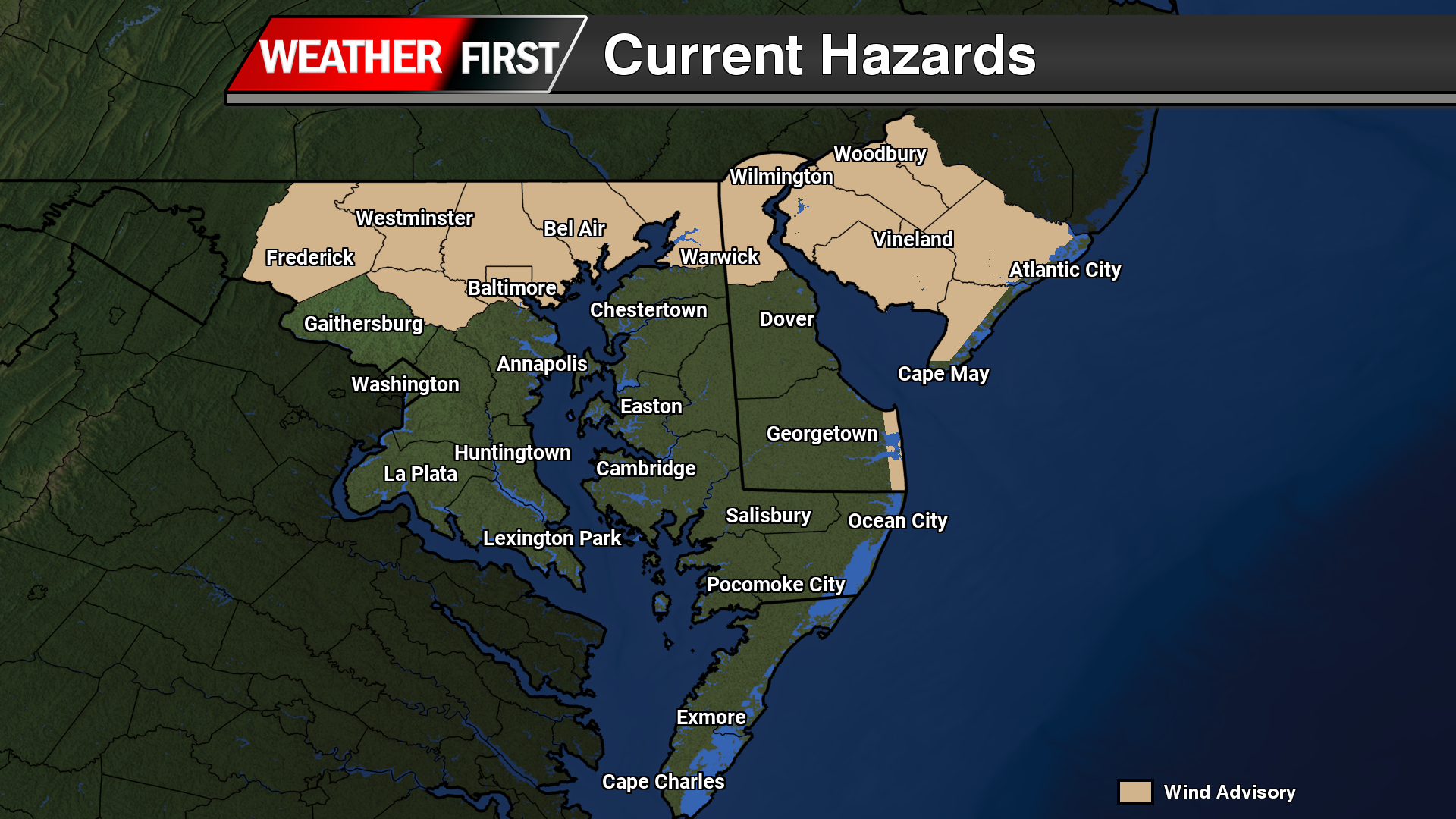
    ...WIND ADVISORY REMAINS IN EFFECT FROM 1 AM FRIDAY TO 1 AM EST
    SATURDAY...
    
    * WHAT...Southwest winds 20 to 30 mph with gusts up to 45 mph
      expected Thursday night through Friday morning. Winds turn to the
      northwest behind a strong cold front Friday afternoon. There may
      be a lull in the strongest wind gusts around midday Friday before
      the cold front passes through the region. Wind gusts in the wake
      of the front up to 50 MPH are possible.
    
    * WHERE...In Delaware, Delaware Beaches County. In New Jersey,
      Eastern Monmouth, Western Monmouth, Atlantic, Atlantic Coastal
      Cape May, Cape May, Coastal Atlantic, Coastal Ocean, Ocean, and
      Southeastern Burlington Counties.
    
    * WHEN...From 1 AM Friday to 1 AM EST Saturday.
    
    * IMPACTS...Gusty winds will blow around unsecured objects. Tree
      limbs could be blown down and a few power outages may result.
    
    PRECAUTIONARY/PREPAREDNESS ACTIONS...
    
    Winds this strong can make driving difficult, especially for high
    profile vehicles. Use extra caution.

    As the frontal boundary approaches, winds will strengthen significantly, with gusts of 40 to 50 mph possible across portions of New England and the Mid-Atlantic. A Wind Advisory is in effect for several areas. Rainfall totals are currently forecast to range between 0.50 and 1.50 inches, which will be beneficial in helping to alleviate ongoing drought conditions across much of the eastern United States.

    The sharp temperature gradient associated with the frontal passage may provide enough atmospheric instability to support a narrow line of embedded thunderstorms. Within this line, a strong low-level jet could allow isolated stronger wind gusts to mix down to the surface. While widespread severe weather is not anticipated, localized areas may experience brief heavy rainfall and gusty winds.

    Behind the front, gusty conditions will persist through Friday, with winds continuing to gust between 40 and 50 mph at times. Skies will gradually clear as cooler air filters into the region, bringing a return to sunshine and more seasonable temperatures.

  • UPDATED: Accumulating Snowfall Expected Late Tonight; Bitter Arctic Air To Follow

    UPDATED: Accumulating Snowfall Expected Late Tonight; Bitter Arctic Air To Follow

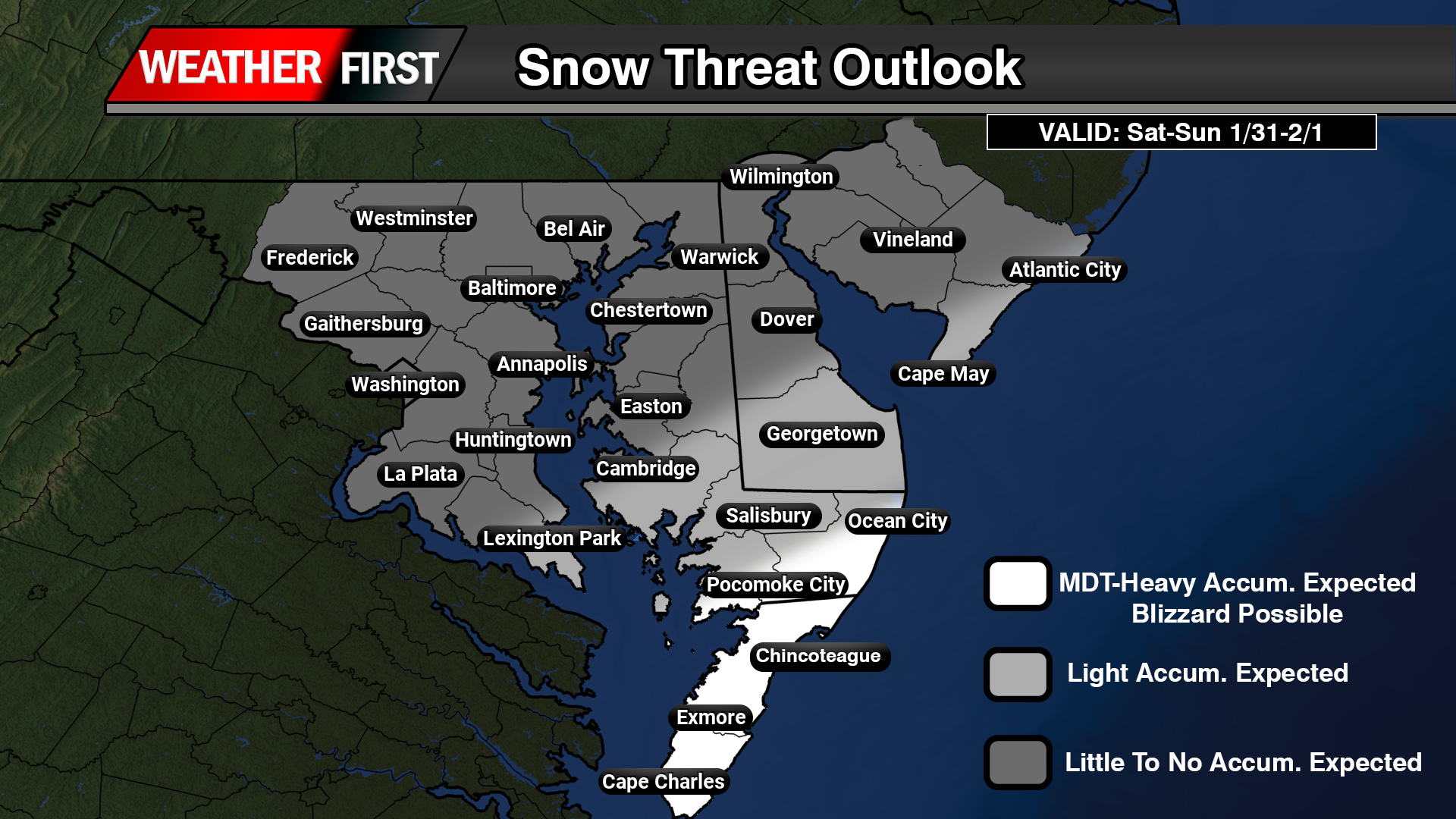
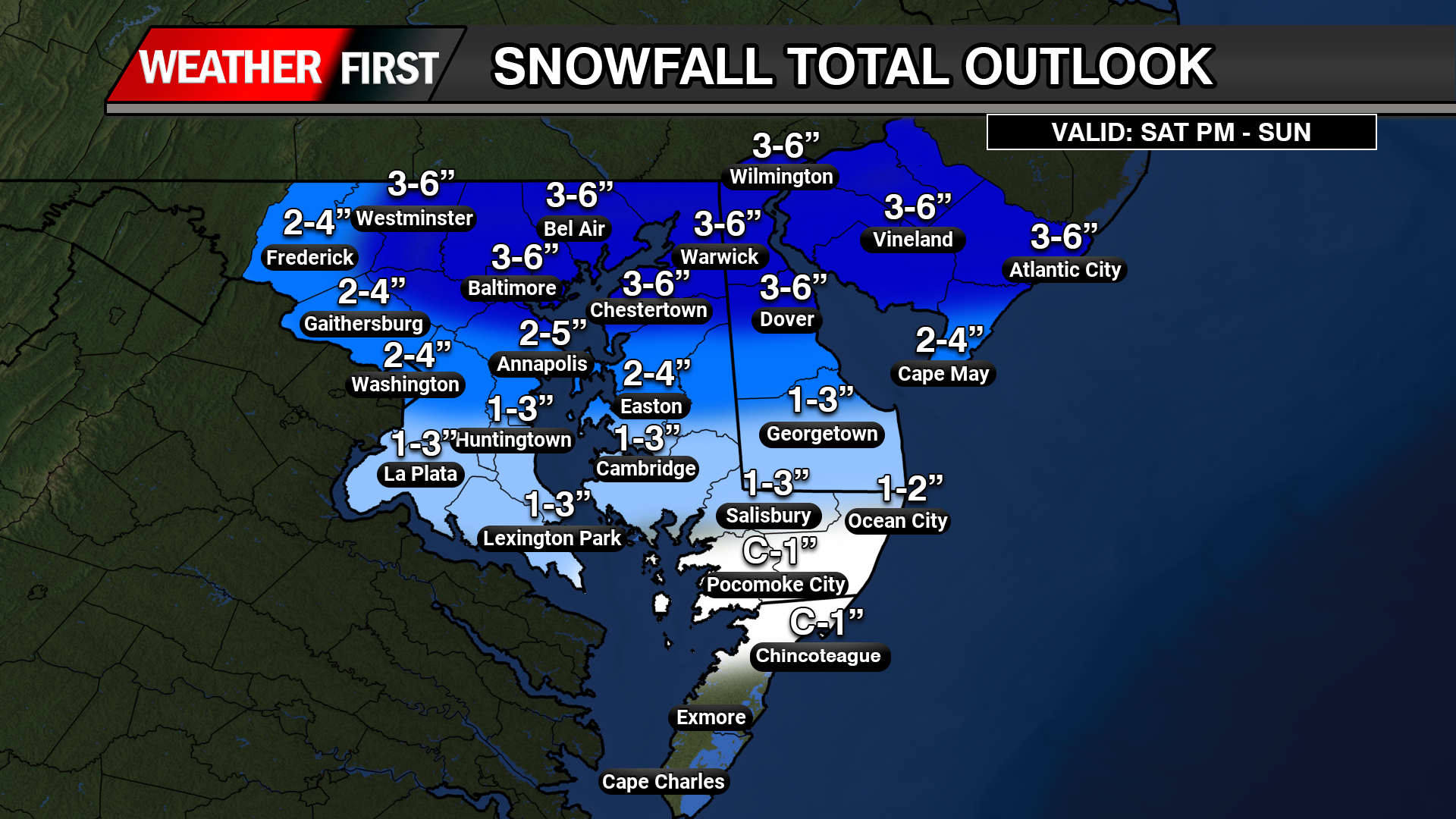
    Another round of accumulating snowfall is on tap for this weekend during the early morning hours Sunday through the late morning hours. Overall snowfall amounts have increased across Central and Northern Delmarva for tonight. A Clipper system approaching from the Mid-west will begin to redevelop a coastal low will bring a band of light to moderate snowfall to the region on Sunday as an arctic frontal boundary moves through bring severely cold temperatures throughout the Eastern US.

    Looks like right now areas across Northern Maryland, Northern Delmarva, and South Jersey will be in the hot seat for seeing the most accumulating snow when the coastal low begins to take over. A widespread swaft of 3-6 inches of snow is likely with areas further south will have lighter precipitation to deal with overall. Making for Sunday morning travel a bit slick with temperatures in the upper 20s to lower 30s and the winds begin to pick up later in the day for some blowing and drifting.

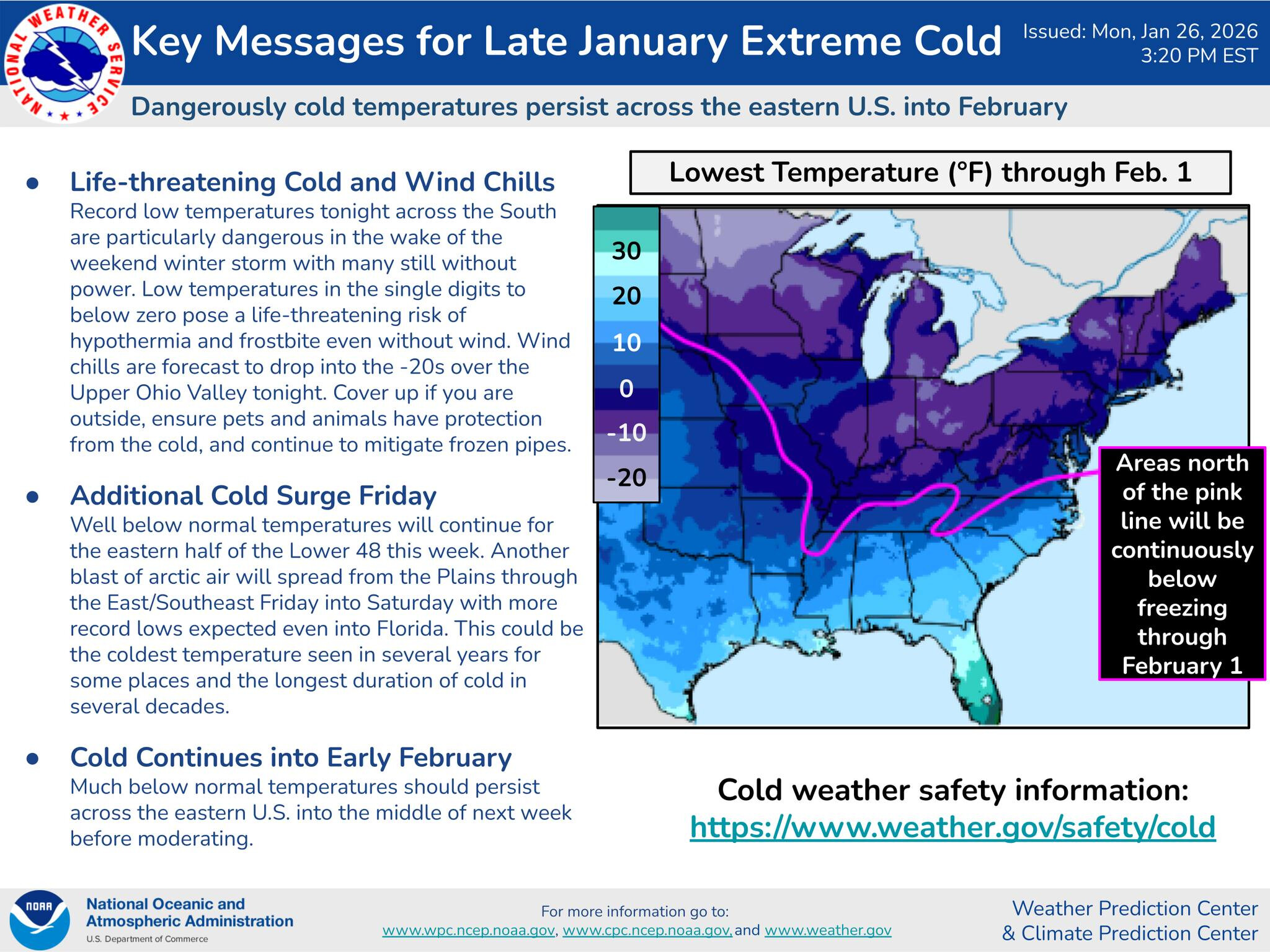
    An Arctic air mass is moving southward, bringing dangerously low temperatures and life-threatening wind chills across a broad swath of the central US, from the Northern Plains towards the Mid-Atlantic

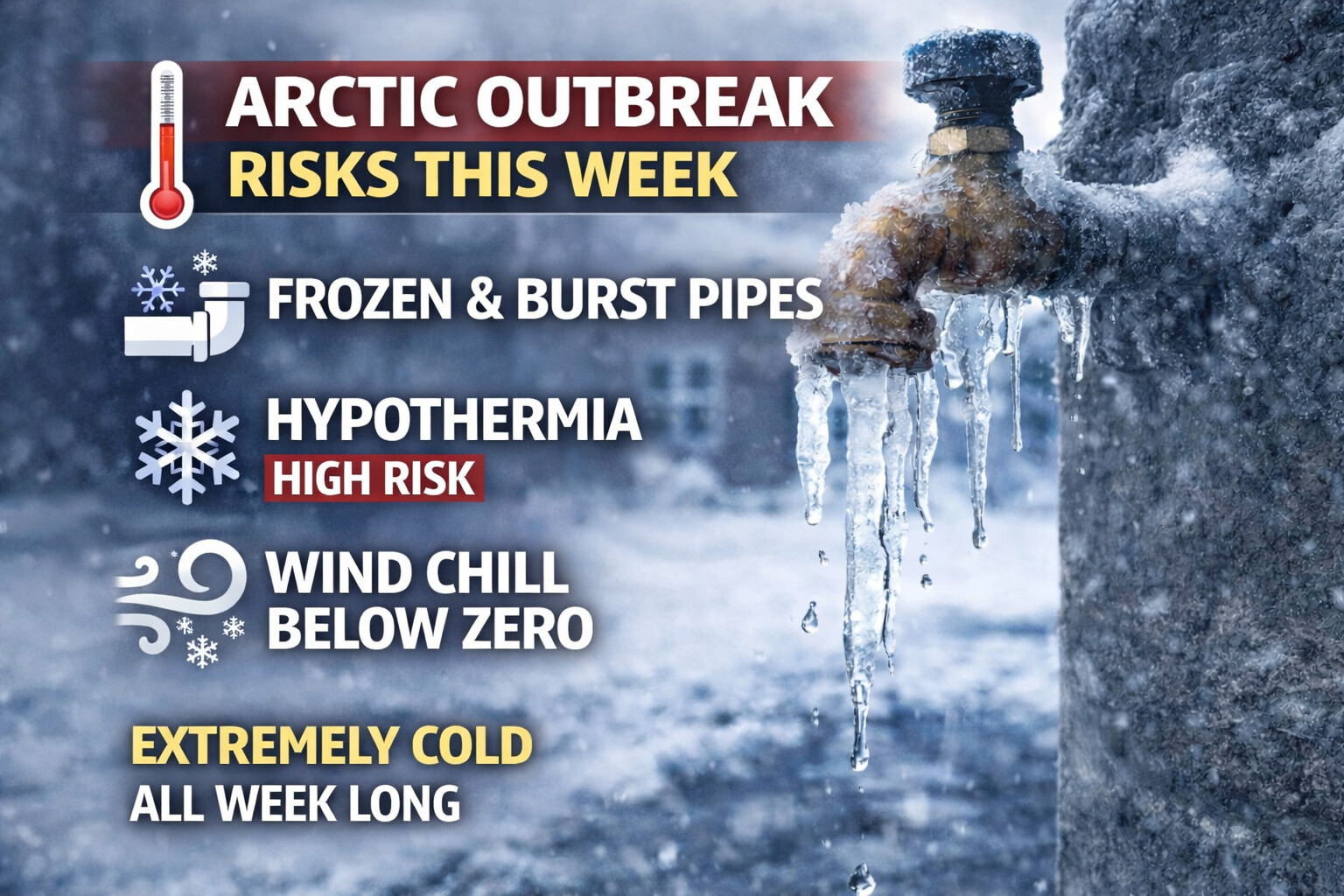
    Temperatures are forecasted to plunge 20 to 30 degrees below normal, with wind chills dropping below -30°F in some areas. This extreme cold poses serious risks to human health, pets, and infrastructure, including the potential for frozen pipes.

    Residents in the affected regions are urged to prepare immediately by taking steps to protect themselves, their animals, and their homes. The agencies emphasize the importance of readiness to mitigate the harsh impacts of this severe weather event.

  • Accumulating Snow On The Way For Sunday; Followed By Arctic Blast

    Accumulating Snow On The Way For Sunday; Followed By Arctic Blast

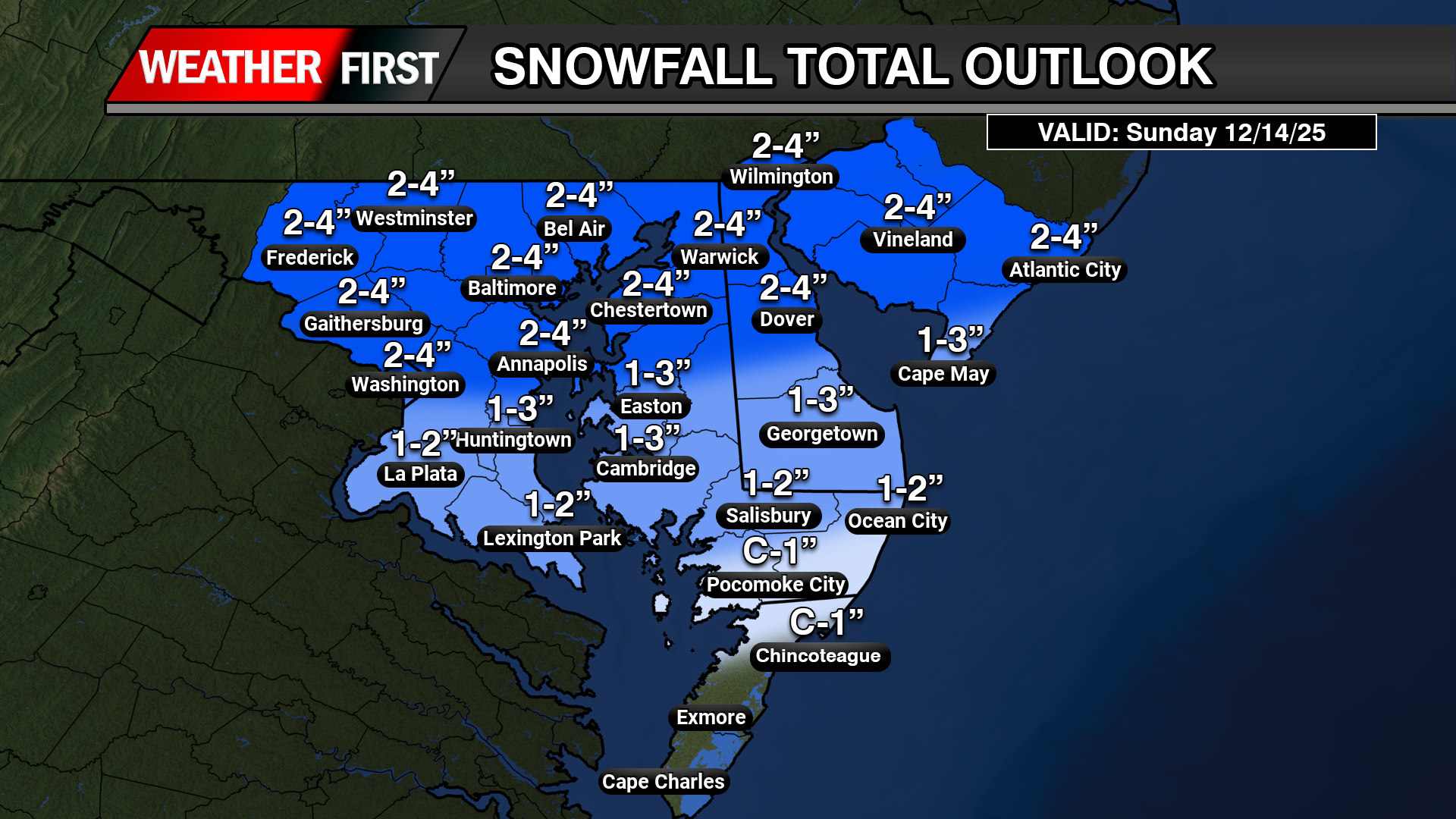
    Another round of accumulating snowfall is on tap for this weekend during the early morning hours Sunday through the late morning hours. A Clipper system approaching from the Mid-west will begin to redevelop a coastal low will bring a band of light to moderate snowfall to the region on Sunday as a arctic frontal boundary moves through bring severely cold temperatures throughout the Eastern US.

    Looks like right now areas across Northern Maryland, Northern Delmarva, and South Jersey will be in the hot seat for seeing the most accumulating snow when the coastal low begins to take over. A widespread swaft of 2-4 inches of snow seems probable with areas further south will have lighter precipitation to deal with overall. Making for Sunday morning travel a bit slick with temperatures in the upper 20s and the winds begin to pick up later in the day for some blowing and drifting.

    An Arctic air mass is moving southward, bringing dangerously low temperatures and life-threatening wind chills across a broad swath of the central US, from the Northern Plains towards the Mid-Atlantic

    Temperatures are forecasted to plunge 20 to 30 degrees below normal, with wind chills dropping below -30°F in some areas. This extreme cold poses serious risks to human health, pets, and infrastructure, including the potential for frozen pipes.

    Residents in the affected regions are urged to prepare immediately by taking steps to protect themselves, their animals, and their homes. The agencies emphasize the importance of readiness to mitigate the harsh impacts of this severe weather event.

  • Delmarva’s First Measurable Snow Of The Season On Friday

    Delmarva’s First Measurable Snow Of The Season On Friday

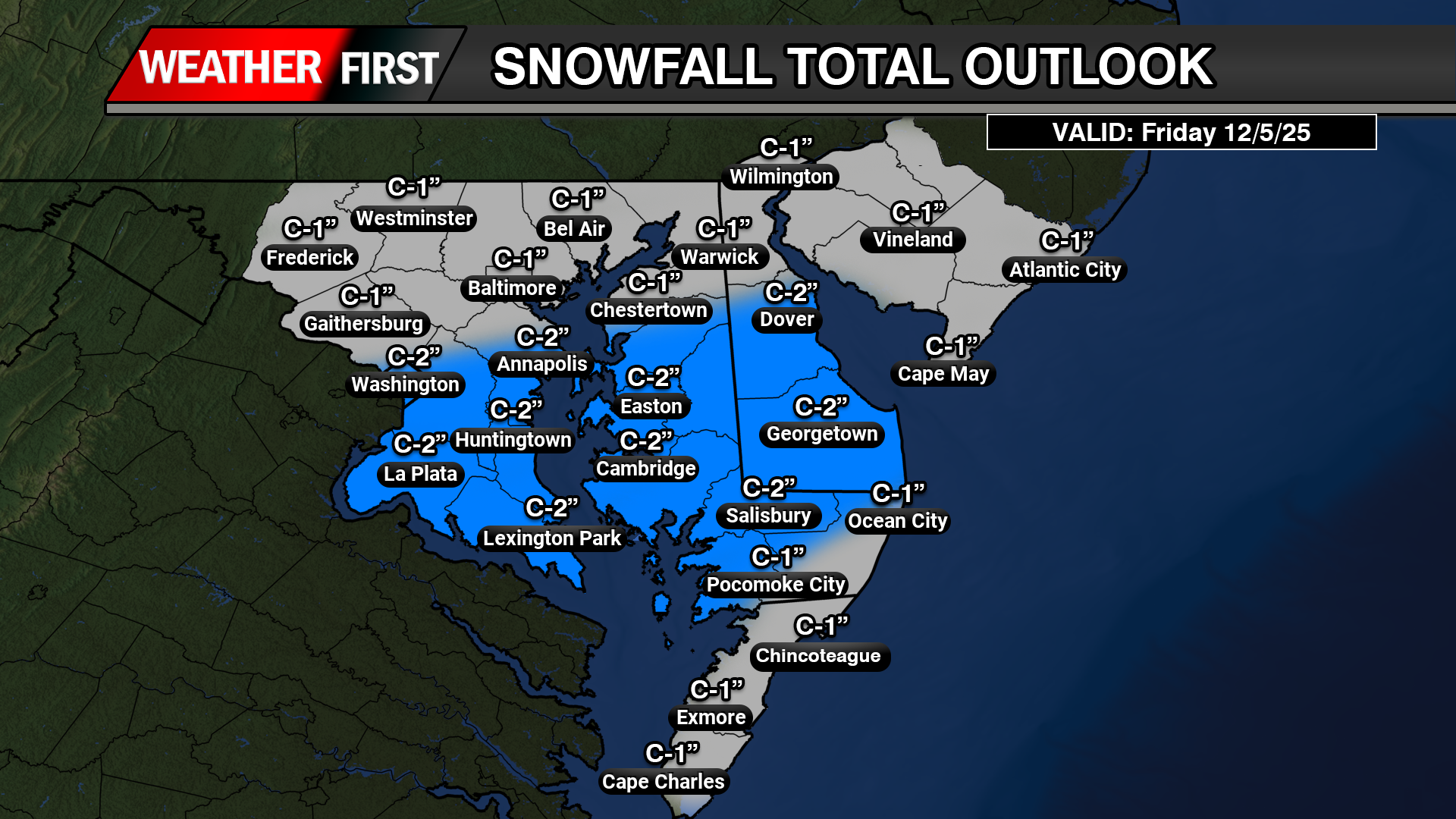
    Well folks, it looks like we have our first snowfall of season upon us for Friday. Its not a major event or anything but enough to make things a bit slippery for your Friday morning commute. Only because usually the first snow is the one that gives motorists headaches and no being used to dealing with it on the roadways. Here is the break down.

    A weak flat wave system will be riding along an arctic boundary as precipitation enters the colder airmass. An area of high pressure out ahead providing the fresh arctic airmass will be enough to support a few hours of wet snow across the Mid-Atlantic starting around 2-3am on Friday and become more steady when day breaks. Snow will remain steady through 10am before beginning to taper off and or mixing with rain towards noon across the Maryland Eastern Shore and the VA counties.

    The latest forecast is calling for a spread of a heavy coating to on the high end 2 inches across Southern Maryland and Central Delmarva. This is where the majority of the heavier snow bands will likely end up as temperatures will range from 28-32 during the whole duration. Area further south across Ocean City along the coast will be dealing with some mixing problems at times with the warmer ocean waters nearby. Areas further north across Northern Maryland, Northern Delmarva, and South Jersey will only see a dusting up to a inch with light snow overall based on the latest track.

    As mentioned before, impacts from this winter storm will be very light with only light accumulations expected. Motorists should still use caution on area roadways as they may become icy and slushy at times during the Friday morning commute.

  • CME Alert: Strong Solar Storm May Bring Widespread Aurora to Delmarva Tonight Or Tomorrow Night

    CME Alert: Strong Solar Storm May Bring Widespread Aurora to Delmarva Tonight Or Tomorrow Night

    Space weather forecasters are keeping a close eye on a powerful solar eruption that may bring a dazzling show to the night sky across Delmarva, along with the potential for minor disruptions to technology here on Earth.

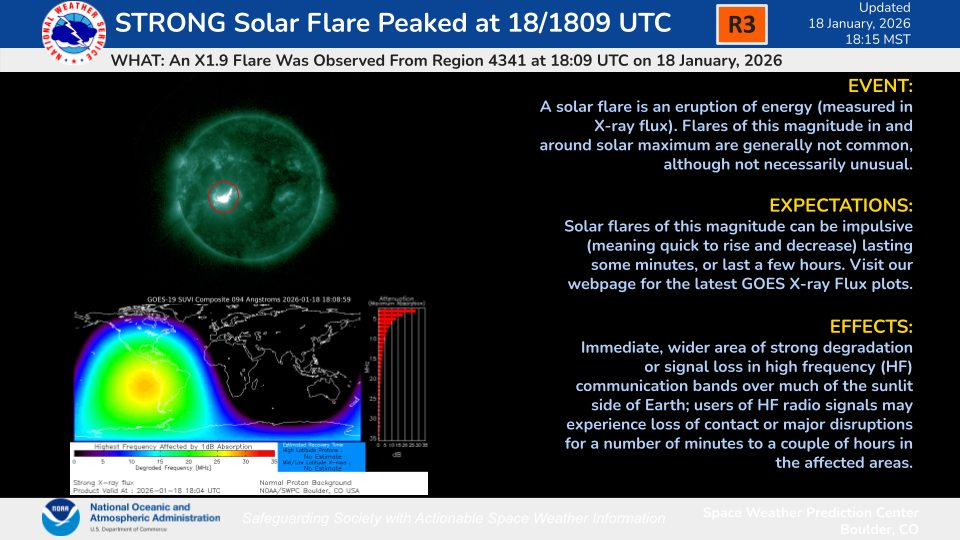
    Earlier today, the NOAA Space Weather Prediction Center (SWPC) confirmed a fast-moving coronal mass ejection (CME) associated with an intense X5.1-class solar flare that blasted off the Sun from active Region 4274. This marks the strongest flare yet from that sunspot group, and one of the most energetic solar events of the year.

    Preliminary analysis shows the CME is racing toward Earth at extraordinary speeds, with shockwave estimates near 4.4 million miles per hour. Forecasters believe the leading edge could impact Earth as early as late tonight, November 11th, continuing into the early morning hours of November 12th.


    What This Means for Delmarva

    While current projections indicate the CME may not be perfectly directed toward Earth, there still appears to be enough of a direct component to trigger strong geomagnetic storm conditions. SWPC experts are evaluating whether a G4 Watch (a category representing severe impacts) will be needed.

    Under these conditions, residents across Delmarva may have the chance to witness the Northern Lights, an opportunity that’s becoming more frequent as the Sun approaches the peak of its 11-year solar cycle.

    Auroras could become visible tonight after dark, especially if skies remain clear and the geomagnetic field responds strongly.

    Viewing will be best:

    • Away from city lights
    • With a clear north-facing view
    • During peak storming windows expected from 11 PM to 3 AM

    Even smartphone cameras may capture the aurora better than the naked eye thanks to long-exposure capabilities.


    Potential Impacts

    Geomagnetic storms of this magnitude can cause:

    • GPS inaccuracies
    • High-frequency radio disruptions
    • Voltage fluctuations on power grids
    • Impacts to satellites and spacecraft operations

    Airline routing over polar regions may also be adjusted during peak activity to maintain communications reliability.

    The SWPC emphasizes that this situation remains fluid, and forecasters will continue refining projections as new data arrives.


    Stay Alert for Updates

    Residents are encouraged to monitor official forecasts tonight, especially if you’re hoping to catch a rare aurora show right here in the Mid-Atlantic.

    We will provide updates as conditions evolve and viewing opportunities come into better focus.

  • G3 Geomagnetic Storm Watch: Northern Lights Possible Over Delmarva Thursday Night

    G3 Geomagnetic Storm Watch: Northern Lights Possible Over Delmarva Thursday Night

    The northern lights may make a rare appearance over Delmarva Thursday night into early Friday, thanks to a strong solar storm heading toward Earth.

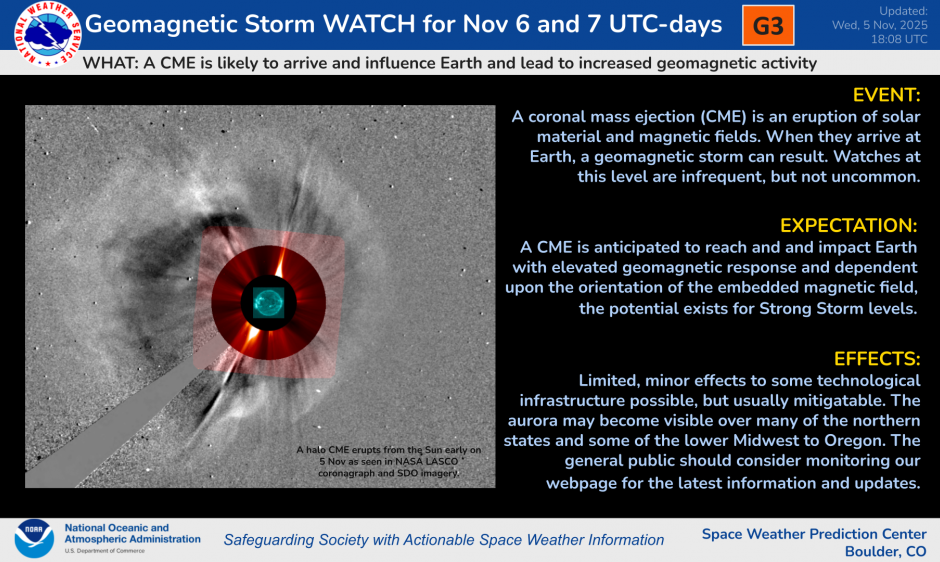
    NOAA’s Space Weather Prediction Center has issued a G3 (Strong) Geomagnetic Storm Watch for November 6–7 UTC days, which covers Thursday evening into Friday morning here on the East Coast. This watch was issued because a coronal mass ejection (CME) a large burst of solar material and magnetic energy is currently racing toward Earth.

    When could we see it?

    Forecasters say the CME may arrive as early as Thursday evening or as late as Friday morning. If it hits with the right strength and magnetic alignment, the northern lights could become visible much farther south than usual, including here on the Delmarva Peninsula.

    What determines visibility?

    Even with a strong watch issued, scientists won’t know the full impact until the CME reaches a spacecraft positioned between the Sun and Earth at Lagrange Point 1, about 1 million miles away. Once that happens, experts will get real-time details on:

    • The CME’s actual speed
    • The strength of its magnetic field
    • The direction that magnetic field is pointing

    If the magnetic field is oriented opposite Earth’s, auroras can dramatically intensify.

    What we might see

    If geomagnetic conditions strengthen after the initial arrival:

    • Faint auroras may appear low on the northern horizon
    • Colors could include greens, pinks, or purples
    • Views improve in dark locations away from city lights

    Cloud cover and bright moonlight can limit visibility, so clear skies will be key.

    Any risks?

    NOAA notes only minor impacts are expected to technology and infrastructure, things like temporary radio or GPS disruptions. For the general public, this is mainly an exciting sky-watching opportunity.


    How to watch

    • Look north toward the horizon
    • Find a dark, open area away from streetlights
    • Check NOAA’s aurora forecasts for real-time updates

    We’ll continue to follow this solar storm closely and update you if aurora visibility increases for our region. Stay tuned, we could be in for a beautiful show from the Sun!

  • Delmarva Skywatchers: Comet Lemmon to Illuminate The Skies Northwest After Sunset

    Delmarva Skywatchers: Comet Lemmon to Illuminate The Skies Northwest After Sunset

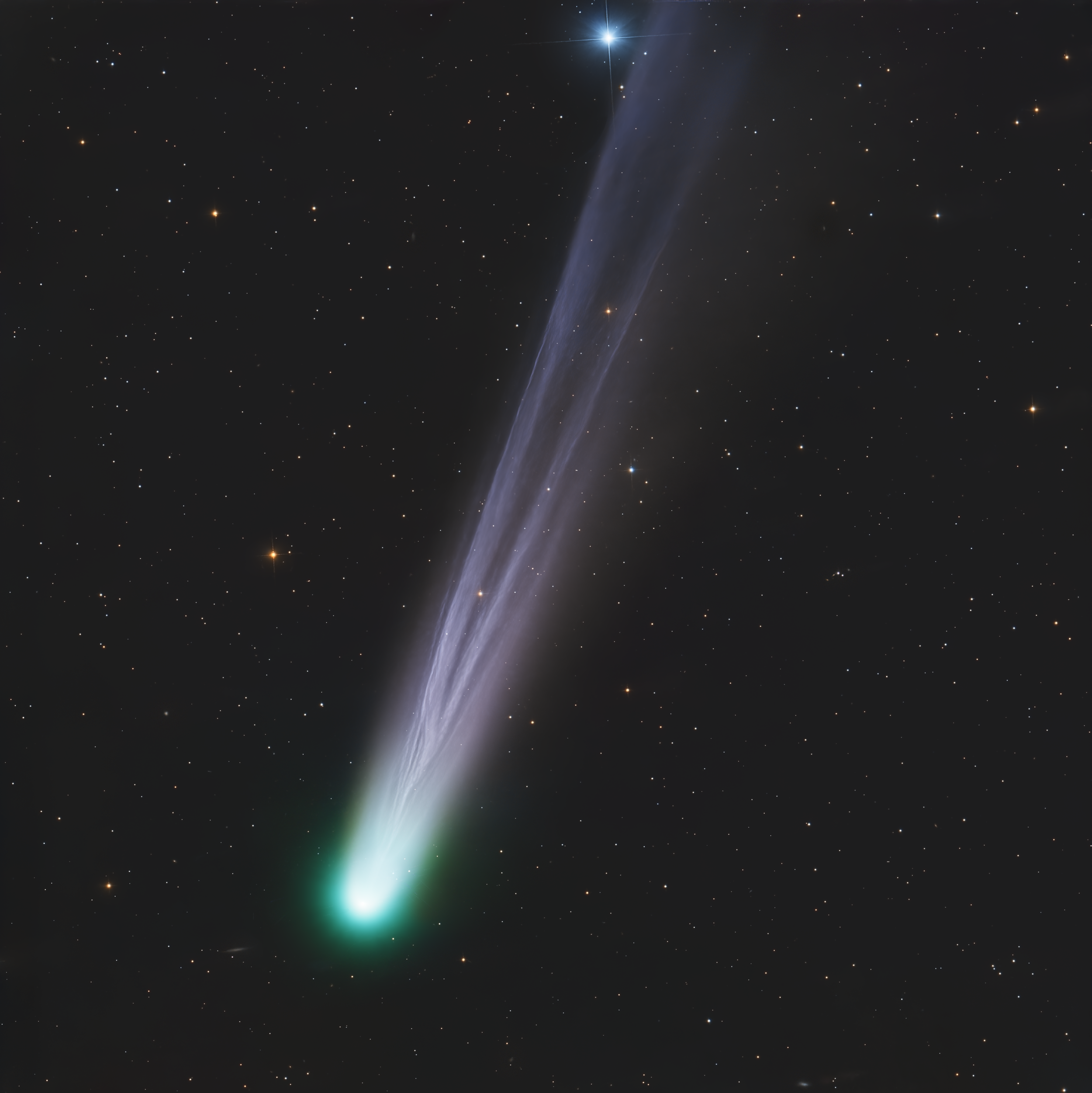
    If you’re looking for a celestial treat in the coming nights, keep your eyes on the northwest sky just after sunset — Comet C/2025 A6 (Lemmon) is making its way into evening visibility, and Delmarva is in a prime spot to catch it.

    Discovered in January 2025 by the Mount Lemmon Survey, Comet Lemmon has become one of the most talked-about comets of the year. Originally expected to remain faint, the comet has surprised astronomers by brightening faster than forecast.

    Lemmon will make its closest approach to Earth on October 21, 2025, at about 0.596 AU (roughly 89 million km) away. It reaches perihelion (its closest point to the Sun) on November 8, 2025.

    Currently, the comet is estimated to be around magnitude 5 to 6, making it not quite prominent to the naked eye in most skies — but definitely within reach of binoculars or small telescopes in a dark location. Some predictions are more optimistic, suggesting it might brighten to magnitude ~4 around late October, which would make it more noticeable even to unaided eyes under favorable conditions.

    One of the exciting features now is that Lemmon will be about 42° away from the Sun during its closest approach — meaning it should be visible low in the western sky about an hour after sunset. The star Arcturus (in the constellation Boötes) and the double star Izar are being cited as useful reference points to help find it.

    By mid-to-late October, it should shift from being a dawn object into the evening sky, which greatly improves viewing opportunities for observers who aren’t night-owls.

    Photo: Chuck Ayoub

    What Delmarva Observers Need to Know

    When & Where to Look

    • The comet will be best seen just after nautical twilight, once the sky is fairly dark but before it sinks too close to the horizon.
    • Start scanning the northwest to west-northwest horizon — the comet will be relatively low.
    • Use a low horizon (free from trees or buildings) to maximize your view.
    • For timing, expect prime viewing windows roughly 30 to 90 minutes after sunset, though this will shift slightly each evening as the comet’s position changes.

    Sky Conditions

    • Fortunately, forecasts suggest clear skies are likely — ideal conditions for comet watching.
    • Minimize light pollution: try to get to a darker spot (away from street lights or heavy urban glow) to boost your chances of spotting Lemmon.
    • Use apps like Stellarium, SkySafari, or TheSkyLive to track its nightly position against the background stars.

    Tips for Viewing & Photographing Comet Lemmon

    For Visual Observers (Binoculars / Telescopes)

    • Start with 10×50 or 10×60 binoculars — these will likely pick up the comet before your eyes can.
    • Use a low-power eyepiece in a telescope (e.g. 40–60×) to get a wider field of view and more context.
    • Try averted vision (looking slightly to the side of the comet) — your peripheral vision is better at detecting faint objects.
    • Take time to let your eyes acclimate to the dark (about 20–30 minutes).

    For Astrophotographers

    • Use a wide-field lens (e.g. 24–50 mm) on a full-frame or APS-C camera, or a modest focal length if using a telescope.
    • Aim for exposures of 30–120 seconds, depending on your tracking capability and sky conditions.
    • Use a star-track mount or equatorial tracker if possible, so you can lengthen exposure without the stars trailing.
    • Stack multiple frames in post-processing to improve signal-to-noise and bring out tail structure.
    • Consider taking sequences over several nights — the comet’s movement will allow you to show motion or tail changes.
    • Use dark, flat, and bias calibration frames to clean up the images.

    Caution / Tips

    • Because the comet is low, atmospheric extinction and scattering may dim it. Give yourself some margin.
    • Watch for fog, haze, or humidity near the horizon, which could obscure faint details.
    • Be patient — the comet’s brightness can vary, and fainter comets often require persistence and ideal conditions.

    Why This Is a Special Opportunity

    Comet Lemmon is not a frequently returning visitor — its inbound orbital period is estimated at about 1,350 years, and after its perihelion passage that period may shorten to around 1,150 years. It last visited Earth’s vicinity more than a millennium ago, and this may be our best chance to glimpse it in our lifetime.

    If conditions hold, Lemmon could become the brightest comet of 2025 — a rare and beautiful sight in the autumn sky.

    So, clear your evening calendar (or at least a half hour), pack your binoculars or camera gear, and look northwest after sunset over Delmarva. With luck and clear skies, you may witness a stunning visitor from the outer reaches of the solar system.

  • DEMA Mobilizes Delaware National Guard in Preparation for Coastal Storm Effects

    DEMA Mobilizes Delaware National Guard in Preparation for Coastal Storm Effects

    (SMYRNA, DE) — The Delaware Emergency Management Agency (DEMA) has announced the activation of the Delaware National Guard to support preparations and response efforts as the state faces threats from coastal flooding and strong winds expected to persist through tomorrow.

    Having coordinated with state and local officials since Friday, DEMA said it is strategically deploying Guard resources to where they will be needed most. Reception centers are already open across Kent and Sussex counties, with sheltering plans in place should demand increase. Agencies including the Delaware Department of Health and Social Services, DelDOT, and the American Red Cross are working closely with local authorities to facilitate access to these resources.

    In Bowers Beach, the mayor has issued a voluntary evacuation order for residents east of Whitwells Delight Road. Individuals needing shelter are guided to the Magnolia Fire Company or to contact the Kent County Emergency Operations Center at 302-735-3465 for further guidance.

    Reception Center Locations

    • Kent County: Magnolia Fire Hall, 2 North Main Street, Magnolia, DE
    • Sussex County: Millsboro Fire Hall, 109 E State St, Millsboro, DE

    DelDOT continues to monitor road conditions and post closures through its website and mobile app. Meanwhile, DNREC has closed beaches, surf crossings, and campgrounds at Delaware Seashore State Park and Cape Henlopen State Park until further notice.

    DEMA Director A.J. Schall commented, “We’re monitoring the situation and proactively positioning additional resources to support counties and municipalities in safeguarding residents. DEMA will continue to issue Watches, Warnings, and other directives as needed.”

    Officials warn that moderate-to-major coastal flooding, damaging wind gusts, tree damage, power outages, and roadway flooding remain possible. Additional local evacuations may be ordered if conditions worsen.


    Safety Guidelines for Residents

    1. Enroll in DENS – Sign up for the Delaware Emergency Notification System to receive alerts via phone or email.
    2. Know your zone – Use the Know Your Zone tool to determine whether your address falls within an evacuation zone. Stay alert even if you are outside a designated zone.
    3. Plan your evacuation – Outline a route, inform family members, and carry hard copies of important documents.
    4. Assemble an emergency kit – Include essentials such as medications, food, water, batteries, flashlights, and supplies for pets for 3–7 days.
    5. Stay informed – Monitor trusted media, state agencies’ social accounts, and radio stations for updates.
    6. Turn Around, Don’t Drown – Never drive through floodwaters.

    Emergency Alert Radio Stations: WDEL-AM 1150, WDEL-FM 101.7, WCHK-FM 101.3, WWTX-AM 1290, WRDX-FM 92.9, WJWL-AM 900, WDOV-AM 1410, WSTW-FM 93.7, WDDE-FM 91.1, WILM-AM 1450, WDSD-FM 94.7. Boaters should monitor Marine Channel 16

  • Strong Coastal Low Could Bring Major Impacts to Delmarva This Weekend

    Strong Coastal Low Could Bring Major Impacts to Delmarva This Weekend

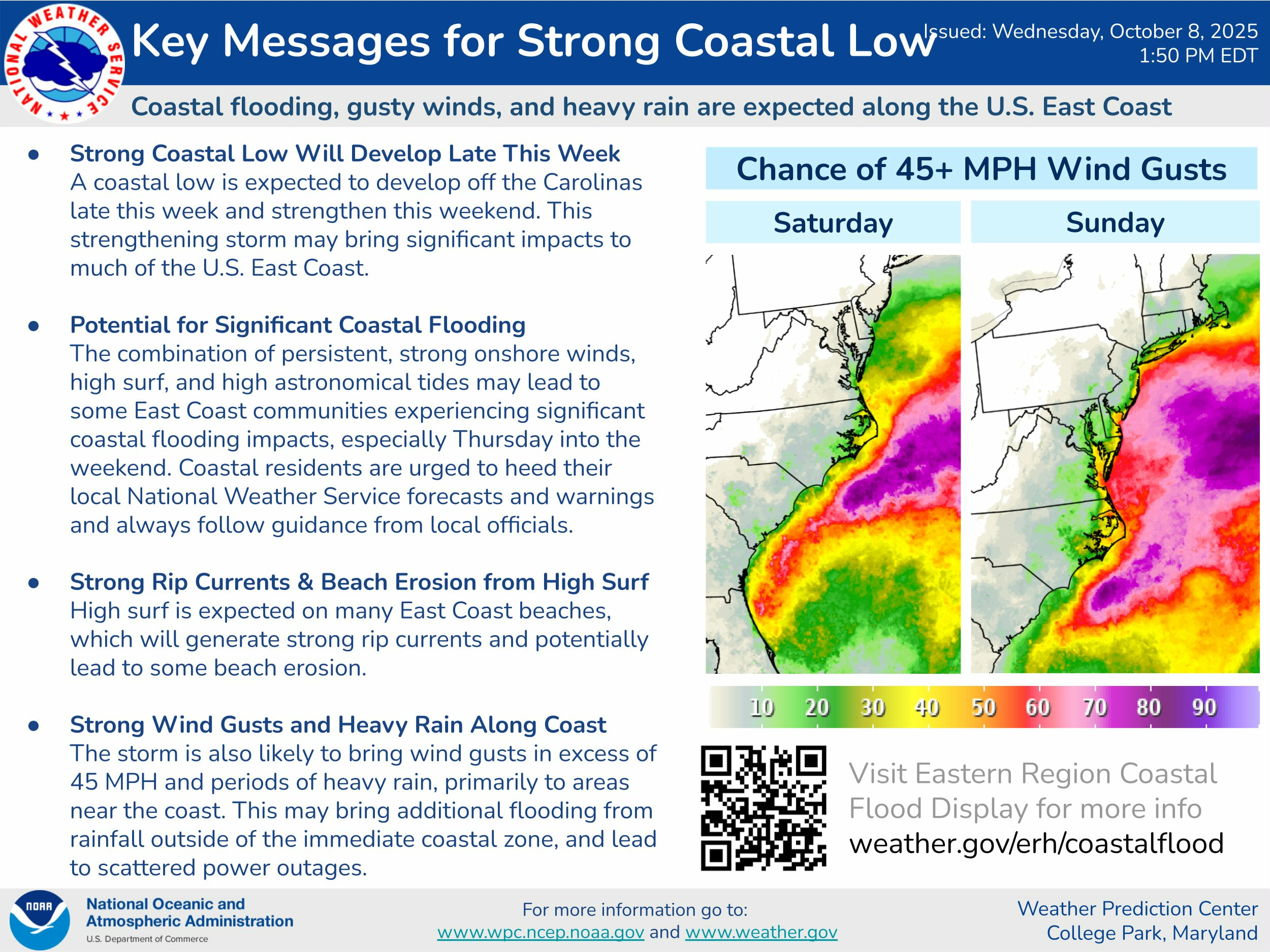
    A powerful coastal low is forecast to develop off the Carolina coast late this week before strengthening and tracking northward this weekend. The system is expected to bring gusty winds, heavy rain, and coastal flooding to much of the East Coast — including the Delmarva Peninsula.

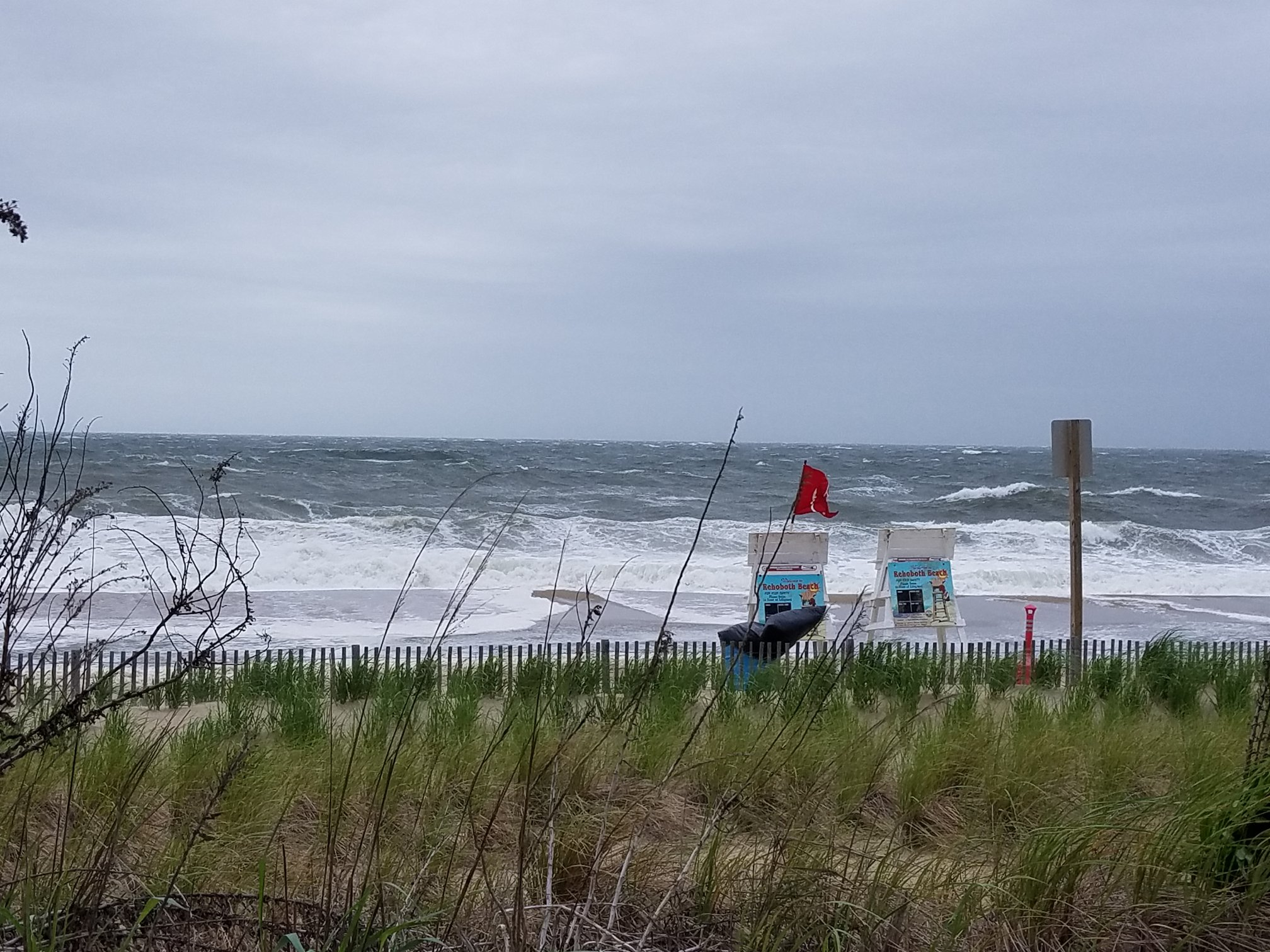
    The combination of strong onshore winds, high surf, and high astronomical tides could lead to significant coastal flooding across parts of Delaware, Maryland, and Virginia. The most widespread impacts are expected from Friday night through Sunday, with the highest risk during periods of high tide.

    Persistent onshore winds will also generate dangerous rip currents and high surf, likely leading to beach erosion along the Atlantic coastline and the lower Delaware and Chesapeake Bays. Coastal residents should closely monitor updates and follow any advisories issued by local emergency management or the National Weather Service.

    In addition to flooding, the storm could bring wind gusts over 45 mph, especially along coastal areas, which may result in scattered power outages and tree damage. Heavy rainfall could also lead to localized flooding inland, particularly in poor drainage areas.

    The Weather Prediction Center highlights the Delmarva coast as an area of elevated concern for strong wind gusts and coastal flooding potential this weekend.

    Residents are urged to stay alert as the system approaches and to secure outdoor items ahead of the storm.

  • Very Rare “Fujiwhara Effect” Of Tropical Cyclones Potentially Threaten The Eastern Seaboard

    Very Rare “Fujiwhara Effect” Of Tropical Cyclones Potentially Threaten The Eastern Seaboard

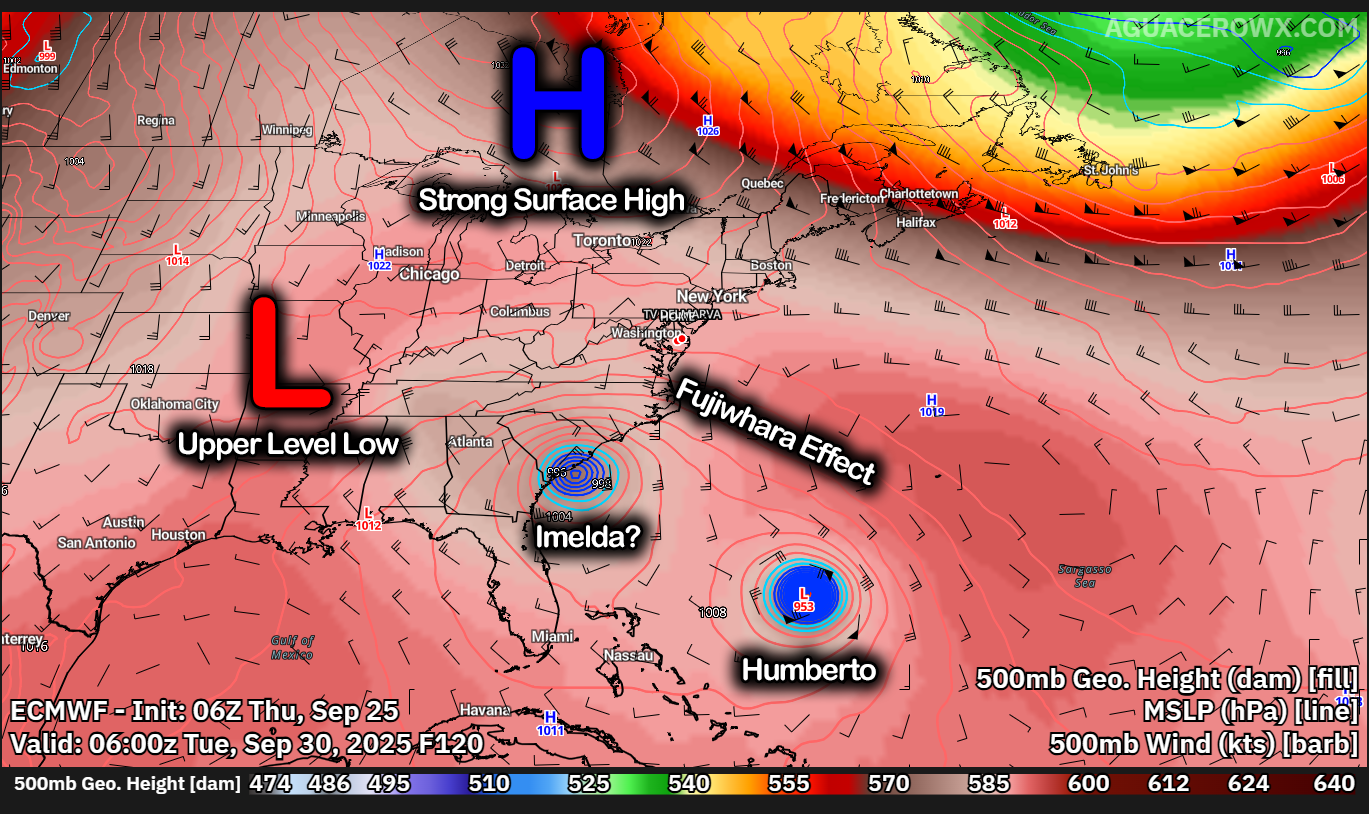
    Ladies and gentlemen, we may get to witness an extremely unique weather phenomena coming into early next week. There has been a lot of talk about something called the “Fujiwhara Effect” and this is becoming more of a real scenario which makes forecasting very difficult. We already have Humberto which formed yesterday in areas north and east of the Lesser Antilles which is expected to become a major hurricane towards the weekend. Another tropical wave near Hispaniola is expected to develop into Imelda and will become in close enough proximity to Humberto to do a bit of a waltz we can say.

    First off what is the Fujiwhara Effect? The Fujiwhara effect describes the rotational interaction of two vortices, such as tropical cyclones, where they orbit a common center and can either merge into one larger storm, cause one to be absorbed, or break apart and move away from each other. The effect, named after Japanese meteorologist Sakuhei Fujiwhara, is more common in the Pacific Ocean, where tropical cyclones are more numerous.

    This is exactly what we have going on here with potentially two tropical cyclones is close enough proximity to start doing some very strange movements as they share a similar fulcrum point between each other. Humberto should stay off our coast but Imelda is the one to watch as this becomes a threat towards the Southeast US coastal toward the Mid-Atlantic coasts. To throw a bigger wrench into things, we have a strong surface high moving in across the Great Lakes and New England with a retrograding upper level low in the Midwest. So many steering currents to bring what would be Imelda towards the US Coastlines. And could stall Imelda in place with a tremendous rainfall threat.

    We really need to see if Imelda can form a center of circulation to get a better handle on where it would go and the impacts with the Fujiwhara. This is going to be a fairly impactful and intriguing setup overall. The meteorology behind this is truly astonishing. Regardless, residents along the Eastern Seaboard need to relate alert as we head into the weekend.

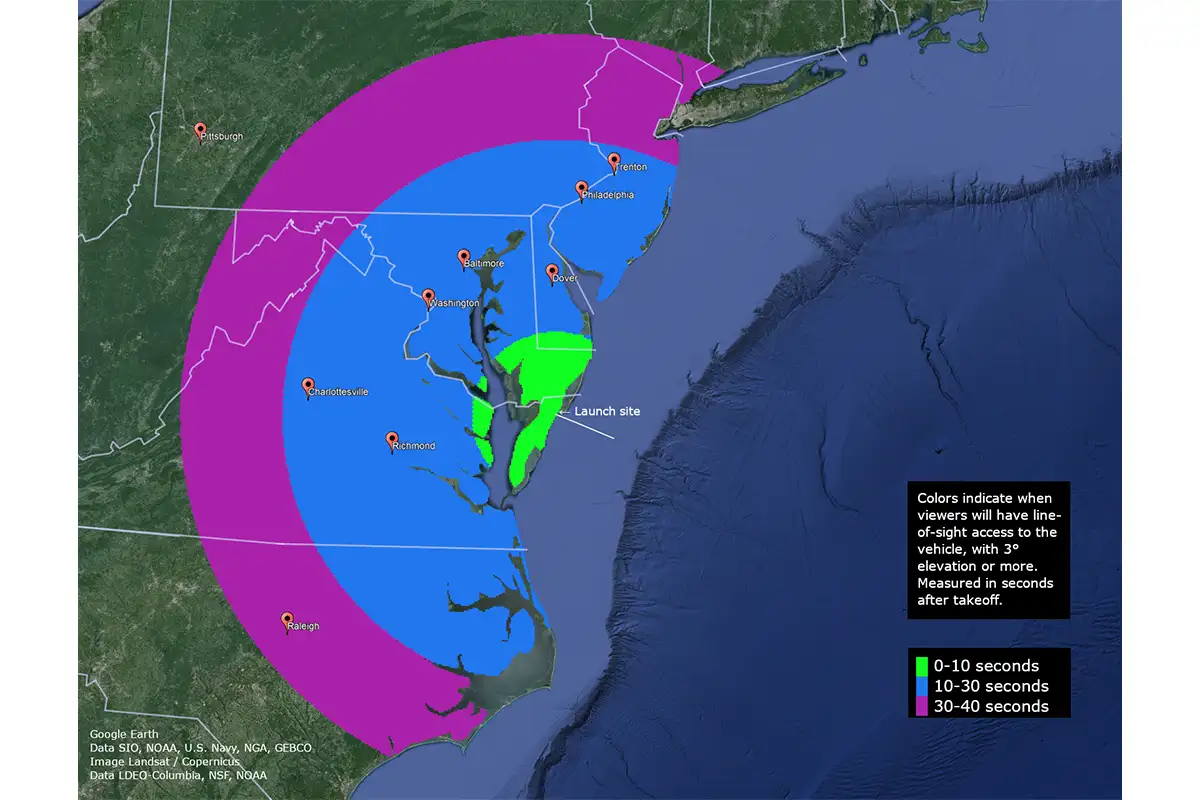
  • Tonight: NASA’s TOMEX+ Mission Could Light Up Delmarva Skies

    Tonight: NASA’s TOMEX+ Mission Could Light Up Delmarva Skies

    Launch Window: Between 10 p.m. tonight and 3 a.m. tomorrow
    Mission: TOMEX+ (Turbulent Oxygen Mixing Experiment Plus)

    What to Expect

    NASA is launching a series of three sounding rockets from Wallops Island tonight as part of the TOMEX+ mission. Its goal? To explore the mesopause, one of the most turbulent atmospheric zones located around 56 miles above Earth, where a layer of atomic sodium resides—created by tiny meteors burning up in the sky

    • First Two Rockets: They’ll release vibrant vapor tracers—colorful clouds that you can photograph from the ground. These tracers help scientists visualize and map wind patterns in the upper atmosphere.
    • Third Rocket (Launching ~5 Minutes Later): Equipped with a lidar instrument, it will emit short pulses of light to precisely measure atmospheric density and movement over time

    Together, this trio offers scientists a uniquely detailed 3D view of turbulence at the edge of space, shedding light on high-altitude cloud formation, satellite drag, and even atmospheric behavior on other planets

    Viewing Tips for Region Residents

    If the skies are clear, residents of Northern Virginia and nearby metro areas like Washington, D.C., Baltimore, and Philadelphia may catch the spectacle:

    • Within 10 seconds of launch: expect visibility closest to Wallops Island.
    • In Northern Virginia and similar zones, visibility may occur 10–30 seconds after liftoff.
    • Western Virginia and parts of Pennsylvania may see it 30–40 seconds post-launch

    A livestream and live mission updates will begin approximately five minutes before each rocket’s launch on NASA’s social media channels


  • Ignoring Warnings Of Hurricane Erin Puts Lives at Risk: Experts Urge Public to Follow Safety Alerts

    Ignoring Warnings Of Hurricane Erin Puts Lives at Risk: Experts Urge Public to Follow Safety Alerts

    — Hurricane Erin is currently off the coast of the Delmarva Pennisula. Beaches along the Eastern Seaboard have raised red flags, warning the public about dangerous surf and rip currents. Public officials, meteorologists, and emergency responders have all strongly advised against entering the water or engaging in beach recreation during this time. Despite this, too many people ignore these warnings. They dismiss the threat by comparing the storm to past hurricanes or by calling official alerts “fake news.” This attitude is not just reckless; it endangers lives. Public weather alerts are issued for one fundamental reason: to save lives and protect communities. These warnings are based on complex meteorological data, satellite tracking, and sophisticated computer forecasting models that take into account storms’ wind speeds, rainfall potential, storm surge, and other hazards. They reflect expert analysis designed to help residents prepare for events that could cause flooding, property damage, injury, or loss of life. The forecasts are never perfect, but they are the single best guide available for decision-making during severe weather. The Delmarva Peninsula is especially vulnerable to the effects of hurricanes and tropical storms. Its low-lying geography makes it prone to flooding and storm surge.

    History confirms the risks. In 2003, Hurricane Isabel caused major flooding on Maryland’s Eastern Shore. Many residents underestimated the danger, leading to costly damages and some fatalities. These events are reminders that storms can rapidly shift in intensity and impact, and no storm can be judged solely by the name or category it carries. Rip currents provide another deadly danger lurking near coastal waters. Even when skies seem clear, distant hurricanes create powerful currents that sweep swimmers away. Each year, lifeguards on Delmarva rescue dozens of people caught in rip currents, and fatalities occur when warnings are ignored. These dangers are not theoretical. Emergency responders put their lives at risk when they respond to people who disregard official advice. Ignoring safety warnings during high surf does not just risk one person’s life; it endangers entire communities and stretches local emergency resources. Social media complicates matters further. While it enables rapid sharing of information, it can also spread false or misleading messages.

    Photo: James Spann

    Posts claiming that storms are “no big deal” or that warnings are exaggerated encourage complacency. This undermines trust in professional meteorologists and emergency officials who spend countless hours ensuring their forecasts are as accurate as possible. Public confidence is essential in emergency management, and misinformation erodes that trust. People often compare new storms to past events, assuming they can “handle it better” or that it “won’t be as bad.” This oversimplifies the complex nature of severe weather. No two storms are exactly alike. Factors like storm speed, rainfall distribution, and coastal geography combine in unique ways each time, making every event different. Dismissing warnings by relying on past experience is dangerous. Sometimes, storms do weaken or shift course, leading some to say the forecasts were wrong. That perception fails to acknowledge the purpose of advance warnings: to give people time to take precautions against worst-case scenarios. It is better to prepare and have a storm pass with minor impacts than to ignore warnings and face disaster unprepared. In summary, public weather alerts exist to protect every member of the community.

    They are developed through rigorous science and decades of storm data. When officials issue beach closures, evacuation orders, or high surf warnings, they do so with public safety as their priority. Ignoring these alerts is not a harmless act of skepticism; it endangers lives, burdens first responders, and threatens entire communities. The best way to protect yourself and those around you is to listen to professional forecasts, respect warnings, and prepare accordingly. Share accurate information and encourage others to do the same. Storms do not negotiate with opinions or social media posts. They follow the rules of nature. Our safety depends on understanding that truth and acting on it.

  • NWS Confirms EF-0 Tornado In Omar, DE On Monday

    NWS Confirms EF-0 Tornado In Omar, DE On Monday

    Public Information Statement
    National Weather Service Mount Holly NJ
    1224 PM EDT Wed Jul 2 2025
    
    ...NWS Damage Survey for Sussex County DE Tornado Update #1...
    
    .Update...EF-0 Tornado Confirmed in Frankford, DE on June 30th
    
    .Frankford Tornado...
    
    Rating:                 EF-0
    Estimated Peak Wind:    65 mph
    Path Length /statute/:  0.5 miles
    Path Width /maximum/:   100 yards
    Fatalities:             0
    Injuries:               0
    
    Start Date:             June 30, 2025
    Start Time:             1:16 PM EDT
    Start Location:         Frankford, DE
    Start Lat/Lon:          38.5266, -75.2111
    
    End Date:               June 30, 2025
    End Time:               1:16 PM EDT
    End Location:           Frankford, DE
    End Lat/Lon:            38.5243, -75.2016
    
    Damage assessment determined that an EF0 tornado with a maximum
    wind speed of 65 mph briefly touched down along Omar Rd in
    Frankford, DE and moved ESE over a heavily forested area towards
    Shockley Town Rd. Several brief video clips shared by broadcast
    media and social media showed various angles of a tornado in
    progress in the heavily forested area between Omar Rd and
    Shockley Town Rd. Several large branches were twisted and snapped
    along Omar Rd. Additional damage is possible in the heavily
    forested area, but the survey team was unable to access the area.
    
    Special thanks to local media and the Sussex County Emergency
    Management for their assistance in this storm survey.
    
    &&
    
    EF Scale: The Enhanced Fujita Scale classifies tornadoes into the
    following categories:
    
    EF0.....65 to 85 mph
    EF1.....86 to 110 mph
    EF2.....111 to 135 mph
    EF3.....136 to 165 mph
    EF4.....166 to 200 mph
    EF5.....>200 mph
    
    NOTE:
    The information in this statement is preliminary and subject to
    change pending final review of the event and publication in NWS
    Storm Data.
  • Rare G4 Geomagnetic Storm May Bring Northern Lights to Delmarva Sunday Night

    Rare G4 Geomagnetic Storm May Bring Northern Lights to Delmarva Sunday Night

    Delmarva Peninsula — A rare and powerful G4 (Severe) Geomagnetic Storm Watch has been issued by the NOAA Space Weather Prediction Center (SWPC) for Sunday, June 1st, bringing the potential for Northern Lights (aurora borealis) to be visible as far south as parts of the Delmarva Peninsula, pending favorable sky conditions.

    The alert, issued Saturday, cites a series of strong solar eruptions from the Sun’s surface that are sending coronal mass ejections (CMEs) toward Earth. These charged solar particles are forecast to arrive late Sunday (UTC time), with impacts possible through early Monday.

    NOAA’s G-scale for geomagnetic storms ranges from G1 (Minor) to G5 (Extreme). A G4 storm is a rare event, with only a few occurring each solar cycle, and can trigger vibrant auroras that stretch well south of their typical range near the Arctic Circle.

    If skies remain clear Sunday night, residents across Maryland’s Eastern Shore, Delaware, and even coastal Virginia could have a chance to spot the shimmering auroras towards the northern skies—especially from darker rural areas away from city lights.

    In addition to auroras, G4-level geomagnetic storms can cause intermittent issues with GPS accuracy, radio communications, and satellite operations, though infrastructure is generally equipped to handle such events.

    The storm is associated with recent activity from sunspot region 4100 launching a long duration M8 solar flare. SWPC forecasters say the exact timing and intensity of auroral displays will depend on how directly the CME hits Earth’s magnetic field and how the Interplanetary Magnetic Field (IMF) aligns.

    For the best chance at viewing the aurora:

    • Look north after dark Sunday night.
    • Get away from light pollution.
    • Bring a camera—auroras are often more easily detected in long-exposure photos than by eye at lower latitudes.

    This could be one of the most significant aurora viewing opportunities for the Mid-Atlantic region in for 2025 thus far. Stay tuned to local forecasts for cloud cover updates and check the NOAA SWPC or aurora tracking sites for real-time alerts.

  • NOAA Forecasts Above-Normal 2025 Atlantic Hurricane Season

    NOAA Forecasts Above-Normal 2025 Atlantic Hurricane Season

    The National Oceanic and Atmospheric Administration (NOAA) has issued its outlook for the 2025 Atlantic hurricane season, predicting above-normal activity. The season, which runs from June 1 through November 30, is expected to produce 13 to 19 named storms, with six to ten becoming hurricanes, and three to five reaching major hurricane status (Category 3 or higher).

    NOAA attributes the heightened activity to several factors, including warmer-than-average sea surface temperatures in the Atlantic Ocean and Caribbean Sea, and a neutral phase of the El Niño-Southern Oscillation (ENSO), which can influence hurricane development.

    “With the combination of warm ocean temperatures and neutral ENSO conditions, the atmosphere is primed for an active hurricane season,” said NOAA Administrator Rick Spinrad.

    This forecast aligns with projections from other institutions, such as Colorado State University and the UK Met Office, which also anticipate above-average hurricane activity for the 2025 season.

    NOAA emphasizes the importance of preparedness, urging residents in hurricane-prone areas to review their emergency plans and stay informed through official channels. The agency’s full fleet of satellites and advanced modeling systems will continue to monitor tropical activity throughout the season.

    For more information and updates, visit NOAA’s National Hurricane Center at www.nhc.noaa.gov.

  • High End EF-1 Tornado Confirmed From Dorchester To Sussex County

    High End EF-1 Tornado Confirmed From Dorchester To Sussex County

    …NWS Damage Survey for 05/16/25 Tornado Event Update #2…

    Update…Added information for Rhodesdale-Bethel Tornado

    Overview…Multiple rounds of storms produced damage across the
    region including a tornado in southern New Jersey and another that
    began in eastern Maryland before crossing into southern Delaware.

    .Rhodesdale-Bethel Tornado…

    Rating: EF-1
    Estimated Peak Wind: 100-110 mph
    Path Length /statute/: 11.4 miles
    Path Width /maximum/: 600 yards (discontinuous circulations)
    Fatalities: 0
    Injuries: 0

    Start Date: May 16, 2025
    Start Time: 6:52 PM EDT
    Start Location: 2 SSE Rhodesdale / Dorchester County / DE
    Start Lat/Lon: 38.5538 / -75.8291

    End Date: May 16, 2025
    End Time: 7:06 PM EDT
    End Location: 1 S Bethel / Sussex County / DE
    End Lat/Lon: 38.5625 / -75.6209

    On Friday May 16th, an EF-1 tornado occurred beginning in
    Dorchester County, Maryland before crossing into Sussex County,
    Delaware.

    The tornado began south-southeast of Rhodesdale, along
    Rhodesdale-Vienna Road. Significant tree damage occurred to a line
    of trees to the east of the road, with many trees snapped along
    their trunks and several more uprooted. The tree damage appeared
    to be convergent with trees bent towards the center of the damaged
    area. The tornado may have lifted briefly as it continued to the
    east-northeast as little damage was noted along Indiantown Road.
    By the time the tornado reached Eldorado-Sharptown Road, damage to
    trees resumed with several more snapped and uprooted. As the
    tornado approached Galestown, damage occurred to an elongated farm
    building, with the entire structure lifted off its foundation and
    pushed several yards to the east-northeast. The most concentrated
    damage was found in Galestown, near where the tornado reached its
    peak width. Radar observations indicate that multiple
    circulations may have been present at this time, resulting in the
    increased width. Many more trees were twisted, snapped, and/or
    uprooted with some causing damage to homes as a result.

    The tornado then moved into Sussex County, Delaware and crossed
    the Nanticoke River. More tree damage was observed in Phillips
    Landing Park where a tree was snapped and twisted near the base of
    its trunk with additional tree damage in the Cherry Walk Woods
    neighborhood and along Phillips Landing Road. Additional trees
    were damaged along Shell Bridge Road with a tree snapped near the
    intersection with Phillips Landing Road. Several large limbs were
    also downed near Broad Creek, south-southwest of Bethel. The
    tornado dissipated in this area though additional damage was noted
    continuing eastward towards Laurel. This was the result of
    straight-line winds associated with the rear-flank downdraft which
    also caused the loss of part and all of the roofs to two
    commercial structures in Laurel as well as additional tree damage
    south of Chipman Pond.

    The National Weather Service would like to thank the Eldorado-
    Brookview Volunteer Fire Company, Laurel Fire Department, and
    Sussex County Emergency Management and Communications for their
    valuable assistance with this survey.

  • NWS Mount Holly to Undergo Scheduled System Upgrade; Temporary Service Adjustments Expected

    NWS Mount Holly to Undergo Scheduled System Upgrade; Temporary Service Adjustments Expected

    The National Weather Service Forecast Office in Mount Holly, NJ will be conducting a required, scheduled update to their Advanced Weather Interactive Processing System (AWIPS) system from 8 AM EDT Tuesday, May 13, 2025 through approximately 5 PM EDT Thursday, May 15, 2025. The NWS uses the AWIPS computer system to display and integrate weather and water information, and to send life-saving information, such as weather and water warnings, to the public.

    During the time of the update, forecast operations will be conducted by the National Weather Service Forecast Office in New York, NY (Upton, NY) to minimize any potential interruption to services. No impacts to our core services of forecast products and weather watches, warnings and advisories are expected during this period. However, limited impacts will occur to the following services: 

    • All NOAA Weather Radio Transmitters maintained by NWS Philadelphia/Mount Holly will be off the air through the time of the install. This includes the following transmitters: Hibernia Park, PA; Philadelphia, PA; Allentown, PA; Sudlersville, MD; Lewes, DE; Southhard/Howell Township, NJ; Hardyston, NJ; and Atlantic City, NJ
    • Tidal water level forecast services will be updated less frequently through this period. Forecasts will remain available at water.noaa.gov/wfo/phi and www.weather.gov/erh/coastalflood?wfo=phi 
    • Local graphical forecast maps that are hosted in various places on www.weather.gov/phi will not be updated. This includes all maps on the Graphical Hazardous Weather Outlook page ( https://www.weather.gov/erh/ghwo?wfo=phi).

    The forecast office in Mount Holly, NJ will remain open and staffed throughout this period for public and partner phone calls and additional functions that can be completed without AWIPS.


    If you have any questions, please contact Sarah Johnson, Warning Coordination Meteorologist, by email at [email protected] or by phone at (609) 261-6602 extension 223.  

  • Long Duration Rain Event Possible This Weekend Through Next Week In The Mid-Atlantic

    Long Duration Rain Event Possible This Weekend Through Next Week In The Mid-Atlantic

    A prolonged and potentially significant rain event is increasingly likely to take shape across the Eastern United States beginning this weekend and persisting through much of next week. A classic late-spring pattern is emerging, characterized by a cut-off low-pressure system becoming trapped beneath a blocking ridge to the north—a scenario often associated with extended periods of unsettled weather.

    Forecast data from the ECMWF (European Centre for Medium-Range Weather Forecasts) highlights a deep 500mb trough settling over the Ohio Valley, with a steady stream of Atlantic moisture being funneled into the region. This setup closely mirrors the persistent pattern observed in May of last year, which brought nearly two weeks of damp, chilly, and gray conditions to much of the Northeast and Mid-Atlantic.

    Both the ECMWF and Canadian (CMC) models are signaling a so-called “firehose” of moisture—originating from the Gulf Stream—pushing into the Mid-Atlantic and New England from Saturday through at least Thursday. The persistent onshore flow raises additional concerns beyond the rainfall itself, including the potential for coastal erosion and localized coastal flooding, particularly in vulnerable shoreline communities.

    Projected rainfall totals are significant. Both the ECMWF and CMC models suggest widespread accumulations of 2 to 6 inches from the D.C.-Maryland-Virginia (DMV) region northward into northern New Jersey. Should these forecasts verify, the event could mark a dramatic reversal of ongoing drought conditions across parts of the Northeast, effectively acting as a “drought buster.”

    While the forecast remains subject to change in the coming days, confidence is growing in a wet and unsettled period ahead—bringing both relief for parched soils and challenges for outdoor activities, agriculture, and coastal infrastructure.

  • Lyrid Meteor Shower 2025: When, Where, and How to See This Spring’s Fiery Display

    Lyrid Meteor Shower 2025: When, Where, and How to See This Spring’s Fiery Display

    Get ready for a springtime sky show! The Lyrid meteor shower is set to peak this week, offering skywatchers across the Northern Hemisphere a chance to witness one of the oldest and most reliable annual meteor showers.

    The 2025 Lyrids will reach their peak overnight Tuesday, April 22 into the early morning hours of Wednesday, April 23. Under dark, clear skies, observers can expect to see 15 to 20 meteors per hour, with some leaving glowing, persistent trails that hang in the sky for seconds at a time.

    When and Where to Watch

    The best time to look for Lyrids is after midnight local time, when the radiant point—located near the bright star Vega in the constellation Lyra—climbs higher into the sky. The higher Vega rises, the better your chances of spotting meteors streaking across the heavens.

    For the best view, head to a dark-sky location away from city lights. Lie back, give your eyes 20 to 30 minutes to adjust, and look up—you don’t need a telescope or binoculars.

    Will the Moon Interfere?

    The first quarter Moon sets before the peak viewing window opens, which means conditions will be much darker in the early morning hours of April 23—perfect for spotting fainter meteors that might otherwise be washed out by moonlight.

    A Shower with Deep Roots

    The Lyrids are caused by debris from Comet C/1861 G1 Thatcher, which last passed through the inner solar system over 160 years ago. First recorded by Chinese astronomers in 687 BCE, the Lyrids have been lighting up Earth’s skies for over 2,700 years, earning a reputation for occasional bursts of intense activity.

    While this year’s shower isn’t expected to produce an outburst, unexpected surges can’t be ruled out—making every meteor you catch feel just a little more magical.

    Weather Outlook

    As always, the weather plays a key role in visibility. Clear skies will offer the best opportunity to catch the show, so check your local forecast in advance. For those under clouds, several astronomy organizations will host livestreams of the event.

    Tips for the Best Experience

    • Go dark: Find a spot away from artificial light for the best contrast.
    • Get comfy: A reclining chair or blanket will help you look straight up without neck strain.
    • Dress warmly: Even in April, nighttime temperatures can dip, especially in open areas.
    • Be patient: It can take time for your eyes to adjust and for the meteors to start putting on a show.

    The Lyrid meteor shower may not be the year’s flashiest, but its long history and crisp spring timing make it a fan favorite. Make a wish—or a dozen—and enjoy one of nature’s best nighttime displays.

  • March 2025 Goes Down as the Windiest on Record for Parts of the U.S.

    March 2025 Goes Down as the Windiest on Record for Parts of the U.S.

    Image From WeatherMatrx

    If you thought March felt windier than usual — you were absolutely right.

    This past March wasn’t just breezy — it was officially the windiest on record for several cities across the Central and Eastern U.S., according to data from the National Weather Service.

    Why Was It So Windy?

    Spring is typically known for being a bit blustery as seasons change. But this year, things were taken to a whole new level.

    Meteorologists say an unusually active jet stream combined with frequent storm systems created a perfect recipe for non-stop wind throughout the month. The strong contrast between areas of high and low pressure kept the air constantly moving — and moving fast.

    Cities That Smashed Records

    Some of the hardest-hit areas for wind records included:

    • Chicago, IL
    • Omaha, NE
    • Kansas City, MO
    • Des Moines, IA

    These cities didn’t just have a few windy days — their average wind speeds for the entire month were 2 to 4 mph higher than normal. That may not sound like much, but for monthly records, that’s a big deal.

    What Were the Impacts?

    The gusty conditions led to plenty of problems:

    • Trees and power lines were knocked down
    • Dust storms reduced visibility across the Plains
    • Wildfire danger spiked in dry areas
    • Air travel was affected with delays and rough landings

    It was a challenging month for truck drivers, travelers, and anyone trying to enjoy the outdoors.

    Will Windy Marches Become More Common?

    It’s too early to say if this is the start of a long-term trend or just a particularly stormy spring. But meteorologists will definitely be keeping an eye on future wind patterns as the climate continues to change.

    Either way, March 2025 will go down in the books as one of the windiest we’ve ever seen — and one that residents across the Midwest and Plains won’t forget anytime soon.

  • GOES-19 Goes Operational Across The US

    GOES-19 Goes Operational Across The US

    A very exciting day in the weather world. Welcome to GOES-19, the brand new updated satellite covering the United States is now in operation!

    GOES-19, formerly known as GOES-U, introduces significant enhancements over its predecessor, GOES-16, particularly in space weather monitoring. A notable addition is the Compact Coronagraph-1 (CCOR-1), the nation’s first operational coronagraph, designed to observe the solar corona and detect coronal mass ejections (CMEs). This instrument provides imagery within 30 minutes of acquisition, a substantial improvement over the previous system’s eight-hour delay, thereby enhancing space weather forecasting capabilities.

    GOES-19 continues the high-temporal resolution imaging capabilities introduced with the GOES-R series but maintains and enhances rapid updates for weather monitoring.

    • Full-Disk Updates Every 5 Minutes: GOES-19 can scan the entire Earth every five minutes, providing near-real-time global coverage to track weather systems, storms, and environmental changes. This allows meteorologists to monitor rapidly developing weather patterns with high-frequency updates.
    • Mesoscale Region Updates Every 30 Seconds: In high-impact weather events, GOES-19 can focus on two mesoscale sectors simultaneously, delivering images every 30 seconds per region. This is crucial for tracking severe thunderstorms, hurricanes, wildfires, and other rapidly evolving atmospheric phenomena, offering nearly real-time updates for forecasters.

    These rapid update capabilities, combined with its advanced instruments like the Advanced Baseline Imager (ABI) and Geostationary Lightning Mapper (GLM), allow GOES-19 to provide even more detailed and timely data, improving short-term forecasting, severe weather warnings, and disaster response efforts.

    ​GOES-19, previously known as GOES-U, introduces several advanced features over its predecessor, GOES-16, enhancing both Earth and space weather monitoring capabilities.​

    Enhanced Magnetometer (GMAG): GOES-19 is equipped with an upgraded magnetometer that offers improved measurements of Earth’s magnetic field compared to earlier GOES-R series satellites.

    These advancements position GOES-19 as a critical asset in NOAA’s mission to provide timely and accurate environmental data, ensuring improved forecasting and preparedness for both terrestrial and space weather phenomena.

  • Severe Weather On Tap For Monday Evening Across Delmarva

    Severe Weather On Tap For Monday Evening Across Delmarva

    Strong to severe thunderstorms remain on tap as we venture into the afternoon and evening hours today as a strong cold front advances from the west. A “Slight Risk” of severe weather from the Storm Prediction Center laid across all of the Mid-Atlantic today.

    Looking at satellite this morning over towards our west a nice blanket of sunshine moving into the region to help destabilize the atmosphere with surface heating as temperatures are expected to be well into the 70s as dew points surge into the 60s to have plenty of moisture in place. Well suited for thunderstorm develop later today.

    The first round of storms will begin to develop across the Maryland Western shore around the mid-afternoon hours (4-5PM) which will have the highest chances of larger hail or even an isolated tornado being discrete in nature. Later in the evening hours as the cold front arrives, a squall line likely to develop with the primary threat of damaging straight line winds. Although a quick spin up in the line is always a possibility but those probabilities remain on the low side of things.

    As mentioned before, the primary threat for the storms this afternoon will be indeed damaging straight line winds from the main squall line that moves through towards the evening hours from 7-10PM. Winds gusting as high as 70 mph are possible with the strongest portions of the line. Heavy rainfall from the squall line of 1-3″/hr could lead to some localized flooding in spots. During the mid afternoon hours when a few discrete cells form will have the best shot of large hail to 1″ or locally larger. Tornado threat remains low but not impossible for the first cells to develop in the afternoon hours and then again in the line itself.

  • ECMWF Weather Model to Adopt Fully Open Data Policy in 2025

    ECMWF Weather Model to Adopt Fully Open Data Policy in 2025

    The European Centre for Medium-Range Weather Forecasts (ECMWF) has announced it will transition to a fully open data model in 2025, granting public access to its extensive troves of weather prediction data.

    The move marks a significant shift for ECMWF, which has traditionally maintained a subscription-based system for much of its data. Under the new policy, all forecast data, historical records, and related meteorological datasets will be freely accessible. The change aligns ECMWF with the principles of open data and follows a growing trend among global meteorological institutions to enhance transparency and accessibility.

    “This is a transformative moment for meteorology and climate science,” said ECMWF Director-General Florence Rabier. “By making our data fully open, we empower researchers, businesses, and the public with vital information that can improve weather forecasting, climate resilience, and decision-making across multiple sectors.”

    ECMWF is renowned for producing some of the world’s most accurate weather forecasts, supporting disaster response efforts, aviation, agriculture, and climate research. The organization’s data is widely utilized by meteorologists and policymakers globally.

    The open data initiative is expected to benefit innovation in artificial intelligence and machine learning, as researchers will have unrestricted access to one of the most comprehensive meteorological datasets available. The change will also aid governments and humanitarian organizations in making timely, data-driven decisions during extreme weather events.

    ECMWF will implement the new policy in phases throughout 2025, ensuring a seamless transition for current users. More details on the rollout plan and specific datasets to be released will be provided in the coming months.

    The announcement underscores a broader movement toward open science, reinforcing ECMWF’s role as a leader in global weather and climate forecasting.

    For more information, visit www.ecmwf.int.

  • Severe Weather Awareness Week Day 4: Lightning Safety

    Severe Weather Awareness Week Day 4: Lightning Safety

    There is no safe place outside when thunderstorms are in the area. If you hear thunder, you are likely within striking distance of the storm. Just remember, When Thunder Roars, Go Indoors. Too many people wait far too long to get to a safe place when thunderstorms approach. Unfortunately, these delayed actions lead to many of the lightning deaths and injuries in the United States.

    Lightning is a giant spark of electricity in the atmosphere or between the atmosphere and the ground. In the initial stages of development, air acts as an insulator between the positive and negative charges in the cloud and between the cloud and the ground; however, when the differences in charges becomes too great, this insulating capacity of the air breaks down and there is a rapid discharge of electricity that we know as lightning. There’s so much to learn about lightning.

    Lightning kills about 20 people each year in the United States and hundreds more are injured. Some survivors suffer lifelong neurological damage. Here’s more information on the victims and the survivors.

  • Severe Weather Awareness Week: Day 3 “Severe Thunderstorms & Hail”

    Severe Weather Awareness Week: Day 3 “Severe Thunderstorms & Hail”

    Severe thunderstorms are officially defined as storms that are capable of producing hail that is an inch or larger or wind gusts over 58 mph. Hail this size can damage property such as plants, roofs and vehicles. Wind this strong is able to break off large branches, knock over trees or cause structural damage to trees. Some severe thunderstorms can produce hail larger than softballs or winds over 100 mph, so please pay attention to the weather so you know when severe storms are possible. Thunderstorms also produce tornadoes and dangerous lightning; heavy rain can cause flash flooding.

    Do you know the difference between a National Weather Service Severe Thunderstorm Watch and a Severe Thunderstorm Warning? Check your knowledge below.

    Severe Thunderstorm Watch: Be Prepared! Severe thunderstorms are possible in and near the watch area. Stay informed and be ready to act if a severe thunderstorm warning is issued. The watch area is typically large, covering numerous counties or even states.

    Severe Thunderstorm Warning: Take Action! Severe weather has been reported by spotters or indicated by radar. Warnings indicate imminent danger to life and property. Take shelter in a substantial building. Get out of mobile homes that can blow over in high winds. Warnings typically encompass a much smaller area (around the size of a city or small county) that may be impacted by a large hail or damaging wind identified by an NWS forecaster on radar or by a trained spotter/law enforcement who is watching the storm.

    Find out what you can do before severe weather strikes. Preparation is key to staying safe and minimizing impacts.

    • Be Weather-Ready: Check the forecast regularly to see if you’re at risk for severe weather. Listen to local news or a NOAA Weather Radio to stay informed about severe thunderstorm watches and warnings. Check the Weather-Ready Nation for tips.
    • Sign Up for Notifications: Know how your community sends warning. Some communities have outdoor sirens. Others depend on media and smart phones to alert residents to severe storms.
    • Create a Communications Plan: Have a family plan that includes an emergency meeting place and related information. Pick a safe room in your home such as a basement, storm cellar or an interior room on the lowest floor with no windows. Get more ideas for a plan at: https://www.ready.gov/make-a-plan
    • Practice Your Plan: Conduct a family severe thunderstorm drill regularly so everyone knows what to do if a damaging wind or large hail is approaching. Make sure all members of your family know to go there when severe thunderstorm warnings are issued. Don’t forget pets if time allows.
    • Prepare Your Home : Keep trees and branches trimmed near your house. If you have time before severe weather hits, secure loose objects, close windows and doors, and move any valuable objects inside or under a sturdy structure.
    • Help Your Neighbor: Encourage your loved ones to prepare for severe thunderstorms. Take CPR training so you can help if someone is hurt during severe weather.

    Find out what you can do when severe weather strikes. Acting quickly is key to staying safe and minimizing impacts.

    • Stay Weather Ready: Continue to listen to local news or a NOAA Weather Radio to stay updated about severe thunderstorm watches and warnings.
    • At Your House: Go to your secure location if you hear a severe thunderstorm warning. Damaging wind or large hail may be approaching. Take your pets with you if time allows.
    • At Your Workplace or School: Stay away from windows if you are in a severe thunderstorm warning and damaging wind or large hail is approaching. Do not go to large open rooms such as cafeterias, gymnasiums or auditoriums.
    • Outside: Go inside a sturdy building immediately if severe thunderstorms are approaching. Sheds and storage facilities are not safe. Taking shelter under a tree can be deadly. The tree may fall on you. Standing under a tree also put you at a greater risk of getting struck by lightning.
    • In a Vehicle: Being in a vehicle during severe thunderstorms is safer than being outside; however, drive to closest secure shelter if there is sufficient time.

    What should you do when the lightning and thunder stops and it looks likes the severe thunderstorm is over?

    • Stay Informed: Continue listening to local news or a NOAA Weather Radio to stay updated about severe thunderstorm watches and warnings. More severe thunderstorms could be headed your way.
    • Contact Your Family and Loved Ones: Let your family and close friends know that you’re okay so they can help spread the word. Text messages or social media are more reliable forms of communication than phone calls.
    • Assess the Damage: After you are sure the severe weather threat has ended, check your property for damages. When walking through storm damage, wear long pants, a long-sleeved shirt and sturdy shoes. Contact local authorities if you see power lines down. Stay out of damaged buildings. Be aware of insurance scammers if your property has been damaged.
    • Help Your Neighbor: If you come across people that are injured and you are properly trained, if needed, provide first aid to victims until emergency response team members arrive.
  • Delaware Severe Weather Awareness Week: Day 2 “Tornado Safety”

    Delaware Severe Weather Awareness Week: Day 2 “Tornado Safety”

    Delaware Severe Weather Awareness Week is a reminder that Delaware has been hit with many major weather events within the past five years. This year marks five years since Tropical Storm Isaias spawned the longest tornado ever recorded in Delaware, which wreaked a path of destruction as it traveled from Dover in Kent County to Glasgow in New Castle County. In April of 2023, a tragic tornado fatality occurred in Sussex County. It was the first tornado-related death since two people were killed near a mobile home community near Hartly on July 21, 1983. Record rainfall from the remnants of Hurricane Ida in 2021 caused historic flooding in parts of downtown Wilmington,

    What is a Tornado?

    A tornado is a violently rotating column of air extending from the base of a thunderstorm down to the ground. Tornadoes are capable of completely destroying well-made structures, uprooting trees, and hurling objects through the air like deadly missiles. Tornadoes can occur at any time of day or night and at any time of the year. Although tornadoes are most common in the Central Plains and the southeastern United States, they have been reported in all 50 states.

    What Are The Differences Between A Tornado Watch & Tornado Warnings

    What is the difference between a Tornado Watch, a Tornado Warning and a Tornado Emergency?  The National Weather Service has three key alerts to watch out for.

    • Tornado Watch: Be Prepared!  Tornadoes are possible in and near the watch area. Review and discuss your emergency plans, take inventory of your supplies and check your safe room. Be ready to act quickly if a warning is issued or you suspect a tornado is approaching. Acting early helps to save lives! Watches are issued by the Storm Prediction Center for counties where tornadoes may occur. The watch area is typically large, covering numerous counties or even states.
    • Tornado Warning: Take Action! A tornado has been sighted or indicated by weather radar. There is imminent danger to life and property. Move to an interior room on the lowest floor of a sturdy building. Avoid windows. If in a mobile home, a vehicle, or outdoors, move to the closest substantial shelter and protect yourself from flying debris. Warnings are issued by your local forecast office. Warnings typically encompass a much smaller area (around the size of a city or small county) that may be impacted by a tornado identified by a forecaster on radar or by a trained spotter/law enforcement who is watching the storm.
    • Tornado Emergency: Seek Shelter Immediately! A tornado emergency is the National Weather Service’s highest alert level. It is issued when a violent tornado has touched down in the watch area. There is a severe threat to human life and property, with catastrophic damage confirmed. Immediately seek refuge in the safest location possible. Call friends and family who are within the watch area to ensure they are aware of the situation. If you see a tornado approaching, do not attempt to outrun it in a vehicle; shelter in place. Once safe, be sure to monitor your local forecast for the latest updates.

    How To Prepare For A Tornado

    • Be Weather-Ready: Check the forecast regularly to see if you’re at risk for tornadoes. Listen to local news or a NOAA Weather Radio to stay informed about tornado watches and warnings. Check the Weather-Ready Nation for tips.
    • Sign Up for Notifications: Know how your community sends warnings. Some communities have outdoor sirens. Others depend on media and smart phones to alert residents of severe storms capable of producing tornadoes.
    • Create a Communications Plan: Have a family plan that includes an emergency meeting place and related information. If you live in a mobile home or home without a basement, identify a nearby safe building you can get too quickly, such as a church or family member.
    • Pick a safe room in your home, such as a basement, storm cellar, or an interior room on the lowest floor with no windows. Check more ideas for your family plan at: https://www.ready.gov/make-a-plan
    • Practice Your Plan: Conduct a family severe thunderstorm drill regularly so everyone knows what to do if a tornado is approaching. Make sure all members of your family know to go there when tornado warnings are issued. Don’t forget pets if time allows.
    • Prepare Your Home: Consider having your safe room reinforced. You can find plans for reinforcing an interior room to provide better protection on the Federal Emergency Management Agency website.
    • Help Your Neighbor: Encourage your loved ones to prepare for the possibility of tornadoes. Take CPR training so you can help if someone is hurt.

    What To Do During A Tornado

    Find out what you can do when a tornado strikes. Acting quickly is key to staying safe and minimizing impacts.

    • Stay Weather-Ready: Continue to listen to local news or a NOAA Weather Radio to stay updated about tornado watches and warnings.
    • At Your House: If you are in a tornado warning, go to your basement, safe room, or an interior room away from windows. Don’t forget pets if time allows.
    • At Your Workplace or School: Follow your tornado drill and proceed to your tornado shelter location quickly and calmly. Stay away from windows and do not go to large open rooms such as cafeterias, gymnasiums, or auditoriums.
    • Outside: Seek shelter inside a sturdy building immediately if a tornado is approaching. Sheds and storage facilities are not safe. Neither is a mobile home or tent.  If you have time, get to a safe building.
    • In a vehicle: Being in a vehicle during a tornado is not safe. The best course of action is to drive to the closest shelter. If you are unable to make it to a safe shelter, either get down in your car and cover your head, or abandon your car and seek shelter in a low lying area such as a ditch or ravine.

    What To Do After A Tornado Strikes

    • Stay Informed: Continue to listen to local news or a NOAA Weather Radio to stay updated about tornado watches and warnings. Multiple rounds of thunderstorms capable of producing tornadoes are possible during severe weather outbreaks.
    • Contact Your Family and Loved Ones: Let your family and close friends know that you’re okay so they can help spread the word. Text messages or social media are more reliable forms of communication than phone calls.
    • Assess the Damage: After the threat for tornadoes has ended, check to see if your property has been damaged. When walking through storm damage, wear long pants, a long-sleeved shirt, and sturdy shoes. Contact local authorities if you see power lines down. Stay out of damaged buildings. Be aware of insurance scammers if your property has been damaged.
    • Help Your Neighbor: If you come across people that are injured and you are properly trained, provide first aid to victims if needed until emergency response teams arrive.
  • Severe Weather And High Winds Possible Again This Weekend On Delmarva

    Severe Weather And High Winds Possible Again This Weekend On Delmarva

    Once again another powerful storm system is expected to develop across the central lower 48 later this week posing a widespread multi-day severe weather outbreak with damaging winds, large hail, tornadoes, and another high wind event impacting millions across the country. The Storm Prediction Center has highlighted a “Slight Risk” of severe weather across the Mid-Atlantic region on Sunday for thunderstorms capable of producing damaging winds along a powerful cold front to swipe through the area.

    Although areas across Delmarva and the surrounding areas will escape the extreme brunt of the severe weather, gusty thunderstorms are possible during the afternoon hours on Saturday where we have surface temperatures well above average into the lower 70s, sufficient moisture with dew points in the 60s, and not to mention the amount of wind shear available. Although the details remain unclear on the severity of the damaging winds or a tornado threat at this time, we will continue to monitor the threat as time gets closer.

    With or without the presence of thunderstorms, strong non-thunderstorm winds will become a problem yet again with wind gusts 40-60 MPH are very possible when this front arrives. Enough to cause more issues with down tree limbs and sporadic power outages. Thunderstorms will only enhance the wind threat more similar to what we seen from last weeks event.

    With a strong low level Jetstream reaching 50-70mph at 5000ft, some of those stronger winds could reach down to the surface at times with the gusty showers and embedded thunderstorms. We will continue to monitor the latest forecast trends as we approach closer towards the weekend.

  • Active Weather Pattern to Impact U.S. Late Next Week into the Weekend

    Active Weather Pattern to Impact U.S. Late Next Week into the Weekend

    An active weather pattern is set to affect much of the United States late next week and into the weekend, with strong weather systems expected to bring heavy precipitation, high winds, and potential drought conditions to various regions.

    The National Weather Service forecasts a strong surface low moving across the country, particularly impacting the central and eastern U.S. This will likely bring periods of heavy rainfall and high winds, while the Southern Plains may experience below-average precipitation and rapid onset drought conditions.

    Heavy Precipitation and High Winds Expected

    From late next week through the weekend, the East Coast will face a high risk (over 60% chance) of heavy precipitation. A broader moderate risk (40-60% chance) extends across much of the eastern U.S., with areas experiencing saturated soils potentially at risk for flooding. In the Northern and Central Plains, Upper Mississippi Valley, and Western Great Lakes, moderate snow accumulation is anticipated, along with high winds in many central U.S. states.

    The combination of snow and wind could cause disruptions to transportation networks, power outages, and tree damage. Meanwhile, regions across eastern New Mexico, western Texas, and southwestern Oklahoma are facing the threat of rapid drought development.

    Dry Conditions in the Southern Plains

    While much of the U.S. is set to see above-normal precipitation, parts of Texas and southwestern Oklahoma are forecast to experience below-average rainfall, which could intensify drought conditions. The persistent dry conditions and strong winds could increase the risk of significant wildfires in the area.

    Potential Impacts and Hazards

    The forecasted heavy precipitation could lead to flooding in areas still recovering from the aftermath of Hurricane Helene, particularly along the East Coast. As the storm system moves across the country, high winds may bring additional challenges, from power disruptions to transportation delays. The ongoing dry conditions in the Southern Plains also raise concerns about rapidly worsening drought and wildfire risks.

    As this active weather pattern unfolds, residents are encouraged to stay informed and prepare for potential disruptions.

  • DOGE Looks To Terminate Critical NOAA Leases To NCEP And WPC

    DOGE Looks To Terminate Critical NOAA Leases To NCEP And WPC

    The Trump administration has notified the National Oceanic and Atmospheric Administration (NOAA) of impending lease cancellations for two critical weather forecasting centers, including the NOAA Center for Weather and Climate Prediction in College Park, Maryland.

    Facilities Affected

    The NOAA Center for Weather and Climate Prediction houses the National Weather Service’s National Centers for Environmental Prediction (NCEP), which includes the Environmental Modeling Center. This facility is integral to the development and operation of computer models essential for daily weather forecasting nationwide. The lease cancellation date remains undetermined.

    Government Efficiency Measures

    This action is part of broader efforts by the Department of Government Efficiency (DOGE), led by Elon Musk, to reduce government office space leases. The initiative aims to streamline federal operations by terminating leases deemed non-essential.

    Criticism and Concerns

    Former NOAA officials and meteorologists have expressed alarm over the potential impacts on weather forecasting and public safety. Andrew Rosenberg, a former NOAA official, criticized the measure, likening it to using a “chainsaw” for government cuts.

    Al Roker, a prominent meteorologist, also condemned the decision, highlighting the risks posed by reducing the workforce responsible for tracking severe weather events.

    Legislative Response

    Senator Chris Van Hollen (D-Md.) is investigating the lease cancellations and has requested explanations from Commerce Secretary Howard Lutnick. This follows recent layoffs at NOAA, with reports indicating that approximately 600 employees, or 5% of the NOAA workforce, have been terminated.

    Potential Impact on Americans

    The lease cancellations and workforce reductions at NOAA could significantly impair the agency’s ability to provide accurate and timely weather forecasts. This degradation in forecasting capabilities may affect various sectors, including agriculture, aviation, and emergency management, potentially compromising public safety during extreme weather events.

    The situation underscores the critical role of NOAA in safeguarding lives and property through reliable weather prediction and highlights concerns about the consequences of diminishing federal support for essential scientific services.

  • Severe Weather & High Wind Threat Wednesday

    Severe Weather & High Wind Threat Wednesday

    As a powerful storm system begins to develop across the Central Plains, rounds of severe weather are expected from the deep south towards the Mid-Atlantic. As the month turns a new, we are now in Meteorological Spring and the severe weather threats begin showing up across the country.

    As a strong area of low pressure lifts up towards the Great Lakes, a tight pressure gradient will create tons of wind energy all over the eastern portions of the United States. On the warm side of the system as a powerful cold front advances eastward, instability and moisture coming from the Gulf will create a line of strong to severe thunderstorms to move through the Mid-Atlantic Wednesday afternoon.

    A Slight Risk Of Severe Weather is in place across the Delmarva region down towards areas of the Carolinas. Primary threats will include strong damaging winds and the chance of a isolated tornado can not be ruled out. Storm Prediction Center meteorologist Jeremy Kerr had this to say about the overall threat.

       "Models indicate that surface dew points may increase into the 60s F
    in a corridor across the Carolinas through Virginia during the day.
    Latest NAM forecast soundings suggest that this might occur across
    parts of the Carolina Piedmont into coastal plain prior to the
    arrival of a remnant convective band emerging from the eastern Gulf
    States. Although lower/mid-tropospheric lapse rates are forecast to
    be rather weak, weak near-surface destabilization might become
    sufficient to support a risk for tornadoes and/or damaging straight
    line wind gusts, given forecast very large, clockwise curved
    low-level hodographs.

    In the wake of this initial band of convection, beneath a developing
    dry slot, northward moisture advection and insolation to the lee of
    the Blue Ridge may contribute to modest destabilization by late
    Wednesday afternoon. It appears that this will be aided by the
    leading edge of stronger mid-level cooling spreading to the east of
    the Appalachians, and accompanied by increasing thunderstorm
    development in the presence of strong deep-layer shear. Although
    forecast soundings suggest that low-level hodographs may become more
    modest by this time as the stronger low-level jet core spreads
    offshore, the environment may still become conducive to supercells
    with potential to produce severe wind, hail and perhaps a tornado."

    Including the threat for severe weather, high non-thunderstorm wind damage is possible with a strengthening low level jet stream across the region. Model guidance has been showing very strong low level Jetstream winds of 60-80kts at 5000 feet which can be brought down to the surface from heavy rain or thunderstorms.

    As of this time, strong winds of 45 upwards to 60 mph are possible as this powerful cold front arrives during the afternoon hours on Wednesday. Winds of this magnitude can bring down trees and powerlines to create sporadic areas of power outages. Winds will continue to be strong after the cold front passes through as the pressure gradient remaining strong through Thursday.

  • Fire Weather Watch Issued for Delaware and Eastern Shore of Maryland: Critical Fire Danger Possible

    Fire Weather Watch Issued for Delaware and Eastern Shore of Maryland: Critical Fire Danger Possible

    MOUNT HOLLY, N.J. — The National Weather Service has issued a Fire Weather Watch for Delaware and the Upper Eastern Shore of Maryland, in effect from Saturday morning through Saturday evening.

    The watch covers New Castle, Kent, Inland Sussex, and the Delaware Beaches, as well as Kent, Queen Anne’s, Talbot, and Caroline counties in Maryland.

    Forecasters warn of an increased risk of wildfires due to a combination of strong winds and low relative humidity. Northwest winds are expected to range between 15 to 25 mph, with gusts up to 35 mph. Humidity levels could drop as low as 25%, creating conditions that could cause any fires to ignite and spread quickly.

    Officials strongly discourage outdoor burning during this period.

    A Fire Weather Watch indicates that critical fire weather conditions may develop. Residents should stay updated on the latest forecasts and be prepared for potential Red Flag Warnings.

    For information on wildfire safety, burn restrictions, and prevention, visit your state’s forestry or environmental protection website.

  • Major Storm System Across The Country Next Week: High Winds & Severe Weather

    Major Storm System Across The Country Next Week: High Winds & Severe Weather

    A major storm system is on the way across the Central Plains towards the East Coast bringing a plethora of heavy rain, severe weather and high winds. A severe weather risk from Tuesday-Wednesday where approximately 60 million people are in the threat regions for damaging winds, large hail, and the threat for tornadoes

    The Storm Prediction Center center highlighting a 30% severe weather risk across Northern Lousiana towards Western Kentucky with a large 15% risk from Illinois towards the Gulf Coast Tuesday. Extending into the Mid-Atlantic and the Southeast US on Wednesday. SPC Meteorologist Jeremy Kerr had this to say about the storm threat next week.

    ” Spread typical at this extended time frame (day 5) lingers among the
    various model output concerning the sub-synoptic, and even synoptic,
    details across the southeastern Great Plains through Ohio Valley and
    Southeast, which may considerably impact the severe weather risk
    area and potential. However, the medium-range guidance depicts an
    environment at least conditionally supportive of an organized severe
    weather event, including potential for a few strong tornadoes and
    damaging straight line winds.

    It is possible, but perhaps a bit more uncertain, that this could
    continue across parts of the southern and middle Atlantic Seaboard
    on Wednesday.”

    While the threat for severe weather isn’t enough, this system will be quite the wind maker as well. A powerful Jetstream combined with a strong low level Jetstream of 60-80kts. Providing a lot of wind energy down towards the surface. And with the presence of thunderstorms, that wind threat may increase even more going forward.

    As of now winds gusting 45-60 MPH are not out of the question come Wednesday which may lead to more episodes of down trees, and sporadic power outages. In the event of thunderstorms are in the mix, winds could become locally stronger bringing some of those powerful winds down to the surface.

  • Snowfall Forecast Across Delmarva Weds-Thurs Feb 19-20th

    Snowfall Forecast Across Delmarva Weds-Thurs Feb 19-20th

    A very difficult forecast remains in place as small portions of Delmarva are under the gun for a significant winter storm. A massive shift in the overall storm track the last 24-48 hours taking what would have been a widespread severe winter storm to more of a nuisance across northern and central Delmarva. And quite honestly one of the biggest failures of all numerical models I have seen thus far in my 15 years of doing this. From having a universal 100% trend for days and days with all the medium range guidance to a 200-300 mile shift south over the weekend is mind boggling.

    NBM blends continue to drop across areas of Central Delmarva where there will be a sharp cut off from the northern axis of precipitation. Light accumulations are expected through these areas while further south in Accomack and Northampton counties are still in great shape of significant accumulations of 6 inches or more.

    Of course there has to be one that wants to throw a wrench into the mix and that is the NAM model which wants to shift back north again bringing the pain of widespread significant snowfall. Although the NAM is on this ship alone which at this point in the game is the major outlier. Especially for the fact of bringing 17 inches snow across Salisbury, MD which was the original outputs before the weekend timeframe with all the guidance. Just not feasible anymore at this late in the game. Unless the NAM is seeing something that we don’t. Which i doubt is the case.

    NOAA’s WSSI Index highlighting moderate to major impacts from this winter storm across Accomack and Northampton counties.

    In the National Weather Service’s Winter Storm Severity Index (WSSI), the “Major Impacts” category indicates potentially life-threatening conditions and significant disruptions to daily life and infrastructure.

    Key Characteristics of “Major Impacts”:

    • Travel may become dangerous or impossible due to heavy snow, ice accumulation, or blizzard conditions.
    • Widespread power outages are likely, especially with ice storms or strong winds.
    • Infrastructure and emergency response may be severely strained, with delayed or limited emergency services.
    • Potential closures of roads, schools, and businesses due to hazardous conditions.
    • Risk to life and property, particularly for those caught in extreme conditions without proper preparation.

    This level is just below the most severe category, “Extreme Impacts,” but still signifies a high-impact winter storm that requires preparation and caution.

  • High Wind Warning Issued For All Of The Mid-Atlantic: What You Need to Know

    High Wind Warning Issued For All Of The Mid-Atlantic: What You Need to Know

    A High Wind Warning is in effect from 10 AM Sunday to 6 PM Monday for all of Delaware, Maryland And Virginia. Strong west winds of 20 to 30 mph with gusts reaching up to 60 mph are expected throughout the region.

    Hazards of High Winds

    Winds of this magnitude can create significant hazards, including:

    • Falling Trees and Power Lines: The combination of strong gusts and saturated ground can easily topple trees, leading to widespread power outages and blocked roadways.
    • Structural Damage: High winds can cause damage to roofs, siding, fences, and outdoor furniture. Unsecured objects can become dangerous projectiles.
    • Difficult Travel Conditions: High-profile vehicles such as trucks, RVs, and buses will be especially vulnerable to strong crosswinds. Bridges and open roads will be hazardous.
    • Flying Debris: Loose objects such as garbage bins, decorations, and construction materials can be lifted and thrown, posing risks to people and property.

    How to Prepare for High Winds

    Taking proactive measures can help reduce damage and improve safety during this event:

    Before the Windstorm

    • Secure Outdoor Objects: Bring in or anchor loose items such as patio furniture, trash cans, and decorations.
    • Trim Trees and Branches: Remove weak limbs that could break and cause damage.
    • Charge Electronics: Power outages are likely, so ensure phones, flashlights, and backup batteries are fully charged.
    • Reinforce Windows and Doors: Close and lock all windows and doors. Consider storm shutters or plywood for additional protection.
    • Prepare an Emergency Kit: Include essentials such as flashlights, extra batteries, bottled water, non-perishable food, first-aid supplies, and necessary medications.

    During the Windstorm

    • Stay Indoors: Remain in the lower levels of your home, away from windows and exterior walls.
    • Avoid Unnecessary Travel: If you must drive, be extra cautious, especially on bridges and open roads.
    • Watch for Falling Debris: Avoid walking under trees, power lines, or unstable structures.

    After the Windstorm

    • Check for Damage: Assess your property for broken windows, roof damage, and fallen trees.
    • Report Power Outages: Contact your local utility provider to report outages or downed power lines. Stay at least 30 feet away from fallen wires.
    • Clear Debris Safely: Use caution when removing branches or other debris from your property.

    Stay Informed

    Monitor updates for real-time alerts and emergency instructions. Keeping informed can help you respond effectively to changing conditions.

    With proper preparation and caution, you can minimize the risks associated with this significant wind event. Stay safe and take necessary precautions to protect yourself, your family, and your property.

  • Historic Arctic Outbreak and Potential Severe Winter Storm Poised to Impact Central and Eastern U.S. Next Week

    Historic Arctic Outbreak and Potential Severe Winter Storm Poised to Impact Central and Eastern U.S. Next Week

    A robust Arctic air mass is forecast to plunge into the Central U.S. next week, bringing widespread record-breaking low temperatures and dangerously low wind chills. Meteorologists indicate high confidence in this event, with numerous daily minimum temperature records expected to be set from the central Plains to the south-central U.S. between Tuesday and Friday. Some locations may approach or exceed their lowest recorded temperatures for this late in the winter season, with the freeze line potentially reaching as far south as the Gulf Coast.

    Hazardous Wind Chill Conditions Expected

    Accompanying the frigid temperatures, dangerously low wind chills ranging from -30°F to -60°F are expected across the northern Plains, persisting for several days. These conditions significantly increase the risk of frostbite and hypothermia with even brief exposure. Sub-zero wind chills are forecast to extend southward into Texas, Arkansas, and portions of western Tennessee and Kentucky, posing a widespread risk to public safety and infrastructure.

    Increased Potential for Winter Storm and Heavy Snowfall

    In addition to the Arctic outbreak, there is an increasing probability of a significant severe winter storm forming along the periphery of the cold air mass. While the specific track and intensity remain uncertain, current model guidance suggests that areas from the central Plains and the Ozarks to Kentucky through potentially the Northeast U.S. corridor could experience a highly impactful snowfall. Given the dynamic nature of winter storm development, continued monitoring of forecasts is essential as the system evolves.

    Model guidance continues to grow higher confidence of a severe winter storm with snowfall amounts exceeding 10 inches is becoming more of a reality. NBM probability outputs show very highly probabilities of >60% for 6 inches or more of snowfall with going as far as >30% chance of 12 inches or more of snowfall.

  • Washout Of A Weekend On The Way For The Delmarva Region

    Washout Of A Weekend On The Way For The Delmarva Region

    If you were hoping to have a nice weekend ahead with good weather, this is not the weekend for it. Although the rain is welcomed and very beneficial for the ongoing extreme drought we are in, makes for plans to be remaining indoors. Rain will begin to move into the region during the afternoon hours on Saturday as a warm front lifts through. Rain will be heavy at times after dark through the morning hours.

    There will be a lull in the precipitation heading into the later morning hours on Sunday but we will see a noticeable increase in temperatures surging into the mid 60s. A cold front will be arriving later in the after hours bringing back the heavy rainfall and maybe even a few gusty thunderstorms are possible.

    The Storm Prediction center already highlighting a “Marginal” risk of severe weather for the afternoon hours on Sunday as a potential thing line of storms may form along the cold front. Although not expecting widespread thunderstorm development, a few rogue storms are not out of the question.

    Rainfall on the order of 1-2 inches is very plausible before tapering off Sunday night across the region. Might be some low lying area flooding with the recent rainfall events and the major snow melt from a few days ago.

  • Polar Vortex Split Bringing Arctic Outbreak Starting Next Week

    Polar Vortex Split Bringing Arctic Outbreak Starting Next Week

    A significant meteorological event is poised to impact the contiguous United States next week, as the stratospheric polar vortex undergoes a rare split, leading to an arctic outbreak with temperatures projected to plummet 20 to 40 degrees below normal between February 17th and 23rd.

    Understanding the Polar Vortex Split

    The polar vortex is a large area of low pressure and cold air surrounding both of Earth’s poles, residing in the stratosphere. Typically, this vortex remains stable, containing the cold air within the polar regions. However, certain atmospheric conditions can disrupt this stability, leading to a phenomenon known as a Sudden Stratospheric Warming (SSW). During an SSW, large-scale atmospheric waves, called Rossby waves, propagate into the stratosphere, weakening the polar vortex. If these waves are strong enough, they can cause the vortex to split into two or more smaller vortices. This split allows frigid polar air to descend into mid-latitude regions, including parts of the United States.

    Projected Temperature Anomalies

    Forecast models, including the European Centre for Medium-Range Weather Forecasts (ECMWF) and the Global Forecast System (GFS), indicate that one of the split vortex cores will migrate over North America. This movement is expected to usher in a significant cold air outbreak across the northern, central, and eastern United States. Temperature anomalies during this period are projected to range from 20 to 40 degrees below normal.

    Potential for Increased Winter Storm Activity

    The influx of arctic air sets the stage for enhanced winter storm development. As the cold air interacts with warmer, moisture-laden systems from the south, the likelihood of snow, ice, and mixed precipitation events increases. Regions across the central and eastern U.S. should prepare for potential winter storms during this period, with the possibility of significant snowfall and hazardous travel conditions.

    Preparing for the Arctic Outbreak

    Residents are advised to monitor local weather forecasts and heed warnings from meteorological authorities. Preparations should include:

    • Ensuring adequate heating supplies and checking the functionality of heating systems.
    • Stocking up on essential items in anticipation of potential disruptions.
    • Taking necessary precautions for vulnerable populations, including the elderly and those with health conditions.
    • Preparing vehicles for winter conditions, including checking antifreeze levels and ensuring tires are suitable for snow and ice.

    By staying informed and taking proactive measures, individuals and communities can mitigate the impacts of this impending arctic outbreak.

  • Significant Winter Storm Set to Impact the Delmarva Region Tuesday into Wednesday

    Significant Winter Storm Set to Impact the Delmarva Region Tuesday into Wednesday

    Another winter storm is set to impact the region as we move into Tuesday and Wednesday, bringing a mix of heavy snow, ice, and rain across the Delmarva Peninsula. Snow and wintry precipitation will begin Tuesday afternoon and continue through Wednesday morning, leading to widespread travel disruptions and hazardous conditions.

    This storm is developing as a new area of low pressure forms over the Deep South and tracks northeastward along a stalled frontal boundary. At the same time, a strong high-pressure system to the north will funnel cold air into the region, setting the stage for a classic overrunning event. In this setup, warm, moisture-laden air from the Gulf of Mexico moves over the dense, cold Arctic air advancing southward from Canada, creating widespread heavy snowfall from the Midwest into the Mid-Atlantic. This process, known in meteorology as isentropic ascent, drives the formation of clouds and precipitation as the warm air rises and cools.

    In a winter storm overrunning setup, isentropic ascent occurs when warm, moist air is forced to rise over a cold, dense air mass at the surface. This typically happens along a stationary front or warm front, where the warm air follows sloping isentropic surfaces (constant potential temperature). As the air rises, it cools adiabatically, leading to cloud formation and precipitation.

    Since winter storms involve subfreezing surface temperatures, this precipitation can fall as snow, sleet, or freezing rain, depending on the temperature profile. Stronger isentropic ascent enhances moisture transport and lift, leading to heavier and more widespread winter precipitation.

    Snowfall Potential and Accumulation Estimates

    The latest ensemble model guidance indicates a significant increase in snowfall probabilities across central and northern Delmarva. There is now a 60-90% chance of at least 3 inches of snow north of the Maryland-Delaware state line, with 40-60% probabilities for accumulations exceeding 6 inches from Delmar, DE to Smyrna, DE.

    The heaviest snowfall totals are expected between the MD/DE line and Smyrna, where an average of 4 to 8 inches is forecast. This extends westward toward Washington, D.C.. However, localized snow bands could produce isolated totals up to 10 inches, particularly across central Delmarva.

    Coastal and Southern Delmarva Impacts

    Further south, near the coastal areas including Berlin and Pocomoke City, the storm will begin as snow but may transition to a mix of snow, sleet, and rain as temperatures rise above freezing. This will reduce overall snowfall totals due to melting overnight Tuesday into early Wednesday.

    Meanwhile, areas further north will remain all snow, though the intensity may be slightly lower compared to central Delmarva. Regardless, this storm is shaping up to be a significant winter weather event across the region, bringing hazardous travel conditions and potential disruptions.

    Stay tuned for updates as forecast details continue to evolve.

  • Wintry Mix Threatens Central and Northern Delmarva Again with Ice Accretion and Slick Travel This Weekend

    Wintry Mix Threatens Central and Northern Delmarva Again with Ice Accretion and Slick Travel This Weekend

    A complex winter weather system is set to impact portions of central and northern Delmarva, bringing a mix of snow, sleet, and freezing rain as temperatures hover near the freezing mark towards early Saturday afternoon. This system will create hazardous travel conditions, especially in areas where freezing rain leads to ice accretion.

    Weather Setup and Model Guidance

    Latest guidance from the ICON, GFS, and ECMWF suggests that cold air at the surface will remain entrenched across northern Delmarva, allowing for a prolonged period of wintry precipitation before a gradual changeover to rain. Meanwhile, high-resolution CAMS guidance, including the HRW-WRF & NAM12KM, continues to highlight higher localized areas of ice accumulation, particularly in northern regions where cold air remains stubborn.

    As the system moves through, precipitation is expected to start as a wintry mix of snow, sleet, and freezing rain across northern and central Delmarva, with surface temperatures struggling to rise above 32°F. By early afternoon, warmer air aloft will cause much of central Delmarva to transition to plain rain, while northern Delmarva may see continued ice accretion before the system exits early Sunday.

    Potential Ice Accretion and Travel Hazards

    • Ice Accumulation: Up to 0.10” of ice is possible across northern & central Delmarva, with localized higher amounts in areas where freezing rain persists.
    • Travel Impacts: Slick roadways and hazardous conditions are expected, particularly on bridges and overpasses. Untreated surfaces may become icy and dangerous.
    • Timing: The wintry mix will continue through early afternoon, with a gradual transition to rain in central Delmarva through the evening hours. Northern areas may hold onto freezing rain longer before precipitation moves out early Sunday morning.

    Stay Weather Aware

    Residents across central and northern Delmarva should stay updated with the latest forecasts, as even small changes in temperature could impact precipitation type and ice accumulation. If traveling, exercise caution and allow extra time, especially in areas where freezing rain may linger.

  • Potential Winter Storm Threat Looming Early Next Week

    Potential Winter Storm Threat Looming Early Next Week

    Just when it seemed like winter might be winding down, another round of winter weather is on the horizon. After a brief break from bitter cold and snow, forecast models indicate that winter storm threats will return next week, affecting the Midwest, Mid-Atlantic, and Northeast. This won’t be just one isolated storm, but several waves of wintry weather are expected. This setup is similar to the major winter storm we experienced in early January, featuring a classic “overrunning” pattern, which often produces significant snowfall in our region. But what exactly is an overrunning winter storm?

    An overrunning winter storm occurs when warm, moisture-laden air moves over a colder, denser air mass at the surface, leading to prolonged periods of wintry precipitation. This happens when warm air from the south collides with cold air entrenched to the north. Unlike last time, however, this system is being driven by a strong Arctic high-pressure system, rather than a blocking low-pressure system to the north. Scientifically, this process is known as Isentropic Ascent—a term used to describe how air is lifted along a temperature gradient.

    Current mid-range model guidance (GFS, ECMWF, UKMET, CMC, ICON) consistently shows an overrunning event with multiple waves of low pressure traveling along a stalled frontal boundary. A strong high-pressure system (1038-1040mb) will provide ample cold air north of this boundary, while incoming warm, moist air will fuel heavy precipitation. The exact position of the frontal boundary will determine whether areas experience heavy snow, plain rain, or, in the worst-case scenario, significant icing. Overrunning setups are notorious for producing dangerous ice storms, as cold air remains locked at the surface while warm air aloft causes precipitation to fall as freezing rain or sleet—leading to hazardous road conditions.

    The Weather Prediction Center (WPC) has already issued impact probabilities for next week’s potential winter storm, indicating a 50-60% chance of Minor Winter Storm Impacts and a 40-60% chance of Moderate Winter Storm Impacts. This suggests that disruptions to travel and infrastructure closures could occur.

    We’ll continue to monitor the latest forecast developments and provide real-time updates as this potential winter storm approaches early next week. Stay tuned for the latest information.

  • Freezing Drizzle Threat Wednesday Night into Thursday Morning for Central and Northern Delmarva

    Freezing Drizzle Threat Wednesday Night into Thursday Morning for Central and Northern Delmarva

    A period of freezing drizzle is expected to develop across central and northern Delmarva Wednesday night, bringing the potential for hazardous travel conditions before precipitation transitions to plain rain by Thursday morning. The greatest threat for icy conditions will be across northern Delmarva, where temperatures will be more favorable for freezing precipitation.

    What is Freezing Drizzle?

    Freezing drizzle occurs when supercooled liquid droplets fall from the sky and freeze upon contact with surfaces such as roads, sidewalks, trees, and vehicles. Unlike freezing rain, which tends to form larger droplets, freezing drizzle consists of much smaller droplets that can create a thin but dangerous glaze of ice. Because it often accumulates subtly, freezing drizzle can be particularly hazardous as it may not appear as obvious as snow or sleet.

    Timing & Transition to Rain

    Freezing drizzle is expected to develop shortly after sundown Wednesday evening and will continue off and on through the night. Areas across northern Delmarva will experience the most significant threat of icy conditions due to colder surface temperatures sticking around a bit longer. As temperatures gradually rise early Thursday morning, all areas will transition to plain rain by mid-morning, reducing the risk of ice accumulation.

    Potential Impacts

    Even a light glaze of ice can lead to dangerous conditions, including:

    • Slippery Roads & Sidewalks – Even untreated surfaces may quickly become icy, increasing the risk of accidents and falls.
    • Icy Bridges & Overpasses – Elevated surfaces freeze faster than ground-level roads, making them particularly hazardous.
    • Thin Ice Accumulation on Vehicles – Ice may form on car windshields and other exposed surfaces, requiring extra time for de-icing before travel.

    If you must travel Wednesday night into early Thursday morning, use caution, reduce speed, and be prepared for slick spots, especially in northern Delmarva. Stay updated with the latest forecasts and advisories as conditions evolve.

  • Major Changes Ahead: Stratospheric Polar Vortex Split Could Bring An Active Winter Pattern Back to the U.S. Mid Month

    Major Changes Ahead: Stratospheric Polar Vortex Split Could Bring An Active Winter Pattern Back to the U.S. Mid Month

    As we head into mid-February, significant changes are brewing in the upper atmosphere that could have major implications for winter weather across the United States. The stratospheric polar vortex, a large-scale circulation of frigid air in the upper levels of the atmosphere, is undergoing a split, with one lobe shifting over North America and the other over Eastern Russia. This development could mean that winter is far from over for the Lower 48, with renewed bursts of Arctic air and even the potential for more snow.

    What is the Polar Vortex?

    The polar vortex is a vast region of cold, low-pressure air that resides in the stratosphere above the Arctic. It is typically strongest in winter and is contained by the polar jet stream, which acts as a barrier, keeping the frigid air locked in place. However, disturbances in the atmosphere, such as sudden stratospheric warming (SSW) events, can weaken or even split the polar vortex, allowing cold Arctic air to spill southward into mid-latitude regions, including the United States, Europe, and Asia.

    The Implications of a Polar Vortex Split

    When the polar vortex splits, the disrupted circulation can send lobes of cold air into different parts of the world. In this case, one portion of the vortex is expected to shift over North America, while the other moves over Eastern Russia. This could lead to:

    • Bitter Cold Spells: A more active intrusion of Arctic air into the U.S., potentially bringing below-average temperatures to much of the country, including regions that have recently experienced milder conditions.
    • Increased Snowfall: With cold air in place, any developing storm systems could tap into this frigid air mass and produce widespread snowfall across parts of the Midwest, Northeast, and even the South.
    • Disruptive Weather Patterns: A disrupted polar vortex can lead to more extreme weather events, including stronger storms, ice events, and even severe weather outbreaks as cold air clashes with milder air masses to the south.

    What to Expect Mid-Month

    As we approach mid-February, long-range models suggest a greater likelihood of colder air descending into the central and eastern U.S., potentially bringing another round of winter weather. The exact details remain uncertain, but if history is any guide, a significant polar vortex split often leads to prolonged cold outbreaks lasting several weeks.

    For those who thought winter was winding down, this development is a strong reminder that the season isn’t over just yet. Stay tuned for further updates as meteorologists track the evolving polar vortex split and its potential impacts on the weather in the coming weeks.

  • Delaware Lawmakers Demand Answers Over Surging Energy Bills From Delmarva Power

    Delaware Lawmakers Demand Answers Over Surging Energy Bills From Delmarva Power

    Dover, DE – A sharp rise in energy bills across Delaware has prompted state lawmakers to call for an investigation into the cause of the sudden spike. In a letter addressed to Acting Public Advocate Ruth Ann Price on January 30, members of the Delaware General Assembly expressed concern over the “dramatic increases” reported by their constituents in recent weeks.

    According to lawmakers, the surge in energy costs appears to go beyond what would be expected from the recent stretch of unseasonably cold weather. They also noted that residents served by energy providers other than Delmarva Power have not experienced similar increases, despite facing the same frigid temperatures.

    “Our constituents have already been hit hard by increased prices for groceries, housing, and transportation,” the letter states. “These increased energy bills are pushing some families into dire financial situations—forcing them to choose between putting food on the table or heating their homes.”

    Citing the role of the Delaware Public Advocate, which is mandated by state law to fight for “the lowest reasonable rates for consumers,” lawmakers are demanding an explanation for the spike in costs. They are also calling for a deeper investigation into potential causes and urging efforts to mitigate or halt the increase in energy prices for Delaware residents.

    The request comes at a time when many households are struggling with the broader impacts of inflation and rising living expenses. Lawmakers say they look forward to a response from Price and are committed to working toward solutions that protect Delaware families from further financial strain.

  • Some Beneficial Rain Arriving Tonight: Drought Conditions Continue To Worsen

    Some Beneficial Rain Arriving Tonight: Drought Conditions Continue To Worsen

    A much-needed round of rainfall is set to arrive across the Delmarva Peninsula late tonight, providing a temporary break from the dry conditions that have persisted for months. A warm front will lift through the region after midnight, bringing light to moderate rain that will continue through much of Friday. While occasional breaks in the precipitation are possible, Friday is expected to be a generally wet day before rain tapers off just before sunrise on Saturday morning.

    Rainfall totals will range between 0.5 to 1 inch on average, with localized areas potentially receiving slightly higher amounts. While this rain will help to wash away accumulated road salt and provide some short-term relief, it will do little to alleviate the severe to extreme drought conditions gripping the region. Rainfall deficits remain substantial, with much of Delmarva running nearly a foot below average for the past several months. This system, though beneficial, will barely make a dent in the long-term precipitation shortfall.

    Nonetheless, the rain will bring some temporary improvements to soil moisture levels and reduce the immediate fire danger that has accompanied the prolonged dry spell. However, with no significant additional rainfall in the extended forecast, drought conditions are likely to persist into February.

  • Windy Conditions Moving In For Wednesday: Powerful New England Storm System

    Windy Conditions Moving In For Wednesday: Powerful New England Storm System

    VALID: WEDNESDAY JAN 29TH @ 8AM

    Winds are beginning to intensify along the shoreline as a cold front steadily progresses through the region over the next several hours. Current observations indicate wind gusts already reaching up to 40 mph in some areas, with conditions expected to worsen as the front advances. By tomorrow, winds are forecast to strengthen further as the pressure gradient tightens, resulting in gusts up to 45 mph—nearing Wind Advisory thresholds.

    This increase in wind activity is tied to the influence of a strong low-pressure system currently diving southward from Canada. This system will bring widespread impacts, including areas of heavy snow squalls expected to develop across portions of upstate Pennsylvania and New York on Wednesday. Additionally, the intensification of the low-level jet stream, which is projected to reach speeds between 50 and 80 mph, will contribute to widespread gusty conditions across the mid-Atlantic and Northeast.

    Regions surrounding the Chesapeake Bay and Northern Maryland are expected to experience even stronger winds as the cold front and low-pressure system interact. In particular, wind acceleration along the eastern slopes of the Appalachian Mountains could produce gusts reaching as high as 50 mph. Higher-elevation areas, including parts of Western Maryland and Northern Virginia, where High Wind Warnings are in effect, are likely to encounter gusts exceeding 60 mph at times, presenting potential hazards to outdoor activities, infrastructure, and travel.

    Residents across the affected areas are encouraged to remain vigilant and secure loose objects outdoors, as these strong winds could lead to localized damage and power outages. Travelers should exercise caution, particularly in high-profile vehicles, due to the risk of crosswinds. Stay tuned to local forecasts for updates as this dynamic weather system unfolds.

    Wind Advisory In Effect From 11AM Weds – 6PM Weds

    …WIND ADVISORY IN EFFECT FROM 11 AM TO 6 PM EST WEDNESDAY…

    * WHAT…West winds 20 to 30 mph with gusts up to 50 mph expected.

    * WHERE…Portions of DC, central, north central, northeast, and

    northern Maryland, and northern Virginia.

    * WHEN…From 11 AM to 6 PM EST Wednesday.

    * IMPACTS…Gusty winds will blow around unsecured objects. Tree

    limbs could be blown down and a few power outages may result.

    PRECAUTIONARY/PREPAREDNESS ACTIONS…

    Winds this strong can make driving difficult, especially for high

    profile vehicles. Use extra caution.

  • Rain Chances Increase Later In The Week: Drought Conditions Worsen Here On Delmarva

    Rain Chances Increase Later In The Week: Drought Conditions Worsen Here On Delmarva

    More rain is in the forecast as we approach the weekend, but unfortunately, it is unlikely to significantly alleviate the ongoing drought conditions. Although several snowfall events have occurred this winter—including the major storm on January 5-6—these have not contributed meaningfully to overall precipitation levels. The region remains in a notable deficit, and the upcoming weather system is expected to provide limited relief.

    Later this week, a storm system originating from the Deep South will begin impacting the area. A warm front will approach Friday morning, bringing intermittent light rain throughout the day. This pattern of precipitation will persist into early Sunday morning. Current projections estimate rainfall amounts between 0.50 and 1 inch; however, these figures are subject to change as the system develops. Unfortunately, even this level of precipitation will be insufficient to make a significant dent in the drought conditions.

    Current Precipitation Deficit

    We extend our gratitude to National Weather Service Meteorologist Michael Lee from Mount Holly for providing valuable data and graphical insights into the current precipitation shortfall.

    • Georgetown, DE: From January 28, 2024, to January 27, 2025, the normal precipitation should be 43.98 inches. However, the actual precipitation recorded so far is only 31.66 inches, resulting in a deficit of 12.32 inches.
    • Wilmington, DE: During the same period, normal precipitation is expected to be 45.43 inches, but only 38.37 inches have been recorded, creating a deficit of 7.06 inches.

    These figures highlight the severity of the situation, emphasizing the significant gap that remains to be addressed in the coming months.

    Impacts on Agriculture

    The continued drought is a major concern for local farmers, particularly with the spring growing season fast approaching. Persistent dry conditions are likely to place extreme stress on agricultural operations, potentially affecting crop yields and overall productivity. Addressing this deficit before spring is critical to reducing the strain on farmers who have already faced significant challenges due to drought conditions in recent years.

    While the upcoming rainfall is welcome, it is clear that much more precipitation will be needed to recover from this prolonged dry spell. The hope remains that weather patterns in the next few months will bring sustained rainfall to help close the gap and alleviate some of the burdens facing the region.

  • Warmer Temperatures This Week: Will It Last?

    Warmer Temperatures This Week: Will It Last?

    Many of us have been eagerly anticipating relief from the bitter cold, not only for our comfort but also for some respite from the high costs of heating our homes. Over the last 30 days, we’ve experienced one of the coldest stretches in recent years. In fact, this period ranks as the 6th coldest since 1981, with temperatures averaging a remarkable 9 degrees below normal. However, after enduring weeks of frigid conditions, we’re finally seeing the light at the end of the tunnel as January draws to a close and February begins.

    The dramatic shift in weather patterns can be attributed to a significant change in the overall Northern Hemisphere setup. The persistent lobe of the Polar Vortex, which has been entrenched over the eastern half of the United States, is finally breaking down. This change is ushering in a new phase, with a deep trough developing across the western United States. As a result, Pacific air is beginning to flow more consistently across the lower 48 states. Here in the East, ridging is starting to take hold, allowing for a warmer southerly flow to bring much-needed relief from the cold.

    Now, while we’re not expecting a dramatic swing to extreme warmth akin to the 30-40 degrees below normal temperatures we’ve endured, the return to near-average conditions will be a welcome change. For our region on the Eastern Shore, average temperatures in the mid-40s will feel almost balmy in comparison. In fact, some days may even reach the 50s, which, after this prolonged cold snap, might feel like a veritable heatwave.

    Looking ahead to the next 1-2 weeks, the outlook remains promising. Warmer conditions are expected to persist as February gets underway. Beyond that, the latest 3-4 week outlook from the Climate Prediction Center indicates above-average temperatures for much of the Mid-Atlantic and Southeastern United States. While this signals a reprieve from the deep freeze, the question remains: are we done with the cold and snow for the season? Only time will tell, but for now, we can enjoy a much-deserved break from the relentless chill.

  • Astronomers discover rapid radio bursts from distant ‘dead’ galaxy

    Astronomers discover rapid radio bursts from distant ‘dead’ galaxy

    Astronomers have detected fast-repeating radio bursts from a distant “dead” galaxy, challenging existing theories about such phenomena. The discovery was reported on January 24, 2025.

    Fast radio bursts (FRBs) are intense, millisecond-long pulses of radio waves originating from distant galaxies. While some FRBs have been traced to galaxies with active star formation, the recent detection from a quiescent, or “dead,” galaxy—where star formation has ceased—raises questions about the mechanisms producing these bursts.

    The identification of repeating FRBs from a galaxy previously thought incapable of generating such high-energy phenomena suggests that our understanding of the environments and conditions necessary for FRB production is incomplete. Further research is needed to determine the exact sources and processes responsible for these enigmatic signals.

    The latest bursts were traced to a massive elliptical galaxy located billions of light-years away. This galaxy is classified as “quiescent,” meaning it has not formed new stars for billions of years. Such galaxies are typically considered inhospitable to the high-energy processes thought to produce FRBs, making the discovery especially surprising.

    The Case for Magnetars
    Magnetars, formed from the collapse of massive stars, are leading candidates for the origin of repeating FRBs. Their intense magnetic fields can produce bursts of radio waves during periods of instability. In active galaxies, magnetars can arise from recent supernova explosions, but their presence in a quiescent galaxy indicates they might also be formed by less conventional means, such as mergers of old stellar remnants.

    This finding underscores the importance of continued observation and study of FRBs across diverse galactic environments to unravel the mysteries surrounding their origins.

  • One Of The Coldest January Thus Far In The Last 30-40 Years.

    One Of The Coldest January Thus Far In The Last 30-40 Years.

    *Graphic Provided By The National Weather Service Wakefield, VA*

    As we examine the climate data for January, we have observed some significant trends. So far this month, average temperatures in our region have consistently been 7 to 9 degrees colder than normal. While this cold weather is not unprecedented, all of our long-term climate monitoring stations are reporting the lowest average temperatures for the first 23 days of January in over 30 years, with certain areas such as Richmond, Salisbury, and Elizabeth City recording their coldest temperatures in over 40 years.

    Looking ahead, we anticipate temperatures will begin to stabilize, with averages returning closer to normal levels in the coming week as we near the end of the month. This indicates that while the current temperature deviations are notable, they may decrease somewhat. Nonetheless, we project that Salisbury and Elizabeth City are likely to secure spots on the top 10 coldest January lists by month’s end. Richmond may be on the cusp of making this list, but it is more probable it will fall just outside the top 10. In the meantime, Norfolk, which has a weather record extending over 150 years, is expected to rank between the 15th and 20th coldest January.

    Stay warm everyone, and please keep an eye on those temperature fluctuations! #WeatherUpdate #ColdWeather #JanuaryTemperatures #ClimateChange #StayWarm #TemperatureRecord #Meteorology

  • Largest Ice Build Up In Several Years For Delmarva Coastal Waters

    Largest Ice Build Up In Several Years For Delmarva Coastal Waters

    The U.S. Coast Guard has set Winter Port Condition One for the Chesapeake Bay and the Chesapeake & Delaware (C&D) Canal due to increasing ice formation in the region’s waterways. This status indicates that current weather conditions are conducive to further ice development.

    Recent observations revealed up to 40% ice coverage, with thicknesses reaching two inches, in areas including the C&D Canal, Welch Point to Nine Foot Knoll, and Turkey Point. Further south, from Quantico to Alexandria, Va., as well as the D.C. Harbor and Anacostia River, ice coverage stands at approximately 30%, with thicknesses around one inch. The Nanticoke and Wicomico rivers report 15% ice coverage at one inch thick.

    While no navigation restrictions are currently imposed, the Coast Guard advises mariners to exercise caution. Ice can displace buoys and damage navigational aids, potentially leading to hazards. If ice coverage approaches 100% and impacts port operations, the Coast Guard may initiate icebreaking efforts and implement vessel restrictions.

    The Maryland Department of Natural Resources (DNR) and the Coast Guard have icebreaking vessels on standby. Recent icebreaking activities have been reported in sheltered areas, including Selby Bay, South River, and Bay Bridge Marina, to assist vessels hindered by ice accumulation. Continued low temperatures could lead to widespread ice in creeks and along river and bay shorelines, potentially affecting routes such as the Smith Island to Crisfield ferry and oyster harvest operations.

    Emergency services are also preparing for icy conditions. The Hacks Point Fire Company conducted ice rescue training at Hack Point Marina on the Bohemia River over the weekend to ensure readiness for potential emergencies.

  • DHSS Providing Warming Stations Across The State During The Arctic Outbreak

    DHSS Providing Warming Stations Across The State During The Arctic Outbreak

    ❄️ As we brace ourselves for the frigid days ahead, the Department of Health and Social Services (DHSS) is here to support our beloved community during this harsh winter season. We understand how challenging it can be to face the biting cold, which is why we are taking proactive steps by opening warming stations. These stations are designed to provide warmth and comfort to everyone in need, ensuring that no one feels isolated or uncomfortable during this season.

    📅 We invite you to join us on Tuesday, January 21, from 9 a.m. to 3:30 p.m., and Wednesday through Friday, January 22-24, from 8 a.m. to 4:30 p.m. Our warming stations will be available at various designated locations throughout the county. These spaces have been created to ensure a secure, inviting environment where anyone can find refuge from the chilly conditions.

    ❗ Remember, no one should have to face this frigid weather alone. Together, let’s ensure that everyone in our community can stay safe, warm, and cared for during these cold days. Every bit of support makes a difference!

    🗺️ Be sure to check the accompanying graphic for the specific locations of the warming stations available in your county. This important information will help you or someone you know find shelter from the cold.

    ❤️ Let’s come together to spread the word and keep an eye out for one another. If you or someone you know could benefit from a warm place to go, please don’t hesitate to visit us. Your safety and comfort are our utmost priority this winter!

  • Light Snow Event Tonight For Areas Of Southern Delmarva: Dangerous Cold Remains

    Light Snow Event Tonight For Areas Of Southern Delmarva: Dangerous Cold Remains

    A minor to light snowfall event on the way tonight as a rare southern US snowstorm is underway. Areas of Delmarva will see the extreme northern extend of the precipitation shield bringing areas of snow showers tonight, in particular across the VA counties. With extremely cold temperatures in place, this will be a very light and fluffy snow as temperatures are expected to be in the teens by the time the snow arrives later this evening. Most of the snowfall accumulations will be occurring across Northampton and Accomack counties where a short duration 1 to 2 inches are possible. Even though the amount of precipitation is very little of a tenth of a inch or less, temperatures are playing a huge role for “high ratio snowfall”

    The snow-to-liquid ratio is a quantitative measurement of how fluffy or heavy new fallen snow is.  It’s reported as the number of inches of snow that comes from 1 inch of liquid precipitation.  Typical snow-to-liquid ratios vary by region and by the weather pattern producing the snowfall. Air temperature, humidity, and wind speed influence how dense new fallen snow is. The highest snow ratios (or lowest density snow) are usually formed by temperatures that are roughly between 0°F and 10°F, in what is called the “Dendritic Growth Zone.”  This is the regime for forming large dendrites that accumulate with abundant air space between crystals.   New snow grains that are smaller and pack together better form denser snow.  Snow that forms outside of the Dendritic Growth Zone regime will be denser, as will snow that falls through warmer layers or is subject to riming.  Stronger winds will batter snowflakes together as they fall, which breaks down snow crystals into smaller, denser grains.

    ...WINTER WEATHER ADVISORY IN EFFECT FROM 5 PM THIS AFTERNOON TO 7
    AM EST WEDNESDAY...
    
    * WHAT...Snow expected. Total snow accumulations of 1 to 2 inches.
    
    * WHERE...Portions of northeast North Carolina and eastern and
      southeast Virginia.
    
    * WHEN...From 5 PM this afternoon to 7 AM EST Wednesday.
    
    * IMPACTS...Plan on slippery road conditions. The hazardous
      conditions could impact the Tuesday evening and Wednesday morning
      commutes.
    
  • Cold Weather Advisory In Effect: What It Is & How To Prepare

    Cold Weather Advisory In Effect: What It Is & How To Prepare

    A few changes going into this winter season with the replacement of Wind Chill products. Introducing Extreme Cold Weather products with “Cold Weather Advisories” now in place for areas of the Delmarva region starting tonight through Wednesday morning.

    ...COLD WEATHER ADVISORY NOW IN EFFECT FROM 6 PM THIS EVENING TO
    NOON EST WEDNESDAY...
    
    * WHAT...Very cold wind chills as low as 7 below expected.
    
    * WHERE...Delaware, northeast Maryland, central to southern New
      Jersey, and southeast Pennsylvania.
    
    * WHEN...From 6 PM this evening to noon EST Wednesday.
    
    * IMPACTS...The cold wind chills could result in hypothermia if
      precautions are not taken. Frostbite and hypothermia will occur if
      unprotected skin is exposed to these temperatures.
    
    PRECAUTIONARY/PREPAREDNESS ACTIONS...
    
    Use caution while traveling outside. Wear appropriate clothing, a
    hat, and gloves.
    
    Keep pets indoors as much as possible.
    
    Make frequent checks on older family, friends, and neighbors. Ensure
    portable heaters are used correctly. Do not use generators or grills
    inside.

    Extreme Cold Warning vs Watch and Cold Weather Advisory

    • Extreme Cold Warning: Take Action! An Extreme Cold Warning is issued when dangerously cold air temperatures or wind chill values are expected or occurring. If you are in an area with an Extreme Cold Warning, avoid going outside. If you have to go outside, dress in layers, cover exposed skin, and make sure at least one other person knows your whereabouts. Update them when you arrive safely at your destination.
    • Extreme Cold Watch: Be Prepared. An Extreme Cold Watch is issued when dangerously cold air temperatures or wind chill values are possible. As with a Warning, adjust your plans to avoid being outside during the coldest parts of the day. Make sure your car has at least half a tank of gas, and update your winter survival kit.
    • Cold Weather Advisory: Be Aware. A Cold Weather Advisory is issued when seasonably cold air temperatures or wind chill values, but not extremely cold values, are expected or occurring. Be sure you and your loved ones dress appropriately and cover exposed skin when venturing outdoors.

    Dangerous wind chills dropping down below zero are expected for the next few nights here on Delmarva as winds will be gusting 20-30 mph. Temperatures dropping down to the single digits making it the coldest nights we have seen in the last several years.

    Extremely cold air comes every winter into at least part of the country and affects millions of people across the United States. The arctic air can be dangerous. Combined with brisk winds, dangerously cold wind chill values can result. People exposed to extreme cold are susceptible to frostbite and can succumb to hypothermia in a matter of minutes. Areas most prone to frostbite are uncovered skin and the extremities, such as hands and feet. Hypothermia occurs when the body loses heat faster than it can produce it.

    Prepare for Cold Weather

    The way to avoid frostbite and hypothermia is to plan for extreme cold before it arrives. Don’t get caught unprepared.

    • Check the Forecast at weather.gov or your favorite weather app, station, etc.: Make checking the forecast part of your regular routine so you’ll know when to expect cold weather.
    • Adjust Your Schedule: If possible, avoid being outside during the coldest part of the day, typically the early morning. Try to find a warm spot for your children while waiting for the school bus outside.
    • Protect Your Pets, Livestock and other Property: If you have pets or farm animals, make sure they are not overly exposed to extreme cold and have plenty of food and water that has not frozen.Take precautions to ensure your water pipes do not freeze. Know the temperature thresholds of your plants and crops.
    • Fill up the tank: Make sure your car or vehicle has at least a half a tank of gas during extreme cold so that you can stay warm if you become stranded.
    • Dress for the outdoors even if you don’t think you’ll be out much.
    • Update Your Winter Car Survival Kit: Make sure your car survival kit has the following:
      • Jumper cables: flares or reflective triangle are great extras
      • Flashlights: Replace the batteries before the winter season starts and pack extras
      • First Aid Kit: Carry essential medications with you in a purse or bag
      • Baby gear: Diapers and any special formula or food
      • Medical supplies: Materials for any special medical needs.
      • Food: Non-perishable food such as canned food and a can opener, dry cereal and protein rich foods like nuts and energy bars
      • Water: At least 1 gallon of water per person a day for at least 3 days
      • Basic toolkit: Pliers, wrench, screwdriver
      • Pet supplies: Food and water
      • Radio: Battery or hand cranked
      • Cat litter or sand: For better tire traction
      • Shovel: To dig out snow
      • Ice scraper: Have one in the car even if you usually park in a garage
      • Clothes: Dress for the weather in warm clothes, gloves, hat, sturdy boots, jacket and an extra change cold weather of clothes
      • Warmers: For body, hands and feet
      • Blankets or sleeping bags: If you get stranded you’ll be glad to have it.
      • Charged Cell Phone: And keep a spare charger in your car 

    Essential Tasks After it Warms Up

    • Check Your Pipes: Your pipes may be frozen. Water pipes on exterior walls and in places that are subject to cold, like in the basement, attic, and under kitchen cabinets, freeze most often. Water expands as it freezes, causing pipes to burst. If they are frozen, first turn on the faucet. Water will drip as you warm the pipes. Heat the pipes using a space heater, heating pad, electric hair dryer, or hot water on a cloth. Never use an open flame. Continue until water pressure returns to normal or call a plumber if you have more issues.
    • Salt Your Walkways: Once it warms up enough to go out, it’s important to shovel the snow from your sidewalks and driveway or sprinkle salt if there is ice. If there is a thick layer of snow on the ground that you cannot move, salt the area so that the snow melts. You should also put down salt if there is ice on the stairs leading into your house – less than a quarter inch of ice can be dangerous!
    • Call Your Neighbors: Check to see that your neighbors are okay, particularly seniors, disabled persons, or others living alone. Carbon monoxide poisoning is one of the leading causes of death after extreme cold, particularly if there are power outages. Cases of frostbite and hypothermia are also common for elderly people who were stuck in their homes.
    • Refill Your Supplies: This cold event may be over, but there might be another one soon. It is important to always be prepared.
  • Winter Storm On The Way For Delmarva Sunday Into Monday

    Winter Storm On The Way For Delmarva Sunday Into Monday

    🌨️ First Call Snowfall Forecast 🌨️

    Alright folks, as we approach the weekend, we want to inform you about an upcoming winter storm expected to impact our region, particularly from Sunday to Monday. This storm is anticipated to significantly affect the northern areas of Delmarva and northern Maryland, while southern regions may encounter a mix of winter weather, including rain, which will likely reduce snowfall totals.

    Current forecasts predict that a considerable snowfall of 2-4 inches could cover areas along the I-95 corridor, extending from Washington, DC to Wilmington, DE. Communities such as La Plata, Easton, Dover, and Vineland should also prepare for a dusting to 2 inches of snow. For residents south of this region, conditions will begin with rain but are expected to transition to ice and light snow accumulation of less than an inch.

    Snow and rain are projected to commence Sunday morning, intensifying throughout the afternoon. The precipitation is expected to taper off by early Monday morning; however, please brace for dangerously cold temperatures as we start the new week.

    Stay safe and continue to follow us for updates on this evolving weather scenario! ❄️

  • Increasing Threat of a Snow Event Sunday Night into Monday For Delmarva

    Increasing Threat of a Snow Event Sunday Night into Monday For Delmarva

    A potential snow event is taking shape for Sunday night into Monday as a dynamic weather pattern evolves. Heading into the weekend, an Arctic boundary is expected to push through the region, bringing temperatures into the upper 40s along with rain. However, a secondary piece of energy trailing behind the front will interact with the boundary, allowing a new low-pressure system to rapidly develop. This setup could result in light to moderate snow accumulations across parts of the area.

    Model Analysis and Comparisons

    ECMWF (European Model):
    Currently one of the most reliable models, the ECMWF suggests a light snow event affecting much of Delmarva and extending into the western shore of Maryland. Projected snowfall totals range between 1 and 4 inches, which aligns with current trends. However, areas along the southern shore may experience a mix of rain and snow due to the proximity of the low-pressure center and the Arctic front.

    UKMET, CMC, and RGEM Models:
    These models present a less favorable scenario for snowfall on the shore, with a more northern storm track that shifts the focus of snow accumulation to Pennsylvania, New Jersey, and extreme northwestern Maryland. The CMC and RGEM in particular show no significant snow accumulations for Delmarva. The UKMET, however, highlights a snow band producing 2 to 4 inches across northern Delmarva, aligning more closely with the ECMWF in terms of low-pressure positioning.

    GFS Model:

    The GFS takes a more expansive approach, forecasting widespread snowfall across the region. Accumulations of 2 to 5 inches are indicated from Easton to Dover and northward toward Wilmington. However, the GFS has shown considerable variability and currently holds the lowest verification rate among the models.

    Key Takeaways

    Confidence is increasing for another accumulating snow event across the region late Sunday into Monday. While there is still some uncertainty regarding the exact track of the low-pressure system and snow totals, current trends suggest a light to moderate event is possible, particularly for snow-prone areas on Delmarva. The National Blend of Models (NBM) also supports the potential for snowfall, giving some hope to snow enthusiasts before the arrival of extreme cold next week.

    Stay tuned for updates as this system develops.

  • Dangerous Cold Invades The Lower 48 Next Week: Coldest Outbreak In Several Years

    Dangerous Cold Invades The Lower 48 Next Week: Coldest Outbreak In Several Years

    🚨 Severe Cold Weather Alert: An Arctic air mass is forecasted to sweep across a significant portion of the United States this weekend! 📉 From the Rockies to the Great Plains, this frigid air will reach the Gulf Coast by Saturday night and move towards the Eastern Seaboard by Sunday evening.  

    ❄️ Extremely Low Wind Chills: The Rockies, northern Plains, and Upper Midwest are expected to experience dangerous wind chills as low as -30°F or even lower from Saturday through Tuesday. This extreme cold poses serious risks of hypothermia and frostbite for individuals exposed to these conditions. If you plan to travel, ensure you have a cold weather survival kit prepared for your safety.  

    🌬️ Furthermore, below-zero wind chills are anticipated to extend into the southern Plains and the Ohio Valley from Sunday night through Tuesday. The hazardous cold is likely to persist along the Gulf Coast and across the Southeast U.S. for much of the following week. Stay warm and take all necessary precautions during this severe cold snap! 🥶

  • A Rare Celestial Spectacle: The Lunar Occultation of Mars on January 13, 2025

    A Rare Celestial Spectacle: The Lunar Occultation of Mars on January 13, 2025

    Prepare your stargazing binoculars and telescopes for a truly remarkable event, as Mars will temporarily vanish behind the moon in an astronomical phenomenon known as a lunar occultation. This captivating event will occur on January 13, 2025, offering skywatchers across large portions of the world a rare opportunity to witness the Red Planet disappearing and re-emerging from behind Earth’s natural satellite.

    What is a Lunar Occultation?

    A lunar occultation happens when the moon passes directly between Earth and another celestial object, temporarily obscuring that object from view. In this case, Mars will be hidden behind the moon’s bright disk for several minutes, creating a unique and fleeting moment in the night sky. Lunar occultations of planets are relatively rare occurrences because they require precise alignment between Earth, the moon, and the planet in question. When they do happen, they offer an extraordinary sight for observers and an excellent opportunity for astrophotographers to capture a spectacular cosmic event.

    Coinciding with Mars’ Opposition

    The timing of this occultation makes it even more special. On January 13, Mars will be in opposition, meaning it will be directly opposite the sun from Earth’s perspective. During opposition, Mars appears at its largest and brightest in the night sky, as it reaches its closest approach to Earth. This combination of a lunar occultation and Mars being at opposition is a rare cosmic coincidence that amplifies the visual spectacle.

    Mars will shine brilliantly in a deep reddish hue, and its brightness will contrast sharply with the glowing, full moon. As a result, viewers will have the chance to observe Mars in its most stunning form just before it slips behind the lunar surface.

    Where and When to Watch

    This event will be visible across the contiguous United States, parts of Canada and Mexico, and portions of Western Africa. The exact timing of the occultation will vary slightly depending on your geographic location. Generally, Mars and the moon will rise together around 5 p.m. EST on January 13 and will remain close throughout the night until they set around 8 a.m. EST on January 14.

    In many regions, the occultation will begin in the early evening hours, shortly after sunset. Observers will first see Mars approach the bright limb of the moon before it disappears behind it. Depending on your location, the disappearance will last for several minutes to over an hour before Mars re-emerges on the opposite side of the moon.

    How to Maximize Your Viewing Experience

    For the best possible view of this celestial event, it’s crucial to find a location away from urban light pollution. A rural area or a dark-sky park will provide optimal conditions. Give your eyes at least 20 minutes to adjust to the darkness for enhanced visibility. While the lunar occultation will be visible to the naked eye, using a pair of binoculars or a small telescope will dramatically improve your experience, allowing you to see finer details of both Mars and the lunar surface.

    Astrophotographers should prepare in advance to capture this rare event. A telescope equipped with a camera or a DSLR attached to a high-quality telephoto lens will yield the best results. Since the moon will be full and bright, adjusting exposure settings to balance the moon’s brightness against Mars’ dimmer glow will be key to producing well-detailed images.

    Scientific and Cultural Significance

    Events like the lunar occultation of Mars have fascinated both amateur astronomers and professionals for centuries. Historically, occultations have been used to refine our understanding of the moon’s orbit and to measure the positions of stars and planets with great precision. In the modern era, they serve as a reminder of the dynamic nature of the night sky and offer an excellent opportunity to engage the public in the wonders of astronomy.

    Moreover, such events can inspire a sense of awe and curiosity about the universe. Whether you’re a seasoned stargazer or a casual observer, witnessing Mars disappear behind the moon can be a humbling experience, reminding us of our place in the vast cosmic dance.

    Final Thoughts

    The lunar occultation of Mars on January 13, 2025, is shaping up to be one of the most anticipated astronomical events of the year. With Mars at opposition, the full moon illuminating the sky, and clear winter nights typical for much of the viewing region, conditions are ideal for a memorable stargazing experience.

    Mark your calendar, gather your stargazing gear, and prepare to be dazzled by this celestial spectacle. Whether you watch with the naked eye, through binoculars, or a telescope, the sight of Mars vanishing and reappearing behind the moon is sure to be an unforgettable highlight of your stargazing adventures.

  • Light To Moderate Snowfall Returning To Delmarva This Weekend

    Light To Moderate Snowfall Returning To Delmarva This Weekend

    Here we go ahead folks with another round of snowfall across the shore heading into this weekend. Although not as a major storm like areas of Delmarva witnessed Sunday into Monday, but more of a headache for the already 8-12 inches that remain on the ground currently.

    A southern stream storm system will slide down through the Southeastern US with arctic air already in place blanketed the Deep South with snow & ice before heading off the Carolina coastlines. While this remains a weaker system overall, areas of light to potentially moderate snow is expected across Central and Southern portions of Delmarva. Heaviest impacts will be down in Accomack & Northampton counties in Virginia here on the shore.

    ...WINTER STORM WATCH REMAINS IN EFFECT FROM FRIDAY EVENING THROUGH
    SATURDAY AFTERNOON...

    * WHAT...Heavy mixed precipitation possible. Total snow
    accumulations between 2 and 4 inches and ice accumulations up to
    one tenth of an inch possible.

    * WHERE...Portions of northeast North Carolina and eastern and
    southeast Virginia.

    * WHEN...From Friday evening through early Saturday afternoon.

    * IMPACTS...Plan on slippery road conditions.

    PRECAUTIONARY/PREPAREDNESS ACTIONS...

    Monitor the latest forecasts for updates on this situation.

    Snow will begin to move in across the shore starting in the overnight hours Friday through the morning commute on Saturday. This will be a all snow event for the region as bitter cold arctic air remains locked in across much of the Eastern US.

    As it stands right now, Accomack & Northampton counties will likely see the most snowfall of 2-5″ before tapering off. Across the mid-shore, slightly less amounts of 2-4″ and 1-3″ expected from Pocomoke City towards Georgetown where the snow will be a bit lighter in intensity. Depending how far north the precipitation shield is, these totals could go up or down at this time. Areas across Northern Delmarva will only see about a dusting to a inch maybe if the precip shield is generous enough to keep that far north.

    More updates will follow going into tomorrow with any further changes down the line

  • Crews On Scene Of A Chemical Leak At Purdue Farms Processing Plant in Georgetown, DE

    Crews On Scene Of A Chemical Leak At Purdue Farms Processing Plant in Georgetown, DE

    **Georgetown, DE – January 8, 2025**

    Emergency services are actively responding to a chemical leak at the Perdue Farms processing plant located at 20621 Savannah Road, Georgetown, Delaware. Crews from the Georgetown Fire Company, Georgetown EMS/Station 93, Sussex County Department of Public Safety, and the Delaware Department of Natural Resources and Environmental Control (DNREC) have converged on the scene.

    According to reports, workers at the facility have encountered a mixture of thioacetic acid and caustics, with a white cloud visibly dispersing into the air.

    In response, a 300-meter isolation zone has been established around the plant, and local roads have been closed to ensure public safety. To alert the community, Reverse 911 calls are being disseminated as complaints of unusual odors have surfaced.

    Hazmat and EMS teams are currently staging near the Delaware Coastal Airport to manage the situation effectively. Residents are advised to follow the instructions from emergency services and to avoid the area until further notice. Updates will be provided as more information becomes available.

  • Another Winter Storm Moves Across The Nation From Texas Towards The Mid-Atlantic

    Another Winter Storm Moves Across The Nation From Texas Towards The Mid-Atlantic

    🌨️ As the Midwest and Mid-Atlantic regions work towards recovery from the significant winter storm that recently impacted the area, we are bracing ourselves for another winter storm on the horizon! This time, the storm is coming from the Deep South, particularly Texas, where people are preparing for several inches of snow and ice starting tomorrow. Even places in the Deep South that usually don’t see snow will experience this major winter weather event!

    🌪️ As the low-pressure system advances into the Southeast, it is expected to spread snow across much of the Midwest, the Carolinas, and into the Mid-Atlantic states. While this storm could have been a significant threat with more interaction from the northern jet stream (potentially leading to an intense East Coast nor’easter this weekend), current models indicate that the storm’s path will remain further south and slightly weaker as it reaches the Eastern USA.

    ❄️ Current analyses suggest light to moderate snowfall accumulations for the Delmarva region, with the heaviest totals anticipated in the southern coastal areas. We’ll continue to monitor the situation closely and provide updates as we receive more detailed forecasts. Stay safe and stay tuned for more information!

  • 🔍 Another Winter Storm is Potentially Approaching This Weekend On Delmarva ❄️

    🔍 Another Winter Storm is Potentially Approaching This Weekend On Delmarva ❄️

    As we continue to recover from the recent winter storm, we want to keep everyone informed about the potential for yet another system approaching this weekend. This upcoming storm is part of the southern stream system that I mentioned prior to Christmas. Originating from the deep south, forecasters are noting an increasing chance for a snowstorm in the DFW area, and winter storm watches are already in effect.

    At this moment, the overall strength of the storm remains uncertain due to an additional weather disturbance that is currently moving down from Canada. The interaction between these two weather systems will be crucial; if they phase together, we could potentially see a stronger storm developing along the eastern seaboard, which might shape into a classic Nor’easter.

    Current forecasts indicate that we may experience a weaker system, with light to moderate snow accumulations expected. However, given the recent snowfall, this could worsen already hazardous travel conditions in the region. We will be keeping a close eye on the development of this weather system and will provide updates as we receive more information. Stay tuned and stay safe!

  • Dangerous Cold Following Major Winter Storm: How To Prepare Ahead

    Dangerous Cold Following Major Winter Storm: How To Prepare Ahead

    With the recent snowstorm blanketing the region and extreme cold temperatures expected to follow, it’s crucial to take precautions to safeguard both your health and your home. Freezing temperatures can pose significant risks, from hypothermia and frostbite to frozen pipes that can cause extensive water damage. Here’s a guide to staying safe and minimizing damage during this extreme weather event.

    The Threat of Frozen Pipes

    When temperatures drop below freezing, unprotected pipes are at risk of freezing. Water expands as it freezes, which can cause pipes to crack or burst, leading to costly repairs and potential water damage to your home. With the recent deep snow pack, temperatures will likely plummet over the next few nights ahead.

    How to Prevent Frozen Pipes:

    1. Keep Water Flowing: Allow a small trickle of water to flow from faucets connected to vulnerable pipes. Moving water is less likely to freeze.
    2. Open Cabinet Doors: Open kitchen and bathroom cabinet doors to allow warm air to circulate around plumbing.
    3. Insulate Pipes: Use pipe insulation or heat tape on exposed pipes, especially those in unheated areas such as basements, attics, and garages.
    4. Seal Drafts: Check for drafts near pipes and seal any gaps in walls, windows, or doors to prevent cold air from reaching them.
    5. Maintain Indoor Temperature: Keep your thermostat set to a consistent temperature, even at night, to reduce the risk of freezing.

    What to Do if Pipes Freeze:

    1. Turn Off the Water: If you suspect a pipe has frozen, shut off the water at the main valve to prevent flooding.
    2. Thaw Pipes Safely: Use a hairdryer, heating pad, or space heater to warm the frozen pipe slowly. Never use an open flame, as this can cause a fire.
    3. Check for Leaks: Once the pipe is thawed, turn the water back on slowly and check for any leaks.

    Protecting Yourself and Your Family

    Cold weather poses significant health risks, particularly hypothermia and frostbite. Knowing how to dress and recognizing the signs of cold-related illnesses can prevent serious health issues.

    Tips for Staying Warm:

    1. Dress in Layers: Wear multiple layers of clothing, including a moisture-wicking base layer, an insulating middle layer, and a waterproof outer layer.
    2. Cover Extremities: Wear a hat, gloves, scarf, and thermal socks. Most body heat is lost through the head and extremities.
    3. Stay Dry: Wet clothing can rapidly decrease body temperature. If your clothing becomes wet, change into dry clothes as soon as possible.
    4. Limit Time Outdoors: Try to minimize outdoor activities during extreme cold. If you must go outside, take frequent breaks to warm up indoors.

    Recognizing Cold-Related Illnesses:

    • Hypothermia: Symptoms include shivering, confusion, drowsiness, and slurred speech. Seek medical attention immediately if you suspect hypothermia.
    • Frostbite: Frostbite can affect fingers, toes, nose, and ears. Skin may appear white or grayish-yellow and feel numb or hard. Gradually warm the affected area and seek medical help.

    Preparing Your Vehicle for Extreme Cold

    In addition to protecting your home and health, ensure your vehicle is ready for the extreme cold:

    1. Check Antifreeze Levels: Ensure your vehicle has the correct amount of antifreeze to prevent engine freezing.
    2. Inspect the Battery: Cold weather reduces battery efficiency. Have your battery tested and replace it if necessary.
    3. Maintain Tire Pressure: Cold temperatures cause tire pressure to drop. Check and inflate your tires to the recommended levels.
    4. Keep an Emergency Kit: Include blankets, extra clothing, a flashlight, snacks, water, and a first aid kit in case you become stranded.

    Extreme cold following a snowstorm presents a range of hazards, from frozen pipes and water damage to serious health risks like hypothermia. By taking proactive measures to protect your home, vehicle, and personal safety, you can minimize the impact of this severe weather. Stay informed by monitoring local weather reports and follow the advice of emergency management officials.

    Stay safe and warm!

  • Significant Winter Storm Ahead For Delmarva Sunday Night Through Tuesday.

    Significant Winter Storm Ahead For Delmarva Sunday Night Through Tuesday.

    Signs continue to push for a significant winter storm on the way from areas of the central Plains towards the Mid-Atlantic states over the next few days with heavy snow and dangerous ice. A few changes in the overall forecast are now in play of a colder and slight shift south in the overall snow axis. Let’s go through the run down once more.

    During the daytime hours on Sunday will we be looking at a sunny but very chilly day with highs struggling to get above freezing before later that night clouds start to increase and the snow moves in. Everyone across the region will start off as snow with temperatures in the 20s. Snow ratios will be up slightly during this time period upwards to 15:1. A more powdery & dry snow as temperatures slowly start to warm into the daytime hours on Monday. From the latest futurecast thus far showing widespread areas of moderate snow in time for the Monday morning rush hour and continue throughout the daytime hours. Trends been showing the cold air locking in place a bit better with the extent of the snow shifting south.

    With the American models the GFS/NAM have trended even more south and a little bit colder overall throughout the event but still promoting the warmest solutions of them all. Mixing once again still remaining a possibility towards areas near Salisbury on southward. Significant snowfall accumulations of snow across Central Delmarva. Also some dangerous ice further south in the battle ground zone to shake things up a bit with sleet and freezing rain. These solution have been trending towards the UKMET and ECMWF runs now from the past couple of days.

    UKMET and the ECMWF have been the most aggressive, colder, and even farthest south solutions out of the bunch over the last several days. Also have been the most persistent with the overall snow axis throughout the last several days. Bringing the most significant amounts from areas of the Kent Sussex line through areas near Fruitland, MD. But also as of this afternoon down to Pocomoke City. But i am worry about mixing of ice down in these areas as well so will be holding them a bit lower in amounts as of now.

    As it stands, we are expected widespread amounts of 6-12 inches throughout much of Central and Northern Delmarva with the potential of a localized heavier band to setup during the day on Monday. Mixing is possible for areas further south of Salisbury to reduce totals down a bit. Regardless, a major winter storm is on the way for the first time in 3 years across the region. Make plans and prepare for snow covered roadways and hazardous road conditions. More updates to follow ahead.

  • WINTER STORM EXPECTED FOR DELMARVA SUN-TUES / FIRST CALL FORECAST

    WINTER STORM EXPECTED FOR DELMARVA SUN-TUES / FIRST CALL FORECAST

    *** WINTER STORM EXPECTED FOR DELMARVA SUN-TUES / FIRST CALL FORECAST ***

    Alright ladies and gentlemen, for what seems like a eternity, a winter storm storm has it’s eyes on areas of Delmarva later this weekend to the start of the new work week. A mixture of heavy snow, ice, and even rain for portions of the peninsula and surrounding regions. Let’s give the run down on my current thoughts and the nightmare of a forecast this is turning out to be.

    With the current thinking, many areas across Central and Northern Delmarva are in for one of the largest storms we have seen since Jan 29th 2022 with several inches of snowfall in the forecast. One of the most frustrating aspects is dealing with the typical battleground we see here on the shore with the mixing of ice and rain on the southside. Let’s go through the model suite now that the midday runs have come into play.

    Let’s first start off with the GFS model which has been the biggest push north in the overall mixing battle ground up to the Kent/Sussex county line. Significantly dropping totals from areas south of Milford Delaware to a light 1-3 inches. But absolutely crushing areas from Dover on northward with some blends up to a foot. The other American Model the NAM has been slightly cooler solution with mixing up to Georgetown. Widespread areas of 4-8 in with this solution with 0.10-0.20″ of ice. These two models have been the warmest and most north of the spread.

    Now lets get to more southerly solutions which includes the ICON/CMC/UKMET/ECMWF. The UKMET & ECMWF have been extremely consistent keeping the colder air in place for the duration of this storm for many days now. And from a statistically aspect, these have the highest performing verification in this medium and short term range. The overall axis of heaviest snow with these solutions keeps it between Smyrna through Salisbury with on average 4-8 inches with locally higher amounts. Mixing pushed farther south of Salisbury and more snow for areas of the southern shore. ICON/CMC did trend south toward these solutions today as well.

    And one last blend is well the super blended model known as the NBM (National Blend Of Models) which takes in the consideration of many different solutions with a blend together. Here is a loop of the last several solutions where you see the trend north and then the trend back south again. So you see where the difficulty sets in.

    With that said for now I’m doing a blend between the both north and south solutions. I do worry about mixing up to areas of the mid shore for the warmer mid level temperatures with these kinds of storms. And with the lack of a high pressure to the northeast to lock the cold air in makes it very difficult for a all over region snow event. Even being within 54-72hr time from storm moving in we still have these battles to deal with. There will likely be changes with the snowfall forecast going forward until we get into the 24-48 hour range. Keep checking back for updates as this winter storm unfolds.

  • Major Winter Storm Threat Increasing For Sunday – Monday

    Major Winter Storm Threat Increasing For Sunday – Monday

    After taking a look over the the midday model runs and we are still on track for Delmarva seeing a major winter storm for the first time in a few years. But there is some key features I’m keeping a close eye on. Let’s get the run down going…

    I am seeing some trends of the system moving ever so slightly northward which will shift the overall axis of the heaviest snow corridor back towards the MD/DE line on northward with areas further south to be dealing with some ice or even rain the further south you go. This is typical as we get closer in time with the wobbles back and forth which makes winter storm forecasting so much fun… Regardless, everyone will start off with snow in the evening hours on Sunday throughout the night but during the day Monday is when we play hide and seek with the mixing line.

    Right now the big dogs the ECMWF and UKMET which statistically have higher verification rates in this range are showing a sizeable storm to region with widespread >4in from the Salisbury region on northward. Overall not much change with those two models from the last 24 hours which really support heavier snow from the MD/DE line up to Smyrna.

    GFS/ICON/CMC are a little bit more north than the ECMWF/UKMET counterparts with the mixing line going up through almost Milford DE will all snow north of that. Heaviest snow axis with these runs start from Dover up to the Mason Dixon. Trends we have to keep a watch on to see if they continue for that.

    Overall, the threat of a winter storm continues to grow here on Delmarva, just the minor details still need to be ironed out. I’ve highlighted the regions I am thinking currently will be seeing the heaviest snowfall from this storm near the MD/DE line on northward. Not quite ready to do actual snowfall totals as of yet, we will likely have those around this time tomorrow. With support from the NWS in Wakefield showing a good chunk of Delaware and the Maryland Eastern Shore of 50-80% probabilities of snowfall amounts 3 inches or great.

    Keep checking back for updates on this impending winter storm.

  • New Cold Weather Alerts Aim to Simplify Messaging and Highlight Dangers

    New Cold Weather Alerts Aim to Simplify Messaging and Highlight Dangers

    As winter approaches, significant changes are coming to how extreme cold is communicated to the public. Starting this season, the National Weather Service (NWS) will replace wind chill watches, warnings, and advisories with extreme cold watches, warnings, and advisories. This shift aims to enhance understanding of cold weather hazards and ensure that the dangers of low temperatures are effectively conveyed.

    What’s Changing?

    Previously, wind chill alerts were issued only when wind speeds exceeded 10 mph, focusing solely on the combined effect of wind and low temperatures. However, under the new system, alerts will be based on the apparent temperature, which is the lower value of air temperature or wind chill. This adjustment acknowledges that dangerous cold can occur even in calm conditions.

    For example, if the air temperature drops to life-threatening levels but winds remain light, the new extreme cold warning would still be issued—something the prior system didn’t account for.

    Why the Change?

    The updated system reflects a growing understanding of how cold weather impacts people and communities. By removing the 10 mph wind threshold, the change aims to streamline cold weather alerts and emphasize that frigid temperatures can be dangerous with or without wind.

    Wind chill, however, is not disappearing—it will still be forecasted and reported as a key factor in winter weather conditions. The new terminology is designed to simplify messaging for the public while accounting for broader climatological and health impacts.

    New Guidelines for Alerts

    The thresholds for issuing extreme cold watches, warnings, and advisories have been refined to align with historical climate patterns and their potential impacts. These changes also incorporate insights from recent winters, where dangerously low temperatures have posed threats even in the absence of strong winds.

    • Cold Weather Advisory: Issued for conditions that could cause discomfort or mild health impacts for vulnerable populations.
    • Extreme Cold Watch: Used to signal the potential for dangerous cold weather conditions within a few days.
    • Extreme Cold Warning: Issued when life-threatening cold is imminent or occurring.

    A Clearer Message for Safety

    By simplifying the criteria and expanding the scope of dangerous cold conditions, the new system seeks to reduce confusion and encourage timely action during winter weather events. Whether it’s protecting yourself from frostbite and hypothermia or ensuring pets and pipes are safe, these changes emphasize preparedness for all cold weather scenarios.

  • Critical Fire Danger Expected Across Mid-Atlantic as Red Flag Warning Remains in Effect

    Critical Fire Danger Expected Across Mid-Atlantic as Red Flag Warning Remains in Effect

    Mid-Atlantic states are under critical fire danger warnings today due to a rapid-moving shortwave and accompanying dry cold front. The National Weather Service has issued a Red Flag Warning from 8 a.m. to 6 p.m. for Delaware, with strong northwest winds, low relative humidity, and critically dry fuels creating prime conditions for rapid fire spread.

    Weather Conditions Heighten Fire Risk

    A cold front moving quickly from the west is pushing through the Mid-Atlantic and into New England. This front will bring increased westerly winds at speeds of 10-15 mph, shifting to a gusty northwest direction as it passes. Winds could gust up to 25 mph, adding to the potential for wildfire development.

    Alongside these winds, the region will experience a sharp drop in humidity, expected to fall as low as 25% in areas such as New Castle, Kent, and Sussex counties in Delaware. Even as humidity levels are expected to rise later in the day, the afternoon dryness paired with gusty winds has officials cautioning that conditions could lead to any fires spreading rapidly and becoming difficult to control.

    Red Flag Warning and Precautions

    The Red Flag Warning indicates that dangerous fire weather is imminent or occurring. Officials advise against any outdoor burning, as even a small spark could ignite dry vegetation and fuel a fast-moving blaze. Delaware residents are urged to avoid outdoor fires, including brush and leaf burning, and to ensure that all smoking materials are completely extinguished.

    According to the NWS, “Any fire that develops will catch and spread quickly.” Local fire departments and forestry services are prepared for possible fires and are working to inform residents about the heightened danger today.

    Residents Urged to Stay Informed

    For further information on burn restrictions and fire safety, residents are encouraged to visit their state forestry or environmental protection websites. Local authorities will continue to monitor the situation, but given today’s dry and windy conditions, the community’s vigilance is essential in preventing fires and protecting public safety.

  • Mid-Atlantic Region Fire and Drought Conditions: November Update

    Mid-Atlantic Region Fire and Drought Conditions: November Update

    As October drew to a close, the Mid-Atlantic region, along with much of the Eastern U.S., grappled with significant fire potential, driven by an exceptionally dry autumn and widespread drought conditions. After a brief lull in September, fire activity surged in early October, prompting the National Preparedness Level to peak at Level 5 on October 8—the third time this year that fire danger hit this critical threshold. Although fire activity moderated later in October, Eastern and Southern areas remained active, especially given below-average precipitation levels that left landscapes parched.

    October’s Unusually Dry Conditions and Elevated Temperatures

    Throughout October, the Mid-Atlantic region endured below-normal rainfall, aligning with dry spells that stretched across the Southeast and Lower Mississippi Valley. Temperatures soared well above average from the West Coast to the Appalachians, with particularly extreme heat anomalies across the Plains and into the East. These conditions resulted in drought expansion, with the U.S. Drought Monitor recording 87% of the country in at least abnormally dry conditions—the highest level on record. Drought impacts were most severe across the Plains, Mississippi Valley, Great Lakes, and Appalachians, but the Mid-Atlantic and New England also experienced a marked increase in drought severity.

    Fire Risks Elevated into November

    Looking ahead, fire potential remains a concern as the dry and warm conditions from October carry into November. The Eastern Mid-Atlantic, in particular, faces continued drought and fire potential due to a combination of dry surface fuels and forecasted below-normal precipitation. While the northern Great Lakes region has recently seen rainfall that reduced fire risk, much of the Mid-Atlantic remains vulnerable. Leaf fall has created additional dry surface fuels, and any windy, dry spells are likely to spur ignition events. The combination of hunting season, outdoor fall activities, and leaf litter increases the likelihood of human-caused fires in these conditions.

    Climate Forecasts: Drought and Temperature Trends

    The Climate Prediction Center’s November outlook projects above-normal temperatures across much of the Eastern U.S., including the Mid-Atlantic. This warmth is expected to persist into the winter, with drier-than-average conditions for the Eastern Area, especially in the Southern Mid-Atlantic. As the weather transitions to a La Niña phase, typical patterns favor continued warm, dry conditions, especially in the southern parts of the region. In the northern areas, periodic rainfall could mitigate fire risks, but with deep soil layers still dry from prolonged summer droughts, potential fires may require extensive effort to control.

    Managing Risks and Potential Outcomes

    As the Mid-Atlantic faces November with elevated fire risks, the region’s significant drought conditions and dry surface fuels make any prolonged dry period dangerous. Fall curing of grasses and shrubs, coupled with leaf litter, provides ample fuel for fire spread in windy conditions. Without sustained rainfall, the fire potential will likely remain above average until either soaking rains or winter snow reduces the risk.

    With forecasters calling for continued warmth and dryness through late fall and early winter, the Mid-Atlantic region must prepare for an active fire season. Proactive measures, public awareness, and careful monitoring will be essential to manage fire risks until conditions improve.

  • Delaware Sets New Drought Record with Ongoing Dry Spell

    Delaware Sets New Drought Record with Ongoing Dry Spell

    Yesterday, Wilmington New Castle County Airport officially set a new record, marking 32 consecutive days without measurable precipitation. This new milestone surpasses the previous record of 31 dry days set in 1988, highlighting the exceptional nature of Delaware’s current drought. Notably, Georgetown is also enduring an extended dry streak, now at 33 days. Just one day shy of its own record of 34 consecutive dry days set in 2001, Georgetown might tie or break this benchmark tomorrow, depending on whether the forecasted slight chance of rain materializes.

    If dry conditions persist in Wilmington and Georgetown today as expected, both areas could experience their first month on record without any measurable precipitation. For Wilmington, with a climate record dating back to 1948, this is particularly unprecedented and emphasizes the severity of the current drought. This historic dryness isn’t just a matter of broken records but signals a widespread impact on the state’s environment and resources.

    According to this week’s U.S. Drought Monitor update, an astounding 98% of Delaware now falls under a severe drought designation (D2). This is the highest proportion of the state to experience such drought severity since 2002. With fall typically bringing relief as temperatures drop and plants require less water, there’s hope for some reprieve. However, experts warn that any significant recovery will be slow and depend on gradual moisture restoration over the winter. Unfortunately, the two-week forecast offers little hope for rain, suggesting the situation may worsen before any improvement.

    Residents are urged to conserve water as Delaware faces this critical period. Small changes, like reducing lawn watering, postponing car washes, and shortening showers, can collectively make a meaningful difference in preserving water supplies. Taking these steps now could help prevent more stringent conservation measures down the road if dry conditions continue.

  • Remembering Superstorm Sandy: 12 Years Since Devastation and Resilience in the Mid-Atlantic

    Remembering Superstorm Sandy: 12 Years Since Devastation and Resilience in the Mid-Atlantic

    Today marks the 12th anniversary of Superstorm Sandy, one of the most destructive and unique storms to ever impact the eastern United States. Known for its unparalleled size and intensity, Sandy left a trail of devastation, particularly in the Mid-Atlantic and Delmarva regions. Its unprecedented combination of coastal flooding, record-breaking storm surges, and extreme winds wreaked havoc on communities, reshaping the region’s coastlines and lives.

    Superstorm Sandy: A Perfect Storm of Unusual Forces

    Superstorm Sandy began as a late-season hurricane in the Caribbean, following a northward path typical of Atlantic storms. But on October 29, 2012, Sandy took an unprecedented turn toward the U.S. mainland, merging with an approaching cold front. This merger transformed it into a hybrid system—a unique blend of tropical and extratropical forces—which vastly intensified its size, creating a sprawling wind field that spanned over 1,000 miles.

    Sandy’s unusually broad reach extended its impacts from the southeastern United States to the Canadian border, making it one of the largest and most impactful storms to strike the region. As it approached the coast, the collision of tropical moisture with cold, dry air from the north fueled its power, creating what meteorologists would call a “storm within a storm.” This rare dynamic made Sandy both catastrophic and unforgettable, even by hurricane standards.

    The Delmarva Impact: Coastal Flooding, Record Surge, and Utter Devastation

    Few places experienced Sandy’s wrath like the coastal communities of the Delmarva Peninsula. High tides coincided with Sandy’s powerful surge, creating unprecedented water levels. Flooding inundated roads, homes, and businesses, reaching areas far beyond the typical flood zones. Entire neighborhoods were submerged, with water damage reshaping landscapes and displacing families for weeks or even months.

    Record surges brought water to levels never before seen, breaching sea walls and transforming roads into rivers. Wind gusts reaching hurricane strength lashed the region, snapping trees, toppling power lines, and plunging thousands into darkness. Delmarva’s typically quiet coastal towns were left unrecognizable, and the economic impact was staggering. In total, Superstorm Sandy caused an estimated $70 billion in damages, with Delmarva and surrounding regions taking years to recover fully.

    The Wider Reach: Sandy’s Impact Across the Eastern United States

    The massive size of Superstorm Sandy meant its impacts went far beyond the coastal regions. Sandy’s far-reaching storm winds and extreme low pressure affected states up and down the East Coast, causing widespread flooding, power outages, and emergency declarations. Major urban centers from New York to Philadelphia and Washington, D.C., saw subways, highways, and neighborhoods flooded, with hospitals and critical infrastructure severely impacted.

    The “storm within a storm” effect created a system powerful enough to push storm surges and high winds far inland, affecting areas hundreds of miles from Sandy’s landfall. In addition to its human and structural toll, Sandy disrupted the national economy, resulting in billions in direct costs and lost productivity.

    A Legacy of Change: Building Resilience After Sandy

    Superstorm Sandy stands as a sobering reminder of the vulnerabilities of coastal communities in an era of rising sea levels and more extreme weather events. Since Sandy, cities along the East Coast have implemented a range of measures aimed at preventing future devastation. Infrastructure improvements, such as elevated roads and buildings, fortified seawalls, and improved stormwater management systems, have become priorities in many coastal areas.

    Sandy also transformed disaster preparedness in the region, with improved building codes, advanced forecasting systems, and faster, more coordinated emergency responses. These measures have made coastal communities better equipped for extreme storms, though Sandy’s legacy serves as a reminder of nature’s power.

    Remembering the Impact, Honoring the Resilience

    As we mark twelve years since Superstorm Sandy, memories of the unprecedented storm remain vivid for those who lived through it. The scars left by Sandy run deep, but so does the resilience of the communities that rebuilt. While nature’s power can never be fully controlled, Sandy’s story serves as a testament to the strength of those who confront and recover from its force.

    Today, we remember Sandy not just for the destruction it caused, but for the lessons it taught and the resilience it inspired across the eastern United States.

  • Delmarva’s Near-Record Dry Streak: Farmers, Firefighters, and Residents Hope for Relief Amid Uncertain Forecast

    Delmarva’s Near-Record Dry Streak: Farmers, Firefighters, and Residents Hope for Relief Amid Uncertain Forecast

    Georgetown’s 30-Day Rainfall Absence Marks Unprecedented Drought Conditions

    For 30 consecutive days, Georgetown and surrounding areas across Delmarva have gone without measurable rainfall, plunging the region into severe drought. The consequences of this prolonged dry spell are mounting rapidly: in just the last two weeks, local fire departments have responded to a surge of brush and vegetation fires, while local farmers face deteriorating conditions for harvest.

    Agriculture Struggles Amid Persistent Drought

    Farmers across Delmarva are reporting challenges in both the quality and yield of crops, as dry conditions deplete soil moisture necessary for maturing fields. With harvests already compromised by drought, farmers are worried that continued dry weather could compound their losses. Several farmers have taken preventative measures such as early harvesting, while others are implementing costly irrigation techniques to salvage what they can.

    The drought’s effects on fall foliage have also been pronounced, with some trees experiencing premature leaf drop due to water stress, while others showcase less vibrant colors than usual. This ecological impact signals further risks for habitats dependent on fall vegetation cycles, from soil composition to wildlife activity.

    Fire Risks Rise Alongside Drought

    In tandem with agricultural difficulties, the lack of rainfall has created ideal conditions for wildfires. Brush and vegetation fires have increased markedly over the past one to two weeks, fueled by desiccated ground cover and underbrush. Local fire departments are on high alert, employing all available resources to control these fires, yet the risk remains heightened until rainfall returns.

    A Potential Break in the Dry Streak

    Looking ahead, meteorologists are monitoring the potential for rain this Friday, brought by an anticipated cold front. However, the likelihood of significant rainfall remains low, as moisture from the front may diminish as it moves over the Appalachian Mountains, a phenomenon known to weaken weather systems as they approach Delmarva. Without substantial rainfall, the drought could extend into November, compounding existing agricultural, ecological, and safety concerns.

    Final Thoughts

    Delmarva’s ongoing drought underscores the region’s vulnerability to prolonged dry periods, especially as climate patterns continue to shift. Georgetown’s 30-day dry spell is an urgent reminder of the importance of water management, local support for farmers, and robust fire-prevention strategies in mitigating the effects of future droughts. For now, residents, farmers, and first responders alike are hoping Friday’s front will bring some much-needed relief.

  • Drought Causing Major Problems For Delmarva Agriculture Farmers

    Drought Causing Major Problems For Delmarva Agriculture Farmers

    Farmers across Delaware are facing severe challenges as a prolonged drought continues to devastate agriculture, leaving crops parched and harvests in jeopardy. With no significant rainfall in the forecast, the risk to both crops and the environment is escalating. In addition to diminished yields, the region is also seeing an increased threat of wildfires, compounding the already dire situation.

    The Delmarva Peninsula, known for its fertile soils and agricultural productivity, has been without substantial rain for weeks. As a result, crops are wilting in the fields, and the lack of moisture is taking a toll on growth. Plants rely heavily on soil moisture to absorb nutrients and grow properly, and when water levels drop too low, the stress can stunt development, reduce photosynthesis, and weaken the crops’ overall health. This disruption not only diminishes yields but also leaves plants more vulnerable to disease and pests.

    Drought also has significant long-term consequences for soil health. Dry conditions alter soil structure by causing compaction, reducing its ability to absorb and retain water when it finally arrives. The prolonged dryness also impacts the soil microbiome, the beneficial organisms that help break down organic material and maintain fertility. This degradation can persist beyond the drought itself, creating additional challenges for future growing seasons.

    Adding to the problem, wildfire risk increases significantly during periods of drought. As vegetation dries out, it becomes highly flammable, creating ideal conditions for fires to ignite and spread. Agricultural areas with dry fields and parched crops are particularly vulnerable. Even small sparks, whether from machinery or natural causes like lightning, can set off fires that spread rapidly, posing a danger not only to crops but also to homes and infrastructure in surrounding areas.
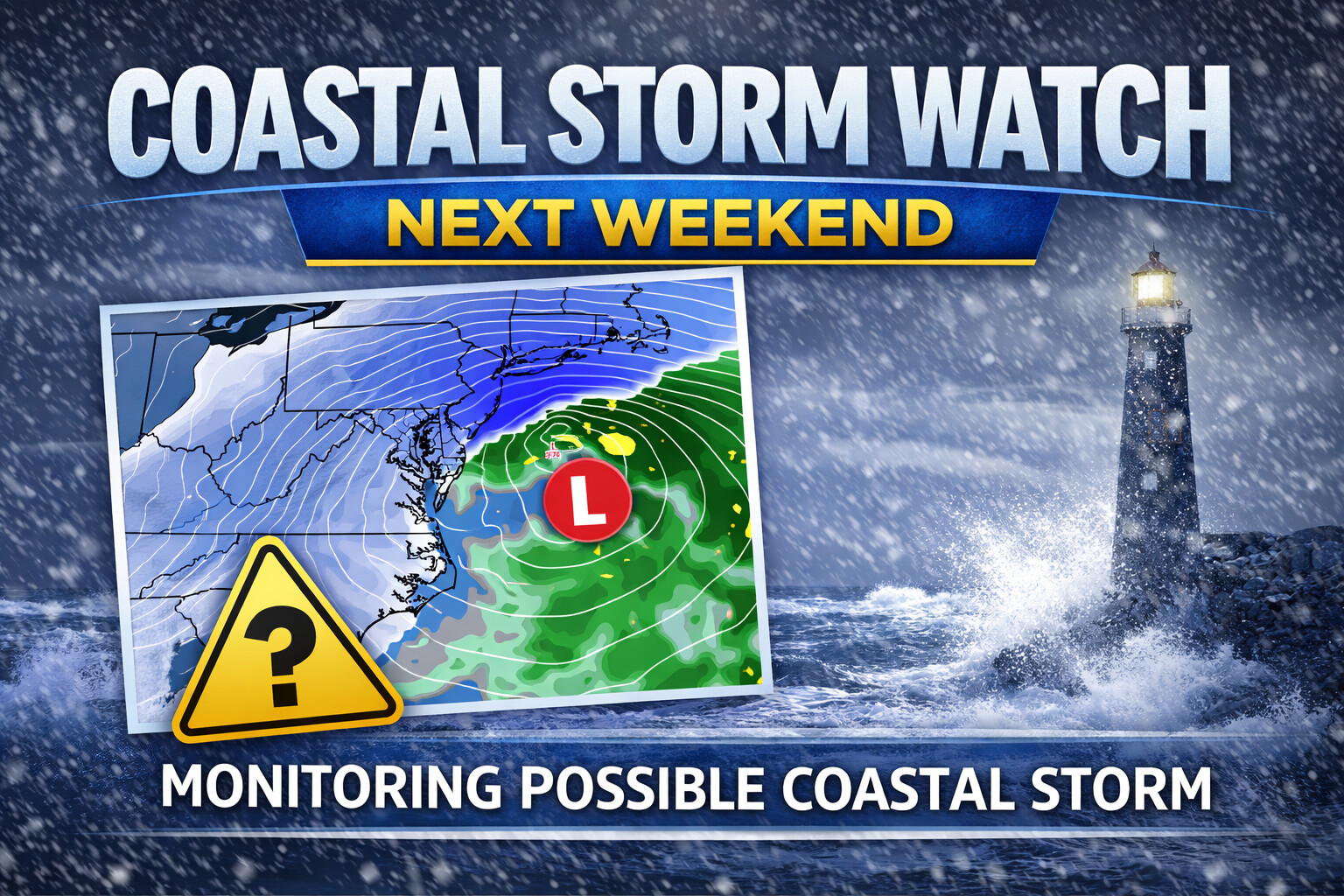
    The timing of this drought is especially problematic for Delaware’s farmers, as it coincides with the crucial late-season growing period. Early-season droughts primarily impacted corn crops, but now soybeans, grains, and other key crops are being affected. Cover crops and small grains, typically planted in the fall to protect and rejuvenate soil, are also at risk, as dry conditions hinder germination. Without adequate rainfall, seeds may fail to sprout, leading to wasted efforts and a diminished foundation for next year’s crops.

    Furthermore, the inability to plant cover crops threatens long-term soil health. These crops are essential for preventing erosion, improving soil structure, and adding organic matter back into the soil. Without them, soils become more prone to degradation, which can lead to lower productivity in the years ahead.

    The compounding effect of back-to-back droughts—one earlier in the season and the current one during this critical growing period—has left farmers struggling to recover. Even if rain comes soon, the damage to crops and soil health may not be fully reversible, as weakened plants and stressed soils may not bounce back entirely.

    In addition to the impact on agriculture, the risk of wildfires adds another layer of concern. Dry vegetation combined with warm winds creates the perfect conditions for fires to spread quickly, potentially destroying not just farmland but entire ecosystems. Controlling wildfires in such conditions is difficult, and the damage they cause can be long-lasting, further threatening the region’s environment and economy.

    As Delaware’s farmers wait for relief, they face a tough reality: without substantial rainfall soon, the consequences of this drought could stretch well into the future. The effects on crop yields, soil health, and wildfire risks highlight the urgency of addressing drought conditions and their wide-reaching impact on agriculture and the broader environment.

  • The Orionid Meteor Shower: A Guide for 2024

    The Orionid Meteor Shower: A Guide for 2024

    The Orionid meteor shower is an exciting annual event, and in 2024, the peak is expected on October 20 at 18:14 UTC. If you’re planning to watch, the best times are the early mornings of October 20 and 21, from after midnight until just before dawn.

    Key Dates and Times

    • Peak Viewing: October 20 and 21, just after midnight until dawn.
    • Duration: September 26 to November 22.
    • Moon Interference: Unfortunately, the moon will be a waning gibbous during the peak, which may make the meteors harder to see. Try positioning yourself so the moon is blocked from view.

    What to Expect

    On a good night, under dark skies with no moon interference, you might see between 10 to 20 meteors per hour. These meteors are known to be fast, and some may leave glowing trails that last a few seconds. Occasionally, a bright fireball might light up the sky.

    Where Do They Come From?

    The Orionids come from debris left behind by Halley’s Comet, one of the most famous comets in history. This comet orbits the sun about every 76 years, and as it passes, it leaves behind dust and small particles. These particles hit Earth’s atmosphere in October, creating the Orionid meteor shower. We also encounter its debris in May, which causes the Eta Aquariid meteor shower.

    What Makes the Orionids Special?

    • Speed: Orionid meteors travel at about 41 miles per second (66 km/s), making them some of the fastest meteors.
    • Trails: Many leave behind glowing ionized gas trails, known as persistent trains, which can last a few seconds after the meteor has disappeared.
    • Bright Meteors: Occasionally, a meteor will be exceptionally bright and may even break up into fragments.

    Where to Look in the Sky

    The Orionid meteors appear to come from the constellation Orion, which rises in the east after midnight. You don’t need to focus on Orion to see the meteors—they can appear in any part of the sky. But if you trace the path of a meteor backward, you might find it originated near Orion’s famous star, Betelgeuse.

    Tips for Viewing

    • Find a wide-open area with minimal light pollution.
    • You don’t need to look in a specific direction, as the meteors can appear anywhere in the sky.
    • If you’re watching with friends, spread out and face different directions for the best chance of spotting meteors.

    The 2024 Orionid meteor shower will peak on the mornings of October 20 and 21, though a bright moon may make it harder to see. Even so, this annual event is a great opportunity to witness fragments of Halley’s Comet streak across the sky. Happy meteor watching!

  • New Brilliant Comet On The Way? Comet C/2024 S1

    New Brilliant Comet On The Way? Comet C/2024 S1

    Comet C/2024 S1 (ATLAS): What to Expect

    Comet C/2024 S1 (ATLAS) is an exciting new discovery in the sky. Found on September 27, 2024, by the ATLAS system, this comet belongs to a special group called Kreutz sungrazers. These comets come incredibly close to the Sun, sometimes within 1.5 million kilometers (900,000 miles)—about the size of the Sun itself.

    While sungrazers have given us spectacular shows in the past, like the Great Comet of 1882 and Ikeya-Seki in 1965, C/2024 S1’s fate remains uncertain. Though originally anticipated to brighten as it nears the Sun, recent data suggest it might be disintegrating.

    Why Is This Comet Special?

    Kreutz sungrazers are particularly intriguing because their close encounters with the Sun make them unpredictable. Sometimes, they light up the sky as they heat up, but other times they disintegrate before they get the chance. C/2024 S1 is set to reach its closest point (perihelion) to the Sun on October 28, 2024. If it survives, there’s potential for it to become bright, possibly visible near sunrise. However, the latest observations show it’s starting to fade, suggesting it may break apart.

    What Does This Mean for Observers?

    If the comet brightens, it will only be for a short time around October 28, but it might be visible near sunrise in the Southern Hemisphere. On October 30 and 31, a thin waning crescent Moon will be in the sky, close to where the comet is expected to appear. While there’s still a chance for a brief show, the disintegration could mean we see very little.

    Warning: Never look directly at the Sun, especially with binoculars or telescopes, as it can cause severe and permanent eye damage.

    Monitoring Efforts

    The Comet Chasers project, involving schoolchildren and research telescopes, has been helping to observe the comet. Scientists are gathering more data to confirm whether C/2024 S1 will survive or disintegrate. Although the early signs are discouraging, comets can change rapidly, and astronomers are keeping a close watch.

    Stay tuned as we learn more in the days leading up to its closest approach!

  • Delmarva Faces Worsening Drought: Concerns for Agriculture and Fall Foliage

    Delmarva Faces Worsening Drought: Concerns for Agriculture and Fall Foliage

    The Delmarva Peninsula is currently experiencing one of its driest periods on record, with no measurable rainfall for several weeks. Unfortunately, according to the latest outlook, this dry spell is expected to persist for at least another two weeks, potentially placing Delmarva in the top 10 driest periods on record.

    While many areas across the mid-Atlantic are facing moderate drought conditions, parts of Delmarva are nearing severe drought status. Widespread severe drought conditions are likely to develop within the next one to two weeks, raising serious concerns, particularly for agriculture.

    Impact on Agriculture

    For farmers, the lack of rain couldn’t have come at a worse time. This is the season when many crops require adequate moisture to finish strong before harvest. The drought has already caused stress to crops like corn and soybeans, with yields expected to be lower than usual. Many farmers may struggle to bring in a profitable harvest, and this could lead to higher food prices in the coming months.

    Livestock farmers are also feeling the pressure as the dry conditions limit the growth of pasture grasses, forcing them to use stored feed much earlier than planned. Watering livestock is becoming a challenge in some areas as ponds and wells continue to dry up.

    Fall Foliage at Risk

    Beyond agriculture, the drought is likely to have a noticeable impact on Delmarva’s fall foliage. Trees that are under stress from drought often turn color earlier than usual, but the display may be shorter-lived and less vibrant. Instead of the bright reds, oranges, and yellows typical of fall, leaves may brown and fall off prematurely, leaving the landscape looking bare far earlier than normal.

    A Look Ahead

    The Climate Prediction Center’s 6 to 14-day outlook offers little hope for immediate relief, with dry conditions expected to continue in the near term. However, looking further out, there is a chance that wetter weather may return in the next 6 to 14 weeks, which could help bring much-needed moisture to the region.

    For now, though, the focus is on coping with the ongoing drought and its effects on both agriculture and the environment. Residents are encouraged to conserve water where possible and be prepared for potential crop shortages and higher prices in the months ahead.

  • Understanding the Bz Interplanetary Magnetic Field (IMF) For Aurora Viewing / Live Conditions

    Understanding the Bz Interplanetary Magnetic Field (IMF) For Aurora Viewing / Live Conditions

    The Interplanetary Magnetic Field (IMF)

    The interplanetary magnetic field (IMF) plays a huge rule in how the solar wind interacts with Earth’s magnetosphere. In this article we will learn what the interplanetary magnetic field is and how it affects auroral activity here on Earth.

    *** LIVE VIEW OF THE SOLAR WIND AND IMF CONDITIONS ***

    The Sun’s magnetic field

    During solar minimum, the magnetic field of the Sun looks similar to Earth’s magnetic field. It looks a bit like an ordinary bar magnet with closed lines close to the equator and open field lines near the poles. Scientist call those areas a dipole. The dipole field of the Sun is about as strong as a magnet on a refrigerator (around 50 gauss). The magnetic field of the Earth is about 100 times weaker.

    Around solar maximum, when the Sun reaches her maximum activity, many sunspots are visible on the visible solar disk. These sunspots are filled with magnetism and large magnetic field lines which run material along them. These field lines are often hundreds of times stronger than the surrounding dipole. This causes the magnetic field around the Sun to be a very complex magnetic field with many disturbed field lines.

    The magnetic field of our Sun doesn’t stay around the Sun itself. The solar wind carries it through the Solar System until it reaches the heliopause. The heliopause is the place where the solar wind comes to a stop and where it collides with the interstellar medium. Because the Sun turns around her axis (once in about 25 days) the interplanetary magnetic field has a spiral shape which is called the Parker Spiral.

    Bt value

    The Bt value of the interplanetary magnetic field indicates the total strength of the interplanetary magnetic field. It is a combined measure of the magnetic field strength in the north-south, east-west, and towards-Sun vs. away-from-Sun directions. The higher this value, the better it is for enhanced geomagnetic conditions. We speak of a moderately strong total interplanetary magnetic field when the Bt exceeds 10nT. Strong values start at 20nT and we speak of a very strong total interplanetary magnetic field when values exceed 30nT. The units are in nano-Tesla (nT) — named after Nikola Tesla, the famous physicist, engineer and inventor.

    Bx, By and Bz

    The interplanetary magnetic field is a vector quantity with a three axis component, two of which (Bx and By) are orientated parallel to the ecliptic. The Bx and By components are not important for auroral activity and are therefor not featured on our website. The third component, the Bz value is perpendicular to the ecliptic and is created by waves and other disturbances in the solar wind.

    Interaction with Earth’s magnetosphere

    The north-south direction of the interplanetary magnetic field (Bz) is the most important ingredient for auroral activity. When the north-south direction (Bz) of the the interplanetary magnetic field is orientated southward, it will connect with Earth’s magnetosphere which points northward. Think of the ordinary bar magnets that you have at home. Two opposite poles attract each other! A (strong) southward Bz can create havoc with Earth’s magnetic field, disrupting the magnetosphere and allowing particles to rain down into our atmosphere along Earth’s magnetic field lines. When these particles collide with the oxygen and nitrogen atoms that make up our atmosphere, it causes them to glow and emit light which we see as aurora.

    For a geomagnetic storm to develop it is vital that the direction of the interplanetary magnetic field (Bz) turns southward. Continues values of -10nT and lower are good indicators that a geomagnetic storm could develop but the lower this value goes the better it is for auroral activity. Only during extreme events with high solar wind speeds it is possible for a geomagnetic storm (Kp5 or higher) to develop with a northward Bz.

    It is important to note that we still cannot predict (accurately and consistently) the Bz(t) i.e. the strength, orientation and duration of the north-south interplanetary magnetic field component Bz of an incoming solar wind structure. We do not know what the solar wind and magnetic field characteristics are until it arrives at the Sun-Earth Lagrange Point 1 (fixed point in space between the Earth and the Sun about 1.5 million kilometers away from the Earth) where satellites measure the properties of the incoming solar wind. We are going to learn more about this in the next paragraph.

    Measuring the interplanetary magnetic field

    The real-time solar wind and interplanetary magnetic field data that you can find on this website come from the Deep Space Climate Observatory (DSCOVR) satellite which is stationed in an orbit around the Sun-Earth Lagrange Point 1. This is a point in space which is always located between the Sun and Earth where the gravity of the Sun and Earth have an equal pull on satellites meaning they can remain in a stable orbit around this point. This point is ideal for solar missions like DSCOVR, as this gives DSCOVR the opportunity to measure the parameters of the solar wind and the interplanetary magnetic field before it arrives at Earth. This gives us a 15 to 60 minute warning time (depending on the solar wind speed) as to what kind of solar wind structures are on their way to Earth.

    The Deep Space Climate Observatory (DSCOVR) mission is now the primary source for real-time solar wind and interplanetary magnetic field data but there is one more satellite at the Sun-Earth L1 point that measures the incoming solar wind and and that is the Advanced Composition Explorer. This satellite used to be the primary real-time space weather data source up until July 2016 when DSCOVR become fully operational. The Advanced Composition Explorer (ACE) satellite is still collecting data and now operates mostly as a backup to DSCOVR.

  • Severe Geomagnetic Storm Expected: CME Set to Impact Earth on October 10-11, 2024

    Severe Geomagnetic Storm Expected: CME Set to Impact Earth on October 10-11, 2024

    A fast-moving coronal mass ejection (CME) erupted from the Sun on the evening of October 8, 2024, and is projected to reach Earth by October 10. This CME, associated with a long-duration X1.8 solar flare, is moving at an estimated speed of 1200 to 1300 km/s. With this velocity, the CME could arrive as early as the morning or midday of October 10 (EDT). Experts are warning of a possible G4 (Severe) geomagnetic storm upon its arrival and throughout its passage.

    What Makes This Storm Significant?

    The CME, triggered by an X-class solar flare, is moving at a particularly high speed. These types of solar flares and subsequent CMEs can cause significant disturbances in Earth’s magnetic field upon impact. If the storm reaches G4 (Severe) on the NOAA Space Weather Prediction Center’s geomagnetic storm scale, the consequences could be far-reaching.

    G4 storms can cause voltage control problems in power grids, affect spacecraft operations, and lead to widespread HF radio blackouts on the daylight side of Earth. In addition, auroras could be visible much farther from the poles than usual, potentially gracing the skies of lower latitudes with a stunning display of the Northern and Southern Lights.

    Arrival and Impact Timing

    Current forecasts suggest that the CME could reach Earth as early as the morning to midday of October 10. However, the precise timing and intensity of the geomagnetic storm won’t be known until the CME is approximately 1 million miles from Earth. At this point, the DSCOVR and ACE satellites will measure its speed, density, and magnetic field characteristics. These factors will determine whether the storm will hit with severe intensity or something less.

    What Does a G4 Storm Mean?

    A G4 storm is classified as “severe” and has the potential to cause significant disruptions across multiple sectors:

    • Power Systems: Voltage irregularities may occur, especially in high-latitude regions. Some transformers could experience damage, though modern grid systems are better equipped to handle these situations.
    • Satellite Operations: Satellites in low-Earth orbit could experience increased drag, forcing operators to make corrections. Communications and GPS signals could also be temporarily disrupted, potentially impacting air traffic control, maritime navigation, and other services.
    • Radio Communications: High-frequency (HF) radio communications, critical for aviation and emergency services, may face widespread blackouts, particularly on the daylight side of the planet.
    • Auroras: One of the more enjoyable effects of geomagnetic storms is the appearance of auroras. During a G4 event, auroras can extend much farther from the poles, potentially being visible across parts of Europe, the northern United States, and even farther south in some cases.

    Preparing for the Storm

    Governments, businesses, and individuals should prepare for the potential effects of this geomagnetic storm. Power grid operators are monitoring the situation closely, and satellite operators may place their spacecraft in safe modes to mitigate damage from solar particles. For the public, it’s a good idea to charge essential devices ahead of time in case of brief power outages and monitor space weather updates.

    Those who live in areas where auroras might be visible should keep an eye on real-time space weather updates and consider venturing outside for what could be an unforgettable display.

    Stay Updated

    We won’t know the full characteristics of this CME until its proximity to Earth allows for satellite measurements. To stay informed on the latest updates and space weather predictions, please visit our webpage. Regular updates will be provided as more data becomes available from DSCOVR, ACE, and other space weather monitoring satellites.

    Prepare for potential disruptions and, if you’re lucky, be ready to witness a breathtaking natural phenomenon in the night sky.

  • Hurricane Milton Aiming For The West Coast Florida Next Week

    Hurricane Milton Aiming For The West Coast Florida Next Week

    The west coast of Florida is bracing for the potential landfall of Hurricane Milton, a rapidly intensifying storm expected to impact the Tampa Bay region and surrounding areas. With projections showing the storm strengthening significantly over the next few days, Florida residents are preparing for what could be another major hurricane following the devastation caused by Hurricane Helene.

    Rapid Intensification Expected

    Forecasters warn that Hurricane Milton is set to undergo rapid intensification, potentially reaching Category 3 or higher before making landfall. Warm Gulf waters and favorable atmospheric conditions are contributing to the storm’s swift development, raising concerns for communities along the west coast of Florida.

    The National Hurricane Center has advised residents in the projected path of Milton to begin preparations now, as the storm may bring life-threatening storm surges, heavy rainfall, and damaging winds. Evacuation orders could be issued in the coming days as the storm’s path becomes clearer.

    Tampa Bay Region at Risk

    The Tampa Bay region, including major cities like Tampa, St. Petersburg, and Clearwater, is under the gun for a potential direct hit from Milton. This area, vulnerable to storm surges due to its coastal geography, faces significant risks if the hurricane continues on its current trajectory.

    Emergency services and local governments are urging residents to secure their properties and gather essential supplies in anticipation of power outages, flooding, and disruptions to daily life.

    Florida Braces for Another Major Impact

    If Hurricane Milton makes landfall as a major hurricane, it will mark Florida’s constant strike for Major Hurricanes here in the last several years in a row. The scars from Helene are still fresh for many, and Milton’s approach has heightened anxiety across the state. However, state and local officials are mobilizing resources and preparing emergency response plans to ensure a coordinated effort to protect lives and property.