
June 22, 2026
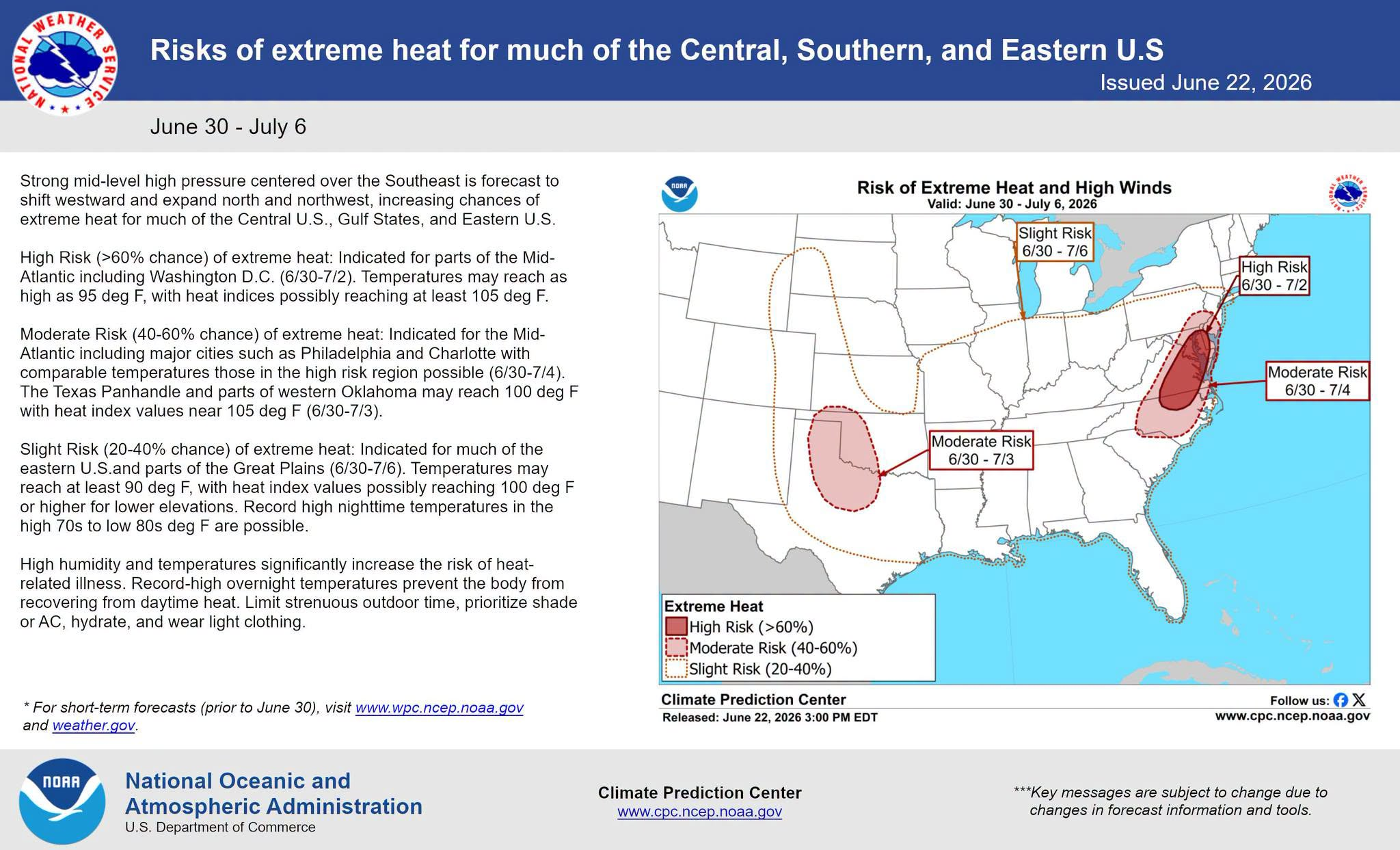
A potentially dangerous and prolonged heat wave could impact millions of Americans heading into the start of July, according to the latest outlook from the National Weather Service’s Climate Prediction Center (CPC).
A strong area of high pressure centered over the southeastern United States is expected to strengthen and expand northward and westward between June 30 and July 6, increasing the likelihood of extreme heat across much of the Central, Southern, and Eastern United States.
The greatest concern exists across portions of the Mid-Atlantic, where a High Risk (greater than 60% chance) of extreme heat has been highlighted from June 30 through July 2. Areas including the Washington, D.C. metropolitan region could experience afternoon temperatures climbing into the mid-90s, while heat index values may soar above 105 degrees.
A broader Moderate Risk (40-60% chance) area extends across much of the Mid-Atlantic and parts of the southern Plains. Major cities such as Philadelphia and Charlotte could experience several consecutive days of oppressive heat and humidity. Across western Oklahoma and the Texas Panhandle, temperatures may approach 100 degrees, with heat index values nearing 105 degrees.
Meanwhile, a Slight Risk (20-40% chance) for extreme heat covers a large portion of the eastern United States and parts of the Great Plains through July 6. Many locations within this area could see temperatures exceed 90 degrees, with heat index values reaching 100 degrees or higher.
In addition to the daytime heat, forecasters are increasingly concerned about warm overnight temperatures. Nighttime lows may remain in the upper 70s to lower 80s, limiting the body’s ability to recover from the daytime heat and increasing the risk of heat-related illnesses.
The CPC notes that high humidity levels combined with persistent heat can create dangerous conditions, particularly for vulnerable populations, outdoor workers, and those without reliable air conditioning.
Residents are encouraged to stay hydrated, limit strenuous outdoor activities during the hottest parts of the day, wear lightweight clothing, and seek air-conditioned environments whenever possible.
While forecast details may continue to evolve over the coming days, confidence is growing that a significant heat event will affect much of the eastern half of the nation as July begins. Communities across the Mid-Atlantic should closely monitor future forecasts and prepare for the possibility of several days of dangerous heat and humidity.