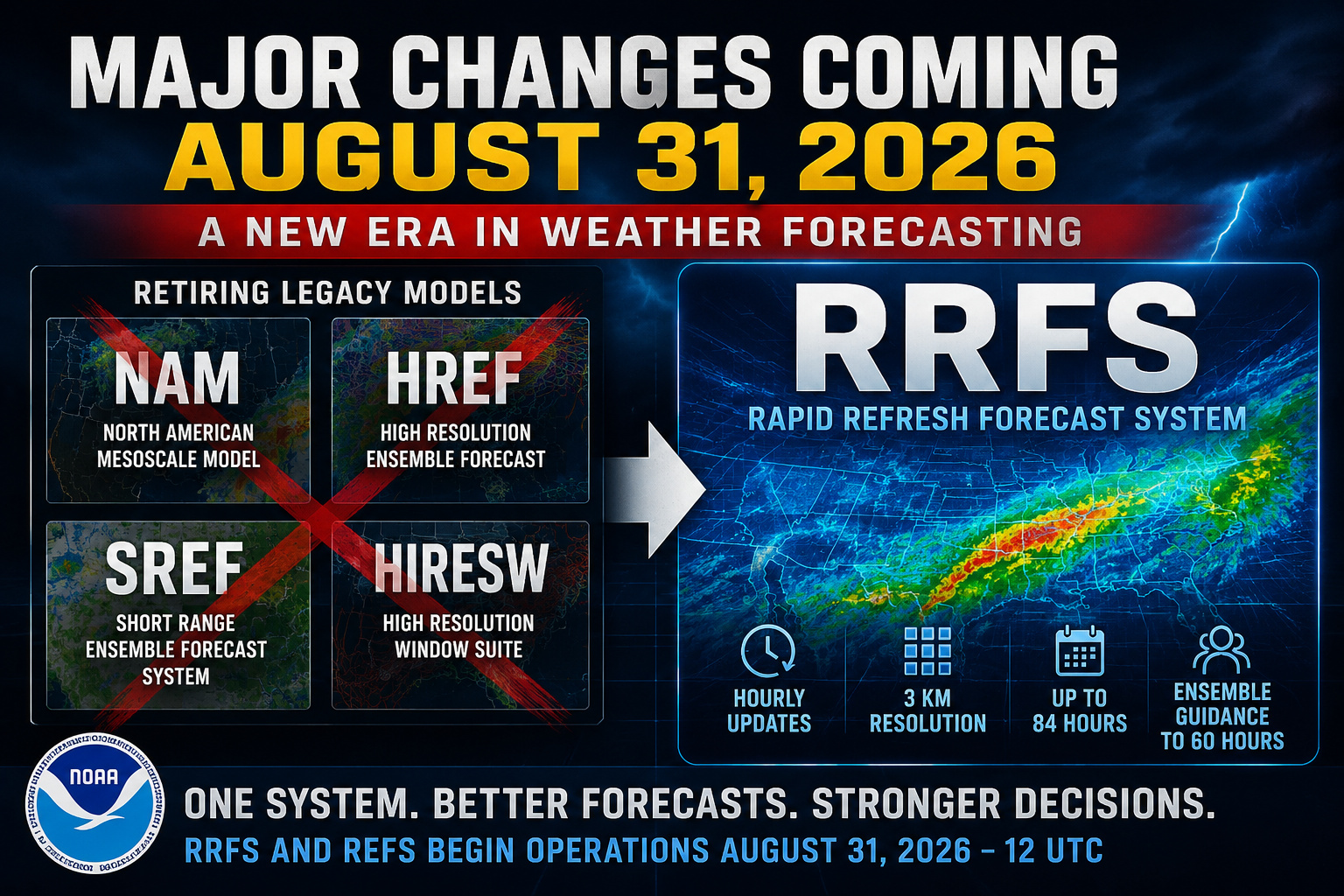

Major changes are coming to the world of weather forecasting later this year, as the National Weather Service and NOAA prepare to retire several long standing forecast models on August 31, 2026, replacing them with a new generation forecasting system known as the Rapid Refresh Forecast System, or RRFS.
According to newly released NOAA Service Change Notices, the RRFS and its ensemble counterpart, the RRFS Ensemble Forecast System (REFS), will officially become operational beginning with the 12 UTC model cycle on August 31st. The transition marks one of the largest overhauls to the National Weather Service’s regional forecasting guidance suite in decades.

The changes will retire several legacy forecasting systems that meteorologists, broadcasters, emergency managers, and weather enthusiasts have relied on for years. Models scheduled for retirement include the North American Mesoscale Model (NAM), the High Resolution Ensemble Forecast (HREF), the Short Range Ensemble Forecast system (SREF), and much of the High Resolution Window guidance suite (HiresW).
The RRFS is designed to unify many of these forecasting systems into one high resolution platform capable of producing hourly updated forecasts across North America at 3 kilometer resolution. NOAA says the new system will simplify the nation’s convective scale guidance while improving consistency between forecast products.
The deterministic version of the RRFS will run hourly, with extended forecasts reaching out to 84 hours during the primary 00z, 06z, 12z, and 18z model cycles. Additional hourly updates will extend to 18 hours. Meanwhile, the REFS ensemble system will provide probabilistic guidance out to 60 hours, replacing the HREF system currently used heavily during severe weather and winter storm forecasting.
One notable aspect of the transition is that NOAA plans to eventually phase out additional models, including the widely used RAP and HRRR systems, as future versions of the RRFS mature. While the HRRR is not being retired on August 31st, NOAA researchers have stated the long term goal is for the RRFS framework to ultimately replace legacy regional convection allowing models entirely.


The move has generated mixed reactions within the meteorological community. Some meteorologists welcome the modernization and unified approach, while others remain cautious about the RRFS performance during severe weather events. Discussions across weather forums and meteorology communities have highlighted concerns regarding convective feedback and supercell handling in earlier experimental RRFS versions.
Great Discussion by SPC Forecaster Evan Bentley https://x.com/evan_bentley/status/2054544214952665366
NOAA says the RRFS has undergone extensive testing through multiple national forecast testbeds and collaborative evaluations involving federal agencies, universities, and meteorological partners across the country. Experimental real time data feeds for the RRFS and REFS are expected to become publicly available around June 9th ahead of full operational implementation later this summer.
For operational meteorologists and weather enthusiasts alike, August 31st will mark the beginning of a major shift in how short range weather forecasting is performed across the United States.