PARIS — Tourists standing in line under the summer heat to visit Notre Dame cathedral have no idea what’s happening just below their feet.
About 13 feet underground, archaeological teams are working their way down through layers of history, uncovering remnants of Roman Paris from 2,000 years ago.
The famous cathedral suffered devastating fire damage in 2019 when its spire collapsed in front of a global audience. After rebuilding efforts, Notre Dame reopened to the public in late 2024. Now city officials want to add trees and cooling shade to the hot, exposed plaza surrounding it.
However, in such an ancient city, construction crews can’t break ground until archaeologists first examine what’s buried below to prevent any damage to historical artifacts.
A section of Notre Dame’s front courtyard has been transformed into an excavation zone — a deep pit surrounded by safety barriers and crossed with wooden walkways, just steps away from the tourist queue.
French news outlets are calling it the “dig of the century.”
“It’s a rare opportunity for us to work on something that’s tangibly going to make a difference to the history of Paris,” Lucie Altenburg, a conservator with the Paris archaeology unit, told The Associated Press.
The hundreds of discoveries include a coin from the 4th century bearing Emperor Constantine’s image, plus fragments of medieval pottery decorated inside with mysterious symbols that researchers haven’t yet decoded — resembling a real-life Da Vinci Code puzzle.
“It makes Notre Dame feel alive again,” said Emily Carter, 34, a tourist from Manchester waiting in line with her two children. “You come to see the cathedral, then realize there’s another city under your feet. That’s almost more moving.”
Archaeological evidence begins appearing just 20 inches down, and the team continues extracting historical items from depths of 13 feet. On productive days, they collect 15 boxes of artifacts from soil that hasn’t been disturbed for decades.
This represents the reality of any ancient city: history isn’t confined to museums — it exists buried beneath the streets.
Urban areas grow upward over time. Every generation constructs new buildings on top of previous ruins, gradually raising the ground level; Rome’s surface has climbed approximately 30 feet since the empire’s fall in the 5th century.
When Athens constructed its subway system for the 2004 Olympics, the project triggered Greece’s most extensive archaeological dig ever, yielding tens of thousands of artifacts now displayed in the metro stations. Paris follows the same pattern.
Everything originates from the Seine river island called Ile de la Cite, where Paris first began.
Notre Dame was later built on this same location.
When the cathedral’s construction started in 1163, the entire plaza was crowded with medieval homes divided by one narrow road, explained Camille Colonna, the archaeologist directing the excavation.
By digging deeper, her team has reached those ancient house foundations — and consequently the historical periods they represent.
Underneath lie grain storage pits from the Merovingian and Carolingian eras spanning the sixth through tenth centuries; even deeper sits a concentrated Roman neighborhood from the fourth and fifth centuries.
Two thousand years of history are compressed into 13 feet of earth — roughly equivalent to stacking two-and-a-half Napoleon Bonapartes on top of each other.
“Here you can see the layers — medieval Paris, Roman Paris, maybe even before that,” said Yasmine Benali, 22, an archaeology student observing from behind the barriers. “It makes the city feel less like a postcard and more like something still being discovered.”
The most valuable discoveries emerge from the most unpleasant locations: deep pits underneath medieval houses that served as both toilets and garbage disposal sites.
From these areas, the team regularly recovers complete jugs and cups — discarded centuries ago but remaining unbroken — mixed among shattered dishes and animal remains.
Finding “complete ceramics” is “rare,” noted Valentine Breloux, an archaeologist with the unit.
The soft waste materials protected these items, allowing them to survive intact through the centuries.
Some discoveries have puzzled experts completely. While cleaning what appeared to be ordinary medieval pottery, conservators discovered faint red writing painted inside — identical mysterious markings appearing on multiple pieces.
The meaning of these symbols remains unknown.
Among everything she’s restored from Notre Dame, Breloux described these as the most “astonishing.”
Coins emerged as blackened circles, corroded by rust. However, X-ray examination revealed a face: Constantine, the Roman emperor who reigned in the early 300s.
Such artifacts also “can be invaluable in giving us the date of the (underground) layer,” Altenberg explained.
The Roman discoveries hold the greatest significance for archaeologists — representing the deepest, oldest, and least understood findings. During Roman occupation, the settlement was named Lutetia, with its main area located across the river on the Left Bank.
When the Roman empire crumbled, residents retreated to the Ile de la Cite, where Notre Dame would eventually stand, and strengthened the island using stone walls salvaged from earlier structures.
Colonna’s team discovered evidence of this: a Roman doorstep unearthed during excavation, originally from a much larger building, transported to the island, flipped over, and installed as street paving.
All discoveries leave the excavation site and travel north to the city’s archaeology center — what Colonna describes as “a huge archaeological store,” serving as Paris’s treasure repository.
For archaeologists, the cathedral dig represents an unusual opportunity. In France, like other countries, they typically work only where construction projects are planned — similar to how quarry workers sometimes accidentally discover dinosaur fossils.
“This only happens because the city of Paris decided it wanted to beautify the area,” Altenburg explained.
The renovated plaza should be largely completed by 2028: designed as a forest-like clearing featuring 160 new trees and a thin water film flowing over stone surfaces for summer cooling — part of Paris’s preparation for increasingly hot summers caused by global warming.
Tourists currently waiting in direct sunlight beneath the gargoyles will soon queue in shaded comfort.
The former underground parking garage will reopen as a visitor center overlooking the Seine.
Meanwhile, the Notre Dame team hopes to dig even deeper — beyond the Romans, toward the earlier inhabitants, the Gauls who first named the city.
“The hope is that we are able to go back in time even further than we’ve ever been before,” Altenburg said.
A major chip design company revealed Tuesday that two technology giants are using its artificial intelligence processors for their data center operations.
During remarks at the Computex technology conference in Taipei, Arm’s chief executive Rene Haas disclosed that ByteDance, the Chinese technology company, and Oracle, the American data center firm, are both purchasing the company’s AGI central processing units.
The announcement highlights the growing demand for specialized AI chips as companies expand their data center capabilities.
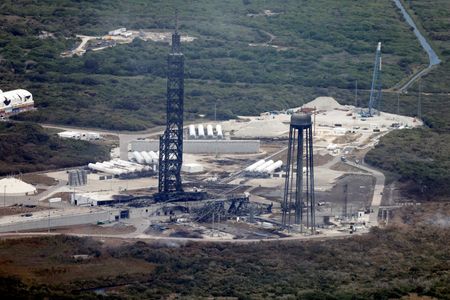
NASA Administrator Jared Isaacman revealed Monday that fixing the damaged Blue Origin launch facility following last week’s massive rocket explosion could require years of work, potentially stretching repairs until 2028.
Speaking during an interview at CNBC’s CEO Council Summit, Isaacman indicated that restoring the launch pad would “take some serious time,” with a 2028 completion date falling “within the realm” of possibility, according to the network’s coverage.
The catastrophic incident occurred Thursday when Blue Origin’s massive New Glenn rocket burst into flames during what should have been a standard engine test while secured to the launch structure. The rocket was being prepared for its fourth orbital mission since January 2025 through a routine static “hot-fire” examination.
The timing of this setback poses significant challenges for billionaire Jeff Bezos’ Blue Origin rocket program and Amazon satellite operations, as the company works to establish stronger competition against Elon Musk’s SpaceX, currently the dominant private space launch provider globally.
Sources within the company and industry reported over the weekend that the blast left the launch facility “practically destroyed,” with engineering assessments suggesting repairs will halt operations for a minimum of six months.
The accident at the U.S. Space Force facility in Cape Canaveral, Florida resulted in no personnel injuries. Additionally, the Amazon Leo satellites intended for the rocket’s payload had not yet been installed when the explosion occurred.
The New Glenn rocket, which honors late astronaut John Glenn, the first American to achieve Earth orbit, serves as a key component in NASA’s Artemis lunar program for transporting moon landers and supplies.
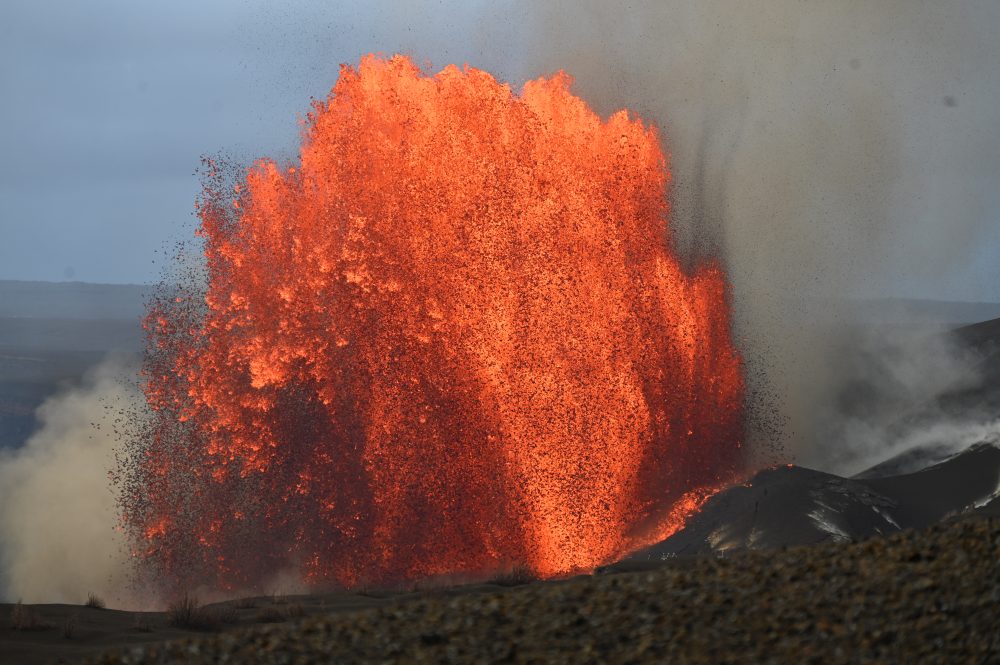
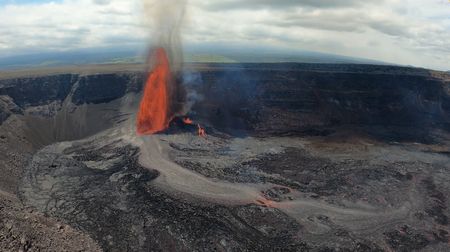
The Hawaiian Volcano Observatory announced Monday that Kilauea volcano has achieved a historic milestone, recording 48 separate lava fountaining episodes since its current eruption cycle started in December 2024.
According to Katie Mulliken, a geologist and spokesperson with the observatory, this marks the highest number of fountaining episodes ever documented during a single eruption at Kilauea.
“Episodes are separated by periods during which little to no lava erupts. Since lava is coming from the same vents in a crater at Kilauea’s summit, it is the same overall eruption,” she explained in an email statement.
The current volcanic activity stands out for multiple reasons, Mulliken noted, particularly because of its accessibility to both local residents and visitors. She contrasted this with a previous eruption in the 1980s that produced 47 lava fountaining episodes across approximately 3½ years but occurred in a much more isolated location.
“The ongoing eruption is also reshaping the topography at the summit,” she said.
However, the spectacular lava displays come with potential risks, as the fountains can affect surrounding communities through the dispersal of volcanic debris and ash, scientifically referred to as tephra.
Situated on Hawaii’s Big Island, Kilauea ranks among the planet’s most active volcanic sites.
The chief executive of Nvidia stated Tuesday that his company possesses sufficient manufacturing capacity to handle strong demand growth for both central processing units and graphics processing units as the artificial intelligence industry continues expanding.
Jensen Huang made these remarks during Nvidia’s GTC press conference at Computex week in Taiwan, one day after the $5 trillion semiconductor company revealed a new processor that brings AI functionality directly to devices.
The company’s latest processor, scheduled for release this fall, will integrate AI capabilities straight into laptop and desktop computers, creating competition with companies like Advanced Micro Devices, Intel and Apple.
According to Huang, the RTX Spark PC processor represents Nvidia’s collaboration with Microsoft to “reinvent the PC” for the artificial intelligence age.
The Nvidia chief executive, who was born in Taiwan’s southern city of Tainan, revealed plans last week for approximately $150 billion in annual investment in Taiwan, calling the island nation the center of the AI revolution.
A thunderous double boom echoed across New England this past weekend, rattling houses and causing pets to scatter in fear while residents turned to social media for answers.
“Did anyone else hear that boom?”
“Anyone feel that?”
NASA initially confirmed over the weekend that a meteor caused the disturbance, but the space agency shared far more remarkable information on Monday.
The space rock weighed as much as an elephant and measured 5 feet (1.52 meter) across, hurtling through space at 42,000 mph (67,592.5 kph) before hitting Earth’s atmosphere. The object disintegrated high above New England on Saturday, releasing energy comparable to roughly 230 tons of TNT, which NASA said explains the loud booms.
NASA shared these extraordinary facts through a social media update Monday, along with additional data.
The space object consisted of natural materials — not satellite parts or space junk — and streaked through the atmosphere for approximately 26 miles (41.8 kilometers), NASA reported, before plunging into Cape Cod Bay off southeastern Massachusetts.
The space agency emphasized that while meteors happen frequently, most don’t attract this level of attention.
“They often occur over the ocean or unpopulated areas with no witnesses, or during the daytime, making them difficult to spot,” NASA stated.
The incident sparked immediate theories and confusion.
The thunderous sound led residents in Massachusetts and Rhode Island to wonder if an earthquake had struck or if a tree had crashed down. Many shared stories of their dogs becoming agitated. At least one person suggested extraterrestrial activity.
A resident in Peabody, Massachusetts, described thinking a massive tree had struck his home due to the windy conditions that day. After stepping outside, he discovered most of his neighbors gathered in the street with identical questions.
Multiple people submitted reports to the U.S. Geological Survey, documenting the tremors they experienced through the National Earthquake Information Center, agency spokesman Steve Sobie confirmed.
The organization created an event page after receiving numerous “Did you feel it?” submissions on its website. However, Sobie noted that no activity appeared on the agency’s seismographs, confirming the shaking wasn’t earthquake-related.
The American Meteor Society collected dozens of accounts from Delaware to Montreal from people who either heard the double boom, felt ground vibrations, or witnessed the fireball, according to program monitor Robert Lunsford.
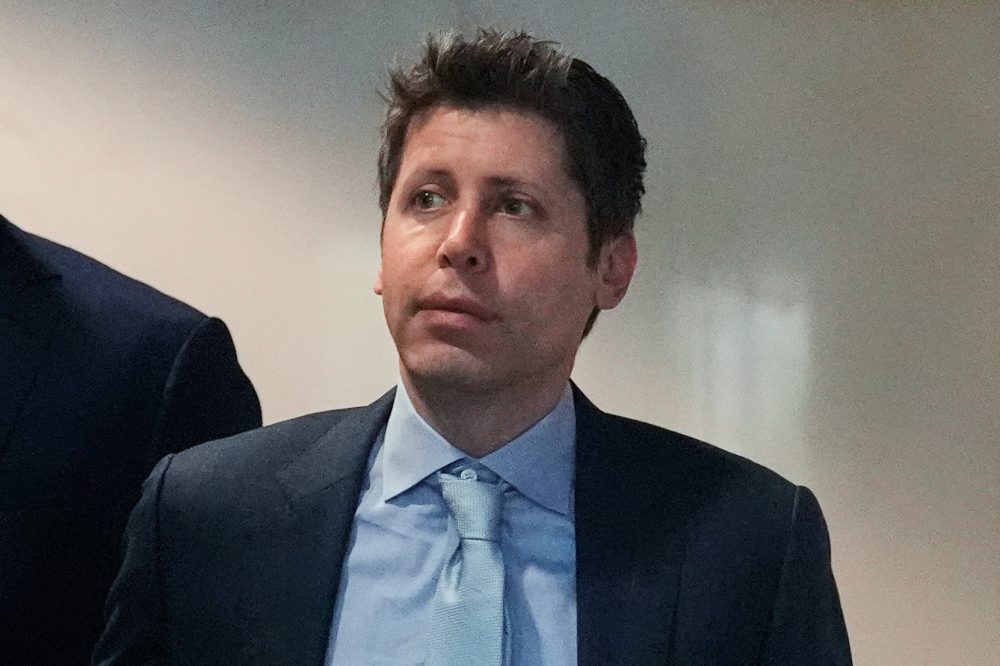
Florida’s Attorney General filed a groundbreaking lawsuit Monday against OpenAI and its CEO Sam Altman, alleging the artificial intelligence company deliberately hid significant safety concerns while promoting ChatGPT to consumers.
Attorney General James Uthmeier announced during a press briefing that the company buried internal safety alerts and misled users about the product’s actual risks and capabilities.
“Today, we announced the first-in-the-nation state-led lawsuit against OpenAI and its CEO, Sam Altman,” Uthmeier said. “OpenAI and Altman ignored internal and external safety warnings, put children at great risk, and allowed a dangerous product to reach millions of Floridians.”
The civil case, filed in Florida’s circuit court, accuses OpenAI and Altman of choosing rapid market entry and profits over user protection while dismissing safety concerns raised by specialists within and outside their organization. According to the lawsuit, the company released technology that promotes harmful behaviors, including self-injury and violence, while falsely claiming it was secure.
The legal filing further contends that ChatGPT gathers information from children without proper parental supervision and creates addictive behaviors and mental harm. The company has also deliberately minimized dangerous mistakes, according to the suit.
State officials noted that Florida law bans unfair and defective business practices. The legal action claims OpenAI’s actions continue to harm Florida residents and seeks accountability.
OpenAI did not immediately provide a response to The Associated Press’ request for comment.
In April, Uthmeier launched a criminal probe into OpenAI regarding whether ChatGPT provided guidance to a shooter who killed two individuals and injured six others at Florida State University last year. In a separate incident, prosecutors revealed that the person accused of murdering two University of South Florida doctoral students had questioned ChatGPT about what would occur if a human body was placed in a garbage bag and disposed of in a dumpster, just days before the victims disappeared.
For the past 16 years, Nicole Calvin has made an annual journey to the University of Michigan campus in Ann Arbor to experience the university’s impressive peony display firsthand.
This year, she made the trip twice.
“I just love walking through the gardens,” Calvin shared on Monday. “I love that they come from different places, and there’s different varieties, different colors. It smells amazing. It’s just a really beautiful place to be.”
University officials expect approximately 100,000 people will visit to witness these distinctive flowering plants and their spectacular displays of pink, white, and red blossoms in numerous varieties and shades.
The W.E. Upjohn Peony Garden houses what may be the world’s most extensive assembly of historical herbaceous peonies dating before 1950.
“There’s been a long fascination with this plant, because, when it’s peak, it’s so out there. It’s such a big show,” explained Doug Conley, who serves as horticulture lead at Nichols Arboretum, locally called The Arb. “And our collection is overwhelming. When you see this garden at peak bloom, there’s nothing like it. You’re captivated by it.”
Watching the peonies has become such a popular springtime activity that shuttle services transport the numerous visitors who flock to The Arb each year to view these garden plants.
Within the W.E. Upjohn Peony Garden, visitors can explore hundreds of historical cultivated types from the 1800s and early 1900s, showcasing American, Canadian, and European peony varieties from that period. During peak blooming season, the garden displays tens of thousands of individual flowers.
Access to the garden costs nothing and remains available from dawn until dusk. Visitors seeking the strongest peony fragrance should plan morning or evening visits when the scents are most pronounced.
“It is restorative for all of us, I think, to come out into nature and be surrounded by joy, beauty,” Conley noted. “It’s a delightful place for people to just come and gather and be.”
June has been designated as National Ocean Month, providing an opportunity to recognize the vital significance of our marine environments and their vast array of resources that provide inspiration, sustenance, and economic advantages to our communities.
This annual observance highlights the critical role that oceans play in supporting both our environment and economy, serving as a reminder of the countless ways these marine ecosystems benefit society.
June has been designated as National Ocean Month, offering an opportunity to recognize the marine environments that provide essential resources supporting coastal communities and their economies.
The observance focuses attention on how ocean waters serve as sources of inspiration, food, and economic opportunity for communities along the coast. These marine resources play a crucial role in sustaining local economies through various industries and activities.
The recognition comes as coastal areas continue to depend on healthy ocean ecosystems for their economic well-being and quality of life. Marine environments contribute to local prosperity through fishing, tourism, recreation, and other ocean-related industries.
BRUSSELS, June 1 – Recent United Nations climate conferences have not produced the bold measures that researchers believe are essential to combat global warming, according to the European Union’s climate commissioner Wopke Hoekstra, who made the remarks on Monday.
Speaking at a Politico-sponsored event in Brussels, Hoekstra stated: “If you look at what the problem actually needs and where the bar should then be, and what most of the COPs of the last five, six, seven, eight years have delivered, then you just have to admit that that was underwhelming.”
The commissioner emphasized that while work should continue at these international climate conferences, where approximately 200 nations make decisions through consensus, there’s also value in having smaller coalitions of countries that are prepared to advance more quickly in addressing global warming.
Nvidia has placed artificial intelligence-powered computers in the spotlight following CEO Jensen Huang’s introduction of a new processor designed to integrate AI capabilities straight into personal computers and laptops, even as the market shows varying levels of interest in these devices.
While HP reported last week that computers optimized for artificial intelligence helped boost its quarterly earnings, Dell stated in January that the AI surge hadn’t created the level of consumer interest the company had expected.
Here’s what you need to know about AI-enabled computers:
UNDERSTANDING AI-POWERED COMPUTERS
According to manufacturers, these AI-enhanced machines can analyze information faster than conventional computers and manage larger amounts of artificial intelligence operations directly within the device itself, including running chatbot programs.
These systems don’t need to depend on remote cloud servers that currently power most AI programs like OpenAI’s ChatGPT and Anthropic’s Claude. Some versions can even support the training of AI models locally on the machine — a resource-heavy process usually performed on specialized servers.
The emergence of AI agents, which are programs capable of completing computer tasks independently with little human oversight, is also bringing renewed focus to AI-powered personal computers.
Nvidia’s RTX Spark, revealed before the Computex technology conference in Taiwan, represents what the company described as a partnership with Microsoft to “reinvent the PC” for the artificial intelligence age. This new processor was created working alongside MediaTek to operate agents directly on the device instead of depending on cloud-based computing.
Computer manufacturers hope these advanced AI capabilities will attract customers as more consumers rely on generative artificial intelligence for tasks ranging from composing emails to organizing travel plans.
HP announced in late May that AI computers represented 44% of its PC sales in the second quarter, an increase from over 35% in the prior quarter, helping the company exceed revenue and profit projections.
Nevertheless, widespread adoption of AI computers might face obstacles due to memory chip shortages and increasing costs.
Research company IDC anticipates that worldwide PC sales will drop in 2026 because of memory shortages, rising component costs and supply limitations, despite higher average prices boosting overall market value.
TECHNOLOGY BEHIND AI COMPUTERS
AI-powered computers feature specialized chips known as neural processing units that manage most of the artificial intelligence work performed on the device.
These NPUs collaborate with standard processing units and graphics chips to handle complicated operations, provide faster processing capabilities and run programs such as AI assistants.
CURRENT AI COMPUTER OPTIONS
Nvidia announced that RTX Spark laptops and small desktop computers are anticipated this fall from ASUS, Dell, HP, Lenovo, Microsoft and MSI, with Acer and Gigabyte planning to release models later.
Many of these manufacturers, together with Microsoft and Qualcomm, currently sell Copilot+ PCs, which need processors specifically built to handle AI operations on the device.
POTENTIAL ISSUES
When Microsoft announced its “recall” function in 2024, it sparked privacy worries. This feature would monitor every activity on the laptop from voice conversations to internet browsing, creating a comprehensive record saved on the device. Users could then search this database and review previous activities.
After facing significant criticism regarding privacy and security issues, Microsoft postponed the feature’s launch and made it available through a testing mode for select users after implementing additional security measures. This optional function is included in the latest Copilot+ PCs.
However, some technology specialists argue that handling more AI-related operations directly on the device provides better privacy protection by removing the requirement to use personal information for training large AI systems.
Marine archaeologists in Norway have pulled up an impressive collection of Chinese porcelain and European artifacts from an 18th-century shipwreck recently discovered in waters off the country’s coast, according to government and museum officials who announced the find Monday.
The Norwegian Maritime Museum reports that divers retrieved carefully packed blue and white porcelain bowls, drinking vessels, fabric, grain, and chandelier components from what remains of the unidentified sailing vessel.
According to the museum, a salvage company owner discovered the wreck in the Skagerrak strait waters near southern Norway. The vessel, thought to have gone down sometime during the mid-1700s, sits approximately 600 meters below the surface.
Norway’s Minister of Climate and Environment, Andreas Bjelland Eriksen, praised the discovery in an official statement: “This find is not only extraordinary, it’s also of considerable scientific value and demonstrates an important technological advancement in underwater archaeology.”
While researchers have yet to determine where the ship originated or its intended destination, the Maritime Museum indicates that investigation into the wreck and its contents continues.
TAIPEI, Taiwan (AP) — Technology giant Nvidia announced Monday the launch of advanced computer processors designed to integrate sophisticated artificial intelligence capabilities into personal laptops and desktop machines, with new computer models from manufacturers like Microsoft and Dell scheduled for release later this year.
The Santa Clara, California-based technology company has already achieved tremendous success providing high-performance processors for data centers during the global AI expansion, but now seeks to broaden its reach into additional AI systems and consumer products.
Company founder and CEO Jensen Huang, who is Taiwanese-American, revealed the announcement during Nvidia’s annual GTC conference in Taipei. He stated that Microsoft and Nvidia “are going to reinvent the PC (personal computer)” during his main presentation.
“This is going to be the new PC,” Huang declared while introducing Nvidia’s RTX Spark superchip — which merges CPU, or central processing unit, and GPU, or graphics processing unit, functions — designed to operate new Windows laptop and desktop models in what the company termed “AI personal computers,” anticipated to launch this fall.
Nvidia currently holds the position as the world’s most valuable corporation, surpassing Apple, Google’s parent Alphabet and Microsoft.
The corporation stated it will be “reinventing the personal computer” for content creation and gaming purposes. “When it has an autonomous (AI) agent, an agent that’s helping you, that understands you, you could talk to it. It could look at you. You could ask it to read files, go help you do some research. It could do a lot more,” Huang explained.
Microsoft announced in a separate statement that personal computers operating on Nvidia’s RTX superchips would support “highly capable AI models” and demanding computational tasks. Using the new superchips, these personal computers can operate AI agents directly on the device, Nvidia reported.
Nvidia’s strategy represents a major development as demand increases for personal AI assistant usage, according to Lian Jye Su, chief analyst at technology research and advisory firm Omdia.
“For consumers, it means more choices, which is always a good thing,” Su commented.
Neil Shah, analyst and co-founder of Counterpoint Research, characterized Nvidia’s announcement as a development that’s “revolutionizing how PCs would look like in the next 10 years.”
The upcoming laptops and desktop computers “will drive agentic AI applications in every home,” Shah explained, aiming to establish an “AI supercomputer” in every household.
During Monday’s presentation, Nvidia’s Huang also announced that its new Vera CPUs for data centers are in complete production and are “going to be our new major growth driver” during the expansion of AI agents, with initial customers anticipated to include Anthropic, OpenAI and SpaceXAI. He additionally presented a humanoid robot reference design that could serve as a framework for future research, particularly in the higher education field.
Uber announced Monday its intention to introduce a self-driving taxi service in Munich, Germany, partnering with Israeli technology firm Autobrains and U.S. chip manufacturer Nvidia to advance autonomous transportation in Europe.
The collaboration will integrate Uber’s transportation platform with Autobrains’ “agentic AI” technology for autonomous driving, operating on Nvidia’s Drive Hyperion system. Munich has been selected as the initial launch location, subject to government regulatory clearance.
According to the companies, this initiative seeks to expand robotic taxi operations beyond limited test programs by developing an “OEM-agnostic” framework capable of functioning with various vehicle types and city environments.
The Autobrains technology divides driving tasks among specialized artificial intelligence agents that make decisions independently, allowing for immediate reactions using conventional automotive sensing equipment.
Munich has become a hub for testing self-driving vehicle technology, with Uber previously announcing intentions to start autonomous vehicle testing in the city beginning in 2026.
Eight crested ibises took flight in a Japanese town on Sunday, marking their return to an area where the species had vanished from the wild many years ago.
The endangered birds were set free from wooden enclosures during a ceremony in Hakui city, located in the Noto region where these creatures were previously spotted in their natural habitat.
Known locally as Toki, these white birds are indigenous to East Asia and are recognized for their distinctive orange-pink coloring beneath their wings and vibrant red markings surrounding their eyes.
Local residents celebrated as the birds flew skyward when Crown Prince Akishino, his wife Kiko, and other officials cut a ribbon around the wooden enclosures.
The species disappeared from the Honshu main island during the 1970s due to excessive hunting and habitat destruction. The final native Japanese ibis passed away in 2003 on Sado Island.
However, the species made a comeback through China’s assistance with breeding programs. According to the Environment Ministry, artificial breeding using a pair gifted from China resulted in the first Japanese crested ibis chick born in captivity in 1999.
These breeding and preservation initiatives have contributed to the species’ population recovery. The ministry reports that in 2008, 10 birds from the Sado conservation center were released on the island, where their numbers have now grown to approximately 500.
The release of these cherished birds was also viewed as a positive sign for the Noto region, which continues to rebuild following the devastating 2024 earthquake.
The eight birds were cared for and protected at a conservation facility on Sado in the adjacent Niigata prefecture. An additional ten birds are scheduled for future release.
DURHAM, N.H. — Following the loss of their second service dog, Booker T. Bones, Brenda and Brian Marquis found themselves searching for assistance with challenging daily tasks.
Their solution came in the form of Robbie, a mechanical assistant that emerges from their hallway into the main living area multiple times throughout each day.
“Do you want to exercise now? Please answer yes or no,” the caregiving machine inquires of 59-year-old Brian Marquis, who has been managing a traumatic brain injury following a 2012 automobile accident.
“Yes,” he replies. He then rises as the robot’s cartoon-like digital display transforms into a fitness video that leads him through his daily physical activity routine.
The multi-decade effort to create household robots that combine usefulness with human-like qualities — inspired by fictional characters such as the humanoid domestic helper Rosie from The Jetsons — remains largely unrealized. This persists even as demand grows, with the oldest members of the baby boom generation reaching 80 years old this year and the nation confronting an escalating shortage of in-home care workers, caused by inadequate compensation, frequent job changes, and challenging work conditions.
However, the device assisting the Marquis household — a robot operated through a laboratory at the University of New Hampshire with support from the National Institute of Aging — provides insight into developing opportunities.
The mobile robot that observers have compared to a clothing rack differed from what Brenda Marquis originally envisioned when she sent a message to a robotics instructor at the nearby university, seeking guidance about robotic canines.
Robbie, the pair’s chosen name for the latest robot version officially designated Stretch 4, remains at its power station located between the cooking area and sleeping quarters for most hours. During active periods, it performs essential functions, such as encouraging Brian, who lives with dementia, to consume his midday meal or stay hydrated.
Brenda Marquis, 59, explained that she and her spouse experience physical, mental, and emotional challenges that complicate their daily existence.
“We’ve been kind of trapped in a problem here in New Hampshire of being able to find and recruit enough home care support,” Brenda Marquis said in an interview at the couple’s Durham, New Hampshire apartment, where she scoots around in a motorized wheelchair while taking care of her husband. “That was when I started looking into robotics and trying to figure out what to do.”
Receiving Brenda’s message was Momotaz Begum, a computer science instructor at the university who has dedicated years to testing “socially assistive” robots designed to support individuals with dementia or similar cognitive conditions. Her research facility houses numerous experimental machines, including four-legged models.
According to the professor, the laboratory consulted focus groups consisting of senior citizens from memory care facilities to determine their preferred type of robotic home companion. Most participants favored animal-inspired robot designs.
“The common feedback that we got about Stretch was, ‘OK, this one looks like a coat hanger,’” she said. “But what we learned over time is that the look doesn’t matter.”
Beyond robotic cleaning devices, the nearest equivalent many elderly individuals have to caregiving robots consists of speakers equipped with artificial intelligence voice technology like Alexa. Certain robot manufacturers have extended this idea into rotating desktop devices such as ElliQ, created for senior companionship.
However, those machines lack sufficient mobility or functionality for the professor, who stated she is “trying to reduce that caregiver burden. And the caregiver actually does way more than social companionship.”
Human-shaped robots, meanwhile, remain impractical for most residential settings and create safety risks for individuals with restricted mobility should the machine stumble and topple over.
The creators of Hello Robot, which produces the Stretch robots, emphasized that its straightforward design is intentional.
“Our robot’s very practical, pragmatic. I think it communicates that,” said CEO Aaron Edsinger, a former director of robotics at Google. “If you show up looking like a humanoid, that expectation’s going to be set so high, it’s going to be very hard to do.”
The standard configuration of the Stretch 4 features an extending mechanical arm capable of retrieving a water container and positioning it for someone to drink using a straw. When presented with a medication container, it can assist in reading small text. The machine combines data from its visual sensors and internal equipment, along with additional sensors placed throughout a residence, to determine its position and identify room occupants.
Produced at Hello Robot’s facility in Martinez, California, and priced at nearly $30,000, the newest model introduced in May remains far from achieving the widespread adoption of a cleaning robot or an AI-enabled speaker. Yet for its intended users, it can provide crucial support.
Robbie’s scheduled care routine for Brian is displayed on the family’s wall, featuring exercise directions, food and medication alerts, bedtime routine reminders, and brief cleaning prompts that activate only when Brian uses the restroom.
“I was never into technology,” Brian Marquis said. “Then I realized I can’t remember to wash my face and my armpits. So, it just really kind of set me free almost.”
According to Brenda Marquis, the robot also relieved her of hours of daily responsibilities and helped reduce costs. Previously concerned about leaving her husband alone for extended periods, she relied on grocery delivery services. Now she can leave him under Robbie’s supervision while she handles shopping personally.
“I can go ahead and go to that mahjong game or whatever. Robbie’s gonna take care of him,” she said.
The chief executive of Nvidia will open the Computex technology conference in Taiwan on Monday with an extensive presentation focused on artificial intelligence, where he’s anticipated to discuss his company’s newest product developments and Taiwan’s crucial position in the tech sector.
The leader of the $5 trillion semiconductor company, a Taiwan native from the southern city of Tainan, revealed intentions last week to put roughly $150 billion per year into Taiwan, calling it the center of the AI transformation.
The presentation is scheduled to start at 11 a.m. (0300 GMT) at the Taipei Music Hall. This appearance follows approximately two weeks after he joined U.S. President Donald Trump on a trip to Beijing as part of a high-profile business group to meet with Chinese leader Xi Jinping.
The executive, who enjoys celebrity-like popularity in Taiwan, is anticipated to discuss Nvidia’s AI processors, software programs and computing systems. Focus will likely center on the company’s data center offerings, including its latest Vera Rubin AI computing platform and Vera central processing unit (CPU), along with its work in areas like robotics and self-driving vehicles.
Nvidia is also constructing a Taiwan headquarters that’s planned to begin operations in 2030. This facility will position the company nearer to important supplier TSMC, which produces many of the sophisticated semiconductors that power AI technology.
One possible discussion topic involves Nvidia’s work, as reported by Reuters in 2023, to create an Arm-based PC processor that would compete with Intel and Advanced Micro Devices. Processors require approximately two years to develop and the CEO has stated that the central processors, or CPUs, are optimized for consumer devices featuring AI capabilities.
During last month’s quarterly earnings report, the executive sought to reassure investors that Nvidia could sustain its rapid expansion. He indicated that a broad range of clients and new products would help the company exceed the approximately $1 trillion in revenue it has projected for its primary AI processors.
Computex is projected to draw 1,500 exhibitors from 33 nations worldwide. Chief executives from Intel and Qualcomm are also scheduled to present speeches at the technology conference.
Tesla’s chief executive appeared virtually at Israel’s major transportation technology conference after security concerns prevented his planned in-person visit. Speaking from Austin, Texas at approximately 2:30 a.m. local time, he participated in the Samson International Smart Mobility Summit 2026 in Tel Aviv, addressing questions about self-driving vehicles, artificial intelligence, and Tesla’s transportation vision.
While his participation provided international recognition for the event, the conference’s primary emphasis centered on the challenging transition from experimental projects to real-world implementation of advanced mobility solutions including autonomous systems, unmanned aircraft, flying vehicles, and innovative transit concepts.
During his virtual appearance, he offered high praise for Israel’s technological achievements. “I have to say, you know, I’m a huge admirer of the innovation coming out of Israel,” he stated.
“Honestly, I think objectively true that Israel punches far above its weight for population. I think probably number one, honestly, in the world,” adding, “My hat is off to Israel for just how much incredible innovation. I say innovation per capita. Israel must be number one by far in the world.”
When discussing Tesla’s self-driving vehicle development, he indicated the company was achieving “steady progress” in making autonomous driving broadly accessible, utilizing “AI and cameras” instead of radar or light detection and ranging (LiDAR), a technology that uses laser pulses to measure distances and create precise 3D maps of objects, terrain, or spaces. “It’s really trying to drive the car in the same way that a human drives the car,” he explained.
The conference’s central theme focused on transforming advanced mobility concepts from experimental demonstrations into functioning infrastructure. Exhibition areas showcased various future transportation technologies: self-driving sensors, unmanned aircraft companies, flying taxi prototypes, road safety systems, and urban transportation proposals. While some technologies were actively seeking commercial customers, others remained dependent on regulatory approval, infrastructure development, or public acceptance before advancing beyond testing phases.
This represented the conference’s fundamental challenge. Advanced mobility technologies were abundant, but practical implementation remained difficult. Transportation Minister Miri Regev connected this obstacle to Israel’s national transportation priorities, including infrastructure development, security considerations, and efforts to encourage public transit usage over private vehicle ownership.
Delivering remarks in Hebrew, she emphasized Israel’s continued investment in future transportation despite current challenges. “The State of Israel, despite the complex period we are in, continues to think ahead, invest in infrastructure, and develop the next generation of startups and technologies,” Regev stated. She highlighted Israeli companies that have transformed global mobility, noting that “millions of drivers around the world use Waze every day,” that “millions of public transport users use Moovit,” and that Mobileye’s technologies, “born in Jerusalem, save lives on roads around the world and advance the autonomous driving revolution.”
In a conversation with The Media Line following her presentation, Regev identified two primary challenges facing Israel’s transportation and technology sectors: security threats, particularly from low-altitude aerial systems, and traffic congestion in a densely populated country with limited space and increasing private vehicle ownership. “The biggest at the moment is the security challenge of low-altitude aerial systems,” she explained. “We saw them in the Russia-Ukraine war, and we also see them today in Lebanon.”
Regarding traffic issues, Regev stated, “Our goal is to move people from private cars to public transportation,” emphasizing that successful transition requires public transportation that is fast, efficient, and accessible.
The shift from private vehicles to integrated public systems emerged as a recurring conference theme. Regev described transportation as affecting living costs, access to outlying areas, employment, education, and essential services, characterizing the ministry’s approach as centered on “Connecting Israel.” She conveyed that transportation policy must now integrate with technology, encompassing not only traditional roads and railways but also data systems, connected vehicles, autonomous platforms, and necessary regulations for operation beyond controlled testing.
Throughout the exhibition area, these challenges manifested differently depending on the specific technology. Some companies faced sensor reliability issues, while others confronted airspace regulations, urban planning requirements, or immediate vehicle safety concerns.
These issues were particularly evident at the Innoviz display. Anna Michlin, VP of product management at the Israeli LiDAR company, explained that autonomous mobility requires perception systems capable of functioning in suboptimal road conditions. Innoviz collaborates with Volkswagen Group and Mobileye on the ID. Buzz autonomous shared mobility project, and with Daimler Truck on autonomous trucking initiatives.
Volkswagen’s ID. Buzz AD autonomous shared mobility project employs fully electric vans engineered to operate without human control in most urban environments, supporting planned ride-pooling and ride-hailing services in cities including Hamburg, Berlin, Oslo, and Los Angeles.
Michlin explained to The Media Line that safer autonomous systems require combining multiple sensors rather than depending on a single technology. “In order to enable safe autonomous mobility, you need to have an ecosystem of sensors that can have reliable sensing in all conditions,” she stated. “This is why cameras, radars, and LiDAR together, when combined, can elevate the safety of the transportation.”
She emphasized that no single sensor provides complete solutions. Cameras, radar, and LiDAR each perceive road conditions differently. Cameras require adequate lighting; LiDAR generates its own illumination; radar, utilizing radio waves, offers significant benefits but provides lower resolution. “They can see larger objects, but not the very small ones,” she noted. For Michlin, Israel’s contribution extends beyond individual technologies to accelerating the broader automotive ecosystem through engineering expertise, academic knowledge, and the startup approach that has characterized much of the country’s technology sector.
The conference also examined aerial technologies, including drones, aerial logistics, and air taxis. Ghil Harly, VP business development at Cando Group, acknowledged the drone industry’s advancement while cautioning against exaggerated expectations about current commercial drone usage. “I always tell my friends, it’s a big hype, right? Because everybody’s talking about drones and what’s happening with drones,” Harly told The Media Line. “But to be fair, let’s be honest, if you look outside of your window, and I dare every one of the viewers to do so, you won’t see a lot of drones in the air.”
Nevertheless, he maintained confidence in the technology’s future. “Will our kids see? Of course,” he said. “It’s here, and it’s here to stay. And it’s advancing. However, it’s still something that is in the works, and it will take time.” Harly noted that current large-scale drone applications remain primarily military, focusing on intelligence, surveillance, and reconnaissance, but Cando aims to demonstrate civilian applications for the same technology.
Harly reported that municipal governments have expanded drone usage beyond homeland security and public safety to include event monitoring, crowd counting, construction site supervision, safety oversight, traffic analysis, and agricultural data collection. “Your customer teaches you the use that you didn’t even think of,” he observed. “It started by counting people, identifying changes, supervising construction sites, safety. It’s a world that never ends.”
Maxim Levy, COO of Dronery, extended this concept into logistics applications. Standing near an electric vertical takeoff and landing aircraft, Levy described Dronery as providing aerial logistics and transportation services focused on autonomous operations. “We give services here in Israel for logistic operations, like delivering medical equipment and medicines between hospitals and between clinics and other complex missions that drones can give the extra advantage that maybe a vehicle will not give it,” he told The Media Line.
The aircraft displayed at the conference, he explained, had completed multiple flights in Israel, including in Tel Aviv, Jerusalem, and Caesarea, though not yet carrying passengers. “We didn’t fly it with people yet, but we are in the process of that,” he said. Levy described the aircraft as capable of vertical takeoff and landing, requiring less space than conventional aircraft, and incorporating safety redundancy through 16 motors and three flight computers.
He projected that commercial operations in Israel could begin within several years, but linked this timeline to security conditions and airspace limitations. “I think that in three or four years we will see them already operating commercially here in Israel,” he predicted. “In other countries in the world, this specific aircraft already operates as a commercial service, but I think when we still have this war here, and we have a lot of restrictions that are concerning the navigation and the communication in the air, it’s still a little bit dangerous.”
While drones and air taxis prompted discussions about airspace usage, other speakers redirected attention to urban infrastructure itself.
Saul Singer, co-founder and chief strategy officer of Line Mobility and co-author of best-sellers Start-Up Nation and The Genius of Israel, argued that mobility discussions should not focus solely on making cars smarter or more autonomous. Singer told The Media Line that the fundamental issue is cities designed around automobiles, and that current approaches have failed to resolve congestion. “Our cities are car-centric,” he said. “They’re full of traffic, and it’s just getting worse.”
His company develops elevated, autonomous mass transit systems designed to operate on dedicated tracks above street level, aiming to provide transportation faster than cars while freeing ground space for community use. “You need to be fast, non-stop,” Singer explained. “You need your own right-of-way, which is elevated. And you need to be autonomous, and it has to be a mass transit system.”
For Singer, elevating transportation above streets serves efficiency and represents a different urban design philosophy. “When transportation’s in the air, so people can have the ground,” he said. “More bike paths, more trees, more space for people. That’s the dream, to have people-centric cities, not car-centric cities.” Singer expressed hope that Israel would pilot the system early, though he added, “We’ll see.”
Other companies concentrated on immediate vehicle safety issues rather than long-term urban transformation.
Adam Tannenbaum, co-founder of TAKY Tech, presented a system designed to prevent children from dying or suffering severe injuries after being left or trapped in overheated vehicles. He told The Media Line that the company’s Athena product utilizes sensor integration from existing vehicle systems, combined with what he termed “escalation decision resolution.” When vehicles reach dangerous temperatures, the system can activate air conditioning, slightly open windows, and turn on lights.
If drivers fail to respond, the system escalates by contacting the driver and additional predetermined contacts. “Ten seconds or so later, we call the driver, and maybe the driver cannot respond,” he explained. “He can’t pick up the call. We call five more people that they’ve selected.”
Tannenbaum noted the problem extends beyond children forgotten in cars during morning routines. He reported that approximately 20% of children who die from vehicle heatstroke enter cars independently later in the day, often during games like hide-and-seek, and that his company addresses this scenario as well. He said the company has engaged with major automotive suppliers and sees deployment possibilities through software updates, including for vehicles currently on roads if necessary hardware exists.
The conference presented multiple visions rather than a single future scenario. For Innoviz, advancement begins with improved perception systems. For Cando and Dronery, progress moves skyward. For Line Mobility, solutions require elevating transit above streets to create ground-level space for people. For TAKY Tech, improvement starts with preventing child deaths in vehicles.
This diversity represented the conference’s central narrative. Advanced mobility no longer constitutes a single field with unified timelines. Some technologies approach deployment readiness, while others await regulation, infrastructure, public acceptance, or stable security conditions. In Israel, these issues are intensified by ongoing conflict, which has made airspace, security, and infrastructure interconnected concerns.
While he provided the conference’s most prominent international presence, and his recognition of Israeli innovation carried significant impact, the future of advanced mobility will be determined beyond conference presentations: in licensing offices, city governments, road testing, emergency services, investment discussions, and daily passenger decisions about whether these systems are sufficiently useful and trustworthy to adopt.
NASA has confirmed that a spectacular meteor explosion was responsible for the brilliant flash of light and thunderous noise that startled residents across New England on Saturday afternoon.
The space agency reported that the celestial event took place around 2:06 p.m. EDT, with both ground observers and NOAA’s GOES-19 satellite capturing the dramatic display, according to a NASA statement posted on X.
The meteor disintegrated approximately 40 miles above the earth’s surface, specifically over northeastern Massachusetts and southeastern New Hampshire, NASA officials explained.
According to the space agency’s calculations, the explosion generated energy comparable to roughly 300 tons of TNT, which explains the powerful sound that echoed throughout the area.
The dramatic audio effect occurs because meteors move at speeds exceeding the sound barrier, generating pressure waves during their fiery descent and destruction in the atmosphere, which can result in thunderous sonic booms audible from the ground below.
The absence of a word for flamingo in Venice’s traditional dialect speaks volumes about how recently these pale pink birds have made the Italian lagoon their home.
These striking birds, known as “fenicotteri” in Italian, are now arriving in Venice in unprecedented numbers as environmental restoration projects rebuild damaged wetlands that could expand their living space and potentially encourage breeding in the lagoon.
The elegant wading birds, which traditionally nest primarily in Spain and France, began appearing in Venice’s expansive lagoon during the early 2000s. They typically gather in fishing areas and mudflats in remote sections of the lagoon, with occasional rare appearances in the canal-filled historic district that draws millions of tourists worldwide.
Environmental experts view their presence in Venice as European flamingo populations spread as evidence of the lagoon’s improving health and its value as a feeding area.
During the previous year, flamingo populations spending winter in Venice reached an unprecedented peak of almost 24,000 birds. This represents an increase of 8,000 from the year before, creating numbers “that position the Venetian Lagoon as one of the most important wintering spots in its entire habitat range,” according to ornithologist Alessandro Sartori.
Sartori conducts weekly boat surveys throughout the lagoon searching for breeding evidence, which would signal the establishment of a permanent Venetian flamingo community. Currently, no new nesting signs exist following two previous breeding efforts in 2008 and 2013 in northern lagoon fishing areas that faced major challenges, including destructive hailstorms that killed numerous birds.
Over 90% of birds documented in the most recent count were located in the northern lagoon, which features extensive natural salt marsh areas. The flamingos are also drawn to traditional fishing valleys, which are semi-natural enclosed wetlands offering plentiful food sources but sometimes creating conflicts with human activities.
An initiative to rebuild salt marshes in the more remote southern lagoon — beyond the historic center and industrial port — creates possibilities for increased flamingo populations there by providing new habitat in a lagoon section where wetland loss has been particularly devastating. This could also redirect birds away from competing human activities in the north.
The Venetian Lagoon spans 550 square kilometers (over 200 square miles) and was originally almost half salt marsh. Currently, salt marsh areas — called “barene” in Venetian dialect — comprise only about 7%, with roughly half being reconstructed, explained Jane da Mosto, executive director of We Are Here Venice, the local partner in the EU’s 23.6 million euro ($27.5 million), 5-year WaterLANDS project aimed at restoring wetlands throughout Europe.
The destruction is particularly severe in central and southern lagoon areas, resulting from combined natural erosion and shipping channel dredging to reach the Marghera industrial port during the 1960s.
“And since then, there’s been much more widespread erosion and loss of sediments from the lagoon to the point that Venice is now on a trajectory to becoming a marine bay,” da Mosto stated. The wetlands reconstruction project “is specifically to show that it’s possible to address this trend and change the course of history.”
Reconstructing salt marshes enhances the lagoon’s capacity to absorb carbon dioxide, a greenhouse gas contributing to climate change, and reduces impacts from rising sea levels. However, da Mosto noted that much larger restoration areas would be necessary to generate significant climate benefits. The EU project aims to make salt marsh reconstruction expandable.
Flamingos can also gain advantages as biological diversity improves.
Da Mosto’s research team is exploring methods to enhance biodiversity on rebuilt marshes, including cultivating plant species that can help prevent erosion and strengthen wetland resilience.
The mudflat where their work takes place shows evidence of flamingo presence, mainly scattered pink feathers. During a recent visit, approximately 30 birds were visible in the distance — flying away when a pair of calling oystercatchers warned them of approaching visitors.
Sartori already believes the reconstruction efforts have started attracting more flamingos to the region. During the past three years, he has observed their numbers in the southern lagoon increase from just a few to as many as 300 to 400 during certain times.
“The hope is that they can find — as they have found in other parts of the Mediterranean — right here on these barene, places where they can nest,” Sartori explained.
The flamingos’ establishment in the lagoon highlights the significance of Venice’s ecosystem and provides visitors with a new perspective for understanding the canal city and surrounding islands through their environmental — not solely historical and artistic — importance.
Nevertheless, Venice visitors hoping to easily observe flamingos will likely face disappointment, as reporters recently needed an hour-long boat journey to locate any. The flamingos live in shallow, hard-to-reach lagoon areas where safe navigation demands careful attention to tides and waterways. Even from far away, the birds are easily startled and quickly fly away.
Sartori anticipates flamingo viewing — currently possible from shores of small lagoon islands Murano and Burano but uncommon in the historic center — could become more frequent as their populations continue expanding.
“Obviously this should always be done with respect for the animals, keeping a safe distance and not interfering with their daily lives,” he noted.
Technology companies Nvidia and Microsoft are reportedly planning to introduce the first Windows operating system computers powered by Nvidia processors as their central processing units next week, according to a Saturday report from Axios that cited industry sources.
The Nvidia-based computers are anticipated to come from Microsoft’s Surface product line along with additional manufacturers such as Dell.
Reuters was unable to immediately confirm the information in the report. Both Microsoft and Nvidia declined to provide comments when contacted for a response.
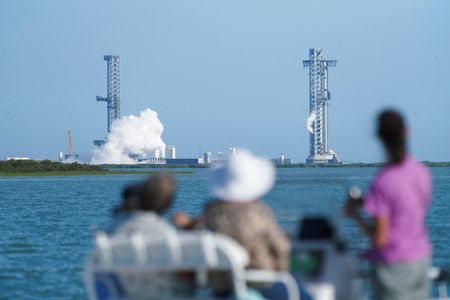
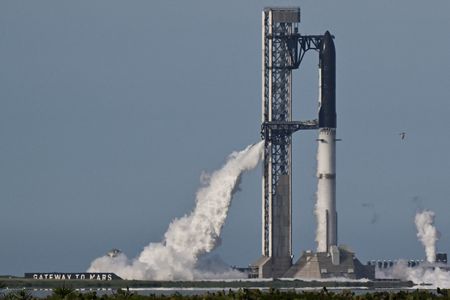
A rocket explosion at Blue Origin’s facility has caused significant damage to the company’s launch pad, leading to months-long delays that will impact Amazon’s satellite deployment plans and strengthen SpaceX’s position in the commercial space industry, according to company and industry sources.
The incident happened during engine testing for the New Glenn rocket, which was scheduled to launch next week. The timing couldn’t be worse for Jeff Bezos’ space ventures, as both Blue Origin and Amazon are working to compete with Elon Musk’s SpaceX in the heavy-lift rocket and satellite internet markets.
The explosion on Thursday also threatens NASA’s moon exploration goals.
The Blue Origin booster named “No, It’s Necessary” – referencing a line from the movie Interstellar – was destroyed in Thursday’s incident. An unnamed source familiar with the situation, who wasn’t authorized to speak publicly, said the launch pad was “practically destroyed” and engineers anticipate at least six months of delays, possibly longer.
“It’s only been a year since the SpaceX Starship also exploded on the launch pad and Blue Origin can also recover. But it will take months to rebuild,” said Antoine Grenier, partner and head of space consulting at Analysys Mason.
LENGTHY RECONSTRUCTION ANTICIPATED
When SpaceX’s Falcon 9 exploded on its launch pad in 2016, the company needed more than a year to fix the damaged infrastructure, though it managed to resume launches in 4-1/2 months by using a different Florida facility.
Although Amazon has diversified its launch partnerships, including working with SpaceX, this gives Musk’s company additional influence over his longtime competitor Bezos.
“Sorry to see this, I hope you recover quickly,” Musk wrote on X, later responding to Bezos with “Ad astra per aspera,” a Latin expression about achieving difficult objectives.
Amazon LEO had been counting on New Glenn’s frequent launch schedule to put half of its 3,200-plus satellite broadband network into orbit by July 2026 to satisfy regulatory requirements. A prolonged grounding by the FAA will seriously jeopardize this timeline.
SATELLITE NETWORK PLANS AT RISK
Grenier from Analysys Mason noted that Amazon has already secured much of the available capacity from other heavy-lift launch providers in the near future. While SpaceX might handle some additional demand, its Falcon 9 can transport roughly half the number of Amazon LEO satellites per mission compared to New Glenn, meaning any major shift would require substantially more launches, he explained.
Additionally, lunar cargo is designed for specific launch vehicles, making switches to different rockets complex.
The rocket was also set to carry Blue Origin’s inaugural Blue Moon lunar lander this year. NASA recently awarded the company a contract to transport two lunar rovers before the Artemis 4 mission in 2028.
NASA announced Thursday it would evaluate immediate effects on its Artemis and Moon Base initiatives, though it’s uncertain whether any missions will need reassignment.
However, it remains unclear how significantly this incident will affect Blue Origin’s future prospects and benefit SpaceX, whose schedule is already packed with its own Starlink satellite deployments plus commercial and government contracts.
The U.S. Space Force and National Reconnaissance Office reaffirmed their support for Blue Origin on Friday, maintaining their newly awarded national security launch contract from Thursday despite the devastating launch pad explosion that occurred hours afterward.
“Long term, the market still needs viable alternatives, so this strengthens SpaceX’s position at the margin, but doesn’t change the broader trajectory toward a multi-provider ecosystem,” said Mark Boggett, CEO of British space investor Seraphim Space.
Federal aviation safety investigators have temporarily disabled their public records database after discovering that artificial intelligence technology was being used to recreate confidential pilot communications from crash investigations.
The National Transportation Safety Board shut down its document access system when officials learned that digital images from their files were being utilized to reconstruct cockpit voice recordings from pilots involved in a recent aviation accident.
The agency’s action highlights growing concerns about how advancing AI capabilities are challenging traditional methods of protecting sensitive investigation materials that have historically remained confidential.
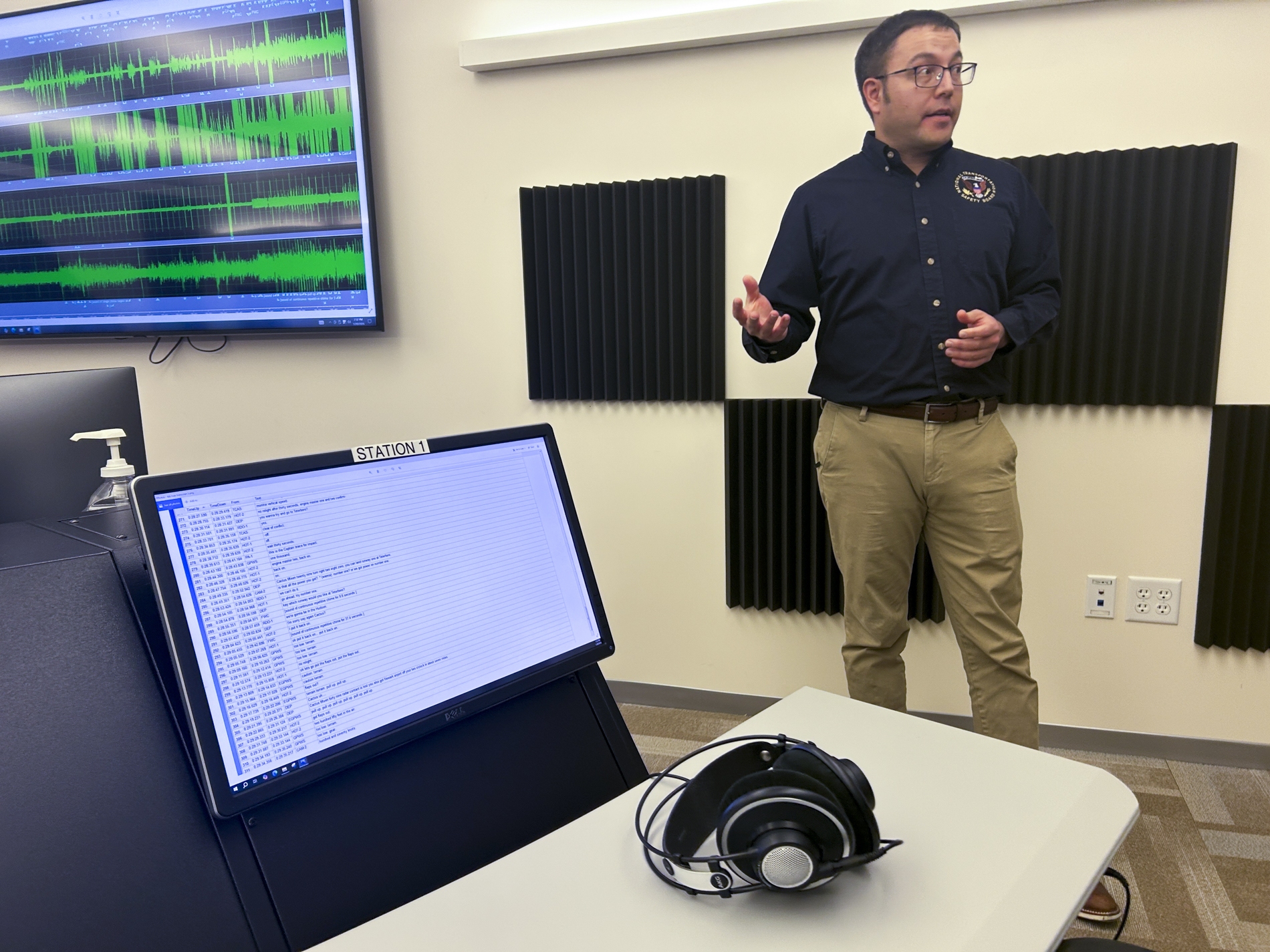
Chris Babcock, an engineer at the National Transportation Safety Board, works in one of the specialized listening facilities at the agency’s Washington, D.C. headquarters, where investigators typically review audio evidence from aircraft incidents.
The temporary shutdown demonstrates the unexpected ways that emerging technology is complicating efforts by federal investigators to maintain privacy protections around sensitive crash investigation materials.
In the United Arab Emirates’ Al Quaa Desert, astronomy enthusiasts are discovering what most of the country has lost to modern development: a crystal-clear view of the stars that once helped desert nomads navigate the vast wilderness.
While the UAE’s towering buildings and brilliant lights showcase the nation’s remarkable transformation into a global center for business and travel, this progress has come at a cost. The celestial views that historically guided Bedouin travelers through the shifting sands of the Empty Quarter have largely disappeared from populated areas.
Volunteers from the Dubai Astronomy Group are now organizing nighttime trips to Al Quaa Desert, among the few remaining dark locations in the Emirates, to help residents reconnect with the night sky and witness the Milky Way.
“It causes us to appreciate our existence in this galaxy,” said Sheeraz Awan, the general manager of the astronomy group, while leading participants during a late May stargazing session.
The Emirates is classified as one of the planet’s most light-polluted nations, joining other Gulf states where most citizens reside in major urban centers.
Research from 2016 determined that “humanity has enveloped our planet in a luminous fog” and found that 99% of UAE residents cannot observe the Milky Way from their residences due to artificial lighting.
This artificial brightness includes everything from highway street lamps to the spectacular LED displays that captivate visitors at Dubai’s Burj Khalifa, the planet’s highest structure. Abu Dhabi is planning to construct a $1.7 billion replica of the Sphere, the Las Vegas venue, on its Yas Island.
In Abu Dhabi, the UAE’s capital, officials have recognized the light pollution issue and established what they term a “Dark Sky Policy” in 2024 addressing illumination and related concerns throughout their emirate. In Dubai, LED displays on buildings are becoming more prevalent and LED billboards are increasingly common. Dubai officials did not respond to requests for comment, though the emirate also contains Al Qudra Lakes, a countryside location with reduced light pollution.
Urban illumination cannot reach Al Quaa Desert.
The desert location is accessible by car, approximately 100 kilometers (62 miles) southeast of Abu Dhabi city via a main highway toward the oasis town of Al Ain, then another route heading south deep into the desert.
Although overhead lighting exists on the section called Razeen Road, including a brightly lit correctional facility along the route, the desert extends just beyond in complete darkness, free from urban illumination. Razeen Road eventually turns east, but an automated gate permits drivers onto a dirt path leading further into the wilderness.
Several kilometers deeper, beyond those camping among the dunes and enjoying some of the final pleasant overnight conditions before UAE summer temperatures reach approximately 45 degrees Celsius (113 degrees Fahrenheit), the astronomy volunteers assembled dozens of visitors for stargazing.
They had company. Multiple workers wrapped in thick blankets were sleeping nearby in a pickup truck bed beneath the stars. Under a single LED light marking the parking area, a Solifugae — commonly called a camel spider — consumed another camel spider following an extended battle. The creature briefly moved toward a reporter and volunteer before vibrations from an approaching vehicle caused it to retreat into the darkness. Everyone present then monitored their footing carefully.
On rugs spread for the May weekend expedition, families conversing in Arabic, English and Russian gazed upward. The half-moon gradually descended beyond the horizon. Shortly after, the Milky Way’s outline became visible to the unaided eye.
“When you look toward the east, can you see that faint cloud,” Awan asked. “That, ladies and gentlemen, is the Milky Way.”
Using a laser pointer to illuminate the star formations, he prompted one woman to cry out: “Ay ye ye!”
The Dubai Astronomy Group volunteers explained this represented one of the optimal periods annually for galaxy observation. Several people gasped upon spotting meteors periodically crossing the sky, clearly visible in the darkness without urban light interference.
Some congregated around telescopes to examine individual stars. Others reclined on the cold desert sand, receiving guidance on using their mobile devices for long-exposure photography to capture the galaxy shining above. Gradually, people slowly returned to their vehicles and began driving back to the UAE’s illuminated highways and cities.
For a brief time, they had connected with the night as Bedouins had done before them.
“When we look at this Milky Way, we’re kind of involved in an activity, which is not new,” Awan told the stargazers. “It’s something that people throughout time have been engaged in.”
California environmental regulators approved modifications to a major climate initiative on Friday, despite widespread opposition from green advocacy groups who argued the revisions would diminish the program’s effectiveness and hamper efforts to reduce emissions that contribute to global warming.
Oil industry representatives, however, contended that the program would continue to create obstacles for reducing energy costs in a state known for high prices.
Democratic Gov. Gavin Newsom and state legislators renewed authorization for California’s cap-and-trade initiative last year, extending it through 2045. This system establishes a decreasing ceiling on total greenhouse gas emissions from large polluting entities throughout the state. Businesses must either cut their pollution output, purchase permits from the government or other companies, or support projects designed to offset their emissions. Comparable systems operate throughout Europe and Asia, with California’s program connected to similar initiatives in Quebec, Canada and Washington state.
The modifications approved Friday will provide companies — primarily manufacturers and oil refiners — with approximately $3.5 billion in free permits if they construct projects that help decrease their emissions. State officials explained this approach aims to prevent major businesses from relocating outside California, though environmental advocates argue it contradicts the program’s fundamental purpose of encouraging companies to reduce pollution to minimize permit costs. They also contend it will reduce funding available for climate change mitigation and reduction programs.
California Air Resources Board Chair Lauren Sanchez, who previously served as the governor’s top climate adviser, stated the modifications will help California maintain its position as a climate leader.
“Moving forward shows that we can be responsive to affordability concerns, new legislative direction, while also setting a clear signal for Californians, other states and global partners that we remain committed to driving long-term investments in clean energy jobs and reducing pollution in communities,” she said.
State law mandates California reduce its planet-warming emissions by 40% and 85% below 1990 levels by 2030 and 2045, respectively. Program supporters believe cap and trade will help achieve these targets.
The governor signed legislation designed to better align the decreasing emissions ceiling with state climate objectives, designate program revenue for various climate, housing and transit initiatives, and potentially enhance carbon-removal projects. The legislation also renamed the program “cap and invest” to highlight its funding of climate initiatives.
However, achieving these objectives has generated months of air board discussions and intensive lobbying by both environmental organizations and the oil industry. An original proposal primarily focused on aligning the program with last year’s legislation, but was modified to emphasize reducing program costs.
California officials have encountered growing pressure to prioritize affordability in climate policy development after two oil refineries announced closure plans in recent years. The Democratic-controlled state has also confronted federal challenges to its climate agenda, including legislation Republican President Donald Trump signed last year blocking a pioneering rule prohibiting new gas-powered car sales by 2035.
The newly approved changes also boost funding from permit sales by $2 billion from 2027 through 2030 for a program offering utility bill credits to Californians and designate approximately $800 million to help cap-and-trade participating businesses limit program costs for residents.
Previously, roughly $4 billion the state collected annually from permit sales funded climate change mitigation, affordable housing and transportation projects through the Greenhouse Gas Reduction Fund.
The governor and state lawmakers determine which programs receive fund money, and last year they agreed to provide $1 billion annually for the state’s delayed high-speed rail project.
The modifications will likely reduce annual fund revenues by half, according to the nonpartisan Legislative Analyst’s Office. This reduction stems largely from the new incentive program for manufacturers and refiners, said Danny Cullenward, a climate economist who opposes the changes, though board staff disputes this assessment.
This week’s regulatory deliberations extended into a second day following extensive public commentary where climate advocates, legal experts and fossil fuel industry leaders discussed the rules’ effects on pollution and consumer costs, with many requesting the board postpone its vote to better align regulations with state priorities.
Environmental groups, Democratic lawmakers and other critics argue the changes impede state efforts to reduce planet-warming emissions. Cullenward stated the new manufacturer and refiner incentive program lacks testing and adequate safeguards to prevent misuse.
“The state is not on track for its climate goals,” he said at a media briefing Wednesday. “Cutting our climate funding does not help address consumer cost concerns, and it doesn’t accelerate emission reductions.”
The board agreed Friday to postpone issuing permits from the new incentive program until the agency’s executive officer reviews the program and reports back with potential modifications.
The Greenhouse Gas Reduction Fund reductions will severely impact diverse programs serving communities statewide, said Michelle Pariset, director of legislative affairs for social justice law firm Public Advocates.
“These are investments that determine whether a student can afford to take transit to school, whether a senior can get to a doctor’s appointment, whether a family can live near reliable transportation instead of enduring long commutes and higher costs,” Pariset said at the Wednesday briefing.
Jodie Muller, president and CEO of the Western States Petroleum Association, said the updates represent progress but inadequately address future energy affordability concerns.
“California refineries need long-term certainty to make the investments that keep energy reliable and affordable for consumers –- and right now, that certainty stops at 2030,” she said in a statement.
The changes will increase California’s dependence on oil imports to satisfy energy requirements, said Rock Zierman, CEO of the California Independent Petroleum Association.
“That means high GHG emissions, fewer jobs, more expensive gasoline, and lower tax revenue for schools, police, fire, and parks,” Zierman said in a statement, using an acronym for greenhouse gas.
The U.S. Space Force announced Friday that it has granted Elon Musk’s SpaceX a massive $4.16 billion contract to develop a program that will detect and monitor airborne threats from orbit.
Known as the Space-Based Advanced Moving Target Indicator (SB-AMTI), the system will function as an integrated network combining orbital sensors, protected communication channels, and terrestrial data processing to enhance collaboration throughout the government’s space industry partners.
According to the Space Force, multiple companies are part of the SB-AMTI contractor group, with SpaceX among them, and additional contracts will be distributed over the next twelve months.
“This initial award is projected to field a constellation of satellites by 2028, providing the Joint Force with an early capability to eliminate operational blind spots,” the agency stated in its announcement.
SpaceX, which announced its initial public offering plans earlier this month, is seeking a valuation exceeding $1.75 trillion.
Just days ago, the Space Force granted SpaceX another major contract worth $2.29 billion to construct a protected, high-speed satellite communication system that will link military sensors and weapons platforms worldwide.
CAPE CANAVERAL, Fla. — A massive rocket owned by Jeff Bezos’ space company Blue Origin detonated during engine testing, producing an enormous orange explosion that could be seen and felt across a wide area.
The space company was conducting fuel tests on their towering New Glenn rocket Thursday evening, planning to fire the engines momentarily in preparation for a planned satellite mission next week. However, the 321-foot tall rocket erupted in flames, damaging portions of the launch facility.
On Friday, emergency authorities issued warnings for residents to stay away from any debris that could potentially reach shorelines and instead contact 911 immediately.
The New Glenn rocket takes its name from John Glenn, America’s first astronaut to orbit Earth. Blue Origin intends to use this rocket system for delivering lunar landing vehicles as part of NASA’s Artemis initiative, which seeks to establish a major installation near the moon’s southern region. The space agency hopes to achieve the first Artemis crew landings by 2028 at the earliest. Just days before this incident, NASA granted Blue Origin a new multi-hundred-million-dollar agreement.
The rocket was empty of its intended payload of 48 Amazon Leo satellites when the explosion occurred. A separate group of Amazon Leo satellites — designed to compete with SpaceX’s Starlink network in providing internet access to isolated areas — remained safely positioned miles away at Cape Canaveral Space Force Station, scheduled for launch aboard a United Launch Alliance Atlas V rocket.
Less than half a day after Blue Origin’s mishap, SpaceX successfully deployed additional Starlink satellites Friday morning. CEO Elon Musk operates two launch facilities — one at the Space Force location where the recent Falcon 9 departed, and another at NASA’s Kennedy Space Center.
Blue Origin operates only one Florida launch site. Their smaller New Shepard vehicles launch from Texas, carrying paying passengers and research payloads on brief space journeys lasting several minutes. These tourist flights were suspended in January to allow the company to concentrate on New Glenn development and future lunar missions. All operations remain halted while investigators examine the cause of Thursday’s explosion.
Three Chinese astronauts safely landed back on Earth Friday evening after completing a mission that lasted almost seven months in space, having finished passing responsibilities to a new crew earlier in the week.
The spacecraft transporting astronauts Zhang Lu, Wu Fei and Zhang Hongzhang from the Shenzhou 21 mission made its descent at the Dongfeng landing site located in north China’s Inner Mongolia region. This mission concludes as China moves forward with plans for its initial lunar landing mission scheduled for 2030.
According to the China Manned Space Agency, as reported by the official Xinhua News Agency, the astronauts accomplished numerous objectives during their stay, including handling and sending experimental data and moving leftover supplies. The crew also passed along their knowledge to the Shenzhou 23 team members who reached the space station this past Monday, Xinhua reported.
Xinhua’s earlier reports indicated the crew had finished three spacewalk activities. Zhang Jingbo, the space agency’s spokesperson, noted that Zhang Lu, who previously participated in the Shenzhou 15 mission to the space station, had now completed seven such operations in total — making him the Chinese astronaut with the highest number of spacewalks, according to the report.
Among the three astronauts who reached the Tiangong space station aboard the Shenzhou 23 spacecraft, one is scheduled to remain for a full year. In Chinese, Tiangong translates to “Heavenly Palace.”
The crew members are commander Zhu Yangzhu, Zhang Zhiyuan and Lai Ka-ying, who Chinese officials also refer to as Li Jiaying, using the Mandarin version of her name. Lai, a Hong Kong native, represents the first astronaut from that city to participate in a space mission.
With China expanding its space initiatives, its astronauts have conducted numerous missions to the Tiangong space station, which was built after China was essentially barred from the International Space Station due to U.S. national security considerations.
The United States remains China’s primary competitor in space exploration, with NASA targeting 2028 for landing astronauts on the moon’s surface.
Scientists have finally solved one of paleontology’s most puzzling questions: why did Tyrannosaurus rex develop such an enormous head while keeping ridiculously small arms?
New research shows that this bizarre body design wasn’t random. As plant-eating dinosaurs grew to massive sizes after dinosaurs became the dominant land creatures, meat-eating predators evolved stronger skulls to tackle bigger prey, while their arms gradually became less important for hunting.
The study found that this evolutionary pattern occurred independently in five different groups of theropods – the two-legged carnivorous dinosaurs. This suggests the combination of big heads and small arms provided significant survival advantages.
T. rex’s comically tiny limbs have long captured public imagination, inspiring countless internet jokes about the fearsome hunter’s inability to clap or do push-ups. But the new findings reveal there was serious evolutionary logic behind this design.
Dinosaurs first emerged around 230 million years ago during the Triassic Period, then ruled the planet through the Jurassic and Cretaceous periods until an asteroid impact wiped them out 66 million years ago. Early meat-eating dinosaurs had well-developed arms that helped them catch prey, but this changed as enormous plant-eaters like long-necked sauropods appeared.
“Body size in dinosaurs increased massively from the Triassic to the end-Cretaceous, so it’s likely that the increase in body size drove some theropods to shift towards using their heads more than their limbs in hunting. Effectively, the forelimbs became redundant in hunting,” explained Charlie Scherer, a University College London doctoral student in paleontology who led the research published in Proceedings of the Royal Society B.
“Natural selection will act on the traits which allow an animal to survive and thrive in its ecosystem. If that means sacrificing the size of the arms for a stronger head, which is the primary weapon for the animal, then that’s likely what will happen,” Scherer added.
The research team developed a new system for measuring skull strength based on factors like skull size, bite power, tooth design, and bone fusion patterns. Tyrannosaurus, which roamed North America during the Cretaceous period, ranked highest, followed by Tyrannotitan from Cretaceous South America.
The study revealed a strong connection between skull strength and arm reduction across multiple dinosaur groups: tyrannosaurs including Tyrannosaurus; carcharodontosaurs including Carcharodontosaurus from Cretaceous Africa; megalosaurs including Megalosaurus from Jurassic England; ceratosaurs including Ceratosaurus from Jurassic North America and Europe; and abelisaurs including Abelisaurus from Cretaceous South America.
These groups included top predators that used large body size and powerful jaws to hunt various giant plant-eaters including sauropods, horned dinosaurs, armored dinosaurs, and duck-billed dinosaurs. One of the earliest examples was Eoabelisaurus, which lived in South America about 170 million years ago during the Jurassic period.
However, not all large meat-eating dinosaurs followed this pattern. Some groups kept long, powerful arms, including Spinosaurus from Cretaceous Africa and Megaraptor from Cretaceous South America.
These dinosaurs “have incredibly large and mobile arms for their body size, which suggest a more prominent role for them in hunting compared to something like T. rex,” Scherer noted.
Smaller theropods also maintained useful arms, including the evolutionary line that eventually led to modern birds.
For giants like Tyrannosaurus, researchers remain uncertain about what purpose the tiny arms served. Not only were T. rex’s arms weak and short, but they had only two fingers instead of the typical three or more.
“Potentially, they did nothing with them – they were just useless. This raises the question: why did they have tiny arms, rather than no arms? If the tiny arms are still there, then it is possible that they still retain some kind of function that we are not aware of,” said University College London paleontologist and study co-author Paul Upchurch.
“For me, however, this is unlikely, and I think something else is going on,” Upchurch continued.
When body parts become unnecessary, genetic changes typically cause them to shrink so animals don’t waste energy building structures they don’t need, Upchurch explained.
“But we know that genetics is complicated, and very often genes have more than one role. For example, a gene might be involved in building something that the animal no longer needs, but the same gene might also be doing something in another part of the body that the animal does still need. This means that the gene is maintained because it is still doing something useful, so the useless structure persists in a reduced form rather than disappearing completely,” Upchurch said.
Taiwan’s premier technology trade show next week is expected to shine a spotlight on Nvidia’s deepening investment in the island nation and Taiwan’s expanding influence in artificial intelligence infrastructure development.
The Nvidia chief executive, Jensen Huang, who arrived in Taipei over a week before the event begins, emphasized his company’s commitment on Wednesday by announcing plans to invest up to $150 billion annually in Taiwan, describing the nation as the center of the artificial intelligence revolution.
“Many years ago, we had 10 partners. Five years ago, maybe 50 partners. Now we have 150 partners,” Huang stated.
Similarly, AMD’s chief executive Lisa Su announced last week that her company plans to invest more than $10 billion in Taiwan’s artificial intelligence industry, noting the company is working with local partners to ensure adequate capacity for growth in 2026 and beyond.
The island nation features a comprehensive network essential for AI data centers, including manufacturers of AI servers, packaging facilities, and component suppliers.
“Taiwan’s AI role is moving from a semiconductor story to an infrastructure story,” commented Ryan Fletcher, a partner at McKinsey & Company.
“The question is no longer only who makes the chip, but who can turn it into a powered, cooled, networked and serviceable AI system.”
The Computex exhibition will take place from June 2-5, beginning with an opening presentation from Huang on Monday, with strengthened relationships between Nvidia and its partners expected to be a major focus.
Since his arrival in Taiwan, Huang has maintained an intensive schedule of meetings and dinners with supply chain leaders, including sessions with TSMC CEO C.C. Wei, Foxconn Chairman Young Liu and Quanta Computer Chairman Barry Lam.
Although Computex has historically focused on consumer electronics, Nvidia has transformed it into a more enterprise-focused event in recent years. Expected highlights include the company’s data center offerings, including its latest Vera Rubin AI computing platform and Vera central processing unit, along with developments in robotics and manufacturing AI applications.
The show, anticipated to be the largest Computex ever with 1,500 exhibitors, will feature other prominent technology executives including Intel CEO Lip-Bu Tan, Qualcomm Chief Executive Cristiano Amon and Arm boss Rene Haas.
Marvell’s chief executive, Matt Murphy, and NXP Semiconductors CEO Rafael Sotomayor are also scheduled to attend.
Intel’s presentation by Tan will draw significant attention from industry observers.
“He’s been able to get Intel back on its feet and his keynote will give indications on other directions that he is looking to take the company,” said Bryan Ma, vice president, client devices research at IDC.
Ma noted he will be watching for developments including a long-rumored Nvidia PC platform, Intel’s Arc G-series processors for handheld gaming devices, and will assess industry sentiment amid elevated memory costs.
Intel is anticipated to highlight its numerous partnerships and renewed focus on high-performance central processing units for AI inference, according to Ian Cutress, chief analyst at More than Moore.
The technology showcase occurs during a period of increased geopolitical tensions.
China’s President Xi Jinping warned U.S. President Donald Trump at their recent summit that mismanaging Taiwan issues could result in conflict between the nations. China has also intensified pressure on Taiwan through increased military activity in surrounding areas.
Despite these tensions, Taiwan’s technology business continues to thrive. The island’s server exports jumped to $60 billion last year, up dramatically from just $571 million in 2017.
A spacecraft owned by Jeff Bezos’ aerospace company Blue Origin detonated during engine testing at the launch site Thursday evening, occurring just days before a scheduled satellite mission next week.
The explosion happened while the rocket was undergoing an engine-firing test at the launch pad, disrupting preparations for the upcoming satellite deployment.
A major Chinese technology company has revealed a new strategy for developing advanced computer chips that could help the nation work around US trade restrictions that have limited access to sophisticated manufacturing equipment.
Huawei introduced an innovative semiconductor design philosophy this week that prioritizes enhancing signal transmission speeds instead of continuing the traditional approach of making transistors progressively smaller. This new method could provide China with an alternative pathway to create state-of-the-art chips despite sanctions that have been in place since 2019.
The restrictions have prevented China from obtaining the most sophisticated extreme ultraviolet lithography machines, which has hampered Chinese chipmakers’ ability to compete with global industry leaders like Taiwan’s TSMC in the race to develop increasingly miniaturized manufacturing processes that enhance chip performance.
The semiconductor field has long followed Moore’s Law, which states that the number of transistors on a microchip approximately doubles every two years. Huawei’s alternative strategy introduces what the company calls the Tau Scaling Law, which focuses on reducing the time required for signals to travel through chips and broader computing systems.
The company’s core innovation, known as LogicFolding, involves organizing logic, analogue and memory circuits in layered, more closely connected configurations. This arrangement could potentially enhance density, efficiency and processing speeds over the coming decade.
Supporters view this approach as a method to continue chip advancement as traditional manufacturing improvements begin to plateau.
“For Huawei, chips face two key constraints. One is inevitable that Moore’s Law will hit a physical ‘wall’ within the next decade,” said He Tingbo, the president of Huawei’s semiconductor business, in comments to China’s People’s Daily this week.
“The other is accidental because of the external restrictions that Huawei encountered this ‘wall’ earlier than its peers,” she added, apparently referring to US sanctions on importing advanced manufacturing equipment.
However, some industry experts argue that minimizing latency has always been a component of semiconductor design and that many of the fundamental concepts resemble existing work in three-dimensional stacking, advanced packaging and system optimization.
“This is a breakthrough for Huawei, but it’s not a threat for TSMC,” Nvidia CEO Jensen Huang told reporters in Taipei on Thursday. “TSMC has been using die stacking and 3D packaging for how long now? Almost 10 years. And so TSMC’s technology is very advanced.”
The semiconductor industry has already adopted advanced packaging technologies that stack chips vertically in the pursuit of building more powerful computing systems. TSMC has led this field with its packaging technology called SoIC, which allows for more tightly integrated diverse chiplets to reduce size and boost performance.
Memory chip manufacturers such as SK Hynix and Samsung Electronics also employ advanced 3D stacking and packaging technologies to create multi-layer memory chips, which are essential components of AI chipsets, while improving power efficiency and performance.
Huawei contends that LogicFolding may surpass commonly used 3D integrated circuit stacking techniques by “very finely and carefully split the critical paths of logic circuits across multiple layers,” according to Liao Heng, chief scientist at Huawei Semiconductor.
However, Bernstein analysts warned in a research note that while stacking multiple chip layers increases transistor density, it also raises power density and creates risks of chip overheating. Production yields and costs will present additional obstacles for widespread adoption, they noted.
Huawei’s own development timeline acknowledges these challenges. The company’s executive said the approach would require new semiconductor design tools adapted to folded chip architectures, along with improved methods for managing heat across devices from smartphones to large AI data centers.
“With the methodology of not optimising the area on a chip level, but on a system level based on time, that will dramatically change the capability requirements for the EDA (electronic design automation) vendors,” said Handel H. Jones, CEO of International Business Strategies, during a panel discussion on Tau Scaling on Tuesday.
Standard electronic design automation software from vendors like Cadence Design Systems and Synopsys serves a vital function in developing blueprints for complex semiconductor devices.
Huawei’s most specific assertions focused on a new Kirin smartphone chip scheduled for release later this year, which would be the first to implement its LogicFolding architecture.
Compared to its previous single-layer design, the new chip would boost power efficiency by 41% and increase the chip’s maximum operating speed by nearly 13%, according to Huawei’s He in a speech on Monday.
These numbers would be substantial if achieved in mass production. However, Huawei did not share production yield data, cost comparisons or a detailed explanation of how the improvements would measure against competing chips manufactured using more advanced process technologies.
“There’s nothing concrete that can be independently verified or benchmarked against other players at the moment,” said Lian Jye Su, chief analyst at tech research firm Omdia.
Jeff Bezos’ space company Blue Origin reported on Thursday that it encountered a malfunction during engine testing, with social media footage capturing their New Glenn rocket bursting into flames in a dramatic explosion.
The incident occurred during what’s known as a hot-fire test, a procedure where rocket engines are ignited while the vehicle remains secured to the ground.
“All personnel are accounted for,” Blue Origin stated in a post on X.
The company has invested billions of dollars over approximately ten years creating New Glenn, a towering rocket standing 29 stories tall featuring a reusable first stage designed to rival SpaceX’s Falcon fleet and its more advanced Starship.
The Federal Aviation Administration did not immediately respond to a Reuters request for comment.
CAPE CANAVERAL, Fla. — An explosive malfunction during a rocket engine test Thursday evening sent shockwaves through surrounding neighborhoods and illuminated the Florida sky with an orange glow.
The incident involved Jeff Bezos’ space company Blue Origin and its New Glenn rocket during what the company described as a hotfire test. Blue Origin confirmed through social media that all personnel were safely accounted for following the blast.
Local emergency authorities have stated there are no dangers from toxic vapors or other safety concerns stemming from the explosion.
This setback comes after the enormous New Glenn vehicle was previously sidelined in April when it failed to deliver a satellite to its intended orbital path due to propulsion system problems. The rocket has only completed three missions and represents Blue Origin’s vehicle of choice for delivering lunar landing craft for NASA.
The blast occurred around 9 p.m., causing structures in neighboring Cape Canaveral and Cocoa Beach to vibrate. Local residents quickly took to social platforms to share their experiences and seek answers about the disturbance. The launch facility at Cape Canaveral Space Force Station’s Launch Complex 36 can be seen from coastal areas, and images of the fiery explosion rapidly spread online.
“We experienced an anomaly during today’s hotfire test,” Blue Origin stated in their official response. “We will provide updates as we learn more.”
The New Glenn vehicle first launched in 2025 from Cape Canaveral and bears the name of John Glenn, the first American to orbit Earth.
Residents and tourists in New York City turned their eyes skyward Thursday to witness the annual astronomical event called Manhattanhenge.
The descending sun appeared perfectly framed within a corridor of towering buildings as it aligned with Manhattan’s organized street layout before disappearing below the skyline.
Thursday’s impressive display marks only the first occurrence this year. An even more complete view of the setting sun nestled between the city’s iconic high-rises is anticipated Friday. The celestial event will return again on July 11 and 12.
This astronomical alignment occurs approximately three weeks on either side of the summer solstice.
Through the years, the event has transformed into an essential viewing experience, drawing photography enthusiasts and curious onlookers to city sidewalks during spring and summer evenings.
Here’s what makes this distinctly New York phenomenon special:
The name was created by astrophysicist Neil deGrasse Tyson in a 1997 piece for “Natural History” magazine. Tyson, who leads the Hayden Planetarium at the American Museum of Natural History in New York, drew inspiration from his teenage visit to Stonehenge.
The television personality, who would later host programs including PBS’ “Nova ScienceNow,” participated in a research expedition guided by Gerald Hawkins, the researcher who initially proposed that Stonehenge’s ancient stone structures functioned as an astronomical observation site.
The New York native Tyson recognized similarities between the sun setting among Manhattan’s skyscrapers and the way sunlight penetrates Stonehenge’s stone circle during the solstice.
However, unlike the ancient Stonehenge architects, Manhattan’s urban designers had no intention of creating solar alignment. The effect emerged purely by coincidence.
The phenomenon doesn’t coincide with this year’s summer solstice on June 21. Rather, it occurs roughly three weeks before and after that date, when the sun positions itself in perfect harmony with the city’s east-west running streets.
Spectators can experience two distinct variations of this event.
Thursday’s display, along with July 12’s occurrence, features exactly half the sun visible above the horizon while the other half sits below during the street alignment moment, the Hayden Planetarium explains.
Friday’s event and July 11’s showing will present the complete sun appearing suspended between structures before it descends toward the New Jersey skyline beyond the Hudson River.
Popular observation locations include the city’s wide east-west avenues: 14th Street, 23rd Street, 34th Street, 42nd Street and 57th Street.
Moving eastward provides increasingly spectacular views as sunlight illuminates building surfaces lining both sides of the roadway. The phenomenon can also be observed from Long Island City in Queens, looking across the East River.
Witnessing Manhattanhenge requires no special arrangements or organized events.
Crowds typically assemble along east-west streets roughly 30 minutes before sunset to capture photographs as evening approaches. Clear skies are essential – overcast or rainy conditions prevent any visible display.
Comparable phenomena happen in other cities featuring organized street patterns. Chicagohenge and Baltimorehenge occur when sunset aligns with those cities’ grid systems during March and September, coinciding with spring and fall equinoxes. Torontohenge takes place in February and October.
However, Manhattanhenge stands out due to the exceptional height of surrounding structures and the clear western view toward the Hudson River.
Samsung Electronics announced Friday that it has commenced distribution of sample units for its newest high-bandwidth memory technology, the 12-layer HBM4E chip, which the company describes as the industry’s inaugural shipment of this advanced product type.
The technology giant from South Korea reported that this latest chip delivers performance speeds exceeding 20% compared to earlier HBM4 generation products.
According to Samsung, the chip incorporates the company’s newest 1c DRAM process technology, which represents sixth-generation 10-nanometer-class DRAM, combined with Samsung’s 4-nanometer foundry logic base die technology.
The manufacturer had announced in April its intention to deliver initial HBM4E chip samples during the second quarter.
This development follows just three months after Samsung initiated shipments of its HBM4 chips to clients in February, highlighting the company’s push to solidify its standing in the emerging AI memory sector through early distribution of cutting-edge product samples.
Among Samsung’s client base are prominent AI industry leaders including AMD, Nvidia and Google, as market demand continues growing for sophisticated memory chips utilized in AI servers and processing units.
Artificial intelligence development may become a key catalyst for expanding Middle East diplomatic partnerships, according to two prominent technology leaders who see enormous potential in regional cooperation.
Judah Taub, managing partner at Hetz Ventures, and Ofer Shacham, co-founder and CEO of Majestic Labs, believe that merging Gulf nations’ abundant energy resources with Israeli technological capabilities could position the Middle East as a major player in the global AI revolution.
Speaking to journalists during a dinner meeting in Jerusalem this week, Shacham emphasized the region’s unique advantages. “This region is primed for an AI upgrade,” Shacham stated. “The whole Gulf region has energy. Israel has the technology and the talent … Everybody basically wants to work together to build the next AI revolution in this region. It’s going to happen eventually.”
The executives highlighted how different areas bring complementary strengths to potential partnerships. Shacham noted that “together we are able to solve a much bigger problem than each one of us separately.” He pointed out that the region hasn’t yet achieved the AI adoption levels seen elsewhere globally, creating significant opportunities for rapid expansion.
A crucial factor in AI development is electrical power consumption. Taub explained that many people don’t understand how much electricity countries need to dedicate to AI technology to remain competitive.
“When you hear of AWS [Amazon Web Services], Google, Anthropic, and OpenAI, they all are now talking about how many gigawatts of AI they’re going to create, because they’re slowly realizing that the number one issue they’re all going to run into is that there simply isn’t enough electricity,” Taub said.
To illustrate the scale, Taub compared current AI power demands to scientific research facilities. While CERN experiments use approximately 0.2 to 0.3 gigawatts at peak capacity, OpenAI is planning data centers requiring about 1 gigawatt for continuous year-round operation. Starlink has projected needs of 10 gigawatts, and Elon Musk has discussed figures reaching 100 gigawatts, with each gigawatt roughly equal to powering 1 million homes.
Israel’s total electricity generation capacity stands at around 27 gigawatts, according to Taub. He predicts that once regional conflicts end and collaboration with additional Gulf countries like Saudi Arabia becomes possible, “one of the first things that moves forward is a regional collaboration for AI.”
Taub described energy as something Saudi Arabia possesses in abundance, while Israel’s technological knowledge makes such partnerships naturally beneficial for both sides.
Beyond electricity generation, companies must consider hardware requirements and emerging regulations that may restrict advanced AI technology sales. Manufacturing companies like Taiwan Semiconductor Manufacturing Company and Nvidia play critical roles in this ecosystem.
“Governments have realized that these are, to an extent, the nuclear facilities of the future, and by selling some of these, you’re helping people that you might not want to leapfrog or do things that they otherwise can’t,” Taub explained.
Shacham’s company, Majestic Labs, which began operations just one month after the October 7, 2023, massacre, is working to revolutionize server architecture. The company aims to replace multiple hardware racks with single, more efficient systems.
“We started Majestic Labs to build AI infrastructure for the world with that notion and vision of ubiquitous AI; we want to bring it to everyone,” Shacham said.
Current AI infrastructure typically requires approximately 40 refrigerator-sized racks of Nvidia equipment, as Taub described. Majestic Labs is working to compress that capability into something closer to microwave-sized units.
Memory has emerged as a major industry constraint, with only a few companies manufacturing the necessary components. Nations are increasingly competing for memory supply and related technologies, which forms a central principle behind Majestic Labs’ approach.
“What Majestic gives you is 10 times, 50 times, sometimes 100 times more users per kilowatt invested in that data center,” Shacham detailed. “Ten times to 100 times more users per $1 million invested in that data center, that’s our advantage.”
According to the company’s website: “One Majestic rack holds the fast memory capacity of 25 Nvidia NVL72 Vera Rubin racks at a fraction of the power. Organizations that could never justify hyperscaler infrastructure can now run any workload.”
Shacham reported that the company expects to ship its initial servers next year and has already secured orders valued at hundreds of millions of dollars. Data centers and foundational AI companies are searching for methods to boost revenue and efficiency from investments that already require massive capital commitments.
Israel has earned recognition for constructing high-quality, optimized data centers, Taub noted. The country particularly excels in application layer development—the software that operates on top of platforms like OpenAI or Anthropic.
“We’re seeing an explosion of apps,” he observed.
Taub’s Hetz Ventures focuses on early-stage investments in Israeli companies developing fundamental cybersecurity and AI infrastructure components—the underlying systems that determine whether everything built above them functions properly.
“We’re typically the first check, the first ticket into these startups,” Taub said. “We’re writing tickets anywhere from the smallest, which will be a million dollars, and up to maybe 10 million. It really depends on the company, and we’re doing this somewhere between six and eight times a year.”
The venture capital firm has achieved several significant successes, including Granulate, which Hetz initially funded at a $6.4 million valuation before Intel acquired it for $650 million. Intel discontinued Granulate in 2024.
Hetz also provided seed funding for Israeli cybersecurity startup Silk Security, which Armis Security purchased in April 2024 for $150 million.
Shacham explained that Israel became a global technology leader, rather than focusing on industries like automobile manufacturing, partly due to its size and partly because moving software, digital products, and intellectual property is much easier than transporting physical goods when a country faces constant conflict and challenging geographical circumstances.
“Half of my company is in the US. I work with Europe, I work with Paris. I work with the Gulf States. They are fighting over us because what we have is easily transferable and very hard to come by,” Shacham said.
He added that working with Gulf States offers the additional benefit of compatible time zones, eliminating the need for anyone to work overnight hours for regional collaboration.
“The biggest market for Israeli technology is still going to be the US and Europe … but there is a cherry on top, because if the Abraham Accords can continue, if there is more stability in the region, this region as a whole could be very prosperous,” Shacham said.
While acknowledging that Saudi Arabia demonstrates clear interest in modernization and technology investment, Shacham admitted that Majestic Labs hasn’t yet converted that interest into signed agreements. However, he confirmed that discussions are already underway.
“For this region to be successful, you need to create business opportunities together,” Shacham concluded. “We need to work together so that we break down those walls, because that’s not going to come from the political aspects. It’s going to come from companies wanting to do stuff together … I think it’s pretty soon that we will have that.”
Maryland’s Department of Natural Resources is calling on residents and visitors to keep watch for marine mammals and sea turtles while enjoying coastal and tidal waters during the summer season and into early fall.
Seasonal marine wildlife including dolphins, manatees, sea turtles, and whales frequently visit the Chesapeake Bay and its tidal tributaries, along with the Atlantic Ocean and coastal bays.
People who spot distressed or injured marine mammals or sea turtles in Maryland waters should call the Maryland Natural Resources Police Hotline at 800-628-9944 or use an online reporting form for deceased animals. Those fishing, boating, or visiting beaches should watch particularly for animals that are stranded, dead, sick, injured, or entangled.
“Maryland has 3,190 miles of tidal coastline, and without reports from the public, it would be impossible to monitor every waterway,” said Stranding Response Program Director Amanda Weschler. “Each stranded animal- and the select necropsies we perform- provides valuable information that contributes to the scientific understanding of marine mammals and sea turtles in Maryland.”
Maryland’s Marine Mammal and Sea Turtle Stranding Response Program has documented more than 1,630 stranding reports since beginning operations in 1990. Summer months through early fall see increased reports of marine mammal and sea turtle observations, including occasional West Indian manatees (Trichechus manatus). Though uncommon, West Indian manatee sightings can occur in Maryland, as the species is considered out-of-habitat in the state. The most recent stranded manatee in Maryland was reported in April 2025.
The Standing Response Program helps enforce federal protections including the Marine Mammal Protection Act and the Endangered Species Act that protect these marine species. Through necropsies conducted on deceased animals, the program collects critical information about individual animal health, coastal population status, and Maryland’s overall marine environment condition.
Various factors cause marine animals to strand, including advanced age, illness, blunt force trauma from vessel strikes, predation, fishing gear entanglement, and parasites.
Not every reported animal undergoes necropsy due to considerations like decomposition level, available resources, and stranding site accessibility and safety. When necropsy isn’t possible, program staff gather basic data, location details, and photographs. The deceased animal may remain at the stranding location for natural decomposition, which benefits the ecosystem. Other disposal options include on-site burial or transport to approved disposal facilities, based on circumstances and local rules. Contact information for those needing disposal assistance is available on the DNR website.
The department emphasizes that anyone finding a stranded marine animal, whether living or dead, should keep a safe and respectful distance while documenting details including photographs, location data, and the animal’s condition for reporting purposes.
Scientists have honored McLaren Formula One driver Oscar Piastri by naming a prehistoric wasp species after him, according to a new research study.
The ancient insect was discovered preserved in amber from northern Myanmar and dates back to the middle Cretaceous period, when dinosaurs roamed the Earth. Researchers published their findings in the academic journal Palaeoworld’s June edition, officially naming the species ‘Gwesped Piastrii.’
According to the research article, scientists chose to honor the racing driver for a specific reason. “The specific epithet honours Mr. Oscar Piastri for his achievements in Formula One, and because the colour of the amber piece recalled to the first author the iconic McLaren orange,” researchers wrote.
The prehistoric wasp lived during the Cretaceous period, which concluded 65 million years ago.
The 25-year-old Australian racing driver entered Formula One competition in 2023 and has secured nine grand prix victories during his career. Piastri is currently at the Isle of Man TT races during a break before the Monaco Grand Prix scheduled for June 7, and has not yet responded to news of the scientific honor.
A recent scientific breakthrough may finally explain how pigeons manage to find their way home across vast distances without getting lost.
While animals employ different methods for navigation such as star patterns and landmark recognition, many birds, fish and sea turtles rely on Earth’s magnetic field for direction. However, the exact mechanism behind this ability has remained unclear to scientists.
These remarkable birds are capable of flying hundreds of miles in one day and have served humans for millennia as messengers carrying news, correspondence and wartime communications.
Researchers have spent decades attempting to solve the puzzle of pigeon navigation. Various theories have emerged, with some scientists proposing that birds sense magnetic signals through light-detecting molecules in their eyes, while others believe the process occurs in their beak or inner ear.
“The magnetic sense has been this mystery for almost 100 years,” explained Martin Wikelski from the Max Planck Institute of Animal Behavior in Germany.
In their latest research, Wikelski and his team set out to uncover the secrets behind pigeon navigation by examining the birds’ organs for magnetic indicators. Their investigation revealed a powerful signal in a surprising location: the liver.
The study found that specific immune cells within the pigeon’s liver process red blood cells and accumulate iron. When researchers temporarily removed these immune cells from pigeons before releasing them, the birds “just couldn’t find their way,” according to Christian Kurts from the University of Bonn in Germany. This finding indicates that these iron-containing liver cells may be essential for directional sensing.
Interestingly, the birds only lost their navigational abilities during cloudy conditions, as they can also rely on solar positioning for guidance.
While scientists had previously theorized about immune cells playing a role in magnetic detection, this research published Thursday in Science journal represents the first comprehensive explanation of the process.
“I would never have guessed it, but once it was explained to me, it makes sense,” commented behavioral ecologist Albert Kao from the University of Massachusetts Boston, who was not involved in the research.
These immune cells are positioned close to nerve pathways in the liver, which could explain how they relay magnetic information to the brain “and help the pigeons to navigate,” stated study co-author Clivia Lisowski from the University of Bonn.
The research team believes other birds and animals such as mice might use similar magnetic navigation systems. However, independent experts emphasize that additional research is required to confirm this navigational method and understand how these signals reach the brain. Although researchers discovered the strongest magnetic activity in pigeon livers, similar immune cells have been identified in other body parts including the beak and spleen.
The solution to this magnetic navigation mystery may not be singular, according to veterinary pathologist Simon Spiro and biologist Hal Drakesmith in their accompanying editorial. Birds might employ different magnetic sensing methods depending on their specific needs, whether for long-distance travel or locating precise destinations.
“Indeed, it could be prudent to have more than one way of getting home in the dark,” they noted.
Technology firm Anthropic announced Thursday it will debut an enhanced Claude Opus 4.8 system while simultaneously preparing to make its sophisticated Mythos artificial intelligence models available to all users within the next several weeks.
The Mythos system represents the AI company’s large language model equipped with enhanced cybersecurity functions that have generated worry among business leaders and government officials regarding potential consequences.
Delaware’s Attorney General Kathy Jennings praised the state’s highest court for backing legislation that permits an electrical substation to be built by Renewable Redevelopment LLC as part of a planned offshore wind development aimed at delivering more affordable and environmentally friendly power to residents.
The Delaware Supreme Court on May 26 confirmed a lower court’s decision supporting the project.
Microsoft plans to announce a collection of internally developed artificial intelligence models at its upcoming developer conference in San Francisco next week, according to a report from the Information published Thursday.
The announcement will take place during the company’s annual “Build” conference and will feature a new coding model designed to enhance its GitHub Copilot platform, the report stated. A source familiar with the plans told the publication that Microsoft also intends to introduce specialized models for transcription, reasoning, speech processing, and image analysis.
When contacted about the report, Microsoft chose not to provide a statement.
Following news of the planned announcement, Microsoft’s stock price rose nearly 3 percent during trading.
The software giant is working to strengthen its artificial intelligence capabilities as it seeks greater independence from OpenAI, which has been a crucial partner. The relationship between the two companies has evolved in recent months, with both organizations adjusting their partnership agreements to become less dependent on one another.
Currently, Microsoft’s GitHub Copilot development tool relies heavily on AI technology from OpenAI, Anthropic, and competitor Google. Although the platform initially showed promising adoption rates, competing products like Anthropic’s Claude Code have gained significant market share in AI-powered programming assistance.
According to earlier Reuters reporting this month, Microsoft is exploring potential acquisitions of AI startups as part of its strategy to expand beyond its OpenAI collaboration. Industry sources indicated these acquisitions could help the company attract AI expertise and achieve its objective of creating an advanced AI model within the next year.
Investor confidence in Microsoft’s AI strategy has declined this year as questions arise about the company’s early advantages in artificial intelligence. The changing dynamics with OpenAI, combined with strong AI developments from competitors Google and Amazon, have contributed to market uncertainty about Microsoft’s position in the sector.
Astronomy enthusiasts should prepare for an extraordinary celestial display this weekend featuring a blue micromoon — combining the rarity of a blue moon with the year’s most distant and tiniest-appearing full moon.
Adding to the spectacle, the bright star Antares will create a photobombing effect during Sunday’s event, delivering a triple celestial treat.
Blue moons happen approximately every two to three years whenever a month contains two complete lunar cycles. This month’s initial full moon occurred on May 1.
Due to the moon’s elliptical orbital path, this weekend’s full moon will sit unusually far from our planet at 252,360 miles (406,135 kilometers), causing it to look somewhat smaller and less bright. This contrasts with a supermoon, which occurs when the full moon moves closer than normal. The latest supermoon, by comparison, was positioned at only 225,130 miles (362,312 kilometers) from Earth.
Gianluca Masi from the Virtual Telescope Project, who plans to broadcast the event live from Italy, explained that Sunday’s micromoon will look roughly 6% smaller and 10% less luminous than a typical full moon — “differences that are subtle enough to likely go unnoticed by most observers.”
The spectacle will be particularly exciting for viewers south of the equator throughout the Pacific region.
Observers in Argentina, Chile, New Zealand, eastern Australia, portions of Antarctica and several other islands will witness Antares briefly disappear as the blue micromoon moves across it.
This red supergiant star sits 550 light-years from Earth and carries the nickname “heart of scorpion” within the Scorpius constellation. One light-year equals nearly 6 trillion miles (9.7 trillion kilometers).
People watching from other global locations won’t see this vanishing effect, but will still observe Antares shining steadily next to the full moon.
Despite its name, this blue moon won’t display turquoise, sapphire or any other color. The designation simply describes the unusual event of experiencing two full moons within a single month.
TOKYO (AP) — Robotic hands skilled enough to sew with a needle, child-sized dancing machines, and full-grown robots designed for package delivery took center stage Thursday at the opening of the Humanoids Summit Tokyo.
While dozens of firms participated in the showcase, featuring major names such as Boston Dynamics and Toyota Motor Corp., Chinese companies clearly emerged as the dominant force.
Chinese upstarts like Booster Robotics and LimX Dynamics have taken original innovations created in Japan and the United States and refined them, frequently targeting affordable large-scale manufacturing. This pattern mirrors what occurred across other Japanese sectors, including consumer electronics, mobile phones, and electric cars. With humanoid technology, Japan held early advantages but struggled to deliver significant commercial breakthroughs.
Tim Hornyuk, who wrote “Loving the Machine: The Art and Science of Japanese Robots” and attended the conference, described this as the “Galapagos syndrome,” where groundbreaking Japanese innovations develop separately and fail to succeed globally.
“I really hope that Japan can come up with a Ford Model T-version of humanoid roots. But I think China has already stolen their lunch. It’s a bit too little too late,” he said.
High Torque of China’s dancing Mini Pi Plus robot, for example, cannot assist in automotive manufacturing or handle household cleaning tasks. However, it appeals with its charm and reasonable pricing, beginning at $5,500.
A notable illustration of Chinese robotics integration in Japan involved GMO, a Tokyo-based artificial intelligence and robotics firm developing a humanoid equipped with camera vision to assist Japan Airlines with cargo handling and various airport duties.
The strategy focuses on creating robots that perform tasks identically to humans, making them replaceable workers in addressing Japan’s growing labor shortage crisis.
The robot’s internal mechanisms came entirely from Unitree, a Chinese company also developing a four-legged canine-style “stellar explorer.”
Industry specialists note that Japan’s precision manufacturing expertise created favorable conditions for robotics advancement. The cultural environment of public acceptance toward robotics also contributed positively.
A recent Pew global survey revealed that Japanese citizens demonstrate high awareness of AI while showing less concern about it, approximately 28%, compared to Americans at 50%.
Japanese automaker Honda Motor Co., a robotics pioneer with its bipedal humanoid Asimo introduced in 2000, displayed a motorized four-finger robotic hand capable of fastening and removing small bolts or threading needles.
Keisuke Tsuta, assistant chief engineer, appeared unbothered that comparable mechanical hands filled nearby displays, many produced by Chinese manufacturers.
According to Tsuta, Honda’s developed technology offers superior durability and strength compared to competing products, and Japanese companies have historically demonstrated excellence in quality mass manufacturing.
The potential threat of Chinese robotics dominance didn’t concern Osaka University Professor Hiroshi Ishiguro, who has spent decades working on humanoids, including creating one resembling himself.
“What’s significant is that Japan has a culture that’s receptive to robotics. If we’re going to really start using robots in society, Japan is the ideal place,” he said, emphasizing that Japanese people don’t show prejudice against robots.
His mechanical duplicate, wearing all black like the professor, performed equally well, perhaps better, when addressing a fundamental philosophical question about robots’ purpose.
“I think robots will coexist with people. Robots are the mirror of human beings,” the robot responded in a somewhat flat but human-sounding voice.
Previously, the professor had addressed a comparable question with a different perspective.
“No one is interested in me. All everyone cares about is my robot,” he said, seated beside his twin-like humanoid.
“As long as people identify with what I have produced, I am a success,” he added.
The chief executive of a French artificial intelligence company has responded to recent papal concerns about military applications of AI technology, maintaining that European nations must develop defensive capabilities in response to global threats.
Arthur Mensch, who serves as CEO and co-founder of the AI startup Mistral, addressed the controversy during remarks Thursday in Paris. “We’re all for peace, but if you look at our rivals and adversaries in the world, they’re using artificial intelligence […] As long as we have adversaries that are threatening, and they are threatening, we do need to have our own capabilities,” Mensch stated.
The company simultaneously revealed plans for a new computing facility in Les Ulis, France.
Key developments include:
• Pope Leo released a statement Monday calling for global oversight to limit AI system development, expressing concerns about potential misinformation spread and risks of ongoing conflicts. The papal document also condemned military AI applications.
• When questioned about these remarks, Mistral stood by its military AI work. The firm currently supplies artificial intelligence technology to French armed forces.
• The company unveiled its Les Ulis data center project, featuring 10 megawatts of processing capacity and scheduled to begin operations in the third quarter of 2026.
• This facility joins two previously announced data centers in Sweden and France, representing part of a €4 billion investment strategy aimed at achieving 200 MW of computing capacity by late 2027.
• Data center developments are encountering community resistance globally, including within France.
• Regarding recent incidents where students disrupted AI executives speaking at American graduation events, Mensch commented: “I think there is some expected anguish around artificial intelligence, in that it’s profoundly changing the way people are working.”
• “It’s not the first time that people are a bit anguished at something coming up. But we’ll be fine. We’ll find a way to use it efficiently,” he continued.
An elephant at the Bronx Zoo who helped scientists better understand animal behavior and became the focus of a prominent animal rights lawsuit has died at age 55.
Happy was put down after contributing to important research that gave scientists new understanding of how elephants behave. The elephant also became central to a widely followed legal case involving animal rights.
The elephant’s death marks the end of a life that significantly advanced scientific knowledge about animal self-awareness and cognition.
TikTok’s parent company is working on custom computer processors to fuel its artificial intelligence operations as rising costs and supply chain issues hamper expansion efforts, according to three sources with knowledge of the project.
ByteDance’s initiative highlights the tech industry’s growing focus on “inference” – the process where AI systems are put to work on tasks requiring more processing power from central processing units alongside the graphics cards from companies like Nvidia that have powered the AI revolution.
This trend has led to processor shortages in recent months, pushing major tech companies including Google’s parent Alphabet, Amazon and Microsoft to create their own custom chips to cut expenses and optimize performance for their specific needs. The development has also positioned major processor manufacturers Intel and AMD as key competitors to Nvidia’s AI market leadership.
The Beijing-based company plans to use its custom-built processors in its own servers and data centers for internal operations while preparing a large-scale launch of AI-powered products including its Coze platform, according to the first source.
ByteDance has reached out to multiple external partners for assistance with the project, with these collaborators expected to help both with chip design and securing production capacity at manufacturing facilities, sources indicated. The initiative is still in early development stages, the first source noted.
The sources requested anonymity since the plans have not been made public.
ByteDance did not provide a response to requests for comment.
The company’s strategy puts it among a growing number of technology firms that have determined the financial benefits of custom processors outweigh the challenges of developing them.
ByteDance is pursuing dual development paths for its processor project – one using technology from SoftBank-owned Arm and another based on the open-source RISC-V design framework, as it evaluates which approach best meets its long-term data center needs, sources revealed.
Creating two designs at once is a typical strategy for major tech companies, allowing them to compare options before investing in expensive, large-scale production.
Arm did not immediately provide comment when contacted.
The custom chip development effort comes as Intel has informed Chinese customers of server processor delivery delays extending up to six months, as previously reported in February.
Intel announced last month that first-quarter demand from AI companies was so intense that the company sold processors it had previously considered unsaleable.
AMD’s chief executive warned recently that the worldwide processor market remains “tight,” with demand exceeding projections and supply limitations expected to continue.
ByteDance currently purchases processors from Intel and AMD, with both companies implementing substantial price increases ranging from 10% to 35% quarter-over-quarter in recent months, according to two sources, spurring ByteDance to speed up its internal chip development efforts.
Intel stated it had adjusted pricing on certain products due to continued strong demand, higher component and material costs, and changing market conditions. AMD did not immediately respond to comment requests.
Nvidia is moving beyond graphics cards into the processor market, with its chief executive hoping the company’s new “Vera” central processors will provide access to a $200 billion market opportunity.
The company introduced a new central processor and AI system using technology from Groq – a startup focused on inference processing – in March, as part of efforts to maintain its position in the AI chip sector.
A new United Nations climate forecast warns that Earth faces an overwhelming likelihood of repeatedly breaking through critical warming limits during the next five years, while simultaneously shattering existing temperature records.
The World Meteorological Organization’s latest projections paint a concerning picture of an overheating Arctic region that could warm nearly 3 degrees Fahrenheit between now and 2030, alongside dangerous drought conditions threatening the Amazon rainforest – a vital component of Earth’s natural climate defense systems. Scientists warn that rising global temperatures from fossil fuel combustion will trigger more severe weather events, including flooding, droughts and extreme heat waves.
The forecast from the U.N. climate agency and the United Kingdom’s Meteorological Office indicates a 75% probability that average global temperatures from 2026 to 2030 will surpass 1.5 degrees Celsius above pre-industrial levels. This benchmark represents the warming limit established by the 2015 Paris climate agreement when averaged over two decades.
A subsequent U.N. scientific assessment revealed that crossing this 1.5-degree mark increases the likelihood of fatalities, environmental hazards and species extinction. Despite appearing minimal, this fractional temperature increase places unbearable stress on vulnerable ecosystems like coral reefs and glaciers.
The WMO report indicates a 91% probability that at least one year within the next five will exceed the 1.5-degree threshold, with an 86% likelihood that one of these years will surpass 2024’s record as Earth’s hottest year on record. Projections show annual temperatures between now and 2030 ranging from 1.3 to 1.9 degrees Celsius above late 1800s levels.
“It’s important to note that (1.5) is not kind of a cliff edge that we’re going to fall off,” said report co-author Melissa Seabrook, a climate scientist at the U.K. Meteorological Office. “Every kind of 0.1 of a degree has more and more severe impact.”
She referenced this week’s extraordinary May heat wave across Europe as an example.
Sustaining temperatures above the 1.5-degree threshold for an entire year or longer “means a whole range of extreme weather events, probably many so hot/wet/dry that it exceeds anything we’ve experienced in the past and thus crucially, anything our city planning, agriculture etc. has anticipated,” Imperial College of London climate scientist Friederike Otto, who wasn’t part of the report, said in an email. “This will mean many people will lose their lives, we are in for a lot of food price shocks, and more intense wildfires.”
Most short-term predictions anticipate the development of a powerful El Nino pattern – a natural warming phenomenon in parts of the central Pacific that influences global weather patterns and elevates worldwide temperatures. The WMO report suggests this could persist through 2028. Due to this factor, Seabrook indicated 2027 will likely surpass 2024’s temperature record.
Should the upcoming five years average above 1.5 degrees Celsius compared to pre-industrial times, Earth will have experienced a quarter-degree Celsius warming within a single decade – exceeding previous warming rates that typically measured closer to two-tenths of a degree Celsius per decade.
Climate researchers are currently examining whether global warming is gaining momentum, “which obviously is quite scary,” and these projections would provide additional support for those observing an accelerated pace of change, Seabrook noted.
The forecasts, derived from averaging approximately 200 computer simulation runs using 13 different climate models from various nations, demonstrate Arctic warming occurring 3.5 times faster than the global average, attributed to diminishing ice and snow that previously reflected solar energy back to space, Seabrook explained. This creates a self-perpetuating cycle.
“As the temperature warms, more sea ice melts, the worse this makes it,” Seabrook said.
Arctic winters from 2020 to 2025 averaged 2.1 degrees Fahrenheit warmer than the 1991-2020 baseline. The WMO anticipates the next five winters will average 5.1 degrees Fahrenheit above that recent standard, Seabrook reported.
The assessment also predicts continued summer Arctic sea ice reduction.
The report anticipates increasingly warm and unusually arid conditions across the Amazon basin, potentially proving catastrophic for both regional populations and global climate stability, Seabrook stated.
Local communities depend on the Amazon for water resources, and the projected hotter, drier environment should elevate wildfire risks, Seabrook explained, potentially transforming the Amazon from a region that currently absorbs heat-trapping carbon dioxide from the atmosphere into an area that amplifies the climate problem.
Africa’s Sahel region, which has experienced exceptional dryness, may receive above-normal rainfall that could trigger flooding, Seabrook said.
United Nations leadership emphasized that climate change mitigation efforts remain insufficient.
“Despite the progress of recent years, it’s clear that global heating is still outpacing global efforts to contain it, and the baking temperatures in Europe, India and elsewhere show yet again the brutal human and economic impacts of humanity still burning colossal amounts of coal, oil and gas,” U.N. climate chief Simon Stiell said about the WMO report.
“Whether it’s extreme heat, mega-storms, floods, massive wildfires or droughts hitting food supply and prices,” he said, “every nation is already paying a huge price from this global climate crisis.”
NEW YORK (AP) — That beloved pair of denim in your wardrobe likely journeyed across the globe, passing through cotton fields, dyeing facilities, washing plants and manufacturing sites before reaching your dresser. The fabric might be brand new but appears aged through stone washing, sanding, chemical bleaching or laser treatments to achieve that worn look.
These manufacturing steps demand substantial water, energy and chemical usage — contributing to why denim has emerged as a key focus for environmental initiatives throughout the fashion sector, which ranks among the globe’s largest greenhouse gas contributors.
Companies are addressing increased consumer awareness by promoting their denim as “sustainable,” highlighting regenerative cotton sources, recycled materials and water-conserving production methods. However, determining the accuracy of these claims proves much more complex. Sustainability lacks a clear definition and universal measurement standards.
Last week, Chinese fast-fashion giant Shein acquired Everlane, a brand known for transparency and sustainability efforts, highlighting broader tensions over scale and affordability. Enhanced sustainable methods typically increase costs, creating challenges for businesses operating with rapid production schedules and budget pricing to implement these practices broadly. Shoppers must navigate complex considerations involving agricultural methods, chemical treatments, worker conditions and varying price points.
Industry professionals recommend consumers research actual jean manufacturing processes to identify truly sustainable options.
Cotton serves as the primary material for most denim, and this crop often demands substantial water, fertilizer and pesticide applications.
Beth Jensen, chief impact officer at the nonprofit Textile Exchange, noted that numerous companies still cannot fully trace their cotton origins. Since denim manufacturing frequently involves multiple nations and suppliers, monitoring workplace conditions also becomes challenging.
“We as an industry, collectively, have a long way to go on this,” she said.
With growing concerns about fashion’s environmental effects, certain companies have explored alternatives like regenerative cotton, emphasizing soil wellness, ecosystem diversity and reduced synthetic chemical usage. However, as Jensen explained, methods that work on California farms may not suit locations like India or Australia due to climate differences.
Following cotton harvest, the material becomes yarn and receives dyeing — usually with indigo, requiring considerable water consumption and chemical processing. The dyed cotton then becomes denim fabric before being cut and assembled into jeans.
Finished jeans typically undergo additional treatments creating various colors, fading effects and distressed appearances. Bill Curtin, owner of New Jersey-based BPD Washhouse, explained that denim finishing divides into “wet” and “dry” methods.
Wet processing involves washing denim with water, chemicals and treatments that lighten or alter the fabric color. Traditional methods used pumice stones for achieving weathered, stonewashed appearances — with stones frequently imported from Mexico, increasing transportation emissions and expenses. Many operations now use enzyme-based substitutes and ozone systems requiring less water.
Dry processing creates wear patterns, whisker marks and torn details through manual work or laser systems, which Curtin described as more efficient and requiring less manual labor.
Stretch denim often includes materials like polyester or elastane — petroleum-based synthetic fibers that may release microplastics during use.
Fashion designer Maria McManus spent years considering adding denim to her environmentally conscious collection but couldn’t find production methods matching her principles. The obstacle, she explained, remained the washing procedures.
“From a water and chemical perspective, it’s very invasive,” she said.
Instead, she obtained dark, untreated denim from Japan — indigo-dyed with minimal processing — and eliminated washing entirely, avoiding the faded and weathered appearance characterizing most commercial jeans. This represented an intentional limitation maintained for years.
Progress occurred through her partnership with Agolde, a prominent denim company. Together with its parent organization Citizens of Humanity, the brand has earned fashion industry recognition for emphasizing regenerative cotton cultivation.
The collaboration provided McManus access to resources her smaller company couldn’t develop independently — a consulting firm connecting her with regenerative cotton producers, an approved indigo-dyeing method using biochemical instead of petrochemical dyes, and thorough supply chain verification.
Even this approach, she noted, involves complications. Organic and regenerative cotton harvests may fail. Supply networks prove difficult to confirm. “You know when they tell you their harvest failed” that they’re honest, she said of one supplier. “I know I can trust them because really, what they should have done as business people or capitalists was just get regular cotton — because nobody is testing this stuff.”
These methods often result in higher costs. McManus’ jeans retail for nearly $700 — reflecting limited production quantities, she explained. “It’s truly a units game.”
Industry professionals advise consumers to question unclear environmental claims and seek companies providing comprehensive details about their sourcing and production methods.
Dana Davis, a strategic fashion adviser who led sustainability efforts for the label Mara Hoffman, urged shoppers to examine beyond individual product descriptions and investigate whether companies address worker rights, materials and production locations throughout their operations — not merely in specialty collections.
“If a brand really explains the whys behind why they’re doing these things, then you can get a sense of, ‘OK, this feels authentic,’” Davis said. However, she noted that “greenwashing” — exaggerating environmental benefits — complicates consumers’ ability to identify genuine efforts.
Third-party certifications offer guidance, though Davis warned no single designation ensures sustainability. B Corp certification deserves consideration, as it assesses companies’ social and environmental performance. Certain plant-based fibers like lyocell, frequently mixed into denim, may originate from Forest Stewardship Council (FSC) approved sources, showing the wood pulp came from responsibly managed forests.
One of the most effective methods for reducing denim’s environmental impact remains the least exciting: purchasing fewer jeans, wearing them longer, washing them less frequently and buying secondhand.
A life cycle study by Levi Strauss & Co. found that if 34.2 million people — representing 1 in 10 Americans — purchased secondhand jeans this year instead of new pairs, it would prevent approximately 1.5 billion pounds (roughly 0.7 million metric tons) of carbon dioxide, matching emissions from about 150,000 gasoline vehicles.
“The most sustainable thing you can do,” Jensen said, “is use a product that’s already been made.”
NEW YORK (AP) — An Asian elephant at the Bronx Zoo who provided scientists with groundbreaking insights into animal intelligence and became the focal point of a high-profile animal rights lawsuit has died at 55 years old, zoo officials announced Wednesday.
The elephant, named Happy, was euthanized on Tuesday at the facility where she had resided for nearly 50 years. According to zoo representatives, several health issues related to her advanced age had worsened over recent weeks, with the animal displaying symptoms of declining kidney or liver function. Post-mortem examination uncovered arthritis and large uterine tumors that could not be surgically removed and are impossible to detect in elephants through standard medical examinations or imaging techniques, the zoo reported.
“She was a wonderful elephant,” said interim zoo director Craig Piper during a Wednesday interview, while saddened staff members mourned the loss of an animal some had cared for more than three decades. “She served as a tremendous ambassador for elephants and for elephant conservation.”
Following Happy’s passing, the zoo’s 57-year-old elephant Patty remains the sole elephant on display in the nation’s most populous city. The facility’s governing organization, the Wildlife Conservation Society, made the decision two decades ago to cease obtaining new elephants.
Happy entered the world in the Asian wilderness and was transported to America when she was just one year old. She received her name from a character in “Snow White and the Seven Dwarfs” prior to her 1977 arrival at the zoo.
The elephant demonstrated strong bonds with her caretakers and responded well to incentives like her preferred snacks, including watermelon and strawberries, according to Keith Lovett, the zoo’s director of animal programs. Piper noted that she would occasionally hide treats in her ear for later consumption.
In 2005, Happy demonstrated to scientists that elephants possess the ability to recognize their own reflection in mirrors — an indication of self-awareness observed in only a handful of animal species. Throughout the study, Happy stood before her mirror image and continuously used her trunk to touch an “X” mark painted above her eye, which she could only observe through the reflection.
She shared living space with other elephants until her final companion passed away in 2006. Happy subsequently lived apart from Patty and another elephant due to worries that they might not coexist peacefully, although Lovett explained the animals maintained visual, scent, and physical contact through a barrier. The third elephant, named Maxine, died in 2018.
Zoo representatives stated that the average lifespan for Asian elephants in American zoos is approximately 45 years. Their longevity in natural habitats is more challenging to determine.
Throughout Happy’s years, elephant exhibits at zoos faced growing criticism. Certain specialists argued that city-based animal facilities were inadequate for animals that travel vast distances in their natural environment. Animal welfare advocates contended that zoo enclosures were inappropriate for highly intelligent, socially complex elephants.
Several zoos eliminated their elephant displays and relocated the animals to sanctuaries, while other facilities continue supporting the housing and breeding of these creatures, maintaining that they generate public interest in wildlife preservation.
The Nonhuman Rights Project, an advocacy organization, filed a lawsuit against the Bronx Zoo in 2018, attempting to have Happy legally recognized as a “person” and relocated to a spacious animal sanctuary. This marked the first legal case of its kind involving an elephant, the group stated.
Using a legal concept typically employed to challenge unlawful human detention, the advocacy group characterized Happy as “an extraordinarily cognitively complex and autonomous nonhuman being” who was illegally denied freedom and suffered from confinement in an exhibit without elephant companions.
Zoo administrators maintained that Happy received excellent care and had access to areas for swimming, foraging, and other instinctive behaviors. Relocating her from her established home could cause her distress, the zoo argued.
New York’s highest court eventually dismissed the activists’ petition by a 5-2 vote. Colorado’s supreme court subsequently issued a comparable decision regarding five elephants at a zoo in that state.
However, two New York high court justices authored strong dissenting opinions. One described Happy’s confinement as “inherently unjust and inhumane” and “an affront to a civilized society.”
The Nonhuman Rights Project continues pursuing similar cases involving elephants in different states.
Happy chose to spend her last weeks in a non-public barn and yard area within her habitat, Piper reported. In what resembled zoo-based end-of-life care, staff members offered hydration, nutrition, and pain relief, he explained.
Officials report that Patty is currently in good health.
The Wildlife Conservation Society announced in 2006 that once only one elephant remained, the animal might be transferred to another zoo under appropriate conditions. Piper stated the zoo will approach any decision about relocating Patty from her 53-year home with careful consideration.
Chemical storage tanks number in the millions across the United States, and specialists indicate failures are extremely uncommon when facilities follow proper maintenance and inspection procedures.
However, the past week witnessed two significant hazardous material incidents on the West Coast. On Tuesday, a large container holding corrosive chemicals burst at a paper mill in Longview, Washington, resulting in two confirmed deaths and potentially nine additional fatalities. Additionally, around 50,000 residents were forced to evacuate in Southern California late last week when a chemical storage vessel overheated and posed a risk of catastrophic explosion. Officials successfully addressed the danger, allowing residents to return to their homes.
These events have sparked discussions about regulatory oversight for companies managing dangerous substances. A review by the Associated Press revealed that officials across local, state and federal jurisdictions share responsibility for maintaining safety at these operations.
Here’s what to understand:
According to chemical engineering professor Stephen Kmiotek, nearly all industries utilize chemical storage tanks. These containers are widespread because most manufacturing operations incorporate chemicals during production processes.
Kmiotek explained that while millions of tanks exist nationwide, they remain generally secure when companies adhere to construction, maintenance and inspection standards. The Worcester Polytechnic Institute professor noted that chemical tank failures occur at approximately 1 incident per 1 million tanks annually.
“There are a lot of measures in place to keep people safe,” Kmiotek stated, noting he has closely monitored the Washington situation.
However, companies must maintain adequate upkeep and inspections, especially as tanks age. He recommended increasing inspection frequency after tanks reach 10 years of operation. This becomes particularly crucial for containers storing highly caustic materials, such as the white liquor involved in the Washington incident. Tank valves require more frequent replacement in these applications.
Washington authorities reported they have not yet determined the tank’s age or when valves were last replaced.
Following the 1984 Bhopal, India, pesticide plant catastrophe that claimed at least 3,800 lives, the chemical industry implemented numerous safety improvements. These included ensuring proper tank construction and inspection, educating workers about hazards, and conducting failure analysis to identify potential risks and affected populations.
The U.S. Environmental Protection Agency participated in responses to both incidents, and the U.S. Chemical Safety Board announced Wednesday it would investigate the Washington event. This independent federal agency examines incidents that could result in “the catastrophic release of extremely hazardous substances.”
State agencies in Washington and California supervised safety at both companies, working alongside local fire marshals and hazardous materials teams, according to Marissa Baker, an associate professor in the University of Washington, Department of Environmental & Occupational Sciences. The California Division of Occupational Safety and Health and the Washington state Department of Labor and Industries would have handled inspections, she explained.
In Washington state, where chemical facilities outnumber available inspectors, the state labor agency typically initiates investigations following complaints or incidents, Baker noted.
Baker mentioned that the Washington company, Nippon Dynawave, had been subject to two state labor and industries agency investigations, though those issues were unrelated to the current situation, and the facility had experienced fires in recent years.
Federal regulations mandate that facilities storing or using hazardous chemicals maintain a “safety data sheet” outlining dangers and emergency response guidance. Companies must share this information with state, tribal and local authorities. Under an EPA right-to-know regulation, businesses must permit fire department inspections upon request.
The federal Occupational Safety and Health Administration has established procedures for industries using or storing highly dangerous chemicals, called Process Safety Management standards. These encompass inspections, training, special work permits, operating procedures and emergency planning and response.
While the GKN Aerospace facility in Garden Grove, California, would be subject to this regulation due to manufacturing materials used, it remained unclear whether the Longview paper mill must follow Process Safety Management protocols.
Stephen Lester, a public health specialist and former science director of the Center for Health, Environment & Justice, expressed concern about unclear exposure level standards. One primary standard addresses workplace exposure, but no established guideline exists for safe chemical exposure levels following spills or explosions.
“Without these health-based guidelines, you’re ending up with some person making the judgment about what’s acceptable and what’s not,” Lester said, drawing from over 40 years helping communities evaluate health risks.
Additionally, workplace standards are based on an average man, failing to account for children, elderly individuals, or those with compromised immune systems.
“It’s a very tough situation. I don’t envy the scientists and the toxicologists in the position of advising the decision makers because that person’s going to have to make a judgment call in their best opinion based on what information he knows and he’s been able to research and generally accept it about the exposure to these chemicals,” Lester said.
Federal aviation officials have suspended all SpaceX Starship rocket launches while they investigate problems that occurred during last week’s test mission.
The Federal Aviation Administration said Wednesday that the hour-long test flight from last Friday constituted a mishap due to issues with the massive rocket’s first-stage booster performance.
Following Friday’s liftoff from Texas, the booster detached normally but suffered engine failures during its return journey to Earth. Rather than executing a planned controlled landing in the Gulf of Mexico, the booster crashed into the water. The FAA reported no injuries or property damage occurred and will supervise the company’s investigation into the incident.
Meanwhile, the upper spacecraft successfully completed its mission around Earth, deploying 20 test satellites before concluding with an intentional fiery descent into the Indian Ocean as scheduled.
Standing 407 feet tall, this rocket represents the largest and most powerful version yet of SpaceX CEO Elon Musk’s Starship vehicle, engineered to transport crews to Mars. NASA plans to use this spacecraft for lunar astronaut missions beginning as early as 2028 and to establish a moon base.
Maintaining steady climate conditions in museums throughout every season requires enormous amounts of power and comes with hefty costs. However, certain cultural institutions are discovering ways to address this challenge.
Museums must keep their internal environments at consistent temperature and humidity levels regardless of outside weather conditions, creating substantial energy demands that drive up operational expenses.
The term “bird watching” doesn’t encompass the complete spectrum of individuals who enjoy seeking out wild birds in their natural habitats. Among these enthusiasts are numerous birders with visual impairments who rely on their sense of hearing to pursue their passion.
These dedicated nature lovers demonstrate that enjoying birds doesn’t require perfect vision, as they’ve developed skills to identify species through their calls, songs, and other auditory cues.
Conservation specialists are working to protect seeds from extremely rare plant species following a recent wildfire that swept through Santa Rosa Island off the California coastline.
Heather Schneider from the Santa Barbara Botanic Garden discussed the facility’s conservation initiatives during a recent interview, highlighting their work to safeguard genetic material from uncommon plant varieties found on the island where the fire occurred.
The botanical garden has been actively collecting and preserving seeds from rare flora native to Santa Rosa Island as part of their broader conservation mission to protect endangered plant species from extinction.
DURHAM, N.C. — Researchers at Duke University have created a revolutionary robot that’s preparing to take on real-world challenges from every possible angle.
Rather than mimicking symmetrical forms found in nature by designing robots that resemble humans, canines, or bugs, engineering professor Boyuan Chen and his research team concentrated on consistency of movement, which he refers to as “dynamic symmetry.”
This approach led to the creation of Argus. The spherical robot takes its name from a legendary multi-eyed creature and features depth-sensing cameras mounted on 20 extending legs that project outward from a center hub. Without designated front, rear, top, or bottom surfaces, the machine can observe and travel in all directions without delay.
“Instead of measuring how your legs are arranged around a different part of your body, we’re measuring how fast you can move in any direction,” Chen said. “Who said, you know, if you have a robot to help us in a most effective way, it has to look like us?”
During testing phases, Argus has successfully traversed sandy shorelines and dense forest floor vegetation, rolling across barriers and regaining balance after being knocked off course. The robot can scale between parallel brick surfaces by alternating between bracing and pushing movements with its appendages. Even when one or multiple motors fail or a leg becomes damaged, operation continues.
“Watching Argus move is unlike watching any other robot we’ve worked with,” said Jiaxun Liu, a graduate student and co-author of a study about Argus published online Wednesday in the journal Science Robotics. “The first time we saw it navigate among trees and rough terrain, even under heavy collisions, we knew this was something different.”
During their research, the team established a new design concept called dynamic isotropy that evaluates robots on a measurement from 0 to 1 according to how evenly they can accelerate in all directions. Most currently operating robots, including humanoid models and drones, achieve scores under 0.6. Argus reaches 0.91.
“When a robot can accelerate equally well in every direction, it stops needing to face the world in any particular way,” said Chen, who hopes the same principle could guide the development of search and rescue robots, underwater or aerial vehicles or robots with the ability to grip objects.
“Instead of building a robot hand that looks like a human hand … one idea is to think about having Argus be the hand itself, and it can manipulate objects in any direction,” he said. “The knowledge we can transfer to the rest of the world is much more deeper than building an existing robot or copying an existing species.”
The nation’s highest court has given final approval to an agreement that resolves a decade-long legal battle over water rights along the Rio Grande, one of North America’s major waterways.
In a concise ruling issued Tuesday, the Supreme Court endorsed the recommendation from a special master to proceed with the settlement framework initially put forward last year by New Mexico, Texas and Colorado.
The agreement mandates cuts to groundwater extraction along the shrinking river and the elimination of water rights tied to agricultural land in southern New Mexico. State officials presented the plan as a commitment to bring stability back to a complex water storage and distribution network serving two major irrigation districts spanning southern New Mexico and western Texas.
Scientists have cautioned that the Rio Grande’s unsustainable usage patterns — the river begins in Colorado and flows southward into Mexico — pose risks to water availability for millions who depend on this cross-border watershed.
Agricultural producers in southern New Mexico have increasingly relied on underground water sources to sustain pecan groves and chile farming operations as rising temperatures and reduced precipitation have diminished river levels and reservoir capacity in recent decades. This groundwater extraction led Texas to file suit in 2013, alleging the practice was reducing water allocations.
Although the Colorado River dominates water crisis coverage, specialists note the Rio Grande faces equally serious challenges. River sections extending north to Albuquerque are projected to run completely dry again this year, representing the third occurrence within a five-year span.
Representatives from the New Mexico Department of Justice and the state engineer’s office did not respond immediately to Wednesday inquiries regarding the court’s decision. They have stated previously that these agreements will enable local water management decisions while preventing catastrophic financial penalties worth billions for water delivery shortfalls.
The settlement framework establishes a comprehensive tracking system for water allocation to Texas. New Mexico will be able to use credit and deficit mechanisms across multiple years to manage drought and wet cycles, though extended delivery delays could trigger additional water-sharing requirements.
According to the settlement terms, New Mexico must decrease yearly groundwater depletion by 18,200 acre-feet, equivalent to approximately 5.9 billion gallons (22.3 billion liters).
Authorities anticipate meeting most reduction targets through voluntary water rights purchases from landowners, which would remove more than 14 square miles (36 square kilometers) of agricultural property from production.
Additional specifics — including total costs — remain under development, but senior water officials have consistently informed New Mexico legislators that success requires “an all hands on deck approach.”
“The problems that we face with water are problems we can’t face unless we work together,” Hannah Riseley-White, director of the Interstate Stream Commission, told a group of water experts during a meeting in March.
She referenced a mix of extended land retirement programs, water conservation measures and upgraded irrigation systems.
SAN JUAN, Puerto Rico (AP) — The governor of Puerto Rico declared a state of emergency Wednesday to combat escalating coastal erosion that has been battering the U.S. territory’s northern shoreline.
Gov. Jenniffer González stated that the executive declaration will enable her administration to fast-track initiatives aimed at safeguarding natural resources and at-risk coastal areas. Officials noted in a statement that elevated sea levels, storm surges and additional environmental factors have worsened the erosion problem throughout Puerto Rico.
González committed to assisting northern municipalities, including Loiza, where residents have been forced to relocate and sections of pavement from seaside roadways have collapsed into the sea after powerful wave activity.
The emergency declaration comes just prior to the beginning of Atlantic hurricane season, which spans from June 1 through November 30.
Officials have not yet calculated the total expense for the planned protective measures.
The organization that oversees OpenAI announced Wednesday it will dedicate an initial $250 million toward grants, partnerships and direct initiatives designed to assist workers and economies as they adapt to disruption from artificial intelligence technology.
This marks the first major funding commitment from the foundation, which plans to support research examining how AI affects employment, provide assistance to workers and communities experiencing immediate job displacement, and investigate new methods for sharing AI’s economic benefits more widely across society.
“The current pace of change means the window to get this right is shorter than we’re used to, and the cost of getting it wrong is profound,” the organization stated.
Growing adoption of AI systems that can automate various tasks including computer programming has raised concerns about potential mass unemployment, with multiple corporations such as Block and Standard Chartered directly attributing recent workforce reductions to AI-driven efficiency improvements.
The foundation obtained a 26% ownership stake in the company’s for-profit division last year during a corporate reorganization that assessed its holdings at $130 billion, establishing it as among the world’s largest charitable organizations. In March, the company pledged to invest a minimum of $1 billion through its charitable arm over the coming year for AI-related initiatives, encompassing life sciences research and community programs.
The organization revealed Wednesday that its initial programs will be unveiled later this year and confirmed it is assembling a team that will operate programs directly rather than functioning solely as a grant distributor like traditional charitable organizations.
Funding will support charitable organizations along with various other types of institutions, according to the announcement.
Among the initiatives the foundation seeks to support are projects utilizing AI-powered modeling systems to predict how economic systems might transform as the technology advances.
A charitable foundation established by Meta CEO Mark Zuckerberg and his wife, Priscilla Chan, announced Wednesday the release of an artificial intelligence system designed to advance medical research and drug development.
The organization, called Biohub, introduced what it describes as a comprehensive model of protein biology that could help scientists create new treatments more efficiently. Proteins serve as the body’s fundamental building blocks, carrying out everything from structural support to energy production, but creating new proteins that remain stable and function properly in human bodies has long challenged researchers.
The new AI system operates using the fourth generation of what’s known as evolutionary scale modeling, or ESM, which analyzes protein patterns that have emerged through natural evolution and applies that information to better understand how proteins work.
“We’ve verified the model’s ability and validated many of its predictions in both immune diseases and cancer cases … It is very promising. We are hopeful that once these models are released, others will quickly adopt them to tackle some of the problems that they see in the lab,” Chan said in an interview.
Drug companies are increasingly incorporating artificial intelligence into their research operations, hoping that advanced modeling systems and automated laboratory equipment will make their development processes more effective.
The Biohub system consists of publicly available AI tools that work together to help scientists better understand and create proteins. Research teams have already used these tools to develop new protein compounds targeting cancer and immune system disorders, which have successfully reactivated immune cells during laboratory testing.
“We’re partnering with a number of different organizations that provide biological analysis platforms, and the models will be available there. But we also have a biohub.ai platform, enabling people to use the models on our servers. We will be providing compute credits for that purpose to researchers,” said Alex Rives, Biohub’s head of science.
The technology will also be accessible through other platforms including AWS Bio Discovery and SandboxAQ.
Established in 2015, the Chan-Zuckerberg Initiative consolidated its medical research activities under Biohub in November 2025, which included purchasing AI-biology startup EvolutionaryScale.
The couple has donated more than $7 billion to charitable causes since 2015 and has promised to donate 99% of their Meta stock holdings during their lifetimes, primarily through Biohub.
NAIROBI, Kenya (AP) — Solar and wind installations combined with battery storage are becoming the dominant choice for Africa’s emerging power infrastructure, as nations and financial backers move away from coal plants and massive hydroelectric dams seeking more affordable, quicker-to-build and dependable electricity sources.
This transformation is evident in a $1.5 billion power deal between China and Zambia revealed in early May, featuring three distinct 300-megawatt developments covering solar, wind and coal-powered generation.
Although coal’s presence highlights the continent’s ongoing requirement for steady baseline power, African nations confronting increased fuel import costs due to the Iran war, unstable electrical grids and expanding industrial needs are progressively embracing renewable power developments that can be constructed more rapidly and economically than conventional facilities.
Among the 322 power projects unveiled throughout Africa in 2025, 173 involved solar installations, with hydropower following at 46, wind at 34, gas at 22 and combined energy developments at 14, based on data from energy research company Electron Intelligence.
“Africa is not on the periphery of the global energy transition, it is sitting at its center,” said Mugwe Manga, climate finance lead at FSD Kenya. “The continent holds the world’s best renewable resources, and the economics have now decisively turned in favor of clean energy.”
According to Olamide Niyi-Afuye, CEO of the Africa Minigrid Developers Association (AMDA), the continent is undergoing a broader strategic shift in how energy infrastructure is being developed, with an emphasis on systems that can be deployed faster and expanded gradually with flexible financing.
Niyi-Afuye pointed to the growing role of solar within mini-grid systems.
According to the International Renewable Energy Agency, Africa added a record 11.3 gigawatts of renewable energy capacity in 2025, triple the previous year. South Africa, Egypt and Ethiopia accounted for much of the growth.
Declining technology prices are providing assistance. Large-scale solar energy expenses have plummeted by almost 90% worldwide since 2010, while land-based wind expenses have decreased approximately 70%, establishing renewables as the most economical option for fresh electricity production in numerous African regions.
“Renewable energy is now unequivocally the fastest, cheapest, and most bankable way to connect people, companies and economies to the megawatts they need to grow,” said Matt Tilleard, CEO of CrossBoundary Energy, which invests in renewable energy in Africa.
A significant portion of the expansion occurs through decentralized solar and battery installations placed directly at mining operations, manufacturing facilities, telecommunications towers and residential properties.
“Most official statistics still measure the energy transition the old way, by counting megawatts connected to national grids,” he said. “But solar and batteries don’t need central utilities.”
Information from the Africa Solar Industry Association reveals 23.4 gigawatts of functioning solar developments had been documented throughout Africa by 2025’s conclusion. However, Chinese shipping data shows 58.1 gigawatts of solar panels have been delivered to African nations since 2017, indicating solar implementation may be advancing much more rapidly than government records reflect.
Financial backers increasingly prefer renewable developments because they can produce profits more quickly and with reduced vulnerability to international fuel price fluctuations.
“Solar and wind projects are especially attractive at this moment because they combine strong commercial fundamentals with relatively lower investment risk,” Niyi-Afuye said.
At the Kamoa-Kakula copper complex in the Democratic Republic of Congo, CrossBoundary Energy is developing a 233-megawatt solar and battery project to supply one of Africa’s largest copper mines. Tilleard said the project moved from signing to more than 80% completion within a year. Coal-fired plants can take up to 12 years to complete, while major hydropower projects often require a decade or more.
“Investors deploy capital and see assets generating revenue within 18 months,” Tilleard said.
The continent’s renewable push is also being accelerated by policy changes. Ethiopia was the first country to ban imports of internal combustion engine vehicles, spurring faster adoption of electric vehicles. In South Africa, relaxing limits on private power generation has opened the door to a surge in industrial renewable energy projects.
Nevertheless, significant challenges persist. Numerous African power companies face financial difficulties. Consequently, lenders remain cautious about extended power purchasing contracts. Funding expenses for renewable developments in Africa reach up to three times those in developed nations due to perceived national risk, according to the International Energy Agency.
Development finance institutions, including the African Development Bank and the International Finance Corporation, are helping bridge the gap with concessional loans, guarantees and risk-sharing structures.
“What remains is not a question of technology or cost,” Manga said. “It is a question of finance, political will and preparing bankable projects that will drive demand for power on the continent.”
Major technology companies are pushing back against proposed Canadian legislation that they say could force them to weaken encryption protections without proper court oversight.
During testimony before Canada’s parliament on Tuesday, representatives from Apple and Google called for amendments to Bill C-22, which is currently under consideration by the House of Commons. The legislation was introduced by Canada’s ruling Liberal Party.
The proposed law mirrors similar measures already in place in Britain and Australia, designed to give law enforcement agencies access to encrypted information. Canadian officials say the legislation would enable them to detect security threats sooner and respond more rapidly.
End-to-end encryption ensures that nobody – not law enforcement agencies or technology companies themselves – can read protected data without the proper decryption key.
While Bill C-22 doesn’t directly mandate that tech companies disable encryption on their products, Apple, Google and Meta Platforms have all voiced opposition to the proposal. These companies contend the legislation creates a framework where government agencies could secretly order them to create backdoor access to their systems without informing users or the general public.
During their appearance before the House of Commons’ Standing Committee on Public Safety and National Security, both Apple and Google representatives advocated for explicit encryption safeguards and mandatory judicial review.
“Secret orders are out of step with other democratic countries and would severely restrict companies’ ability to be transparent with users about how their data is protected,” testified Jeanette Patell, director for government affairs and public policy in Canada for Google.
Apple previously received a confidential order to disable encryption in the UK last year, leading the company to remove encrypted cloud backup services from that country.
When Frank Caputo, a Conservative member from British Columbia, asked Erik Neuenschwander, senior director for user privacy and child safety at Apple, whether the company might exit Canada if forced to build backdoors into its products, Neuenschwander declined to speculate.
“I can’t speculate what would happen in that situation,” Neuenschwander responded. “Through this engagement and the continued dialogue, we hope to have positive amendments made to the bill.”
GARDEN GROVE, Calif. — Roughly 16,000 residents in Southern California continue living away from their homes as authorities maintain evacuation orders due to an ongoing threat from a dangerously overheated chemical storage tank.
Last week’s emergency displaced 50,000 people from the Orange County community of Garden Grove and surrounding areas. When a fortuitous crack developed in the tank’s structure, it released built-up pressure and prevented what could have been a devastating blast, enabling most displaced residents to return during the Memorial Day holiday weekend.
However, concerns about a potential smaller blast or chemical leak have kept evacuation requirements active for roughly one-third of those originally forced to leave. These residents are currently staying in hotel accommodations, temporary shelters at educational facilities, camping areas, or with relatives and friends.
Among those still displaced is Isabel Mendez, who remains away from her mobile home residence. During last week’s evacuation, she experienced facial skin irritation, lip numbness, and throat discomfort. Following costly hotel stays, she has relocated to stay with her mother in the Los Angeles region.
Mendez expressed skepticism about official safety declarations regarding her neighborhood’s condition.
“Of course it is still dangerous,” she said.
According to the federal Environmental Protection Agency, contact with methyl methacrylate — an extremely combustible substance used in plastic manufacturing — may result in severe breathing difficulties, nervous system complications, and irritation affecting skin, eyes, and throat. The storage vessel at GKN Aerospace Transparency Systems, a manufacturer of aircraft cockpit windows, canopies and windshields, holds between 6,000 and 7,000 gallons of this chemical.
“We apologize for the ongoing disruption this incident is causing and our priority remains its safe resolution,” the company said, “so that residents can return to their homes as quickly as possible.”
In a separate incident Tuesday, a chemical tank explosion at a Washington state pulp and paper facility resulted in at least 10 injuries, with an unknown number of fatalities and missing persons.
Work teams at the California facility operated through the night to secure two adjacent tanks, ensuring they would remain unaffected by the damaged container, according to Orange County Fire Capt. Brian Yau.
Fire officials determined the tank’s overheating resulted from a malfunctioning valve in its cooling mechanism.
“That’s what kept it at 50 degrees,” or 10 degrees Celsius, said TJ McGovern, interim chief of the Orange County Fire Authority.
“Due to that failure, the tank went into the heating-up process because it wasn’t continuing to be chilled,” he said at a news conference Monday evening.
Emergency responders continuously sprayed water onto the tank until its internal temperature dropped to 92 F (33.3 C) from the weekend’s peak of 100 F (37.7 C), fire officials reported Tuesday. The water application delivered 1,250 gallons per minute across five days, totaling approximately 9 million gallons used.
The facility’s sprinkler system continues cooling the tank, while company technical experts and firefighters have stripped away insulation to enhance the cooling process.
Fire authorities also examined storm drain water and confirmed its cleanliness, McGovern reported.
“There was no contamination,” Orange County Health Director Regina Chinsio-Kwong said at a Monday news conference. “You should feel comfortable going home even if you’re across the street from that new zone line.”
The emergency unfolded in central Orange County’s densely populated region, encompassing multiple interconnected cities including Garden Grove. This community of 170,000 residents, along with adjacent Westminster, houses Little Saigon, the world’s largest Vietnamese population center outside Vietnam. The area sits near Anaheim, location of Disneyland’s two theme parks, which remained outside evacuation zones.
The situation disrupted Memorial Day activities, graduation events, and routine daily activities.
Henry Nguyen, a 56-year-old automotive repair worker, and his family initially spent two nights sleeping in their vehicle.
Several days into the evacuation period, Nguyen said he secretly returned to their Stanton residence, which was filled with chemical vapors, to retrieve the family’s dog, cat, and betta fish.
He also collected camping gear and established a tent near an emergency shelter that officials created in a nearby park facility in Fountain Valley. Nguyen said he’s attempting to view the situation as a camping adventure in the middle of heavily populated Orange County.
He even transported archery gear to use at a park range to help occupy his teenage daughter, who returned to high school Tuesday, while they await clearance to go home.
“There’s no time frame,” he said.
The South Coast Air Quality Management District plans to conduct air monitoring for several months while the EPA will examine sewer and storm drainage systems for potential spills, Orange County Supervisor Janet Nguyen announced.
As the tank’s temperature rose, the chemical transformed from liquid to vapor form, increasing pressure and explosion potential, explained Andrew Whelton, a Purdue University engineering professor specializing in environmental contamination studies. Some methyl methacrylate may have already solidified into stable plastic material resembling plexiglass, decreasing the hazard level, he noted.
“The tank was on track for a catastrophic explosion,” Whelton said. “The formation of a crack seems to have allowed pressure to vent.”
Risks persist for a smaller explosion that might launch debris or create a chemical cloud moving toward nearby residences, he warned.
The tank requires cooling to approximately 60 to 70 degrees Fahrenheit (15.6 to 21.1 degrees C) before conditions become substantially safer, he indicated.
This California emergency echoes a 2014 chemical spill in Charleston, West Virginia, when storage tanks failed. That incident prevented the capital city and surrounding communities from using tap water for multiple days. Local businesses temporarily closed while hundreds sought emergency medical care for symptoms ranging from nausea to skin rashes. The disaster led to new state legislation mandating increased inspections and registration requirements for above-ground storage tanks.
The space agency has begun placing orders for equipment needed to establish a lunar outpost, just weeks following the successful Artemis II mission that broke records for deep space travel.
On Tuesday, NASA revealed details for the initial stage of constructing a moon base, distributing contract awards worth hundreds of millions to four American companies.
Blue Origin, owned by Jeff Bezos, will supply two landing vehicles to transport lunar rovers to the moon’s surface near the south polar region. The moon vehicles will be manufactured by Astrolab and Lunar Outpost. Firefly Aerospace, which achieved a successful moon landing last year, will transport the initial aerial drones to the lunar surface.
The timeline calls for all equipment to reach the moon ahead of the first Artemis crew landing, currently scheduled for 2028 at the earliest.
This past April, four astronauts completed the Artemis II mission by circling the moon, venturing further from Earth than any Apollo crews during their missions in the late 1960s and early 1970s. The upcoming Artemis III mission next year will see astronauts rehearse connecting NASA’s Orion spacecraft with lunar landing vehicles in Earth orbit, which are being developed by Blue Origin and SpaceX, led by Elon Musk.
NASA has set a target of mid-2027 for Artemis III, followed by a two-person lunar landing mission as early as 2028. The lunar base’s second development stage, spanning from 2029 through the early 2030s, will focus on establishing permanent infrastructure including electrical systems. The facility is expected to accommodate astronauts for long-duration stays in dedicated living quarters during the third phase sometime in the 2030s.
“Then we’ll be able to say, ‘Hey, we’re permanently here and we’re not giving it up,’” said NASA’s moon base program executive Carlos Garcia-Galan.
Garcia-Galan pictures a lunar facility extending across hundreds of square miles, with boundaries defined by drones called MoonFall positioned at strategic points.
Isaacman explained that these boundary markers are designed to show consideration for other nations’ spacecraft and equipment that may be operating in the vicinity. He anticipates similar courtesy from other countries.
The lunar base aims to foster commercial lunar activities while supporting scientific studies and preparing for future Mars missions, according to Isaacman.
“For those waiting patiently, the grand return is close at hand and we will not slow down,” Isaacman said. “We are really just getting started.”
The Maryland Department of Natural Resources has published its comprehensive 2026 update to the state’s catalog of rare, threatened, and endangered plant species, showcasing major conservation work by the department’s Wildlife and Heritage Service.
The resource, offered in both condensed and detailed formats, serves as an essential tool for plant researchers, scientists, nature enthusiasts, and botanists. It compiles conservation rankings from global and regional levels, historical documentation, species life cycles, and regional expertise about every plant species documented within the state. The 2026 revision includes comprehensive research and numerous modifications to species data, representing the latest knowledge of Maryland’s plant communities.
“The level of detail in this update is testament to our ongoing commitment to preserving Maryland’s natural heritage,” said Christopher Frye, state botanist for the Wildlife and Heritage Service and staff lead on this project.
Major elements of the 2026 revision encompass:
Classification and Status Updates: The catalog contains 28 classification modifications and 44 changes to species conservation rankings or designations.
Geographic and Seasonal Information: Department botanists made 89 corrections to county and regional distribution records and incorporated 12 revised blooming and fruiting timeframes.
Additional Species: Eight previously unlisted species were incorporated into the catalog.
Research Documentation: Fifteen additional references were incorporated using verified historical Maryland specimens and records.
The catalog spotlights several remarkable discoveries, including the wood lily (Lilium philadelphicum) found again in Allegany County after being absent for 118 years. The update also incorporates two species facing global extinction threats (G1) that have been recently identified through scientific study: Atlantic ladies tresses (Spiranthes bightensis) and Mid-Atlantic beaksedge (Rhynchospora mesoatlantica).
The Mid-Atlantic beaksedge discovery represents a fascinating tale spanning multiple decades and several states. During the mid-1980s while exploring Eastern Shore wetlands, botanists William McAvoy and Frank Hirst encountered an unknown sedge plant – a grass-like species typically recognized by triangular stems. They initially identified it as Harper’s beaksedge (Rhynchospora harperi) and documented their finding.
Fast-forward to 2023, when genetic science had dramatically progressed. Amanda Eberly, working as a botanist for NatureServe and pursuing graduate studies at the New York Botanical Garden, collaborated with respected botanist Robert Naczi to publish research identifying a new species: the Mid-Atlantic beaksedge. Scientists then realized the Eastern Shore plant from the 1980s was actually this newly described species. This revelation establishes the sedge as an extremely rare global species found in only three locations worldwide – New Jersey, Delaware, and Maryland.
Indigenous plant species serve essential functions in Maryland’s ecological systems, supplying everything from breathable air to host environments for pollinating insects that support agricultural crops. These plants connect deeply with Maryland’s historical and cultural identity while contributing to future possibilities. The extinction of even a single plant species could eliminate potential medical breakthroughs or therapeutic discoveries, emphasizing the critical importance of conservation efforts.
The revised rare, threatened, and endangered plant catalog can now be accessed through the Maryland DNR website.
Federal officials managing the Colorado River face a challenging choice between protecting endangered wildlife and maintaining affordable electricity as the waterway continues shrinking due to overuse and changing climate conditions.
Glen Canyon Dam in northern Arizona may need to implement what’s called a “cool mix flow” – releasing cold water from the deepest parts of its reservoir to lower river temperatures downstream and protect the humpback chub, a threatened native fish species. However, this process would bypass the dam’s power-generating turbines, resulting in substantial electricity production losses.
This decision follows the Colorado River Basin’s worst snowpack in recorded history. The river system supports agricultural operations, industries, wildlife, and supplies water to more than 40 million residents across seven states, tribal territories, and Mexico. Meanwhile, these states have yet to reach agreement on long-term water sharing arrangements beyond this year’s expiring guidelines.
“There is a limited water supply. It’s getting even lower. And with that, a lot of hard decisions need to be made,” said John Berggren, regional policy manager for the environmental nonprofit Western Resource Advocates.
Electric utilities purchasing this hydroelectric power warn that cool water releases would create expensive problems, forcing them to spend millions on alternative energy sources and increasing financial burdens for their customers. Environmental advocates counter that without these releases, warmer downstream waters this summer would enable invasive predatory fish to reproduce, further endangering the humpback chub and devastating a renowned trout fishing area.
The Bureau of Reclamation plans to announce its decision within the coming weeks, stating it’s considering multiple factors including river ecosystem health and dam power production. The Interior Department, which supervises the bureau, refused to provide comment. Should cool water releases receive approval, they would likely occur from June through October using jet tubes that bypass the surface-level turbines.
Lake Powell, one of the Colorado River’s two enormous reservoirs, currently holds just 23% of its capacity following decades of excessive use and evaporation caused by rising average temperatures from climate change. Record low water inflow is projected for this summer. With such depleted reservoir levels, warm surface water gets drawn through the generators and flows downstream.
Smallmouth bass, introduced to Lake Powell during the 1980s for recreational fishing, inhabit these warm surface areas and also get pulled through the hydroelectric generators into the river below. This creates problems for the humpback chub and other federally protected fish species in the Grand Canyon, a 278-mile stretch further south known worldwide for its geological formations. Recent research indicates approximately half the bass survive passage through the generators. When downstream river temperatures are sufficiently warm, they reproduce.
Smallmouth bass already prey on humpback chub in the river’s upper reaches, where agencies annually spend millions controlling these invaders. Native fish populations have remained safer below Glen Canyon Dam because it blocks access to the Grand Canyon – but this protection may not continue much longer.
Water temperatures immediately downstream from the dam are projected to break records established in 2022, when smallmouth bass were initially discovered there. Officials predict temperatures will consistently surpass 60 degrees Fahrenheit by mid-June due to warm water being drawn from Lake Powell. Above that threshold, non-native predatory fish passing through the dam could successfully reproduce.
Officials report that cool water releases from Lake Powell during 2024 and 2025 successfully prevented spawning.
It’s essential to weigh the consequences of not implementing the cool mix, Heather Whitlaw, field supervisor with the U.S. Fish and Wildlife Service, said during a recent meeting addressing this issue. “We are certainly just giving up on the future for any kind of recovery for humpback chub and all of the other pieces of the system that rely on those cooler water temperatures.”
Without a long-term strategy to prevent predators from passing through the dam, refusing cool water releases would force officials to depend entirely on manually removing them downstream.
Utilities dependent on hydropower from federal generators express concern.
Should cool water releases gain approval, it could mean bypassing roughly half the generation at Glen Canyon Dam, requiring utilities to purchase power from other sources that would likely cost more, according to the Utah utility group Heber Light & Power.
“We keep hearing comments that we must continue Cool Mix because the cost of not doing it will be even greater,” the Colorado River Energy Distributors Association, representing about 155 customers who purchase federal hydropower generated from the river and opposes the releases, wrote this month in a letter to Interior Secretary Doug Burgum. “We would like to understand what remediation would consistently cost more than $20 to $30 (million) per year.”
The association argued the releases don’t provide a sustainable solution for preventing smallmouth bass reproduction and jeopardize a critical fund used for operating, maintaining and investing in hydropower and transmission infrastructure.
During 2024’s cool water releases, nearly 900,000 acre-feet of water bypassed the generators, resulting in $19 million in replacement energy expenses, according to the Bureau of Reclamation. The amount of water that would bypass generators this year remains unclear, though replacement costs are expected to reach around $25 million – approximately matching the total expense to hydropower users from the previous two years.
The continuing hydropower losses due to Lake Powell’s decline have created difficulties for Heber Light & Power as population increases, said Emily Brandt, the utility’s energy resource manager. The overall decline has resulted in rate increases over the past five years.
Ann Moulton, who lives in Heber City, has watched her residential electricity bill from Heber Light & Power consistently climb. Her April bill reached $125.98, up from $103.24 and $86.14 for the same month in the two previous years. This is affecting her budget, she said.
Other customers face payment difficulties. This year, the utility has experienced an increase in late payments compared to the past two years, rising from 10% to 12%.
Brandt said the utility supports fish protection, “but this particular experiment seems unnecessary.”
“We’re already seeing reduced generation from drought, and now we’re seeing even further reduced generation because of this environmental experiment,” Brandt said.
Dave Foster still recalls the 2022 trout die-off in Marble Canyon, an isolated river section between the dam and Grand Canyon entrance. Warm water killed nearly half the rainbow trout supporting the world-famous fishery, said Foster, who has worked on or near that river stretch since age 13.
He and other guides continue recovering from the die-off, he said, as “the population has simply not rebounded.” However, cool water releases in recent years have prevented additional negative impacts, and more releases this year would help them survive through fall and winter.
Foster has warned customers booking trips after mid-June that he might cancel if water becomes too warm, which can stress fish. Without cool water releases this year, “that’s it for the trout fishery,” he said. “There’s no ambiguity about it. It will destroy it.”
Brazilian authorities announced Monday they are dedicating 3.1 billion reais ($617.5 million) to support sustainable economic development in the Amazon rainforest region. The funding represents an expansion of a federal initiative called Eco Invest that officials unveiled during last year’s COP30 climate summit.
Officials say the money will support companies focused on sustainable tourism, infrastructure improvements throughout the Amazon, and expansion of what they call the “bioeconomy” — economic activities using natural resources while protecting the forest.
The financing structure involves the National Treasury providing loans to banks at a 1% annual interest rate. Banks must then generate at least four times that amount through private investment, with international investors providing a minimum of 60%. The program has secured 140 billion reais ($28 billion) in combined public and private funding to date.
Monday’s announcement included the National Treasury’s allocation of 3.1 billion reais ($617.5 million) and commitments from eight banks for an additional 10.1 billion reais ($2 billion) through the latest Eco Invest auction, according to the Ministry of Environment.
Carina Pimenta, the national secretary for the bioeconomy at the Ministry of the Environment and Climate Change, explained the funding could assist cooperatives that produce Amazon goods like acai and Brazil nuts, along with tourism facilities in protected areas.
The Amazon rainforest, which is the planet’s largest, serves a vital function in global climate regulation. Brazil contains over 60% of the forest, with much of it located in some of the nation’s most economically disadvantaged states. Regional projects typically involve high costs and significant investor risks, prompting the administration of President Luiz Inácio Lula da Silva to create the Eco Invest program in 2024 to minimize those risks through guarantees.
João Paulo Capobianco, Brazil’s environment minister, stated that Eco Invest advances Brazil’s goal of achieving net-zero carbon emissions by 2050 through financial incentives for Amazon economic activities that don’t depend on deforestation. Although agricultural expansion has historically driven deforestation, Capobianco noted Brazil has decreased forest loss while maintaining productivity since 2023.
The funding announcement follows a challenging week for Brazil’s environmental policies.
Last week, the lower house — predominantly conservative and supportive of agricultural business interests — passed expedited legislation that undermines environmental crime enforcement efforts, including measures that restrict action against illegal deforestation based only on satellite data.
This enforcement approach has been fundamental to Brazil’s environmental protection strategy and, according to Brazil’s natural resources agency known as IBAMA, contributed to approximately 50% reduction in Amazon deforestation since 2023.
The legislation requires Senate approval and the president’s signature, but has generated worry among environmental advocates.
“By weakening oversight tools, territorial protection and environmental governance, the measures reduce the Brazilian state’s ability to prevent, control and respond to the economic, social and climate impacts of climate change,” Climate Observatory, a network of environmental nongovernmental associations, said in a statement Monday.
Capobianco acknowledged that such congressional actions might create uncertainty about Brazil’s environmental commitments, but emphasized the country remains dedicated to meeting its climate goals.
“We will show that Brazil remains on a path of controlling and reducing deforestation,” he said.
A leading artificial intelligence executive warned Monday that tech companies should not be left alone to develop AI technology, calling for increased supervision from government officials, religious leaders and community organizations.
Chris Olah, who co-founded the AI company Anthropic, made these remarks during a Vatican ceremony where the pope presented his first official letter about artificial intelligence. Olah cautioned there exists “a real possibility” that artificial intelligence will replace human workers “at very large scale.”
“If that happens, supporting those displaced will be a moral imperative of historic proportions,” Olah stated while seated next to the pope during the Vatican event on Monday.
The tech executive explained that his company and others face significant business pressures, international competition and personal motivations that may not align with what benefits society as a whole.
“Every frontier AI lab … operates inside a set of incentives and constraints that can sometimes conflict with doing the right thing,” Olah noted, emphasizing that even researchers with good intentions remain subject to these influences.
According to Olah, these competing interests make independent oversight from outside the tech industry crucial for responsible AI development.
The California State University system is providing a preview of the challenges that emerge when university leadership pushes forward with technology adoption while the academic community remains unconvinced about its educational benefits.
The large public university system’s commitment to artificial intelligence is moving ahead despite reservations from both students and faculty members who question whether the technology will actually enhance learning outcomes.
This disconnect between administrative vision and campus sentiment illustrates the broader tensions facing higher education institutions as they navigate emerging technologies and their potential impact on teaching and learning.
MUSANZE, Rwanda — In the mist-shrouded forests of Rwanda’s Volcanoes National Park, a wildlife guide uses distinctive grunts and clicks to communicate with endangered golden monkeys, signaling his peaceful intentions through sounds they recognize.
Within this renowned African park, the challenging landscape of steep ridges and thick vegetation makes it difficult to spot even large mountain gorillas, which are also endangered. Scientists are now adopting innovative technology to better locate and safeguard these species.
The method, called environmental DNA or eDNA, enables researchers to identify wildlife through genetic traces such as hair or droppings found in soil and water sources. This approach minimizes the need for direct human contact during wildlife studies that often involve searching blindly through foggy conditions.
This technique, typically employed in ocean conservation efforts, was brought to the region by the African Wildlife Foundation working alongside Rwanda’s government. The goal is to create a comprehensive catalog of all species within the nation’s borders, supporting biodiversity protection efforts against threats from climate change and growing human populations.
“We selected eDNA as a new technology to bring solutions and to complement existing methods used in ecological monitoring,” said the foundation’s country manager for Rwanda, Patrick Nsabimana.
For many years, biodiversity tracking has depended on camera traps activated by animal movement and direct observations by park rangers.
However, this presents difficulties in challenging landscapes like the Virunga mountains, which form the core of Volcanoes National Park spanning parts of Rwanda, Uganda and Congo. Safety concerns in border regions can also restrict ranger access.
Nsabimana explained that eDNA offers an economical monitoring solution for vast ecosystems like Virunga. Researchers collect samples from areas such as downstream water sources that likely contain traces from animals living at higher elevations, then analyze them in laboratories.
“With one sample, you can detect multiple species, mammals, birds, amphibians and many others,” said Deogratias Tuyisingize, a Rwanda-based biodiversity researcher with the Dian Fossey Gorilla Fund that is also involved in the project.
He emphasized that combining conventional tracking methods with new technology is essential for comprehensive species monitoring. Due to the area’s steep valleys and mountain slopes, “we are sure we were missing some species.”
Project participants noted that improved knowledge of endangered species locations could enhance anti-poaching patrol efforts.
The capacity to create comprehensive biodiversity assessments is vital for conservation work, particularly as Rwanda expands certain national parks by restoring former farmland.
“We can see how species are colonizing these sites over time,” Tuyisingize said.
This enables conservationists to measure progress through the return of rare or threatened wildlife and provides early detection of invasive species.
However, the eDNA method has its constraints. It cannot accurately determine animal population sizes within an ecosystem, and DNA evidence may persist long after species have relocated.
Processing samples within Rwanda also presents challenges, as initial specimens from the project required shipment to Europe for testing.
Joshua Newton, who conducted research on eDNA for Curtin University’s Trace and Environmental DNA Laboratory, said challenges also include having cold storage to preserve DNA samples and ensuring samples are not contaminated.
Information shortfalls present another obstacle. Africa maintains relatively sparse genetic reference databases despite decades of conservation efforts across the continent, complicating efforts to match DNA samples with known species.
Most genetic reference libraries come from Europe and America, said James Munyawera, a lab specialist with the Dian Fossey Gorilla Fund.
Scientists are currently developing region-specific databases to address this gap.
The Volcanoes National Park initiative has also started educating local community members and rangers to participate in monitoring activities by gathering samples.
Chinese technology company Huawei Technologies announced Monday it anticipates creating advanced semiconductors by 2031 with transistor density matching 1.4-nanometre processes, even as U.S. trade restrictions continue to limit China’s ability to manufacture cutting-edge chips.
The announcement represents the most notable aspect of what Huawei terms the Tau Scaling Law, a fresh approach to semiconductor advancement as the industry moves beyond simply reducing transistor size.
He Tingbo, who leads Huawei’s semiconductor division and serves on its Scientist Committee, presented this new framework during a presentation called “New Semiconductor Path in Practice” at Monday’s 2026 IEEE International Symposium on Circuits and Systems (ISCAS) held in Shanghai, according to the company.
While Huawei has not released independent verification of performance metrics, the 1.4 nm goal carries importance since this measurement is anticipated to represent the global standard for cutting-edge chip manufacturing by decade’s end.
Industry observers generally believe China faces challenges reaching such technological levels through traditional production methods, as Washington has limited Chinese access to sophisticated lithography equipment and other essential semiconductor tools.
According to Huawei, the Tau Scaling Law concentrates on reducing the duration required for signals and information to travel within chips and computer systems. Should this approach succeed, it might provide the company with methods to enhance performance and chip capacity while working around limitations on China’s access to the most sophisticated semiconductor machinery.
The company stated that its upcoming Kirin processors, set for release in fall 2026, will be the initial products incorporating a connected design called LogicFolding, which Huawei claims will reduce internal chip wiring and significantly boost performance.
Huawei reported it has created and manufactured 381 different chips during the previous six years using the Tau Scaling Law principles, with applications spanning mobile devices and artificial intelligence computing.
China successfully sent three astronauts into orbit Sunday evening aboard the Shenzhou 23 spacecraft, with one crew member planned to remain at the space station for a full year.
The rocket lifted off from the Jiuquan Satellite Launch Center located in China’s northwest region. This highly anticipated mission occurs as the nation works toward achieving its first human moon landing by 2030.
The three-person crew consists of mission commander Zhu Yangzhu, Zhang Zhiyuan, and Lai Ka-ying, who Chinese officials also refer to as Li Jiaying when using the Mandarin version of her name.
Lai represents a historic milestone as the first astronaut from Hong Kong to participate in a space mission. Born and educated in Hong Kong, she holds a doctorate in computer forensics.
According to state media reports, the team will undertake numerous scientific and practical experiments during their mission. They will also perform a crew changeover with the Shenzhou 21 astronauts, who have been living aboard the Tiangong space station for over 200 days.
One crew member from the Shenzhou 23 mission will remain at the orbital facility for twelve months, marking one of the longest individual space missions ever attempted. State media indicated this extended stay aims to “explore human adaptability and performance limits” during prolonged periods in space.
China continues expanding its space exploration efforts, with astronauts completing numerous missions to the Tiangong facility. The nation developed its own space station after being barred from participating in the International Space Station due to American national security concerns.
The United States remains China’s primary competitor in space exploration, with NASA targeting 2028 for returning astronauts to the moon’s surface.
China’s Tiangong station, meaning “Heavenly Palace,” welcomed its first crew in 2021. The previous year saw an emergency rescue mission within the Shenzhou program, translated as “Divine Vessel,” which brought home astronauts whose return vehicle had been damaged.
ARACHOVA, Greece (AP) — Giannis Stathas recalls childhood winters when heavy snowfall would trap him and other children indoors for days in Arachova, a mountain village renowned for its ski slopes and winter recreation.
“We couldn’t go to school because of the snow,” recalled Stathas, who now serves as mayor of Arachova and its surrounding region. “We might have been stuck at home for two days without being able to go out because of the snow.”
“Now we don’t see that here anymore.”
According to Stathas, the amount of snow that previously accumulated at 300 meters (984 feet) elevation now only occurs at 2,400 meters (7,874 feet) up Mount Parnassos.
Recent research from the University of Cambridge’s Scott Polar Research Institute supports what the mayor has witnessed firsthand.
“What we found across 10 mountains of Greece, across the mainland, is that snow cover is rapidly declining,” explained Konstantis Alexopoulos, a snow hydrologist at the University of Cambridge and the National Observatory of Athens, and co-founder of the Hellenic Mountain Observatory. “We’ve lost more than half of the snow cover … since the mid-1980s.”
The research team analyzed four decades of satellite data from NASA and the European Space Agency, employing machine learning techniques to fill in information gaps caused by cloud interference and irregular satellite coverage.
According to Alexopoulos, this reduction is significant because snow functions as nature’s water storage system.
“Snowpack is really like a savings account,” he explained. “You can deposit an amount today and the longer you keep it in this savings account without spending it, the interest value is going to increase. And snow works in the exact same way.”
While rainfall quickly flows away through rivers to the ocean, snow stays trapped in mountainous areas “ultimately melting at the time that we need it the most,” Alexopoulos noted.
This natural storage system helps maintain water availability during dry periods, which proves particularly crucial in Mediterranean regions where summer precipitation remains scarce.
Alexopoulos emphasized that warming temperatures caused by greenhouse gas emissions are the primary driver behind snow loss, reducing both the amount of snowfall and how long it remains on the ground.
“The snow cover decline that we’re observing on the Greek mountains is not connected to the natural climate variability that does exist,” he stated. “The current rate of climate change globally and specifically in hotspots like the Mediterranean is much faster than what the earth has experienced previously.”
While researchers anticipated some decline, Alexopoulos said the severity caught them off guard. “Other mountainous regions of the world, such as the Andes or the Himalayas, … have all experienced a steep decline in snow cover but not at the rate that we saw in the Greek mountains.”
This research represents among the first comprehensive long-term examinations of Greek mountain conditions.
“Studying mountainous environments is inherently difficult due to remote access,” Alexopoulos explained, noting the challenges of installing and maintaining weather monitoring equipment in these locations.
“In Greece we haven’t focused so much on it because we never really understood the importance of snow’s contribution to our water resources,” he said. “But as this shifts and as this starts to decline, we are seeing those droughts, and we are trying to explain them.”
Though Mount Parnassos wasn’t included in the research, Alexopoulos said it reflects conditions found throughout Greece.
In Arachova, situated below Mount Parnassos, residents are already experiencing the effects.
“One hundred percent of Arachova’s water is supplied by snowmelt,” explained local restaurant owner Aktida Koritou.
She noted that community members have grown increasingly mindful of water conservation, taking extra precautions to avoid waste, particularly during summer months when shortages become most acute.
The mayor expressed serious worry as local springs are running dry and water reservoirs aren’t being replenished.
“The biggest problem begins in late August and early September and lasts until late September or early October,” Stathas explained.
While an unusual April snowfall surprised and pleased locals, it “will hardly help the reservoirs fill up,” according to Stathas.
Local officials are working on solutions. The municipal government is investigating small dam construction to prevent water loss, while the ski facility is implementing measures to help preserve snow for longer periods.
Reduced snowfall also creates drier plant life and heightened fire danger. Stathas said wildfires weren’t previously a concern in northern Greece, but conditions have changed.
“You could set fire among the fir trees 30 years, 40 years ago and there was never a chance that the mountain would burn,” he said. “But now there is a great danger because of the severe drought.”
Arachova’s ski-dependent economy is adapting to these changes.
Koritou, who was employed at the ski facility when it launched in the early 1980s, said skiing season now begins in January rather than December.
“No one will come to the mountain for Christmas. They will go to Switzerland. They will go wherever they find snow,” she said. “So they leave and (business) decreases. This Christmas, there was a 30% reduction, for me at least.”
To address this challenge, municipal leaders are working to expand beyond winter tourism, marketing Arachova as a summer retreat.
“Someone can swim and in 20 minutes come to stay here where it’s cool,” Stathas said. “But to be able to hold on to tourism in the summer, we have to have water.”
Residents still hold memories of previous winters. Koritou remembers farmers hurrying to collect grapes in late October ahead of the season’s first snow. People stored shovels by their entrances, and community members worked together to clear roadways. She also recalls mountain areas where snow remained year-round.
“There are some years when despair grips you,” Koritou said. “For those of us who know winter well, it’s disappointing not to see snow. You want it in the winter. The change is enormous.”
A federal courtroom battle between Elon Musk and OpenAI’s chief executive Sam Altman revealed one area where both tech billionaires found common ground: developing artificial intelligence technology demands massive financial resources and billions in funding.
While this reality appears evident today, with AI-driven stock markets fueling worldwide construction of semiconductor plants and power-intensive data facilities for chatbot operations, courtroom testimony and documents demonstrated how industry leaders with substantial influence were privately discussing these expenses almost ten years ago.
In a 2018 message to Altman and other company co-founders, Musk wrote about what he viewed as a hopeless effort to rival Google, stating: “Even raising several hundred million won’t be enough. This needs billions per year immediately or forget it.”
These escalating expenses influenced OpenAI’s path from its 2015 launch as a nonprofit organization focused on developing AI technology for public benefit to its current status as a commercial company worth $852 billion. With the San Francisco company and other AI firms preparing for potentially record-breaking Wall Street launches, the legal proceedings highlighted questions about whether non-commercial forces can guide AI’s development.
According to Karan Girotra, who teaches operations, technology, and innovation at Cornell Tech, constructing major projects using only nonprofit funding remains possible, though OpenAI’s early period coincided with AI investment uncertainty that created risk. Currently, he noted, AI investment has moved beyond speculation.
“Now it’s traditional investment in something we know works,” Girotra explained. “People want your car, you need to build the factory ahead of demand.”
Musk’s legal action claimed OpenAI abandoned its charitable purpose for AI development, alleging Altman and co-founder Greg Brockman acted secretly and improperly enriched themselves. OpenAI responded that Musk had supported for-profit company plans and filed his 2024 case to damage the ChatGPT creator’s success while developing his competing AI venture, xAI.
The Oakland, California federal jury never reached a decision on the case’s substance, finding Musk’s legal challenge exceeded statutory time limits and dismissing it Monday following three weeks of proceedings.
However, the trial documented internal conflicts that foreshadowed current social and political discussions about AI’s effects and expenses.
Microsoft’s chief technology officer Kevin Scott explained to jurors his company’s decision to invest billions supporting OpenAI’s technology development after founding supporter Musk left OpenAI’s board in 2018, testifying: “It’s sort of hard to imagine at this point, given where AI has gotten.”
Scott continued: “It was before ChatGPT. It was before these remarkable things that are happening right now and so most of the people at Microsoft were very skeptical about whether or not all of these claims were going to materialize into reality.”
Microsoft, named as a defendant in the lawsuit, sought methods to compete with Google in AI research at that time. OpenAI informed Microsoft their requirements included additional data and computing capacity, promising significantly more powerful AI systems with these resources.
Scott testified: “The things that they wanted and ultimately that we helped them do were very capital-intensive projects like building giant data centers, full of very expensive computers and networks.”
Disagreement persists regarding profit’s role as the primary driver behind OpenAI’s transformation into a capitalistic enterprise, which remains unprofitable but appears headed toward a public stock offering possibly this year.
However, the constraining effect of these costs on company choices remains undisputed.
More than five years before ChatGPT’s introduction, OpenAI achieved success training an AI system to defeat professional competitors in Dota 2, a team-based video game featuring ogres, centaurs and mythical beings.
Altman testified about the achievement: “Honestly, the world reacted to it somewhat less than I thought they should have, but to us internally, it really felt like a moment where we had shown that our technology, using something called reinforcement learning, could take on an enormously complex task.”
OpenAI’s broadcast triumph over an elite Dota 2 competitor at a 2017 Seattle event elevated the small nonprofit into serious competition with Google, then considered the AI research frontrunner. This success also prompted internal reflection about nonprofit competition strategies while depending primarily on Musk and other contributors.
Describing Musk’s reaction, Altman testified: “He was impressed. And then immediately after the Dota win, Mr. Musk said he thought we really need to get more serious and figure out how to get way more capital.”
For co-founder and former chief scientist Ilya Sutskever, the Dota success initiated conversations about establishing a for-profit entity to facilitate fundraising.
Sutskever told jurors: “The realization is that to make progress in AI, you need a big computer. And you need the big computer because the brain is a big computer. You have a hundred billion neurons and a hundred trillion synapses in the brain.”
This led to a leadership struggle between Altman and Musk over OpenAI’s direction, with Musk later attempting to merge the AI laboratory with his automotive company Tesla. Other OpenAI executives opposed this plan, ultimately leading to Musk’s departure.
China plans to launch three astronauts to its space station this Sunday, with one crew member remaining aboard for an unprecedented year-long stay as the nation advances toward its goal of landing humans on the moon by 2030.
The Shenzhou-23 spacecraft will blast off at 11:08 p.m. local time (1508 GMT) aboard a Long March-2F Y23 rocket from the Jiuquan Satellite Launch Center in northwest China, carrying three Chinese space travelers.
Among the crew is payload specialist Li Jiaying, formerly a Hong Kong police inspector, who will become the first astronaut from Hong Kong to participate in a Chinese space mission. The mission commander is Zhu Yangzhu, while Zhang Yuanzhi serves as pilot – both are members of the People’s Liberation Army’s astronaut corps.
Officials from the China Manned Space Agency announced Saturday that which of the three astronauts will remain on the Tiangong space station for the full year will be determined based on mission developments. The yearlong duration would represent one of the longest space missions in history, though it falls short of the 14-1/2 month record established by a Russian cosmonaut in 1995.
This launch occurs as competition intensifies between China and the United States in the race to return humans to the lunar surface. The U.S. has raised concerns about what it claims are China’s intentions to colonize and extract resources from the moon, allegations that Beijing has firmly denied.
NASA targets a crewed lunar landing by 2028, two years before China’s deadline. The American space agency seeks to create a sustained lunar presence as preparation for future human missions to Mars.
Recent developments include NASA’s April achievement when four astronauts completed a historic lunar flyby as part of the Artemis II mission, traveling farther from Earth than any previous crew in the first human lunar mission in fifty years.
Additionally, Elon Musk’s SpaceX conducted a mostly successful uncrewed test of its next-generation Starship rocket on Friday, designed to support increased Starlink satellite deployments and transport future NASA lunar missions.
China faces significant challenges in meeting its 2030 target, requiring development of completely new equipment and systems for lunar operations. The nation must demonstrate mission readiness to ensure its astronauts, accustomed to the relatively secure environment of Tiangong in low-Earth orbit, can safely navigate the more dangerous journey to the moon’s surface.
Since 2021, China’s Shenzhou missions have regularly transported three-person crews to the station for six-month assignments. The Chinese space program is currently preparing two Pakistani astronauts, with one potentially joining an anticipated Tiangong mission later this year for a brief stay.
The preceding mission, Shenzhou-22, launched earlier than planned in November to retrieve three Chinese astronauts whose Shenzhou-20 spacecraft sustained damage from orbital debris.
While China has only deployed robotic missions to the moon thus far, its continuing Shenzhou operations demonstrate the country’s advancing space technology. In June 2024, China achieved a world first by collecting lunar samples from the moon’s far side using robotic systems.
Successfully completing a crewed lunar landing before 2030 would support China’s objective to build a permanent lunar base by 2035 in partnership with Russia.
Wu Weiren, the chief scientist of China’s lunar program, has indicated that Beijing’s public schedule is deliberately cautious.
Throughout the past year, Beijing has conducted safety evaluations of equipment designed for the 2030 mission, including heavy-lift Long March-10 rockets, the Mengzhou spacecraft, and the Lanyue lunar lander.
The Shenzhou-23 mission will perform the first autonomous rapid approach and docking with Tiangong’s core module, preparing for the 2030 mission that depends on automated lunar-orbit connection between the Mengzhou capsule and Lanyue lander.
Researchers will examine the physical impacts of radiation exposure, bone density reduction, and psychological strain during the extended Shenzhou-23 mission.
Beijing is conducting the world’s first human “artificial embryo” study in space, having delivered human stem cell samples to the Shenzhou-22 crew aboard Tiangong this month, according to state media reports. The research aims to investigate long-term human habitation, survival, and reproduction capabilities in space environments.
A Chinese artificial intelligence company announced Saturday it will permanently slash prices on its most advanced AI model by 75%, according to a company statement.
DeepSeek said the dramatic reduction will keep pricing for its V4-Pro artificial intelligence model at just one-quarter of what customers previously paid. The company did not reveal whether the permanent discount resulted from greater availability of Huawei’s Ascend 950 chips, which DeepSeek uses to enhance V4’s capabilities.
According to the statement, DeepSeek reduced V4-Pro API pricing to a range of 0.025 to 6 yuan per million tokens (approximately $0.0035 to $0.83) based on how customers use the service. Previously, costs ranged from 0.1 to 24 yuan. Tokens represent units of text that the AI system processes.
Sales of Huawei’s AI chips have grown due to U.S. trade restrictions that block Nvidia from marketing its most sophisticated semiconductors in China. However, additional limits on equipment exports for chip manufacturing have restricted Huawei’s capacity to increase Ascend production.
During V4’s debut last month, DeepSeek explained that the Pro version would carry prices up to 12 times higher than the less capable Flash version because of “constraints in high-end compute capacity,” which restricted how widely it could be offered.
The company also indicated that Pro pricing would drop significantly once Huawei begins mass production of Ascend 950 supernodes during the year’s second half.
A powerful 6.0 magnitude tremor shook Hawaii’s Big Island late Friday evening near Honaunau-Napoopoo, prompting scientists with the United States Geological Survey (USGS) to evaluate conditions at the Kilauea volcano.
The famous Kilauea volcano, recognized as among the globe’s most active volcanic sites, sits on Hawaii’s Big Island and has been producing intermittent eruptions since December 23, 2024.
Scientists with the USGS’ Hawaiian Volcano Observatory (HVO) released information earlier Friday indicating their forecast models predict the volcano’s next eruption will happen between May 24 and May 27.
Friday’s seismic event registered at approximately 23 kilometers (14 miles) below the surface and created tremors that residents across Hawaii, Maui, and Oahu islands could feel, the USGS reported.
Officials with the Pacific Tsunami Warning Center determined the earthquake would not generate tsunami conditions, and authorities received no initial reports of structural damage or injuries from the incident.
Plant species that define familiar landscapes around the world face a growing threat of extinction as rising global temperatures transform their natural environments, new research reveals.
Scientists examined the future survival prospects of more than 67,000 vascular plant species — representing roughly 18% of all known plants with water and nutrient transport systems. Their findings paint a concerning picture for botanical diversity worldwide.
The research indicates that between 7% and 16% of these species could see their natural ranges reduced by more than 90%, putting them in serious danger of disappearing entirely. Among the plants at highest risk are California’s Catalina ironwood, an uncommon native tree, bluish spike-moss from an ancient plant family spanning over 400 million years, and approximately one-third of all Eucalyptus varieties — trees synonymous with Australia’s landscape.
Scientists reached these conclusions by analyzing millions of location records for plants alongside projected greenhouse gas emission patterns for the years 2081-2100.
Plant survival depends on much more than geographic location — it requires specific combinations of temperature ranges, precipitation levels, soil types, land usage, and environmental features like shade coverage.
“One way to picture this is to imagine plants trying to follow a moving ‘climate envelope.’ As temperatures warm, many species can shift northward or uphill to stay cool enough. But temperature is only part of the story,” explained Junna Wang, a Yale University postdoctoral researcher, and Xiaoli Dong, a professor of environmental science and policy at the University of California, Davis, in joint statements to Reuters.
Wang and Dong served as lead researchers for the study, which appeared in the journal Science.
According to their findings, climate change is reducing the availability of these essential environmental combinations in many regions, creating fewer locations where all necessary survival conditions exist simultaneously.
Plants typically spread to new areas over multiple generations through seeds or spores transported by wind, water, wildlife, or gravity. However, when researchers compared realistic plant movement patterns with hypothetical scenarios allowing unlimited dispersal, extinction projections remained remarkably similar.
“If slow movement were the main problem, then allowing unlimited dispersal should dramatically reduce extinction risk. But that is not what we found,” Wang and Dong noted.
This discovery carries significant implications for conservation efforts.
“If dispersal limitation were the main driver, then strategies like assisted migration — physically helping species move to new areas — could solve much of the problem. But if climate change is reducing the amount of suitable habitat overall, then simply helping species move may not be enough,” the researchers added.
Different regions face varying levels of threat. Arctic plants adapted to cold conditions may lose habitat as extremely cold climates become less common. Arid areas, including portions of the western United States and regions with Mediterranean-style climates, confront dangers from intensified drought conditions, reduced soil moisture, and increased wildfire frequency. Along southern and eastern Australian coasts, shorelines may prevent species from migrating toward the poles.
However, the study also identified potential benefits in some areas. Local plant diversity could increase across approximately 28% of Earth’s land surface as species establish themselves in newly favorable locations. This includes parts of tropical and subtropical regions where enhanced rainfall — beyond just temperature changes — might create suitable conditions for additional plant varieties.
The researchers characterized these changes as a worldwide reorganization, with some species vanishing from their traditional territories while others colonize new areas. They emphasized that local increases don’t necessarily indicate overall improvement for plant populations.
These geographical shifts could also produce “novel communities” — plant combinations that have never coexisted historically but would begin interacting for the first time. The researchers acknowledged uncertainty about how these new ecological relationships might develop.
Plants form the foundation of most land-based ecosystems. They capture and store carbon, prevent soil erosion, support animal populations, and supply food, lumber, medicines, and other essential materials. Changes in plant diversity can therefore trigger widespread effects throughout natural systems and human communities.
“If climate change reduces vegetation cover, ecosystems may absorb less carbon dioxide from the atmosphere, which can further intensify warming. That creates a feedback loop in which climate change harms plants, and reduced plant cover/productivity in turn worsens climate change,” Wang and Dong explained.
“Ultimately, protecting plant diversity is not only about conserving nature for its own sake — it is also about maintaining the ecological systems that support human societies,” they concluded.
Researchers from the Maryland Department of Natural Resources (DNR) and the Virginia Institute of Marine Science (VIMS) published findings from the 2026 Chesapeake Bay Blue Crab Winter Dredge Survey this past May, revealing encouraging news for the region’s iconic crustacean population.
The joint annual study counted approximately 349 million blue crabs throughout the Chesapeake Bay in 2026, marking a substantial 46% jump from the previous year’s count of 238 million crabs.
Particularly promising was the surge in young crabs, with researchers documenting 228 million juvenile blue crabs – representing a dramatic 121% rise compared to the prior year’s findings.
This positive trend breaks a concerning pattern, as the above-average population numbers come after six straight years of disappointing juvenile recruitment rates.
Both overall crab numbers and juvenile counts reached their peak levels since 2019, according to the survey data.
Adult male crab populations also showed improvement, with an estimated 37 million adult males recorded – a 43% boost from the previous survey.
However, adult female numbers declined by 25% to 81 million crabs, though this figure still exceeds the management threshold while falling short of target objectives.
The harsh winter conditions took a toll on the Bay’s crab population through increased mortality rates. Approximately 20% of adult male crabs and 12% of adult female crabs perished during the winter months, significantly higher than the typical mortality rates of 9% and 7% respectively observed from 1996 to 2026.
These survey findings arrive as researchers work to complete the Chesapeake Bay blue crab benchmark stock assessment, a comprehensive evaluation of the species and environmental factors influencing population trends.
The preliminary assessment indicates higher crab numbers than previously calculated in the Bay, though it also identifies an unexplained overall population decline affecting the species.
Throughout the coming year, DNR plans to collaborate with other jurisdictions, commercial watermen, and scientific experts to determine how the stock assessment findings will be incorporated into management strategies.
The last blue crab stock assessment conducted in 2011, along with subsequent management actions, successfully restored the Chesapeake’s blue crab population following more than ten years of poor abundance and harvest numbers.
This updated stock assessment will provide essential information to refine that earlier work by establishing appropriate management targets, thresholds, and sustainable fishing quotas.
Maryland and Virginia have jointly conducted the Winter Dredge Survey since 1990, with annual review of findings aimed at maintaining uniform management approaches across both states.
During the survey period, marine biologists employ dredging equipment to collect, measure, document and return blue crabs at 1,500 locations across the Chesapeake Bay between December and March. Complete survey data can be found on the DNR website.
The aerospace company conducted a test launch of its most powerful Starship rocket to date on Friday from its Texas facility.
The massive rocket’s trial flight took place just two days following an announcement from the company’s CEO that the business would go public. According to the NASA Administrator, this test brings the Starship vehicle closer to future lunar missions.
The enhanced rocket represents the company’s largest and most advanced version of the spacecraft designed for deep space exploration.
SpaceX conducted a test flight Friday of its most advanced Starship rocket to date, featuring an enhanced design that NASA plans to use for returning astronauts to the lunar surface.
The revamped mega rocket took its maiden voyage just two days following an announcement by SpaceX CEO Elon Musk about taking his company public. The launch occurred from Texas’s southern border region, with the spacecraft carrying 20 simulated Starlink satellites scheduled for deployment on the opposite side of the globe.
This marks the 12th experimental mission for the rocket system Musk envisions will eventually transport humans to Mars. However, lunar missions through NASA’s Artemis initiative come first in the timeline.
October saw the final launch of the previous generation of space-bound Starships. SpaceX’s third-generation model — an enhanced variant called V3 — lifted off from a newly constructed launch platform at Starbase, located close to the Mexican border. Technical problems with the launch pad prevented Thursday evening’s scheduled attempt.
The company hoped to prevent the explosive incidents that occurred during consecutive launches the previous year, when mid-flight detonations scattered debris across the Atlantic Ocean. Previous test flights also concluded with fiery endings.
Standing at 407 feet (124 meters) tall, this newest variant surpasses earlier Starship models by multiple feet (over 1 meter) and delivers increased engine power.
The updated booster features fewer but larger and more durable grid fins designed to guide it back to Earth after takeoff, plus an enlarged and reinforced fuel transfer system that supplies the 33 primary engines. This fuel line matches the dimensions of SpaceX’s Falcon 9 first-stage booster. The retro-styled, stainless steel vehicle also contains enhanced capabilities across the board — additional cameras, improved navigation and computing systems — along with docking equipment for upcoming rendezvous and lunar operations.
The Starship system is designed for complete reusability, utilizing massive mechanical arms at launch sites to capture returning rocket components. However, during this recent test mission, no recovery operations were planned. The redesigned first-stage booster’s journey ended in the Gulf of Mexico, while the spacecraft and its satellite demonstrations concluded in the Indian Ocean.
NASA has contracted SpaceX for billions of dollars — along with Jeff Bezos’ Blue Origin — to develop the lunar landing vehicles that will transport Artemis astronauts to the moon’s surface.
Both companies are competing to achieve the first successful mission.
Although Starship has reached space’s outer boundaries during multiple flights lasting no more than an hour, Bezos’ Blue Moon vehicle has not yet launched, though a prototype is being prepared for a lunar mission later this year.
NASA plans to follow April’s successful lunar flyby mission with four astronauts by conducting an orbital docking test around Earth next year. During that Artemis III mission, crew members will rehearse connecting their Orion capsule with either Starship, Blue Moon, or both vehicles.
A crewed lunar landing mission — Artemis IV — could occur as early as 2028 using whichever lander proves safer and becomes operational first. This would represent NASA’s first crewed moon landing since Apollo 17 in 1972. The current objective involves establishing a lunar base near the moon’s south pole, operated by both astronauts and robotic systems.
SpaceX has begun accepting bookings for private missions to the moon and Mars aboard Starship.
Dennis Tito, the world’s inaugural space tourist and California businessman, along with his wife, reserved seats 3 1/2 years ago for a lunar orbit flight. The departure date remains undetermined.
This week, another affluent space traveler — Chinese-born bitcoin investor Chun Wang — revealed his plans to journey to Mars on Starship’s inaugural interplanetary voyage. Wang previously funded a SpaceX polar mission in a Dragon capsule last year and, together with his selected crew, became the first to orbit over both polar regions.
Neither cost nor timeline details were disclosed for his Mars expedition.
Elon Musk’s SpaceX conducted a crucial test Friday evening, launching its 12th Starship mission from Texas facilities in what represents the maiden voyage of the upgraded V3 spacecraft.
The uncrewed launch from Starbase, Texas near Brownsville marked a significant moment for the rocket company as it approaches what could become the largest initial public offering in history next month.
This inaugural flight of the Starship V3 – engineered to support more regular Starlink satellite deployments and future NASA lunar missions – comes after months of testing postponements and could influence investor sentiment before the anticipated IPO.
The massive spacecraft, which has consumed over $15 billion in development costs as a completely reusable vehicle, plays a central role in Musk’s vision to reduce launch expenses, grow his Starlink enterprise, and pursue goals from deep-space missions to orbital data facilities – all calculated into his targeted $1.75 trillion IPO valuation.
A positive test outcome would strengthen SpaceX’s argument that Starship, recognized as the world’s most massive and powerful rocket ever launched, is approaching commercial viability following years of explosive failures and development setbacks.
The enormous rocket system, featuring the upper-stage Starship crew vehicle mounted on its Super Heavy booster, lifted off Friday evening from SpaceX’s Gulf of Mexico facilities near Brownsville.
This launch represented the company’s 12th Starship test since 2023 and the inaugural flight for the V3 version of both the spacecraft and its Super Heavy booster – equipped with the company’s latest Raptor 3 engines – plus the first departure from a new launch platform built for the enhanced rocket.
PLANNED OCEAN SPLASHDOWN
SpaceX announced it would not try to recover or land either the booster or upper-stage Starship following Friday’s test mission, regardless of performance.
However, test goals encompass completing multiple return-flight procedures by both the lower-stage rocket and Starship, including controlled landing sequences before both vehicles impact ocean waters.
The Super Heavy aims for a Gulf of Mexico splashdown location approximately seven minutes post-launch. The Starship will continue traveling through suborbital space before executing its own “exciting landing!” as SpaceX describes it, in the Indian Ocean roughly one hour afterward.
During Starship V3’s space journey, mission plans involve its payload system releasing 20 simulated Starlink satellites individually, plus two operational satellites positioned along Starship’s flight path to monitor the spacecraft’s heat protection and relay information to ground controllers during descent.
Approximately 20 minutes following the payload release demonstration, a scheduled restart of Starship’s Raptor engine in space will occur.
For Starship’s intense, transonic return through Earth’s atmosphere, engineers deliberately removed one heat shield tile to assess varying aerodynamic pressures on surrounding tiles. Additional tiles received white paint to function as imaging references during testing.
The rocket’s thermal protection system constitutes one of SpaceX’s most challenging development obstacles with Starship, as engineers work to create an extremely durable protective coating requiring minimal or zero maintenance between flights.
INVESTOR ATTENTION BEFORE IPO
This 12th test flight in the Starship program faces intense investor observation three weeks before an IPO that could establish the first U.S. market entry exceeding $1 trillion and instantly make SpaceX among the world’s most valuable public companies.
SpaceX’s most profitable operations, focused on its Starlink business and orbital data center plans, depend heavily on Starship successfully delivering them to space.
Although Musk has publicly accepted previous test-flight failures calmly, questions remain about how investors will balance the billionaire entrepreneur’s willingness to accept short-term risks against his long-term goals for lunar and interplanetary exploration.
SpaceX’s engineering approach, viewed as more risk-accepting than many established aerospace companies, relies on a flight-testing method that pushes new spacecraft to failure points, then refines improvements through repeated attempts.
Musk, who established his California-based rocket firm in 2002, stated one year ago he expected Starship to complete its first uncrewed Mars journey by late 2026, a timeline now clearly unattainable.
The V3 incorporates numerous enhancements designed to optimize the vehicle’s performance for missions extending beyond the low-Earth orbit domain of SpaceX’s current primary launch system, comprising Falcon 9 or Falcon Heavy rocket boosters with Dragon capsules.
Among the key improvements to the Super Heavy booster is redesigning its 33 Raptor engines to generate increased thrust from a configuration that weighs considerably less.
The upper-stage Starship’s propulsion system has similarly been enhanced for extended-duration missions, featuring capabilities for spacecraft-to-spacecraft connections, space-based refueling, and improved maneuverability.
Several Starship tanker craft would need to perform the orbital refueling process – a dangerous and untested procedure necessary for SpaceX’s strategy regarding its initial lunar-landing mission, scheduled for 2028.
These elements were all included in the $3 billion-plus contract SpaceX secured in 2021 through NASA’s Artemis program, the U.S. initiative to return astronauts to the moon’s surface this decade for the first time since 1972. These objectives position Starship at the heart of a renewed space competition with China, which targets its own crewed lunar landing in 2030.
Maritime safety advocates successfully extracted 10 derelict boats from Virginia waters during a coordinated three-day cleanup operation that ran from April 14-16. The BoatUS Foundation partnered with Lynnhaven River and TowBoatUS crews from Gwynns Island and Portsmouth to tackle the removal project in Gloucester and Portsmouth areas.
The cleanup represents part of a larger initiative targeting up to 100 abandoned vessels throughout the region. Lynnhaven River NOW spearheaded the collaborative effort, bringing together nonprofit organizations, government agencies, and private sector partners to combat the mounting environmental and safety concerns created by derelict boats. The project receives backing from a 2023 grant awarded by the National Oceanic and Atmospheric Administration Marine Debris Program.
“Abandoned boats don’t just disappear. They become a burden on communities, the environment and local economies,” said Alanna Keating, Director of Outreach at BoatUS Foundation. “By connecting trusted partners, we are addressing the issue of ADVs and making real progress toward cleaner, safer Virginia waterways.”
The extraction of derelict vessels delivers immediate advantages for waterway health and surrounding communities. When left to deteriorate, these boats can discharge fuel into the water, create dangerous obstacles for navigation, and cause lasting harm to marine habitats and coastal areas. Successful removal operations improve safety conditions for boaters, protect natural environments, and prevent long-term ecological damage.
Two TowBoatUS operators handled the challenging removal work: Chris Parker from Gwynns Island and Donald Duck from Portsmouth. Both contractors donated considerable time and equipment while navigating the complexities of extracting vessels in various states of decay.
“Every removal is different, and often more complex than people realize,” Parker said. “Some vessels can be refloated and towed, while others need to be taken apart piece by piece. It takes time and coordination, but the impact on the community and the bay is significant once removed.”
“These boats pose real risks to navigation and safety,” Duck said. “We see how they can break free, damage property, or require emergency response. Prevention through proper insurance and responsible disposal can make a big difference.”
The BoatUS Foundation operates a comprehensive abandoned vessel program that includes the Turning the Tide Summit and maintains a national tracking database for derelict boats across the country.
Several local officials attended the cleanup activities, including Gloucester County Administrator Greg Gentry, Virginia Department of Environmental Quality Coastal Zone Manager Jeff Flood, and Portsmouth Mayor Shannon Glover.
Boaters who spot abandoned or deteriorating vessels in waterways are urged to file reports with appropriate authorities.
The autonomous vehicle company Waymo has temporarily shut down its self-driving car operations in Atlanta and Texas following severe weather that left one of its vehicles trapped in floodwater, raising concerns about more dangerous storms expected during the holiday weekend.
The National Weather Service has forecast severe thunderstorms with large hail and strong winds for Friday across Texas and other areas of the Southern and Central Plains.
Weather experts are warning about potential flash flooding along the Gulf Coast areas of Texas and Louisiana on Saturday, with rain and thunderstorms anticipated throughout much of the central and eastern United States.
One of the company’s autonomous vehicles became trapped during heavy rainfall in Atlanta on Wednesday that caused street flooding and inundated part of a downtown highway. The vehicle had no passengers inside and was successfully retrieved afterward, according to a company statement. At least one additional vehicle from the fleet was also affected by the storm.
The company’s operations are limited to Atlanta city limits in Georgia, while it provides services across multiple Texas cities.
Operations in Texas were suspended “out of an abundance of caution for the forecasted severe weather,” according to the company’s statement.
Maryland property owners will soon have better access to funding for natural shoreline protection projects under new legislation signed into law.
The governor signed the Supporting Inclusive Community Adaptation Act on April 14, which updates the state’s approach to helping residents build living shorelines. The Maryland Department of Natural Resources backed the legislation, which eliminates upfront financial barriers and creates opportunities for partial loan forgiveness.
“Living shorelines are critical protections for Maryland’s coastal areas, and this new law will help ensure that resilient, nature-based solutions remain accessible to all,” said Dr. Natalie Snider, DNR’s Watershed and Climate Services Director.
The legislation also makes DNR’s Resilience Through Restoration a permanent program and allows the state to better support community involvement in climate adaptation planning. Additionally, it enables the use of public lands to demonstrate nature-based climate resilience solutions.
Maryland’s Shoreline Challenge
With over 7,000 miles of tidal shoreline, Maryland faces significant vulnerability to coastal flooding and rising sea levels. The Shore Erosion Task Force Final Report indicates that nearly 4,600 miles of the state’s shoreline are experiencing active erosion, leading to approximately 260 acres of land loss each year. Since roughly 90% of these tidal shorelines belong to private owners, the state’s coastal resilience relies heavily on individual landowners, communities, and nonprofit organizations taking action.
DNR’s Shoreline Conservation Service has been helping protect Maryland’s coastlines for more than six decades. The program has offered both technical knowledge and financial assistance since 1964 to help navigate complex shoreline management challenges.
Following the passage of the Living Shoreline Protection Act in 2008, the Shoreline Conservation Service shifted to focus exclusively on nature-based solutions instead of traditional infrastructure like bulkheads and revetments. Living shorelines incorporate native vegetation, sand, and carefully positioned stone structures to stabilize coastal areas.
Traditional bulkheads can speed up erosion on adjacent properties and eventually require replacement, while living shorelines absorb wave impact, create important wildlife habitat, and become more effective as native plants establish themselves. Research has shown that living shorelines demonstrate greater resilience than bulkheads and need less ongoing maintenance.
Since September 2022, the Shoreline Conservation Service has handled more than 1,800 individual requests, showing strong statewide demand for shoreline erosion expertise. The program currently oversees 50 active loan repayments, bringing in $559,903 in FY26 revenue, with five additional loans worth $334,554 in future payments. Total active loan balances now surpass $4 million.
Despite the program’s success, costs have presented major obstacles for many Maryland residents. Living shoreline projects can cost anywhere from $300 to more than $1,500 per linear foot, depending on wave conditions and construction methods. Previously, the program required property owners to pay 50-80% of costs upfront—a prohibitive expense for many. Faced with these financial demands, some owners chose cheaper but less durable traditional infrastructure, missing opportunities to install longer-lasting natural shorelines that benefit both local ecosystems and coastal communities.
The new legislation officially eliminates the substantial upfront cash requirement for private property owners in the Shore Erosion Loan Program. The law’s partial loan forgiveness framework will follow ecological, performance-based, and equity standards, with implementation planned for spring 2027.
Property owners along shorelines can submit technical assistance requests to the Shoreline Conservation Service. This specialized financing option provides zero-interest, long-term funding (5-20 years) for living shoreline installation.
Project Examples
Anne Arundel County, West River – Private Property Living Shoreline (2023)
Loan Award: $73,500 (64% of total cost) Owner Cash Match: $20,500 (36%) Total Project Cost: $94,000 Status: Constructed 2023
This project used six sand-containment groins, sand fill, and native marsh grass plantings to protect a 19th-century historical structure on a Maryland Historical Trust easement along the West River. The living shoreline stabilizes the property and improves wetland habitat next to this historically important site.
“When we first noticed signs of erosion on our farm, we wanted to act quickly while still preserving the natural character of the shoreline. A living shoreline was the clear choice. The DNR’s Shoreline Conservation Officers were instrumental in making the project possible helping us define the scope….While the project was a significant investment, the shoreline improvement loan allowed us to move forward promptly….It was a major undertaking that we could not have accomplished without the help of the Maryland DNR, and we are extremely pleased with the results,” said a private property owner on the West River in Anne Arundel County.
Talbot County, Pickering Creek Audubon Center Shoreline Resiliency Project (2024)
Positioned in front of the Chesapeake Audubon Society’s main campus office and program meeting space, this 600-linear-foot living shoreline project protects an essential educational facility. DNR technical staff helped the organization navigate the complex permitting process and worked directly with contractors to ensure proper project execution.
“For us, the loan made the impossible possible. The available funding and structure of the loan was beneficial to our financial needs, but most importantly, the technical assistance provided important guidance that led our project to a successful outcome….DNR was especially helpful in liaising with contractors and helping to translate our needs into reality with a superb on-the-ground project,” said Mark Scallion, Director of Pickering Creek Audubon Center.
When officials at the Hampton Roads Planning District Commission headquarters in Virginia faced a deteriorating asphalt parking area needing repairs, they decided against simply installing more traditional dark pavement.
Their replacement lot, finished last year, features porous concrete sections and zones with native vegetation and recycled components designed to reduce temperatures and flooding risks.
With these new sections, “the rain infiltrates faster than it can puddle and stop on the surface,” explained Jill Sunderland, the commission’s senior water resources planner.
“You notice too, that it’s cooler,” Sunderland continued. “You really can tell a difference out there … not to mention it’s just more inviting.”
This initiative represents one of many examples where communities and organizations nationwide are implementing alternatives to conventional asphalt surfaces to combat excessive heat and manage water drainage — particularly as climate impacts intensify.
New Orleans has mandated its Department of Public Works utilize permeable surfacing in appropriate lots and spaces. In Indianapolis, the Newfields art museum redesigned one parking area to incorporate bioretention rain gardens and converted another using a permeable grid system rather than standard blacktop. Denver’s dePaving a Greener Denver program aims to reduce the city’s coverage of parking areas and other impervious surfaces.
Communities are also reducing pavement by eliminating regulations requiring minimum parking space quotas for new residential or commercial construction. Buffalo, New York; Austin, Texas; and Minneapolis have modified these requirements recently.
Representatives from the asphalt industry highlight improvements in their materials while advising parking lot operators to carefully evaluate the longevity of non-asphalt options.
Here’s an examination of various alternatives to conventional lots.
In certain downtown areas, parking occupies 25% or more of available land, with research indicating over one-third of parking spots remain unused at any moment, according to Adam Millard-Ball, a professor of urban planning at UCLA. Many areas see limited usage at sports venues, shopping centers, or office buildings. Various organizations provide funding for municipalities and businesses to replace or modify these hardscape parking zones traditionally constructed with asphalt.
Reflective surface treatments or coatings, implemented in Los Angeles’ Pacoima neighborhood, work similarly to paint to prevent surfaces from absorbing excessive heat.
Adding plant life also helps control temperatures by absorbing energy and releasing moisture.
Sacramento, California, mandates parking lot developers plant sufficient trees to shade 50% of the area within 15 years of construction. Washington, D.C., and Seattle maintain green space requirements for landscaping, especially for new developments. Some municipalities utilize solar panel installations as shading structures.
Without these solutions, dark paved areas can capture heat and increase temperatures by up to 20 degrees. This heat generally accumulates throughout daytime hours.
The warmth spreads, contributing to the urban heat island effect, explained Vincent Cotrone, extension educator of urban forestry at Pennsylvania State University. Hotter neighborhoods often result in increased energy consumption as residents depend more heavily on air conditioning for comfort. These cooling units discharge hot air back outdoors.
Other alternatives target issues arising when impervious pavement blocks rainwater from penetrating soil. When water flows off paved areas, it can transport pollutants including oil and heavy metals into neighboring waterways, Cotrone noted.
More sophisticated than gravel, lattice pavers permit grass growth. These, along with interlocking pavers creating gaps between individual pieces, enable rainwater filtration. Additional permeable materials for runoff management include stone beds, brick pavers, or honeycomb-style frameworks.
The Hampton Roads Planning District Commission employs stamped, grooved concrete edging so when stormwater flows from regular concrete to porous concrete, sediment becomes trapped rather than creating clogs requiring maintenance.
Extended plant channels called bioswales and sunken areas known as rain gardens both utilize sand, soil, and vegetation to filter contaminants before stormwater reaches streams or sewage systems.
At Indianapolis’ Newfields museum, one parking area includes rain gardens while the overflow lot consists of recycled plastic grid pavers.
“It has worked really well for us because we don’t park on that lot every single day,” stated Jonathan Wright, director of the garden. “Why should it be asphalt and not breathing and not permeable when you only need to use it 10% of the time?”
Alternative materials may require higher initial investments, so experts recommend owners conduct cost analyses considering additional benefits throughout a parking lot’s lifespan.
“If we were going to just repave it with asphalt, we could have done it significantly cheaper,” noted Sunderland regarding the Virginia project. “It’s more expensive initially, but you get so much more life out of it.”
Buzz Powell, technical director at the Asphalt Pavement Alliance, a coalition of national industry groups, stated asphalt offers greater versatility and handles heavy traffic better than some newer alternatives, noting any new pavement may eventually require repairs.
“I just think we need to be really, really careful when we put alternative systems in to make sure that we have a good understanding of what the life cycle impact is gonna be,” Powell commented. “Some things can be really sexy on the front end and look good on paper, but then when you run a trash truck over it, it can’t handle the stresses and strains.”
Asphalt can be applied at varying thicknesses for different requirements, and porous asphalt is gaining popularity. He indicated it may repair more easily — and all choices involve tradeoffs regarding environmental impact, durability, and maintenance based on usage.
“My focus is 100% to make asphalt better,” he added. “If we do better asphalt, that means better mixing materials, better structural pavement design, and better pavement preservation.”
Some experts supporting alternatives also express concern that budget-limited cities interested in renovating parking lots may struggle to secure necessary funding.
“We are headed in the right direction, but at the same time, we’ve got acres and acres of nothing but blacktop parking lots that sit there and age and again, heat up,” said Cotrone. “And we just don’t have the dollars to go retrofit those.”
However, enhancing parking lot construction methods or reducing their overall footprint can simultaneously address multiple challenges, from heat to water quality to related inequality concerns.
“The reality is, one city changing their surfaces is just not by itself not going to have a big impact,” explained Greg Kats, founder of the Smart Surfaces Coalition. “But once cities are able to understand in a rigorous way the scale of the benefits… it’s kind of intuitive.”
A biotechnology company specializing in bringing back vanished species has achieved a major breakthrough by successfully hatching more than two dozen healthy baby chickens using an innovative artificial egg system.
Colossal Biosciences, which focuses on “de-extinction” projects aimed at resurrecting lost species, announced this week that their artificial egg platform has proven successful. The achievement marks a crucial advancement in their efforts to revive the South Island Giant Moa, a massive flightless bird from New Zealand that disappeared hundreds of years ago.
The moa represents one of two bird species in the company’s revival portfolio, alongside the dodo. Overall, the firm is working to bring back six different extinct species using ancient DNA as their guide. Last year, the company reported they had genetically engineered the dire wolf, an Ice Age predator that vanished long ago.
“Using our system we have hatched 26 chicks and we are now actively monitoring these birds as they grow up,” Colossal CEO and co-founder Ben Lamm told Reuters.
According to Lamm, the chicks emerged at the company’s Dallas headquarters.
The innovative artificial egg system features a specially engineered silicone-based membrane housed within a sturdy external framework. Scientists designed the membrane to replicate how natural eggshells facilitate gas exchange, allowing developing bird embryos to obtain oxygen through controlled movement of gases and moisture.
“The technology is designed to closely replicate the conditions of a natural egg to produce healthy animals with normal development, fertility and longevity. This is especially important for species like the moa, whose eggs were far larger than those of any living bird, making traditional surrogate approaches impractical,” Lamm explained.
The company’s dire wolf project involved creating embryos through cloning from modified gray wolf cells, which were then placed in surrogate domestic dog mothers. However, no existing bird species is large enough to produce an egg comparable to the South Island Giant Moa’s, which measures approximately the size of a soccer ball.
The extinct moa reached heights of roughly 12 feet and vanished about 500 years ago, primarily due to human hunting. Today’s closest living relative is the emu, a large flightless Australian bird that grows to about six feet tall.
“In order to hatch a South Island Giant Moa, Colossal needs a way to gestate the embryo. There is no living surrogate large enough to lay a South Island Moa egg, as they are around eight times larger than an emu egg,” Lamm noted.
Lamm outlined the artificial egg procedure in detail.
“The process begins with a fertilized avian embryo, similar to the earliest stages of development inside a natural egg. The embryo and yolk are then transferred into Colossal’s artificial egg platform, which is designed to replicate the key functions of a natural eggshell and incubation environment, including gas exchange, moisture regulation, temperature stability and developmental support,” he said.
“As the embryo develops, the system provides continuous environmental control and supplementation where needed – for example, calcium support during skeletal growth, which would normally come from the natural shell. Because the embryo develops visibly on top of the yolk, researchers can monitor development in real time throughout embryogenesis,” Lamm added, referring to the process where fertilized eggs transform into embryos.
The 26 successful chicks required roughly 21 days from embryo transfer to hatching, which aligns with typical development timelines for their species, Lamm reported.
Beyond its application for extinct species revival, Lamm believes this artificial egg technology could prove valuable for protecting endangered bird species currently at risk.
While significant, this breakthrough represents just one step toward the ultimate goal of restoring the moa population.
“Other hurdles include the need to reconstruct an accurate moa genome from ancient DNA, identify the genetic basis of key moa traits and engineer those traits into a closely related living species such as the emu,” Lamm acknowledged.
“At Colossal, the project is currently in the genome-sequencing phase,” Lamm said, with teams working to construct comprehensive genomes for this species and eight other extinct moa varieties. “So far, the team has identified multiple strong ancient DNA sources, including samples from the South Island Giant Moa.”
The proliferation of data centers throughout Texas is placing unprecedented strain on the state’s electrical infrastructure, raising serious questions about the power grid’s capacity to satisfy these massive energy requirements.
These computer facilities are generating substantial demand for additional electrical power across Texas, but uncertainty remains about whether the existing grid infrastructure can adequately supply the enormous amounts of electricity these operations require.
With Americans discarding nearly 1,800 pounds of waste annually, one Illinois university is providing students with valuable recycling education that offers lasting benefits.
The institution has developed a program that teaches students practical skills for giving discarded items new purpose, helping address the growing waste problem facing the nation.
SpaceX came tantalizingly close to launching its massive Starship rocket Thursday evening, with the countdown halting just 30 seconds before liftoff due to a series of technical malfunctions.
The towering 407-foot (124-meter) spacecraft was ready to embark on a test mission from Texas that would take it on a path spanning half the globe. However, complications arose with the newly constructed launch pad at Starbase near the Mexican border, forcing engineers to call off the attempt when time ran out.
Company CEO Elon Musk later explained that a hydraulic pin responsible for keeping the launch tower’s arm secured failed to withdraw properly. He indicated that if engineers can resolve the issue promptly, the company will try again Friday.
The failed launch attempt occurred just one day following Musk’s announcement that his aerospace company plans to go public.
The spacecraft carries 20 simulated Starlink satellites that were scheduled for deployment before the vehicle’s planned controlled descent into the Indian Ocean, concluding what was intended to be an hour-long mission. This marks the 12th test flight planned for a Starship and the first attempt since last fall.
NASA has designated this newest iteration of Starship as the vehicle that will transport astronauts to the lunar surface in the coming years.
SpaceX plans to conduct the 12th uncrewed test flight of its Starship rocket on Thursday, marking the first launch of a redesigned vehicle that plays a crucial role in Elon Musk’s lunar and Mars exploration goals, as well as the company’s upcoming public stock offering.
The rocket system consists of SpaceX’s Super Heavy booster paired with the Starship upper-stage vehicle, engineered for complete reusability and designed to transport both crew members and cargo.
This inaugural flight of the Starship V3, equipped with new capabilities to support future lunar and Martian missions, represents a critical evaluation for the spacecraft as SpaceX prepares for its stock market launch with a target valuation of $1.75 trillion.
Here’s a chronological overview of Starship test flights:
FIRST TEST FLIGHT – APRIL 20, 2023
The rocket detonated just minutes following takeoff from South Texas, failing to accomplish multiple mission targets.
Although the two-stage vehicle reached less than half the distance to space’s edge, ascending to approximately 25 miles (40.23 km), the mission achieved its primary objective of launching the new rocket from the pad despite several engine malfunctions.
SECOND TEST FLIGHT – NOVEMBER 18, 2023
The rocket launched from the Starbase facility near Boca Chica, Texas, but encountered failure in space shortly after takeoff.
While the Super Heavy first-stage booster successfully separated from the main Starship, it detonated over the Gulf of Mexico moments later. The upper stage was subsequently lost during the flight.
THIRD TEST FLIGHT – MARCH 14, 2024
The rocket nearly completed its entire test mission on the third try, traveling further than previous attempts, but broke apart during its Earth return.
Communication with the spacecraft ceased moments after live video footage from an onboard camera revealed a reddish glow surrounding the silver vehicle due to re-entry heat.
FOURTH TEST FLIGHT – JUNE 6, 2024
The spacecraft endured a blazing, high-speed return from space and accomplished a groundbreaking controlled ocean landing in the Indian Ocean, representing significant progress for a vehicle built to return from orbit.
While descending, protective tiles and metal fragments separated from the craft, and portions of its steering flaps sustained severe damage, though they continued functioning sufficiently for the ocean landing.
FIFTH TEST FLIGHT – OCTOBER 13, 2024
The company’s launch tower successfully captured the massive first-stage booster using enormous mechanical arms as it returned to the Texas launch site for the first time.
This capture represented a major advancement for SpaceX’s testing program for a rocket designed to transport heavier payloads to orbit, carry astronauts to the moon for NASA, and eventually journey to Mars.
SIXTH TEST FLIGHT – NOVEMBER 19, 2024
The company conducted its sixth test flight, enhancing the upper stage’s space capabilities, but abandoned an attempt to catch the booster at the launch site while then U.S. President-elect Donald Trump observed in person.
The Super Heavy booster instead landed in the Gulf of Mexico after SpaceX redirected it from the launch tower, suggesting the vehicle failed to meet the requirements for a catch attempt.
SEVENTH TEST FLIGHT – JANUARY 16, 2025
A rocket detonated in space above the Bahamas approximately eight minutes post-launch, creating fields of burning debris that streaked across the sky over the Turks and Caicos Islands.
The vehicle featured multiple new onboard systems flying for the first time and carried the initial batch of simulated satellites intended for space deployment.
Both the U.S. Federal Aviation Administration and Turks and Caicos Islands officials initiated investigations into the rocket test.
EIGHTH TEST FLIGHT – MARCH 6, 2025
The upper stage detonated in space minutes after launching from Texas, causing the FAA to temporarily suspend flights at Miami, Fort Lauderdale, Palm Beach and Orlando airports due to “space launch debris.”
The FAA opened a mishap investigation into the event. Musk described the explosion as “a minor setback.”
MAY 22
The FAA authorized Starship to resume flights following the March incident, permitting SpaceX to proceed with another Texas launch.
However, the agency extended the Aircraft Hazard Area along the rocket’s flight path from 885 nautical miles to 1,600 nautical miles, reaching eastward from the South Texas coastline through the Straits of Florida and encompassing the Bahamas and Turks and Caicos Islands.
NINTH TEST FLIGHT – MAY 27, 2025
The rocket launched into space from Texas but lost control approximately midway through its mission, failing to achieve several key test objectives.
SpaceX also lost communication with the 232-foot Super Heavy booster during its descent before it crashed into the ocean, rather than executing the controlled splashdown the company had intended.
The upper stage achieved suborbital space but started spinning uncontrollably roughly 30 minutes into the mission, after SpaceX cancelled a planned release of eight mock Starlink satellites when the vehicle’s Pez dispenser-like mechanism malfunctioned.
TENTH TEST FLIGHT – AUGUST 26, 2025
The spacecraft successfully released its first group of mock Starlink satellites in space and evaluated new heat shield tiles during re-entry, reaching development goals that had been postponed by recent failures.
Approximately 30 minutes into the mission, the craft’s Pez-like deployment system ejected eight dummy Starlink satellites, representing a crucial test for a rocket that SpaceX intends to use in its satellite launch operations.
ELEVENTH TEST FLIGHT – OCTOBER 13, 2025
The company launched its 11th rocket from Texas and successfully landed it in the Indian Ocean, marking the final flight before testing commenced on a new version of the massive rocket equipped with additional features for lunar and Martian missions.
After propelling the upper stage into space, Super Heavy returned for a gentle splashdown in the Gulf of Mexico seven minutes after liftoff, evaluating a landing engine setup before the booster’s destruction.
TWELFTH TEST FLIGHT – EXPECTED ON MAY 21, 2026
The upcoming test flight is anticipated to be the inaugural launch of Starship V3 and its enhanced Super Heavy booster, as well as the first mission from a new launch pad constructed for the more powerful rocket.
Key improvements include a redesign of the booster’s 33 Raptor engines to generate increased thrust from a lighter configuration.
CAPE CANAVERAL, Fla. — The final moments of a distant star have been captured in breathtaking detail, creating one of the most beautiful cosmic images ever recorded.
Using the Gemini North Telescope positioned on Mauna Kea, Hawaii’s highest mountain, astronomers photographed this stellar death in stunning clarity. The National Science Foundation’s NOIRLab, which manages the telescope, made the photograph public on Thursday.
The subject is actually a pair of stars located 1,500 light-years from our planet, commonly called the Crystal Ball Nebula due to the pale, round gas cloud that surrounds it. One light-year equals nearly 6 trillion miles.
This gaseous envelope develops when a star expels its exterior material during its final stages. The remaining stellar center then superheats this cloud to temperatures reaching tens of thousands of degrees, creating its ghostly luminescence.
Researchers think that one of the two stars in this planetary nebula system — which was originally larger than our sun — has completed its life cycle.
The nebula, officially designated NGC 1514, was observed by Gemini North during the previous year, with the full-color image processing finished just last week.
A small seabird species that once regularly nested along Delaware’s coastal areas each summer has experienced such significant population decline that it now carries a state-endangered designation, prompting wildlife officials to implement a fresh strategy for recovery.
The least tern, which historically made its home on beaches along both the bay and ocean shores throughout Delaware during breeding season, has seen its numbers drop dramatically in recent years, according to DNREC.
In response to this troubling trend, the state environmental agency has decided to change course with a different approach aimed at helping these recognizable birds rebuild their population and secure a more stable future.
A groundbreaking study has revealed why the Great Pyramid of Giza has survived for millennia – ancient Egyptian engineers incorporated advanced earthquake-resistant features into its design over 4,600 years ago.
Scientists used specialized equipment called seismometers to measure continuous background vibrations at 37 different points throughout and around the massive structure, which served as pharaoh Khufu’s burial site. The measurements showed the pyramid maintains remarkably consistent and stable responses to ground movement, despite its enormous size and intricate internal layout.
Located just outside Cairo in Giza, the monument’s four sides each span approximately 755 feet at ground level, covering roughly 13 acres of limestone bedrock. While it once reached 480 feet in height, erosion and the ancient removal of outer casing stones have reduced it to about 455 feet tall. For nearly 3,800 years, it held the record as Earth’s tallest human-made structure.
The research team identified multiple design elements that provide seismic protection: an exceptionally wide foundation with a low center of gravity, perfectly symmetrical shape, decreasing mass toward the summit, and complex interior chambers that reduce vibration buildup. The structure also sits on solid limestone bedrock.
“These elements together create a well-balanced, coherent structure,” said seismologist Mohamed ElGabry of the National Research Institute of Astronomy and Geophysics, or NRIAG, in Egypt, lead author of the study published on Thursday in the journal Scientific Reports.
“Ancient Egyptian builders clearly possessed practical knowledge related to stability, foundation behavior, mass distribution and load transfer,” NRIAG seismologist and study senior author Asem Salama said.
Testing revealed that vibrations recorded inside the pyramid occurred at frequencies indicating mechanical stress was distributed uniformly throughout the structure.
“So while I would hesitate to claim that they intentionally designed the pyramid specifically for earthquake resistance, I do think they developed architectural and geotechnical solutions that naturally produced structures with exceptional long-term resilience,” Salama said.
These techniques were developed through experience and experimentation, as evidenced by earlier pyramid construction failures that preceded this masterpiece.
Researchers gathered seismic information from internal corridors and rooms, including the main burial space known as the King’s Chamber, plus the surrounding rock and earth.
While vibration amplification typically increases with height in tall buildings, the team discovered reduced amplification in five special chambers positioned above the King’s Chamber, despite their elevated location.
“This suggests these chambers effectively help dissipate seismic energy and protect the King’s Chamber – one of the most critical areas – from excessive shaking,” ElGabry said.
Recent regional earthquakes in 1847 and 1992 caused extensive damage to thousands of structures, with the 1992 event claiming over 560 lives. The pyramid sustained minimal damage from both events.
The monument stands as part of a larger archaeological site that includes additional pyramids and the Great Sphinx of Giza, attracting countless visitors throughout history.
“The Great Pyramid is not only an extraordinary engineering achievement but also a profound work of art and human vision. Its perfect symmetry, monumental scale and elegant proportions create a timeless beauty that continues to inspire awe even after 4,600 years,” ElGabry said.
“Beyond its physical beauty, what impresses me most is the incredible project management and organizational mastery it represents. Building such a monument took approximately 20 years and required sustaining a clear, long-term vision, an extremely complex supply chain and the coordination of tens of thousands of skilled workers, engineers, and administrators,” ElGabry said.
The massive undertaking involved managing personnel, training specialized craftsmen, maintaining food supplies for workers, and coordinating transportation of enormous stone quantities.
“It reminds us what human civilization is capable of when vision, science, organization and determination come together,” ElGabry said.
“They really did,” Salama said, “build ‘one for the ages’.”
Virginia’s annual birding competition has concluded with The Thrashers claiming the top prize in the state’s 3rd Annual Virginia Birding Classic, marking another year of record-breaking participation and fierce competition throughout the state.
During the competition period from April 15 through May 15, participating teams ventured across Virginia’s public lands with the goal of spotting as many different bird species as they could within a single 24-hour timeframe. This year’s competitors managed to document more than 200 species total, demonstrating both Virginia’s rich bird diversity and the dedication of the state’s birding enthusiasts. The 2026 competition has also strengthened what appears to be an emerging competitive rivalry within the Virginia Birding Classic.
Following their Cardinal Cup victory in 2025 as part of the Birdbrains team, Chopper Dawson came back with many of the same team members but operating under their new identity as The Thrashers, successfully holding onto their championship status. At the same time, June McDaniels and Andrew Baldelli of the Twitchers maintained their impressive track record by securing second place once again, after claiming victory in the competition’s first year in 2024.
The Virginia Department of Wildlife Resources (DWR) has announced the final standings for the 2026 Virginia Birding Classic Cardinal Cup winners:
1st Place — 135 Species The Thrashers Chopper Dawson, Ewa Greene, Todd Dixon, Allen Cumbia, and George Arnold
2nd Place — 124 Species Twitchers June McDaniels and Andrew Baldelli
3rd Place — 101 Species WAYOUT Joan Mashburn, Jim Pearson, Carol Mullen, and Evan Pannkuk
The Virginia Department of Wildlife Resources expressed gratitude to all competing teams, supporters, partners, and volunteers whose contributions led to another successful year for the event. Each year brings continued growth for the Virginia Birding Classic while showcasing the exceptional birdwatching and public land access opportunities found across Virginia.
Delaware Bay transforms into a vital rest stop each spring as thousands of migrating shorebirds make their epic journey from South American wintering areas to Arctic nesting sites.
Multiple species of these long-distance travelers depend on the bay’s resources to refuel during their demanding trek northward. The birds consume horseshoe crab eggs along the shoreline, providing them with essential energy needed to complete their migration to breeding territories.
This remarkable natural event creates an impressive wildlife display that draws attention from researchers and nature enthusiasts alike. The DNREC Delaware Shorebird Project actively monitors this annual migration pattern, keeping close tabs on the feeding activity and bird populations during their Delaware Bay stopover.
American energy storage developers achieved a milestone in the opening months of 2026, adding 9.7 gigawatt-hours of new capacity during the first quarter – setting a new record for that time period, according to an industry analysis released Thursday.
The sector experienced a 32% expansion compared to the same quarter last year, even as the industry contends with federal policies that developers claim are hampering clean energy progress, according to findings from the Solar Energy Industries Association (SEIA) and Benchmark Mineral Intelligence.
According to the SEIA, the increased demand stems from data center requirements, fluctuating power costs, and global supply chain disruptions affecting gas and turbine equipment.
Leading tech corporations such as Google and Meta have signed agreements this year to secure tens of thousands of megawatt-hours worth of storage systems to support data centers required for artificial intelligence operations.
OBSTACLES FOR RENEWABLE SECTOR
The solar sector confronts tariff challenges and halted approvals for large-scale developments under the Trump administration, reflecting priorities centered on oil, gas, coal and nuclear power sources.
According to the analysis, 467 solar and storage developments are awaiting permits and may experience postponements or terminations.
“If federal permitting bottlenecks persist, household electric bills will continue to rise and China will surge further ahead in the race for AI leadership,” the report said.
The analysis projects over 610 GWh in storage expansion through 2030.
“Energy storage’s remarkable first quarter only underscores the fundamental values of this technology,” said Darren Van’t Hof, SEIA’s interim president and chief executive.
Sufficient energy storage capabilities can protect customers from fuel cost volatility, contribute to reduced electricity expenses and enhance power grid dependability, he explained.
Texas, Arizona and California topped utility-scale deployments during the quarter. More than 70% of utility-scale storage systems installed during this period were located in states won by U.S. President Donald Trump.
Large-scale utility projects represented 7.8 GWh of first-quarter deployments; commercial and industrial installations contributed 648 megawatt-hours while residential systems added 515 MWh.