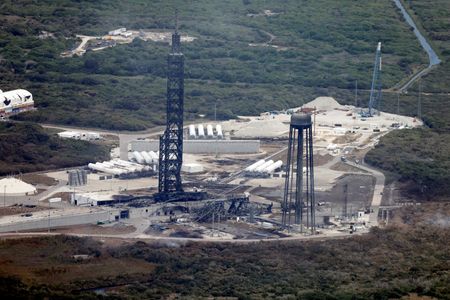

A rocket explosion at Blue Origin’s facility has caused significant damage to the company’s launch pad, leading to months-long delays that will impact Amazon’s satellite deployment plans and strengthen SpaceX’s position in the commercial space industry, according to company and industry sources.
The incident happened during engine testing for the New Glenn rocket, which was scheduled to launch next week. The timing couldn’t be worse for Jeff Bezos’ space ventures, as both Blue Origin and Amazon are working to compete with Elon Musk’s SpaceX in the heavy-lift rocket and satellite internet markets.
The explosion on Thursday also threatens NASA’s moon exploration goals.
The Blue Origin booster named “No, It’s Necessary” – referencing a line from the movie Interstellar – was destroyed in Thursday’s incident. An unnamed source familiar with the situation, who wasn’t authorized to speak publicly, said the launch pad was “practically destroyed” and engineers anticipate at least six months of delays, possibly longer.
“It’s only been a year since the SpaceX Starship also exploded on the launch pad and Blue Origin can also recover. But it will take months to rebuild,” said Antoine Grenier, partner and head of space consulting at Analysys Mason.
LENGTHY RECONSTRUCTION ANTICIPATED
When SpaceX’s Falcon 9 exploded on its launch pad in 2016, the company needed more than a year to fix the damaged infrastructure, though it managed to resume launches in 4-1/2 months by using a different Florida facility.
Although Amazon has diversified its launch partnerships, including working with SpaceX, this gives Musk’s company additional influence over his longtime competitor Bezos.
“Sorry to see this, I hope you recover quickly,” Musk wrote on X, later responding to Bezos with “Ad astra per aspera,” a Latin expression about achieving difficult objectives.
Amazon LEO had been counting on New Glenn’s frequent launch schedule to put half of its 3,200-plus satellite broadband network into orbit by July 2026 to satisfy regulatory requirements. A prolonged grounding by the FAA will seriously jeopardize this timeline.
SATELLITE NETWORK PLANS AT RISK
Grenier from Analysys Mason noted that Amazon has already secured much of the available capacity from other heavy-lift launch providers in the near future. While SpaceX might handle some additional demand, its Falcon 9 can transport roughly half the number of Amazon LEO satellites per mission compared to New Glenn, meaning any major shift would require substantially more launches, he explained.
Additionally, lunar cargo is designed for specific launch vehicles, making switches to different rockets complex.
The rocket was also set to carry Blue Origin’s inaugural Blue Moon lunar lander this year. NASA recently awarded the company a contract to transport two lunar rovers before the Artemis 4 mission in 2028.
NASA announced Thursday it would evaluate immediate effects on its Artemis and Moon Base initiatives, though it’s uncertain whether any missions will need reassignment.
However, it remains unclear how significantly this incident will affect Blue Origin’s future prospects and benefit SpaceX, whose schedule is already packed with its own Starlink satellite deployments plus commercial and government contracts.
The U.S. Space Force and National Reconnaissance Office reaffirmed their support for Blue Origin on Friday, maintaining their newly awarded national security launch contract from Thursday despite the devastating launch pad explosion that occurred hours afterward.
“Long term, the market still needs viable alternatives, so this strengthens SpaceX’s position at the margin, but doesn’t change the broader trajectory toward a multi-provider ecosystem,” said Mark Boggett, CEO of British space investor Seraphim Space.