A brand-new podcast is pulling back the curtain on the secrets lurking beneath the surface of the Great Lakes. Called Beyond the Shore, the series comes from Michigan Public and is hosted by Rebecca Williams.
Williams guides listeners through a fascinating underwater world, shining a light on long-lost shipwrecks, remarkable animal life, and the little-known ecosystems that exist beneath one of North America’s most iconic natural landmarks.
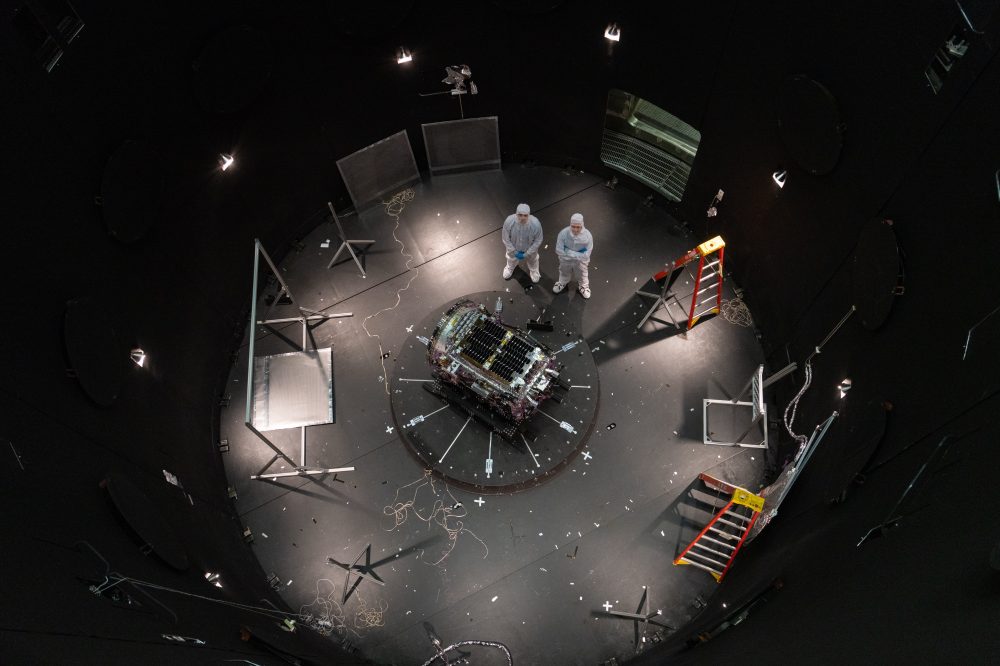
CAPE CANAVERAL, Fla. — NASA is in a race against time to prevent a valuable space telescope from tumbling back into Earth’s atmosphere, and a bold rescue mission is set to begin as early as this week.
The agency has committed $30 million to the salvage effort, which involves launching a robotic spacecraft designed to push the Swift Observatory into a higher, safer orbit. NASA contracted startup company Katalyst Space Technologies for the job, and the firm has built a three-armed robotic craft to chase down and grab the telescope once it reaches space.
The rescue vehicle will launch aboard a Pegasus rocket — a system carried aloft by an airplane — lifting off from an atoll in the Marshall Islands in the Pacific Ocean. Liftoff could happen as early as Tuesday.
Swift has been scanning the skies since 2004, but a recent surge in solar activity has been pulling it closer to Earth at an increasing rate. The telescope must be moved to a higher, more stable orbit before it’s too late.
Katalyst’s autonomous spacecraft, called Lift, is roughly the size of a small kitchen refrigerator and has a solar panel wingspan of about 40 feet (12 meters). It features three arms, each stretching just over 3 feet (1 meter), tipped with two finger-like pinching grippers that resemble the hands of a Lego mini figure.
Once Lift launches, it will take roughly a month to catch up with Swift and latch on, followed by another two months to raise the telescope’s orbit from its current altitude of 224 miles (360 kilometers) up to 373 miles (600 kilometers). The critical threshold is 185 miles (300 kilometers) — if Swift drops below that point before the rescue is complete, the mission fails. Current estimates put that deadline around October.
Katalyst Space CEO Ghonhee Lee said this is uncharted territory for American space operations. “This is the first American space robot to go up and do anything like this,” he told the Associated Press. “NASA has all these big senior observatories … all of them can benefit from a service like this. So what we’re proving with this mission is this is a new play in the playbook that’s available.”
Only China has previously attempted something similar, successfully moving a satellite to a higher orbit four years ago.
Swift, which weighs 1.6 tons (1.4 metric tons), was never built to be serviced or retrieved — making the operation particularly difficult. NASA officials acknowledge there are no guarantees. The agency signed its contract with Katalyst last September with two basic conditions: move fast, and don’t make things worse. Nine months later, the company is ready to proceed.
“I have to be honest. No one thought it was going to be possible. No one thought we would get as far as we’ve already gotten today,” said Shawn Domagal-Goldman, NASA’s astrophysics director.
To buy more time, NASA shut down all of Swift’s scientific instruments in February to slow its descent. NASA’s science mission chief Nicky Fox said the effort is absolutely worth it.
“If we let Swift reenter, we would lose that telescope. We would lose a lot of capability,” Fox said. “We don’t currently have the budget to build another one to replace that.”
Swift earned its name — the telescope is built to swiftly pivot and capture fleeting cosmic events like gamma ray bursts and exploding stars. With more discoveries expected from the Webb Space Telescope and the soon-to-launch Roman Space Telescope, a rescued Swift would be busier than ever, serving as what NASA describes as its “first responder” in space.
Katalyst views this mission as the foundation for a new space repair industry. The company’s next-generation robotic rescuer, expected to fly next year, will be capable of reaching satellites as high as 22,300 miles (35,800 kilometers) above Earth. Lee envisions a future with hundreds of robots in orbit — not just repairing and repositioning satellites, but also refueling them and helping construct solar farms, data centers, and other space-based platforms.
NASA’s Hubble Space Telescope, now 36 years old, could be the next candidate for a Katalyst rescue mission, potentially in 2028. Like Swift, Hubble is also losing altitude due to heightened solar activity. Lee said his company’s next-generation robot, currently in development, could extend Hubble’s life within a couple of years.
“It’s a national treasure,” Fox said of Hubble. “People love Hubble.”
If everything goes according to plan with the Swift mission, Lee says the telescope could be back in scientific operation by September.
Whether you embrace or resist generative AI chatbots, they are increasingly showing up in people’s romantic lives.
It’s no surprise that many people are skeptical about technology’s role in dating. Even so, a rising number of individuals are treating AI as an informal dating coach or relationship advisor. People are using these tools to get help crafting dating app profiles, figure out what messages from potential partners mean, write responses, and get general advice about romance.
The results, however, can be hit or miss. Knowing how to use a chatbot effectively — and where its limits are — can make a real difference. Here’s what experts have to say.
Logan Ury, the director of relationship science at the dating app Hinge, said she understands why people feel uneasy about AI in dating, but no matter how we go about finding love, “what we’re searching for stays the same.” Hinge offers AI-powered tools to help users build their profiles and keep conversations flowing more naturally.
Ury said AI is best used as a wingman rather than a ghostwriter, because “when you show up on that date, it’s very important that who your match meets is the person who they’ve been talking to online.”
In her view, good uses of AI include getting feedback on your profile or brainstorming first date ideas based on your match’s interests. What she doesn’t recommend: copying and pasting chatbot-written messages or using AI to alter or generate photos of yourself.
Dating coach Erika Ettin takes an even more cautious approach. She advises limiting chatbot use to tasks like proofreading your profile or messages. Ettin encourages people seeking relationships to aim for authenticity rather than a polished, AI-crafted image.
“All I ask is for people to put their own thought and critical thinking in first, and then if they’re going to use AI to check something, it’s after they have already formulated an opinion,” Ettin said.
Jules White, director of Vanderbilt University’s initiative on the future of learning and generative AI, pointed out that many users give chatbots “way too little and then expecting it to read their minds.”
The usefulness of the advice you get depends heavily on how you phrase your questions. Vague prompts tend to produce generic answers, while specific, well-structured questions lead to more personalized responses. But White noted that effective prompting isn’t just about choosing the right words — it’s about learning how to “yield this computational thought effectively to solve problems.”
One method White recommends is asking the chatbot to interview you before giving advice. You might say something like, “Here’s what I’m trying to do. I want you to ask me questions one at a time until you have enough information to do that thing,” White explained. This allows the chatbot to refine its questions based on your answers, producing more relevant guidance.
Matt Shumer, a general partner at investment firm Shumer Capital and a well-known figure in the AI world, said the most useful prompts are ones that push you to think more deeply. He advises telling a chatbot not to hand you an answer outright, but instead to “help me get there on my own.” In a dating context, that might mean sharing messages from someone you’re trying to understand and asking the chatbot to help you think through the situation the way a dating coach might.
“Help me understand the nuance, how they might be thinking about it, what the right way to respond is, but don’t give me the answer,” Shumer said.
While many people turn to AI expecting a neutral, unbiased take, the advice a chatbot gives is only as reliable as the information you provide. And many chatbots are designed to be agreeable — meaning they’re more likely to side with you when you’re describing a conflict or disagreement.
If you only share your own perspective during an argument, the chatbot won’t be able to offer a truly balanced view.
Liesel Sharabi, director of the Relationships and Technology Lab at Arizona State University, said sharing information from both sides of a situation can help, but it still won’t fully overcome a chatbot’s tendency to flatter the user.
“Hopefully, if you were having a problem in your relationship you wouldn’t make all of your decisions based on what one friend told you, right? Don’t do that with AI either — use it as one data point among many,” she said.
When temperatures soar, it’s not just people who struggle — birds and other wildlife are also at serious risk from extreme heat and humidity, experts say.
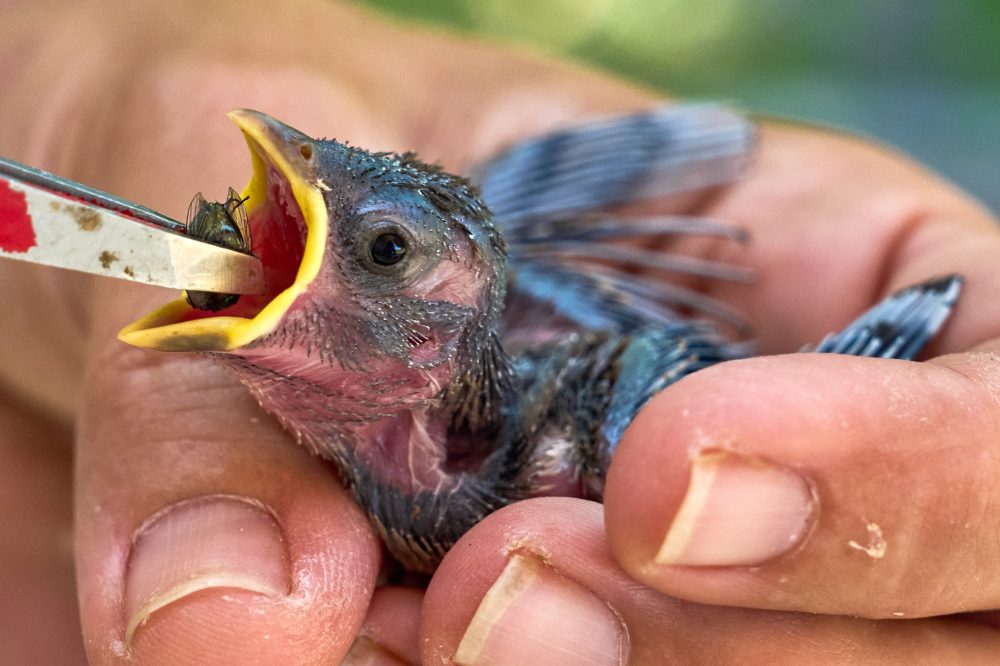
Birds play a vital role in ecosystems around the world. They pollinate flowers, keep pest populations in check, spread seeds, and can even act as early warning indicators of environmental problems. Protecting them during dangerous heat events matters.
David Bird, an emeritus professor of wildlife biology at McGill University, noted that birds are a remarkably diverse group and are often well-equipped to handle extended stretches of hot weather. Their body temperatures naturally run higher than those of mammals — some birds maintain temperatures around 38 degrees Celsius, or about 100 degrees Fahrenheit, and some run even warmer.
To stay cool, birds can adjust their feathers and increase airflow through a complex internal system of air sacs. They also change their behavior in response to heat.
Still, every bird has a limit. Aimee Van Tatenhove, a postdoctoral fellow at the Cornell Lab of Ornithology, explained that this threshold varies depending on the species. “This level differs by species, and as you can imagine, species that live closer to the poles are often much more susceptible to heat than species that live closer to the equator,” she said. “Prolonged intense heat like Europe is experiencing right now is likely pushing many species toward their maximum heat tolerances, putting them at risk of heat illness or death.”
Unlike humans and some other mammals, birds don’t sweat. Instead, they rely on other natural cooling methods. Some species — including common backyard birds — will open their beaks and pant, similar to how a dog cools itself. Others flutter the loose skin on their throat in a behavior called “gular fluttering.” Birds also frequently seek out shade and cool off in birdbaths, fountains, and shallow ponds.
There are several things people can do to help birds during a heat wave. In the near term, setting out shallow containers of fresh water in safe locations — away from predators — can make a real difference. Experts do caution that these water sources need to be kept clean.
Keeping bird feeders stocked is another way to help, giving birds an easy meal so they don’t have to forage in the blazing sun. This is especially important because insect populations — a primary natural food source for many birds — have declined sharply in recent years, partly due to climate change and pollution.
For those with more space, Professor Bird suggested planting layered vegetation over time, such as small shrubs and larger trees, to create shaded areas in yards.
That said, sometimes the best option is simply to leave birds alone. Jack Kottwitz, an assistant professor at Michigan State University’s College of Veterinary Medicine, pointed out that birds are often capable of finding their own comfort. “These birds know better than what we do about what is comfortable for them,” he said. Birds will naturally seek out cooler spots, lower perches, or even areas near fans.
The same general advice applies to other wildlife. Experts warn against offering wild animals unfamiliar food or water, or attempting to bring them inside. Signs of heat stress in wild animals can look similar to symptoms of diseases that those animals may carry.
The best course of action when encountering a sick or injured wild animal is to contact a local wildlife rehabilitator, who has the training and tools to provide proper care.
Lisa Duke, sanctuary grounds manager at the W.K. Kellogg Bird Sanctuary, which is affiliated with Michigan State, summed it up simply: “The best thing for wildlife is to let them be wild. They know what to do with their bodies.”
A massive space rock is set to cruise past Earth this weekend, though scientists say there is nothing to worry about.
The asteroid, known as 1997 NC1, will make its nearest pass to our planet Saturday morning, approaching within 1.6 million miles — or about 2.6 million kilometers — according to the European Space Agency.
First spotted nearly 30 years ago by an asteroid-detection program based in Hawaii, the rock measures somewhere between 2,461 feet and 5,413 feet across — roughly equivalent to the height of two to four Empire State Buildings stacked side by side.
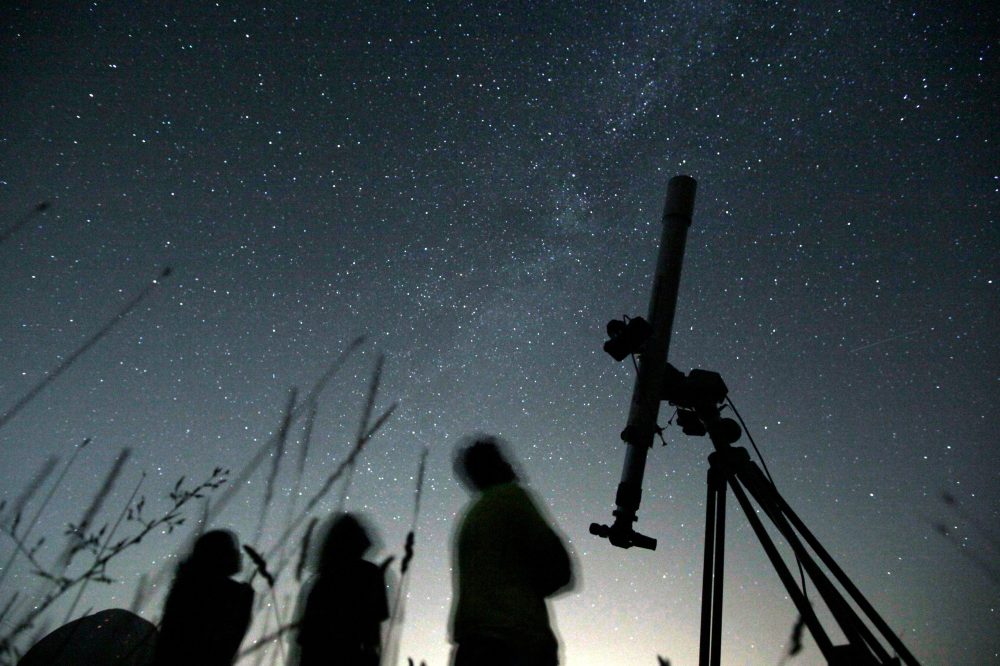
Amateur astronomers armed with binoculars or a small telescope may be able to see it as a faint dot of light drifting across the sky. According to NASA, Earth won’t see this asteroid pass from such a close range again until the year 2133.
The last comparable flyby occurred in 2022, when a similarly sized asteroid called 1994 PC1 made a safe pass near Earth at an even closer distance.
Space agencies including NASA and the European Space Agency continuously monitor the orbits of asteroids and other debris in space to guard against any potential impact with Earth. Last year, scientists tracked a smaller, hockey puck-shaped asteroid and confirmed it had no chance of striking Earth or the moon.
OpenAI, the company behind ChatGPT, announced Friday that it is holding back its newest artificial intelligence model at the request of the Trump administration — marking the latest step in an unprecedented government review of AI technology over potential cybersecurity threats.
The new AI product, called GPT-5.6 Sol, will be made available only to a “small group of trusted partners” that have received approval from the Trump administration, OpenAI said.
In a statement, OpenAI made clear it has reservations about the arrangement going forward: “We don’t believe this kind of government access process should become the long-term default.” The company described the restricted rollout as a temporary measure on the “path to broader availability in the coming weeks.”
This cautious, phased launch comes on the heels of government action earlier this month against Anthropic, a competing AI company and maker of the Claude chatbot. Anthropic was forced to pull two of its newly released models — known as Fable 5 and Mythos 5 — offline just days after their public debut, in response to a Trump directive that blocked foreign nationals from accessing them.
Government officials have been on high alert since Anthropic flagged earlier this year that its Mythos model showed an unusual ability to identify weaknesses in software — a capability that could potentially be exploited by malicious hackers to attack critical computer systems worldwide.
President Trump signed an executive order on AI oversight in June, creating a framework that allows the federal government to evaluate the national security risks of the most powerful AI systems for up to 30 days before they become publicly available. While the order describes AI developer participation as voluntary, the full framework has not yet been put in place.
OpenAI said its Sol model “is better at helping people find and fix vulnerabilities” than it is at enabling cyberattacks, and that it does not exceed the company’s own internal risk limits. However, OpenAI acknowledged that unexpected risks could still emerge, particularly if the model is used alongside other tools.
“That uncertainty, along with the model’s broader step change in capabilities, is why we are pairing the model’s increased capabilities with stronger safeguards and a phased release,” the company said Friday.
OpenAI announced Friday that it is holding off on a full public release of its latest artificial intelligence model, GPT-5.6, after the U.S. government requested early access to the technology before it becomes widely available.
Rather than launching to the general public, the company is initially making the model accessible only to a limited group of vetted partners, whose identities have been shared with federal authorities.
The move reflects increasing concern in Washington about the national security implications of powerful AI systems. Policymakers have been pushing tech companies to put stronger safeguards in place around their most advanced tools.
By gaining early access to these so-called frontier AI models, U.S. officials hope to spot potential threats — from cyberattacks to military misuse — before the technology is broadly deployed.
In a blog post, OpenAI described the restricted release as a short-term measure while the company collaborates with the federal government on a wider framework for how future AI models will be launched. The company also noted that it briefed the government on its plans and the model’s capabilities ahead of the release.
President Donald Trump signed an executive order earlier this month creating a voluntary framework that allows AI developers to give the U.S. government access to advanced “covered frontier models” for up to 30 days before sharing them with trusted partners.
“We are taking this short-term step because we believe it is the strongest path to broader availability in the coming weeks, while we work with the Administration to develop the cyber Executive Order framework and a repeatable process for future model releases,” OpenAI stated.
The company said it will continue thorough testing and close coordination with partners as it prepares for a broader release. However, OpenAI also warned that this level of government oversight should not become a permanent standard, and it did not disclose the names of its partner organizations.
OpenAI expressed concern that ongoing government restrictions could limit access to advanced AI tools for developers, businesses, cybersecurity professionals, and international partners who stand to benefit from them.
The centerpiece of the new model lineup is GPT-5.6 Sol, described as the company’s most capable model to date. It is accompanied by a mid-range option called Terra and a lower-cost version called Luna.
As Greece prepares for another dangerous wildfire season, a new defense strategy is being developed from space. A fleet of small, suitcase-sized satellites will be deployed to detect the earliest signs of fire — a groundbreaking system that officials hope will protect lives and communities. European planners also see potential for the same satellite technology to be used for border monitoring, heat-wave preparedness, and continental defense, particularly as tensions grow from Russia’s ongoing war in Ukraine and shifting relationships across the Atlantic.
ATF scraps phone-tracking program amid legal concerns
The Bureau of Alcohol, Tobacco, Firearms and Explosives has ended its contract for a surveillance tool that allowed government agencies to track mobile devices without a warrant. The tool, known as Webloc, pulls location data from consumer apps and advertising networks. Lawmakers, a prosecutor, and a judge all raised red flags about whether using it was legal. The ATF said it concluded the pilot program simply didn’t meet its needs. However, other federal agencies — including the FBI and the Department of Homeland Security — reportedly continue purchasing commercial location data without warrants.
Former Meta executive takes company to court over memoir
A former high-ranking Meta employee has filed a federal lawsuit against the social media company, accusing it of trying to muzzle her bestselling book, “Careless People,” which offers a detailed insider look at her time at the tech giant. Filed Thursday in federal court in Northern California, the suit argues that a private arbitration order barring her from discussing the company or promoting her book is not legally valid. She also claims the severance agreement she signed upon leaving Meta was made under pressure.
Apple raises prices on Macs and iPads
Apple announced Thursday that it is raising the prices on several Mac and iPad models, pointing to a shortage of memory chips driven by surging demand from the artificial intelligence industry. The Cupertino, California company described the situation as an “unprecedented challenge” for the consumer electronics sector. Under the new pricing, the entry-level MacBook Neo will run $699, up from $599. The 512 gigabyte MacBook Air climbs to $1,299 from $1,099, and the one terabyte MacBook Pro rises to $1,999 from $1,699. On the tablet side, the 128 gigabyte iPad Air now costs $749, up from $599, while the 256 gigabyte iPad Pro Wi-Fi jumps to $1,199 from $999. Analysts anticipate iPhone prices could follow suit later this year.
Australia moves to tighten social media ban for children
Australian Prime Minister Anthony Albanese announced that his government is prioritizing efforts to strengthen what is considered the world’s first law banning children under the age of 16 from social media platforms. Observers noted Friday that the push comes after evidence emerged that the ban — which took effect in December and applies to platforms such as Facebook, Instagram, and YouTube — has not been working as intended. Addressing Parliament on Thursday, Albanese said his government is exploring ways to make the restrictions more effective, adding: “We’re working on that as a priority because this is something that other generations didn’t have to deal with.”
New nonprofit launches to help workers displaced by AI
A newly formed bipartisan nonprofit organization is stepping up to assist Americans who have lost jobs due to artificial intelligence. Called RAISE US, the group is launching with more than $500 million earmarked for education and job training programs at the state level. Research from the Boston Consulting Group suggests that more than half of all U.S. jobs will be significantly changed by AI in the coming years. The organization was co-founded by former Commerce Secretary Gina Raimondo and former Indiana Governor Eric Holcomb. Initial programs are planned for Arkansas, Maryland, Utah, and Connecticut, with the idea that successful approaches can eventually be adopted as national policy by Congress.
Poll: Most Americans hit by scams, but few report them
A new survey from the AP-NORC Center finds that the majority of Americans are bombarded with scam attempts on a daily basis, and roughly three in ten say they have personally lost money or had their personal information stolen by scammers. A separate Gallup poll conducted with the Stop Scams Alliance between January and February found that in just the past year, about one in ten U.S. adults — or someone in their household — was tricked by a scammer into losing money or handing over access to a financial account. Nearly half of those victims reported losses exceeding $500. Despite the widespread impact, both surveys found that very few victims actually reported the scam to federal authorities or local law enforcement.
Experts offer tips to reduce AI’s environmental toll
Artificial intelligence is consuming enormous amounts of energy and water, and every online search adds to the environmental burden. While it may feel like individuals have little power to change that, sustainability experts say there are steps people can take. One key piece of advice: be brief when using AI tools. Experts point out that AI has genuine practical uses, but it’s not necessary for simple tasks like finding a cookie recipe, getting directions, or checking business hours. They also warn that the tech industry is pushing consumers to rely on AI for everyday tasks while remaining secretive about the true scale of its energy and water consumption.
Humanoid robot company heads to Wall Street
Oregon-based Agility Robotics, which builds human-like robots, is preparing to become a publicly traded company. The firm announced a planned merger with an investment company that values Agility at $2.5 billion, which would make it the first publicly traded business focused specifically on humanoid robots. Its flagship product, called Digit, is built to move heavy bins and containers in warehouse settings. Unlike many humanoid robots, Digit’s legs are designed more like a bird’s than a human’s. The company’s CEO says the robots are meant to take on repetitive, injury-prone jobs. Agility has received backing from Amazon, Nvidia, and other investors, with early customers that include Toyota and Mercado Libre. A fifth generation of the Digit robot is expected to be unveiled later this year.
Scientists shift focus from chatbots to AI that understands the physical world
A growing number of artificial intelligence researchers are moving beyond chatbot technology toward what are being called AI “world models” — systems designed to understand how the physical world works, not just how language is structured. Prominent scientists, including those dubbed the “Godmother of AI” Fei-Fei Li and researcher Yann LeCun, are leading the charge. They argue that true AI advancement requires machines to grasp the structure of space and time. While chatbots continue to attract massive investment — with trillions of dollars flowing to companies like Anthropic and OpenAI — a rising number of AI entrepreneurs are focusing on building systems that can respond intelligently to real-world physical environments.
ATHENS, Greece — When wildfires break out across the Mediterranean in summer, they can turn deadly within minutes. Greece knows this all too well.
In 2018, a fast-moving blaze east of Athens killed more than 100 people. Five years after that tragedy, an enormous fire swept through a remote nature reserve, becoming the largest wildfire ever recorded in the European Union.
Now Greece is turning to space for answers. The country has deployed a dedicated constellation of satellites to monitor for fires — a first for any nation on Earth.
Four satellites, each smaller than a piece of carry-on luggage, were launched into low Earth orbit in May. The move made Greece the first country in the world to fully incorporate a dedicated satellite network into its national firefighting operations.
The satellites were built by German company OroraTech and are equipped with thermal sensors capable of detecting new fires as small as four meters — about 13 feet — across. That’s a major improvement over traditional satellites, which can only pick up fires roughly the size of a cruise ship.
As Europe endures another brutal heatwave, the risk of wildfires looms large. Greece faces a particularly difficult challenge, with its dry, mountainous terrain and more than 100 inhabited islands.
When a fire is detected, artificial intelligence processes the satellite data and sends an alert to fire commanders that already includes the fire’s location, size, and intensity. When multiple fires are burning simultaneously, that real-time information becomes critical for deciding where to send resources first.
Fire Service Col. Zisoula Ntasiou, who also serves as vice president of the International Association of Fire and Rescue Services, explained the system’s value to the Associated Press: “For example, if you have 10 fires all over Greece and the fire radiative power is lower in some cases, you will not give priority to those ignitions; you will give priority to other ones.”
The thermal sensors can also pick up heat from solar panels, factory rooftops, and sun-baked rock surfaces. However, AI models are designed to filter out those false signals before any alerts reach emergency responders, according to officials involved in the program.
Greece experienced its hottest summer on record in 2024, followed by its third-hottest last year.
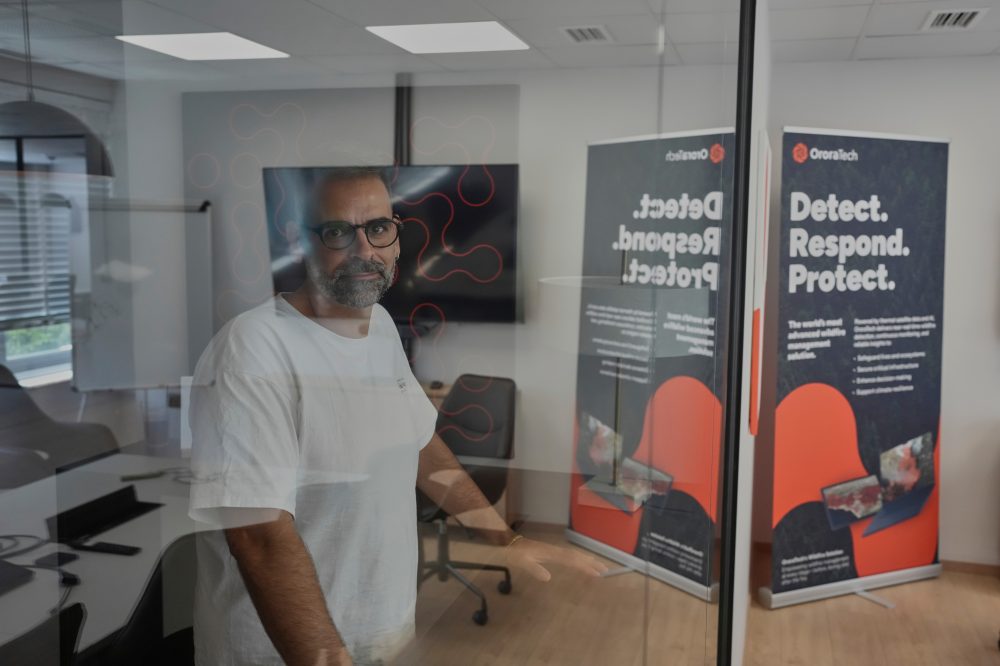
Ioannis Lantouris, who heads OroraTech’s Greek operations, spoke with the AP from his Athens office, where engineers were actively working on fire behavior models and kept a full-scale replica of the satellite near their workstations. “The global temperature is going up. That causes fires to change in intensity and ferocity,” he said. “Our models have to change and adjust to that. They have to be faster. They have to be more precise.”
The satellite system adds another layer of detection on top of existing drones and ground sensors, which Greece expanded significantly following the 2018 disaster that prompted a complete overhaul of how the country handles wildfires. The constellation helps close coverage gaps left by international satellites, spots fires in hard-to-reach areas, and builds more detailed models of how fires spread.
While several countries use thermal satellites, Greece is the first to fully weave them into its firefighting infrastructure. And the current system is just the beginning of a larger effort backed by Europe.
Greece is now developing a broader observation network with three European companies. That network will combine thermal satellites, radar satellites that can see through clouds and smoke, and optical satellites that capture highly detailed ground imagery. The total cost is 200 million euros — roughly $227 million — funded by the European Union. Declining costs for satellite launches and manufacturing have made the expansion financially viable, and additional satellites are expected to be deployed before the end of the year.
Planners in Athens and across Europe are already looking ahead to applying similar networks for purposes far beyond fire detection — including border surveillance, crop monitoring, disaster response, and heat wave planning.
One key priority is identifying urban “heat islands,” which would allow authorities to better direct cooling centers and emergency services to the areas that need them most.
These ambitions are part of a broader strategic shift by European governments to reduce reliance on foreign technology. Unsettled by Russia’s war in Ukraine and growing strains in trans-Atlantic relations, Europe is pushing for greater independence in critical technologies, and space infrastructure has become a central piece of that effort.
Greece’s satellite network fits into a continent-wide initiative that links launch vehicles, navigation systems, Earth observation tools, and secure communications into a more self-sufficient technological framework.
The ultimate goal, officials say, is to move past using satellite imagery as a passive tool and instead develop near-real-time decision-making systems that help governments respond to crises as they unfold.
The coming Greek summer will serve as the system’s first real-world test.
NOAA Marine and Aviation Operations is preparing to celebrate the grand opening of a newly renovated pier facility with a ribbon cutting ceremony at its North Charleston, South Carolina location.
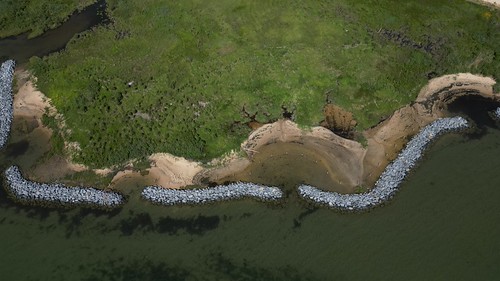
The renovation project involved tearing down and completely rebuilding the pier, which now includes shoreside power connections for docked vessels. The project also added a new warehouse, a sea wall, a living shoreline, and other supporting infrastructure to the site.
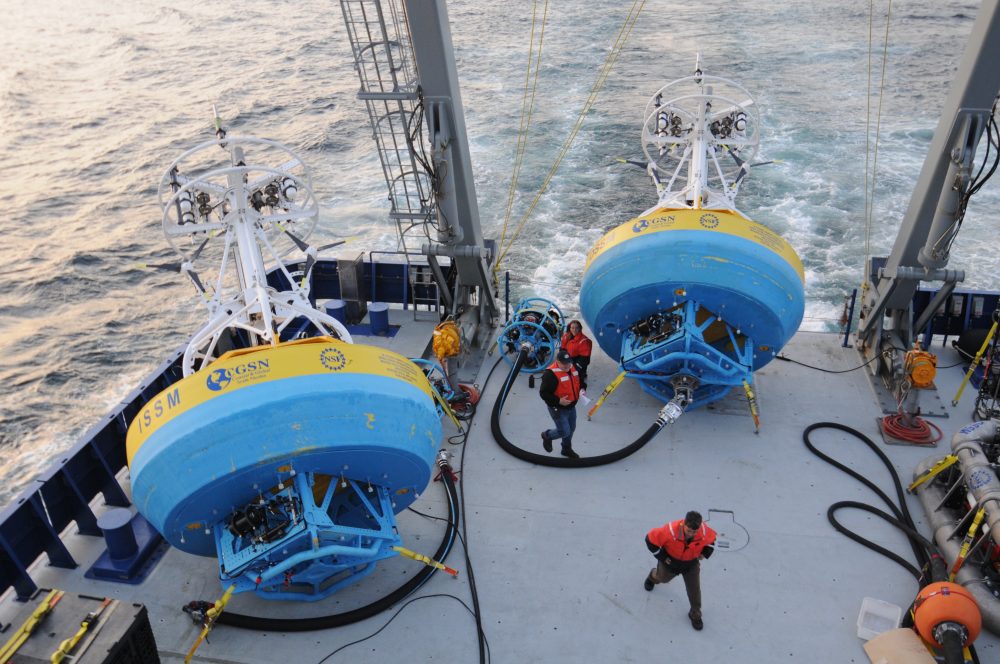
With the reconstruction complete, NOAA ships Ronald H. Brown and Nancy Foster — both of which call Charleston home — will once again have a dedicated berth at the facility. The upgrades are designed to better support research missions conducted throughout the Atlantic Ocean.
The ribbon cutting ceremony is scheduled for Wednesday, July 8 at 10 a.m. EDT at the NOAA North Charleston Pier Facility, located at 2234 S. Hobson Ave., Charleston, S.C. 29405.
Among those expected to attend are Neil Jacobs, Ph.D., the NOAA administrator, and Rear Admiral Chad M. Cary, who serves as NOAA Corps director and assistant administrator for NOAA Marine and Aviation Operations.
Members of the media who wish to cover the event must RSVP by emailing [email protected] no later than July 3, as access to the secure federal facility requires advance approval.
NOAA Marine and Aviation Operations oversees a fleet of 15 research and survey ships. The vessels range from large oceanographic ships capable of reaching the deepest parts of the world’s oceans to smaller craft used to chart shallow bays and coastal inlets across the United States. The fleet supports fisheries surveys, nautical charting, and ocean and climate research. All NOAA ships are crewed by NOAA Corps officers and civilian professional mariners.
A series of earthquakes in recent days — striking California, Venezuela, and Japan — sent warnings to millions of people through their mobile phones, giving them critical seconds to protect themselves before the shaking began.
Venezuela was hit by two deadly earthquakes on Wednesday evening and Thursday morning, while significant tremors also rattled Japan’s northern coast. Earlier in the week, a moderate earthquake struck the U.S. state of California. And at the start of June, 37 people in the Philippines lost their lives in a quake near Mindanao.
Many countries around the world have developed systems designed to alert residents seconds before an earthquake’s shaking arrives. And even in nations that lack those systems — like Venezuela — Google’s Android Earthquake Alerts can still deliver life-saving warnings.
Here’s what you need to know about how these systems work:
According to the U.S. Geological Survey, several countries currently operate Early Earthquake Warning systems — often referred to as EEW. Those countries include the United States, Mexico, Japan, Turkey, Romania, China, Italy, and Taiwan.
Venezuela is not among them. The back-to-back 7.2- and 7.5-magnitude earthquakes that struck Wednesday evening were among the most powerful to hit the country in over 100 years.
Despite the absence of a national system, some Venezuelans still received advance warnings through Google’s Android Earthquake Alerts platform. That system gathers crowdsourced data from the sensors built into individual smartphones to detect seismic activity and push warnings to nearby users.
Pericles Sánchez, a 39-year-old writer based in Caracas, received a warning on his Android phone several minutes before the earthquake reached his home — giving him enough time to run outside. He said his family’s house was not damaged.
“It wasn’t until we were already outside that we started to feel it,” Sánchez said.
On the U.S. West Coast, the USGS runs a system called ShakeAlert for California, Oregon, and Washington. That system delivers alerts through several channels, including a state-operated app called MyShake. Combined, those platforms notified more than 4 million people ahead of Wednesday’s California earthquake, according to USGS scientist Robert de Groot.
The first public EEW system launched in Mexico back in 1991. Today, Mexicans receive warnings through broadcast stations, mobile apps, and public alarm systems. Mexico City also holds regular earthquake drills so residents know how to respond.
Japan significantly expanded its earthquake warning capabilities following the devastating magnitude 9.0 earthquake and tsunami in 2011, which killed more than 22,000 people and triggered a catastrophic meltdown at the Fukushima Daiichi nuclear power plant. The country built out an underwater monitoring network called the Seafloor Observation Network for Earthquakes and Tsunamis — or S-Net — which uses thousands of miles of undersea cables and sensors to monitor the offshore subduction zone where tectonic plates collide. It is considered the most advanced system in the world, adding roughly 20 seconds to earthquake warning times and making tsunami warnings up to 20 minutes faster.
California’s MyShake app launched in 2019 and has since delivered 6.8 million alerts for 194 separate earthquakes, according to state data.
To understand how these systems work, it helps to know that earthquakes produce several types of seismic waves. P-waves travel the fastest but cause only minor vibrations. S-waves are slower but far more dangerous, producing the intense ground shaking most people associate with earthquakes. L-waves arrive last and are the most destructive of all.
Most EEW systems use seismometers and other sensors to detect these waves, then quickly transmit that data to regional networks. Within seconds, analysts can estimate the earthquake’s location and likely magnitude. If the intensity crosses a certain threshold, alerts are pushed out to areas expected to feel the impact.
In the United States, those alerts go out through the Wireless Emergency Alert system, various apps, and regional warning platforms. Some people may receive multiple alerts for the same event, while others — especially those in rural areas or without phones nearby — may receive none at all.
De Groot of the USGS emphasized the importance of having multiple alert channels in place.
“It’s always good to have more than one way of getting alerts. It’s the reason why you carry a spare tire in your car or carry some small bills in your wallet because the ATM may not work,” he said.
Google’s Android warning system relies on the accelerometers inside smartphones — the same sensors that rotate the screen when you tilt your phone. If a stationary Android device detects a P-wave, it sends a signal to Google’s detection center, which then cross-references data from other phones in the region. That combined data is used to confirm the quake and trigger alerts.
One limitation of these systems is that people closest to an earthquake’s epicenter often receive the shortest warning times — sometimes the shaking has already started before the alert arrives. Those farther from the epicenter may have more time to react, though typically still only seconds.
The reason warnings can outpace earthquakes at all comes down to physics: electronic signals travel at the speed of light, far faster than seismic waves move through the earth. It’s similar to a thunderstorm — the farther you are from a lightning strike, the longer it takes before you hear the thunder.
Wireless Emergency Alerts are capped at 90 characters and are broadcast from cell towers to any compatible mobile device. Alerts from apps like MyShake or those sent through Google devices typically include more detail — such as the distance in miles from the device to the epicenter and the earthquake’s estimated magnitude.
Regardless of the platform, all alerts carry the same core instruction: “Drop, cover, hold on.”
SAN JUAN, Puerto Rico — The pair of devastating earthquakes that struck the northern coast of Venezuela, leaving more than 180 people dead, represent a rare seismic event scientists refer to as a “doublet.”
According to the U.S. Geological Survey, a doublet occurs when two earthquakes of comparable size strike in roughly the same location within a very short period of time. On Wednesday evening, a magnitude 7.2 quake hit first, with a slightly stronger magnitude 7.5 following just 39 seconds afterward.
The back-to-back strikes brought down buildings in Venezuela’s capital city of Caracas and surrounding areas. Around 1,500 people sustained injuries, and thousands more were reported missing. Officials said the coastal region of La Guaira, situated north of Caracas, suffered some of the worst destruction and the highest number of casualties.
Christine Goulet, director of the USGS earthquake science center in California, told the Associated Press that while doublets are less common than the typical pattern of one major quake followed by smaller aftershocks, they can occur anywhere on the planet.
Doublets tend to point to a complicated fault structure. In Venezuela, that structure is known as the Bocono fault, which stretches along the spine of the Venezuelan Andes for approximately 300 miles, or 500 kilometers. The region had already experienced a doublet in September 2025, when quakes of magnitudes 6.2 and 6.3 struck west of Caracas, killing at least one person and injuring more than 100 others. The towns of Zulia and Lara reported the bulk of the damage from that earlier event.
Most earthquakes take place along the boundaries where tectonic plates meet. This week’s doublet was triggered by a rupture at the boundary between the Caribbean and South American tectonic plates. The Caribbean plate, which sits to the north of Venezuela, moves eastward relative to the South American plate at an average pace of about 0.79 inches — or 2 centimeters — per year.
“It’s a large displacement,” Goulet noted. “It’s on the order of the San Andreas fault.”
The movement involved shallow strike-slip faulting, a process in which two sections of rock slide horizontally past one another. Goulet explained that this type of movement is not automatically more hazardous than others.
“A more vertical motion can be more damaging,” she said, adding that other variables — including how long the rupture extends — also determine how much destruction results.
David Naar, associate dean at the University of South Florida’s College of Marine Science, noted that the boundary between the Caribbean and South American plates is less active compared to other plate boundaries around the world. According to USGS data, only seven earthquakes of magnitude 6 or greater have struck near the location of this week’s quakes over the past century.
Those include the 2025 doublet, as well as individual earthquakes in 2009, 1989, and 1975. The deadliest of those earlier events was a magnitude 6.6 quake in July 1967 that killed hundreds of people.
Caracas resident José Vitriago remembers that 1967 earthquake. He was only 2 years old at the time. “Our house broke,” he recalled in an interview with state-owned broadcaster Venezolana de Televisión. Vitriago described Wednesday’s doublet as “horrible, horrible.”
Looking at a broader historical record, USGS data shows that five earthquakes of magnitude 7 or higher have struck northern Venezuela or its coastline since 1900. The most catastrophic quake on record in the region occurred in March 1812 along the Bocono fault system, with an estimated death toll of around 30,000 people.
Scientists are unable to predict when earthquakes will strike, but aftershocks are a common follow-up to major seismic events. The USGS has calculated a 99% probability that at least one magnitude 4 aftershock will hit Venezuela within the coming week, and a 24% chance that a magnitude 6 aftershock could occur.
One added concern is that Venezuela lacks an early earthquake warning system — the kind that uses sensors to detect the first waves of a quake and alert people before stronger shaking arrives.
“It’s very distressing that there was basically no time to evacuate,” Goulet said. “That’s extremely unfortunate.”
SpaceX is moving forward with plans to construct an eight-mile natural gas pipeline — dubbed “Starpipe” — connecting to its launch facilities in Texas as early as next month, according to county documents reviewed by Reuters. The goal is to support a significant increase in launches of the company’s next-generation Starship rocket.
According to a filing made last month with the Texas Railroad Commission by SpaceX affiliate Lone Star Mineral Development, the pipeline is expected to be operational by January 26. Starpipe will terminate at Starbase, SpaceX’s company town in Texas.
The project, first reported by the Rio Grande Valley Business Journal, reflects Elon Musk’s ambition to dramatically speed up Starship development and increase its flight frequency. The towering 40-story rocket is central to SpaceX’s plans to grow its Starlink broadband network, launch orbital AI data center satellites, and eventually send astronauts to both the moon and Mars.
Starship is designed to be fully reusable and consumes roughly 630,000 gallons — about 2.4 million liters — of liquid methane per launch. Currently, that fuel is delivered by hundreds of tanker trucks over the course of several hours, a method that is incompatible with Musk’s vision for scaling up launches. The rocket has completed 12 test flights since 2023, but Musk has stated he wants to eventually reach hundreds and even thousands of launches per year.
SpaceX did not return a request for comment from Reuters.
While it is uncommon for a space company to construct its own natural gas pipeline for rocket fuel, Starpipe may only be the first step in a more ambitious long-term strategy. A Reuters review of Cameron County land records shows SpaceX has spent years exploring potential drilling operations near Starbase and across Texas.
SpaceX President Gwynne Shotwell told CNBC on June 12, the day the company went public, that SpaceX intended to build pipelines, process its own propellant, and was actively looking into drilling for its own natural gas.
Texas oil and gas consultant Stan Lindsey noted that venturing into natural gas extraction would be a tall order for a company without experience in that industry. “I’m not saying it’s beyond the realm of possibility … it’s possible they got a really nice prospect,” Lindsey said. He added that if the drilling plans don’t pan out, “they’ve got a fallback position” in Starpipe.
Land records show SpaceX has signed more than 100 paid-up oil and gas leases with Texas landowners since 2023.
Starpipe is slated to originate on an 83-acre tract at the Port of Brownsville, which SpaceX is reportedly in talks to lease from the city for 50 years, according to a port official who spoke with Reuters anonymously due to the private nature of the negotiations.
Engineering documents SpaceX submitted to the U.S. Army Corps of Engineers — included in a public notice from last August — indicate the company wants to build a liquefaction facility at Starbase to convert the piped-in natural gas into liquid methane on-site.
“Certainly that would make the most efficient sense,” said William Farrar, a Texas oil and gas attorney and geoscientist with extensive experience in the field.
Lindsey also noted that SpaceX could potentially tap into a pipeline expansion project by Enbridge — the Valley Crossing Pipeline — which would run near the starting point of Starpipe. Enbridge did not immediately respond to a request for comment.
SpaceX’s expansion into gas infrastructure — an area traditionally dominated by energy and pipeline companies — highlights the firm’s long-held strategy of owning as much of its supply chain as possible. That capital-heavy approach has helped SpaceX outpace competitors in rocket and spacecraft development.
The pipeline’s 16-inch diameter suggests the company anticipates fuel needs well beyond the 25 launches per year currently authorized by the Federal Aviation Administration.
According to SpaceX’s initial public offering prospectus, the company ultimately aims to deploy thousands of solar-powered, AI-focused satellites whose combined energy output could approach one-fifth of the entire U.S. power grid.
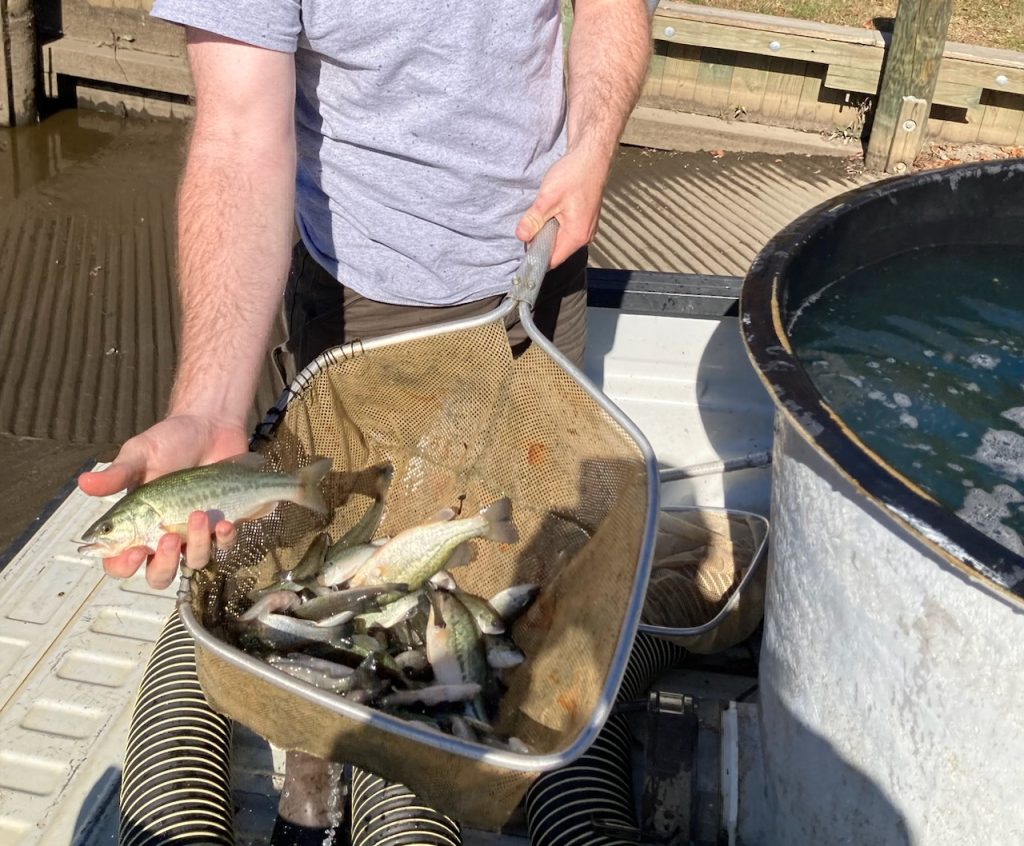
For more than four decades, the Maryland Department of Natural Resources has been working to give largemouth bass a fighting chance in the state’s tidal rivers. Since the early 1980s, the agency has released more than six million of the fish into those waterways, with the goal of boosting existing populations and creating better fishing opportunities for Maryland anglers.
The program carries real economic weight. Each year, the DNR issues permits for more than 400 fishing tournaments centered on black bass — the broader genus that includes largemouth bass — making tidal bass fishing a significant recreational and economic driver for the state.
The stocking effort runs year-round and is funded through state fishing license fees.
Spring: Where It All Begins
The process kicks off each April when fisheries biologists take an electrofishing boat onto the Potomac River to collect adult largemouth bass. Between 20 and 30 fish are gathered, with a ratio of two to three males for every female. These adult fish — known as broodstock — are then brought to the Joseph Manning Hatchery at Cedarville State Forest, where they spawn naturally in hatchery ponds. The young fish are left in a predator-free setting until they’ve used up their yolk sacs, the built-in nutrient supply they’re born with. The adult fish are then returned to their original spots on the Potomac.
The number of newly hatched fish — called fry — produced each season depends heavily on factors outside the hatchery’s control, including water temperature, spawn timing, and the availability of zooplankton for the fry to feed on. In 2025, conditions were nearly ideal, and the Manning Hatchery ponds turned out far more fry than the facility could raise to larger sizes. Those extra fry became the first batch stocked for the year, released into areas of Maryland’s tidal waters with the best habitat for young fish — typically shallow areas with plenty of underwater vegetation and large pieces of woody debris that offer cover from predators and easy access to food. In 2025, a total of 40,000 bass fry were stocked in prime habitat areas along the Potomac and Patuxent rivers.
Summer: A Second Wave
Fish not released in May are either kept in hatchery ponds or moved to large indoor tanks, depending on the size they’re being raised to reach. Those grown in the ponds are targeted to reach two to four inches in length. At that size, they have a better chance of survival than newly hatched fry, though they still need quality habitat to find food and avoid predators. These fish are typically released in June, when underwater vegetation in tidal areas is more plentiful. In 2025, more than 26,000 fish in that size range were stocked across the Nanticoke, Choptank, Potomac, Wicomico, and Patapsco rivers, along with Marshyhope Creek.
Fall: The Largest Fish
Fish transferred to indoor tanks are raised to four inches or more and are generally released in October or early November, since reaching that size takes additional time and feeding. These fish are grown with the help of a bead filter — a piece of equipment purchased through donations to the Black Bass Conservation Fund — which keeps water quality high and allows a large number of fish to grow in tanks much smaller than outdoor hatchery ponds. The filter makes it possible for the DNR to stock roughly 4,000 additional fish of four inches or more each year. Because of their larger size, these fish have the best survival odds and can be placed in waterways that may not have ideal young-fish habitat but can still support healthy fisheries thanks to abundant food sources and good adult habitat. In 2025, a total of 4,375 fish were stocked in the Middle, Choptank, and Patapsco rivers, as well as Marshyhope and Tuckahoe creeks.
Making Every Fish Count
As the target release size goes up, so does the time and food needed to get there — creating a trade-off between the number of fish stocked and their individual size. Decisions about where to stock, when to do it, and what size fish to use are guided by available habitat data and findings from the department’s Tidal Bass Survey, which tracks the long-term health of Maryland’s tidal bass fisheries. Results from the survey are published in the Black Bass Annual Review on the DNR’s website.
By matching fish size to habitat conditions and directing stocking efforts toward waterways most in need of supplementation, the DNR aims to give every stocked fish the best possible shot at survival — and give Maryland anglers the most value for the license fees that make the program possible.
The program is supported by Maryland fishing license sales, the Sportfish Restoration Act, and the Black Bass Conservation Fund. Information about the conservation fund and how to contribute is available on the DNR website.
NEW YORK (AP) — A new study suggests that when it comes to laughter, humans and great apes have a lot more in common than you might think — and they have for a very long time.
To reach that conclusion, researchers turned to a surprisingly simple method: tickling. Scientists tickled 13 captive apes — among them gorillas, orangutans, chimpanzees, and bonobos — and recorded the sounds they made. Those decades-old recordings were then revisited and compared against fresh recordings of four young children being tickled and playing at home.
What they found was striking. Both humans and great apes laugh with a consistent rhythm — a steady, predictable beat between each burst of laughter. That shared pattern, researchers believe, is a clue pointing back to a common ancestor.
“In a way, we are very similar to other great apes because we’ve been laughing in a similar way for 15 million years,” said Chiara De Gregorio, a primatologist at the University of Warwick in England and one of the study’s authors.
Laughter is a universal way of expressing joy and playfulness without saying a single word. Many other animals can laugh too, but their versions don’t mirror human patterns as closely. Rats, for instance, respond to tickling with high-pitched squeaks that fall outside the range of human hearing.
While researchers have spent time analyzing animals’ facial expressions during laughter, far less attention has been paid to how those laughs actually sound. And human laughter, it turns out, has grown more sophisticated over time. We adjust our laughs depending on the situation — think of the polite chuckle you might give a coworker versus the uncontrollable laughter shared with a close friend.
“We are like the masters of laughter, I would say,” De Gregorio added. Her team’s findings were published Thursday in the journal Communications Biology.
Brittany Florkiewicz, who researches animal communication at Lyon College and was not involved in the study, said the results make sense and highlight the need for more research in this area. She would like to see similar recordings made of other animals known for playful expressions — such as dogs, horses, and cats — to better understand how laughter developed across species.
Doing so, she said, could help scientists “understand what makes us uniquely human, but also what is similar between humans and other animals.”
It may sound like a lighthearted topic, but studying the roots of laughter offers real insight into how humans learned to communicate — and ultimately, how we developed language itself. Since sounds leave no fossil record, scientists are piecing together that history one laugh at a time.
A Texas-based biotechnology company and a federal wildlife agency have joined forces to build what they’re calling a biological safety net for the nation’s most vulnerable species.
Colossal Biosciences and the U.S. Fish and Wildlife Service announced Thursday a sweeping plan to establish a cryogenic archive — dubbed the BioVault — that would store living cells, reproductive tissues, and genetic DNA from every species currently protected under the U.S. Endangered Species Act. That covers approximately 2,300 types of animals and plants classified as either threatened or endangered.
Colossal CEO and co-founder Ben Lamm said the goal is to preserve biological samples before species populations decline beyond the point of no return. “The materials support assisted reproduction, genetic management of wild populations and future restoration if a species is lost entirely. For the first time, we have the technology to make that possible at scale,” Lamm told Reuters.
Colossal describes itself as a company focused on “de-extinction” — the science of bringing back vanished species. The company made headlines last year when it announced it had genetically engineered the dire wolf, an Ice Age predator that disappeared thousands of years ago. Colossal says it will invest tens of millions of dollars to build and run the BioVault, and that the agreement with the federal government does not require any federal funding.
The archive is designed to function as a permanent public resource, with standardized samples and open-access genetic data available to scientists across the globe.
Colossal’s chief animal officer, Matt James, explained that the Fish and Wildlife Service — which operates under the U.S. Interior Department — is leading the partnership. The agency will determine conservation priorities and supply the field networks and legal authority needed to collect samples at this scale. James noted that no completion deadline has been set for the project.
U.S. Fish and Wildlife Service Director Brian Nesvik expressed support for the effort. “This collaboration will help advance our understanding of how biobanking and genomics can complement existing conservation tools and contribute to the recovery and long-term resilience of imperiled species,” Nesvik said in a statement provided by Colossal.
Samples stored in the BioVault will be kept in liquid nitrogen at minus-321 degrees Fahrenheit (minus-196 degrees Celsius) at Colossal’s Dallas headquarters and at additional locations. Lamm said the system is designed with multiple layers of backup protection. “Redundancy is built into the architecture so that no single event, whether a natural disaster, power failure or regional disruption, can compromise the integrity of the collection,” he said.
Lamm drew a comparison between the BioVault and the biblical story of Noah’s Ark. “The Noah’s Ark metaphor is about preserving the blueprint of life before it’s lost, not waiting until a species is on the brink to start paying attention. Noah didn’t build the ark after the flood. The whole point was preparation, preservation and the option to restore what might otherwise disappear forever,” Lamm said.
He continued: “We’re not loading two of every animal onto a boat, we’re preserving the genomic and biological building blocks that define what an entire population is. Every species we bank is a species whose biological information, millions of years of evolutionary innovation encoded in its DNA, is protected against the worst outcomes.”
The stored material could support recovery programs, help restore genetic diversity in struggling populations, and in extreme cases, serve as the foundation for future de-extinction efforts, Lamm said.
Species protected under the Endangered Species Act range widely — from well-known animals like the polar bear to lesser-known creatures such as the Hine’s emerald dragonfly.
Lamm noted that biobanking for wildlife has existed for decades, but in a fragmented way. Zoos, universities, government agencies, and private institutions have each built their own collections independently, with different procedures, different access policies, and no shared catalog. The result is uneven coverage — some species have duplicate samples stored at multiple institutions while others have none at all. The BioVault is intended to address that gap by operating as a national program backed by a government mandate.
One well-known model for this kind of preservation is the Svalbard Global Seed Vault, a so-called “doomsday” facility on a remote Norwegian Arctic island that stores food crop seeds from around the world.
James said that samples contributed to the BioVault will remain the property of the organizations that donate them. He also issued a broader invitation to the conservation community. “This is also a call to the broader conservation community — zoos, universities, government agencies, NGOs and research institutions around the world. The Colossal BioVault is built to be complementary, not competitive. If you’re doing this work, we want to work with you,” James said.
A wasting disease that exploded during a severe Pacific marine heatwave between 2013 and 2016 — known as “the Blob” — wiped out vast numbers of sea star species and caused the collapse of enormous stretches of coastal kelp forests stretching from the Aleutian Islands all the way down to the Baja Peninsula. Among the hardest-hit species was the sunflower sea star, a top-of-the-food-chain predator that keeps kelp forest ecosystems in check by feeding on sea urchins and other kelp grazers.
Now, as captive breeding efforts and the discovery of new sea star refuges — including one found in Greater Farallones National Marine Sanctuary in August 2025 — offer renewed hope for the species, researchers at NOAA’s Pacific Marine Environmental Laboratory (PMEL) have created a fast environmental DNA, or eDNA, detection method that gives scientists a powerful new way to track the sunflower sea star’s health and potential comeback.
“By analyzing tiny amounts of genetic material they shed into the water, we can now identify these large but elusively rare sea stars without ever seeing them,” said Zachary Gold, a scientist who leads PMEL’s Ocean Molecular Ecology program. “This opens the door to efficiently monitoring the recovery of this species, especially at deeper depths and sites that are difficult for divers to survey.”
The eDNA technique is capable of detecting just a small handful of DNA copies in a single liter of seawater. Compared to traditional dive surveys, it is cheaper, more sensitive, and better suited for quick assessments. Results can come back within one to two days and can then be followed up with visual confirmation in the water. In one recent example, after an eDNA signal was detected in Northern California’s Noyo Bay, divers were able to locate a juvenile sunflower sea star roughly the size of a teacup.
Why the Sunflower Sea Star Matters to Kelp Forests
The sunflower sea star — once plentiful along the Pacific Coast and now proposed for listing under the Endangered Species Act — plays a role similar to that of the sea otter. Both are aggressive hunters of bottom-dwelling sea urchins. When sunflower stars, sea otters, and other healthy predator communities are present and thriving, they help keep sea urchin populations in check, which in turn protects vital kelp forest ecosystems.
Kelp forests rank among the most biologically productive and economically valuable ecosystems on the planet. They serve as nurseries and high-quality habitat for hundreds of marine species, filter nutrient pollution, and support fish populations and commercial fishing industries worldwide.
Under normal conditions in healthy kelp forests off California, sea urchins play a natural role — grazing on algae and helping cycle nutrients along the ocean floor. But when that balance breaks down, urchin populations can explode, turning once-vibrant kelp forests into barren underwater wastelands. Even after the Blob’s warmth faded, starving sea urchins continued to prevent kelp from bouncing back by constantly eating off new growth across hundreds of miles of coastline.
Captive Breeding Programs Offer a Lifeline
When the sea star wasting disease outbreak struck, scientists moved quickly to bring surviving sunflower stars into captivity to protect the species and study the illness. That intervention led to two major breakthroughs: researchers learned how to successfully breed sunflower stars in a captive setting, and they identified a previously unknown bacterium called Vibrio pectenicida as the main cause of the disease.
The captive breeding program also gave scientists a way to test and validate their new eDNA detection tool. The research team put the method through its paces in labs, in aquarium settings, and out in the ocean, comparing results alongside traditional dive surveys. The findings were clear — the test accurately identified whether the species was present or absent, and the more sunflower stars divers spotted, the higher the concentration of DNA the method picked up.
Signs of Recovery Being Tracked Along the Pacific Coast
In recent years, scattered sightings in Olympic Coast National Marine Sanctuary and in Northern California tidepools have sparked cautious optimism that sunflower stars may be slowly returning to parts of their historic range. In 2026, a team that included NOAA scientists surveyed 39 sites across California — covering former population hotspots, locations with recent informal sightings, and areas within and near marine protected areas.
Using the eDNA method, the researchers confirmed the presence of sunflower stars at six separate sites across Mendocino, Sonoma, and San Mateo counties. Notably, one of those detections marked the first confirmed presence of the species south of San Francisco in ten years.
PMEL’s Ocean Molecular Ecology program has since been deploying the tool to assist conservation partners. In Olympic Coast National Marine Sanctuary, researchers are now pairing eDNA detections with visual surveys to modernize how they track the species.
“The development of a targeted, validated detection method for the sunflower sea star adds to NOAA’s growing inventory of tools to monitor and evaluate species of concern or importance,” said Krista Nichols, a genetics program manager with NOAA’s National Marine Fisheries Service. “For sea stars in particular, the use of eDNA could be a game changer for this struggling apex predator.”
New Nonprofit Launches $500M Effort to Help Workers Displaced by AI
A newly formed bipartisan nonprofit organization called RAISE US is stepping up to address one of the biggest economic concerns of our time: workers losing their jobs to artificial intelligence. The group is launching with more than $500 million earmarked for education and job training programs at the state level. According to an analysis by the Boston Consulting Group, more than half of all jobs in the United States could be transformed by AI within the next few years. Former Commerce Secretary Gina Raimondo and former Indiana Gov. Eric Holcomb are leading the effort as co-founders. Initial programs are planned for Arkansas, Maryland, Utah, and Connecticut. Raimondo has said the goal is for those states to serve as testing grounds for ideas that Congress could eventually turn into national policy.
Scam Attempts Are Overwhelming Americans — But Few Report Them
A new AP-NORC poll reveals that the vast majority of Americans are bombarded with scam attempts on a daily basis, with roughly 3 in 10 people saying they have personally lost money or had their personal information stolen by scammers. A separate survey conducted by Gallup and the Stop Scams Alliance between January and February found that in the past year alone, about 1 in 10 U.S. adults — or someone in their household — was tricked by a scammer into losing money or handing over access to a financial account. Nearly half of those victims reported losing more than $500. Despite the widespread impact, both surveys found that very few victims actually reported the scam to federal authorities or local law enforcement.
AI’s Hidden Environmental Cost — And What You Can Do About It
Every time you type a question into an AI tool, you’re adding to your environmental footprint. Artificial intelligence systems consume enormous amounts of energy and water, and experts warn that the problem is getting worse as AI use expands. While it may feel like individuals have little power to change things, sustainability experts say there are steps people can take. The advice is straightforward: keep your AI queries brief and think twice before using AI for simple tasks like finding a cookie recipe, getting directions, or looking up business hours. Experts note that the tech industry is actively pushing people to rely on AI for these everyday tasks, while remaining secretive about just how much energy and water their systems actually consume.
Humanoid Robot Company Eyes Wall Street in $2.5 Billion Deal
Agility Robotics, an Oregon-based company that builds human-shaped robots, is preparing to enter the public markets. The company announced a planned merger with an investment firm that would value it at $2.5 billion — a move that would make it the first publicly traded company focused specifically on humanoid robots. Its flagship product, called Digit, is built to handle heavy bins and containers in warehouse environments. Unlike other humanoid robots, Digit’s legs are designed more like a bird’s than a human’s. The company’s CEO has said the robots are intended to take over repetitive, injury-prone tasks. Agility has financial backing from Amazon, Nvidia, and others, with Toyota and Mercado Libre among its early customers. A fifth generation of Digit is expected to arrive later this year.
AI Scientists Shift Focus from Chatbots to the Physical World
Some of the brightest minds in artificial intelligence are moving beyond the chatbot era. A growing number of researchers and entrepreneurs are now focused on what are called AI “world models” — systems designed to understand the physical structure of space and time, not just process written language. Among those leading the charge are prominent scientists including “Godmother of AI” Fei-Fei Li and Yann LeCun. While enormous sums of money — potentially trillions of dollars — continue to flow into chatbot developers like Anthropic and OpenAI, a rising faction of AI innovators is devoted to building systems that can respond intelligently to real-world, physical environments.
China Reclaims Title of World’s Fastest Supercomputer
For the first time since 2017, a computer in China has claimed the top spot on the list of the world’s most powerful supercomputers. A machine called LineShine, located in Shenzhen, China, knocked the previous leader — a U.S. computer known as El Capitan, based in California — out of first place. The latest rankings from the TOP500 project, announced Tuesday, show that the LineShine computer at China’s National Supercomputing Center is capable of performing 2.198 exaflops, meaning it can carry out more than 2 quintillion calculations every second. The Top500 list is widely seen as a measure of a country’s technological strength.
AI Chatbots Are Now Playing Matchmaker in the Dating World
Artificial intelligence is finding its way into the world of romance. People are turning to AI in several ways when it comes to dating — some use AI-powered matchmaking services, others rely on it to build out their dating profiles, and many are using chatbots to help write messages to potential partners or decode messages they receive. Major dating apps and AI companies are embracing the trend. ChatGPT and Gemini have both shared content on TikTok highlighting their tools’ ability to offer personalized relationship guidance. Dating coach Carey Gaynes captured the moment with a cultural reference: “Claude is the new Cyrano,” she said, pointing to the 19th century French play ‘Cyrano de Bergerac,’ in which one character secretly writes the romantic words spoken by another.
Alibaba Takes Pentagon to Court Over Military Company Label
Chinese tech giant Alibaba has filed a lawsuit against the U.S. Department of Defense, seeking to have its name removed from a government list that designates it as a Chinese military company. The suit was filed Tuesday in California and argues that the designation has no factual or legal foundation. The label, which was announced on June 8, effectively brands Alibaba as a national security threat and has caused significant damage to the company’s reputation. The Pentagon has claimed that Alibaba has indirect ties to China’s defense sector, a claim the company strongly denies. Alibaba says it operates under an independent board of directors and has no connections to the military. The lawsuit follows similar legal challenges brought by other Chinese companies facing the same designation.
Supreme Court Shuts Down Lawsuit Linking Cisco Technology to Persecution of Falun Gong
The U.S. Supreme Court has sided with technology company Cisco, agreeing to end a lawsuit that alleged the company’s products were used to help the Chinese government persecute members of the Falun Gong spiritual movement. The justices ruled Tuesday that American courts are not the appropriate venue for such cases, rejecting the plaintiffs’ arguments that the lawsuit could proceed under the 18th-century Alien Tort Statute and the Torture Victim Protection Act, which was first passed in 1991. The ruling continues a legal trend in which courts have turned away plaintiffs attempting to use the U.S. justice system to seek accountability for actions taken by foreign governments, particularly when those actions occurred on foreign soil.
AI Spending Frenzy Rattles Investors as Stock Values Slide
Major technology companies are pouring staggering amounts of money into artificial intelligence, but investors are starting to show signs of concern. Alphabet, Amazon, Meta, and Microsoft together plan to spend as much as $720 billion this year building out AI data centers. This week, markets reflected growing doubt about whether AI can generate enough profit to justify that level of investment. On Monday, shares of Amazon and Alphabet each dropped by roughly 5%. On Tuesday, chipmakers including Nvidia and Micron dragged the broader market downward. As tech companies increasingly turn to financial markets to fund their AI expansion, questions are mounting about whether the current pace of spending is sustainable over the long term.
Artificial intelligence-powered chatbots — programs designed to mimic real human conversation — are becoming a fixture in everyday American life, according to a newly released poll from the Pew Research Center.
The survey found that the majority of people who use chatbots rely on them to assist with tasks related to work or school, or to look up information online. Those findings aren’t entirely surprising given how rapidly the technology has grown.
What may raise eyebrows, however, is the emotional role these tools are beginning to play for some users. The poll found that 10% of Americans are turning to chatbots for emotional support, while 4% say they use them specifically for companionship — a finding that some may find unsettling.
The data also shows a clear generational divide, with younger Americans adopting chatbot technology at a much faster rate than their older counterparts.
London’s eighth annual climate week delivered an unintended but powerful message this week when an event specifically designed to address the dangers of extreme heat was shut down — because the building hosting it was simply too hot.
The gathering had been scheduled to take place at the London School of Economics, in a building nearly a century old that relies on natural airflow and fans rather than air conditioning. Organizers pulled the plug, citing concerns about public health risks.
Chris Anderson, a climate expert with the non-profit organization Practical Action, said the cancellation drove home just how far-reaching the effects of a warming planet can be. “There’s a real irony that an event designed to help vulnerable people adapt to extreme heat in a temperate, wealthy country had to be cancelled,” Anderson said.
The disruption unfolded as British temperatures climbed to a provisional record high for the month of June. Helen Clarkson, CEO of Climate Group, said the heatwave demonstrated that “science has come to life, and reality is clearly showing there is more of this to come.” The government issued an extreme heat warning, and some schools were forced to close their doors.
Despite the heat, the broader climate week drew more than 75,000 participants from governments, corporations, financial institutions, and civil society groups. They took part in more than 1,300 events focused on speeding up climate action, ahead of the COP31 climate talks scheduled in Turkey in November.
A major theme throughout the week was building resilience against extreme weather — including heat, drought, flooding, and storms — particularly in developing nations that are least equipped to handle such events.
United Nations Secretary-General Antonio Guterres called on capital markets to treat climate resilience as a valuable asset and urged governments to increase funding for adaptation projects. He also pushed for taxes on the windfall profits earned by fossil fuel producers.
The urgency behind these calls is backed by sobering data. A report published in October by The Lancet found that global deaths linked to heat have climbed 23% since the 1990s, now averaging around 546,000 fatalities each year, with developing countries bearing the heaviest burden.
The UK’s Climate Change Committee, an independent advisory body, has labeled the country’s current preparations “inadequate” and estimates that roughly £11 billion in annual investment would be needed to adequately address the problem. The committee has also warned that heat-related deaths in the UK could exceed 10,000 per year by 2050.
The sweltering conditions were referenced by multiple speakers throughout the week, including Guterres, British minister Ed Miliband, and the leader of the Pacific nation of Palau, all of whom pressed attendees to accelerate efforts to curb global warming.
Executives from food company Danone and consumer goods firm Unilever told an LSEG event that their companies are investing in reducing carbon emissions and water consumption in agriculture, among other initiatives.
Bertrand Millot, head of sustainability at Canadian pension fund La Caisse, noted that Asian countries are among those facing the greatest risks and must adapt quickly. “It’s a question of survival … and companies need to prepare,” he said.
A team of astronomers has discovered two massive planets that are so extraordinarily light they make cotton candy seem heavy — and they’re roughly the size of Jupiter.
The two planets circle a star located 1,110 light-years from Earth and hold the record as the largest known exoplanets with a density lower than that of cotton candy.
George Dransfield of the University of Oxford described the discovery, saying the planets rank as the least dense known worlds at their size.
“These two planets have densities comparable to a nice blob of shaving foam, fresh from the can,” Dransfield said in an email. She and her research team published their results Wednesday in Monthly Notices of the Royal Astronomical Society.
Dransfield believes these airy, wispy worlds are likely white or blue in color, depending on cloud cover in their skies — not the pink hues of cotton candy. The planets are thought to consist mainly of hydrogen and helium, though follow-up observations using NASA’s Webb Space Telescope will be needed to confirm what they’re actually made of.
The two planets were detected by NASA’s Tess satellite over the past decade. They orbit a star in the southern constellation Volans, which is known as the flying fish. Researchers used ground-based telescopes to study the planets’ orbits and calculate their density from 1,110 light-years away — a distance that equals nearly 6 trillion miles, or 9.7 trillion kilometers.
To put their lightness in perspective, Jupiter is up to 35 times denser than either of these two newly found planets.
So-called super-puff planets are considered uncommon in the universe. Scientists believe they form in the gas-and-dust disk surrounding a young star in regions where gas is more plentiful than dust. Over time, these planets lose much of their material, becoming even less substantial.
NASA has confirmed nearly 6,300 planets outside our solar system to date. According to Dransfield, fewer than 40 of those qualify as super-puffs.
“Ultimately, by studying exotic systems containing rare planet types, we add further pieces to the puzzle of planet formation and learn more about our place in the cosmos,” she said.
What does it take to live past 100 years old? Three sisters from Brazil, whose ages add up to 316 years, may help scientists find the answer. Guinness World Records officially recognized the trio this month as the oldest living set of siblings anywhere in the world.
A research initiative called the DNA Longevo Project, spearheaded by scientist Mayana Zatz at the University of Sao Paulo, is working to uncover the biological reasons behind human aging. The three sisters represent a remarkable opportunity for that research.
By studying people like them, scientists hope to learn why certain individuals stay physically strong and mentally sharp at extraordinarily advanced ages. The research involves comparing people in their 90s and beyond — including centenarians — against those who have experienced physical decline, memory loss, or chronic illness, in an effort to identify traits connected to a longer life.
“Through DNA testing, we look for protective genes, and we know there are several of them,” said Zatz, who leads the university’s Human Genome Research Center. “The more people we have who live past 100, especially families with multiple centenarians, the more accurate our research will be in identifying them.”
Researchers believe that inherited genetic traits may matter more than a person’s environment when it comes to staying healthy in old age.
The three sisters — Levita de Deus Nunes, 109, Zoraide de Deus Mota, 104, and Zulina de Deus Nunes, 103 — all live in Rio de Janeiro. They were brought to the attention of scientists through LongeviQuest, a worldwide organization that verifies extreme age records and works alongside Guinness World Records.
“When sisters reach that age, there is clearly a strong genetic component,” said Ben Meyers, CEO of LongeviQuest. “But because they live near each other, they also have a support network, with family able to help when needed. There is definitely a community aspect as well.”
The sisters themselves point to healthy eating habits and staying active as the reasons for their long lives. Zulina recalled growing up swimming and fishing in rivers. “Everything was fresh. We didn’t have a refrigerator,” she said.
Zoraide offered her own piece of wisdom: “Breastfeeding is incredibly important.”
By most measures, the sisters lived fairly typical lives. Levita worked as a craftswoman and later at a television network. Zoraide pursued a nursing career and raised five children. Zulina stayed home to raise six children of her own.
Looking back, Levita has no regrets. “I had a good childhood and adolescence. I can’t complain,” she said.
Beyond lifestyle choices, researchers are particularly interested in how genetics may shield the heart, muscles, and brain from the effects of aging. Fellow researcher Joao Paulo Guilherme, who collaborates with Zatz, explained that the study’s ultimate aim is “to reach 500 centenarians so we can draw more definitive conclusions about longevity.”
A Chinese cybersecurity firm says it has developed homegrown artificial intelligence tools designed to rival Anthropic’s Mythos system — a U.S.-developed program that has raised alarms across the global cybersecurity community.
360 Security Technology made the announcement Wednesday, framing Anthropic’s Mythos as a strategic cyber weapon that China simply cannot allow to go unanswered.
Mythos, which was previewed in April, is an AI system capable of detecting vulnerabilities in software. Cybersecurity experts have warned the technology could significantly amplify the threat of cyberattacks. This month, the U.S. government ordered Anthropic to halt exports of a less powerful version of the program, citing concerns about national security.
At the ISC.AI 2026 cybersecurity conference held in Beijing, 360 founder Zhou Hongyi took the stage to introduce two new AI security tools grouped under the name “Yitian Tulong” — a reference to a beloved Chinese martial arts novel, with the phrase translating roughly to “Heavenly Sword and Dragon Saber.”
Zhou explained that one of the tools, called “Tulongfeng,” is built to automatically find software vulnerabilities, and he referred to it as “China’s version of Mythos.” The second tool, “Yitianzhen,” is designed to automate cyber defense and incident response.
“This kind of powerful weapon that can change the landscape of cyber offence and defence cannot be held only by others,” Zhou said in remarks published by 360.
He characterized vulnerability-detecting AI as a national strategic asset, one that could serve both defensive and offensive purposes when it comes to critical infrastructure.
China and the United States have long traded accusations over offensive cyber operations targeting each other’s critical systems. The unveiling by 360 represents the most prominent Chinese response yet to the concerns sparked by Mythos.
Anthropic stated in April that its Mythos Preview tool had uncovered “thousands” of significant vulnerabilities across operating systems, web browsers, and other software. The U.S. government subsequently directed the company to suspend exports of a scaled-down version of Mythos to all international destinations and foreign nationals, again citing national security.
Zhou warned that China risked falling into a situation of “one-way transparency” — where U.S. entities could use Mythos-like systems to scan Chinese software and infrastructure, while Chinese companies had no comparable tools to do the same. His comments reflect a broader anxiety in China, with state media describing Mythos as displaying “unprecedented cyberattack capabilities.” Zhou himself sits on China’s top political advisory body.
360 reported that Tulongfeng has identified 3,432 software vulnerabilities, including 105 that have been confirmed by Chinese authorities. Reuters was unable to independently verify those figures.
Zhou said his company would not simply replicate the American approach, which he described as depending on “the strongest model, the strongest computing power and the strongest chips.” U.S. export restrictions on advanced chips, tightened since 2022, have limited China’s ability to keep pace with American AI developers, though that gap has reportedly narrowed over the past year. The U.S. has defended those restrictions by arguing the chips could be used to enhance the Chinese military’s AI capabilities.
“Objectively speaking, domestic models still have a 20%-30% gap in base capability,” Zhou acknowledged. “China cannot wait until model capabilities have fully caught up before starting vulnerability discovery, because we cannot afford to wait.”
Instead, Zhou said 360 is pursuing what he called an “agent” approach — combining AI models with security expertise, vulnerability databases, and automated tools. He claimed this strategy, which he said only 360 has successfully deployed, gives Tulongfeng capabilities on par with Mythos.
“If Mythos is a top-end chip, what we are building is a complete machine that can run stably, work 24 hours a day and make fewer mistakes,” Zhou said. “If the U.S. route is to cultivate a genius hacker, 360’s route is to organise a professional attack-and-defence team.”
The announcement comes against a backdrop of growing AI-related cyber threats. Anthropic previously disclosed that hackers exploited weaknesses in its Claude AI to attack roughly 30 organizations worldwide. A separate study by IBM and Palo Alto Networks found that 67% of 1,000 executives surveyed said they had been targeted by AI-driven attacks within the past year.
Zhou is a well-known figure in China’s technology sector. He founded 360, which built its reputation through antivirus software before expanding into cybersecurity services for businesses and government clients.
The Maryland Department of Natural Resources is offering area fishing enthusiasts a chance to land a free day on the water — and help protect the Chesapeake Bay at the same time. The agency is giving away 100 charter or guided fishing trips focused on catching blue catfish, an invasive species in the Chesapeake Bay watershed. Each trip is valued at up to $1,500.
The contest, called “Reel in the Blues Bonanza,” is accepting entries from June 24 through July 13. Anyone 18 years of age or older can submit one entry through a simple online form for a shot at winning a summer or fall fishing outing targeting these invasive fish.
One hundred winners will be chosen at random from all entries submitted. Those who win will need to reach out to a participating captain or guide to set up their trip. Winners are allowed to bring guests, up to the capacity of the charter boat they select. Charter fees and mate tips are covered as part of the prize.
Blue catfish are considered great eating, and mates can fillet the catch right on the boat so winners can take the fish home.
The giveaway serves several goals: removing blue catfish from the bay, encouraging more recreational fishermen to target this invasive species, and boosting Maryland’s charter and guided fishing industry. Blue catfish, known scientifically as Ictalurus furcatus, pose a serious threat to the ecosystem because of their aggressive feeding habits, rapid reproduction, and ability to crowd out native species that are important to both commercial and recreational fishing in Maryland.
This contest is one piece of a broader departmental effort to reduce the damage caused by invasive catfish. Other programs include collecting harvest data from charter captains, backing invasive species fishing tournaments, and coordinating with partners and other agencies to increase the number of fish removed. Anglers with a valid Maryland fishing license face no season restrictions or catch limits when targeting blue catfish recreationally.
Winners of the Reel in the Blues Bonanza will be notified and given a list of participating captains and guides by July 15. They must confirm acceptance of the prize by responding to the department no later than July 22. Trips are expected to take place between late July 2026 and October 2026. Winners are responsible for getting themselves to the dock where their charter departs.
A newly published scientific critique is putting Microsoft’s quantum computing research back under the microscope, casting doubt on findings the tech giant has used to support its bold claim that it will have a fully operational quantum computer ready by 2029.
The critique, appearing in the peer-reviewed journal Nature, was authored by Henry Legg, a quantum physics lecturer at the University of St. Andrews in Scotland. His analysis targets a paper Microsoft published in Nature in February 2025 — a study that has become the cornerstone of the company’s entire quantum computing program going forward.
Quantum computers represent a potential leap beyond today’s conventional machines, capable of tackling complex scientific and cybersecurity challenges that current technology simply cannot handle. The field has attracted significant attention from the federal government, with U.S. President Donald Trump’s administration committing $2 billion to quantum research and this week announcing a goal of achieving a scientific quantum system by 2028.
Microsoft is competing in this space alongside tech industry heavyweights including IBM and Alphabet’s Google. However, while those rivals are building machines using more established quantum technologies, Microsoft has spent close to two decades pursuing a different, more experimental scientific path — one it believes could allow it to leap ahead of the competition.
The February 2025 Nature paper at the center of the controversy made a specific claim: that Microsoft had developed software capable of detecting a tiny gap in an otherwise highly conductive wire. That gap is significant because qubits — the basic building blocks of quantum computers — are extremely sensitive and tend to lose their operational state within fractions of a second. Microsoft argues that identifying a stable gap in a conductive wire is a key step toward creating qubits that last longer and perform more reliably.
Legg’s critique, however, challenges that conclusion. He found that Microsoft’s software “yielded inconsistent and misreported outcomes.” He also pointed to a larger dataset that Microsoft made publicly available but did not include in the published paper, saying it showed only random noise with no convincing evidence of the gap the company claimed to have found.
In an interview, Legg used a colorful analogy to describe his concern — comparing the effort to finding an image of Jesus on a piece of toast by searching through an entire bakery’s supply of bread.
“If you’re looking into something which is essentially just random physics, eventually you will find the Jesus in your toast,” Legg said.
Microsoft pushed back in a formal reply also published in Nature, describing the software as a “practical tuning tool” used to identify optimal locations on its chips for placing qubits. Chetan Nayak, who leads Microsoft’s quantum hardware division, told Reuters the software works well enough that the company uses it routinely to configure chips that are now actively performing quantum computing operations.
“It’s almost like arguing, is flight possible or not? And then you’re standing next to an airplane,” Nayak said. “Well, why don’t you hop in and take a ride?”
This is not the first time Microsoft’s quantum research has faced serious scrutiny. Two earlier Microsoft-backed papers were retracted from Nature, while editors issued alerts flagging potential research problems in two additional papers — one in Nature and one in Science. Microsoft has said those previously retracted papers were produced outside its own laboratories and that it did not review the underlying data before they were published.
Microsoft also announced last year that it had identified the Majorana, a long-theorized subatomic particle that is central to its quantum approach. That discovery, however, has not been published in a peer-reviewed journal.
Sergey Frolov, a physicist at the University of Pittsburgh who has previously criticized Microsoft’s quantum research, said the company lacks the track record of reliable experimental evidence that supports the approaches taken by competitors like IBM and Quantinuum — approaches that do not depend on the existence of the Majorana particle.
“Neither Microsoft nor anyone else has laid a foundation where it is clear that these advances are plausible, through a series of reliable experiments,” Frolov said. “On the contrary, we have a series of papers that keep being challenged at the very basic level, by different people.”
WASHINGTON (AP) — Every online search powered by artificial intelligence is quietly adding to our environmental burden, consuming energy and water at a scale most people never consider.
AI technology and the massive data centers that support it are voracious consumers of both electricity and water — and the companies behind them offer little transparency about just how much of those resources they’re burning through, according to experts. That means every time you ask an AI tool a question, precious natural resources are being used up.
“AI is going in the opposite direction to decarbonization efforts,” said cognitive computer scientist Sasha Luccioni, co-founder and chief scientific officer of the Sustainable AI Group. “We should be thinking about where we are going towards. If you’re recycling and a vegan but then you’re using ChatGPT to do your multiplication for you, well that’s kind of against the trend.”
Luccioni also offered a more hopeful perspective: “It’s like one other thing among many to think about when you’re like developing these daily habits. It is not too late. You are not obliged to use AI for everything. You can opt out, you can have a say and you can kind of just like think about how you engage with this technology.”
At the same time, she noted that major technology companies are making it increasingly difficult by “integrating generative AI into everything. … There’s like this bait-and-switch going on. I feel that nowadays you use the same tools that you used to use, but now they’re generative AI.”
Several experts in water use, artificial intelligence, data center placement, and environmental sustainability say individuals aren’t completely without options.
Their primary recommendation is straightforward: use AI less.
“The cleanest form of AI use is no use,” said Kaveh Madani, a water scientist and director of the United Nations University Institute for Water, Environment and Health in Canada. “So when you could avoid using AI, don’t use it.”
Experts say people should avoid turning to AI for simple everyday tasks like math calculations, getting directions, checking store hours, finding recipes, or building a shopping list — things people handled just fine before AI existed.
“Yeah, it’s great. You can generate a chocolate chip cookie recipe with Claude, or you can open a damn book. Like, those still exist. You really don’t need Claude,” Luccioni said. “You really don’t need all of these generative AI technologies to do day-to-day tasks. I do agree there are some productivity gains to be had but I think that it’s a pretty small percentage of what people are currently using.”
When you do need to use AI, experts advise keeping your queries short and to the point. More words mean more computing power, which means more energy and water consumed. There’s no need to be polite or provide unnecessary background details, Madani and others said.
The scale of the problem is enormous. Last year, data centers worldwide consumed 448 trillion watt-hours of electricity — more than all but 10 countries on Earth — and that figure is projected to more than double within the next four years, according to a new report from the United Nations University. By that point, data center electricity use would rank just behind five nations globally.
By 2030, the electricity alone needed to run data centers — not even counting the water used to cool them — would require nearly 2.5 trillion gallons (9.3 trillion liters) of water to generate. That’s enough drinking water to supply the entire world for nearly two years, according to Madani, who co-authored the study.
To put individual queries in perspective: receiving a text-based AI response uses about as much energy as running an efficient light bulb for two and a half minutes. That may sound small, but it’s happening 2.5 billion times every day on ChatGPT alone, according to the report. Generating a complex AI video, meanwhile, is the equivalent of burning that same bulb for 42 hours and uses about a gallon of water (4 liters).
Adding to the frustration, private AI companies provide almost no meaningful data about how much energy and water their tools consume, said Luccioni and other researchers who have attempted to calculate those figures. That forces experts to rely on estimates drawn from less common open-source AI systems.
“We have no way of knowing and getting a sense of the amount of energy,” said a University of Michigan computer science professor who tracks energy consumption of open-source models.
“If there’s no transparency, we have no choice. We’re really not choosing. We are being given whatever is being given to us,” said a former top sustainability official for Amazon Web Services, who also previously directed a university water security center and worked as a data scientist at NASA and the National Oceanic and Atmospheric Administration. “That’s the power. The power is to say ‘I actually want to understand what I’m consuming’.”
Many popular search engines, including Google, now automatically route queries through AI without users requesting it. Luccioni argues that users should have to actively choose AI — not opt out of it.
“End users, you and me, we have absolutely no control other than saying ‘OK we don’t want to use any of it’ and even then the companies force it onto us,” said the University of Michigan professor.
There are practical workarounds available. In Google, you can disable AI responses by adding “-ai” to the end of your search, or by selecting “Web” from the search options, Luccioni said. Search engines like Ecosia work to offset their carbon footprint by planting trees and use less energy-intensive AI. DuckDuckGo and Startpage both offer options to search without AI.
The former Amazon Web Services sustainability official believes consumer pressure can genuinely move the needle. “The big power I think the consumer has is the market message because I’ve seen that when I worked at Amazon. They listen. They listen if everybody suddenly starts caring about not having a footprint,” she said.
Community pushback against data centers is already growing. Where these facilities once went up without much resistance, residents near high-population areas are now speaking out. As one example, data centers in two Virginia counties near Washington consumed 2.1 billion gallons (8 billion liters) of water in 2023.
The chief operating officer of a company that builds energy-ready data center campuses acknowledged the shift: “The moment you say that you’re building a data center, there’s a backlash. The data center is the new boogeyman.”
He said that community pressure is actually driving improvements. “AI is not going anywhere. It has to be done. But it has to be with the help of the community, where we’re understanding the concerns of the community,” he said.
OpenAI pulled back the curtain Wednesday on its first custom-built artificial intelligence chip, created alongside semiconductor partner Broadcom, as the company pushes to accelerate the growth of its computing infrastructure.
AI companies like OpenAI and Anthropic are facing a serious crunch when it comes to securing enough computing power to run their most advanced chatbots and coding tools. Some organizations, including OpenAI, have begun developing their own chips as a way to cut costs and establish an alternative to the graphics processing units made by Nvidia, which have become the go-to hardware for AI workloads.
The new chip, called Jalapeño, was engineered by OpenAI’s team working alongside Broadcom. It is built specifically to handle inference — the process by which an AI system processes data to respond to a user’s question on platforms like ChatGPT.
Broadcom CEO Hock Tan told Reuters the chip performs on par with Nvidia’s Blackwell processors and the tensor processing units developed by Alphabet’s Google.
OpenAI’s hardware chief Richard Ho said the Jalapeño chip was built to work quickly and efficiently with the large language models, or LLMs, that drive many of today’s AI applications. “It will be performant on, we think, all kind of future iterations of LLMs,” Ho told Reuters.
OpenAI said it plans to roll out Jalapeño before the close of this year, describing it as the opening move in a multi-generational chip development strategy.
Canadian electronics manufacturer Celestica will be responsible for assembling the server systems that house the chips. Both the chips and the server systems will be used exclusively by OpenAI.
The company said it already has chip samples running inside its labs, operating at the intended power and performance levels with its GPT-5.3-Codex-Spark AI model.
OpenAI’s engineers spent approximately nine months completing the chip’s design before sending it to Taiwan’s TSMC for manufacturing. The company said AI tools helped speed up certain parts of that design process.
Reuters first reported back in 2023 that OpenAI was looking into building its own chip.
Other major tech players, including Meta Platforms, Amazon, and Google, have similarly turned to companies like Broadcom and Marvell for chip design services and intellectual property that are difficult to develop entirely in-house.
Anthropic, meanwhile, is also weighing whether to develop its own AI chip, according to sources who spoke with Reuters in April.
Tan noted that, for now, Broadcom’s profit margins on custom AI chips are not as strong as on some of its other products, such as networking switches. He attributed this to surging demand for the high-bandwidth memory that AI chips require. Tan said South Korea’s SK Hynix and Samsung Electronics are among the suppliers providing Broadcom with that memory.
A remarkable archaeological find in Denmark is shedding new light on just how advanced Viking society really was. Experts from the Moesgaard Museum announced this week the discovery of a massive textile production site from the Viking Age, covering more than 100,000 square meters — equivalent to over one million square feet.
The site is located in Søften, about 10 kilometers, or roughly 6 miles, north of Aarhus — Denmark’s second-largest city — on the Jutland peninsula. Based on its features, researchers believe it was active sometime between A.D. 600 and 950, placing it in the late Iron Age through the early Viking Age.
Archaeologist Liv Stidsing Reher-Langberg, who led the 10-month excavation, described what sets this location apart from others of the same period. “We have a clear focus on textile production, which makes this settlement different from other kinds of settlements of this period,” she said.
Among the artifacts uncovered were spindle whorls and weight looms — tools that point directly to weaving and fabric-making activities. Reher-Langberg noted that researchers also turned up silver coins, glass beads, and pottery at the site. More than 80 pit houses — partially underground structures used during Viking times as both workshops and living quarters — were found across the sprawling location, along with a dedicated flax processing area.
The layout of the site is also telling. Separate zones for crafts and production were identified, along with a single residential home. Archaeologists believe this arrangement suggests the operation was run by a powerful individual who controlled both the resources and the production process.
Reher-Langberg explained that interest in the area had been building for some time. Over the past 30 years, hobbyists using metal detectors had been finding silver coins nearby. A smaller trial excavation conducted about a year and a half ago — ahead of planned road and industrial construction — gave archaeologists reason to dig deeper.
“We could see in the trenches that it just keeps on going, with these houses and pit houses and textile production features,” she said.
Moesgaard Museum historian Kasper Andersen called the Søften discovery “another piece in the puzzle” for understanding the economic, cultural, and political landscape of the time. He noted that during the Viking era, the nearby city of Aarhus — then called Aros — served as a hub for royalty and international commerce. Just last year, a separate Viking site was found in Lisbjerg, only about 4 kilometers, or 2.5 miles, away, believed to have been home to members of the nobility.
Andersen suggested that goods produced at places like Søften were likely funneled into a broad international trade network. “When you have a production site of this scale, it cannot be only because of the local area. It needs to be understood as part of a greater network, a much bigger international perspective,” he said.
Reher-Langberg said future carbon dating and pollen analysis could help answer remaining questions, including details about the specific types of textiles made at the site.
The Viking Age is generally recognized as spanning from A.D. 793 to 1066, a period during which Norse peoples carried out widespread exploration, raiding, trade, and settlement across Europe and even into North America.
For Andersen, the Søften site challenges outdated stereotypes about Viking culture. He said the discovery shows Vikings were “not just simple, uncivilized, barbaric hordes, rambling about Europe.” He added: “To have a place like Søften, you need a very well-organized society with a production line, and you also need a market to have the production. The textiles from Søften go into a market that’s much bigger than just the local area.”
PROVIDENCE, R.I. — Computer scientist Louis Castricato spent eight years studying the AI technology that powers chatbots like ChatGPT and Claude before concluding that the field had largely run its course as a research discipline.
“We basically have passed the point of doing real fundamental LLM research,” Castricato said. “Now it’s just applications.”
He walked away from his studies at Brown University and launched a startup called Overworld — a name that reflects his new mission: building AI that can understand and navigate the physical world, not just process language.
Chatbot-based AI still represents enormous business opportunity, with investors committing trillions of dollars to companies like Anthropic and OpenAI. But a rising number of AI entrepreneurs are setting their sights on what they consider the next major breakthrough: “world models” — systems designed to teach AI, and sometimes robots, how to function in real physical environments.
Among those leading this charge is Fei-Fei Li, widely known as the “Godmother of AI,” who describes the world model concept as “one of the most important and most overloaded terms in AI today.”
The core idea behind world model research is that true intelligence requires more than reading text. An AI system also needs to understand the environment around it.
“Where language models learn the statistical structure of text, world models learn the statistical structure of space and time: how light falls on a surface, how a garden looks from an angle no camera has captured, how objects respond to force and follow the laws of physics,” wrote Li, who founded the San Francisco startup World Labs, in a recently published essay.
AI pioneer Yann LeCun is another major voice in this space. He stepped down last year from his role as Meta’s chief AI scientist to launch Paris-based Advanced Machine Intelligence Labs.
“World model is quickly becoming a buzzword,” LeCun said on a recent episode of the “Unsupervised Learning” podcast, describing it as something that allows an AI agent “to predict the consequences of its own actions.”
Definitions of world models vary widely, often shaped by what a researcher or entrepreneur hopes to build — whether that’s a more capable robot or a more dynamic video game.
Current AI language models were trained on vast amounts of human-generated text and visual content, producing assistants that are transforming office work and creative industries. But some experts see fundamental limits in generative AI systems that work by predicting the next word or pixel.
Martin Hebert, dean of computer science at Carnegie Mellon University, points out that chatbots can’t pick up a coffee mug.
“There’s all the geometry of the world, the dynamic of how I move my hand, the physical interaction of the contact with the cup,” Hebert said. “This is much more complex than just predicting the next word in a sentence.”
For Hebert, who has spent more than four decades in robotics research, world models represent a faster and more affordable path to what the tech industry calls “physical AI.”
“Some people may have different definitions, but physical and embodied AI are kind of the evolution of what we used to call robotics,” he said. He compared the concept to the way the human nervous system operates — allowing the body to adapt instinctively without conscious thought.
“In your body and spinal cord you have a very general model of how to balance, how to walk around, and you can adapt to your knee hurting in the morning, so you now walk a little differently,” Hebert said. “You don’t need to think about that. You have a general model somewhere in your nervous system and brain that allows your body to adapt very quickly.”
Robots aren’t the only destination for this technology. Castricato founded Overworld last year, and his small Rhode Island-based startup is currently developing video game environments where scenes — like a creepy forest — shift and respond as a virtual character moves through and interacts with them.
“There’s no other world model where you can just walk through doors or where you can interact with a detailed environment like this,” he said. “We optimize for interaction above anything else.”
While practical applications aren’t as immediately obvious as AI coding tools, world model companies are drawing significant interest from investors. Venture capitalist Steve Jang, co-founder and managing partner at Kindred Ventures, is backing Overworld along with other world model startups, including Causal Labs, which is developing AI for weather forecasting, and Extropic, which is building specialized computer chips designed for world model applications.
“I think that the future is many different types of models with many different philosophies and architectures,” Jang said. “I don’t think that it’ll be one large, dense model to rule them all.”
In her recent essay, Li attempted to establish a framework for understanding the competing visions in this field. She noted the confusion that comes from using the same term to describe very different technologies.
“A video model that produces gorgeous but physically impossible flames, a language model improvising a playable game, and a physics engine that faithfully simulates combustion all go by the same name,” she wrote.
Li sorted world models into three categories: “renderers,” which focus on visual realism but aren’t reliable for teaching robots; “simulators,” which create training environments that accurately mirror physical reality; and “planners,” which try to determine what an AI agent or robot should do when placed in an unpredictable setting.
“A robot that can plan is a robot that can work, and the entire industry is racing to be the one that gets there first,” she wrote.
An artificial intelligence model called Mythos, developed by the company Anthropic, successfully detected security weaknesses in some of the most sensitive computer systems operated by the U.S. government, according to a Tuesday report from the Associated Press citing an official familiar with the matter.
Anthropic had joined forces with Washington’s intelligence community to run a series of tests using the Mythos model. During those tests, the AI was able to pinpoint certain vulnerabilities in a matter of hours. However, officials noted that identifying those flaws does not necessarily mean the model had the ability to take advantage of them within that same window of time.
Reuters, which first reported on the AP story, noted that it was unable to independently confirm the details of the report.
A U.S. government official has revealed that an artificial intelligence model built by the company Anthropic managed to locate security flaws in some of the most sensitive and protected computer systems in the country — and it did so in a matter of hours.
The official, who agreed to speak with The Associated Press only under the condition that their identity not be disclosed, said Anthropic partnered with U.S. intelligence agencies to run tests using the company’s AI model known as Mythos. While the model pinpointed certain vulnerabilities within hours, the official was careful to note that finding those weaknesses is not the same as being able to take advantage of them in that same timeframe.
According to the official, the testing took place under an Anthropic program called Project Glasswing, which brought together major technology companies and other businesses. The goal was to help protect critical software around the world from what officials described as “severe” risks that the Mythos model could pose to public safety, national security, and the economy.
The testing had already been briefly referenced publicly during a June 11 hearing before the Senate Committee on Banking, Housing, and Urban Affairs. Democratic Sen. Mark Warner of Virginia mentioned it at the time, stating, “This tool broke into almost all of our classified systems, not in weeks but in hours.” Warner attributed that information to Gen. Joshua Rudd, who leads both the National Security Agency and U.S. Cyber Command.
When reached for comment, the NSA declined to respond. A spokesperson for Anthropic also chose not to comment.
Even as Anthropic has been working alongside U.S. agencies on security testing, its relationship with the Trump administration has grown increasingly strained. The California-based company has raised concerns about how the U.S. military intends to use its AI technology, while the administration has moved to limit access to certain Anthropic models.
Earlier this month, the administration issued a directive requiring Anthropic to block foreign nationals from using its newest AI models, referred to as Fable 5 and Mythos 5. Anthropic had recently released Fable to the general public — a scaled-back version of the more powerful Mythos, which the company has kept under tight restrictions because of cybersecurity concerns.
That directive came just ten days after President Donald Trump signed an executive order establishing a process for the federal government to evaluate national security risks tied to the most advanced AI systems — giving officials up to a month to review them before public release. The order specified that participation by AI developers would be voluntary.
To comply with the administration’s directive, Anthropic said it shut off access to those models for all of its customers. The company also stated that it did not believe the government’s concerns justified the actions that were taken.
A group of cybersecurity executives has since urged the Trump administration to reverse the directive, warning that it could end up benefiting America’s adversaries more than harming them. More than 100 cybersecurity professionals and leaders from companies including Adobe and Nvidia signed a letter to the government stating that Anthropic’s Mythos models are “quite good” at uncovering software flaws and turning them into weapons — but are “not uniquely good at these tasks.”
Many of those who signed the letter said they routinely rely on other AI models, including open-source options, for security audits and training purposes. The letter warned that stripping away top-tier cyber defense tools “without a good reason” is dangerous at a time when the United States’ adversaries are rapidly building up their own capabilities.
Seventeen young conservationists were honored by the Maryland Department of Natural Resources at a graduation ceremony held June 23 at Sandy Point State Park, marking the completion of the 2025-26 Maryland Conservation Corps program.
The graduates finished 9.5 months of hands-on job training, conservation projects, and stewardship work carried out through the Maryland Park Service. The Maryland Conservation Corps first launched in 1984 and became one of the earliest programs supported by AmeriCorps funding roughly a decade later. After the federal government abruptly cut AmeriCorps funding in 2025, the program shifted to operating through a partnership with the Department of Service and Civic Innovation Maryland Corps/Service Year Option.
DNR Deputy Secretary David Goshorn offered his congratulations to the graduating class. “Congratulations and thanks to the Maryland Conservation Corps Class of 2026 for contributing a year of service to our citizens and the environment,” Goshorn said. “DNR remains committed to the Corps. Their conservation work helps ensure we can maintain and share Maryland’s beautiful natural areas with the public. We look forward to the contributions that we know Corps graduates will make as they move through their careers and lives.”
Corps members, all between the ages of 18 and 24, begin their service every September. This year’s class was spread across five regions of the Maryland Park Service: Assateague State Park in the east, Deep Creek Lake State Park in the west, Fair Hill Natural Resources Management Area in the north central region, Gunpowder Falls State Park in the south central region, and Merkle Natural Resources Management Area in the south. Teams traveled from those home bases to assist additional parks and public lands, tackling high-priority work including habitat restoration and trail construction.
The accomplishments of this year’s class were significant. Members improved more than 1,000 acres of public land and 125 miles of trails, delivered educational programs to over 9,000 students and park visitors, cleared acres of invasive plant species, and planted thousands of trees, native plants, and grasses.
Maryland Park Service Director Angela Crenshaw praised the graduates’ dedication. “Our graduating Maryland Conservation Corps members are the future of the conservation, stewardship, and service movements in the great state of Maryland,” Crenshaw said. “Each year a new team of young adults from diverse backgrounds unite to work toward the common goal of improving public lands.”
The program provides real-world, team-based experience covering topics from aquatic systems to public lands management. Numerous program alumni have gone on to careers in conservation, including positions within the Maryland Department of Natural Resources. Partner organizations supporting the program include the National Aquarium in Baltimore, the Maryland Department of Agriculture, the National Park Service, and The Nature Conservancy.
Those interested in applying for a future class of the Maryland Conservation Corps can register for an upcoming informational webinar through the Park Service website.
WASHINGTON — The Trump administration has announced $17.5 billion in federal loans to fast-track the construction of 10 new large nuclear reactors, as the country faces rapidly growing electricity demand driven largely by massive data centers.
Energy Secretary Chris Wright described “tremendous interest” from data center developers, utilities, and energy companies looking to participate in the initiative. Officials said Tuesday that construction on the new plants could begin as early as 2030, with the reactors coming online in the mid-2030s.
“This is the start,” Wright told reporters. “We’re going to move with the players that are ready to stand up and move quickly. Once that supply chain is up and running, do we think there will be dozens of these built going forward? I’d be very surprised if there were not.”
The majority of America’s existing nuclear power plants were constructed between 1970 and 1990. Only two brand-new large reactors have been built in the U.S. in recent decades — both at Georgia Power Co.’s Plant Vogtle — and those projects finished years behind schedule and billions of dollars over budget. All 10 of the newly planned reactors will use the same design: Westinghouse’s AP1000.
Wright acknowledged that the Plant Vogtle project ran into serious trouble due to poor planning, supply chain failures, and the disruptions caused by the COVID-19 pandemic. Even so, he maintained that the reactor design itself is “robust and sound.”
“By building in volume and at multiple locations, we think we will create and stand up a large supply chain and build a lot of construction expertise,” Wright said. “We expect the timing and cost of these plants to well outperform what was done on Vogtle.”
According to the Energy Department, seven utilities and energy companies have signed letters of intent and identified potential sites. From those, five sites will be chosen, each hosting two reactors. The federal loan money would be used to purchase nuclear components that require long production lead times — not as direct construction loans.
The department has not yet disclosed which utilities are involved or which states the sites are located in, saying it would be premature to release that information before final selections are made. No timeline was given for when those decisions will be announced.
President Donald Trump has set an ambitious goal of quadrupling the nation’s domestic nuclear power output within the next 25 years and has signed executive orders intended to speed up development. The administration is also working to advance newer technologies such as small modular nuclear reactors.
Dan Sumner, president and chief executive officer of Westinghouse, argued that nuclear power needs to be built at a fleet scale for the United States to maintain leadership in artificial intelligence, advanced manufacturing, and the industries that will shape the coming century.
Not everyone supports the push for more nuclear plants. Critics argue they are too costly and carry greater risks compared to other low-carbon energy alternatives.
The urgency behind the initiative is partly driven by explosive growth in electricity consumption. Data centers accounted for 4% to 5% of total U.S. electricity use in 2024, a share that government estimates suggest could nearly triple by 2028. Some analysts project overall nationwide electricity demand could climb as much as 20% over the next decade, with data centers being a primary driver.
The Energy Department said the loans could shave up to three years off the development timeline and reduce construction costs. The goal is to have all 10 reactors under construction by 2030 and delivering power by the mid-2030s.
The utilities and Westinghouse are expected to contribute a combined total of up to $5 billion in equity across the five two-reactor projects. Wright said the federal government would provide up to $17.5 billion in loans — roughly $3.5 billion per project — to complement that equity investment. He described the arrangement as “very, very low risk to the American taxpayers.”
Artificial intelligence company Anthropic rolled out a new AI-powered agent on Tuesday that operates directly inside Salesforce’s Slack messaging platform, allowing it to participate in workplace group chats alongside human employees.
The new tool, named Claude Tag, is activated when a user types @Claude inside a Slack conversation thread. Once summoned, it can read through ongoing discussions, break tasks into manageable steps, and proactively surface relevant updates across an organization — even without being directly asked.
The agent is designed to remember context over time and is currently being offered as a research preview to Claude Enterprise and Team customers. Anthropic said it plans to bring the feature to additional platforms in the future.
The launch is part of Anthropic’s broader push to capture business customers, an effort that has helped drive the company’s valuation to $965 billion — surpassing that of rival OpenAI.
Company administrators will have the ability to closely manage what data and tools Claude Tag can access within each individual Slack channel, which Anthropic says will help keep sensitive company information protected.
Cat Wu, Anthropic’s head of product for Claude Code, described the announcement as a meaningful step forward because the agent acts on its own initiative within any Slack channel and can interact with multiple team members at once.
“A lot of the capabilities did exist, but actually the form factor of being able to tag it the same way that you would a coworker is really powerful,” Wu told Reuters.
As an example, Wu explained that she personally gave her own Claude Tag access to her Gmail account. The agent reads her incoming messages, identifies when someone important has reached out, and then notifies her through Slack — a platform where she said she tends to respond more quickly.
Wu added that Anthropic is working to extend this same functionality to other platforms in the weeks ahead.
HELSINKI — Finland could give the green light to Tesla’s self-driving assistance technology sooner than a broader European Union decision anticipated for October, the country’s transport authority announced Tuesday.
In April, the Netherlands became the first nation in Europe to grant provisional approval for Tesla’s Full Self-Driving, known as FSD, marking an initial step toward a possible EU-wide rollout if a qualified majority of member states vote in favor. Estonia and Belgium have since joined the Netherlands in permitting the technology, which enables vehicles to steer themselves — though some regulatory bodies have expressed reservations.
“An EU-wide solution can be expected in October 2026. However, Traficom is prepared to proceed on a faster schedule after the summer if the necessary additional information has been obtained on the key areas of assessment,” the Finnish Transport and Communications Agency, known as Traficom, said in an official statement.
Traficom outlined several areas currently under review, including how quickly drivers are able to resume control of the vehicle, how the system handles passing maneuvers in low-visibility conditions on Finnish roads, and a speed offset feature that has drawn concern from neighboring Sweden and Norway.
Despite those open questions, Traficom indicated its general assessment of the system has been favorable. The EU-wide committee vote is set for October, and the next discussion among member states is scheduled for June 30.
Approximately 6,500 vehicles in Finland are already equipped with the FSD system, representing about 0.24% of the country’s 2.7 million passenger cars.
Because Tesla’s FSD still requires a human driver to remain attentive and ready to intervene, it is not classified as fully autonomous. However, Traficom noted that genuinely self-driving vehicles could begin appearing on Finnish roads as early as 2028.
Reuters previously reported in May that Finland was among several European countries Tesla reached out to following the Dutch approval, inquiring whether they would be open to following suit.
Forty mayors representing cities across the globe have put their names to a new agreement designed to give local leaders more influence over how data centers are built and run in their communities. The pact was announced Tuesday during London Climate Action Week.
The agreement was organized through C40 Cities, an alliance of nearly 100 municipalities working to address climate change. The group says roughly 1,700 data centers already exist within its network of cities, and that number is expected to grow by more than 40% in 50 of those cities.
While many new data centers are heading to rural areas where land is cheaper, C40 says urban areas are also facing enormous pressure from this rapid expansion.
The effort got its start when the mayors of Phoenix and Melbourne, Australia, came together over shared concerns — specifically that data centers were consuming large amounts of electricity and water while also competing with housing developers for available land.
“We found out that the challenges in every region around the world were very similar,” said Cassie Sutherland, a managing director at C40. “Our approach was to say OK, how do we now use a global mayoral voice to come together with the conditions under which they will accept data centers.”
Data centers tend to cluster in cities because businesses using artificial intelligence need systems that respond instantly, and companies want their data infrastructure close to their operations. Andrew Batson, global head of data center research at JLL, noted that data centers moving into rural areas is a more recent trend.
Public and political pushback against data centers has been building due to concerns about power outages, higher electricity costs, and the massive amounts of water these facilities require. Some states have already paused tax incentives or are weighing construction moratoriums.
Roughly half of the mayors who signed the pact are from the United States. American cities include Seattle, Palo Alto and Riverside in California, Phoenix and Albuquerque in the Southwest, Beverly in Massachusetts, Lincoln in Nebraska, Chicago and Cleveland in the Midwest, and Miami in the South.
International participants include cities in Greece, Spain, Italy, Germany, the United Kingdom, Norway, and Montreal in Canada. African cities from Ivory Coast, Sierra Leone, South Africa, and Kenya also joined, along with Asia-Pacific cities in India and Australia, and Lebanon in the Middle East.
Sutherland said the pact must now be turned into real action, with each city using it as a guide for crafting local regulations or policies. Mayors will need support from other government officials, utility companies, and the private sector to make meaningful changes.
The agreement outlines several key standards: data centers should be built on abandoned or underused land, minimize noise, heat, and air pollution, run on renewable energy and battery storage, cut water use and emissions, and capture waste heat. Mayors also want data centers to create local jobs, purchase goods and services locally, fund their own infrastructure upgrades, and engage with community members.
In the Phoenix area, pending permit requests alone could double electricity demand if all proposed data centers are built. Developers are drawn to the region because of its reliable power supply and consistent weather.
Phoenix Mayor Kate Gallego expressed concern that current data center investments are worsening climate change and failing to serve local residents. She said a united front among mayors will prevent developers from simply seeking out communities that lack the power to negotiate better terms.
“We understand the importance of this innovation, it’s creating great jobs in our community,” Gallego said. “We just want to make sure that we get it right for our local residents and for the health of our planet.”
As of Tuesday, no cities from Southeast Asia had signed the pact. C40 said several cities in that region were unable to join due to national policies or other complications, though discussions are continuing.
Southeast Asia accounts for roughly a quarter of global energy demand growth, driven in part by more than 2,000 data centers operating across Indonesia, Malaysia, Singapore, Thailand, Vietnam, and the Philippines, according to the think tank Ember. The International Energy Agency projects that annual energy demand from those data centers will more than double within five years. Malaysia has been a particular hotspot, drawing major investments from tech giants including Microsoft, Google, and Nvidia.
Melbourne played a central role in shaping the pact. According to the city’s Lord Mayor Nicholas Reece, if Melbourne follows through on all its current plans, data centers there could consume up to 20 billion liters — roughly 5.3 billion gallons — of water annually, equal to about 4% of the city’s drinking water supply. That water supply is already under strain from population growth, longer dry spells, and intensifying heat driven by climate change.
Reece said tighter environmental regulations in Melbourne are unlikely to drive away future investment, noting that data centers ultimately go where there is sufficient power, land, and proximity to markets and companies using artificial intelligence.
“We don’t want to see a race to the bottom between cities where governments, desperate for investment, are chasing data centers on any terms possible,” he said. “We want to see a better framework in place so that the investment rush in data centers can be a win-win — a win for investors and also a win for local communities.”
China has surged back to the top of the world’s supercomputer rankings, but technology and policy experts say the milestone tells us more about Beijing’s ambitions in chip development than its position in the global artificial intelligence competition.
The machine known as LineShine, located at the National Supercomputing Centre in Shenzhen, China, secured the number one position on the TOP500 — a ranking of the world’s most powerful supercomputers published twice a year. The system runs entirely on chips designed within China, marking the country’s first appearance at the top of the list in three years.
The announcement arrives at a moment of heightened rivalry between the U.S. and China in advanced computing. U.S. President Donald Trump signed an executive order Monday aimed at positioning the United States ahead of China in the growing field of quantum computing.
In the June 2026 edition of the TOP500, LineShine displaced the previous champion, El Capitan — a supercomputer housed at Lawrence Livermore National Laboratory that the U.S. government uses for nuclear weapons development and upkeep.
Despite the headline-grabbing result, experts caution against reading too much into it when it comes to AI. On a separate benchmark test designed to more closely reflect the kind of computing involved in AI applications, LineShine ranked only fourth. The distinction matters because the TOP500 ranking uses tests modeled after traditional scientific computing tasks, not the workloads that power modern artificial intelligence systems.
For decades, supercomputers were built to tackle complex scientific problems — like modeling how atoms interact — and were primarily found at national laboratories and universities. The TOP500 list was designed with those machines in mind. But in recent years, major cloud computing companies including Microsoft, Amazon.com, and Alphabet’s Google have constructed enormous computing systems tailored specifically for AI, and most of those companies choose not to compete for a spot on the TOP500.
A study published last year by AI policy researchers Konstantin Pilz, James Sanders, Robi Rahman, and Lennart Heim concluded that the Colossus system owned by SpaceX’s xAI was already likely more powerful than the U.S. government’s El Capitan.
Jimmy Goodrich, a senior fellow at the University of California’s Institute for Global Conflict and Cooperation, put it bluntly: “If the hyperscalers submitted their systems, this ‘world’s fastest’ would not crack the top five.”
Experts say China’s decision to enter LineShine into the rankings after a three-year absence signals a desire for recognition of its domestic chip-building progress. China first claimed the top spot on the TOP500 back in 2010 and exchanged the title with the U.S. and Japan repeatedly until 2023, when it stopped submitting systems — a period that coincided with years of U.S. export restrictions on chips and computing technology, which began under Trump’s first administration and continued under President Joe Biden.
Addison Snell, CEO of Intersect360 Research, a firm specializing in supercomputer analysis, said he wasn’t shocked by the result itself — but by China’s choice to publicize it. “I’m not surprised it’s the number one system. What I’m surprised by is that they submitted it and want recognition for it,” he said.
Notably, the LineShine system does not include any advanced AI chips, according to details released alongside the results — likely because the manufacturing tools needed to produce such chips remain under U.S. export controls.
Goodrich was skeptical of the message China may be trying to send. “China is hoping to convince the world export controls are useless by hoping we ignore the details,” he said.
The National Supercomputing Centre did not respond to a request for comment before publication.
United Nations Secretary-General António Guterres stepped up pressure on artificial intelligence companies Tuesday, demanding they publicly disclose how much carbon pollution, water, and land their operations consume.
Speaking at Europe’s largest independent climate conference — London Climate Action Week — Guterres unveiled what he called the AI Environmental Transparency Initiative. The proposal calls on AI companies to measure and make public the environmental toll of their fast-growing technology, which has already drawn criticism from communities living near data centers and from governments pushing for standardized industry reporting.
Guterres also called on these companies to pledge that their facilities will run entirely on electricity generated by renewable sources, such as wind and solar power, no later than 2030.
“No more hidden costs,” he said at the conference. “No more shifting the burden onto those least able to bear it. It is time to come clean.”
A number of major technology companies have already promised to transition to cleaner energy sources, with some aiming to meet that goal before the end of the decade — including through solar and nuclear power. However, the explosive growth of AI has complicated those pledges, pushing greenhouse gas emissions higher. Regulatory obstacles have also slowed the development of climate-friendly energy projects.
According to the International Energy Agency, coal currently supplies roughly 30% of the electricity used by data centers worldwide. Renewable sources — mainly wind, solar, and hydropower — account for about 27%, natural gas provides 26%, and nuclear energy contributes 15%. Renewables are projected to meet only half of the growing demand over the next five years.
While many, including Guterres, have pointed to AI’s potential to help speed up climate solutions — improving energy efficiency and cutting emissions — the technology’s environmental footprint is already comparable to that of some of the world’s largest nations, according to a UN report released earlier this month.
That same report found that the water consumption, energy use, and pollution linked to AI are expected to double within four years. Data centers powering AI accounted for approximately 1.5% of global electricity use in 2025, a figure projected to climb to nearly 3% by 2030.
“Despite these obvious concerns, communities are often left in the dark about the environmental impact of the infrastructure rising around them,” Guterres said.
The UN chief has consistently pushed world leaders to take aggressive climate action and will again bring nations together at this year’s annual Conference of Parties, set to take place in Turkey.
On Tuesday, addressing AI’s environmental impact was just one piece of a broader set of actions Guterres said are needed to keep global temperatures from rising more than 1.5 degrees Celsius — or 2.7 degrees Fahrenheit — above pre-industrial levels, a target established under the 2015 Paris Agreement. Last year marked the first time the three-year temperature average surpassed that threshold.
“Every major emitter must accelerate action,” Guterres said. “And every country must over-deliver on its commitments.”
He called for steep reductions in methane — a greenhouse gas responsible for about one-third of global warming and far more potent than carbon dioxide, though it breaks down more quickly in the atmosphere. He also urged countries to reduce their reliance on coal, oil, and natural gas.
Guterres did highlight some encouraging signs in the clean energy transition. Falling costs are driving wider adoption of renewable technologies, and clean power generation — led by solar and wind — outpaced total global electricity demand growth last year. For the first time in modern history, renewables made up more than one-third of the world’s electricity supply in 2025, while coal’s share dipped below one-third of global generation.
China remains the leading force in the global shift toward clean energy, and fossil fuel use in Europe is broadly declining. In contrast, the United States under President Donald Trump has moved to embrace coal, oil, and gas while cutting support for renewable energy and climate initiatives — changes occurring alongside a global energy crisis worsened by the U.S. war in Iran, which Guterres described as “the mother of all energy shocks.”
Drawing on the setting of his London address, Guterres framed the current moment as “A Tale of Two Crises” — a nod to Charles Dickens’ novel “A Tale of Two Cities.”
“For the climate agenda, this is indeed the best of times and the worst of times,” he said. “The worst — because climate impacts are intensifying, tipping points are looming, and the energy crisis has exposed the deep risks of dependence on fossil fuels. But also the best — because the renewables revolution is well underway.”
Marie Lansley recently relocated to San Francisco for a new job while simultaneously navigating the world of dating. As she searches for a partner, the 36-year-old said she has been “trying everything” — and that includes turning to artificial intelligence for a little help.
For Lansley and a growing number of singles, AI chatbots have stepped into the role of informal dating coach and relationship advisor.
She consults AI chatbots to help her get conversations going — something she finds awkward on dating apps, even though she has no trouble striking up chats with people face to face. While she remains hopeful about what the technology can offer, she recognizes the tension between romance and algorithms.
“I am open to AI finding me the love of my life, but I’m also not fully convinced that it can,” Lansley said. “AI is great at making dating more efficient. But the chemistry — that’s always going to be analog.”
People are using AI in a variety of ways to pursue romance. Some sign up for AI-powered matchmaking services. Others lean on the technology to polish their dating profiles. The most widespread use, however, is having chatbots write opening messages to potential partners or help decode messages received from them.
Lansley switches between OpenAI’s ChatGPT and Anthropic’s Claude depending on her needs. Other daters rely on tools like Elon Musk and X’s Grok, Google’s Gemini, and similar platforms. Dating apps and AI companies are embracing this trend — both ChatGPT and Gemini have shared content on TikTok highlighting their chatbots’ personalized, character-driven relationship tips.
Dating coach Carey Gaynes drew a literary comparison to describe the phenomenon. “Claude is the new Cyrano,” she said, pointing to the 19th century French play “Cyrano de Bergerac,” in which the main character secretly supplies the romantic words another man uses to woo a woman. “You’re using a voice that isn’t yours.”
Gaynes said she has heard from daters of all age groups who are turning to AI — both through her coaching clients and her YouTube channel, Coffee with Carey. She can see its usefulness but shares a common concern about people depending on it too heavily.
People’s feelings about AI in the dating world span a wide spectrum, from genuine enthusiasm to outright resistance and plenty of skepticism in between.
Lansley said she was caught off guard by how emotionally aware chatbots can seem. When she went through an onboarding process with the AI matchmaker on an app called Known, she said the questions asked by the bot went “one or two levels deeper” than what typical dating apps ask, and the bot appeared to be genuinely trying to show empathy. That said, it didn’t guarantee a great outcome — her first match through the service wasn’t the right fit.
Mason Naung, a 25-year-old student in Los Angeles, said he personally doesn’t use chatbots to come up with messages, but he can understand how they might help with “icebreakers” in those early exchanges with someone new.
“I’ve been on Hinge on and off for a year or two, and sometimes I kind of struggle to think about what the opening line should be like with this girl, right?” he said. Still, he noted that if AI-written messages continued beyond those first few exchanges, that would be a “small red flag” in his view.
Chatbots aren’t just helping people start conversations — they’re also being used to end them. Dani Cohen, a 27-year-old business owner in San Diego, said she would far prefer receiving an AI-written goodbye message from someone she had dated a few times over being “ghosted” — cut off entirely without any explanation.
“Obviously, in a perfect world, everyone knows exactly what they want to say and how to say it in the kindest way possible and they do that. That’s not the world we live in,” she said. “Anything to get people to communicate, and to communicate their thoughts kindly and effectively, is great.”
A number of people who spoke with The Associated Press — including some who have used AI for dating purposes — said they had reservations about applying the technology to such a deeply personal area of life. Many said there was a point at which using AI in dating would feel inappropriate to them.
Others said they wouldn’t consider using a chatbot for their love life at all.
Clara Sullivan, a 22-year-old student in Los Angeles, said she would not respond to a potential partner if she found out their messages had been written by AI. “I think it’s really scary how reliant people are on it,” Sullivan said. “It’s completely gotten rid of people’s ability to think creatively and on their own.”
That concern is widely shared. A 2025 survey from the Pew Research Center found that 53% of American adults believe AI will diminish people’s ability to think creatively. Half of those surveyed said they think AI will make it harder for people to build meaningful relationships.
Despite the unease, the blending of AI with the highly profitable dating industry was probably inevitable. Many dating platforms have been quietly incorporating AI features for years.
Tinder offers an AI-powered tool called Chemistry that recommends profiles based on a user’s preferences. Hinge has AI-driven conversation starters and profile-building tools designed to make interactions easier. Meanwhile, the founder of Bumble recently announced the app will move away from its well-known swipe feature in favor of AI-driven matchmaking. After some pushback, Bumble CEO and founder Whitney Wolfe Herd released a statement saying what they are building “is rooted in a simple belief: technology should make love and connection feel more human, not less.”
Mohammed Nizami, 23, said he uses AI for certain things in his daily life — but romance isn’t one of them. “We’re all craving for some degree of authentic connection. Certainly with your partner, you want that,” he said. “If there’s some filter or barrier between you and your partner or potential partner, I think that’s just not a great way to start a relationship.”
Nizami also questioned whether chatbots even offer the best advice, noting that many tend to be agreeable rather than honest — which might feel reassuring but doesn’t always lead to sound guidance.
Despite all the hesitation, AI’s footprint in modern dating is expected to grow.
“It’s kind of a sad commentary on the state of the world. Dating is supposed to be one of the things that cannot be replaced, right?” said Jake Clay, a 30-year-old content creator in New York City. “It’s kind of sad to think that something so pivotal to your life journey is being outsourced to an AI who can’t understand the emotions around it.”
Clay did note one silver lining: his friends have stopped texting him as often to help them interpret messages from people they’re seeing, since they now go straight to chatbots instead. He joked that he appreciates AI “lifting the load” in that regard — but also called it a “Catch-22,” since it bypasses “some of the normal processes in life that I feel like should be a little bit more sacred.”
The United Nations is pushing major artificial intelligence companies to come clean about the environmental damage caused by their rapidly expanding data centers, with the UN’s top official launching a new transparency initiative on Tuesday.
Speaking during London Climate Action Week, UN Secretary-General António Guterres painted a stark picture of just how resource-hungry the AI industry has become. “By 2030, they could use more power than all but five countries – and enough water to meet the basic needs of all 1.3 billion residents of sub-Saharan Africa for an entire year,” he warned.
The worldwide boom in data center construction to support the AI industry has already raised alarms among environmental groups, who have pointed to the facilities’ enormous appetite for both energy and water, as well as a general lack of transparency from the companies involved.
As part of the newly unveiled UN AI Environmental Transparency Initiative, Guterres urged AI companies to track and publicly report their water usage, carbon output, and land use. He also called on those firms to commit to powering all of their data centers with renewable energy by the year 2030.
“If AI is to help build a better future, it must be honest about what it costs us now,” he said.
Currently, AI companies largely depend on voluntary net-zero pledges and renewable energy goals to reduce their carbon footprints. Many are also turning to natural gas or promoting nuclear power as energy sources for new facilities.
Guterres expressed frustration that the world is falling short of its global climate targets and pushed back against those advocating for greater fossil fuel use. He argued that expanding renewable energy projects and using them to power transportation, buildings, and industry is one of the quickest paths to cutting emissions and reducing dependence on imported fossil fuels.
Beyond AI, Guterres also introduced a call to action targeting methane emissions, directing fossil fuel companies to repair leaks, end routine flaring, and adopt a science-based global standard for emissions. “I am urging the fossil fuel industry to step up and do what is long overdue,” he said, noting that methane is a highly potent greenhouse gas responsible for roughly one-third of current global warming.
Additionally, Guterres announced he plans to bring world leaders together this September in the lead-up to COP31, the UN Climate Conference scheduled to take place in Turkey, with the goal of accelerating a “just transition” away from fossil fuels.
Back in 1976, when the United States was celebrating its 200th birthday, the Environmental Protection Agency sealed away a time capsule with a commitment to open it exactly 50 years later — in 2026. That milestone has now arrived, but the agency may not follow through on that decades-old pledge.
The time capsule, buried at the Kennedy Space Center, has become something of a mystery as the anniversary year unfolds, with no clear indication that the EPA plans to honor the promise made half a century ago.
Scientists examining the interstellar comet known as 3I/ATLAS say this cosmic traveler is extraordinarily old — likely formed somewhere between 10 and 12 billion years ago in an ancient planetary system far from our own.
The comet, which measures roughly 1.6 miles (2.6 km) across, is believed to be the oldest known object ever to pass through our solar system. That conclusion comes from Martin Cordiner, a planetary scientist and astrochemist at NASA’s Goddard Space Flight Center in Greenbelt, Maryland, who led the research. The study was published Monday in the journal Nature.
3I/ATLAS is only the third interstellar object ever observed traveling through our solar system. By studying its chemical composition, researchers were able to piece together clues about the physical and chemical environment where it originally formed.
According to the research team, the comet appears to have originated in a far colder environment — approximately minus-405 degrees Fahrenheit (minus-243 degrees Celsius) — compared to the conditions that gave rise to Earth and other bodies in our solar system about 4.5 billion years ago. The comet has since traveled an enormous distance after being somehow ejected from its original planetary system.
“We have never before seen an object like 3I/ATLAS,” Cordiner said.
Researchers used the James Webb Space Telescope to measure isotope ratios — essentially different versions of chemical elements like hydrogen and carbon — present on the comet. The hydrogen isotopes shed light on the temperature and radiation levels where 3I/ATLAS formed, while the carbon isotopes offered insight into the interstellar gas cloud that gave birth to it and its home planetary system.
One striking finding: the comet’s water contained roughly 30 times more deuterium — a type of hydrogen isotope — than comets found within our own solar system. Its carbon isotope ratios also differed significantly from anything observed in solar system objects or in nearby interstellar clouds and planet-forming disks around young stars.
Cordiner described 3I/ATLAS as most likely a leftover fragment from the process of planet formation around a distant star.
“Our James Webb Space Telescope observations tell us that the planet-forming environment of 3I/ATLAS’s host system was distinct from our own solar system. It was likely colder, and less metal rich, while being more heavily irradiated by UV and cosmic rays,” Cordiner said.
Despite its cold and distant origins, the comet is loaded with organic molecules containing carbon, hydrogen, nitrogen, oxygen, and sulfur. Cordiner said this “shows that despite a cold and distant origin, the volatile elements for life as we know it were abundant in this distant planet-forming disk.”
The carbon composition suggests 3I/ATLAS may have formed as far back as 12 billion years ago, during a period of intense star formation in its region of space. Given that the universe is estimated to have begun with the Big Bang roughly 13.8 billion years ago, 3I/ATLAS would have formed when the cosmos was only about 13% of its current age.
While researchers believe the comet originated within the Milky Way, its age means they cannot entirely rule out that it came from another galaxy. Cordiner noted that “it could take as little as a billion years for a fast interstellar object to get here from our nearest galactic neighbors, the Magellanic Clouds.”
The comet was likely flung out of its home system through gravitational interactions with planets, though some kind of collision has not been ruled out either.
The two previously observed interstellar objects were comets 1I/’Oumuamua, detected in 2017, and 2I/Borisov, discovered in 2019. 3I/ATLAS is now approaching Saturn’s orbit, with scientists expecting it to pass beyond Pluto’s orbit in 2029 and exit the outer boundary of our solar system around 2035.
Despite some earlier speculation that the object could be an alien spacecraft, researchers are confident it is a naturally occurring comet. “While good scientists always remain open to updating their understanding, we take great care to weigh the evidence for each hypothesis,” Cordiner said. “In this case, the evidence was clear from a very early stage that we were looking at a comet-like object, and over time that interpretation has been confirmed by subsequent observations.”
SALISBURY, Md. — The City of Salisbury is keeping the public informed about the ongoing cleanup at 317–325 Lake Street, a property that has been formally designated as a Brownfield by both the United States Environmental Protection Agency (USEPA) and the Maryland Department of the Environment.
A Brownfield is defined as a property where the potential presence of hazardous substances, pollutants, or contaminants may complicate efforts to expand, redevelop, or reuse the land. At this particular site, petroleum contamination was found in both the soil and groundwater. The main chemical concern is Total Petroleum Hydrocarbons, or TPH — compounds that can be carcinogenic, contribute to neurological disorders, and cause respiratory or reproductive health problems. To address the contamination, the City of Salisbury was awarded $1,791,543.00 in federal funding from the USEPA to bring the property up to federal environmental standards.
A Long History of Industrial Use
The two parcels — 317 Lake Street and 325 Lake Street — have a complicated past. From the late 1930s through the mid-1980s, the site functioned as a fuel tank farm, housing 15 aboveground storage tanks of various sizes along with two underground storage tanks. The land sat abandoned until 1990, when 317 Lake Street reopened as a waste oil processing facility. That same year, an aboveground storage tank spilled roughly 12,000 gallons of No. 6 fuel oil, with an estimated 4,000 gallons flowing into the Wicomico River. The facility went dormant again in 1992 and remained inactive until 2008, when the property owner removed all aboveground storage tanks.
The City of Salisbury purchased both parcels in 2020. In 2023, all remaining structures on the site were demolished down to their foundations. Following a thorough review of cleanup options, city officials selected a plan involving the excavation and removal of two feet of contaminated soil, replacement with a two-foot soil mitigation cap, and then placement of eight inches of clean soil on top to support future plantings.
Public Input Opportunity
The City of Salisbury Department of Infrastructure and Development is inviting community members to attend a public meeting to share their thoughts on the project’s progress. The meeting will be held on Thursday, July 9th, 2026, from 5:30 p.m. to 7:30 p.m. at the Government Office Building, located at 125 N. Division Street, Room #306, Salisbury, MD 21801.
Elon Musk’s social media platform X bounced back Monday after a widespread outage left tens of thousands of users unable to access the service, according to outage-tracking site Downdetector.com.
The trouble started at approximately 9:00 a.m. Eastern Time, with reports of problems surging to more than 25,000 in the United States at its worst point. By the time the platform had largely recovered, U.S. reports had dropped to around 620, according to Downdetector, which compiles outage data from user-submitted reports across multiple sources.
Users in other countries were also affected. In Canada, problem reports climbed above 3,400 before falling to roughly 30, while the United Kingdom saw reports exceed 9,000 earlier in the day before those numbers also came down significantly.
It’s worth noting that the figures from Downdetector reflect user-submitted reports, so the true number of people impacted by the outage could be different from what the data shows.
SpaceX, which owns X, had not responded to a request for comment regarding the cause of the outage at the time of reporting.
A Maryland Department of Natural Resources initiative focused on climate adaptation along the Eastern Shore has approved seven grants worth more than $4.5 million to safeguard large areas of saltmarsh habitat through living shoreline construction.
The funded projects are designed to shield coastal areas and islands from shoreline erosion, creating a protective buffer for nearby communities while preserving habitat for migratory birds such as the saltmarsh sparrow and other vulnerable wildlife. Among the projects, one will specifically help protect an important roadway, and another will support an outdoor space dedicated to veterans.
Together, these efforts contribute to the Roots for Resilience program’s goal of protecting 400 acres of high-quality marsh habitat by 2029.
A living shoreline relies on nature-based methods — including marsh plantings, coir logs, sills, and breakwaters — to hold shorelines in place while keeping natural coastal processes intact. This approach helps reduce flooding and erosion, shields infrastructure, lowers long-term costs, supports working waterfronts, and strengthens communities against rising sea levels.
DNR Secretary Josh Kurtz highlighted the importance of the work: “These projects are ideally suited for the Roots for Resilience initiative, designed for the vulnerable communities of the Eastern Shore. The shared goals of protecting people and habitats are vitally connected. These living shoreline projects demonstrate how solutions work best when we work with nature to benefit local communities.”
Roots for Resilience launched in May 2026 and is backed by $42.5 million in federal grant funding. The program channels that money into nature-based climate solutions such as tree plantings, sustainable forest management, coastal wetland restoration, and living shoreline projects.
Funding comes through a Climate Pollution Reduction Grant from the U.S. Environmental Protection Agency, awarded to the Atlantic Conservation Coalition — a group made up of The Nature Conservancy and agencies from four coastal states, including DNR and the Maryland Department of the Environment.
Eastern Shore saltmarshes face growing threats from rising sea levels and gradual land sinking, putting these low-lying coastal wetlands at serious risk of being swallowed by open water. These habitats serve a vital role by filtering pollutants, storing carbon in plant roots and soil, and protecting shorelines from erosion and storm surges.
Grant recipients include Maryland counties and nonprofit organizations, chosen through a formal Request for Proposals process. One project is already cleared for construction, while six others will receive funding to complete their designs before becoming eligible for construction money. The total funding available through this program for living shoreline restoration is approximately $17 million.
All projects will take place in Dorchester and Somerset counties between 2026 and 2029, with additional funds and in-kind contributions coming from project partners. The seven project locations are as follows:
Wroten Island — Green Trust Alliance received a grant for a shovel-ready, permitted living shoreline at Wroten Island that will reduce erosion and protect more than 150 acres of marsh habitat. Construction is expected to get underway in fall 2026.
Pocomoke Sound — The Lower Shore Land Trust will use its grant to design a living shoreline on conservation-easement property along the Pocomoke Sound shoreline, aiming to protect more than 200 acres of healthy salt marsh for sensitive species including the eastern diamondback terrapin and saltmarsh sparrow.
Smith Island — Ducks Unlimited will design a living shoreline within the Martin National Wildlife Refuge on Smith Island, protecting 118 acres of marsh habitat that migrating waterfowl depend on.
Deal Island — The Alliance for the Chesapeake Bay will design a living shoreline within the Deal Island Wildlife Management Area at Little Deal Island, protecting 78 acres of marsh by curbing erosion along the island’s southwestern side.
Franks Island — Somerset County received a grant to design a living shoreline that will protect 72 acres of marsh from erosion, strengthen Franks Island’s ability to withstand storm impacts, and shield the Deal Island Causeway.
Fishing Bay — Dorchester County will use its grant to design a living shoreline at the Fishing Bay Wildlife Management Area, reducing erosion and protecting 116 acres of marsh that supports a variety of birds and aquatic species.
Taylors Island — The Military Bowl Foundation received funding to design a living shoreline at Patriot Point, an outdoor retreat for veterans. The project aims to protect 100 acres of marsh habitat along migratory routes used by birds and other wildlife.
In addition to the living shoreline grants, DNR is currently reviewing applications from nonprofits that will partner with county governments to conduct community outreach on enhanced forestry management and help identify contractors to meet the program’s forest management goals. Additional funding opportunities are listed on the Roots for Resilience open solicitations website.
The United States continues to hold an overall advantage in biotechnology innovation, but China is quickly catching up — and some industry leaders say the gap is narrowing faster than many realize, according to a newly released survey of senior U.S. figures in the biotech industry and higher education.
The poll, carried out by the Cure Innovation Index, evaluated both countries across six key areas of the biotech sector. China came out on top in two of those categories: clinical drug development and supply chain operations. The United States led in technology transfer, access to capital, commercialization, and talent. In the area of scientific discovery, the two nations were considered essentially equal.
“The U.S. is still leading, but confidence is eroding. Most said they see China as an existential threat,” said Seema Kumar, CEO at Cure, which operates as an affiliate of the investment firm Deerfield Management.
The survey results were shared publicly on Monday in San Diego at the annual gathering of the Biotechnology Innovation Organization.
In recent years, major pharmaceutical companies around the world have increasingly turned to drug candidates developed in China, drawn by lower costs, a more streamlined regulatory environment, and what some describe as an uneven playing field created by government subsidies.
Data from a Georgetown University study shows how dramatically the landscape has shifted. By 2024, the United States’ share of early-stage drug development had fallen to roughly 37%, down from 48% in 2015. Over that same period, China’s share of global drug development climbed from just 8% to more than 32%.
Pharmaceutical companies are now licensing drug compounds from China at an increasing rate, hoping to transform upfront investments of as little as $80 million into treatments worth billions of dollars.
The shift has raised alarms within the U.S. government. A December report from the National Security Commission on Emerging Biotechnology cautioned that “China has systematically built a vertically integrated biotechnology ecosystem that is now in prime position to challenge U.S. leadership.”
In response, the Biosecure Act — signed into law by President Donald Trump late last year — now restricts federal agencies from doing business with biotechnology companies based outside the United States.
Kumar outlined the contrasting strengths of each country: “China has speed, scale, manufacturing, development, execution, and the U.S. is better at scientific quality, talent, some work on the tech transfer, and most important of all, it has the access to the world’s most valuable healthcare market. Commercialization is America’s superpower. … The buyer is in the U.S.”
That market advantage is significant. According to data from Iqvia, the U.S. accounted for 53% of the global pharmaceutical market in 2025, up from 49% in 2021. Europe’s share held steady at 24%, while the Asia-Pacific region’s portion dipped slightly from 13% to 11%.
Perhaps the most striking finding from the Cure survey, Kumar noted, is that many respondents ranked potential cuts to U.S. research funding as a more pressing concern than competition from China.
“The U.S. has all of the right ingredients, but the way we have been funding probably needs to change,” Kumar said. She called for stronger financial support for the National Institutes of Health and for modernizing the country’s clinical development infrastructure — an area she noted has not been meaningfully updated since the passage of the nearly 50-year-old Bayh-Dole Act.
BEIJING — China’s ambitious effort to power its booming artificial intelligence data center industry with renewable energy is running into serious obstacles, with industry experts pointing to unpredictable electricity demand and reluctant grid operators as major stumbling blocks.
Providing dependable electricity to AI-focused data centers has risen to the level of national strategic priority. China’s 2026 government work report, released earlier this year, specifically called for tighter coordination between computing infrastructure and the country’s power supply networks.
Central to that strategy is a bold plan to route more clean electricity directly to the fast-growing data center sector. Chinese authorities have set a goal for renewable sources to supply 80% of the industry’s total electricity needs by 2030 — a dramatic jump from just 11% in 2023.
The electricity demand coming from China’s data centers is expected to grow by 300 billion to 500 billion kilowatt-hours between 2026 and 2030, representing 18% of the country’s total electricity demand growth during that period, according to Pei Shanpeng, a director at Chinese power company State Power Investment Corp. To put that in perspective, the lower end of that estimate is roughly equal to the entire annual power consumption of the United Kingdom.
Despite this surging demand, experts say data centers are actually a poor match for green energy suppliers when compared to traditional heavy industries like aluminum smelting. The core problem is that data centers’ peak electricity needs are much harder to forecast.
“At least for now, they do not appear to be very flexible (in managing power demand),” Pei said during an industry conference held in Beijing last week.
“From what we understand, they (data centers) cannot really adjust power consumption load much. GPUs are very expensive, so once they are purchased, operators want to use them as quickly and as intensively as possible,” he added.
Pei noted that the push to increase green power use in data centers is driven primarily by the desire to reduce carbon emissions rather than to cut electricity costs for operators.
Experts also cautioned that broader adoption of direct green-power connections to data centers could face pushback from grid operators. Those operators worry that such arrangements would reduce their electricity sales and make it harder to recoup the large investments they’ve made in transmission and distribution infrastructure — especially if demand were to slow or decline.
China’s effort to build dedicated power networks for AI operations comes as the country’s rapid buildout of data centers has already begun straining electricity infrastructure in some regions, driving up both average and peak grid loads and forcing operators to manage the tension between growing demand and reliability concerns.
“If 15% of the power consumption loads can be adjusted, it will significantly reduce capacity expansion pressure on the grid over the next three to five years,” said Wang Zelin, deputy director at State Grid Jibei Electric Power Research Institute.
Ongoing drought conditions are forcing the National Park Service to take drastic and expensive action at Lake Powell, where falling water levels have left at least one dock stranded far from the reservoir’s current shoreline.
The agency is spending $74 million to relocate the dock, which can no longer reach the water due to the reservoir’s dramatically reduced levels. The project underscores the growing financial toll that prolonged drought is taking on one of the nation’s most visited recreational waterways.
Lake Powell, which straddles the border between Utah and Arizona, has seen its water supply severely diminished in recent years, creating ongoing logistical headaches for the park service as it struggles to keep facilities accessible to visitors.
A bird banding program at Masonville Cove is shedding new light on how birds travel along the Chesapeake Bay corridor — and delivering an exciting milestone: the return of birds that were first tagged two years ago.
Since the program launched, researchers have banded more than 3,000 birds from roughly 90 different species. The effort is a collaboration involving the Maryland Port Administration, MES, the U.S. Fish and Wildlife Service, and the nonprofit Birds of Urban Baltimore, known as BUrB. BUrB holds the required permits from the U.S. Geological Survey and the Maryland Department of Natural Resources, while volunteers assist with fieldwork and data collection.
Bird banding involves safely capturing birds, attaching a small metal band to one leg, and recording measurements before releasing them. Scientists document details such as weight, size, age, and sex — information that helps build a long-term picture of migration patterns, survival rates, and animal behavior.
Fall 2025 was the third migration banding season at Masonville Cove. Between early August and early November, with a brief additional session in December, the team banded 838 birds representing 56 species. A standout moment came on September 27, when the station set a single-day record — 107 newly banded birds plus three recaptures processed in one day.
Looking at the full year, the team banded 1,341 birds across 72 species. More than 210 members of the public stopped by the station, and six new volunteers joined the team — the largest single-season growth the program has seen.
MES Environmental Specialist Cal Liddell said spotting returning birds has been one of the most rewarding parts of the work. “This year we’ve started catching a lot of birds that we originally banded in 2023, such as Carolina chickadee and a northern rough-winged swallow,” Liddell said. Those recaptures suggest that Masonville Cove serves as a reliable waypoint along the Atlantic Flyway, where birds come back season after season to rest, feed, or breed.
Anyone who has spent time at an indoor swimming pool knows that distinctive smell — but it turns out that odor isn’t actually from chlorine itself. It comes from chloramines, which are chemical compounds that form when chlorine binds with body waste in the water.
Now, a high school swimmer from Minneapolis, Minnesota has developed a portable device designed to measure chloramine levels. The student’s invention could offer a practical new way to monitor the chemical environment inside indoor pool facilities.
Federal agriculture and plant health officials have given the green light to release a natural predator insect as a way to combat several invasive knotweed species spreading across the lower 48 states.
The Animal and Plant Health Inspection Service has completed a final supplemental environmental assessment, along with a finding of no significant impact, related to a 2020 environmental assessment. The review covers the planned field release of the knotweed psyllid Aphalara itadori, an insect originating from Murakami, Japan, that belongs to the Hemiptera order and Psyllidae family.
The targeted plants — Japanese knotweed, giant knotweed, and Bohemian knotweed, known scientifically as Fallopia japonica, F. sachalinensis, and F. x bohemica — are classified as significant invasive weeds within the United States.
This approach is known as classical biological control, which involves introducing a natural enemy of an invasive species from its native region to help manage its spread in a new environment.
Because officials concluded there would be no significant environmental impact, they determined that a more extensive environmental impact statement does not need to be prepared.
Nobel Prize-winning researcher John Jumper announced Friday that he is walking away from Google DeepMind after nearly a decade to take a position at AI startup Anthropic.
Jumper, who shared the Nobel Prize with Google’s Demis Hassabis in 2024, built his reputation as a co-creator of AlphaFold — an artificial intelligence system that has mapped out more than 200 million protein structures, shaving years off the timeline for biological and medical discoveries.
“After nearly nine years, I have decided to leave Google DeepMind and join Anthropic,” Jumper wrote in a post on X.
His departure is the latest sign of an escalating battle for elite AI researchers among major technology companies. Giants like Meta and Alphabet, as well as AI startups including Anthropic and OpenAI, are all competing aggressively to attract the brightest minds in the field as they push to develop next-generation AI systems.
Jumper’s exit follows closely on the heels of another notable Google departure. Just days earlier, Noam Shazeer — a vice president of engineering at Google and co-lead of its Gemini AI models — announced he would be leaving to join OpenAI, which is preparing for an initial public offering.
Hassabis responded to Jumper’s announcement on X, saying: “What we achieved with AlphaFold changed the world, and showed the field what was possible with AI for science and medicine, lighting the way for how AI can benefit humanity.”
According to his LinkedIn profile, Jumper holds the title of VP, Engineering Fellow, at Google DeepMind. He is heading to Anthropic at a particularly turbulent moment for the startup, which is currently involved in a significant legal and regulatory dispute with the U.S. government.
Anthropic has a science-focused event scheduled for June 30. The company did not respond to a request for comment about what role Jumper will take on.
In his farewell post, Jumper called Google DeepMind a “special place” and expressed ongoing interest in the work the organization will continue to do.
A Google DeepMind spokesperson offered this response by email: “We are grateful for John’s significant contributions to Google DeepMind’s work in advancing science and AI. We wish him well in his next chapter.”
The Maryland Department of Natural Resources has awarded competitive grants to nine communities across the state to help them plan and design solutions for managing flooding and other weather-related challenges.
The selected projects are aimed at reducing risk for vulnerable communities, accounting for shifting environmental conditions in local plans and policies, and developing nature-based approaches to address flooding and erosion.
Money for the grants comes from the state’s Resilience Through Restoration Initiative and the National Oceanic and Atmospheric Administration. After operating as a pilot program for eight years, the Resilience Through Restoration Initiative was made permanent through 2026 legislation, securing its role in protecting communities from flooding, erosion, and storm damage.
The following local governments and community partners have been awarded Fiscal Year 2027 grant funding, pending final approval from federal partners:
The Resilience Authority of Annapolis and Anne Arundel County will design a living shoreline in Crownsville to protect a nearby tidal marsh and flood-prone River Road while also preserving and improving bird habitat.
The Reverend Samuel Green Sr. Foundation will design a living shoreline in Annapolis along Martins Cove to protect existing and planned trails that reconnect two historically significant African American communities.
Cecil County will launch a public outreach effort focused on flooding, which includes educating property owners, boosting flood reporting through MyCoast Maryland, and collecting data needed to earn credits under the National Flood Insurance Program’s Community Rating System.
Dorchester County will design a living shoreline to protect nearby wetlands and maintain access to a county marina and public boat ramp on Elliott Island.
The City of Havre de Grace will design a submerged gravel wetland and an offline wetland along Lilly Run to reduce nuisance stormwater overflow and flooding in the area.
Howard County will design a stormwater detention pond retrofit featuring bioswales and the removal of a concrete channel at St. Peter’s Episcopal Church in Old Ellicott City, reducing flood risk from storm system overflows.
The City of Hyattsville will design innovative green infrastructure stormwater practices along Kennedy Street to cut down on neighborhood flooding and test hybrid approaches to localized flood mitigation.
The Town of Berwyn Heights will develop a flood preparedness and mitigation plan addressing vulnerable properties, critical assets, and infrastructure, while recommending green infrastructure solutions and laying out a framework for future investments.
The City of Crisfield will design a tidal wetland restoration project in southern Crisfield to reduce tidal and stormwater flooding along South Somerset Avenue and Woodson School Road.
Starting in mid-July, the Department of Natural Resources will begin accepting applications for the next fiscal year through its online Grants Gateway.
Sunday is a big day for the sun — it’s the longest day of the year across the Northern Hemisphere.
This Sunday marks the summer solstice, the official beginning of astronomical summer for those of us north of the equator. On the other side of the world, it’s the opposite: the Southern Hemisphere will experience its shortest day of the year, and winter will begin there.
The word “solstice” traces back to Latin roots — “sol,” meaning sun, and “stitium,” which translates roughly to “pause” or “stop.” The summer solstice represents the peak of the sun’s climb higher across the sky throughout the year, when it travels its longest and highest path from horizon to horizon. For those who love the long days, here’s the catch: starting after Sunday, the sun will begin retreating, and each day will grow slightly shorter until late December.
Cultures around the world have recognized the solstice for thousands of years. Sweden holds its traditional midsummer eve celebrations around this time, and the ancient monument Stonehenge was deliberately constructed to line up with the sun’s position at both the summer and winter solstices.
To understand why the solstice happens, it helps to know a little about how Earth moves. As our planet orbits the sun, it does so on a tilt, which causes sunlight and warmth to be distributed unevenly between the northern and southern halves of the globe for most of the year.
The solstices occur at the two moments when Earth’s tilt is at its most extreme — either leaning toward the sun or away from it. During these times, the two hemispheres receive very different amounts of daylight, making days and nights as unequal as they get all year.
At the Northern Hemisphere’s summer solstice, Earth’s upper half is angled toward the sun, producing the year’s longest stretch of daylight and shortest night. The summer solstice typically falls somewhere between June 20 and 22. This year, it lands on June 21.
The flip side occurs at the Northern Hemisphere’s winter solstice, when Earth’s upper half tilts farthest away from the sun. That produces the shortest day and longest night of the year, and it falls between December 20 and 23.
In between the solstices are the equinoxes, when Earth’s tilt is neither toward nor away from the sun. During an equinox, both hemispheres receive roughly equal amounts of sunlight, and the sun rises almost exactly due east while setting almost exactly due west.
The word “equinox” comes from Latin words meaning “equal” and “night” — because on that day, daylight and darkness last nearly the same amount of time, though the exact split can vary by a few minutes depending on your location.
The Northern Hemisphere’s fall, or autumnal, equinox can occur anywhere from September 21 to 24, depending on the year. The spring, or vernal, equinox falls between March 19 and 21. The precise moment of an equinox is when the sun is directly overhead at the equator.
It’s also worth noting that there are two different ways people define the seasons. Astronomical seasons are based on Earth’s movement around the sun — which is what the solstices and equinoxes mark. Meteorological seasons, on the other hand, are based on temperature patterns. Meteorologists divide the year into four three-month periods: spring begins March 1, summer on June 1, fall on September 1, and winter on December 1.
A federal judge in Ohio has extended a legal block preventing the state from enforcing a law that would require children under 16 to obtain parental permission before using social media apps. U.S. District Court Judge Algenon Marbley issued the preliminary injunction Monday as part of an ongoing lawsuit brought by NetChoice, a trade organization that represents major tech platforms including TikTok, Snapchat, and Meta. NetChoice argues the law violates free speech protections and is too broad and unclear. Ohio officials maintain the law is necessary to shield young people from the dangers of social media.
Kansas City Faces Pushback Over Facial Recognition on Public Buses
Kansas City, Missouri, is moving ahead with plans to install facial recognition cameras on its public bus system, though the rollout has hit delays due to technical problems, funding setbacks, and privacy concerns. City officials had hoped the cameras would be operational in time for World Cup matches that began being hosted there this week. The state withdrew its financial support, but the project is continuing with federal and local funding. SafeSpace Global, the company behind the technology, says it will improve passenger safety. Critics, however, are raising alarms about privacy rights and the potential for misuse. Extra law enforcement officers have been deployed during the World Cup to maintain security in the meantime.
Federal Regulators Push Grid Operators to Accommodate AI Data Centers
Federal energy regulators have directed regional electric grid operators to speed up the process of connecting large power consumers to the country’s aging and overburdened transmission network. The Federal Energy Regulatory Commission says the move is necessary to keep pace with the rapidly growing electricity demands of artificial intelligence data centers. The commission noted that states will retain control over retail electric rates and related conditions. The order comes as public frustration mounts over data centers’ enormous consumption of energy and water, as well as concerns about noise, air pollution, and the loss of open land and farmland.
World Cup Fans Frustrated by Ticket Failures Through Resale Sites
While excitement has been high on the soccer field at the World Cup, many fans have taken to social media to express anger over tickets that never showed up, orders canceled without warning, and lengthy attempts to resolve issues between FIFA’s ticketing system and third-party resale platforms. A large portion of complaints have been directed at industry leader StubHub, though buyers have also reported problems with competitors SeatGeek and Vivid Seats. Experts and fans say some issues stem from technical glitches, while others may involve sellers who never actually had tickets to sell. FIFA has stated that purchases made through its official website are guaranteed.
Sanders Proposes Public Ownership Stake in Major AI Companies
Senator Bernie Sanders has introduced a proposal that would give American citizens a direct ownership interest in the nation’s largest artificial intelligence companies. The legislation, first shared with The Associated Press, calls for a one-time 50% tax on the stock of top AI firms, with those shares placed into a sovereign wealth fund managed by an independent commission. Sanders estimates the fund could reach approximately $7 trillion in value and generate annual payments to the American public. While the concept of public AI ownership has received backing from President Donald Trump and some AI industry leaders, Sanders’ version would go further by giving the public actual decision-making authority within those companies.
AI Industry Money Floods New York Congressional Race
A New York Democratic state assemblyman named Alex Bores is running for a seat in Congress, and the race has turned into a multimillion-dollar battleground over artificial intelligence policy. A political group funded by investors in OpenAI has spent more than $7 million on advertisements opposing Bores, targeting his push for AI regulation. On the other side, a group backed by Anthropic has poured more than $10 million into supporting his campaign. The central issue is Bores’ RAISE Act, a proposed AI safety law. The Manhattan-based district leans liberal, making the heavy involvement of the tech industry all the more notable.
Nvidia CEO Calls for New Social Norms in the Age of AI
The head of Nvidia, Jensen Huang, whose company’s work has been central to the rise of artificial intelligence, says society must adapt to a world shaped by AI. Speaking in an interview with The Associated Press in Sherman, Texas, Huang expressed optimism about AI’s potential to accelerate economic growth and scientific discovery, while also acknowledging criticism about job losses and broader risks to humanity. “We need to create new social norms,” Huang said. “I would advocate that everybody use AI. Just go engage it.”
Nvidia Bets AI Will Create Manufacturing Jobs in Texas
Nvidia is positioning artificial intelligence as a driver of American manufacturing growth, announcing a major AI infrastructure expansion as part of a $2 billion partnership with Coherent. The effort centers on a Texas factory that produces materials used in lasers that improve chip performance. CEO Jensen Huang argues that AI will generate jobs rather than eliminate them. Nvidia is shifting its focus from chip development alone to building complete AI systems, with production based in the United States. The Texas factory is projected to create 1,000 jobs, and the AI sector has garnered support from both political parties as a priority for economic growth and national security.
Tech Entrepreneur Killed in Texas Plane Crash
A well-known technology entrepreneur named Joshua Baer died this week when a small business jet crashed on a highway in Laredo, Texas. Baer was the founder of an Austin-based venture capital firm that backed a wide range of tech startups, from robotics to autonomous ships, and was widely credited with helping fuel Austin’s technology scene. His LinkedIn profile featured him wearing a black T-shirt with the message, “I help people quit jobs.” The aircraft went down after the pilots reported mechanical trouble and requested an emergency landing at a nearby airport.
French President Calls for Global AI Cooperation
French President Emmanuel Macron is urging the United States to share access to advanced artificial intelligence technology rather than limiting it to American interests, and is calling on democratic nations to work together on AI regulation. Speaking at a high-level gathering in France, Macron criticized U.S. restrictions on foreign access to cutting-edge AI systems. OpenAI CEO Sam Altman, speaking at the G7 summit, also called for an international body to set AI safety standards. A recent White House directive involving Anthropic’s AI models has deepened European concerns about U.S. dominance in the tech sector. Macron warned that restricting access could ultimately hurt American companies and pledged to increase investment in France’s own AI industry.
TOULOUSE, France — Qantas Airways is placing a major wager on science to make the world’s longest commercial flights more endurable, revealing detailed plans for nonstop Sydney-to-London service set to begin next October. The Australian airline’s ambitious initiative — dubbed “Project Sunrise” — includes a specially designed wellness area, strategic meal scheduling, extra legroom options, and custom animated cabin lighting.
The carrier also has plans to eventually offer nonstop flights between Sydney and New York, and this week provided in-depth briefings on the science of operating roughly 20-hour journeys as it works to persuade travelers to pay more for skipping a layover.
“It’s a major biological challenge crossing all these time zones — seven to nine for London and 14 to 16 for New York,” said Peter Cistulli, a professor of sleep medicine at the University of Sydney who contributed to the scientific research behind Project Sunrise.
Frequent Australian long-haul travelers surveyed by Reuters said their top concerns when considering these ultra-long flights were seat comfort, the freedom to move around the cabin, and ticket prices.
Qantas has gone further than those basics, examining every aspect of the passenger experience on the specially modified Airbus A350-1000ULR aircraft since the project began nearly ten years ago. That research has covered everything from nutrition and ergonomics to movement patterns — and most critically, lighting, which plays a key role in regulating the human body clock.
By carefully scheduling meals — including avoiding food immediately after takeoff — and using lighting to establish a “protective sleep window,” passengers in tests showed sharper alertness compared to those on a conventional flight service, Cistulli noted.
Cabin designer David Caon said he was tasked with approaching the interior as both a health and scientific challenge, not just a visual one.
“When you have a passenger for essentially a whole day, it really does drive a whole set of new decisions,” he said.
Caon explored unconventional concepts during the design process, including exercise bikes and yoga mats. Neither made the final version, but a dedicated wellness zone did — featuring soft, diffused, shimmering light throughout the space.
“I wanted to recreate the sense of lying by the swimming pool,” Caon told reporters.
Throughout the rest of the cabin, custom mood lighting will mimic sunrises and sunsets, gradually shifting from the front of the plane to the back. Programming the 14 distinct lighting “scenarios,” each inspired by Australian landscapes, took several weeks to complete.
All of these features are designed to reduce the strain of flights that could stretch as long as 22 hours on these specially outfitted aircraft.
Beyond passenger comfort, the spacious cabin design also serves a financial purpose — transforming Australia’s geographic isolation into a travel experience competitors cannot easily replicate, with the goal of generating 20% more revenue per flight.
Qantas CEO Vanessa Hudson said the anticipated price premium over one-stop flights is based on results already seen on routes between Perth and Europe. Most industry analysts say the performance of the airline’s 17-hour Perth-to-London service is a promising sign for the Project Sunrise business model.
The plane has been configured with a heavy emphasis on premium seating, as the airline must maximize profit from just 238 passengers due to weight limitations. In some weather conditions, the airline may need to leave certain seats empty to conserve fuel.
A senior airline industry executive noted that other operational risks would include the high cost of emergency diversions given the extreme length of the routes.
Sam Davies, who works in drinks marketing and travels between his home in Paris and Sydney using the existing Perth route, said he would consider the nonstop option.
“There is something wonderful about waking up in Australia and not having to get off anywhere and go through security and kill three hours, so I am all up for it,” he said.
However, Davies added that seat comfort would ultimately be the deciding factor. “I am six-foot-four (193 cm) so the economy seat is too small… I would have to ask for some more details on the seats,” he said.
Qantas confirmed that standard economy seat pitch — the distance between rows — would be 33 inches (84 cm), though some rows would be slightly tighter at 32 inches, with that information disclosed at the time of booking. A portion of the cabin will be marketed as “Economy Plus,” offering 34 inches of legroom. At the front of the plane, Qantas is joining other carriers in offering enclosed first-class suites with a fixed bed.
Melbourne-based business executive Ian Morden said ultra-long flights don’t discourage him, since he uses the time to work and think. Still, he questioned whether the four hours saved by avoiding a stopover would justify the ticket prices the airline’s financial model requires.
“A slight premium would be justifiable but… I probably wouldn’t choose it for a 20% premium on an already much more expensive business-class flight,” he said.
London-based Nathalie Curtis, who travels frequently for her work in the international cultural sector, said she would book the flight if it delivered on the airline’s promises — though she raised concerns about how quickly cabin conditions can deteriorate on very long flights.
“If it allows you to move around, reduce jet lag with lighting adjustment and is hygienic and saves… four hours then I would go for it and pay a 20% premium,” she said.
Mark Levine, an Australian strategic adviser based in New York, said nonstop flights from Sydney would eliminate the logistical headaches that come with living across multiple continents.
“The distance doesn’t change but the journey feels a little smaller,” he said.
Delaware’s Department of Natural Resources and Environmental Control has officially unveiled its new Delaware Environmental Laboratory, situated near Smyrna.
The facility is described as a state-of-the-art testing center capable of analyzing water quality, identifying chemical contaminants — including per- and polyfluoroalkyl substances, commonly known as PFAS — and conducting both molecular and microbiology research.
DNREC Secretary Greg Patterson presided over a ceremonial ribbon cutting to mark the occasion. He was joined by members of Delaware’s congressional delegation, state legislators, former DNREC cabinet secretaries, and representatives from various organizations that rely on the environmental lab for scientific analysis and data.
WASHINGTON — Federal energy regulators voted Thursday to make it easier for large power consumers, including artificial intelligence data centers, to gain faster access to the nation’s electric transmission network as demand for electricity continues to surge.
Energy Secretary Chris Wright had pushed the Federal Energy Regulatory Commission to act, arguing the move would help the United States stay ahead of China in the rapidly expanding AI industry. Technology companies and data center developers have welcomed the prospect of quicker connections to the power grid.
However, the plan drew pushback from utilities, state governments, and regional grid operators, who expressed concern that the Republican administration’s approach could strip away their authority to oversee the connection process. Clean energy supporters also raised alarms, arguing the agency should be strengthening — not weakening — state-level efforts to promote renewable energy sources.
The commission’s decision arrives as public frustration mounts over data centers, with many communities worried about climbing electricity bills, heavy water usage, pollution, and the strain these massive facilities place on local infrastructure and power supplies.
FERC members voted unanimously to ensure that AI data centers and other large power consumers are “able to connect to the transmission system in a timely and orderly manner.”
Laura Swett, a President Donald Trump appointee who chairs the commission, described the vote as a historic move to modernize the country’s electricity market while also shielding everyday ratepayers from bearing the costs of connecting major power users to the grid.
“I know that Americans across the country are concerned about affordability, and so are we,” Swett said, speaking on behalf of the five-member commission.
Swett also acknowledged growing public anxiety over large power loads: “Many Americans are increasingly concerned about the interconnection of large (power) loads, and data centers will increase their bills in that stress. As chairman, I am taking extremely seriously the mission that Congress has entrusted us to ensure that rates are reasonable and that Americans pay their fair share or less.”
Under the commission’s order, data centers would be required to cover the full cost of any grid upgrades necessary for their connection. Even so, the order does little to address the tightening energy supplies that are already pushing electricity bills higher in some regions and triggering warnings about potential blackouts, as data center construction outpaces the development of new power plants to support them.
The vote comes eight months after Wright asked the independent agency to take a stronger role in ensuring that the massive computing facilities needed to power AI are connected quickly to high-voltage transmission lines.
Tech giants are scrambling to secure enough power for their data centers and report that, in some locations, connecting to the electric grid could take years.
Beyond power shortages, the tech industry is facing growing resistance from local communities. Residents near proposed data centers have raised concerns about rising electricity costs, pollution, and water use, with protests erupting over the loss of open land, farmland, and rural character in affected areas.
By one estimate, more than 4,000 data centers are currently operating across the United States, with an additional 3,000 either planned or under construction. Some of these facilities consume more electricity than a small city, and their size has grown dramatically to meet the demands of AI technology.
President Trump has sought to downplay public concerns about AI, viewing the technology as essential for attracting foreign investment and maintaining the country’s economic and military strength. This month, Trump signed an executive order establishing a framework allowing the federal government to evaluate national security risks posed by the most advanced AI systems for up to a month before they are released to the public.
In December, FERC had already taken an earlier step to help data center operators access electricity more quickly, voting to allow tech companies to essentially connect a data center directly to a power plant.
Companies including xAI, Google, Microsoft, Meta, Oracle, OpenAI, and Amazon have signed Trump’s Ratepayer Protection Pledge, committing to build or purchase new power generation sources for their data centers and cover the costs of necessary infrastructure upgrades.
The companies also pledged to make backup power available during emergencies to help prevent blackouts and to hire locally during their data center construction efforts.
According to data from the Electric Power Research Institute, data centers currently account for roughly 5% of U.S. electricity demand — a figure that could triple by 2035. In Virginia alone, data centers represent more than 25% of total electricity demand and could climb above 40% by 2030.
Tech companies have continued to increase spending on data centers, but signs suggest construction is struggling to keep pace. A J.P. Morgan report released last month found that, based on satellite imagery, more than 60% of data center capacity scheduled for completion in 2027 has not yet broken ground, with another 7% facing delays. The report cited permitting issues and shortages of gas turbines, transformers, and skilled workers as the primary causes.
Space companies are in preliminary discussions with insurance providers about coverage for data centers operating in Earth’s orbit — a sign that an experimental industry backed by some of the biggest names in tech is beginning to take shape.
The idea of placing data centers in space — partly to get around power limitations on Earth — has attracted increasing attention after Elon Musk described the concept as the future of AI development ahead of SpaceX’s record-setting public listing this month. Blue Origin, the space company founded by Jeff Bezos, along with several startups including Orbital, Starcloud, Lonestar Data Holdings, and Cowboy Space, have all indicated plans to launch space-based data centers.
Getting insurance coverage is considered a key hurdle for these companies. Without it, securing the debt financing necessary to grow such ventures would be extremely difficult.
Reuters spoke with four brokers and underwriters and three space companies, all of whom confirmed that conversations about orbital data center insurance have taken place — though those discussions are still in early stages.
Insurance broker Marsh confirmed that multiple companies have reached out to insurers to learn what coverage for orbital data centers might look like, though the firm declined to name those companies.
“We’re already starting to see companies that are focused on data centers and companies that are focused on digital infrastructure looking to the insurance community for support,” said Patton Kline, U.S. aviation and space practice leader at Marsh.
Lonestar said it recently hosted a briefing at Marsh’s offices for insurance marketplace Lloyd’s of London, with roughly 25 insurers in attendance.
SpaceX and Blue Origin did not respond when contacted for comment.
While insurers already have experience covering launch failures, satellite problems, orbital debris, and space weather — a global market that brings in about $500 million in annual premiums, according to industry executives and insurance firm Axa XL — orbital AI infrastructure is an entirely different matter.
“The conversations in the market are focused on whether the risk can be modeled, rather than what the premium should be,” said Kasey Roh, U.S. head of Upstage AI, a company that builds AI tools for insurers.
One major challenge involves placing a value on fast-evolving AI chips that could be exposed to extreme conditions in space, according to Orbital CEO Euwyn Poon.
David Wade, a space underwriter at Atrium, noted that most of the companies involved are still in early venture-capital-funded stages, and a significant insurance market won’t emerge until they grow further.
“Until we get past that early round of financing and start seeing some of these companies expand by raising debt, I think the insurance needs are very limited at the moment,” Wade said.
Cities may not be living things, but they behave a lot like them — growing, changing, and sometimes declining in ways that mirror biological processes. Now, a team of researchers has used satellite imagery to monitor the vital signs of six major cities across the globe, identifying what they call a distinctive “urban pulse” unique to each one.
The six cities studied were Dubai, Lagos, Mexico City, Mumbai, Seattle, and Shenzhen. Scientists developed a new approach to document changes happening in each city in near real-time, offering a far more detailed picture than traditional methods have allowed.
For years, experts have tracked urban growth using data collected infrequently — things like annual census figures, yearly economic reports, or decade-long maps showing how a city’s boundaries have shifted. But the researchers behind this new study argue that approach leaves out crucial details about how cities actually develop.
“We got the inspiration from the human pulse, which tells us different information about our health than weight or height,” said study lead author Zhe Zhu, a professor of remote sensing and director of the Global Environmental Remote Sensing Laboratory at the University of Connecticut’s Department of Natural Resources and the Environment.
Zhu explained that the urban pulse concept goes beyond simply recording end results. “The urban pulse measures the high-frequency process of development, and therefore we can spot early warning signs of economic stress or stagnation before they become full-blown crises,” he said. “We compare traditional metrics to looking at a heart attack — the outcome — whereas the ‘urban pulse’ is like monitoring the daily lifestyle and vital signs leading up to that heart attack — the process.”
The study’s central finding, published in the journal Proceedings of the National Academy of Sciences, is that urban growth is far from smooth or predictable. Study senior author Karen Seto, a professor of geography and urbanization science at Yale University, described what the data revealed.
“Urbanization is actually ‘spiky,’ meaning that it happens in abrupt, intense bursts, or ‘cyclical,’ moving through boom-and-rest phases that don’t match annual seasons, or ‘asynchronous,’ as different neighborhoods in the exact same city develop at completely different, uncoordinated times,” Seto said. “This is important because, for decades, researchers have characterized cities through static maps.”
To gather their data, the team relied on dense, high-frequency satellite imagery from NASA’s Landsat program and the European Space Agency’s Sentinel-2 satellites. They focused on physical changes such as new construction, demolition, major infrastructure upgrades, and development spreading into green spaces.
“We selected cities with a wide range of political-economic conditions including the state-led development of Shenzhen, the market-driven growth of Seattle, the informal expansion of Lagos and the megaprojects of Dubai,” Zhu said.
Each city displayed its own distinct pattern. Shenzhen — once a small fishing village near Hong Kong that has grown into a massive metropolis — showed the highest levels of growth intensity, with large, clustered spikes reflecting rapid, government-directed development. Dubai also recorded enormous growth, but its pulse was more speculative in nature, driven by isolated, high-cost coastal megaprojects that surged and then stalled. Lagos, Nigeria’s largest city, had a highly fragmented pulse, with long quiet stretches broken up by short, intense bursts of activity. Seattle’s pattern reflected a market-driven cycle of redevelopment and increasing density.
Mumbai, India’s financial and commercial hub, and Mexico City, the most populous city in North America, stood out for their resilience — both showed far less disruption during global shocks like the COVID-19 pandemic compared to the other cities studied.
“Just as a human pulse reacts to illness, our data captured the exact moment COVID-19 triggered a synchronized ‘cardiac arrest’ in development worldwide. But the recovery was entirely unequal,” Zhu said.
He added: “Shenzhen saw a sharp, coordinated dip followed by a rapid rebound. Lagos experienced a muted pulse that transitioned into smaller, incremental changes. Meanwhile, cities like Mumbai and Mexico City showed much less of an impact. It showed us that global shocks don’t manifest the exact same way in every city’s ‘body.’”
The researchers believe their method has real-world applications for those managing urban areas. “For urban planners and policymakers, it functions as a diagnostic tool. Instead of reacting to a crisis after the fact, they can see exactly when and where a neighborhood’s ‘pulse’ is slowing down and intervene early to prevent infrastructure collapse or economic decay. It also prevents cities from overheating their labor and material markets,” Seto said.
If you’re hunting for a World Cup ticket, be careful — scammers are out in full force targeting fans eager to catch a match in person.
Security experts and law enforcement agencies are sounding the alarm about criminals using a variety of tricks to take advantage of soccer fans desperate to attend games at the tournament, which got underway June 11. The event runs through July 19, and the biggest matches are still ahead.
With FIFA setting record-high ticket prices and some games already sold out, the demand is creating a perfect storm for fraud.
Here’s what fans need to watch out for:
If you spot a Facebook post advertising last-minute seats to a hot game at what seems like a great price, slow down before pulling out your wallet. Ask yourself whether the deal seems too good to be true.
Just like other types of fraud, World Cup scammers exploit high demand to pressure buyers into paying for tickets that don’t exist. Britain’s Home Office flagged this tactic last month as part of an ongoing fraud awareness effort, warning fans to watch for classic pressure lines like “lots of interest” or “I need to sell right now.”
“Scammers often use urgency to push you into making hasty decisions,” the agency cautioned.
Social media platforms have become breeding grounds for ticket fraud.
The U.S. Federal Trade Commission put out a consumer alert back in March warning that scammers use social media posts to steer people toward fraudulent websites, where they either advertise phony tickets or sell the same seat to multiple buyers.
The British government also warned that criminals may advertise a spare ticket on social media, then shift the conversation to an encrypted messaging app like WhatsApp, pressure the buyer to wire money to a bank account, and then block the victim and vanish.
Two weeks before the tournament began, Meta Platforms announced that Facebook users searching for World Cup tickets would start seeing pop-up alerts reminding them to purchase only from verified sellers and explaining how to flag suspicious listings.
Cybersecurity experts say criminals are now using artificial intelligence to craft convincing messages, slick-looking fake storefronts, and fraudulent endorsements.
“My advice: assume any World Cup deal that reached you through a social media ad or search result is suspect until proven otherwise,” said Chris Olson, CEO of digital safety company The Media Trust.
Olson said the World Cup is driving a spike in “phishing attacks and cloaking schemes,” adding that “AI-powered phishing campaigns are becoming more sophisticated, more targeted, and more difficult to detect. We’ve seen it all, from data harvesting to fake ticket sales.”
For legitimate tickets, fans should start at the official FIFA website, which handles both direct sales and authorized resale. Established third-party resale platforms like StubHub and SeatGeek are also options, though FIFA cautions that purchasing outside official channels increases the risk of receiving counterfeit or invalid tickets — or paying inflated prices.
Another threat comes from websites designed to look like the official FIFA site. The FBI issued a public service announcement warning that scammers are building copycat FIFA websites to steal personal information or peddle fake tickets and hospitality packages.
The agency identified more than three dozen fraudulent sites with web addresses that can easily be mistaken for the real thing, including examples like fifa-online.com and fifa-ticket.live. Most of those sites have gone dark, and some have been flagged as malware, but the FBI cautioned that new ones will keep popping up.
The FBI recommends typing fifa.com directly into your browser’s address bar rather than using a search engine. If you do use Google, steer clear of sponsored results at the top of the page — the agency warned those could be “paid imitators” trying to divert traffic to scam sites.
Fans who can’t make it to a game in person and plan to stream matches online face their own set of risks.
Not all games will air on free channels, and experts warn that scammers are setting up shady streaming sites to cash in on that demand. According to a report by Assaf Morag, a researcher at cybersecurity firm Flare, cybercriminals typically build copycat streaming sites and promote them through platforms like Telegram, Facebook, Discord, and Reddit.
Drawing on patterns from past major sporting events, illegal streams tend to appear right before a match kicks off. Once viewers click in, criminals can bombard them with scam ads, fake software update prompts, and data harvesting tools — or earn commissions by redirecting them to gambling or adult content sites.
“Nearly 40% of users who access illegal streams experience direct financial losses due to scams, fraud, or compromised payment information,” Morag said. “The trap is incredibly easy to fall into. You click a ‘Play’ button, and the site immediately forces your browser through multiple hidden layers of tracking, pop-ups, and advertising infrastructure explicitly designed to hide malicious software — all while the match never actually loads.”
A high-ranking Google executive who helps lead the company’s flagship artificial intelligence program is heading to a competing firm.
Noam Shazeer, a vice president of engineering at Google and one of the co-leads of its Gemini AI models, announced on Wednesday that he will be departing the tech giant to take a position at OpenAI.
SEOUL — South Korean semiconductor company SK Hynix announced Thursday that it has begun delivering samples of its newest high-bandwidth memory chips to key customers, a move aimed at solidifying its foothold in the rapidly expanding artificial intelligence chip market.
The company’s latest product, a 12-layer chip called the HBM4E, is capable of reaching speeds up to 16 gigabits per second per pin. SK Hynix says the chip also delivers more than 20% greater power efficiency compared to earlier generations.
High-bandwidth memory chips play a critical role in AI computing, serving as essential components inside the processors used to train AI systems. These chips help manage the enormous volumes of data that modern AI applications require to function.
SK Hynix currently holds the position of primary HBM supplier to Nvidia, one of the world’s leading makers of AI processors. The South Korean firm faces ongoing competition in this space from rivals Samsung and Micron.
A team of archaeologists has revealed the discovery of a structure near Stonehenge in southern England that may have functioned as a kind of “prototype” for the world-famous prehistoric monument, which is estimated to be around 5,000 years old.
Researchers from the British firm Wessex Archaeology announced Thursday that the ancient structure would have featured two wooden poles positioned 120 meters — about 394 feet — apart. Crucially, the alignment of those poles would have pointed directly toward the rising sun on the summer solstice and the setting sun on the winter solstice, mirroring the same solar alignment that makes Stonehenge so remarkable.
Scientists believe this newly found structure predates Stonehenge by approximately 500 years, making it an even older example of ancient people tracking the movements of the sun.
The excavation was led by archaeologist Phil Harding, a 76-year-old who became widely recognized in the United Kingdom through his long-running work on the Channel 4 television series “Time Team.” Harding described the dig site as likely a gathering place for significant religious ceremonies. In addition to the structural evidence, the team also recovered pottery, animal bones, and a rare disc-shaped knife.
Harding reflected on the significance of the find, saying, “Opportunities like this probably only come once in a career, in a lifetime. I’m probably towards the end of my career now, but thank God I’m still in archaeology long enough to be part of this discovery, because it’s certainly the highlight of my career.”
The announcement was timed to coincide with the upcoming summer solstice, which falls this Sunday — the longest day of the year in the Northern Hemisphere. Each year, thousands of people make their way to Stonehenge to mark the occasion.
Stonehenge itself stands as one of Britain’s most recognized cultural landmarks and a major tourist destination. The World Heritage Site sits on the flat expanse of Salisbury Plain and was constructed in stages beginning about 5,000 years ago. The distinctive stone circle was erected during the late Neolithic period, around 2,500 B.C.
Scholars have long debated the purpose of Stonehenge. The most widely accepted theory holds that it served as a sun-aligned temple. However, English Heritage notes that other proposed explanations include it being a coronation site for Danish kings, a druid temple, a healing center, or even an ancient astronomical tool used to predict eclipses and solar events.
The dig that led to this discovery took place at Bulford, roughly 3.1 miles from Stonehenge’s stone circle. The excavation was conducted as part of archaeological work tied to the British defense ministry’s efforts to house troops who had been relocated from Germany, where the military maintained a large presence for many years. The land surrounding Stonehenge includes one of the largest military training areas in the United Kingdom, and Bulford is home to a military barracks.
The original fieldwork was carried out between 2015 and 2017, but the results required several more years of analysis and testing before they could be formally released.
As thousands prepare to gather at Stonehenge on Sunday — many dressed as druids and pagans — Harding offered a striking reflection on the connection between past and present: “What few will realize is that 5,000 years ago on a nearby hillside overlooking modern day Bulford, people were doing the exact same thing — revering and celebrating the sunrise on Midsummer’s Day.”
Cybersecurity firm Fortinet announced Wednesday that it has become aware of an active campaign in which hackers are attempting to steal login credentials from its firewall and virtual private network (VPN) devices.
According to a company statement, the attackers are pulling information from “previous incidents” and using a technique known as “bruteforcing” — a method where hackers repeatedly try different password combinations in an attempt to break into a targeted network or device.
Fortinet was clear that the malicious activity is “not related to any recent incident or advisory,” suggesting it is not tied to any newly discovered vulnerability or recently disclosed security event.
NEW YORK (AP) — A new scientific discovery has pushed back the known history of the plague by roughly 200 years, with researchers now tracing the disease’s earliest outbreaks to approximately 5,500 years ago.
The plague has afflicted human populations for millennia, most famously devastating Europe’s population during the 14th century in what became known as the Black Death. While the disease is rare today, it still exists and can be treated with antibiotics.
“To understand our own history, we believe that understanding the history of plague is extremely important,” said study co-author Eske Willerslev, an evolutionary geneticist with the University of Copenhagen in Denmark.
Willerslev and a team of researchers examined remains from four burial sites near Lake Baikal in Siberia, searching for traces of the bacteria responsible for the plague. Their efforts turned up plague DNA in the teeth of 18 ancient hunter-gatherers.
Carbon dating of the bones revealed that the plague caused two separate outbreaks, with the earliest cases appearing around 5,500 years ago.
Researchers determined that the prehistoric version of the plague developed gradually and struck several small family groups. It is believed to have originated in marmots — large rodents native to the region — and spread to humans who consumed raw organs or handled infected animal hides while butchering them. The disease also passed between people through respiratory droplets from coughing and sneezing, according to the study’s authors.
A significant portion of those who perished were young children between the ages of 8 and 11. The study, published Wednesday in the journal Nature, noted that three young girls were buried together, two of whom were likely cousins. An aunt and nephew were also found in the same grave, while her niece was buried separately in another shared plot.
“People were around to bury the dead who knew who these people were when they were alive. And that’s a really human element to all of the scientific work,” said study co-author Ruairidh Macleod, who studies ancient DNA at the University of Oxford.
Researchers suggested that children may have faced greater danger because their immune systems were not fully developed.
The fact that multiple victims were found together indicates the prehistoric plague could cause both isolated cases and larger outbreaks, according to geneticist Aida Andrades Valtueña with the Max Planck Institute for Evolutionary Anthropology, who was not involved in the study.
The research also showed that this early form of the plague existed long before the bubonic plague strain that caused the Black Death in medieval Europe. Yet evidence suggests these earlier outbreaks were equally lethal, wiping out not just densely populated urban centers but also small, mobile hunter-gatherer communities.
Understanding this history can help scientists “understand the steps that the bacterium took to become the deadly pathogen we know today, and that can provide clues on how pathogens may emerge in the future,” Andrades Valtueña said in an email.
A coalition of major technology companies dedicated to advancing carbon removal technology announced Wednesday it will pour an additional $915 million into the sector, while also welcoming two new members to its ranks.
The group, known as Frontier and launched in 2022 by companies including Stripe and Google, works to accelerate the growth of carbon removal technologies by committing to purchase credits before projects are fully operational. This advance purchasing approach reduces financial risk for developers and helps the projects scale up more rapidly.
With the new funding commitment, Frontier’s total pledges now stand at $1.8 billion. Anthropic and Salesforce were announced as the newest participants in the coalition.
The freshly committed funds will be directed toward several emerging approaches to removing carbon from the atmosphere, including ocean alkalinity enhancement, biomass-based removal, enhanced rock weathering, and direct air capture.
Frontier noted that these technologies have the potential to collectively reach gigaton-scale removal capacity, though each one comes with its own set of cost and technological challenges.
Going forward, the coalition said it plans to make roughly 10 to 15 targeted investments through long-term offtake contracts spanning eight to ten years, with some agreements extending as far out as 2040. The organization did not provide a breakdown of how much each individual company contributed to the new funding total.
Scientists have emphasized that carbon removal initiatives are a critical tool for counterbalancing emissions from sectors of the economy that continue to rely on fossil fuels.
BOSTON (AP) — For generations, Boston families have gathered on the gently sloping green lawns surrounding the Bunker Hill Monument to play and enjoy picnics — all while remnants of one of the American Revolution’s most pivotal battles lay quietly buried just beneath the surface.
Now, guided by a map that is centuries old, a team of archaeologists has been carefully excavating the park that marks the spot where American patriots hurriedly built an earthen fortification in an effort to slow the advance of British forces during what history remembers as the Battle of Bunker Hill.
Using ground-penetrating radar, researchers pinpointed possible locations of the fort within Boston’s Charlestown neighborhood. Shortly after breaking ground on the first trench, the team — led by Joe Bagley, the city of Boston’s official archaeologist — discovered clear evidence of a ditch that had been dug in the hours leading up to the battle on June 17, 1775, one of the earliest engagements of the American Revolution.
“The part that’s really crazy to me is that we get to stand in the same ditch,” Bagley said, speaking from one of two active dig sites where workers remove soil roughly four inches at a time, place it into buckets, and sift it through screens. Every item uncovered is bagged and catalogued.
The excavation has already produced musket balls and pieces of a musket from the battle itself. Researchers also recovered objects believed to have been left by British soldiers who held the area following the battle, among them tea cups, tobacco pipes, sleeve buttons, and a wig curler. Although nearly 150 combatants lost their lives at the site, no human remains have been found — though a forensic archaeologist is present to examine any bones that may surface.
“Everything about the ditch is from 1775. You’ve got musket balls, gun flints. It’s what you would expect to see,” Bagley said. “It’s pretty powerful because these things are being dropped in the middle of the battle.”
While many people associate the beginning of the American Revolution with the battles of Lexington and Concord on April 19, 1775, a number of historians consider Bunker Hill and June 17 to represent the war’s first truly significant military engagement.
The colonial rebels had originally planned to fortify Bunker Hill — a 110-foot-high slope in Charlestown situated across the Charles River from British-held Boston — in anticipation of a possible British assault. For reasons that remain unclear to historians, they instead took up a position on a smaller and more exposed ridge called Breed’s Hill, where the bulk of the fighting occurred.
Though the battle concluded with the rebels withdrawing, the British suffered more than 1,000 casualties in the process. Bunker Hill is frequently viewed as a moral victory for the American side, as the British failed to achieve a decisive win and the engagement helped unite the colonies in their resistance. A 221-foot white stone obelisk now stands atop Breed’s Hill as a memorial to the battle.
At the dig site, battlefield archaeologist Joel Bohy, who focuses on identifying weaponry from the American Revolution, expressed amazement at what the earth has given up. One volunteer cradled two jagged stones in her hand — a gray English gun flint and a beige French gun flint. When a musket’s trigger was pulled, the flint would strike steel, creating sparks that set off the gunpowder charge.
Eight marble-sized musket balls from both sides of the conflict were also recovered. The shape and markings on some of the balls indicated they had been fired but had not struck anyone — rounds that hit a person would have been visibly deformed.
“You can see the ramrod mark from when the soldier rammed it down. You can see the little ring on the top where it was pushed down,” Bohy said, noting that “marks on the edge of the ball” confirm it had been fired.
On the night before the battle, more than 1,000 provincial soldiers and local residents used pickaxes and shovels to dig through the darkness and construct a ditch three feet deep and more than six feet wide. The excavated soil was piled in front of the ditch to form a six-foot-high wall, or parapet, that stretched 150 feet along each of the fort’s four sides.
A map created by Henry Pelham just two months after the battle depicted a square redoubt on Breed’s Hill. Until this current dig, however, no one had physically confirmed that the shape shown on the map was accurate. Earlier excavations conducted in the 1990s had turned up battle-related items and some indications of the ditches, but nothing conclusive.
“If you come to the site, we have the monument, we have a lot of maps on display, and the landscape is beautiful. But you can’t really see the fort, the fortifications that were built,” Bagley said. “Very little of what’s here visibly is from 1775. So, this trench is the reason why all of this is here.”
In addition to locating the fort itself, the dig is giving visitors the opportunity to hold “a piece of the battle in their hand,” Bohy said. “In a way, it makes the history more dimensional when you look at these objects from the battle itself.”
A group of tourists from Colorado paused to observe the ongoing work. One of them, Greg Nockleby, who had spent a week in Boston exploring American history, described the scene as a “wonderful surprise.”
“A live dig happening right now to uncover our nation’s history is amazing,” he said. “To see that there has been people here who have died for our freedom and our nation is very immersive.”
The world’s largest eyewear manufacturer, EssilorLuxottica, has entered into a long-term partnership with chipmaking equipment company Applied Materials to develop augmented reality display technology and AI-powered glasses, the two companies announced Tuesday.
Under the agreement, the two companies will work together to expand the commercial availability of AI glasses, with research and development centered on cutting-edge optical technologies.
EssilorLuxottica is already a major player in the AI glasses space through an ongoing partnership with Meta, selling smart glasses under both the Ray-Ban and Oakley brand names. The companies took another step forward in 2025 with the launch of the Ray-Ban Meta Display — their first device to feature a built-in screen.
AI-powered glasses work by embedding a camera, microphone, and speakers directly into a standard eyeglass frame. An AI voice assistant built into the device can answer questions and describe what the wearer is looking at.
Augmented reality technology — which layers digital images over a person’s natural field of vision — presents a significantly more difficult optical engineering challenge than standard AI glasses.
Applied Materials, headquartered in California, manufactures the specialized equipment used to build the ultra-thin layers of material found at the core of the semiconductor chips required to power AR displays.
A major milestone has been reached in Delaware’s effort to green the state — the Tree for Every Delawarean Initiative, known as TEDI, has now exceeded 500,000 trees planted.
The program is working toward an ambitious target of planting one million trees across the state by the year 2030, and the latest numbers show it has now crossed the halfway point.
Along with the milestone announcement, officials have opened up a new application window for groups and organizations that are interested in receiving funding for tree planting projects planned for spring 2027.
Those who want to take part in the initiative are encouraged to apply during this current funding period.
The Federal Communications Commission announced Tuesday that new models of Chinese-made toy drones will be permitted for import into the United States.
Back in December, the FCC had moved to block all new models of foreign-manufactured drones and key components from entering the country, specifically targeting products from China’s DJI and Autel, citing unacceptable threats to national security. Since then, the agency has gradually allowed some new drone models back in.
The latest decision stems from a Pentagon finding that “unsophisticated, low-risk toys” lacking the “organic capabilities and features in range, endurance, sensing, payload, connectivity, and data collection and storage” associated with conventional drones do not present national security concerns.
The FCC laid out tight criteria for what qualifies as a toy drone under this exemption. Qualifying devices must weigh no more than 150 grams — about 5.29 ounces — and can only be operated within a line-of-sight distance of 100 meters or less, which is roughly 328 feet. They also cannot have any network or connectivity features, cannot carry cameras or sensors capable of recording or collecting data, and are limited to no more than 10 minutes of flight time.
The U.S. government has been taking a number of steps to restrict Chinese technology products, and the FCC is weighing additional measures. Last month, the agency said it would allow Chinese drones and consumer routers already sold in the United States to continue receiving critical software updates at least through the end of 2028.
Separately, the FCC is reviewing whether to ban the import of Chinese equipment from a group of manufacturers, having already prohibited the import or sale of their new models back in 2022.
The commission is also considering a proposal that would bar U.S. telecommunications carriers from connecting their networks with Chinese telecom companies identified as national security risks — a move that would also prevent those Chinese firms from operating data centers on American soil.
A team of researchers says it has taken a fresh look at data from a particular kind of stellar explosion and confirmed what scientists have long believed — that the universe is expanding at an ever-increasing rate. That conclusion is the same one that led scientists in the 1990s to identify a mysterious cosmic force known as dark energy.
The new findings directly contradict a study published earlier this year that claimed the universe’s expansion was no longer speeding up — a conclusion that would have upended our basic understanding of how the cosmos works.
“The universe is still accelerating,” said astrophysicist Brodie Popovic of the University of Southampton in England, one of the lead researchers behind the study, which was published this month in the journal Monthly Notices of the Royal Astronomical Society. “There’s still a lot we don’t know and are excited to learn, but we think we’re on the right track,” Popovic added.
The research team, which included two Nobel Prize recipients, used observations from two separate datasets involving what are known as Type Ia supernovas — powerful stellar explosions — to calculate enormous distances across the cosmos. These explosions occur when an object called a white dwarf, the dense leftover core of a low- to intermediate-mass star at the end of its life, is destroyed.
This category of supernova has become a key tool for astronomers because all such explosions appear to release roughly the same amount of light. That means scientists can use how bright or faint they appear from Earth to figure out how far away they are — essentially using them as cosmic measuring sticks. By tracking the brightness of these events, scientists can determine how fast the universe is expanding and how that rate has changed over time. Because light takes time to travel through space, observing distant objects is effectively a look back into the past.
The universe began with the Big Bang approximately 13.8 billion years ago and has been growing ever since. In 1998, scientists revealed that this growth is actually speeding up, attributing the acceleration to a poorly understood invisible force called dark energy. Ordinary matter — stars, planets, gas, dust, and everything familiar on Earth — makes up an estimated 5% of the universe’s total contents. Dark matter, which is detected through its gravitational pull on galaxies and stars, accounts for roughly 27%, while dark energy is estimated to comprise about 68%.
The earlier 2025 study, also published in the same journal, argued that dark energy is fading and has stopped driving the universe’s accelerating expansion.
“Type Ia supernovae are the premier tool for measuring the expansion history of the universe, and provided the first evidence in 1998 that cosmic expansion is accelerating due to dark energy,” said astrophysicist Adam Riess of Johns Hopkins University in Maryland, a co-author of the new study and a Nobel laureate in physics in 2011 for helping discover the accelerating expansion of the universe.
Riess went on to explain the core disagreement: “Over the past decade, a group at Yonsei University has argued that supernova distances should be calibrated differently by accounting for the ages of the stars that eventually explode, and that this ‘age effect’ could substantially alter the evidence for acceleration. In our study, we found no evidence for the claimed ‘age effect’ in the largest calibrated supernova samples used by the cosmology community over the last decade.”
Astrophysicist Young-Wook Lee of Yonsei University in Seoul, one of the leaders of the earlier 2025 study, stood by his team’s work. Lee said the arguments put forward by the authors of the new study have “serious methodological flaws or lead to conclusions that are internally inconsistent by their own logic.”
The researchers behind the new study said they remain confident in both their methods and their conclusion that the universe’s expansion is indeed still accelerating.
The true nature of dark energy remains one of science’s biggest unsolved mysteries. New tools, including the recently opened Vera Rubin Observatory in Chile and the Nancy Grace Roman Space Telescope — set for launch in August — could shed new light on the question.
“We’re hoping the new data we get from Vera Rubin and the Nancy Grace Roman Space Telescope will help us narrow down what dark energy really is,” Popovic said.
The Maryland Department of Natural Resources (DNR) is once again opening its doors to public nominations for one of the state’s most distinguished environmental honors — the Admiral of the Chesapeake Bay Award.
First established by Governor J. Millard Tawes in 1959, the award is a lifetime achievement recognition presented by the governor to individuals who have shown an exceptional dedication to conserving and restoring the Chesapeake Bay.
DNR officials say they are specifically looking for candidates who have spent their careers building community support, leading restoration projects, advancing scientific knowledge of the Bay, or contributing in other meaningful ways to improving the overall health of the Chesapeake Bay and its surrounding watershed.
Those wishing to nominate someone can submit a nomination form through DNR’s official website. The deadline to submit nominations is August 31. A volunteer committee of DNR staff members will review all submissions and provide recommendations to the Secretary and the Governor. Winners will be publicly announced once selected, with DNR aiming to make those announcements before the close of the year.
This marks the second year that DNR has offered a public nomination process for the award. The first time it was used, last year, it resulted in Professor Thomas Miller — a longtime fisheries biologist at the University of Maryland Center for Environmental Science — being chosen as the recipient. He received the award during a public ceremony featuring Gov. Wes Moore at the Board of Public Works.
The award has now been given to more than 100 individuals over the decades. Past recipients include Captain Eldridge Meredith, a waterman and charter boat captain who spent 80 years working in and around the Bay; David M. Goshorn, who currently serves as DNR’s Deputy Secretary and previously worked as DNR’s Chesapeake Bay restoration officer; and John Page Williams, a master naturalist and environmental educator who devoted 46 years to work with the Chesapeake Bay Foundation.
A French robotics company is entering the rapidly growing AI robot market with a machine that deliberately avoids looking like a human being.
Genesis AI, a Paris-based startup backed by former Google CEO Eric Schmidt, introduced its first general-purpose robot on Tuesday. The robot, called Eno, features a wheeled base instead of legs, a foldable tower structure, and hands designed to match the shape of a human hand.
While many leading robotics manufacturers have favored humanoid designs, Genesis AI took a different approach. The company says Eno is built not to resemble humans, but to expand on what humans can do.
Vivian Sun, Vice President of Commercial and Strategy at Genesis AI, told Reuters that the wheeled base was a deliberate choice because most industrial customers work on flat floors. She noted that legs would only be practical in situations involving stairs or similar obstacles.
“We are mimicking humans in capabilities, not in form,” Sun said. “Humans can go up and down, and so does the robot, but through this foldable design.”
Eno operates using Genesis AI’s own artificial intelligence model. The company was founded in early 2025 and has already raised $105 million — equivalent to about €90.6 million — making it one of France’s largest fundraising rounds and matching the record seed round previously set by Mistral AI, considered Europe’s top AI company. The company’s overall valuation has not been disclosed.
Genesis AI has built dozens of units so far and plans to ramp up production in the second half of 2026. The company intends to begin targeted customer deployments by the end of that year, starting with logistics and manufacturing businesses before expanding to hotels, hospitals, and eventually everyday consumers.
In a statement, Schmidt said the robot would not replace human expertise but would instead “amplify it,” calling the technology “one of the largest economic opportunities of the AI era.”
The robot’s debut comes as the global robotics industry is expanding quickly, fueled by advances in artificial intelligence. That growth has sparked widespread concern about job security. A Reuters/Ipsos poll conducted this month found that 53% of Americans were worried that AI could put them or someone in their household out of a job.
Technical hurdles, including limitations around processing power and battery life, continue to be challenges for the industry as a whole.
A networking technology company that spun out of Intel is making its mark on some of the most demanding computing work in the country — simulating nuclear weapons reactions.
Cornelis, which separated from Intel in 2020 and in which the chipmaker still holds a minority stake, announced Tuesday that its chips are now powering a supercomputer used for nuclear weapons research in the United States.
Lawrence Livermore National Laboratory revealed it has chosen Cornelis chips to connect 952 computers within its newly built system, known as “Lynx.” The laboratory operates under the National Nuclear Security Administration, alongside two other U.S. national labs, and together they use highly precise computer simulations of nuclear reactions to develop and maintain the country’s nuclear arsenal — considered one of the most computationally intensive challenges in the entire tech industry.
The Lynx system is one piece of a broader $70 million initiative across the three laboratories, aimed at constructing reliable, high-performance supercomputers using standard, commercially available hardware rather than custom-built components.
Cornelis is working to establish its Omni-Path networking technology as a serious competitor to chips made by rivals such as Nvidia and Broadcom. The technology is designed for situations where a computing task is too large for a single machine and must be distributed across many computers at once.
A key advantage of Cornelis chips is their ability to intelligently route data traffic. Rather than sending information through a congested path, the chips can identify a less crowded route — even if it’s technically a longer one — to get the data to its destination more quickly.
Lisa Spelman, CEO of Cornelis, described it this way: “You might drive a mile longer, but you get there 10 minutes faster because you avoided the stadium traffic from the FIFA World Cup.”
TOKYO (AP) — Japanese technology powerhouse SoftBank Group Corp. announced Tuesday that it is rolling out a new cybersecurity service built on OpenAI technology, with both companies confirming the initiative is designed to combat the growing danger of cyberattacks.
SoftBank’s Chief Executive Masayoshi Son described Japan’s current vulnerability to cyberattacks as “a crisis,” drawing a stark comparison to being targeted by machine guns rather than the single rifle shots of years past.
Son said the service will function as “a patching service,” with the country’s top 3,000 companies in critical sectors — including airports, power systems, and transportation — as the primary targets for protection.
“I feel it is our duty,” Son said, repeatedly referring to those carrying out the attacks as “the bad guys.”
According to Son, the process begins with diagnosing any vulnerabilities a company may have, followed by a detailed analysis of what steps are needed to close those security “holes.”
OpenAI’s chief, Sam Altman, had been expected to attend the launch event in person but instead appeared only briefly in a video message. He explained his absence by saying his baby daughter had arrived earlier than anticipated. OpenAI’s chief researcher, Mark Chen, attended the event in his place.
SoftBank and OpenAI — the company behind the widely used chatbot ChatGPT — established a 50-50 joint venture called SB OAI Japan last year. The partnership was created to develop and exclusively offer AI services tailored to the Japanese market.
Tuesday’s event served as a major update highlighting the service’s official launch. No pricing details were disclosed. However, SoftBank announced that all attendees at the Tokyo presentation would be eligible to apply for a complimentary security diagnosis.
Experts note that the rise of artificial intelligence has caused the volume and complexity of cyberattacks to grow at an exponential rate, making it increasingly necessary for defensive tools to be equally sophisticated and adaptable.
River guides who operate tours through the Grand Canyon are growing increasingly anxious about what a drier future means for their livelihoods.
The Colorado River, which winds through one of the world’s most iconic natural landmarks, has been experiencing lower water levels as a result of climate change. For the businesses that depend on healthy river conditions to take visitors on rafting and recreation trips, the shrinking water supply represents a serious and growing threat.
Guide companies that have built their operations around Grand Canyon river travel are now questioning whether those businesses can remain viable as the new climate reality continues to reshape the river’s flow.
Scientists have discovered that nearly 166,000 square kilometers — roughly 64,000 square miles — of the world’s coral reefs have the ability to withstand and recover from the effects of climate change, according to research released Tuesday. That figure is three times larger than what earlier studies had suggested.
Coral reefs play a vital role in ocean ecosystems, supporting about a quarter of all marine life on Earth. In recent years, they have faced mounting threats from powerful tropical storms, water pollution, and widespread “bleaching” events triggered by rapidly rising ocean temperatures. Some researchers have warned that the damage could become permanent.
The new findings come from an analysis of 45,000 coral surveys combined with decades’ worth of climate and ocean data. The study pinpointed climate-resilient reefs in 71 countries and 100 territories, including areas of the Caribbean, Pacific, and Atlantic oceans that had not previously been identified as having strong recovery potential.
Emily Darling, director of coral conservation at the Wildlife Conservation Society and one of the study’s authors, said the results challenge the idea that coral reefs are a lost cause. “Coral reefs are often framed as ecosystems beyond saving,” she said. “This research shows otherwise: we know where the hope is and what we need now is political will.”
The research comes as countries around the world are developing plans to place 30% of their land and ocean environments under formal protection by 2030 — a global goal referred to as “30 by 30.” The new data could help governments factor coral reef locations into those conservation strategies.
Darling noted that action is particularly pressing right now. “Only 28% of the reefs currently fall within protected and conserved areas, so the opportunity is clear, and so is the urgency, especially as we face an upcoming super El Nino event,” she said.
Stacy Jupiter, co-author and executive director of the Wildlife Conservation Society’s Global Marine Program, said the data gives policymakers a clearer picture of where limited conservation funding should be directed. “In certain cases, where reefs are below certain benchmarks for ecosystem function, it may be a case of triage, where we may need to leave those places,” she said.
A new report from the United Nations Children’s Fund (UNICEF) reveals a startling reality: nearly every child on the planet faces exposure to at least one climate-related danger, with up to 1.8 billion children at risk from droughts and 1.2 billion threatened by extreme heat.
Released on Tuesday, UNICEF’s Children’s Climate Risk Report warns that children are “disproportionately affected” by a growing number of climate-related threats. The agency is urging governments around the world to immediately step up investments in infrastructure, adaptation strategies, and disaster management to better shield children from these dangers.
The report examined a wide range of climate hazards, including air pollution and the threat of diseases spread by insects, such as malaria. Researchers also took into account how well children across the globe can access clean water, healthcare, and social services.
Among the report’s most alarming findings: as many as 1.1 billion children worldwide are simultaneously exposed to at least three overlapping climate risks. UNICEF cautioned that this creates a “dangerous cascade of multiple, overlapping hazards” that could overwhelm governments and social service systems.
Rohini Sampoornam Swaminathan, a UNICEF statistics manager and one of the report’s authors, emphasized the compounding nature of these threats. “It’s not just the exposure to the single hazards like floods or droughts or heat waves and extreme heat that children face, but it is the exposure to multiple hazards,” she said.
The numbers are staggering across multiple categories of risk. Up to 662 million children face danger from tropical storms, while 337 million are at risk from river flooding and 33 million from coastal flooding. Additionally, around 1 billion children — the majority living in Africa — are exposed to malaria.
The report also found that in 2024, climate hazards disrupted the education of 242 million children across 85 countries.
UNICEF identified Somalia, Madagascar, Myanmar, Cambodia, and Pakistan as the nations most vulnerable to climate-related risks. Countries with economies heavily dependent on farming — including Bangladesh, Indonesia, Nigeria, Pakistan, and Tanzania — are home to the largest numbers of children exposed to drought.
Children living in landlocked countries are also facing what the report calls “disproportionate” risks, including drought, desertification, heat stress, and flash flooding. Nations such as Botswana and Burkina Faso are expected to see worsening water shortages in the years ahead.
SAN FRANCISCO — Over 100 cybersecurity professionals and executives are urging the Trump administration to reverse a government directive that blocks foreign nationals from accessing Anthropic’s most cutting-edge artificial intelligence models, warning that the restriction could end up benefiting America’s rivals more than protecting the country.
Anthropic announced Friday that it had taken two of its newest AI models — known as Fable 5 and Mythos 5 — offline in order to comply with the government’s order. The company made clear it did not believe the action was justified by the security concern the government had raised.
The San Francisco-based company had previously limited access to some of its most advanced technology to a select group of customers, citing the models’ ability to outperform human cybersecurity professionals in identifying and exploiting software weaknesses. Anthropic had held prior discussions with the White House regarding the capabilities of these newer models.
In a letter released Sunday, more than 100 cybersecurity professionals and leaders from companies including Adobe and Nvidia called on the federal government to lift the export control directives targeting Anthropic’s models. They also urged the administration to “commit to an open, scientific and transparent process of handling AI risk assessments in the future.”
The letter acknowledged that Anthropic’s Mythos models are “quite good” at uncovering software vulnerabilities and turning them into exploits, but argued they are “not uniquely good at these tasks.” Many of those who signed the letter said they regularly rely on other foundation and open-source models for security audits and training purposes.
According to the letter, stripping away top-tier cyber defense tools “without a good reason” is dangerous at a time when America’s adversaries are rapidly closing the gap. The letter noted that China’s AI models are “only months behind the best American models” and suggested China’s government likely has access to advanced capabilities that have not been made publicly available.
The export controls represent the most significant step the U.S. government has taken to date in limiting access to highly advanced AI systems. Anthropic had released Fable broadly just last week — a scaled-back version of the more powerful Mythos model, which the company had already been keeping under tight wraps due to cybersecurity concerns.
The Commerce Department had not responded to a request for comment as of Monday.
The directive came just 10 days after President Donald Trump signed an executive order creating a framework allowing the federal government to evaluate the national security implications of the most advanced AI systems for up to one month before they are released to the public. The order specified that participation by AI developers would be voluntary.
Relations between the Trump administration and Anthropic have been strained. The company has pushed for guardrails on AI development to reduce risks and strengthen both economic and national security benefits for the United States.
The tension escalated following a contract dispute with the Pentagon, after which Defense Secretary Pete Hegseth moved to label Anthropic a supply chain risk — an extraordinary step against a domestic company that Anthropic has since challenged in two separate federal courts. The company said it sought guarantees that the Pentagon would not deploy its technology in fully autonomous weapons systems or for surveilling American citizens. Hegseth countered that the company must permit any use the Pentagon considered lawful.
Like all reptiles, sea turtles breathe air — yet they are remarkably suited for a life spent in the ocean. Their bodies are sleek and hydrodynamic, and their large flippers make them efficient swimmers. These ancient creatures inhabit tropical and subtropical ocean waters across the globe.
Of the seven known species of sea turtles in the world, six of them can be found in waters belonging to the United States. Those species are the green, hawksbill, Kemp’s ridley, leatherback, loggerhead, and olive ridley sea turtles.
Senior technical staff from the artificial intelligence company Anthropic are scheduled to sit down with officials from the U.S. Department of Commerce in Washington on Monday, according to a Trump administration official. The meeting comes after the federal government ordered Anthropic late last week to cut off access to its most powerful AI models for foreign nationals, pointing to national security concerns.
Since the Trump administration first contacted Anthropic on Friday, representatives from the company have been meeting with government officials virtually every day, according to a source close to the company who spoke with Reuters.
The administration’s order directed Anthropic to block foreign nationals — whether they are located inside or outside the United States — from using its two latest models, called Fable 5 and Mythos 5. Anthropic disclosed the order in a blog post on Friday and said it responded by disabling access to those models worldwide.
In that same post, Anthropic explained that the government believes someone has found a way to get around, or “jailbreak,” a safety feature designed to prevent Fable 5 from being used to identify software vulnerabilities. However, Anthropic pushed back, saying the workaround discovered only “minor” security flaws — the kind that other AI models already available to the public can also detect.
As of the time of this report, neither the Commerce Department nor Anthropic had responded to requests for comment regarding Monday’s planned meeting.
The Maryland Department of Natural Resources is looking for charter boat captains and fishing guides willing to get paid to fight an invasive species problem in the Chesapeake Bay. Through a new initiative called the Reel in the Blues Bonanza, qualified operators can earn up to $1,500 per trip by taking contest winners out on blue catfish fishing excursions during the summer and fall of 2026.
Captains and guides interested in taking part must complete an interest form no later than June 22. The program serves a dual purpose: reducing the population of blue catfish — an invasive species — in the Chesapeake Bay, while also providing a boost to the charter and guided fishing trip industry.
Starting June 24, 2026, the Maryland DNR will open a public giveaway where residents can enter to win free blue catfishing trips on the Chesapeake Bay. Details on how to enter will be shared on the DNR’s website, through email newsletters, and across social media platforms.
Those who win a trip will receive a list of participating captains and guides and can reach out directly to schedule their outing. The DNR will then reimburse the captain or guide up to $1,500 per trip within 30 days of completion. That amount may exceed the standard cost of a charter trip and is designed to also cover a tip for the boat’s mates.
To qualify for the program, captains and guides must hold a Maryland Waterman ID number, possess a valid U.S. Coast Guard captain’s license — known as a Merchant Mariner’s Credential — if serving as a captain, and submit harvest data electronically through the FACTS reporting system.
Blue catfish, known scientifically as Ictalurus furcatus, have become a serious concern in the region. Their aggressive feeding habits, lack of selectivity in what they eat, and rapid reproduction rate make them a threat to native fish species — some of which hold significant commercial and recreational value in Maryland.
This pilot program is one piece of a broader departmental strategy to curb the damage done by invasive catfish to native wildlife and aquatic ecosystems. Other efforts underway include offering incentives to charter captains who collect harvest data during catfish trips, backing invasive species fishing tournaments, and collaborating with various stakeholders and agencies to ramp up removal efforts. Anglers with a valid Maryland fishing license face no season restrictions or catch limits when it comes to recreational blue catfishing.
If funding allows and interest remains strong, the program could continue through 2027 and 2028. The department plans to evaluate the 2026 pilot by tracking participation rates, the number of blue catfish harvested, customer satisfaction, and feedback gathered from the captains and guides involved.
Two Maryland organizations are set to receive financial support to expand environmental education and stewardship efforts across the state.
The funding comes through the U.S. Environmental Protection Agency’s Chesapeake Bay Implementation Grant and is administered by the Maryland Department of Natural Resources. Final dollar amounts will depend on federal funding availability and approval.
Two groups were selected to receive awards:
The Accokeek Foundation will use its funding to blend traditional ecological knowledge, cultural heritage, and historical context into programming. A key component is the Wild Rice Meaningful Watershed Educational Experience, aimed at seventh grade students in both Prince George’s County Public Schools and Charles County Public Schools. Participants will take part in hands-on restoration work, including planting, data collection, and maintaining wetland ecosystems.
The Anne Arundel Community College Environmental Center will bring together community members, college students, high school students, and local organizations for field and laboratory research. Activities will include collecting environmental data, assessing horseshoe crab populations, evaluating shoreline conditions, and building a culture of stewardship.
Starting in July, the Maryland Department of Natural Resources will begin accepting applications for the next fiscal year through its online Grants Gateway.
Federal scientists are warning that a combination of El Niño and a significant marine heatwave could have wide-ranging consequences for ocean life along the West Coast.
El Niño is a natural climate pattern characterized by warmer-than-normal sea surface temperatures in the Pacific Ocean. When it occurs alongside a large marine heatwave, the effects on ocean ecosystems can be amplified, potentially affecting everything from fish populations to the fishing fleets that depend on them.
Researchers are closely monitoring how these warming ocean conditions may shift the distribution and abundance of key marine species. Warmer waters can push certain species into new areas while making traditional habitats less hospitable, creating challenges for both wildlife and the commercial fishing industry.
The squid fishing fleet, which operates along the West Coast, is among the industries that could see notable changes as ocean temperatures rise. Commercial fishing operations often rely on predictable patterns of where marine species gather, and significant temperature shifts can disrupt those patterns.
Scientists note that understanding the relationship between large-scale climate events like El Niño and marine ecosystems is critical for managing fisheries and protecting ocean biodiversity during periods of environmental stress.
The Maryland Department of Natural Resources has handed out competitive grants to nine local governments and community organizations to help plan and design solutions for managing flooding and other weather-related hazards.
The selected projects are aimed at reducing risk in vulnerable communities, incorporating shifting environmental conditions into existing plans, and developing nature-based approaches to handle flooding and erosion challenges.
Money for the grants comes from the state’s Resilience Through Restoration Initiative and the National Oceanic and Atmospheric Administration. After operating as a pilot program for eight years, the Resilience Through Restoration Initiative was made permanent through 2026 legislation, cementing its role in shielding Maryland communities from flooding, erosion, and storm damage.
The following local governments and community partners have been awarded Fiscal Year 2027 grant funding, pending final approval from federal partners:
Anne Arundel County: The Resilience Authority of Annapolis and Anne Arundel County received a grant to design a living shoreline in Crownsville that will protect a nearby tidal marsh and flood-prone River Road while also preserving and improving bird habitat. The Reverend Samuel Green Sr. Foundation received funding to design a living shoreline in Annapolis along Martins Cove, which will protect existing and planned trails that reconnect two historic African American communities.
Cecil County: Cecil County was awarded funding to launch a public outreach effort on flooding, which includes educating property owners, boosting flood reporting through MyCoast Maryland, and collecting data needed to earn credits through the National Flood Insurance Program’s Community Rating System.
Dorchester County: Dorchester County received a grant to design a living shoreline that will protect nearby wetlands and preserve access to a county marina and public boat ramp on Elliott Island.
Harford County: The City of Havre de Grace was awarded funding to design a submerged gravel wetland and an offline wetland along Lilly Run to reduce recurring stormwater overflow and flooding issues.
Howard County: Howard County received a grant to design a stormwater detention pond retrofit featuring bioswales and the removal of a concrete channel at St. Peter’s Episcopal Church in Old Ellicott City, with the goal of lowering flood risk tied to storm system overflows.
Prince George’s County: The City of Hyattsville was awarded funds to design innovative green infrastructure stormwater practices along Kennedy Street to cut down on neighborhood flooding and test hybrid approaches to localized flood mitigation. The Town of Berwyn Heights received a grant to develop a flood preparedness and mitigation plan that addresses vulnerable properties and infrastructure, recommends green infrastructure solutions, and lays out a framework for future investments.
Somerset County: The City of Crisfield was awarded funding to design a tidal wetland restoration project in southern Crisfield that will reduce tidal and stormwater flooding along South Somerset Avenue and Woodson School Road.
Starting in mid-July, the Department of Natural Resources will begin accepting applications for the next fiscal year through its online Grants Gateway.
Google revealed Monday that a hacking group linked to China spent more than a year covertly stealing data from academic, medical, and military research institutions in the United States and Canada before anyone detected the intrusion.
According to Google’s Threat Intelligence Group, the operation ran from September 2023 through November 2025. During that time, the hackers pursued information tied to defense intelligence, military strategy in the Indo-Pacific region, artificial intelligence, unmanned vehicles, cyber warfare programs, and medical research.
While Google declined to identify the specific organizations that were targeted, the company said the victims collectively work across a wide range of fields — including drug discovery, clinical trials, public health policy, and military readiness. Together, these institutions employ thousands of workers and manage research budgets totaling billions of dollars.
Google has attributed the operation to a hacking group it refers to as UNC6508, described as a relatively new and little-known cyberespionage actor. Luke McNamara, deputy chief analyst at Google Threat Intelligence Group, noted that the group’s tactics align broadly with Chinese-linked hacking behavior observed over many years — behavior focused on collecting information likely to be of value to the Chinese government.
The Chinese Embassy in Washington did not respond to a request for comment. China has consistently denied involvement in or support for unauthorized hacking operations.
The earliest confirmed activity in this campaign traces back to September 2023, when the hackers took advantage of security flaws in servers running REDCap — a web-based application commonly used by nonprofits to create and manage online surveys and databases. Using specially crafted malicious software, the attackers obtained legitimate REDCap login credentials and used them to access the targeted networks.
Once inside, they configured a system to automatically route emails containing any of nearly 150 specific keywords and search terms to a Gmail account under their control. Those terms included phone numbers and email addresses for individuals at targeted organizations, along with language related to geopolitical strategy, military planning, advanced technology, and medical research.
Google ultimately identified multiple organizations in the U.S. and Canada that had been compromised and notified each of them, researchers said. REDCap did not respond to a request for comment.
A bipartisan coalition of U.S. senators, joined by two Democratic House committees, sent letters Monday to the National Science Foundation demanding it reverse plans to dismantle a wide-reaching ocean monitoring system — with House members going further by alleging the agency is acting outside the law.
The Ocean Observatories Initiative is made up of more than 900 underwater and ocean-surface sensors that cost $386 million to build. Over the past decade, the network has gathered data on ocean circulation, marine ecosystems, climate change, and extreme weather. That information has been made freely available to the public and has contributed to more than 500 scientific publications. The project was originally expected to continue operating for another 15 to 20 years.
The National Science Foundation directed that most of the system’s instruments be removed from waters off Oregon, Washington, Alaska, North Carolina, and Greenland by 2027. Scientists say that decision came without warning and without any scientific review. The independent federal agency — created by Congress — characterized the move not as a cancellation, but as a “descoping” in line with what it called “evolving scientific priorities and emerging technologies.” The Trump administration’s proposed 2026 budget called for a 55% reduction in the agency’s funding.
Democratic Sen. Jeff Merkley of Oregon was blunt in his criticism, telling the Associated Press: “It just seems like this is supreme stupidity and a violation of the fundamental distribution of powers in our Constitution. This program is authorized, it’s funded, and for the administration to shut it down without direction from Congress violates that vision in which the people’s representatives decide what’s done and funded, and the executive branch executes that vision.”
Sen. Merkley and Republican Sen. Lisa Murkowski of Alaska co-led the Senate letter, which was also signed by Democratic Sens. Edward Markey and Elizabeth Warren of Massachusetts, Tammy Baldwin of Wisconsin, Patty Murray and Maria Cantwell of Washington, Sheldon Whitehouse of Rhode Island, Chris Van Hollen of Maryland, and Ron Wyden of Oregon. The letter called on the NSF to pause the dismantling and conduct a full review — including input from the marine science community — before moving forward.
“Eliminating most of this complex ocean monitoring system threatens the safety of our coastal communities while undermining our nation’s ability to monitor coastal environments, marine currents, and extreme weather events,” the senators wrote.
House Democrats took an even harder line. Members of the House Science, Space and Technology Committee and the House Natural Resources Committee sent a joint letter calling on the agency to “cease this expensive, destructive, and — crucially — illegal action at once.” That letter was led by Reps. Zoe Lofgren and Jared Huffman of California, the top Democrats on their respective committees, and was signed by 23 Democratic members from each panel.
In a statement dated June 3, the NSF said its decision was informed in part by a 2025 National Academies report on the future of ocean science. The agency added: “NSF remains committed to ocean science and will continue working with the scientific community on high-priority research objectives.”
The cuts to the ocean observatory are part of a larger pullback from environmental and climate-related science under President Donald Trump’s administration, which has also moved to reduce staffing at agencies including the National Oceanic and Atmospheric Administration and the Environmental Protection Agency, and has loosened emissions regulations.
Federal appropriations law requires the NSF to notify the House and Senate Appropriations Committees at least 30 days before decommissioning any agency-owned facility or asset worth more than $2.5 million. According to the House letter, no such notification was provided.
Sen. Merkley said he first heard about the dismantling through news reports. “It was like the alarm bells just went off,” he said. “None of us knew about this, and there didn’t appear to have been any consultation or any scientific commission or stakeholders that were leading to this.”
While his office was still working to confirm whether formal notification had been given, Merkley added: “If there was no notification, this would appear to be illegal.”
Merkley and Murkowski also planned to introduce legislation Monday that would block the NSF from using federal funds to decommission instruments until a thorough review is completed. Scientists were scheduled to begin pulling the first buoy off the Oregon coast on Tuesday.
The senators also pointed to the approaching El Niño — a periodic Pacific Ocean warming pattern that disrupts weather and intensifies marine heat waves — as evidence that the timing of the cuts is especially problematic. “The loss of this deep-water observation system would threaten our ability to prepare for and monitor future El Niño events,” they wrote, warning that coastal communities, fishermen, and emergency responders would lose access to critical data.
The House letter was equally pointed: “Instead of paying for the valuable insights that can be gleaned from the 10-years-and-counting continuous monitoring, taxpayers are now paying for research vessels to span the ocean dredging up hundreds of pieces of instrumentation. This is pathetic. In a time of strained resources, the NSF is wasting time and money to destroy its own scientific infrastructure.”
A massive data center is being built in the desert of southern New Mexico, and not everyone in the area is happy about it.
Developers behind the project say the region has sufficient water resources to support the large facility. However, some local residents remain unconvinced, expressing concern about what a water-intensive operation could mean for an already dry landscape.
The construction site is located in Doña Ana County, New Mexico, where water availability is a longstanding and sensitive issue for the community.
As demand for data centers continues to surge — driven by cloud computing, artificial intelligence, and streaming services — these facilities are increasingly being built in areas that may not have traditionally hosted such infrastructure. Large data centers can consume significant amounts of water for cooling their servers.
The tension between technological development and natural resource conservation is at the heart of local concerns. While developers point to studies and projections suggesting the water supply can handle the added demand, skeptical community members worry about the long-term impact on a resource that is already precious in the desert Southwest.
The project represents a broader national conversation about where to build the data infrastructure powering the modern digital economy — and at what environmental cost.
A New Mexico border county that has long been searching for ways to boost its economy has approved the construction of one of the largest data centers in the entire country — and the project comes with its own gas-powered electricity plant attached.
But what seemed like a promising economic win is now generating serious concern. Local residents and officials are experiencing what many are calling buyer’s remorse over the massive development.
Water availability is emerging as the central issue driving the backlash. In an already dry desert region, the prospect of a large-scale data center — which typically requires enormous amounts of water for cooling systems — has raised alarm bells about the long-term impact on the area’s limited water supply.
The approval came from a county eager to attract jobs and investment to a region that has struggled economically. However, as details of the project have come into clearer focus, some who initially supported the deal are now questioning whether the tradeoffs are worth it.
Exhausted teenagers, committed fathers, and countless bird species came together for an intensive competition that NPR followed for a complete day.
National Public Radio documented the full 24-hour experience at the World Series of Birding, observing how young participants worked together while battling fatigue during the demanding event.
The competition featured hundreds of different bird species as teams raced against time to spot and identify as many as possible throughout the marathon event.
The artificial intelligence company that created ChatGPT is facing a multistate investigation into user safety concerns as it moves toward its initial public stock offering.
State attorneys general have issued a subpoena to the tech firm as part of their examination into potential risks posed by the popular chatbot. Company representatives said they plan to cooperate fully with the investigation and emphasized their commitment to user protection.
“AI is a new and powerful technology, and we work every day to safely bring its benefits to people in a responsible way,” an emailed statement from a spokesperson said. “We take the concerns raised by state attorneys general seriously.”
The artificial intelligence company has faced mounting criticism after reports that ChatGPT provided supportive responses to users contemplating suicide or criminal activities. Additional concerns have emerged regarding the platform’s handling of medical information and personal user data.
Recent legal challenges include a lawsuit filed Thursday by a Canadian mother who claims the chatbot influenced her daughter’s decision to take her own life by hanging. In June, the Florida attorney general filed suit against the company following two separate shooting incidents where the alleged perpetrators reportedly consulted ChatGPT during their planning phases.
Company officials responded that their technology repeatedly urged those individuals to contact real-world support services, including mental health professionals. They also confirmed their cooperation with law enforcement agencies investigating both shooting cases.
This investigation emerges shortly after the company submitted paperwork to federal securities regulators for its much-anticipated stock market debut. Meanwhile, artificial intelligence competitor SpaceX completed its own public offering Friday. The rocket company, established by Elon Musk, also operates an AI division that developed a competing chatbot named Grok.
The appropriate governmental response to AI’s potential benefits and risks has emerged as a significant policy debate.
European regulators have launched their own investigations into Musk’s Grok platform over antisemitic content and sexually explicit material, including deepfake nude images. Additionally, another chatbot developer planning a public offering was ordered Friday by the Trump administration to discontinue two of its international online services due to national security concerns.
The Wall Street Journal first reported on the subpoena issued to the ChatGPT company.
When contacted Saturday, a dozen state attorneys general offices did not respond to requests for information about the investigation details.
In their public response, company officials outlined protective measures implemented for younger users of their chatbot service.
“Today’s ChatGPT includes a more protective experience for minors and people experiencing difficult situations, with safeguards that direct them to real-world resources and trusted human contacts,” the statement read in part. “We believe kids should be treated like kids, which is why we built age prediction, released parental tools to guide their children’s use of AI, and disallowed advertising that targets kids.”
Amazon’s chief executive Andy Jassy joined other technology industry leaders in expressing security concerns about Anthropic’s most sophisticated artificial intelligence systems to Trump administration officials this week, according to a source with knowledge of the discussions.
Amazon has not yet provided a response to requests for comment on the matter.
The Trump administration took action Friday, ordering Anthropic to prevent foreign nationals from accessing its newest AI models, Fable 5 and Mythos 5, regardless of whether they are located within the United States or abroad. The directive was based on national security considerations. Anthropic responded by announcing it would shut down worldwide access to these models.
According to Anthropic’s Friday blog post, federal officials believe there exists a technique to circumvent or “jailbreak” protective measures that would otherwise stop Fable 5 from being utilized to identify software security weaknesses.
The federal restrictions took the form of export control measures, as Anthropic explained in its online statement. The Commerce Department’s Bureau of Industry and Security, the agency responsible for overseeing export controls, has not yet responded to requests for comment.
Several experts who support export restrictions on cutting-edge AI technology expressed confusion about the Trump administration’s decision, noting it impacts friendly nations alongside potential adversaries.
“This was not well thought-out,” said Jimmy Goodrich, a senior fellow at the University of California’s Institute for Global Conflict and Cooperation. “It even bans Canadians and Brits employed at Anthropic from doing research and development.”
The directive was issued at a time when an earlier conflict between Trump administration officials and Anthropic appeared to be resolving within various parts of the federal government. Anthropic has privately submitted paperwork for a U.S. initial public offering.
WASHINGTON — Major artificial intelligence company Anthropic announced Friday that it has disabled access to its newest AI systems, called Fable 5 and Mythos 5, following orders from the Trump administration aimed at blocking foreign nationals from using the technology.
These export restrictions represent the federal government’s most sweeping effort yet to limit access to cutting-edge AI technology. Anthropic had just launched Fable to the public this week. The model serves as a restricted version of the company’s even more sophisticated Mythos system, which has extremely limited access because of cybersecurity concerns.
The company issued a statement expressing disagreement with how the government handled the situation, noting it received the federal directive Friday afternoon without details about specific national security issues. “We believe the government should have the ability to block unsafe deployments, as part of a statutory process that is transparent, fair, clear, and grounded in technical facts,” the company said. “This action does not adhere to those principles.”
Anthropic described the situation as a “misunderstanding” and expressed hope to reinstate access to the models “as soon as possible.”
The Commerce Department has not yet provided comment on the matter.
This development follows President Donald Trump’s executive order signed 10 days ago, which created a system for federal officials to review national security threats posed by advanced AI systems for up to 30 days before public launch. The order indicated that AI company participation would remain voluntary.
Federal authorities have implemented new restrictions preventing foreign entities from accessing cutting-edge artificial intelligence technology developed by Anthropic, according to a Friday report from Axios.
Reuters was unable to independently confirm the details of this development.
According to the report, U.S. Commerce Secretary Howard Lutnick delivered correspondence to Anthropic CEO Dario Amodei on Friday, informing the company that its Mythos 5 and Fable 5 AI systems would fall under export control regulations. These restrictions apply to any destination beyond U.S. borders and extend to all foreign nationals currently within American territory, the report stated.
Federal officials have made public dozens of new documents detailing unexplained aerial sightings, marking the third batch of files released following President Donald Trump’s directive for complete transparency regarding mysterious sky objects and potential alien encounters.
The Pentagon disclosed 72 cases on Friday, featuring accounts of spinning craft emitting light beams, brilliant red spheres unlike anything witnesses had seen, and one peculiar object resembling a potato covered in shimmering, scale-like panels.
While the documents don’t contain the major revelations Trump has hinted at, they provide fresh insights into recent encounters and government attempts to understand these puzzling incidents. No definitive proof of extraterrestrial visitors or official cover-ups emerged from the files.
Consider the potato-shaped incident.
During a cold February 2022 morning at Fort Carson in Colorado Springs, Colorado, five U.S. Army personnel exited an office building and spotted something unusual suspended above Cheyenne Mountain several miles away.
An FBI document described the object as having “distinct edges and appeared to look painted in a creamy/whitish opalescent color.” The craft featured “articulating fish scales or panels that were non-symmetrical, non-overlapping and irregular shaped.”
The soldiers told FBI investigators the object remained stationary and gleaming for approximately two minutes before disappearing instantly. Without phones available, no photographic or video evidence exists.
Investigators struggled to provide a clear explanation for the encounter. Their assessment concluded with “low confidence” that the phenomenon might have been “backscattering of sunlight.” Early morning light could have bounced off mountain snow and lit up low-hanging clouds, they theorized.
The witnesses maintained weather conditions were clear without clouds. No aircraft or balloons were thought to be operating nearby. The four-page assessment, heavily censored and credited only to an “intelligence community partner,” determined it likely wasn’t foreign adversary technology. An FBI illustration depicts exactly what one might expect — a scaled, pale potato floating above a small mountain.
The incident remains without resolution.
Another inconclusive investigation examined multiple October 2023 sightings involving six federal law enforcement officers. The agents reported repeatedly observing a bright orange sphere emerging above a ridge and creating two to four smaller red spheres.
Most times the spheres vanished quickly, but during one occurrence, agents said a sphere remained motionless overhead for several hours. No photographic or video documentation of these encounters exists, according to the assessment.
A recent analysis explores various potential causes. Military personnel were running training operations in the region, deploying flares during exercises. Additional testing of experimental U.S. technology might have occurred in the vicinity, the evaluation noted. Officials labeled these explanations as “plausible” without reaching definitive conclusions.
However, investigators didn’t dismiss the chance of “unrecognized technology.” Given limited available evidence, they recommended additional investigation into the matter.
The Pentagon’s All-domain Anomaly Resolution Office conducted the evaluation. Congress established this office in 2022 to examine reports of unidentified anomalous phenomena, or UAP. Earlier agency reports state no evidence of extraterrestrial life has been discovered.
The recent files include an FBI account from February describing a sighting in an unnamed Northeast United States location. An individual whose identity is redacted reported returning home to find an intense light floating beneath backyard trees. They characterized it as a sphere of “brilliant and beautiful” red unlike anything previously witnessed.
“Inside the red sphere, at the center, there appeared to be what (redacted) described as a ‘white plasma sun’ about the size of a basketball,” the FBI file states.
A second sphere materialized, and both silently departed from view, according to the document. Mobile phone video captures two luminous red orbs moving across the sky. The White House posted the footage on social media Friday with only the file designation: “‘NORTHEASTERN ORB SIGHTING,’ 2025.”
The Trump administration’s disclosure initiative has resulted in approximately 300 released files spanning back to the 1940s, including some never before made public and others adding details to known cases.
The latest collection features a 2008 CIA assessment from Zimbabwe marked “never before released.” Above the nation’s primary airport on a July day, witnesses reportedly observed something resembling a Hollywood production: “disc-like in shape with a hollow center, and had a series of rotating lights on the underside of the airframe.”
“At one point during observation, ‘beams’ were observed emanating from the object,” the CIA assessment stated.
The lights shifted colors as the craft climbed high beyond sight, the document indicates. Discussion arose regarding its origin, with some suggesting foreign government involvement while others proposed “extraterrestrial origins.”
SALISBURY, Md. — Zoo officials are calling on the public to attend a ceremonial groundbreaking event scheduled for Wednesday, June 17, beginning at 10 a.m. for the facility’s new Expedition Ecuador Habitat designed to house white-nosed coati. This development represents a major achievement in the zoo’s continued dedication to animal welfare, visitor experience, and creating immersive animal environments.
Community members are welcome to participate in the June 17 morning ceremony and celebrate this important moment alongside zoo personnel and advocates.
The initiative stands as the zoo’s first completely new animal enclosure built in over a decade and a half. The habitat design prioritizes both creature comfort and public education, creating an active and stimulating space for a coati group while also supporting the behavioral needs of solitary adult males. These highly gregarious creatures originate from Central and South American regions and belong to the raccoon species family.
Building work should wrap up by late 2026. The completed enclosure will include dual outdoor observation areas where visitors can watch these energetic and inquisitive animals in a natural-style environment. The structure will also incorporate interior viewing panels, giving guests chances to observe the coatis during any weather conditions.
Bringing coatis back represents a longtime objective in the zoo’s species collection strategy to reintroduce this animal type to the facility. Distinguished by their elongated snouts, banded tails, and inquisitive nature, coatis will offer visitors a special chance to watch and discover one of South America’s most captivating species.
In a recent situation demonstrating the zoo’s dedication to animal care, officials were approached by the USDA and the Association of Zoos and Aquariums’ Species Survival Plan about an emergency placement need for a coati from a closing facility in northern New York. With habitat construction plans already in motion, zoo staff could intervene and offer sanctuary.
A middle-aged female coati called Lulu has recently joined the zoo and is currently receiving care in a specialized holding space within the veterinary facility. She remains in outstanding health and will move to her permanent enclosure after building completion, where officials expect her to flourish.
“This groundbreaking represents another step forward in our commitment to providing exceptional animal care and engaging experiences for our guests,” said Chuck Eicholz, Director of the Salisbury Zoo. “We are excited to share this moment with the community and look forward to providing Lulu with a new home here at the Salisbury Zoo.”
The endeavor receives backing from the recently established Salisbury Zoo Foundation, Inc., the zoo’s 501(c)(3) fundraising organization, along with generous contributions from the Palmer Foundation, whose donation helped initiate the project.
Fundraising activities continue, with additional contributions required to complete construction and establish Lulu’s permanent residence. Those interested in supporting Expedition Ecuador can find information at: https://salisburyzoo.org/support/fundraising/expedition-ecuador/
Details about the habitat’s official opening will be shared as construction advances.
Thousands of users experienced difficulties accessing Facebook and Instagram on Friday, as the parent company Meta acknowledged widespread service disruptions across its platforms.
Company spokesperson Andy Stone confirmed the problems in a statement posted on X, saying “We’re aware people are currently having trouble accessing our services. We’re working on it.”
Data from Downdetector.com showed more than 62,000 user reports of Facebook problems and over 8,000 Instagram-related complaints as of 10:11 a.m. Eastern Time on Friday. The website monitors service interruptions by collecting status updates from multiple sources.
The tracking site notes that because their data comes from user submissions, the total number of people affected could differ from the reported figures.
Meta has not yet provided details about what caused the service interruption when contacted for additional information.
BERLIN (AP) — A humpback whale that captured Germany’s attention for months survived approximately five days following a final disputed rescue operation that failed to return the animal to the Atlantic Ocean, authorities announced Friday.
The marine mammal, given the nicknames “Timmy” and “Hope” by German news outlets, was discovered deceased on May 14, washed ashore near the tiny island of Anholt in the Kattegat, a wide waterway separating Denmark and Sweden that links the Baltic and North seas.
Finding the whale’s body brought closure to months of dramatic and divisive rescue operations that reached their peak on May 2, when the creature was moved by barge toward the North Sea in a last-ditch effort to save it. Researchers, government leaders, citizens and private groups debated whether allowing the weakened and ill animal to die naturally was more compassionate than pursuing additional rescue measures.
Information from a tracking device placed on the whale’s dorsal fin indicates the animal’s death most likely happened on May 6 or 7, stated Till Backhaus, who serves as environment minister for Mecklenburg-Western Pomerania.
During those five days, the whale traveled approximately 215 kilometers (134 miles) but was swimming back toward the Baltic Sea, moving away from its intended destination of the Atlantic Ocean.
Following that period, the information suggests the whale probably floated without direction — or the tracking device stopped functioning, Backhaus explained Friday at a press briefing.
The whale was initially observed near Germany’s coastline on March 3, creating a media sensation that featured breaking news alerts and continuous online updates about the animal’s condition.
Experts remain uncertain why the whale entered the Baltic Sea, an environment unsuitable for its survival, though some specialists suggested it might have become disoriented while following a school of herring or during seasonal migration.
A post-mortem examination of the remains has not yet identified what caused the whale’s death, Backhaus reported, but officials did learn that “Timmy” was actually female, contradicting months of assumptions about the whale being male.
The minister noted that the autopsy revealed no significant injuries, and found no evidence of violence or foreign objects that could have led to death.
“Did it have any nets or other foreign objects on its body, in its mouth or on its body?” Backhaus stated. “Nothing was found.”
According to German news agency dpa, portions of the whale’s remains will be converted to biodiesel in Denmark, while some bones will be donated to a Danish museum.
Japan’s H3 rocket achieved a crucial successful launch Friday, introducing a new budget-friendly model that the country desperately needed after facing multiple setbacks in an increasingly competitive space industry.
The rocket launched from Tanegashima Space Center on a southwestern Japanese island Friday morning, with its second stage reaching the intended orbit, according to the Japan Aerospace Exploration Agency’s live broadcast coverage.
JAXA reported that six small satellites created by universities and other institutions aboard the rocket were also successfully deployed into space.
Friday’s launch introduced the H3’s new “30 configuration” featuring three liquid-fuel LE-9 engines without rocket boosters, creating a budget-conscious option to enhance the rocket series’ market competitiveness. This model represents one of three variants created to serve diverse customer requirements.
This sixth successful mission follows two previous failures of the new rocket design that succeeded the reliable H-2A, which maintained an almost flawless track record.
The H3 rocket aims to offer better cost efficiency in the worldwide space market currently led by Elon Musk’s SpaceX. Japan views dependable, commercially viable launch capabilities as essential for its space initiatives and national defense.
During its initial launch in March 2023, the H3 experienced second-stage engine ignition failure. Later in December, while carrying a navigation satellite, the rocket failed to place its cargo in the correct orbit due to second-stage engine problems.
The H3 had remained inactive since December, and another failure Friday would have severely damaged Japan’s upcoming space endeavors, including a Mars mission scheduled for 2028. A smaller Epsilon S series has also faced delays after catching fire during 2024 testing.
JAXA and Mitsubishi Heavy Industries, who are jointly developing the rocket, aim to eventually conduct H3 launches six to eight times per year.