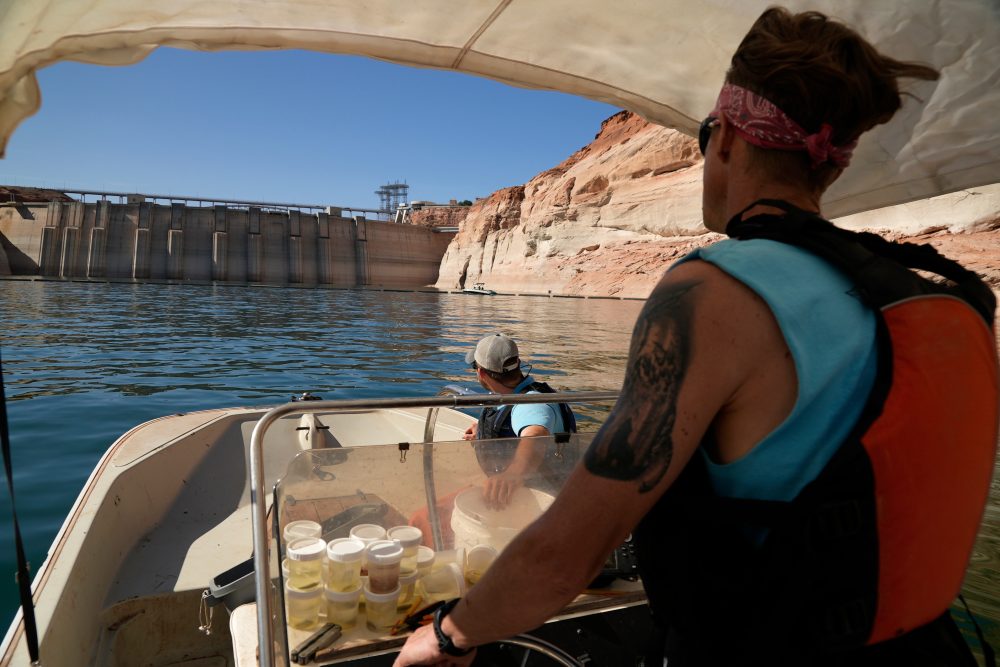

Federal officials managing the Colorado River face a challenging choice between protecting endangered wildlife and maintaining affordable electricity as the waterway continues shrinking due to overuse and changing climate conditions.
Glen Canyon Dam in northern Arizona may need to implement what’s called a “cool mix flow” – releasing cold water from the deepest parts of its reservoir to lower river temperatures downstream and protect the humpback chub, a threatened native fish species. However, this process would bypass the dam’s power-generating turbines, resulting in substantial electricity production losses.
This decision follows the Colorado River Basin’s worst snowpack in recorded history. The river system supports agricultural operations, industries, wildlife, and supplies water to more than 40 million residents across seven states, tribal territories, and Mexico. Meanwhile, these states have yet to reach agreement on long-term water sharing arrangements beyond this year’s expiring guidelines.
“There is a limited water supply. It’s getting even lower. And with that, a lot of hard decisions need to be made,” said John Berggren, regional policy manager for the environmental nonprofit Western Resource Advocates.
Electric utilities purchasing this hydroelectric power warn that cool water releases would create expensive problems, forcing them to spend millions on alternative energy sources and increasing financial burdens for their customers. Environmental advocates counter that without these releases, warmer downstream waters this summer would enable invasive predatory fish to reproduce, further endangering the humpback chub and devastating a renowned trout fishing area.
The Bureau of Reclamation plans to announce its decision within the coming weeks, stating it’s considering multiple factors including river ecosystem health and dam power production. The Interior Department, which supervises the bureau, refused to provide comment. Should cool water releases receive approval, they would likely occur from June through October using jet tubes that bypass the surface-level turbines.
Lake Powell, one of the Colorado River’s two enormous reservoirs, currently holds just 23% of its capacity following decades of excessive use and evaporation caused by rising average temperatures from climate change. Record low water inflow is projected for this summer. With such depleted reservoir levels, warm surface water gets drawn through the generators and flows downstream.
Smallmouth bass, introduced to Lake Powell during the 1980s for recreational fishing, inhabit these warm surface areas and also get pulled through the hydroelectric generators into the river below. This creates problems for the humpback chub and other federally protected fish species in the Grand Canyon, a 278-mile stretch further south known worldwide for its geological formations. Recent research indicates approximately half the bass survive passage through the generators. When downstream river temperatures are sufficiently warm, they reproduce.
Smallmouth bass already prey on humpback chub in the river’s upper reaches, where agencies annually spend millions controlling these invaders. Native fish populations have remained safer below Glen Canyon Dam because it blocks access to the Grand Canyon – but this protection may not continue much longer.
Water temperatures immediately downstream from the dam are projected to break records established in 2022, when smallmouth bass were initially discovered there. Officials predict temperatures will consistently surpass 60 degrees Fahrenheit by mid-June due to warm water being drawn from Lake Powell. Above that threshold, non-native predatory fish passing through the dam could successfully reproduce.
Officials report that cool water releases from Lake Powell during 2024 and 2025 successfully prevented spawning.
It’s essential to weigh the consequences of not implementing the cool mix, Heather Whitlaw, field supervisor with the U.S. Fish and Wildlife Service, said during a recent meeting addressing this issue. “We are certainly just giving up on the future for any kind of recovery for humpback chub and all of the other pieces of the system that rely on those cooler water temperatures.”
Without a long-term strategy to prevent predators from passing through the dam, refusing cool water releases would force officials to depend entirely on manually removing them downstream.
Utilities dependent on hydropower from federal generators express concern.
Should cool water releases gain approval, it could mean bypassing roughly half the generation at Glen Canyon Dam, requiring utilities to purchase power from other sources that would likely cost more, according to the Utah utility group Heber Light & Power.
“We keep hearing comments that we must continue Cool Mix because the cost of not doing it will be even greater,” the Colorado River Energy Distributors Association, representing about 155 customers who purchase federal hydropower generated from the river and opposes the releases, wrote this month in a letter to Interior Secretary Doug Burgum. “We would like to understand what remediation would consistently cost more than $20 to $30 (million) per year.”
The association argued the releases don’t provide a sustainable solution for preventing smallmouth bass reproduction and jeopardize a critical fund used for operating, maintaining and investing in hydropower and transmission infrastructure.
During 2024’s cool water releases, nearly 900,000 acre-feet of water bypassed the generators, resulting in $19 million in replacement energy expenses, according to the Bureau of Reclamation. The amount of water that would bypass generators this year remains unclear, though replacement costs are expected to reach around $25 million – approximately matching the total expense to hydropower users from the previous two years.
The continuing hydropower losses due to Lake Powell’s decline have created difficulties for Heber Light & Power as population increases, said Emily Brandt, the utility’s energy resource manager. The overall decline has resulted in rate increases over the past five years.
Ann Moulton, who lives in Heber City, has watched her residential electricity bill from Heber Light & Power consistently climb. Her April bill reached $125.98, up from $103.24 and $86.14 for the same month in the two previous years. This is affecting her budget, she said.
Other customers face payment difficulties. This year, the utility has experienced an increase in late payments compared to the past two years, rising from 10% to 12%.
Brandt said the utility supports fish protection, “but this particular experiment seems unnecessary.”
“We’re already seeing reduced generation from drought, and now we’re seeing even further reduced generation because of this environmental experiment,” Brandt said.
Dave Foster still recalls the 2022 trout die-off in Marble Canyon, an isolated river section between the dam and Grand Canyon entrance. Warm water killed nearly half the rainbow trout supporting the world-famous fishery, said Foster, who has worked on or near that river stretch since age 13.
He and other guides continue recovering from the die-off, he said, as “the population has simply not rebounded.” However, cool water releases in recent years have prevented additional negative impacts, and more releases this year would help them survive through fall and winter.
Foster has warned customers booking trips after mid-June that he might cancel if water becomes too warm, which can stress fish. Without cool water releases this year, “that’s it for the trout fishery,” he said. “There’s no ambiguity about it. It will destroy it.”