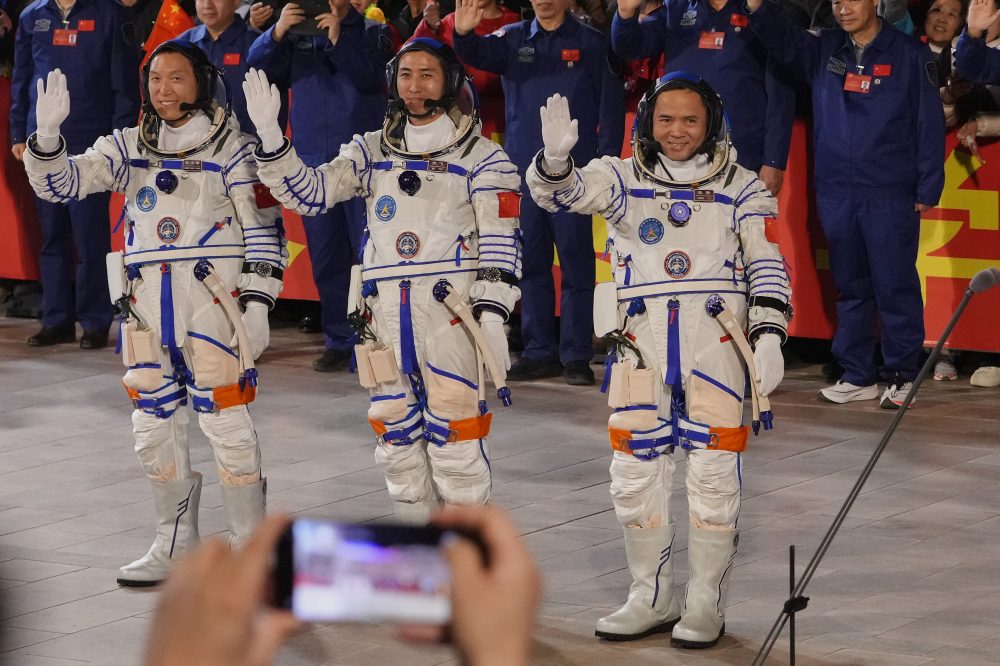

Three Chinese astronauts safely landed back on Earth Friday evening after completing a mission that lasted almost seven months in space, having finished passing responsibilities to a new crew earlier in the week.
The spacecraft transporting astronauts Zhang Lu, Wu Fei and Zhang Hongzhang from the Shenzhou 21 mission made its descent at the Dongfeng landing site located in north China’s Inner Mongolia region. This mission concludes as China moves forward with plans for its initial lunar landing mission scheduled for 2030.
According to the China Manned Space Agency, as reported by the official Xinhua News Agency, the astronauts accomplished numerous objectives during their stay, including handling and sending experimental data and moving leftover supplies. The crew also passed along their knowledge to the Shenzhou 23 team members who reached the space station this past Monday, Xinhua reported.
Xinhua’s earlier reports indicated the crew had finished three spacewalk activities. Zhang Jingbo, the space agency’s spokesperson, noted that Zhang Lu, who previously participated in the Shenzhou 15 mission to the space station, had now completed seven such operations in total — making him the Chinese astronaut with the highest number of spacewalks, according to the report.
Among the three astronauts who reached the Tiangong space station aboard the Shenzhou 23 spacecraft, one is scheduled to remain for a full year. In Chinese, Tiangong translates to “Heavenly Palace.”
The crew members are commander Zhu Yangzhu, Zhang Zhiyuan and Lai Ka-ying, who Chinese officials also refer to as Li Jiaying, using the Mandarin version of her name. Lai, a Hong Kong native, represents the first astronaut from that city to participate in a space mission.
With China expanding its space initiatives, its astronauts have conducted numerous missions to the Tiangong space station, which was built after China was essentially barred from the International Space Station due to U.S. national security considerations.
The United States remains China’s primary competitor in space exploration, with NASA targeting 2028 for landing astronauts on the moon’s surface.