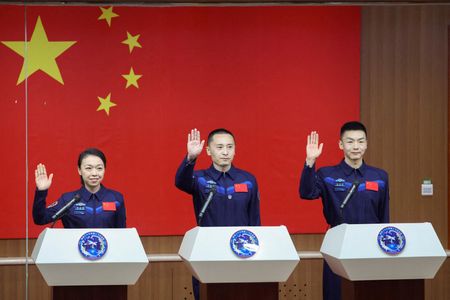

China plans to launch three astronauts to its space station this Sunday, with one crew member remaining aboard for an unprecedented year-long stay as the nation advances toward its goal of landing humans on the moon by 2030.
The Shenzhou-23 spacecraft will blast off at 11:08 p.m. local time (1508 GMT) aboard a Long March-2F Y23 rocket from the Jiuquan Satellite Launch Center in northwest China, carrying three Chinese space travelers.
Among the crew is payload specialist Li Jiaying, formerly a Hong Kong police inspector, who will become the first astronaut from Hong Kong to participate in a Chinese space mission. The mission commander is Zhu Yangzhu, while Zhang Yuanzhi serves as pilot – both are members of the People’s Liberation Army’s astronaut corps.
Officials from the China Manned Space Agency announced Saturday that which of the three astronauts will remain on the Tiangong space station for the full year will be determined based on mission developments. The yearlong duration would represent one of the longest space missions in history, though it falls short of the 14-1/2 month record established by a Russian cosmonaut in 1995.
This launch occurs as competition intensifies between China and the United States in the race to return humans to the lunar surface. The U.S. has raised concerns about what it claims are China’s intentions to colonize and extract resources from the moon, allegations that Beijing has firmly denied.
NASA targets a crewed lunar landing by 2028, two years before China’s deadline. The American space agency seeks to create a sustained lunar presence as preparation for future human missions to Mars.
Recent developments include NASA’s April achievement when four astronauts completed a historic lunar flyby as part of the Artemis II mission, traveling farther from Earth than any previous crew in the first human lunar mission in fifty years.
Additionally, Elon Musk’s SpaceX conducted a mostly successful uncrewed test of its next-generation Starship rocket on Friday, designed to support increased Starlink satellite deployments and transport future NASA lunar missions.
China faces significant challenges in meeting its 2030 target, requiring development of completely new equipment and systems for lunar operations. The nation must demonstrate mission readiness to ensure its astronauts, accustomed to the relatively secure environment of Tiangong in low-Earth orbit, can safely navigate the more dangerous journey to the moon’s surface.
Since 2021, China’s Shenzhou missions have regularly transported three-person crews to the station for six-month assignments. The Chinese space program is currently preparing two Pakistani astronauts, with one potentially joining an anticipated Tiangong mission later this year for a brief stay.
The preceding mission, Shenzhou-22, launched earlier than planned in November to retrieve three Chinese astronauts whose Shenzhou-20 spacecraft sustained damage from orbital debris.
While China has only deployed robotic missions to the moon thus far, its continuing Shenzhou operations demonstrate the country’s advancing space technology. In June 2024, China achieved a world first by collecting lunar samples from the moon’s far side using robotic systems.
Successfully completing a crewed lunar landing before 2030 would support China’s objective to build a permanent lunar base by 2035 in partnership with Russia.
Wu Weiren, the chief scientist of China’s lunar program, has indicated that Beijing’s public schedule is deliberately cautious.
Throughout the past year, Beijing has conducted safety evaluations of equipment designed for the 2030 mission, including heavy-lift Long March-10 rockets, the Mengzhou spacecraft, and the Lanyue lunar lander.
The Shenzhou-23 mission will perform the first autonomous rapid approach and docking with Tiangong’s core module, preparing for the 2030 mission that depends on automated lunar-orbit connection between the Mengzhou capsule and Lanyue lander.
Researchers will examine the physical impacts of radiation exposure, bone density reduction, and psychological strain during the extended Shenzhou-23 mission.
Beijing is conducting the world’s first human “artificial embryo” study in space, having delivered human stem cell samples to the Shenzhou-22 crew aboard Tiangong this month, according to state media reports. The research aims to investigate long-term human habitation, survival, and reproduction capabilities in space environments.