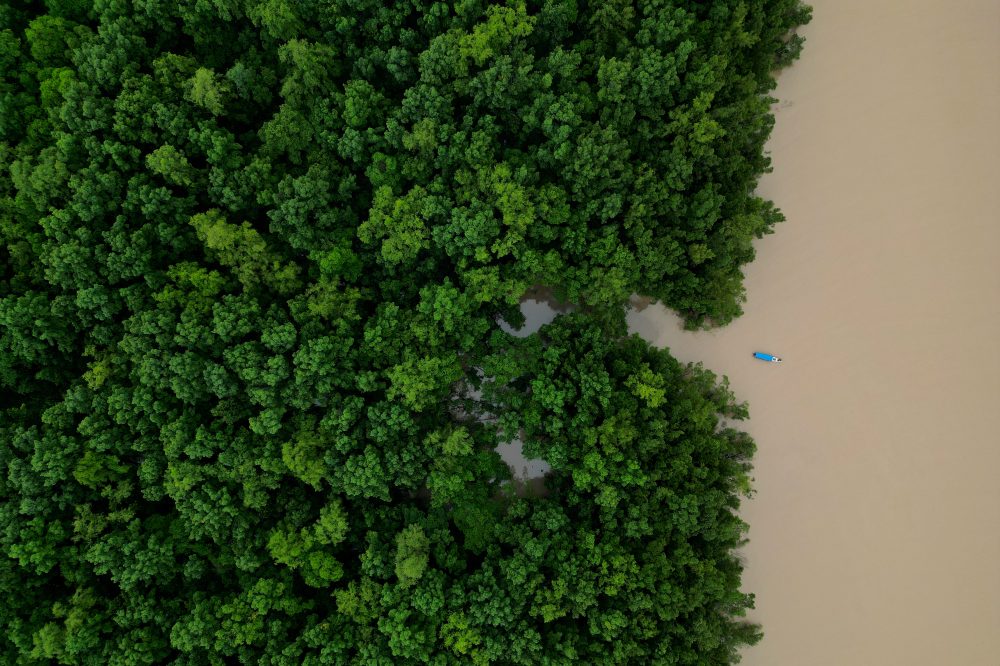

Brazilian authorities announced Monday they are dedicating 3.1 billion reais ($617.5 million) to support sustainable economic development in the Amazon rainforest region. The funding represents an expansion of a federal initiative called Eco Invest that officials unveiled during last year’s COP30 climate summit.
Officials say the money will support companies focused on sustainable tourism, infrastructure improvements throughout the Amazon, and expansion of what they call the “bioeconomy” — economic activities using natural resources while protecting the forest.
The financing structure involves the National Treasury providing loans to banks at a 1% annual interest rate. Banks must then generate at least four times that amount through private investment, with international investors providing a minimum of 60%. The program has secured 140 billion reais ($28 billion) in combined public and private funding to date.
Monday’s announcement included the National Treasury’s allocation of 3.1 billion reais ($617.5 million) and commitments from eight banks for an additional 10.1 billion reais ($2 billion) through the latest Eco Invest auction, according to the Ministry of Environment.
Carina Pimenta, the national secretary for the bioeconomy at the Ministry of the Environment and Climate Change, explained the funding could assist cooperatives that produce Amazon goods like acai and Brazil nuts, along with tourism facilities in protected areas.
The Amazon rainforest, which is the planet’s largest, serves a vital function in global climate regulation. Brazil contains over 60% of the forest, with much of it located in some of the nation’s most economically disadvantaged states. Regional projects typically involve high costs and significant investor risks, prompting the administration of President Luiz Inácio Lula da Silva to create the Eco Invest program in 2024 to minimize those risks through guarantees.
João Paulo Capobianco, Brazil’s environment minister, stated that Eco Invest advances Brazil’s goal of achieving net-zero carbon emissions by 2050 through financial incentives for Amazon economic activities that don’t depend on deforestation. Although agricultural expansion has historically driven deforestation, Capobianco noted Brazil has decreased forest loss while maintaining productivity since 2023.
The funding announcement follows a challenging week for Brazil’s environmental policies.
Last week, the lower house — predominantly conservative and supportive of agricultural business interests — passed expedited legislation that undermines environmental crime enforcement efforts, including measures that restrict action against illegal deforestation based only on satellite data.
This enforcement approach has been fundamental to Brazil’s environmental protection strategy and, according to Brazil’s natural resources agency known as IBAMA, contributed to approximately 50% reduction in Amazon deforestation since 2023.
The legislation requires Senate approval and the president’s signature, but has generated worry among environmental advocates.
“By weakening oversight tools, territorial protection and environmental governance, the measures reduce the Brazilian state’s ability to prevent, control and respond to the economic, social and climate impacts of climate change,” Climate Observatory, a network of environmental nongovernmental associations, said in a statement Monday.
Capobianco acknowledged that such congressional actions might create uncertainty about Brazil’s environmental commitments, but emphasized the country remains dedicated to meeting its climate goals.
“We will show that Brazil remains on a path of controlling and reducing deforestation,” he said.