
Maryland property owners will soon have better access to funding for natural shoreline protection projects under new legislation signed into law.
The governor signed the Supporting Inclusive Community Adaptation Act on April 14, which updates the state’s approach to helping residents build living shorelines. The Maryland Department of Natural Resources backed the legislation, which eliminates upfront financial barriers and creates opportunities for partial loan forgiveness.
“Living shorelines are critical protections for Maryland’s coastal areas, and this new law will help ensure that resilient, nature-based solutions remain accessible to all,” said Dr. Natalie Snider, DNR’s Watershed and Climate Services Director.
The legislation also makes DNR’s Resilience Through Restoration a permanent program and allows the state to better support community involvement in climate adaptation planning. Additionally, it enables the use of public lands to demonstrate nature-based climate resilience solutions.
Maryland’s Shoreline Challenge
With over 7,000 miles of tidal shoreline, Maryland faces significant vulnerability to coastal flooding and rising sea levels. The Shore Erosion Task Force Final Report indicates that nearly 4,600 miles of the state’s shoreline are experiencing active erosion, leading to approximately 260 acres of land loss each year. Since roughly 90% of these tidal shorelines belong to private owners, the state’s coastal resilience relies heavily on individual landowners, communities, and nonprofit organizations taking action.
DNR’s Shoreline Conservation Service has been helping protect Maryland’s coastlines for more than six decades. The program has offered both technical knowledge and financial assistance since 1964 to help navigate complex shoreline management challenges.
Following the passage of the Living Shoreline Protection Act in 2008, the Shoreline Conservation Service shifted to focus exclusively on nature-based solutions instead of traditional infrastructure like bulkheads and revetments. Living shorelines incorporate native vegetation, sand, and carefully positioned stone structures to stabilize coastal areas.
Traditional bulkheads can speed up erosion on adjacent properties and eventually require replacement, while living shorelines absorb wave impact, create important wildlife habitat, and become more effective as native plants establish themselves. Research has shown that living shorelines demonstrate greater resilience than bulkheads and need less ongoing maintenance.
Since September 2022, the Shoreline Conservation Service has handled more than 1,800 individual requests, showing strong statewide demand for shoreline erosion expertise. The program currently oversees 50 active loan repayments, bringing in $559,903 in FY26 revenue, with five additional loans worth $334,554 in future payments. Total active loan balances now surpass $4 million.
Despite the program’s success, costs have presented major obstacles for many Maryland residents. Living shoreline projects can cost anywhere from $300 to more than $1,500 per linear foot, depending on wave conditions and construction methods. Previously, the program required property owners to pay 50-80% of costs upfront—a prohibitive expense for many. Faced with these financial demands, some owners chose cheaper but less durable traditional infrastructure, missing opportunities to install longer-lasting natural shorelines that benefit both local ecosystems and coastal communities.
The new legislation officially eliminates the substantial upfront cash requirement for private property owners in the Shore Erosion Loan Program. The law’s partial loan forgiveness framework will follow ecological, performance-based, and equity standards, with implementation planned for spring 2027.
Property owners along shorelines can submit technical assistance requests to the Shoreline Conservation Service. This specialized financing option provides zero-interest, long-term funding (5-20 years) for living shoreline installation.
Project Examples
Anne Arundel County, West River – Private Property Living Shoreline (2023)
Loan Award: $73,500 (64% of total cost)
Owner Cash Match: $20,500 (36%)
Total Project Cost: $94,000
Status: Constructed 2023
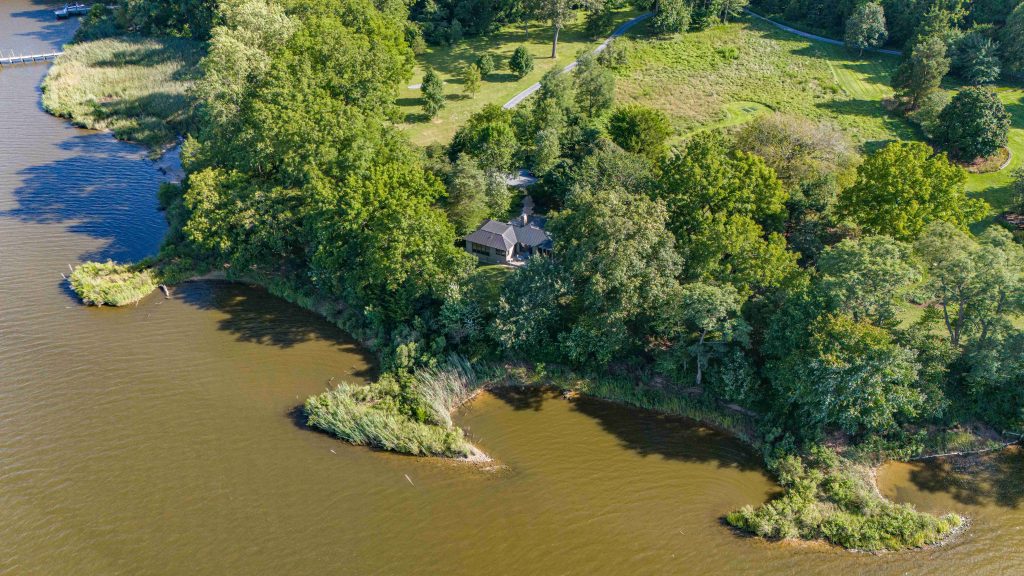
This project used six sand-containment groins, sand fill, and native marsh grass plantings to protect a 19th-century historical structure on a Maryland Historical Trust easement along the West River. The living shoreline stabilizes the property and improves wetland habitat next to this historically important site.
“When we first noticed signs of erosion on our farm, we wanted to act quickly while still preserving the natural character of the shoreline. A living shoreline was the clear choice. The DNR’s Shoreline Conservation Officers were instrumental in making the project possible helping us define the scope….While the project was a significant investment, the shoreline improvement loan allowed us to move forward promptly….It was a major undertaking that we could not have accomplished without the help of the Maryland DNR, and we are extremely pleased with the results,” said a private property owner on the West River in Anne Arundel County.
Talbot County, Pickering Creek Audubon Center Shoreline Resiliency Project (2024)
Loan Award: $225,595
Additional Funding: $527,647 (Outcome 1 Trust Fund)
Status: Constructed 2024
Positioned in front of the Chesapeake Audubon Society’s main campus office and program meeting space, this 600-linear-foot living shoreline project protects an essential educational facility. DNR technical staff helped the organization navigate the complex permitting process and worked directly with contractors to ensure proper project execution.
“For us, the loan made the impossible possible. The available funding and structure of the loan was beneficial to our financial needs, but most importantly, the technical assistance provided important guidance that led our project to a successful outcome….DNR was especially helpful in liaising with contractors and helping to translate our needs into reality with a superb on-the-ground project,” said Mark Scallion, Director of Pickering Creek Audubon Center.