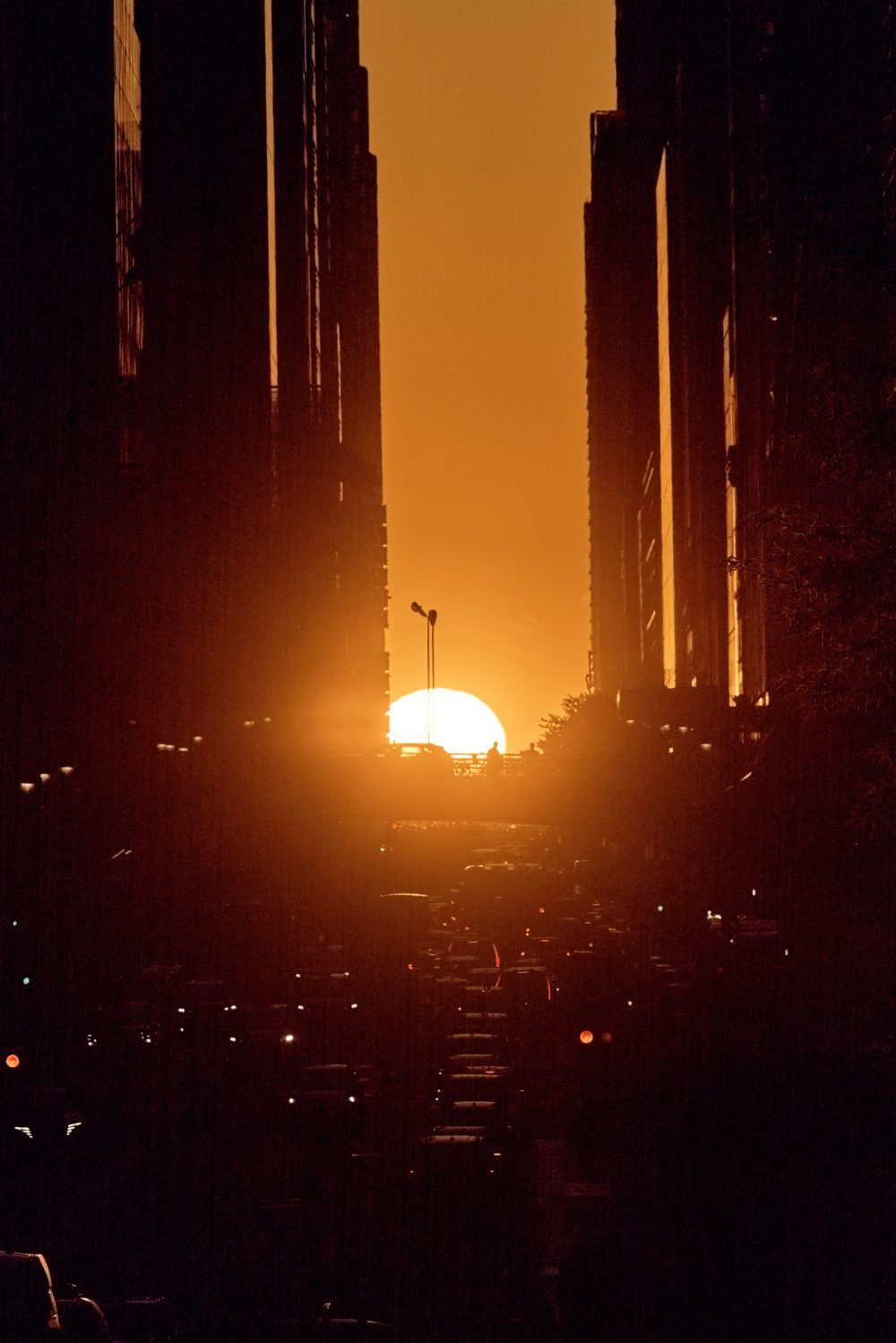

Residents and tourists in New York City turned their eyes skyward Thursday to witness the annual astronomical event called Manhattanhenge.
The descending sun appeared perfectly framed within a corridor of towering buildings as it aligned with Manhattan’s organized street layout before disappearing below the skyline.
Thursday’s impressive display marks only the first occurrence this year. An even more complete view of the setting sun nestled between the city’s iconic high-rises is anticipated Friday. The celestial event will return again on July 11 and 12.
This astronomical alignment occurs approximately three weeks on either side of the summer solstice.
Through the years, the event has transformed into an essential viewing experience, drawing photography enthusiasts and curious onlookers to city sidewalks during spring and summer evenings.
Here’s what makes this distinctly New York phenomenon special:
The name was created by astrophysicist Neil deGrasse Tyson in a 1997 piece for “Natural History” magazine. Tyson, who leads the Hayden Planetarium at the American Museum of Natural History in New York, drew inspiration from his teenage visit to Stonehenge.
The television personality, who would later host programs including PBS’ “Nova ScienceNow,” participated in a research expedition guided by Gerald Hawkins, the researcher who initially proposed that Stonehenge’s ancient stone structures functioned as an astronomical observation site.
The New York native Tyson recognized similarities between the sun setting among Manhattan’s skyscrapers and the way sunlight penetrates Stonehenge’s stone circle during the solstice.
However, unlike the ancient Stonehenge architects, Manhattan’s urban designers had no intention of creating solar alignment. The effect emerged purely by coincidence.
The phenomenon doesn’t coincide with this year’s summer solstice on June 21. Rather, it occurs roughly three weeks before and after that date, when the sun positions itself in perfect harmony with the city’s east-west running streets.
Spectators can experience two distinct variations of this event.
Thursday’s display, along with July 12’s occurrence, features exactly half the sun visible above the horizon while the other half sits below during the street alignment moment, the Hayden Planetarium explains.
Friday’s event and July 11’s showing will present the complete sun appearing suspended between structures before it descends toward the New Jersey skyline beyond the Hudson River.
Popular observation locations include the city’s wide east-west avenues: 14th Street, 23rd Street, 34th Street, 42nd Street and 57th Street.
Moving eastward provides increasingly spectacular views as sunlight illuminates building surfaces lining both sides of the roadway. The phenomenon can also be observed from Long Island City in Queens, looking across the East River.
Witnessing Manhattanhenge requires no special arrangements or organized events.
Crowds typically assemble along east-west streets roughly 30 minutes before sunset to capture photographs as evening approaches. Clear skies are essential – overcast or rainy conditions prevent any visible display.
Comparable phenomena happen in other cities featuring organized street patterns. Chicagohenge and Baltimorehenge occur when sunset aligns with those cities’ grid systems during March and September, coinciding with spring and fall equinoxes. Torontohenge takes place in February and October.
However, Manhattanhenge stands out due to the exceptional height of surrounding structures and the clear western view toward the Hudson River.