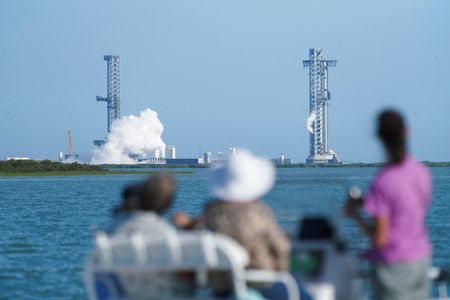

Elon Musk’s SpaceX conducted a crucial test Friday evening, launching its 12th Starship mission from Texas facilities in what represents the maiden voyage of the upgraded V3 spacecraft.
The uncrewed launch from Starbase, Texas near Brownsville marked a significant moment for the rocket company as it approaches what could become the largest initial public offering in history next month.
This inaugural flight of the Starship V3 – engineered to support more regular Starlink satellite deployments and future NASA lunar missions – comes after months of testing postponements and could influence investor sentiment before the anticipated IPO.
The massive spacecraft, which has consumed over $15 billion in development costs as a completely reusable vehicle, plays a central role in Musk’s vision to reduce launch expenses, grow his Starlink enterprise, and pursue goals from deep-space missions to orbital data facilities – all calculated into his targeted $1.75 trillion IPO valuation.
A positive test outcome would strengthen SpaceX’s argument that Starship, recognized as the world’s most massive and powerful rocket ever launched, is approaching commercial viability following years of explosive failures and development setbacks.
The enormous rocket system, featuring the upper-stage Starship crew vehicle mounted on its Super Heavy booster, lifted off Friday evening from SpaceX’s Gulf of Mexico facilities near Brownsville.
This launch represented the company’s 12th Starship test since 2023 and the inaugural flight for the V3 version of both the spacecraft and its Super Heavy booster – equipped with the company’s latest Raptor 3 engines – plus the first departure from a new launch platform built for the enhanced rocket.
PLANNED OCEAN SPLASHDOWN
SpaceX announced it would not try to recover or land either the booster or upper-stage Starship following Friday’s test mission, regardless of performance.
However, test goals encompass completing multiple return-flight procedures by both the lower-stage rocket and Starship, including controlled landing sequences before both vehicles impact ocean waters.
The Super Heavy aims for a Gulf of Mexico splashdown location approximately seven minutes post-launch. The Starship will continue traveling through suborbital space before executing its own “exciting landing!” as SpaceX describes it, in the Indian Ocean roughly one hour afterward.
During Starship V3’s space journey, mission plans involve its payload system releasing 20 simulated Starlink satellites individually, plus two operational satellites positioned along Starship’s flight path to monitor the spacecraft’s heat protection and relay information to ground controllers during descent.
Approximately 20 minutes following the payload release demonstration, a scheduled restart of Starship’s Raptor engine in space will occur.
For Starship’s intense, transonic return through Earth’s atmosphere, engineers deliberately removed one heat shield tile to assess varying aerodynamic pressures on surrounding tiles. Additional tiles received white paint to function as imaging references during testing.
The rocket’s thermal protection system constitutes one of SpaceX’s most challenging development obstacles with Starship, as engineers work to create an extremely durable protective coating requiring minimal or zero maintenance between flights.
INVESTOR ATTENTION BEFORE IPO
This 12th test flight in the Starship program faces intense investor observation three weeks before an IPO that could establish the first U.S. market entry exceeding $1 trillion and instantly make SpaceX among the world’s most valuable public companies.
SpaceX’s most profitable operations, focused on its Starlink business and orbital data center plans, depend heavily on Starship successfully delivering them to space.
Although Musk has publicly accepted previous test-flight failures calmly, questions remain about how investors will balance the billionaire entrepreneur’s willingness to accept short-term risks against his long-term goals for lunar and interplanetary exploration.
SpaceX’s engineering approach, viewed as more risk-accepting than many established aerospace companies, relies on a flight-testing method that pushes new spacecraft to failure points, then refines improvements through repeated attempts.
Musk, who established his California-based rocket firm in 2002, stated one year ago he expected Starship to complete its first uncrewed Mars journey by late 2026, a timeline now clearly unattainable.
The V3 incorporates numerous enhancements designed to optimize the vehicle’s performance for missions extending beyond the low-Earth orbit domain of SpaceX’s current primary launch system, comprising Falcon 9 or Falcon Heavy rocket boosters with Dragon capsules.
Among the key improvements to the Super Heavy booster is redesigning its 33 Raptor engines to generate increased thrust from a configuration that weighs considerably less.
The upper-stage Starship’s propulsion system has similarly been enhanced for extended-duration missions, featuring capabilities for spacecraft-to-spacecraft connections, space-based refueling, and improved maneuverability.
Several Starship tanker craft would need to perform the orbital refueling process – a dangerous and untested procedure necessary for SpaceX’s strategy regarding its initial lunar-landing mission, scheduled for 2028.
These elements were all included in the $3 billion-plus contract SpaceX secured in 2021 through NASA’s Artemis program, the U.S. initiative to return astronauts to the moon’s surface this decade for the first time since 1972. These objectives position Starship at the heart of a renewed space competition with China, which targets its own crewed lunar landing in 2030.