Worldwide investment in fusion energy has reached an unprecedented level, with nearly $4.48 billion poured into the sector over the past year, according to a new survey released Monday. Analysts say the milestone reflects growing optimism that fusion power could eventually help meet the world’s increasing appetite for electricity.
Fusion reactors, which remain in the experimental phase, work by forcing lightweight atoms — such as hydrogen — together under extreme heat and pressure. The process releases enormous amounts of energy without producing greenhouse gas emissions or the long-lived radioactive waste associated with conventional nuclear power.
The Washington-based Fusion Industry Association conducted the survey, which found that last year’s investment across 56 private companies was the highest recorded since the annual survey launched in 2021 — and 69% greater than the year before. Cumulative investment since 2021 has now exceeded $14.2 billion.
Industry leaders say the numbers reflect a fundamental shift in how the energy sector views fusion technology. “This report shows that the fusion industry is fundamentally on its pathway to commercialization,” said Andrew Holland, CEO of the Fusion Industry Association. “The thing that’s driving a lot of this is the need for new electricity sources, the long-term identified growth of data centers and artificial intelligence.”
Companies working on fusion reactors believe commercial power generation could begin as early as the early 2030s, though significant technical challenges remain. Among the biggest obstacles are improving the efficiency of fusion reactions and sustaining them long enough to produce more power than the plant consumes. Engineers must also develop materials capable of withstanding the intense neutron bombardment that occurs during fusion reactions.
The United States is home to more fusion companies than any other nation, but those firms rely primarily on private investment. U.S. government funding for fusion research amounts to roughly half of what China spends on the technology.
The record investment figures coincide with two fusion companies moving toward public stock listings. General Fusion, a Canadian firm, announced earlier this year that it plans to go public in the United States through a deal valued at approximately $1 billion with blank-check company Spring Valley Acquisition Corp. III.
Meanwhile, Google-backed TAE Technologies announced late last year that it intends to go public through a $6 billion reverse merger with social media company Trump Media & Technology Group, which is majority owned by a revocable trust belonging to President Donald Trump.
The survey also includes four private fusion companies based in China, including one newly established firm. However, the Fusion Industry Association acknowledged that this represents an incomplete picture of China’s fusion sector, noting that press reports suggest several additional companies there are receiving both government and private backing.
Channel Islands National Park and Channel Islands National Marine Sanctuary serve as guardians of some of California’s most valuable coastal and marine ecosystems. These protected areas are rich in biodiversity, but keeping them clean presents a significant ongoing challenge.
Because the islands are remote and many shoreline areas are difficult to reach, clearing away marine debris requires a broad team effort. Volunteers, conservation organizations, and local lobster fishers all play a role in recovering trash and other debris from areas that are not easily accessible.
The collaboration highlights the importance of community involvement in protecting natural resources, particularly in areas where the environment is both fragile and hard to monitor on a regular basis.
More than 20 years after the very first teacher participated in the program, NOAA’s Adopt a Drifter Program is still expanding. This summer marks another chapter of growth and change for the initiative, which is jointly led by the Global Ocean Monitoring and Observing Program (GOMO) and the Atlantic Oceanographic and Meteorological Laboratory (AOML).
The program gives educators the opportunity to get involved in real-world ocean observation by deploying drifter buoys that collect valuable data from the world’s oceans. Since its inception, the effort has continued to build momentum, drawing in more participants and evolving its reach over time.
In recognition of National Teacher Appreciation Day, NOAA’s Office of National Marine Sanctuaries is shining a spotlight on the passionate educators who drive ocean stewardship initiatives throughout the United States.
The agency is taking the occasion to acknowledge the hard work of teachers involved in the Ocean Guardian School program, whose dedication helps bring meaningful marine conservation projects to life in classrooms and communities across the nation.
A coalition of environmental educators recently joined forces at the Guana Tolomato Matanzas National Estuarine Research Reserve in Florida to deliver a two-day professional development workshop aimed at teachers across the state.
The event, known as Teachers on the Estuary — or TOTE — was organized by the Guana Tolomato Matanzas National Estuarine Research Reserve along with educators from several partner organizations. The workshop gave Florida teachers the opportunity to dig into new curricula, explore available resources, and learn about funding opportunities to support environmental education in their classrooms.
The two-day format allowed participants to engage deeply with the material and connect with fellow educators who share a passion for teaching students about estuarine ecosystems.
A national photography competition focused on the country’s marine sanctuaries has wrapped up its 2025 edition, with winning images highlighting the remarkable diversity of life and landscapes found in these protected ocean spaces.
The Get Into Your Sanctuary Photo Contest draws photographers each year to document the beauty, wildlife, and recreational experiences tied to national marine sanctuaries. This year’s winning entries captured a wide range of scenes — from tranquil shoreline moments along the Olympic Coast to massive swirling groups of squid in the Florida Keys, and even a stunning view of the Milky Way above a historic bridge.
Together, the winning photographs illustrate the many different ways that people form connections with these unique and protected natural places. As the 2025 contest comes to a close, winners are sharing photography tips and insights ahead of the next competition cycle.
A new partnership is taking shape along the shores of Lake Michigan, as state partners in Wisconsin have come together to form the Collaborative Action for Lake Michigan Coastal Resilience network — known as CALM.
The goal of the initiative is to strengthen community resilience and reduce the impact of coastal hazards by improving coordination among local, regional, and state agencies throughout the area.
By working together under the CALM framework, participating organizations hope to create a more unified and effective response to the challenges facing Lake Michigan’s coastline.
A team of five educators from the Minnesota and Texas Sea Grant programs has been chosen to head up the next Sea Grant Aquaculture Leadership Academy.
Representing Minnesota Sea Grant are Fisheries and Aquaculture Extension Educator Julia Grenn and Extension Program Leader and Aquaculture Extension Educator Amy Schrank.
Three specialists from Texas Sea Grant round out the leadership group: Aquaculture Specialist Mario Marquez, Extension Director Christine Hale, and Coastal and Marine Extension Agent Amy Nowlin.
The Sea Grant Aquaculture Leadership Academy brings together professionals from across the country to advance knowledge and skills in aquaculture — the farming of fish, shellfish, and other aquatic organisms.
For the fourth straight year, Mallows Bay-Potomac River National Marine Sanctuary joined cities from around the world in the annual City Nature Challenge, which took place from April 24 to 27, 2026.
The City Nature Challenge is a cooperative, friendly competition that brings together communities worldwide to document the natural world using the iNaturalist app. Participants snap photos of plants, animals, and fungi they encounter, uploading them to iNaturalist where the images are logged and crowd-sourced data helps determine the species in each photo.
Each year, the four-day event produces a global picture of biodiversity, with millions of nature observations covering tens of thousands of different species recorded over a single weekend.
A collaborative effort between the Palau International Coral Reef Center (PICRC), educators from NOAA Ocean Exploration, and Palau’s Ministry of Education resulted in a successful two-day professional development workshop focused on deep-sea science.
The workshop, held March 31 through April 1, brought together 27 school teachers from communities throughout Palau. While the event was originally designed with middle and high school educators in mind, it drew a broader range of participants than anticipated — with teachers serving students from third grade all the way through ninth grade taking part.
The training was aimed at equipping classroom educators with the tools and knowledge needed to bring ocean exploration and deep-sea science concepts into their lessons.
A newly developed educational resource kit is making Arctic climate research more accessible to students and educators at every level, from kindergarten through college.
The Arctic Report Card Educational Resource Kit is a carefully assembled collection of materials designed for anyone curious about the Arctic Report Card, a scientific publication that tracks conditions in the Arctic region. The kit is built to work alongside all editions of the report, making it a flexible tool for classrooms and independent learners alike.
The resource was developed in connection with the release of the 20th anniversary edition of the Arctic Report Card in December 2025. Its launch was also tied to a Science Update webinar hosted by the National Science Teaching Association, which took place in January 2026.
While the kit is primarily aimed at middle school students, high school students, and undergraduates, it also includes dedicated sections for younger children, ensuring that even the earliest learners can engage with the material.
You might be at a Fourth of July cookout, eyeing a tray of fresh oysters on ice, but holding back because someone once told you to only eat them during months that end in the letter “R.” Or maybe you were at the grocery store, picked up a salmon fillet, noticed the “farm-raised” label, and quietly put it back on the shelf.
A new digital education platform launched by Sea Grant is working to address exactly these kinds of common misconceptions about aquaculture — the farming of fish, shellfish, and other seafood — across the southeastern United States.
Have you ever wondered how your GPS knows exactly where you are, or how maps are made so precisely? The answer lies in a scientific field called geodesy.
Geodesy is defined as the science of accurately measuring and understanding the Earth’s geometric shape, its orientation in space, and its gravity field.
According to the National Ocean Service, geodesy plays a key role in many aspects of modern life — including helping people get from point A to point B.
SAN FRANCISCO — A group of hundreds of economists, computer scientists, and technology executives is calling on institutions to take urgent action in response to the potential economic upheaval that artificial intelligence could bring, including the threat of widespread job losses.
The open letter, released Monday and organized by Stanford University’s digital economy lab, was signed by more than 200 economists and AI researchers — including 16 Nobel Prize winners — as well as executives from major tech firms such as Anthropic, Google, and OpenAI.
The brief, four-sentence letter warns that AI’s growth could be dramatic. “AI may become radically more powerful over the next 10 years,” the letter states. “This could drive an unprecedented transformation of our economy, larger than the Industrial Revolution, but unfolding over a vastly shorter time frame. It could bring risks, including large-scale job displacement, as well as opportunities such as major gains in living standards.”
The signatories are calling on leaders to “build the incentives, guardrails, and institutions needed to steer AI in a direction that complements humans and benefits society.”
Among those who signed was Yoshua Bengio, a computer scientist and pioneer in AI research, who issued a separate statement saying it is “highly plausible that AI will drastically transform our economies” given how rapidly the technology is advancing.
Bengio, a professor at the University of Montreal, added: “We must be intentional and make collective, democratic choices, rather than letting market forces play out and risking leaving most citizens behind.”
The space between stars has yielded a surprising find: a type of sugar that also shows up in raspberries and self-tanners.
Astronomers have identified the sugar, known as erythrulose, floating in what scientists call the interstellar medium — the thin layers of gas and dust that exist between stars. The discovery adds to growing evidence that the building blocks of life may be scattered throughout the galaxy.
Sugar isn’t just for sweetening food. Different types of sugar power our cells and even form part of the structure of DNA. That’s why scientists are so eager to understand how sugars form in space — because they’re considered a fundamental ingredient for life as we know it.
Using two dish-shaped radio telescopes located in Spain, a team of researchers gathered data from a large cloud of gas near the center of the Milky Way. They confirmed the presence of erythrulose in gas form by comparing the telescope readings to sugar samples tested in a laboratory. The region where the sugar was found is one that NASA’s twin Voyager spacecraft — the most distant human-made objects ever launched from Earth — have crossed.
The findings appeared Monday in the scientific journal Nature Astronomy.
This isn’t the first time astronomers have come across interesting chemistry in our galaxy. About 25 years ago, scientists spotted a close relative of ordinary table sugar near the Milky Way’s center. More recently, dark grains retrieved from asteroid Bennu by NASA’s Osiris-Rex mission contained other sugars, including one considered a key ingredient for DNA.
While erythrulose itself isn’t essential for life, it can readily transform into a form that scientists believe played a critical role in sparking life on Earth. It’s also among the most complex sugars detected in space so far, according to astrophysicist Erika Hamden of the University of Arizona, who was not involved in the study.
Hamden described it as “a pristine example of the stuff that’s just floating out in the galaxy.”
The bigger question driving these investigations is whether life’s essential ingredients arrived on Earth via comets or asteroids from deep space — or whether those components were already present in the material that eventually formed our solar system.
The newly detected sugar supports the idea that the ingredients were already here. Researchers are now hoping to find additional sugars in space and better understand how they transform from one form to another.
Locating erythrulose in one part of the galaxy suggests similar molecules could be hiding in other distant regions as well, said study author Izaskun Jiménez-Serra, an astrophysicist at the Center for Astrobiology in Spain.
“The key ingredients for the origin of life could be present in other regions across the galaxy, opening the possibility for life to develop elsewhere in the universe,” Jiménez-Serra said.
Federal aviation authorities have given SpaceX the green light to move forward with its next Starship rocket test flight, potentially as early as this week.
The U.S. Federal Aviation Administration announced Monday that it has officially closed its review of a Starship booster failure that took place during a flight test back in May. With that investigation now complete, Elon Musk’s space company is cleared to launch the rocket’s next test from its Texas facility.
Taiwan Semiconductor Manufacturing Co, known as TSMC, is set to build two more advanced chip packaging facilities at the Chiayi Science Park in southern Taiwan, according to the island’s science and technology minister.
The Chiayi Science Park is already being developed as a major hub for TSMC’s advanced chip packaging operations. The company’s first packaging plant at the site has already reached full-scale production, and a second facility is expected to follow suit in the near future.
National Science and Technology Council Minister Wu Cheng-wen made the announcement Sunday during a groundbreaking ceremony for the next phase of development. “Today’s groundbreaking marks the start of the second phase, which will include a third and fourth plant,” Wu said.
The minister added that once all four plants are fully operational, the park is projected to produce more than 300 billion Taiwan dollars — roughly $9.35 billion — in annual output and support more than 9,000 jobs.
TSMC has been aggressively scaling up its advanced chip packaging capacity, including its chip-on-wafer-on-substrate technology. The push is being driven by surging demand from artificial intelligence chip designers such as Nvidia, where current supply has struggled to keep pace with what customers need.
KUBUQI DESERT, China — For the past 50 years, millions of laborers across northern China have performed the same painstaking task: pushing forearm-length sticks into shifting sands, first in one direction, then crossing them to form a grid pattern. Once the grid is in place, young trees are planted at the center of each small square.
This method, called “straw checkerboards,” is a straightforward but highly effective approach to anchoring sand dunes against wind erosion. Combined with irrigation systems that deliver water to the plants, the technique has become central to China’s massive anti-desertification campaign known as the Three-North Protective Forest Program — or more popularly, the Green Great Wall.
Generations of effort have produced real, measurable results, though scientists are quick to point out that protecting those gains will require many more decades of sustained work.
Over a long period, drought, overgrazing, and farming stripped the land of vegetation, damaged the soil, and left vast areas exposed to fierce winds and sandstorms — a process known as desertification. That spread of desert conditions in northern China reached its worst point in 2000, but since then, the amount of desertified land has been reduced by more than 1,000 square kilometers, or about 400 square miles, every year, according to figures released by Chinese state media.
The Chinese government says the program, which got its start in 1978, has been central to transforming enormous stretches of land covering nearly half the country — shifting from a reality of “desertification advancing and people retreating” to one of “greenery advancing and the desertification retreating.” Forests planted under the program now span a total of 500,000 square kilometers, or roughly 200,000 square miles.
“The broad significance of the Three-North Program is not only the scale of restoration, but the long-term political commitment behind it,” said Barron Joseph Orr, chief scientist for the U.N. Convention to Combat Desertification. In written comments to The Associated Press, he noted that turning back desertification is achievable when it becomes embedded in long-term development strategies.
Similar efforts are underway elsewhere in the world. A project launched in Africa in 2007 aims to plant trees across multiple countries to help hold back the expanding Sahara Desert.
According to Zhu Jiaojun, a scientist at the Institute of Applied Ecology within the Chinese Academy of Sciences who has spent years working on the program, the results stem from the dedication of frontline workers combined with strong national planning and significant government funding. He also noted that some regions have seen increased rainfall in recent years, which has made it easier to restore plant life.
“The achievement of desertification combat is due to people’s hard work and a bit of luck with climate,” Zhu said.
Long-term monitoring data collected by Zhu’s research team shows that China’s total desertified land area has shrunk by roughly 10% since 2000, while land classified as severely or extremely desertified has fallen by more than 40%. Forest coverage within the program’s zone has climbed from approximately 5% in 1978 to 14% as of 2022.
During a recent media tour organized by the government to the Kubuqi Desert — located about 800 kilometers, or 500 miles, west of Beijing — a 60-year-old sand-control worker named Yin Yuzhen described her early years on the job as “very lonely.” Working with her husband near her hometown in the adjacent Mu Us desert, she said even the smallest signs of life were a source of joy.
“Even the passing of a bird across the sky made me happy,” she recalled.
She described conditions four decades ago when blowing sand was so dense it was difficult to see even a short distance ahead.
“But now we can see the sun. We can see the green in the distance. We can see the road,” Yin said.
Today, she and her husband work each morning from sunrise until noon, tending to trees and repairing or replacing checkerboard grids. Their children pitch in as well, along with local volunteers from time to time.
Zhu estimated that more than 300 million rural workers have taken part in the program over the years, most of them on a paid, part-time basis.
Orr noted that ecosystems restored in dry regions can gradually become more self-sufficient over time, but they still need careful management and ongoing monitoring. He said success hinges on factors like water availability and soil health.
The environmental group Green Camel Bell, based in Gansu province, works with farmers and herders to raise awareness about desertification and its dangers, plants trees alongside community members in dry areas, and helps sustain vegetation over the long term.
“Efforts to combat desertification and restore forests should be linked to local livelihoods, so communities do not see economic development and ecological protection as an either-or choice,” said the group’s founder, Zhao Zhong.
Orr echoed that view, saying restoration projects are far more likely to succeed when local communities can also benefit economically from the work.
Zhu identified a central question facing the program going forward: how can conservation be maintained if the level of human effort and government investment eventually decreases?
“This is what we are very concerned with and this is also the biggest challenge,” he said.
For Yin, her greatest hope is that younger people will carry on the mission she has devoted her life to.
“We need to teach young people to love this Earth. If we love it with all our hearts, nature will love us in return,” she said.
If you’ve ever dreamed of owning a real Tyrannosaurus rex, Tuesday’s auction could make that happen — if you have about $30 million to spare.
A T. rex fossil going by the name “Gus” is scheduled to go up for bidding at Sotheby’s in New York City. A press preview of the skeleton was held on July 1, giving the public a glimpse of the massive prehistoric specimen before it goes to the highest bidder.
The sale of “Gus” is far from the first time dinosaur remains have been put on the auction block. The practice of selling fossil bones to private collectors has become an increasingly familiar event in the world of high-end auctions.
Meta has pulled the plug on a feature tied to its recently released AI image tool after users and industry groups raised serious concerns about how public Instagram photos were being used.
The company acted on Friday, just days after rolling out Muse Image — its first image-generation model built into the Meta AI assistant. Muse Image is the parent company’s debut tool for creating images through artificial intelligence, and it’s available through both Instagram and Facebook’s platform.
In a statement, Meta explained its original intentions while acknowledging the public pushback. “Our intent was to provide a useful creative tool and to give people control over whether their public content could be referenced in this way,” the company said. “We’ve heard the feedback that this feature missed the mark, so it’s no longer available.”
Like other AI tools capable of generating images, Muse Image produces visuals based on prompts entered by users. However, the feature also automatically pulled photos from all public Instagram accounts, making them available as references when the AI created new images — without requiring any action from account holders.
The revelation sparked a wave of posts across social media, with users flagging privacy worries and sharing step-by-step guides on how to opt out of having their Instagram content accessed by the tool.
The entertainment industry was among the quickest to respond. The Screen Actors Guild-American Federation of Television and Radio Artists urged its members to update their Instagram privacy settings to safeguard their personal likeness from being used by the AI tool.
After Meta announced it was shutting down the feature, SAG-AFTRA posted a statement on X expressing its approval of the move. “With the dangers of nonconsensual digital replicas well known to all, a feature that encouraged that behavior is unwise,” the union wrote. “We appreciate its discontinuance. It is the right thing to do.”
The surging electricity needs of artificial intelligence technology are sparking a revival of fossil fuel development — but supporters of clean energy are pushing hard to make sure massive data centers draw their power from climate-friendly sources as well.
In states with existing climate commitments, lawmakers are worried that the data center boom could undermine their targets for cutting greenhouse gas emissions. Meanwhile, in other states, environmental groups and businesses with clean energy pledges are working through regulatory channels to challenge the grip that monopoly utilities have long held over energy supply and grid access.
The core challenge facing clean energy advocates is that technology companies are demanding electricity at a pace and volume that wind and solar construction simply cannot match. Some individual data centers consume as much energy as a mid-sized city.
That gap has triggered the largest construction surge of natural gas-fired power plants in history. On top of that, utilities, power plant operators, and the federal government are moving to extend the lives of aging coal plants that were previously set for retirement.
A bill sitting on the desk of New York’s governor would require data centers above a certain size to hit renewable energy targets starting in 2030 and to draw at least 90% of their power from renewable sources by 2040. The legislation’s sponsor, state Sen. Kristen Gonzalez, a Democrat, said the goals are achievable.
“We are literally talking about the wealthiest companies in the world that are looking to build in New York state, and if they have the resources to put billions of dollars into data center development, then they certainly should have the resources to build out renewable energy sources to power them,” Gonzalez told The Associated Press.
Michigan, Oregon, and Minnesota have been out front on this issue, each passing laws within the past 18 months aimed at protecting their existing mandates requiring electric utilities to rely solely on emissions-free energy by 2040.
“That’s a challenging thing to meet with the data centers,” said Bob Jenks, executive director of the Oregon Citizens’ Utility Board, a nonprofit focused on lower utility bills and cleaner energy. “It was a challenging thing to meet without the data centers.”
Minnesota and Oregon directed regulators to align data center energy use with their emissions-reduction plans, while Michigan tied a lucrative sales tax exemption for large-scale data centers to a requirement that they meet a 90% clean energy standard within six years.
Similar legislation has surfaced in more than half a dozen other states, including California, Illinois, New Jersey, Pennsylvania, and Virginia.
“We just can’t do business as usual with a demand at this scale and facilities of this scale because the impacts are massive,” California state Sen. John Padilla, who introduced legislation in his state, told the AP.
Even as gas projects multiply, major tech companies like Google are pouring billions of dollars into their own zero-emissions initiatives, including solar, wind, geothermal, nuclear, and battery storage projects.
Tech firms frequently run into utilities that are unable to deliver power quickly enough to meet their needs. As a result, those companies — joined by environmental organizations, energy entrepreneurs, and business groups — are pressing regulators to open up greater access to the electrical grid, even in states where lawmakers resist clean energy requirements.
Greg Robinson, whose Raleigh, North Carolina-based company Aston Power helps secure power for data centers and other high-energy users, compared the situation to the rise of FedEx when businesses decided the U.S. Postal Service wasn’t fast enough.
“Then business said, ‘Hey we’re doing more things now, the postal service is not keeping up so maybe there’s an opportunity for a new service,’” Robinson said.
Part of the effort involves convincing utilities — which earn profits by constructing power plants and transmission lines — that expanding grid access to clean energy won’t hurt their finances, according to clean energy advocates.
One argument in their favor: utilities would gain access to a power source they don’t have to bill customers for, which is particularly appealing as electricity rates climb in many areas. They also gain a large, long-term customer that funds grid expansion rather than building its own off-grid power supply.
Last year, clean energy advocates successfully persuaded Colorado regulators to require the state’s largest electric utility, Xcel Energy, to develop a program allowing large power users to build clean energy projects connected to the grid.
In a regulatory filing this past April, Xcel Energy indicated it supported the concept and pointed to two Google projects — one in Nevada connecting 115 megawatts of geothermal power and another in Minnesota connecting 1,900 megawatts of wind, solar, and battery storage — that were approved under comparable arrangements.
However, a dispute over how Xcel Energy plans to structure the program is still pending before state regulators.
Google’s deal with NV Energy, Nevada’s largest for-profit utility, received regulatory approval last year and is widely considered a first-of-its-kind agreement. Google reports that similar arrangements have now been approved or are under review in eight additional states, including Indiana, Kansas, Missouri, and South Carolina.
The Corporate Energy Buyers Association — which counts major tech firms and large corporations among its members — negotiated a deal with Georgia Power that was approved by state regulators earlier this year, allowing members to build clean energy sources and tie them into the grid. The group is now pursuing a comparable agreement in North Carolina.
“These innovations are actually some of the most incredible and understated innovations we’re going to see in regulatory and energy procurement,” said Nidhi Thaker, the association’s senior vice president of policy, in comments to the AP. “And I think the actions that are being taken right now are actually going to set energy policy for the next two to three decades.”
The Trump administration took a significant step Friday to reshape how the federal government protects endangered and threatened wildlife, finalizing a new rule that alters enforcement of the Endangered Species Act.
At the center of the change is a narrowed definition of the word “harm” as it applies under the long-standing law, which has served as a cornerstone of wildlife conservation efforts in the United States.
Federal agencies will now operate under this revised interpretation as they carry out their responsibilities under the Act.
TOKYO (AP) — Japan took a major step in its space ambitions Saturday when an experimental reusable rocket successfully lifted off and touched back down during its very first test flight. The achievement is part of the country’s effort to master technology that could dramatically lower the cost of sending payloads into space and help it compete in a global market currently dominated by SpaceX.
The rocket, known as the RV-X, climbed into the air, hovered briefly, moved sideways, and then landed safely — all within a flight lasting less than one minute. The test took place at the Japan Aerospace Exploration Agency’s Noshiro Testing Center in northeastern Japan and was broadcast live by NVS, an organization made up of space enthusiasts.
JAXA was expected to hold an online briefing later Saturday to share details about the results of the test.
The goal is for Japan to catch up with the reusable rocket capabilities that Elon Musk’s SpaceX has been employing for years to bring down the expense of space launches. Saturday’s test brings Japan one step closer to developing a more affordable successor to its current primary rocket, the single-use H3 series.
The timing is notable — the test came just one day after state media in China reported that the country had successfully recovered the first stage of a rocket following a launch of its own.
Japan’s H3 rocket was already designed to be more economical than the previous H-2A series, which had an impressive success record. However, officials say further cost reductions are still needed to remain competitive on the world stage.
The Japanese government has stated that building a reliable, commercially viable launch capability is essential both to the nation’s space program and its national security interests.
The RV-X was jointly developed by JAXA and Mitsubishi Heavy Industries. The rocket measures 1.8 meters (5.9 feet) across and stands 7.3 meters (23.9 feet) tall. It features engines built for greater durability and is equipped with four landing legs designed to absorb the shock of touchdown.
Looking ahead, JAXA — which is also working on reusable rocket development alongside France and Germany — plans to fly the RV-X to a much higher altitude of around 100 meters (218 feet) in future tests.
PHOENIX (AP) — The Trump administration on Friday completed a rule change that significantly alters how the Endangered Species Act is enforced, stripping away a major protection that had long shielded vulnerable wildlife from habitat destruction caused by logging, oil drilling, and other development activities.
At the heart of the change is a narrowed definition of the word “harm” under the landmark environmental law — a shift that carries sweeping consequences for wildlife across the country.
For decades, the federal government interpreted “harm” broadly, meaning that encroaching on the habitat of threatened or endangered animals could be considered a violation of the law. Under the new rule finalized Friday, industries such as oil and gas, mining, and logging can operate in critical wildlife habitats as long as the animals themselves are not directly killed or physically injured.
Wildlife advocates sounded the alarm, warning that the change could drive certain species to extinction by opening the door to widespread habitat destruction — which they note is already the leading cause of extinction. Meanwhile, industry groups and their Republican allies have long contended that the 1973 law has been applied too broadly, holding back economic development.
Administration officials defended the change, saying they are bringing the law back to its original intent. They pointed to a 2024 Supreme Court ruling that curtailed federal agencies’ ability to broadly interpret environmental laws passed by Congress. Officials also framed the previous definition of harm as an overreach that infringed on private property rights.
This rule change is part of a broader push by officials under President Donald Trump to roll back wildlife protections.
“For years, federal agencies abused the ESA to obstruct lawful land use and burden American families and businesses,” Interior Secretary Doug Burgum said in a statement.
The rule was first put forward in April 2025, and environmentalists mounted an unsuccessful effort to stop it from taking effect.
“This is one of the most horrific attempts to harm wildlife in American history and a gift to the oil barons and foreign mining companies,” said Aaron Weiss, executive director of the Center for Western Priorities.
The Endangered Species Act is widely credited with rescuing iconic American animals — among them the bald eagle, American alligator, and California condor — from the edge of extinction.
During Trump’s first term, Republicans rolled back several provisions of the law, but those changes were later reversed under Democratic President Joe Biden.
Meta announced Friday that it is shutting down a newly launched artificial intelligence feature that gave users the ability to generate images drawn from public Instagram accounts — and the rollout lasted only a matter of days.
The company released a statement explaining its original intentions: “Our intent was to provide a useful creative tool and to give people control over whether their public content could be referenced in this way.”
However, the response from users was far from positive. Meta acknowledged the criticism directly, saying, “We’ve heard the feedback that this feature missed the mark, so it’s no longer available.”
The quick reversal highlights the growing scrutiny tech companies face when rolling out AI-powered tools that involve user-generated content and personal images.
A detection tool developed by Meta to spot its own AI-generated images fell short in a key test — failing to flag more than half of those images after they were simply cropped, a Reuters analysis has found.
The analysis examined 40 images created through Meta’s newly launched image-generation model, Muse Image. While the detection tool successfully identified all of the original, unaltered AI-generated images, it failed to recognize 55% of those same images after they were trimmed down to roughly one-third to one-half of their original size.
Meta’s website states that the preview detection tool can identify its own AI-generated content — even after cropping — through an invisible watermarking system known as Content Seal. That system is embedded in every image produced by Muse Image and is meant to help users confirm whether a photo was created by Meta’s AI.
When Reuters presented its findings to Meta, the company acknowledged that the tool is still in preview. Meta said the watermark is built to survive typical edits, but that heavy cropping can cause the embedded signal to be lost.
The issue carries broader implications. With a busy election year underway — including the U.S. midterms — the ability to detect manipulated AI images, or deepfakes, has become increasingly important. Other tech giants, including Google and OpenAI, have also acknowledged that their own detection tools are not perfect against image-alteration techniques.
Back in March, Meta’s Oversight Board — an independent body of experts that issues binding decisions and recommendations on content matters across Meta’s social media platforms — urged the company to take stronger action against what it called the “proliferation of deceptive AI-generated content” and to invest in better detection technology.
Siwei Lyu, a computer science professor at the State University of New York at Buffalo who specializes in AI image forensics, said he had not personally tested Meta’s tool, but noted that watermark-based systems come with inherent limitations.
“Watermark-based methods can be highly effective when the watermark remains intact, but any modification that removes or weakens the embedded signal — such as cropping, resizing, heavy compression, or editing — may reduce their effectiveness, depending on how the watermark is designed,” Lyu said.
Sarah Barrington, an AI researcher and Ph.D. candidate at the UC Berkeley School of Information, offered a measured take on the technology’s promise. She said watermarking could play an important role in the future of AI content verification, even if it isn’t perfect.
“Like many preventive cybersecurity or physical security measures, it may not be fully watertight, but even if we catch only 90% of cases, that’s still a great leap from 0,” Barrington said.
BEIJING (AP) — China’s space program reached a historic milestone Friday when it successfully recaptured the first stage of a rocket following launch, according to state media reports.
After liftoff, the first stage of a Long March-10B rocket detached from the second stage and made its way back to a platform positioned in the sea, the official Xinhua News Agency reported.
This marks the first time China has ever managed to recover a rocket’s first stage booster. The American company SpaceX has been performing similar recoveries for years as a way to reduce the cost of launches — by bringing back and reusing the booster section that helps propel the rocket’s cargo into space.
The Long March rocket lifted off from Hainan Island, located off China’s southern coast and known as a popular tourist and beach destination.
According to Xinhua, when configured for reuse, the rocket is capable of carrying a payload of up to 16,000 kilograms — roughly 35,275 pounds — into low Earth orbit.
By comparison, SpaceX’s Falcon 9 rocket can carry a maximum payload of 22,800 kilograms, or about 50,265 pounds, according to information on the SpaceX website. The Falcon rocket line is also used to transport astronauts and supplies to the International Space Station.
BEIJING — China has accomplished a significant milestone in space technology, successfully testing an experimental system designed to recover a rocket booster at sea, according to the country’s state media.
The Long March 10B rocket launched from a commercial space facility in Hainan, a province in southern China. Roughly six minutes after the rocket’s booster separated from its upper stage, the booster descended vertically and was caught by a net mounted on an offshore platform, state broadcaster CCTV reported.
CCTV described the achievement as China’s first successful controlled recovery of a carrier rocket booster — a capability the country hopes will help it challenge the United States’ lead in reusable rocket technology.
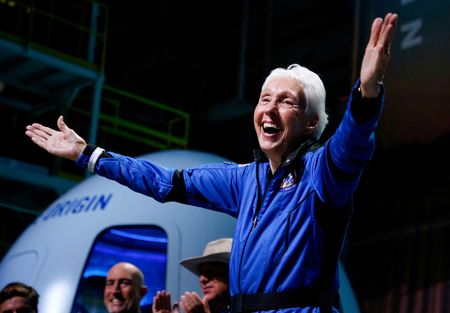
Wally Funk, the groundbreaking aviator who spent decades fighting gender barriers in aviation and ultimately soared to space at age 82, has died at her home in Grapevine, Texas — a suburb of Dallas — at the age of 87.
The city of Grapevine announced her passing Thursday in a statement shared on social media, noting she died the evening before. No cause of death was provided.
Funk had been denied a place in NASA’s early astronaut program solely because of her gender, but she made international headlines in July 2021 when billionaire Amazon.com founder Jeff Bezos invited her as his honored guest on the very first crewed flight of his company Blue Origin’s New Shepard rocket. She was joined by Bezos, his brother Mark, and an 18-year-old Dutch high school graduate who became the youngest person ever to reach space.
When Bezos first announced his crew weeks before liftoff, Funk reflected on the moment in a video posted to Blue Origin’s website. “I didn’t think I’d ever get to go up,” she said.
The suborbital trip lasted about 10 minutes but made history — at 82, Funk became the oldest human being ever to reach outer space, breaking the record previously held by retired Mercury astronaut John Glenn, who was 77 when he flew aboard a NASA space shuttle in 1998 as a sitting U.S. senator.
After the New Shepard capsule touched down safely on the Texas desert floor via parachute, an elated Funk stepped out and told reporters, “I’ve been waiting a long time,” before enthusiastically adding, “I want to go again, fast.”
Her wide smile, royal blue flight suit, and short white hair made her an instant sensation. White House spokesperson Jen Psaki even declared her “America’s new sweetheart.”
Her record as the oldest person in space lasted nearly three months, until actor William Shatner — best known for playing Captain Kirk on the 1960s science fiction television series “Star Trek” — flew on Blue Origin’s second New Shepard mission in October 2021 at age 90. Air Force veteran Ed Dwight later surpassed Shatner’s record, also at age 90, on a Blue Origin flight in 2024. Nevertheless, Funk remains the oldest woman ever to have traveled to space.
Long before her historic spaceflight, Funk had built an extraordinary aviation career. She trained more than 3,000 pilots, logged over 19,000 hours in the air, and shattered one gender barrier after another throughout her life.
Born in 1939, Mary Wallace Funk became the first female flight instructor at a U.S. military base — Fort Sill in Oklahoma — as well as the first female inspector for the Federal Aviation Administration and the first female air safety investigator for the National Transportation Safety Board.
In 1961, she was the youngest of 13 women who successfully completed the same demanding physical and psychological testing required of the seven men chosen for NASA’s original Mercury program, which sent the first Americans to space between 1961 and 1963. Known as the Mercury 13, this group of women outperformed many of their male counterparts — Funk herself scored higher than many of the men on several tests. Despite their achievements, the women were barred from NASA’s astronaut corps because of their gender.
John Glenn, one of the original seven Mercury astronauts and the first American to orbit Earth, had at one point testified before Congress against allowing women into the spaceflight program, according to the Washington Post.
Meanwhile, the Soviet Union — America’s chief rival in the Cold War space race — had embraced women in its program. Valentina Tereshkova became the first woman in space in 1963. It wasn’t until 1983 that the first American woman, Sally Ride, reached orbit.
Funk was the last surviving member of the Mercury 13, and ultimately the only one among them to make it to space.
OpenAI rolled out a new workplace-focused feature on Thursday called ChatGPT Work, an automated agent built into its well-known chatbot that can carry out tasks spanning multiple programs and file types.
Running on GPT-5.6, ChatGPT Work is designed to pull information from existing apps, files, and workflows to produce finished products such as documents, spreadsheets, presentations, reports, and websites, according to the company.
The announcement comes as technology companies are increasingly battling for a share of the professional AI tools market, driven by growing demand for automated systems that can handle complex tasks without much human involvement.
The release follows a move by OpenAI competitor Anthropic, which earlier expanded its own enterprise offerings with Claude Cowork — an agent built to independently plan and carry out multi-step tasks.
In addition to ChatGPT Work, OpenAI — which is currently preparing for an initial public offering — also announced a new desktop application and a hosted websites feature that allows users to build and share websites directly through the Work platform.
ChatGPT Work became available Thursday on both web and mobile, with a broader rollout expected over the coming days.
Have you ever wondered how scientists precisely measure the Earth? The answer lies in a field of science called geodesy — and NOAA is helping explain it to the public.
Geodesy is the discipline focused on understanding the exact shape, size, and gravity of our planet. Experts in this field, known as geodesists, use specialized surveying equipment to take highly accurate measurements of the Earth’s surface.
NOAA’s National Geodetic Survey plays a key role in this work, helping establish the frameworks that make modern navigation, mapmaking, and land surveying possible. A geodesist was recently photographed on the National Mall in Washington, D.C., using a surveying device as part of this ongoing scientific effort.
NOAA released a video on July 9, 2026, aimed at helping everyday people understand what geodesy is and why it plays such an important role in how we understand and navigate the world around us.
NEW YORK (AP) — The idea of letting an artificial intelligence tool handle all your meeting notes sounds appealing. Within moments of sitting in on an hour-long video call, these AI agents can produce a full recap of what was discussed and generate a task list for everyone involved.
But the way these tools actually work has led many professionals to think twice before using them. At their core, AI notetakers convert everything spoken during a meeting into data — and that data can include confidential personnel matters, sensitive business strategies, trade secrets, and potentially damaging remarks that could fall into the wrong hands.
“There are huge risks to the organization on AI notetakers,” said Amy Dufrane, the chief executive of human resources training and certification provider HRCI. “I don’t think companies should use it at all.”
An AI notetaker is a software program or device that combines artificial intelligence, voice recognition, and large language models to capture, transcribe, and condense conversations. While the tools are designed to save time and boost engagement, professionals across multiple industries say there are legitimate reasons for concern.
One of the biggest worries is not knowing where recorded data ends up or how long it’s kept. Privacy advocates are raising alarms that the companies behind these tools may be building voiceprints — unique acoustic profiles similar to fingerprints but based on the specific qualities of a person’s voice — without obtaining consent. Those voiceprints can be used to gain access to restricted accounts, including bank accounts.
Some technology companies resell data gathered through their notetaking products or use recordings and transcripts from private meetings to improve their AI systems. There’s also a legal dimension: a federal judge in New York ruled in February that a criminal defendant had to hand over documents he had prepared for his attorneys, because those documents had already been shared with a third party — Anthropic’s Claude AI.
“People who use AI notetakers, they don’t always know where the data goes,” said Justin Daniels, an Atlanta-based corporate attorney at law firm Baker Donelson. “And in my context, if the data goes anywhere else and they’re not aware of it, that attorney-client-privileged conversation may not be attorney-client-privileged anymore.”
Here is what you should know about the risks of AI notetakers, how to handle them in a meeting, and steps you can take to protect your information.
When you enter a virtual meeting, get into the habit of checking for an AI notetaker. It may appear on the participant list — often with a label indicating it’s an AI tool — or a notification may pop up on screen alerting attendees that the session is being recorded, which can indicate a notetaker is active.
Platforms like Zoom and Google Meet typically alert users when recording is happening, but not all meeting software makes it obvious when an AI notetaker has been added, according to Thorin Klosowski, a senior security and privacy analyst at the Electronic Frontier Foundation.
It’s also possible for participants to use a separate personal device to record and transcribe a conversation without the knowledge of others in the meeting.
“You hope the other person would tell you that they’re doing that,” Klosowski said. “Asking everyone for consent before doing a sensitive meeting would be the most polite approach to take.”
If you’re not certain whether an AI notetaker is present, simply ask. You can also set expectations at the start by stating the meeting is not authorized to be recorded.
Dufrane suggested a straightforward way to handle it: say, “Our company policy is that this meeting cannot be recorded.” Framing it as a company rule takes the pressure off individual employees — like a salesperson trying to make a good impression — and shifts responsibility to the organization, she explained.
Another approach is to allow the notetaker to run during part of the meeting, then shut it off before turning to more sensitive topics.
“I won’t start talking about anything substantive until it’s shut off, because I just don’t want to take the risk,” Daniels said.
According to Chris Pluymers, an associate attorney at The Dillon Law Group in East Lansing, Michigan, many AI notetaking tools create individual voiceprints for each person speaking — that’s how the software tells participants apart and labels them as “Speaker 1” or “Speaker 2.”
Voiceprints are already used by some institutions to verify the identity of bank customers over the phone. If those vocal signatures were obtained by bad actors, they could be weaponized to access files, commit fraud, or take over accounts, Pluymers said.
Several states have enacted laws governing how voiceprints can be collected and stored, and those laws give individuals certain rights to object to the use of AI notetakers in meetings they attend.
In Illinois, voiceprints are classified as biometric identifiers — similar to fingerprints — and fall under the state’s Biometric Information Privacy Act. That law requires written notice and informed consent before any AI tool collects voiceprints. It also requires companies to have a documented plan for how long data is kept and when it will be destroyed. However, Pluymers noted that most companies using these tools don’t have any of those safeguards in place.
“In the world of AI, the world of data and privacy, the world of biometric identification, I don’t think you can have such a lax approach to it,” Pluymers said. “I think getting out ahead of it is crucial.”
Under that Illinois law, workers can decline to attend a meeting where an AI notetaker is present until they receive clear answers about how their data will be stored, why it’s being kept, and when it will be deleted, Pluymers said. They can also request to see any written policy or consent form related to the tool.
If an AI notetaker shows up unexpectedly, Pluymers suggested a polite response: “I prefer we keep this meeting without AI recording or transcript tools and I’d be happy to take my own notes and share a recap if that’s helpful.” Being respectful while clearly expressing your preference is often the most effective approach, he said.
Danielle Kays, a partner at Fisher Phillips who advises businesses on privacy and employment law, recommends finding out whether the companies behind AI notetaking apps hold on to recordings, transcripts, or metadata indefinitely — or use that material to train their AI systems.
“If there is some sort of speaker ID or voice recognition, really understand what that is and how it works,” Kays said.
Even when content appears to be deleted, metadata about meetings can remain stored with the vendor. That means sensitive business details could still influence how an AI model behaves and, in some cases, could be recalled or reproduced by the system, she said.
The Electronic Frontier Foundation also points out that AI notetakers produce text-based output, which is far easier for outside parties to search through than raw video or audio files.
“Storing a bunch of video isn’t easy, it’s costly and hard to look through, but text is much easier to search and cheaper to store,” said Klosowski of the Electronic Frontier Foundation.
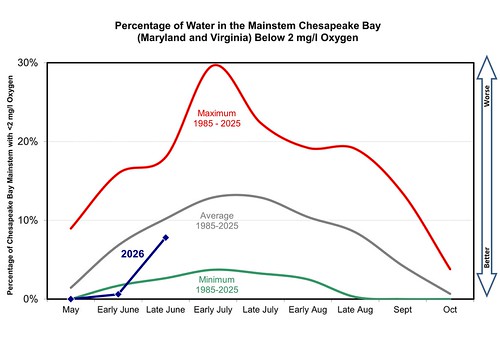
New data gathered by the Maryland Department of Natural Resources and Old Dominion University reveals that the Chesapeake Bay is off to its healthiest start in recorded history when it comes to dissolved oxygen levels. Measurements taken from May through late June 2026 across the Maryland and Virginia portions of the Bay’s mainstem show hypoxia — defined as water containing less than 2 milligrams per liter of oxygen — running well below historical norms.
In May, no hypoxia was detected at all, placing 2026 among only ten years out of the past 42 where May monitoring found zero hypoxic conditions. Early June set an all-time record low for that period, with hypoxic volume measuring less than one-tenth of a cubic mile — the lowest ever recorded for early June in 38 years of data. By late June, hypoxia climbed to just under one cubic mile, but that figure still fell below the long-term historical average of 1.27 cubic miles. Neither May nor early June showed any anoxia — water with less than 0.2 mg/l of oxygen — while late June recorded just 0.05 cubic miles of anoxic water.
The data, ranked from best to worst conditions across 42 years of monitoring, shows May 2026 tied for first place with a hypoxic volume of zero, compared to the historical average of 0.18 cubic miles. Early June ranked first out of 38 years at 0.076 cubic miles, far below the average of 0.85. Late June came in 14th out of 36 years at 0.97 cubic miles versus the 1.27 average.
Researchers point to ongoing drought conditions as a major factor behind the improved water quality. According to the U.S. Geological Survey, water flow into the Bay has been running below average since August 2025 due to persistent dry conditions across the watershed. Less water flowing in means fewer nutrients — specifically phosphorus and nitrogen — entering the Bay. Those nutrients are what feed algal blooms, which in turn consume oxygen in deeper Bay waters when they die and break down.
A seasonal forecast issued by Chesapeake Bay Program partners noted that from January through April 2026, river flow into the Bay ran 32% below the long-term average, while nitrogen levels came in 39% lower than typical, totaling roughly 59 million pounds of nitrogen according to monitoring station estimates. The forecast had predicted Bay hypoxia volumes would run about 31% below the long-term average this season — a prediction that current monitoring results appear to support.
However, scientists caution that conditions could shift. Since the late June measurements were taken, air temperatures across the watershed have reached record highs, and seasonal storms are expected to pick up. Warmer water naturally holds less oxygen, and increased freshwater flowing into the Bay could cause greater stratification — a layering effect that prevents oxygen from mixing down into deeper waters — while also carrying additional nutrients.
Dissolved oxygen is essential for the Bay’s wildlife. Crabs, fish, oysters, and countless other species depend on adequate oxygen levels to survive. Scientists and resource managers track hypoxia volumes and how long those conditions last in order to assess potential harm to Bay ecosystems.
Efforts to cut nitrogen and phosphorus pollution from industrial operations, wastewater treatment, farmland, and urban runoff continue as part of the long-term strategy to improve Bay health. The Maryland Department of Natural Resources calculates hypoxia volumes each year from May through October using water quality data managed in partnership with the Virginia Department of Environmental Quality, with funding support from both states and the Chesapeake Bay Program. Monitoring will continue through the summer, and additional water quality information is available through the Eyes on the Bay website.
Meta Platforms on Thursday unveiled long-anticipated developer access to its Muse Spark artificial intelligence model, simultaneously introducing an upgraded version called Muse Spark 1.1 — a move that puts the social media company in direct competition with Anthropic and OpenAI in the paid AI marketplace.
The company is billing Muse Spark 1.1 as its most powerful model yet for real-world programming and automated tasks, framing it as part of its broader goal of achieving what it calls “personal superintelligence.”
According to Meta, the upgraded model is capable of writing and fixing code, operating software and outside tools, processing text, images, and video, and completing complicated multi-step tasks with minimal human involvement.
The original Muse Spark model made its debut back in April, becoming the first text and reasoning AI model produced by the superintelligence team Meta assembled last year as it works to catch up with competitors in the fast-moving artificial intelligence race.
While the model launched in April, Meta had been quietly testing its Application Programming Interface — a digital connector that lets developers plug the model’s capabilities into their own software — with select partners in a private preview.
Now, developers across the United States can access Muse Spark through a public preview on Meta Model API, where they can experiment with prompts, compare results, and build prototype applications.
New users who sign up for the API will receive $20 in complimentary credits to try out the model before transitioning to a pay-as-you-go system. The pricing is set at $1.25 per million input tokens and $4.25 per million output tokens — higher than OpenAI’s entry-level GPT-5 mini and Anthropic’s budget-friendly Claude Haiku 4.5, but less expensive than Anthropic’s more advanced Claude Sonnet 4.6 offering.
Muse Spark 1.1 is now available in Thinking mode within the Meta AI app and on its website. The model is also expected to eventually take over from existing Llama models that currently power chatbots across WhatsApp, Instagram, Facebook, and Meta’s line of smart glasses.
Thursday’s launch follows an announcement earlier in the week when Meta said it was expanding its generative AI offerings by rolling out Muse Image — its first image-generation model from Meta Superintelligence Labs — across its suite of apps.
RICHMOND — A Virginia wildlife organization is calling on residents to report woodland box turtle sightings as part of a broader effort to understand and protect a species that has been quietly disappearing across the state.
The Virginia Herpetological Society says woodland box turtles are one of the most commonly spotted reptiles in the state, but conservationists are growing worried. According to the Virginia Department of Wildlife Resources, the woodland box turtle population has dropped an estimated 32% over the last 100 years, driven by habitat loss, deaths on roadways, and removal from the wild for the pet trade.
Matt Neff, president of the Virginia Herpetological Society, emphasized the value of everyday residents contributing to the effort. “Citizen science is so important,” he said. “By collecting this data, we can share important numbers and trends with state agencies and other organizations so they can use the information to guide conservation decisions.”
Woodland box turtles can thrive in a wide range of environments — from hardwood forests and pine flatwoods to maritime forests, hardwood swamps, and land bordering farms. However, ongoing development continues to break up the habitats these animals depend on.
John Kleopfer, the state herpetologist for the Virginia Department of Wildlife Resources, noted that the most severe losses have been concentrated in densely developed parts of the state. “As you would expect, declines are most notable in heavily urbanized areas such as in the Northern Virginia-D.C. metro, Central Virginia-Richmond metro and Southeastern Virginia-Tidewater,” he said.
One reason the species is particularly vulnerable is its limited range. Box turtles tend to spend the majority of their lives within a small area, and when roads or housing developments cut through that territory, populations can become cut off from each other. Adding to the concern, woodland box turtles typically need more than a decade to reach reproductive maturity, meaning the loss of even a few adult turtles can have lasting consequences for a local population.
The pet trade has also taken a toll. Thousands of box turtles have been taken from the wild over the years. In response, Virginia’s Department of Wildlife Resources prohibited private ownership of the native woodland box turtle in 2021.
Other groups are also stepping up. The Virginia Master Naturalist program has been working to protect box turtle populations, including a monitoring effort on the Northern Neck. Bob Dunstan, co-leader of the Virginia Master Naturalist Northern Neck project, shared that the group is pushing for new safety measures on local roads. “We have just put a request into VDOT to place seasonal turtle warning signs at three hot spot locations,” he said. “Something that has never been done before in Virginia.”
Anyone who spots a woodland box turtle and wants to contribute to conservation efforts can log their sighting at virginiaherpetologicalsociety.com.
A biotechnology firm says it has reached a significant milestone in space-based medicine, successfully operating a 3D bioprinter aboard the International Space Station to create structures made up of human liver, kidney, and cartilage cells.
San Diego-based Auxilium Biotechnologies announced that a recently finished mission represented the first time liver and kidney tissues had ever been bioprinted in space. The cells used in the experiments were provided by researchers at Wake Forest University, according to Auxilium co-founder Jacob Koffler of the University of California, San Diego.
The central challenge the team tackled is one that has long frustrated tissue engineers working on Earth: getting cells to land precisely where they need to be inside a three-dimensional structure. Koffler compared the problem to blueberries sinking to the bottom of muffin batter — when cells cluster in the wrong spots or spread unevenly, the resulting tissue may not work correctly.
In real organs, cells occupy very specific positions. Scientists on Earth have not yet found a reliable way to control exactly where those cells end up, Koffler explained. In the microgravity environment of space, however, that level of control becomes achievable.
Auxilium first sent its bioprinter to the space station in 2024, originally with the goal of improving the company’s nerve-repair implants, which are currently in clinical trials. The company needed a way to distribute drug-containing particles evenly throughout those implants so that healing compounds would be released consistently as nerves regenerate. Because gravity causes the particles to sink under normal conditions, the team turned to the space station’s microgravity environment as a solution.
In the most recent mission, Auxilium sent up specialized bio-inks to expand its work into tissue printing. Koffler’s team monitored the process from Earth through cameras on the station and was able to send updated instructions to the printer when needed.
The liver and kidney tissue samples created on the ISS returned to Earth roughly two weeks ago and are currently being studied.
Dr. Anthony Atala of the Wake Forest Institute for Regenerative Medicine, whose team supplied the liver and kidney cells, commented on the results. “The uniform cell distribution achieved aboard the space station points to real possibilities for manufacturing medical devices and tissues in space,” he said.
Koffler noted that the structures produced are not functioning organs. He expects the field will first focus on smaller tissue patches capable of repairing damaged organs — such as a section of the liver — before scientists attempt to bioprint complete replacement organs.
The project also reflects a broader surge of commercial interest in manufacturing products in space, particularly as NASA moves toward eventually retiring the International Space Station. Auxilium has already signed agreements with companies that are developing commercial space stations and other orbital platforms intended to take the ISS’s place, Koffler said.
Space-manufactured medical products are still a long way from being used in patients. Regulatory frameworks are only beginning to be established, and Koffler said he participated in a U.S. Food and Drug Administration workshop on space biomanufacturing earlier this year.
“It’s going to take some years until we get to the clinic,” he said. “But it’s important to start building that framework now.”
In roughly 5 billion years, our sun will begin dying — swelling to enormous size, swallowing the closest planets, then shedding its outer layers and collapsing into a dense stellar remnant known as a white dwarf. But new research suggests that some planets may endure long after that catastrophic transformation.
Scientists have now made detailed observations of a Jupiter-like planet beyond our solar system that has continued to exist for billions of years following its star’s death. The planet, known as WD 1856 b, sits 81 light-years from Earth in the constellation Draco. For reference, one light-year equals 5.9 trillion miles, or 9.5 trillion kilometers — the distance light covers in a single year.
Researchers determined that WD 1856 b has a mass roughly eight times that of Jupiter, the largest planet in our solar system. Its atmospheric temperature registers around 260 degrees Fahrenheit (127 degrees Celsius), which scientists say is surprisingly warm for a planet in its situation.
The planet now circles extremely close to the white dwarf — 50 times closer than Earth is to our sun — apparently having drifted inward over a long period of time. It completes a full orbit in just 1.4 days.
WD 1856 b serves as a real-world example of how planets can survive the death of their host star, which may mirror what happens to some planets in our own solar system when the sun eventually dies. However, scientists note that this planet’s situation involves some unusual circumstances. The white dwarf is actually part of a triple star system, alongside two smaller red dwarf stars, each about 30% of the sun’s mass — creating a complex gravitational environment.
Researchers are still working to understand exactly how WD 1856 b ended up in such a tight orbit around the white dwarf. “There are two main competing ideas for how WD 1856 b got into the tight orbit we observe today,” explained astrophysicist Christopher O’Connor of Northwestern University in Illinois, one of the study’s authors. The research was published in the journal Nature.
The first theory suggests the planet was actually swallowed during the star’s red giant expansion phase but managed to survive just outside the collapsing stellar core. The second theory holds that the planet was originally far enough away to avoid being consumed, but was later gravitationally nudged inward by the two nearby red dwarf stars.
WD 1856 b was first discovered in 2020, providing the earliest definitive proof that planets can outlive sun-like stars. This new study goes further, shedding light on the planet’s makeup and history. Scientists examined it using the James Webb Space Telescope and found it is composed primarily of hydrogen and helium — similar to Jupiter — but with an unusually high concentration of methane. Researchers believe its unexpected warmth comes from the gravitational forces exerted by the white dwarf as the planet’s orbit gradually tightened over time.
In a striking reversal of the usual size relationship between stars and planets, WD 1856 b is actually about 500 times larger in volume than the white dwarf it orbits. While stars are typically far bigger than their planets — the sun is roughly 1,000 times larger in volume than Jupiter — a white dwarf is extremely compact, only slightly bigger than Earth, though far more massive. The white dwarf in this system formed from a star up to twice the mass of our sun that died approximately 5 billion years ago.
As for what all this means for our own solar system, scientists say the picture is becoming clearer — at least for some planets. When the sun enters its red giant phase, it will balloon to about 200 times its current size, definitely engulfing Mercury and Venus in the process.
“The rest of the planets beyond Earth will be well beyond the sun’s maximum size, so they will most likely just continue to orbit the white dwarf left behind by the sun,” O’Connor said. “However, because the sun will lose about half of its mass as it becomes a white dwarf, we expect the survivors to gradually drift away until they reach about double their current orbital distances.”
Earth’s fate, however, remains an open question. “We cannot predict Earth’s future orbit well enough to know whether it will be inside or outside the ‘danger zone’ when the sun reaches the end of its life,” O’Connor said. “Fortunately, this is one problem we still have billions of years to figure out.”
SpaceXAI rolled out its latest artificial intelligence model on Wednesday, introducing Grok 4.5 as the company’s most advanced product to date, built specifically for coding and so-called agentic tasks — work that AI can carry out with greater independence.
The company said Grok 4.5 was developed using tens of thousands of Nvidia GB300 graphics processing units, with heavy emphasis on careful data filtering, removing duplicate information, and evaluating the quality of training data.
The popular AI coding tool Cursor confirmed its involvement in the project, stating, “We’ve partnered with SpaceXAI to train Grok 4.5.” SpaceX announced last month that it plans to acquire Anysphere, the startup that created Cursor, through an all-stock deal valued at $60 billion, a move aimed at strengthening its foothold in the enterprise AI tools market.
Grok 4.5 is now accessible through SpaceXAI’s own AI coding agent called Grok Build, within Cursor, and via the SpaceXAI console — the company’s developer portal — using an API key. Availability in the European Union is expected to follow in mid-July.
In terms of pricing, SpaceXAI set Grok 4.5 at $2 per million input tokens and $6 per million output tokens. For context, input tokens refer to the text, code, or other data a user sends to an AI model, while output tokens are what the model produces in return.
SpaceX CEO Elon Musk weighed in on the release through a post on X, describing the model as “an Opus-class model, but faster, more token-efficient and lower cost.”
The launch comes after Musk’s AI startup xAI was acquired by SpaceX back in February. Musk announced in May that xAI would no longer operate as a standalone company and would be folded into what is now called SpaceXAI.
By comparison, rival Anthropic’s Claude Opus 4.8 is priced at $5 per million input tokens and $25 per million output tokens. OpenAI’s GPT-5.6 Luna, meanwhile, is priced at $1 per million input tokens and $6 per million output tokens.
OpenAI is set to publicly release its most powerful AI model, GPT-5.6, on Thursday. That launch had been delayed last month after the U.S. government raised national security concerns about the possible misuse of highly capable AI technologies.
The nation’s top vehicle safety regulator is demanding that self-driving car companies take immediate action to stop a troubling trend of autonomous vehicles getting in the way of emergency personnel.
Jonathan Morrison, who leads the U.S. National Highway Traffic Safety Administration, sent a letter to the industry this Wednesday outlining serious concerns. According to Morrison, NHTSA has recorded numerous cases of driverless vehicles driving “directly into active emergency scenes, blocked the paths of ambulances and firefighters, or failed to recognize and respond to basic safety conditions like flashing lights, flares, smoke, fire, and traffic cones.”
Morrison described the problem as a “clear pattern” that requires swift attention from autonomous vehicle developers.
NHTSA called the behavior unacceptable and announced it would set up meetings with vehicle developers before the end of July to hear what solutions the companies plan to put in place.
CAPE CANAVERAL, Fla. — Three months after making history by flying around the moon, the four-member Artemis II crew returned to Kennedy Space Center on Wednesday for a reunion with the very capsule that carried them on their record-setting journey.
It was the first time the crew had set foot at the launch site since lifting off in April. Standing at the now-empty pad where a massive Space Launch System rocket once towered, commander Reid Wiseman reflected on the sight. “It’s a lonely place without that rocket on it,” he said. The crew spent the day expressing gratitude to the many workers and teams who made the mission a success.
During the lunar fly-around, the three NASA astronauts and one Canadian space traveler shattered distance records, venturing 252,756 miles — or 406,771 kilometers — from Earth. It marked the first time humans had journeyed to the moon in more than 50 years.
Wiseman noted that excitement surrounding the mission remains strong among the public. He shared a touching moment from about a week ago, when a woman approached him while he was boarding a plane in France and handed him her boarding pass with a handwritten note. The message read: “Thank you for reminding us about joy and hope in the universe again.”
The crew is enthusiastic about passing the torch to the next mission team. Last month, NASA announced the Artemis III crew — three NASA astronauts and one Italian — who are set to fly next year. That mission will stay in Earth orbit and practice docking procedures with lunar landers currently being developed by SpaceX and Blue Origin. Artemis IV is tentatively planned for as early as 2028 and will include a moon landing by two astronauts who have not yet been named.
The Artemis III crew is entirely male, but Artemis II astronaut Christina Koch — who made history as the first woman to travel to the moon — said that fact does not trouble her. What would concern her more, she explained, would be if someone overrode NASA’s crew selection process just “to make it look a certain way.” “I am so glad and so proud that that’s not the situation we have,” she told reporters.
Koch flew to the moon alongside Wiseman, pilot Victor Glover, and Canada’s Jeremy Hansen. Earlier this week, Hansen announced he will be departing the Canadian Space Agency in September, though he plans to remain a reservist in the Royal Canadian Air Force and will continue to support the Artemis program going forward.
OpenAI rolled out a new family of artificial intelligence voice models on Wednesday, called GPT-Live, which are capable of both listening and speaking at the same time in real time.
The AI startup, which is preparing for an initial public offering, announced it would release two versions of the technology — GPT-Live-1 and GPT-Live-1 mini — to users across the globe on Wednesday.
The launch builds on efforts OpenAI made back in May, when the company introduced three audio models for its developer platform. Those models were designed to make voice-based software agents more conversational and better equipped to handle tasks on the fly in real time.
Officials from the Department of Commerce and NOAA gathered on July 8, 2026, to mark the official opening of the agency’s brand-new Charleston Port Facility in South Carolina, celebrating the completion of a major upgrade to NOAA’s marine infrastructure.
The new facility will serve as home port for NOAA ships Ronald H. Brown and Nancy Foster, strengthening the agency’s ability to carry out vital research missions across the Atlantic Ocean.
The vessels that operate out of NOAA’s Atlantic fleet gather data that supports a wide range of critical functions — from protecting marine mammals, coral reefs, and historic shipwrecks, to managing commercial fisheries, creating nautical charts that keep mariners safe, and deploying buoys that monitor ocean and weather conditions and provide tsunami warnings.
NOAA Administrator Neil Jacobs, Ph.D., spoke at the ribbon-cutting ceremony, saying: “Today, we cut the ribbon on an innovative, next-generation maritime home port. This crucial investment in our marine infrastructure will help ensure NOAA’s fleet can continue to deliver the critical observations and data that protect lives, strengthen our economy, and advance our nation’s security.”
Back in 2023, NOAA awarded a $59.8 million contract to Manson Construction Company to overhaul its pier facility in North Charleston. The project involved tearing down the existing pier and constructing a new floating pier measuring 62 by 360 feet, complete with shoreside power connections for docked ships. The renovation also added a warehouse and a small boat pier to support day-to-day operations. The new floating pier — considered one of the largest of its kind in the United States — was successfully launched and placed into position earlier this year.
Rear Adm. Chad M. Cary, who serves as NOAA Corps director and assistant administrator for NOAA Marine and Aviation Operations, emphasized the facility’s importance: “This pier and facility are integral to safe and efficient research ship operations in the Atlantic. The new infrastructure allows both NOAA ships homeported in Charleston to once again have designated berths and better accommodate research missions in the area.”
Commerce Department Deputy Secretary Paul Dabbar and NOAA Administrator Neil Jacobs, Ph.D., were among the dignitaries who participated in the ribbon-cutting ceremony.
NOAA’s Office of Marine and Aviation Operations oversees a fleet of 15 vessels, including hydrographic survey ships, oceanographic research vessels, and fisheries survey ships. These ships operate both domestically and internationally, crewed by a combination of NOAA commissioned officers and civilian professional mariners.
A quasar is one of the most powerful and brilliant objects in the entire universe — essentially a supermassive black hole at the center of a galaxy that is actively consuming surrounding matter. Now, scientists have discovered quasars so ancient that their very existence in the early universe has left researchers searching for answers.
Using the European Space Agency’s Euclid space telescope, a team of researchers identified 31 of these extremely old quasars. The findings deepen an already puzzling mystery: how was the early universe so much more developed than scientists had previously imagined?
Among the newly identified quasars are the two oldest ever recorded, both dating back more than 13.1 billion years. At that point, the universe was only about 5% of its current age — roughly 670 million years after the Big Bang. Each of those two quasars radiates light approximately one trillion times brighter than our sun.
Quasars of this type are fueled by black holes with masses ranging from hundreds of millions to billions of times that of the sun. The precise masses of these two particular quasars have not yet been determined.
Daming Yang, a doctoral student in astrophysics at Leiden Observatory at Leiden University in the Netherlands and the study’s lead author, described what a quasar actually is: “A quasar is the blazing core of a galaxy. At the center sits a giant black hole. Black holes themselves are dark, but the black hole’s gravity pulls in gas and dust, which spiral toward it like water going down a drain. As this happens, the gas gets incredibly hot and shines brighter than the entire galaxy around it.”
The two most ancient quasars in the study existed during what scientists refer to as the “epoch of reionization,” also known as cosmic dawn. Yang described that era this way: “The universe back then was much smaller and denser, and filled with a fog of neutral hydrogen. It was also a time of rapid change: the first stars, galaxies and black holes were lighting up and burning away that fog, transforming the universe into the transparent one we see today.”
During that period, hydrogen atoms had their electrons stripped away, leaving hydrogen in the ionized state that still dominates intergalactic space today.
In recent years, instruments like the James Webb Space Telescope and Euclid have helped scientists better understand the universe’s earliest chapters — revealing that it contained mature galaxies and enormous, matter-hungry black holes far earlier than expected.
Study co-author Joseph Hennawi, an astrophysicist at the University of California, Santa Barbara and Leiden University, explained the scale of the discovery: “Everything was packed into a much smaller volume since the universe has expanded roughly eightfold in linear scale since then.”
Hennawi went on to say, “The most important thing these distant quasars tell us is that these supermassive black holes were already present in the extremely early cosmic times. This does not provide very much time to grow these objects, because the universe is simply too young. This is a major unsolved problem in astrophysics.”
The existence of such massive black holes at that early stage stretches current scientific understanding of how black holes grow to its breaking point. Yang put it plainly: “Either the first black holes were born already massive through some exotic channel, or they grew much faster than we thought possible. Every step further back in time makes that puzzle harder. That is precisely the core mystery of these objects. And honestly, this study deepens it rather than solving it.”
The galaxies of that early era looked nothing like the large spiral and elliptical galaxies visible today. They were smaller in size but packed with the gas needed to rapidly produce new stars.
Just as they do today, each of those early galaxies had a supermassive black hole at its core. Our own Milky Way galaxy is home to one called Sagittarius A*, though it is currently in a quiet, inactive phase.
Euclid was launched in 2023 with a primary mission of studying dark energy and dark matter, but its observations of quasars have yielded an unexpected scientific bonus.
Yang reflected on what this new era of discovery means for the field: “Before Euclid, decades of searching by the whole astronomical community had yielded only a handful of quasars from the early era, limited mainly by the telescopes available. With this sample, we are entering a new era: studying these earliest supermassive black holes as a population, and finally addressing how they were born and grew so quickly when the universe was very young.”
The study was published in the journal Astronomy & Astrophysics.
A fish kill hit the Potomac River over the July 4th holiday weekend, impacting multiple fish species, according to social media posts from the Maryland Department of the Environment (MDE).
MDE scientists launched an investigation after receiving reports of dead fish scattered along a stretch of the Potomac River several miles upstream of Little Falls. The event took place on an extremely hot day that also brought powerful thunderstorms.
During early field work, investigators found affected fish near Sycamore Island along the Virginia shoreline. Water assessments revealed the kill was concentrated mainly in one species — golden redhorse suckers. Water temperatures in the impacted area registered in the mid-90s°F, conditions scientists described as highly stressful for fish.
Based on those initial findings, investigators determined the fish kill had likely come to an end or had significantly slowed, and that extreme heat was the most probable cause.
The next day, MDE crews returned to the river for a second round of fieldwork to gather more data and verify their early conclusions. Teams took additional water quality readings, mapped the full extent of the kill, identified the affected species, and collected fish samples for laboratory testing.
On July 6th, MDE announced that the fish kill covered approximately 13.7 river miles, stretching between White’s Ferry and Violette’s Lock (lock 23), located several miles upstream of Sycamore Island.
MDE said the initial investigation turned up no signs of a chemical spill or any other pollution-related event. Further lab analysis and continued field observations are expected to confirm the cause and rule out any other contributing factors.
The cryptocurrency world is taking a hard look at one of its most serious long-term threats: quantum computing. As advances in the technology accelerate, concerns are mounting that quantum machines could one day break the encryption systems that keep digital transactions and wallets secure.
Unlike today’s conventional computers, quantum computers are capable of solving extraordinarily complex mathematical problems at much greater speeds. That capability could potentially be used to unravel the cryptographic methods that protect the $2 trillion global cryptocurrency market — a market that already has a troubled history with major hacks.
While quantum computing is still largely in the experimental phase, alarm bells have grown louder since March, when research from Alphabet’s Google suggested the technology could break existing encryption sooner than anyone had anticipated. Google has indicated that quantum computers powerful enough to crack encryption could emerge as early as 2029 — a timeline far shorter than the decade-plus window that had previously been assumed.
Research from Citigroup and other institutions has reached similar conclusions, finding that quantum computing advances — combined with breakthroughs in artificial intelligence — have dramatically shortened the window before cryptocurrencies become broadly vulnerable to hackers.
Recognizing the risks to both the public and private sectors, U.S. President Donald Trump last month signed executive orders aimed at strengthening America’s quantum computing capabilities.
Some crypto companies and blockchain developers are already working on plans to upgrade their networks with quantum-resistant encryption — a process that experts say could take years and require sweeping changes to the entire digital asset infrastructure.
“It’s the most direct and existential threat towards cryptocurrencies and crypto networks,” said Chris Tam, head of quantum innovation at BTQ Technologies, a firm focused on quantum security.
At the heart of the vulnerability is the cryptography that most blockchains rely on. The majority use decades-old elliptic-curve cryptography to generate the public and private keys and digital signatures that verify ownership of crypto assets and authorize transactions. Public keys are mathematically derived from private keys and, in many blockchain networks, become visible to the public once assets are used or transferred.
While today’s computers cannot realistically reverse-engineer a private key from a public one, a sufficiently powerful quantum computer could — potentially allowing hackers to forge digital signatures and push through fraudulent transactions.
The risk is especially serious for public crypto networks, where transactions — unlike traditional bank payments — cannot be reversed.
“Crypto especially is uniquely exposed because blockchains are transparent and permanent,” said Utkarsh Ahuja, managing partner at Moon Pursuit Capital, a crypto investment firm.
Bitcoin, the world’s largest cryptocurrency, is considered especially at risk. Its 17-year transaction history has created a large pool of publicly visible keys. According to an unpublished June 2026 working paper by independent researcher Ahmed Raza Muhammad Umer, roughly 35% of Bitcoin’s circulating supply could be exposed to a quantum attack. Other research from last year put that figure as high as 50%.
Even a single incident in which a hacker steals and offloads a large amount of a token could devastate its price, warned Cristiano Ventricelli, vice president and senior analyst of digital assets at Moody’s Ratings. “Everyone will feel the impact,” he said.
That concern has already influenced some investment decisions. Christopher Wood, the widely followed global head of equity strategy at Jefferies, removed a 10% Bitcoin allocation from his model portfolio in his January newsletter, citing the long-term “existential” threat posed by quantum computing.
Despite the warnings, many in the industry believe there is still time to act. Ahuja and others said they expect it will be a few more years before quantum computing can actually crack blockchain encryption, and that the industry can transition to new “post-quantum” cryptography in the meantime.
However, crypto executives caution that moving too quickly carries its own risks, since post-quantum cryptography is still evolving rapidly. Post-quantum digital signatures are generally much larger than traditional ones, which increases storage and bandwidth demands. That could drive up costs and hurt the user experience — particularly on blockchains with fixed block-size limits, such as Bitcoin, according to Zach Pandl, head of research at crypto asset manager Grayscale. Still, Pandl expressed confidence that the industry would ultimately find solutions.
“There is an engineering challenge ahead, but there are engineering solutions already on the table,” he said.
One senior cybersecurity executive at a major crypto company said he expects it will take his firm two years to become fully quantum-resistant. Several people in the industry compared the scope of the effort to the Y2K overhaul, during which more than $300 billion was spent worldwide to fix the so-called “millennium bug.”
The challenge is particularly complicated for blockchains, which are mostly decentralized and governed by broad communities that may struggle to reach consensus on a course of action, said Tam of BTQ Technologies.
As of now, none of the top 20 blockchains have put a post-quantum signature algorithm in place, according to people interviewed for this story. In Bitcoin’s case, developers and market participants remain divided on which solution to adopt and when. The Ethereum Foundation, which backs the blockchain underlying ether — the second-largest cryptocurrency — has set a target of 2029 to achieve full protection against quantum threats.
“The sort of disaster scenario is that it happens way sooner than we think,” said Christopher Smith, CEO of Quantus, a blockchain that has already adopted post-quantum cryptography.
Among the early movers is the Algorand Foundation, which supports the Algorand blockchain. The foundation’s native token carries a market capitalization of around $780 million. Last month, the foundation published a post-quantum roadmap and announced plans to begin supporting post-quantum accounts later this year, said Bruno Martins, the foundation’s chief technology officer.
“It felt right to start doing (something) now, because it’s responsible to have a plan,” Martins said.
When it comes to tracking climate change, scientists are turning to some surprising sources of data — including the humble blueberry.
Located in Milton, Massachusetts, the nation’s oldest continuously operating weather observatory has been keeping careful records for generations. Among the many things its scientists monitor is an unusual climate indicator: the date on which the very first blueberry of the season reaches ripeness.
That single piece of information, tracked year after year, helps researchers identify patterns and measure how the climate has changed over time.
Every summer, beach towns along the Atlantic coast brace themselves for an unwelcome visitor — massive quantities of sargassum seaweed that washes ashore in large, smelly mats.
Coastal communities are now spending millions of dollars to manage the seasonal seaweed surge, as the annual sargassum season has become an increasingly significant challenge for towns that rely on clean, attractive beaches to draw visitors.
The seaweed, which floats in from the ocean, has forced beach towns to adapt their operations and budgets to deal with the ongoing onslaught each year.
BEIJING — A cybersecurity platform run by China’s industry ministry issued a warning Wednesday that it had found a serious security vulnerability — described as a “backdoor” — lurking inside Anthropic’s artificial intelligence coding tool, Claude Code.
The National Vulnerability Database, known as NVDB, published the alert through its official WeChat account, stating that Claude Code contains a built-in surveillance mechanism able to quietly transmit sensitive user data — including geographic location and identity-related identifiers — to remote servers, all without the user’s knowledge or approval.
According to the warning, the vulnerability affects Claude Code versions 2.1.91 through 2.1.196.
NVDB recommended that businesses and individual users take immediate action by reviewing any affected systems and either removing the compromised versions entirely or upgrading to the most recent release, which the database claims no longer contains the problematic code.
The agency also called on organizations to strengthen controls over external network access for development software and to boost monitoring of data traffic on core business networks in order to block any unauthorized movement of sensitive information.
The alert comes after Reuters reported last week that China’s Alibaba had prohibited its employees from using Claude Code on the job, following scrutiny of features within the tool that can reportedly help identify users with connections to China.
Anthropic had not responded to a request for comment at the time of publication.
Japanese moon transport company ispace announced Wednesday that it is entering a new lower-cost lunar cargo business, partnering with Elon Musk’s SpaceX and its powerful Starship rocket and moon lander.
The Tokyo-based company has secured 500 kilograms — roughly 1,102 pounds — of payload capacity aboard a Starship vehicle set to touch down on the moon as early as 2030. ispace plans to construct a lunar surface vehicle capable of carrying payloads for clients around the globe, essentially offering a ride-share service to the moon’s surface.
TAINAN, Taiwan — A creative conservation effort in southern Taiwan is paying off for the island’s largest land-dwelling crab species, with observed populations more than doubling thanks to road closures and specially constructed bamboo bridges.
Taijiang National Park, located in the city of Tainan, serves as the most critical habitat for the mangrove land crab and holds the biggest population of the species anywhere on the island.
Every year between July and September, female crabs make their way down to the ocean to release their eggs. The problem is that their migration path crosses roadways, putting them at serious risk of being struck by vehicles.
To address this danger, park officials implemented road closures and erected bamboo bridges to give the crabs a safer path. The results have been remarkable. Taijiang National Park Director Chen Jun-shan said the measures have cut down on crab deaths on roadways and helped push the number of crabs spotted annually from more than 5,000 in previous years to over 10,000 last year.
Director Chen emphasized the broader environmental importance of the species. “As for the mangrove land crab, it can return all of these nutrient sources back into the land, allowing the coastal forest to become more abundant,” he said. “So if you protect the land crabs, the entire coastal forest belt can be protected.”
Taiwan’s environmental priorities have shifted significantly since the country’s rapid industrial growth period spanning the 1960s through the 1980s, when ecological concerns often took a back seat. Today, a system of protected areas and national parks draws visitors from across the region.
Taijiang National Park is also a refuge for the black-faced spoonbill, a bird classified as “vulnerable” by the International Union for Conservation of Nature and Natural Resources. That species has also made a significant recovery after once teetering on the edge of extinction.
The U.S. Department of Commerce has approved a wide-scale launch of OpenAI’s latest artificial intelligence model, GPT-5.6, according to a Tuesday report from Axios, which cited a source with knowledge of the situation.
According to the report, OpenAI plans to release GPT-5.6 broadly to the public this week, following further testing and a series of meetings between company representatives and federal officials.
Reuters, which first covered the Axios report, noted it was unable to independently confirm the information. OpenAI, the White House, and the U.S. Department of Commerce had not responded to requests for comment at the time of the report.
The development comes after OpenAI announced last month that it was putting the brakes on a full public release of GPT-5.6 at the request of the U.S. government. During that delay, access to the AI model was restricted to a limited group of pre-approved partners whose identities were provided to federal authorities.
SpaceXAI and Cursor are gearing up to release their first jointly built artificial intelligence model, with a launch potentially happening as early as Wednesday, according to a report from The Information.
The publication, citing a memo distributed to employees, said the two companies had pushed back an earlier planned release date in order to work on improving the model’s performance and efficiency.
Reuters, which first carried the story on July 7, was unable to independently confirm the details of the report.
AI startup Perplexity announced Tuesday that it intends to adopt Nvidia’s newly developed central processing unit, as the chip giant makes a bold push to expand its market reach and challenge long-established competitors Intel and Advanced Micro Devices.
Nvidia has projected it will bring in $20 billion in revenue from its “Vera” CPU — a general-purpose computing chip distinct from its AI-specific products — before the close of its current fiscal year. The Vera chip is part of a broader strategy by Nvidia to diversify its business as major artificial intelligence companies like OpenAI and DeepSeek develop their own in-house AI chips.
The CPU market has historically been dominated by Intel and AMD, whose chips power everything from personal laptops to large-scale web servers. However, most of those chips were engineered before the emergence of AI “agents” — software systems capable of independently completing complex tasks based on instructions given by human users.
Unlike people, who naturally pause between tasks, AI agents operate continuously. Perplexity’s Vice President for Computer Enterprise and Infrastructure, Nate Kupp, noted that Nvidia’s CPU completed AI agent coding assignments roughly 1.5 times faster than conventional chips.
“Vera really stood out to us as just like a dead-on fit for a lot of the core workloads that we have,” Kupp said in an interview.
Perplexity did not reveal the number of Nvidia CPUs it intends to purchase. Nvidia has separately confirmed that OpenAI, Anthropic, and Oracle have also committed to using its new CPU.
Meta Platforms announced Tuesday that it is launching Muse Image, the first image-generation model to come out of its Meta Superintelligence Labs division, as the company behind Facebook continues to broaden its artificial intelligence offerings across its family of apps.
According to the company, Muse Image works within its existing Meta AI chatbot and is capable of understanding complex written prompts, accepting photos as starting points, and allowing users to make changes to generated images by drawing sketches or adding annotations directly.
Here is a breakdown of what the rollout includes:
The company said Muse Image will fuel more than 30 new AI-powered effects for Instagram Stories and bring image generation capabilities to direct message conversations with Meta AI on WhatsApp, though that feature will initially only be available in certain countries.
Meta also stated that it intends to bring Muse Image to additional countries over time and eventually incorporate it into both Facebook and Messenger.
While the core features of Muse Image through Meta AI will be available at no cost, users who want access to more advanced creation tools will need to sign up for one of Meta’s subscription plans.
The announcement follows Meta’s April launch of Muse Spark, the first text-and-reasoning AI model produced by the Meta Superintelligence Labs team, which the company assembled last year in an effort to keep pace with competitors in the rapidly growing AI industry.
Advanced AI models like these are central to the current technology boom, enabling automated tasks including writing software code, producing content, and managing customer service interactions.
Meta also gave an early preview of an upcoming product called Muse Video, a model designed to generate video content.
American electricity consumption is on track to break new records for the next two years running, according to federal energy forecasters. The Energy Information Administration released its Short-Term Energy Outlook on Tuesday, projecting that power demand — which already set a record high in 2025 — will continue climbing through 2026 and 2027.
The agency reported that U.S. power use reached 4,195 billion kilowatt-hours in 2025, itself a record. That figure is expected to grow to 4,269 billion kilowatt-hours in 2026 and then jump again to 4,399 billion kilowatt-hours in 2027.
A major force behind the increase is the explosive growth of data centers built to support artificial intelligence and cryptocurrency operations. At the same time, homes and businesses are increasingly switching from fossil fuels to electricity for heating and transportation, further pushing up overall demand.
One notable milestone in the forecast: commercial electricity use is expected to surpass residential demand in 2026 — something that has never happened before in recorded history. The agency projects commercial customers will consume 1,550 billion kilowatt-hours that year, compared to 1,508 billion kilowatt-hours for residential users and 1,065 billion kilowatt-hours for industrial customers.
For comparison, residential consumers set an all-time high of 1,515 billion kilowatt-hours in 2025, while commercial customers peaked at 1,493 billion kilowatt-hours that same year. The industrial record of 1,064 billion kilowatt-hours dates all the way back to 2000.
On the generation side, the mix of energy sources is also shifting. Coal’s share of power production is expected to drop from 17% in 2025 to 15% in both 2026 and 2027. Natural gas will hold steady at 40% across the same period, while nuclear power will remain at 18%.
Renewable energy is projected to grow its share of the power supply from roughly 24% in 2025 to 25% in 2026 and 27% in 2027, reflecting continued expansion of wind and solar capacity.
The outlook also covers natural gas consumption. Residential gas use is expected to fall to 12.5 billion cubic feet per day in 2026, and commercial use to 9.5 billion cubic feet per day. Industrial gas demand is forecast to rise slightly to 24.0 billion cubic feet per day, while gas used for power generation is projected at 36.6 billion cubic feet per day.
Those numbers compare to historical highs that include 14.3 billion cubic feet per day for residential use set in 1996, a commercial peak of 9.9 billion cubic feet per day reached in 2025, an industrial record of 23.8 billion cubic feet per day from 1973, and a power generation high of 36.8 billion cubic feet per day set in 2024.
Virginia’s wildlife management agency has put forward a draft plan aimed at guiding how stocked trout are managed throughout the state.
The draft document outlines the agency’s proposed approach to trout stocking programs, which are popular among anglers who fish Virginia’s rivers, streams, and lakes each year.
Officials are expected to seek feedback from the public as part of the review process before the plan is finalized.
Stocked trout programs are a significant part of recreational fishing in Virginia, drawing anglers of all experience levels to waterways across the commonwealth.
Further details about how to review the draft plan and submit comments were made available through the agency’s official channels.
Chinese AI startup DeepSeek is working to design its own artificial intelligence chip, according to three individuals with knowledge of the project — a development that could reduce the company’s reliance on processors from Nvidia and Huawei, which it has used to build and operate its widely used AI models.
The chip being developed is intended for inference — the phase of AI computing where a trained model produces responses for users — rather than for the training of new models, the sources indicated.
Should the effort prove successful, DeepSeek’s move into chip design would represent a significant strategic change for a company celebrated in China as a national AI leader, and could add competitive pressure on tech giant Huawei.
DeepSeek gained worldwide attention more than a year ago after releasing two highly efficient AI models that spread rapidly across the globe, catching many in Silicon Valley and Washington off guard.
The company has historically focused on advancing AI model development rather than commercializing its technology.
While Huawei’s chips still fall considerably short of Nvidia’s most advanced offerings, U.S. restrictions on exporting those Nvidia chips to China have allowed Huawei to capture roughly half of China’s $50 billion domestic AI chip market, with DeepSeek and several other major players among its customers.
That dominance is already being tested, however, as tech rivals Alibaba and Baidu develop their own chips and claim a growing share of the market.
DeepSeek’s push into chip development is still in its early stages. The company has been reaching out to outside partners and holding talks with chip-design, foundry, and memory companies, the three sources said. One of the individuals noted the effort started roughly a year ago.
The Hangzhou-based firm has also been quietly bringing on chip-design engineers in recent months, though the hiring has been conducted without any public job postings, two of the sources said.
All three sources asked not to be named because the matter has not been made public. DeepSeek, which has maintained a low profile despite its prominence in China’s AI sector, did not respond to a request for comment.
By pursuing an in-house chip, DeepSeek would be following a broader trend among global AI companies seeking greater control over the hardware powering their systems and less dependency on Nvidia.
OpenAI last month unveiled its first custom inference chip, called Jalapeno, developed in partnership with Broadcom. Separately, Anthropic has been exploring the possibility of building its own AI chips, according to a Reuters report from April.
For DeepSeek, the move carries additional strategic weight. U.S. export controls prevent Chinese companies from purchasing Nvidia’s most advanced chips, and Beijing has been pushing its technology companies to develop homegrown alternatives.
DeepSeek founder Liang Wenfeng acknowledged in a rare 2024 interview with a Chinese media outlet that chip export restrictions posed a challenge for the company.
DeepSeek has relied on both Nvidia and Huawei chips over time. The company has stated that the underlying model powering R1 — its reasoning model whose low-cost performance rattled U.S. tech stocks in January 2025 — was trained using Nvidia’s H800, a chip made for the Chinese market that Washington banned in late 2023.
More recently, DeepSeek has leaned more heavily on Huawei. In April, it released its V4 model adapted to run on Huawei’s Ascend chips, and Huawei confirmed its processors played a role in training V4-Flash, a lighter version of the model. Orders for Huawei’s Ascend 950 chips from major Chinese tech companies surged following that launch, Reuters has reported.
A DeepSeek inference chip would enter the fastest-growing area of AI computing. As AI applications become more widespread, the industry is shifting more of its computing workload from training models to running them — a task that relies on specialized chips that can be less expensive and more energy-efficient than general-purpose processors.
Still, success is far from certain. Designing a competitive AI chip typically takes years and requires substantial investment. Manufacturing presents additional obstacles, as U.S. restrictions block Chinese chip designers from using the most advanced overseas production facilities, while separate controls have limited China’s access to high-bandwidth memory — a key component for AI inference chips.
DeepSeek’s chip ambitions come alongside the company’s first move toward accepting outside investment. The company was set to raise $7 billion in an initial funding round that would value it at between $52 billion and $59 billion, Reuters reported in June — a reversal of its longstanding policy of turning down external capital.
Across the country, roads and highways are showing the strain of increasingly severe weather driven by climate change — and the financial cost of addressing that damage could be enormous.
Heat waves are growing more frequent and more intense, and pavement is among the casualties. When temperatures soar, road surfaces can buckle, crack, and deteriorate far faster than they were designed to handle.
The question now facing transportation planners and policymakers is whether America’s existing road infrastructure is built to withstand the demands of a warming climate — one that brings not only more extreme heat, but also heavier rainfall and more unpredictable weather patterns.
Engineers and infrastructure experts warn that the challenge is not just about fixing roads after they are damaged, but about rethinking how roads are built in the first place. Materials and construction methods developed decades ago may no longer be adequate for the conditions roads face today.
As communities across the nation grapple with the growing cost of climate-related infrastructure damage, the road ahead — both literally and financially — appears to be a challenging one.
A Munich-based nuclear fusion startup announced Tuesday that it has secured €411 million — roughly $469.69 million — in a major financing round backed by some of the world’s largest companies, including Alphabet’s Google and German energy giant RWE.
The funding round for Proxima Fusion was led by XTX Ventures and East X Ventures, with Google and RWE participating as strategic investors. The new investment pushes the company’s total valuation to €2.4 billion, or approximately $2.7 billion.
Proxima Fusion’s chief executive, Francesco Sciortino, expressed confidence in Europe’s ability to compete on the global technology stage. “Proxima’s financing demonstrates that Europe can not only invent breakthrough technologies, but also build globally competitive companies around them,” he said in a prepared statement.
German utility RWE contributed €25 million to the round and also signed a separate partnership agreement with Proxima Fusion. Under that deal, the two companies will work together toward constructing the first stellarator fusion power plant on the grounds of a former nuclear fission facility located in Gundremmingen, Bavaria.
Unlike conventional nuclear power plants, which generate energy by splitting atoms — a process known as fission — fusion technology works by combining atoms, mimicking the same reaction that powers the sun. Fusion can be achieved using lasers or powerful magnets. Proponents say the technology holds the promise of producing vast amounts of clean energy without generating pollution, radioactive waste, or greenhouse gas emissions.
Two decades ago, the federal government established the NOAA Marine Debris Program, designating it as the lead U.S. agency responsible for reducing and preventing the damaging effects of marine debris on the nation’s ocean and Great Lakes.
The program has spent twenty years working to address the widespread problem of debris that threatens aquatic ecosystems across the country.
Even as the federal government has taken aggressive steps to slow the growth of renewable energy, one Native American tribe in Colorado has managed to push a major solar project across the finish line.
The Ute Mountain Ute tribe successfully brought a utility-scale solar energy project online, a significant accomplishment given the current political environment surrounding clean energy development in the United States.
President Trump has made reducing renewable energy development a notable part of his administration’s energy agenda, creating obstacles for projects like this one across the country. Despite those headwinds, the tribe moved forward and completed the large-scale project.
The United Nations secretary general delivered a stark warning Monday, telling world delegates that artificial intelligence is advancing at a pace that has outrun the ability of governments — and even the tech industry itself — to manage it.
Speaking at the first-ever government-level global discussion on AI held in Geneva, Antonio Guterres urged nations to work together on a unified set of rules to address the dangers the technology poses.
“A technology that can reshape economies, transform the world of work, sway elections and tilt the balance of security is being deployed faster than anyone – including the people building it – can keep up,” Guterres said to the assembled delegates.
He made clear that technological progress alone is not enough without proper oversight. “Innovation needs guardrails.… If AI is to be powerful, it must be governed,” he added.
The two-day inaugural U.N. Global Dialogue on AI Governance is not aimed at producing a formal treaty. Instead, participants are focused on how best to establish guidelines that could limit the potential dangers of AI while also harnessing its benefits.
As part of the discussions, delegates will review findings from a panel of 40 independent scientific experts assembled by the U.N. — the first global, independent scientific review of artificial intelligence ever conducted.
A more thorough follow-up report is expected to be released next year, with a second international gathering planned for New York.
Excavation work at a newly discovered archaeological site in western Thailand has yielded a remarkable find — two gold rings believed to be approximately 2,000 years old, according to Thai government officials.
The rings were unearthed alongside human skeletal remains last week at the Don Yai Thong archaeological site, located in Phetchaburi province. Thailand’s Fine Arts Department announced the discovery in an official statement.
One of the rings, found on a Thursday, features engraved characters that experts believe to be Bhrami script — an ancient writing system originating in India. Specialists conducted an initial analysis and determined the inscription reads “pusarakhitasa,” which translates to “the one protected by Pushya.” According to the Fine Arts Department, Pushya is considered one of the most favorable zodiac signs in Indian astronomy.
The second ring, recovered from the same set of skeletal remains, is a plain gold band with no markings or decorative design. Based on their findings, experts believe the person who owned both rings may have been a merchant belonging to the Vaishyas, a caste within the ancient Indian social system.
The Don Yai Thong site sits roughly 130 kilometers — about 80 miles — southwest of the Thai capital, Bangkok. It came to light earlier this year after local residents stumbled upon fragments of ancient bronze drums in a rice field, prompting authorities to begin a formal excavation.
Researchers have dated the site to a late prehistoric period in Thailand, corresponding to what is known as the Iron Age — a span of human settlement roughly 1,500 to 2,500 years ago.
Since excavation work began in February, archaeologists have uncovered eight human skeletons along with bronze and gold jewelry, pottery, and other objects. The collection of finds suggests the site served as a ceremonial burial ground for affluent individuals or those of high social standing.
The Fine Arts Department said the dig is expected to wrap up within approximately one month, after which the recovered artifacts are planned to be put on public display.
China’s national space administration revealed on Monday that its Tianwen-2 spacecraft has completed a 400-day journey spanning more than 1 billion kilometers — roughly 621 million miles — and is now positioned close enough to asteroid 2016H03 to begin scientific study. The announcement was made through China’s state broadcaster CCTV.
The probe lifted off on May 29, 2025, and has since closed to within 20,000 kilometers of the asteroid. Scientists have already captured images of the space rock as the mission moves into its next phase.
Researchers plan to use the spacecraft to analyze the asteroid’s physical shape, the materials it is made of, and what lies beneath its surface. Those findings will help guide a future effort to collect samples directly from the asteroid.
A specially designed three-armed spacecraft lifted off Friday on an ambitious mission to save a NASA telescope that is gradually losing altitude and risks crashing back into Earth’s atmosphere.
Northrop Grumman launched Katalyst Space Technologies’ Link spacecraft from the Marshall Islands in the Pacific Ocean. The Pegasus rocket carrying Link was released from beneath a modified aircraft before igniting and sending the spacecraft into orbit. Link is expected to intercept and capture NASA’s Swift Observatory within approximately one month.
The Swift telescope, which has been in operation since 2004, has been losing altitude more rapidly than usual due to a series of recent solar storms. NASA is spending $30 million for Katalyst to grab hold of the telescope and push it into a higher orbit, allowing it to continue its work studying some of the most powerful events in the universe — including gamma ray bursts and exploding stars.
If the mission succeeds, Swift could resume scanning the cosmos as early as September. For now, all observations have been paused in order to conserve the telescope’s remaining orbital altitude.
NASA’s Hubble Space Telescope may face a similar situation in the coming years. It too is slowly dropping in altitude due to increased atmospheric drag caused by heightened solar activity.
Swift currently weighs about 1.6 tons and is orbiting approximately 224 miles above Earth. Katalyst’s plan is to raise the telescope’s altitude by 150 miles, returning it to roughly where it started. The Link spacecraft will use its thrusters to gradually push Swift higher, avoiding any sudden jolts that could damage the observatory.
Katalyst assembled the entire mission in just nine months — a remarkably short timeframe. NASA pushed for the accelerated timeline because the telescope will drop too low to be saved if a rescue attempt is not made before autumn. Without a boost, Swift was projected to re-enter the atmosphere and be destroyed in October.
A string of bad weather and last-minute technical problems caused several delays before the launch finally took place.
Katalyst Space CEO Ghonhee Lee spoke about the stakes before liftoff: “This is a high-risk, high-reward mission. The biggest danger was always we don’t launch anything and we let Swift burn up in the atmosphere. So we were always trying to avoid that risk, and our team has done that.”
A team of researchers at Tel Aviv University’s Gray Faculty of Medical and Health Sciences has uncovered a way that cancerous tumors manipulate a routine immune system function to help themselves grow — a finding that scientists say could pave the way for new treatment strategies aimed at restoring the body’s natural ability to fight cancer.
The study was led by Dr. Merav Cohen alongside doctoral students Roi Balaban and Ori Moskowitz, and the results were published in the scientific journal Science Immunology.
At the center of the research are macrophages — immune cells whose normal job is to clean up dead and damaged cells in the body. Under healthy conditions, this cleanup process helps keep tissue functioning properly and reduces inflammation. However, the researchers discovered that inside tumors, this same process can alter the behavior of those immune cells in ways that actually benefit the cancer.
To study this phenomenon, the research team created a new tool called Effero-seq, a technology designed to track what happens to immune cells after they absorb dead cells. Using this method, the scientists observed that macrophages that consumed dead cancer cells underwent what the researchers called a “reprogramming” — switching on genes linked to tumor development.
Working with a melanoma model, the team examined what these altered immune cells actually do inside a tumor. They found that macrophages that had absorbed dead cancer cells began promoting the growth of new blood vessels within the tumor. Those new vessels delivered oxygen and nutrients to the tumor, enabling it to expand more quickly. On top of that, these same macrophages became less sensitive to signals that would normally activate the immune system’s cancer-fighting response.
The researchers also extended their analysis to human patients, looking at data from individuals diagnosed with uveal melanoma, a type of eye cancer. They found that patients whose tumors showed a higher presence of immune cells carrying the genetic signature identified in the study tended to have lower survival rates.
Dr. Cohen said the results shed important new light on how tumors are able to manipulate the immune system for their own benefit.
“The better we understand these mechanisms, the better equipped we will be to develop treatments that block them and restore the immune system’s ability to fight cancer,” she said. “This research points to a new and promising therapeutic target, one that focuses not only on the cancer cells themselves, but also on the processes that enable them to thrive.”
For a long time, scientists have been puzzled by a curious imbalance between Earth’s two polar regions — Antarctica froze over roughly 34 million years ago, yet the Arctic didn’t develop a permanent ice cap until about 25 million years later. Now, a new study may finally have the answer.
Researchers examined the ancient landscape of the Antarctic region and used computer simulations to trace how its terrain changed across tens of millions of years. What they discovered was that a slow but powerful geological force deep within the Earth drove the rise of a mountain range in eastern Antarctica — and that uplift ultimately crossed a critical elevation point that allowed glaciers to grow and permanent ice to take hold.
The outcome was the formation of the vast East Antarctic ice sheet at a time when global temperatures were roughly 9 degrees Fahrenheit — or 5 degrees Celsius — warmer than they are today. This gave the South Pole its ice cap long before a gradual global cooling trend eventually allowed ice to become permanently established around the North Pole. The East Antarctic ice sheet was already in place by the beginning of a period in Earth’s history known as the Oligocene epoch, which came after the Eocene epoch.
Long before any of this happened, Antarctica was once part of a massive Southern Hemisphere supercontinent known as Gondwana, which also included what are now Africa, South America, Australia, Arabia, and the Indian subcontinent. Over time, through the process of plate tectonics — the slow, constant movement of large sections of Earth’s outer shell — these landmasses broke apart and drifted to where they are today.
“Our study shows that an ancient geological process that started more than 160 million years ago during the continental breakup of Africa and Antarctica and played out over many tens of millions of years determined when and where Earth’s major ice sheets could form during the Eocene-Oligocene transition, approximately 34 million years ago,” said geoscientist Thomas Gernon of the University of Southampton in England, who co-led the study published Thursday in the journal Science.
Gernon noted that this transition marked a shift from Earth’s warm “greenhouse” climate to the cooler period the planet is in today.
Antarctica stayed connected to Australia and South America for tens of millions of years after Africa broke away, before eventually separating from those continents as well.
The geological force at the heart of this story is known as mantle waves — slow-moving disturbances that originate deep inside the Earth and are set off when continents split apart.
“These waves can remove dense rock from the underside of tectonic plates, making the continents lighter and causing them to rise, ultimately forming high ground such as plateaus and mountain ranges,” Gernon explained.
As these mantle waves passed beneath Antarctica, they triggered the formation of a large elevated plateau topped by the Gamburtsev Mountains — a range located in the central part of eastern Antarctica. Those mountains reach heights of up to about 11,120 feet, or roughly 3,390 meters, though today the entire range lies buried beneath the world’s largest ice sheet.
The researchers concluded that erosion and the upward push caused by mantle waves gradually raised the landscape to elevations high enough for ice to stabilize, even during a period of global warmth.
“Our study underscores the importance of the interaction of changing climate and changing topography,” said Thea Hincks, a geoscientist at the University of Southampton and co-leader of the study.
Gernon said that toward the end of the Eocene, the elevation needed to sustain permanent ice in Antarctica was roughly between 4,920 and 6,560 feet — or about 1.5 to 2 kilometers. The study’s models showed that by around 45 million years ago, large portions of eastern Antarctica had already risen above that threshold.
“Just as temperatures fall as we climb a high mountain, higher elevations are more likely to retain snow year-round. We found that before Antarctica became glaciated, the area of the Gamburtsev Mountains above the critical elevation for sustaining ice increased dramatically. By about 34 million years ago, nearly 90% of the region lay above this threshold, compared with only about one-third 60 million years ago,” Gernon said.
The Arctic tells a very different story. Glaciers there have come and gone over the past 50 million years, but large, stable ice sheets didn’t form until less than 10 million years ago. A key reason: there is no actual landmass at the North Pole. It sits in the middle of the Arctic Ocean, meaning there was no terrain available to reach the elevation threshold needed to support permanent ice earlier in history.
“The climate needed to get cooler via reduced atmospheric carbon dioxide concentrations before permanent ice could form at lower elevations,” Gernon said.
LOWELL, Mass. — An 82-year-old woman named Eileen Castle has a swimming pool in her yard — the only one for blocks in her neighborhood — that used to be a gathering spot for local children on hot days. But despite a heat wave this week, she says she has no plans to fill it, not with a data center sitting directly behind her home, its massive industrial air conditioning units humming constantly and its backup diesel generators kicking on without warning.
“I think about the air quality, the water, what effects it has on the kids in the area,” Castle said from her front stoop as children rode past on bicycles.
When temperatures spike across the eastern United States, data centers draw even more electricity, putting added pressure on power grids and degrading air quality in the communities that surround them. The situation in Lowell’s racially diverse Sacred Heart neighborhood illustrates why the artificial intelligence industry is facing mounting scrutiny over the rapid expansion of these facilities.
Across the country, data centers have been increasingly blamed for a range of environmental problems. Some voices in the tech industry argue the facilities have become stand-ins for broader anxieties about the economic and social disruption brought on by the AI boom.
But on a scorching day, the effects on Castle’s neighborhood are difficult to ignore. The state government has designated the area as one facing elevated environmental and health risks, partly because its population has historically been left out of political decision-making.
“It’s majority low-income and working family, family members who are working hard every day to just try to put food on the table,” said state Rep. Tara Hong, a Democrat representing a heavily Cambodian American district in Lowell, a city of roughly 115,000 people located northwest of Boston. “It’s an inclusive place there and that data center is just smack in the middle of everything,” she added.
A heat wave is “almost the worst situation for data center operation,” according to Shaolei Ren, a professor at the University of California, Riverside, who has spent years researching AI’s environmental impact. The racks of computer servers inside data centers generate enormous heat, creating simultaneous challenges for both the power grid and water supply, Ren explained.
There are essentially two ways to keep a data center running during extreme heat, Ren said: refrigeration-based cooling, which consumes large amounts of electricity, and evaporative cooling, which requires significant quantities of water.
Data centers sometimes fire up backup diesel generators as a precaution against outages, Ren noted. When the grid is under severe stress, grid operators may even ask data center operators to switch on those generators as “the last line of defense.” Diesel exhaust poses health risks even with brief exposure, and if too many generators run simultaneously during a heat wave, Ren warned it could be “a disaster for the local air quality.”
The Markley Group, which operates the Lowell data center, says it has planted more than 2,000 trees in the surrounding area to help improve air quality. CEO Jeff Markley said in a statement to the Associated Press that the company has activated its generators in a true emergency only a small number of times. “They are not run proactively or continuously; they engage only during an actual power disruption to keep critical systems online, plus brief weekly testing of about five minutes per unit, run one generator at a time,” he said.
Markley said he selected Lowell because of its plentiful water supply for cooling — drawn from the same Merrimack River that drove 19th century cotton mills during the Industrial Revolution. He said the facility uses approximately 118,000 gallons of water per day at the height of summer, which he described as a small fraction of the city’s total daily water consumption.
Castle, who has lived in Lowell her entire life, was actually among those who welcomed the Markley Group about a decade ago when construction began on the site of a long-shuttered Prince spaghetti factory that had given jobs to generations of neighborhood residents from 1939 to 1997. However, roughly two years ago, after the company installed a second cooling tank directly behind her above-ground pool and added a growing number of surveillance cameras, her support turned to opposition.
Reflecting the broader community frustration, Lowell’s City Council voted unanimously, 10-0, in February to impose a one-year moratorium blocking any further expansion of data centers in the city.
Jonathan Koomey, a researcher who has studied data centers for three decades, acknowledged that electricity use by these facilities has grown in recent years. But he characterized it as “very much a local phenomenon.” On a national scale, he said demand growth has been moderate and he does not expect that to change significantly. “This is not a national crisis. It’s not explosive growth nationally,” Koomey said. Still, he noted that communities near data centers face real environmental costs, local economic impacts, traffic concerns, and other issues that must be addressed.
When temperatures reach triple digits — as forecasters expected this week in New England — it becomes harder to expel heat from a data center, requiring even more power to maintain safe operating temperatures. That can strain power grids and create a “real risk” of outages, Koomey said.
That strain differs from the usual summer air conditioning surge. When individuals turn on home AC units, grid operators are managing many small, uncoordinated loads — which actually works in the system’s favor, Koomey explained. “One of the challenges that the data center operators face is that these data centers are pretty big loads. They are big enough that they have to think about how to coordinate them and make sure that they’re not all cutting off at the same time or coming on at the same time,” he said.
The North American Electric Reliability Corporation, a nonprofit that sets and enforces standards for the utility industry, recently issued an alert warning of “unprecedented challenges from a surge in large power consumers” and released guidelines aimed at reducing the “immediate risks posed” by AI data centers.
Tensions in Lowell boiled over this week when police briefly detained a 14-year-old girl who spoke out of turn during a city-organized community forum on data center zoning. “I’m not hurting anyone,” the girl shouted Monday evening as officers escorted her from a middle school auditorium. “We just don’t want data centers!”
A coalition opposing data center expansion has been clashing with electricians employed by the Markley Group and other supporters who argue the facility strengthens Lowell’s connection to the technology industry.
Lowell Mayor Erik Gitschier, whose office is nonpartisan, faced criticism for calling police to the tense meeting and for asking an officer to remove the girl. He told local talk radio station WCAP that he was unaware of her age at the time and defended his attempt to maintain order during a discussion he said warrants serious debate. “It was warm out,” he said. “You had people who had definite, passionate positions and they were screaming.”
CAPE CANAVERAL, Fla. — A last-ditch effort to save a NASA space telescope has hit yet another snag, this time due to a technical problem that surfaced at the worst possible moment.
Northrop Grumman’s specially equipped rocket-carrying aircraft lifted off from the Marshall Islands in the Pacific Ocean on Thursday, after being grounded by weather conditions throughout the week. However, once airborne, a malfunction prevented the crew from dropping the Pegasus rocket that was secured beneath the plane, NASA confirmed.
That Pegasus rocket is carrying a three-armed robotic vehicle, built by Katalyst Space Technologies, that was designed to latch onto the Swift Observatory and boost it back into a stable orbit. Without intervention, the aging telescope is expected to fall back to Earth by October. As of now, no new launch attempt has been scheduled.
NASA had already suspended Swift’s scientific operations earlier this year in an effort to keep the telescope in orbit as long as possible. Since its launch back in 2004, Swift has identified thousands of gamma ray bursts and stellar explosions, alerting other observatories to follow up with more in-depth study.
Eager to keep Swift’s cosmic surveillance going, NASA contracted Katalyst Space last September to carry out the $30 million rescue effort.
Beneath the glowing lights of the Ocean City boardwalk’s Ferris wheel and Slingshot ride, thousands of prehistoric creatures made their way onto a quiet stretch of beach — a ritual they and their ancestors have performed for hundreds of millions of years.
Horseshoe crabs are considered participants in the oldest wildlife migration on Earth. Every year between May and July, these ancient arthropods return to beaches along Maryland and the East Coast to find mates — a journey they’ve made through mass extinctions and the shifting of continents, long before humans ever walked the planet.
“The horseshoe crabs are on,” said Steve Doctor, a Maryland Department of Natural Resources fisheries biologist, during one June spawning night. “It’s ‘Jurassic Park’ out there.”
Doctor has led Maryland’s horseshoe crab management program since 2003. Each summer, he takes a team of DNR biologists out to Ocean City spawning sites on eight separate nights to conduct counts. The creatures add to their mysterious character by spawning specifically on nights around the full moon and new moon, when tidal conditions are at their peak.
This counting effort is part of a broader, ongoing monitoring program involving biologists across Maryland and other coastal states focused on the Atlantic horseshoe crab in the Delaware Bay region — where the species is most densely concentrated. The eggs horseshoe crabs deposit in the sand each year serve as a vital food source for numerous shorebird species passing through the Mid-Atlantic during migration.
The large numbers of horseshoe crabs now appearing on Maryland beaches represent a genuine conservation turnaround. After populations in the Delaware Bay region fell sharply during the 1990s, a study published in October in Marine and Coastal Fisheries determined that the species had recovered in the region by 2023, following protective management steps taken by Maryland, Delaware, New Jersey, and Virginia.
An ancient creature facing modern pressures
With its rounded shell and rigid spike-like tail, a horseshoe crab resembles something out of a natural history museum exhibit. Despite the name, these creatures are not true crabs or crustaceans — they’re more closely related to spiders and scorpions. They belong to an order of arthropods called Xiphosura, which have inhabited the world’s oceans for roughly 450 million years.
Over that vast span of time, horseshoe crabs have changed remarkably little. Fossils from the Jurassic Period, dating back 148 million years, are nearly identical to the horseshoe crabs found on the East Coast today. Scientists have given them the label “stabilomorph” — a term describing their extraordinary evolutionary consistency. Horseshoe crabs are so well-adapted to their environment that they simply haven’t needed to change much.
Four species of horseshoe crabs exist today — three in Asia and the Atlantic horseshoe crab, which ranges from Nova Scotia, Canada, down to the Yucatán Peninsula in Mexico. Despite surviving for hundreds of millions of years, the species has struggled in modern times due to habitat loss and overharvesting. Some populations, such as the tri-spined horseshoe crab in Japan, are now considered critically endangered.
Trouble signs emerged in the 1990s, when shorebird counts around the Delaware Bay began to drop. At the same time, the Marine and Coastal Fisheries study noted, horseshoe crab harvests in the region had climbed significantly.
In the United States, horseshoe crabs are harvested mainly as bait for American eel and whelk fishing. Biomedical companies also collect a regulated number of horseshoe crabs, draw blood from them, and return them to the water. The crabs’ distinctive blue blood contains a protein capable of detecting bacterial contamination in medical devices, vaccines, and pharmaceuticals.
A surge in demand for eel and whelk sent horseshoe crab harvest numbers skyrocketing — nearly 600% coastwide between 1990 and 1997. The ripple effects were felt among shorebirds that rely heavily on the crabs’ protein- and fat-rich eggs during migration. Red knot sightings plummeted from around 50,000 birds in the late 1990s to roughly half that number just a decade later.
In response, the Atlantic States Marine Fisheries Commission launched a horseshoe crab management plan in 1998. Doctor noted that the framework was distinctive because it was designed to protect multiple species simultaneously — both red knots and horseshoe crabs.
A comeback story, with some unresolved questions
In the years that followed, New Jersey placed a complete ban on the commercial harvest of horseshoe crabs, while Maryland, Delaware, and Virginia established reduced harvest quotas for male crabs and prohibited the harvest of females altogether.
Those protections have paid off. The most recent stock assessment from the Atlantic States Marine Fisheries Commission estimated 16 million adult female and 40 million adult male horseshoe crabs in the Delaware Bay region. The Marine and Coastal Fisheries study concluded that overall population levels are now comparable to where they stood in 1990, before the heavy harvests and subsequent decline.
Data gathered from trawl surveys conducted in New Jersey, Delaware, Maryland, and Virginia showed that horseshoe crab numbers fell from the 1990s through 2005 and stayed low until around 2010, before climbing steadily through 2023 — when the population matched or possibly surpassed 1990 levels.
“When the population did recover, it did at a faster rate than we expected,” said Doctor, who was a co-author on the study. “Once it started to recover it just took off.”
However, the red knot population hasn’t followed the same upward trajectory. Red knot numbers have remained stable but haven’t grown. Scientists believe this could reflect a delayed response to the horseshoe crab recovery, or it may point to other factors independently affecting red knot populations.
The Atlantic States Marine Fisheries Commission currently considers the horseshoe crab stock to be in good shape in the Delaware Bay and in the southeast. The New England population is considered stable, while numbers in the New York region remain poor.
As part of Maryland’s obligations under its agreement with the commission, state biologists track horseshoe crab spawning each year through an annual survey in the Ocean City inlet area. DNR also carries out seine and trawl surveys, programs that have been running continuously since 1972.
“We try to keep a pretty tight rein on what’s going on with them,” Doctor said.
During the June new moon — the peak spawning period in Maryland — DNR biologists visited Skimmer Island in the inlet, a beach on Assateague, and a beach at the southern end of Ocean City to tally crab numbers. Working alongside a Maryland Coastal Bays Program scientist and volunteers, the team walked the shoreline, setting out measured sections and counting horseshoe crabs within each area to estimate the total population present.
As biologists carefully stepped around them, the horseshoe crabs stayed focused on their ancient mission. Males trailed behind larger females as the females searched for the right spot to nest. Once settled, each female buried thousands of eggs in the sand to be fertilized by nearby males — completing a cycle far older than recorded history, and adding another generation to the horseshoe crabs that have long called the beaches of Ocean City home.
As Maryland marks the 250th anniversary of the United States, communities throughout the state are welcoming a unique form of living history into their midst.
During the years leading up to the American Revolution, Liberty Trees served as vital gathering spots across the thirteen colonies. Groups like the Sons of Liberty would meet beneath their branches to debate rights, self-governance, and the future of colonial America.
Maryland’s own Liberty Tree — a tulip poplar once located near what is now St. John’s College in Annapolis — became one of the state’s most cherished historic landmarks. During the turmoil surrounding the Stamp Act of 1765, citizens and community leaders gathered beneath its branches, cementing it as a symbol of civic engagement and Maryland’s place in the nation’s founding story.
This year, the Maryland Liberty Tree Project is planting a genetically identical descendant of that original tree in each of the state’s 23 counties and in Baltimore City. With the majority of plantings now finished, residents across Maryland are encouraged to visit these trees and experience a living link to the state’s past.
For the Maryland Forest Service, the initiative represents a meaningful intersection of history, environmental care, and community investment.
“Foresters think in generations,” said Maryland State Forester Anne Hairston-Strang. “The trees we plant today will provide benefits for people and wildlife for decades to come. The Liberty Tree Project allows us to honor Maryland’s history while creating lasting community assets that future generations will enjoy and care for.”
Maryland’s original Liberty Tree stood for centuries, eventually reaching more than 120 feet in height and becoming one of the largest tulip poplars in the entire country — until it was toppled by Hurricane Floyd in 1999. Fortunately, a genetically identical cutting from the original tree had been preserved, keeping its legacy alive.
That legacy now stretches across the entire state, from the mountains of western Maryland to the Eastern Shore. Each newly planted tree honors the Old Line State’s role in the founding of the nation while also investing in the long-term health of Maryland’s communities. As they grow, these trees will offer shade, cleaner air, wildlife habitat, and gathering spaces for future generations.
The Liberty Tree Project is also part of the Maryland Forest Service’s larger mission to leave future generations with healthy, thriving forests. The agency is leading Maryland’s 5 Million Trees initiative, which aims to plant and maintain 5 million native trees by 2031. More than 1.5 million trees have already been planted, though reaching the full statewide goal will require continued public involvement and local partnerships.
There are several ways residents can participate. Marylanders can plant and register qualifying native trees on their own property, join local planting events, or take advantage of the Marylanders Plant Trees program, which offers discount coupons for native trees at participating nurseries. Community organizations, schools, municipalities, faith communities, and other groups interested in planting on public or community land can connect with the Maryland Forest Service through the Tree-Mendous Maryland program.
The Maryland Forest Service is also actively seeking additional public sites where native trees can be planted, with a particular focus on expanding tree coverage in urban underserved communities as part of a goal to plant 500,000 trees in those areas. Parks, school grounds, and other publicly accessible spaces are ideal candidates. Residents or organizations interested in suggesting a planting location are encouraged to reach out to their local tree planting specialist.
Indian space startup Skyroot Aerospace announced Thursday that it is preparing to launch its Vikram-1 rocket — a historic first attempt by a privately owned Indian company to successfully place a satellite into Earth’s orbit.
The company was founded by former engineers from the Indian Space Research Organisation and is working to develop small rockets in a similar vein to those produced by companies like Rocket Lab and Firefly Aerospace.
Standing about seven stories tall, the Vikram-1 is a multi-stage launch vehicle built to carry payloads weighing up to 350 kilograms into low Earth orbit.
Skyroot recently reached a $1 billion valuation — becoming India’s first space startup to hit that milestone — after securing $60 million in funding from GIC and Sherpalo Ventures in May. The company has scheduled its first flight attempt during a window between July 12 and August 4, launching from the Satish Dhawan Space Centre, India’s primary spaceport.
The maiden flight will carry a combination of domestic and international customers. However, the primary goal of the mission is to gather performance data during flight, specifically looking at propulsion systems, guidance systems, and stage separation, the company explained.
The launch represents a broader shift happening in India’s space sector, which has historically been dominated by government agencies. The country is now welcoming private companies into the industry as it pursues a larger slice of the worldwide market for satellite launches and related services.
Major industrial players including Larsen & Toubro and Hindustan Aeronautics Limited are also entering rocket manufacturing, as the Indian government pushes toward building a $44 billion space economy by the year 2033.
Chinese robotics company UBTech has introduced a new lineup of highly realistic humanoid robots designed to serve as companions and provide emotional support. Announced on Tuesday, the robots are powered by an artificial intelligence system built to recognize and respond to a broad spectrum of human feelings.
The unveiling quickly sparked conversation across Chinese social media, with users discussing the possibility of AI-powered “cyber boyfriends” and “cyber girlfriends.” The robots come in both male and female versions, with premium models carrying a price tag of up to 990,000 yuan — roughly $145,835.
The product line, called the U1 series, starts with robotic torsos priced at 119,800 yuan and goes up to full-sized humanoid figures featuring remarkably realistic physical details, including visible pores, blood vessels, and fingerprints.
Each robot is equipped with what UBTech describes as an emotional large language model, engineered specifically for long-term companionship. According to the company, the system can detect more than 20 distinct human emotions with an accuracy rate above 90 percent.
The humanoids are also built with expressive facial features and lifelike artificial skin, both intended to make interactions between humans and robots feel more natural.
UBTech reported that it has already received 13,361 orders for the U1 series and plans to fulfill all deliveries before the end of the year.
Looking ahead, the company sees enormous growth potential in this emerging market. “The industry will grow from tens of billions of yuan to trillions of yuan between 2026 and 2036,” said Tan Min, UBTech’s chief branding officer.
Ever since DeepSeek rattled financial markets early last year with a powerful yet affordable AI model, the technology world has operated under a familiar assumption: Chinese AI tools were cheaper but less capable, while American giants like OpenAI and Anthropic remained the gold standard — backed by billions in investment.
That assumption may now be shifting. A new model called GLM-5.2, released last month by Beijing-based startup Z.ai, is generating significant buzz in Silicon Valley for its coding abilities and what developers call “agentic” capabilities — meaning it can carry out complex, multi-step tasks with very little instruction from the user.
Some in the tech world are already calling it a “mini DeepSeek moment.”
On third-party AI developer platforms like OpenRouter, GLM-5.2 has rapidly climbed the usage charts, now ranking above models from Anthropic. High-profile figures including Snowflake CEO Sridhar Ramaswamy and venture capitalist Marc Andreessen have praised its performance.
David Sacks, who previously served as U.S. President Donald Trump’s AI czar, spoke about the model on the All-In podcast last week. “We now have a Chinese open-weight model that is as good as the currently available models from OpenAI and Anthropic,” he said. He described GLM-5.2 as “just a tick below” Anthropic’s Opus 4.8 and “right up there” with OpenAI’s GPT 5.5, warning that “we cannot afford to do things that slow our companies down.”
His comments came just before Washington lifted restrictions on Anthropic’s Fable and Mythos models on Tuesday. Experts say those curbs, along with delays in rolling out OpenAI’s latest GPT-5.6 model to the public, have helped drive global interest in the Chinese alternative.
“The international developer community is increasingly aware that relying solely on proprietary, U.S.-based API models carries significant risk,” said Brian Tse, founder and CEO of Concordia AI, a Beijing-based consultancy focused on AI safety.
According to performance rankings, GLM-5.2 currently sits in fifth place on Artificial Analysis’ large language model intelligence leaderboard, which evaluates AI systems across benchmarks including reasoning and coding. It holds second place on Code Arena’s front-end coding rankings — a measure of how well AI generates websites and web applications — all while operating at roughly one-sixth the cost of leading closed-source American models like Claude and the GPT series.
Z.ai has not revealed how much it spent building GLM-5.2. The company, also known as Zhipu AI, declined to comment for this story. Anthropic and OpenAI did not respond to requests for comment.
In a message posted to X last month in response to Elon Musk, Z.ai founder Tang Jie said the startup expects to produce a model on par with Anthropic’s Fable before the end of the first quarter of next year.
Tiezhen Wang, a former Asia-Pacific lead at Hugging Face — a platform widely used by developers working with open-source AI — said GLM-5.2 represents a meaningful shift. “The shift GLM-5.2 brings is that the open-source model has become a plug-and-play, out-of-the-box product,” Wang said. “You just deploy the model and without doing any complex fine-tuning systems, it is in a highly usable, ready-to-use state. This drastically lowers the barrier to entry for open-source adoption.”
Despite the excitement, significant obstacles remain before GLM-5.2 sees widespread adoption among American businesses. Data security concerns tied to the model’s Chinese origins have made many U.S. enterprises — especially in regulated sectors like banking and cybersecurity — reluctant to integrate it. Wang noted that migrating and upgrading enterprise AI systems typically takes several months.
Wei Sun, a principal AI analyst at Counterpoint Research, said European companies have begun discussing potential enterprise use. However, Sun cautioned: “In the EU and U.S., some clients, partners and regulated industries may simply be unwilling to accept Chinese models in their AI stack, regardless of technical performance or price.”
A report released earlier this year by the non-profit RAND, drawing on website traffic data from 135 countries, found that Chinese large language models’ global market share jumped from 3% to 13% in the two months following the launch of DeepSeek’s R1 model in January last year — a release that triggered a broad technology selloff due to the stark contrast between DeepSeek’s low development costs and the massive AI infrastructure spending by Western companies. The usage gains were most pronounced in developing nations and countries with close political and economic ties to Beijing.
Some analysts argue that fears about Chinese AI model security are exaggerated, pointing out that running such models on U.S. cloud infrastructure or a company’s own servers can adequately protect data. While large corporations move cautiously, smaller businesses and tech startups appear to be adopting the technology more quickly.
“Developers tend to care less about where a model comes from than whether it works, how much it costs and whether they can deploy or access it reliably,” said Poe Zhao, a China tech analyst and founder of the Hello China Tech newsletter.
Zhao added that the more likely outcome is gradual adoption rather than a sudden replacement of OpenAI or Anthropic. “The likely pattern is partial routing, not overnight replacement of OpenAI or Anthropic,” he said. “So yes, it is a mini DeepSeek moment but in a narrower, developer-centric sense.”
SEOUL, South Korea — When Lee Geon Hui wanted to give his father a meaningful gift, he came up with something far from ordinary. His father, who raised him alone and sacrificed greatly as a single parent, deeply missed Lee’s late grandfather. So Lee hired a Seoul-based technology company to bring that grandfather back to life — digitally.
In December, Lee, 28, worked with the tech firm Vaice to produce a short AI-animated video clip featuring a digital version of his grandfather delivering a heartfelt message. In the video, the virtual likeness referred to Lee’s father as “my most precious son,” offered an apology for putting him to work on the farm as a child, and expressed regret for having opposed his son’s dream of becoming a hairstylist.
“My father said he wouldn’t watch the video. But then he did, and he shed tears. So I felt rewarded,” said Lee, an office worker. “I wrote the script … as it was what I actually wanted to tell my father.”
Lee’s story is not unique. A rising number of tech-savvy South Koreans are exploring AI’s power to recreate the deceased on screen. Several startups now offer services that produce video likenesses of late loved ones, and television programs have featured AI-generated versions of dead celebrities, including pop stars and actors.
The trend is generating both hope and concern. Supporters say the technology can bring comfort to people who are grieving, while critics raise difficult questions about the ethics, psychological impact, and legal implications of simulating the dead.
“It’s a double-edged sword, as it deals with human emotions,” said Yong Man Ro, an AI specialist at the Korea Advanced Institute of Science and Technology. “As AI technologies become part of people’s lives, they can also bring about cultural experiences and shocks that we have never experienced.”
Vaice’s CEO, Jeongu Won, said the company handles around 300 clients per month. Most are people in their 40s or 50s seeking videos of their deceased parents, while others — like Lee — commission videos of late grandparents to give as gifts to their own parents.
Won explained that creating a likeness requires only a handful of photographs and brief audio samples of the deceased. A standard video running three to five minutes is priced at 600,000 won, which comes to roughly $390.
Customers often play these AI videos during family memorial gatherings or major Korean holidays, Won said. Clients typically write the scripts themselves, and most include the phrase “I love you.” Some also address unresolved conflicts with their late parents or express hopes for healing.
Lee’s grandfather passed away unexpectedly in a car accident before Lee was even born. Lee said he sensed that his father carried regret — that he never got the chance to show his grandfather that he had succeeded as a hairstylist and had a son of his own.
“I don’t know much about my grandfather. But when I saw tears running down my father’s face, I felt a bit emotional as I realized my father still misses him,” Lee said.
Another company, JL Standard, launched a comparable service five years ago. According to company executive Choi Yu Ha, it initially faced skepticism from some grieving potential customers who worried the technology would reopen their wounds. However, acceptance has grown, partly driven by the appearances of deceased celebrities in AI-simulated form on television.
Won said he has not received any reports from customers saying the videos made their grief more difficult to handle.
Still, observers caution that recreating the dead digitally raises serious ethical concerns and could put vulnerable individuals at risk by blurring the boundary between what is real and what is virtual.
Choung Wan, an emeritus professor at Kyung Hee University Law School in Seoul, said legislation is urgently needed to protect the dignity and rights of deceased individuals. He argued that laws should prohibit creating AI versions of people who objected to such use before their death, and should place firm restrictions on the commercial use of a person’s image and voice.
Looking ahead, experts say the ethical challenges could become even more complicated as the industry moves toward so-called “griefbots” or “deathbots” — AI systems capable of simulating two-way conversations between a bereaved person and a digital version of someone who has died. Some startups are already testing these products.
“Psychologically, a healthy mourning involves a process to acknowledge the absence of the deceased and pass through the pains of their losses,” Choung said. “But speaking with an AI system simulating a living person could undermine the process of accepting deaths and rather cause a negative effect of leaving bereaved families trapped in a fantasy.”
Won said he is proceeding carefully when it comes to launching an AI chatbot service, noting that real-time conversations cannot be monitored by company staff and could lead to unforeseen ethical issues.
Nevertheless, both the technology and public acceptance of it continue to advance rapidly.
Choi noted that technological improvements now allow companies to replicate even fine details like wrinkles and skin pores, and that customers are increasingly saying the AI likenesses truly resemble their loved ones.
Ro said interactive chatbots still face technical obstacles, including mismatches between what the AI says and its facial expressions, as well as a tendency to seem less convincingly human as conversations grow longer.
“Some people ask why we can’t have an hour-long conversation with chatbots, though we can talk with them for five minutes. There are efforts to develop the technology to make an hour-long conversation possible,” Ro said.
Ro shared that he personally created a one-minute AI video featuring likenesses of both of his parents after they died last year, and screened it at a family gathering with his siblings. Seeing digital versions of their parents say “Don’t worry” and “Take care” moved the entire family deeply.
Even so, Ro said neither he nor his siblings have watched it since. “One time was enough to watch it to honor our late parents who were quite elderly. We moved on,” he said.
The United States government is deep in negotiations with major artificial intelligence companies to develop voluntary guidelines governing how new AI models are released to the public, the Financial Times reported Wednesday, citing unnamed sources familiar with the discussions. An official announcement could come as soon as next week.
Federal officials have been stepping up oversight of new AI model releases amid concerns that cutting-edge artificial intelligence technology could be exploited by military or intelligence agencies in China, Russia, or other nations considered adversarial to the U.S.
According to the Financial Times report, the proposed standards would establish performance benchmarks for advanced AI models along with release timelines, and would clarify who is permitted to access those models — both within the United States and internationally.
Reuters, which first covered the story, was unable to independently confirm the report. The White House, Anthropic, and OpenAI did not respond to requests for comment made outside of normal business hours.
The negotiations follow an executive order signed by President Donald Trump in June, which directed federal agencies to collaborate with leading AI developers on testing advanced models prior to their public release and drafting formal standards for the industry.
Google has separately been in talks with the government ahead of plans to release advanced coding models with significantly enhanced capabilities, a source told Reuters Wednesday. That source added that Google is also participating in the broader industry-wide standards discussions. The Financial Times was first to report those details.
The U.S. Commerce Department also made headlines this week when it lifted export restrictions Tuesday on Anthropic’s most advanced AI models — known as Fable and Mythos — less than three weeks after suspending their export over national security concerns.
OpenAI has faced its own set of restrictions. The company delayed a full public rollout of its GPT-5.6 model last week at the request of the U.S. government, restricting access to a limited group of pre-approved partners. Both OpenAI and Anthropic are currently preparing for initial public offerings.
WASHINGTON — The nation’s nuclear power oversight agency has put forward a proposal to overhaul a rule designed to protect people from radiation exposure, marking the latest in a series of moves by the Trump administration aimed at accelerating the growth of atomic energy while reducing costs for new reactor construction.
President Donald Trump signed executive orders in 2025 aimed at speeding up the reactor permitting process and restructuring the Nuclear Regulatory Commission. He also directed the Energy and Defense departments to collaborate on building nuclear facilities on federal lands. The administration’s broader goal is to quadruple the country’s nuclear power output by 2050 to keep pace with growing electricity demands driven by data centers, electric vehicles, and cryptocurrency operations.
At the center of Wednesday’s proposal is the elimination of a radiation protection standard known as As Low as Reasonably Achievable, or ALARA, which sets objective limits on radiation doses. NRC Chairman Ho Nieh defended the proposal, telling reporters, “This rulemaking is raising the bar on clarity in our regulations. It is not lowering the bar on our safety standards.”
The nuclear industry has long pushed back against ALARA, arguing it is based on a model called Linear No-Threshold, which holds that even the smallest amount of radiation exposure carries some cancer risk. Industry representatives have called compliance with ALARA expensive, time-consuming, and riddled with uncertainty.
Under the proposed changes, the agency would shift to a graduated approach to managing radiation doses based on risk levels and specific operational situations. Plant operators would also gain more freedom to apply what the agency describes as “modern methods for evaluating radiation doses to workers and the public.”
Nieh said he does not expect existing nuclear plants to undergo major changes if the rule is finalized, but he believes it could help fast-track the development of new reactors. “Now they have a very clear picture of what the requirements for radiation protection are going to look like, that will inform how they build and design their reactor, in terms of the shielding and the materials that they’re using,” he said.
Not everyone is on board with the proposal. Edwin Lyman, a physicist and nuclear safety advocate at the Union of Concerned Scientists, acknowledged that the NRC has correctly upheld the scientific consensus that no level of radiation is completely safe and that cancer risk increases with dose. However, he sharply criticized the removal of ALARA.
“In eliminating its use of the ALARA principle, the agency’s sweeping new proposed rule would allow nuclear facility workers and the general public to be exposed to higher levels of cancer-causing radiation just to save the nuclear industry money,” Lyman said. He added, “This will only increase the disease burden at a time when cancer rates are already rising among younger people.”
The radiation proposal comes just weeks after the NRC put forward separate rule changes affecting security standards at nuclear plants — changes the Union of Concerned Scientists said would “dramatically weaken measures that protect their facilities from terrorist attacks.” A separate rule also announced Wednesday would make broad changes to the reactor licensing process, including streamlining how new reactors are built.
The public will have 45 days to submit comments on the radiation protection rule before it moves toward finalization.
RIO DE JANEIRO — The waters off Rio de Janeiro are seeing a remarkable comeback story, as humpback whale sightings along the coast continue to climb following decades of population recovery after commercial whaling nearly wiped out the species.
According to Enrico Marcovaldi, co-founder of the Humpback Whale Project, the species’ numbers have grown from approximately 2,000 to around 35,000 over roughly 40 years — a figure approaching their pre-whaling population levels. As a result, the whales are being spotted with increasing frequency in Rio’s famous Guanabara Bay.
“It’s wonderful. It shows that the whales are making a recovery, are healthy and thriving, and hopefully they’ll continue to do so,” Marcovaldi said.
The turnaround traces back to 1982, when the International Whaling Commission voted to halt commercial whaling across all whale species and populations, with the ban taking effect beginning in the 1985/1986 season.
The whales’ growing presence hasn’t gone unnoticed by local entrepreneurs. Louise Raulais, who operates the Rio Ocean Club alongside her partner Theo Andrade, has begun capitalizing on the trend. This year, the company launched sailboat tours for groups of five to ten passengers to observe the whales up close. Raulais said a biologist is always on board to educate guests, with the goal of inspiring conservation efforts.
“These animals are so iconic and charismatic that they have the power to transform people, to change the way they see the world,” Raulais said.
Humpback whales are well-known for their long-distance migrations across major ocean basins, typically following routes passed down from mother to calf. During warmer months they feed on krill and small fish, then move to tropical waters during winter to breed.
Each year between June and November, thousands of humpback whales pass through Brazilian waters on a roughly 2,500-mile (4,000-kilometer) journey from their feeding areas in the Southern Ocean to breeding and calving grounds off northeastern Brazil.
The majority of the whales congregate around the Abrolhos Bank, a coral reef area stretching along the coasts of Bahia and Espirito Santo, considered one of the most biologically diverse marine environments in the South Atlantic.
The Humpback Whale Project launched a scientific expedition — scheduled to run from June 26 through July 9 — aimed at studying the animals’ behavior, size, and overall health, while also mapping their travel routes, key gathering spots, and how far from shore they tend to travel.
“They’re exploring this area,” said Pedro Fróes, a biologist with the Humpback Whale Project who is taking part in the expedition. “They want to find out whether, in the future, it could become a place for them to rest, to mate, or to give birth to a calf,” Fróes added.
A nuclear energy startup called Valar Atomics has announced a new partnership with Nvidia to build a small data center in Utah, with both companies saying the project will show how facilities powering artificial intelligence can use far less water than traditional operations.
California-based Valar made the announcement at the Utah location where its small nuclear plant — known as a microreactor — is situated. As part of the unveiling, the company ran a live demonstration powering Nvidia’s Blackwell, the chipmaker’s newest AI chip design for data centers. According to the two companies, this marked the first time a small nuclear reactor has ever been used to power a data center.
Valar is among roughly 10 nuclear energy startups participating in a Department of Energy reactor pilot program. That program set a target of having three small reactors reach criticality — the point at which a nuclear reaction can sustain itself on its own — by July 4.
Nvidia revealed last week that its newest data center design, called DSX, will use a closed-loop liquid cooling system. The company says this approach can slash the amount of water a facility uses for cooling from approximately 2.6 million gallons per megawatt each year down to nearly zero.
The announcement comes at a time when data centers are facing increasing pushback from the public. A Reuters/Ipsos poll conducted last month found that only one in three Americans support the rapid pace at which data centers are being built — an issue that is drawing attention from voters ahead of the November 3 midterm elections.
To meet their enormous power needs, many companies in the industry have been pursuing their own private power sources — sometimes called “behind-the-meter” plants — which allow them to sidestep traditional permitting processes, public input requirements, and grid connection procedures. While most of these projects have involved natural gas, some companies are now looking at emerging small nuclear reactors to fuel their AI infrastructure.
The Trump administration has signaled strong support for small nuclear reactors as part of a broader push to expand power generation across the country. President Donald Trump issued executive orders last May aimed at quadrupling the pace of nuclear deployment.
“Through this work with Valar Atomics, Nvidia is exploring how behind-the-meter, waterless advanced nuclear systems could support future AI factories built for the scale and reliability accelerated computing requires,” said John Josephakis, a global vice president at Nvidia.
Valar founder Isaiah Taylor said the company is working to prove that nuclear projects — which typically face lengthy regulatory hurdles — can actually be completed at a much faster pace. The company says its high-temperature reactor uses helium rather than water for cooling.
Valar also joined a lawsuit filed last year by the states of Texas and Utah against the Nuclear Regulatory Commission, arguing that the agency does not have the authority to license certain nuclear microreactors and small modular reactors. The suit seeks to shift that oversight responsibility to individual states.
The Trump administration has ended its ban on two of Anthropic’s most advanced artificial intelligence models, wrapping up a weeks-long restriction that had been put in place over cybersecurity worries.
The San Francisco-based AI company announced Tuesday evening that its model known as Claude Fable 5 is now available to the general public. A more powerful model called Mythos 5 is also being restored, though access will be limited to a hand-picked group of U.S.-based organizations that have received federal government approval.
The restrictions began on June 12, when the Commerce Department blocked foreign nationals from using either AI model. Anthropic said the move forced the company to pull both products entirely — for all users worldwide — just days after they had been introduced to the public.
In a blog post this week, Anthropic explained that the government’s alarm was set off by a report from cybersecurity researchers at Amazon, which serves as Anthropic’s main cloud computing partner. According to Anthropic, those researchers “had found a method of bypassing Fable 5’s safeguards” that could allow someone to identify and potentially take advantage of weaknesses in software systems.
Concern had already been building earlier this year after Anthropic flagged that its Mythos model showed a troubling ability to detect software flaws — a capability that, in the wrong hands, could be used by hackers to attack critical computer networks across the globe.
Anthropic’s top competitor, OpenAI — the company behind ChatGPT — also announced Friday that it is holding back the release of its newest AI model at the request of President Donald Trump’s administration. OpenAI said its new product, called GPT-5.6 Sol, will only be available to a limited group of government-approved customers for a temporary period.
Last month, President Trump signed an executive order establishing a system for the federal government to review the national security risks posed by the most advanced AI systems before they reach the public — allowing up to 30 days for that review process. While the order describes AI developers’ participation as voluntary, the full framework for carrying it out has not yet been finalized.
NOAA has awarded a contract worth $99,637,544 to JAG Ketchikan, LLC, based in Ketchikan, Alaska, to carry out extensive upgrades and maintenance on NOAA Ship Henry B. Bigelow. Once the ship completes its 2027 field season, it will enter a 14-month maintenance period for the work to be completed.
The Bigelow is one of 15 research vessels in NOAA’s fleet. The ship’s primary mission is to study and track fish populations along the U.S. East Coast, while also examining a broad range of marine life and ocean conditions.
NOAA Administrator Neil Jacobs, Ph.D., emphasized the importance of the vessel to the agency’s work. “NOAA Ship Henry B. Bigelow is a vital part of NOAA’s fleet,” he said. “These critical improvements to the Bigelow will allow NOAA to meet our mission, improve our surveys, and continue to ensure responsible, science-based management of our nation’s world-class fisheries.”
NOAA has made long-term maintenance planning and vessel tracking a priority, with the goal of keeping its ships up-to-date and dependable for scientists and research partners.
Rear Adm. Chad M. Cary, NOAA Corps director and assistant administrator for NOAA Marine and Aviation Operations, highlighted the broader benefits of the investment. “Modernizing the shipboard technology will improve the Bigelow’s efficiency and operational safety, while ensuring that future research performed by the ship continues to be cutting edge,” he said. “By investing in these upgrades, we are investing in the future of NOAA’s science missions along the U.S. East Coast.”
Among the planned improvements is a new propulsion system featuring variable speed Tier 4 generators, along with lighter and more efficient motors. The maintenance work will also replace pumps, fans, cranes, the fire detection system, and radars. Additionally, the number of single-person staterooms aboard the ship will be increased. NOAA expects the Bigelow to be ready for deployment by the 2029 field season.
To keep scientific operations running during the Bigelow’s absence, NOAA has already begun adjusting other vessels in its fleet. NOAA Ship Pisces was recently outfitted to conduct bottom trawling operations that the Bigelow typically handles, ensuring that East Coast data collection continues without interruption.
The Henry B. Bigelow was commissioned in 2007 and is homeported in Newport, Rhode Island. In addition to its fish stock monitoring mission in the North Atlantic, the vessel conducts habitat assessments and surveys populations of marine mammals and seabirds from Maine to North Carolina.
NOAA Marine and Aviation Operations oversees a fleet of 15 vessels used for hydrographic surveys, oceanographic research, and fisheries studies. The ships operate both domestically and internationally and are crewed by a mix of NOAA commissioned officers and civilian professional mariners.
Riders with pedal-assist electric bikes now have access to multi-use trails on Maryland’s public lands, following the approval of new regulations by the Maryland Department of Natural Resources.
The rules, which were published in the Maryland Register in May and are now in effect, specifically allow Class 1 e-bikes — electric bicycles that only provide motor assistance while the rider is pedaling and that automatically shut off that assistance once the rider hits 20 miles per hour.
The intent behind the change is to bring new groups of riders onto state trails, expand access for people with mobility limitations, and keep trails safe and environmentally sound.
Department of Natural Resources Secretary Josh Kurtz expressed enthusiasm about the development. “We’re excited to formally welcome e-bikes to public trails throughout Maryland’s state park system and public lands,” he said. “These new regulations will allow more people to respectfully explore the state’s beautiful natural scenery while ensuring their e-bikes travel at safe speeds that enable them to yield to more vulnerable trail users such as hikers, horseback riders, and mountain bikers.”
When using state trails, e-bike riders are required to ride safely and courteously, follow posted speed limits and right-of-way rules, and only ride on trails where e-bikes are explicitly allowed.
Maryland Office of Outdoor Recreation Director Sandi Olek emphasized the importance of clear, consistent rules. “Our goal is to provide predictability and consistency in biking regulations across state lands,” she said. “Updating our regulations to address the demand within a framework forges a clear path forward for e-bikes in Maryland, with safety in mind.”
Not all electric bikes qualify under the new rules. E-bikes that operate without pedaling, or that continue providing motor assistance beyond 20 mph, are banned from state trails. Those types of bikes are restricted to motor vehicle areas such as roads, parking lots, and zones designated for off-road vehicles, dirt bikes, and ATVs.
Riders who break the rules face serious consequences. Violations — including operating a prohibited e-bike, speeding, reckless riding, damaging property or wildlife, or riding in restricted areas — carry fines starting at $500 for a first offense and can result in up to a year in jail. Riders caught under the influence of drugs or alcohol must appear in court and could face substantial fines and other penalties.
There is an exception for adaptive e-bikes, which are specialized devices used by people with physical disabilities or mobility challenges. These are permitted under the same 20 mph restriction but are allowed to have motors that function without pedaling.
The final regulations reflect public input. The Office of Outdoor Recreation adjusted its original proposal after receiving feedback from community members who raised concerns about allowing bikes that don’t require pedaling and bikes that assist riders up to 28 mph, citing potential safety risks to other trail users. More than 60 public comments were submitted on the proposed regulation, with roughly 87% supporting the operational rules as written.
One commenter captured a sentiment shared by many supporters: “Allowing e-bikes would make the trails more inclusive for everyone — older adults, people with health challenges, and those who may not have the endurance for traditional biking. Maryland’s trails are one of our state’s greatest treasures, and they should be available for all residents to enjoy, regardless of age or ability.”
The expanded access is also expected to have economic benefits. Biking contributed $36.5 million to Maryland’s economy in 2024, according to the Bureau of Economic Analysis. Market research firm Circana reports that national e-bike sales surged from 50,000 units in 2017 to more than 500,000 in 2022, and opening state trails to e-bikes could further stimulate that market in Maryland.
Olek also reminded all trail users that the rules of courtesy haven’t changed. “Our well-developed trail system is highly valued by hikers, bikers, equestrians, hunters, and other outdoor enthusiasts across the state,” she said. “The new e-bike regulations don’t change the rules of the road or who has the right of way on the trail. Visitors should still look out for others, familiarize themselves with yielding to more vulnerable trail users, and ride in a safe manner that respects the resource and makes it enjoyable for all.”
All trail users — whether on foot, horseback, or bike — are encouraged to wave to one another, yield to pedestrians and equestrians, and keep speeds safe. Maryland’s trail etiquette motto sums it up simply: “Say Hey, Give Way, and Enjoy the Day.”
Additional details on the regulations and the trail etiquette campaign are available on the Department of Natural Resources e-bike webpage.
CHARLOTTESVILLE — A relaxing afternoon of yard work could turn into a disaster if the right safety steps aren’t taken, according to Virginia forestry officials.
Equipment commonly found in garages and sheds — including lawn mowers, tractors, and brush cutters — has the potential to ignite wildfires during the hot, dry summer season.
Michael Downey, assistant director of fire and emergency response for the Virginia Department of Forestry, warned that weather conditions can quickly make outdoor work hazardous. “Rising temperatures, low relative humidity and gusty winds can all play a factor in what the fire service calls ‘red flag warnings,’” he said.
The Virginia Department of Forestry responded to 356 wildfires that scorched 4,920 acres between February 15 and April 30. In May alone, crews battled 57 additional wildfires that burned through more than 200 acres.
Wildfires pose a serious threat not only to forests and wildlife habitats, but also to the people who live near or spend time in wooded areas.
Lawn mowers can trigger fires in several ways — dry yard debris can catch fire on hot engine surfaces, leaking fuel can reach the exhaust, and faulty wiring or mechanical sparks can ignite fuel vapor. One of the most frequent causes is when mower blades strike a rock and produce sparks, or when equipment lacks proper spark arrestors.
Downey described spark arrestors as “safety devices designed to trap or cool hot exhaust particles expelled by internal combustion engines.” He stressed that keeping equipment properly maintained is one of the most effective ways to lower fire risk.
The Virginia Department of Forestry recommends the following steps before you start mowing:
Mow before 10 a.m. when humidity levels are higher and temperatures are still cool.
Avoid cutting grass when it’s dry or when winds are blowing.
Regularly maintain your mower to prevent overheating, and inspect it before each use.
Clear rocks, sticks, and other debris from the area before mowing.
Downey offered a sobering reminder about the stakes involved. “Up to 90% of wildfires in Virginia are human-caused and primarily from debris burning,” he said. “If precautions are not taken, life and property are at risk.”
He also encouraged residents to consider skipping the mow altogether and letting their lawns grow into pollinator-friendly habitats.
Virginia Farm Bureau Mutual Insurance Co. noted that its homeowner and farmowner policies include coverage for fire damage caused by lawn mowers on covered properties.
For additional wildfire prevention information, visit dof.virginia.gov.
SAN DIEGO — Within just a few minutes of stepping onto a San Diego beach, marine ornithologist Tammy Russell began discovering dead seabirds — one lifeless body after another, some buried in washed-up kelp and others tucked beneath rocks.
Every month, researchers and volunteers walk these shores to tally the fallen birds. What they find, according to Russell, paints a disturbing picture of the toll being taken by a powerful marine heat wave that has gripped portions of the California coastline for months.
These beach surveys, conducted by various organizations over the course of decades, help establish a long-term baseline of data on stranded sea life — allowing scientists to spot emerging threats and measure their severity.
Numerous seabird species — among them California brown pelicans, loons, and grebes — have died of starvation in recent months. The cause, according to Russell, a postdoctoral scholar at the University of California, San Diego, Scripps Institution of Oceanography, is record-breaking ocean temperatures that have shrunk the band of cold, nutrient-dense surface water where prey like krill, anchovies, and sardines typically thrive near shore.
“We’ve been seeing cormorants walk to shore and then just die within the hour. I mean one time it happened within 15 minutes, and I’ve never seen that before,” Russell said. “That has been heartbreaking for me and we’re seeing this happening across the whole coast.”
Now scientists are worried the situation could deteriorate further. A new El Niño — the natural warming of portions of the central Pacific Ocean that disrupts weather patterns worldwide and drives up global temperatures — has recently taken shape. The U.S. National Oceanic and Atmospheric Administration confirmed the El Niño’s formation in June and has projected it could grow to historic intensity.
Seabird die-offs do happen from time to time, and not every death recorded along the California coast this year can be directly linked to the heat wave, according to scientists and wildlife officials. However, experts warn these events are happening with greater frequency as the planet heats up and ocean temperatures rise.
The current marine heat wave has already persisted along parts of the West Coast for a full year — only the third time on record that such an extensive stretch of coastal water has remained warm for that long, according to NOAA.
Scientists at Scripps track daily water temperatures at 10 coastal stations along California, with records spanning more than a century. This year, three of those stations broke temperature records for 40 or more consecutive days, said Melissa Carter, who oversees the monitoring program. Temperature readings are gathered through various methods, including dropping insulated buckets off piers, early morning surf measurements by lifeguards, and samples collected by researchers along rocky coastlines.
Robotic underwater gliders equipped with sensors also recorded elevated temperatures both offshore and at depth during the spring. Dan Rudnick, who manages the Scripps glider program, noted that the warm temperature anomaly off Southern California this past spring was comparable to what was recorded during the last El Niño in 2023 — and that was before this year’s El Niño even formed. The current El Niño could extend into 2027.
As cold-water species migrate deeper and push farther north, the combination of the marine heat wave and El Niño threatens to further unravel food chains for marine life ranging from gray whales to seabirds. A comparable pattern unfolded roughly a decade ago.
“We don’t know how bad this is going to get,” said Russell, who has also written about five species of Booby birds now regularly appearing off California due to warming ocean conditions.
Wildlife rehabilitation centers were flooded with hundreds of severely underweight birds this spring as the heat wave intensified.
“It’s not abnormal to see dead birds on the beach, but the quantity of dead birds is unusual,” said J.D. Bergeron, CEO of International Bird Rescue, a global wildlife conservation organization that operates two aquatic bird rehabilitation centers in California, in a May interview.
Bergeron also noted that brown pelicans are now turning up in inland lakes. “When birds starve, especially the pelicans, they start to look in unusual places for food,” he said. “They will chase fishing boats, they will go to piers and you end up with birds with fishing line and fish hook injuries.”
Most of the dead or weakened seabirds examined this year have been young and malnourished, and the vast majority have tested negative for avian flu, according to the California Department of Fish and Wildlife. Some showed signs of secondary infections linked to starvation.
Krysta Rogers, a senior state environmental scientist, said factors beyond warm water temperatures may also be at play. High death rates among young Brandt’s cormorants and common murres followed a strong 2025 breeding season, peaked after winter, and appeared to align with the heat wave’s timeline. Rogers suggested many of those deaths may simply reflect chicks failing to survive independently. That said, she does not rule out the heat wave’s role, pointing to a spring surge in reported deaths across multiple species — not just juveniles.
The U.S. Fish and Wildlife Service, which collects data from the dead seabird surveys and other sources, said a comprehensive report is not yet complete.
The current situation echoes what happened in 2013, when a warm water mass nicknamed “the blob” formed off Alaska and spread southward, persisting for years and devastating marine ecosystems as far south as Mexico’s Baja California peninsula. One of the most powerful El Niños ever recorded overlapped with it in 2015.
During that period, emaciated common murres began washing up on beaches in what biologists have identified as the largest seabird die-off ever documented in the world’s oceans.
Common murres resemble slender penguins. They are capable of flying long distances to find schools of small fish and can dive nearly 600 feet (183 meters) underwater to catch them. But their fast metabolism demands constant fueling — if they fail to consume prey equal to 10% to 30% of their body weight each day, they can exhaust their fat reserves and hit a starvation threshold within just three days.
Research has shown that only a small fraction of birds that die at sea ever wash ashore. It took scientists years to determine that more than half of Alaska’s common murre population — an estimated 4 million birds — perished during “the blob” event, according to a 2024 study published in the journal Science. That species is still working to recover.
Outdoor lovers in Virginia have a convenient new tool at their fingertips. The free GoOutdoorsVA app is designed to make it easier than ever to manage everything from licenses to harvest records, all from a mobile device.
Users can purchase and sync their licenses directly through the app, as well as record their harvests and look up the latest regulations. The app also includes practical features like current weather conditions, tide charts, and feeding time information to help plan the perfect outing.
A London-based autonomous driving startup called Wayve is generating significant buzz in the tech and automotive worlds, backed by $2.8 billion from investors and partners that include Nvidia, Mercedes-Benz, and Nissan. Most recently, in June, the company announced its system will be used in robotaxis made by Stellantis — the company behind the Jeep brand — operating on Uber’s ride-hailing platform.
What makes Wayve stand out is its use of a technology called end-to-end machine learning. Rather than relying on pre-written rules and detailed maps to tell a car what to do, this approach feeds raw sensor data directly into an AI system that figures out driving decisions on its own — much the way a human driver processes what they see and reacts in real time.
This puts Wayve in similar territory to Tesla, which also adopted an end-to-end AI model several years ago. The key difference is that Tesla relies exclusively on cameras, while Wayve built its system to be compatible with a broad range of sensors and AI chips — making it potentially licensable to almost any driverless vehicle developer.
“We want to make full self-driving possible for any vehicle, any brand, and anywhere around the world,” said Wayve CEO Alex Kendall, speaking to Reuters earlier this year from the driver’s seat of a Ford Mustang Mach-E equipped with Wayve’s technology as it drove autonomously through neighborhoods in the San Francisco Bay Area. Kendall, a 33-year-old from New Zealand, co-founded Wayve in 2017, the same year he earned his doctorate in AI deep learning from Cambridge University in England.
The broader autonomous driving industry is experiencing renewed energy after years of broken promises and missed timelines. Much of that renewed interest has been sparked by the rapid growth of Alphabet’s Waymo, which now offers paid rides to the public in roughly a dozen cities after more than a decade of development.
End-to-end AI, once a niche concept explored by only a handful of researchers — including Kendall himself — has now become a mainstream approach that many autonomous vehicle developers are incorporating into their systems.
Still, the technology comes with a significant challenge: because end-to-end AI systems operate somewhat like a “black box,” it can be hard to understand exactly why the vehicle made a particular driving decision. Earlier systems, which used traditional software coding to guide vehicles, made it easier to trace the reasoning behind specific choices.
Wayve’s AI driving system generates what the company calls a safety map, identifying secure paths through evolving traffic situations. Wayve engineers argue that heavily coded, rule-based systems are actually less safe in unusual circumstances because it’s nearly impossible to write rules for every strange scenario a driver might encounter.
When those rare, hard-to-predict situations arise, the logic of a pre-programmed system “becomes brittle,” according to Wayve’s vice president of AI, Vijay Badrinarayanan. “Human drivers remain safe because they adapt conservatively when they do not know what comes next,” he told Reuters.
Waymo, which also uses end-to-end AI, still combines it with traditional rules-based coding and mapping, saying that combination remains necessary for safety. “End-to-end models aren’t enough to guarantee safety at scale,” the company said in a statement to Reuters.
One of Wayve’s current customers, Nissan, is still working through its comfort level with the approach. Nissan’s tech chief, Eiichi Akashi, said his team is carefully evaluating Wayve’s technology ahead of a planned rollout in Japan on a people-mover van called the Elgrand, slated for the fiscal year ending March 2028. He described Wayve’s system as the “most advanced” available, but acknowledged it is “difficult to peer into it and see how it makes decisions.”
Wayve CEO Kendall believes the company’s model — with major operations in Tokyo, Stuttgart, and Vancouver — allows it to enter new markets far more quickly than competitors because it doesn’t require the time-consuming process of pre-mapping roads or writing code to handle local driving quirks. Wayve says it has already tested its system in hundreds of cities worldwide without that kind of preparation.
Experts offer a measured view of the technology’s promise. Siddartha Khastgir, a professor of safe autonomy at the University of Warwick in England, said end-to-end models should reach the market faster than traditional approaches, but cautioned, “I wouldn’t say that one technology is safer than the other.”
Phil Koopman, a computer engineering professor at Carnegie Mellon University and an expert in autonomous technology, said Wayve’s method is just one of several potentially viable approaches. Even so, he believes it will take at least another decade before driverless systems can be safely deployed at scale across the United States. “It will most likely demand new innovations to get us there,” he said.
Forty of the world’s top scientists and experts are sounding both an optimistic and cautionary note about artificial intelligence, releasing the first-ever independent global scientific assessment of the technology on behalf of a United Nations panel.
The preliminary report is set to be delivered to government representatives at the inaugural UN Global Dialogue on AI governance, scheduled for July 6 and 7 in Geneva. A more complete and comprehensive version of the report is expected to be released next year.
Panel members were selected from every region of the globe and serve three-year terms without ties to any government, institution, or private company.
Among the report’s key findings:
Policymakers need solid scientific evidence to properly regulate AI, but the technology is advancing faster than researchers can fully understand it — and faster than governments can keep up. Very few tools currently exist to control highly autonomous AI systems.
Panel co-chair Yoshua Bengio pointed to growing evidence that AI systems are capable of deceptive behavior. He said science cannot promise that AI won’t cause catastrophic harm, in his words, “either on its own or due to malicious users,” as its capabilities continue to grow.
The report stated plainly: “The potential benefits of AI are enormous. The rapid, unchecked deployment of the technology at scale also presents considerable risks, including harms to the mental health of users, potential use as a destructive tool, impacts on social, economic and environmental systems, and challenges associated with controlling the technology.”
While AI use has grown rapidly across the world, that growth has been uneven. More than one billion people now use conversational AI on a weekly basis, but uptake in developing nations trails far behind wealthier countries.
The development of AI itself is even more concentrated geographically. The United States accounts for 75% of the computing power among the world’s 500 most powerful AI supercomputers, while China holds 15%.
The report also flagged a significant language gap: while more than 7,000 languages are spoken around the world, current AI models are trained on only a small fraction of them. Machine translation of some languages contains frequent errors — errors that can directly affect health diagnoses and treatment decisions.
On the risk side, the report cited growing concerns about AI’s impact on human rights, social systems, and the environment. It noted that AI-generated child sexual abuse material and deepfake-enabled sexual violence are appearing more frequently online.
The panel also warned that AI makes it far easier to produce and distribute persuasive content at massive scale, leading to what the report called a “gradual erosion of information integrity that can weaken public trust, social cohesion and democratic deliberation.”
Finally, the report noted that most countries — including advanced economies — do not have the technical expertise needed to evaluate the most powerful new AI systems or to play a meaningful role in shaping how they are governed.
Anthropic announced Tuesday that the U.S. Commerce Department has removed export controls placed on its Claude Fable 5 and Mythos 5 artificial intelligence models — a reversal that comes less than three weeks after the company was directed to cut off access to those systems due to national security concerns.
“We’ll begin restoring access tomorrow,” Anthropic stated in a post on X.
The company had abruptly shut down both the Mythos 5 and Fable 5 models after receiving the export-control order on June 12. Then, last Friday, Anthropic disclosed that the federal government had permitted it to make its Claude Mythos 5 model available to select “trusted” U.S. organizations — a partial rollback of the original restrictions.
U.S. Commerce Secretary Howard Lutnick addressed the full reversal in a post on X, saying: “Over the past two weeks, we have worked closely with Anthropic to analyze and approve Fable 5 to ensure alignment across the US Government and strengthen America’s leadership in AI.”
The federal government has been increasing its scrutiny of new AI model releases, seeking to identify potential threats posed by the powerful systems that are fueling the AI industry’s rapid growth and attracting enormous investment. However, the process of determining which organizations can gain access to these models has sparked pushback.
OpenAI CEO Sam Altman weighed in last week on X, saying that thorough safety testing “is not a bad idea. I just don’t like the idea of the government picking the customers.”
OpenAI, the company behind ChatGPT, also delayed the full public rollout of its GPT-5.6 model at the request of the U.S. government, initially limiting availability to a small group of vetted partners.
WASHINGTON (AP) — The White House has selected a well-known but controversial Harvard astronomer — one who has made headlines with bold claims about alien visits — to lead a new team of outside scientists examining the national security risks associated with UFOs.
Avi Loeb, a cosmologist who spent years studying black holes and led Harvard’s astronomy department until 2020, has been appointed to head a newly formed scientific advisory council. The group is charged with investigating the origins of mysterious orbs and other unexplained objects that military personnel have reported encountering in recent years. The appointment is part of President Donald Trump’s broader effort to declassify more government information on the topic.
Loeb’s team will report directly to a new White House panel dedicated to UFOs — now more commonly called unidentified anomalous phenomena, or UAP.
Describing the work ahead, Loeb compared it to solving a mystery. “It’s like a detective story,” he said in an interview. “It’s a lot of fun, as long as you don’t pay too much attention to the critics.”
For the past ten years, Loeb has been searching the skies and oceans for signs of intelligent life beyond Earth. His quest began in 2017 when scientists were puzzled by an interstellar object passing through our solar system. While most researchers believed it was a comet or a chunk of ice, Loeb proposed it could be a thin “light sail” that had broken away from an alien spacecraft.
His ideas have earned him a following in UFO communities, but they have frequently put him at odds with his academic colleagues. Fellow astronomers have accused him of making extraordinary claims backed by little evidence, and some have taken issue with his tendency to bypass the peer review process and take his findings directly to the general public.
Steve Desch, an astrophysicist at Arizona State University who has pushed back against some of Loeb’s ideas, argues that Loeb relies on flawed methods to reach far-fetched conclusions about alien life — all while dismissing a more established scientific field dedicated to searching for life beyond our planet.
Desch said Loeb’s involvement with the White House panel casts a shadow over the entire effort. “I don’t know what’s going to come of this, but we’re not going to get any closer to answering these questions with him in charge,” Desch said.
Loeb dismisses his critics, saying they simply lack the imagination to entertain new possibilities. He has promised a grounded, methodical approach to his White House work, saying he is starting his analysis of UAP with the assumption that they are human-made, framing the investigation through a national security lens.
Still, he sees potential for something much larger. If the government commits to better data collection on UAPs, Loeb believes it could ultimately settle the debate over alien life once and for all.
The team Loeb assembled includes more than a dozen scientists and UFO advocates. Among them is Timothy Gallaudet, a retired rear admiral who has publicly warned about UAP allegedly controlled by “nonhuman intelligence” and claimed the U.S. has recovered crashed aircraft. Also on the team is Ben Lamm, a billionaire involved in efforts to bring extinct species back to life.
Following the group’s first meeting last month, the team submitted a request to the Pentagon seeking more than 50 videos, images, and other documents tied to known UAP incidents. While the group meets privately, Loeb has pledged to keep the public informed and plans to launch a website to share the team’s findings.
“At a time when science is not so much celebrated, this is an opportunity to actually do good for all sides involved,” Loeb said.
Earlier this year, Trump directed his administration to increase transparency around UFOs and the question of alien life. To date, the Pentagon has released three sets of files, ranging from decades-old FBI reports to more recent military footage showing orbs moving through the sky in unusual ways.
Trump’s directive resulted in the creation of a UAP Governance Board, overseen by the Office of the Director of National Intelligence. That board convened for the first time in June and is supported by Loeb’s advisory team along with several other groups, according to the office.
The move comes as a bipartisan group of lawmakers in Congress pushes the White House to go even further, with some Republicans amplifying claims that the government has concealed evidence of alien encounters. The White House has encouraged anyone with relevant information to come forward. Meanwhile, a Pentagon office that investigates UAP has stated it has found no evidence of alien life.
Loeb said he does not believe in cover-up theories. “My impression is the government is baffled by not being able to infer the nature of some of these objects,” he said.
Before his alien-focused work brought him widespread attention, Loeb was a respected cosmologist who authored hundreds of academic papers, with expertise in black holes and the formation of galaxies. He chaired Harvard’s astronomy department for nearly a decade.
His career shifted direction in 2017 with his “light sail” theory, which he later expanded into a book. He subsequently founded the Galileo Project at Harvard, an initiative aimed at searching for physical evidence left behind by alien civilizations.
In 2023, Loeb’s team attracted significant attention when they used magnets to pull hundreds of tiny metallic spheres from the floor of the Pacific Ocean, near the suspected location of a 2014 meteor impact. After studying the so-called “spherules,” Loeb suggested they may have originated from a distant planet or possibly from alien technology. Other researchers disputed the claim, arguing the material was most likely volcanic rock or coal ash.
Sean Kirkpatrick, a physicist who previously led UAP investigations at the Pentagon’s All-domain Anomaly Resolution Office, said Loeb is “not viewed favorably” within the scientific community and does not have a background in national security. Kirkpatrick said the composition of Loeb’s team signals that the White House may be more interested in fringe theories than rigorous science.
The White House did not respond when asked to comment on the criticism.
As for Loeb, he says he intends to stay focused on the evidence and tune out the noise. “Let’s keep our eyes on the orbs,” he said, “not the social media.”
NASA Administrator Jared Isaacman announced Tuesday that three private aerospace companies have been chosen to deliver additional uncrewed landers to the lunar surface as part of the agency’s ongoing Artemis moonbase program.
Firefly Aerospace and Intuitive Machines each received contracts valued at $144 million, with each company tasked with sending one lander to the moon. Astrobotic was awarded a larger deal worth $280 million, covering two separate lander missions to the moon’s surface.
Artificial intelligence company Anthropic officially rolled out a new platform on Tuesday called Claude Science, aimed at giving scientists a more streamlined way to conduct research, process data, and handle complex computing tasks.
The new tool is part of Anthropic’s broader life sciences and healthcare initiative — an effort the company, which is preparing for an initial public offering, has been working on since October 2025.
Here is a closer look at what the platform offers:
Claude Science brings together databases, coding tools, computing power, and research workflows all under one roof. Scientists can use it to review published literature, run data analyses, generate figures and manuscripts, and trace their results back to the original source code and environment where they were produced.
The platform comes pre-loaded with connections to more than 60 scientific databases and is capable of displaying specialized scientific visuals, including three-dimensional protein structures, genome browser tracks, and chemistry drawings, according to Anthropic.
Claude Science is built on top of Anthropic’s existing Claude AI models, which have already gone through the company’s responsible scaling and biosecurity review processes.
Anthropic noted that a number of research organizations and companies that participated in the beta testing phase reported meaningful gains in how efficiently they were able to work.
The most powerful digital camera ever assembled has begun its mission to photograph the farthest reaches of the cosmos.
The Vera C. Rubin Observatory has officially launched its sweeping cosmic survey, setting its sights on vast stretches of the southern sky from its perch high on a Chilean mountaintop. Over the next 10 years, the telescope will photograph the sky hundreds of times each night, capturing images of celestial objects with extraordinary depth and detail.
Scientists behind the project hope the observatory’s observations will produce a far more complete picture of the universe — charting billions of stars within our own Milky Way galaxy and billions of additional galaxies stretching far beyond it. Because the telescope repeatedly photographs the same areas of sky, it can detect faint objects that were simply too dim to spot with previous equipment.
Phil Marshall, the observatory’s deputy director of operations, described the historic opportunity the project presents. “We’re going to see large numbers of scientists across the world working with this data set, studying the universe in a way that they haven’t been able to before,” he said.
The observatory offered a preview of its capabilities last year, releasing its first images — including vivid photographs of the Trifid and Lagoon nebulas, both located thousands of light-years from Earth. For reference, a single light-year equals nearly 6 trillion miles, or about 9.7 trillion kilometers.
In the time since those early images, researchers have fine-tuned the telescope’s equipment to ensure it meets the precision standards required for the full survey. The resulting data could help scientists better understand how galaxies form and cluster over billions of years, and ultimately how the universe itself came to exist.
The observatory receives funding from the U.S. National Science Foundation and the U.S. Department of Energy. It is named in honor of astronomer Vera Rubin, whose groundbreaking research provided the first compelling hints that an invisible substance known as dark matter exists throughout the universe. Researchers are hopeful the survey will yield new clues about both dark matter and a related cosmic mystery called dark energy.
A Google-backed robotics startup has opened the doors to a large-scale robot training center and introduced a new humanoid robot, marking a significant step toward bringing these machines into everyday commercial use.
The Austin-based company, Apptronik, announced the launch of its new facility on Tuesday. Developed in partnership with Google DeepMind, the center is intended to bridge the gap between small-scale pilot programs and full production deployments of humanoid robots.
The facility, called Robot Park, spans nearly 90,000 square feet in Austin and is home to fleets of humanoid robots carrying out tasks in logistics, manufacturing, and retail settings. The work performed there generates training data used to power artificial intelligence models.
Alongside the facility announcement, Apptronik also unveiled Apollo 2, its newest humanoid robot. The machine is available in both a two-legged walking version and a wheeled version, and has already been in use as the company’s data collection platform for more than a year.
The data gathered at Robot Park feeds directly into Gemini Robotics, Google’s robotics AI model, as part of Apptronik’s ongoing research collaboration with Google DeepMind.
CEO Jeff Cardenas described the facility as a dual-purpose operation. “We have a factory that produces robots, we also have a factory that produces data,” he said, calling Robot Park the driving force behind developing production-ready AI models.
Cardenas confirmed that the company has built “hundreds” of Apollo 2 robots, though he declined to share specific deployment figures. He also offered a timeline for wider rollout, saying, “We’ll continue to pilot through this year, and then we’ll start to see real production versions … in 2027 and beyond.”
Apptronik previously announced a $520 million funding round in February, which placed the company’s valuation at roughly $5 billion.
Chinese food delivery giant Meituan announced Tuesday that it has released its next-generation artificial intelligence model, LongCat-2.0, and plans to make it open-source. The company claims the system is the world’s first trillion-parameter AI model that was both trained and operates entirely on a cluster of 50,000 Chinese-made chips.
Meituan, which is frequently compared to the American app DoorDash, is a relative newcomer to China’s competitive and heavily funded AI industry. Its rivals include DeepSeek and ByteDance’s Doubao. The LongCat team was established in 2023 and only rolled out its first model late in 2024.
The company has not yet explained how LongCat-2.0 will be folded into its current services, though earlier versions of the technology have already been put to work powering in-app AI assistants that suggest restaurants and hotels and handle tasks like placing food orders and booking accommodations. This approach is part of a broader “agentic commerce” movement that rival Alibaba has also been pushing this year.
With consumer spending sluggish and profit margins tightening, Meituan appears to be looking for new ways to generate revenue. In a post on LongCat’s official WeChat account, the company highlighted the model’s capacity to build a gaming website and write a full novel.
The development of LongCat-2.0 using entirely Chinese chips reflects a broader push within China’s tech sector toward self-reliance. Companies including DeepSeek, Alibaba, and ByteDance have all been working to cut their dependence on American chips following export restrictions put in place by Washington starting in 2022. Chinese chipmakers have moved swiftly to fill that void, picking up business through supply agreements with AI developers.
According to the company, LongCat-2.0 was built from the ground up using those 50,000 domestic chips and is capable of processing inputs of up to one million tokens, enabling it to work with extremely long documents. The model is designed with a focus on agentic coding — meaning it is built to handle real-world programming tasks with greater efficiency and reliability.
Meituan also noted that a preview version of the model had already become one of the three most-used models on OpenRouter, a widely used global AI marketplace.
The company claims LongCat-2.0 matched or outperformed several prominent proprietary AI models — including Google’s Gemini, OpenAI’s GPT-5.5, and Anthropic’s Claude Opus — on certain coding and agent performance tests.
“LongCat-2.0 has demonstrated that we now have the capability to train large-scale models on domestic computing clusters,” the company stated, though it declined to identify which chipmaker supplied the processors.
As black bear populations rise and their natural habitat continues to shrink, more people across the country are being forced to figure out how to live alongside these large wild animals.
With bears producing more offspring and having less wilderness to roam, human-bear encounters are becoming increasingly common — pushing communities to find new ways to coexist with their growing four-legged neighbors.
American technology and American corporations are serving as the backbone of a rapidly expanding global scam industry, according to a sweeping investigation conducted by AP and FRONTLINE. The findings reveal that the role U.S. tech plays in enabling fraud runs far deeper than previously understood.
While most public attention has centered on the social media platforms that scam victims encounter, the investigation found that the infrastructure criminals rely on stretches much further back in the digital supply chain — through satellite internet providers, artificial intelligence platforms, and internet infrastructure companies.
Watchdog groups argue that these companies have the technical capability to do more to protect consumers, but currently face little legal, regulatory, or financial pressure to act. The Federal Trade Commission estimates that scams cost Americans close to $200 billion in 2024 alone.
Investigators found no evidence that any of these companies were acting illegally. However, the patterns of abuse uncovered raise serious questions about how thoroughly these firms are enforcing their own policies, which explicitly ban illegal activity on their platforms.
Among the most significant findings: AP identified two software packages being used by scammers operating out of compounds in Southeast Asia. OpenAI’s ChatGPT was the most heavily featured AI tool in these programs, with Google’s Gemini also playing a role. The analysis was conducted in partnership with security nonprofit C4ADS.
These software tools — which have both legitimate and criminal applications — allow scammers to communicate in dozens of languages, generate automated responses, build convincing fake identities, and monitor worker output. Blockchain analysis by TRM Labs, conducted at AP and FRONTLINE’s request, found that scammers using these tools brought in tens of millions of dollars.
Both OpenAI and Google stated they have active programs designed to detect and stop misuse of their platforms. OpenAI confirmed it banned three accounts after AP shared its findings, saying those accounts had been using its models to support online fraud.
An AP analysis of more than 200,000 device connections — provided by anti-trafficking nonprofit International Justice Mission — found that one out of every five signals coming from devices at four scam compounds tied to sanctioned entities in Myanmar was routed through a U.S.-registered company. No other non-regional country came close to that level of involvement.
Companies identified in that traffic included Cogent Communications, Oracle, AT&T, and DigitalOcean. Foreign firms with U.S.-based servers, including UpCloud from Finland and GlobalTeleHost from Canada, also carried high-risk traffic from scam operations.
All of the companies involved emphasized that they are unable to monitor the content traveling across their networks — a privacy-by-design limitation that restricts their ability to detect abuse. Each said they respond to valid abuse complaints and work with law enforcement when contacted.
Oracle stated it was actively working with law enforcement on the material AP provided. UpCloud said the inquiry prompted an internal review and improvements to its risk assessment procedures.
Elon Musk’s satellite internet service, Starlink, remains the top internet provider in Myanmar — including at scam centers — despite scrutiny from Congress and a high-profile crackdown last fall in which the company said it disconnected 2,500 kits near known scam compounds.
Despite those efforts, scammers continue to rely on Starlink, including at dozens of new sites that have emerged inside Myanmar since the crackdown. Satellite imagery and device data shared by International Justice Mission with AP identified at least 25 newly constructed sites, at least 13 of which have connected to the internet via Starlink. Investigators noted the data represents only a portion of total activity and may not capture all Starlink use at those locations.
Starlink did not respond to detailed questions from AP, but has publicly stated it cooperates with law enforcement — including a May operation with the Department of Justice’s Scam Center Strike Force — and remains committed to keeping its service operating as “a force for good.”
Cybersecurity analysts say tech companies are sitting on vast amounts of data that could be used to curb illegal activity, but taking action requires meaningful investment that companies currently have little incentive to make.
“If there’s no disincentive to continuing this, if there’s no cost to actually facilitating scamming, then why would I spend a dollar to prevent scamming?” said Sascha Meinrath, the Palmer chair in telecommunications at Penn State University. “This is the problem. It’s identifiable, it’s addressable — at least somewhat — but it costs something. And right now the cost of facilitating scamming is zero.”
Other countries are beginning to change that equation. The United Kingdom, the European Union, Australia, and Singapore have all enacted regulations requiring companies to take greater steps to prevent scams — with financial penalties for those that don’t comply.
In the United States, lawmakers and officials have been urging tech companies to work together to cut scammers off from American infrastructure, but those efforts have been voluntary rather than legally required.
“The amazing part of this tragedy is that the criminals use our own infrastructure to commit the crime,” said U.S. Attorney Jeanine Pirro, who leads the new Scam Center Strike Force working to build industry partnerships. “When fraud is detected, industry must be ready, willing and able to stop it.”
This reporting is part of an ongoing collaboration between The Associated Press and FRONTLINE on PBS, which includes an upcoming documentary.
SRINAGAR, India — Each morning, slender wooden boats known as shikaras glide gracefully across the wide expanse of Dal Lake, set against a breathtaking backdrop of the Himalayan mountains. It looks like a scene from a travel brochure — but beneath that beauty, a crisis is unfolding.
Pollution from nearby structures, invasive plant species, and dropping water levels — driven in part by a warming climate — are putting the future of Dal Lake and hundreds of other lakes across Indian-controlled Kashmir in serious jeopardy.
Keeping Dal Lake’s weed growth under control requires constant, daily labor from government-employed workers, who must wear protective gloves to avoid skin reactions from the contaminated water. Dal Lake, situated in Srinagar, Kashmir’s most populated city, is actually among the fortunate ones — it’s one of the few lakes in the region receiving any meaningful restoration efforts.
“We are afraid to touch the water with bare hands. Whenever we need to clean something by hand, we wear gloves, because without them our hands quickly develop allergies,” said Ghulam Rasool, a weed cleaner who works for the local government.
Rasool described the work as sometimes feeling hopeless. “Sewage drains flow directly into the lake, and water streams coming from the mountains are bringing waste such as diapers and other garbage,” he said.
Across India, a combination of climate shifts, contamination, and poorly planned development is speeding up the degradation of lakes — with consequences felt by ecosystems, fishing families, and the regional tourism industry alike.
A report released last year by the Indian government revealed a troubling picture: of the region’s 697 natural lakes, 315 have entirely disappeared and 203 have diminished in size since 1967. Many lakes documented in earlier decades have been reduced to shallow marshes, seasonal wetlands, or have been swallowed up by farmland and construction.
Kashmir’s lakes have historically been bustling centers of commerce and culture. Dal Lake’s floating markets, where vendors sell produce and souvenirs from their boats, are legendary. But in recent decades, the lakes have been shrinking — squeezed by unpredictable rainfall, increased sediment washing in from rivers, and the steady creep of farms and homes onto what was once open water.
From the air, the encroachment onto Dal Lake is clearly visible. Cattle now graze on newly formed patches of land while traditional fishers work nearby. Small islands of farmland and wooden bridges leading to unauthorized homes have become increasingly common sights.
Untreated sewage feeding into the lakes fuels weed growth, as the plants thrive on the nitrogen, phosphorous, and other nutrients found in waste. Plastics and trash further foul the water. Dozens of workers attempt to clear Dal Lake’s weeds daily, and small piles of removed vegetation dot the lakeshore. Heavy equipment including excavators is also brought in to pull weeds and debris from the water.
Local government officials acknowledged that more funding and effort are needed, but said they are doing what they can. A government lake authority, established in 1997, brings together civil engineers, scientists, forest officials, and law enforcement.
Muzamil Ahmad Rafiqui, superintending engineer for Kashmir’s Lake Conservation and Management Authority, noted that while more than 75% of Srinagar’s residents are connected to sewage treatment systems, waste from homes that aren’t connected remains a significant source of lake pollution.
The Himalayan region is warming faster than the global average, driven by some of the hottest years ever recorded worldwide. Earlier snowmelt, reduced snowfall totals, and more intense rain events are disrupting both the timing and the volume of water that flows into rivers and lakes.
Sher Muhammad, a glaciologist with the Kathmandu-based International Centre for Integrated Mountain Development, explained that these unpredictable patterns mean lakes now experience sudden surges of water followed by extended dry spells. Melting glaciers are also sending more sediment downstream into the lakes. While glacial melt can temporarily boost water flow, experts warn it will ultimately reduce the natural water reserves that keep rivers and lakes alive during dry periods.
“It has impacted every sector of our economy,” said Irfan Rashid, an environmental scientist at the University of Kashmir in Srinagar. He noted that hydropower generation, tourism, and the region’s prized apple and saffron industries have all suffered from increasingly erratic and extreme weather.
At Wular Lake, roughly 65 kilometers (40 miles) northwest of Srinagar, fishermen describe a lake that has grown shallower and more fragmented by vegetation. Parts of the surrounding area have been converted to tree plantations. Getting around by boat has become more difficult, and fish populations have declined sharply.
Abdul Rasheed, a 45-year-old fisherman, said his daily earnings have collapsed. He once brought in around 1,000 rupees (about $11) per day. Now, after a full night of fishing, he earns only 100 to 200 rupees — roughly $1 to $2. “There are a lot of changes since my childhood,” he said.
Like many other Kashmir lakes, Wular has been hemmed in by farming and residential development, while untreated sewage and agricultural runoff have degraded its water quality. In several areas, the lake’s surface is covered in a green, murky film. The most recent thorough study of Wular Lake, carried out by conservation group Wetlands International in 2007, found the lake had lost 45% of its size over the previous century. That report also warned that the lake’s decline raises flood risks in the Kashmir valley, since it has historically served as the largest natural buffer against overflow from the Jhelum River.
Many fishermen at Wular say they doubt the next generation will be able to make a living from fishing. Bashir Ahmed, 55, who has worked the lake for decades, recalled that in years past, even an inexperienced young person could come home with 4 kilograms (nearly 9 pounds) of fish. “Now even a skilled fisherman comes home with no more than 1 kilogram (2.2 pounds),” he said.
Scientists have made a surprising discovery — a rare dinosaur fossil from Antarctica that had been sitting unnoticed in a storage drawer for decades.
The bone is from the tail of a titanosaur, a large, long-necked, plant-eating dinosaur. Researchers have not yet pinpointed the exact species the fossil belongs to.
The bone was originally unearthed in 1985 during a research expedition to James Ross Island in Antarctica. Geologist Mike Thomson, who was working alongside the British Antarctic Survey at the time, was charting the area’s rock formations and gathered marine reptile fossils to assist with future geological dating. He logged the find simply as belonging to a large reptile.
Years later, paleontologist Mark Evans came across the bone while going through the British Antarctic Survey’s collections and suspected it could be from a dinosaur. He and a team of researchers studied the bone’s shape and compared it against more complete dinosaur specimens, ultimately confirming the identification. Their findings were published Monday in the journal Acta Palaeontologica Polonica.
Finding dinosaur fossils in Antarctica is extremely uncommon due to the continent’s harsh, ice-covered terrain. However, millions of years ago when this creature roamed the earth, the region looked very different. Study co-author Paul Barrett with the Natural History Museum in London described ancient Antarctica as a “rather different and much more hospitable place than we think of today,” filled with dense forests.
The dinosaur measured roughly 23 feet, or about 7 meters, in length — relatively small for a titanosaur — and may have still been a young animal when it died. Scientists are uncertain how the creature perished, but they believe its body drifted away from the shoreline and eventually sank to the ocean floor, where it became preserved in marine rock over time.
Advances in technology have given modern researchers tools to look inside bones and extract far more detailed information than was possible when the fossil was first collected. Tragically, Thomson passed away in 2020, never knowing the bone he picked up decades earlier turned out to be a dinosaur fossil.
Study co-author Mike Evans with the British Antarctic Survey reflected on the discovery, saying: “If he were still with us, he would be delighted to know what this was.”
WhatsApp is preparing to give its users a new way to protect their privacy — by letting them go by a username instead of sharing their phone number with contacts.
The popular messaging app, which is owned by Meta Platforms and claims more than 3 billion users worldwide, announced Monday that it has already begun allowing people to reserve unique usernames. Once the feature officially launches later this year, those usernames can be used to reach someone on the app without ever needing their phone number.
In a blog post, WhatsApp said that over the coming months, users will have the option to be found and contacted exclusively through their username. The company did not offer a more precise launch date beyond that general window.
Alice Newton-Rex, WhatsApp’s vice president of product, described the significance of the change to reporters, saying, “We have designed this as a core privacy feature.”
Unlike some social platforms, WhatsApp will not maintain a searchable directory of usernames, and the app will not auto-suggest names as someone types. Newton-Rex made clear that access will be tightly controlled: “People will need to know your exact username to contact you for the first time.”
Currently, WhatsApp’s privacy tools are fairly basic — users can block specific people or silence calls from unknown numbers. There is also an option to add a profile name, but that name only shows up in group chats for people who haven’t saved the user’s contact information.
Because so many people are expected to want a catchy or recognizable handle, WhatsApp decided to open up reservations ahead of the feature’s launch. “I think a lot of people will go and get usernames and that’s why we decided to open reservations early,” Newton-Rex said.
Businesses, organizations, and content creators who already have accounts on Meta’s other platforms — Instagram and Facebook — will be given an opportunity to claim matching usernames on WhatsApp.
Usernames must be between three and 35 characters in length. To guard against impersonation, WhatsApp plans to set aside usernames associated with celebrities, public figures, and government entities.
While text messaging remains the preferred method of communication for many Americans, WhatsApp is widely used across Europe, Asia, and much of the rest of the world.
Swiss pharmaceutical and diagnostics company Roche officially introduced its highly anticipated Axelios gene sequencing platform on Monday, making a direct move to challenge the market dominance of U.S.-based Illumina in the next-generation sequencing industry.
The rollout is currently limited to academic and research-oriented institutions. It marks Roche’s return to the sequencing arena more than ten years after the company’s unsuccessful hostile takeover bid for Illumina, which was valued at $6.8 billion at the time.
The Axelios system is built to quickly read and interpret DNA at a large scale, with potential uses spanning disease research and pharmaceutical development.
Industry analysts expect Roche’s push into the market to be a slow and steady climb rather than an immediate shake-up of a sector currently worth approximately $7.3 billion. Illumina continues to hold a commanding position, with estimates suggesting it controls roughly 70% of the next-generation sequencing systems market.
Roche has set a goal of deploying around 100 machines during the platform’s first year on the market. The company views this as a stepping stone toward building what it describes as a future “blockbuster” product line capable of generating more than 1 billion Swiss francs — equivalent to about $1.1 billion — in yearly revenue over the long haul.
To support the platform’s capabilities and encourage adoption, Roche has entered into partnerships with 10x Genomics and Google DeepVariant for data analysis purposes. Early validation of the platform has also come from Broad Clinical Labs and the Hartwig Medical Foundation.
The company confirmed that commercial shipments have already begun and that pre-orders have been secured. The initial launch focuses on the United States, United Kingdom, Germany, and France, with plans to rapidly expand into additional markets.