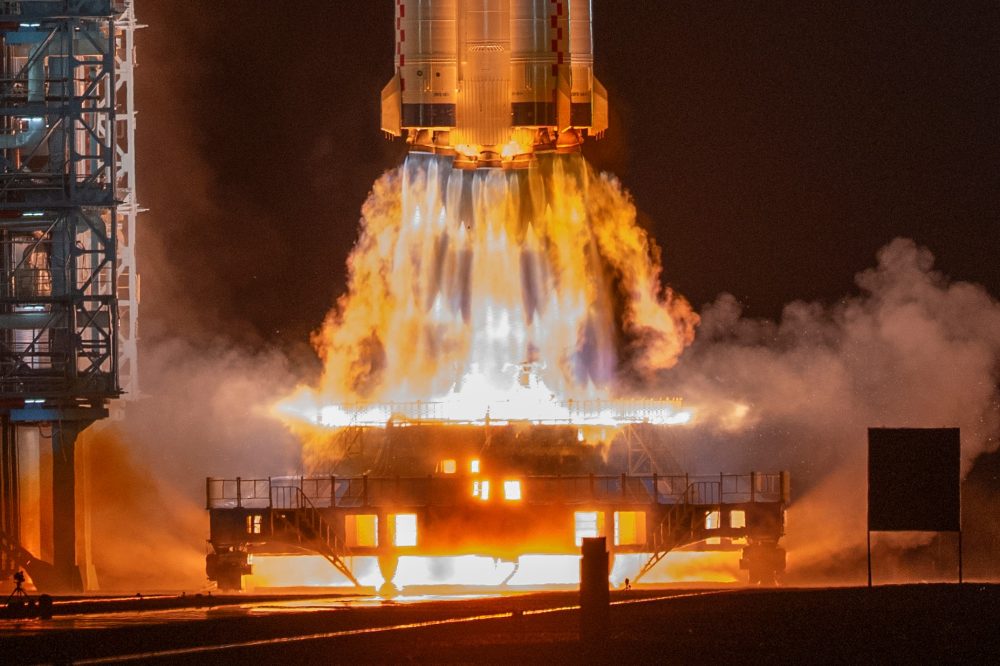

China successfully sent three astronauts into orbit Sunday evening aboard the Shenzhou 23 spacecraft, with one crew member planned to remain at the space station for a full year.
The rocket lifted off from the Jiuquan Satellite Launch Center located in China’s northwest region. This highly anticipated mission occurs as the nation works toward achieving its first human moon landing by 2030.
The three-person crew consists of mission commander Zhu Yangzhu, Zhang Zhiyuan, and Lai Ka-ying, who Chinese officials also refer to as Li Jiaying when using the Mandarin version of her name.
Lai represents a historic milestone as the first astronaut from Hong Kong to participate in a space mission. Born and educated in Hong Kong, she holds a doctorate in computer forensics.
According to state media reports, the team will undertake numerous scientific and practical experiments during their mission. They will also perform a crew changeover with the Shenzhou 21 astronauts, who have been living aboard the Tiangong space station for over 200 days.
One crew member from the Shenzhou 23 mission will remain at the orbital facility for twelve months, marking one of the longest individual space missions ever attempted. State media indicated this extended stay aims to “explore human adaptability and performance limits” during prolonged periods in space.
China continues expanding its space exploration efforts, with astronauts completing numerous missions to the Tiangong facility. The nation developed its own space station after being barred from participating in the International Space Station due to American national security concerns.
The United States remains China’s primary competitor in space exploration, with NASA targeting 2028 for returning astronauts to the moon’s surface.
China’s Tiangong station, meaning “Heavenly Palace,” welcomed its first crew in 2021. The previous year saw an emergency rescue mission within the Shenzhou program, translated as “Divine Vessel,” which brought home astronauts whose return vehicle had been damaged.