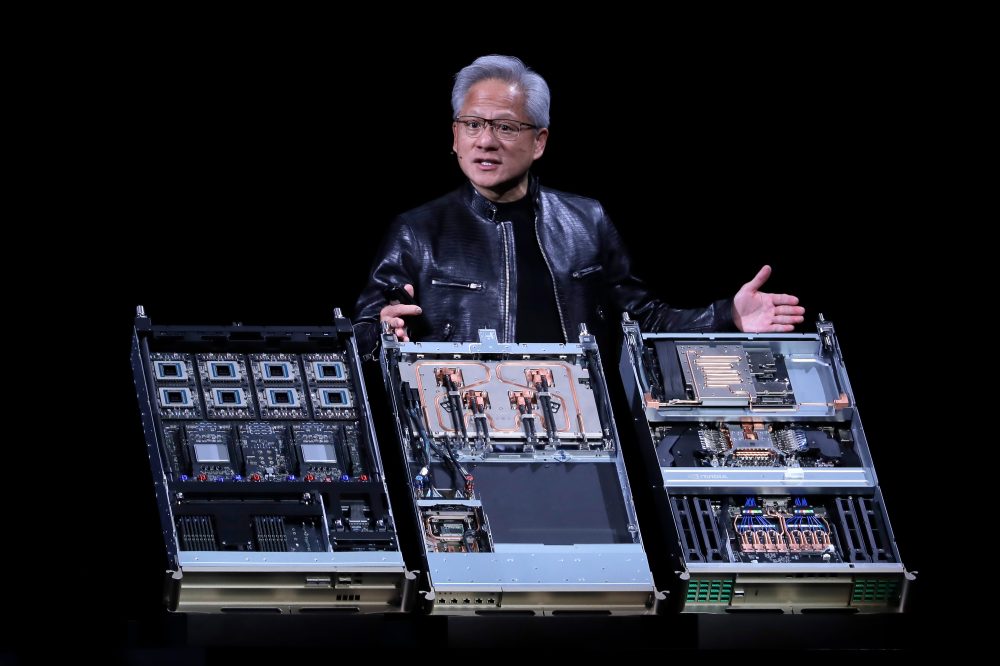

TAIPEI, Taiwan (AP) — Technology giant Nvidia announced Monday the launch of advanced computer processors designed to integrate sophisticated artificial intelligence capabilities into personal laptops and desktop machines, with new computer models from manufacturers like Microsoft and Dell scheduled for release later this year.
The Santa Clara, California-based technology company has already achieved tremendous success providing high-performance processors for data centers during the global AI expansion, but now seeks to broaden its reach into additional AI systems and consumer products.
Company founder and CEO Jensen Huang, who is Taiwanese-American, revealed the announcement during Nvidia’s annual GTC conference in Taipei. He stated that Microsoft and Nvidia “are going to reinvent the PC (personal computer)” during his main presentation.
“This is going to be the new PC,” Huang declared while introducing Nvidia’s RTX Spark superchip — which merges CPU, or central processing unit, and GPU, or graphics processing unit, functions — designed to operate new Windows laptop and desktop models in what the company termed “AI personal computers,” anticipated to launch this fall.
Nvidia currently holds the position as the world’s most valuable corporation, surpassing Apple, Google’s parent Alphabet and Microsoft.
The corporation stated it will be “reinventing the personal computer” for content creation and gaming purposes. “When it has an autonomous (AI) agent, an agent that’s helping you, that understands you, you could talk to it. It could look at you. You could ask it to read files, go help you do some research. It could do a lot more,” Huang explained.
Microsoft announced in a separate statement that personal computers operating on Nvidia’s RTX superchips would support “highly capable AI models” and demanding computational tasks. Using the new superchips, these personal computers can operate AI agents directly on the device, Nvidia reported.
Nvidia’s strategy represents a major development as demand increases for personal AI assistant usage, according to Lian Jye Su, chief analyst at technology research and advisory firm Omdia.
“For consumers, it means more choices, which is always a good thing,” Su commented.
Neil Shah, analyst and co-founder of Counterpoint Research, characterized Nvidia’s announcement as a development that’s “revolutionizing how PCs would look like in the next 10 years.”
The upcoming laptops and desktop computers “will drive agentic AI applications in every home,” Shah explained, aiming to establish an “AI supercomputer” in every household.
During Monday’s presentation, Nvidia’s Huang also announced that its new Vera CPUs for data centers are in complete production and are “going to be our new major growth driver” during the expansion of AI agents, with initial customers anticipated to include Anthropic, OpenAI and SpaceXAI. He additionally presented a humanoid robot reference design that could serve as a framework for future research, particularly in the higher education field.