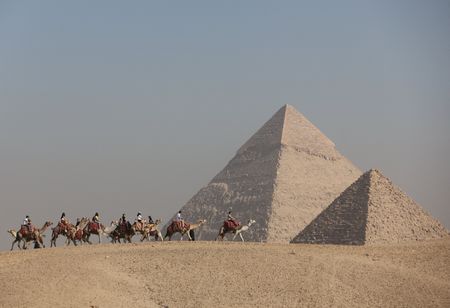

A groundbreaking study has revealed why the Great Pyramid of Giza has survived for millennia – ancient Egyptian engineers incorporated advanced earthquake-resistant features into its design over 4,600 years ago.
Scientists used specialized equipment called seismometers to measure continuous background vibrations at 37 different points throughout and around the massive structure, which served as pharaoh Khufu’s burial site. The measurements showed the pyramid maintains remarkably consistent and stable responses to ground movement, despite its enormous size and intricate internal layout.
Located just outside Cairo in Giza, the monument’s four sides each span approximately 755 feet at ground level, covering roughly 13 acres of limestone bedrock. While it once reached 480 feet in height, erosion and the ancient removal of outer casing stones have reduced it to about 455 feet tall. For nearly 3,800 years, it held the record as Earth’s tallest human-made structure.
The research team identified multiple design elements that provide seismic protection: an exceptionally wide foundation with a low center of gravity, perfectly symmetrical shape, decreasing mass toward the summit, and complex interior chambers that reduce vibration buildup. The structure also sits on solid limestone bedrock.
“These elements together create a well-balanced, coherent structure,” said seismologist Mohamed ElGabry of the National Research Institute of Astronomy and Geophysics, or NRIAG, in Egypt, lead author of the study published on Thursday in the journal Scientific Reports.
“Ancient Egyptian builders clearly possessed practical knowledge related to stability, foundation behavior, mass distribution and load transfer,” NRIAG seismologist and study senior author Asem Salama said.
Testing revealed that vibrations recorded inside the pyramid occurred at frequencies indicating mechanical stress was distributed uniformly throughout the structure.
“So while I would hesitate to claim that they intentionally designed the pyramid specifically for earthquake resistance, I do think they developed architectural and geotechnical solutions that naturally produced structures with exceptional long-term resilience,” Salama said.
These techniques were developed through experience and experimentation, as evidenced by earlier pyramid construction failures that preceded this masterpiece.
Researchers gathered seismic information from internal corridors and rooms, including the main burial space known as the King’s Chamber, plus the surrounding rock and earth.
While vibration amplification typically increases with height in tall buildings, the team discovered reduced amplification in five special chambers positioned above the King’s Chamber, despite their elevated location.
“This suggests these chambers effectively help dissipate seismic energy and protect the King’s Chamber – one of the most critical areas – from excessive shaking,” ElGabry said.
Recent regional earthquakes in 1847 and 1992 caused extensive damage to thousands of structures, with the 1992 event claiming over 560 lives. The pyramid sustained minimal damage from both events.
The monument stands as part of a larger archaeological site that includes additional pyramids and the Great Sphinx of Giza, attracting countless visitors throughout history.
“The Great Pyramid is not only an extraordinary engineering achievement but also a profound work of art and human vision. Its perfect symmetry, monumental scale and elegant proportions create a timeless beauty that continues to inspire awe even after 4,600 years,” ElGabry said.
“Beyond its physical beauty, what impresses me most is the incredible project management and organizational mastery it represents. Building such a monument took approximately 20 years and required sustaining a clear, long-term vision, an extremely complex supply chain and the coordination of tens of thousands of skilled workers, engineers, and administrators,” ElGabry said.
The massive undertaking involved managing personnel, training specialized craftsmen, maintaining food supplies for workers, and coordinating transportation of enormous stone quantities.
“It reminds us what human civilization is capable of when vision, science, organization and determination come together,” ElGabry said.
“They really did,” Salama said, “build ‘one for the ages’.”