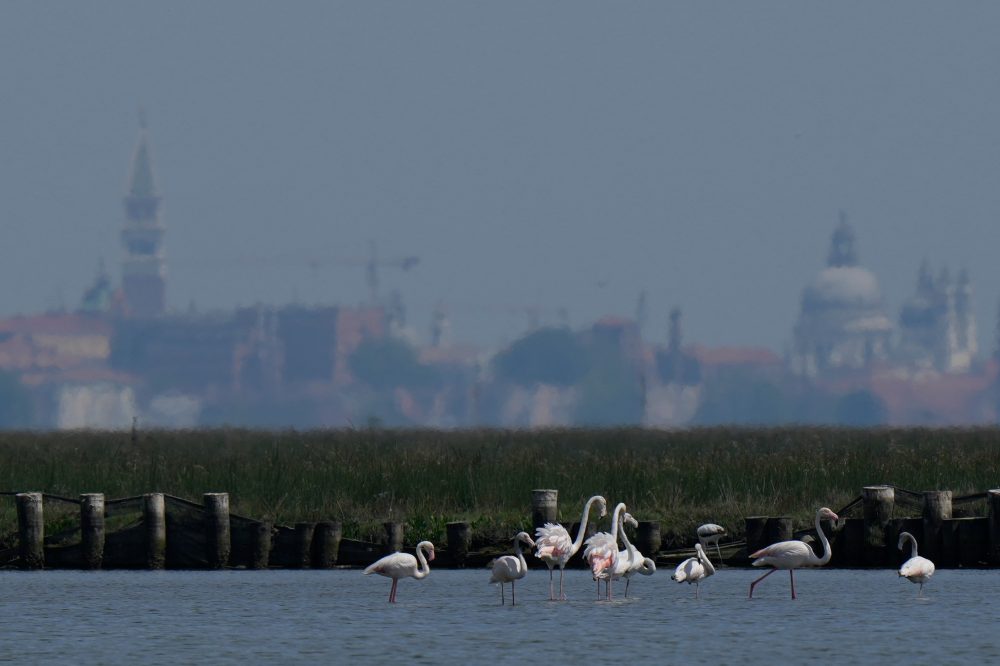

The absence of a word for flamingo in Venice’s traditional dialect speaks volumes about how recently these pale pink birds have made the Italian lagoon their home.
These striking birds, known as “fenicotteri” in Italian, are now arriving in Venice in unprecedented numbers as environmental restoration projects rebuild damaged wetlands that could expand their living space and potentially encourage breeding in the lagoon.
The elegant wading birds, which traditionally nest primarily in Spain and France, began appearing in Venice’s expansive lagoon during the early 2000s. They typically gather in fishing areas and mudflats in remote sections of the lagoon, with occasional rare appearances in the canal-filled historic district that draws millions of tourists worldwide.
Environmental experts view their presence in Venice as European flamingo populations spread as evidence of the lagoon’s improving health and its value as a feeding area.
During the previous year, flamingo populations spending winter in Venice reached an unprecedented peak of almost 24,000 birds. This represents an increase of 8,000 from the year before, creating numbers “that position the Venetian Lagoon as one of the most important wintering spots in its entire habitat range,” according to ornithologist Alessandro Sartori.
Sartori conducts weekly boat surveys throughout the lagoon searching for breeding evidence, which would signal the establishment of a permanent Venetian flamingo community. Currently, no new nesting signs exist following two previous breeding efforts in 2008 and 2013 in northern lagoon fishing areas that faced major challenges, including destructive hailstorms that killed numerous birds.
Over 90% of birds documented in the most recent count were located in the northern lagoon, which features extensive natural salt marsh areas. The flamingos are also drawn to traditional fishing valleys, which are semi-natural enclosed wetlands offering plentiful food sources but sometimes creating conflicts with human activities.
An initiative to rebuild salt marshes in the more remote southern lagoon — beyond the historic center and industrial port — creates possibilities for increased flamingo populations there by providing new habitat in a lagoon section where wetland loss has been particularly devastating. This could also redirect birds away from competing human activities in the north.
The Venetian Lagoon spans 550 square kilometers (over 200 square miles) and was originally almost half salt marsh. Currently, salt marsh areas — called “barene” in Venetian dialect — comprise only about 7%, with roughly half being reconstructed, explained Jane da Mosto, executive director of We Are Here Venice, the local partner in the EU’s 23.6 million euro ($27.5 million), 5-year WaterLANDS project aimed at restoring wetlands throughout Europe.
The destruction is particularly severe in central and southern lagoon areas, resulting from combined natural erosion and shipping channel dredging to reach the Marghera industrial port during the 1960s.
“And since then, there’s been much more widespread erosion and loss of sediments from the lagoon to the point that Venice is now on a trajectory to becoming a marine bay,” da Mosto stated. The wetlands reconstruction project “is specifically to show that it’s possible to address this trend and change the course of history.”
Reconstructing salt marshes enhances the lagoon’s capacity to absorb carbon dioxide, a greenhouse gas contributing to climate change, and reduces impacts from rising sea levels. However, da Mosto noted that much larger restoration areas would be necessary to generate significant climate benefits. The EU project aims to make salt marsh reconstruction expandable.
Flamingos can also gain advantages as biological diversity improves.
Da Mosto’s research team is exploring methods to enhance biodiversity on rebuilt marshes, including cultivating plant species that can help prevent erosion and strengthen wetland resilience.
The mudflat where their work takes place shows evidence of flamingo presence, mainly scattered pink feathers. During a recent visit, approximately 30 birds were visible in the distance — flying away when a pair of calling oystercatchers warned them of approaching visitors.
Sartori already believes the reconstruction efforts have started attracting more flamingos to the region. During the past three years, he has observed their numbers in the southern lagoon increase from just a few to as many as 300 to 400 during certain times.
“The hope is that they can find — as they have found in other parts of the Mediterranean — right here on these barene, places where they can nest,” Sartori explained.
The flamingos’ establishment in the lagoon highlights the significance of Venice’s ecosystem and provides visitors with a new perspective for understanding the canal city and surrounding islands through their environmental — not solely historical and artistic — importance.
Nevertheless, Venice visitors hoping to easily observe flamingos will likely face disappointment, as reporters recently needed an hour-long boat journey to locate any. The flamingos live in shallow, hard-to-reach lagoon areas where safe navigation demands careful attention to tides and waterways. Even from far away, the birds are easily startled and quickly fly away.
Sartori anticipates flamingo viewing — currently possible from shores of small lagoon islands Murano and Burano but uncommon in the historic center — could become more frequent as their populations continue expanding.
“Obviously this should always be done with respect for the animals, keeping a safe distance and not interfering with their daily lives,” he noted.