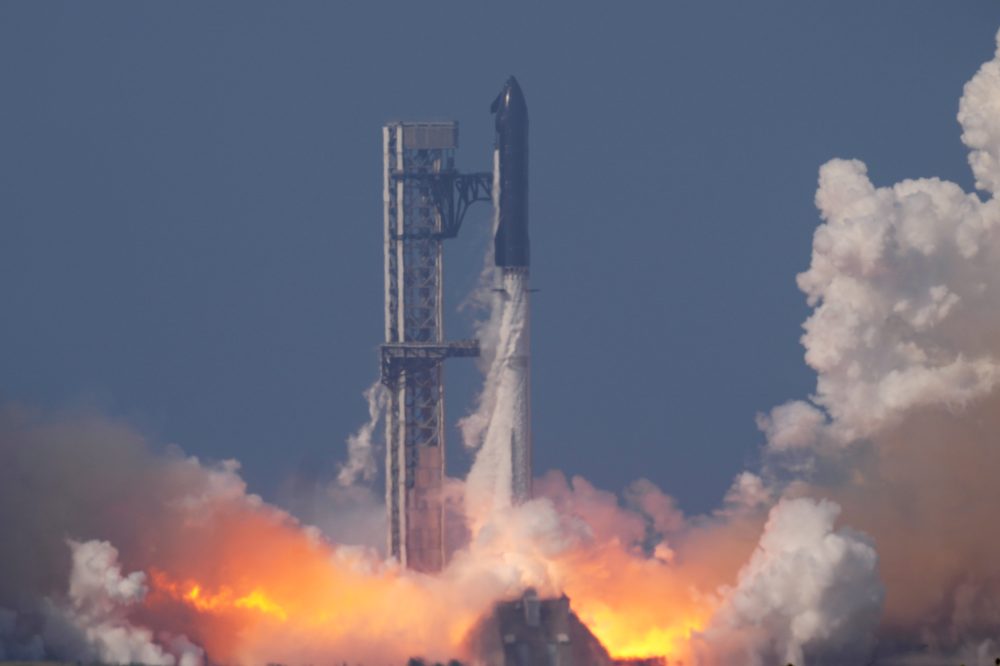

SpaceX conducted a test flight Friday of its most advanced Starship rocket to date, featuring an enhanced design that NASA plans to use for returning astronauts to the lunar surface.
The revamped mega rocket took its maiden voyage just two days following an announcement by SpaceX CEO Elon Musk about taking his company public. The launch occurred from Texas’s southern border region, with the spacecraft carrying 20 simulated Starlink satellites scheduled for deployment on the opposite side of the globe.
This marks the 12th experimental mission for the rocket system Musk envisions will eventually transport humans to Mars. However, lunar missions through NASA’s Artemis initiative come first in the timeline.
October saw the final launch of the previous generation of space-bound Starships. SpaceX’s third-generation model — an enhanced variant called V3 — lifted off from a newly constructed launch platform at Starbase, located close to the Mexican border. Technical problems with the launch pad prevented Thursday evening’s scheduled attempt.
The company hoped to prevent the explosive incidents that occurred during consecutive launches the previous year, when mid-flight detonations scattered debris across the Atlantic Ocean. Previous test flights also concluded with fiery endings.
Standing at 407 feet (124 meters) tall, this newest variant surpasses earlier Starship models by multiple feet (over 1 meter) and delivers increased engine power.
The updated booster features fewer but larger and more durable grid fins designed to guide it back to Earth after takeoff, plus an enlarged and reinforced fuel transfer system that supplies the 33 primary engines. This fuel line matches the dimensions of SpaceX’s Falcon 9 first-stage booster. The retro-styled, stainless steel vehicle also contains enhanced capabilities across the board — additional cameras, improved navigation and computing systems — along with docking equipment for upcoming rendezvous and lunar operations.
The Starship system is designed for complete reusability, utilizing massive mechanical arms at launch sites to capture returning rocket components. However, during this recent test mission, no recovery operations were planned. The redesigned first-stage booster’s journey ended in the Gulf of Mexico, while the spacecraft and its satellite demonstrations concluded in the Indian Ocean.
NASA has contracted SpaceX for billions of dollars — along with Jeff Bezos’ Blue Origin — to develop the lunar landing vehicles that will transport Artemis astronauts to the moon’s surface.
Both companies are competing to achieve the first successful mission.
Although Starship has reached space’s outer boundaries during multiple flights lasting no more than an hour, Bezos’ Blue Moon vehicle has not yet launched, though a prototype is being prepared for a lunar mission later this year.
NASA plans to follow April’s successful lunar flyby mission with four astronauts by conducting an orbital docking test around Earth next year. During that Artemis III mission, crew members will rehearse connecting their Orion capsule with either Starship, Blue Moon, or both vehicles.
A crewed lunar landing mission — Artemis IV — could occur as early as 2028 using whichever lander proves safer and becomes operational first. This would represent NASA’s first crewed moon landing since Apollo 17 in 1972. The current objective involves establishing a lunar base near the moon’s south pole, operated by both astronauts and robotic systems.
SpaceX has begun accepting bookings for private missions to the moon and Mars aboard Starship.
Dennis Tito, the world’s inaugural space tourist and California businessman, along with his wife, reserved seats 3 1/2 years ago for a lunar orbit flight. The departure date remains undetermined.
This week, another affluent space traveler — Chinese-born bitcoin investor Chun Wang — revealed his plans to journey to Mars on Starship’s inaugural interplanetary voyage. Wang previously funded a SpaceX polar mission in a Dragon capsule last year and, together with his selected crew, became the first to orbit over both polar regions.
Neither cost nor timeline details were disclosed for his Mars expedition.