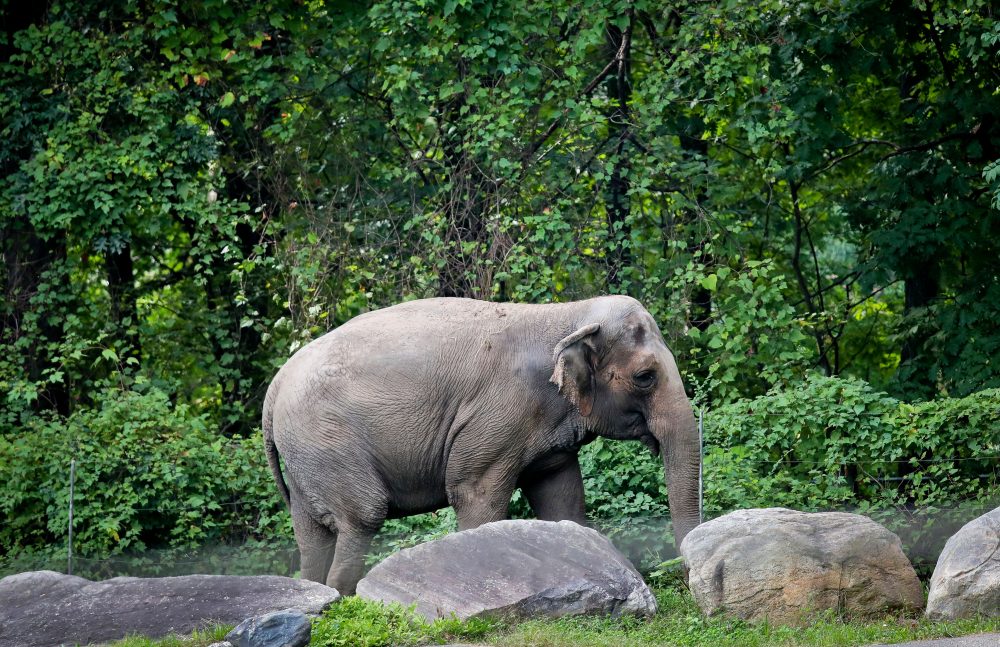

NEW YORK (AP) — An Asian elephant at the Bronx Zoo who provided scientists with groundbreaking insights into animal intelligence and became the focal point of a high-profile animal rights lawsuit has died at 55 years old, zoo officials announced Wednesday.
The elephant, named Happy, was euthanized on Tuesday at the facility where she had resided for nearly 50 years. According to zoo representatives, several health issues related to her advanced age had worsened over recent weeks, with the animal displaying symptoms of declining kidney or liver function. Post-mortem examination uncovered arthritis and large uterine tumors that could not be surgically removed and are impossible to detect in elephants through standard medical examinations or imaging techniques, the zoo reported.
“She was a wonderful elephant,” said interim zoo director Craig Piper during a Wednesday interview, while saddened staff members mourned the loss of an animal some had cared for more than three decades. “She served as a tremendous ambassador for elephants and for elephant conservation.”
Following Happy’s passing, the zoo’s 57-year-old elephant Patty remains the sole elephant on display in the nation’s most populous city. The facility’s governing organization, the Wildlife Conservation Society, made the decision two decades ago to cease obtaining new elephants.
Happy entered the world in the Asian wilderness and was transported to America when she was just one year old. She received her name from a character in “Snow White and the Seven Dwarfs” prior to her 1977 arrival at the zoo.
The elephant demonstrated strong bonds with her caretakers and responded well to incentives like her preferred snacks, including watermelon and strawberries, according to Keith Lovett, the zoo’s director of animal programs. Piper noted that she would occasionally hide treats in her ear for later consumption.
In 2005, Happy demonstrated to scientists that elephants possess the ability to recognize their own reflection in mirrors — an indication of self-awareness observed in only a handful of animal species. Throughout the study, Happy stood before her mirror image and continuously used her trunk to touch an “X” mark painted above her eye, which she could only observe through the reflection.
She shared living space with other elephants until her final companion passed away in 2006. Happy subsequently lived apart from Patty and another elephant due to worries that they might not coexist peacefully, although Lovett explained the animals maintained visual, scent, and physical contact through a barrier. The third elephant, named Maxine, died in 2018.
Zoo representatives stated that the average lifespan for Asian elephants in American zoos is approximately 45 years. Their longevity in natural habitats is more challenging to determine.
Throughout Happy’s years, elephant exhibits at zoos faced growing criticism. Certain specialists argued that city-based animal facilities were inadequate for animals that travel vast distances in their natural environment. Animal welfare advocates contended that zoo enclosures were inappropriate for highly intelligent, socially complex elephants.
Several zoos eliminated their elephant displays and relocated the animals to sanctuaries, while other facilities continue supporting the housing and breeding of these creatures, maintaining that they generate public interest in wildlife preservation.
The Nonhuman Rights Project, an advocacy organization, filed a lawsuit against the Bronx Zoo in 2018, attempting to have Happy legally recognized as a “person” and relocated to a spacious animal sanctuary. This marked the first legal case of its kind involving an elephant, the group stated.
Using a legal concept typically employed to challenge unlawful human detention, the advocacy group characterized Happy as “an extraordinarily cognitively complex and autonomous nonhuman being” who was illegally denied freedom and suffered from confinement in an exhibit without elephant companions.
Zoo administrators maintained that Happy received excellent care and had access to areas for swimming, foraging, and other instinctive behaviors. Relocating her from her established home could cause her distress, the zoo argued.
New York’s highest court eventually dismissed the activists’ petition by a 5-2 vote. Colorado’s supreme court subsequently issued a comparable decision regarding five elephants at a zoo in that state.
However, two New York high court justices authored strong dissenting opinions. One described Happy’s confinement as “inherently unjust and inhumane” and “an affront to a civilized society.”
The Nonhuman Rights Project continues pursuing similar cases involving elephants in different states.
Happy chose to spend her last weeks in a non-public barn and yard area within her habitat, Piper reported. In what resembled zoo-based end-of-life care, staff members offered hydration, nutrition, and pain relief, he explained.
Officials report that Patty is currently in good health.
The Wildlife Conservation Society announced in 2006 that once only one elephant remained, the animal might be transferred to another zoo under appropriate conditions. Piper stated the zoo will approach any decision about relocating Patty from her 53-year home with careful consideration.