
GARDEN GROVE, Calif. — Roughly 16,000 residents in Southern California continue living away from their homes as authorities maintain evacuation orders due to an ongoing threat from a dangerously overheated chemical storage tank.
Last week’s emergency displaced 50,000 people from the Orange County community of Garden Grove and surrounding areas. When a fortuitous crack developed in the tank’s structure, it released built-up pressure and prevented what could have been a devastating blast, enabling most displaced residents to return during the Memorial Day holiday weekend.
However, concerns about a potential smaller blast or chemical leak have kept evacuation requirements active for roughly one-third of those originally forced to leave. These residents are currently staying in hotel accommodations, temporary shelters at educational facilities, camping areas, or with relatives and friends.
Among those still displaced is Isabel Mendez, who remains away from her mobile home residence. During last week’s evacuation, she experienced facial skin irritation, lip numbness, and throat discomfort. Following costly hotel stays, she has relocated to stay with her mother in the Los Angeles region.
Mendez expressed skepticism about official safety declarations regarding her neighborhood’s condition.
“Of course it is still dangerous,” she said.
According to the federal Environmental Protection Agency, contact with methyl methacrylate — an extremely combustible substance used in plastic manufacturing — may result in severe breathing difficulties, nervous system complications, and irritation affecting skin, eyes, and throat. The storage vessel at GKN Aerospace Transparency Systems, a manufacturer of aircraft cockpit windows, canopies and windshields, holds between 6,000 and 7,000 gallons of this chemical.
“We apologize for the ongoing disruption this incident is causing and our priority remains its safe resolution,” the company said, “so that residents can return to their homes as quickly as possible.”
In a separate incident Tuesday, a chemical tank explosion at a Washington state pulp and paper facility resulted in at least 10 injuries, with an unknown number of fatalities and missing persons.
Work teams at the California facility operated through the night to secure two adjacent tanks, ensuring they would remain unaffected by the damaged container, according to Orange County Fire Capt. Brian Yau.
Fire officials determined the tank’s overheating resulted from a malfunctioning valve in its cooling mechanism.
“That’s what kept it at 50 degrees,” or 10 degrees Celsius, said TJ McGovern, interim chief of the Orange County Fire Authority.
“Due to that failure, the tank went into the heating-up process because it wasn’t continuing to be chilled,” he said at a news conference Monday evening.
Emergency responders continuously sprayed water onto the tank until its internal temperature dropped to 92 F (33.3 C) from the weekend’s peak of 100 F (37.7 C), fire officials reported Tuesday. The water application delivered 1,250 gallons per minute across five days, totaling approximately 9 million gallons used.
The facility’s sprinkler system continues cooling the tank, while company technical experts and firefighters have stripped away insulation to enhance the cooling process.
Fire authorities also examined storm drain water and confirmed its cleanliness, McGovern reported.
“There was no contamination,” Orange County Health Director Regina Chinsio-Kwong said at a Monday news conference. “You should feel comfortable going home even if you’re across the street from that new zone line.”
The emergency unfolded in central Orange County’s densely populated region, encompassing multiple interconnected cities including Garden Grove. This community of 170,000 residents, along with adjacent Westminster, houses Little Saigon, the world’s largest Vietnamese population center outside Vietnam. The area sits near Anaheim, location of Disneyland’s two theme parks, which remained outside evacuation zones.
The situation disrupted Memorial Day activities, graduation events, and routine daily activities.
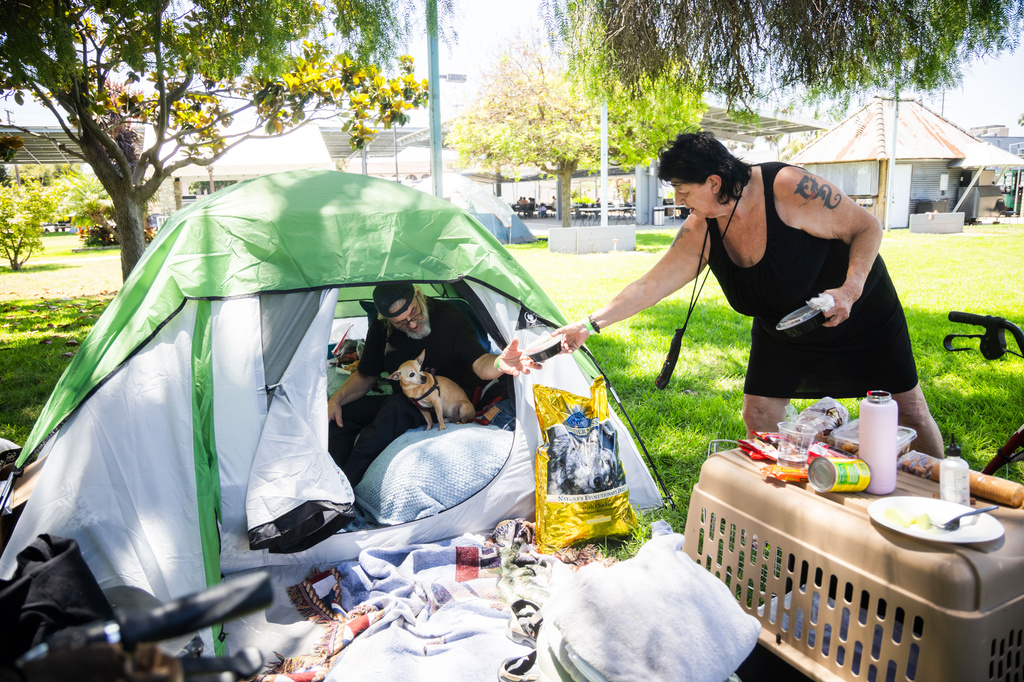
Henry Nguyen, a 56-year-old automotive repair worker, and his family initially spent two nights sleeping in their vehicle.
Several days into the evacuation period, Nguyen said he secretly returned to their Stanton residence, which was filled with chemical vapors, to retrieve the family’s dog, cat, and betta fish.
He also collected camping gear and established a tent near an emergency shelter that officials created in a nearby park facility in Fountain Valley. Nguyen said he’s attempting to view the situation as a camping adventure in the middle of heavily populated Orange County.
He even transported archery gear to use at a park range to help occupy his teenage daughter, who returned to high school Tuesday, while they await clearance to go home.
“There’s no time frame,” he said.
The South Coast Air Quality Management District plans to conduct air monitoring for several months while the EPA will examine sewer and storm drainage systems for potential spills, Orange County Supervisor Janet Nguyen announced.
As the tank’s temperature rose, the chemical transformed from liquid to vapor form, increasing pressure and explosion potential, explained Andrew Whelton, a Purdue University engineering professor specializing in environmental contamination studies. Some methyl methacrylate may have already solidified into stable plastic material resembling plexiglass, decreasing the hazard level, he noted.
“The tank was on track for a catastrophic explosion,” Whelton said. “The formation of a crack seems to have allowed pressure to vent.”
Risks persist for a smaller explosion that might launch debris or create a chemical cloud moving toward nearby residences, he warned.
The tank requires cooling to approximately 60 to 70 degrees Fahrenheit (15.6 to 21.1 degrees C) before conditions become substantially safer, he indicated.
This California emergency echoes a 2014 chemical spill in Charleston, West Virginia, when storage tanks failed. That incident prevented the capital city and surrounding communities from using tap water for multiple days. Local businesses temporarily closed while hundreds sought emergency medical care for symptoms ranging from nausea to skin rashes. The disaster led to new state legislation mandating increased inspections and registration requirements for above-ground storage tanks.