
PARIS — Tourists standing in line under the summer heat to visit Notre Dame cathedral have no idea what’s happening just below their feet.
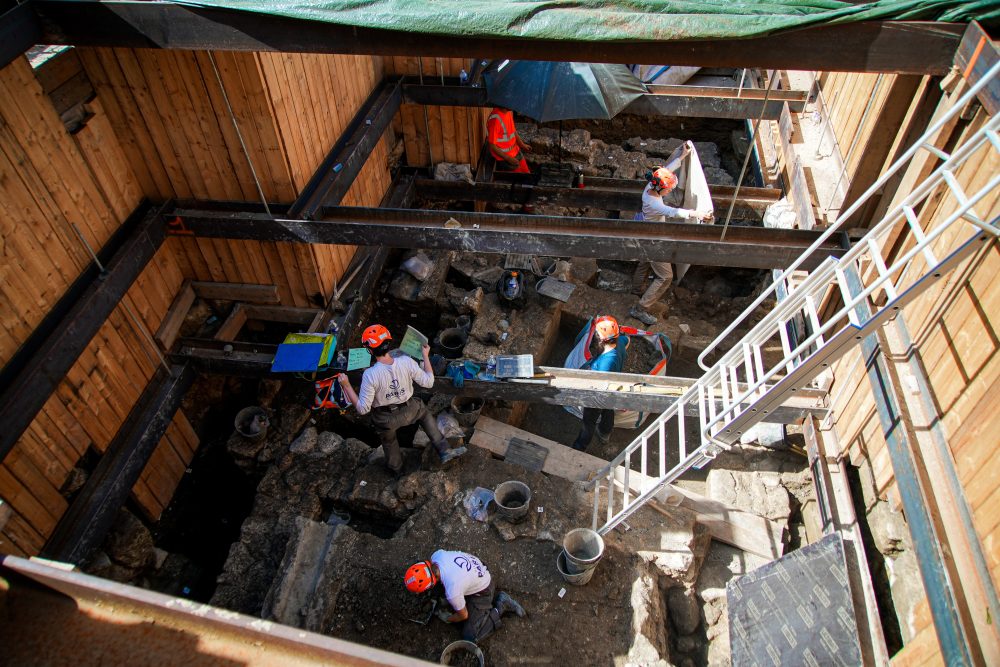
About 13 feet underground, archaeological teams are working their way down through layers of history, uncovering remnants of Roman Paris from 2,000 years ago.
The famous cathedral suffered devastating fire damage in 2019 when its spire collapsed in front of a global audience. After rebuilding efforts, Notre Dame reopened to the public in late 2024. Now city officials want to add trees and cooling shade to the hot, exposed plaza surrounding it.
However, in such an ancient city, construction crews can’t break ground until archaeologists first examine what’s buried below to prevent any damage to historical artifacts.
A section of Notre Dame’s front courtyard has been transformed into an excavation zone — a deep pit surrounded by safety barriers and crossed with wooden walkways, just steps away from the tourist queue.
French news outlets are calling it the “dig of the century.”
“It’s a rare opportunity for us to work on something that’s tangibly going to make a difference to the history of Paris,” Lucie Altenburg, a conservator with the Paris archaeology unit, told The Associated Press.
The hundreds of discoveries include a coin from the 4th century bearing Emperor Constantine’s image, plus fragments of medieval pottery decorated inside with mysterious symbols that researchers haven’t yet decoded — resembling a real-life Da Vinci Code puzzle.
“It makes Notre Dame feel alive again,” said Emily Carter, 34, a tourist from Manchester waiting in line with her two children. “You come to see the cathedral, then realize there’s another city under your feet. That’s almost more moving.”
Archaeological evidence begins appearing just 20 inches down, and the team continues extracting historical items from depths of 13 feet. On productive days, they collect 15 boxes of artifacts from soil that hasn’t been disturbed for decades.
This represents the reality of any ancient city: history isn’t confined to museums — it exists buried beneath the streets.
Urban areas grow upward over time. Every generation constructs new buildings on top of previous ruins, gradually raising the ground level; Rome’s surface has climbed approximately 30 feet since the empire’s fall in the 5th century.
When Athens constructed its subway system for the 2004 Olympics, the project triggered Greece’s most extensive archaeological dig ever, yielding tens of thousands of artifacts now displayed in the metro stations. Paris follows the same pattern.
Everything originates from the Seine river island called Ile de la Cite, where Paris first began.
Notre Dame was later built on this same location.
When the cathedral’s construction started in 1163, the entire plaza was crowded with medieval homes divided by one narrow road, explained Camille Colonna, the archaeologist directing the excavation.
By digging deeper, her team has reached those ancient house foundations — and consequently the historical periods they represent.
Underneath lie grain storage pits from the Merovingian and Carolingian eras spanning the sixth through tenth centuries; even deeper sits a concentrated Roman neighborhood from the fourth and fifth centuries.
Two thousand years of history are compressed into 13 feet of earth — roughly equivalent to stacking two-and-a-half Napoleon Bonapartes on top of each other.
“Here you can see the layers — medieval Paris, Roman Paris, maybe even before that,” said Yasmine Benali, 22, an archaeology student observing from behind the barriers. “It makes the city feel less like a postcard and more like something still being discovered.”
The most valuable discoveries emerge from the most unpleasant locations: deep pits underneath medieval houses that served as both toilets and garbage disposal sites.
From these areas, the team regularly recovers complete jugs and cups — discarded centuries ago but remaining unbroken — mixed among shattered dishes and animal remains.
Finding “complete ceramics” is “rare,” noted Valentine Breloux, an archaeologist with the unit.
The soft waste materials protected these items, allowing them to survive intact through the centuries.
Some discoveries have puzzled experts completely. While cleaning what appeared to be ordinary medieval pottery, conservators discovered faint red writing painted inside — identical mysterious markings appearing on multiple pieces.
The meaning of these symbols remains unknown.
Among everything she’s restored from Notre Dame, Breloux described these as the most “astonishing.”
Coins emerged as blackened circles, corroded by rust. However, X-ray examination revealed a face: Constantine, the Roman emperor who reigned in the early 300s.
Such artifacts also “can be invaluable in giving us the date of the (underground) layer,” Altenberg explained.
The Roman discoveries hold the greatest significance for archaeologists — representing the deepest, oldest, and least understood findings. During Roman occupation, the settlement was named Lutetia, with its main area located across the river on the Left Bank.
When the Roman empire crumbled, residents retreated to the Ile de la Cite, where Notre Dame would eventually stand, and strengthened the island using stone walls salvaged from earlier structures.
Colonna’s team discovered evidence of this: a Roman doorstep unearthed during excavation, originally from a much larger building, transported to the island, flipped over, and installed as street paving.
All discoveries leave the excavation site and travel north to the city’s archaeology center — what Colonna describes as “a huge archaeological store,” serving as Paris’s treasure repository.
For archaeologists, the cathedral dig represents an unusual opportunity. In France, like other countries, they typically work only where construction projects are planned — similar to how quarry workers sometimes accidentally discover dinosaur fossils.
“This only happens because the city of Paris decided it wanted to beautify the area,” Altenburg explained.
The renovated plaza should be largely completed by 2028: designed as a forest-like clearing featuring 160 new trees and a thin water film flowing over stone surfaces for summer cooling — part of Paris’s preparation for increasingly hot summers caused by global warming.
Tourists currently waiting in direct sunlight beneath the gargoyles will soon queue in shaded comfort.
The former underground parking garage will reopen as a visitor center overlooking the Seine.
Meanwhile, the Notre Dame team hopes to dig even deeper — beyond the Romans, toward the earlier inhabitants, the Gauls who first named the city.
“The hope is that we are able to go back in time even further than we’ve ever been before,” Altenburg said.