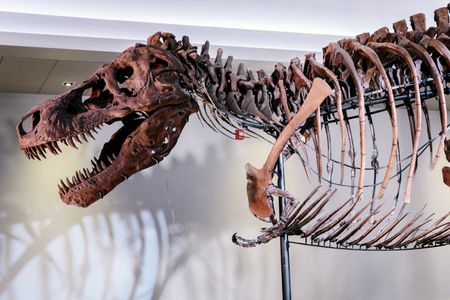

Scientists have finally solved one of paleontology’s most puzzling questions: why did Tyrannosaurus rex develop such an enormous head while keeping ridiculously small arms?
New research shows that this bizarre body design wasn’t random. As plant-eating dinosaurs grew to massive sizes after dinosaurs became the dominant land creatures, meat-eating predators evolved stronger skulls to tackle bigger prey, while their arms gradually became less important for hunting.
The study found that this evolutionary pattern occurred independently in five different groups of theropods – the two-legged carnivorous dinosaurs. This suggests the combination of big heads and small arms provided significant survival advantages.
T. rex’s comically tiny limbs have long captured public imagination, inspiring countless internet jokes about the fearsome hunter’s inability to clap or do push-ups. But the new findings reveal there was serious evolutionary logic behind this design.
Dinosaurs first emerged around 230 million years ago during the Triassic Period, then ruled the planet through the Jurassic and Cretaceous periods until an asteroid impact wiped them out 66 million years ago. Early meat-eating dinosaurs had well-developed arms that helped them catch prey, but this changed as enormous plant-eaters like long-necked sauropods appeared.
“Body size in dinosaurs increased massively from the Triassic to the end-Cretaceous, so it’s likely that the increase in body size drove some theropods to shift towards using their heads more than their limbs in hunting. Effectively, the forelimbs became redundant in hunting,” explained Charlie Scherer, a University College London doctoral student in paleontology who led the research published in Proceedings of the Royal Society B.
“Natural selection will act on the traits which allow an animal to survive and thrive in its ecosystem. If that means sacrificing the size of the arms for a stronger head, which is the primary weapon for the animal, then that’s likely what will happen,” Scherer added.
The research team developed a new system for measuring skull strength based on factors like skull size, bite power, tooth design, and bone fusion patterns. Tyrannosaurus, which roamed North America during the Cretaceous period, ranked highest, followed by Tyrannotitan from Cretaceous South America.
The study revealed a strong connection between skull strength and arm reduction across multiple dinosaur groups: tyrannosaurs including Tyrannosaurus; carcharodontosaurs including Carcharodontosaurus from Cretaceous Africa; megalosaurs including Megalosaurus from Jurassic England; ceratosaurs including Ceratosaurus from Jurassic North America and Europe; and abelisaurs including Abelisaurus from Cretaceous South America.
These groups included top predators that used large body size and powerful jaws to hunt various giant plant-eaters including sauropods, horned dinosaurs, armored dinosaurs, and duck-billed dinosaurs. One of the earliest examples was Eoabelisaurus, which lived in South America about 170 million years ago during the Jurassic period.
However, not all large meat-eating dinosaurs followed this pattern. Some groups kept long, powerful arms, including Spinosaurus from Cretaceous Africa and Megaraptor from Cretaceous South America.
These dinosaurs “have incredibly large and mobile arms for their body size, which suggest a more prominent role for them in hunting compared to something like T. rex,” Scherer noted.
Smaller theropods also maintained useful arms, including the evolutionary line that eventually led to modern birds.
For giants like Tyrannosaurus, researchers remain uncertain about what purpose the tiny arms served. Not only were T. rex’s arms weak and short, but they had only two fingers instead of the typical three or more.
“Potentially, they did nothing with them – they were just useless. This raises the question: why did they have tiny arms, rather than no arms? If the tiny arms are still there, then it is possible that they still retain some kind of function that we are not aware of,” said University College London paleontologist and study co-author Paul Upchurch.
“For me, however, this is unlikely, and I think something else is going on,” Upchurch continued.
When body parts become unnecessary, genetic changes typically cause them to shrink so animals don’t waste energy building structures they don’t need, Upchurch explained.
“But we know that genetics is complicated, and very often genes have more than one role. For example, a gene might be involved in building something that the animal no longer needs, but the same gene might also be doing something in another part of the body that the animal does still need. This means that the gene is maintained because it is still doing something useful, so the useless structure persists in a reduced form rather than disappearing completely,” Upchurch said.