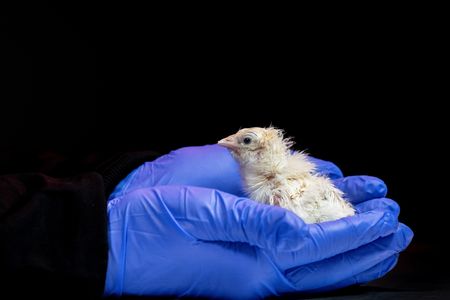

A biotechnology company specializing in bringing back vanished species has achieved a major breakthrough by successfully hatching more than two dozen healthy baby chickens using an innovative artificial egg system.
Colossal Biosciences, which focuses on “de-extinction” projects aimed at resurrecting lost species, announced this week that their artificial egg platform has proven successful. The achievement marks a crucial advancement in their efforts to revive the South Island Giant Moa, a massive flightless bird from New Zealand that disappeared hundreds of years ago.
The moa represents one of two bird species in the company’s revival portfolio, alongside the dodo. Overall, the firm is working to bring back six different extinct species using ancient DNA as their guide. Last year, the company reported they had genetically engineered the dire wolf, an Ice Age predator that vanished long ago.
“Using our system we have hatched 26 chicks and we are now actively monitoring these birds as they grow up,” Colossal CEO and co-founder Ben Lamm told Reuters.
According to Lamm, the chicks emerged at the company’s Dallas headquarters.
The innovative artificial egg system features a specially engineered silicone-based membrane housed within a sturdy external framework. Scientists designed the membrane to replicate how natural eggshells facilitate gas exchange, allowing developing bird embryos to obtain oxygen through controlled movement of gases and moisture.
“The technology is designed to closely replicate the conditions of a natural egg to produce healthy animals with normal development, fertility and longevity. This is especially important for species like the moa, whose eggs were far larger than those of any living bird, making traditional surrogate approaches impractical,” Lamm explained.
The company’s dire wolf project involved creating embryos through cloning from modified gray wolf cells, which were then placed in surrogate domestic dog mothers. However, no existing bird species is large enough to produce an egg comparable to the South Island Giant Moa’s, which measures approximately the size of a soccer ball.
The extinct moa reached heights of roughly 12 feet and vanished about 500 years ago, primarily due to human hunting. Today’s closest living relative is the emu, a large flightless Australian bird that grows to about six feet tall.
“In order to hatch a South Island Giant Moa, Colossal needs a way to gestate the embryo. There is no living surrogate large enough to lay a South Island Moa egg, as they are around eight times larger than an emu egg,” Lamm noted.
Lamm outlined the artificial egg procedure in detail.
“The process begins with a fertilized avian embryo, similar to the earliest stages of development inside a natural egg. The embryo and yolk are then transferred into Colossal’s artificial egg platform, which is designed to replicate the key functions of a natural eggshell and incubation environment, including gas exchange, moisture regulation, temperature stability and developmental support,” he said.
“As the embryo develops, the system provides continuous environmental control and supplementation where needed – for example, calcium support during skeletal growth, which would normally come from the natural shell. Because the embryo develops visibly on top of the yolk, researchers can monitor development in real time throughout embryogenesis,” Lamm added, referring to the process where fertilized eggs transform into embryos.
The 26 successful chicks required roughly 21 days from embryo transfer to hatching, which aligns with typical development timelines for their species, Lamm reported.
Beyond its application for extinct species revival, Lamm believes this artificial egg technology could prove valuable for protecting endangered bird species currently at risk.
While significant, this breakthrough represents just one step toward the ultimate goal of restoring the moa population.
“Other hurdles include the need to reconstruct an accurate moa genome from ancient DNA, identify the genetic basis of key moa traits and engineer those traits into a closely related living species such as the emu,” Lamm acknowledged.
“At Colossal, the project is currently in the genome-sequencing phase,” Lamm said, with teams working to construct comprehensive genomes for this species and eight other extinct moa varieties. “So far, the team has identified multiple strong ancient DNA sources, including samples from the South Island Giant Moa.”