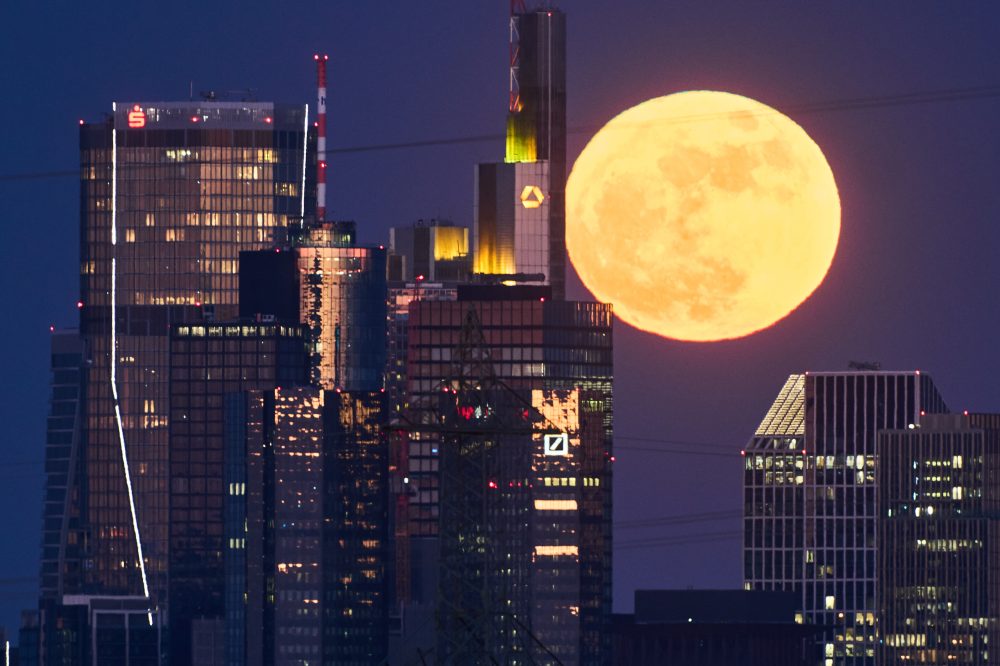

Astronomy enthusiasts should prepare for an extraordinary celestial display this weekend featuring a blue micromoon — combining the rarity of a blue moon with the year’s most distant and tiniest-appearing full moon.
Adding to the spectacle, the bright star Antares will create a photobombing effect during Sunday’s event, delivering a triple celestial treat.
Blue moons happen approximately every two to three years whenever a month contains two complete lunar cycles. This month’s initial full moon occurred on May 1.
Due to the moon’s elliptical orbital path, this weekend’s full moon will sit unusually far from our planet at 252,360 miles (406,135 kilometers), causing it to look somewhat smaller and less bright. This contrasts with a supermoon, which occurs when the full moon moves closer than normal. The latest supermoon, by comparison, was positioned at only 225,130 miles (362,312 kilometers) from Earth.
Gianluca Masi from the Virtual Telescope Project, who plans to broadcast the event live from Italy, explained that Sunday’s micromoon will look roughly 6% smaller and 10% less luminous than a typical full moon — “differences that are subtle enough to likely go unnoticed by most observers.”
The spectacle will be particularly exciting for viewers south of the equator throughout the Pacific region.
Observers in Argentina, Chile, New Zealand, eastern Australia, portions of Antarctica and several other islands will witness Antares briefly disappear as the blue micromoon moves across it.
This red supergiant star sits 550 light-years from Earth and carries the nickname “heart of scorpion” within the Scorpius constellation. One light-year equals nearly 6 trillion miles (9.7 trillion kilometers).
People watching from other global locations won’t see this vanishing effect, but will still observe Antares shining steadily next to the full moon.
Despite its name, this blue moon won’t display turquoise, sapphire or any other color. The designation simply describes the unusual event of experiencing two full moons within a single month.