
TOKYO (AP) — Robotic hands skilled enough to sew with a needle, child-sized dancing machines, and full-grown robots designed for package delivery took center stage Thursday at the opening of the Humanoids Summit Tokyo.
While dozens of firms participated in the showcase, featuring major names such as Boston Dynamics and Toyota Motor Corp., Chinese companies clearly emerged as the dominant force.
Chinese upstarts like Booster Robotics and LimX Dynamics have taken original innovations created in Japan and the United States and refined them, frequently targeting affordable large-scale manufacturing. This pattern mirrors what occurred across other Japanese sectors, including consumer electronics, mobile phones, and electric cars. With humanoid technology, Japan held early advantages but struggled to deliver significant commercial breakthroughs.
Tim Hornyuk, who wrote “Loving the Machine: The Art and Science of Japanese Robots” and attended the conference, described this as the “Galapagos syndrome,” where groundbreaking Japanese innovations develop separately and fail to succeed globally.
“I really hope that Japan can come up with a Ford Model T-version of humanoid roots. But I think China has already stolen their lunch. It’s a bit too little too late,” he said.
High Torque of China’s dancing Mini Pi Plus robot, for example, cannot assist in automotive manufacturing or handle household cleaning tasks. However, it appeals with its charm and reasonable pricing, beginning at $5,500.
A notable illustration of Chinese robotics integration in Japan involved GMO, a Tokyo-based artificial intelligence and robotics firm developing a humanoid equipped with camera vision to assist Japan Airlines with cargo handling and various airport duties.
The strategy focuses on creating robots that perform tasks identically to humans, making them replaceable workers in addressing Japan’s growing labor shortage crisis.
The robot’s internal mechanisms came entirely from Unitree, a Chinese company also developing a four-legged canine-style “stellar explorer.”
Industry specialists note that Japan’s precision manufacturing expertise created favorable conditions for robotics advancement. The cultural environment of public acceptance toward robotics also contributed positively.
A recent Pew global survey revealed that Japanese citizens demonstrate high awareness of AI while showing less concern about it, approximately 28%, compared to Americans at 50%.
Japanese automaker Honda Motor Co., a robotics pioneer with its bipedal humanoid Asimo introduced in 2000, displayed a motorized four-finger robotic hand capable of fastening and removing small bolts or threading needles.
Keisuke Tsuta, assistant chief engineer, appeared unbothered that comparable mechanical hands filled nearby displays, many produced by Chinese manufacturers.
According to Tsuta, Honda’s developed technology offers superior durability and strength compared to competing products, and Japanese companies have historically demonstrated excellence in quality mass manufacturing.
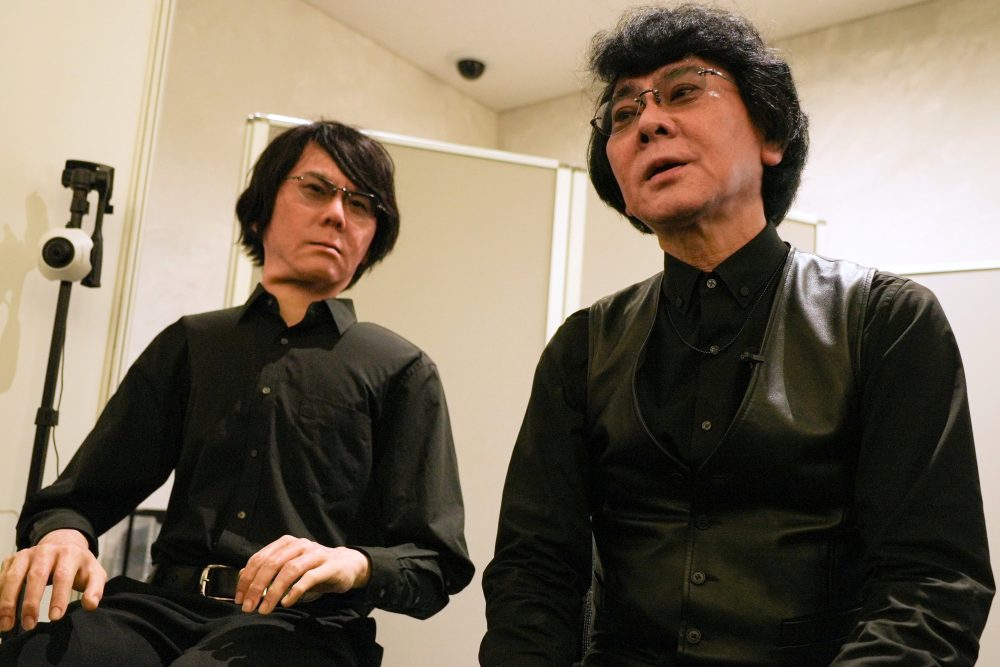
The potential threat of Chinese robotics dominance didn’t concern Osaka University Professor Hiroshi Ishiguro, who has spent decades working on humanoids, including creating one resembling himself.
“What’s significant is that Japan has a culture that’s receptive to robotics. If we’re going to really start using robots in society, Japan is the ideal place,” he said, emphasizing that Japanese people don’t show prejudice against robots.
His mechanical duplicate, wearing all black like the professor, performed equally well, perhaps better, when addressing a fundamental philosophical question about robots’ purpose.
“I think robots will coexist with people. Robots are the mirror of human beings,” the robot responded in a somewhat flat but human-sounding voice.
Previously, the professor had addressed a comparable question with a different perspective.
“No one is interested in me. All everyone cares about is my robot,” he said, seated beside his twin-like humanoid.
“As long as people identify with what I have produced, I am a success,” he added.