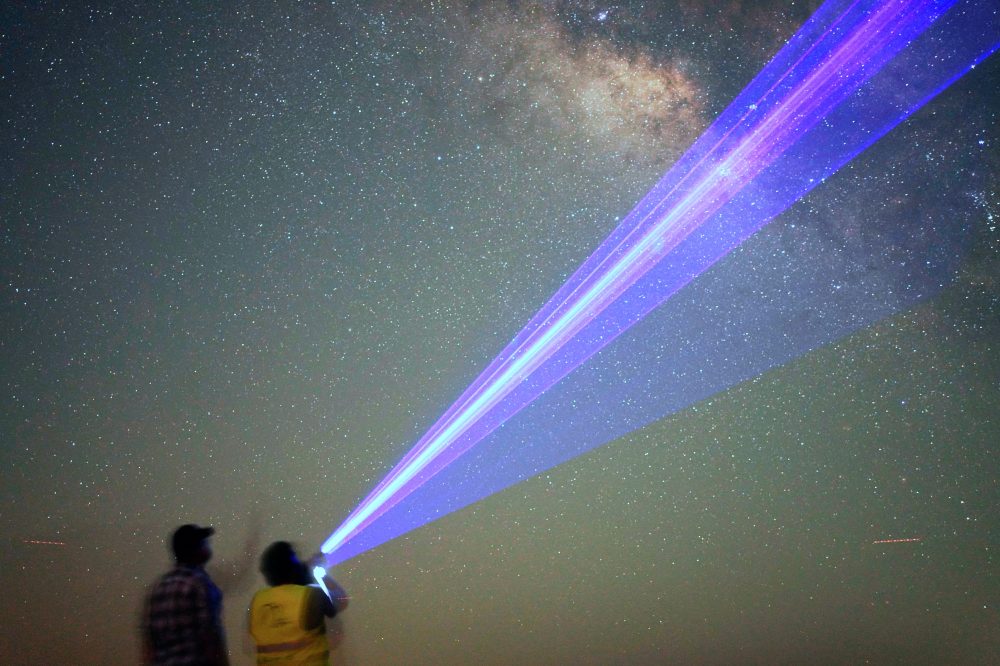

In the United Arab Emirates’ Al Quaa Desert, astronomy enthusiasts are discovering what most of the country has lost to modern development: a crystal-clear view of the stars that once helped desert nomads navigate the vast wilderness.
While the UAE’s towering buildings and brilliant lights showcase the nation’s remarkable transformation into a global center for business and travel, this progress has come at a cost. The celestial views that historically guided Bedouin travelers through the shifting sands of the Empty Quarter have largely disappeared from populated areas.
Volunteers from the Dubai Astronomy Group are now organizing nighttime trips to Al Quaa Desert, among the few remaining dark locations in the Emirates, to help residents reconnect with the night sky and witness the Milky Way.
“It causes us to appreciate our existence in this galaxy,” said Sheeraz Awan, the general manager of the astronomy group, while leading participants during a late May stargazing session.
The Emirates is classified as one of the planet’s most light-polluted nations, joining other Gulf states where most citizens reside in major urban centers.
Research from 2016 determined that “humanity has enveloped our planet in a luminous fog” and found that 99% of UAE residents cannot observe the Milky Way from their residences due to artificial lighting.
This artificial brightness includes everything from highway street lamps to the spectacular LED displays that captivate visitors at Dubai’s Burj Khalifa, the planet’s highest structure. Abu Dhabi is planning to construct a $1.7 billion replica of the Sphere, the Las Vegas venue, on its Yas Island.
In Abu Dhabi, the UAE’s capital, officials have recognized the light pollution issue and established what they term a “Dark Sky Policy” in 2024 addressing illumination and related concerns throughout their emirate. In Dubai, LED displays on buildings are becoming more prevalent and LED billboards are increasingly common. Dubai officials did not respond to requests for comment, though the emirate also contains Al Qudra Lakes, a countryside location with reduced light pollution.
Urban illumination cannot reach Al Quaa Desert.
The desert location is accessible by car, approximately 100 kilometers (62 miles) southeast of Abu Dhabi city via a main highway toward the oasis town of Al Ain, then another route heading south deep into the desert.
Although overhead lighting exists on the section called Razeen Road, including a brightly lit correctional facility along the route, the desert extends just beyond in complete darkness, free from urban illumination. Razeen Road eventually turns east, but an automated gate permits drivers onto a dirt path leading further into the wilderness.
Several kilometers deeper, beyond those camping among the dunes and enjoying some of the final pleasant overnight conditions before UAE summer temperatures reach approximately 45 degrees Celsius (113 degrees Fahrenheit), the astronomy volunteers assembled dozens of visitors for stargazing.
They had company. Multiple workers wrapped in thick blankets were sleeping nearby in a pickup truck bed beneath the stars. Under a single LED light marking the parking area, a Solifugae — commonly called a camel spider — consumed another camel spider following an extended battle. The creature briefly moved toward a reporter and volunteer before vibrations from an approaching vehicle caused it to retreat into the darkness. Everyone present then monitored their footing carefully.
On rugs spread for the May weekend expedition, families conversing in Arabic, English and Russian gazed upward. The half-moon gradually descended beyond the horizon. Shortly after, the Milky Way’s outline became visible to the unaided eye.
“When you look toward the east, can you see that faint cloud,” Awan asked. “That, ladies and gentlemen, is the Milky Way.”
Using a laser pointer to illuminate the star formations, he prompted one woman to cry out: “Ay ye ye!”
The Dubai Astronomy Group volunteers explained this represented one of the optimal periods annually for galaxy observation. Several people gasped upon spotting meteors periodically crossing the sky, clearly visible in the darkness without urban light interference.
Some congregated around telescopes to examine individual stars. Others reclined on the cold desert sand, receiving guidance on using their mobile devices for long-exposure photography to capture the galaxy shining above. Gradually, people slowly returned to their vehicles and began driving back to the UAE’s illuminated highways and cities.
For a brief time, they had connected with the night as Bedouins had done before them.
“When we look at this Milky Way, we’re kind of involved in an activity, which is not new,” Awan told the stargazers. “It’s something that people throughout time have been engaged in.”