
DURHAM, N.C. — Researchers at Duke University have created a revolutionary robot that’s preparing to take on real-world challenges from every possible angle.
Rather than mimicking symmetrical forms found in nature by designing robots that resemble humans, canines, or bugs, engineering professor Boyuan Chen and his research team concentrated on consistency of movement, which he refers to as “dynamic symmetry.”
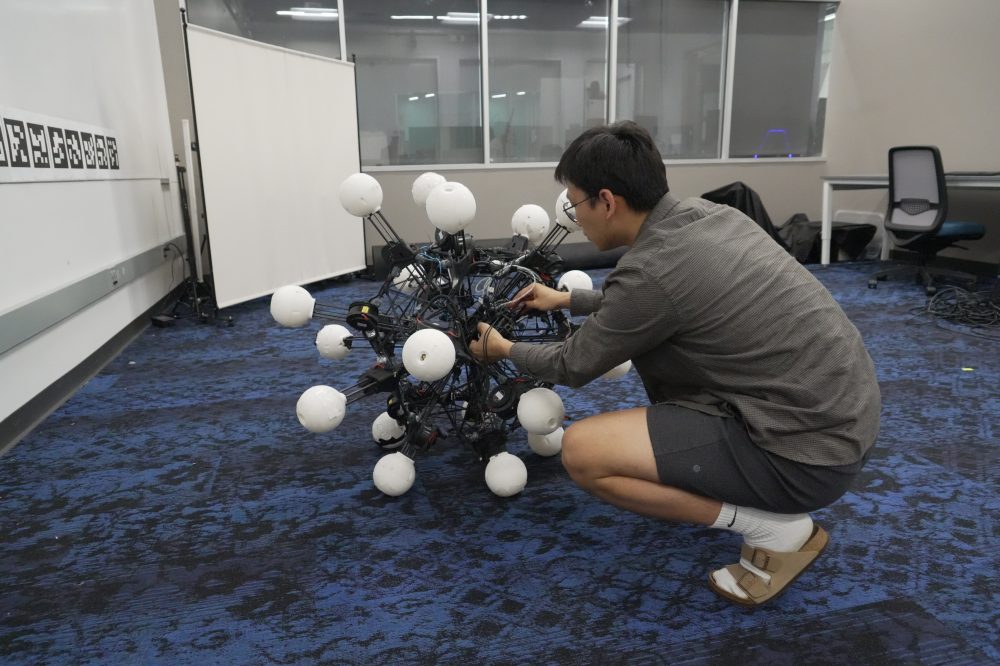
This approach led to the creation of Argus. The spherical robot takes its name from a legendary multi-eyed creature and features depth-sensing cameras mounted on 20 extending legs that project outward from a center hub. Without designated front, rear, top, or bottom surfaces, the machine can observe and travel in all directions without delay.
“Instead of measuring how your legs are arranged around a different part of your body, we’re measuring how fast you can move in any direction,” Chen said. “Who said, you know, if you have a robot to help us in a most effective way, it has to look like us?”
During testing phases, Argus has successfully traversed sandy shorelines and dense forest floor vegetation, rolling across barriers and regaining balance after being knocked off course. The robot can scale between parallel brick surfaces by alternating between bracing and pushing movements with its appendages. Even when one or multiple motors fail or a leg becomes damaged, operation continues.
“Watching Argus move is unlike watching any other robot we’ve worked with,” said Jiaxun Liu, a graduate student and co-author of a study about Argus published online Wednesday in the journal Science Robotics. “The first time we saw it navigate among trees and rough terrain, even under heavy collisions, we knew this was something different.”
During their research, the team established a new design concept called dynamic isotropy that evaluates robots on a measurement from 0 to 1 according to how evenly they can accelerate in all directions. Most currently operating robots, including humanoid models and drones, achieve scores under 0.6. Argus reaches 0.91.
“When a robot can accelerate equally well in every direction, it stops needing to face the world in any particular way,” said Chen, who hopes the same principle could guide the development of search and rescue robots, underwater or aerial vehicles or robots with the ability to grip objects.
“Instead of building a robot hand that looks like a human hand … one idea is to think about having Argus be the hand itself, and it can manipulate objects in any direction,” he said. “The knowledge we can transfer to the rest of the world is much more deeper than building an existing robot or copying an existing species.”