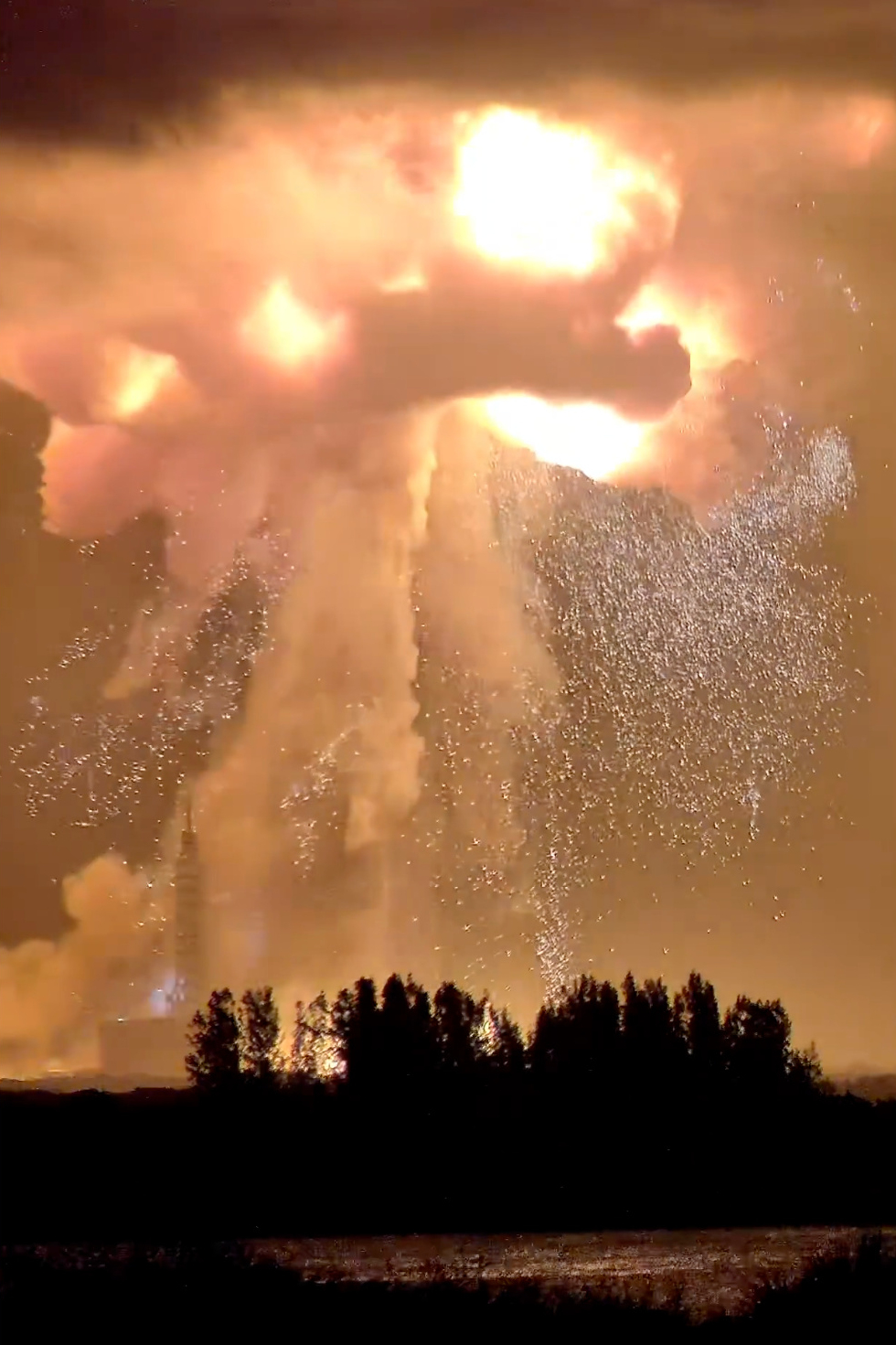

CAPE CANAVERAL, Fla. — A massive rocket owned by Jeff Bezos’ space company Blue Origin detonated during engine testing, producing an enormous orange explosion that could be seen and felt across a wide area.
The space company was conducting fuel tests on their towering New Glenn rocket Thursday evening, planning to fire the engines momentarily in preparation for a planned satellite mission next week. However, the 321-foot tall rocket erupted in flames, damaging portions of the launch facility.
On Friday, emergency authorities issued warnings for residents to stay away from any debris that could potentially reach shorelines and instead contact 911 immediately.
The New Glenn rocket takes its name from John Glenn, America’s first astronaut to orbit Earth. Blue Origin intends to use this rocket system for delivering lunar landing vehicles as part of NASA’s Artemis initiative, which seeks to establish a major installation near the moon’s southern region. The space agency hopes to achieve the first Artemis crew landings by 2028 at the earliest. Just days before this incident, NASA granted Blue Origin a new multi-hundred-million-dollar agreement.
The rocket was empty of its intended payload of 48 Amazon Leo satellites when the explosion occurred. A separate group of Amazon Leo satellites — designed to compete with SpaceX’s Starlink network in providing internet access to isolated areas — remained safely positioned miles away at Cape Canaveral Space Force Station, scheduled for launch aboard a United Launch Alliance Atlas V rocket.
Less than half a day after Blue Origin’s mishap, SpaceX successfully deployed additional Starlink satellites Friday morning. CEO Elon Musk operates two launch facilities — one at the Space Force location where the recent Falcon 9 departed, and another at NASA’s Kennedy Space Center.
Blue Origin operates only one Florida launch site. Their smaller New Shepard vehicles launch from Texas, carrying paying passengers and research payloads on brief space journeys lasting several minutes. These tourist flights were suspended in January to allow the company to concentrate on New Glenn development and future lunar missions. All operations remain halted while investigators examine the cause of Thursday’s explosion.