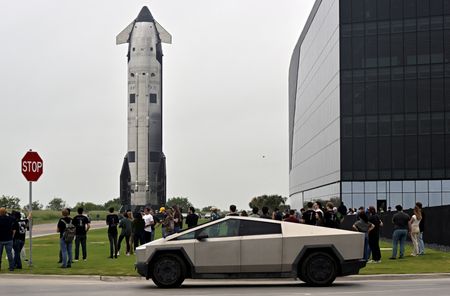

SpaceX plans to conduct the 12th uncrewed test flight of its Starship rocket on Thursday, marking the first launch of a redesigned vehicle that plays a crucial role in Elon Musk’s lunar and Mars exploration goals, as well as the company’s upcoming public stock offering.
The rocket system consists of SpaceX’s Super Heavy booster paired with the Starship upper-stage vehicle, engineered for complete reusability and designed to transport both crew members and cargo.
This inaugural flight of the Starship V3, equipped with new capabilities to support future lunar and Martian missions, represents a critical evaluation for the spacecraft as SpaceX prepares for its stock market launch with a target valuation of $1.75 trillion.
Here’s a chronological overview of Starship test flights:
FIRST TEST FLIGHT – APRIL 20, 2023
The rocket detonated just minutes following takeoff from South Texas, failing to accomplish multiple mission targets.
Although the two-stage vehicle reached less than half the distance to space’s edge, ascending to approximately 25 miles (40.23 km), the mission achieved its primary objective of launching the new rocket from the pad despite several engine malfunctions.
SECOND TEST FLIGHT – NOVEMBER 18, 2023
The rocket launched from the Starbase facility near Boca Chica, Texas, but encountered failure in space shortly after takeoff.
While the Super Heavy first-stage booster successfully separated from the main Starship, it detonated over the Gulf of Mexico moments later. The upper stage was subsequently lost during the flight.
THIRD TEST FLIGHT – MARCH 14, 2024
The rocket nearly completed its entire test mission on the third try, traveling further than previous attempts, but broke apart during its Earth return.
Communication with the spacecraft ceased moments after live video footage from an onboard camera revealed a reddish glow surrounding the silver vehicle due to re-entry heat.
FOURTH TEST FLIGHT – JUNE 6, 2024
The spacecraft endured a blazing, high-speed return from space and accomplished a groundbreaking controlled ocean landing in the Indian Ocean, representing significant progress for a vehicle built to return from orbit.
While descending, protective tiles and metal fragments separated from the craft, and portions of its steering flaps sustained severe damage, though they continued functioning sufficiently for the ocean landing.
FIFTH TEST FLIGHT – OCTOBER 13, 2024
The company’s launch tower successfully captured the massive first-stage booster using enormous mechanical arms as it returned to the Texas launch site for the first time.
This capture represented a major advancement for SpaceX’s testing program for a rocket designed to transport heavier payloads to orbit, carry astronauts to the moon for NASA, and eventually journey to Mars.
SIXTH TEST FLIGHT – NOVEMBER 19, 2024
The company conducted its sixth test flight, enhancing the upper stage’s space capabilities, but abandoned an attempt to catch the booster at the launch site while then U.S. President-elect Donald Trump observed in person.
The Super Heavy booster instead landed in the Gulf of Mexico after SpaceX redirected it from the launch tower, suggesting the vehicle failed to meet the requirements for a catch attempt.
SEVENTH TEST FLIGHT – JANUARY 16, 2025
A rocket detonated in space above the Bahamas approximately eight minutes post-launch, creating fields of burning debris that streaked across the sky over the Turks and Caicos Islands.
The vehicle featured multiple new onboard systems flying for the first time and carried the initial batch of simulated satellites intended for space deployment.
Both the U.S. Federal Aviation Administration and Turks and Caicos Islands officials initiated investigations into the rocket test.
EIGHTH TEST FLIGHT – MARCH 6, 2025
The upper stage detonated in space minutes after launching from Texas, causing the FAA to temporarily suspend flights at Miami, Fort Lauderdale, Palm Beach and Orlando airports due to “space launch debris.”
The FAA opened a mishap investigation into the event. Musk described the explosion as “a minor setback.”
MAY 22
The FAA authorized Starship to resume flights following the March incident, permitting SpaceX to proceed with another Texas launch.
However, the agency extended the Aircraft Hazard Area along the rocket’s flight path from 885 nautical miles to 1,600 nautical miles, reaching eastward from the South Texas coastline through the Straits of Florida and encompassing the Bahamas and Turks and Caicos Islands.
NINTH TEST FLIGHT – MAY 27, 2025
The rocket launched into space from Texas but lost control approximately midway through its mission, failing to achieve several key test objectives.
SpaceX also lost communication with the 232-foot Super Heavy booster during its descent before it crashed into the ocean, rather than executing the controlled splashdown the company had intended.
The upper stage achieved suborbital space but started spinning uncontrollably roughly 30 minutes into the mission, after SpaceX cancelled a planned release of eight mock Starlink satellites when the vehicle’s Pez dispenser-like mechanism malfunctioned.
TENTH TEST FLIGHT – AUGUST 26, 2025
The spacecraft successfully released its first group of mock Starlink satellites in space and evaluated new heat shield tiles during re-entry, reaching development goals that had been postponed by recent failures.
Approximately 30 minutes into the mission, the craft’s Pez-like deployment system ejected eight dummy Starlink satellites, representing a crucial test for a rocket that SpaceX intends to use in its satellite launch operations.
ELEVENTH TEST FLIGHT – OCTOBER 13, 2025
The company launched its 11th rocket from Texas and successfully landed it in the Indian Ocean, marking the final flight before testing commenced on a new version of the massive rocket equipped with additional features for lunar and Martian missions.
After propelling the upper stage into space, Super Heavy returned for a gentle splashdown in the Gulf of Mexico seven minutes after liftoff, evaluating a landing engine setup before the booster’s destruction.
TWELFTH TEST FLIGHT – EXPECTED ON MAY 21, 2026
The upcoming test flight is anticipated to be the inaugural launch of Starship V3 and its enhanced Super Heavy booster, as well as the first mission from a new launch pad constructed for the more powerful rocket.
Key improvements include a redesign of the booster’s 33 Raptor engines to generate increased thrust from a lighter configuration.