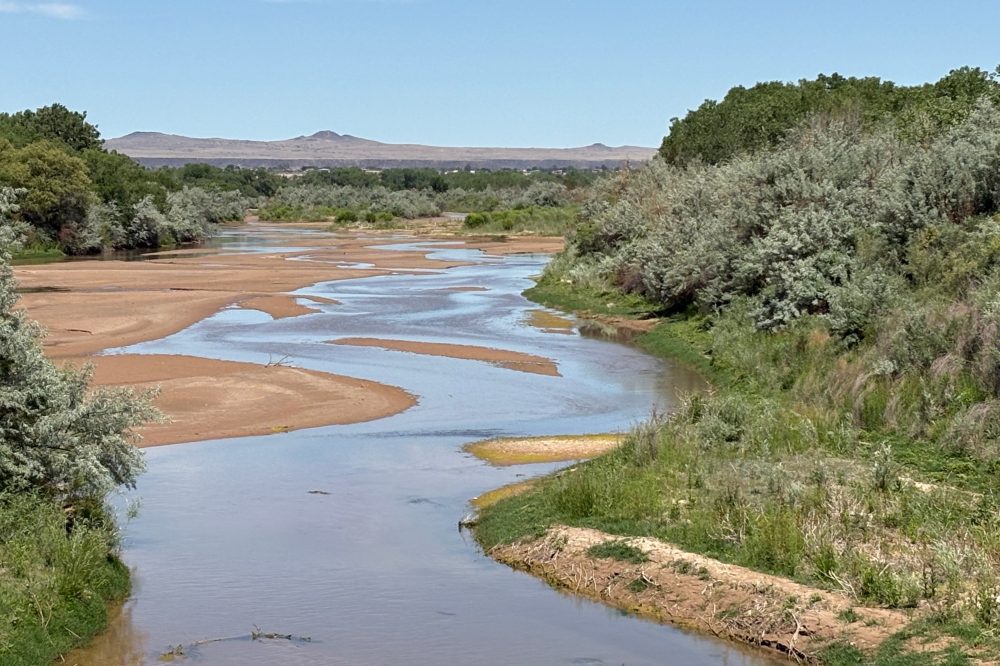

The nation’s highest court has given final approval to an agreement that resolves a decade-long legal battle over water rights along the Rio Grande, one of North America’s major waterways.
In a concise ruling issued Tuesday, the Supreme Court endorsed the recommendation from a special master to proceed with the settlement framework initially put forward last year by New Mexico, Texas and Colorado.
The agreement mandates cuts to groundwater extraction along the shrinking river and the elimination of water rights tied to agricultural land in southern New Mexico. State officials presented the plan as a commitment to bring stability back to a complex water storage and distribution network serving two major irrigation districts spanning southern New Mexico and western Texas.
Scientists have cautioned that the Rio Grande’s unsustainable usage patterns — the river begins in Colorado and flows southward into Mexico — pose risks to water availability for millions who depend on this cross-border watershed.
Agricultural producers in southern New Mexico have increasingly relied on underground water sources to sustain pecan groves and chile farming operations as rising temperatures and reduced precipitation have diminished river levels and reservoir capacity in recent decades. This groundwater extraction led Texas to file suit in 2013, alleging the practice was reducing water allocations.
Although the Colorado River dominates water crisis coverage, specialists note the Rio Grande faces equally serious challenges. River sections extending north to Albuquerque are projected to run completely dry again this year, representing the third occurrence within a five-year span.
Representatives from the New Mexico Department of Justice and the state engineer’s office did not respond immediately to Wednesday inquiries regarding the court’s decision. They have stated previously that these agreements will enable local water management decisions while preventing catastrophic financial penalties worth billions for water delivery shortfalls.
The settlement framework establishes a comprehensive tracking system for water allocation to Texas. New Mexico will be able to use credit and deficit mechanisms across multiple years to manage drought and wet cycles, though extended delivery delays could trigger additional water-sharing requirements.
According to the settlement terms, New Mexico must decrease yearly groundwater depletion by 18,200 acre-feet, equivalent to approximately 5.9 billion gallons (22.3 billion liters).
Authorities anticipate meeting most reduction targets through voluntary water rights purchases from landowners, which would remove more than 14 square miles (36 square kilometers) of agricultural property from production.
Additional specifics — including total costs — remain under development, but senior water officials have consistently informed New Mexico legislators that success requires “an all hands on deck approach.”
“The problems that we face with water are problems we can’t face unless we work together,” Hannah Riseley-White, director of the Interstate Stream Commission, told a group of water experts during a meeting in March.
She referenced a mix of extended land retirement programs, water conservation measures and upgraded irrigation systems.