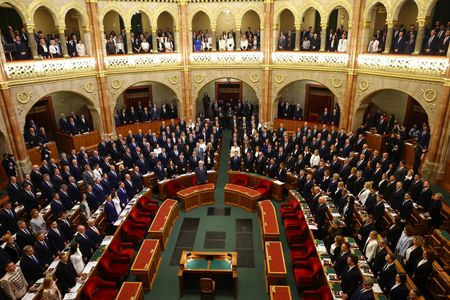
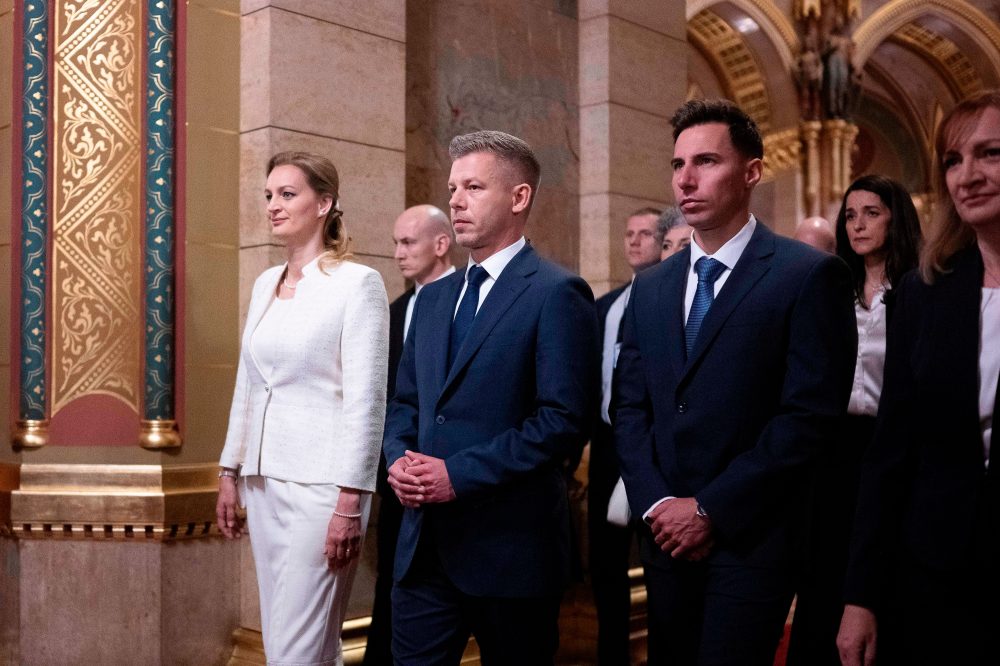
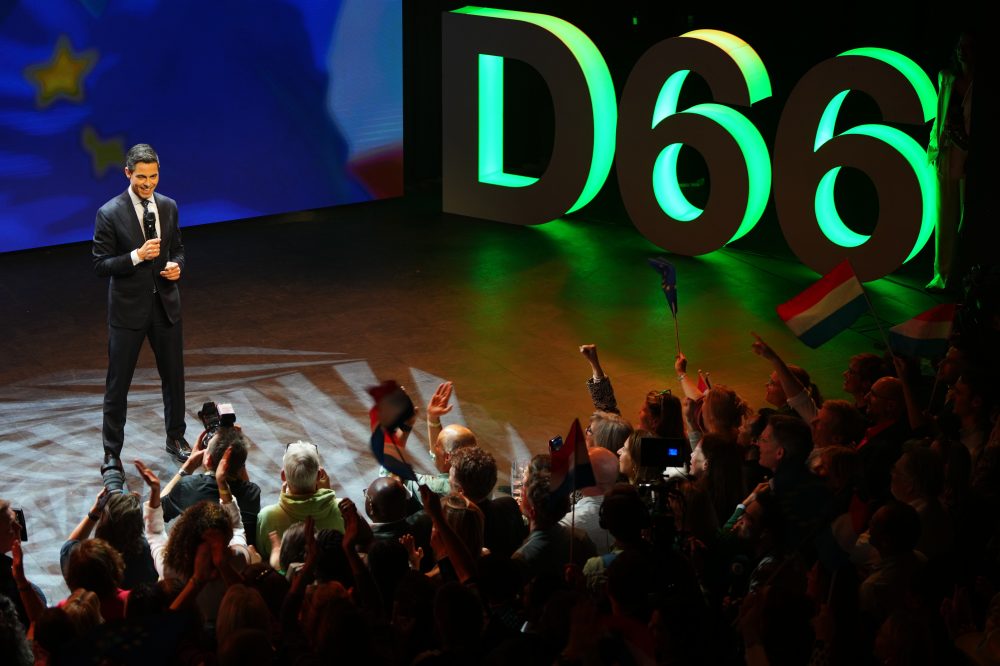
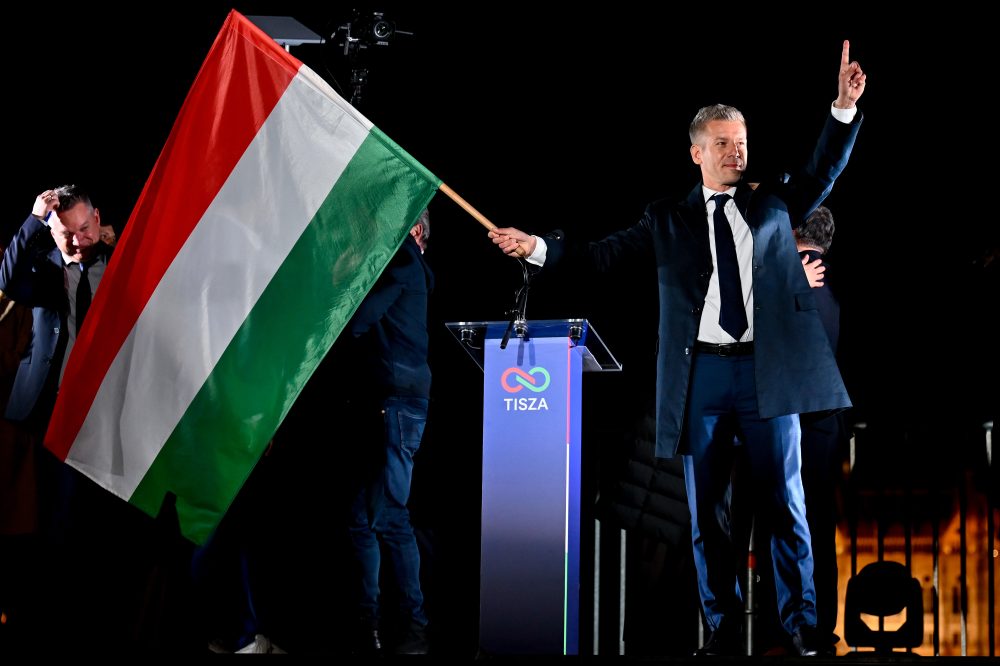
BUDAPEST – Peter Magyar officially took the oath of office as Hungary’s new prime minister on Saturday, marking a significant political transition for the European nation.
The centre-right politician’s rise to power comes after he campaigned on a reform agenda, promising to address the country’s prolonged period of economic difficulties and repair damaged relationships with important international allies that deteriorated during Viktor Orban’s time in leadership.
Magyar’s inauguration represents a notable shift in Hungarian politics as the nation seeks to move forward from recent challenges under the previous administration.
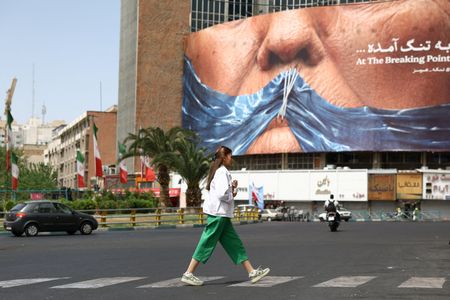
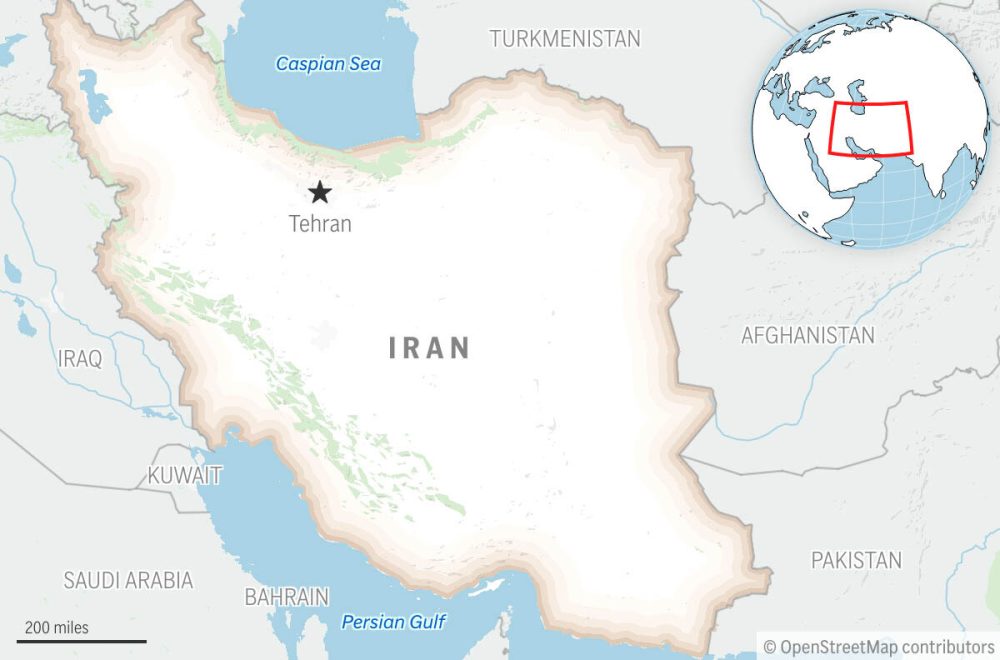
DUBAI, United Arab Emirates (AP) — An unstable truce between the United States and Iran appeared to remain intact Saturday following American military action against Iranian oil vessels, while Bahrain announced the arrest of dozens allegedly tied to Iran’s Revolutionary Guard.
Friday’s military actions raised questions about the delicate month-long ceasefire that Washington maintains remains valid. The United States continues to wait for Tehran’s response to its most recent peace proposal aimed at ending hostilities, reopening the Strait of Hormuz, and scaling back Iran’s controversial nuclear activities.
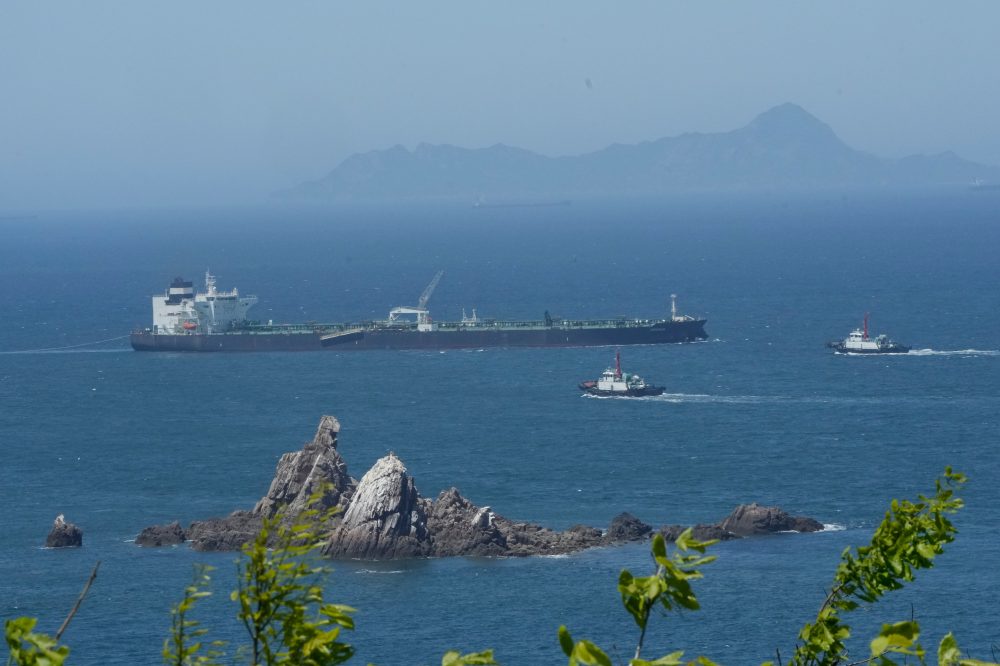
American military officials reported Friday that their forces had incapacitated two Iranian oil tankers attempting to break through a U.S. naval blockade at Iranian ports. Earlier that day, the military announced it had prevented attacks on three Navy vessels and conducted strikes against Iranian military installations in the strategic waterway.
In Bahrain, the small Gulf nation’s Interior Ministry announced Saturday the detention of 41 individuals suspected of belonging to a cell connected to Iran’s Revolutionary Guard. Officials said investigations continue to identify additional members of the organization, though they declined to provide additional specifics.
The island kingdom operates under Sunni Muslim leadership while maintaining a predominantly Shiite population similar to Iran. Human rights organizations have accused Bahrain of exploiting the Iran-U.S. conflict, which involves the country hosting America’s Fifth Fleet, to justify suppressing domestic opposition.
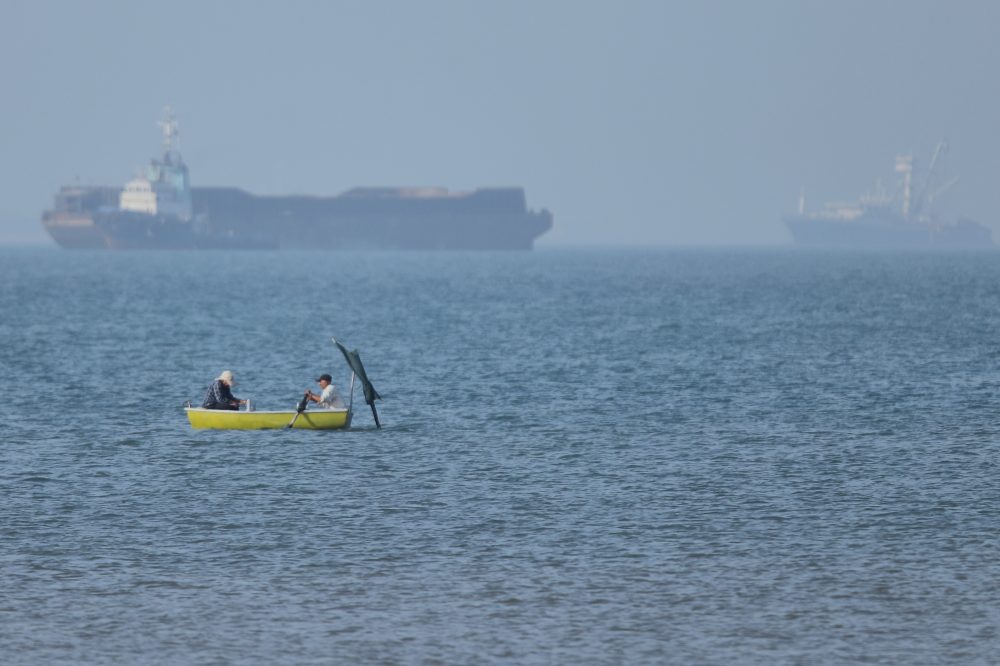
Tehran has largely sealed off the vital shipping lane for global energy supplies since the United States and Israel initiated military action on February 28, triggering worldwide fuel price increases and destabilizing international markets. Washington has implemented its own naval blockade of Iranian shipping facilities.
American military officials released footage showing Friday’s strikes on the two Iranian tankers, with fighter jets targeting their smokestacks. Earlier this week, a U.S. military aircraft disabled a tanker’s steering system after officials said it attempted to violate the blockade.
An overnight American attack resulted in at least one sailor’s death and injured 10 others when a cargo ship caught fire, according to a news outlet linked to Iran’s judicial system. Officials have not confirmed whether this vessel was among the two tankers the U.S. acknowledged striking.
President Donald Trump has maintained that the ceasefire continues despite recent military actions. He has repeated warnings about resuming comprehensive bombing campaigns if Iran rejects an agreement to reopen the strait and curtail its nuclear development.
Iranian foreign ministry representative Esmail Baghaei stated Friday that his country was ignoring “deadlines” and continues examining the American proposal for ongoing talks, state-run IRNA reported.
A senior Iranian official also confirmed Friday that Supreme Leader Mojtaba Khamenei remains in “complete health” and will make public appearances in the future.
Mazaher Hosseini, connected to the former Supreme Leader’s office, made these statements at a government-supporting event. Hosseini explained that Mojtaba had experienced knee and back problems that have mostly resolved, leaving him in good physical condition.
Khamenei has not appeared publicly since hostilities began, and the ongoing lack of verified photographs, recordings, or video footage has sparked questions about his wellbeing. Statements like Hosseini’s are viewed by some as efforts to address speculation that he may have died.
International diplomatic activity has increased as tensions continue rising.
Russia’s foreign ministry announced Saturday that both Russia and Saudi Arabia are advocating for continued diplomatic work toward a “sustainable, long-term agreement” to conclude the conflict.
Top diplomats from Egypt and Qatar have also emphasized that diplomatic solutions represent the only viable path forward, according to details from a Saturday telephone conversation between Egyptian Foreign Minister Badr Abdelatty and Qatari counterpart Sheikh Mohammed bin Abdulrahman Al Thani.
Pakistani Prime Minister Shehbaz Sharif revealed his nation has maintained continuous contact with both the United States and Iran “day and night” working to extend the ceasefire and achieve a lasting peace agreement.
A temporary halt in hostilities between Russia and Ukraine began Saturday, offering war-weary civilians their first peaceful nights in months as part of a three-day truce negotiated by American officials.
President Donald Trump announced Friday that both nations had committed to the ceasefire running from May 9 through May 11, which also includes an exchange of prisoners. Trump expressed optimism for a “big extension” of the agreement.
The pause in fighting coincided with Russia’s World War Two victory commemoration in Moscow, which proceeded without incident despite earlier Russian threats of potential Ukrainian attacks that could have prompted massive retaliation against Kyiv.
Ukrainian air defense forces reported detecting some unmanned aircraft along the extensive 1,000-kilometer front line stretching across southeastern Ukraine during morning hours, though no missile alerts were issued overnight or into Saturday.
“On the one hand, this is very good because, honestly, the sleepless nights have gotten a bit tiresome,” said Kateryna Kizev, who evacuated from the frontline city of Kherson in the south and currently resides in Cherkasy in central Ukraine.
“At least for a few days we will be able to sleep in peace and without the attacks,” the 22-year-old told Reuters at Kyiv’s Independence Square during a weekend visit to the capital.
KREMLIN SAYS A UKRAINIAN SETTLEMENT IS COMPLICATED
Ever since Russia launched its comprehensive invasion of Ukraine in February 2022, Moscow has bombarded power facilities and critical infrastructure throughout Ukraine using missiles and drones, while Kyiv has targeted Russia’s energy production and export sites.
Diplomatic efforts have reached an impasse, with Ukraine refusing Russia’s conditions that it relinquish territory it has successfully protected after forcing Russian troops away from the capital during the early stages of the conflict.
“It is understandable that the American side is in a hurry,” Kremlin spokesman Dmitry Peskov told state television reporter Pavel Zarubin.
“But the issue of a Ukrainian settlement is far too complex, and reaching a peace agreement is a very long way with complex details,” Peskov said.
The temporary truce encompasses a halt to all “kinetic activity” and an arrangement to exchange 1,000 prisoners of war from both sides. Officials had not announced Saturday when the prisoner swap would occur.
“There were no strikes on the Red Square. Obviously, there was no massive retaliatory missile strike on Kyiv from us,” Kremlin aide Yury Ushakov told reporters.
Both Russia and Ukraine had previously declared individual ceasefires starting on different days this week, but each side rapidly accused the other of violations.
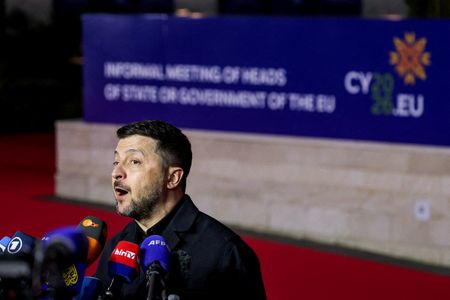
Ukrainian President Volodymyr Zelenskiy indicated the current truce resulted from ongoing U.S. diplomatic initiatives and emphasized that humanitarian concerns remain central to Kyiv’s priorities.
UKRAINE MARKS VICTORY DAY DIFFERENTLY
Ukraine, which remained part of the Soviet Union until 1991 and suffered millions of casualties during World War Two, shifted its remembrance ceremonies for the Soviet triumph over Nazi Germany from May 9 to May 8 after Russia’s invasion began.
However, some Ukrainian citizens who lost family members during World War Two continue to place flowers at Soviet military monuments on May 9.
“This ceasefire – for a day, or two or three – these are temporary measures. We need peace. It is the fifth year already. It is enough,” Oleksandr Boiko told Reuters in Kharkiv.
“I have lost everything… We need peace.”
Another Kharkiv resident, Ramaz Tsytsyashvili, expressed hope that the ceasefire might create opportunities for additional discussions to conclude the war.
“And perhaps there will be a miracle and this temporary silence, this ceasefire, will hold up a bit and continue, and then step by step it will move to negotiations, and affairs will be solved in offices, not on the battlefield.”
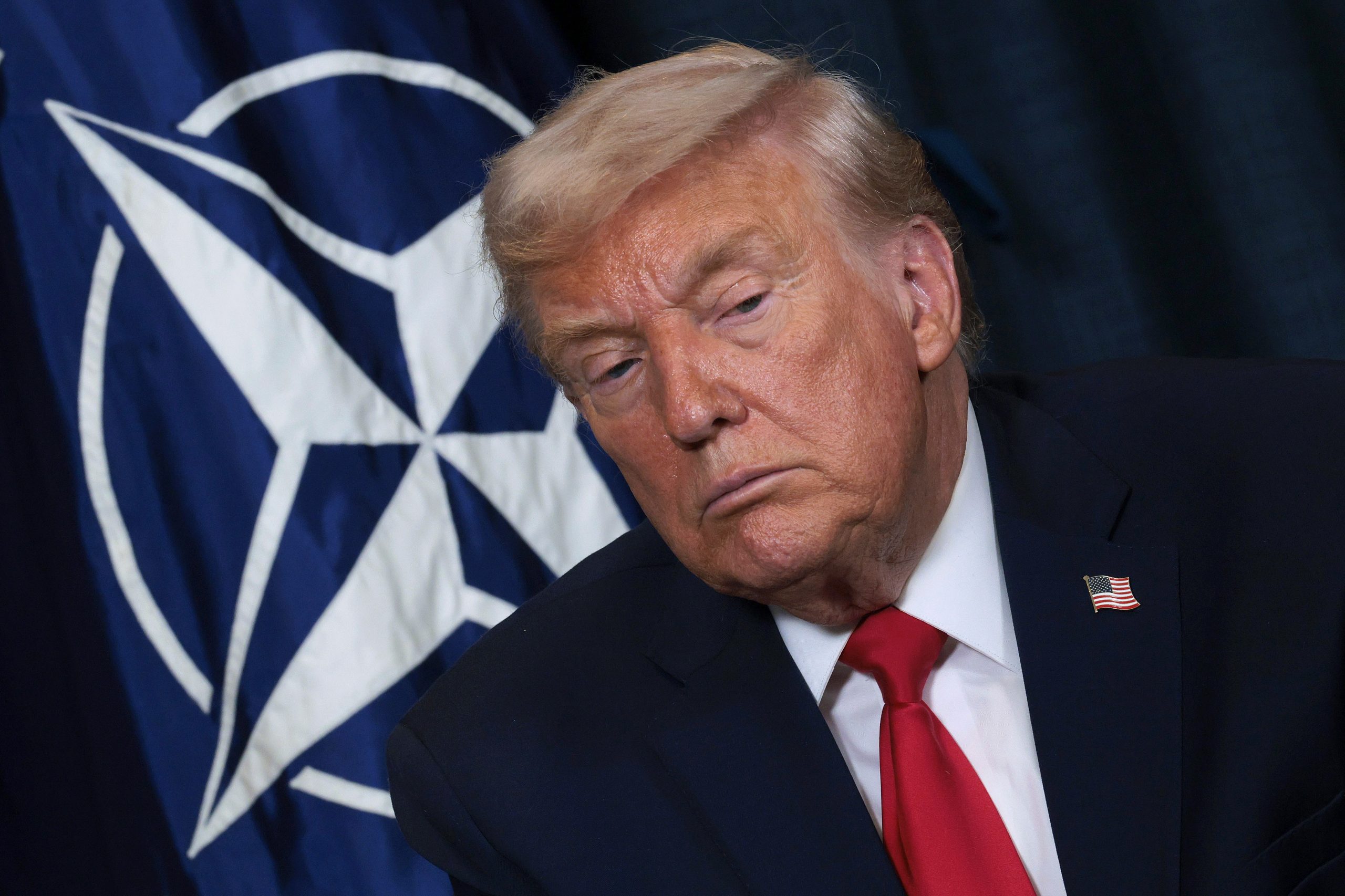
German Chancellor Friedrich Merz emphasized Saturday that European nations remain committed to preserving NATO’s effectiveness, even as disagreements with the Trump administration over the Iran conflict have created new strains within the alliance.
Speaking during a press conference in Stockholm alongside Swedish Prime Minister Ulf Kristersson, Merz addressed mounting concerns about NATO’s future amid escalating disputes between Washington and European partners.
Relations have deteriorated significantly after Germany and several other European nations declined to back the U.S. and Israeli military campaign against Iran that started in late February. These tensions add to existing friction over defense spending requirements and immigration policies that Trump has previously criticized.
“We are really willing to keep this alliance alive for the future,” Merz stated during the joint appearance. He noted that both Sweden and Finland have bolstered NATO’s European component.
“We know that there are some differences. We know that we are seeing challenges, all of us, but our final goal is to bring this conflict to an end and to guarantee that Iran is not able to produce nuclear weapons,” the German leader explained.
“And this goal is a common goal between America and Europe,” he added.
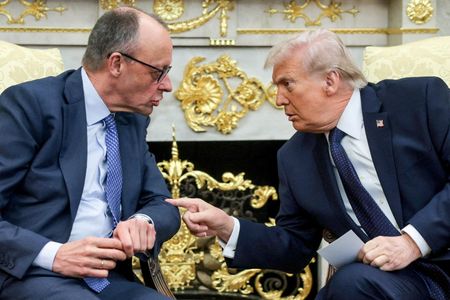
The relationship between Germany and the U.S. has become particularly strained after Merz criticized Iran for “humiliating” America last month. In response, Trump ordered the withdrawal of 5,000 American troops and canceled plans to deploy long-range Tomahawk missiles.
Merz downplayed the significance of troop reductions, arguing that “unity of purpose” matters more than numbers. He maintained that having a robust European NATO presence serves American interests.
“We are remaining interested and highly interested in having the American army and the American military support on our side,” he said. “So this is something we are having in common and we are trying to achieve that currently.”
European nations, including Germany, are investing heavily in military modernization after years of reduced defense spending, responding to what Merz described earlier Saturday as an immediate Russian threat to Europe.
His comments came as Russian President Vladimir Putin participated in Moscow’s annual parade commemorating the Soviet victory over Nazi Germany in World War Two. Merz expressed disappointment that Slovakian Prime Minister Robert Fico had reportedly planned to attend the ceremony, saying he intended to discuss “this day in Moscow” with the Slovak leader.
However, while Fico did travel to Moscow, he ultimately chose not to participate in the parade itself.
MADRID – Five European nations have committed to dispatching aircraft to retrieve their citizens from a cruise vessel bound for Spain following a hantavirus outbreak aboard the ship, according to Spain’s interior minister who spoke in Madrid on Saturday.
Fernando Grande-Marlaska announced that Germany, France, Belgium, Ireland, and the Netherlands have all confirmed their evacuation plans. Additionally, the European Union will provide two more aircraft for other European passengers, he stated.
The United States and United Kingdom have also arranged flights and backup plans for non-EU passengers whose home countries cannot provide air transportation, Grande-Marlaska explained.
Travelers will be permitted to bring only necessary personal items, while their remaining baggage and the body of a passenger who died aboard the vessel will stay with the ship as it travels to the Netherlands for disinfection procedures, Garcia noted.
Spanish nationals will be the first to leave the ship, with health officials determining the sequence for evacuating other passenger groups. Grande-Marlaska emphasized that no passengers will be permitted to leave the vessel until their designated evacuation aircraft is prepared for immediate departure.
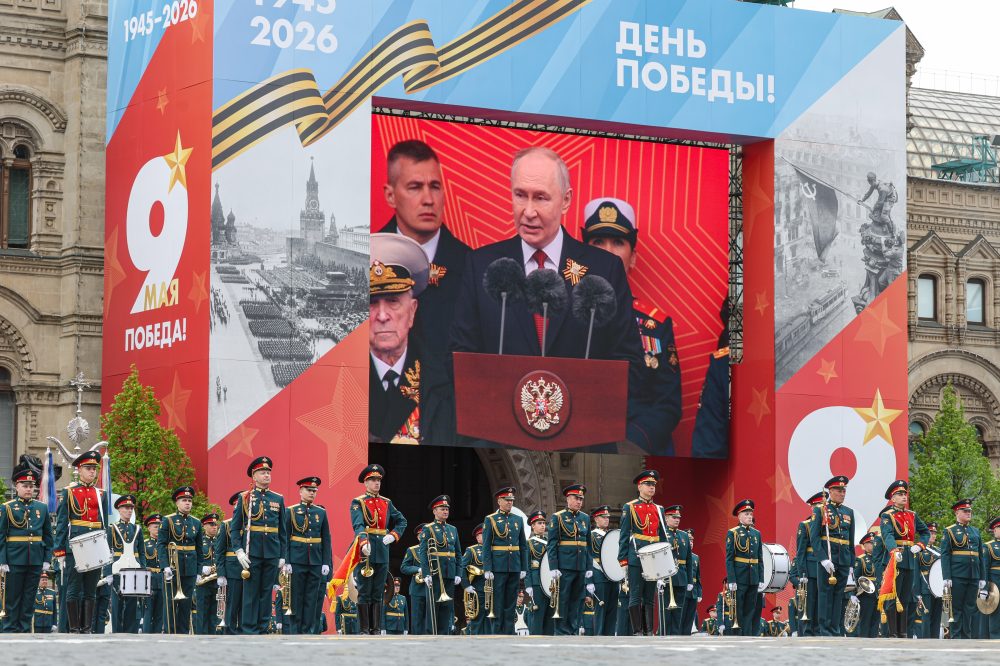
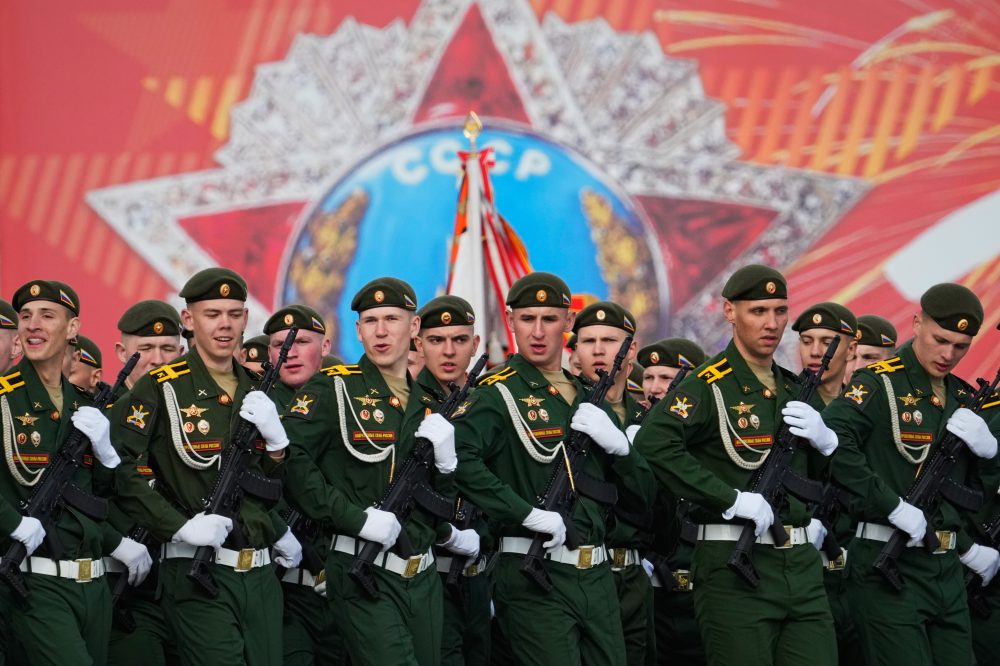
MOSCOW (AP) — Russia conducted its annual Victory Day commemoration on Saturday with a reduced military display in Moscow’s Red Square, surrounded by enhanced security protocols.
The Associated Press photo desk compiled a collection of images documenting the ceremony.
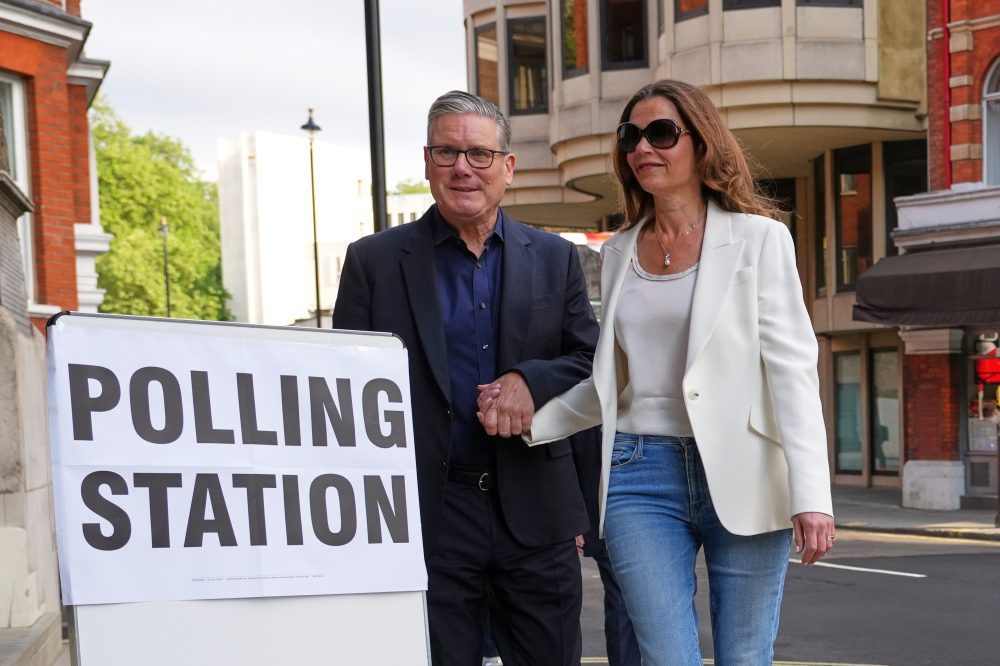
British Prime Minister Keir Starmer vowed to rebuild his faltering administration Saturday as pressure mounted for his resignation following catastrophic local election defeats that saw his Labour Party lose ground across the United Kingdom.
Saturday’s final tallies revealed Labour’s loss of 1,000 council seats throughout England and the end of their 27-year reign in Wales. Meanwhile, the anti-immigration Reform UK party secured nearly 1,300 seats across England, finished runner-up in Wales, and expanded their presence in Scotland.
The outcomes delivered a harsh judgment from voters in contests many viewed as an unofficial vote of confidence in Starmer, whose approval ratings have collapsed since bringing his center-left party to power fewer than two years ago.
Despite the electoral devastation, Starmer declared he would not abandon his post “and plunge the country into chaos,” and no immediate leadership challenge materialized against him.
Cabinet members rallied around Starmer, while prominent Labour figures viewed as potential successors remained silent. Health Secretary Wes Streeting, former Deputy Prime Minister Angela Rayner, and Greater Manchester Mayor Andy Burnham have avoided making any leadership moves.
However, an increasing number of Labour members of parliament called for the prime minister to establish a timeline for stepping down this year. Under British parliamentary rules, parties can replace their leader during a term without triggering new elections.
“There has to be a timetable,” legislator Clive Betts told the BBC. Fellow lawmaker Tony Vaughan advocated for an “orderly transition of leadership.”
In a bid to signal change Saturday, Starmer recalled two veteran Labour figures from previous administrations. He named former Prime Minister Gordon Brown as a special envoy for global finance and appointed ex-deputy leader Harriet Harman as an adviser on women and girls’ issues.
Starmer plans to deliver a major address Monday aimed at rebuilding momentum before the government outlines its legislative agenda Wednesday during King Charles III’s speech at Parliament’s State Opening ceremony.
The elections marked a major victory for Reform UK, the newest far-right movement under veteran nationalist leader Nigel Farage.
Campaigning on anti-establishment and anti-immigration platforms, the party captured hundreds of local council positions in working-class northern English communities like Sunderland that had been Labour strongholds for generations. Reform also seized territory from Conservatives in areas such as Essex county, located east of London.
Farage declared the outcomes represented a “historic change in British politics.” He expressed confidence that “voters who have come to us are not doing it as a short-term protest.”
Reform UK currently controls only eight of Parliament’s 650 seats, leaving questions about whether the party could replicate this success in nationwide elections.
The voting produced regional governments in Scotland and Wales controlled by independence-minded parties committed to dissolving the United Kingdom, though neither is actively pursuing that agenda.
The Scottish National Party, which has ruled from Edinburgh since 2007, secured another term but failed to achieve a majority, making an independence referendum unlikely. Labour and Reform finished tied for a distant second place.
Plaid Cymru (The Party of Wales) captured the most seats in Cardiff’s legislature, the Senedd. The party, which supports Welsh independence but lacks immediate plans for pursuing it, fell short of a majority but will likely form the new government. Reform finished second while Labour placed a distant third in one of their traditional strongholds, with outgoing First Minister Eluned Morgan losing her seat.
Economic struggles form the core of Labour’s difficulties, mirroring challenges facing incumbent governments worldwide.
After ending 14 years of Conservative leadership marked by austerity measures and the COVID-19 pandemic, Labour has failed to address cost-of-living concerns and revitalize a stagnant economy amid challenging conditions created by the Ukraine conflict and, recently, Iran. Starmer has also frustrated supporters through welfare spending cuts, some of which were reversed following internal Labour opposition.
Some Labour members argue the government’s accomplishments, including tenant protections and minimum wage increases, are being overlooked. Many blame Starmer, describing him as an uninspiring leader distracted by controversies including his controversial appointment of Peter Mandelson, a scandal-linked associate of Jeffrey Epstein, as Britain’s ambassador to Washington.
However, Stephen Houghton, the departing leader of Barnsley council in northern England where Labour lost to Reform, suggested the issues “go deeper than the prime minister.”
“This has been coming for 30 years around the country, in post-industrial communities, coastal communities, that have been left behind,” he explained. “You can change prime ministers all day long. If you don’t change policy, it’s not going to charge.”
The results demonstrate the fragmentation of UK politics following decades of Labour and Conservative Party dominance, with both traditional parties suffering significant losses Thursday.
Voters had numerous options, including the centrist Liberal Democrats and nationalist movements in Scotland and Wales.
The major beneficiaries were populist newcomers Reform UK and the Green Party, which has broadened its focus from environmental issues to social justice and Palestinian advocacy under self-described “eco populist” leader Zack Polanski. The Greens captured hundreds of council seats from Labour in urban areas and university communities while gaining control of multiple local governments.
Tony Travers, a government professor at the London School of Economics, suggested the results indicate the next national election, scheduled by 2029, may not produce a majority for any single party.
“So then you’re in the world of, after the election, two or three big minority parties trying to work out how they would govern,” he explained — a scenario traditionally viewed as “very un-British.”
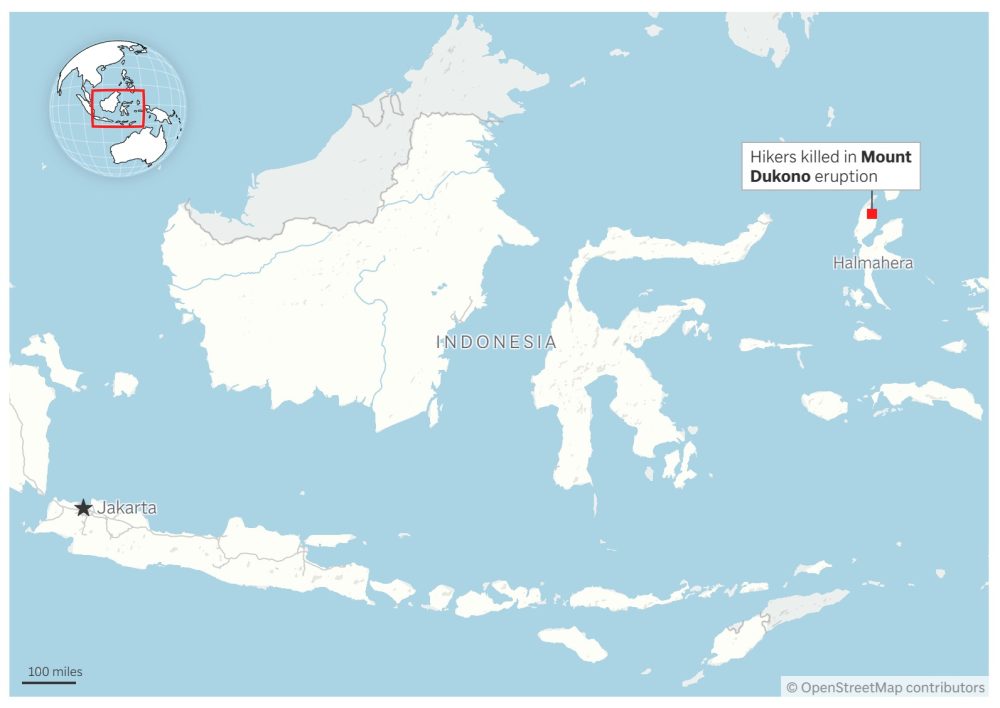
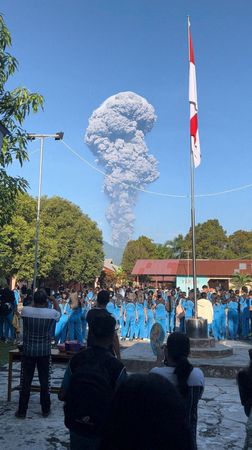
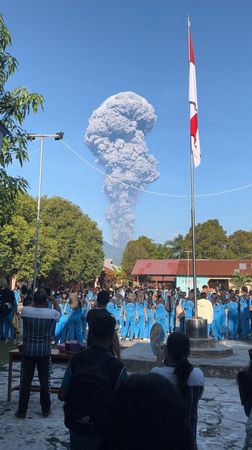
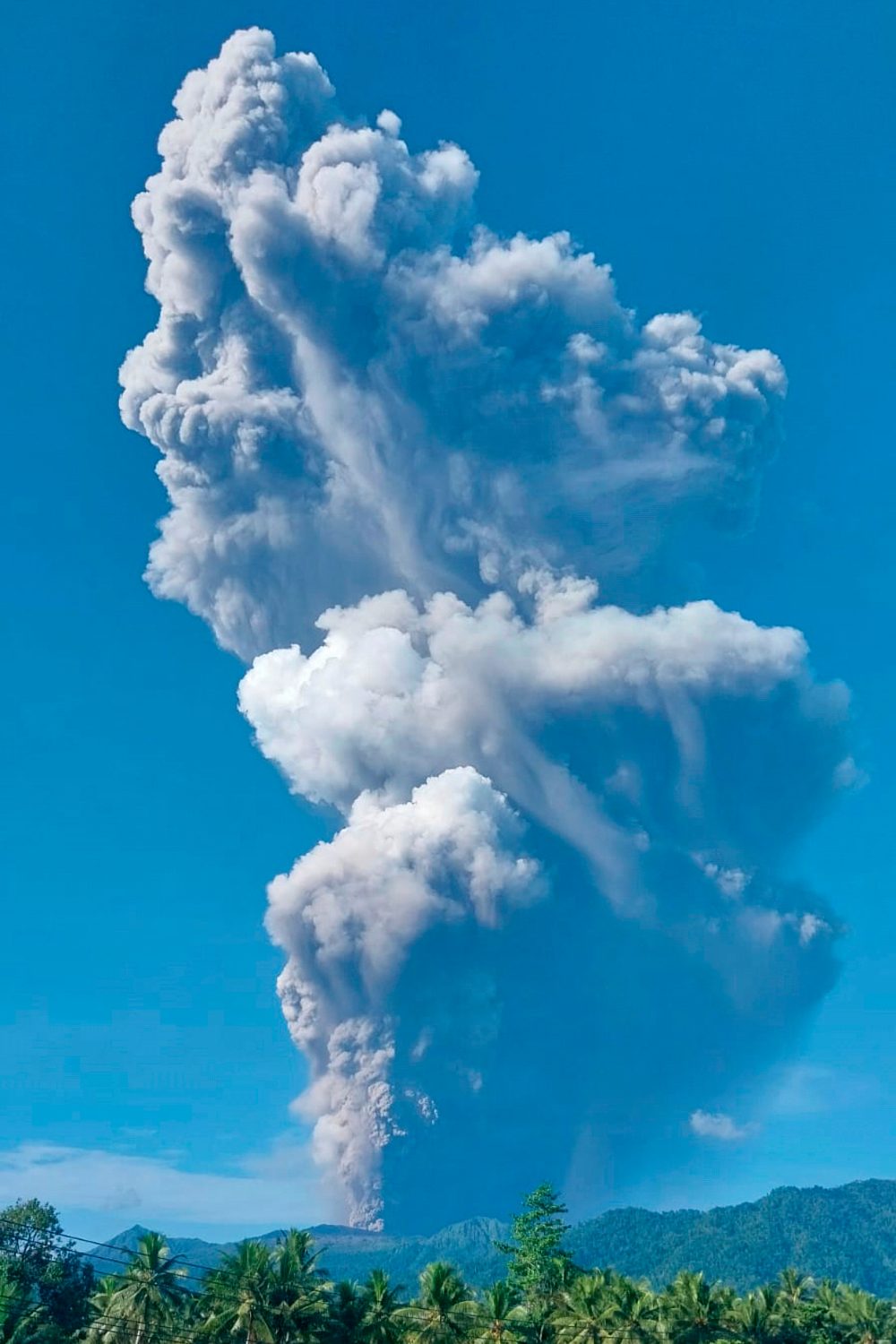
JAKARTA, Indonesia — Search teams recovered the remains of one woman Saturday following a deadly volcanic eruption at Mount Dukono on Indonesia’s remote Halmahera island, while operations continue to locate two missing Singaporean climbers, according to local officials.
Twenty hikers had attempted to climb the 4,445-foot volcano Friday despite existing safety prohibitions when Dukono suddenly erupted in the early morning hours, sending a massive ash plume approximately 6 miles skyward.
The recovered victim, identified only as Enjel and described as an experienced local climber, was discovered Saturday afternoon roughly 165 feet from the main crater’s edge, according to Iwan Ramdani, director of the local Search and Rescue Office. Two Singaporean climbers remain missing as rescue operations continue despite ongoing volcanic activity.
“The rescue efforts went through a situation that required careful calculation and a well-planned evacuation strategy,” Ramdani explained. “We took into account the potential escalation of volcanic activity as well as the safety of all personnel.”
Seventeen climbers were successfully rescued following the initial eruption, including seven Singapore nationals and two Indonesian climbers who later assisted rescue teams by providing crucial information about climbing paths used by the missing victims. Ten of those evacuated sustained minor burns.
More than 100 rescue personnel supported by drone technology resumed search efforts Saturday morning, concentrating on a 7,500-square-foot zone where evidence was discovered during initial operations, despite dangerous conditions and continued eruptions.
Ramdani emphasized that rescuer safety remains the top priority given Dukono’s elevated volcanic activity.
“The main challenge in this search effort is that we are racing against ongoing eruptions,” Ramdani stated in a video message. “When the authorities declare conditions safe, we move closer to the crater area, but when an eruption occurs, we must immediately secure all search personnel from potential danger.”
Indonesia’s volcanic monitoring agency documented several eruptions from early Saturday through late morning, with ash columns reaching heights of nearly 10,000 feet above the crater. Monitoring stations also recorded lava bursts throughout the overnight hours.
Mount Dukono has maintained the country’s second-highest alert classification since 2008. Officials established a 2.5-mile restricted zone around the active crater in December 2024.
Regional authorities officially prohibited all hiking access to Mount Dukono in April and strengthened the prohibition following Friday’s incident. The National Disaster Management Agency cautioned that violating restricted areas could lead to legal consequences.
The agency called on climbers and tour companies to follow safety guidelines, pointing out that similar restrictions are in effect for dozens of other active volcanoes nationwide that are currently at heightened alert status.
Indonesia, home to over 270 million residents, is located along the Pacific “Ring of Fire” and contains more than 120 active volcanic peaks.
SYDNEY – A far-right political movement in Australia achieved a historic milestone over the weekend when Pauline Hanson’s One Nation party captured its first-ever seat in the nation’s House of Representatives during a special election, according to initial vote tallies.
This victory aligns with a global trend of increasing support for far-right populist movements. Earlier this week, Britain’s governing Labour party experienced significant losses in local council races across the country.
Former agribusiness executive David Farley secured the rural Farrer district for the anti-immigration political organization, earning a commanding 59.1% of votes and defeating the sitting centre-right Liberal Party candidate. The district is located approximately 340 miles south of Sydney and 200 miles north of Melbourne, according to Australian Broadcasting Corp. projections.
“It’s very clear, the next member for Farrer is David Farley,” stated Australian Broadcasting Corp election analyst Casey Briggs during a television broadcast. “It’s not a close result.”
This victory represents a major breakthrough for One Nation, marking their first lower-house parliamentary win since Hanson established the party three decades ago.
However, the outcome will not impact the governing Labor Party’s parliamentary control, as they maintain 94 seats out of 150 in the lower chamber.
The position became available after Liberals leader Sussan Ley stepped down in February.
Labor chose not to field a candidate for this seat, which has remained under conservative opposition control since its creation more than 50 years ago.
Indonesian law enforcement officials detained 321 foreign nationals during a Saturday operation targeting an illegal online gambling enterprise in Jakarta, according to police statements.
The arrests took place at an office complex in Central Jakarta as part of ongoing efforts to combat prohibited online gambling activities in Indonesia, which maintains strict prohibitions on gambling as the world’s most populous Muslim-majority country.
Wira Satya Triputra, who leads the Indonesian police force’s criminal investigation division, revealed the nationality breakdown during a news briefing. The detained individuals included 228 Vietnamese citizens, 57 Chinese nationals, 13 from Myanmar, 11 from Laos, five Thai citizens, and three Cambodian nationals.
According to Wira’s statements, the gambling operation had been active for approximately two months before the raid occurred.
Among the 321 individuals taken into custody, 275 face potential charges under Indonesia’s criminal statutes regarding gambling violations, which could result in prison sentences of up to nine years if convicted.
Wira indicated that the majority of the foreign suspects understood they had traveled to Indonesia specifically to operate online gambling services, and their operations primarily served customers outside Indonesia.
Untung Widyatmoko, representing Interpol Indonesia, addressed reporters about emerging patterns in regional criminal activity. He noted that online gambling operations appear to be relocating from Cambodian urban centers to Indonesian territory.
This enforcement action represents the second major arrest of foreign nationals within a 48-hour period. Indonesian immigration officials had previously apprehended 210 foreign individuals on Friday in connection with alleged online investment fraud schemes on Batam island, located approximately 20 kilometers from Singapore.
MOSCOW, May 9 – Russian officials stated Saturday that Washington is pushing too quickly for a peace agreement to resolve the Ukraine conflict, but achieving any meaningful resolution remains extremely distant due to the complexity of issues involved and suspended diplomatic talks.
The ongoing conflict, now in its fifth year, represents Europe’s most devastating war since World War II. Moscow’s military has yet to capture the entirety of Ukraine’s eastern Donbas region, where Ukrainian defenders have retreated to heavily fortified urban positions.
President Donald Trump has pledged to bring the Ukraine war to an end, describing his inability to achieve this goal as among his greatest frustrations. However, on Friday he revealed a temporary halt in fighting from May 9 through May 11 that both nations have accepted.
Kremlin spokesperson Dmitry Peskov spoke with state media correspondent Pavel Zarubin, stating: “It is understandable that the American side is in a hurry.”
Peskov continued: “But the issue of a Ukrainian settlement is far too complex, and reaching a peace agreement is a very long way with complex details.”
Moscow’s military campaign in Ukraine has now exceeded four years – a duration longer than the Soviet Union’s involvement in World War II, which Russians commemorate as the Great Patriotic War from 1941 to 1945.
According to Trump’s announcement on Truth Social, the temporary truce between Ukraine and Russia includes halting all “kinetic activity” and exchanging 1,000 prisoners from both countries.
When speaking to media Friday, Trump expressed hope for extending the pause, saying: “I’d like to see a big extension. It could be.”
Moscow confirmed the arrangement covers three days, while diplomatic discussions remain stalled.
Kremlin foreign policy advisor Yuri Ushakov explained: “Negotiations will probably resume, but it is still unclear when. There was an agreement that the Victory Day ceasefire would last for three days: May 9, 10, and 11.”
A Chinese business leader’s recent journey to Brazil’s Amazon rainforest could signal a major shift in global commodity trading that might help preserve one of the world’s most critical ecosystems.
Xing Yanling, who heads the Tianjin Meat Industry Association representing importers handling roughly 40% of China’s Brazilian beef purchases, shared her Amazon experience with friends on WeChat in April, describing the overwhelming beauty of being surrounded by “tens of thousands of shades of green.”
Her organization has now pledged to purchase 50,000 metric tons of certified deforestation-free Brazilian beef before year’s end. This commitment represents 4.5% of Brazil’s expected beef exports to China this year and could indicate China’s willingness to invest in environmentally responsible supply chains.
This development contradicts the widespread belief among Brazilian cattle ranchers that Chinese buyers prioritize low prices above all other considerations. China stands as the world’s top importer of both beef and soybeans.
The commitment emerges as China’s government demonstrates increasing concern about trade’s environmental consequences while safeguarding domestic industries. In 2019, Chinese officials modified forest legislation to prohibit illegal timber trading. Two years ago, China and Brazil jointly agreed to combat illegal deforestation linked to trade. Additionally, China’s state-controlled trading company COFCO began working to remove deforestation from its supply operations last year.
According to Andre Vasconcelos, who leads global engagement for Trase, a platform monitoring supply chain environmental impacts, beef represents an ideal target for meaningful environmental action since it’s less essential to Chinese diets than commodities like soybeans.
“At the same time, there is awareness, supported by available information, that beef, especially Brazilian beef, is the commodity most associated with deforestation among all agricultural commodities imported by China,” he explained.
The Amazon, Earth’s largest and most biodiverse rainforest, loses hundreds of thousands of acres annually, with MapBiomas, a Brazilian land-use monitoring organization, reporting that 90% of cleared land immediately becomes cattle pasture.
Some Chinese consumers recognize this connection and are becoming more selective as their wealth increases, Xing noted.
“It’s not just ‘cheap is good,’” she stated. “This means deforestation‑free, green, safe and traceable beef will have a stronger market in the future.”
While most Chinese consumers facing rising food costs cannot afford to prioritize environmental factors over price, the traceability offered by this initiative also addresses food safety worries.
The beef will carry a Beef on Track label created by Brazilian nonprofit Imaflora, featuring four compliance levels based on supply chain tracing depth and ranchers’ ability to demonstrate legal land clearing.
Tianjin importers are prepared to pay 10% premiums for beef from processing facilities that can verify their supplier farms have no connections to legal or illegal deforestation or slave labor.
Should this trend expand, the effects could be substantial. Government statistics and beef export association ABIEC show China purchases more than 10% of Brazil’s beef production. ABIEC members include major companies JBS and MBRF.
However, Brazil’s weak traceability infrastructure could limit any positive impact. The current system relies on cattle transportation documents that prosecutors say bad actors can easily falsify to conceal supply chain violations, a practice known as “cattle laundering.” System improvements could require years to implement.
When Xing and her team visited the Carioca farm in Castanhal, located in the northern Amazon, rancher Altair Burlamaqui expected only productive discussions. After touring his cattle operations and the extensive rainforest reserve on his property, the delegation became so enthusiastic they asked if he dreamed of selling his beef in China as a product that supports Amazon protection. The possibility was both exciting and daunting.
“What I gathered from the conversation with them is that they want a product with more added value for a section of their population who is willing to pay for it,” he said. “But that section of their population may be bigger than the entire Brazilian population.”
The broader industry has responded less enthusiastically to Tianjin’s sustainability initiative. Two sources who recently spoke with ABIEC leadership told Reuters the beef export organization disapproves of Xing’s efforts.
One source explained their worry that sustainable beef requirements might create additional barriers in an already restricted market.
China implemented beef import quotas this year to protect domestic producers, and Brazil expects to reach its 1.1 million ton limit by next month’s end, when Tianjin plans to import its first sustainable-certified beef container.
ABIEC released a statement saying it “supports initiatives focused on certification but considers that any new labels should align with already established systems, avoiding overlaps and requirements that lack public infrastructure for implementation, which could create potential barriers to production.” The organization declined to respond to Reuters’ questions.
The quota system may delay Tianjin’s timeline since beef imports exceeding the limit face 55% Chinese tariffs. Beijing established these quotas during a year when global beef production is declining as ranchers in the United States and Brazil rebuild herds, driving up prices worldwide, including in China.
Chinese consumers already purchase traceable products regularly. During their Brazil visit, Xing’s team demonstrated how they attach QR codes to eggs, allowing consumers to trace them to originating farms.
Traceability helps regulators track disease outbreak sources and enables companies to eliminate suppliers involved in environmental violations. Consumers willingly pay double for those eggs, Xing reported.
The Beef on Track certification will be available for processing companies, retailers, and importers to implement by year-end. Its basic standard matches criteria used by Brazil’s federal prosecutors to monitor whether farms directly supplying the beef industry follow environmental and labor regulations.
That program has approved suppliers producing 2.7 million tons of beef annually – only one-fifth of Brazil’s total production but nearly double China’s imports last year. This year’s Tianjin beef imports will come from this approved output.
No Brazilian meat processing companies have yet announced adoption plans for the certification.
Imaflora contends their designed certification will generate opportunities rather than obstacles for producers, similar to what occurred with timber and coffee industries.
“The industry is still trying to understand how this certification can recognize and value Brazilian products, in a scenario of geopolitical tension,” said Marina Guyot, an Imaflora policy manager.
She added that the certification aims to acknowledge companies’ existing sustainability and traceability efforts.
“It’s a certification that creates the possibility of valuing this effort,” she concluded.
Bahrain’s interior ministry announced Saturday the detention of 41 individuals suspected of having connections to Iran’s Revolutionary Guards, according to the country’s state news agency.
Security officials discovered a network with alleged ties to Iran’s IRGC, the ministry stated. Prosecutors conducting the investigation also examined cases involving individuals who expressed support for Iranian military strikes.
The arrests come after Iran launched strikes against targets in Bahrain and other Gulf Arab nations hosting U.S. military installations, following the start of military action by the United States and Israel against Iran on February 28.
LONDON – Authorities in Britain have filed criminal charges against two young men accused of creating antisemitic content for social media platforms in a Jewish neighborhood of north London.
According to a Saturday announcement from the Crown Prosecution Service, Adam Bedoui, 20, and Abdelkader Amir Bousloub, 21, face religiously aggravated harassment charges. Investigators allege the pair deliberately traveled to the Jewish community to record hateful videos for social media.
Both defendants are scheduled to make their court appearance at Thames Magistrates’ Court to face the charges stemming from their alleged actions.
BUDAPEST, Hungary — A new chapter began in Hungarian politics Saturday as Péter Magyar took the oath of office as prime minister, bringing Viktor Orbán’s lengthy 16-year tenure to a close.
Magyar made his way to the Parliament building Saturday morning alongside members of his center-right Tisza party, which delivered a historic upset victory over Orbán’s nationalist Fidesz party in last month’s elections. The electoral triumph marked the largest vote and seat count any party has achieved since Hungary transitioned from Communist rule.
The political shift positions Tisza to dismantle numerous policies that earned Orbán criticism as an authoritarian leader, tackle widespread corruption allegations, and reshape Hungary’s role in European Union politics, where the outgoing leader frequently blocked important bloc decisions.
Magyar’s party delegation included 140 representatives as they entered the impressive neo-Gothic parliament complex, securing control of 141 seats in the 199-member legislative body. Meanwhile, Orbán’s Fidesz-KDNP alliance saw their representation plummet from 135 seats to just 52, with the far-right Mi Hazánk party claiming the remaining six positions.
Notably absent from Saturday’s inaugural ceremony was Orbán himself, marking his first absence since Hungary established its initial post-Communist Parliament in 1990. Following his electoral defeat, Orbán announced plans to concentrate on reconstructing his nationalist political movement.
The incoming leader, a 45-year-old attorney who established Tisza in 2024 following years working within Orbán’s inner circle, has pledged to eliminate government corruption that he claims has deprived Hungarian citizens of economic advancement opportunities.
Magyar invited citizens to join a daylong “regime-change” festival outside Parliament to commemorate his swearing-in ceremony and mark the conclusion of the Orbán period. Following his 3 p.m. oath-taking, the new prime minister planned to speak to supporters gathered outside.
The new administration has committed to mending Hungary’s strained relationship with the European Union, which deteriorated significantly under Orbán’s leadership, and to reestablish the country’s position among Western democratic nations. Hungary’s democratic credentials faced scrutiny as Orbán developed increasingly close ties with Russia.
A primary objective for Magyar involves securing approximately 17 billion euros ($20 billion) in EU funding that was suspended during Orbán’s administration due to rule-of-law violations and corruption issues. These funds are essential for revitalizing Hungary’s economy, which has remained stagnant over the past four years.
Demonstrating their pro-EU stance, Tisza representatives announced they will restore the European Union flag to Parliament’s exterior, which Orbán’s administration removed in 2014.
Budapest’s liberal mayor, Gergely Karácsony, extended a public invitation to a riverside celebration along the Danube Saturday evening to mark Orbán’s departure and welcome the new government.
In his social media announcement, Karácsony described the gathering as an opportunity to honor Hungarians who courageously opposed Orbán’s system over the years. “Teachers fired, civilians and journalists humiliated, small churches torn apart,” he wrote on Facebook.
“We can finally leave this era behind us — but first, let us remember the everyday heroes and express our gratitude with a farewell to the system,” Karácsony posted.
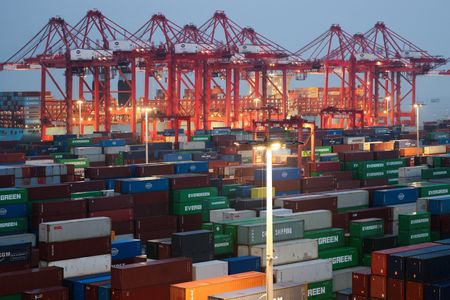
Chinese manufacturing exports experienced a dramatic acceleration in April as production facilities worked overtime to fulfill surging demand from artificial intelligence sectors and businesses stockpiling materials due to concerns that Middle East conflicts could drive global supply costs higher.
The robust export performance has expanded China’s trade surplus with the United States to $87.7 billion for the year, creating a key talking point for President Donald Trump’s upcoming Beijing visit next week for a leadership summit aimed at continuing last year’s trade ceasefire.
Although Chinese manufacturers have managed to navigate challenges from the Middle East crisis so far, economic experts caution that prolonged warfare and rising energy costs could eventually reduce international demand, leaving weak domestic spending unable to compensate for the shortfall.
Currently, economists are monitoring the speed of the artificial intelligence manufacturing surge and whether related equipment shipments can sustain China’s export momentum.
“The conflict in the Middle East pushed up demand for global manufacturing inventory replenishment, and under the upward cycle of semiconductors, imports and exports maintained a boom,” said Xing Zhaopeng, senior China strategist at ANZ.
“There is still room for expansion in this round of manufacturing cycle driven by AI, and it is expected that the annual export growth rate will be about 10%.”
Saturday’s customs data revealed exports jumped 14.1% compared to the previous year in dollar terms, significantly exceeding March’s 2.5% increase and surpassing economist predictions of 7.9% growth.
Separate manufacturing activity reports from last month indicated new export orders reached their peak level in two years during April.
Import activity also remained robust, increasing 25.3% compared to March’s 27.8% rise. Economic forecasters had anticipated 15.2% growth.
These figures pushed China’s monthly trade surplus to $84.8 billion in April, up from March’s $51.13 billion.
China’s broader economic performance showed strength in the opening quarter, with GDP expansion reaching 5% annually, matching the government’s yearly target ceiling and reducing pressure for immediate economic stimulus measures.
However, even China, frequently criticized by international partners for subsidy-supported low-cost production, faces challenges from reduced buyer spending power as fuel and shipping expenses climb.
Manufacturing data released last month indicated input costs stayed high, especially for processed goods and petroleum, coal, and chemical products.
Jobless rates also increased slightly while retail sales, measuring consumer spending, continued lagging behind industrial production.
Trump plans to meet with Chinese President Xi Jinping during his May 14-15 Beijing trip, as both nations work to stabilize relations strained by disputes over trade, Taiwan, and the Iran conflict.
Trump will likely seek trade concessions from Beijing before November’s U.S. midterm elections, though business leaders and analysts don’t anticipate major agreements.
When confronted with U.S. tariffs that temporarily reached triple-digit levels, Chinese exporters pursued alternative markets including South America by reducing prices. China concluded 2025 with a record $1.2 trillion trade surplus.
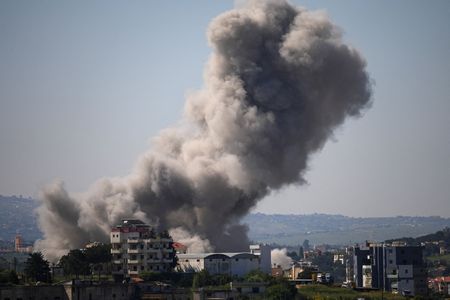
Diplomatic efforts to resolve the ongoing conflict between the United States and Iran showed little progress over the weekend as military confrontations intensified in the Persian Gulf, challenging a fragile ceasefire that began one month ago.
The latest escalation represents the most significant fighting near the Strait of Hormuz since the temporary truce took effect, with the United Arab Emirates facing fresh attacks on Friday.
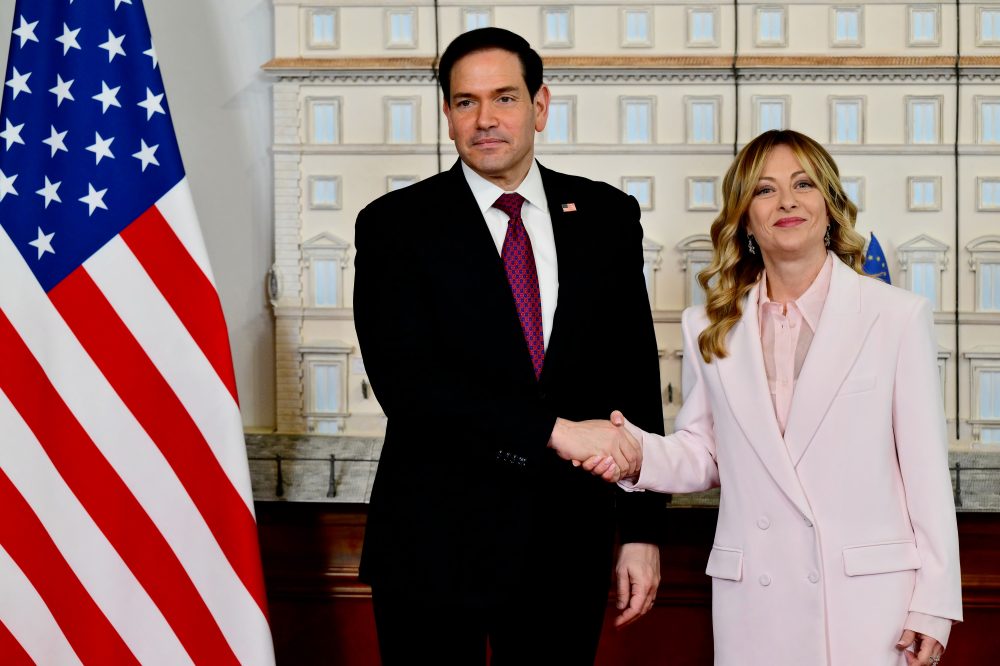
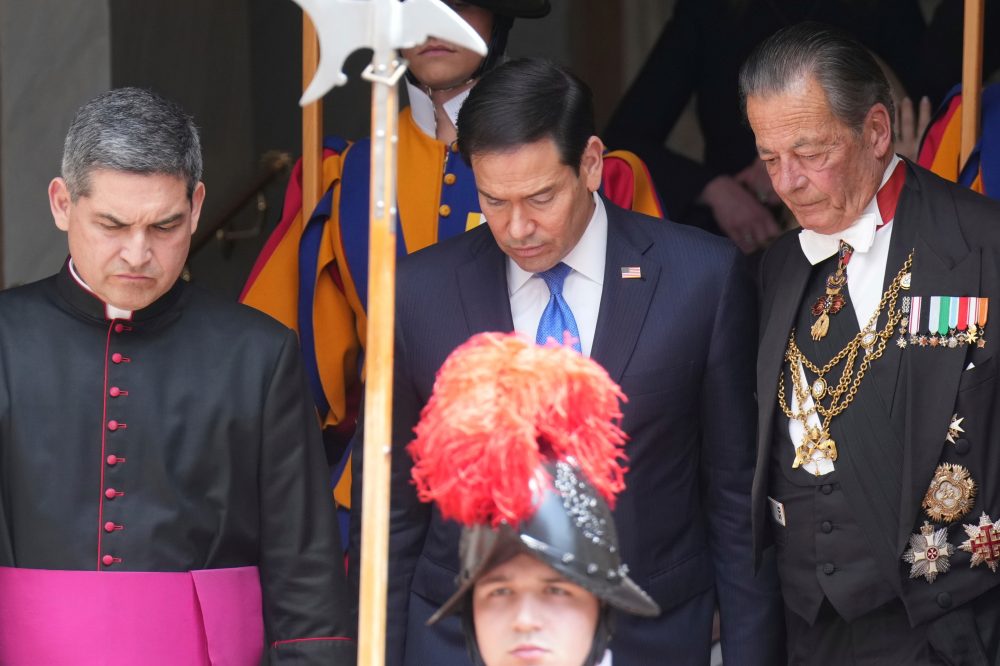
The Biden administration continues to wait for Tehran’s answer to an American proposal designed to formally conclude hostilities before addressing more complex matters, particularly Iran’s nuclear activities. During remarks in Rome on Friday, Secretary of State Marco Rubio indicated the United States anticipated receiving Iran’s decision that day, though Iranian foreign ministry officials stated they were still deliberating their response.
Military engagements persisted Friday between Iranian naval forces and American ships operating in the Strait of Hormuz, according to Iran’s semi-official Fars news outlet. The Tasnim news service subsequently quoted an Iranian military official confirming the situation had stabilized while cautioning that additional confrontations remained possible.
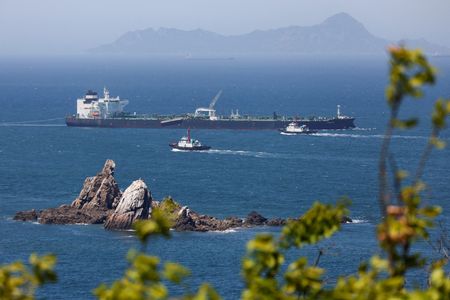
American military officials reported striking two vessels with Iranian connections as they attempted to reach an Iranian harbor, with a U.S. fighter aircraft targeting their smokestacks and compelling them to retreat.
Since hostilities commenced with U.S.-Israeli air operations across Iran on February 28, Tehran has effectively prevented non-Iranian maritime traffic from using the strait. Previously, twenty percent of global oil shipments traveled through this critical waterway.
Last month, the United States established a blockade targeting Iranian ships. However, a CIA evaluation suggested Iran could endure economic pressure from American port blockades for approximately four additional months, according to a U.S. official with knowledge of the assessment. This intelligence raises concerns about President Donald Trump’s negotiating position in a conflict that has drawn criticism from both voters and American allies.
A senior intelligence official dismissed as inaccurate the reports regarding the CIA analysis, which the Washington Post initially disclosed.
Combat operations spread beyond the waterway itself. UAE authorities reported their air defense systems intercepted two ballistic missiles and three unmanned aircraft from Iran on Friday, resulting in moderate injuries to three individuals.
Iran has consistently attacked the UAE and other Gulf nations that provide facilities for U.S. military operations. Following what the UAE described as a significant escalation, Iran intensified its assault campaign this week after Trump unveiled “Project Freedom” to provide naval escorts for ships in the strait, an initiative he suspended after two days.
On Thursday, Trump maintained the ceasefire declared April 7 remained intact despite recent flare-ups, while Iran accused the United States of violating the agreement.
“Every time a diplomatic solution is on the table, the U.S. opts for a reckless military adventure,” Foreign Minister Abbas Araqchi stated on Friday. Iran’s Mehr news service reported that one crew member died, ten suffered injuries, and six remained missing following a U.S. Navy assault on an Iranian merchant vessel late Thursday.
The United States has struggled to gain international backing for the conflict. Following discussions with Italian Prime Minister Giorgia Meloni, Rubio criticized Italy and other partners for failing to support Washington’s campaign to reopen the strait, cautioning about establishing a dangerous precedent by permitting Tehran to control an international shipping route.
While continuing diplomatic initiatives, the United States also increased economic sanctions to pressure Iran.
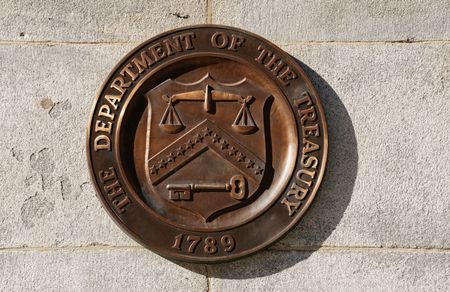
Prior to Trump’s upcoming visit to China for meetings with President Xi Jinping, the U.S. Treasury Department announced Friday new sanctions targeting ten individuals and entities, including several based in China and Hong Kong, for supporting Iran’s military acquisition of weapons and raw materials for manufacturing Tehran’s Shahed drones.
Treasury officials stated in their announcement they were prepared to take action against any foreign corporation supporting illegal Iranian trade and could implement secondary sanctions on foreign financial institutions, including those connected to China’s independent oil refineries.
VÖLKLINGEN, Germany — A historic German ironworks facility recognized by UNESCO has become the canvas for an extraordinary international art exhibition featuring creators from around the globe.
The Urban Art Biennale 2026 has launched at the Völklingen Ironworks, where 50 artists representing 17 nations are displaying their work throughout the massive industrial complex. This marks the continuation of an event that has occurred every two years for the past decade and a half.
“This location is at the core of street art and graffiti art,” explained Ralf Beil, who serves as general director of the facility that now operates as a public museum. “It all began in industrial places like this.”
According to Beil, the creators “love this place and they do works for the Völklinger Hütte, in the Völklinger Hütte, with the Völklinger Hütte.”
Among the featured works is an installation by France-based artist Tomas Lacque, who assembled a small vehicle, tire stack, playthings and rubble all coated in paint. Positioned within a hall that once housed active furnaces, the piece seems to suggest fossil-fuel transportation being buried in ash reminiscent of Pompeii.
Spanish creator Ampparito painted the phrase “no hay nada de valor” (meaning “There is nothing of value here”) in enormous white lettering across the roof of one building. The artwork is most visible from an observation deck positioned 45 meters (148 feet) high.
Dutch artist Boris Tellegen, who goes by Delta, created an enormous green-and-black wooden structure that illuminates the ironworks’ interior. Meanwhile, French collective Vortex-X, known for repurposing salvaged materials, suspended white industrial fabric strips across a building hall in their piece called “Memory in transit.”
The industrial site encompasses 6 hectares (nearly 15 acres) and forms a complex network of smokestacks and furnaces where visitors still see threatening warning signs from the industrial period, including alerts about “danger of crushing.” The facility towers over Völklingen, a town situated close to Germany’s French border.
UNESCO added the site to its world heritage registry in 1994, acknowledging it as “the only intact example, in the whole of western Europe and North America, of an integrated ironworks that was built and equipped in the 19th and 20th centuries.”
Production ceased in 1986, leaving the furnaces dormant, and the location has remained unchanged since that time. However, its visual character dates much earlier, as no new equipment was installed after the mid-1930s.
“It’s so dusty and it’s so old, but it’s beautiful, you know, there’s beauty in decay,” commented British artist Remi Rough. “I think what I’ve done makes you kind of just perceive it in a bit of a different way.”
Rough created small paintings designed to be “very clean and clinical,” providing contrast to the surrounding environment.
Danish creator Anders Reventlov expressed feeling “humble to be able to do something here.”
“As somebody told me … it was hell to work here,” Reventlov noted. “Now it’s not hell. It’s like a nice place, people walking around, there are bees, there are beautiful flowers, but yeah, we still remember the history and that’s super important.”
Beil emphasized that organizers “want pieces which are really original for this space and this also is then prohibiting (them) from being commercial.”
“This is an installation for the space,” he stated. “This is pure art.”
The exhibition begins Saturday and continues through November 15.
VENICE, Italy — Political turmoil has disrupted the world’s most prestigious contemporary art exhibition as the Venice Biennale opened Saturday without its coveted Golden Lion awards following the jury’s mass resignation over Israel and Russia’s involvement in the show.
The judging panel stepped down specifically to protest nations currently facing International Criminal Court investigations for human rights violations, though critics argue the United States should have faced similar scrutiny. British artist Anish Kapoor referenced “the politics of hate and war and all that that’s been going on now for too long.”
Instead of traditional jury selections, attendees at the Giardini and Arsenale locations will cast Eurovision-style votes to choose the top national pavilion among 100 entries and the best work from the main curated exhibition, “In Minor Keys.” Results will be revealed on the final day, November 22.
The centerpiece exhibition features a massive red-feathered sculpture adorned with beaded embroidery that welcomes guests. Drawing from New Orleans Black Masking traditions that trace back to enslaved African practices, this costume-inspired artwork establishes the show’s emphasis on marginalized voices.
Koyo Kouoh, who made history as the first African woman selected to oversee the main Biennale display, had gathered 110 artists and collectives before her passing last year. Five co-curators have continued her vision of highlighting overlooked perspectives.
“She was someone who thought about making spaces for everyone to shine and we see it in her exhibition, we see it with ourselves,” explained co-curator Marie Helene Pereira.
At the British Pavilion, Turner Prize recipient Lubaina Himid presents “Predicting History: Testing Translation,” examining the immigrant experience through vibrant paintings depicting couples navigating newcomer challenges.
One artwork shows two architects debating construction plans. “One of them is trying to decide, would we build a building here, that proves that we have contributed to the culture, and the other architect is saying ‘No, no, no, no, no. Let’s build something that we can escape in tomorrow,’” explained Himid, who was born in Zanzibar and has lived in Great Britain for over seven decades.
The Vatican offers a peaceful retreat from global conflicts through the Mystic Gardens of the Discalced Carmelite order, located near Venice’s central railway station.
Visitors stroll through vineyard paths, passing pomegranate trees and herb gardens while listening through headphones to compositions by 12th-century abbess, mystic and composer St. Hildegard of Bingen, reimagined by contemporary artists including Brian Eno and Patti Smith.
“Music also helps us delve into ourselves and understand, to use a phrase by Hildegard, the symphony that God has placed in our lives,” stated Rev. Ermanno Barucco, prior of the Carmelite order.
The Austrian Pavilion draws crowds with Florentina Holzinger’s provocative performance piece featuring a nude woman suspended as a human bell clapper. Inside, another naked performer circles on a Jet Ski within a tank, symbolizing Venice’s transformation into an overtouristed entertainment destination.
The installation “Seaworld Venice” includes a nude woman breathing through scuba gear in a large tank filled with treated wastewater from nearby restrooms that has undergone multiple filtration processes.
Romanian-born artist Belu-Simion Fainaru’s exhibit features water dripping from hanging tubes into a pool, pausing every 42 seconds to represent divine creative force in Jewish mystical tradition. Padlocks surrounding the pavilion, similar to those placed by couples on European bridges, bear Hebrew inscriptions of “Love thy neighbor as thyself” and the hopeful message “This too shall pass.”
“I am against boycott, I’m for dialogue, and that’s a political statement,” declared Fainaru, who condemned the jury’s exclusion of Israel as discriminatory.
Estonian artist Merike Estna will spend the entire Biennale creating a large-scale wall painting inside a community center gymnasium that previously served as a church. The building’s complex history reflects her technique of layering paint to create richly textured surfaces over time, representing women’s undervalued daily labor.
Curator Natalia Sielewicz compared the work to “the everyday feminism of sustaining life, of sustaining our planet.”
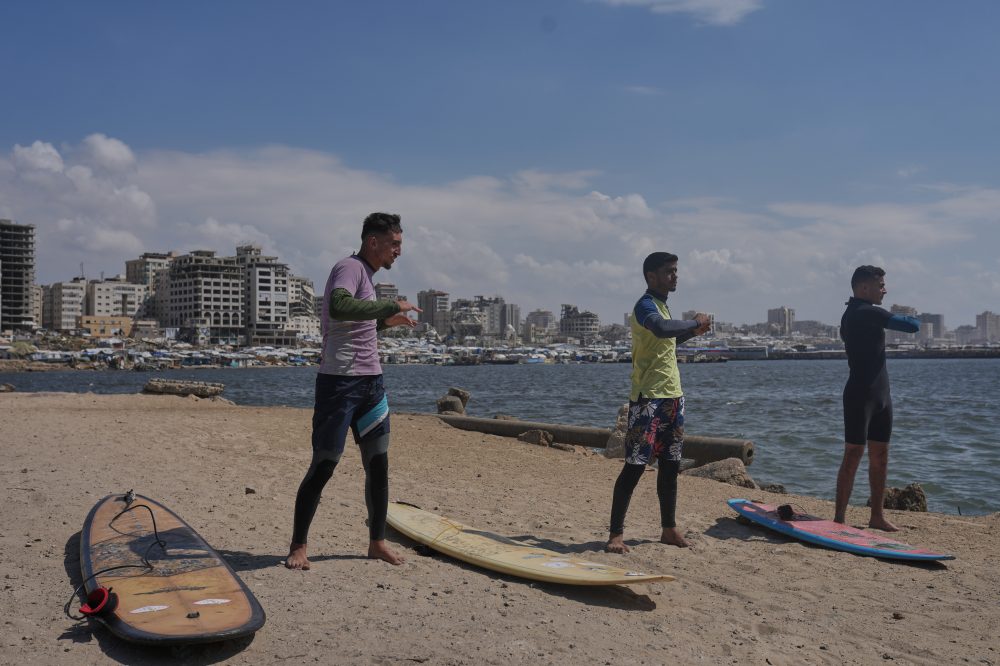
DEIR AL-BALAH, Gaza Strip — While Gaza remains gripped by a devastating humanitarian crisis and an unstable ceasefire, a small group of Palestinian surfers continues to seek solace and happiness in the Mediterranean waters along the territory’s coastline.
According to Tahseen Abu Assi, a Gaza City surfer, just three or four men continue to surf because of limited surfboards and lack of repair materials for damaged equipment.
Throughout the two-year conflict, Abu Assi transported his surfboard during each forced relocation because replacement would be impossible. “If something happened to it I won’t be able to get another one,” he explained, pointing out that surfboards haven’t been allowed into the Palestinian territory since 2007. Israel’s restrictions include surfboards among various sports equipment and other banned items.
This Tuesday, Abu Assi joined two other surfers in the waters near Gaza City’s port, including Khalil Abu Jiab, who celebrated while riding the large waves with his arms extended upward.
Following the conflict’s start, Israeli forces imposed severe limitations on maritime activities in Gaza, with UN reports documenting attacks on fishermen both on land and at sea, including those using small paddle craft.
In the previous year, Israel designated Gaza’s coastal waters as off-limits, prohibiting fishing, swimming, and ocean access, creating hazardous conditions for surfing.
Maritime activities remain forbidden and perilous in northern and southern Gaza waters. Even central Gaza’s waters, near Gaza City, pose risks due to Israeli naval patrols.
“There is fear of course, but we can’t leave this sport,” Abu Assi explained. “During the war, in the middle of the war, in the middle of the bombing and the planes above us, we used to go down and practice this sport.”
Since Gaza’s waves seldom reach suitable surfing heights, enthusiasts abandon all other activities when conditions improve, he noted.
Heavy combat throughout the region decreased following an unstable ceasefire that began October 10, though fatal Israeli attacks have persisted, with Hamas and Israel each blaming the other for truce violations.
The Israel-Hamas conflict started October 7, 2023, when militants launched an assault on southern Israel, resulting in approximately 1,200 deaths, primarily civilians, and capturing 251 hostages. Gaza’s Health Ministry reports that Israel’s military campaign has resulted in 72,628 Palestinian deaths and 172,520 injuries.
Gaza residents continue facing severe challenges obtaining food, clean water, healthcare, and housing following widespread destruction, collapsed medical infrastructure, and mass displacement of the population.
However, for the territory’s remaining surfers, the waves provide temporary relief from their circumstances.
“As soon as the sea gets high, you leave your work and leave your whole life,” Abu Assi said. “Work can be caught up on, as they say. We go practice this sport.”
MOSCOW — Russian President Vladimir Putin will address a heavily fortified Victory Day ceremony in Moscow’s Red Square on Saturday, commemorating the end of World War II amid unprecedented security measures and ongoing conflict with Ukraine.
For the first time in almost twenty years, the annual military display will exclude tanks, missiles, and other heavy weaponry, featuring only the traditional aircraft flyover. Putin, who has held power for over 25 years, typically uses Russia’s most significant national holiday to display military strength and build support for the ongoing Ukrainian conflict, now in its fifth year.
Russian officials attributed the modified parade format to the “current operational situation” and cited potential threats from Ukrainian forces. Kremlin representative Dmitry Peskov confirmed that authorities have implemented “additional security measures” for the event.
Both nations attempted ceasefires this week that ultimately failed. Russia announced a temporary halt to hostilities for Friday and Saturday, while Ukrainian leader Volodymyr Zelenskyy declared a truce beginning May 6, though both sides accused each other of continued attacks.
President Donald Trump announced Friday that both Russia and Ukraine agreed to his ceasefire proposal running Saturday through Monday, including a prisoner exchange, calling it potentially the “beginning of the end” of the conflict.
Zelenskyy, who earlier suggested Russian officials “fear drones may buzz over Red Square” on May 9, responded to Trump’s announcement by issuing a decree sarcastically allowing Russia to proceed with Victory Day celebrations while temporarily designating Red Square off-limits for Ukrainian attacks.
Peskov dismissed Zelenskyy’s decree as a “silly joke,” telling reporters, “We don’t need anyone’s permission to be proud of our Victory Day.”
While Russia’s larger military forces continue making gradual progress along the 1,000-kilometer front line, Ukraine has responded with increasingly effective long-range strikes targeting Russian energy infrastructure, manufacturing facilities, and military installations. Ukrainian forces have developed drone technology capable of reaching targets more than 1,000 kilometers inside Russian territory, far exceeding their pre-2022 capabilities.
Russian officials threatened a “massive missile strike on the center of Kyiv” if Ukraine attempts to interfere with Saturday’s celebrations. The Defense Ministry urged civilians and foreign diplomatic staff to “leave the city promptly,” though European Union representatives stated their diplomats would remain in the Ukrainian capital despite the warnings.
Putin has consistently utilized Victory Day ceremonies to promote national unity and emphasize Russia’s global influence. The Soviet Union suffered 27 million casualties during 1941-45 in what Russians call the Great Patriotic War, a massive loss that profoundly affected the national consciousness and remains one of the few unifying elements in the country’s complex Communist-era history.
Red Square Victory Day parades have featured extensive displays of military hardware — including armored vehicles and nuclear-capable intercontinental ballistic missiles — annually since 2008. Regional parades throughout the country have also been reduced or cancelled entirely due to security considerations.
As military units prepared for Saturday’s march, Moscow authorities restricted mobile internet and text messaging services throughout the capital, citing public safety requirements. The government has systematically increased internet restrictions and online monitoring, leading to growing public frustration and rare expressions of dissent.
International guests scheduled to attend the Moscow festivities include Malaysia’s King Sultan Ibrahim Iskandar, Laos President Thongloun Sisoulith, Kazakhstan’s President Kassym-Jomart Tokayev, Uzbekistan’s President Shavkat Mirziyoyev, and Belarus’ authoritarian leader Alexander Lukashenko. Slovakia’s Prime Minister Robert Fico, representing a European Union member nation, planned to meet with Putin and visit the Tomb of the Unknown Soldier memorial near the Kremlin but intended to skip the Red Square parade.
The family of imprisoned Hong Kong democracy advocate Jimmy Lai is pinning their hopes on President Donald Trump’s upcoming meeting with Chinese leader Xi Jinping, believing diplomatic negotiations could be their last chance to secure his freedom.
Lai, who previously believed Trump might prevent China from implementing its controversial national security legislation, instead found himself sentenced to two decades behind bars under that very law.
The 78-year-old former newspaper publisher established a pro-democracy publication that authorities shuttered amid the government’s response to Hong Kong’s widespread 2019 demonstrations against Chinese rule.
Political analysts view Lai’s imprisonment as emblematic of eroding civil liberties that Beijing had guaranteed when Britain transferred Hong Kong’s sovereignty in 1997. His son Sebastien Lai expressed urgent concerns about his elderly father’s deteriorating situation in an Associated Press interview.
While Trump’s discussions with Xi are expected to cover trade relations, Middle East conflicts, and Taiwan tensions, the president has indicated plans to address Lai’s case. Speaking to radio host Hugh Hewitt, Trump noted “there’s a little bitterness, I would say, with him and Jimmy Lai.”
The 31-year-old son believes his father’s situation could be resolved more easily than other complicated international disputes the two leaders will tackle.
“My father will die in prison if he’s not freed,” he stated, warning that such an outcome would devastate his family while creating a martyred figure. “It’s a lose-lose scenario for every single person.”
Trump has publicly expressed compassion for the elder Lai’s predicament. “I feel so badly,” the president told journalists in December following Lai’s conviction for conspiring with foreign entities and publishing seditious content. Trump had previously raised the activist’s case during his October meeting with Xi.
Mark Clifford, who leads the Committee for Freedom in Hong Kong Foundation advocating for Lai’s release, said sources briefed on the October discussions indicated Xi and his team “noted” Trump’s comments without strong opposition. This response suggests willingness to engage in dialogue, Clifford explained.
According to Clifford’s sources, Trump directed Treasury Secretary Scott Bessent to mention Lai’s release during June trade negotiations with China. Bessent reportedly raised Trump’s interest in freeing the activist during recent talks with Chinese officials, who acknowledged the request without significant pushback.
“It is positive that senior Chinese officials have stopped pushing back on the issue,” Clifford observed. The Treasury Department declined to comment on these claims.
However, Beijing maintains its hardline stance publicly. In March, Chinese foreign ministry representative Guo Jiakun labeled Lai as the orchestrator behind the 2019 civil unrest that disrupted Hong Kong.
When questioned Thursday about potentially releasing Lai, the foreign ministry avoided direct answers, stating that Hong Kong matters are domestic concerns where external interference isn’t permitted.
Hong Kong’s government previously dismissed connections between Lai’s case and press freedoms. Officials told the AP that Lai received conviction through transparent and equitable legal proceedings, emphasizing their commitment to law enforcement.
The White House hasn’t responded to inquiries about how aggressively Trump will advocate for Lai’s freedom.
More than 100 bipartisan congressional members sent a Thursday letter urging Trump to pursue Lai’s release during the Xi summit.
Despite escalating U.S.-China tensions, diplomatic efforts have achieved some prisoner releases. American pastor David Lin gained freedom in 2024 after nearly two decades in Chinese detention, while both nations exchanged several prisoners through diplomatic arrangements that year.
Activists note Beijing’s growing reluctance to release human rights challengers. Chinese Nobel winner Liu Xiaobo died in a northeastern Chinese hospital in 2017 despite international appeals for his medical release abroad.
Human rights attorney Jared Genser, Liu’s former representative, said a White House official confirmed Trump had contacted Xi requesting Liu’s medical release.
Under Xi’s predecessor Hu Jintao, China prioritized economic cooperation and international image concerns, explained Genser, who secured another activist’s freedom in 2007. Xi’s administration emphasizes national sovereignty and rejecting foreign intervention.
“China knows that by taking a very tough and unrelenting position that most countries in the world are not going to be willing to do more than privately raise a case,” Genser said. “That self-censorship to me is the biggest factor… in our inability to secure the release of political prisoners under Xi Jinping, as compared to Hu Jintao.”
John Kamm, who founded the prisoner advocacy organization Dui Hua Foundation, said China previously offered concessions when seeking specific goals, like Olympic hosting rights.
However, he attributed reduced success in freeing detained activists partly to American inattention. “I don’t know of anyone in this administration who cares about political prisoners in China,” Kamm stated, suggesting Secretary of State Marco Rubio might be an exception, though focused elsewhere.
Kamm noted Trump’s emphasis on trade, investment, and Middle East conflicts, but suggested China might release Lai in exchange for American concessions on Beijing’s priorities.
Thomas Kellogg from Georgetown Center for Asian Law believes both governments have motivations for reaching an agreement.
Freeing Lai would allow China to demonstrate readiness to progress beyond the nearly six-year period since implementing Hong Kong’s security legislation, while Trump’s team could claim a diplomatic victory after “a difficult couple of months,” Kellogg explained.
Such an achievement would generate praise even from administration critics, he added. “If the Trump administration is pushing very hard for Jimmy Lai’s release, then we could get a positive outcome.”
Wilson Chan, co-founder of the Pagoda Institute think tank, doubts diplomatic resolution prospects, believing Beijing wants to send a message through Lai’s case.
Chan suggested that continued international attention might make Beijing view Lai as an influential figure still representing security threats, while silence would eliminate pressure for action.
Lai, who holds British citizenship, chose not to appeal his conviction and sentence. The government, which considers him Chinese, seeks to seize his assets citing national security justifications.
Sebastien Lai described this action as another instance of his father “still being attacked.”
The elder Lai experiences health problems including irregular heartbeat and diabetes, according to his Hong Kong legal representatives in January. Prosecutors cited medical reports indicating his overall health remains stable. Officials claim his solitary confinement resulted from his own request.
The London-based son has maintained correspondence with his father throughout more than five years of detention. He believes his father would prefer quiet retirement if granted early release.
“The Chinese government would be complicit in killing him,” he warned.
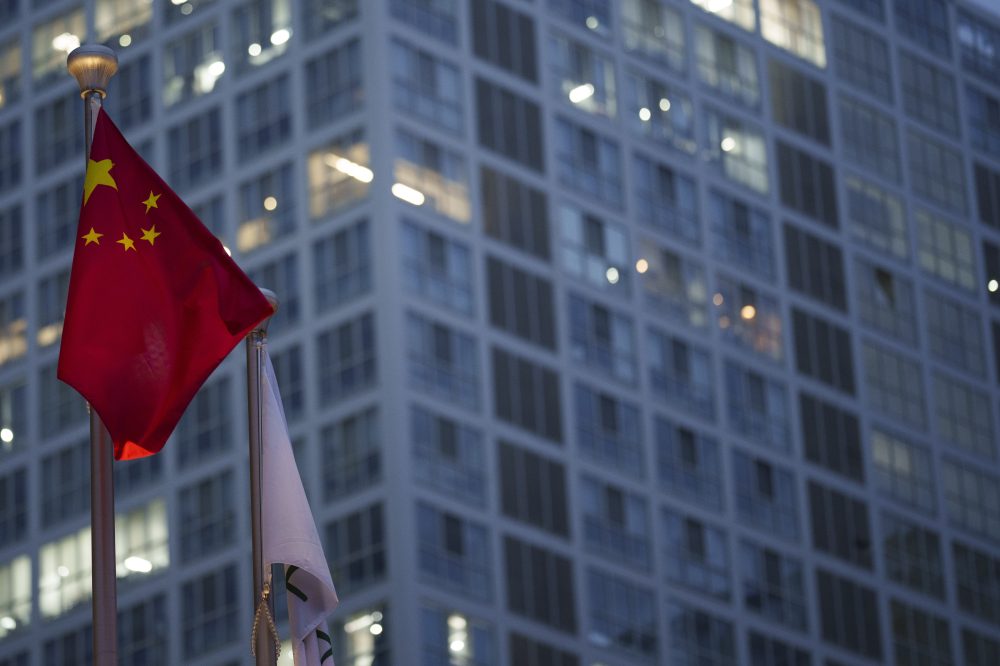
Chinese officials announced Saturday that the nation’s overseas sales jumped 14.1% in April compared to the same month last year, surpassing expectations despite ongoing conflicts in Iran and continuing effects from elevated U.S. trade tariffs.
The trade figures were published just days before a scheduled summit next week in Beijing between President Donald Trump and Chinese President Xi Jinping.
The April performance significantly exceeded economic forecasts and marked a substantial improvement over March’s modest 2.5% annual increase.
Meanwhile, Chinese purchases from other countries grew 25.3%, which represented a slight slowdown from March’s 27.8% rise but remained strong overall.
The upcoming Trump-Xi meeting occurs as the two nations face numerous challenges in their relationship, with diplomatic efforts to resolve the Iranian conflict taking precedence over traditional trade disputes.
“We’re expecting that overall external demand will remain a solid driver of growth this year,” said Lynn Song, chief economist for Greater China at Dutch bank ING, likely led by China’s exports of semiconductors and autos.
Earlier this year, Chinese officials established an economic growth goal of 4.5% to 5% annually, marking a decrease from the previous year’s 5% target and representing the most modest objective since 1991. International sales are anticipated to continue supporting the broader economy, particularly as shipments to European, Southeast Asian, Latin American and African markets have increased in recent months.
Beyond discussions about ending the Iranian conflict, the Trump-Xi talks will likely address trade policies and export restrictions, including rare earth materials and American technology limitations affecting China. These conversations follow a year-long trade agreement between the nations that was established when the leaders previously met in South Korea.
While major policy changes regarding export controls seem unlikely, the forthcoming meeting may produce gradual improvements to address trade tensions, according to HSBC economists in a recent analysis.
“On balance, China looks to have more leverage,” wrote Leah Fahy, senior China economist of Capital Economics, in a note. “But higher tariffs haven’t stopped China’s exports from continuing to surge over the past year, and Beijing has showed that it is prepared to wait out U.S. pressure.”
For Chinese manufacturers, rising oil and fuel costs due to the Iranian conflict are increasing production and transportation expenses across the country’s industrial facilities, according to Wei Li, head of multi-asset investments at BNP Paribas Securities (China). Additionally, global inflation pressures could reduce consumer spending power in China’s international markets.
Despite these challenges, China’s economy has demonstrated greater stability than many other nations, benefiting from substantial oil reserves and a more varied energy portfolio.
NAIROBI, Kenya — Ethiopia is spearheading a dramatic shift toward electric vehicles across Africa as mounting fuel costs and supply disruptions drive nations to embrace cleaner, more affordable transportation options.
Data from China’s Commerce Ministry reveals Africa purchased 44,358 electric vehicles from China in 2025, representing a significant jump from 19,386 units the previous year. These shipments, worth more than $200 million, demonstrate surging demand particularly in Ethiopia following its 2024 prohibition on new gasoline and diesel vehicle imports.
Ethiopia now operates more than 115,000 electric vehicles on its roadways, representing approximately 8% of its total vehicle fleet. During 2025, the country acquired one-third of all African EV imports from China, outpacing major markets including South Africa, Egypt, Morocco and Nigeria.
With the ongoing Iran conflict creating fuel supply disruptions throughout transportation networks and everyday life, Ethiopia’s push to reduce expensive oil and gas imports while bolstering energy independence has intensified. Yet this transition raises concerns about charging network development and vehicle costs.
Ethiopia allocates roughly $4.2 billion annually for fuel imports, putting pressure on its foreign currency reserves.
Trade and Regional Integration Minister Kassahun Gofe stated the nation also spends up to $128 million monthly on fuel subsidies, while deliveries have fallen short by over 180,000 metric tons due to Iran’s effective blockade of the Strait of Hormuz, a shipping channel handling approximately one-fifth of Gulf region oil exports before the conflict began.
Officials have intensified their push for accelerated EV adoption, positioning it as essential protection against external supply disruptions.
“From a general perspective, it is sustainable,” commented Hiten Parmar, executive director of The Electric Mission, based in South Africa. “By replacing imported fuel with domestically generated electricity, Ethiopia is strengthening its energy security position.”
Ethiopia benefits from having over 90% of its electricity sourced from renewable energy, primarily hydroelectric and solar power. The Grand Ethiopian Renaissance Dam, Africa’s most significant hydroelectric development, is projected to double the country’s power production, although the project has sparked a decade-long water rights disagreement with downstream nations Egypt and Sudan.
“That scale of generation creates a foundation for electrified transport,” Parmar noted. “It allows EVs to be powered by locally produced clean energy, rather than costly imports.”
“By gradually adopting EVs, that intensive fuel import expenditure can be reduced and redirected into other critical development needs,” Parmar explained.
According to the International Energy Agency, electric vehicles worldwide eliminated more than 1 million barrels of daily oil consumption in 2024.
Egypt, South Africa and Morocco are also pursuing electric vehicle transitions through policy incentives, manufacturing investments and clean energy development.
“That transition is beginning to ease pressure on fuel demand,” explained Bob Wesonga, policy and investments lead at the Africa E-Mobility Alliance.
“That’s over 100,000 vehicle owners who are no longer directly exposed to pump price shocks,” he noted. “In the medium to long term, this creates a buffer against global oil volatility.”
Those who have made the switch report substantial cost reductions.
“A private EV owner now spends roughly $4 a month on charging compared to about $27 previously spent on fuel,” Wesonga said. “For public transport operators, the difference is even more striking.”
The electric vehicle transition confronts significant infrastructure obstacles, Parmar acknowledges.
“The technology is already mature, the challenge is building it out fast enough,” he stated.
Ethiopia is installing ultra-fast charging stations in its capital Addis Ababa, but expanding them countrywide requires substantial time and financial commitment.
“The biggest hurdle is the last-mile power distribution,” Wesonga explained. “While Ethiopia has a surplus of generation, getting that power reliably to where it’s needed, especially outside Addis Ababa, remains a challenge.”
Power outages and delays in connecting high-capacity charging facilities have hindered infrastructure development despite growing electric vehicle demand.
“Charging infrastructure is still heavily concentrated in the capital and along a few corridors,” Wesonga observed. “That limits e-mobility to specific areas and creates a bottleneck as adoption grows.”
Ethiopia joins several African nations working to establish domestic EV manufacturing. Government records indicate 17 electric vehicle assembly facilities are planned in Ethiopia, with goals to expand that figure to 60 by 2030 as part of a broader localization and cost-reduction strategy.
Vehicle affordability continues as a significant obstacle. While operational expenses are reduced, electric vehicle prices remain elevated compared to typical household incomes.
“The purchase price is still out of reach for many,” Wesonga said. “At the same time, restrictions on fossil fuel vehicles have pushed up the cost of used cars, creating additional barriers.”
This situation could produce unexpected social consequences without careful management.
“A national fleet transition is always gradual,” Parmar said. “Existing combustion vehicles will remain in use for some time, and the transition needs to account for livelihoods tied to that system.”
Despite challenges, both specialists believe the long-term direction is evident. Reduced operating and maintenance expenses for electric vehicles could lower transportation costs over time, decreasing goods prices and improving economic opportunity access.
Ethiopia is also studying approaches from nations like China and Norway, where government support, infrastructure investment and consumer incentives have accelerated adoption.
“This is not just about transport,” Wesonga concluded. “It’s about reshaping how the country uses energy, and who benefits from that shift.”
Rescue operations have restarted in Indonesia as authorities continue searching for three hikers who disappeared when Mount Dukono volcano erupted on Halmahera island, according to local officials.
The volcanic explosion occurred Friday morning at 7:41 a.m. local time in North Maluku province, launching ash clouds reaching heights of 6.2 miles above the mountain, Indonesia’s volcanology agency reported.
Search teams had to suspend operations Friday night due to ongoing volcanic activity but returned to the field Saturday morning.
More than 100 rescue workers, along with military and police units plus two thermal drones, have been mobilized to locate the missing individuals, according to Iwan Ramdani, who leads the local rescue organization.
The missing hikers include two people from Singapore and one Indonesian citizen, Ramdani confirmed.
“We are focusing the search around the crater, covering an area around 700 metres,” Iwan stated.
Emergency teams successfully evacuated 17 people on Friday, including seven Singaporeans and 10 Indonesians.
Local police chief Erlichson Pasaribu reported that survivors indicated three individuals, two of them Singaporean, perished in the eruption, though rescue officials have not yet verified these fatalities as of Saturday.
Continued volcanic eruptions are creating obstacles for Saturday’s search mission, Iwan noted.
Lana Saria, who heads the volcanology agency, confirmed in an official statement that at least four additional eruptions were documented Saturday morning.
Mount Dukono remains at the third-highest alert level, Saria explained.
Officials are warning residents and visitors to avoid all activities within a 2.5-mile radius of the volcanic crater, she advised.
No airline flight cancellations have been reported due to the eruption.
Indonesia is located within the Pacific “Ring of Fire,” a region known for intense seismic activity where multiple tectonic plates meet.
Four Israeli military personnel sustained injuries on Friday during multiple drone strikes carried out by Hezbollah, according to Israeli Defense Forces reports. One soldier received serious injuries while three others suffered moderate wounds in the separate incidents.
The most recent attack occurred when an unmanned aircraft penetrated Israeli airspace after crossing the border from Lebanon, injuring three soldiers. Military officials transported the wounded for medical care and contacted their families. An IDF spokesperson characterized the incident as “another violation of the ceasefire understandings by the terrorist organization.”
In an earlier Friday assault, Hezbollah detonated multiple explosive drones near Israeli troops conducting operations in southern Lebanon. One soldier received moderate injuries in that strike and was taken to a medical facility for treatment, with his family receiving notification.
Authorities also dealt with a separate security concern when law enforcement discovered an unmanned aircraft on a school rooftop in Nahariya. Police officers and explosive ordnance disposal specialists responded to the location, cleared the educational facility of occupants, and worked to safely disable and remove the device. Officials reported no casualties from this incident.
Israeli military leadership announced Thursday the cancellation of multiple public gatherings in northern Israel after intelligence assessments suggested Hezbollah might launch rocket attacks in retaliation for the death of Ahmed Ghaleb Balout, a Radwan Force commander killed in Beirut one day earlier.
Following a military confrontation between American and Iranian forces in the Strait of Hormuz on Thursday, President Trump minimized the significance of the clash while expressing confidence that a diplomatic agreement with Tehran could materialize soon.
Speaking to the press during a visit to construction work at Washington, DC’s Reflecting Pool, Trump described the incident in casual terms. “Yeah, it is. They trifled with us today. We blew them away,” the president stated, calling the engagement both a “trifle” and a “love tap.”
Despite the military escalation, Trump maintained optimism about diplomatic prospects with Iran.
“A deal with Iran might not happen, but it could happen any day. I believe they want the deal more than I do,” he told reporters.
The confrontation involved three American naval vessels – the USS Truxtun, USS Rafael Peralta, and USS Mason – which came under assault from Iranian unmanned aircraft, missiles, and speedboats during their passage through the strategic waterway, according to military officials.
US Central Command subsequently acknowledged conducting what they termed “self-defense strikes” targeting Iranian military installations, including facilities used to launch drones and missiles. American officials reported that Iranian vessels participating in the attack were eliminated.
Tehran’s official media outlets claimed Iranian military units engaged what they called “enemy units,” stating the action was a response to an American attack on an Iranian petroleum vessel.
Witnesses reported hearing explosions in the vicinity of Iran’s Qeshm Island and the port city of Bandar Abbas after the military exchange.
The United Arab Emirates activated its defensive systems to counter incoming Iranian projectiles and drones during the incident.
“UAE air defenses are currently engaging missile and drone attacks originating from Iran,” the UAE defense ministry announced on X, noting that sounds from intercepting weapons were audible “across various parts of the country.”
A Fox News correspondent reported that the American strikes on an Iranian coastal city and an island within the Strait of Hormuz came after the UAE and Saudi Arabia expressed frustration over previous Iranian attacks on the UAE that American officials had treated as minor incidents.
The military action occurred while diplomatic discussions about a potential ceasefire continue. The United Nations has documented that approximately 1,500 vessels remain stranded in the Gulf due to Iran’s ongoing closure of the strait, while petroleum markets experienced significant price increases following the renewed conflict.
The Islamic State has officially taken credit for a deadly car bombing that killed a high-ranking Shiite religious leader in Syria’s capital, marking a significant security breach in Damascus.
Sheikh Farhan Hassan al-Mansour, who served as the preacher and imam at the Sayyidah Zaynab shrine, died instantly when an explosive device detonated beneath his vehicle on May 1, 2026. The blast occurred near the Safir Al-Zahra Hotel in Damascus’s southern suburbs.
According to a Syrian security official who examined the bombing site, the explosive was placed under al-Mansour’s car and triggered from a distance. The attack also wounded multiple assistants traveling with the cleric and injured bystanders in the vicinity.
ISIS announced its role in the killing through official communication channels and its weekly publication, Al-Naba. The terrorist organization labeled al-Mansour as one of the “imams of the Rafida” – a slur extremists use against Shiites – and characterized the murder as an act of “revenge” in their ongoing campaign against religious leaders tied to Syria’s previous government and its supporters.
The target and location hold deep strategic meaning. The Sayyidah Zaynab shrine stands as one of Shiism’s holiest sites and previously symbolized Iranian and Hezbollah power in Syria before their influence waned after the Assad government’s collapse in December 2024.
The successful elimination of the shrine’s top religious figure at the center of his own territory demonstrates that ISIS dormant cells retain the capability to surveil, plan and execute operations within Damascus’s core areas.
Syrian officials responded by implementing increased security protocols throughout Damascus and surrounding regions. Multiple Syrian organizations, including the Supreme Islamic Shiite Council, paid tribute to al-Mansour, calling him a “martyr of the pulpit” recognized for his moderate stance and unity advocacy.
Damascus media outlets subsequently reported that authorities broke up a three-person cell operating in the Sayyidah Zaynab vicinity, believed to have provided logistics and support for the operation.
The strike occurs during a crucial transition period for Syria, as ISIS appears to be taking advantage of security gaps created by military repositioning and security forces focused on wider political issues.
Security experts note the organization has moved away from its previous territorial control approach – which effectively ended in 2019 – toward a strategy of “qualitative attrition” using targeted killings and surprise attacks designed to erode public trust and highlight government failures to safeguard important figures.
Al-Mansour’s murder creates fresh challenges for Syrian security forces. Though ISIS remnants primarily hide in Syrian desert areas, the group has again proven its operational capabilities can penetrate crucial urban areas, sparking concerns about current anti-terrorism approaches and the possibility that sleeper cells could alter the security environment.
A new study reveals Vietnam has significantly increased its artificial island construction activities in the contested Spratly Islands, creating 534 acres of new land over the past twelve months, according to research published by a Washington-based policy institute.
The Asia Maritime Transparency Initiative at the Center for Strategic and International Studies released findings Friday showing Vietnam’s continued development in the disputed South China Sea region. The recent construction brings Vietnam’s total artificial land creation in the Spratly archipelago to approximately 2,771 acres.
According to the research, Vietnam completed major landfill work at Barque Canada Reef during spring 2025, establishing what has become the country’s most extensive installation in the island chain. Following that project’s completion, Vietnamese forces initiated smaller development projects at multiple additional locations throughout the latter half of 2025.
The study documents significant infrastructure improvements, noting Vietnam has constructed three additional harbor facilities at Grierson Reef, Petley Reef, and South Reef. These additions increase Vietnam’s total harbor count in the archipelago to 15 facilities, with 11 of those built since 2021. Researchers also identified early construction phases of what appears to be another harbor project at Landsdowne Reef.
Environmental consequences have accompanied the expansion activities. The think tank calculated Vietnam’s reef destruction, encompassing areas buried under landfill and zones dredged for navigation channels and port facilities, now totals roughly 4,120 acres.
While Vietnam’s construction pace initially appeared to match China’s development rate in early 2025, recent Chinese activities at Antelope Reef have restored China’s lead in the region. Current estimates show China maintains approximately 5,460 acres of artificial land and has caused 6,224 acres of reef damage.
Vietnam’s embassy in Washington has not provided responses to requests for commentary on the construction activities. China previously expressed opposition to Vietnam’s development at Barque Canada Reef, asserting territorial claims over the area. Beijing maintains sovereignty claims over nearly the entire South China Sea, despite competing territorial assertions from Brunei, Malaysia, the Philippines, and Vietnam.
North Korean leader Kim Jong Un reinforced his nation’s alliance with Russia in a congratulatory message sent to President Vladimir Putin on Saturday, marking the anniversary of Nazi Germany’s defeat in World War Two.
In his communication, Kim emphasized North Korea’s stance to “give top priority” to its relationship with Russia and pledged continued adherence to “the implementation of the obligations of the inter-state treaty,” state media KCNA reported.
The two nations established a “Comprehensive Strategic Partnership Treaty” in 2024 when Putin traveled to Pyongyang, with the agreement containing provisions for mutual defense cooperation.
North Korea has deployed approximately 14,000 soldiers to assist Russian military operations in the Kursk region amid the ongoing conflict in Ukraine. Intelligence sources from South Korea, Ukraine, and Western nations report significant losses among these forces, with casualties exceeding 6,000 North Korean troops.
Russia conducted its most limited Victory Day military parade in recent years on Saturday, scaled down due to security concerns over potential Ukrainian attacks. Moscow’s campaign has faced challenges more than four years into what has become Europe’s most devastating conflict since World War Two.
Both Russia and Ukraine confirmed Friday their acceptance of a three-day ceasefire brokered by U.S. President Donald Trump, scheduled to last from May 9 through May 11.
HAVANA — Secretary of State Marco Rubio stood behind the Trump administration’s latest sanctions against Cuba on Friday, with the most significant penalties targeting GAESA (Grupo de Administración Empresarial S.A.), a massive business empire controlled by Cuba’s military forces.
The penalties announced Thursday also hit Moa Nickel, a Cuban-Canadian partnership involving Sherritt International of Canada. The Canadian company responded immediately by announcing its complete withdrawal from Cuba, bringing to a close more than three decades of operations on the island.
According to Lee Schlenker, who researches at the Quincy Institute’s Global South program, the May 1 executive order and May 7 designations dramatically broaden Washington’s ability to impose penalties on foreign individuals and companies.
“Not only are they subject to having their assets frozen but their U.S. accounts as well as their travel to the U.S., that of their shareholders, investors or employees,” Schlenker explained. “This is bound to have an extremely significant impact of the presence of foreign companies” in Cuba.
Cuba specialist Pavel Vidal from Pontificia Universidad Javeriana described the new restrictions as “very concerning” for an economy that’s already “practically paralyzed.” Since January, Washington has prevented fuel deliveries to Cuba, worsening the nation’s prolonged economic troubles. Vidal predicted the sanctions would discourage GAESA’s existing business partners, noting that “very few will risk defying them.”
Vidal characterized the fresh measures as creating “total isolation,” powered by the fear they create among global financial institutions, insurance companies and multinational corporations.
Having examined GAESA’s internal records, Vidal emphasized that the organization’s extensive involvement across virtually all Cuban economic sectors makes any business relationship with the island potentially problematic under Washington’s new regulations.
Based on Vidal’s analysis of available data, GAESA controls approximately 40% of Cuba’s total economic output. By early 2024, the conglomerate possessed $14.5 billion in available cash, generating yearly income three times larger than Cuba’s entire government budget.
Created during the 1990s under military leadership, GAESA represented the Cuban Armed Forces’ calculated answer to the economic devastation following the Soviet collapse and intensified U.S. economic pressure during that period.
Though government-owned, GAESA operates without financial scrutiny from the Office of the Comptroller General. Former director Gladys Bejerano acknowledged this absence of oversight in a 2024 discussion before stepping down shortly afterward.
Luis Alberto Rodríguez López-Calleja ran GAESA for many years until his passing in July 2022. Married to former President Raúl Castro’s daughter, he represented a cornerstone of the ruling family — a position now carried forward by his son, Raúl Guillermo Rodríguez Castro. Though officially working as his grandfather’s personal security chief, the younger Castro has recently become a key go-between in delicate negotiations with Washington.
This week’s sanctions also placed Ania Guillermina Lastres on the U.S. penalty list. Taking over from López-Calleja, she now leads GAESA as executive president, directing the organization’s extensive global financial operations.
From available information, GAESA controls numerous retail businesses selling products ranging from groceries and clothing to household goods, plus an extensive service network including vehicle rentals and tourism agencies. The conglomerate also runs Cuba’s banking sector, currency exchange operations, and manages the nation’s primary hotel properties.
Speaking to reporters Friday, Rubio emphasized the sanctions targeted the regime rather than ordinary Cubans, describing GAESA as an organization that “is taking anything that makes money in Cuba and illegally putting it into the pockets of a few regime insiders.”
Cuban officials argue the sanctions represent “collective punishment” intended to devastate the island’s economy, claiming the Trump administration’s approach prioritizes political gains over Cuban citizens’ well-being.
These latest penalties against Havana arrive amid an ongoing U.S. energy embargo that has triggered widespread electrical and water service disruptions plus acute fuel and water shortages.
WASHINGTON – Federal officials announced Friday they have imposed financial penalties on 10 people and businesses accused of helping Iran’s armed forces acquire weapons and materials needed to manufacture Shahed drones.
The Treasury Department’s action targets several entities located in China and Hong Kong that allegedly assisted Tehran’s military procurement efforts. The sanctions were revealed just days ahead of President Donald Trump’s planned trip to China for discussions with President Xi Jinping, while diplomatic initiatives to resolve the Iranian conflict remain at an impasse.
Treasury officials stated their commitment to continued economic measures against Iran’s defense manufacturing infrastructure to prevent Tehran from rebuilding its production capabilities and extending its influence beyond Iranian borders.
The department also warned it stands ready to take action against any international companies supporting illegal Iranian trade operations, including aviation firms, and may apply secondary sanctions to foreign banks that facilitate Iran’s activities, particularly those linked to China’s smaller independent oil refineries.
“Under President Trump’s decisive leadership, we will continue to act to Keep America Safe and target foreign individuals and companies providing Iran’s military with weapons for use against U.S. forces,” Treasury Secretary Scott Bessent stated.
MOSCOW – Russia conducted its most diminished Victory Day celebration in years on Saturday, citing security concerns from potential Ukrainian attacks as Moscow’s military campaign continues to face challenges more than four years into Europe’s bloodiest conflict since World War Two.
The annual May 9th ceremony in Red Square represents Russia’s most honored national observance – an occasion to commemorate the Soviet Union’s triumph over Nazi Germany and honor the 27 million Soviet citizens, many of whom were Ukrainian, who died in the war.
Traditionally used as a showcase for Russia’s military might, including nuclear-capable long-range missiles, this year’s ceremony excluded tanks and other military hardware from rolling across Red Square’s historic cobblestones.
Military personnel still marched and celebrated near Vladimir Lenin’s Mausoleum, fighter aircraft soared over the Kremlin’s towers, and President Vladimir Putin delivered remarks before placing flowers at the Unknown Soldier’s memorial.
“In general, everything is as usual, except for the demonstration of military equipment,” Kremlin aide Yuri Ushakov told reporters.
Russia, which launched its invasion of Ukraine in 2022, has threatened that any Ukrainian attempt to interfere with the ceremony would trigger extensive missile attacks on Kyiv. Moscow advised foreign diplomatic missions to evacuate personnel from the Ukrainian capital should such strikes occur.
Ukrainian President Volodymyr Zelenskiy indicated his nation’s May 9th activities would depend on Friday’s developments, while accusing Moscow of breaking its own ceasefire agreement.
Multiple layers of air defense systems and electronic countermeasures protect Moscow, designed to intercept and destroy incoming drones and missiles targeting the capital and its surrounding region of 22 million residents.
THE UKRAINE CONFLICT OVERSHADOWS RUSSIAN CELEBRATION
Following Nazi Germany’s 1941 invasion of the Soviet Union, the Red Army ultimately drove German forces back to Berlin, where Adolf Hitler took his own life and the Soviet Victory Banner was hoisted over the Reichstag in May 1945.
Nazi Germany’s complete surrender took effect at 11:01 p.m. on May 8, 1945, recognized as “Victory in Europe Day” by Britain, the United States and France. Since it was already May 9th in Moscow, that date became the Soviet Union’s “Victory Day” in what Russians term the Great Patriotic War of 1941-45.
However, this year’s parade occurs during heightened anxiety in Moscow regarding the Ukrainian conflict’s eventual resolution.
The war has claimed hundreds of thousands of lives, devastated large portions of Ukraine and strained Russia’s $3 trillion economy, while European relations have deteriorated to their worst point since the Cold War’s peak.
“The crisis is still deepening gradually, but any sharp movement can send the economy (and not only the economy) into a tailspin,” imprisoned pro-war Russian nationalist Igor Girkin, who has criticized the Kremlin’s war management, wrote on Telegram.
Girkin, a former Federal Security Service official, used maritime imagery to suggest that Russia’s leadership was more concerned about losing their positions than preventing national disaster.
Kremlin spokesperson Dmitry Peskov rejected CNN and other Western media claims that Putin’s security had been enhanced due to coup or assassination concerns. Russian officials have called reports of coup plotting absurd.
However, just 21 years earlier, Putin hosted President George W. Bush at the Moscow parade alongside France’s Jacques Chirac and Chinese President Hu Jintao.
This year’s attendees included Belarusian President Alexander Lukashenko, Malaysia’s King Sultan Ibrahim and Laos’ Prime Minister Thongloun Sisoulith.
The United States has modified its United Nations resolution calling on Iran to cease attacks and mining operations in the Strait of Hormuz, though diplomatic sources indicate China and Russia remain poised to block the measure, according to Friday reports.
The timing presents diplomatic challenges as President Donald Trump prepares for his China visit next week, where the Iran conflict is anticipated to dominate discussions.
The revised draft, distributed to Security Council members Thursday afternoon, eliminated language referencing Chapter VII of the U.N. Charter, which would have enabled the council to authorize actions from economic sanctions to military intervention.
Despite this change, strong language condemning Iran persists, along with provisions stating that if Iran fails to comply, the council would “meet again to consider effective measures … including sanctions measures, in order to ensure the freedom of navigation in the area.”
No timeline has been established for when the Security Council might hold a vote on this resolution.
Although the current text stops short of explicitly authorizing military force, it doesn’t prohibit such action and “reaffirms the right of member States … to defend their vessels from attacks and threats, including those that undermine navigational rights and freedoms.”
Last month, Russia and China blocked a similar U.S.-supported resolution within the 15-member Security Council that appeared to create pathways for legitimizing American military response against Iran.
According to diplomatic sources, the initial version of this resolution, co-authored by the United States and Bahrain and circulated earlier this week, faced significant opposition from Chinese and Russian representatives.
One U.N. diplomat indicated that removing the Chapter VII language, which was also done with last month’s failed resolution, has not addressed the fundamental concerns raised by China and Russia.
China’s U.N. representatives declined to comment on the updated draft, while Russian officials did not provide immediate responses.
Thursday’s statement from Russia’s mission emphasized that Security Council members should avoid “pushing through one-sided and confrontational draft resolutions” that might “trigger a new wave of escalation in the Middle East.”
“It is precisely for this reason that on April 7, Russia, along with China, blocked the adoption of a draft resolution on the situation in the Strait of Hormuz,” the statement explained.
Earlier this week, U.S. Secretary of State Marco Rubio characterized the proposed resolution as a measure of the United Nations’ effectiveness and appealed to China and Russia to refrain from vetoing the proposal.
American military forces struck and incapacitated two Iranian oil vessels Friday following combat exchanges in the strategically vital Strait of Hormuz, according to reports from Dubai in the United Arab Emirates.
The confrontation puts additional strain on a fragile ceasefire agreement established one month ago, which Washington maintains remains active. American officials are currently waiting for Tehran’s response to the most recent diplomatic proposal aimed at ending hostilities, reopening the waterway, and scaling back Iran’s controversial nuclear activities.
Secretary of State Marco Rubio expressed optimism about receiving what he termed “a serious offer” from Iranian leadership Friday.
Pentagon officials confirmed their forces had neutralized two Iranian vessels attempting to break through America’s naval blockade of Iranian harbors. Earlier military reports indicated successful defense against strikes targeting three U.S. Navy vessels, followed by retaliatory attacks on Iranian military installations within the strait.
Since America and Israel initiated military action on February 28, Iran has largely shut down this crucial global energy corridor, triggering worldwide fuel cost increases and destabilizing international markets. Washington has responded by implementing its own embargo of Iranian shipping facilities.
UAE Defense Ministry officials reported three casualties after their air defense systems engaged two incoming ballistic missiles and three unmanned aircraft launched from Iran. Officials could not confirm whether all projectiles were successfully intercepted.
American military footage released Friday showed strikes against the smokestacks of both Iranian tankers by U.S. fighter aircraft. Earlier this week, American jets damaged the steering mechanism of another vessel allegedly attempting to violate the blockade.
Thursday evening, Pentagon sources reported successfully repelling Iranian assaults on three Navy ships in the Strait of Hormuz and conducting counter-strikes against Iranian military targets. No American vessels sustained damage in the engagement.
“They threaten Americans, they are going to be blown up,” Rubio declared to media representatives Friday.
Tehran’s Foreign Ministry denounced what officials characterized as “hostile” American military actions, claiming they breached ceasefire terms. Iranian Foreign Minister Abbas Araghchi wrote on social media: “Every time a diplomatic solution is on the table, the U.S. opts for a reckless military adventure.”
An overnight American attack resulted in one sailor’s death and injured ten others aboard a cargo ship that subsequently caught fire, according to reports from an Iranian judicial news service. It remains unclear whether this vessel was among the two tankers the U.S. confirmed targeting.
President Donald Trump continues to assert the ceasefire remains intact while reaffirming warnings to resume comprehensive bombing campaigns should Iran reject agreements to reopen the strait and curtail nuclear development.
Pakistani Prime Minister Shehbaz Sharif revealed his nation has maintained continuous communication with both Washington and Tehran “day and night” working toward ceasefire extension and peace negotiations.
Satellite imagery analyzed by The Associated Press reveals what appears to be an oil contamination zone in the Persian Gulf extending from the western coastline of Kharg Island, Iran’s primary crude oil export facility.
Friday’s satellite data shows the contamination covering approximately 71 square kilometers (27 square miles) with evidence suggesting continued leakage from the terminal, according to Ami Daniel, chief executive of maritime intelligence company Windward AI.
Daniel calculated that roughly 80,000 barrels worth of oil has leaked from Kharg Island since satellites first detected the contamination Tuesday. The cause remains undetermined, whether from equipment failure, aerial bombardment, or other factors.
“This is the risk of fighting in an oil-rich area,” Daniel explained, noting that cleanup operations are unlikely in Gulf waters that have become an active combat zone.
The contamination appears to be moving southwest and could potentially reach coastlines of the UAE, Qatar, or Saudi Arabia within two weeks, Daniel warned.
Nina Noelle, an international crisis operations specialist with Greenpeace Germany, said Friday that initial evaluations and recent imagery suggest the spill is beginning to break apart and likely won’t impact land areas. She noted that depending on wind patterns, wave action, and current conditions, portions of the contamination could still potentially affect sensitive marine ecosystems.
“More likely, it will dissipate offshore under prevailing conditions,” Noelle stated.
Pentagon representatives declined to discuss whether American forces are monitoring the spill or whether recent strikes occurred on the Iranian island. Based on earlier imagery from this week, the contamination began before the latest round of U.S. military action.
Rubio declared Friday that Iranian establishment of a government entity to inspect and tax vessels seeking strait passage is “unacceptable.”
Lloyd’s List Intelligence, a maritime data organization, reported Thursday that Iran has established this agency, designated as the Persian Gulf Strait Authority.
Iran’s move to establish formal oversight of the channel has generated fresh concerns about international maritime commerce, with hundreds of commercial ships trapped in the Persian Gulf and unable to reach open waters.
“Is the world going to accept that Iran now controls an international waterway?” Rubio questioned. “What is the world prepared to do about it?”
Iran has essentially sealed the strait, a critical passage for transporting oil, natural gas, fertilizer, and other petroleum derivatives, while America maintains its blockade of Iranian harbors.
A Chinese-operated oil tanker came under attack near the strait. China has maintained oil imports from Iran despite the effective waterway closure.
China’s Foreign Ministry voiced concerns, confirming the tanker held Marshall Islands registration with Chinese crew members aboard. No casualties were reported from this incident.
An oil vessel that transited the Strait of Hormuz in mid-April reached South Korean waters Friday carrying 1 million barrels of crude oil. South Korea, which imported over 60% of its crude through the strait last year, has implemented price controls on gasoline and other petroleum products.
President Donald Trump announced Friday that both Russian and Ukrainian leadership have accepted his proposal for a temporary halt in fighting, along with a major prisoner exchange that could mark a turning point in the ongoing conflict.
The ceasefire will span three days from Saturday through Monday, coinciding with Russia’s Victory Day celebration that honors their World War II triumph over Nazi Germany, Trump revealed on social media.
Ukrainian President Volodymyr Zelenskyy confirmed his country’s participation in the agreement, though Russian President Vladimir Putin and Kremlin officials had not yet issued public statements about the deal.
“I am pleased to announce that there will be a THREE DAY CEASEFIRE (May 9th, 10th, and 11th) in the War between Russia and Ukraine,” Trump posted. “The Celebration in Russia is for Victory Day but, likewise, in Ukraine, because they were also a big part and factor of World War II.”
The Republican commander-in-chief explained that all combat operations will cease during this period, while both nations will release 1,000 prisoners each as part of the arrangement.
This development comes after a previous Russian-declared ceasefire for Friday and Saturday fell apart quickly, with each side accusing the other of violations, similar to how Ukraine’s earlier unilateral ceasefire attempt also failed.
Trump revealed he contacted both leaders personally to request the ceasefire. “Hopefully, it is the beginning of the end of a very long, deadly, and hard fought War,” he stated.
The president indicated that discussions about permanently ending the conflict that started in February 2022 are ongoing, saying “we are getting closer and closer every day.” Trump’s stance on the war has shifted between optimistic predictions of resolution and suggestions that the warring parties should continue fighting until a decisive outcome.
For Ukraine, the prisoner exchange component proved crucial in their decision to participate, as Zelenskyy noted that securing the return of captured soldiers has remained a top priority throughout the war.
“Red Square matters less to us than the lives of Ukrainian prisoners of war who can be brought home,” Zelenskyy wrote on Telegram, referencing the location where Russia traditionally holds its Victory Day military parade.
Following his initial statement, Zelenskyy issued an official presidential order “authorizing” Russia’s parade to proceed, while declaring Moscow’s Red Square off-limits for Ukrainian attacks during the celebration. This move appeared calculated to demonstrate Ukraine’s military reach into Russian territory while publicly linking their restraint to the ceasefire terms.
Zelenskyy credited American diplomatic efforts for facilitating the agreement and expressed gratitude to Trump and his administration for their involvement in the negotiations. He emphasized Ukraine’s expectation that Washington will ensure Russian compliance with the deal.
“We are counting on the United States to ensure that Russia fulfills its commitments,” Zelenskyy said.
The Ukrainian leader also directed his staff to immediately begin preparations for the prisoner exchange process.
Trump’s optimistic announcement contrasted sharply with earlier comments from Secretary of State Marco Rubio, who expressed pessimism about diplomatic progress in ending the four-year conflict.
“While we’re prepared to play whatever role we can to bring it to a peaceful diplomatic resolution, unfortunately right now, those efforts have stagnated,” Rubio told reporters during a visit to Rome and the Vatican. “But we always stand ready if those circumstances change.”
GABORONE, Botswana (AP) — Festus Mogae, who led Botswana for a decade and transformed the nation’s approach to combating HIV and AIDS, passed away Friday at age 86, according to government officials. Authorities did not release details about what caused his death.
Current President Duma Boko announced that Mogae’s decade-long presidency from 1998 to 2008 brought the African nation international recognition for responsible financial stewardship and democratic values. The country will observe three days of official mourning to honor the late leader.
The southern African nation, known for its sparse population and dry climate, leads the world in diamond production by value and ranks second globally by volume, trailing only Russia. Diamond exports represent approximately 80% of Botswana’s total exports and contribute one-fourth of the nation’s economic output, based on International Monetary Fund data.
During his presidency, Mogae elevated the battle against HIV/AIDS to a top government priority and established no-cost antiretroviral treatment programs at government healthcare centers starting in 2002, later expanding access to non-citizens in 2019.
These initiatives resulted in a substantial reduction in HIV/AIDS rates throughout Botswana, which previously ranked among nations with the world’s most severe infection levels.
Boko praised Mogae for representing Botswana honorably on the global stage while consistently advocating for rational thinking, national unity, and advancement.
“Today Botswana mourns a distinguished statesman, a patriot whose life was devoted to the service of his country,” Boko declared during his national address.
Mogae received the Ibrahim Prize for Achievement in African Leadership, among Africa’s highest honors for governmental excellence, acknowledging his democratic governance and smooth transition of power.
The diamond-rich nation has discovered all of the world’s largest uncut diamonds during the past ten years, including a 2,492-carat gem found in the previous year that became the second-largest diamond ever extracted from a mine and the biggest discovery in over 100 years.
Before assuming the presidency, Mogae worked as an economist and held the position of central bank governor for the Bank of Botswana.
MIAMI — A federal jury in Miami has delivered guilty verdicts against four men who participated in the deadly conspiracy that led to the assassination of Haiti’s President Jovenel Moïse in 2021.
Federal prosecutors successfully argued that South Florida became the operational headquarters where conspirators organized and funded their scheme to remove Moïse from power and install their preferred replacement.
The defendants — Arcangel Pretel Ortiz, Antonio Intriago, Walter Veintemilla and James Solages — were convicted on multiple charges including conspiracy to assassinate or abduct Haiti’s democratically elected president and supplying resources for the deadly operation. Additional convictions for breaking the U.S. Neutrality Act mean each man could receive a life sentence behind bars.
The Haitian leader died on July 7, 2021, during a brutal assault on his residence outside Port-au-Prince carried out by approximately two dozen international hired soldiers, primarily from Colombia. His spouse, Martine, sustained injuries in the attack and was transported to the United States for medical care.
After nearly eight weeks of testimony in the Miami courthouse, the jury reached their decision. Moïse’s murder plunged the Caribbean island into chaos, with criminal organizations gaining unprecedented control and unleashing increased violence.
Court records show that Ortiz and Intriago operated Counter Terrorist Unit Federal Academy and Counter Terrorist Unit Security, companies known collectively as CTU, while Veintemilla ran Worldwide Capital Lending Group. All three businesses operated from South Florida locations.
Investigators identified Christian Sanon, who holds both Haitian and American citizenship, as the person conspirators originally wanted to install as Moïse’s successor. Meanwhile, Solages worked as CTU’s Haiti representative, maintaining contact with Sanon and other participants in the plot. Sanon awaits his own trial proceedings.
Five additional individuals have already admitted their guilt in the assassination conspiracy and received life prison terms.
BUENOS AIRES – Argentine officials successfully stopped an aircraft carrying 400 kilograms of cocaine through a joint operation with United States drug enforcement authorities, the country’s security minister announced during a Friday briefing.
Security Minister Alejandra Monteoliva revealed the international drug interdiction operation during her press conference, highlighting the collaborative effort between Argentine forces and the U.S. Drug Enforcement Administration in the major narcotics seizure.
TEHRAN, Iran — In an unexpected cultural moment amid ongoing tensions between Iran and the United States, Tehran’s Museum of Contemporary Art has unveiled a striking exhibition featuring American artwork that critiques war and violence.
The display showcases six pieces by renowned 1960s American Pop artists Roy Lichtenstein, Robert Indiana, and James Rosenquist, specifically selected for their anti-war messages. The exhibition opened this week while anti-American imagery continues to dominate Tehran’s streets through billboards and posters.
These masterpieces belong to an extensive collection of American and European modern art purchased by former Empress Farah Pahlavi during the 1970s. Since the 1979 Islamic Revolution that overthrew the Western-allied shah, most of these valuable works have remained locked away from public view.
Young Iranian visitors have found deep connections with the displayed pieces after enduring weeks of U.S.-Israeli military strikes. Many spent time examining Rosenquist’s “F-111,” a Vietnam War-era collage that challenges America’s military-industrial complex through imagery combining aircraft components, nuclear explosions, and a child’s portrait.
Another featured work, Lichtenstein’s “Brattata,” presents his signature comic book-inspired style depicting a fighter pilot destroying an enemy aircraft.
“American artists have always had a really interesting way of ridiculing war, and that’s always fascinated me in their work,” said Ghazaleh Jahanbin, a Tehran artist visiting the show. “Maybe part of it, I don’t know, comes from their geographical distance from war itself.”
Museum director Reza Dabirinezhad explained to Iran’s ISNA news agency that the exhibition, called “Art and War,” was designed to address current regional developments. The government-operated facility, overseen by the Culture Ministry, chose works “that were either shaped by the experience of war or created as reactions to wars,” he stated.
The collection’s origins trace back to Shah Mohammad Reza Pahlavi’s government, which established the museum and acquired artistic treasures during the oil-rich 1970s when Iran served as America’s primary Middle Eastern ally. Former Empress Farah Pahlavi personally selected works from masters including Pablo Picasso, Vincent Van Gogh, Mark Rothko, Francis Bacon, and David Hockney.
However, the museum had operated for only two years before the shah’s overthrow led to Shiite clerical rule. Officials then stored the collection in museum vaults for decades to prevent conflicts with Islamic principles or perceptions of Western favoritism.
Beginning in 2012, museum staff occasionally organized temporary exhibitions featuring select pieces from the multi-billion-dollar collection. Despite Iran’s economic struggles under Western sanctions, officials have protected the artwork from sale. The country did exchange one Willem de Kooning painting in 1994 for a treasured Persian manuscript from an American foundation.
Current warfare had forced museums and cultural institutions throughout Iran to close until a fragile ceasefire in early April permitted reopening. Dabirinezhad noted that only limited pieces were exhibited in case renewed conflict required rapid return to secure storage.
Iranian culture enthusiasts welcomed the reopening as relief from wartime stress and an opportunity to reconnect with artistic expression.
“It was a such a great thing to happen. A couple of weeks ago I was talking with my friends and everybody was talking about how much they missed visiting museums,” said Jahanbin.
Concerns persist about potential conflict resumption as Iran and the United States maintain their military standoff, with Iran controlling the Strait of Hormuz while the U.S. blockades Iranian ports during ongoing diplomatic negotiations.
“This state of being undecided leaves you dazed and confused, everything is up in the air,” said Mohammad Sadegh Abbasi, one of the visitors perusing the exhibit. “I hope everything ends well soon and we get a secure and calm life.”
“Some of the works remind me of the scenes I saw (during the war),” he added.
The current six-piece display continues through May 10, with museum leadership planning weekly rotations of additional war-themed works from their extensive collection.
BETHLEHEM, West Bank — As dawn broke over Bethlehem, Mohamad Al-Assi’s footsteps echoed along the concrete barrier separating Israel from the occupied West Bank. The 27-year-old Palestinian runner was participating in Friday’s Palestine Marathon, the first time the event had been held in three years.
The marathon represented a personal milestone for Al-Assi, who was freed from Israeli custody just six months earlier. Footage from his release shows a dramatically different man — thin and weak-looking, his athletic build diminished after spending more than two and a half years behind bars.
Since beginning his comeback training in December, Al-Assi has steadily increased his running distance each month. His fitness tracking app shows he covered 62 miles in that initial month, building up to 135 miles by April.
Training hasn’t been easy in his home at Dheisheh, a Palestinian refugee camp filled with cinderblock houses and narrow streets. His mother wakes him each morning for his runs through the challenging terrain.
“The main difficulties we face are the cars on the roads and the presence of Israeli security forces along the route where I train,” Al-Assi explained.
Military operations in the camp forced him to halt his preparation multiple times.
“I would return home feeling hopeless because I couldn’t do what I had intended to do,” Al-Assi said.
The unique geography of the West Bank means marathon runners cannot complete a full 26.2-mile course without encountering checkpoints or military barriers. Friday’s route addressed this by having participants complete the same circuit twice.
The course wound through narrow streets of two Palestinian refugee camps before descending to agricultural areas near Bethlehem, where farmland is divided by concrete walls, razor wire, and surveillance equipment. Runners concluded at Bethlehem’s historic Manger Square.
Race organizers emphasize how the event illustrates the movement restrictions Palestinians face in the occupied territory, where security checkpoints can interrupt daily travel and where Israeli settlements increasingly limit access to open spaces for recreation.
“Marathon runners anywhere may ‘hit a wall’ under the physical and emotional strain of completing the 42-kilometer race course,” organizers noted on their website.
However, in the West Bank, they noted, “runners literally hit the Wall.”
Despite economic hardships in the West Bank and ongoing tensions following Gaza’s fragile ceasefire, Bethlehem embraced a festive atmosphere. Spectators gathered near the Church of the Nativity to support runners at both the early morning start and finish. Traditional music filled the streets as bagpipers and drummers provided encouragement along the route.
Meanwhile, in Gaza’s Nuseirat area, a separate event took place along a beachside stretch roughly equivalent to marathon distance. Fifteen disabled participants, including amputees, completed a 2K race, while thousands more ran a 5K distance. The inclusion of women marked a significant change from 2013, when the UN refugee agency canceled a similar event because Hamas had prohibited female participation.
Haya Alnaji, a 22-year-old who participated in Gaza’s 5K race, viewed the turnout as evidence of Palestinian resilience after more than two years of conflict devastation.
“All of Gaza loves sports,” she stated.
Al-Assi’s imprisonment began in April 2023 under administrative detention, a system allowing Israel to hold individuals for extended periods without formal charges. Israeli human rights organizations and the Palestinian Prisoners Society report that 3,000 to 4,000 Palestinians currently remain under this system.
By October 2023, Al-Assi received a sentence for allegedly transferring funds to suspicious organizations, charges he disputes. Israel maintains strict oversight of financial transfers, particularly those involving Gaza, due to concerns about money reaching militant groups. Palestinians argue that legitimate donations and charitable contributions often get caught in these investigations. Israeli military, intelligence, and prison officials declined to comment on Al-Assi’s specific case.
During his incarceration, Al-Assi said widespread hunger affected nearly all detainees due to insufficient food provisions. The weight loss destroyed the endurance he had developed through a decade of athletic training.
“I have more muscle mass than fat, so when I lost weight, the loss came from my muscles rather than fat,” he explained. “This had a major impact on my physical fitness.”
Beyond physical recovery, he also needed to rebuild his mental strength for marathon competition.
“I was emotionally shattered after spending such a long period in prison,” he said.
After crossing Friday’s finish line in second place overall, Al-Assi dropped to his knees in gratitude as supporters and media surrounded him. He dedicated his performance to Palestinians still held in Israeli facilities.
“After 32 months in prison, Mohamad Al-Assi is first in his class!” he declared through tears, raising his arms skyward.
THE HAGUE, Netherlands — An explosive device that was inserted through a mail slot detonated at the political headquarters of Dutch Prime Minister Rob Jetten on Thursday evening, though no one was hurt in the incident, officials confirmed Friday.
Authorities in The Hague have taken a 37-year-old individual into custody in connection with the explosion at the D66 party’s offices, though police have not disclosed additional information about the suspect or potential reasons behind the attack.
According to Jetten, approximately 30 members of the party’s youth organization were conducting a meeting when the blast occurred, leaving them shaken but physically uninjured.
During his regular Friday press briefing, Jetten, who assumed the prime minister role in February, addressed reporters about the incident. “It’s pretty futile if you think you can intimidate politicians with these kinds of actions,” he stated.
Political leaders from across the spectrum have denounced the bombing alongside Jetten.
Dilan Yeşilgöz, who heads the center-right VVD party, described the incident as a “cowardly act” in a social media statement. Meanwhile, opposition figure Jesse Klave from the leftist PRO party characterized the explosion as “a direct attack on our democracy and the rule of law.”
This marks the second assault on the downtown Hague facility within twelve months. Last September, a right-wing protest turned violent, resulting in damage to the same office building just prior to the national elections.
When the earlier attack occurred in the fall, Jetten, who holds the distinction of being the Netherlands’ youngest prime minister in history, responded with similar resolve, referring to the perpetrators as “scum” on social media.
American military forces targeted two Iranian oil vessels on Friday that officials say were attempting to breach an active US blockade, according to an announcement from U.S. Central Command posted on social media.
The tankers, which were flying Iranian flags and reportedly empty at the time of the strike, were hit as part of ongoing enforcement operations. Military officials also revealed that a third Iranian vessel had been taken out of commission earlier in the week on Wednesday.
“All three vessels are no longer transiting to Iran,” Central Command said.
The military action represents the latest escalation in tensions involving Iranian shipping operations and U.S. maritime enforcement efforts in the region.
A Palestinian-American businessman is fighting back against federal terrorism allegations, asking a Miami judge to dismiss claims that his Gaza development projects inadvertently supported Hamas operations.
Bashar Masri, known for constructing upscale hotels in Gaza and developing the Palestinians’ inaugural planned city in the West Bank, faces a civil lawsuit filed by families affected by Hamas’ October 7, 2023 assault on Israel. The legal action claims his waterfront properties concealed underground passages that the militant organization utilized during their attack.
Prior to Israel’s current military campaign in Gaza, Hamas had constructed an extensive underground tunnel system spanning most of the territory. Companies faced difficult decisions about investing in an area controlled by an organization classified as terrorist by the United States, where major development required the group’s implicit consent.
The federal case, representing approximately 200 American claimants, contends that Masri was aware of Hamas tunnels beneath his two coastal hotels, alleging the organization accessed these passages through guest accommodations. The suit further claims the group drew electrical power for underground installations from solar equipment at an industrial complex he managed.
The claimants are pursuing financial compensation from Masri and four associated businesses through the Anti-Terrorism Act, which permits American terrorism victims to pursue damages in federal courts.
In their dismissal request submitted to Miami federal court, Masri’s legal team argued he bears no responsibility for the October 2023 Israeli attacks, characterizing them as “barbaric acts of terrorism.”
The defense team stated the defendants “unequivocally condemn Hamas’ violence and the suffering it inflicted upon innocent civilians,” while asserting the claimants failed to demonstrate Masri understood his activities could facilitate Hamas attacks.
The legal action represents mere “speculation” that Masri and his businesses “engaged in international terrorism merely by participating in economic development projects” in Gaza, his attorneys argued.
Masri refused additional commentary. Legal representatives for the claimants did not respond immediately to requests for statements.
Among the claimants is Israeli technology executive Eyal Waldman, a peace advocate and Masri’s former business associate whose youngest daughter died during the October 7 militant assault at the Nova music festival.
Masri has maintained prominence as a developer and received federal aid funding. His primary venture is Rawabi, a $1.4 billion West Bank development representing the first master-planned community created by and for Palestinians.
His Gaza enterprises featured two Mediterranean luxury destinations – the Ayan Hotel and Blue Beach Resort – plus the Gaza Industrial Estate near the Israeli border. All sustained significant damage during the conflict, as Israeli strikes devastated large portions of Gaza.
Waldman’s company previously hired over 100 Palestinian engineers in Rawabi and Gaza through a technology firm supported by Masri, an arrangement both leaders promoted as demonstrating how business collaboration could advance peace.
Waldman has not yet responded to requests for comment.
American military officials announced that their naval forces have struck and rendered inoperable two additional Iranian oil vessels that attempted to break through a United States naval blockade in the Gulf of Oman waters.
The military action represents another escalation in tensions during what officials describe as an already unstable ceasefire agreement between the two nations.
The Iranian tankers were reportedly attempting to circumvent the American blockade of Iranian ports when U.S. forces engaged and disabled the vessels.
Costa Rica will inaugurate its new president Laura Fernandez on Friday, as the 39-year-old conservative leader prepares to launch an aggressive campaign against organized crime in the traditionally peaceful Central American country.
Fernandez has outlined ambitious plans to overhaul the court system and security legislation. During her announcement of Gerald Campos as security minister last week, she declared her intention to wage “a war without quarter, a heavy-handed war against organized crime.”
The nation has historically stood out as a peaceful haven in a turbulent region, having eliminated its armed forces in 1948 while neighboring countries struggled with brutal dictatorships, military coups and internal conflicts.
But during the administration of outgoing President Rodrigo Chaves, homicide statistics reached unprecedented levels over the past four years. U.S. officials have linked this surge to Costa Rica’s emergence as a major corridor for cocaine trafficking from South America to markets in the United States and Europe.
Fernandez previously held the position of presidency minister under Chaves, who will maintain significant political influence as head of the Sovereign People party and will serve as both presidency and justice minister in the new administration.
Constitutional term limits prevented Chaves from seeking re-election. During his tenure, he frequently clashed with judicial authorities, leading opponents to draw comparisons to El Salvador’s President Nayib Bukele and his authoritarian approach.
The country is currently constructing a high-security detention facility based on El Salvador’s controversial CECOT anti-terrorism complex, where hundreds of Venezuelan nationals were detained without trial following their deportation from the United States in early 2023.
Human rights organizations have documented allegations of torture, inadequate nutrition, limited medical treatment and restricted legal representation for prisoners, many of whom received sentences through expedited mass proceedings.
Fernandez secured victory in February’s election with 49% of voter support and her party captured 31 out of 57 legislative seats, giving the ruling coalition complete control of the unicameral congress. Her term will extend through 2030.
The swearing-in ceremony is planned for noon local time (1800 GMT) at the National Stadium in the capital, a facility completed in 2007 with Chinese funding, though Chaves shifted toward closer ties with Washington during his presidency.
Distinguished guests will include Spain’s King Felipe VI, Israeli President Isaac Herzog and U.S. Deputy Secretary of State Christopher Landau, along with the leaders of Panama, Guatemala and the Dominican Republic. Notable absences include El Salvador’s Bukele and Nicaragua’s President Daniel Ortega.
While murder statistics soared under Chaves, his administration oversaw robust economic growth following the pandemic, controlled inflation rates and decreased poverty levels, though employment opportunities remained constrained.
Fernandez assumes leadership of the nation’s 5 million residents during a period of global instability, including the ongoing Middle East conflict involving the U.S. and Israel against Iran that has driven up petroleum costs worldwide and created potential budget pressures.
ATHENS – Greek officials launched an investigation Friday after fishermen discovered an armed Ukrainian naval drone hidden inside a cave on the island of Lefkada in the Ionian Sea.
The unmanned watercraft, identified as a MAGURA V3-type vessel manufactured in Ukraine, was found Thursday evening by local fishermen. Authorities remain puzzled about how the drone ended up in Greek territorial waters.
According to anonymous officials briefed on the discovery, initial examination revealed the sea drone was equipped with three detonators. One source indicated the vessel contained explosive materials, though Greek military officials have not yet verified this claim.
Explosive ordnance disposal teams have begun the careful process of disassembling the device, starting with battery removal, while underwater specialists have been deployed to the discovery site. Military personnel will spearhead the ongoing investigation to determine the drone’s technical specifications and intended mission, a defense official confirmed to Reuters.
Coast guard sources suggest investigators are exploring whether the unmanned vessel was designed to attack ships transporting Russian petroleum products throughout the Mediterranean region.
Maritime security experts theorize the drone may have been part of a larger fleet of similar devices or possibly veered off its planned route due to communication system malfunction.
KINSHASA, Congo — Militants with ties to ISIS launched deadly raids on Congolese villages near the Uganda border, leaving at least 40 people dead and destroying homes, according to local civil rights leaders who reported the violence Friday.
The overnight assault was conducted by the Allied Democratic Forces from Wednesday evening through Thursday afternoon, said Charité Banza, who heads the Ituri civil society organization, and Kinos Katua, a group member residing in the affected region.
The Allied Democratic Forces originated in Uganda and declared loyalty to ISIS in 2019, maintaining a presence in the cross-border area for years.
Banza informed The Associated Press that the violence claimed 25 lives in border communities within North Kivu’s Beni territory, while another 15 people died in Ituri province.
The casualty count could climb higher as multiple residents remain unaccounted for following the raids, Katua warned.
Amnesty International released a report this week labeling the Allied Democratic Forces responsible for “war crimes and crimes against humanity.”
The ADF represents just one of many armed factions active in Congo that regularly target innocent civilians. This past July, the organization massacred 66 people in eastern Congo in what United Nations officials described as a “bloodbath.”
Congo continues to endure violence from approximately 100 additional rebel organizations, particularly the Rwanda-supported M23 movement, which has captured major urban centers throughout the eastern territories.
JAKARTA, May 8 – Rescue operations for three hikers trapped by an ongoing volcanic eruption at Mount Dukono in Indonesia have been suspended until Saturday due to continued volcanic activity on Halmahera island, according to local emergency officials.
Iwan Ramdani, who leads the regional rescue agency, explained the decision to reporters Friday: “The search has been temporarily closed today and will resume tomorrow, not because we don’t want to search at night, but because Mount Dukono will continue to erupt.”
Emergency crews successfully evacuated 17 individuals from the area, including seven people from Singapore and 10 Indonesian nationals. The three hikers who remain unaccounted for consist of two Singaporeans and one Indonesian citizen.
The volcanic blast occurred Friday morning at 7:41 a.m. local time in North Maluku province, launching volcanic debris and ash approximately 6 miles high into the atmosphere, according to Indonesia’s volcanic monitoring agency.
Video footage captured by witnesses and confirmed by Reuters documented hikers rushing down the mountainside as massive clouds of smoke and ash billowed behind them. In the recording, a tour guide can be heard speaking in English: “Oh I hope they’re alive. Dukono always dangerous. When it’s really quiet, it means a big eruption is coming.”
Lana Saria, director of the volcanology agency, announced that the mountain’s alert level remains at the third-highest warning status. Agency video showed enormous clouds of superheated ash pouring from the volcanic crater and covering the mountain’s slopes.
While Mount Dukono’s volcanic activity diminished last year, it intensified again in late March with almost 200 smaller eruptions occurring since then.
Local police commander Erlichson Pasaribu reported that survivors indicated three people, including two from Singapore, perished in the eruption, though rescue authorities have not yet verified these fatalities. Pasaribu noted that climbing Mount Dukono has been prohibited since a previous eruption earlier in 2024.
Officials have issued warnings for people to avoid all activities within 2.5 miles of the volcanic crater. The volcanology agency also cautioned about potential volcanic mudflows during rainfall.
No airline schedule disruptions have been reported from the eruption so far. Indonesia is positioned along the Pacific “Ring of Fire,” a region known for intense seismic activity where multiple tectonic plates meet.
BEIRUT — Five people lost their lives Friday when Israeli forces conducted airstrikes in southern Lebanon, as the militant group Hezbollah launched rocket attacks into northern Israel that resulted in no injuries.
Lebanon’s Health Ministry reported that four individuals were killed and eight others injured when Israeli forces targeted the southern village of Toura, located near the coastal city of Tyre. Additionally, Lebanon’s National News Agency documented a separate strike near the southeastern village of Kfar Chouba that claimed the life of a paramedic working with the Lebanese Civil Defense.
These military actions occurred several hours after Israel’s Arabic-speaking military spokesperson had issued evacuation orders to residents in six villages throughout Tyre province, which included Toura.
During the early afternoon hours, Hezbollah launched multiple rockets toward communities in northern Israel. Israeli defense forces successfully intercepted one projectile while the remaining rockets landed in unpopulated areas, causing no harm to civilians.
This recent military confrontation between the two sides occurred despite an ongoing ceasefire that began on April 17, and came just two days following Israel’s first airstrike targeting Beirut’s southern suburbs since the truce took effect.
Israeli military officials announced Thursday that they had eliminated Ahmed Balout, whom they described as a commander within Hezbollah’s specialized Radwan Force, along with two additional fighters. Hezbollah has not yet responded to these claims.
Israeli forces claim to have eliminated more than 85 Hezbollah fighters and attacked 180 locations associated with the organization during the past week, though they have not provided supporting evidence for these assertions.
During Friday meetings with a European Union delegation, Lebanese President Joseph Aoun urged European nations to apply pressure on Israel to honor the ceasefire agreement and stop “detonating and bulldozing” residential properties in villages currently under Israeli control.
In statements released through his office, Aoun emphasized that Lebanon remains dedicated to the ceasefire in order to begin discussions that will resolve the current situation.
Following her meeting with Aoun, European Commissioner for Equality Hadja Lahbib told members of the press that both Israel and Hezbollah are holding Lebanon “hostage.”
“Hezbollah should stop its attacks and disarm, and Israel should put limits to its airstrikes that target and have targeted humanitarian centers,” Lahbib said.
Aoun subsequently held discussions with Simon Karam, who leads Lebanon’s delegation for negotiations with Israel in Washington. These talks are scheduled to take place in the U.S. capital during Thursday and Friday of next week.
The current conflict between Israel and Hezbollah commenced on March 2, when Hezbollah launched rockets into northern Israel, occurring two days after the United States and Israel initiated military action against Iran, Hezbollah’s primary supporter. Since then, Israel has conducted hundreds of aerial bombardments and begun a ground offensive in southern Lebanon, seizing control of numerous border towns and villages.
Subsequently, Lebanon and Israel engaged in their first face-to-face negotiations in over thirty years. The two nations have remained in an official state of war since Israel’s establishment in 1948.
A ten-day cessation of hostilities announced in Washington became effective on April 17, and was later extended for an additional three weeks.
BANGKOK (AP) — Gem workers in Myanmar have uncovered an exceptionally large ruby that experts believe ranks as the second-heaviest ever discovered in the war-torn Southeast Asian country, according to state media reports released Friday.
The precious stone weighs 11,000 carats (equivalent to 2.2 kilograms or 4.8 pounds) and was found close to Mogok town in the upper Mandalay region, which serves as the center of the nation’s profitable gem extraction operations. This area has recently seen heavy combat as part of Myanmar’s ongoing civil war.
State-run Global New Light of Myanmar reported that workers found the uncut ruby during mid-April, shortly following the country’s traditional New Year celebrations.
Though the gemstone weighs approximately half as much as a 21,450-carat (4.29 kilogram or 9.45 pound) specimen discovered in 1996, experts consider this latest find more precious because of its exceptional color and clarity. The stone displays a purplish-red coloration with yellow highlights, premium color grading, moderate see-through qualities, and a surface that reflects light exceptionally well.
The nation of Myanmar supplies approximately 90% of global ruby production, with most stones coming from the Mogok and Mong Hsu regions. Both legally traded and illegally smuggled precious stones represent a significant income source for Myanmar. Human rights advocates and organizations like the British-based Global Witness research group have called on jewelry companies to boycott gems from Myanmar, arguing that the industry has provided crucial funding to the country’s military leadership for many years.
A supposedly civilian administration took power this year following elections that human rights organizations and opposition groups condemned as fraudulent. The voting restored President Min Aung Hlaing to office, the military commander who orchestrated the latest coup in 2021. He and his cabinet members recently inspected the enormous ruby during a visit to his office in Naypyitaw, the nation’s capital.
Revenue from gemstone extraction also provides essential financing for ethnic rebel groups seeking independence, which has contributed to Myanmar’s decades-long internal warfare.
Safety conditions in these mining areas continue to be unstable. The Ta’ang National Liberation Army, known as TNLA, a rebel organization representing the Palaung ethnic community, seized control of Mogok in July 2024. While the TNLA managed the mining operations after taking over, Myanmar’s military eventually regained authority through a peace agreement negotiated by China that was finalized in late 2024.
JAKARTA, Indonesia — Three mountain climbers lost their lives when Mount Dukono volcano violently erupted on a remote Indonesian island, officials confirmed Friday.
Around 20 adventurers had begun their ascent of the 4,445-foot peak on Halmahera island Thursday, ignoring established safety barriers, according to North Halmahera police chief Erlichson Pasaribu.
The group found themselves trapped when the volcano exploded at 7:41 a.m. local time, launching a massive ash plume approximately 6.2 miles above the mountain’s peak. Seismic equipment registered the blast for over 16 minutes, Indonesia’s Geological Agency reported.
“They were aware that climbing was prohibited as the mountain is the restricted zone due to its high alert status, but insisted on going ahead,” Pasaribu said in a television interview.
Emergency crews mobilized after receiving distress signals from the volcanic area. Three men — two from Singapore and one Indonesian citizen — perished at the location, Pasaribu confirmed.
By Friday afternoon, rescue operations had successfully brought down 14 climbers, including seven international visitors. Five of those rescued sustained injuries. Search teams remained active looking for additional climbers thought to be making their way down the mountain.
Recovery of the victims’ remains has been impossible due to ongoing volcanic activity and hazardous conditions blocking rescue access to the site.
The Center for Volcanology and Geological Hazard Mitigation has maintained a long-standing prohibition on all activities within 2.5 miles of Dukono’s crater, warning of dangers including volcanic projectiles, ash deposits and poisonous gases. Officials suspect the hikers were within the forbidden area when the eruption occurred.
Even with social media alerts and posted warnings at the location, “many people remain determined to climb, driven by the desire to create online content,” Pasaribu said.
Mount Dukono ranks among Indonesia’s most restless volcanoes, maintaining nearly constant eruptions since 1933. The nation lies within the Pacific “Ring of Fire,” a region known for intense earthquake and volcanic activity, hosting over 120 active volcanic peaks.
Officials also cautioned about potential secondary dangers, including volcanic mud flows, particularly during heavy rainfall, which could flow down rivers originating from the volcano’s flanks.
Volcanic conditions at Dukono continue at elevated levels, with authorities maintaining the second-highest alert status. The volcano has demonstrated increased explosive activity since late March, recording nearly 200 eruptions since March 30 with roughly 95 daily occurrences.
“Friday’s eruption was among the strongest during this period,” said Lana Saria, director of Indonesia’s Geology Agency at the Energy and Mineral Resources Ministry. She noted that ash clouds varying from white to gray to black were drifting northward.
She cautioned that falling ash could impact surrounding communities, including Tobelo town, creating health concerns and disrupting transportation and everyday activities.
Authorities advised residents, visitors and mountaineers to stay composed, heed official instructions and stay away from prohibited zones while Mount Dukono monitoring continues.
OSLO – A Norwegian court has ordered a Chinese national to remain in police detention for as long as four weeks while authorities continue their investigation into espionage allegations, officials announced Friday.
The woman represents one of multiple individuals under suspicion in the case and was taken into custody earlier this week. Norwegian law enforcement officials say she is believed to have participated in illegal efforts to access and download satellite information.
Attempts to contact the suspect’s legal representative were unsuccessful.
Should prosecutors decide to move forward with formal charges, the woman could face as much as a decade behind bars if convicted under Norway’s penal code section 122.
WARSAW, May 8 – Poland has become the first European Union member nation to finalize a loan agreement through the bloc’s new defense financing initiative, obtaining 43.7 billion euros to bolster its military capabilities as Europe increases security measures in response to growing geopolitical tensions.
The agreement makes Poland the inaugural country to utilize the Security Action for Europe (SAFE) program, which seeks to enhance the EU’s defense readiness and acquire military equipment to address potential dangers from Russia or Belarus.
During Friday’s signing ceremony, Prime Minister Donald Tusk described the moment as significant. “This is a turning point in the history of Poland and the European Union,” Tusk stated.
“…This is a gigantic sum that will be invested directly in Polish security, the Polish arms industry, Polish companies that cooperate with the arms industry, and in our technological capabilities,” he added.
The Polish government moved forward with the SAFE program even after facing opposition from the nation’s nationalist president through a veto, revealing ongoing tensions about debt policy and Brussels’ influence on security matters in the politically split nation.
While Poland stands to receive the largest portion of the 150-billion-euro SAFE program, the presidential veto forced officials to rely on an existing military fund, blocking the release of approximately 7 billion zlotys that had been designated for border security forces and police operations.
Poland now leads Europe in defense expenditure as a percentage of national economic output and intends to allocate 4.8% of its GDP toward defense by 2026.
The nation has committed to substantial purchases of military equipment including tanks, artillery systems, and air defense technology, while simultaneously working to boost domestic manufacturing through partnerships with international defense contractors.
U.S. Secretary of State Marco Rubio concluded his diplomatic mission to Europe on Friday, meeting with Italian officials in an effort to rebuild relationships strained by recent conflicts and policy disputes.
Italy’s Foreign Minister Antonio Tajani emphasized the mutual dependence between Europe and America during his discussions with Rubio, expressing optimism that the visit had helped ease recent diplomatic friction.
“I believe things can go in the right direction,” Tajani stated. “I am convinced Europe needs America — Italy needs America — and the United States also needs Europe and Italy.”
Tajani expressed hope that “tensions have been calmed” following Rubio’s diplomatic outreach. The foreign ministers addressed multiple international issues, including the Iran conflict, developments in Lebanon, and situations in Venezuela and Cuba. Rubio also scheduled meetings with Italian Premier Giorgia Meloni.
The diplomatic tensions stem from President Donald Trump’s trade policies, European reluctance to support U.S. efforts in the Iran conflict, and Trump’s criticism of Pope Leo XIV, creating friction between the historically allied nations.
Meanwhile, Rubio indicated that U.S. officials expect Iran’s response to ongoing diplomatic negotiations later Friday. “We should know something today,” said Rubio, who also serves as White House national security adviser. “I hope it’s a serious offer. I really do.”
The fragile ceasefire in the Iran conflict faced additional pressure Friday as the United Arab Emirates faced missile and drone attacks, occurring just hours after American forces prevented strikes on three Navy vessels in the Strait of Hormuz and launched counterattacks against Iranian military installations.
No immediate damage reports emerged from the UAE incidents. Despite continued military exchanges, Iran and the United States have managed to avoid returning to full-scale warfare while negotiators work toward a resolution.
Key unresolved issues include Iran’s nuclear program, which prompted the U.S.-Israeli military action beginning February 28, and control of the Strait of Hormuz, a crucial shipping route that Iran has largely blocked to pressure the global economy.
Iranian officials announced Thursday they were reviewing the most recent American proposals for ending hostilities, delivered through Pakistani mediators.
In separate domestic developments, a federal judge in New York declared the Trump administration’s cancellation of over $100 million in humanities funding unconstitutional Thursday. U.S. District Judge Colleen McMahon ruled that the Department of Government Efficiency lacked authority to terminate the grants and permanently prohibited the administration from ending the funding.
The ruling favored The Authors Guild and other organizations whose grants were eliminated. Government attorneys had defended the cuts to more than 1,400 congressionally approved grants as legitimate implementation of Trump’s directives to eliminate diversity, equity and inclusion programs and reduce discretionary spending.
Additionally, a federal trade court struck down Trump’s global tariffs Thursday in a 2-1 decision. The Court of International Trade in New York determined the 10% worldwide tariffs exceeded presidential authority granted by Congress, ruling them “invalid” and “unauthorized by law.”
These tariffs were implemented after the Supreme Court invalidated broader tariffs in February. The administration is expected to appeal the decision.
In an unscheduled appearance Thursday, Trump visited the Lincoln Memorial to inspect the Reflecting Pool after having it coated in what he calls “American flag blue.” The nearly $2 million project replaced the pool’s original gray stone color, which Trump criticized as inadequate.
“It never had the color people wanted, but now it’s going to have the great color,” Trump declared, surrounded by Cabinet members including Interior Secretary Doug Burgum and Homeland Security Secretary Markwayne Mullin.
The United Nations World Food Programme issued an urgent warning Friday that Somalia could lose all humanitarian food assistance by July unless emergency funding is secured to address what officials describe as one of the world’s worst malnutrition emergencies.
Speaking to reporters from Rome via video conference, Matthew Hollingworth, the WFP’s assistant executive director for programme operations, described the deteriorating situation in stark terms.
“Somalia faces a really severe malnutrition crisis and is one of the biggest malnutrition hotspots in the world,” Hollingworth stated during the Geneva briefing.
The crisis has reached alarming proportions, with approximately 6 million Somalis – nearly one-third of the population – currently experiencing severe hunger. Additionally, 1.9 million children are suffering from acute malnutrition, according to WFP data.
The humanitarian emergency stems from a devastating combination of factors, including consecutive seasons of failed rainfall that have destroyed agricultural crops and decimated livestock herds. Persistent violence and instability throughout the country have compounded these challenges, occurring at a time when international aid has been drastically reduced and supply chains disrupted by Middle Eastern conflicts.
Somalia continues to grapple with overlapping security challenges, including the ongoing insurgency led by the Al-Shabaab militant organization against the federal government, as well as political tensions between the capital Mogadishu and regional authorities over governance and security matters.
The current crisis bears troubling similarities to 2022, when Somalia teetered on the edge of famine following an extended drought period. However, Hollingworth emphasized that the critical difference now is the absence of adequate funding to mount a large-scale humanitarian response.
The WFP, which handles 90% of Somalia’s food security operations, has been forced to dramatically scale back its assistance, reducing the number of people it can help from 2 million to just 500,000. Without immediate additional funding, the organization may be compelled to suspend all operations by July.
Complicating relief efforts further, humanitarian organizations are experiencing significant delays in obtaining essential supplies. Ready-to-use Therapeutic Food, a crucial treatment for malnourished children, is facing delivery delays of up to 40 days due to supply chain disruptions caused by ongoing conflicts in the Middle East region.
An early morning raid by suspected Islamic State West Africa Province militants on a Nigerian military installation has left at least two soldiers dead and several others wounded, including the base commander, according to military officials and security sources.
The deadly incident occurred Thursday before dawn at the Forward Operating Base located in Magumeri, a town in northeastern Nigeria’s Borno state. The attack adds to the ongoing violence from an insurgency that has plagued the region for over ten years.
According to a military source speaking to Reuters, the militants launched their assault during conditions of limited visibility, resulting in three soldiers being killed and severe injuries to the commanding officer.
“Three soldiers were killed in the attack while the commanding officer was severely injured … and 14 other soldiers were injured,” the source reported, noting that approximately eight attackers were also killed. Military forces managed to seize 20 motorcycles, multiple machine guns, and rocket-propelled grenades from the militants after successfully defending against the assault, the source added.
A civilian joint taskforce member, part of a vigilante organization that assists military operations, witnessed three deceased soldiers and observed portions of the base engulfed in flames following the attack.
“The commanding officer sustained injury and about 20 others sustained gunshot injuries,” he reported, estimating that around 10 Boko Haram/ISWAP militants were eliminated.
The Nigerian military reported that forces from Operation Hadin Kai, the military’s anti-insurgency campaign in the northeast, “successfully contained” the assault and “neutralised scores” of ISWAP fighters who had attempted to breach the base perimeter.
“Regrettably, two gallant soldiers paid the supreme price in the course of the battle, while an officer and other wounded personnel are currently stable and receiving appropriate medical attention,” stated Lieutenant Colonel Sani Uba, the joint task force spokesperson.
Military officials confirmed that some equipment and temporary buildings sustained fire damage during the confrontation, while troops recovered anti-aircraft weapons, AK-47 rifles, and ammunition abandoned by retreating militants.
JOHANNESBURG (AP) — South Africa’s Constitutional Court has overturned a parliamentary decision that shielded President Cyril Ramaphosa from investigation in a cash controversy, opening the door for potential impeachment proceedings against the nation’s leader.
In 2022, Ramaphosa avoided impeachment when members of his African National Congress party voted down a damaging report that called for a complete investigation into the theft of roughly $580,000 discovered hidden inside a sofa at his Phala Phala wildlife ranch.
The high court’s decision means the investigative report must now go before an impeachment committee for thorough review, which could ultimately vote to remove Ramaphosa from office.
Chief Justice Mandisa Maya explained the next steps: “In the event that the panel (of inquiry) concludes that sufficient evidence exists, the matter must be referred to the impeachment committee.”
Opposition leader Julius Malema of the Economic Freedom Fighters has demanded Ramaphosa step down immediately and face impeachment proceedings.
Malema’s party joined other opposition groups in challenging the ANC lawmakers’ decision in court, arguing they used their legislative control to protect Ramaphosa from facing consequences.
Speaking to supporters following the court decision, Malema declared: “Ramaphosa is going to jail. With the amount of shenanigans and evidence that will come out of that impeachment process, there is no way that Ramaphosa is not going to jail.”
The president has consistently rejected allegations of misconduct, stating the money represented payment from buffalo transactions at his ranch.
While Ramaphosa told investigators he notified his security chief about the theft, a parliamentary investigation dismissed his explanation and called for a complete impeachment committee review.
This ongoing controversy has created significant political challenges for Ramaphosa, with rival parties demanding his resignation.
He weathered the initial challenge when his party controlled parliament, but the ANC lost its majority in 2024 elections for the first time since taking power in 1994. Ramaphosa is now in his final presidential term.
Additional accusations against him include tax violations, money laundering, and currency regulation breaches, with critics questioning why legitimate business funds would be concealed in furniture.
Presidential spokesman Vincent Magwenya stated Friday that Ramaphosa has consistently cooperated with all investigations and will continue doing so.
“President Ramaphosa maintains that no person is above the law and that any allegations should be subjected to due process without fear, favour or prejudice,” Magwenya said.
Earlier investigations by the central bank and a government oversight agency found no evidence of wrongdoing by Ramaphosa.
A Rwandan professor and government critic passed away while in custody this week, just days before he was scheduled to walk free from prison, prompting international human rights advocates to demand an independent investigation into the death of Aimable Karasira.
Rwandan officials say Karasira died Wednesday after consuming too much of his prescribed medication. However, Human Rights Watch has challenged this explanation and is pushing for global attention to the case, requesting that a team of independent experts examine the circumstances.
“There are many reasons to question the circumstances surrounding Aimable Karasira’s death in custody, not least the years of harassment and persecution he experienced at the hands of the authorities,” Human Rights Watch’s Clémentine de Montjoye stated. “The government bears the burden of proving that Karasira was not unlawfully killed.”
The academic passed away at Nyarugenge District Hospital in Rwanda’s capital city of Kigali. Hillary Sengabo, who speaks for the country’s prison administration, informed The New Times of Rwanda that Karasira “took chunks of medicine which he had been prescribed for a preexisting condition.”
The controversy began in 2020 when Karasira published a YouTube video discussing family members he lost during Rwanda’s 1994 genocide and its aftermath — including deaths that occurred after the rebel forces who ended the genocide assumed control of the nation’s leadership. Following the video’s release, Human Rights Watch documented that Karasira faced intimidation from intelligence personnel and received threats from unknown individuals.
Authorities took Karasira into custody in 2021 on multiple charges related to denying the genocide and promoting divisiveness. A court found him guilty on some counts while clearing him of others.
“The prosecution appealed his acquittal on several charges, including genocide denial and justification, and demanded a 30-year sentence, which was pending at the time of his death,” Human Rights Watch explained. “But as Karasira had already served four years of his five-year term awaiting trial, his sentence was nearing its end, and he was to be released on May 6.”
British historian Michela Wrong, who authored a book examining alleged wrongdoing by Rwanda’s leadership, described Karasira’s death as revealing about the country’s current state.
“He told visitors he was being beaten and tortured,” Wrong wrote on social media platform X. “Prison eventually proved a fatal experience, as for so many in Rwanda. Now he’s supposedly died of an overdose of his prescription medicine.”
Human Rights Watch drew parallels between Karasira’s death and the 2020 custody death of musician and government opponent Kizito Mihigo. The organization noted both individuals possessed “moral authority” that connected with citizens and troubled government officials.
President Paul Kagame’s administration, which has governed Rwanda since 1994, has worked to heal ethnic rifts through legislation and other initiatives. Many praise Kagame for maintaining relative calm and order in the nation.
The administration established strict criminal laws targeting genocide-related crimes and the thinking that led to them, while Kagame has cultivated compliance among the country’s approximately 14 million residents. National identification documents no longer list ethnic background, and genocide education is now standard in school curricula.
Hundreds of community initiatives, supported by government agencies or civil organizations, work toward Rwandan unity, and each April the country participates in solemn remembrance ceremonies marking the genocide’s anniversary.
However, Kagame’s opponents argue he silences all disagreement. Many view him as leading an authoritarian system that has eliminated nearly all political opposition in Rwanda, as critics face imprisonment, exile, disappearance, or death under questionable circumstances.
BERLIN (AP) — Law enforcement responded to an active hostage situation at a German bank on Friday morning where multiple suspects were holding captives, including the operator of an armored cash transport vehicle, according to official reports.
Authorities received the emergency call around 9 a.m. regarding the incident at a Volksbank location in Sinzig, a community of approximately 17,000 residents situated in the Rhine valley close to Koblenz, regional law enforcement confirmed.
Officials reported late Friday morning that they believe “several perpetrators and hostages” are inside the banking facility, with the armored vehicle operator among those being held captive. Law enforcement characterized the ongoing situation as “static” in an official social media update.
Authorities assured the public that residents outside the established security perimeter around the location face no danger.
Security concerns and domestic unease are overshadowing Russia’s most significant national holiday as the country prepares for Saturday’s Victory Day observances, with the ongoing Ukraine conflict creating an atmosphere of uncertainty around the traditional Red Square festivities.
A temporary halt to hostilities that Moscow declared for Friday and Saturday fell apart almost immediately. Both Russian and Ukrainian officials pointed fingers at each other for violating the pause in combat, mirroring similar failed attempts at temporary ceasefires from earlier this week.
These mutual recriminations highlight the profound mistrust that exists between the warring nations more than four years into Russia’s comprehensive military campaign against Ukraine. This distrust has undermined American-led diplomatic initiatives aimed at achieving a peaceful resolution.
Ukrainian forces have increasingly demonstrated their ability to strike targets far within Russian territory using advanced drone and missile systems, particularly targeting major petroleum infrastructure in recent months.
At the same time, growing dissatisfaction with certain wartime measures has increased scrutiny on Russian President Vladimir Putin, who is scheduled to deliver remarks Saturday during Victory Day festivities. The holiday honors the defeat of Nazi Germany eight decades ago and traditionally serves as a platform for patriotic displays and demonstrations of Russian military capabilities.
However, this year’s observance carries a markedly different tone.
Russian military officials stated Friday that their troops in Ukraine “fully halted all military activities and maintained their existing positions and defensive lines” beginning at midnight when Putin’s unilateral cessation took effect.
However, Moscow accused Ukrainian military units of continuing strikes against Russian installations and civilian targets in the border regions of Belgorod and Kursk.
Russian air defense systems intercepted 390 Ukrainian unmanned aircraft and six Neptune long-range missiles targeting Russian territory after the ceasefire began, military officials reported.
A Ukrainian drone attack damaged the administrative headquarters of the Southern Russia Air Navigation facility in Rostov-on-Don, leading to flight suspensions at 13 airports across southern Russia, according to the Transport Ministry.
Ukrainian President Volodymyr Zelenskyy presented a contradictory account. He stated that Russian military operations persisted throughout the night along battle lines, while Ukrainian defensive systems destroyed 56 Russian drones.
“This demonstrates clearly that Russia made no genuine effort to implement any form of ceasefire,” Zelenskyy stated.
Zelenskyy also announced Friday that Ukrainian forces conducted another long-distance attack on Russian oil infrastructure, this time targeting facilities in the Yaroslavl region, located more than 700 kilometers from the Ukrainian border. He did not provide details about the timing of this operation.
Russian leadership has issued repeated warnings that Moscow will respond forcefully — potentially including large-scale strikes on Kyiv — should Ukrainian attacks interfere with Saturday’s official ceremonies.
“We have increased our attention to potential retaliatory actions,” presidential adviser Yuri Ushakov informed reporters Thursday.
Russia’s Foreign Ministry recommended that foreign diplomatic missions and international organizations in Kyiv evacuate their facilities in anticipation of possible strikes, while the Defense Ministry issued similar evacuation advisories to civilians.
Zelenskyy expressed astonishment that international leaders would attend Moscow’s commemorative events.
Among those expected in the Russian capital were Malaysia’s King Sultan Ibrahim Iskandar, Laos President Thongloun Sisoulith, and Belarus’ authoritarian ruler Alexander Lukashenko. Slovakia’s Prime Minister Robert Fico, representing a European Union nation, planned to meet with Putin and participate in a wreath-laying ceremony at the Tomb of the Unknown Soldier near the Kremlin, though he would avoid the Red Square parade.
Putin, who has governed Russia for over 25 years, has leveraged the Soviet Union’s World War II triumph to build domestic support for his leadership and the Ukrainian campaign, while also demonstrating Russia’s international influence.
This context makes it notable that the customary military parade will proceed without tanks, missiles, and other ground-based weaponry for the first time in almost twenty years, featuring only aircraft in the traditional aerial display. Officials attributed this decision to the “current operational circumstances,” without providing further explanation.
Russia’s numerically superior and better-equipped military has found itself in a prolonged, difficult campaign in Ukraine. The February 2022 invasion was intended to achieve rapid success for the Kremlin.
Ukraine’s capacity to conduct long-distance strikes deep within Russian territory is creating anxiety for the Kremlin. These operations focus on Russian energy production facilities, manufacturing centers, and military storage sites.
Some Russian citizens have expressed frustration with internet restrictions and governmental oversight of online activities, including the blocking of the widely-used Telegram messaging platform.
Mobile internet connectivity and text messaging will be limited throughout Moscow on Saturday, according to the Ministry of Digital Development, Communications and Mass Media, which justified these severe restrictions as necessary for public security.
These limitations will affect access to websites on the Russian government’s “white list,” a collection of state-authorized online platforms that remain accessible during the nation’s increasingly frequent internet disruptions. Residential internet connections and Wi-Fi services will continue operating normally, officials confirmed.
Britain’s Princess of Wales will journey to northern Italy next week to witness an extraordinary educational story that began with communities turning discarded wartime machinery into groundbreaking schools for young children.
Kate’s destination is Reggio Emilia, where residents—particularly women—helped fund Italy’s earliest nursery schools following World War II by selling scrap metal from military vehicles and equipment abandoned by retreating German troops, including at least one tank.
These grassroots efforts became the foundation for what’s now known as the “Reggio Emilia approach,” an educational philosophy that has gained international recognition and aligns closely with Kate’s commitment to supporting children’s emotional and social development.
The Princess, who is married to Prince William and has three children, established the Royal Foundation Centre for Early Childhood in 2021 to unite researchers and specialists working in early child development.
Scheduled for May 13-14, this marks Kate’s first official international engagement since she finished her cancer treatment.
“Some time ago, British representatives visited our city and our early childhood education services, and shortly afterwards we heard of the Princess’s interest in coming to see us,” Education Councillor Marwa Mahmoud told Reuters.
According to Italian authorities, Kate’s visit will focus on several key aspects: the historical origins of Reggio’s educational system, its public nature, women’s contributions, connections between natural environments and learning, and robust community participation.
The mid-sized Italian city boasts some of the country’s highest early education enrollment rates, with nearly all children ages three to six attending preschool and infant-toddler program participation exceeding twice the national rate.
Reggio Emilia’s innovative schools for children under six emerged decades ahead of Italy’s 1968 national education law.
Central to the Reggio Emilia philosophy is viewing children as engaged learners capable of discovering and comprehending their environment through multiple forms of expression—what educators call the “hundred languages” of children.
Classrooms center around shared areas called piazzas, featuring on-site kitchens and creative workshops where youngsters explore different materials, colors, and sounds.
Currently, the city operates 89 infant-toddler centers and preschools, with most run by municipal or state authorities and tuition based on household earnings.
Global recognition surged after Newsweek magazine named a Reggio Emilia preschool among the world’s ten best schools in 1991.
“For years, Britain looked to Reggio Emilia as a model, with hundreds of teachers visiting annually,” explained Maddalena Tedeschi, who heads Reggio Children, an international research promotion center.
“Policy changes and funding cuts in the UK later reduced travel, but interest remained and evolved into new forms of exchange.”
Government officials in Botswana announced Friday that Festus Mogae, the country’s former president, has passed away. Mogae, who had a background in economics, served as leader of the African nation for ten years.
During his presidency, Mogae earned widespread international recognition for his dedication to effective governance and his significant efforts in battling the HIV/AIDS epidemic. Botswana is known for its substantial diamond resources, which contributed to the country’s economic development during his tenure.
The announcement of his death was made from Gaborone, the capital city of Botswana, on Friday.
SOFIA, Bulgaria — Bulgarian lawmakers officially installed former President Rumen Radev as the nation’s new prime minister on Friday, marking an effort to stabilize the country’s political landscape and boost economic progress in the European Union member state.
Speaking to parliament members, the 62-year-old acknowledged the challenges ahead: “We have no illusions about the crises and trials facing the government, which will soon be seeking your support – galloping prices, budget, missing reforms, a severe global energy crisis and escalating conflicts.”
Parliamentary representatives backed Radev’s appointment with a vote of 124 in favor, 70 against, and 36 members choosing to abstain.
The former president stepped down from his largely symbolic presidential position in January, cutting short his second term several months early to pursue the more influential prime minister role. Bulgaria’s prior conservative administration fell apart in December following massive anti-corruption demonstrations that brought hundreds of thousands of citizens, particularly young people, into the streets.
Radev gained widespread support by positioning himself as an adversary of entrenched criminal networks and their connections to top government officials. During his campaign events, he promised to “remove the corrupt, oligarchic model of governance from political power.”
His Progressive Bulgaria party achieved an overwhelming win in the April 19 parliamentary elections, securing a strong majority with 131 seats out of 240 total legislative positions.
The new prime minister, who previously served as a military fighter pilot, completed a Master of Strategic Studies program at the U.S. Air War College in 2003 before taking command of Bulgaria’s air force. His political base includes supporters who hope he will eliminate the nation’s oligarchic corruption alongside those who back his skeptical views toward Europe and friendly stance toward Russia.
While Radev’s pro-Russian positions have sparked worry about Bulgaria’s role in European decision-making, political experts anticipate his governing approach will likely remain measured, unlike former Hungarian Prime Minister Viktor Orbán’s tactics, particularly given Bulgaria’s heavy dependence on European funding.
Florence Thiéry, an analyst with the Credendo insurance group, offered this assessment in written remarks: “He will more likely seek to dilute Sofia’s support for Kyiv, for which Bulgaria is a key supplier of ammunition, and push for the resumption of Russian oil and gas imports, prioritizing lower-cost energy supplies.”
Thiéry continued: “Despite these positions, Bulgaria’s full accession to the Schengen Area and its recent adoption of the euro are expected to support continuity in foreign policy, making a reversal of its Euro-Atlantic stance unlikely.”
SINZIG, Germany – Authorities in western Germany are managing an ongoing hostage crisis at a local savings bank where multiple individuals are being held against their will, according to law enforcement officials.
The incident began Friday morning around 7 a.m. GMT in the center of Sinzig, a town located in the Rhineland-Palatinate region. Among those trapped inside the financial institution is at least one armored car driver who was apparently conducting a cash delivery.
“It is currently believed that there are several perpetrators and hostages inside the bank,” police said in a statement, adding that the situation was currently “stable.”
Law enforcement has deployed significant resources to the scene and established a wide security perimeter around the affected area. Officials emphasized that civilians outside the restricted zone face no immediate threat.
The crisis remains active as authorities work to resolve the standoff safely.
A significant shift is occurring within the North Atlantic Treaty Organization as European member nations increasingly assume leadership positions while American influence appears to be waning.
The changing dynamics within the alliance have become more pronounced as coordination issues and strategic disagreements create new challenges for the decades-old military partnership.
This transformation represents a notable departure from the traditional structure where the United States has historically played the dominant role in NATO operations and decision-making processes.
The evolving leadership structure comes at a time when alliance members are grappling with questions about future cooperation and strategic alignment on key international issues.
These developments highlight the ongoing evolution of transatlantic relationships and the changing nature of international security partnerships in the current geopolitical climate.
JOHANNESBURG – South Africa’s constitutional court delivered a victory Friday to opposition forces attempting to restart impeachment proceedings against President Cyril Ramaphosa related to a controversy known locally as “Farmgate.”
The controversy nearly ended Ramaphosa’s presidency when it emerged in 2022 following findings by an independent panel that suggested possible misconduct on his part.
While Ramaphosa has consistently denied any wrongdoing and faced no criminal charges, the scandal created significant political turmoil.
At the time, his African National Congress (ANC) party stood by him, leveraging their parliamentary control to block any impeachment proceedings from moving forward.
The Economic Freedom Fighters (EFF), a far-left opposition party, took the matter to South Africa’s highest court in 2024, contending that parliament violated the law by refusing to hold Ramaphosa accountable for his actions.
CHISINAU, May 8 – The European Union’s foreign policy chief Kaja Kallas announced Friday that while no specific timeline has been established, the bloc is eager to accelerate formal membership negotiations with Moldova.
“We haven’t set that date, but it’s clear that we need to move fast,” Kallas stated during a joint news conference alongside Moldova’s President Maia Sandu. She emphasized that recent governmental transitions in various nations have created a favorable political climate.
“So that’s why I also think that we should move while nobody is against Moldova, because you never know when there comes a government that might have, you know, a bilateral issue,” Kallas explained.
The EU official praised Moldova’s advancement in implementing necessary reforms and assured that the separatist territory of Transdniestria “will not become an obstacle” to Moldova’s European integration goals.
President Sandu reaffirmed her nation’s commitment to finalizing the membership agreement by 2028.
Relatives and human rights advocates are urgently requesting the immediate release of Chinese journalist Dong Yuyu, citing severe deterioration of his health while incarcerated.
Yuyu, who worked as an editor for the state-run Guangming Daily newspaper, was arrested during a lunch meeting with a Japanese diplomat in 2022 and received a seven-year espionage conviction in 2024.
“Yuyu is now effectively facing a death sentence,” his family declared in a Thursday statement.
According to his relatives, Yuyu was admitted to a Tianjin prison medical facility on April 27, where physicians discovered irregular heart rhythms and a lung mass that his family worries may be cancerous.
His relatives report that he has been forced to work extended shifts manufacturing clothing while imprisoned and has been denied adequate rest periods.
“My mother and I are very sad and anxious,” stated his son Dong Yifu, who lives in the United States and has been campaigning for his father’s freedom.
“The international community must increase pressure on Beijing to secure his release on medical parole, as well as permission for him to travel abroad for treatment and reunite with his family,” declared Aleksandra Bielakowska from Reporters Without Borders.
The family hopes President Donald Trump’s administration will address Yuyu’s situation during next week’s planned summit with Chinese President Xi Jinping.
While employed at Beijing’s government-supported Guangming Daily, Yuyu also contributed to various other outlets, including Chinese periodicals and The New York Times’ Chinese-language platform.
His writings promoted constitutional democracy, governmental reform, and political openness — perspectives that were previously tolerated but are now prohibited topics in China.
ROME — Secretary of State Marco Rubio continues his diplomatic mission in Rome today with a scheduled meeting with Italian Prime Minister Giorgia Meloni, as both nations work to repair damaged relations stemming from disagreements over the Iran conflict.
The diplomatic rift has widened in recent weeks following President Trump’s implementation of new tariffs, his criticism of European nations for not supporting the U.S. position on Iran, and his public disputes with Pope Leo XIV. These issues have created significant strain between the United States and Italy, two nations that have historically maintained close ties.
Rubio’s agenda also includes discussions with Italy’s Foreign Minister Antonio Tajani as part of his broader diplomatic effort to restore trans-Atlantic cooperation.
The Secretary’s visit began Thursday with a meeting with Pope Leo XIV, marking the start of his mission to reduce tensions across the Atlantic. Italian officials plan to use these discussions to maintain their strategic alliance with America while resisting Washington’s demands regarding the Iran situation.
President Trump has publicly denounced both the Vatican and Italy’s leadership for their opposition to the war. Meloni has characterized the conflict as “illegal” and described Trump’s comments about the pontiff as “unacceptable.”
In response, Trump has questioned Meloni’s leadership, calling her “negative” regarding U.S. war efforts and suggesting she lacks courage. The Italian Prime Minister, once considered among Trump’s strongest European supporters, now finds their relationship significantly deteriorated, as Trump has publicly acknowledged.
Washington has already announced plans to relocate 5,000 military personnel from Germany, and Trump has warned of potential troop withdrawals from Italy and Spain due to their positions on the Iran conflict.
Italy serves as a crucial operational center for American and allied activities throughout the Mediterranean, Middle East, and North Africa. Any reduction in military presence could significantly impact NATO’s strategic positioning in southern Europe.
Military cooperation faced a significant test in late March when Italy refused to permit U.S. bombers heading to the Middle East to use the Sigonella base in Sicily without legislative authorization.
Italy’s constitutional framework and international agreements specify how military installations may be utilized, permitting logistics and training within NATO parameters while typically prohibiting direct combat operations like bombing missions without explicit approval.
Both Meloni and Tajani have consistently stated Italy will not participate in the Iran conflict, emphasizing that any American request to use Italian facilities for combat purposes requires parliamentary consent, where war opposition remains substantial.
Rome faces significant challenges regarding both its security relationship with Washington and the economic consequences of the conflict. Meloni has expressed concern that closure of the Strait of Hormuz is increasing energy expenses and reducing consumer spending power, while potential American tariff policies threaten Italy’s export-dependent economy.
The Prime Minister is dealing with political challenges following a March referendum loss and growing domestic opposition to the war, further complicating her diplomatic position.
Since assuming office in 2022, Meloni has attempted to position herself as a dependable American partner and intermediary between Washington and Europe, but current disputes over Iran and trade policies, combined with her recent political difficulties, have highlighted the constraints of this approach.
During his Vatican visit Thursday, Rubio spent two and a half hours in discussions with Pope Leo XIV and Vatican Secretary of State Cardinal Pietro Parolin, addressing “efforts to achieve a durable peace in the Middle East” and other shared concerns, according to State Department officials.
Both nations emphasized that Rubio’s meetings with the Pope and Vatican leadership demonstrated the strength of bilateral relations.
American officials indicated the conversations reinforced “the strong relationship between the United States and the Holy See” and mutual dedication to advancing peace and human dignity.
Small business owners throughout Russia are facing mounting challenges as government-imposed internet limitations severely impact their daily operations and customer communications.
Natalia Kukovinets, who operates a dog clothing business called Wag’n Tails, exemplifies the struggles faced by web-reliant entrepreneurs. She has been forced to repeatedly change communication platforms to maintain contact with her clientele as authorities continue expanding digital restrictions.
The government’s actions include limiting access to widely-used messaging platforms like Telegram, restricting VPN services, and implementing security-related mobile internet blackouts throughout various regions. These unpredictable disruptions particularly burden smaller enterprises, potentially jeopardizing billions in online commerce.
Kukovinets has relied entirely on Telegram for sales since Russian officials blocked Instagram in 2022 and WhatsApp earlier this year. Working from her Moscow studio where she creates embroidered accessories for pet enthusiasts, she explained the platform’s importance.
“Telegram is basically everything when it comes to client communication,” Kukovinets stated while wearing a custom shirt reading ‘Peace, friendship, puppy.’
However, she noted significant operational difficulties: “It has become harder to track incoming requests. It does not work without a VPN turned on, and notifications often do not come through.”
The impact extends far beyond individual cases. According to state news agency Interfax, approximately 2.9 million small and medium enterprises plus 14.1 million independent contractors depend on messaging applications for business purposes.
Despite these widespread effects, the Kremlin announced this week it would not provide financial compensation to businesses affected by its extended mobile internet shutdown in Moscow. The capital experienced nearly three weeks of blocked coverage in March, with regular disruptions occurring in other areas.
President Vladimir Putin has defended these internet limitations as necessary security measures. However, the approach has drawn unusual criticism from business leaders, and a March poll by independent research firm Levada found over two-thirds of Russians believe the restrictions have complicated their lives.
Moscow restaurant Skrepka experienced firsthand consequences when an April glitch prevented processing numerous online orders for traditional Easter desserts.
“Telegram was down, so the customers started shouting,” explained manager Daria Teterina. “It was a reputational loss.”
While official economic impact data remains unavailable, the Association of Internet Trade Companies reported that digital platform sales reached 11.5 trillion roubles ($153.74 billion) in 2025.
Anton Belykh, who manages Moscow property company DNA Realty, described ongoing communication problems affecting his business operations.
“When I’m in the city centre, I don’t see messages until much later,” Belykh said. “Overall, it creates a lot of inconvenience. Clients lose revenue, communication becomes more difficult, and both we and our clients end up losing money.”
The Kremlin has dismissed comparisons to Soviet-era information control, characterizing the measures as temporary. However, normal messaging app access appears unlikely to resume soon, as authorities pursue criminal charges against Telegram’s founder while promoting a government-supported alternative called MAX.
Russian users have shown reluctance to adopt MAX, with Belykh reporting only 2-3% of his clients using the platform. Both Kukovinets and the restaurant manager indicated they would continue using Telegram when possible.
“There is… a risk that not all our customers would be ready to move to platforms that are currently allowed. So we made the decision to stay with Telegram,” Kukovinets concluded.
LONDON — Authorities have filed harassment charges against a 39-year-old individual following reports that the former Prince Andrew was confronted by a masked individual in a threatening manner while walking his dogs near his residence.
Alex Jenkinson is scheduled to appear before Norwich Magistrates Court on Friday to answer two charges of employing threatening, abusive, or insulting language or conduct that constitutes harassment or causes alarm or distress. Norfolk Constabulary made the announcement regarding these charges Thursday evening.
Authorities stated that the defendant was taken into custody Wednesday evening following reports of a man “conducting himself in an intimidating fashion” in the vicinity of Andrew’s residence in eastern England.
According to The Daily Telegraph, an individual wearing a ski mask approached the former royal while yelling offensive language.
The 66-year-old Mountbatten-Windsor, who is the younger sibling of King Charles III, relocated to the monarch’s private Sandringham Estate, approximately 100 miles north of London, following his removal from his long-term residence near Windsor Castle due to revelations concerning his association with Jeffrey Epstein.
The royal family removed all his honors and titles and excluded him from public duties following years of controversy surrounding his financial difficulties and connections to dubious individuals, including Epstein.
Virginia Giuffre, one of Epstein’s accusers, claimed she was compelled to engage in sexual activity with the then-prince on three occasions beginning at age 17. While he disputed these allegations, he ultimately reached a settlement for an undisclosed amount and recognized Giuffre’s suffering as a trafficking victim. Giuffre died by suicide in April 2025 at age 41.
In February, he made history as the first senior British royal in nearly 400 years to face arrest when British authorities detained him for several hours on suspicion of misconduct in public office related to his Epstein connections.
Law enforcement had previously indicated they were “evaluating” allegations that Mountbatten-Windsor provided trade intelligence to Epstein, a wealthy financier and convicted sex offender, in 2010, during his tenure as the U.K. special envoy for international trade.
Communication between the two individuals was made public by the U.S. Justice Department as part of millions of pages of documentation from the American investigation into Epstein.
Paraguay’s leader delivered a strong message of support for Taiwan on Friday, publicly rejecting China’s latest attempt to isolate the island democracy by pressuring its remaining diplomatic partners.
President Santiago Peña declared his nation’s commitment to Taiwan during a ceremonial military event, emphasizing the deep value Paraguay places on the relationship just one day after Beijing called for the South American country to abandon its Taiwan ties.
Speaking through an interpreter outside Taiwan’s presidential office, Peña described the ceremony as representing both nations’ steadfast commitment to strengthening their partnership and cooperation.
“Paraguay highly values the relationship,” Peña stated, according to his interpreter.
The Paraguayan leader emphasized that his country would continue backing Taiwan based on shared democratic principles, freedom, and human rights values, while working to advance their strategic bilateral partnership.
Taiwan’s President Lai Ching-te expressed gratitude to Paraguay’s government for advocating on Taiwan’s behalf and maintaining strong support for the island’s participation in international affairs.
“I believe the friendship between Taiwan and Paraguay will further deepen and their cooperation will become closer through the visit of President Peña,” Lai remarked.
This show of solidarity followed Thursday’s statement from Chinese foreign ministry spokesperson Lin Jian, who pressed Paraguayan officials to “come to the right side of the history as soon as possible” by ending diplomatic recognition of Taiwan. Lin cited the one-China principle as fundamental to international relations, noting that 183 nations maintain diplomatic ties with China.
During Friday’s bilateral meeting, Peña made a passionate appeal for Taiwan’s international recognition, arguing that Taiwan’s people deserve the right to determine their own future according to democratic and fair principles.
“I want to stress that excluding Taiwan from the important United Nations system is not only unfair, but also undermines the legitimacy of the United Nations as the most representative organization of democratic countries in the world,” he declared.
The two leaders oversaw the signing of several bilateral agreements, including a memorandum of understanding regarding artificial intelligence computing center investment.
In a separate interview with Taiwan’s Central News Agency, Peña revealed he had spoken with Honduran President Nasry Asfura before arriving in Taiwan for his four-day visit. While they didn’t directly address the possibility of Honduras resuming relations with Taiwan, Peña told Asfura about Paraguay’s positive relationship with the island nation.
Honduras switched its diplomatic recognition from Taiwan to China in 2023. However, Asfura, who gained the presidency with backing from U.S. President Donald Trump, has initiated a review of agreements between his country and Beijing, sparking speculation that Honduras might distance itself from China as part of the Trump administration’s efforts to counter Chinese influence in Latin America.
Paraguay stands as Taiwan’s only remaining diplomatic partner in South America and one of just 12 countries globally that officially recognize the island democracy. Beijing views Taiwan as part of its territory and has intensified efforts in recent years to convince Taiwan’s diplomatic allies to switch sides, while simultaneously escalating military pressure around the island.
The diplomatic tensions highlight ongoing challenges for Taiwan’s international standing. Last week, President Lai traveled to Eswatini, Taiwan’s final diplomatic ally in Africa, after being compelled to delay the trip when several countries reportedly denied him permission to fly through their airspace due to Chinese pressure.
While China didn’t confirm or deny these allegations, Beijing expressed “high appreciation” for countries that respect the “one China principle,” referring to China’s territorial claims over Taiwan.
The division between China and Taiwan dates back to 1949, when Communist forces took control in Beijing following a civil war. Defeated Nationalist Party members retreated to Taiwan, which eventually evolved from military rule into a multi-party democratic system.
A deadly explosion at a fireworks manufacturing facility in central China has claimed 37 lives, with one person still unaccounted for, according to Chinese state media reports released Friday.
The devastating blast took place Monday at a production facility in Changsha, located in Hunan province, as confirmed by China’s official news agency Xinhua.
More than 60 individuals sustained injuries in the explosion, according to initial reports from the scene.
Officials are continuing their investigation into what caused the deadly incident and have mandated that all fireworks production operations in the surrounding region cease operations immediately.
The facility was run by Huasheng Fireworks Manufacturing and Display Co., situated in Liuyang, a county-level city under Changsha’s administration that serves as one of China’s major fireworks production centers, according to China Daily.
Liuyang holds significant historical importance in fireworks manufacturing. According to Guinness World Records, the region is connected to the first documented firework – the Chinese firecracker – which was created by Li Tian, a monk who resided near Liuyang during the Tang dynasty period spanning approximately 618 to 907 C.E.
This tragedy follows two fatal explosions that occurred at fireworks retail locations during February’s Lunar New Year celebrations, as previously reported by Chinese authorities.
Japan is banking on coordinated efforts between its central bank and U.S. Treasury Secretary Scott Bessent to strengthen its currency intervention strategy and halt the yen’s ongoing weakness.
The approach depends on cooperation between key players – Japan’s central bank, its finance ministry, and Washington officials – with the goal of making it more expensive for investors to bet against the yen rather than achieving a complete turnaround.
Bank of Japan Governor Kazuo Ueda’s shift toward tighter monetary policy last month created a turning point, bringing the central bank into rare agreement with Japan’s Ministry of Finance and presenting a more coordinated approach to stopping the currency’s fall.
Just two days following Ueda’s statements on April 28, Japan’s finance ministry executed its first yen-strengthening intervention in almost two years – followed by additional actions in May, according to sources who spoke with Reuters.
After reportedly investing nearly 10 trillion yen ($63.7 billion) in recent intervention efforts, financial experts believe Tokyo is hoping Bessent’s upcoming visit to Japan will provide additional support, either through direct endorsement or strategic statements indicating U.S. acceptance of Japan’s currency actions.
“At this time, it is a significant alignment,” stated Bart Wakabayashi, branch manager at State Street in Tokyo, discussing Japanese officials collaborating with the U.S. to counter yen short-sellers.
“It is significant, particularly in the fact that Japan is not doing this alone. We’re looking to see if something comes out of these Bessent meetings, but I think even just the appearance that they’re talking about FX levels is important,” he explained.
Bessent previously supported the yen in January by advocating for faster Bank of Japan interest rate increases to prevent currency declines and prompting the U.S. to conduct an unusual rate check – widely interpreted as preparation for potential joint intervention.
During his three-day visit, Bessent is scheduled to meet with Japanese counterpart Satsuki Katayama, Prime Minister Sanae Takaichi, and potentially BOJ Governor Ueda.
“No one wants to fight the U.S.,” commented Atsushi Takeuchi, a former central bank official who participated in Tokyo’s previous market interventions.
“I’m sure Japanese policymakers are approaching Washington on various fronts, as it would make a huge difference if Bessent openly endorses Tokyo’s intervention,” he added.
Senior currency official Atsushi Mimura revealed Thursday that Tokyo maintains daily communication with U.S. authorities, noting that his counterparts “fully understand our thinking and our actions.”
After Bessent’s departure from Tokyo, responsibility returns to the Bank of Japan to support the finance ministry’s yen stabilization efforts.
Market participants will closely examine upcoming speeches by senior officials before the June policy meeting for any indication that last month’s hawkish stance is becoming actual policy.
Unlike previous instances when Ueda’s dovish messaging encouraged yen selling, his current emphasis on inflation risks from currency weakness has kept a June rate increase as a possibility.
Several finance ministry sources, speaking anonymously, described Ueda’s communication as unusually successful in shaping market expectations.
“If the BOJ indeed raises rates in June, that makes it easier to squeeze in another hike by year-end,” said a source familiar with the central bank’s thinking.
Ueda will deliver a closely monitored speech on June 3, just before the June 15-16 meeting where markets are questioning whether policymakers will increase rates to 1.0% from 0.75%.
Deputy Governor Ryozo Himino and board members Kazuyuki Masu and Junko Koeda will also speak this month, with any suggestion they might support a rate increase likely to encourage yen buyers.
All three voted to maintain steady rates in April, while three other board members dissented and called for raising rates to 1.0%.
A potential complication involves Prime Minister Takaichi, a long-time supporter of loose monetary policy who has previously opposed central bank tightening. Though publicly quiet, she has appointed monetary policy doves to the central bank board and recently criticized trade minister Ryosei Akazawa for suggesting rate increases could help the yen.
“The premier doesn’t want the BOJ to raise rates. But she also wants to do something about rising living costs,” making yen-buying intervention the only practical choice, a government source told Reuters.
Broader economic forces are creating additional pressure. Japan’s heavy dependence on energy imports means the oil price surge from Middle East conflicts is worsening the trade deficit, adding downward pressure on the currency despite domestic policy changes, analysts note.
However, Tokyo’s renewed market interventions, supported by stronger policy signals, could provide authorities time to maintain stability until global conditions improve.
“Critics often argue that intervention serves little purpose beyond delaying the underlying market trend,” said Rong Ren Goh, a portfolio manager at Eastspring Investments in Singapore. “But even if intervention has not fundamentally reversed the market’s directional bias, it has at least broken the momentum.”
Without intervention, continued yen selling could have escalated into more chaotic depreciation, Goh explained, making it “much harder for the authorities to contain.”
South Korean lawmakers have abandoned efforts to vote on constitutional changes that would have restricted presidential powers to declare martial law, following sustained opposition from conservative legislators.
Parliamentary Speaker Woo Won-shik announced Friday that the proposed amendment would not advance to a full assembly vote after the conservative People Power Party conducted a filibuster to block the measure.
The legislation, backed by six political parties including the governing Democratic Party, would have mandated that presidents obtain legislative consent before implementing martial law. Under the proposed framework, any presidential martial law declaration would become void if parliament rejected it or failed to approve it within a 48-hour window.
The constitutional revision effort emerged following the political turmoil caused by conservative former President Yoon Suk Yeol’s short-lived martial law order in late 2024, which sent shockwaves through the nation.
Beyond martial law restrictions, the amendment would have added language to the constitution’s introduction honoring the Gwangju uprising, a pivotal moment in South Korea’s democratic evolution. The May 18, 1980 civilian revolt against military dictator Chun Doo-hwan resulted in hundreds, potentially thousands, of deaths.
Constitutional modifications require support from a minimum of 191 members in the 286-seat legislature, according to Woo’s statement. An initial attempt to pass the amendment on Thursday collapsed when People Power Party members boycotted the proceedings, preventing the necessary quorum from being reached.
The presidential administration expressed disappointment over the amendment’s failure due to PPP resistance and called on lawmakers to resume constitutional reform discussions during the latter portion of their current term.
OMDURMAN, Sudan (AP) — After being displaced from his farmland for two years due to Sudan’s ongoing war, Omer al-Hassan made his way back to restart agricultural operations. However, Middle Eastern conflicts are now threatening to deepen his financial struggles and food insecurity as costs for fuel and fertilizer continue climbing.
Al-Hassan and fellow agricultural workers across Sudan are preparing for a costly planting season in the coming weeks. Several told The Associated Press they plan to reduce crop production or abandon planting entirely — alarming developments for a nation where three years of warfare have created widespread hunger.
The conflict involving Iran has “affected everything related to agriculture,” al-Hassan explained while harvesting onions with other workers. After spending two months clearing overgrown weeds from their land, “plowed the soil and we said God bless, and even then we struggled so much, one had to sometimes skip a meal.”
Al-Hassan and ten fellow farmers working his property explained they cannot manage agricultural expenses without governmental assistance, leading to production cuts and fertilizer rationing on his farm that also grows potatoes and tomatoes.
Fellow farmer Mohammed al-Badri explained he could only afford to cultivate half his property due to increasing expenses: “The rest of it is nothing.”
The Gulf area, where hundreds of commercial vessels have remained stuck for weeks due to Iran’s control over the Strait of Hormuz, supplies more than half of Sudan’s sea-imported fertilizer. Additionally, fuel costs have increased approximately 30%.
This means food costs throughout Sudan are also rising sharply.
Sorghum. Millet. Sesame. These essential Sudanese crops now face significant threats.
Agricultural workers already strained by domestic warfare between Sudan’s military forces and the paramilitary Rapid Support Forces are now witnessing cost increases for fertilizer, gasoline needed for farm machinery, and diesel required for irrigation systems.
These increasing expenses have established “a dangerous reality” for farmers who will face difficulties without governmental intervention, explained Abdoun Berqawi, an agricultural worker in Gezira, among the nation’s primary food-production areas.
Berqawi reported that a 50-kilogram (110-pound) urea fertilizer bag now costs approximately $50, increased from $11 during the same timeframe last year. Tractor fuel has jumped from $2.50 to $8 per gallon.
Agriculture ministry officials in Sudan did not immediately respond to requests for information about their crisis response plans.
A military media representative accompanied the AP during its visit, including during interviews. The AP maintains complete editorial control over its content.
The Iranian conflict has created a “dangerous chain reaction … at the wrong moment” as farmers prepare for planting season, stated Melaku Yirga, Mercy Corps vice president for the Africa region, who recently traveled to Sudan’s Kassala and Gedaref provinces, another major food-production area.
“People are buying less food, cutting or skipping meals, selling assets and taking greater risks just to survive,” Yirga explained. “Mothers are being forced to make painful choices about who gets to eat the little food that is available, while some families are resorting to leaves or animal feed just to get by.”
Farmers who obtained bank loans face potential imprisonment if poor harvests prevent loan repayment, noted Merghany Omar, an agricultural worker in al-Matammah in River Nile province. He explained that onion cultivation, a regional staple, no longer generates enough income to cover planting expenses.
These developments are happening alongside existing challenges including currency devaluation, explained Samy Guessabi, country director for Action Against Hunger in Sudan.
Residents in some of the nation’s most isolated regions, Kordofan, White Nile, Darfur and Blue Nile, are suffering most severely where “agricultural zones are remote and poorly connected,” he noted.
Even in Sudan’s metropolitan areas, vegetables and dairy products have increased approximately 40% due to fuel price spikes.
The domestic war had already created widespread hunger. The U.N. World Food Program estimates 19 million people throughout Sudan are experiencing acute hunger, with numerous families approaching famine conditions. Last year, famine was officially declared in two major areas, Darfur and Kordofan.
Currently, humanitarian response efforts have been significantly delayed by the Iranian conflict and its impact on supply chains.
WFP reported its Sudan-destined food aid shipments are traveling 9,000 kilometers (5,500 miles) further to reach their destinations, increasing both costs and delivery times.
This occurs partly because many ships also avoid the Bab el-Mandeb Strait at the Red Sea’s southern entrance, another vital waterway, according to WFP shipping chief Henrik Hansen. Iranian-supported Houthi rebels in Yemen have threatened shipping operations there.
Mubarak al-Nour, a farmer and former parliamentary member in Gedaref, explained that even if Sudanese farmers obtain fertilizer, delays could cause them to miss the planting season running from June through November. Some farmers are switching to cheaper crops requiring minimal or no fertilizer and reducing cultivation of corn, sesame and other rain-dependent crops.
Even if agricultural supplies arrive in Sudan timely, challenges remain.
Fuel shortages in certain areas result from warring factions blocking essential supplies, explained Mathilde Vu, an advocacy manager with the Norwegian Refugee Council. She noted local fuel markets have been heavily targeted in recent months during a “senseless escalation” of drone attacks nationwide.
LONDON — The BBC organized a celebration at London’s Royal Albert Hall, movie theaters showcased his wildlife documentaries, and colleagues spent weeks honoring the renowned naturalist as Sir David Attenborough marked his 100th birthday on Friday.
However, the globally recognized wildlife broadcaster likely felt uneasy about all the fanfare surrounding his centennial celebration, according to Alastair Fothergill, who has produced several of Attenborough’s most celebrated documentaries.
“He’s always been very clear to all of us that work with him: ‘Remember, the animals are the stars, I’m not,’” Fothergill told The Associated Press. “So, yes, surprisingly for one of the most famous men on the planet, he doesn’t like being famous at all.”
Nevertheless, Attenborough had to embrace the recognition this week as researchers, government officials, and environmental advocates honored the broadcaster who has delivered playful gorillas, jumping whales, and miniature toxic frogs into households across the globe for more than seven decades.
Using BBC series including Life on Earth, The Private Life of Plants, and The Blue Planet, Attenborough has revealed nature’s magnificence, intensity, and occasional strangeness through his quiet, musical narration that expresses his personal wonder at the scenes before him.
Audiences who might never venture beyond their local communities were taken to the Himalayas, the Amazon rainforest, and the uncharted woodlands of Papua New Guinea. Behind the remarkable footage lay a dedication to scientific precision that educated viewers about complicated topics including evolution, wildlife behavior, and ecosystem diversity.
As scientific evidence accumulated, he started warning about climate change, marine plastic pollution, and other human-driven dangers to our planet.
This approach helped audiences grasp not just how species developed but, more crucially, the importance of conservation efforts, explained Ben Garrod, an evolutionary biologist at the University of East Anglia and fellow broadcaster who has collaborated with Attenborough.
According to Garrod, Attenborough originally viewed himself as an impartial observer but felt obligated to advocate when he witnessed that political leaders, corporate executives, and citizens weren’t treating the crisis with appropriate urgency.
“He is showing you the majesty, the ferocity, the fragility of the natural world. He shouldn’t have ever had to have turned to policymaking and advocacy,” Garrod said.
“I think it’s very easy for a lot of people to say, ‘He should have done it sooner. Why didn’t he act 20 years, 30 years, 40 years ago?’” Garrod then asked: “Why didn’t we?”
Attenborough entered the world in London on May 8, 1926, sharing his birth year with the late Queen Elizabeth II. He grew up on the campus of what is currently the University of Leicester, where his father held an administrative position.
His passion for the natural world emerged during childhood, when he would bicycle through nearby rural areas collecting treasures like empty bird nests, snake skin that had been shed, and most significantly, fossils.
“I’d find a fossil and show it to my father and he’d say ‘Good, good, tell me all about it.’ So I responded and became my own expert,” Attenborough told Smithsonian Magazine in 1981.
He continued his education by studying geology and zoology at the University of Cambridge.
Attenborough began working at the BBC in 1952, handling behind-the-scenes duties on “everything from ballet to short stories.” After approximately two months with the network, the discovery of a “living fossil” near East Africa’s coastline created worldwide excitement, and he was assigned to create a brief segment about the coelacanth.
The piece featured Professor Julian Huxley, an evolutionary biologist, presenting the story from the studio using preserved animal specimens and a coelacanth photograph to describe the fish’s importance.
Yet Attenborough believed television had greater potential.
“I’d always wanted to do films on animals around the world,” he recalled in a 1985 interview with The Associated Press. “But the attitude was, ‘We’ve got TV cameras in the studio. What’s this about spending money abroad?’”
In 1954, he successfully convinced the BBC to allow him to join a London Zoo expedition traveling to West Africa for specimen collection. This launched a ten-year period as presenter and producer of “Zoo Quest,” launching his field-based career.
Among the most memorable instances of his extensive career occurred during the 1979 program “Life on Earth,” when Attenborough met a mountain gorilla family in a forest along the Rwanda-Congo border.
In that sequence, selected as one of Britain’s greatest television moments ever, a young gorilla rests on his body while baby gorillas attempt to pull off his shoes. Attenborough smiles, chuckles, and appears overwhelmed with joy.
“I honestly don’t know how long it was,” Attenborough later told the BBC. “I suspect it was about 10 minutes, or even a quarter of an hour. I was simply transported.”
“Extraordinary, really,” he reflected. “It was one of the most privileged moments of my life.”
Attenborough has merged his television expertise, audience awareness, and scientific dedication to develop a persona capable of presenting complex wildlife, conservation, and natural history topics to mainstream viewers, noted Jean-Baptiste Gouyon, a science communication professor at University College London.
“Basically he gave wildlife television a figure, a front of the house person … which has come to embody television discourse about nature,” Gouyon said.
On his centennial birthday, admirers made efforts to reach him. In a recorded message, he mentioned expecting to observe the day quietly. That didn’t happen.
“I’ve been completely overwhelmed by birthday greetings from preschool groups to care home residents and countless individuals and families of all ages,” he said. “I simply can’t reply to each of you all separately, but I would like to thank you all most sincerely for your kind messages.”
According to Fothergill, he has no plans to retire.
“He said to me recently he feels unbelievably privileged that a man in his late 90s is still being asked to work. And, you know, he will go on forever. He will die in his safari shorts.”
LONDON — Early election returns from England revealed significant setbacks for Prime Minister Keir Starmer’s Labour Party on Friday, while Nigel Farage’s Reform UK party made substantial inroads across the country.
Political observers are interpreting these local contests as an informal assessment of Starmer’s leadership, who took office fewer than two years ago.
Overnight ballot counting showed Reform UK securing hundreds of council positions in blue-collar communities throughout northern England, including Hartlepool.
The electoral landscape may shift as Friday progresses, with results expected from most local councils, including traditional Labour strongholds such as London. Vote tallying will also occur for regional legislative bodies in Scotland and Wales.
A decisive Labour defeat could prompt restless party members to challenge a leader who brought them to victory in July 2024. Even if Starmer weathers the current storm, numerous political experts question whether he will guide the party through the next general election, which must occur by 2029.
Deputy Prime Minister David Lammy urged party members against removing the prime minister, stating “you don’t change the pilot during the flight.”
BUDAPEST, Hungary — Péter Magyar will be sworn in as Hungary’s new prime minister this Saturday inside the country’s ornate neo-Gothic parliament building, while thousands of supporters are expected to fill the square outside celebrating the end of Viktor Orbán’s 16-year leadership.
Last month, Magyar’s center-right Tisza party achieved a stunning electoral victory over Orbán’s nationalist-populist Fidesz party, securing more votes and parliamentary seats than any political party since Hungary emerged from Communist rule.
The overwhelming electoral mandate will enable Tisza to reverse numerous policies that earned Orbán criticism as an authoritarian leader among his detractors, while also investigating the economic arrangements that significantly enriched many of his associates and relatives.
Prior to beginning his governing duties, Magyar has invited Hungarians to join a daylong “regime-change” festival on Saturday to commemorate his swearing-in ceremony and the conclusion of the Orbán period.
“We will step through the gateway of regime change with a huge party. Come along, and invite your family and friends!” Magyar wrote in a social media post Sunday.
The 45-year-old attorney established Tisza in 2024 following years working within Orbán’s political circle, and has pledged to eliminate government corruption that he claims has denied Hungarians economic prosperity.
Among his primary objectives is securing approximately 17 billion euros ($20 billion) in European Union funding for Hungary that was withheld during Orbán’s administration due to concerns about rule-of-law violations and corruption. These funds are desperately needed to revitalize Hungary’s faltering economy, which has remained stagnant over the past four years.
Magyar has also committed to mending his nation’s relationships with EU allies that Orbán had severely strained, and to reestablish Hungary’s standing among Western democratic nations that had been questioned as Orbán developed closer ties with Russia.
Demonstrating this dedication, Tisza representatives announce they will restore the EU flag to the parliament building’s exterior starting Saturday, after Orbán’s administration took it down in 2014.
While there is widespread celebration over Orbán’s departure, many of the nearly 3.4 million Hungarians who supported Tisza anticipate Magyar will pursue accountability from Fidesz officials and their business partners for alleged wrongdoing during the previous administration.
Magyar intends to establish the National Asset Recovery and Protection Office, an agency responsible for investigating and attempting to reclaim public money allegedly misappropriated during Orbán’s time in power. He has also promised to halt operations at Hungary’s public broadcasting news divisions — commonly viewed as a propaganda tool for Orbán’s party — until impartiality can be reestablished.
Tisza is anticipated to implement significant reforms throughout Hungary’s government structure, including creating individual ministries for health, environmental protection and education that were absent under Orbán’s system.
Magyar has stated he will bring expertise back to Hungary’s government, nominating several cabinet members who have gained international recognition in their respective areas.
The future leader has suggested diplomat and foreign policy specialist Anita Orbán, who shares no family connection with the departing prime minister, for foreign affairs minister, former Shell executive István Kapitány for economy and energy minister, and economist András Kármán for finance minister.
Magyar is scheduled to take his oath of office at approximately 3 p.m. local time Saturday, followed by remarks to the assembled crowd outside. In his event invitation, he guaranteed artistic performances and unexpected special guests.
Budapest’s liberal mayor, Gergely Karácsony, has separately organized a “system-closing” celebration along the Danube River, describing it as an opportunity to honor Hungarians who courageously opposed Orbán’s governance for years.
“Teachers fired, civilians and journalists humiliated, small churches torn apart,” Karácsony wrote in a social media post. “We can finally leave this era behind us — but first, let us remember the everyday heroes and express our gratitude with a farewell to the system.”
During the first week of May 2026, workers throughout Latin America and the Caribbean participated in widespread May Day demonstrations and rallies.
The events, which took place from May 1-7, 2026, featured large gatherings where participants voiced opposition to various policies, including those of U.S. President Donald Trump. The demonstrations represented a significant show of solidarity among workers across the region.
In Brazil, international pop star Shakira performed at a massive free concert on Rio de Janeiro’s famous Copacabana Beach, attracting an estimated 2 million attendees to the beachfront venue.
Meanwhile, in Bolivia’s capital city of La Paz, educators demanding increased salaries engaged in heated protests near the presidential palace, with some demonstrators hurling tomatoes at riot police officers during the confrontation.
The photo collection documenting these regional events was assembled by photojournalist Andre Penner, who is based in Sao Paulo.
SEOSAN, South Korea — A massive oil tanker flying under Malta’s flag docked off South Korea’s western coastline Friday, delivering one million barrels of crude oil after successfully navigating the contested Strait of Hormuz last month, officials from a major South Korean refinery announced.
South Korea, similar to numerous other Asian countries, relies heavily on Middle Eastern crude oil imports. This recent delivery of one million barrels represents between 35 and 50 percent of the nation’s daily oil requirements.
Iran’s control over the Strait of Hormuz has sent shockwaves through global markets and triggered rising fuel costs, while the ongoing Iranian conflict has sparked fears of an impending energy shortage in South Korea’s export-reliant economy. The nation has implemented gasoline and petroleum product price controls for the first time in decades to prevent dramatic cost increases, while directing refineries to redirect naphtha exports for local consumption as officials work urgently to establish backup oil sources and alternative shipping lanes.
The vessel, named Odessa, arrived in waters near Seosan, a western port city, on Friday morning, several weeks after transiting the Strait of Hormuz while Iran and the United States were engaged in ceasefire negotiations, HD Hyundai Oilbank reported.
The tanker is expected to dock at the company’s offshore terminal facility later Friday to begin offloading its cargo. HD Hyundai Oilbank announced plans to process the crude oil into various petroleum products including gasoline, diesel fuel, and naphtha. The company operates refining capabilities that can handle up to 690,000 barrels of crude oil daily.
Last year, South Korea received over 60 percent of its crude oil and 50 percent of its naphtha—an essential petrochemical ingredient for plastic production—via the Strait of Hormuz shipping corridor.
CEBU, Philippines — Government leaders from across Southeast Asia convened for their yearly conference on Friday, facing mounting concerns about how Middle East hostilities could affect their nations’ economies and populations. Thailand’s foreign minister characterized the Iran conflict as something that “should not have occurred in the first place.”
The urgency felt by Association of Southeast Asian Nations officials became evident through their decision to prioritize emergency preparedness discussions, particularly focusing on securing reliable energy and food resources for their rapidly developing region that depends heavily on Middle Eastern oil and gas imports.
The gathering took place on Cebu island in the Philippines, where President Ferdinand Marcos Jr. directed organizers to eliminate customary ceremonial elements due to global economic uncertainties.
A major concern confronting ASEAN officials involves potential mass evacuations from Middle Eastern countries, where over one million Southeast Asian workers currently reside, should conflicts escalate significantly.
Multiple Southeast Asian nationals have lost their lives following military actions launched by the United States and Israel against Iran on February 28. Intermittent fighting has persisted despite a ceasefire agreement established a month ago, particularly around the crucial Strait of Hormuz.
According to a preliminary joint statement reviewed by The Associated Press, the emergency strategy urges the organization’s 11 member countries to coordinate information sharing and strengthen partnerships with global organizations “to ensure the safety and welfare of ASEAN nationals in affected areas.”
While ASEAN representatives typically employ measured diplomatic language, Thailand’s foreign minister Sihasak Phuangketkeow spoke more directly, advocating for an indefinite extension of the current U.S.-Iran ceasefire and guaranteed safe maritime passage through the Strait of Hormuz.
“This war should not have occurred in the first place,” Sihasak stated during a brief AP interview, emphasizing that all ASEAN nations share these concerns. “We don’t know what the objectives are right?”
“The peace talks seem to be moving but we want the war to end,” Sihasak added.
The regional emergency strategy encompasses several initiatives, including potentially approving an emergency fuel-sharing agreement this year, developing an interconnected power network, expanding crude oil supplier diversity, encouraging electric vehicle adoption, and exploring emerging technologies such as civilian nuclear power.
While Middle Eastern concerns dominated the abbreviated summit designed to reduce expenses, leaders also addressed ongoing regional tensions, including South China Sea territorial disagreements with Beijing, Myanmar’s five-year internal conflict, and recent border disputes between Thailand and Cambodia.
In a forthcoming maritime policy statement, leaders committed to “endeavour to conclude the negotiation of an effective and substantive Code of Conduct in the South China Sea.”
Discussions regarding this proposed non-aggression agreement between ASEAN and China have continued for over ten years amid escalating confrontations, particularly between Chinese and Philippine maritime forces.
These prolonged negotiations have fueled criticism of ASEAN as an ineffective forum where officials gather annually in traditional attire for symbolic unity photographs despite underlying disagreements.
Four ASEAN members—Brunei, Malaysia, Vietnam, and the Philippines—are directly involved in the longstanding South China Sea disputes. The remaining regional partners include Cambodia, East Timor, Indonesia, Laos, Myanmar, Singapore, and Thailand.
America’s standing on the world stage has taken a significant hit, with international opinions of the United States now ranking lower than those of Russia, according to a new study released Friday.
The annual Democracy Perception Index, conducted by Denmark’s Alliance of Democracies Foundation, shows this marks the second year in a row that America’s global reputation has declined. The research also found that the United States ranks among the top countries considered a major global threat, following Russia and Israel.
Anders Fogh Rasmussen, who founded the alliance and previously served as NATO Secretary General, expressed disappointment but not surprise at the findings.
“The fast decline of the United States’ perception around the world is saddening but not shocking,” Rasmussen stated.
He pointed to recent American foreign policy decisions as contributing factors, saying: “U.S. foreign policy over the past 18 months has, among other things, called into question the transatlantic relationship, imposed widespread tariffs, and threatened to invade a NATO ally’s territory.”
Several specific policy moves have created tension with international partners, including trade tariffs implemented by President Trump, his ongoing statements about potentially taking control of Greenland from Denmark (a NATO member), reduced assistance to Ukraine, and the military conflict with Iran that has led to higher oil prices worldwide.
The strain on international relationships deepened when Trump expressed frustration with European nations for not deploying naval forces to keep the Strait of Hormuz open for global shipping during the Iran conflict. In April, the president even suggested the possibility of America leaving NATO, which further damaged alliance relationships.
The survey’s numerical rankings place the United States at negative 16 percent, a dramatic shift from positive 22 percent just two years earlier. Russia scored negative 11 percent, while China received a positive 7 percent rating, though the study didn’t explain the favorable view of China.
Nira Data, the polling company that conducted the research, gathered responses from more than 94,000 people across 98 nations between March 19 and April 21. The portion measuring country perceptions included 46,600 participants from 85 different countries.
The findings were made public in advance of the Copenhagen Democracy Summit scheduled for May 12.
BEIJING – A catastrophic explosion at a fireworks manufacturing plant in China has claimed 37 lives, with authorities confirming Friday that the death count has increased from the previously reported 26 fatalities, according to China’s state news agency Xinhua. One individual remains unaccounted for following the Monday afternoon disaster.
The devastating blast occurred at approximately 4:40 p.m. local time in Liuyang, a city located in southern China’s Hunan province. This community serves as the nation’s primary fireworks production hub, responsible for manufacturing 60% of China’s domestic fireworks supply and approximately 70% of the country’s pyrotechnic exports.
Emergency response teams have concluded their search and rescue operations at the blast site, while medical facilities continue treating 51 injured individuals, state media reported.
Chinese authorities have initiated a comprehensive investigation into the incident, with law enforcement officials bringing in eight individuals for questioning in connection with the fatal explosion. The inquiry is being overseen by China’s highest prosecutorial authorities, demonstrating the severity of the incident.
In response to the tragedy, Hunan provincial officials have mandated that all fireworks manufacturing facilities in Liuyang cease operations temporarily while safety inspections are conducted.
This marks the most deadly industrial accident in China since a 2019 chemical facility explosion in Jiangsu province that resulted in 78 deaths. Earlier this year in June, another fireworks plant explosion in Hunan province killed nine workers.
British Prime Minister Keir Starmer faced a political crisis Friday as his Labour Party experienced devastating defeats in local elections, with results demonstrating widespread public dissatisfaction with his administration just two years following his overwhelming general election triumph.
Labour witnessed dramatic losses across multiple regions where results were announced overnight, including longtime party strongholds in former manufacturing areas of central and northern England, as well as portions of London.
Reform UK, the anti-immigration populist movement led by Brexit advocate Nigel Farage, emerged as the primary winner, securing over 200 council positions throughout England. The party positioned itself to potentially become the leading opposition force in Scotland and Wales against independence-supporting parties like the Scottish National Party and Plaid Cymru.
“The picture has been pretty much as bad as anyone expected for Labour, or worse,” stated John Curtice, Britain’s most respected pollster.
These contests for 136 local councils across England, plus devolved parliaments in Scotland and Wales, constitute the most important gauge of public sentiment ahead of the next general election scheduled for 2029.
Labour Party legislators indicated that poor performance in Scotland, potential loss of control in Wales, and failure to retain many of approximately 2,500 council seats being defended in England would intensify pressure on Starmer to resign or announce his departure timeline.
Initial returns revealed the ongoing breakdown of Britain’s historic two-party structure into a multi-party system, which political experts describe as among the most significant shifts in British politics over the past century.
Both Labour and Conservative parties saw support drain to Reform, while the left-wing environmental Green Party gained ground on the opposite end of the political spectrum. Nationalist movements were anticipated to claim victories in Scottish and Welsh elections.
Farage described the outcomes as “way exceeding” his projections and representing a “historic change in British politics.”
Labour suffered complete defeats in several closely monitored early contests.
The party surrendered control of Tameside council in Greater Manchester for the first time in nearly five decades after Reform captured all 14 seats Labour had been defending.
In neighboring Wigan, a former coal mining area under Labour control for more than 50 years, the party lost all 20 seats it was defending to Reform. In Salford, Labour retained only three of 16 seats it had been protecting.
The outcomes were “soul-destroying,” according to Rebecca Long-Bailey, a Labour parliament member representing Salford.
Although governing parties typically face challenges during mid-term elections, polling experts predicted Labour could lose more council seats than any local election since former Prime Minister John Major lost over 2,000 in 1995 during his scandal-plagued administration.
Reform UK gained 253 council seats in England with results from more than 4,200 positions still pending. Labour lost 185 seats while the Conservative party dropped 93 seats.
Most election outcomes, including Scottish and Welsh parliamentary seats, were expected to be announced Friday afternoon and evening.
Starmer, a former attorney, won office in 2024 with one of the largest parliamentary majorities in contemporary British history, promising stability over charisma following years of political turmoil.
However, his tenure has been characterized by multiple policy reversals, frequent adviser changes, and the problematic selection of Peter Mandelson as Britain’s U.S. ambassador, who was dismissed nine months into the position due to connections with deceased convicted sex offender Jeffrey Epstein.
Starmer maintains he will lead Labour into the next election, and the party has never successfully ousted a sitting prime minister throughout its 125-year existence.
The prime minister benefits from the fact that two leading potential successors — Greater Manchester mayor Andy Burnham and former Deputy Prime Minister Angela Rayner — are not currently positioned to launch leadership campaigns, while other possible challengers appear reluctant to challenge him presently.
Energy minister Ed Miliband rejected Thursday a Times newspaper report claiming he had suggested Starmer consider establishing a departure timeline from Downing Street.
JAKARTA – Emergency rescue teams in Indonesia are working urgently to reach 20 hikers who became trapped following Friday morning’s eruption of Mount Dukono on Halmahera island, according to local rescue officials.
The volcano, situated in North Maluku province, began erupting at 7:41 a.m. local time on Friday, launching volcanic debris and ash approximately 6 miles high into the atmosphere, Indonesia’s volcanology agency reported.
Agency head Lana Saria confirmed in an official statement that the mountain’s alert level remains at the third-highest warning status.
Local rescue agency chief Iwan Ramdani confirmed to Reuters that search teams consisting of numerous personnel, including law enforcement officers, have been dispatched to locate the stranded hikers. Among those trapped, nine individuals are citizens of Singapore while the remaining eleven are Indonesian nationals, Ramdani reported.
Officials have issued safety warnings urging local residents to avoid all activities within a 2.5-mile radius of the volcanic crater.
The volcanology agency has also cautioned about potential dangers from volcanic mudflows that could occur during rainfall.
Aviation authorities have not yet reported any flight cancellations or delays resulting from the volcanic activity.
During an official visit to Taipei this Friday, Paraguay’s President Santiago Pena emphasized his nation’s strong commitment to maintaining diplomatic relations with Taiwan, even as China intensifies pressure to sever those ties.
Taiwan’s President Lai Ching-te formally welcomed Pena in a ceremony where both leaders highlighted their shared democratic principles. Paraguay stands among just 12 nations worldwide that recognize Taiwan diplomatically, and represents Taiwan’s final diplomatic partner in South America as well as its largest ally by geographic size.
This marks Pena’s second presidential visit to the self-governing island that Beijing considers part of its territory. China made a direct appeal Thursday urging Paraguay to cut its Taiwan connections.
During the welcoming ceremony, Pena made clear his position on the partnership. “Paraguay deeply values this relationship and reiterates its commitment to continue supporting Taiwan in a strategic alliance based on shared values such as democracy, freedom, human rights, and the rule of law,” he stated.
President Lai responded by acknowledging Paraguay’s consistent international advocacy for Taiwan. “The Paraguayan government has long spoken up for Taiwan in the international arena and firmly supports Taiwan’s international participation,” Lai remarked.
“I believe that through President Pena’s visit this time, the friendship between Taiwan and Paraguay will become even deeper and cooperation even closer,” the Taiwan leader added.
Pena maintains strong connections with Washington, having visited the U.S. capital in February for President Donald Trump’s new peace board initiative, where Trump referred to him as a “young handsome guy.”
Beijing maintains that Taiwan constitutes a Chinese province without sovereign rights, a stance that Lai’s administration firmly rejects.
Paraguay’s leadership has consistently emphasized that its Taiwan relationship stems from common democratic principles. However, China has intensified its diplomatic outreach to Paraguayan officials, with a March Reuters investigation revealing that over a dozen Paraguayan legislators, media figures, and opposition leaders have traveled to China since late 2023, sparking internal discussions about potential economic consequences of the Taiwan relationship.
Southeast Asian nations convened an emergency summit Friday on the Philippine island of Cebu to forge a unified approach against the energy crisis stemming from the Middle East conflict.
The Association of Southeast Asian Nations (ASEAN) is grappling with severe economic pressure as the nearly 70-day blockade of the Strait of Hormuz has disrupted oil supplies to the import-dependent region.
Philippine President Ferdinand Marcos Jr., serving as ASEAN’s current chair, emphasized the need for collective action during his opening address.
“We must ensure regional energy security and resilience,” Marcos stated. “At a time of heightened volatility, ASEAN must strengthen coordination and reinforce preparedness, pursue practical collective measures to safeguard a stable energy supply and improve interconnectivity.”
The economic ministers who met Thursday in Cebu “identified practical, concrete response measures” for maintaining energy and food security, though their proposals remained vague on implementation details.
The suggested measures involve expanding supplier networks and transportation routes while establishing emergency communication systems, but specific actions remain uncertain.
With nearly 700 million residents and economies totaling $3.8 trillion, the region faces substantial risks from the Iranian conflict’s aftermath. The Philippines has already declared a national energy emergency and is advocating for an ASEAN oil-sharing agreement based on voluntary commercial arrangements.
However, achieving coordination poses significant obstacles for the organization. While member nations have experienced rapid individual economic expansion, regional integration has lagged due to stark differences among the 11 countries and the absence of centralized enforcement mechanisms.
During Friday’s leadership retreat, officials plan to advocate for diplomatic negotiations between the United States and Iran while calling for the Strait of Hormuz to reopen. Before the conflict, this waterway facilitated passage for approximately 130 vessels daily and carried one-fifth of global oil and gas shipments.
According to a preliminary statement draft reviewed by Reuters Thursday, leaders will encourage member states to finalize domestic procedures needed for the fuel-sharing agreement’s “earliest possible entry into force.”
Despite the war’s dominance over discussions, other diplomatic advances occurred Thursday. Marcos facilitated talks between Thai and Cambodian leaders amid their fragile ceasefire, resulting in renewed engagement commitments following last year’s deadly border clashes.
Foreign ministers also scheduled a virtual conference with Myanmar’s representative, as that nation seeks to restore normal ASEAN relations and resume summit participation after being banned following its 2021 military takeover, which sparked nationwide protests and civil conflict.
Myanmar’s situation has created lasting divisions within the bloc, with some members supporting engagement with the new civilian government headed by former military leader Min Aung Hlaing, who recently assumed the presidency after elections dominated by pro-military parties.
A group of British Parliament members will travel to China later this month, marking the first such diplomatic visit in five years, according to sources with knowledge of the planning.
Twelve lawmakers representing both Labour and Conservative parties will embark on the five-day journey in mid-May, organized through the Great Britain-China Centre. This non-governmental organization receives funding from Britain’s Foreign, Commonwealth and Development Office to foster diplomatic relationships with China.
The sources requested anonymity since arrangements for the visit remain in development. Reuters was unable to confirm which specific lawmakers will participate or obtain their planned schedule.
Neither the organizing center nor the Foreign Office provided immediate responses when contacted for comment.
This parliamentary visit comes as British lawmakers have traveled to Taiwan nine times since 2022. Taiwan operates as a democratic territory that China considers part of its sovereign land, though Taiwan disputes this claim.
Diplomatic tensions escalated in 2021 when China placed sanctions on nine British citizens, including former Conservative Party leader Iain Duncan Smith. Beijing accused these individuals of promoting “lies and disinformation” regarding alleged human rights violations in China’s Xinjiang region.
Relations began improving in January when President Xi Jinping met with Prime Minister Starmer during his China visit. Both nations described this meeting as a “reset” of their relationship, and Beijing subsequently removed sanctions from six active lawmakers.
Previous years saw deteriorating relations due to disagreements over pandemic response, human rights concerns, and espionage allegations.
China continues maintaining sanctions against two British academics and legal professionals, plus four Britain-based organizations, all connected to Xinjiang-related issues.
The upcoming British visit follows a March trip by nine European Parliament members, their first such journey in eight years after China removed sanctions on select European lawmakers in 2025.
These renewed parliamentary exchanges represent cautious steps toward rebuilding diplomatic communication following years of strained relationships between China and European nations.
Nevertheless, ongoing controversies persist, including allegations of Chinese espionage activities and China’s proposed large embassy construction project in London.
Earlier this week, a London court convicted two individuals of conducting espionage operations for Hong Kong and China, specifically targeting prominent democracy advocates now residing in Britain.
Both convicted men hold dual Chinese and British citizenship and maintained their innocence throughout proceedings. China’s London embassy has denounced Britain for what it calls manufactured accusations against the defendants.
The United Arab Emirates activated its air defense systems to counter incoming missiles and drones launched by Iran during the early morning hours Friday, marking another challenge to the fragile month-old truce between the United States and Iran.
Limited information was immediately available regarding this most recent assault on the UAE, which occurred just one day following hostile exchanges between American and Iranian forces near the Strait of Hormuz. The attack comes as Washington continues waiting for Tehran’s response to a diplomatic proposal aimed at resolving the ongoing conflict. Since hostilities began on February 28, Iran has repeatedly launched strikes against the UAE and other Gulf nations that provide bases for U.S. military operations.
On Thursday, President Donald Trump reported that three American Navy destroyers faced hostile fire while navigating through the strait, a critical waterway that handles approximately 20 percent of global oil and liquefied natural gas shipments—a passage Iran has effectively blocked since fighting commenced.
“Three World Class American Destroyers just transited, very successfully, out of the Strait of Hormuz, under fire. There was no damage done to the three Destroyers, but great damage done to the Iranian attackers,” Trump posted on Truth Social.
Speaking to reporters afterward, Trump maintained that the ceasefire remained intact while downplaying the severity of Thursday’s confrontation.
“They trifled with us today. We blew them away,” Trump stated from Washington.
Iranian military leadership countered by alleging American forces breached the ceasefire through attacks on an Iranian oil vessel and another ship, along with conducting aerial strikes against civilian locations on Qeshm Island within the Strait of Hormuz and nearby mainland coastal regions of Bandar Khamir and Sirik. Military officials claimed they retaliated by striking U.S. naval assets positioned east of the strait and south of Chabahar port.
An Iranian spokesperson from the Khatam al-Anbiya Central Headquarters claimed their counterstrikes caused “significant damage,” though U.S. Central Command reported no American assets sustained hits.
Iran’s Press TV subsequently announced that after several hours of combat, “the situation on Iranian islands and coastal cities by the Strait of Hormuz is back to normal now.”
Both nations have periodically engaged in armed exchanges since the April 7 ceasefire implementation, with Iran conducting attacks against targets throughout Gulf states, including the UAE.
Asian markets saw oil prices climb Friday morning, with Brent crude surging past $100 per barrel following the latest U.S.-Iran clashes.
Despite Thursday’s military action, Trump indicated that diplomatic discussions with Tehran continue progressing, telling reporters, “We’re negotiating with the Iranians.”
Prior to the recent strikes, American officials had presented a proposal designed to formally conclude the conflict, though the plan reportedly does not address crucial U.S. requirements for Iran to halt nuclear activities and reopen the strait passage.
Tehran indicated it has not yet made a determination regarding the proposed agreement.
Nevertheless, Trump claimed Iranian officials had accepted his demand prohibiting Iran from acquiring nuclear weapons, a restriction he said was included in the American proposal.
“There’s zero chance. And they know that, and they’ve agreed to that. Let’s see if they are willing to sign it,” Trump explained.
When asked about potential timeline for reaching an agreement, Trump responded, “It might not happen, but it could happen any day. I believe they want to deal more than I do.”
The ongoing conflict has created challenges for Trump’s relationship with his domestic political supporters, particularly given his campaign promises to avoid foreign military entanglements and reduce fuel costs.
According to American Automobile Association data, average U.S. gasoline prices have increased more than 40 percent since late February, rising approximately $1.20 per gallon to exceed $4, as Strait of Hormuz shipping disruptions have driven crude oil prices higher.
DUBAI, United Arab Emirates (AP) — Defense officials in the United Arab Emirates confirmed Friday morning that the nation’s air defense systems were “actively engaging” incoming missiles and drones, marking another test of the fragile truce between the U.S. and Iran.
UAE defense authorities warned citizens to stay away from any fallen debris and urged people not to photograph or handle “any debris or fragments that have fallen as a result of successful air interceptions.”
The attack came just hours after American military forces reported stopping Iranian assaults on three U.S. Navy vessels in the Strait of Hormuz late Thursday, with the military subsequently striking back at “Iranian military facilities responsible for attacking U.S. forces.”
According to U.S. Central Command’s social media statement, American forces successfully defended against “unprovoked Iranian attacks” and launched defensive counterstrikes in response.
Military officials confirmed that none of the American ships sustained damage during the encounter. The U.S. military emphasized it does not want to escalate tensions but “remains positioned and ready to protect American forces.”
Speaking to media in Washington, President Donald Trump maintained that the ceasefire was still intact despite the recent violence.
The fragile peace agreement between Washington and Tehran has mostly survived since taking effect on April 8. Diplomatic efforts last month in Pakistan, where representatives from both nations met face-to-face, failed to produce a lasting resolution to the conflict that started February 28 when American and Israeli forces conducted joint military operations against Iranian targets.
MELBOURNE, Australia — Authorities have filed slavery and terrorism charges against three Australian women following their return from Syria, where officials claim they maintained connections to the Islamic State terrorist organization.
The women arrived Thursday on Qatar Airways flights from Doha, along with seven other individuals — four women and nine children total — who had been detained for years at Roj Camp in Syria’s desert region. Despite government warnings that criminal charges awaited their return, the group proceeded with their journey home.
Melbourne court proceedings on Friday resulted in charges against Kawsar Abbas, 53, and her daughter Zeinab Ahmed, 31. Law enforcement officials allege the family purchased a female Yazidi slave for $10,000 during their time in Syria.
Defense attorneys indicated they plan to request bail for both women when court reconvenes Monday.
According to police allegations, Abbas relocated to Syria in 2014 with her husband and children during the height of ISIS’s self-declared caliphate. Authorities claim Abbas participated in acquiring the slave, who was subsequently held at the family’s residence.
The elder woman faces four counts of crimes against humanity under Australian legislation, while her daughter confronts two slavery-related charges. Each count potentially carries a 25-year prison sentence.
Kurdish military forces detained both women in March 2019, and they have remained at Roj Camp with other family members since that time.
A third woman, age 32, was apprehended at Sydney Airport and charged with terrorist organization membership and unlawfully entering territory under terrorist control. These charges each carry maximum 10-year prison terms.
Investigators say this woman followed her ISIS-affiliated partner to Syria. Australian law prohibited travel to Raqqa, the former Syrian ISIS stronghold, without legitimate justification between 2014 and 2017.
The Sydney defendant plans to seek bail release during Friday court proceedings.
Government officials have criticized these women for supporting Islamic State militants through their Syrian travel and have declined to assist in their repatriation efforts.
Law enforcement agencies have conducted investigations into potential Australian involvement in Syrian atrocities for over ten years.
Twenty-one additional Australian women and children continue to be held at Roj Camp in northeastern Syria near the Iraqi border. Advocacy groups have informed media outlets they intend to secure their return within the coming weeks.
One woman among those remaining faces a temporary exclusion order preventing her Australian return.
Such exclusion orders allow Australia to block high-risk citizens from returning for up to two years.
These legal measures were established through 2019 legislation designed to prevent defeated ISIS combatants from returning to Australia. No previous public reports exist of such an order being implemented.
Children under 14 cannot be subject to exclusion orders, and Australia has rejected policies that would separate children from their mothers.
Australian administrations have previously facilitated the return of Australian women and children from Syrian detention facilities on two separate occasions. Additional Australians have returned through independent means without government support.
SEOUL, South Korea — North Korean leader Kim Jong Un announced Friday that his military will position new long-range artillery weapons this year with the capability to reach South Korea’s capital area, while also preparing to put the nation’s first naval destroyer into active service within weeks.
This declaration follows recent reports from South Korea indicating that North Korea’s updated constitution has removed all mentions of Korean reunification, aligning with Kim Jong Un’s pledges to sever relations with South Korea and create a two-nation framework on the Korean Peninsula.
On Wednesday, Kim toured a weapons manufacturing facility to examine the production of 155-mm self-propelled gun-howitzers scheduled for placement at an artillery position near the southern border before year’s end, according to the North’s state-run Korean Central News Agency.
The news agency quoted Kim stating that the firing distance of this heavy-caliber weapon exceeds 60 kilometers (37 miles). “Such a rapid extension of striking range and remarkable improvement of striking capability will provide a great change and advantage in the land operations of our army,” Kim said according to KCNA.
Kim indicated that multiple operational and tactical missile platforms along with advanced multiple rocket launcher systems are also planned for border deployment.
While North Korea’s artillery weapons receive less international scrutiny than its ballistic missiles, which face U.N. Security Council launch prohibitions, the country currently maintains numerous artillery pieces positioned near the South Korean border. These weapons present a significant danger to Seoul, South Korea’s capital housing 10 million residents located approximately 40 to 50 kilometers (25 to 30 miles) from the border.
KCNA reported that Kim boarded the destroyer Choe Hyon on Thursday to evaluate its performance capabilities off North Korea’s western coastline. Kim directed officials to transfer the vessel to naval forces by mid-June as planned, after expressing satisfaction that all testing for the destroyer’s operational readiness proceeded without issues, the news agency stated.
Photographs released by KCNA showed Kim’s teenage daughter accompanying him on the destroyer during her most recent public appearance with her father. One image captured her positioned behind Kim as he addressed navy personnel, while another depicted them sharing a meal with the ship’s crew. South Korea’s intelligence agency suggested last month that she might be viewed as Kim’s potential successor.
The destroyer, which received significant publicity when revealed last year, represents North Korea’s largest and most sophisticated naval vessel. North Korea subsequently introduced a second destroyer of identical design, though it sustained damage during a failed launch event. Kim has expressed intentions to construct two additional destroyers.
Kim’s recent military facility visits occurred after South Korea announced Wednesday that North Korea’s new constitution eliminated previous commitments to peaceful reunification with South Korea and redefined the country’s boundaries to include only the northern portion of the Korean Peninsula.
These modifications reflect Kim’s increasingly aggressive position toward South Korea, which he has designated as his nation’s eternal and primary adversary while diplomatic efforts remain stagnant and tensions escalate over his nuclear programs. In January 2024, Kim directed constitutional revisions to remove concepts of shared governance with South Korea, a move that would abandon his predecessors’ longstanding aspirations of peacefully achieving Korean unity under Northern terms.
Kim’s hostile rhetoric toward the South has dealt a significant blow to Seoul’s progressive administration, which seeks renewed engagement and has implemented preliminary measures to reduce tensions, including ending propaganda transmissions along the border.
North Korea has rejected dialogue opportunities with both South Korea and the United States, instead concentrating on expanding its nuclear and missile capabilities since Kim’s comprehensive nuclear negotiations with President Donald Trump failed in 2019.
A prominent Salvadoran investigative news organization says government authorities have frozen financial assets and property belonging to two of its staff members, marking what the outlet describes as an escalation in political retaliation for their critical reporting on President Nayib Bukele’s administration.
El Faro’s Director Carlos Dada revealed during a Thursday press conference that bank accounts and real estate had been seized, calling the action part of a coordinated effort to silence the publication’s work.
“It’s another level of attack against us with a clear purpose,” Dada stated. “These are not fiscal measures. They are political measures trying to silence us.”
The news organization has engaged in ongoing conflicts with Bukele regarding their investigative work into governmental corruption, particularly their reporting that revealed secret negotiations between his administration and criminal gangs. The asset seizures occurred shortly after El Faro collaborated with PBS Frontline on a documentary examining these gang negotiations.
Since taking office in 2019 as the region’s youngest head of state on promises to combat corruption, Bukele has drawn mounting criticism from human rights organizations for suppressing opposition and authorizing abuses during a four-year emergency decree that has resulted in over 91,000 imprisonments.
While Bukele’s administration did not provide immediate comment on the asset freezing, the president has previously dismissed El Faro’s investigative work as “fake news.”
According to Dada, the publication discovered the asset seizures through banking institutions and property records rather than receiving official government notification.
Salvadoran tax authorities have conducted continuous audits of the outlet since 2020, claiming the organization owes $200,000 in unpaid taxes—allegations that Dada has rejected.
El Faro’s reporting staff has faced cyberattacks using surveillance software, with Pegasus spyware discovered on more than 20 journalists’ mobile devices in 2022. The publication subsequently filed a federal lawsuit against NSO Group in U.S. courts.
Due to the increasingly hostile environment in El Salvador, El Faro relocated its main operations to Costa Rica in 2023, with all staff members now living outside their home country.
Bukele’s suppression of dissent expanded in 2025 with the detention of well-known human rights advocate Ruth López, who remains imprisoned a year later without trial and with restricted access to family and legal representation. Following her arrest in July 2025, Cristosal, the nation’s premier human rights organization where López was employed, announced its departure from El Salvador citing escalating intimidation and legal pressure.
Similar tactics of conducting government audits and seizing assets to intimidate opposition voices have been employed elsewhere in the region, particularly in Nicaragua under Daniel Ortega’s leadership.
Claudia Paz y Paz, who heads the Costa Rica-based Center for Justice and International Law and represents El Faro before the Inter-American Commission of Human Rights, described the asset seizures during Thursday’s press conference as “retaliation” aimed at the publication’s journalism and an attempt to “silence the voices of journalists.”
BEIJING — Two former Chinese defense ministers received death sentences with two-year suspensions on Thursday from a military tribunal for corruption charges, China’s official Xinhua News Agency reported.
The military court found Wei Fenghe guilty of taking bribes and imposed a death sentence with a two-year delay. Li Shangfu received an identical punishment after being convicted of both accepting and giving bribes.
In China’s legal system, death sentences with suspensions are typically converted to life imprisonment.
These punishments represent the most recent developments in President Xi Jinping’s ongoing effort to remove high-ranking officials from power. Xi launched his anti-corruption campaign over ten years ago and has maintained its intensity, reaching a peak in January with the dismissal of China’s top military commander and other military leaders. The influential Central Military Commission, which previously included 11 members, now consists of only Xi and one other member.
Although the campaign focuses on eliminating corruption, Xi has also employed these anti-corruption measures as a tool to strengthen political allegiance and authority among elite officials.
It remains unknown if either official had policy disputes or political conflicts with Xi.
Wei held the defense minister position from 2018 through 2023. Li took over the role but served only briefly before vanishing from public appearances. His removal from office occurred in October 2023.
Throughout his career, Li worked primarily as an expert in missile technology and military procurement within China’s People’s Liberation Army, and had been subject to U.S. travel restrictions and financial penalties due to acquiring Russian military equipment.
The Communist Party removed both officials from membership in 2024, confirming their downfall.
Dong Jun, who replaced Li as defense minister, remains in his position. Military analysts observe that he was not given a seat on the historically influential Central Military Commission, which controls the armed forces and typically includes the defense minister.
SYDNEY – Three women connected to ISIS faced arrest in Australia this week following their return from Syria, where they had been held in detention camps for more than seven years, according to authorities.
Two of the women, ages 53 and 31, are facing charges related to crimes against humanity, specifically for allegedly owning and using enslaved individuals while living in Syria. These charges could result in prison sentences of up to 25 years. The pair was taken into custody at Melbourne’s airport on Thursday evening after arriving in the country.
“This remains an active investigation into very serious allegations,” stated Australian Federal Police Assistant Commissioner Counter Terrorism Stephen Nutt.
According to police reports, both women departed for Syria in 2014 alongside their families and are accused of holding a female individual in slavery at their residences. Legal representatives for the women were not immediately available for comment.
In a separate incident, authorities arrested a 32-year-old Australian woman at Sydney’s airport on Thursday on terrorism-related charges, including allegations of joining the Islamic State organization. These charges carry a potential 10-year prison term, and her court appearance is scheduled for Friday.
Police indicated this woman had traveled to Syria in 2015 to reunite with her spouse, who had previously departed Australia to join ISIS.
Earlier this week, government officials revealed that four women and nine children were planning to return to Australia from Syrian detention facilities without official government support.
Authorities have refused to provide updates regarding the fourth woman or the status of the children involved.
The return of these individuals has created political pressure for the center-left government, with opposition voices criticizing officials for failing to prevent their homecoming. However, government representatives emphasized that there are “very serious limits” on their authority to block Australian citizens from re-entering their home country.
After ISIS lost its territorial control, numerous family members of suspected fighters found themselves detained in Syrian camps.
In January, the United States initiated the relocation of detained ISIS members from Syria following the breakdown of the Kurdish-led Syrian Democratic Forces, which had been responsible for guarding approximately twelve facilities housing fighters and associated civilians, including foreign nationals.
The Australian government previously brought home four women and 13 children from Syrian camps in 2022. According to the Australian Broadcasting Corp, approximately 21 Australians continue to be held at the al-Roj camp.
Russian air defense systems shot down more than 50 unmanned aircraft targeting Moscow during a 15-hour span from Thursday into Friday, the city’s mayor reported.
Moscow Mayor Sergei Sobyanin announced the drone interceptions through multiple posts on the messaging platform Telegram throughout Thursday. The tally of destroyed aircraft climbed past 50 between approximately 11 a.m. Thursday and 2 a.m. Friday, Sobyanin stated.
According to the mayor, emergency response teams were investigating wreckage that fell to the ground following the interceptions.
In a separate announcement on Telegram, Russia’s Defense Ministry claimed its forces had destroyed 95 Ukrainian drones during a four-hour window that concluded at midnight across multiple areas of central and southern Russia.
The Defense Ministry also declared it would implement a three-day halt to military operations beginning at midnight on May 7-8 and lasting through May 10, citing observances related to the Soviet Union’s World War Two victory over Nazi Germany.
False medical rumors circulating on social media platforms have triggered a wave of deadly violence in the Democratic Republic of Congo, resulting in at least 17 deaths according to health monitoring organizations.
The crisis began late last year in Tshopo, a rainforest-covered province in northeastern Congo, when unsubstantiated claims about a mysterious illness causing male genital atrophy began spreading through local communities.
Social media testimonials quickly amplified these baseless fears, creating widespread panic that escalated into lethal mob violence before authorities could intervene effectively.
Four medical professionals conducting vaccination research became victims of this misinformation-fueled rage in October, according to government officials and a team member who survived the attacks.
The violence has extended beyond the initial incident, with the WHO-led Africa Infodemic Response Alliance documenting 17 total fatalities connected to these false rumors, though Reuters was unable to independently confirm all reported deaths.
Elodie Ho, who directs the Nairobi-based monitoring alliance, explained how the misinformation campaign evolved: “It started in communities. It spread into social media and local media. It was amplified by those actors,” she said, noting that the false information “really led to death and murder.”
Reuters’ investigation of more than twelve video testimonials revealed that religious institutions in Tshopo helped propagate the unfounded claims. International social media accounts and regional news outlets also contributed to spreading the misinformation.
Two verified videos showed religious leaders and congregation members at churches in the provincial capital Kisangani claiming that prayer had healed supposed victims of the nonexistent condition.
To document these October incidents and examine misinformation patterns across Africa, Reuters analyzed medical research and interviewed over 20 individuals, including regional administrators, healthcare professionals, and medical specialists.
When contacted by Reuters, a Tshopo government representative confirmed that local authorities had investigated claims from five individuals who said they were affected, but discovered no evidence supporting the existence of such an illness.
Provincial officials have taken action against those who incited the panic. A local court imposed a 12-month prison sentence on a man who falsely accused another person of transmitting the alleged disease, while approximately twelve individuals were arrested, according to government spokespeople.
Medical mistrust in parts of Africa stems partly from colonial-era experiences and more recent problematic Western clinical trials, creating conditions where false health information can flourish.
The African Union’s Africa Centres for Disease Control and Prevention notes that affordable artificial intelligence tools and widespread social media access have intensified this distrust. Limited healthcare access, weak legal systems, and social media usage all contribute to rumor proliferation.
Dr. Jean Kaseya, who leads the African Union’s disease control center, emphasized how false information prevents people from seeking life-saving medical care.
“When populations do not trust vaccines, health workers, or government policies, it means they don’t access services that can help them survive,” Kaseya stated.
Similar attacks targeting community leaders and healthcare workers have occurred in Mozambique and Malawi, connected to false cholera-related information.
A WHO-operated health information line designed to counter medical misinformation has experienced a dramatic increase in calls, jumping from 3,331 in the first quarter of 2025 to 31,636 in the fourth quarter.
Another WHO initiative tracking community interactions has documented approximately 500 incidents since launching last year involving rumors, conspiracy theories, and other misleading information.
Dr. Bavon Tangunza, who manages the misinformation response alliance in Congo, received early warnings about the false illness claims in Tshopo during early October when a colleague alerted him to rumors circulating in the province.
Video testimonials from alleged victims soon emerged online, including footage of a taxi driver speaking at a Christian event in Tshopo, describing how megachurch pastor Jules Mulindwa of the Pentecostal Church Light of the World had supposedly cured him through prayer.
The taxi driver provided no evidence for his claims, and Reuters could not determine his identity or who recorded the video, which displayed the church’s logo. A prominent church worker posted it on TikTok, where it gained widespread viewership and sharing.
The video accumulated over 300,000 views on the Facebook page of Boyoma Revolution, an online news platform registered with a Marseille, France address.
Mulindwa, who presents himself as a prophet with a TikTok channel showing large follower crowds and over 400,000 subscribers, has previously made false claims about curing coronavirus, according to CongoCheck, an online fact-checking organization.
Court records reviewed by Reuters show he received a 12-month prison sentence for defamation last year, though a prosecution lawyer confirmed he has not served the sentence. A close relative working for Mulindwa disputed the conviction when contacted by Reuters.
Mulindwa did not respond to comment requests from the news agency.
Additional footage posted October 3 by a local congregation called Assemblée Chretienne de Kisangani showed pastor Christophore Kabamba claiming to possess a miraculous cure. The church did not respond to Reuters’ inquiries.
James Baka, a Kisangani university student appearing in the video, told Reuters through Facebook messaging that he witnessed others being miraculously healed by the pastor.
When asked for comment, Boyoma Revolution acknowledged no evidence existed for the illness but did not explain why the video remained on their platform.
Meta placed the October video from Mulindwa’s church into their third-party fact-checking review system after Reuters brought it to their attention, according to a company statement.
Meta’s fact-checkers evaluate content on a scale reaching ‘false,’ with each rating carrying different restrictions and labels, based on their misinformation policy for regions outside the United States.
When asked about specific actions taken regarding the material, Meta indicated that fact-checkers determine appropriate ratings independently.
TikTok did not immediately respond to Reuters’ questions.
Tshopo Kwetu, a regional news outlet, also shared posts about the fabricated illness. Director Gaston Mukendi told Reuters his organization published information from various sources as part of their journalistic responsibilities.
He highlighted an interview with a medical student who debunked the rumor as an anxiety-related disorder.
Violence erupted October 6 when healthcare workers arrived in villages within Tshopo’s Isangi area to conduct vaccination surveys.
In Ilambi village, young men accused the health workers of secretly spreading the fake disease after seeing outsiders wearing high-visibility clothing and carrying tablet computers, according to local officials and Jean-Claude Kengefuku Mbatu, a team member who escaped.
Two team members, medical doctors Placide Mbungi and John Tangakeya, attempted to explain their vaccine research, which had no connection to the health scare.
They were killed immediately, officials and Mbatu reported.
“They burned him alive, without even leaving me a trace of him,” Tangakeya’s widow Justine Tangakeya Basekauke told Reuters.
In neighboring Yafira village, their colleagues Mathieu Mosisi and Kevin Ilunga sought assistance from a local police officer, but an angry crowd killed them as well, Tshopo health official Marie Jeanne Lebe told Reuters following a completed incident review.
Reuters could not independently verify all circumstances surrounding the deaths.
The day following the killings, on October 7, the governor’s office released a printed and online statement declaring the rumors false and dangerous.
Over the subsequent month, AIRA’s Tangunza helped develop messages for broadcast in local languages through radio, online platforms, and community workers, while conducting workshops to prepare responses for future misinformation crises.
However, the rumors continue resurfacing months later.
In March, a woman in Congo’s Lualaba province was accused of spreading the disease and lynched, while another person survived an attack, AIRA reported based on local media accounts. Reuters could not independently verify these reports.
Efforts to combat false information face additional challenges as foreign aid cuts from the United States and other nations over the past year have left AIRA with reduced funding, director Ho told Reuters.
The Gates Foundation, one of AIRA’s funders, confirmed an active grant through December but did not indicate whether additional grants were being considered.
AIRA currently maintains personnel in only three countries, including Tangunza in Congo, down from five previously.
An artificial intelligence platform designed to track online conversations for fake information monitoring is currently inactive due to lack of funding for monthly provider subscriptions, Ho explained.
The WHO regional office indicated that discussions are ongoing to secure funding for sustaining and expanding AIRA’s operations.
American naval forces successfully defended against Iranian military attacks targeting three U.S. Navy vessels while traveling through the strategically important Strait of Hormuz, according to military officials.
The confrontation took place on Thursday as Navy destroyers were making their passage through the waterway, U.S. Central Command announced on social media.
Following the defensive action, American forces conducted retaliatory strikes against Iranian military installations that officials say were responsible for launching the attacks on U.S. personnel.
The incident highlights ongoing tensions in the region as American naval vessels continue regular operations through one of the world’s most critical shipping lanes.