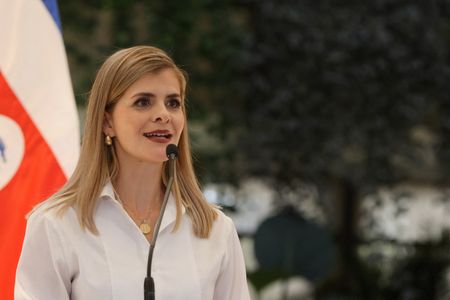

Costa Rica will inaugurate its new president Laura Fernandez on Friday, as the 39-year-old conservative leader prepares to launch an aggressive campaign against organized crime in the traditionally peaceful Central American country.
Fernandez has outlined ambitious plans to overhaul the court system and security legislation. During her announcement of Gerald Campos as security minister last week, she declared her intention to wage “a war without quarter, a heavy-handed war against organized crime.”
The nation has historically stood out as a peaceful haven in a turbulent region, having eliminated its armed forces in 1948 while neighboring countries struggled with brutal dictatorships, military coups and internal conflicts.
But during the administration of outgoing President Rodrigo Chaves, homicide statistics reached unprecedented levels over the past four years. U.S. officials have linked this surge to Costa Rica’s emergence as a major corridor for cocaine trafficking from South America to markets in the United States and Europe.
Fernandez previously held the position of presidency minister under Chaves, who will maintain significant political influence as head of the Sovereign People party and will serve as both presidency and justice minister in the new administration.
Constitutional term limits prevented Chaves from seeking re-election. During his tenure, he frequently clashed with judicial authorities, leading opponents to draw comparisons to El Salvador’s President Nayib Bukele and his authoritarian approach.
The country is currently constructing a high-security detention facility based on El Salvador’s controversial CECOT anti-terrorism complex, where hundreds of Venezuelan nationals were detained without trial following their deportation from the United States in early 2023.
Human rights organizations have documented allegations of torture, inadequate nutrition, limited medical treatment and restricted legal representation for prisoners, many of whom received sentences through expedited mass proceedings.
Fernandez secured victory in February’s election with 49% of voter support and her party captured 31 out of 57 legislative seats, giving the ruling coalition complete control of the unicameral congress. Her term will extend through 2030.
The swearing-in ceremony is planned for noon local time (1800 GMT) at the National Stadium in the capital, a facility completed in 2007 with Chinese funding, though Chaves shifted toward closer ties with Washington during his presidency.
Distinguished guests will include Spain’s King Felipe VI, Israeli President Isaac Herzog and U.S. Deputy Secretary of State Christopher Landau, along with the leaders of Panama, Guatemala and the Dominican Republic. Notable absences include El Salvador’s Bukele and Nicaragua’s President Daniel Ortega.
While murder statistics soared under Chaves, his administration oversaw robust economic growth following the pandemic, controlled inflation rates and decreased poverty levels, though employment opportunities remained constrained.
Fernandez assumes leadership of the nation’s 5 million residents during a period of global instability, including the ongoing Middle East conflict involving the U.S. and Israel against Iran that has driven up petroleum costs worldwide and created potential budget pressures.