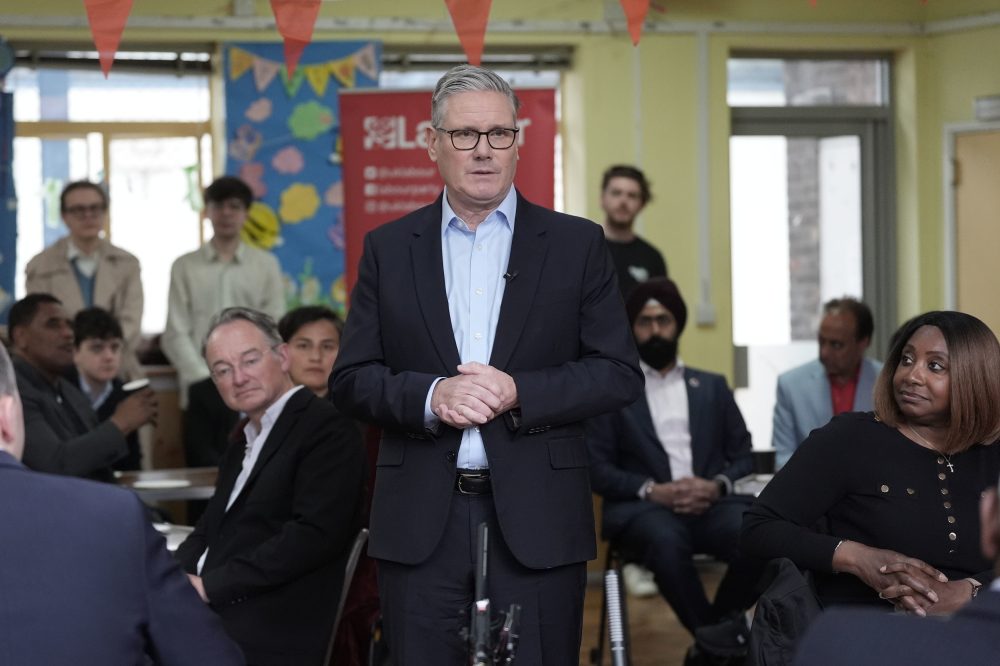

British Prime Minister Keir Starmer vowed to rebuild his faltering administration Saturday as pressure mounted for his resignation following catastrophic local election defeats that saw his Labour Party lose ground across the United Kingdom.
Saturday’s final tallies revealed Labour’s loss of 1,000 council seats throughout England and the end of their 27-year reign in Wales. Meanwhile, the anti-immigration Reform UK party secured nearly 1,300 seats across England, finished runner-up in Wales, and expanded their presence in Scotland.
The outcomes delivered a harsh judgment from voters in contests many viewed as an unofficial vote of confidence in Starmer, whose approval ratings have collapsed since bringing his center-left party to power fewer than two years ago.
Despite the electoral devastation, Starmer declared he would not abandon his post “and plunge the country into chaos,” and no immediate leadership challenge materialized against him.
Cabinet members rallied around Starmer, while prominent Labour figures viewed as potential successors remained silent. Health Secretary Wes Streeting, former Deputy Prime Minister Angela Rayner, and Greater Manchester Mayor Andy Burnham have avoided making any leadership moves.
However, an increasing number of Labour members of parliament called for the prime minister to establish a timeline for stepping down this year. Under British parliamentary rules, parties can replace their leader during a term without triggering new elections.
“There has to be a timetable,” legislator Clive Betts told the BBC. Fellow lawmaker Tony Vaughan advocated for an “orderly transition of leadership.”
In a bid to signal change Saturday, Starmer recalled two veteran Labour figures from previous administrations. He named former Prime Minister Gordon Brown as a special envoy for global finance and appointed ex-deputy leader Harriet Harman as an adviser on women and girls’ issues.
Starmer plans to deliver a major address Monday aimed at rebuilding momentum before the government outlines its legislative agenda Wednesday during King Charles III’s speech at Parliament’s State Opening ceremony.
The elections marked a major victory for Reform UK, the newest far-right movement under veteran nationalist leader Nigel Farage.
Campaigning on anti-establishment and anti-immigration platforms, the party captured hundreds of local council positions in working-class northern English communities like Sunderland that had been Labour strongholds for generations. Reform also seized territory from Conservatives in areas such as Essex county, located east of London.
Farage declared the outcomes represented a “historic change in British politics.” He expressed confidence that “voters who have come to us are not doing it as a short-term protest.”
Reform UK currently controls only eight of Parliament’s 650 seats, leaving questions about whether the party could replicate this success in nationwide elections.
The voting produced regional governments in Scotland and Wales controlled by independence-minded parties committed to dissolving the United Kingdom, though neither is actively pursuing that agenda.
The Scottish National Party, which has ruled from Edinburgh since 2007, secured another term but failed to achieve a majority, making an independence referendum unlikely. Labour and Reform finished tied for a distant second place.
Plaid Cymru (The Party of Wales) captured the most seats in Cardiff’s legislature, the Senedd. The party, which supports Welsh independence but lacks immediate plans for pursuing it, fell short of a majority but will likely form the new government. Reform finished second while Labour placed a distant third in one of their traditional strongholds, with outgoing First Minister Eluned Morgan losing her seat.
Economic struggles form the core of Labour’s difficulties, mirroring challenges facing incumbent governments worldwide.
After ending 14 years of Conservative leadership marked by austerity measures and the COVID-19 pandemic, Labour has failed to address cost-of-living concerns and revitalize a stagnant economy amid challenging conditions created by the Ukraine conflict and, recently, Iran. Starmer has also frustrated supporters through welfare spending cuts, some of which were reversed following internal Labour opposition.
Some Labour members argue the government’s accomplishments, including tenant protections and minimum wage increases, are being overlooked. Many blame Starmer, describing him as an uninspiring leader distracted by controversies including his controversial appointment of Peter Mandelson, a scandal-linked associate of Jeffrey Epstein, as Britain’s ambassador to Washington.
However, Stephen Houghton, the departing leader of Barnsley council in northern England where Labour lost to Reform, suggested the issues “go deeper than the prime minister.”
“This has been coming for 30 years around the country, in post-industrial communities, coastal communities, that have been left behind,” he explained. “You can change prime ministers all day long. If you don’t change policy, it’s not going to charge.”
The results demonstrate the fragmentation of UK politics following decades of Labour and Conservative Party dominance, with both traditional parties suffering significant losses Thursday.
Voters had numerous options, including the centrist Liberal Democrats and nationalist movements in Scotland and Wales.
The major beneficiaries were populist newcomers Reform UK and the Green Party, which has broadened its focus from environmental issues to social justice and Palestinian advocacy under self-described “eco populist” leader Zack Polanski. The Greens captured hundreds of council seats from Labour in urban areas and university communities while gaining control of multiple local governments.
Tony Travers, a government professor at the London School of Economics, suggested the results indicate the next national election, scheduled by 2029, may not produce a majority for any single party.
“So then you’re in the world of, after the election, two or three big minority parties trying to work out how they would govern,” he explained — a scenario traditionally viewed as “very un-British.”