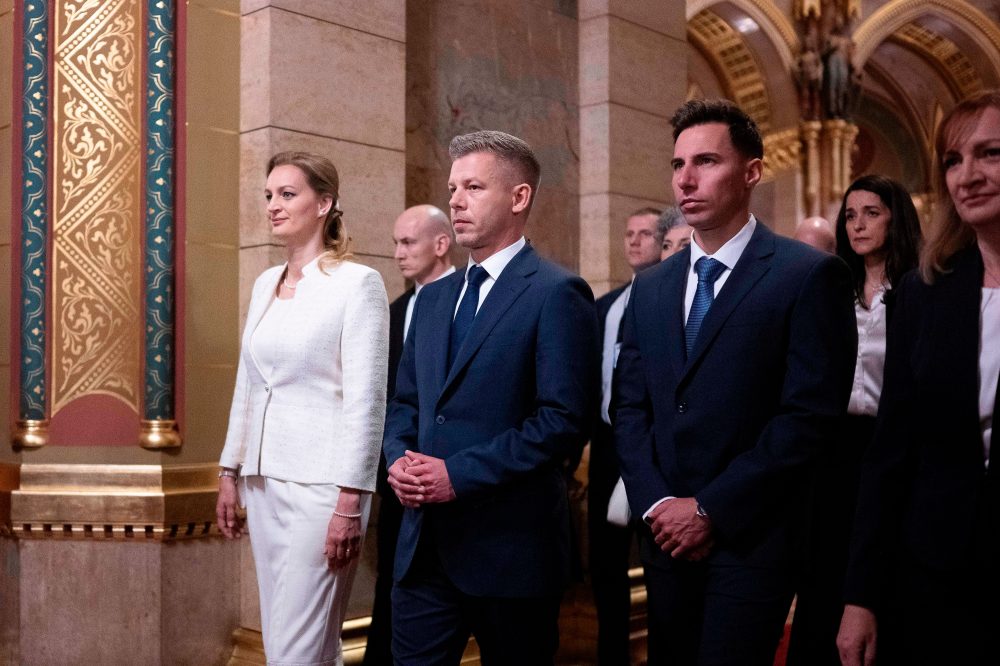

BUDAPEST, Hungary — A new chapter began in Hungarian politics Saturday as Péter Magyar took the oath of office as prime minister, bringing Viktor Orbán’s lengthy 16-year tenure to a close.
Magyar made his way to the Parliament building Saturday morning alongside members of his center-right Tisza party, which delivered a historic upset victory over Orbán’s nationalist Fidesz party in last month’s elections. The electoral triumph marked the largest vote and seat count any party has achieved since Hungary transitioned from Communist rule.
The political shift positions Tisza to dismantle numerous policies that earned Orbán criticism as an authoritarian leader, tackle widespread corruption allegations, and reshape Hungary’s role in European Union politics, where the outgoing leader frequently blocked important bloc decisions.
Magyar’s party delegation included 140 representatives as they entered the impressive neo-Gothic parliament complex, securing control of 141 seats in the 199-member legislative body. Meanwhile, Orbán’s Fidesz-KDNP alliance saw their representation plummet from 135 seats to just 52, with the far-right Mi Hazánk party claiming the remaining six positions.
Notably absent from Saturday’s inaugural ceremony was Orbán himself, marking his first absence since Hungary established its initial post-Communist Parliament in 1990. Following his electoral defeat, Orbán announced plans to concentrate on reconstructing his nationalist political movement.
The incoming leader, a 45-year-old attorney who established Tisza in 2024 following years working within Orbán’s inner circle, has pledged to eliminate government corruption that he claims has deprived Hungarian citizens of economic advancement opportunities.
Magyar invited citizens to join a daylong “regime-change” festival outside Parliament to commemorate his swearing-in ceremony and mark the conclusion of the Orbán period. Following his 3 p.m. oath-taking, the new prime minister planned to speak to supporters gathered outside.
The new administration has committed to mending Hungary’s strained relationship with the European Union, which deteriorated significantly under Orbán’s leadership, and to reestablish the country’s position among Western democratic nations. Hungary’s democratic credentials faced scrutiny as Orbán developed increasingly close ties with Russia.
A primary objective for Magyar involves securing approximately 17 billion euros ($20 billion) in EU funding that was suspended during Orbán’s administration due to rule-of-law violations and corruption issues. These funds are essential for revitalizing Hungary’s economy, which has remained stagnant over the past four years.
Demonstrating their pro-EU stance, Tisza representatives announced they will restore the European Union flag to Parliament’s exterior, which Orbán’s administration removed in 2014.
Budapest’s liberal mayor, Gergely Karácsony, extended a public invitation to a riverside celebration along the Danube Saturday evening to mark Orbán’s departure and welcome the new government.
In his social media announcement, Karácsony described the gathering as an opportunity to honor Hungarians who courageously opposed Orbán’s system over the years. “Teachers fired, civilians and journalists humiliated, small churches torn apart,” he wrote on Facebook.
“We can finally leave this era behind us — but first, let us remember the everyday heroes and express our gratitude with a farewell to the system,” Karácsony posted.