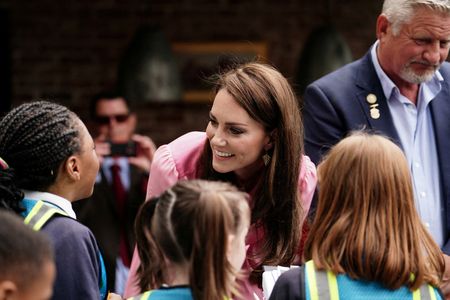

Britain’s Princess of Wales will journey to northern Italy next week to witness an extraordinary educational story that began with communities turning discarded wartime machinery into groundbreaking schools for young children.
Kate’s destination is Reggio Emilia, where residents—particularly women—helped fund Italy’s earliest nursery schools following World War II by selling scrap metal from military vehicles and equipment abandoned by retreating German troops, including at least one tank.
These grassroots efforts became the foundation for what’s now known as the “Reggio Emilia approach,” an educational philosophy that has gained international recognition and aligns closely with Kate’s commitment to supporting children’s emotional and social development.
The Princess, who is married to Prince William and has three children, established the Royal Foundation Centre for Early Childhood in 2021 to unite researchers and specialists working in early child development.
Scheduled for May 13-14, this marks Kate’s first official international engagement since she finished her cancer treatment.
“Some time ago, British representatives visited our city and our early childhood education services, and shortly afterwards we heard of the Princess’s interest in coming to see us,” Education Councillor Marwa Mahmoud told Reuters.
According to Italian authorities, Kate’s visit will focus on several key aspects: the historical origins of Reggio’s educational system, its public nature, women’s contributions, connections between natural environments and learning, and robust community participation.
The mid-sized Italian city boasts some of the country’s highest early education enrollment rates, with nearly all children ages three to six attending preschool and infant-toddler program participation exceeding twice the national rate.
Reggio Emilia’s innovative schools for children under six emerged decades ahead of Italy’s 1968 national education law.
Central to the Reggio Emilia philosophy is viewing children as engaged learners capable of discovering and comprehending their environment through multiple forms of expression—what educators call the “hundred languages” of children.
Classrooms center around shared areas called piazzas, featuring on-site kitchens and creative workshops where youngsters explore different materials, colors, and sounds.
Currently, the city operates 89 infant-toddler centers and preschools, with most run by municipal or state authorities and tuition based on household earnings.
Global recognition surged after Newsweek magazine named a Reggio Emilia preschool among the world’s ten best schools in 1991.
“For years, Britain looked to Reggio Emilia as a model, with hundreds of teachers visiting annually,” explained Maddalena Tedeschi, who heads Reggio Children, an international research promotion center.
“Policy changes and funding cuts in the UK later reduced travel, but interest remained and evolved into new forms of exchange.”