
TEHRAN, Iran — In an unexpected cultural moment amid ongoing tensions between Iran and the United States, Tehran’s Museum of Contemporary Art has unveiled a striking exhibition featuring American artwork that critiques war and violence.
The display showcases six pieces by renowned 1960s American Pop artists Roy Lichtenstein, Robert Indiana, and James Rosenquist, specifically selected for their anti-war messages. The exhibition opened this week while anti-American imagery continues to dominate Tehran’s streets through billboards and posters.
These masterpieces belong to an extensive collection of American and European modern art purchased by former Empress Farah Pahlavi during the 1970s. Since the 1979 Islamic Revolution that overthrew the Western-allied shah, most of these valuable works have remained locked away from public view.
Young Iranian visitors have found deep connections with the displayed pieces after enduring weeks of U.S.-Israeli military strikes. Many spent time examining Rosenquist’s “F-111,” a Vietnam War-era collage that challenges America’s military-industrial complex through imagery combining aircraft components, nuclear explosions, and a child’s portrait.
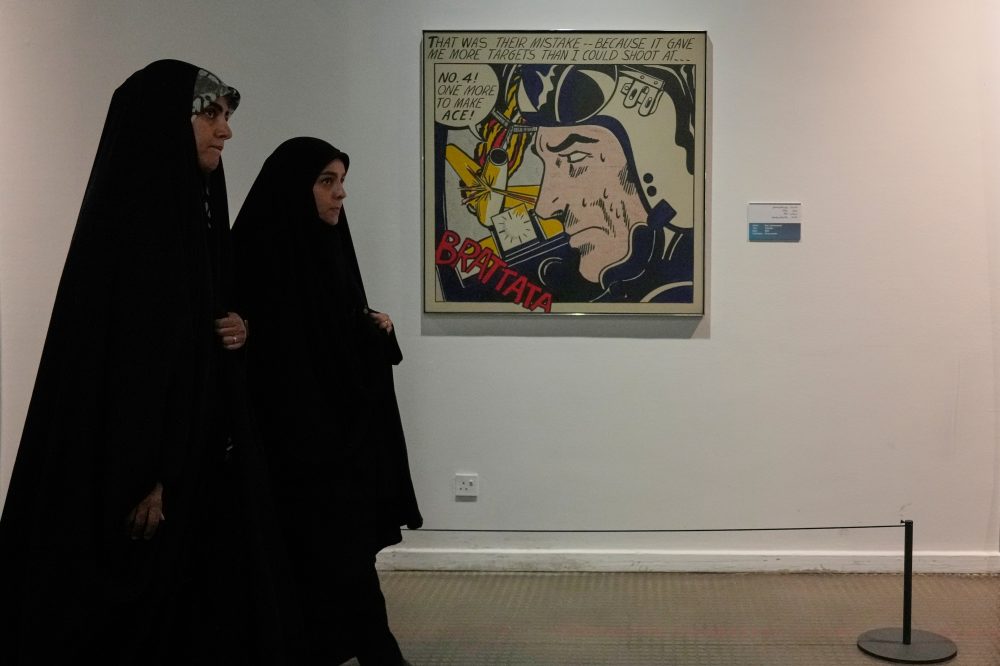
Another featured work, Lichtenstein’s “Brattata,” presents his signature comic book-inspired style depicting a fighter pilot destroying an enemy aircraft.
“American artists have always had a really interesting way of ridiculing war, and that’s always fascinated me in their work,” said Ghazaleh Jahanbin, a Tehran artist visiting the show. “Maybe part of it, I don’t know, comes from their geographical distance from war itself.”
Museum director Reza Dabirinezhad explained to Iran’s ISNA news agency that the exhibition, called “Art and War,” was designed to address current regional developments. The government-operated facility, overseen by the Culture Ministry, chose works “that were either shaped by the experience of war or created as reactions to wars,” he stated.
The collection’s origins trace back to Shah Mohammad Reza Pahlavi’s government, which established the museum and acquired artistic treasures during the oil-rich 1970s when Iran served as America’s primary Middle Eastern ally. Former Empress Farah Pahlavi personally selected works from masters including Pablo Picasso, Vincent Van Gogh, Mark Rothko, Francis Bacon, and David Hockney.
However, the museum had operated for only two years before the shah’s overthrow led to Shiite clerical rule. Officials then stored the collection in museum vaults for decades to prevent conflicts with Islamic principles or perceptions of Western favoritism.
Beginning in 2012, museum staff occasionally organized temporary exhibitions featuring select pieces from the multi-billion-dollar collection. Despite Iran’s economic struggles under Western sanctions, officials have protected the artwork from sale. The country did exchange one Willem de Kooning painting in 1994 for a treasured Persian manuscript from an American foundation.
Current warfare had forced museums and cultural institutions throughout Iran to close until a fragile ceasefire in early April permitted reopening. Dabirinezhad noted that only limited pieces were exhibited in case renewed conflict required rapid return to secure storage.
Iranian culture enthusiasts welcomed the reopening as relief from wartime stress and an opportunity to reconnect with artistic expression.
“It was a such a great thing to happen. A couple of weeks ago I was talking with my friends and everybody was talking about how much they missed visiting museums,” said Jahanbin.
Concerns persist about potential conflict resumption as Iran and the United States maintain their military standoff, with Iran controlling the Strait of Hormuz while the U.S. blockades Iranian ports during ongoing diplomatic negotiations.
“This state of being undecided leaves you dazed and confused, everything is up in the air,” said Mohammad Sadegh Abbasi, one of the visitors perusing the exhibit. “I hope everything ends well soon and we get a secure and calm life.”
“Some of the works remind me of the scenes I saw (during the war),” he added.
The current six-piece display continues through May 10, with museum leadership planning weekly rotations of additional war-themed works from their extensive collection.