
American military forces struck and incapacitated two Iranian oil vessels Friday following combat exchanges in the strategically vital Strait of Hormuz, according to reports from Dubai in the United Arab Emirates.
The confrontation puts additional strain on a fragile ceasefire agreement established one month ago, which Washington maintains remains active. American officials are currently waiting for Tehran’s response to the most recent diplomatic proposal aimed at ending hostilities, reopening the waterway, and scaling back Iran’s controversial nuclear activities.
Secretary of State Marco Rubio expressed optimism about receiving what he termed “a serious offer” from Iranian leadership Friday.
Pentagon officials confirmed their forces had neutralized two Iranian vessels attempting to break through America’s naval blockade of Iranian harbors. Earlier military reports indicated successful defense against strikes targeting three U.S. Navy vessels, followed by retaliatory attacks on Iranian military installations within the strait.
Since America and Israel initiated military action on February 28, Iran has largely shut down this crucial global energy corridor, triggering worldwide fuel cost increases and destabilizing international markets. Washington has responded by implementing its own embargo of Iranian shipping facilities.
UAE Defense Ministry officials reported three casualties after their air defense systems engaged two incoming ballistic missiles and three unmanned aircraft launched from Iran. Officials could not confirm whether all projectiles were successfully intercepted.
American military footage released Friday showed strikes against the smokestacks of both Iranian tankers by U.S. fighter aircraft. Earlier this week, American jets damaged the steering mechanism of another vessel allegedly attempting to violate the blockade.
Thursday evening, Pentagon sources reported successfully repelling Iranian assaults on three Navy ships in the Strait of Hormuz and conducting counter-strikes against Iranian military targets. No American vessels sustained damage in the engagement.
“They threaten Americans, they are going to be blown up,” Rubio declared to media representatives Friday.
Tehran’s Foreign Ministry denounced what officials characterized as “hostile” American military actions, claiming they breached ceasefire terms. Iranian Foreign Minister Abbas Araghchi wrote on social media: “Every time a diplomatic solution is on the table, the U.S. opts for a reckless military adventure.”
An overnight American attack resulted in one sailor’s death and injured ten others aboard a cargo ship that subsequently caught fire, according to reports from an Iranian judicial news service. It remains unclear whether this vessel was among the two tankers the U.S. confirmed targeting.
President Donald Trump continues to assert the ceasefire remains intact while reaffirming warnings to resume comprehensive bombing campaigns should Iran reject agreements to reopen the strait and curtail nuclear development.
Pakistani Prime Minister Shehbaz Sharif revealed his nation has maintained continuous communication with both Washington and Tehran “day and night” working toward ceasefire extension and peace negotiations.
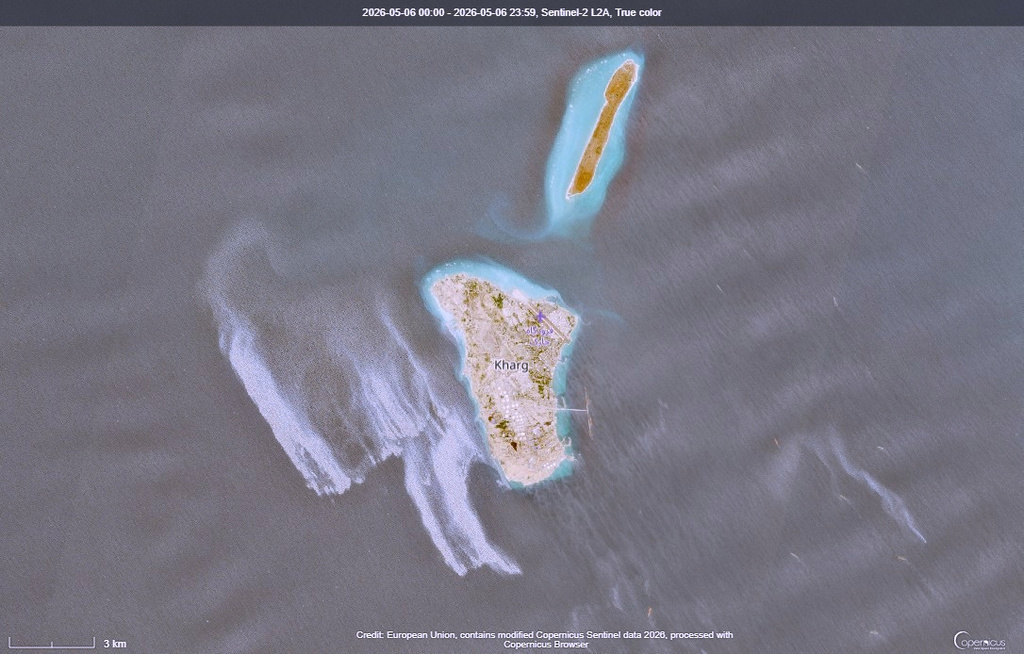
Satellite imagery analyzed by The Associated Press reveals what appears to be an oil contamination zone in the Persian Gulf extending from the western coastline of Kharg Island, Iran’s primary crude oil export facility.
Friday’s satellite data shows the contamination covering approximately 71 square kilometers (27 square miles) with evidence suggesting continued leakage from the terminal, according to Ami Daniel, chief executive of maritime intelligence company Windward AI.
Daniel calculated that roughly 80,000 barrels worth of oil has leaked from Kharg Island since satellites first detected the contamination Tuesday. The cause remains undetermined, whether from equipment failure, aerial bombardment, or other factors.
“This is the risk of fighting in an oil-rich area,” Daniel explained, noting that cleanup operations are unlikely in Gulf waters that have become an active combat zone.
The contamination appears to be moving southwest and could potentially reach coastlines of the UAE, Qatar, or Saudi Arabia within two weeks, Daniel warned.
Nina Noelle, an international crisis operations specialist with Greenpeace Germany, said Friday that initial evaluations and recent imagery suggest the spill is beginning to break apart and likely won’t impact land areas. She noted that depending on wind patterns, wave action, and current conditions, portions of the contamination could still potentially affect sensitive marine ecosystems.
“More likely, it will dissipate offshore under prevailing conditions,” Noelle stated.
Pentagon representatives declined to discuss whether American forces are monitoring the spill or whether recent strikes occurred on the Iranian island. Based on earlier imagery from this week, the contamination began before the latest round of U.S. military action.
Rubio declared Friday that Iranian establishment of a government entity to inspect and tax vessels seeking strait passage is “unacceptable.”
Lloyd’s List Intelligence, a maritime data organization, reported Thursday that Iran has established this agency, designated as the Persian Gulf Strait Authority.
Iran’s move to establish formal oversight of the channel has generated fresh concerns about international maritime commerce, with hundreds of commercial ships trapped in the Persian Gulf and unable to reach open waters.
“Is the world going to accept that Iran now controls an international waterway?” Rubio questioned. “What is the world prepared to do about it?”
Iran has essentially sealed the strait, a critical passage for transporting oil, natural gas, fertilizer, and other petroleum derivatives, while America maintains its blockade of Iranian harbors.
A Chinese-operated oil tanker came under attack near the strait. China has maintained oil imports from Iran despite the effective waterway closure.
China’s Foreign Ministry voiced concerns, confirming the tanker held Marshall Islands registration with Chinese crew members aboard. No casualties were reported from this incident.
An oil vessel that transited the Strait of Hormuz in mid-April reached South Korean waters Friday carrying 1 million barrels of crude oil. South Korea, which imported over 60% of its crude through the strait last year, has implemented price controls on gasoline and other petroleum products.