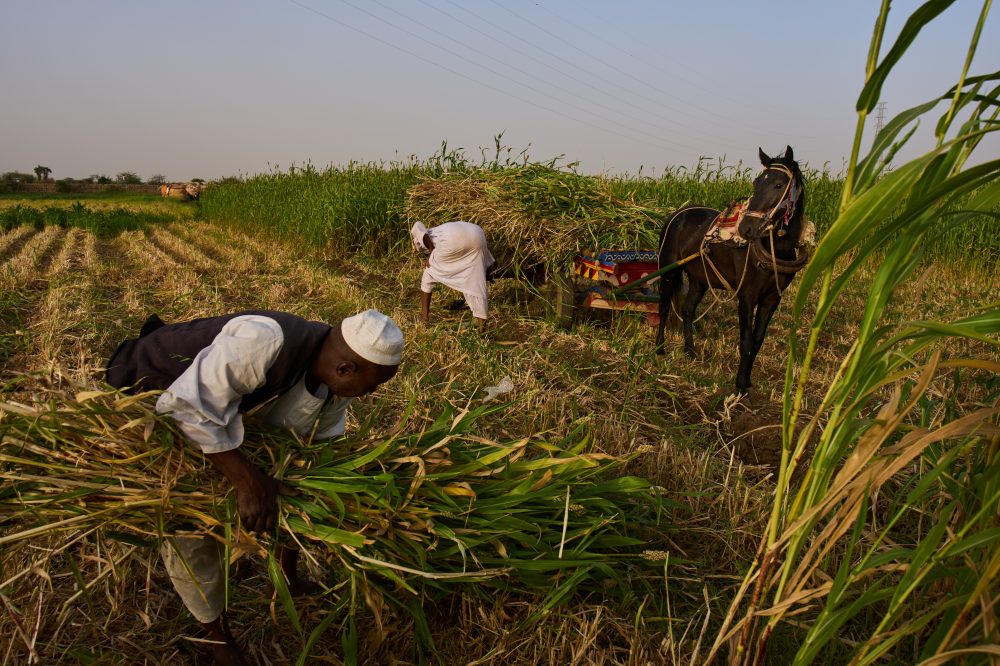

OMDURMAN, Sudan (AP) — After being displaced from his farmland for two years due to Sudan’s ongoing war, Omer al-Hassan made his way back to restart agricultural operations. However, Middle Eastern conflicts are now threatening to deepen his financial struggles and food insecurity as costs for fuel and fertilizer continue climbing.
Al-Hassan and fellow agricultural workers across Sudan are preparing for a costly planting season in the coming weeks. Several told The Associated Press they plan to reduce crop production or abandon planting entirely — alarming developments for a nation where three years of warfare have created widespread hunger.
The conflict involving Iran has “affected everything related to agriculture,” al-Hassan explained while harvesting onions with other workers. After spending two months clearing overgrown weeds from their land, “plowed the soil and we said God bless, and even then we struggled so much, one had to sometimes skip a meal.”
Al-Hassan and ten fellow farmers working his property explained they cannot manage agricultural expenses without governmental assistance, leading to production cuts and fertilizer rationing on his farm that also grows potatoes and tomatoes.
Fellow farmer Mohammed al-Badri explained he could only afford to cultivate half his property due to increasing expenses: “The rest of it is nothing.”
The Gulf area, where hundreds of commercial vessels have remained stuck for weeks due to Iran’s control over the Strait of Hormuz, supplies more than half of Sudan’s sea-imported fertilizer. Additionally, fuel costs have increased approximately 30%.
This means food costs throughout Sudan are also rising sharply.
Sorghum. Millet. Sesame. These essential Sudanese crops now face significant threats.
Agricultural workers already strained by domestic warfare between Sudan’s military forces and the paramilitary Rapid Support Forces are now witnessing cost increases for fertilizer, gasoline needed for farm machinery, and diesel required for irrigation systems.
These increasing expenses have established “a dangerous reality” for farmers who will face difficulties without governmental intervention, explained Abdoun Berqawi, an agricultural worker in Gezira, among the nation’s primary food-production areas.
Berqawi reported that a 50-kilogram (110-pound) urea fertilizer bag now costs approximately $50, increased from $11 during the same timeframe last year. Tractor fuel has jumped from $2.50 to $8 per gallon.
Agriculture ministry officials in Sudan did not immediately respond to requests for information about their crisis response plans.
A military media representative accompanied the AP during its visit, including during interviews. The AP maintains complete editorial control over its content.
The Iranian conflict has created a “dangerous chain reaction … at the wrong moment” as farmers prepare for planting season, stated Melaku Yirga, Mercy Corps vice president for the Africa region, who recently traveled to Sudan’s Kassala and Gedaref provinces, another major food-production area.
“People are buying less food, cutting or skipping meals, selling assets and taking greater risks just to survive,” Yirga explained. “Mothers are being forced to make painful choices about who gets to eat the little food that is available, while some families are resorting to leaves or animal feed just to get by.”
Farmers who obtained bank loans face potential imprisonment if poor harvests prevent loan repayment, noted Merghany Omar, an agricultural worker in al-Matammah in River Nile province. He explained that onion cultivation, a regional staple, no longer generates enough income to cover planting expenses.
These developments are happening alongside existing challenges including currency devaluation, explained Samy Guessabi, country director for Action Against Hunger in Sudan.
Residents in some of the nation’s most isolated regions, Kordofan, White Nile, Darfur and Blue Nile, are suffering most severely where “agricultural zones are remote and poorly connected,” he noted.
Even in Sudan’s metropolitan areas, vegetables and dairy products have increased approximately 40% due to fuel price spikes.
The domestic war had already created widespread hunger. The U.N. World Food Program estimates 19 million people throughout Sudan are experiencing acute hunger, with numerous families approaching famine conditions. Last year, famine was officially declared in two major areas, Darfur and Kordofan.
Currently, humanitarian response efforts have been significantly delayed by the Iranian conflict and its impact on supply chains.
WFP reported its Sudan-destined food aid shipments are traveling 9,000 kilometers (5,500 miles) further to reach their destinations, increasing both costs and delivery times.
This occurs partly because many ships also avoid the Bab el-Mandeb Strait at the Red Sea’s southern entrance, another vital waterway, according to WFP shipping chief Henrik Hansen. Iranian-supported Houthi rebels in Yemen have threatened shipping operations there.
Mubarak al-Nour, a farmer and former parliamentary member in Gedaref, explained that even if Sudanese farmers obtain fertilizer, delays could cause them to miss the planting season running from June through November. Some farmers are switching to cheaper crops requiring minimal or no fertilizer and reducing cultivation of corn, sesame and other rain-dependent crops.
Even if agricultural supplies arrive in Sudan timely, challenges remain.
Fuel shortages in certain areas result from warring factions blocking essential supplies, explained Mathilde Vu, an advocacy manager with the Norwegian Refugee Council. She noted local fuel markets have been heavily targeted in recent months during a “senseless escalation” of drone attacks nationwide.