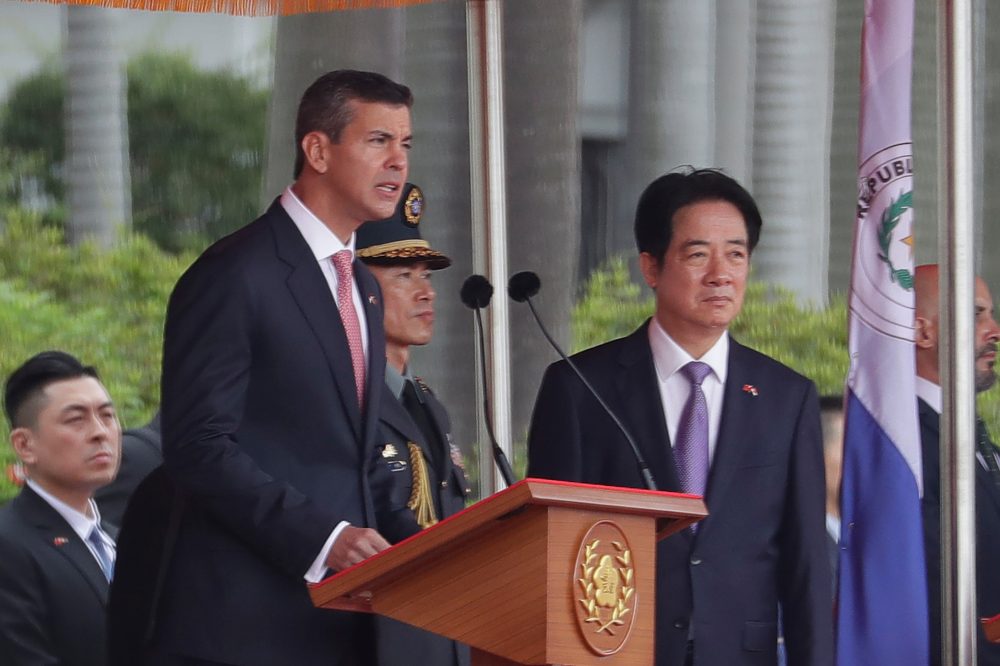

Paraguay’s leader delivered a strong message of support for Taiwan on Friday, publicly rejecting China’s latest attempt to isolate the island democracy by pressuring its remaining diplomatic partners.
President Santiago Peña declared his nation’s commitment to Taiwan during a ceremonial military event, emphasizing the deep value Paraguay places on the relationship just one day after Beijing called for the South American country to abandon its Taiwan ties.
Speaking through an interpreter outside Taiwan’s presidential office, Peña described the ceremony as representing both nations’ steadfast commitment to strengthening their partnership and cooperation.
“Paraguay highly values the relationship,” Peña stated, according to his interpreter.
The Paraguayan leader emphasized that his country would continue backing Taiwan based on shared democratic principles, freedom, and human rights values, while working to advance their strategic bilateral partnership.
Taiwan’s President Lai Ching-te expressed gratitude to Paraguay’s government for advocating on Taiwan’s behalf and maintaining strong support for the island’s participation in international affairs.
“I believe the friendship between Taiwan and Paraguay will further deepen and their cooperation will become closer through the visit of President Peña,” Lai remarked.
This show of solidarity followed Thursday’s statement from Chinese foreign ministry spokesperson Lin Jian, who pressed Paraguayan officials to “come to the right side of the history as soon as possible” by ending diplomatic recognition of Taiwan. Lin cited the one-China principle as fundamental to international relations, noting that 183 nations maintain diplomatic ties with China.
During Friday’s bilateral meeting, Peña made a passionate appeal for Taiwan’s international recognition, arguing that Taiwan’s people deserve the right to determine their own future according to democratic and fair principles.
“I want to stress that excluding Taiwan from the important United Nations system is not only unfair, but also undermines the legitimacy of the United Nations as the most representative organization of democratic countries in the world,” he declared.
The two leaders oversaw the signing of several bilateral agreements, including a memorandum of understanding regarding artificial intelligence computing center investment.
In a separate interview with Taiwan’s Central News Agency, Peña revealed he had spoken with Honduran President Nasry Asfura before arriving in Taiwan for his four-day visit. While they didn’t directly address the possibility of Honduras resuming relations with Taiwan, Peña told Asfura about Paraguay’s positive relationship with the island nation.
Honduras switched its diplomatic recognition from Taiwan to China in 2023. However, Asfura, who gained the presidency with backing from U.S. President Donald Trump, has initiated a review of agreements between his country and Beijing, sparking speculation that Honduras might distance itself from China as part of the Trump administration’s efforts to counter Chinese influence in Latin America.
Paraguay stands as Taiwan’s only remaining diplomatic partner in South America and one of just 12 countries globally that officially recognize the island democracy. Beijing views Taiwan as part of its territory and has intensified efforts in recent years to convince Taiwan’s diplomatic allies to switch sides, while simultaneously escalating military pressure around the island.
The diplomatic tensions highlight ongoing challenges for Taiwan’s international standing. Last week, President Lai traveled to Eswatini, Taiwan’s final diplomatic ally in Africa, after being compelled to delay the trip when several countries reportedly denied him permission to fly through their airspace due to Chinese pressure.
While China didn’t confirm or deny these allegations, Beijing expressed “high appreciation” for countries that respect the “one China principle,” referring to China’s territorial claims over Taiwan.
The division between China and Taiwan dates back to 1949, when Communist forces took control in Beijing following a civil war. Defeated Nationalist Party members retreated to Taiwan, which eventually evolved from military rule into a multi-party democratic system.