
VENICE, Italy — Political turmoil has disrupted the world’s most prestigious contemporary art exhibition as the Venice Biennale opened Saturday without its coveted Golden Lion awards following the jury’s mass resignation over Israel and Russia’s involvement in the show.
The judging panel stepped down specifically to protest nations currently facing International Criminal Court investigations for human rights violations, though critics argue the United States should have faced similar scrutiny. British artist Anish Kapoor referenced “the politics of hate and war and all that that’s been going on now for too long.”
Instead of traditional jury selections, attendees at the Giardini and Arsenale locations will cast Eurovision-style votes to choose the top national pavilion among 100 entries and the best work from the main curated exhibition, “In Minor Keys.” Results will be revealed on the final day, November 22.
The centerpiece exhibition features a massive red-feathered sculpture adorned with beaded embroidery that welcomes guests. Drawing from New Orleans Black Masking traditions that trace back to enslaved African practices, this costume-inspired artwork establishes the show’s emphasis on marginalized voices.
Koyo Kouoh, who made history as the first African woman selected to oversee the main Biennale display, had gathered 110 artists and collectives before her passing last year. Five co-curators have continued her vision of highlighting overlooked perspectives.
“She was someone who thought about making spaces for everyone to shine and we see it in her exhibition, we see it with ourselves,” explained co-curator Marie Helene Pereira.
At the British Pavilion, Turner Prize recipient Lubaina Himid presents “Predicting History: Testing Translation,” examining the immigrant experience through vibrant paintings depicting couples navigating newcomer challenges.
One artwork shows two architects debating construction plans. “One of them is trying to decide, would we build a building here, that proves that we have contributed to the culture, and the other architect is saying ‘No, no, no, no, no. Let’s build something that we can escape in tomorrow,’” explained Himid, who was born in Zanzibar and has lived in Great Britain for over seven decades.
The Vatican offers a peaceful retreat from global conflicts through the Mystic Gardens of the Discalced Carmelite order, located near Venice’s central railway station.
Visitors stroll through vineyard paths, passing pomegranate trees and herb gardens while listening through headphones to compositions by 12th-century abbess, mystic and composer St. Hildegard of Bingen, reimagined by contemporary artists including Brian Eno and Patti Smith.
“Music also helps us delve into ourselves and understand, to use a phrase by Hildegard, the symphony that God has placed in our lives,” stated Rev. Ermanno Barucco, prior of the Carmelite order.
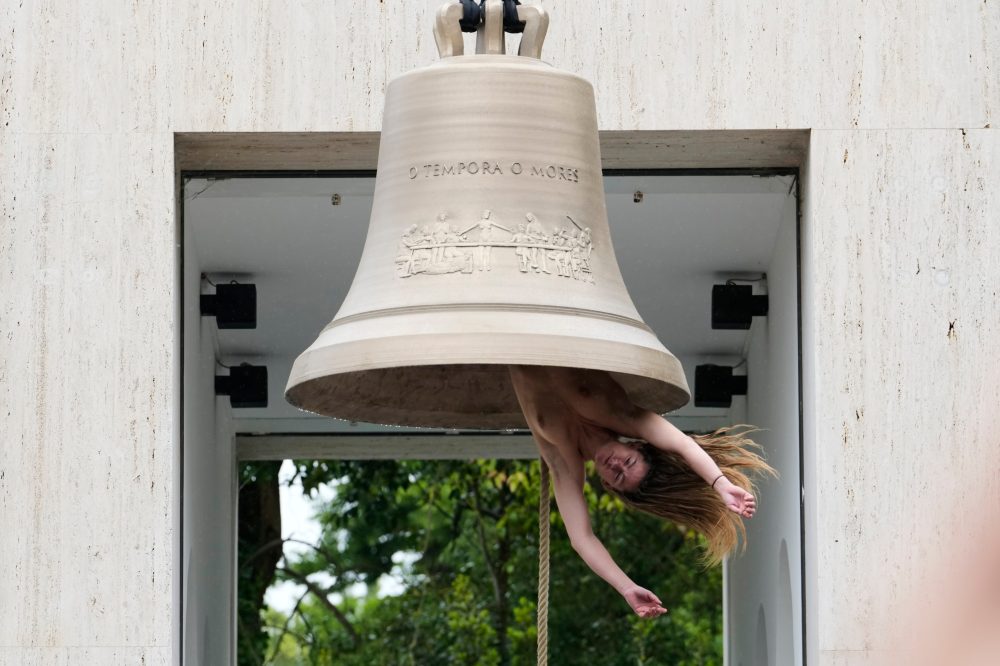
The Austrian Pavilion draws crowds with Florentina Holzinger’s provocative performance piece featuring a nude woman suspended as a human bell clapper. Inside, another naked performer circles on a Jet Ski within a tank, symbolizing Venice’s transformation into an overtouristed entertainment destination.
The installation “Seaworld Venice” includes a nude woman breathing through scuba gear in a large tank filled with treated wastewater from nearby restrooms that has undergone multiple filtration processes.
Romanian-born artist Belu-Simion Fainaru’s exhibit features water dripping from hanging tubes into a pool, pausing every 42 seconds to represent divine creative force in Jewish mystical tradition. Padlocks surrounding the pavilion, similar to those placed by couples on European bridges, bear Hebrew inscriptions of “Love thy neighbor as thyself” and the hopeful message “This too shall pass.”
“I am against boycott, I’m for dialogue, and that’s a political statement,” declared Fainaru, who condemned the jury’s exclusion of Israel as discriminatory.
Estonian artist Merike Estna will spend the entire Biennale creating a large-scale wall painting inside a community center gymnasium that previously served as a church. The building’s complex history reflects her technique of layering paint to create richly textured surfaces over time, representing women’s undervalued daily labor.
Curator Natalia Sielewicz compared the work to “the everyday feminism of sustaining life, of sustaining our planet.”