
MOSCOW – Russia conducted its most diminished Victory Day celebration in years on Saturday, citing security concerns from potential Ukrainian attacks as Moscow’s military campaign continues to face challenges more than four years into Europe’s bloodiest conflict since World War Two.
The annual May 9th ceremony in Red Square represents Russia’s most honored national observance – an occasion to commemorate the Soviet Union’s triumph over Nazi Germany and honor the 27 million Soviet citizens, many of whom were Ukrainian, who died in the war.
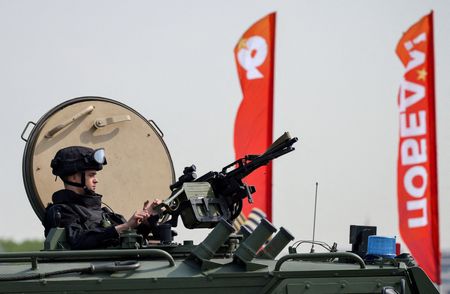
Traditionally used as a showcase for Russia’s military might, including nuclear-capable long-range missiles, this year’s ceremony excluded tanks and other military hardware from rolling across Red Square’s historic cobblestones.
Military personnel still marched and celebrated near Vladimir Lenin’s Mausoleum, fighter aircraft soared over the Kremlin’s towers, and President Vladimir Putin delivered remarks before placing flowers at the Unknown Soldier’s memorial.
“In general, everything is as usual, except for the demonstration of military equipment,” Kremlin aide Yuri Ushakov told reporters.
Russia, which launched its invasion of Ukraine in 2022, has threatened that any Ukrainian attempt to interfere with the ceremony would trigger extensive missile attacks on Kyiv. Moscow advised foreign diplomatic missions to evacuate personnel from the Ukrainian capital should such strikes occur.
Ukrainian President Volodymyr Zelenskiy indicated his nation’s May 9th activities would depend on Friday’s developments, while accusing Moscow of breaking its own ceasefire agreement.
Multiple layers of air defense systems and electronic countermeasures protect Moscow, designed to intercept and destroy incoming drones and missiles targeting the capital and its surrounding region of 22 million residents.
THE UKRAINE CONFLICT OVERSHADOWS RUSSIAN CELEBRATION
Following Nazi Germany’s 1941 invasion of the Soviet Union, the Red Army ultimately drove German forces back to Berlin, where Adolf Hitler took his own life and the Soviet Victory Banner was hoisted over the Reichstag in May 1945.
Nazi Germany’s complete surrender took effect at 11:01 p.m. on May 8, 1945, recognized as “Victory in Europe Day” by Britain, the United States and France. Since it was already May 9th in Moscow, that date became the Soviet Union’s “Victory Day” in what Russians term the Great Patriotic War of 1941-45.
However, this year’s parade occurs during heightened anxiety in Moscow regarding the Ukrainian conflict’s eventual resolution.
The war has claimed hundreds of thousands of lives, devastated large portions of Ukraine and strained Russia’s $3 trillion economy, while European relations have deteriorated to their worst point since the Cold War’s peak.
“The crisis is still deepening gradually, but any sharp movement can send the economy (and not only the economy) into a tailspin,” imprisoned pro-war Russian nationalist Igor Girkin, who has criticized the Kremlin’s war management, wrote on Telegram.
Girkin, a former Federal Security Service official, used maritime imagery to suggest that Russia’s leadership was more concerned about losing their positions than preventing national disaster.
Kremlin spokesperson Dmitry Peskov rejected CNN and other Western media claims that Putin’s security had been enhanced due to coup or assassination concerns. Russian officials have called reports of coup plotting absurd.
However, just 21 years earlier, Putin hosted President George W. Bush at the Moscow parade alongside France’s Jacques Chirac and Chinese President Hu Jintao.
This year’s attendees included Belarusian President Alexander Lukashenko, Malaysia’s King Sultan Ibrahim and Laos’ Prime Minister Thongloun Sisoulith.