
VÖLKLINGEN, Germany — A historic German ironworks facility recognized by UNESCO has become the canvas for an extraordinary international art exhibition featuring creators from around the globe.
The Urban Art Biennale 2026 has launched at the Völklingen Ironworks, where 50 artists representing 17 nations are displaying their work throughout the massive industrial complex. This marks the continuation of an event that has occurred every two years for the past decade and a half.
“This location is at the core of street art and graffiti art,” explained Ralf Beil, who serves as general director of the facility that now operates as a public museum. “It all began in industrial places like this.”
According to Beil, the creators “love this place and they do works for the Völklinger Hütte, in the Völklinger Hütte, with the Völklinger Hütte.”
Among the featured works is an installation by France-based artist Tomas Lacque, who assembled a small vehicle, tire stack, playthings and rubble all coated in paint. Positioned within a hall that once housed active furnaces, the piece seems to suggest fossil-fuel transportation being buried in ash reminiscent of Pompeii.
Spanish creator Ampparito painted the phrase “no hay nada de valor” (meaning “There is nothing of value here”) in enormous white lettering across the roof of one building. The artwork is most visible from an observation deck positioned 45 meters (148 feet) high.
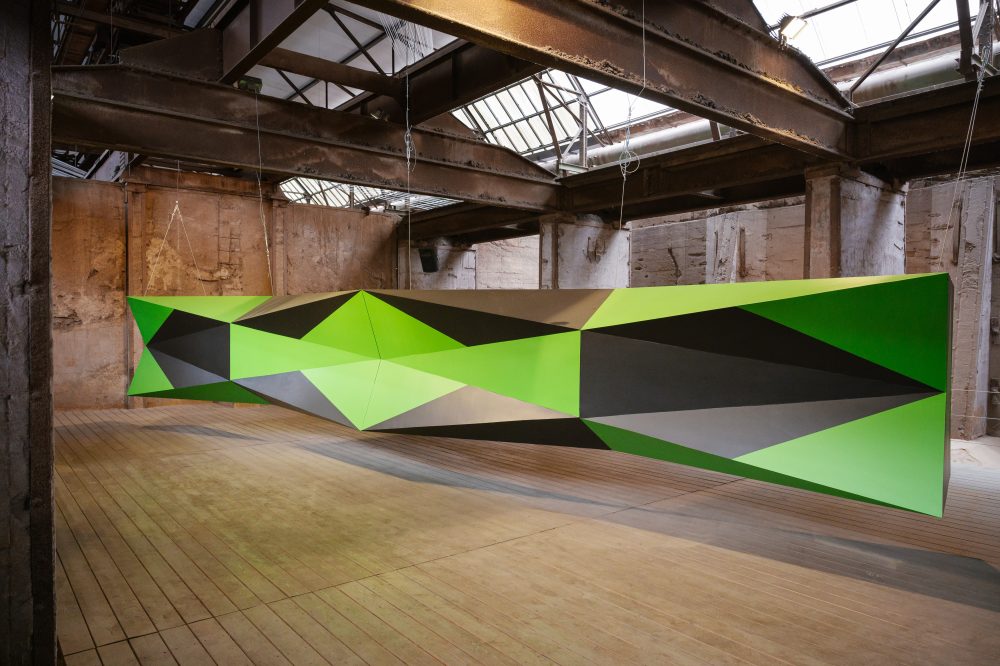
Dutch artist Boris Tellegen, who goes by Delta, created an enormous green-and-black wooden structure that illuminates the ironworks’ interior. Meanwhile, French collective Vortex-X, known for repurposing salvaged materials, suspended white industrial fabric strips across a building hall in their piece called “Memory in transit.”
The industrial site encompasses 6 hectares (nearly 15 acres) and forms a complex network of smokestacks and furnaces where visitors still see threatening warning signs from the industrial period, including alerts about “danger of crushing.” The facility towers over Völklingen, a town situated close to Germany’s French border.
UNESCO added the site to its world heritage registry in 1994, acknowledging it as “the only intact example, in the whole of western Europe and North America, of an integrated ironworks that was built and equipped in the 19th and 20th centuries.”
Production ceased in 1986, leaving the furnaces dormant, and the location has remained unchanged since that time. However, its visual character dates much earlier, as no new equipment was installed after the mid-1930s.
“It’s so dusty and it’s so old, but it’s beautiful, you know, there’s beauty in decay,” commented British artist Remi Rough. “I think what I’ve done makes you kind of just perceive it in a bit of a different way.”
Rough created small paintings designed to be “very clean and clinical,” providing contrast to the surrounding environment.
Danish creator Anders Reventlov expressed feeling “humble to be able to do something here.”
“As somebody told me … it was hell to work here,” Reventlov noted. “Now it’s not hell. It’s like a nice place, people walking around, there are bees, there are beautiful flowers, but yeah, we still remember the history and that’s super important.”
Beil emphasized that organizers “want pieces which are really original for this space and this also is then prohibiting (them) from being commercial.”
“This is an installation for the space,” he stated. “This is pure art.”
The exhibition begins Saturday and continues through November 15.